Ever wonder how historians separate fact from fiction when studying... Show more
Sign up to see the contentIt's free!
Access to all documents
Improve your grades
Join milions of students
By signing up you accept Terms of Service and Privacy Policy
Subjects
10,115
•
Dec 12, 2025
•
lexa
@lexa_bhakk
Ever wonder how historians separate fact from fiction when studying... Show more


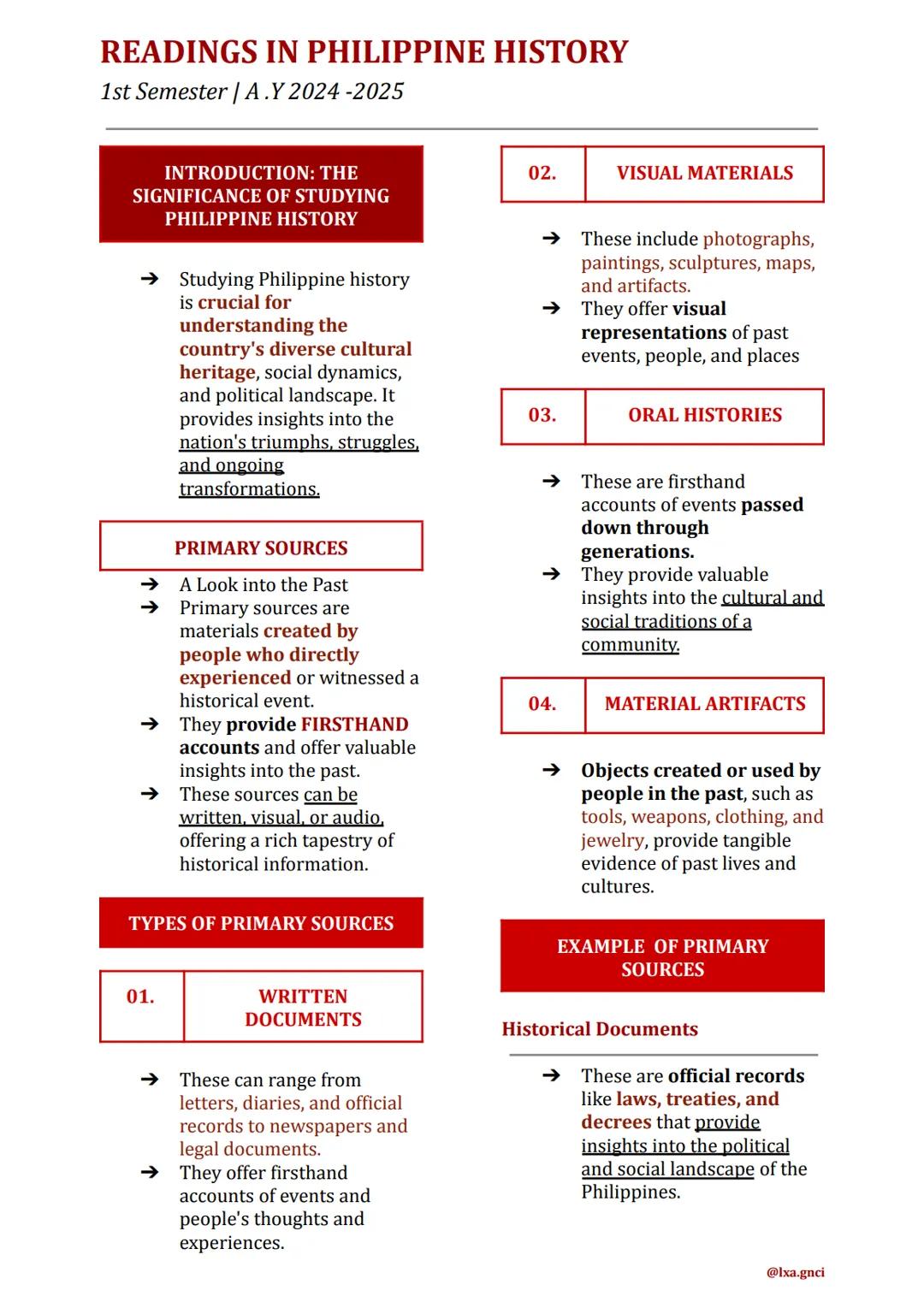
Learning Philippine history helps you understand why our country is the way it is today. It's like having a backstory that explains current events, politics, and even our cultural quirks.
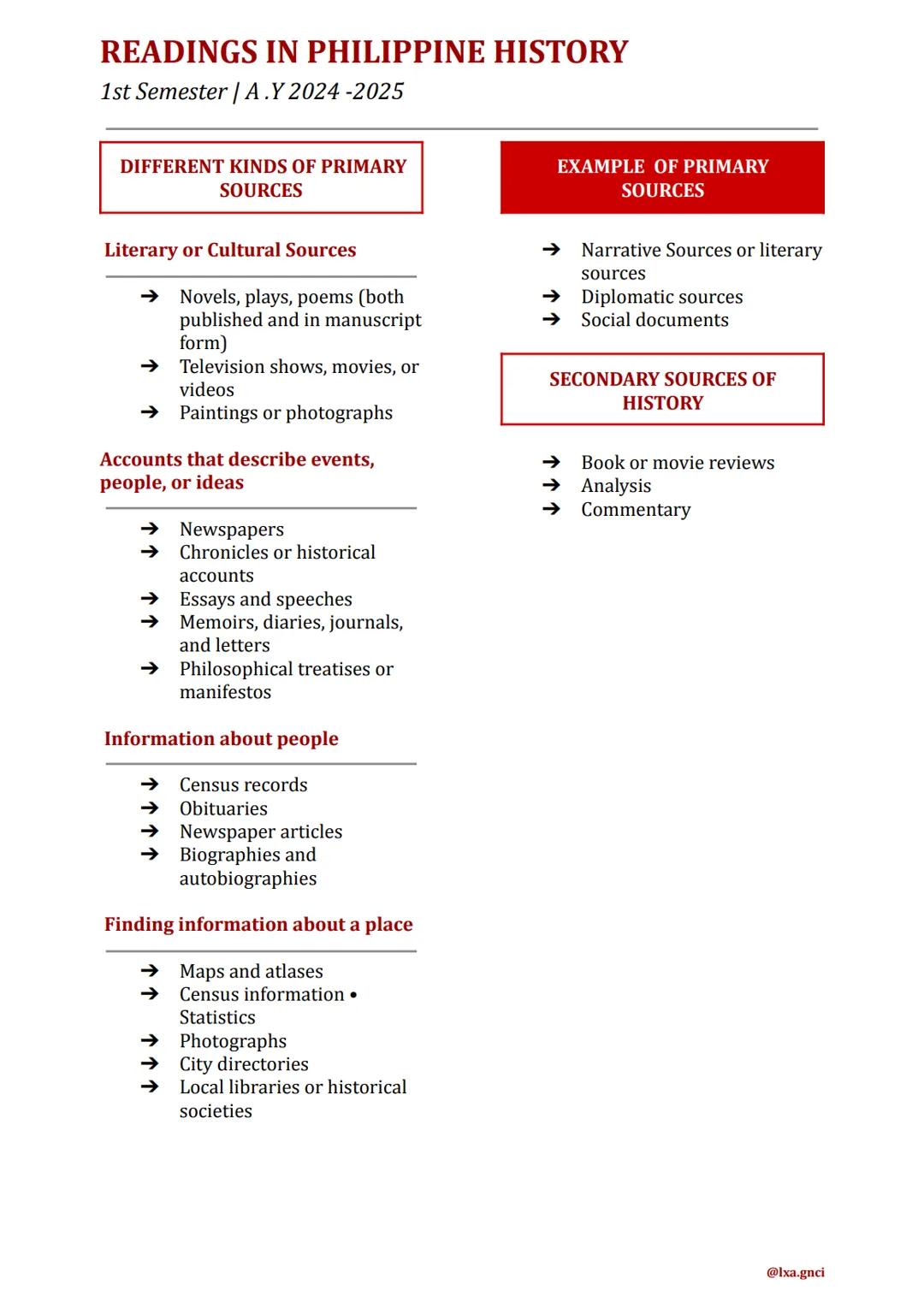
Primary sources are your direct connection to the past – think of them as historical evidence straight from people who were actually there. These include written documents like diaries and letters, visual materials like old photos and paintings, oral histories passed down through families, and physical artifacts like tools and jewelry.
Quick Tip: When you see a historical photo or read an old diary entry, you're looking at a primary source – someone's actual experience from that time period.
The cool thing about primary sources is they give you the raw, unfiltered story. A soldier's letter home during World War II tells you way more about what war was really like than any textbook summary ever could.

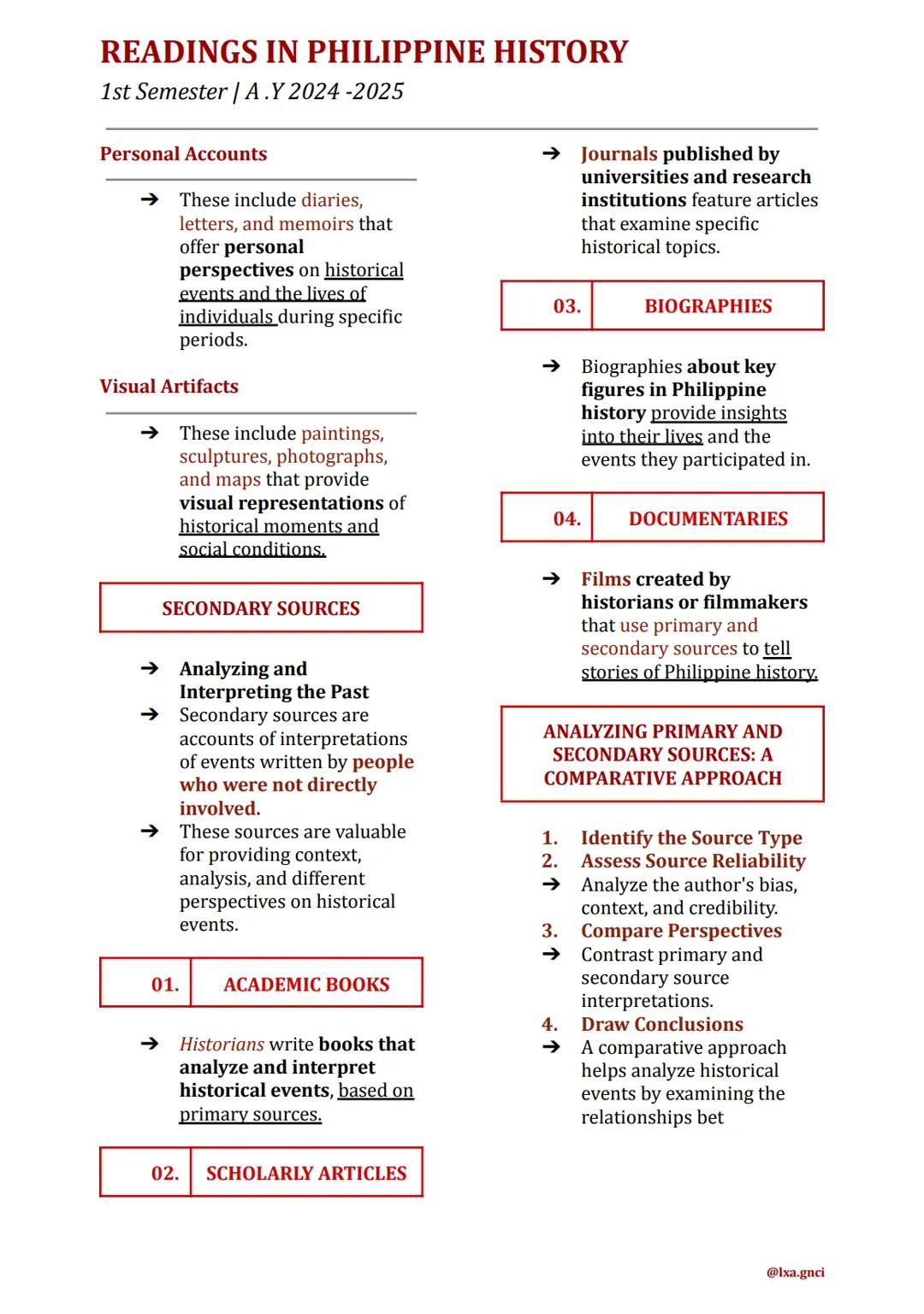
Secondary sources are like historical commentary – they're written by people who weren't there but studied what happened. Think history textbooks, documentaries, and scholarly articles. These are super helpful because historians do the heavy lifting of analyzing and connecting the dots for you.
Here's your game plan for analyzing any historical source: First, figure out if it's primary or secondary. Then check for bias – everyone has an agenda, so ask yourself why this person created this source. Finally, compare different perspectives to get the full picture.
Pro Strategy: Always cross-reference multiple sources. If three different sources say the same thing, you're probably looking at solid evidence.
The key is learning to think like a detective. Don't just accept what you read – question it, compare it, and look for evidence that backs it up.

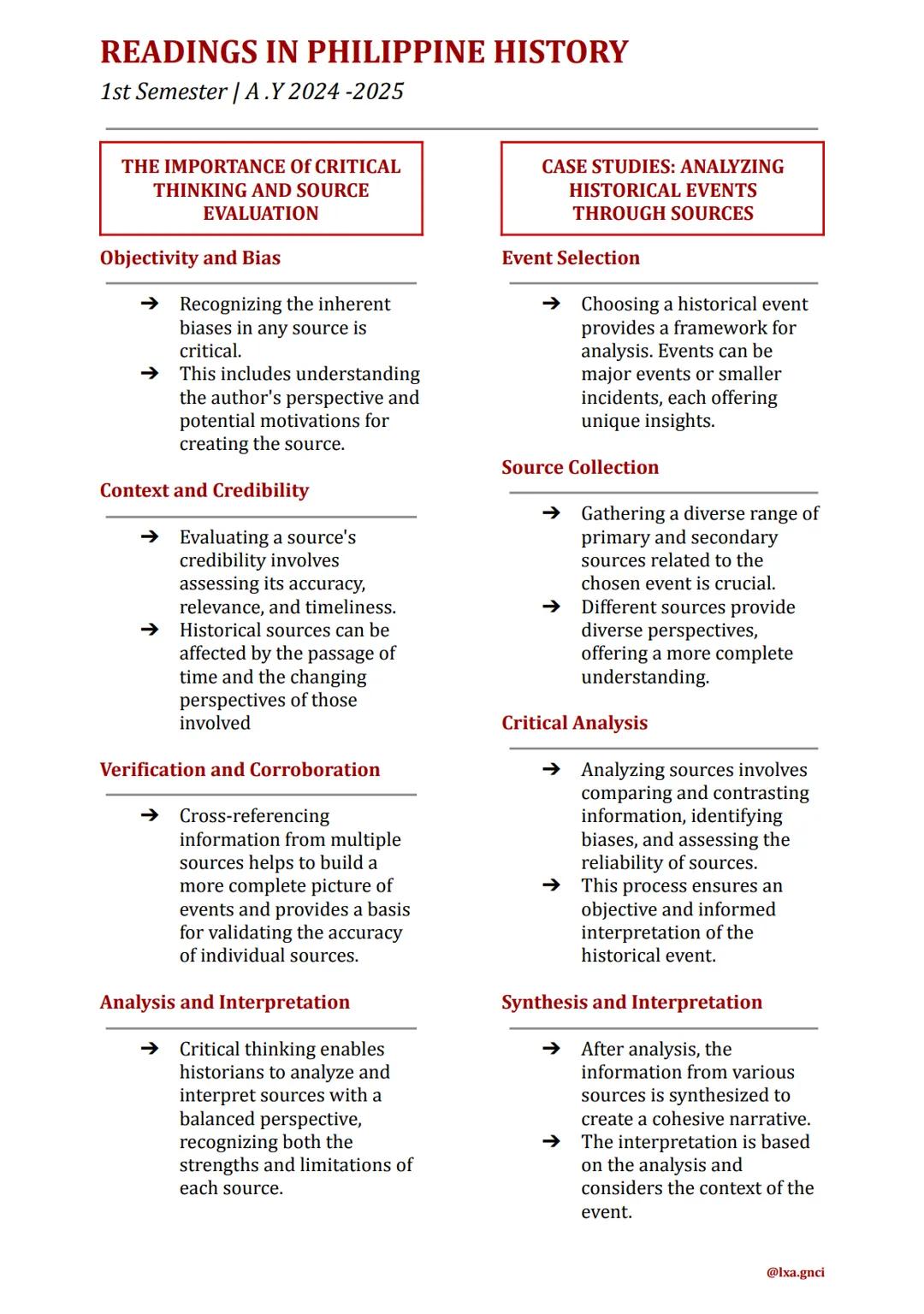
Critical thinking is your superpower against fake news and historical myths. Every source has bias – even photographs can be misleading depending on what's left out of the frame. Your job is to recognize these biases and work around them.
When evaluating sources, check three things: Is the author credible? Is the information relevant to what you're studying? Is it actually accurate when compared to other evidence? Verification and corroboration mean checking multiple sources to build a complete picture.
Reality Check: Even primary sources can be wrong or biased. A diary entry shows what someone thought happened, not necessarily what actually happened.
For case studies, historians pick an event, gather diverse sources, analyze them critically, and then create a balanced interpretation. This process helps separate historical facts from historical fiction.

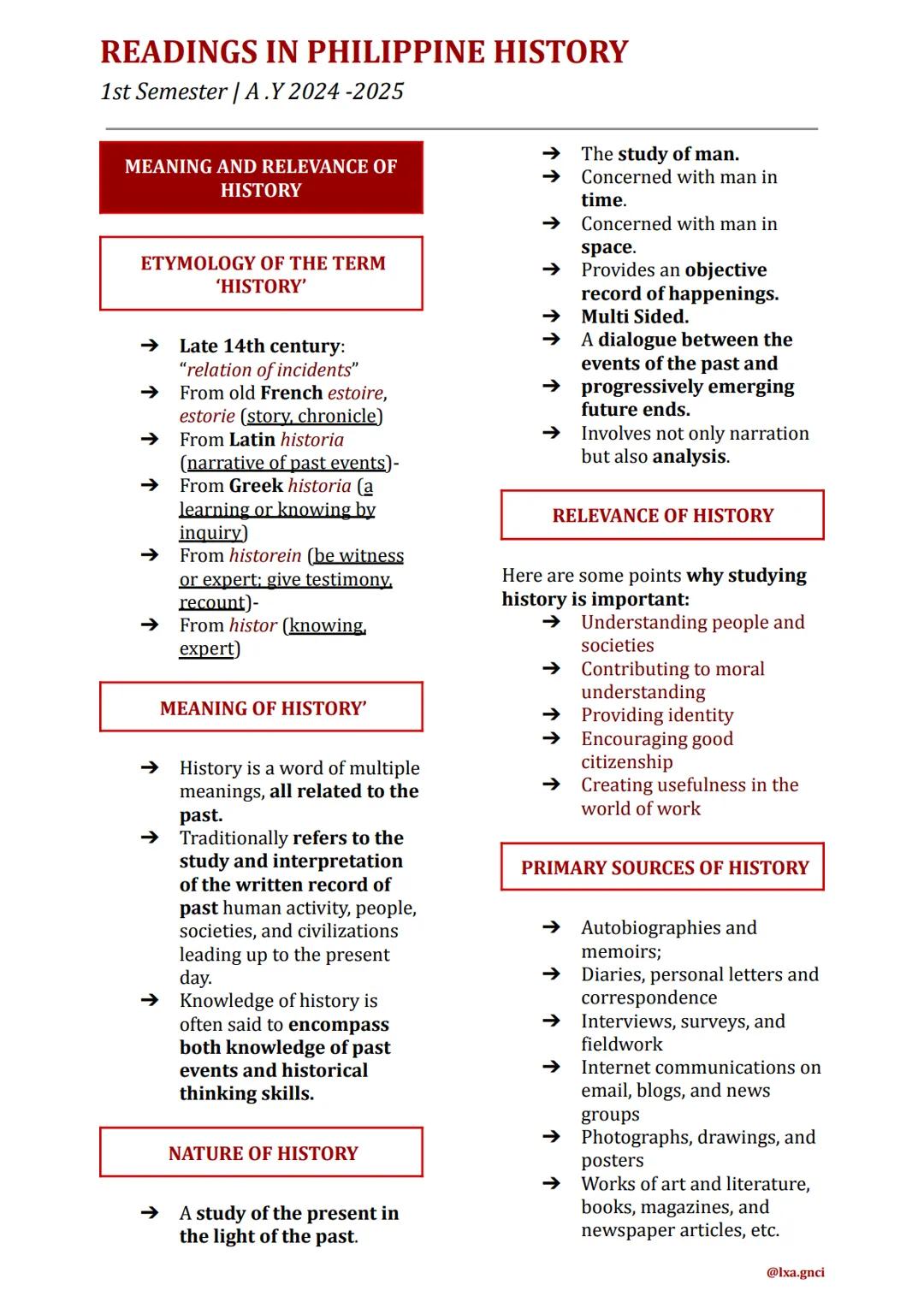
The word "history" comes from the Greek word meaning "learning by inquiry" – basically, it's detective work about the past. History isn't just memorizing events; it's understanding how past decisions shape our present world.
History's nature is multifaceted: it studies people across time and space, provides objective records, and involves both storytelling and analysis. It's literally "a study of the present in light of the past."
Why This Matters: History helps you understand people and societies, contributes to moral understanding, provides identity, and makes you a better citizen.
Studying history is practical too – it develops critical thinking skills that employers value. Plus, understanding historical patterns helps you make sense of current events and avoid repeating past mistakes.

Primary sources come in many forms: literary sources (novels, poems, plays), accounts (newspapers, memoirs, letters), information about people (census records, biographies), and place-specific materials (maps, photographs, local records).
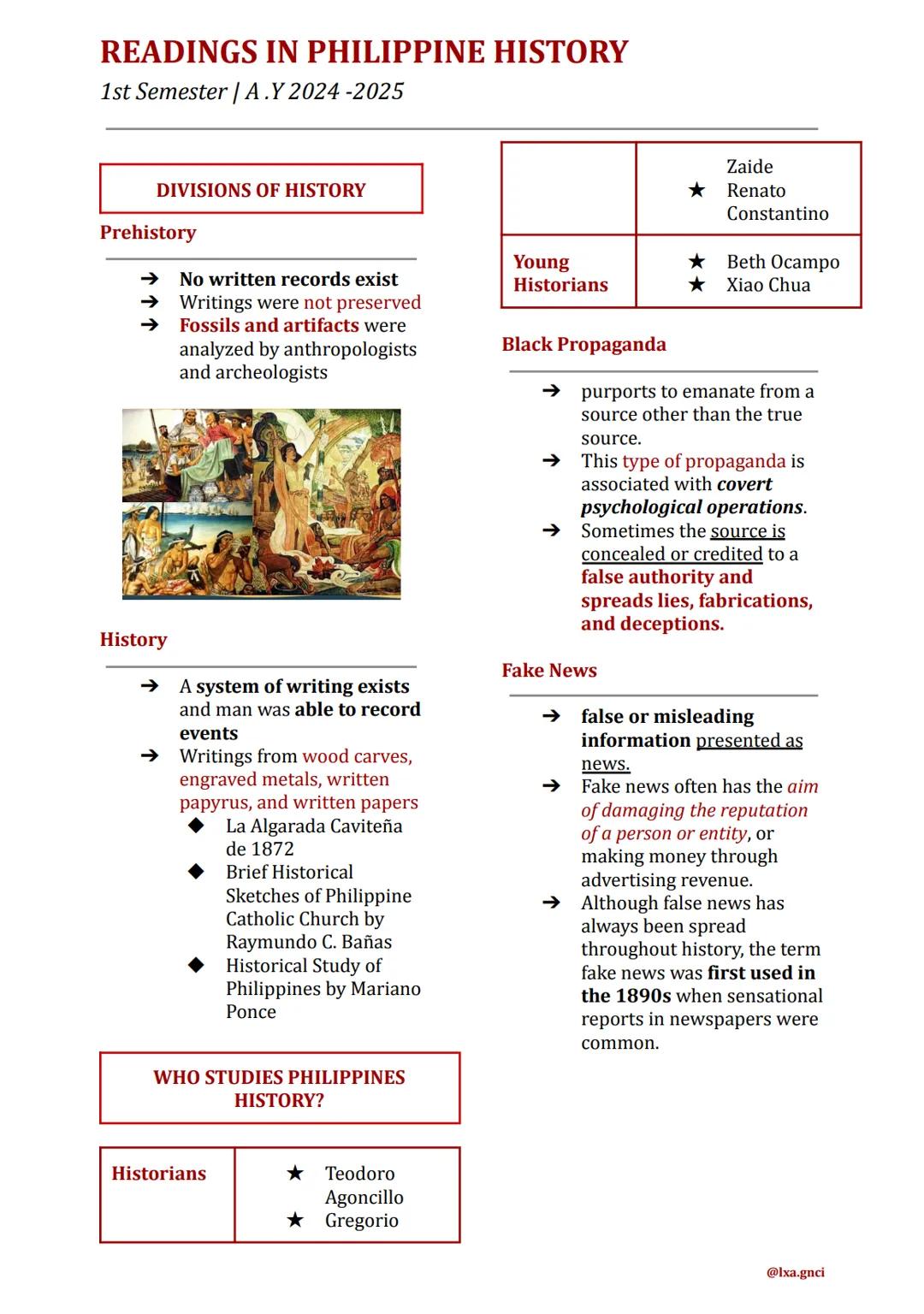
History is divided into prehistory (no written records, studied through fossils and artifacts) and history (written records exist). This distinction matters because written sources give us much more detailed information about people's thoughts and motivations.
Watch Out: Not all "historical" information is reliable. Black propaganda and fake news have existed throughout history – people have always tried to spread false information for political gain.
Secondary sources like book reviews, analysis, and commentary help interpret primary sources, but remember they're filtered through someone else's perspective.

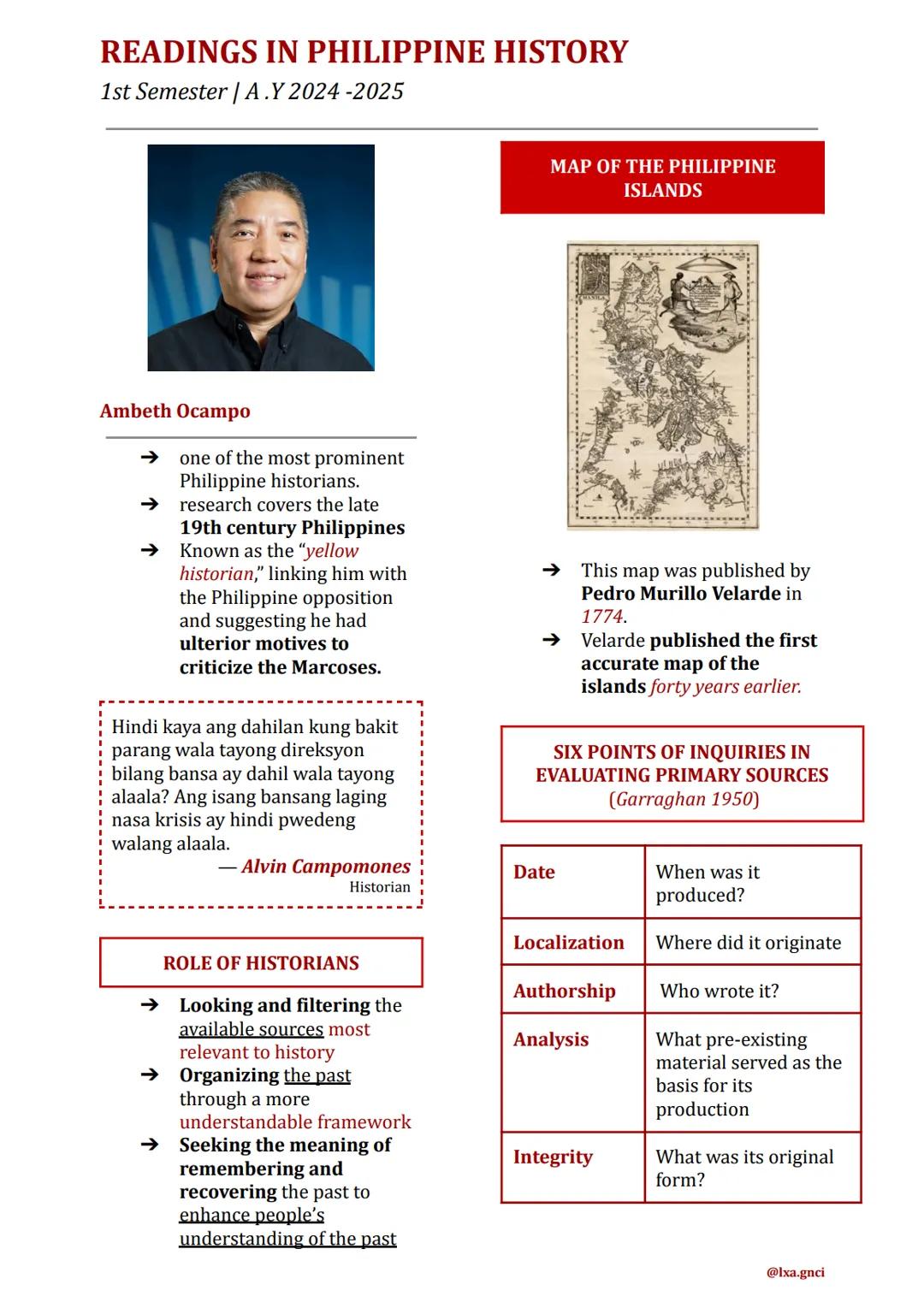
Key Philippine historians include Teodoro Agoncillo, Renato Constantino, and Ambeth Ocampo (known as the "yellow historian"). These scholars have shaped how we understand Philippine history, though each brings their own perspective and potential biases.
Historical maps, like Pedro Murillo Velarde's 1774 map of the Philippines, are crucial primary sources that show how people understood geography and territory at specific times.
Food for Thought: "Maybe the reason we seem to have no direction as a nation is because we have no memory? A country always in crisis cannot be without memory." – Alvin Campomanes
Historians serve as filters, organizing the past into understandable frameworks and helping people learn from history to better understand the present.

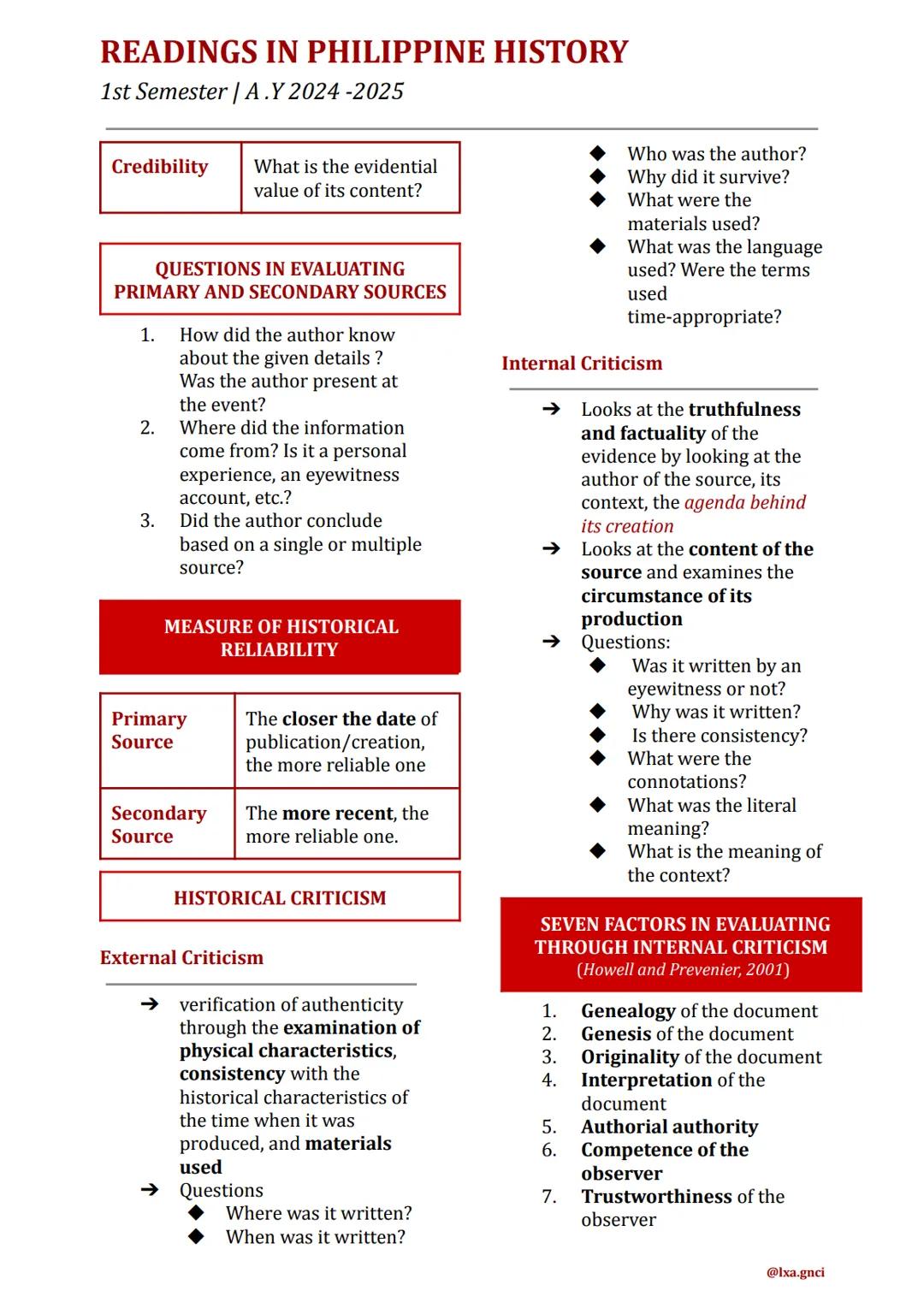
When evaluating primary sources, use Garraghan's six points of inquiry: Date (when was it made?), Localization (where did it come from?), Authorship (who created it?), Analysis (what sources did they use?), Integrity (is it in original form?), and Credibility (how reliable is the content?).
Ask yourself: Was the author present at the event? Where did their information come from? Did they use single or multiple sources? These questions help determine reliability.
Remember: For primary sources, the closer to the actual event, the more reliable. For secondary sources, more recent is often better because historians have had more time to analyze evidence.
Historical criticism involves both external criticism (checking physical authenticity) and internal criticism (examining truthfulness and context). This two-step process helps separate genuine historical evidence from fakes and forgeries.

External criticism examines the physical aspects of a source – when and where was it written? What materials were used? Was the language appropriate for that time period? It's like forensic analysis for historical documents.
Internal criticism digs deeper into content and context. Was the author an eyewitness? Why was it written? Is the information consistent? What was the author's agenda? This helps determine if the content is actually truthful.
Critical Insight: Just because a document is authentically old doesn't mean its contents are accurate – and just because content seems true doesn't mean the document is genuine.
The seven factors for internal criticism include checking the document's genealogy, genesis, originality, interpretation, authorial authority, and the competence and trustworthiness of the observer. This systematic approach helps historians make informed judgments about evidence.

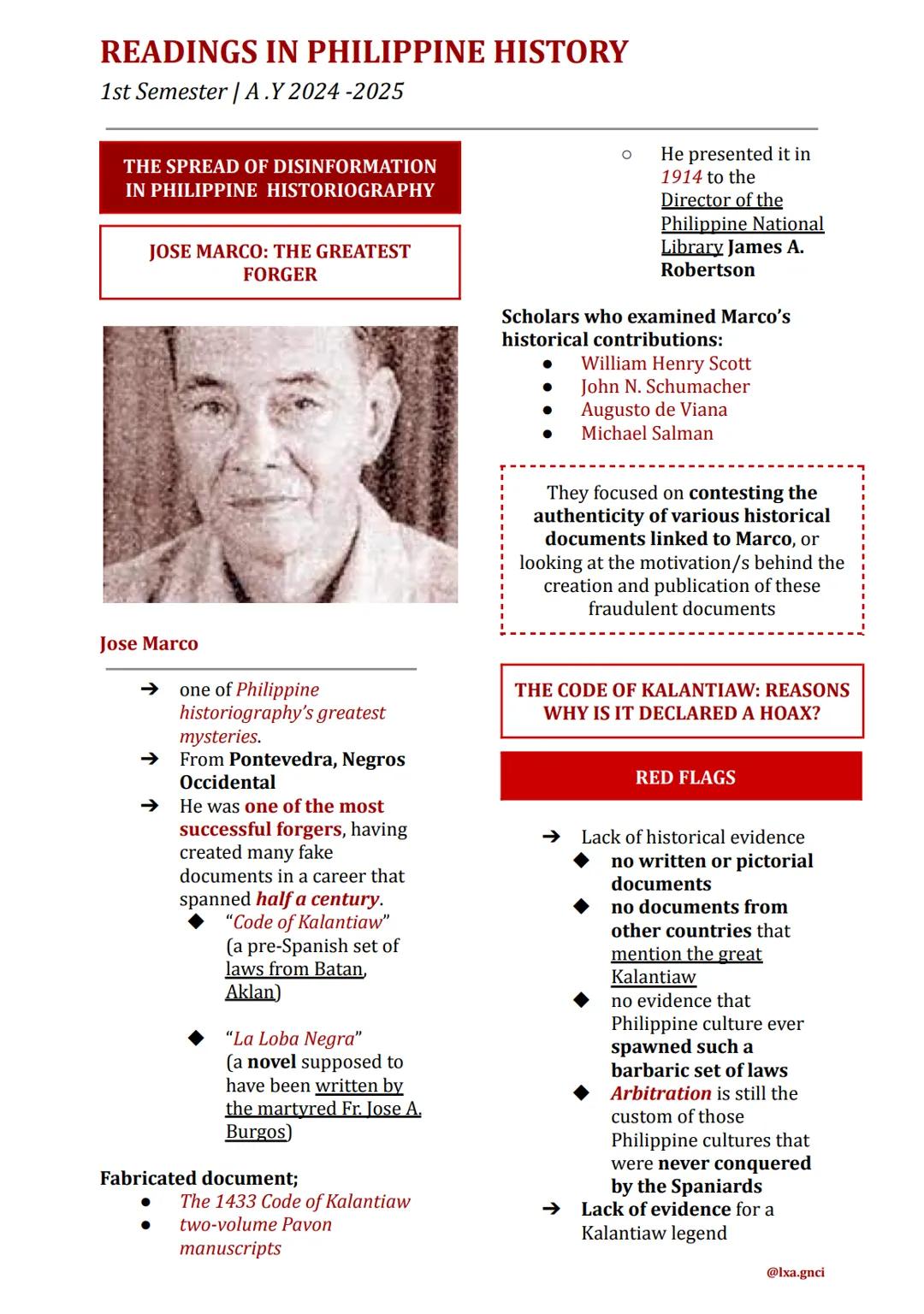
Meet Jose Marco, Philippine history's most successful con artist. This guy from Negros Occidental spent half a century creating fake historical documents that fooled historians for decades. His most famous forgery was the "Code of Kalantiaw" – supposedly ancient Filipino laws from 1433.
Marco presented his fabricated documents to the Philippine National Library in 1914, and they were accepted as genuine historical evidence. He also created fake manuscripts and even a novel supposedly written by martyred priest Fr. Jose Burgos.
Plot Twist: Marco's forgeries were so convincing that they were taught in schools as real Philippine history for over 50 years!
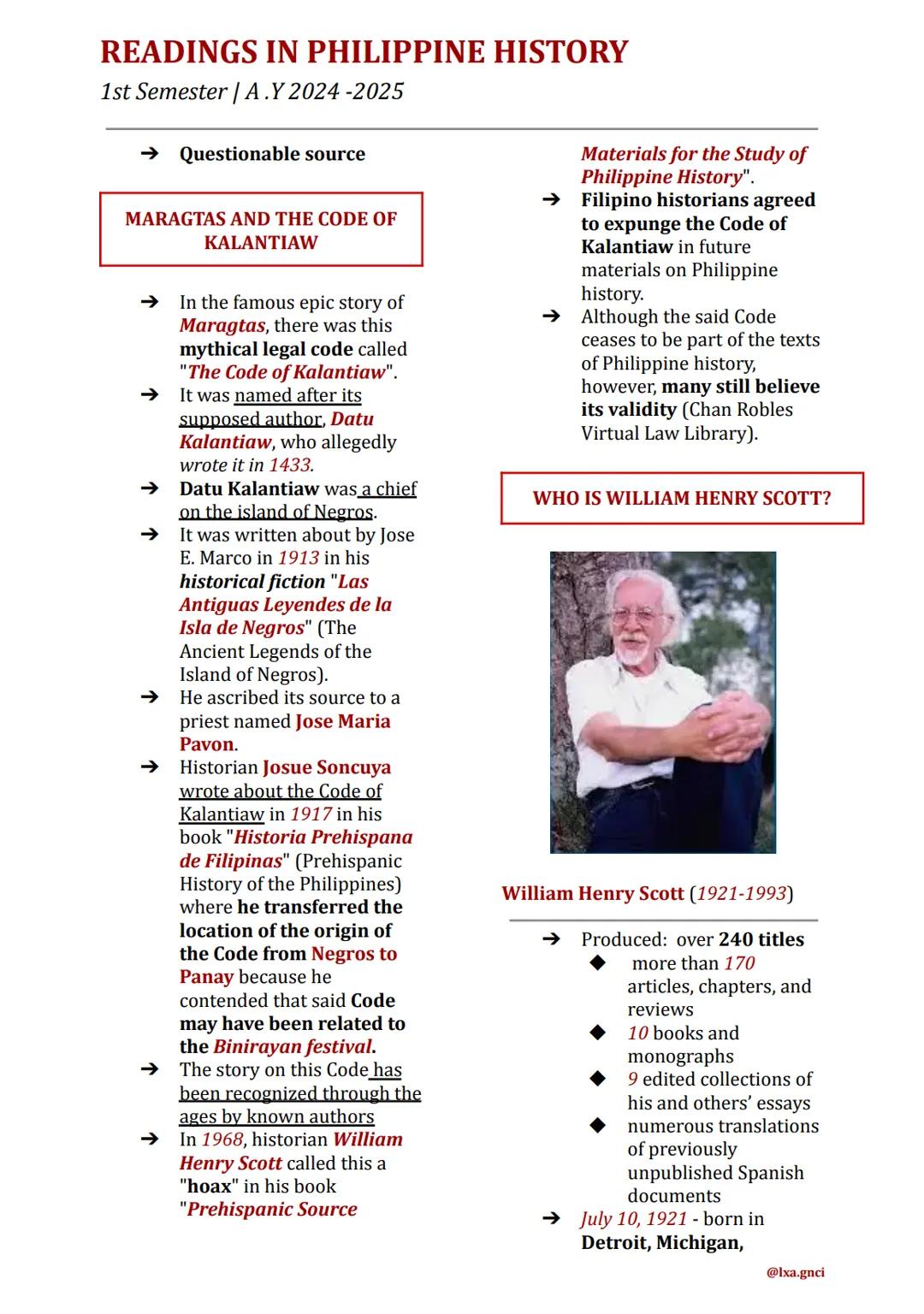
Scholars like William Henry Scott, John Schumacher, and others eventually exposed Marco's work as fraudulent. They focused on examining the authenticity of documents and understanding why someone would create such elaborate historical hoaxes.

The Code of Kalantiaw was supposedly written by Datu Kalantiaw in 1433, containing harsh laws for ancient Filipinos. Jose Marco presented this as historical fact in his 1913 work, claiming he found it in Spanish priest Jose Maria Pavon's papers.
Red flags that revealed it as fake: no historical evidence existed anywhere, no other countries mentioned this "great" leader Kalantiaw, and the barbaric laws didn't match Filipino cultural patterns of using arbitration to solve disputes.
Historical Reality Check: In 1968, historian William Henry Scott officially declared the Code a hoax, and Filipino historians agreed to remove it from future textbooks.
Despite being debunked, many people still believe the Code is real – showing how hard it is to correct historical misinformation once it spreads. This is why learning source evaluation skills is so important for understanding what really happened in the past.
Our AI companion is specifically built for the needs of students. Based on the millions of content pieces we have on the platform we can provide truly meaningful and relevant answers to students. But its not only about answers, the companion is even more about guiding students through their daily learning challenges, with personalised study plans, quizzes or content pieces in the chat and 100% personalisation based on the students skills and developments.
You can download the app in the Google Play Store and in the Apple App Store.
That's right! Enjoy free access to study content, connect with fellow students, and get instant help – all at your fingertips.
App Store
Google Play
The app is very easy to use and well designed. I have found everything I was looking for so far and have been able to learn a lot from the presentations! I will definitely use the app for a class assignment! And of course it also helps a lot as an inspiration.
Stefan S
iOS user
This app is really great. There are so many study notes and help [...]. My problem subject is French, for example, and the app has so many options for help. Thanks to this app, I have improved my French. I would recommend it to anyone.
Samantha Klich
Android user
Wow, I am really amazed. I just tried the app because I've seen it advertised many times and was absolutely stunned. This app is THE HELP you want for school and above all, it offers so many things, such as workouts and fact sheets, which have been VERY helpful to me personally.
Anna
iOS user
I think it’s very much worth it and you’ll end up using it a lot once you get the hang of it and even after looking at others notes you can still ask your Artificial intelligence buddy the question and ask to simplify it if you still don’t get it!!! In the end I think it’s worth it 😊👍 ⚠️Also DID I MENTION ITS FREEE YOU DON’T HAVE TO PAY FOR ANYTHING AND STILL GET YOUR GRADES IN PERFECTLY❗️❗️⚠️
Thomas R
iOS user
Knowunity is the BEST app I’ve used in a minute. This is not an ai review or anything this is genuinely coming from a 7th grade student (I know 2011 im young) but dude this app is a 10/10 i have maintained a 3.8 gpa and have plenty of time for gaming. I love it and my mom is just happy I got good grades
Brad T
Android user
Not only did it help me find the answer but it also showed me alternative ways to solve it. I was horrible in math and science but now I have an a in both subjects. Thanks for the help🤍🤍
David K
iOS user
The app's just great! All I have to do is enter the topic in the search bar and I get the response real fast. I don't have to watch 10 YouTube videos to understand something, so I'm saving my time. Highly recommended!
Sudenaz Ocak
Android user
In school I was really bad at maths but thanks to the app, I am doing better now. I am so grateful that you made the app.
Greenlight Bonnie
Android user
I found this app a couple years ago and it has only gotten better since then. I really love it because it can help with written questions and photo questions. Also, it can find study guides that other people have made as well as flashcard sets and practice tests. The free version is also amazing for students who might not be able to afford it. Would 100% recommend
Aubrey
iOS user
Best app if you're in Highschool or Junior high. I have been using this app for 2 school years and it's the best, it's good if you don't have anyone to help you with school work.😋🩷🎀
Marco B
iOS user
THE QUIZES AND FLASHCARDS ARE SO USEFUL AND I LOVE THE SCHOOLGPT. IT ALSO IS LITREALLY LIKE CHATGPT BUT SMARTER!! HELPED ME WITH MY MASCARA PROBLEMS TOO!! AS WELL AS MY REAL SUBJECTS ! DUHHH 😍😁😲🤑💗✨🎀😮
Elisha
iOS user
This app is phenomenal down to the correct info and the various topics you can study! I greatly recommend it for people who struggle with procrastination and those who need homework help. It has been perfectly accurate for world 1 history as far as I’ve seen! Geometry too!
Paul T
iOS user
The app is very easy to use and well designed. I have found everything I was looking for so far and have been able to learn a lot from the presentations! I will definitely use the app for a class assignment! And of course it also helps a lot as an inspiration.
Stefan S
iOS user
This app is really great. There are so many study notes and help [...]. My problem subject is French, for example, and the app has so many options for help. Thanks to this app, I have improved my French. I would recommend it to anyone.
Samantha Klich
Android user
Wow, I am really amazed. I just tried the app because I've seen it advertised many times and was absolutely stunned. This app is THE HELP you want for school and above all, it offers so many things, such as workouts and fact sheets, which have been VERY helpful to me personally.
Anna
iOS user
I think it’s very much worth it and you’ll end up using it a lot once you get the hang of it and even after looking at others notes you can still ask your Artificial intelligence buddy the question and ask to simplify it if you still don’t get it!!! In the end I think it’s worth it 😊👍 ⚠️Also DID I MENTION ITS FREEE YOU DON’T HAVE TO PAY FOR ANYTHING AND STILL GET YOUR GRADES IN PERFECTLY❗️❗️⚠️
Thomas R
iOS user
Knowunity is the BEST app I’ve used in a minute. This is not an ai review or anything this is genuinely coming from a 7th grade student (I know 2011 im young) but dude this app is a 10/10 i have maintained a 3.8 gpa and have plenty of time for gaming. I love it and my mom is just happy I got good grades
Brad T
Android user
Not only did it help me find the answer but it also showed me alternative ways to solve it. I was horrible in math and science but now I have an a in both subjects. Thanks for the help🤍🤍
David K
iOS user
The app's just great! All I have to do is enter the topic in the search bar and I get the response real fast. I don't have to watch 10 YouTube videos to understand something, so I'm saving my time. Highly recommended!
Sudenaz Ocak
Android user
In school I was really bad at maths but thanks to the app, I am doing better now. I am so grateful that you made the app.
Greenlight Bonnie
Android user
I found this app a couple years ago and it has only gotten better since then. I really love it because it can help with written questions and photo questions. Also, it can find study guides that other people have made as well as flashcard sets and practice tests. The free version is also amazing for students who might not be able to afford it. Would 100% recommend
Aubrey
iOS user
Best app if you're in Highschool or Junior high. I have been using this app for 2 school years and it's the best, it's good if you don't have anyone to help you with school work.😋🩷🎀
Marco B
iOS user
THE QUIZES AND FLASHCARDS ARE SO USEFUL AND I LOVE THE SCHOOLGPT. IT ALSO IS LITREALLY LIKE CHATGPT BUT SMARTER!! HELPED ME WITH MY MASCARA PROBLEMS TOO!! AS WELL AS MY REAL SUBJECTS ! DUHHH 😍😁😲🤑💗✨🎀😮
Elisha
iOS user
This app is phenomenal down to the correct info and the various topics you can study! I greatly recommend it for people who struggle with procrastination and those who need homework help. It has been perfectly accurate for world 1 history as far as I’ve seen! Geometry too!
Paul T
iOS user
lexa
@lexa_bhakk
Ever wonder how historians separate fact from fiction when studying the past? Understanding Philippine history isn't just about memorizing dates – it's about learning to think critically about sources and evidence. This knowledge will help you navigate not just history... Show more

Access to all documents
Improve your grades
Join milions of students
By signing up you accept Terms of Service and Privacy Policy
Learning Philippine history helps you understand why our country is the way it is today. It's like having a backstory that explains current events, politics, and even our cultural quirks.
Primary sources are your direct connection to the past – think of them as historical evidence straight from people who were actually there. These include written documents like diaries and letters, visual materials like old photos and paintings, oral histories passed down through families, and physical artifacts like tools and jewelry.
Quick Tip: When you see a historical photo or read an old diary entry, you're looking at a primary source – someone's actual experience from that time period.
The cool thing about primary sources is they give you the raw, unfiltered story. A soldier's letter home during World War II tells you way more about what war was really like than any textbook summary ever could.

Access to all documents
Improve your grades
Join milions of students
By signing up you accept Terms of Service and Privacy Policy
Secondary sources are like historical commentary – they're written by people who weren't there but studied what happened. Think history textbooks, documentaries, and scholarly articles. These are super helpful because historians do the heavy lifting of analyzing and connecting the dots for you.
Here's your game plan for analyzing any historical source: First, figure out if it's primary or secondary. Then check for bias – everyone has an agenda, so ask yourself why this person created this source. Finally, compare different perspectives to get the full picture.
Pro Strategy: Always cross-reference multiple sources. If three different sources say the same thing, you're probably looking at solid evidence.
The key is learning to think like a detective. Don't just accept what you read – question it, compare it, and look for evidence that backs it up.

Access to all documents
Improve your grades
Join milions of students
By signing up you accept Terms of Service and Privacy Policy
Critical thinking is your superpower against fake news and historical myths. Every source has bias – even photographs can be misleading depending on what's left out of the frame. Your job is to recognize these biases and work around them.
When evaluating sources, check three things: Is the author credible? Is the information relevant to what you're studying? Is it actually accurate when compared to other evidence? Verification and corroboration mean checking multiple sources to build a complete picture.
Reality Check: Even primary sources can be wrong or biased. A diary entry shows what someone thought happened, not necessarily what actually happened.
For case studies, historians pick an event, gather diverse sources, analyze them critically, and then create a balanced interpretation. This process helps separate historical facts from historical fiction.

Access to all documents
Improve your grades
Join milions of students
By signing up you accept Terms of Service and Privacy Policy
The word "history" comes from the Greek word meaning "learning by inquiry" – basically, it's detective work about the past. History isn't just memorizing events; it's understanding how past decisions shape our present world.
History's nature is multifaceted: it studies people across time and space, provides objective records, and involves both storytelling and analysis. It's literally "a study of the present in light of the past."
Why This Matters: History helps you understand people and societies, contributes to moral understanding, provides identity, and makes you a better citizen.
Studying history is practical too – it develops critical thinking skills that employers value. Plus, understanding historical patterns helps you make sense of current events and avoid repeating past mistakes.

Access to all documents
Improve your grades
Join milions of students
By signing up you accept Terms of Service and Privacy Policy
Primary sources come in many forms: literary sources (novels, poems, plays), accounts (newspapers, memoirs, letters), information about people (census records, biographies), and place-specific materials (maps, photographs, local records).
History is divided into prehistory (no written records, studied through fossils and artifacts) and history (written records exist). This distinction matters because written sources give us much more detailed information about people's thoughts and motivations.
Watch Out: Not all "historical" information is reliable. Black propaganda and fake news have existed throughout history – people have always tried to spread false information for political gain.
Secondary sources like book reviews, analysis, and commentary help interpret primary sources, but remember they're filtered through someone else's perspective.

Access to all documents
Improve your grades
Join milions of students
By signing up you accept Terms of Service and Privacy Policy
Key Philippine historians include Teodoro Agoncillo, Renato Constantino, and Ambeth Ocampo (known as the "yellow historian"). These scholars have shaped how we understand Philippine history, though each brings their own perspective and potential biases.
Historical maps, like Pedro Murillo Velarde's 1774 map of the Philippines, are crucial primary sources that show how people understood geography and territory at specific times.
Food for Thought: "Maybe the reason we seem to have no direction as a nation is because we have no memory? A country always in crisis cannot be without memory." – Alvin Campomanes
Historians serve as filters, organizing the past into understandable frameworks and helping people learn from history to better understand the present.

Access to all documents
Improve your grades
Join milions of students
By signing up you accept Terms of Service and Privacy Policy
When evaluating primary sources, use Garraghan's six points of inquiry: Date (when was it made?), Localization (where did it come from?), Authorship (who created it?), Analysis (what sources did they use?), Integrity (is it in original form?), and Credibility (how reliable is the content?).
Ask yourself: Was the author present at the event? Where did their information come from? Did they use single or multiple sources? These questions help determine reliability.
Remember: For primary sources, the closer to the actual event, the more reliable. For secondary sources, more recent is often better because historians have had more time to analyze evidence.
Historical criticism involves both external criticism (checking physical authenticity) and internal criticism (examining truthfulness and context). This two-step process helps separate genuine historical evidence from fakes and forgeries.

Access to all documents
Improve your grades
Join milions of students
By signing up you accept Terms of Service and Privacy Policy
External criticism examines the physical aspects of a source – when and where was it written? What materials were used? Was the language appropriate for that time period? It's like forensic analysis for historical documents.
Internal criticism digs deeper into content and context. Was the author an eyewitness? Why was it written? Is the information consistent? What was the author's agenda? This helps determine if the content is actually truthful.
Critical Insight: Just because a document is authentically old doesn't mean its contents are accurate – and just because content seems true doesn't mean the document is genuine.
The seven factors for internal criticism include checking the document's genealogy, genesis, originality, interpretation, authorial authority, and the competence and trustworthiness of the observer. This systematic approach helps historians make informed judgments about evidence.

Access to all documents
Improve your grades
Join milions of students
By signing up you accept Terms of Service and Privacy Policy
Meet Jose Marco, Philippine history's most successful con artist. This guy from Negros Occidental spent half a century creating fake historical documents that fooled historians for decades. His most famous forgery was the "Code of Kalantiaw" – supposedly ancient Filipino laws from 1433.
Marco presented his fabricated documents to the Philippine National Library in 1914, and they were accepted as genuine historical evidence. He also created fake manuscripts and even a novel supposedly written by martyred priest Fr. Jose Burgos.
Plot Twist: Marco's forgeries were so convincing that they were taught in schools as real Philippine history for over 50 years!
Scholars like William Henry Scott, John Schumacher, and others eventually exposed Marco's work as fraudulent. They focused on examining the authenticity of documents and understanding why someone would create such elaborate historical hoaxes.

Access to all documents
Improve your grades
Join milions of students
By signing up you accept Terms of Service and Privacy Policy
The Code of Kalantiaw was supposedly written by Datu Kalantiaw in 1433, containing harsh laws for ancient Filipinos. Jose Marco presented this as historical fact in his 1913 work, claiming he found it in Spanish priest Jose Maria Pavon's papers.
Red flags that revealed it as fake: no historical evidence existed anywhere, no other countries mentioned this "great" leader Kalantiaw, and the barbaric laws didn't match Filipino cultural patterns of using arbitration to solve disputes.
Historical Reality Check: In 1968, historian William Henry Scott officially declared the Code a hoax, and Filipino historians agreed to remove it from future textbooks.
Despite being debunked, many people still believe the Code is real – showing how hard it is to correct historical misinformation once it spreads. This is why learning source evaluation skills is so important for understanding what really happened in the past.
Our AI companion is specifically built for the needs of students. Based on the millions of content pieces we have on the platform we can provide truly meaningful and relevant answers to students. But its not only about answers, the companion is even more about guiding students through their daily learning challenges, with personalised study plans, quizzes or content pieces in the chat and 100% personalisation based on the students skills and developments.
You can download the app in the Google Play Store and in the Apple App Store.
That's right! Enjoy free access to study content, connect with fellow students, and get instant help – all at your fingertips.
265
Smart Tools NEW
Transform this note into: ✓ 50+ Practice Questions ✓ Interactive Flashcards ✓ Full Mock Exam ✓ Essay Outlines
App Store
Google Play
The app is very easy to use and well designed. I have found everything I was looking for so far and have been able to learn a lot from the presentations! I will definitely use the app for a class assignment! And of course it also helps a lot as an inspiration.
Stefan S
iOS user
This app is really great. There are so many study notes and help [...]. My problem subject is French, for example, and the app has so many options for help. Thanks to this app, I have improved my French. I would recommend it to anyone.
Samantha Klich
Android user
Wow, I am really amazed. I just tried the app because I've seen it advertised many times and was absolutely stunned. This app is THE HELP you want for school and above all, it offers so many things, such as workouts and fact sheets, which have been VERY helpful to me personally.
Anna
iOS user
I think it’s very much worth it and you’ll end up using it a lot once you get the hang of it and even after looking at others notes you can still ask your Artificial intelligence buddy the question and ask to simplify it if you still don’t get it!!! In the end I think it’s worth it 😊👍 ⚠️Also DID I MENTION ITS FREEE YOU DON’T HAVE TO PAY FOR ANYTHING AND STILL GET YOUR GRADES IN PERFECTLY❗️❗️⚠️
Thomas R
iOS user
Knowunity is the BEST app I’ve used in a minute. This is not an ai review or anything this is genuinely coming from a 7th grade student (I know 2011 im young) but dude this app is a 10/10 i have maintained a 3.8 gpa and have plenty of time for gaming. I love it and my mom is just happy I got good grades
Brad T
Android user
Not only did it help me find the answer but it also showed me alternative ways to solve it. I was horrible in math and science but now I have an a in both subjects. Thanks for the help🤍🤍
David K
iOS user
The app's just great! All I have to do is enter the topic in the search bar and I get the response real fast. I don't have to watch 10 YouTube videos to understand something, so I'm saving my time. Highly recommended!
Sudenaz Ocak
Android user
In school I was really bad at maths but thanks to the app, I am doing better now. I am so grateful that you made the app.
Greenlight Bonnie
Android user
I found this app a couple years ago and it has only gotten better since then. I really love it because it can help with written questions and photo questions. Also, it can find study guides that other people have made as well as flashcard sets and practice tests. The free version is also amazing for students who might not be able to afford it. Would 100% recommend
Aubrey
iOS user
Best app if you're in Highschool or Junior high. I have been using this app for 2 school years and it's the best, it's good if you don't have anyone to help you with school work.😋🩷🎀
Marco B
iOS user
THE QUIZES AND FLASHCARDS ARE SO USEFUL AND I LOVE THE SCHOOLGPT. IT ALSO IS LITREALLY LIKE CHATGPT BUT SMARTER!! HELPED ME WITH MY MASCARA PROBLEMS TOO!! AS WELL AS MY REAL SUBJECTS ! DUHHH 😍😁😲🤑💗✨🎀😮
Elisha
iOS user
This app is phenomenal down to the correct info and the various topics you can study! I greatly recommend it for people who struggle with procrastination and those who need homework help. It has been perfectly accurate for world 1 history as far as I’ve seen! Geometry too!
Paul T
iOS user
The app is very easy to use and well designed. I have found everything I was looking for so far and have been able to learn a lot from the presentations! I will definitely use the app for a class assignment! And of course it also helps a lot as an inspiration.
Stefan S
iOS user
This app is really great. There are so many study notes and help [...]. My problem subject is French, for example, and the app has so many options for help. Thanks to this app, I have improved my French. I would recommend it to anyone.
Samantha Klich
Android user
Wow, I am really amazed. I just tried the app because I've seen it advertised many times and was absolutely stunned. This app is THE HELP you want for school and above all, it offers so many things, such as workouts and fact sheets, which have been VERY helpful to me personally.
Anna
iOS user
I think it’s very much worth it and you’ll end up using it a lot once you get the hang of it and even after looking at others notes you can still ask your Artificial intelligence buddy the question and ask to simplify it if you still don’t get it!!! In the end I think it’s worth it 😊👍 ⚠️Also DID I MENTION ITS FREEE YOU DON’T HAVE TO PAY FOR ANYTHING AND STILL GET YOUR GRADES IN PERFECTLY❗️❗️⚠️
Thomas R
iOS user
Knowunity is the BEST app I’ve used in a minute. This is not an ai review or anything this is genuinely coming from a 7th grade student (I know 2011 im young) but dude this app is a 10/10 i have maintained a 3.8 gpa and have plenty of time for gaming. I love it and my mom is just happy I got good grades
Brad T
Android user
Not only did it help me find the answer but it also showed me alternative ways to solve it. I was horrible in math and science but now I have an a in both subjects. Thanks for the help🤍🤍
David K
iOS user
The app's just great! All I have to do is enter the topic in the search bar and I get the response real fast. I don't have to watch 10 YouTube videos to understand something, so I'm saving my time. Highly recommended!
Sudenaz Ocak
Android user
In school I was really bad at maths but thanks to the app, I am doing better now. I am so grateful that you made the app.
Greenlight Bonnie
Android user
I found this app a couple years ago and it has only gotten better since then. I really love it because it can help with written questions and photo questions. Also, it can find study guides that other people have made as well as flashcard sets and practice tests. The free version is also amazing for students who might not be able to afford it. Would 100% recommend
Aubrey
iOS user
Best app if you're in Highschool or Junior high. I have been using this app for 2 school years and it's the best, it's good if you don't have anyone to help you with school work.😋🩷🎀
Marco B
iOS user
THE QUIZES AND FLASHCARDS ARE SO USEFUL AND I LOVE THE SCHOOLGPT. IT ALSO IS LITREALLY LIKE CHATGPT BUT SMARTER!! HELPED ME WITH MY MASCARA PROBLEMS TOO!! AS WELL AS MY REAL SUBJECTS ! DUHHH 😍😁😲🤑💗✨🎀😮
Elisha
iOS user
This app is phenomenal down to the correct info and the various topics you can study! I greatly recommend it for people who struggle with procrastination and those who need homework help. It has been perfectly accurate for world 1 history as far as I’ve seen! Geometry too!
Paul T
iOS user