Open the App

Subjects

Introduction to Disaster Preparedness and Risk Management

2

0

user profile picture

Karen Gella

12/11/2025

DRRR

DISRRR

182

Dec 11, 2025

28 pages

Introduction to Disaster Preparedness and Risk Management

user profile picture

Karen Gella

@cayennexxx

Disasters are serious disruptions that cause widespread human, material, and... Show more

Page 1
Page 2
Page 3
Page 4
Page 5
Page 6
Page 7
Page 8
Page 9
Page 10
1 / 10
--- OCR Start ---
Disaster
Disaster
-serious disruption of the functioning
of a community or a society causing
widespread human, material,
e

Understanding Disasters and Risk

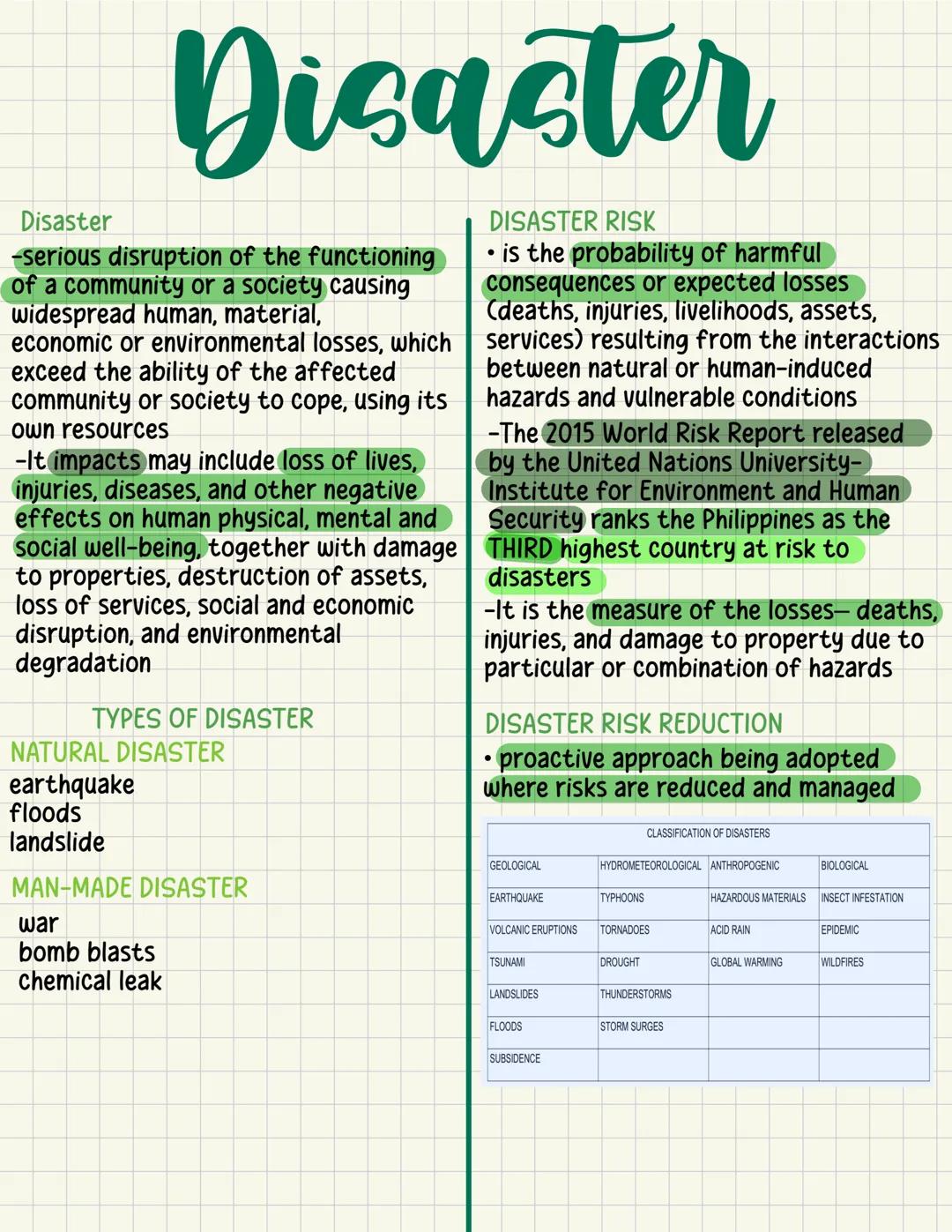
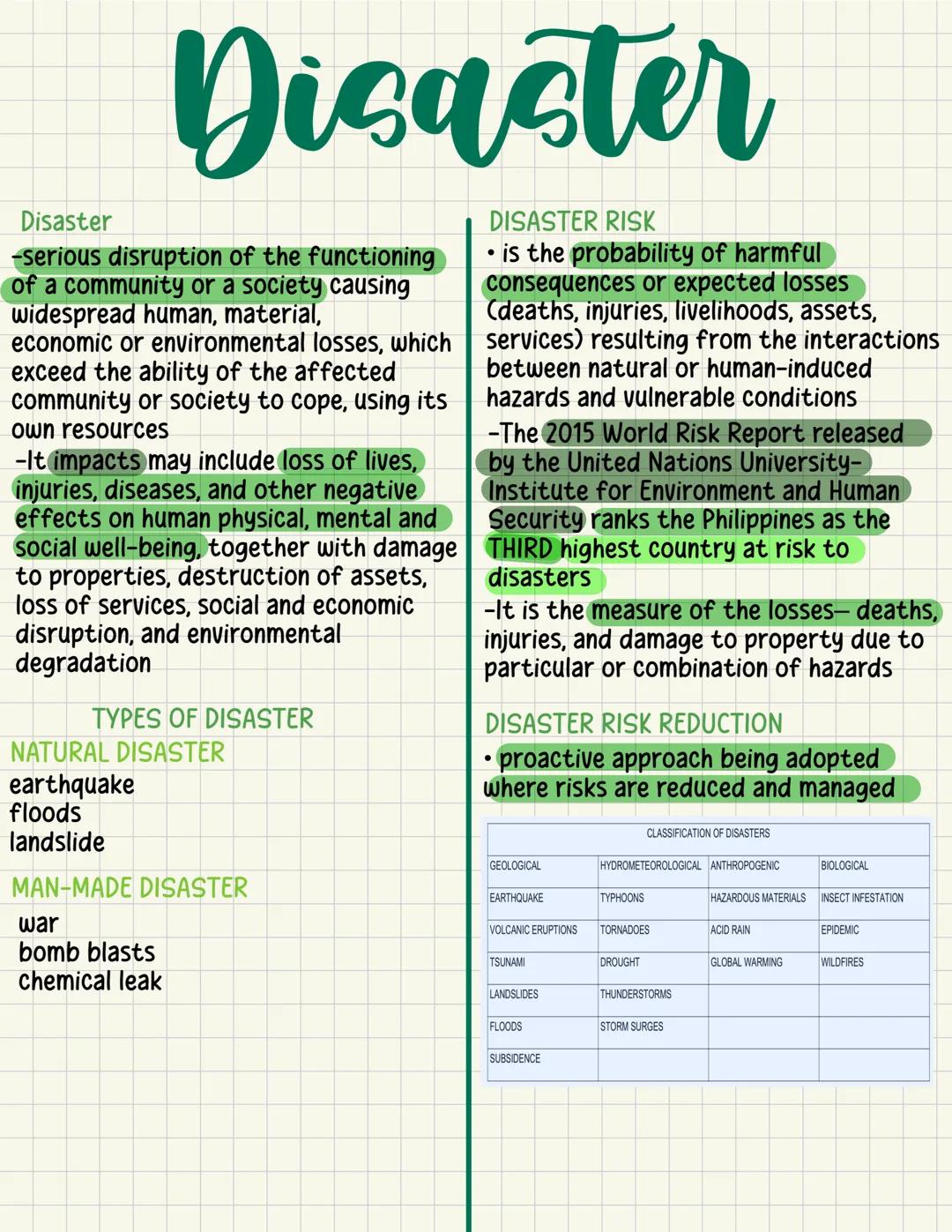
Disasters seriously disrupt communities by causing widespread losses that exceed a society's ability to cope using only its own resources. When disasters strike, they can impact everything from human health to economic stability and environmental wellbeing.

Disaster risk is the probability of harmful consequences resulting from interactions between natural or human-induced hazards and vulnerable conditions. The 2015 World Risk Report ranked the Philippines as the third highest country at risk to disasters globally, highlighting the urgency of understanding and preparing for potential threats.

Disasters can be classified into different categories based on their origin:

  1. Natural disasters: Include geological events (earthquakes, volcanic eruptions, tsunamis), hydrometeorological events (typhoons, floods, storm surges), and biological threats (epidemics, insect infestations)

  2. Human-induced (anthropogenic) disasters: Include technological failures, hazardous materials incidents, war, terrorism, and civil unrest

💡 Remember: Disaster Risk Reduction (DRR) uses a proactive approach where potential risks are identified, assessed, and managed before disasters happen rather than just responding after they occur.

--- OCR Start ---
Disaster
Disaster
-serious disruption of the functioning
of a community or a society causing
widespread human, material,
e

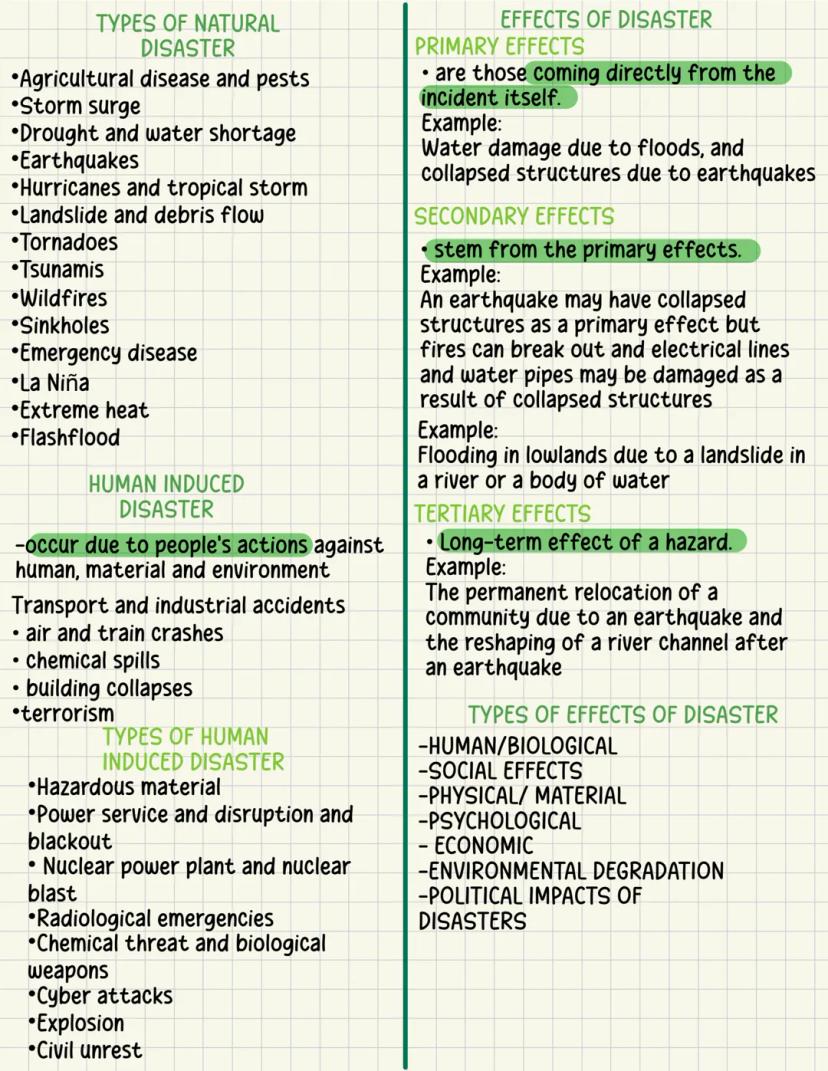
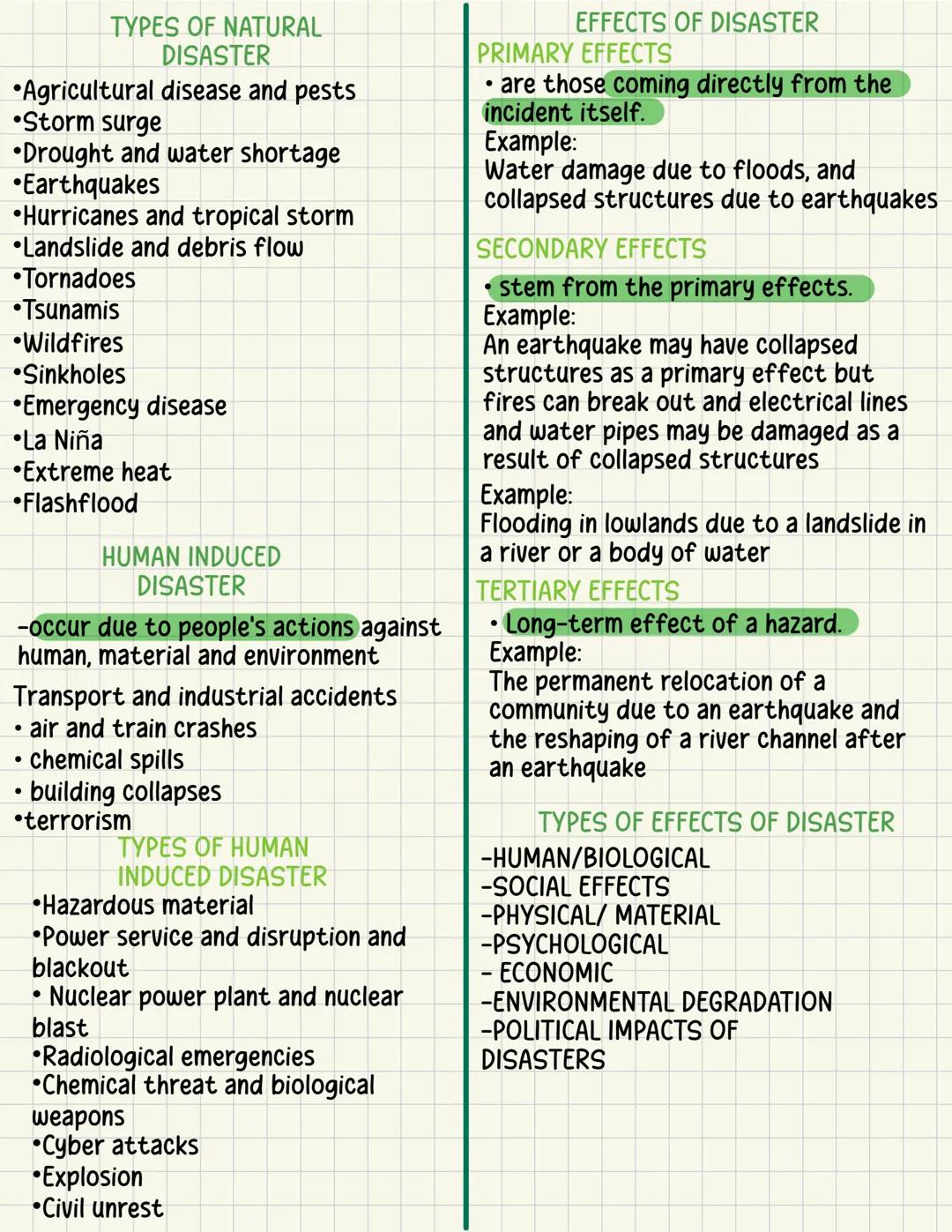
Types of Disasters and Their Effects

Natural disasters come in many forms and affect communities differently:

  • Agricultural diseases and pests can destroy food supplies
  • Earthquakes, hurricanes, and tsunamis can devastate infrastructure
  • Droughts, landslides, and wildfires can make environments uninhabitable

Human-induced disasters result from people's actions against humans, materials, and the environment:

  • Transport and industrial accidents (chemical spills, building collapses)
  • Power disruptions and blackouts
  • Nuclear incidents and radiological emergencies
  • Cyber attacks and civil unrest

The effects of disasters occur at different stages:

  • Primary effects come directly from the disaster (water damage from floods, collapsed buildings from earthquakes)
  • Secondary effects stem from primary effects (fires breaking out after an earthquake)
  • Tertiary effects are long-term consequences (permanent relocation of communities)

Disasters impact societies through multiple dimensions:

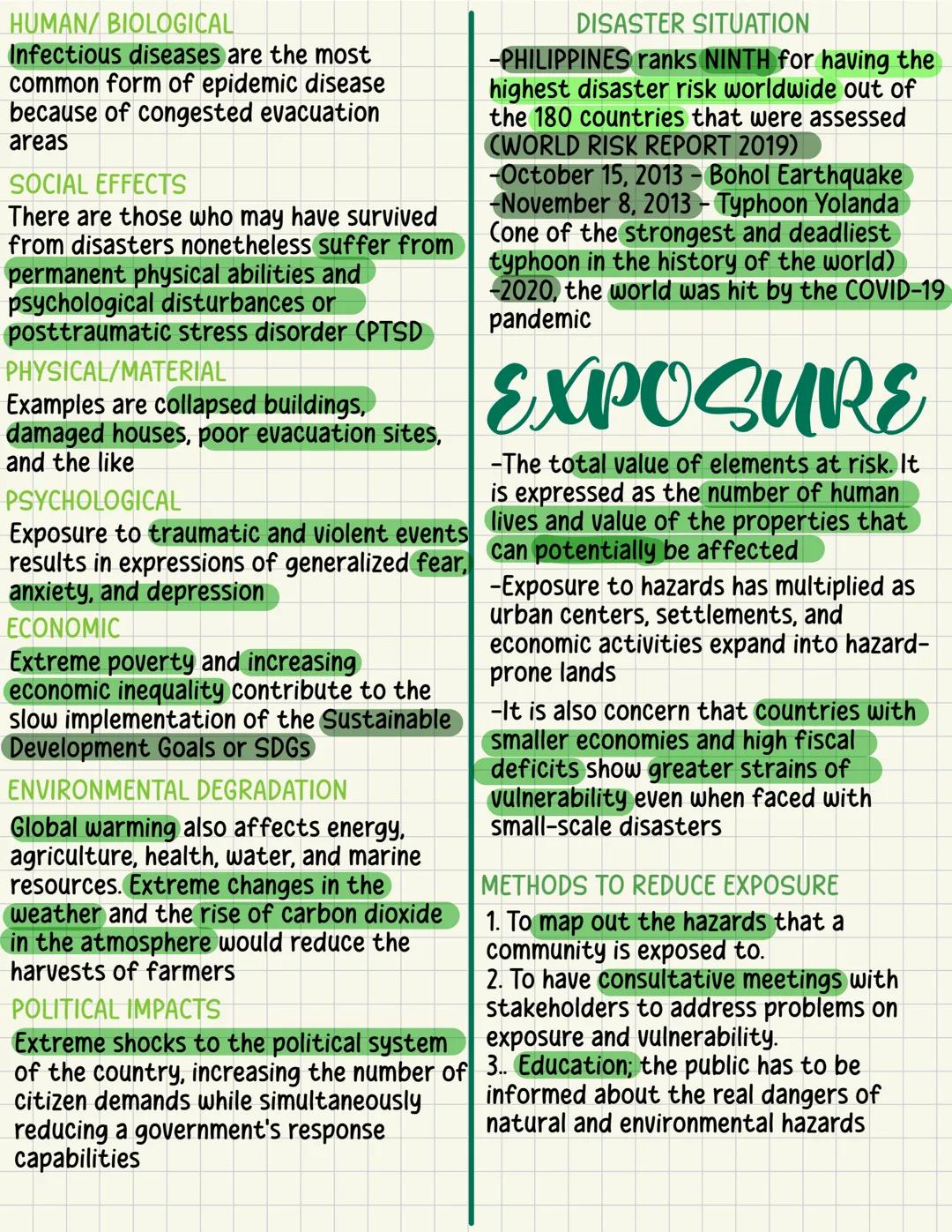
  • Human/biological effects (spread of infectious diseases)
  • Social and psychological impacts (trauma and PTSD)
  • Physical/material destruction (damaged infrastructure)
  • Economic consequences (extreme poverty)
  • Environmental degradation (loss of natural resources)

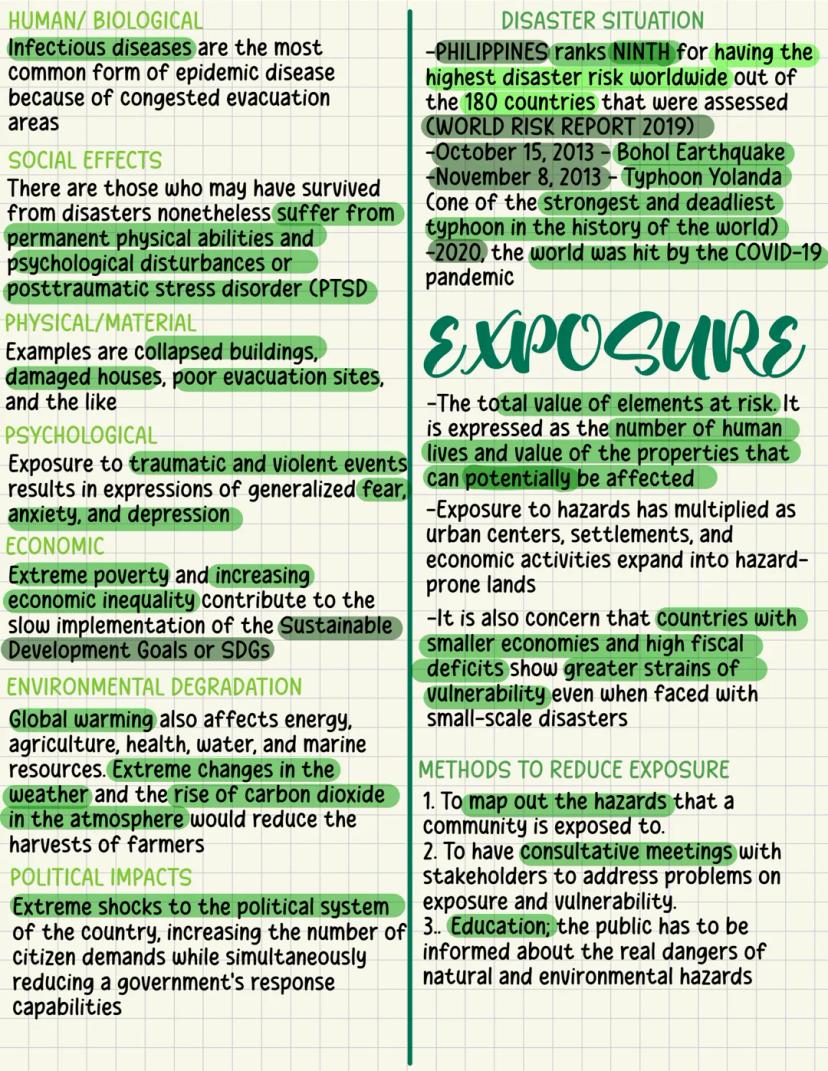
💡 Did you know? The Philippines ranks ninth for having the highest disaster risk worldwide out of 180 assessed countries according to the World Risk Report 2019.

--- OCR Start ---
Disaster
Disaster
-serious disruption of the functioning
of a community or a society causing
widespread human, material,
e

Disaster Exposure and Vulnerability

Exposure refers to the total value of elements at risk—the number of lives and property value potentially affected by disasters. As urban centers and economic activities expand into hazard-prone areas, exposure increases dramatically.

Countries with smaller economies and high fiscal deficits show greater vulnerability even when faced with small-scale disasters. To reduce exposure, communities should:

  1. Map out the hazards they face
  2. Hold consultative meetings with stakeholders
  3. Educate the public about real dangers of natural hazards

Psychological impacts of disasters are significant but often overlooked. Exposure to traumatic events results in generalized fear, anxiety, and depression. Many survivors suffer from post-traumatic stress disorder (PTSD) even after physical recovery.

Environmental degradation from disasters compounds existing problems. Global warming affects energy, agriculture, health, and marine resources. Extreme weather changes and rising carbon dioxide reduce agricultural harvests, threatening food security.

The economic impacts of disasters contribute to extreme poverty and inequality, slowing the implementation of Sustainable Development Goals (SDGs). After major disasters, recovery often takes years of concentrated effort.

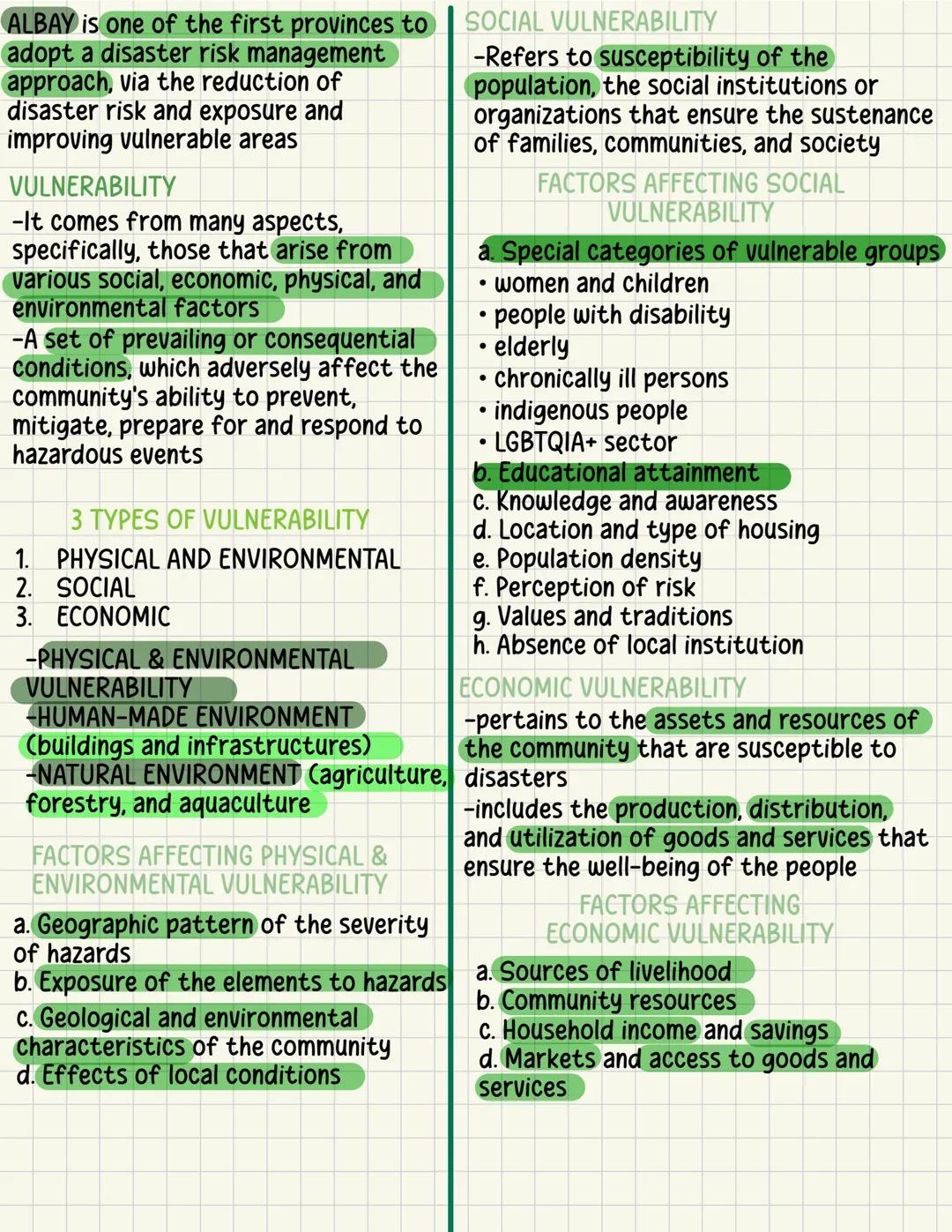
💡 Success Story: Albay province was one of the first in the Philippines to adopt a comprehensive disaster risk management approach. By focusing on reducing disaster risk and exposure while improving vulnerable areas, they've significantly decreased disaster impacts in their region.

--- OCR Start ---
Disaster
Disaster
-serious disruption of the functioning
of a community or a society causing
widespread human, material,
e

Understanding Vulnerability

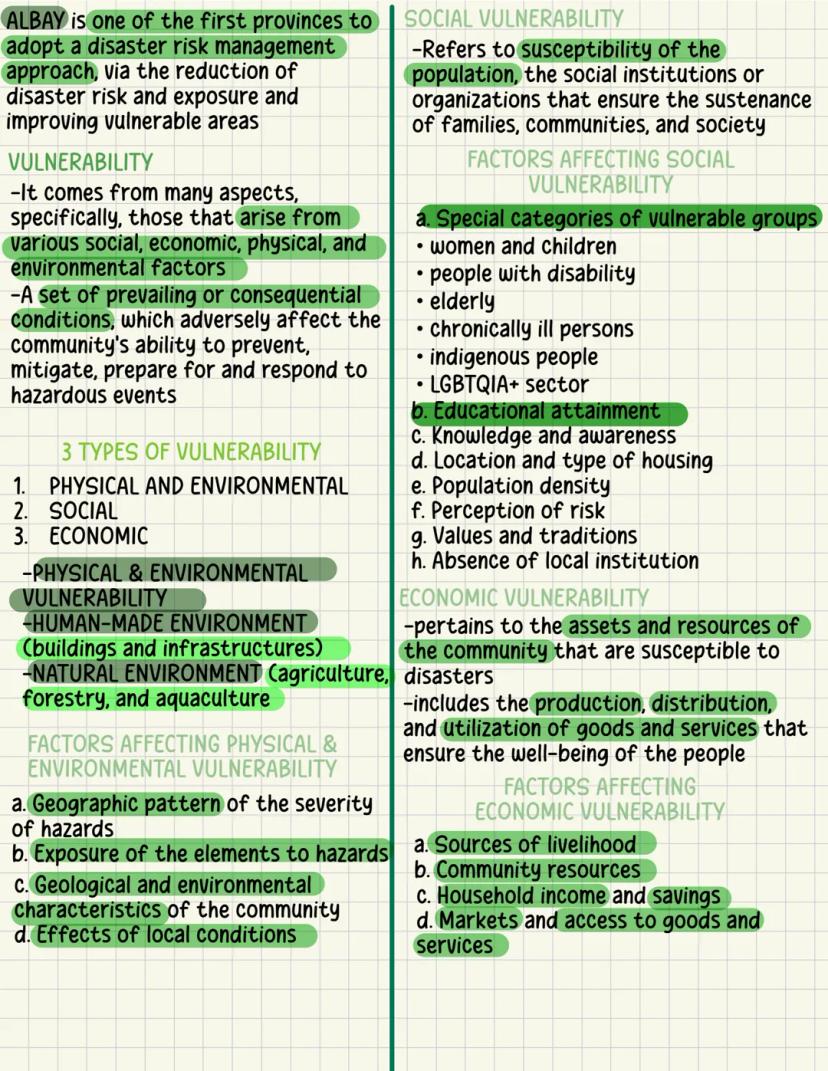
Vulnerability refers to conditions that adversely affect a community's ability to prevent, mitigate, prepare for, and respond to hazards. It stems from various social, economic, physical, and environmental factors that make people susceptible to disasters.

The three main types of vulnerability are:

  1. Physical and Environmental Vulnerability

    • Affects human-made environments (buildings, infrastructure)
    • Affects natural environments (agriculture, forestry, aquaculture)
    • Influenced by geographic patterns of hazards, exposure, geological characteristics, and local conditions
  2. Social Vulnerability

    • Refers to susceptibility of populations and social institutions
    • Particularly affects vulnerable groups:
      • Women and children
      • People with disabilities
      • Elderly individuals
      • Chronically ill persons
      • Indigenous people
      • LGBTQIA+ sector
    • Also influenced by educational attainment, knowledge, housing type, population density, and community values
  3. Economic Vulnerability

    • Pertains to community assets and resources susceptible to disasters
    • Includes production, distribution, and utilization of goods and services
    • Factors include livelihood sources, community resources, household income, and access to markets

💡 Important fact: Your level of vulnerability to disasters depends not just on where you live, but also on your social status, economic resources, and access to information. Reducing vulnerability requires addressing all these dimensions.

--- OCR Start ---
Disaster
Disaster
-serious disruption of the functioning
of a community or a society causing
widespread human, material,
e

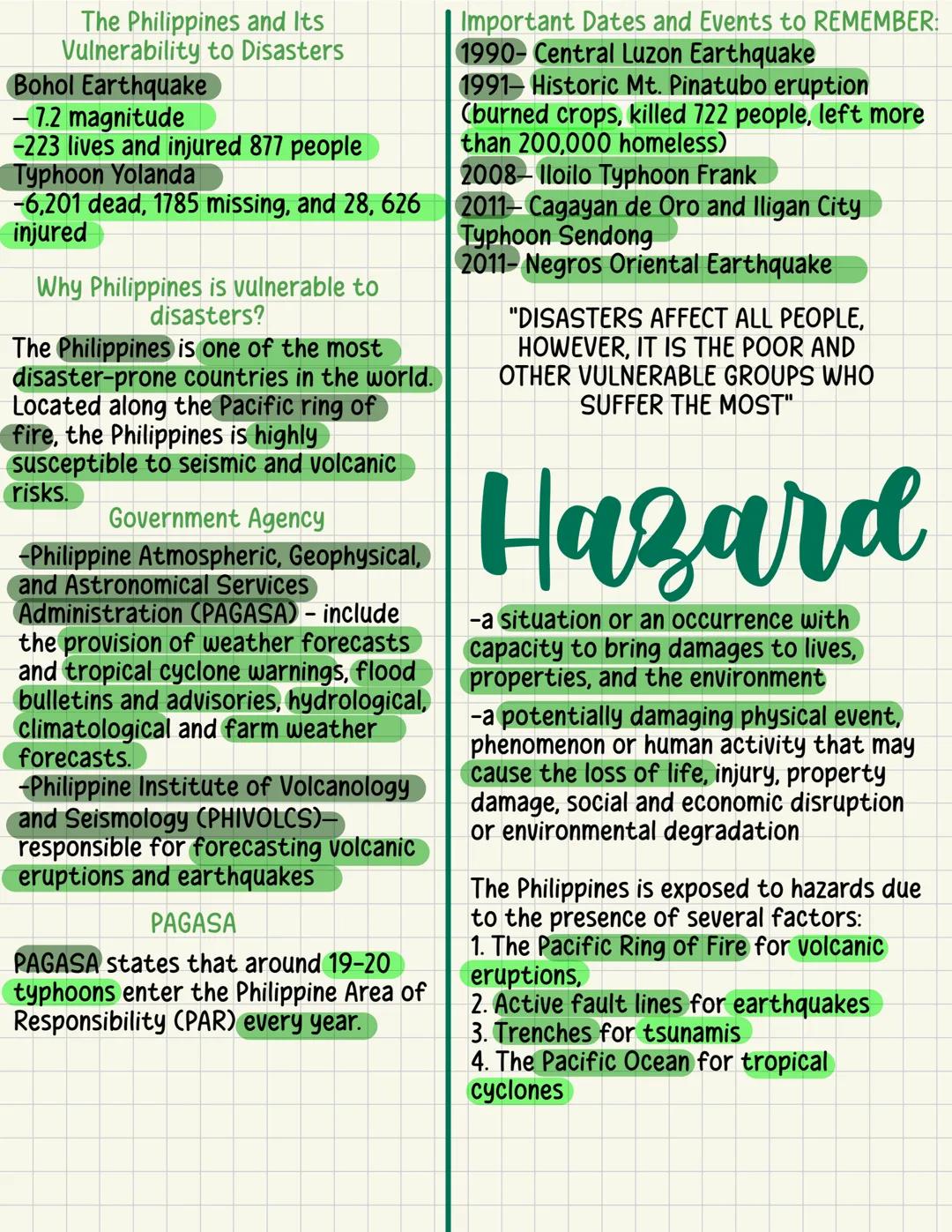
The Philippines and Hazards

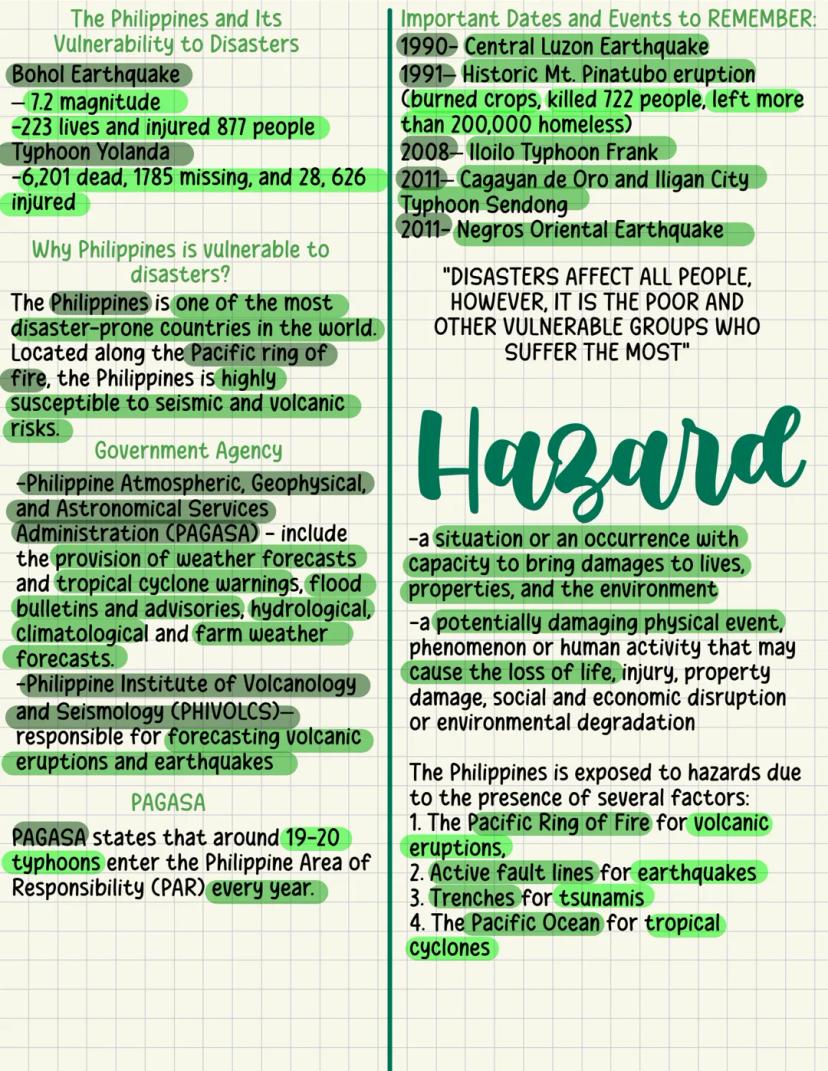
The Philippines ranks among the most disaster-prone countries in the world. Located along the Pacific Ring of Fire, the country is highly susceptible to seismic and volcanic risks. Additionally, about 19-20 typhoons enter the Philippine Area of Responsibility (PAR) annually, according to PAGASA.

Major disasters in recent Philippine history include:

  • The 2013 Bohol Earthquake (7.2 magnitude, 223 lives lost)
  • Typhoon Yolanda in 2013 (6,201 dead, 1,785 missing)
  • The 1991 Mt. Pinatubo eruption (killed 722 people, left 200,000 homeless)
  • The 2020 COVID-19 pandemic

Government agencies play crucial roles in disaster monitoring:

  • PAGASA (Philippine Atmospheric, Geophysical, and Astronomical Services Administration) provides weather forecasts and tropical cyclone warnings
  • PHIVOLCS (Philippine Institute of Volcanology and Seismology) forecasts volcanic eruptions and earthquakes

A hazard is a potentially damaging physical event, phenomenon, or human activity that may cause loss of life, injury, property damage, or environmental degradation. The Philippines faces multiple hazards due to:

  1. The Pacific Ring of Fire (volcanic eruptions)
  2. Active fault lines (earthquakes)
  3. Trenches (tsunamis)
  4. The Pacific Ocean (tropical cyclones)

💡 Remember: "Disasters affect all people; however, it is the poor and other vulnerable groups who suffer the most." This highlights why disaster preparation and education must be accessible to everyone.

--- OCR Start ---
Disaster
Disaster
-serious disruption of the functioning
of a community or a society causing
widespread human, material,
e

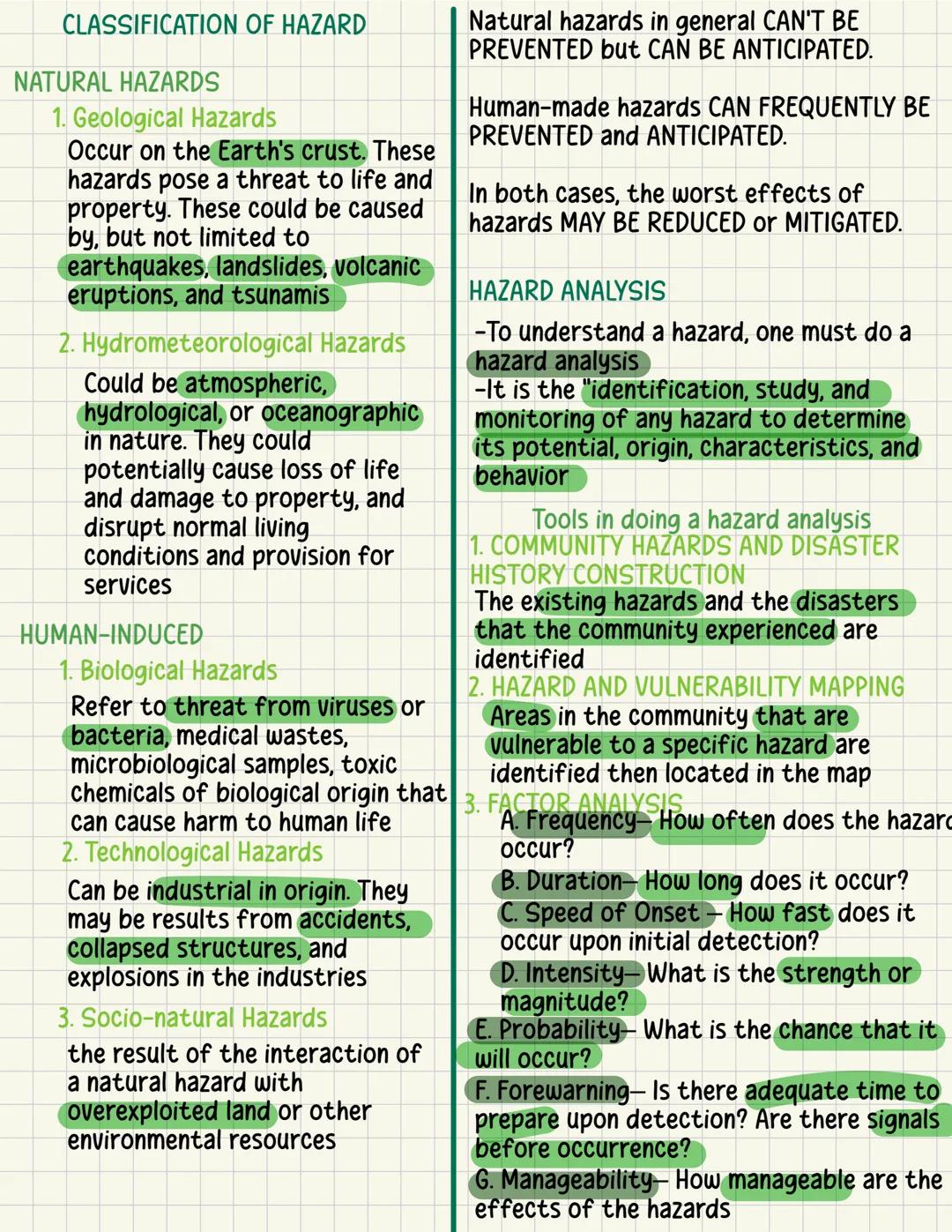
Classification of Hazards

Hazards are classified into natural and human-induced categories, each with distinct characteristics and impacts.

Natural Hazards:

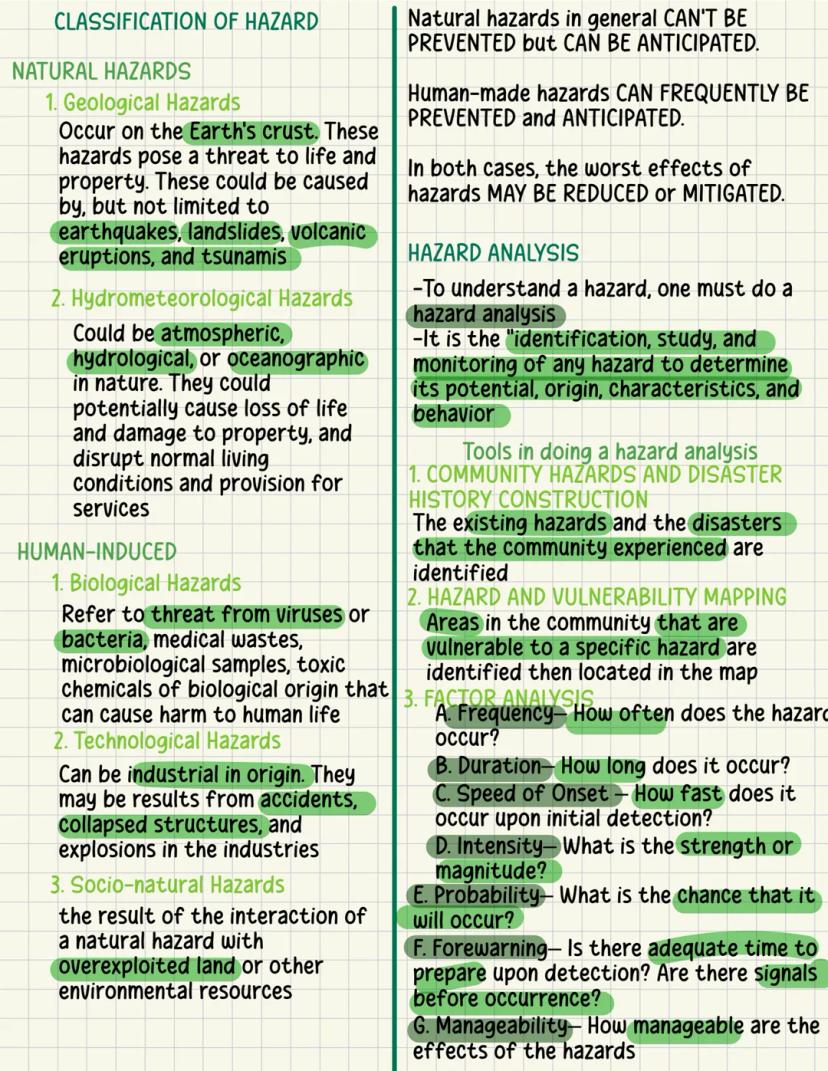
  1. Geological Hazards occur within Earth's crust and pose threats to life and property, including:

    • Earthquakes
    • Landslides
    • Volcanic eruptions
    • Tsunamis
  2. Hydrometeorological Hazards are atmospheric, hydrological, or oceanographic events that can cause loss of life and damage:

    • Typhoons and hurricanes
    • Floods
    • Droughts
    • Storm surges

Human-Induced Hazards:

  1. Biological Hazards include threats from viruses, bacteria, medical wastes, and toxic chemicals of biological origin

  2. Technological Hazards are industrial in origin, resulting from accidents, collapsed structures, and industrial explosions

  3. Socio-natural Hazards result from interaction between natural hazards and overexploited environmental resources

While natural hazards generally can't be prevented but can be anticipated, human-made hazards can frequently be both prevented and anticipated. In all cases, the worst effects may be reduced or mitigated through proper planning.

Hazard analysis tools help communities understand and prepare for hazards:

  1. Community Hazards and Disaster History Construction identifies existing hazards and past disaster experiences
  2. Hazard and Vulnerability Mapping locates vulnerable areas on maps
  3. Factor Analysis examines frequency, duration, speed of onset, intensity, probability, forewarning, and manageability of hazards

💡 Pro tip: When analyzing a hazard in your community, remember to assess both its likelihood (how often it might occur) and its potential impact (how severe it could be). This helps prioritize which hazards need the most urgent attention.

--- OCR Start ---
Disaster
Disaster
-serious disruption of the functioning
of a community or a society causing
widespread human, material,
e

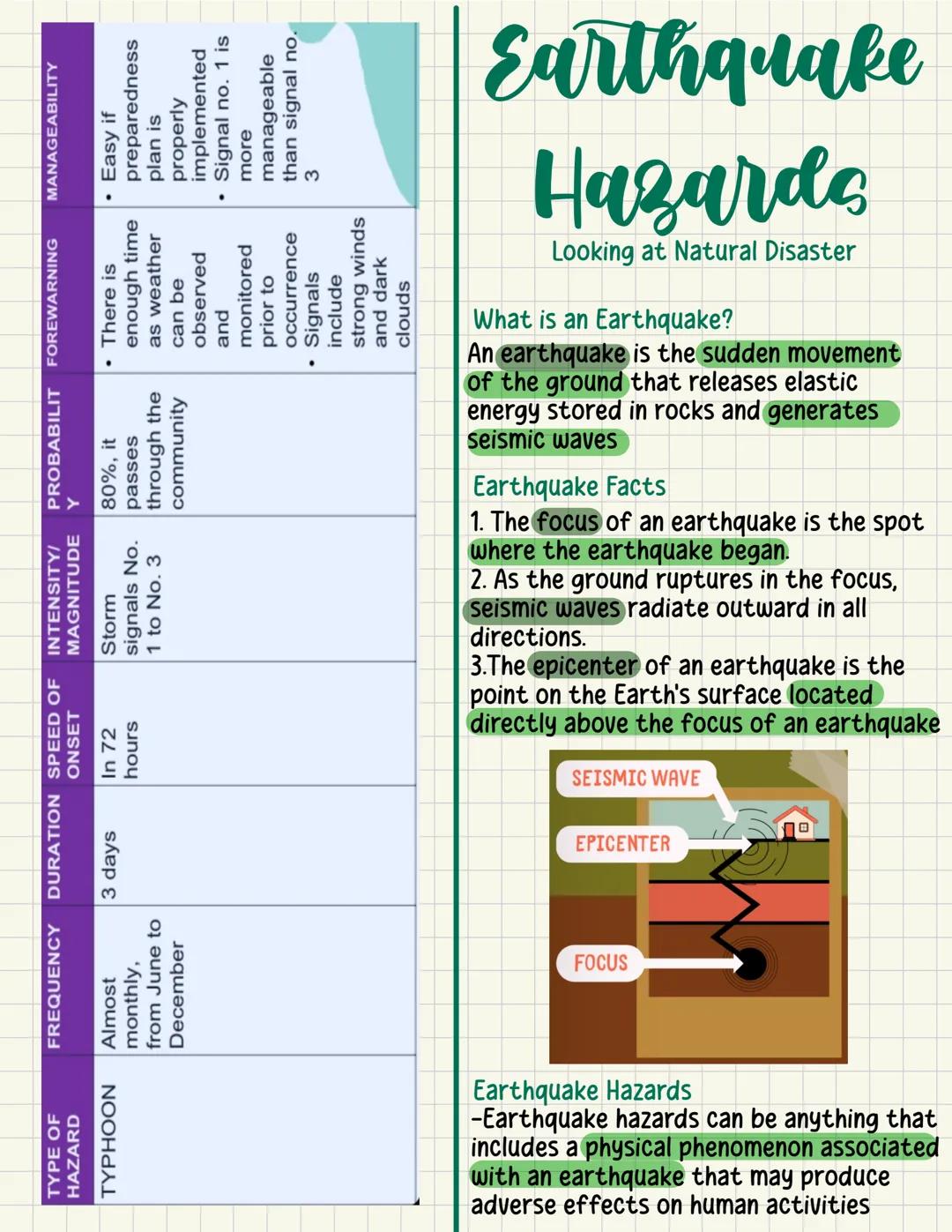
Earthquake Hazards

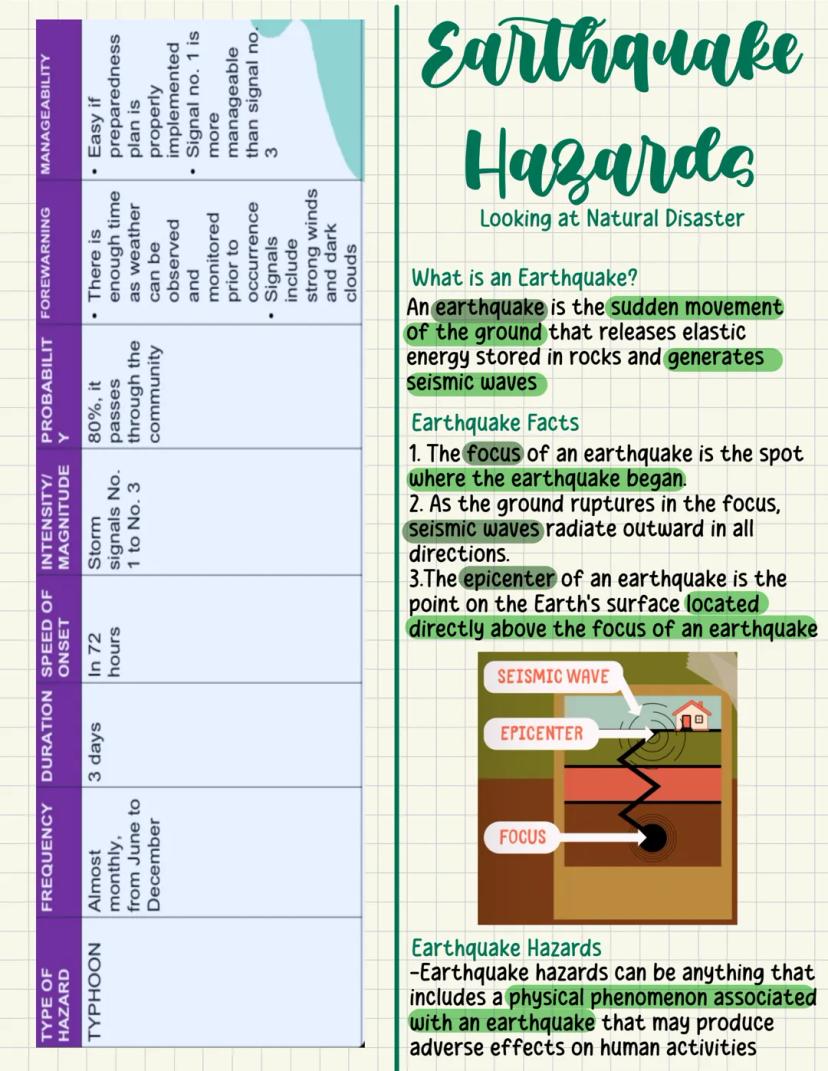
An earthquake is the sudden ground movement that releases elastic energy stored in rocks and generates seismic waves. Understanding earthquake basics can help you prepare for these unpredictable events.

Key earthquake terminology:

  • The focus is where the earthquake begins underground
  • Seismic waves radiate outward in all directions from the focus
  • The epicenter is the point on Earth's surface directly above the focus

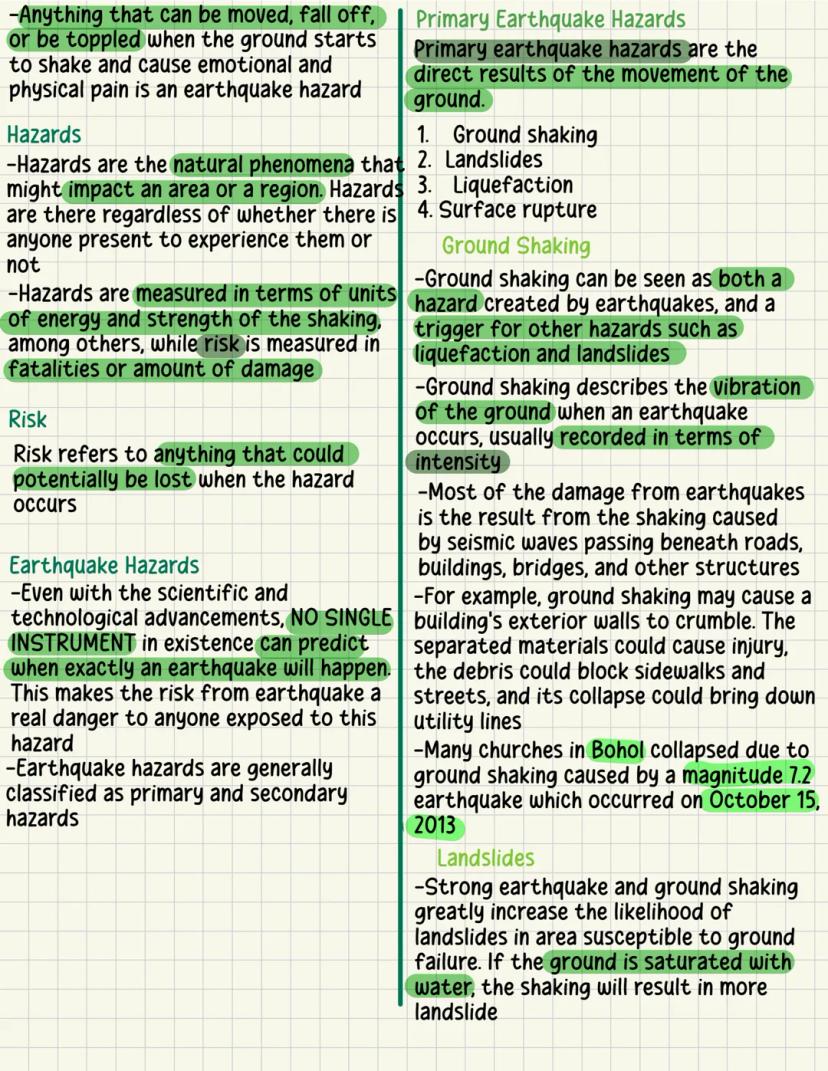
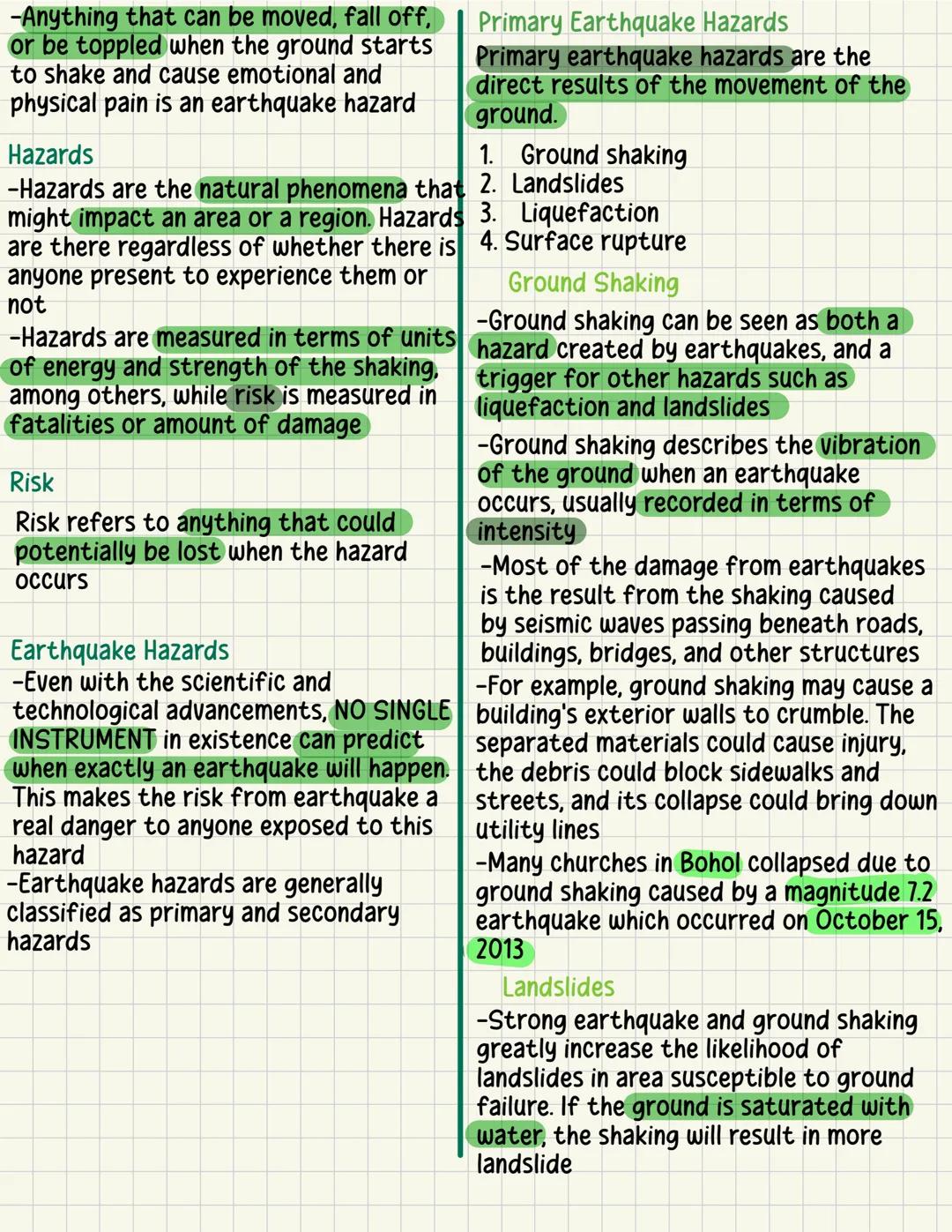
Earthquake hazards are physical phenomena associated with earthquakes that produce adverse effects on human activities. Essentially, anything that can move, fall, or topple when the ground shakes and cause harm is considered an earthquake hazard.

It's important to distinguish between hazards and risks:

  • Hazards are natural phenomena that might impact an area, measured in units of energy or strength of shaking
  • Risk refers to what could potentially be lost when the hazard occurs, measured in fatalities or amount of damage

Despite scientific advancements, no instrument can predict exactly when an earthquake will happen, making earthquake risk a real danger to those in vulnerable areas.

💡 Important distinction: A hazard is the natural event itself (like ground shaking), while risk involves the potential consequences to people and property. You can't stop an earthquake from happening, but you can reduce your risk through preparation and structural improvements.

--- OCR Start ---
Disaster
Disaster
-serious disruption of the functioning
of a community or a society causing
widespread human, material,
e

Primary Earthquake Hazards

Primary earthquake hazards are the direct results of ground movement during an earthquake. Understanding these hazards helps you prepare for potential impacts.

  1. Ground shaking is both a hazard itself and a trigger for other hazards:

    • Vibrations when an earthquake occurs are recorded as intensity
    • Most earthquake damage results from seismic waves passing beneath structures
    • Can cause building exteriors to crumble, creating injuries and blocking escape routes
    • The 2013 Bohol earthquake (7.2 magnitude) collapsed many churches due to severe ground shaking
  2. Landslides become more likely during earthquakes:

    • Strong ground shaking increases landslide probability in susceptible areas
    • Water-saturated ground is especially vulnerable to earthquake-triggered landslides
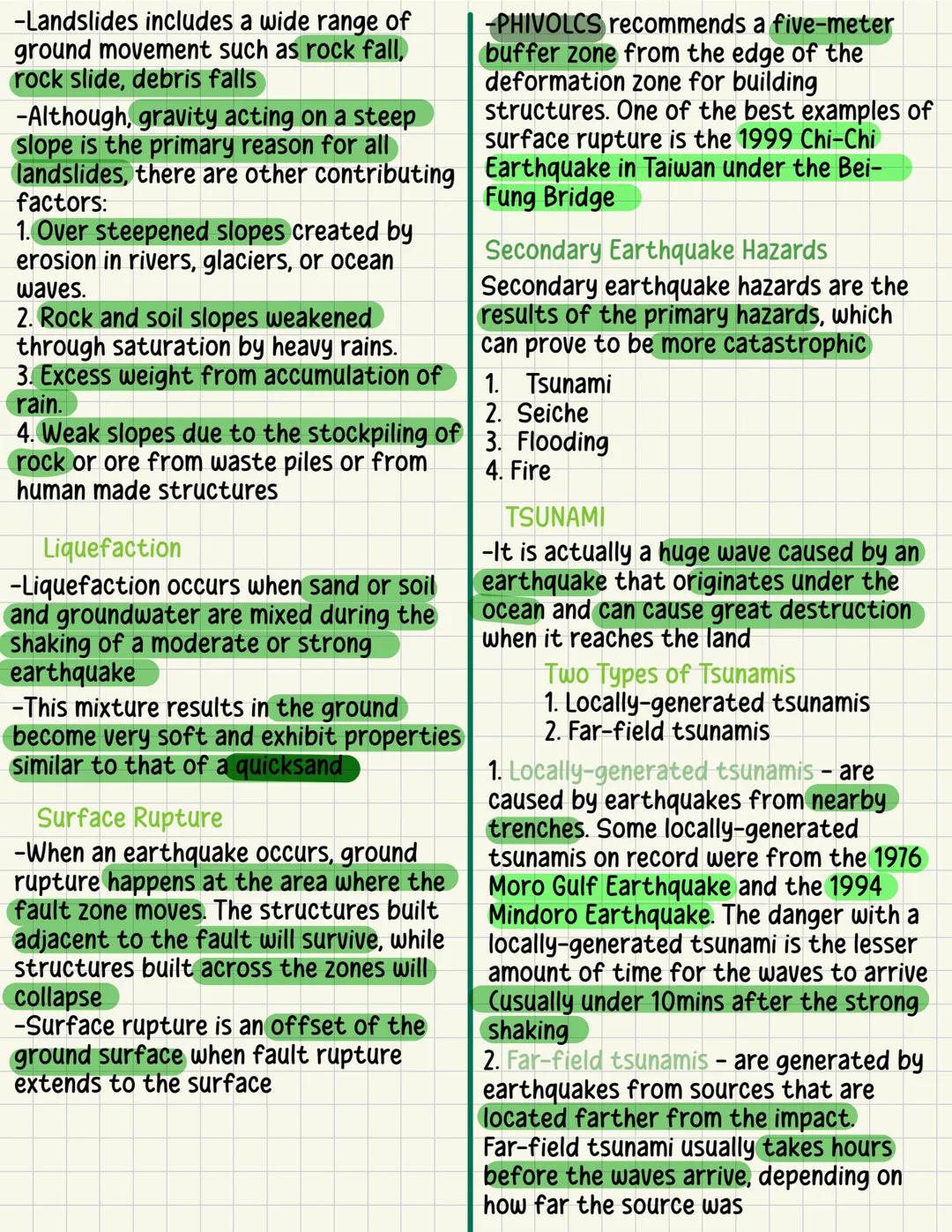
    • Include rock falls, rock slides, and debris falls
    • Contributing factors include over-steepened slopes, water saturation, and excess weight
  3. Liquefaction occurs when soil and groundwater mix during moderate or strong earthquakes:

    • Results in ground becoming very soft, similar to quicksand
    • Buildings can sink, tilt, or collapse when built on liquefied soil
  4. Surface rupture happens when fault movement reaches the surface:

    • Structures built across fault zones will collapse during rupture
    • Creates an offset of the ground surface
    • PHIVOLCS recommends a five-meter buffer zone from deformation edges
    • The 1999 Chi-Chi Earthquake in Taiwan demonstrated dramatic surface rupture at Bei-Fung Bridge

💡 Safety tip: During an earthquake, remember to "Drop, Cover, and Hold On." Drop to the ground before the earthquake drops you, take cover under a sturdy desk or table, and hold on until the shaking stops.

--- OCR Start ---
Disaster
Disaster
-serious disruption of the functioning
of a community or a society causing
widespread human, material,
e

Secondary Earthquake Hazards

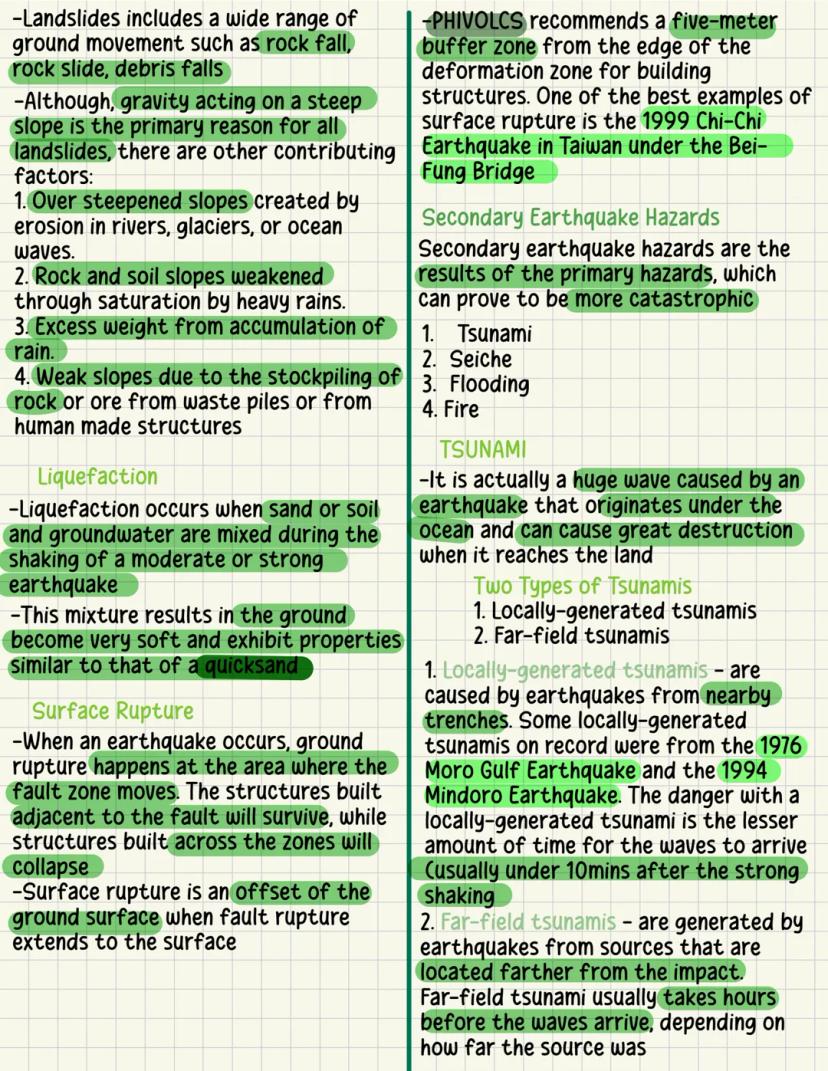
Secondary earthquake hazards result from primary hazards and can be more catastrophic than the initial earthquake. They include:

  1. Tsunamis are huge waves caused by underwater earthquakes that can cause devastating destruction when they reach land. They come in two types:

    • Locally-generated tsunamis come from nearby trenches (like the 1976 Moro Gulf Earthquake) and arrive within minutes of shaking, giving little warning time
    • Far-field tsunamis come from distant sources and may take hours to arrive
  2. Seiches are standing waves in enclosed or partially-enclosed bodies of water triggered by earthquake waves. They can affect:

    • Lakes and reservoirs
    • Swimming pools
    • Bays and harbors
  3. Flooding can result from earthquakes in several ways:

    • Tsunami waters remaining after initial waves recede
    • Landslides hitting rivers and causing water to overflow
    • Damaged dams releasing water into low-lying areas
    • Can cause significant loss of life and property regardless of cause
  4. Fire is a major secondary hazard following earthquakes:

    • Historically caused by tipped-over candles or lanterns
    • Modern sources include damaged gas lines and electrical wires
    • Water for firefighting may be unavailable due to broken water mains
    • The 1995 Kobe Earthquake in Japan saw hundreds of fires break out while water systems failed

💡 Tsunami safety tip: If you're near the coast and feel strong earthquake shaking, don't wait for official warnings—move immediately to higher ground or inland. Natural warning signs like unusual water recession should trigger immediate evacuation.

--- OCR Start ---
Disaster
Disaster
-serious disruption of the functioning
of a community or a society causing
widespread human, material,
e

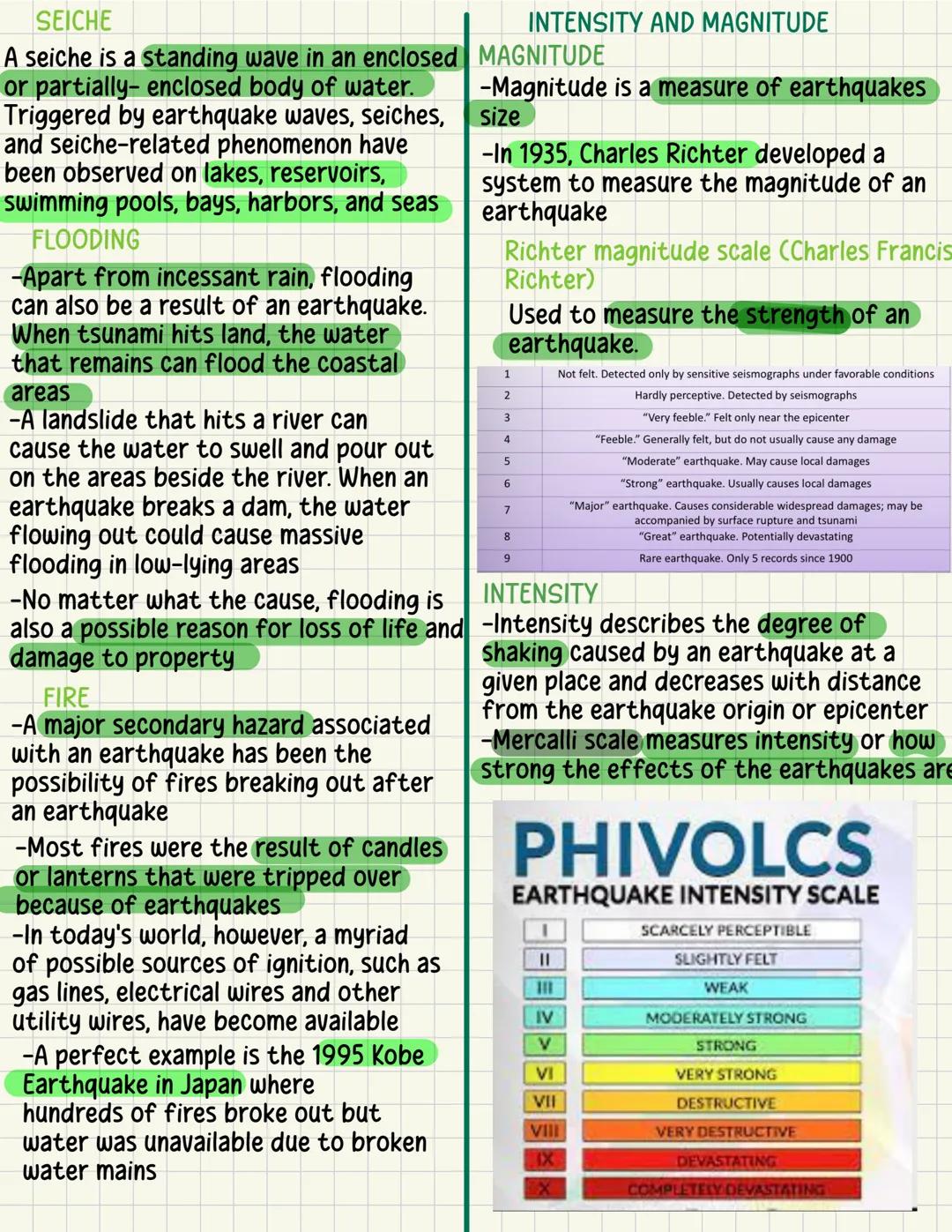
Earthquake Intensity and Magnitude

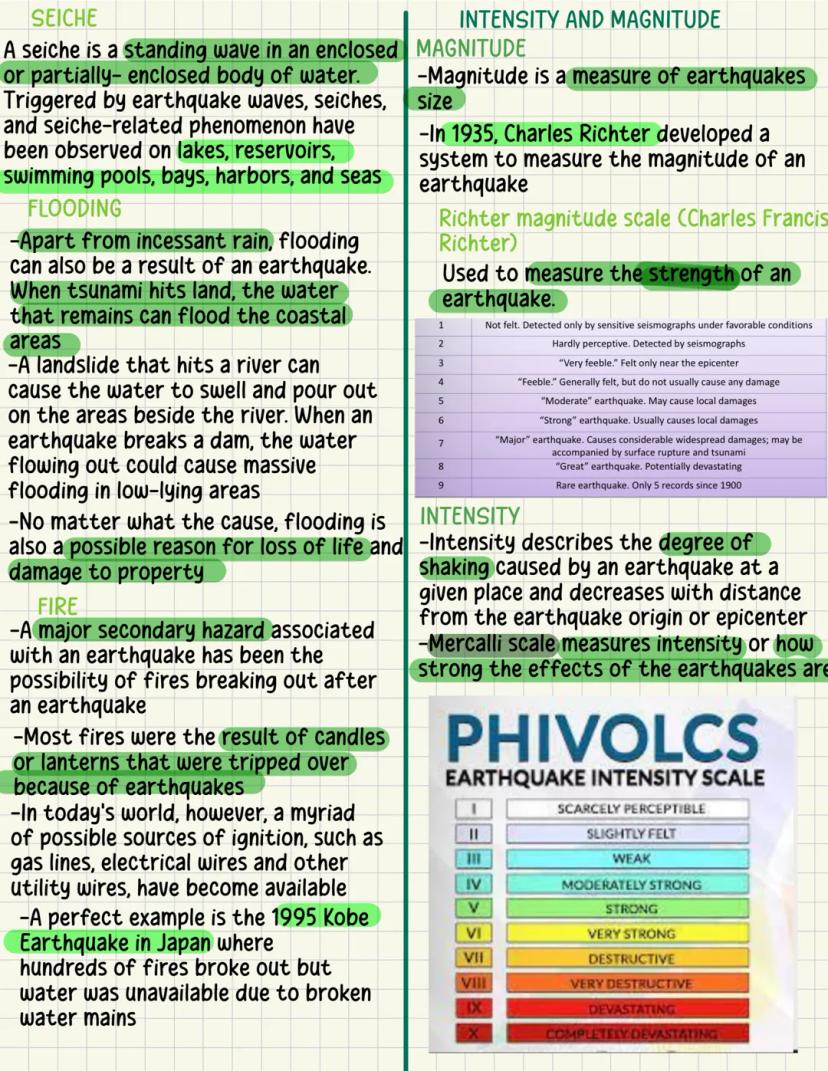
Magnitude measures an earthquake's size or energy release, while intensity describes the degree of shaking at a specific location. Understanding both helps assess earthquake impacts.

Magnitude (Richter Scale):

  • Developed by Charles Richter in 1935
  • Measures the absolute size of an earthquake
  • Logarithmic scale where each number represents about 31 times more energy than the previous number
  • Scale ranges from 1 (barely detectable) to 9+ (extremely rare, devastating earthquakes)

The Richter magnitude scale measures earthquakes from:

  • 1-3: Minor earthquakes, often only detected by instruments
  • 4-5: Noticeable shaking, minor damage possible
  • 6-7: Strong to major earthquakes causing significant damage
  • 8-9+: Great to rare catastrophic earthquakes with widespread destruction

Intensity (PHIVOLCS Earthquake Intensity Scale):

  • Measures the effects of an earthquake at a specific location
  • Decreases with distance from the epicenter
  • PHIVOLCS uses a scale from I (scarcely perceptible) to X (completely devastating)

Key intensity levels include:

  • I-III: Barely noticeable to weak shaking
  • IV-V: Moderately strong to strong shaking
  • VI-VII: Very strong to destructive effects
  • VIII-X: Very destructive to completely devastating impacts

💡 Understanding the difference: Think of magnitude as the size of the earthquake at its source (like wattage of a light bulb), while intensity is how strong the effects are where you are (how bright the light appears from different distances).


We thought you’d never ask...

What is the Knowunity AI companion?

Our AI companion is specifically built for the needs of students. Based on the millions of content pieces we have on the platform we can provide truly meaningful and relevant answers to students. But its not only about answers, the companion is even more about guiding students through their daily learning challenges, with personalised study plans, quizzes or content pieces in the chat and 100% personalisation based on the students skills and developments.

Where can I download the Knowunity app?

You can download the app in the Google Play Store and in the Apple App Store.

Is Knowunity really free of charge?

That's right! Enjoy free access to study content, connect with fellow students, and get instant help – all at your fingertips.

Can't find what you're looking for? Explore other subjects.

Students love us — and so will you.

4.9/5

App Store

4.8/5

Google Play

The app is very easy to use and well designed. I have found everything I was looking for so far and have been able to learn a lot from the presentations! I will definitely use the app for a class assignment! And of course it also helps a lot as an inspiration.

Stefan S

iOS user

This app is really great. There are so many study notes and help [...]. My problem subject is French, for example, and the app has so many options for help. Thanks to this app, I have improved my French. I would recommend it to anyone.

Samantha Klich

Android user

Wow, I am really amazed. I just tried the app because I've seen it advertised many times and was absolutely stunned. This app is THE HELP you want for school and above all, it offers so many things, such as workouts and fact sheets, which have been VERY helpful to me personally.

Anna

iOS user

I think it’s very much worth it and you’ll end up using it a lot once you get the hang of it and even after looking at others notes you can still ask your Artificial intelligence buddy the question and ask to simplify it if you still don’t get it!!! In the end I think it’s worth it 😊👍 ⚠️Also DID I MENTION ITS FREEE YOU DON’T HAVE TO PAY FOR ANYTHING AND STILL GET YOUR GRADES IN PERFECTLY❗️❗️⚠️

Thomas R

iOS user

Knowunity is the BEST app I’ve used in a minute. This is not an ai review or anything this is genuinely coming from a 7th grade student (I know 2011 im young) but dude this app is a 10/10 i have maintained a 3.8 gpa and have plenty of time for gaming. I love it and my mom is just happy I got good grades

Brad T

Android user

Not only did it help me find the answer but it also showed me alternative ways to solve it. I was horrible in math and science but now I have an a in both subjects. Thanks for the help🤍🤍

David K

iOS user

The app's just great! All I have to do is enter the topic in the search bar and I get the response real fast. I don't have to watch 10 YouTube videos to understand something, so I'm saving my time. Highly recommended!

Sudenaz Ocak

Android user

In school I was really bad at maths but thanks to the app, I am doing better now. I am so grateful that you made the app.

Greenlight Bonnie

Android user

I found this app a couple years ago and it has only gotten better since then. I really love it because it can help with written questions and photo questions. Also, it can find study guides that other people have made as well as flashcard sets and practice tests. The free version is also amazing for students who might not be able to afford it. Would 100% recommend

Aubrey

iOS user

Best app if you're in Highschool or Junior high. I have been using this app for 2 school years and it's the best, it's good if you don't have anyone to help you with school work.😋🩷🎀

Marco B

iOS user

THE QUIZES AND FLASHCARDS ARE SO USEFUL AND I LOVE THE SCHOOLGPT. IT ALSO IS LITREALLY LIKE CHATGPT BUT SMARTER!! HELPED ME WITH MY MASCARA PROBLEMS TOO!! AS WELL AS MY REAL SUBJECTS ! DUHHH 😍😁😲🤑💗✨🎀😮

Elisha

iOS user

This app is phenomenal down to the correct info and the various topics you can study! I greatly recommend it for people who struggle with procrastination and those who need homework help. It has been perfectly accurate for world 1 history as far as I’ve seen! Geometry too!

Paul T

iOS user

The app is very easy to use and well designed. I have found everything I was looking for so far and have been able to learn a lot from the presentations! I will definitely use the app for a class assignment! And of course it also helps a lot as an inspiration.

Stefan S

iOS user

This app is really great. There are so many study notes and help [...]. My problem subject is French, for example, and the app has so many options for help. Thanks to this app, I have improved my French. I would recommend it to anyone.

Samantha Klich

Android user

Wow, I am really amazed. I just tried the app because I've seen it advertised many times and was absolutely stunned. This app is THE HELP you want for school and above all, it offers so many things, such as workouts and fact sheets, which have been VERY helpful to me personally.

Anna

iOS user

I think it’s very much worth it and you’ll end up using it a lot once you get the hang of it and even after looking at others notes you can still ask your Artificial intelligence buddy the question and ask to simplify it if you still don’t get it!!! In the end I think it’s worth it 😊👍 ⚠️Also DID I MENTION ITS FREEE YOU DON’T HAVE TO PAY FOR ANYTHING AND STILL GET YOUR GRADES IN PERFECTLY❗️❗️⚠️

Thomas R

iOS user

Knowunity is the BEST app I’ve used in a minute. This is not an ai review or anything this is genuinely coming from a 7th grade student (I know 2011 im young) but dude this app is a 10/10 i have maintained a 3.8 gpa and have plenty of time for gaming. I love it and my mom is just happy I got good grades

Brad T

Android user

Not only did it help me find the answer but it also showed me alternative ways to solve it. I was horrible in math and science but now I have an a in both subjects. Thanks for the help🤍🤍

David K

iOS user

The app's just great! All I have to do is enter the topic in the search bar and I get the response real fast. I don't have to watch 10 YouTube videos to understand something, so I'm saving my time. Highly recommended!

Sudenaz Ocak

Android user

In school I was really bad at maths but thanks to the app, I am doing better now. I am so grateful that you made the app.

Greenlight Bonnie

Android user

I found this app a couple years ago and it has only gotten better since then. I really love it because it can help with written questions and photo questions. Also, it can find study guides that other people have made as well as flashcard sets and practice tests. The free version is also amazing for students who might not be able to afford it. Would 100% recommend

Aubrey

iOS user

Best app if you're in Highschool or Junior high. I have been using this app for 2 school years and it's the best, it's good if you don't have anyone to help you with school work.😋🩷🎀

Marco B

iOS user

THE QUIZES AND FLASHCARDS ARE SO USEFUL AND I LOVE THE SCHOOLGPT. IT ALSO IS LITREALLY LIKE CHATGPT BUT SMARTER!! HELPED ME WITH MY MASCARA PROBLEMS TOO!! AS WELL AS MY REAL SUBJECTS ! DUHHH 😍😁😲🤑💗✨🎀😮

Elisha

iOS user

This app is phenomenal down to the correct info and the various topics you can study! I greatly recommend it for people who struggle with procrastination and those who need homework help. It has been perfectly accurate for world 1 history as far as I’ve seen! Geometry too!

Paul T

iOS user


DRRR

182

Dec 11, 2025

28 pages

Introduction to Disaster Preparedness and Risk Management

user profile picture

Karen Gella

@cayennexxx

Disasters are serious disruptions that cause widespread human, material, and environmental losses beyond a community's ability to cope using its own resources. Understanding disaster risks and implementing preparedness strategies can significantly reduce impacts, which may include loss of lives, injuries,... Show more

--- OCR Start ---
Disaster
Disaster
-serious disruption of the functioning
of a community or a society causing
widespread human, material,
e

Sign up to see the contentIt's free!

Access to all documents

Improve your grades

Join milions of students

By signing up you accept Terms of Service and Privacy Policy

Understanding Disasters and Risk

Disasters seriously disrupt communities by causing widespread losses that exceed a society's ability to cope using only its own resources. When disasters strike, they can impact everything from human health to economic stability and environmental wellbeing.

Disaster risk is the probability of harmful consequences resulting from interactions between natural or human-induced hazards and vulnerable conditions. The 2015 World Risk Report ranked the Philippines as the third highest country at risk to disasters globally, highlighting the urgency of understanding and preparing for potential threats.

Disasters can be classified into different categories based on their origin:

  1. Natural disasters: Include geological events (earthquakes, volcanic eruptions, tsunamis), hydrometeorological events (typhoons, floods, storm surges), and biological threats (epidemics, insect infestations)

  2. Human-induced (anthropogenic) disasters: Include technological failures, hazardous materials incidents, war, terrorism, and civil unrest

💡 Remember: Disaster Risk Reduction (DRR) uses a proactive approach where potential risks are identified, assessed, and managed before disasters happen rather than just responding after they occur.

--- OCR Start ---
Disaster
Disaster
-serious disruption of the functioning
of a community or a society causing
widespread human, material,
e

Sign up to see the contentIt's free!

Access to all documents

Improve your grades

Join milions of students

By signing up you accept Terms of Service and Privacy Policy

Types of Disasters and Their Effects

Natural disasters come in many forms and affect communities differently:

  • Agricultural diseases and pests can destroy food supplies
  • Earthquakes, hurricanes, and tsunamis can devastate infrastructure
  • Droughts, landslides, and wildfires can make environments uninhabitable

Human-induced disasters result from people's actions against humans, materials, and the environment:

  • Transport and industrial accidents (chemical spills, building collapses)
  • Power disruptions and blackouts
  • Nuclear incidents and radiological emergencies
  • Cyber attacks and civil unrest

The effects of disasters occur at different stages:

  • Primary effects come directly from the disaster (water damage from floods, collapsed buildings from earthquakes)
  • Secondary effects stem from primary effects (fires breaking out after an earthquake)
  • Tertiary effects are long-term consequences (permanent relocation of communities)

Disasters impact societies through multiple dimensions:

  • Human/biological effects (spread of infectious diseases)
  • Social and psychological impacts (trauma and PTSD)
  • Physical/material destruction (damaged infrastructure)
  • Economic consequences (extreme poverty)
  • Environmental degradation (loss of natural resources)

💡 Did you know? The Philippines ranks ninth for having the highest disaster risk worldwide out of 180 assessed countries according to the World Risk Report 2019.

--- OCR Start ---
Disaster
Disaster
-serious disruption of the functioning
of a community or a society causing
widespread human, material,
e

Sign up to see the contentIt's free!

Access to all documents

Improve your grades

Join milions of students

By signing up you accept Terms of Service and Privacy Policy

Disaster Exposure and Vulnerability

Exposure refers to the total value of elements at risk—the number of lives and property value potentially affected by disasters. As urban centers and economic activities expand into hazard-prone areas, exposure increases dramatically.

Countries with smaller economies and high fiscal deficits show greater vulnerability even when faced with small-scale disasters. To reduce exposure, communities should:

  1. Map out the hazards they face
  2. Hold consultative meetings with stakeholders
  3. Educate the public about real dangers of natural hazards

Psychological impacts of disasters are significant but often overlooked. Exposure to traumatic events results in generalized fear, anxiety, and depression. Many survivors suffer from post-traumatic stress disorder (PTSD) even after physical recovery.

Environmental degradation from disasters compounds existing problems. Global warming affects energy, agriculture, health, and marine resources. Extreme weather changes and rising carbon dioxide reduce agricultural harvests, threatening food security.

The economic impacts of disasters contribute to extreme poverty and inequality, slowing the implementation of Sustainable Development Goals (SDGs). After major disasters, recovery often takes years of concentrated effort.

💡 Success Story: Albay province was one of the first in the Philippines to adopt a comprehensive disaster risk management approach. By focusing on reducing disaster risk and exposure while improving vulnerable areas, they've significantly decreased disaster impacts in their region.

--- OCR Start ---
Disaster
Disaster
-serious disruption of the functioning
of a community or a society causing
widespread human, material,
e

Sign up to see the contentIt's free!

Access to all documents

Improve your grades

Join milions of students

By signing up you accept Terms of Service and Privacy Policy

Understanding Vulnerability

Vulnerability refers to conditions that adversely affect a community's ability to prevent, mitigate, prepare for, and respond to hazards. It stems from various social, economic, physical, and environmental factors that make people susceptible to disasters.

The three main types of vulnerability are:

  1. Physical and Environmental Vulnerability

    • Affects human-made environments (buildings, infrastructure)
    • Affects natural environments (agriculture, forestry, aquaculture)
    • Influenced by geographic patterns of hazards, exposure, geological characteristics, and local conditions
  2. Social Vulnerability

    • Refers to susceptibility of populations and social institutions
    • Particularly affects vulnerable groups:
      • Women and children
      • People with disabilities
      • Elderly individuals
      • Chronically ill persons
      • Indigenous people
      • LGBTQIA+ sector
    • Also influenced by educational attainment, knowledge, housing type, population density, and community values
  3. Economic Vulnerability

    • Pertains to community assets and resources susceptible to disasters
    • Includes production, distribution, and utilization of goods and services
    • Factors include livelihood sources, community resources, household income, and access to markets

💡 Important fact: Your level of vulnerability to disasters depends not just on where you live, but also on your social status, economic resources, and access to information. Reducing vulnerability requires addressing all these dimensions.

--- OCR Start ---
Disaster
Disaster
-serious disruption of the functioning
of a community or a society causing
widespread human, material,
e

Sign up to see the contentIt's free!

Access to all documents

Improve your grades

Join milions of students

By signing up you accept Terms of Service and Privacy Policy

The Philippines and Hazards

The Philippines ranks among the most disaster-prone countries in the world. Located along the Pacific Ring of Fire, the country is highly susceptible to seismic and volcanic risks. Additionally, about 19-20 typhoons enter the Philippine Area of Responsibility (PAR) annually, according to PAGASA.

Major disasters in recent Philippine history include:

  • The 2013 Bohol Earthquake (7.2 magnitude, 223 lives lost)
  • Typhoon Yolanda in 2013 (6,201 dead, 1,785 missing)
  • The 1991 Mt. Pinatubo eruption (killed 722 people, left 200,000 homeless)
  • The 2020 COVID-19 pandemic

Government agencies play crucial roles in disaster monitoring:

  • PAGASA (Philippine Atmospheric, Geophysical, and Astronomical Services Administration) provides weather forecasts and tropical cyclone warnings
  • PHIVOLCS (Philippine Institute of Volcanology and Seismology) forecasts volcanic eruptions and earthquakes

A hazard is a potentially damaging physical event, phenomenon, or human activity that may cause loss of life, injury, property damage, or environmental degradation. The Philippines faces multiple hazards due to:

  1. The Pacific Ring of Fire (volcanic eruptions)
  2. Active fault lines (earthquakes)
  3. Trenches (tsunamis)
  4. The Pacific Ocean (tropical cyclones)

💡 Remember: "Disasters affect all people; however, it is the poor and other vulnerable groups who suffer the most." This highlights why disaster preparation and education must be accessible to everyone.

--- OCR Start ---
Disaster
Disaster
-serious disruption of the functioning
of a community or a society causing
widespread human, material,
e

Sign up to see the contentIt's free!

Access to all documents

Improve your grades

Join milions of students

By signing up you accept Terms of Service and Privacy Policy

Classification of Hazards

Hazards are classified into natural and human-induced categories, each with distinct characteristics and impacts.

Natural Hazards:

  1. Geological Hazards occur within Earth's crust and pose threats to life and property, including:

    • Earthquakes
    • Landslides
    • Volcanic eruptions
    • Tsunamis
  2. Hydrometeorological Hazards are atmospheric, hydrological, or oceanographic events that can cause loss of life and damage:

    • Typhoons and hurricanes
    • Floods
    • Droughts
    • Storm surges

Human-Induced Hazards:

  1. Biological Hazards include threats from viruses, bacteria, medical wastes, and toxic chemicals of biological origin

  2. Technological Hazards are industrial in origin, resulting from accidents, collapsed structures, and industrial explosions

  3. Socio-natural Hazards result from interaction between natural hazards and overexploited environmental resources

While natural hazards generally can't be prevented but can be anticipated, human-made hazards can frequently be both prevented and anticipated. In all cases, the worst effects may be reduced or mitigated through proper planning.

Hazard analysis tools help communities understand and prepare for hazards:

  1. Community Hazards and Disaster History Construction identifies existing hazards and past disaster experiences
  2. Hazard and Vulnerability Mapping locates vulnerable areas on maps
  3. Factor Analysis examines frequency, duration, speed of onset, intensity, probability, forewarning, and manageability of hazards

💡 Pro tip: When analyzing a hazard in your community, remember to assess both its likelihood (how often it might occur) and its potential impact (how severe it could be). This helps prioritize which hazards need the most urgent attention.

--- OCR Start ---
Disaster
Disaster
-serious disruption of the functioning
of a community or a society causing
widespread human, material,
e

Sign up to see the contentIt's free!

Access to all documents

Improve your grades

Join milions of students

By signing up you accept Terms of Service and Privacy Policy

Earthquake Hazards

An earthquake is the sudden ground movement that releases elastic energy stored in rocks and generates seismic waves. Understanding earthquake basics can help you prepare for these unpredictable events.

Key earthquake terminology:

  • The focus is where the earthquake begins underground
  • Seismic waves radiate outward in all directions from the focus
  • The epicenter is the point on Earth's surface directly above the focus

Earthquake hazards are physical phenomena associated with earthquakes that produce adverse effects on human activities. Essentially, anything that can move, fall, or topple when the ground shakes and cause harm is considered an earthquake hazard.

It's important to distinguish between hazards and risks:

  • Hazards are natural phenomena that might impact an area, measured in units of energy or strength of shaking
  • Risk refers to what could potentially be lost when the hazard occurs, measured in fatalities or amount of damage

Despite scientific advancements, no instrument can predict exactly when an earthquake will happen, making earthquake risk a real danger to those in vulnerable areas.

💡 Important distinction: A hazard is the natural event itself (like ground shaking), while risk involves the potential consequences to people and property. You can't stop an earthquake from happening, but you can reduce your risk through preparation and structural improvements.

--- OCR Start ---
Disaster
Disaster
-serious disruption of the functioning
of a community or a society causing
widespread human, material,
e

Sign up to see the contentIt's free!

Access to all documents

Improve your grades

Join milions of students

By signing up you accept Terms of Service and Privacy Policy

Primary Earthquake Hazards

Primary earthquake hazards are the direct results of ground movement during an earthquake. Understanding these hazards helps you prepare for potential impacts.

  1. Ground shaking is both a hazard itself and a trigger for other hazards:

    • Vibrations when an earthquake occurs are recorded as intensity
    • Most earthquake damage results from seismic waves passing beneath structures
    • Can cause building exteriors to crumble, creating injuries and blocking escape routes
    • The 2013 Bohol earthquake (7.2 magnitude) collapsed many churches due to severe ground shaking
  2. Landslides become more likely during earthquakes:

    • Strong ground shaking increases landslide probability in susceptible areas
    • Water-saturated ground is especially vulnerable to earthquake-triggered landslides
    • Include rock falls, rock slides, and debris falls
    • Contributing factors include over-steepened slopes, water saturation, and excess weight
  3. Liquefaction occurs when soil and groundwater mix during moderate or strong earthquakes:

    • Results in ground becoming very soft, similar to quicksand
    • Buildings can sink, tilt, or collapse when built on liquefied soil
  4. Surface rupture happens when fault movement reaches the surface:

    • Structures built across fault zones will collapse during rupture
    • Creates an offset of the ground surface
    • PHIVOLCS recommends a five-meter buffer zone from deformation edges
    • The 1999 Chi-Chi Earthquake in Taiwan demonstrated dramatic surface rupture at Bei-Fung Bridge

💡 Safety tip: During an earthquake, remember to "Drop, Cover, and Hold On." Drop to the ground before the earthquake drops you, take cover under a sturdy desk or table, and hold on until the shaking stops.

--- OCR Start ---
Disaster
Disaster
-serious disruption of the functioning
of a community or a society causing
widespread human, material,
e

Sign up to see the contentIt's free!

Access to all documents

Improve your grades

Join milions of students

By signing up you accept Terms of Service and Privacy Policy

Secondary Earthquake Hazards

Secondary earthquake hazards result from primary hazards and can be more catastrophic than the initial earthquake. They include:

  1. Tsunamis are huge waves caused by underwater earthquakes that can cause devastating destruction when they reach land. They come in two types:

    • Locally-generated tsunamis come from nearby trenches (like the 1976 Moro Gulf Earthquake) and arrive within minutes of shaking, giving little warning time
    • Far-field tsunamis come from distant sources and may take hours to arrive
  2. Seiches are standing waves in enclosed or partially-enclosed bodies of water triggered by earthquake waves. They can affect:

    • Lakes and reservoirs
    • Swimming pools
    • Bays and harbors
  3. Flooding can result from earthquakes in several ways:

    • Tsunami waters remaining after initial waves recede
    • Landslides hitting rivers and causing water to overflow
    • Damaged dams releasing water into low-lying areas
    • Can cause significant loss of life and property regardless of cause
  4. Fire is a major secondary hazard following earthquakes:

    • Historically caused by tipped-over candles or lanterns
    • Modern sources include damaged gas lines and electrical wires
    • Water for firefighting may be unavailable due to broken water mains
    • The 1995 Kobe Earthquake in Japan saw hundreds of fires break out while water systems failed

💡 Tsunami safety tip: If you're near the coast and feel strong earthquake shaking, don't wait for official warnings—move immediately to higher ground or inland. Natural warning signs like unusual water recession should trigger immediate evacuation.

--- OCR Start ---
Disaster
Disaster
-serious disruption of the functioning
of a community or a society causing
widespread human, material,
e

Sign up to see the contentIt's free!

Access to all documents

Improve your grades

Join milions of students

By signing up you accept Terms of Service and Privacy Policy

Earthquake Intensity and Magnitude

Magnitude measures an earthquake's size or energy release, while intensity describes the degree of shaking at a specific location. Understanding both helps assess earthquake impacts.

Magnitude (Richter Scale):

  • Developed by Charles Richter in 1935
  • Measures the absolute size of an earthquake
  • Logarithmic scale where each number represents about 31 times more energy than the previous number
  • Scale ranges from 1 (barely detectable) to 9+ (extremely rare, devastating earthquakes)

The Richter magnitude scale measures earthquakes from:

  • 1-3: Minor earthquakes, often only detected by instruments
  • 4-5: Noticeable shaking, minor damage possible
  • 6-7: Strong to major earthquakes causing significant damage
  • 8-9+: Great to rare catastrophic earthquakes with widespread destruction

Intensity (PHIVOLCS Earthquake Intensity Scale):

  • Measures the effects of an earthquake at a specific location
  • Decreases with distance from the epicenter
  • PHIVOLCS uses a scale from I (scarcely perceptible) to X (completely devastating)

Key intensity levels include:

  • I-III: Barely noticeable to weak shaking
  • IV-V: Moderately strong to strong shaking
  • VI-VII: Very strong to destructive effects
  • VIII-X: Very destructive to completely devastating impacts

💡 Understanding the difference: Think of magnitude as the size of the earthquake at its source (like wattage of a light bulb), while intensity is how strong the effects are where you are (how bright the light appears from different distances).

We thought you’d never ask...

What is the Knowunity AI companion?

Our AI companion is specifically built for the needs of students. Based on the millions of content pieces we have on the platform we can provide truly meaningful and relevant answers to students. But its not only about answers, the companion is even more about guiding students through their daily learning challenges, with personalised study plans, quizzes or content pieces in the chat and 100% personalisation based on the students skills and developments.

Where can I download the Knowunity app?

You can download the app in the Google Play Store and in the Apple App Store.

Is Knowunity really free of charge?

That's right! Enjoy free access to study content, connect with fellow students, and get instant help – all at your fingertips.

2

Smart Tools NEW

Transform this note into: ✓ 50+ Practice Questions ✓ Interactive Flashcards ✓ Full Mock Exam ✓ Essay Outlines

Mock Exam
Quiz
Flashcards
Essay

Can't find what you're looking for? Explore other subjects.

Students love us — and so will you.

4.9/5

App Store

4.8/5

Google Play

The app is very easy to use and well designed. I have found everything I was looking for so far and have been able to learn a lot from the presentations! I will definitely use the app for a class assignment! And of course it also helps a lot as an inspiration.

Stefan S

iOS user

This app is really great. There are so many study notes and help [...]. My problem subject is French, for example, and the app has so many options for help. Thanks to this app, I have improved my French. I would recommend it to anyone.

Samantha Klich

Android user

Wow, I am really amazed. I just tried the app because I've seen it advertised many times and was absolutely stunned. This app is THE HELP you want for school and above all, it offers so many things, such as workouts and fact sheets, which have been VERY helpful to me personally.

Anna

iOS user

I think it’s very much worth it and you’ll end up using it a lot once you get the hang of it and even after looking at others notes you can still ask your Artificial intelligence buddy the question and ask to simplify it if you still don’t get it!!! In the end I think it’s worth it 😊👍 ⚠️Also DID I MENTION ITS FREEE YOU DON’T HAVE TO PAY FOR ANYTHING AND STILL GET YOUR GRADES IN PERFECTLY❗️❗️⚠️

Thomas R

iOS user

Knowunity is the BEST app I’ve used in a minute. This is not an ai review or anything this is genuinely coming from a 7th grade student (I know 2011 im young) but dude this app is a 10/10 i have maintained a 3.8 gpa and have plenty of time for gaming. I love it and my mom is just happy I got good grades

Brad T

Android user

Not only did it help me find the answer but it also showed me alternative ways to solve it. I was horrible in math and science but now I have an a in both subjects. Thanks for the help🤍🤍

David K

iOS user

The app's just great! All I have to do is enter the topic in the search bar and I get the response real fast. I don't have to watch 10 YouTube videos to understand something, so I'm saving my time. Highly recommended!

Sudenaz Ocak

Android user

In school I was really bad at maths but thanks to the app, I am doing better now. I am so grateful that you made the app.

Greenlight Bonnie

Android user

I found this app a couple years ago and it has only gotten better since then. I really love it because it can help with written questions and photo questions. Also, it can find study guides that other people have made as well as flashcard sets and practice tests. The free version is also amazing for students who might not be able to afford it. Would 100% recommend

Aubrey

iOS user

Best app if you're in Highschool or Junior high. I have been using this app for 2 school years and it's the best, it's good if you don't have anyone to help you with school work.😋🩷🎀

Marco B

iOS user

THE QUIZES AND FLASHCARDS ARE SO USEFUL AND I LOVE THE SCHOOLGPT. IT ALSO IS LITREALLY LIKE CHATGPT BUT SMARTER!! HELPED ME WITH MY MASCARA PROBLEMS TOO!! AS WELL AS MY REAL SUBJECTS ! DUHHH 😍😁😲🤑💗✨🎀😮

Elisha

iOS user

This app is phenomenal down to the correct info and the various topics you can study! I greatly recommend it for people who struggle with procrastination and those who need homework help. It has been perfectly accurate for world 1 history as far as I’ve seen! Geometry too!

Paul T

iOS user

The app is very easy to use and well designed. I have found everything I was looking for so far and have been able to learn a lot from the presentations! I will definitely use the app for a class assignment! And of course it also helps a lot as an inspiration.

Stefan S

iOS user

This app is really great. There are so many study notes and help [...]. My problem subject is French, for example, and the app has so many options for help. Thanks to this app, I have improved my French. I would recommend it to anyone.

Samantha Klich

Android user

Wow, I am really amazed. I just tried the app because I've seen it advertised many times and was absolutely stunned. This app is THE HELP you want for school and above all, it offers so many things, such as workouts and fact sheets, which have been VERY helpful to me personally.

Anna

iOS user

I think it’s very much worth it and you’ll end up using it a lot once you get the hang of it and even after looking at others notes you can still ask your Artificial intelligence buddy the question and ask to simplify it if you still don’t get it!!! In the end I think it’s worth it 😊👍 ⚠️Also DID I MENTION ITS FREEE YOU DON’T HAVE TO PAY FOR ANYTHING AND STILL GET YOUR GRADES IN PERFECTLY❗️❗️⚠️

Thomas R

iOS user

Knowunity is the BEST app I’ve used in a minute. This is not an ai review or anything this is genuinely coming from a 7th grade student (I know 2011 im young) but dude this app is a 10/10 i have maintained a 3.8 gpa and have plenty of time for gaming. I love it and my mom is just happy I got good grades

Brad T

Android user

Not only did it help me find the answer but it also showed me alternative ways to solve it. I was horrible in math and science but now I have an a in both subjects. Thanks for the help🤍🤍

David K

iOS user

The app's just great! All I have to do is enter the topic in the search bar and I get the response real fast. I don't have to watch 10 YouTube videos to understand something, so I'm saving my time. Highly recommended!

Sudenaz Ocak

Android user

In school I was really bad at maths but thanks to the app, I am doing better now. I am so grateful that you made the app.

Greenlight Bonnie

Android user

I found this app a couple years ago and it has only gotten better since then. I really love it because it can help with written questions and photo questions. Also, it can find study guides that other people have made as well as flashcard sets and practice tests. The free version is also amazing for students who might not be able to afford it. Would 100% recommend

Aubrey

iOS user

Best app if you're in Highschool or Junior high. I have been using this app for 2 school years and it's the best, it's good if you don't have anyone to help you with school work.😋🩷🎀

Marco B

iOS user

THE QUIZES AND FLASHCARDS ARE SO USEFUL AND I LOVE THE SCHOOLGPT. IT ALSO IS LITREALLY LIKE CHATGPT BUT SMARTER!! HELPED ME WITH MY MASCARA PROBLEMS TOO!! AS WELL AS MY REAL SUBJECTS ! DUHHH 😍😁😲🤑💗✨🎀😮

Elisha

iOS user

This app is phenomenal down to the correct info and the various topics you can study! I greatly recommend it for people who struggle with procrastination and those who need homework help. It has been perfectly accurate for world 1 history as far as I’ve seen! Geometry too!

Paul T

iOS user