Open the App

Subjects

EAPP

Dec 12, 2025

573

11 pages

EAPP First Semester Midterm Reviewer

G

Gojo @satorufux

Think of academic texts as the serious, fact-based writing you'll encounter in college and beyond - research papers,... Show more

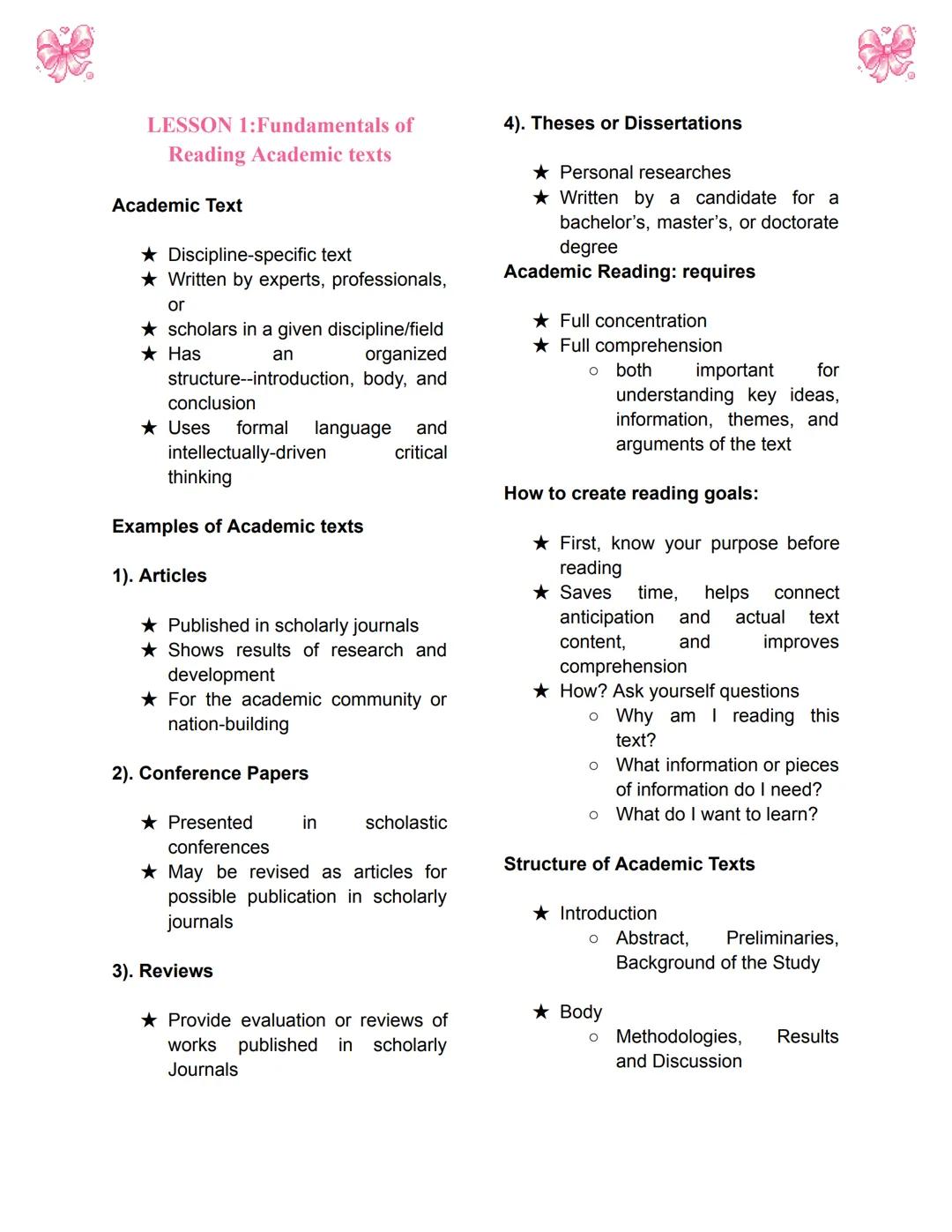
LESSON 1: Fundamentals of
Reading Academic texts
Academic Text
★ Discipline-specific text
★ Written by experts, professionals,
or
★ scholars

Fundamentals of Reading Academic Texts

Ever wondered what makes a research paper different from a blog post? Academic texts are discipline-specific writings created by experts, scholars, and professionals who know their stuff inside and out. These texts follow a strict structure with an introduction, body, and conclusion, plus they use formal language that sounds way more professional than your everyday conversations.

You'll encounter several types of academic texts throughout your studies. Articles published in scholarly journals show research results that contribute to knowledge-building. Conference papers are presentations given at academic conferences that might later become published articles. Reviews evaluate other scholarly works, while theses and dissertations represent personal research projects by students pursuing degrees.

Reading academic texts isn't like scrolling through social media - it requires full concentration and comprehension to grasp key ideas and arguments. Before diving in, always set clear reading goals by asking yourself "Why am I reading this?" and "What specific information do I need?" This approach saves time and dramatically improves your understanding.

Pro Tip Academic texts typically organize content into three main sections - Introduction (abstract, background), Body (methodologies, results), and Conclusion. Knowing this structure helps you navigate any academic text more efficiently.

LESSON 1: Fundamentals of
Reading Academic texts
Academic Text
★ Discipline-specific text
★ Written by experts, professionals,
or
★ scholars

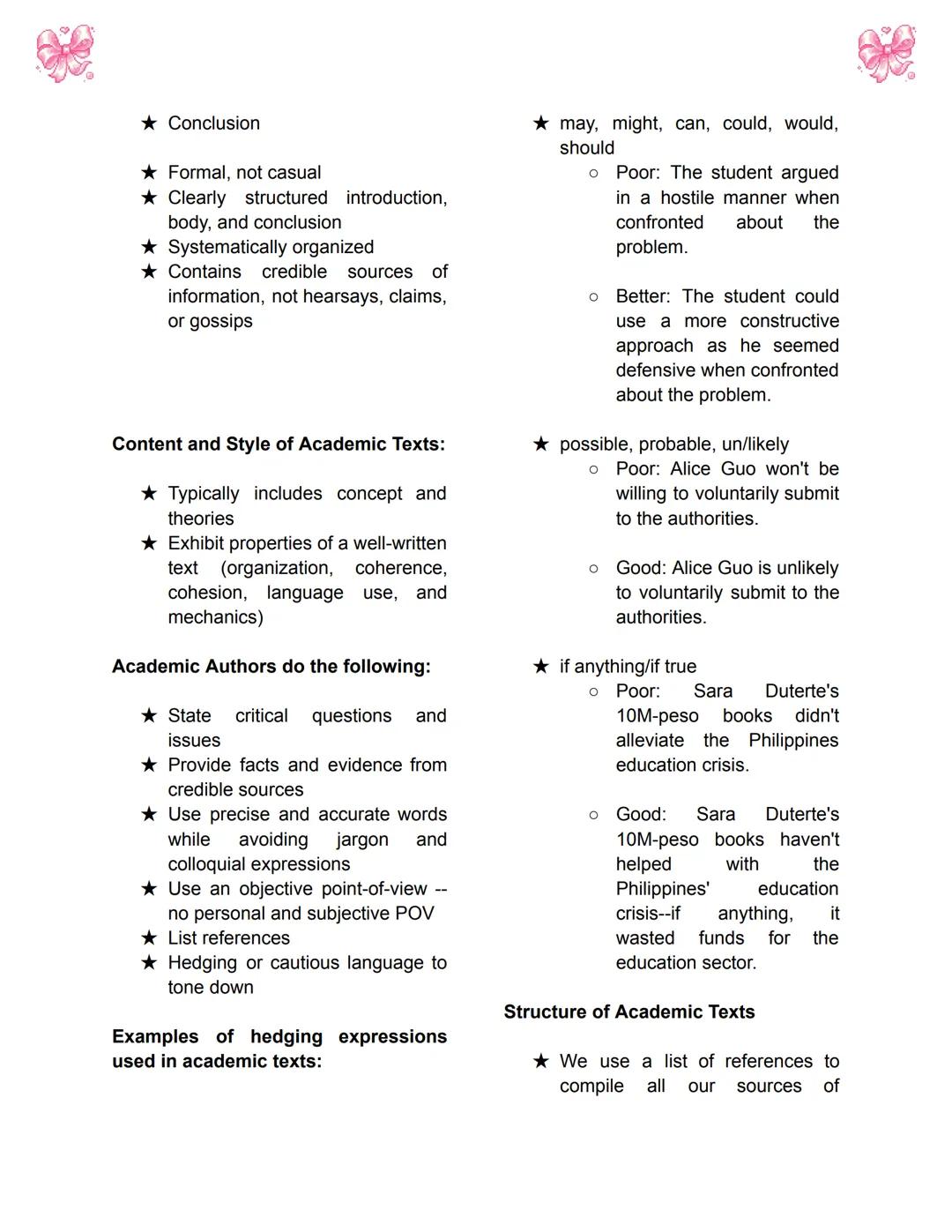
Content and Style of Academic Writing

Academic writing has its own personality - formal, systematic, and backed by solid evidence rather than opinions or gossip. Academic authors focus on presenting critical questions, providing facts from credible sources, and using precise language while avoiding slang and casual expressions. They maintain an objective point-of-view, meaning no personal bias creeps into their analysis.

One key feature you'll notice is hedging language - cautious expressions that tone down claims. Instead of saying "The student argued in a hostile manner," academic writers might say "The student could use a more constructive approach as he seemed defensive." Common hedging words include may, might, possible, probable, and unlikely.

Critical reading strategies make all the difference in understanding academic texts. Before reading, identify your purpose. During reading, annotate by highlighting key points and writing margin notes. After reading, reflect on what you learned, discuss ideas with classmates, and connect new information to what you already know.

Remember Every academic text includes a reference list that compiles all sources used. This isn't just for show - it's how scholars build on each other's work and avoid plagiarism.

LESSON 1: Fundamentals of
Reading Academic texts
Academic Text
★ Discipline-specific text
★ Written by experts, professionals,
or
★ scholars

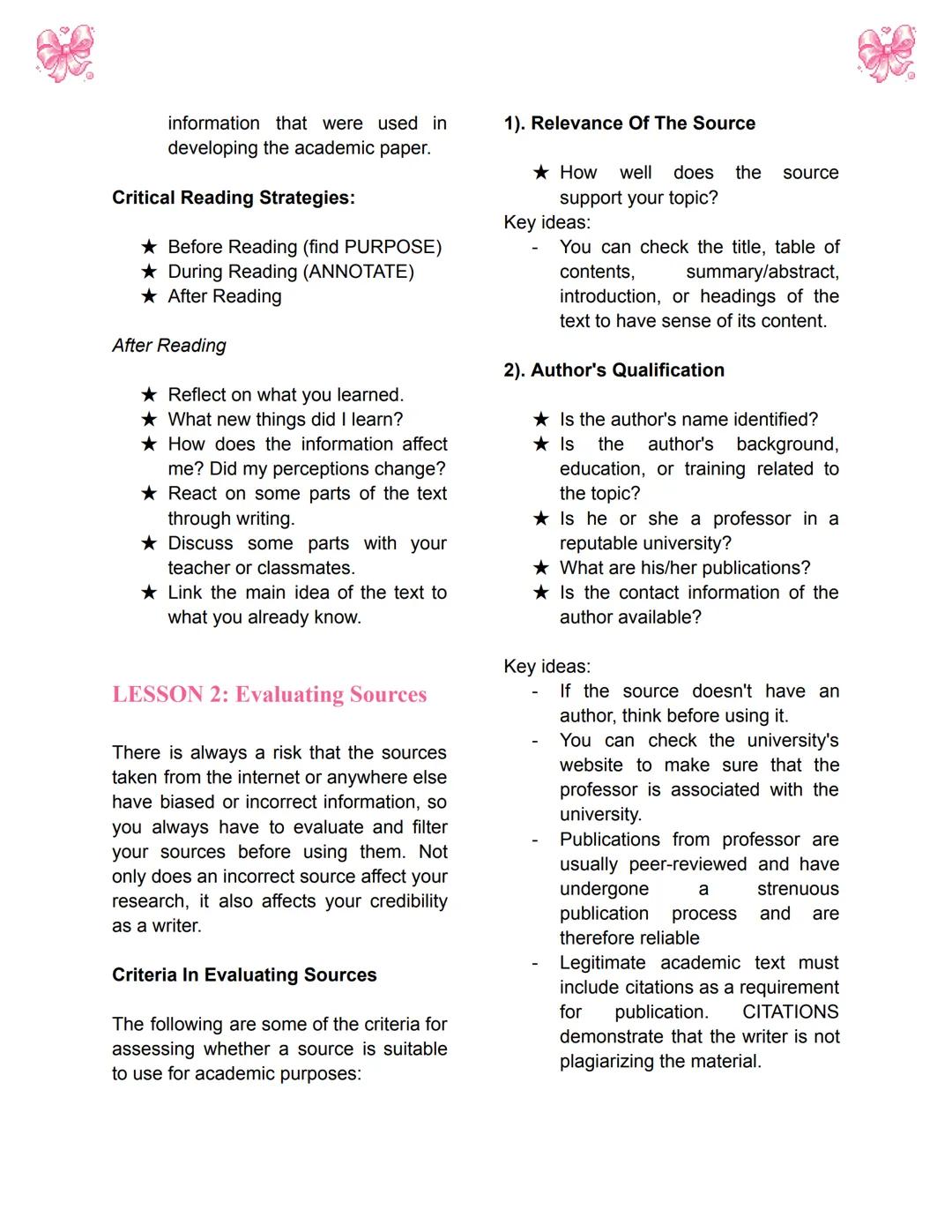
Evaluating Sources Like a Pro

With so much information online, knowing how to spot reliable sources from questionable ones is absolutely essential. Using incorrect sources doesn't just hurt your research - it damages your credibility as a writer. Smart students learn to evaluate sources using specific criteria before incorporating them into their work.

Relevance comes first - does the source actually support your topic? Check the title, table of contents, abstract, and headings to get a sense of the content. Next, examine the author's qualifications. Is their name identified? Do they have relevant education and training? Are they affiliated with a reputable university? If there's no author listed, think twice before using that source.

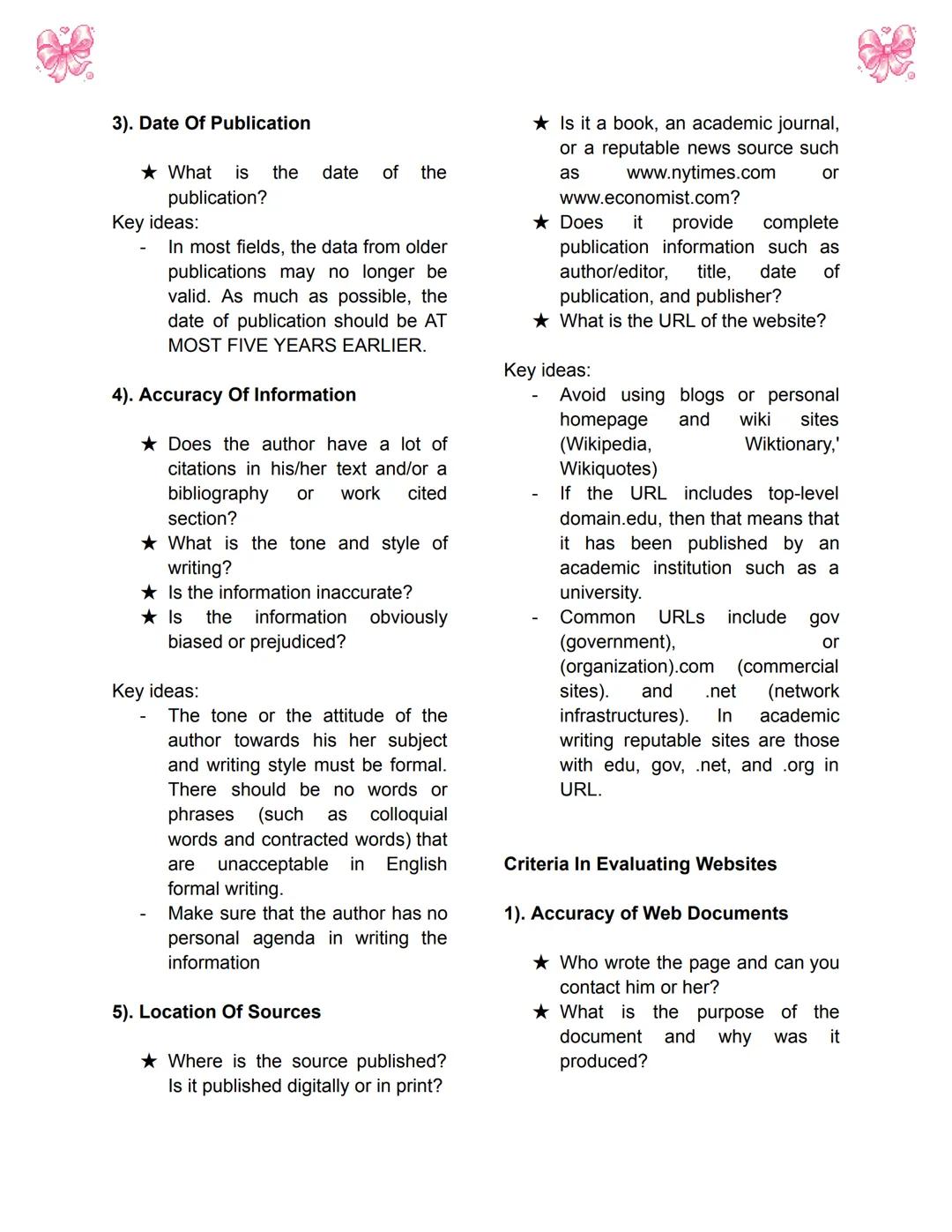
Publication date matters more than you might think. In most fields, information older than five years may no longer be valid, so prioritize recent sources. Also check for accuracy by looking at the author's citations, writing style, and tone - legitimate academic texts use formal language and include proper citations to demonstrate they're not plagiarizing.

Source location tells you a lot about credibility. Academic journals, university websites (.edu), and government sites (.gov) are generally trustworthy. Avoid blogs, personal homepages, and Wiki sites for serious academic work.

Warning If a source seems biased, lacks citations, or comes from an unreliable website, skip it. Your research is only as strong as your weakest source.

LESSON 1: Fundamentals of
Reading Academic texts
Academic Text
★ Discipline-specific text
★ Written by experts, professionals,
or
★ scholars

Evaluating Websites and Online Sources

Website evaluation requires extra attention since anyone can publish content online. Start with accuracy - can you identify and contact the author? What's their purpose for creating the document, and are they qualified to write about the topic? Make sure there's a distinction between the author and the webmaster.

Authority focuses on who published the document and what institution backs it. Check the website's domain - .edu indicates academic institutions, .gov represents government sources, and .org typically belongs to organizations. Look for the author's credentials and qualifications listed on the site.

Objectivity helps you determine if the page masks advertising or promotes bias. Ask yourself why it was written and for whom - treat suspicious pages like infomercials on TV. Currency examines when the content was produced and updated, plus whether links are current or dead.

Coverage evaluates whether links complement the document's theme, if there's a good balance of text and images, and whether information is cited correctly. Consider if special software is required to view content and whether access is free or requires payment.

Quick Check Look for these red flags - no author information, outdated content, broken links, obvious bias, and missing citations. These signals usually indicate unreliable sources.

LESSON 1: Fundamentals of
Reading Academic texts
Academic Text
★ Discipline-specific text
★ Written by experts, professionals,
or
★ scholars

Understanding Source Credibility

Certain principles help distinguish credible sources from questionable ones. Peer-reviewed journals are generally trustworthy because experts review the content before publication. However, sources from television or magazines may not meet academic standards, and sources not written by experts often lack validity.

Online sources require careful scrutiny - not everything published digitally should serve as a reference. Personal and editable sources like blogs and Wikipedia are generally unacceptable for academic work, even when they cite references. The key exception involves sources that have no relevance to your research problem, which obviously shouldn't be used.

Credible sources share common characteristics in-text citations, reference lists, and authors affiliated with reputable academic institutions. These elements demonstrate the writer's commitment to academic integrity and scholarly standards.

Understanding different text types helps too. Newspapers are non-academic texts without citations that contain opinions, yet they remain credible for historical accounts. Academic texts include research papers, argumentative essays, informative essays, persuasive essays, reflection papers, and reaction papers.

Key Point When in doubt about a source's credibility, check for author credentials, institutional affiliation, proper citations, and recent publication dates. These factors usually indicate reliable academic sources.

LESSON 1: Fundamentals of
Reading Academic texts
Academic Text
★ Discipline-specific text
★ Written by experts, professionals,
or
★ scholars

Basics of Summarizing

Summarizing means taking longer passages and restating the essential main ideas in your own words. It's like creating a highlight reel of the most important points from a text. This skill helps you deepen understanding, identify relevant information, combine supporting details, and capture key ideas clearly and concisely.

You're NOT summarizing when you write down everything, copy text word-for-word, include incoherent or irrelevant ideas, add information not in the original text, or create a summary as long as the original. Effective summarizing requires selectivity and your own voice.

Successful summarizing follows clear guidelines. First, clarify your purpose before reading - understand why you're summarizing and what you want to achieve. Then read and understand the text's meaning completely. Don't stop until you grasp the author's message and locate the main idea.

Annotation becomes crucial - select and mark key ideas and phrases while reading. Create an outline by writing important points in bullet or outline form. Most importantly, never copy single sentences from the original text. Always rephrase ideas in your own words, then compare your output with the original to ensure accuracy.

Success Tip Think of summarizing as telling a friend the main points of what you read without looking at the text. If you can do that clearly and concisely, you're on the right track.

LESSON 1: Fundamentals of
Reading Academic texts
Academic Text
★ Discipline-specific text
★ Written by experts, professionals,
or
★ scholars

Summary Formats and Reporting Verbs

Three main formats help organize your summaries effectively. Idea Heading Format places the summarized idea before the citation. Author Heading Format puts the summarized idea after the citation, with the author's name connected by a reporting verb. Date Heading Format places the summarized idea after the publication date.

Reporting verbs are words used to discuss another person's writings or assertions - they help incorporate sources into your text. Varying these verbs makes your writing more interesting and shows the importance of each source. You can use past or present tense depending on your meaning and stance.

Verb tense choice sends a message. Past tense usually indicates you view an idea as outdated and want to negate it "Early studies suggested that high-fat diets were the primary cause of heart disease." Present tense generally indicates you view the idea as relevant or agreeable "Current research suggests that a balanced diet plays a crucial role in reducing heart disease risk."

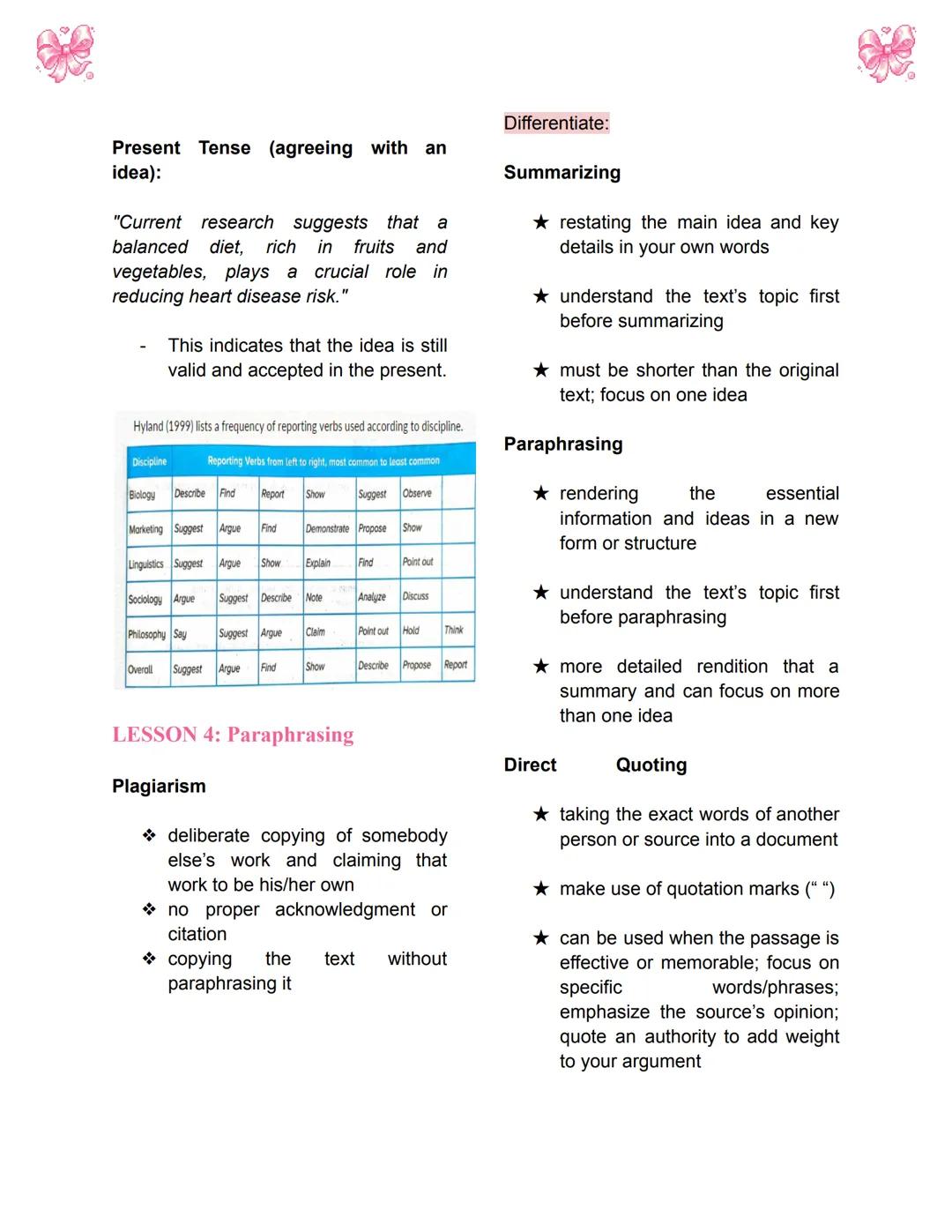
Different academic disciplines favor different reporting verbs. Biology commonly uses describe, find, report, show, suggest, and observe. Marketing prefers suggest, argue, find, demonstrate, propose, and show. Philosophy tends toward say, suggest, argue, claim, point out, hold, and think.

Writing Hack Instead of always using "says" or "states," mix in verbs like argues, demonstrates, proposes, explains, or points out to make your summaries more sophisticated and precise.

LESSON 1: Fundamentals of
Reading Academic texts
Academic Text
★ Discipline-specific text
★ Written by experts, professionals,
or
★ scholars

Understanding Plagiarism and Text Types

Plagiarism is deliberately copying someone else's work and claiming it as your own without proper acknowledgment or citation. It's basically academic theft, and it can seriously damage your reputation and grades. Understanding the difference between summarizing, paraphrasing, and direct quoting helps you avoid this trap.

Summarizing restates main ideas and key details in your own words, focusing on understanding the topic first. Your summary must be shorter than the original text and typically focuses on one main idea. Paraphrasing renders essential information in a new form or structure, providing more detailed rendition than a summary and can focus on multiple ideas.

Direct quoting takes exact words from another source and requires quotation marks. Use quotes when the passage is particularly effective or memorable, when you want to focus on specific words or phrases, when emphasizing the source's opinion, or when quoting an authority adds weight to your argument.

The key to avoiding plagiarism lies in proper attribution and using your own voice. Whether you summarize, paraphrase, or quote, always cite your sources correctly and make sure you're adding your own analysis and understanding to the conversation.

Academic Integrity When you properly cite sources and express ideas in your own words, you're joining the scholarly conversation rather than stealing from it. This builds your credibility as a thinker and writer.

LESSON 1: Fundamentals of
Reading Academic texts
Academic Text
★ Discipline-specific text
★ Written by experts, professionals,
or
★ scholars

Paraphrasing Techniques and Best Practices

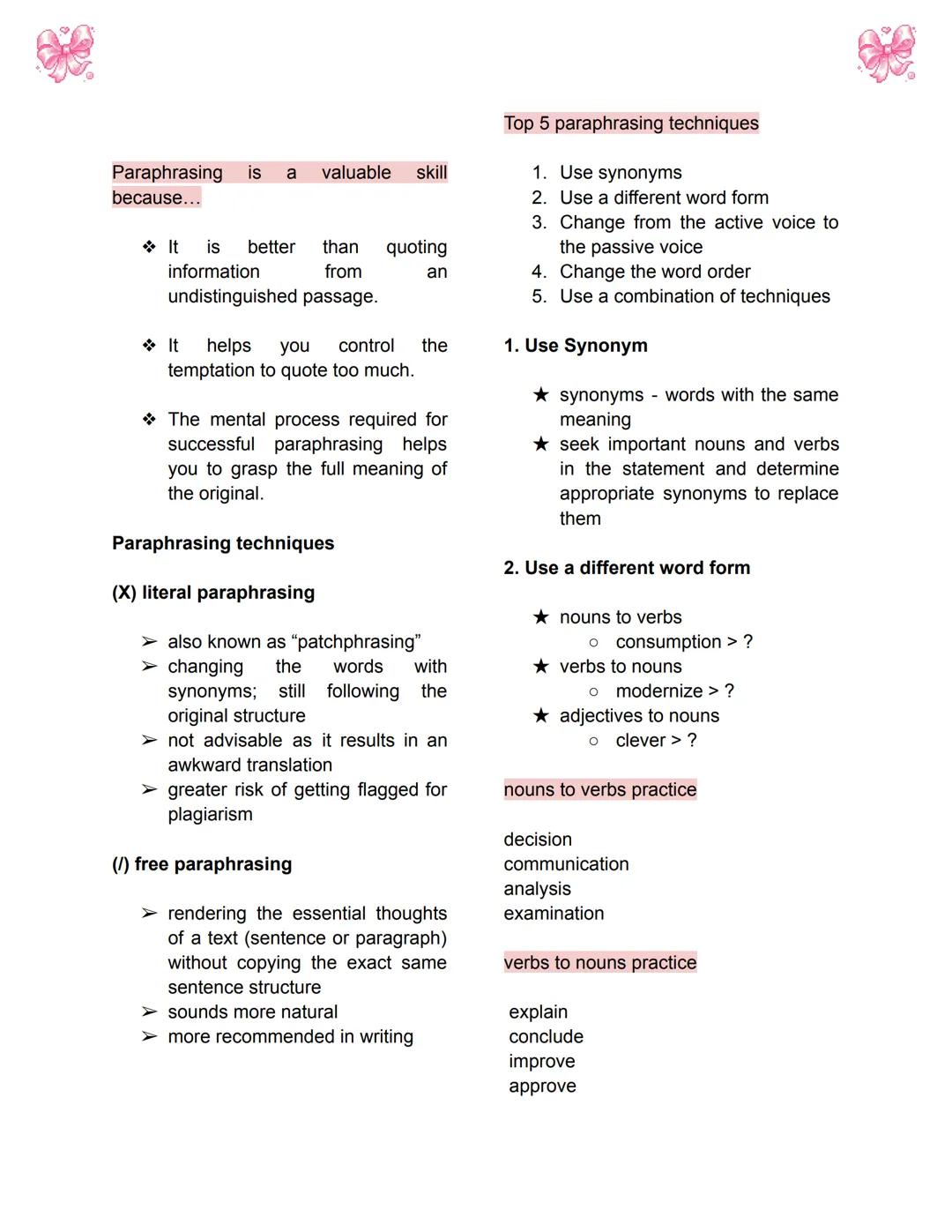
Paraphrasing proves more valuable than quoting because it helps you control the temptation to quote excessively while the mental process required helps you grasp the original's full meaning. However, not all paraphrasing techniques are created equal.

Literal paraphrasing (also called "patchphrasing") simply changes words with synonyms while following the original structure. This approach is not advisable because it results in awkward translation and carries greater risk of plagiarism flags. Free paraphrasing renders essential thoughts without copying the exact sentence structure, sounds more natural, and is much more recommended.

Five effective paraphrasing techniques can transform your writing. Using synonyms involves finding words with the same meaning for important nouns and verbs. Changing word forms converts nouns to verbs (consumption becomes consume), verbs to nouns (modernize becomes modernization), and adjectives to nouns (clever becomes cleverness).

Voice changes shift from active to passive voice or vice versa. Word order changes rearrange sentence structure while maintaining meaning. Combination techniques use multiple approaches together for the most natural-sounding results.

Paraphrasing Pro-Tip Practice converting word forms regularly - decision becomes decide, communication becomes communicate, analysis becomes analyze. This flexibility helps you express ideas more naturally in your own voice.

LESSON 1: Fundamentals of
Reading Academic texts
Academic Text
★ Discipline-specific text
★ Written by experts, professionals,
or
★ scholars

We thought you’d never ask...

What is the Knowunity AI companion?

Our AI companion is specifically built for the needs of students. Based on the millions of content pieces we have on the platform we can provide truly meaningful and relevant answers to students. But its not only about answers, the companion is even more about guiding students through their daily learning challenges, with personalised study plans, quizzes or content pieces in the chat and 100% personalisation based on the students skills and developments.

Where can I download the Knowunity app?

You can download the app in the Google Play Store and in the Apple App Store.

Is Knowunity really free of charge?

That's right! Enjoy free access to study content, connect with fellow students, and get instant help – all at your fingertips.

7

Smart Tools NEW

Transform this note into: ✓ 50+ Practice Questions ✓ Interactive Flashcards ✓ Full Mock Exam ✓ Essay Outlines

Mock Exam
Quiz
Flashcards
Essay

Can't find what you're looking for? Explore other subjects.

Students love us — and so will you.

4.9/5

App Store

4.8/5

Google Play

The app is very easy to use and well designed. I have found everything I was looking for so far and have been able to learn a lot from the presentations! I will definitely use the app for a class assignment! And of course it also helps a lot as an inspiration.

Stefan S

iOS user

This app is really great. There are so many study notes and help [...]. My problem subject is French, for example, and the app has so many options for help. Thanks to this app, I have improved my French. I would recommend it to anyone.

Samantha Klich

Android user

Wow, I am really amazed. I just tried the app because I've seen it advertised many times and was absolutely stunned. This app is THE HELP you want for school and above all, it offers so many things, such as workouts and fact sheets, which have been VERY helpful to me personally.

Anna

iOS user

I think it’s very much worth it and you’ll end up using it a lot once you get the hang of it and even after looking at others notes you can still ask your Artificial intelligence buddy the question and ask to simplify it if you still don’t get it!!! In the end I think it’s worth it 😊👍 ⚠️Also DID I MENTION ITS FREEE YOU DON’T HAVE TO PAY FOR ANYTHING AND STILL GET YOUR GRADES IN PERFECTLY❗️❗️⚠️

Thomas R

iOS user

Knowunity is the BEST app I’ve used in a minute. This is not an ai review or anything this is genuinely coming from a 7th grade student (I know 2011 im young) but dude this app is a 10/10 i have maintained a 3.8 gpa and have plenty of time for gaming. I love it and my mom is just happy I got good grades

Brad T

Android user

Not only did it help me find the answer but it also showed me alternative ways to solve it. I was horrible in math and science but now I have an a in both subjects. Thanks for the help🤍🤍

David K

iOS user

The app's just great! All I have to do is enter the topic in the search bar and I get the response real fast. I don't have to watch 10 YouTube videos to understand something, so I'm saving my time. Highly recommended!

Sudenaz Ocak

Android user

In school I was really bad at maths but thanks to the app, I am doing better now. I am so grateful that you made the app.

Greenlight Bonnie

Android user

I found this app a couple years ago and it has only gotten better since then. I really love it because it can help with written questions and photo questions. Also, it can find study guides that other people have made as well as flashcard sets and practice tests. The free version is also amazing for students who might not be able to afford it. Would 100% recommend

Aubrey

iOS user

Best app if you're in Highschool or Junior high. I have been using this app for 2 school years and it's the best, it's good if you don't have anyone to help you with school work.😋🩷🎀

Marco B

iOS user

THE QUIZES AND FLASHCARDS ARE SO USEFUL AND I LOVE THE SCHOOLGPT. IT ALSO IS LITREALLY LIKE CHATGPT BUT SMARTER!! HELPED ME WITH MY MASCARA PROBLEMS TOO!! AS WELL AS MY REAL SUBJECTS ! DUHHH 😍😁😲🤑💗✨🎀😮

Elisha

iOS user

This app is phenomenal down to the correct info and the various topics you can study! I greatly recommend it for people who struggle with procrastination and those who need homework help. It has been perfectly accurate for world 1 history as far as I’ve seen! Geometry too!

Paul T

iOS user

The app is very easy to use and well designed. I have found everything I was looking for so far and have been able to learn a lot from the presentations! I will definitely use the app for a class assignment! And of course it also helps a lot as an inspiration.

Stefan S

iOS user

This app is really great. There are so many study notes and help [...]. My problem subject is French, for example, and the app has so many options for help. Thanks to this app, I have improved my French. I would recommend it to anyone.

Samantha Klich

Android user

Wow, I am really amazed. I just tried the app because I've seen it advertised many times and was absolutely stunned. This app is THE HELP you want for school and above all, it offers so many things, such as workouts and fact sheets, which have been VERY helpful to me personally.

Anna

iOS user

I think it’s very much worth it and you’ll end up using it a lot once you get the hang of it and even after looking at others notes you can still ask your Artificial intelligence buddy the question and ask to simplify it if you still don’t get it!!! In the end I think it’s worth it 😊👍 ⚠️Also DID I MENTION ITS FREEE YOU DON’T HAVE TO PAY FOR ANYTHING AND STILL GET YOUR GRADES IN PERFECTLY❗️❗️⚠️

Thomas R

iOS user

Knowunity is the BEST app I’ve used in a minute. This is not an ai review or anything this is genuinely coming from a 7th grade student (I know 2011 im young) but dude this app is a 10/10 i have maintained a 3.8 gpa and have plenty of time for gaming. I love it and my mom is just happy I got good grades

Brad T

Android user

Not only did it help me find the answer but it also showed me alternative ways to solve it. I was horrible in math and science but now I have an a in both subjects. Thanks for the help🤍🤍

David K

iOS user

The app's just great! All I have to do is enter the topic in the search bar and I get the response real fast. I don't have to watch 10 YouTube videos to understand something, so I'm saving my time. Highly recommended!

Sudenaz Ocak

Android user

In school I was really bad at maths but thanks to the app, I am doing better now. I am so grateful that you made the app.

Greenlight Bonnie

Android user

I found this app a couple years ago and it has only gotten better since then. I really love it because it can help with written questions and photo questions. Also, it can find study guides that other people have made as well as flashcard sets and practice tests. The free version is also amazing for students who might not be able to afford it. Would 100% recommend

Aubrey

iOS user

Best app if you're in Highschool or Junior high. I have been using this app for 2 school years and it's the best, it's good if you don't have anyone to help you with school work.😋🩷🎀

Marco B

iOS user

THE QUIZES AND FLASHCARDS ARE SO USEFUL AND I LOVE THE SCHOOLGPT. IT ALSO IS LITREALLY LIKE CHATGPT BUT SMARTER!! HELPED ME WITH MY MASCARA PROBLEMS TOO!! AS WELL AS MY REAL SUBJECTS ! DUHHH 😍😁😲🤑💗✨🎀😮

Elisha

iOS user

This app is phenomenal down to the correct info and the various topics you can study! I greatly recommend it for people who struggle with procrastination and those who need homework help. It has been perfectly accurate for world 1 history as far as I’ve seen! Geometry too!

Paul T

iOS user


EAPP

573

Dec 12, 2025

11 pages

EAPP First Semester Midterm Reviewer

G

Gojo

@satorufux

Think of academic texts as the serious, fact-based writing you'll encounter in college and beyond - research papers, scholarly articles, and dissertations written by experts. Learning to read, evaluate, summarize, and paraphrase these texts is crucial for your academic success... Show more

LESSON 1: Fundamentals of
Reading Academic texts
Academic Text
★ Discipline-specific text
★ Written by experts, professionals,
or
★ scholars

Sign up to see the contentIt's free!

Access to all documents

Improve your grades

Join milions of students

By signing up you accept Terms of Service and Privacy Policy

Fundamentals of Reading Academic Texts

Ever wondered what makes a research paper different from a blog post? Academic texts are discipline-specific writings created by experts, scholars, and professionals who know their stuff inside and out. These texts follow a strict structure with an introduction, body, and conclusion, plus they use formal language that sounds way more professional than your everyday conversations.

You'll encounter several types of academic texts throughout your studies. Articles published in scholarly journals show research results that contribute to knowledge-building. Conference papers are presentations given at academic conferences that might later become published articles. Reviews evaluate other scholarly works, while theses and dissertations represent personal research projects by students pursuing degrees.

Reading academic texts isn't like scrolling through social media - it requires full concentration and comprehension to grasp key ideas and arguments. Before diving in, always set clear reading goals by asking yourself: "Why am I reading this?" and "What specific information do I need?" This approach saves time and dramatically improves your understanding.

Pro Tip: Academic texts typically organize content into three main sections - Introduction (abstract, background), Body (methodologies, results), and Conclusion. Knowing this structure helps you navigate any academic text more efficiently.

LESSON 1: Fundamentals of
Reading Academic texts
Academic Text
★ Discipline-specific text
★ Written by experts, professionals,
or
★ scholars

Sign up to see the contentIt's free!

Access to all documents

Improve your grades

Join milions of students

By signing up you accept Terms of Service and Privacy Policy

Content and Style of Academic Writing

Academic writing has its own personality - formal, systematic, and backed by solid evidence rather than opinions or gossip. Academic authors focus on presenting critical questions, providing facts from credible sources, and using precise language while avoiding slang and casual expressions. They maintain an objective point-of-view, meaning no personal bias creeps into their analysis.

One key feature you'll notice is hedging language - cautious expressions that tone down claims. Instead of saying "The student argued in a hostile manner," academic writers might say "The student could use a more constructive approach as he seemed defensive." Common hedging words include may, might, possible, probable, and unlikely.

Critical reading strategies make all the difference in understanding academic texts. Before reading, identify your purpose. During reading, annotate by highlighting key points and writing margin notes. After reading, reflect on what you learned, discuss ideas with classmates, and connect new information to what you already know.

Remember: Every academic text includes a reference list that compiles all sources used. This isn't just for show - it's how scholars build on each other's work and avoid plagiarism.

LESSON 1: Fundamentals of
Reading Academic texts
Academic Text
★ Discipline-specific text
★ Written by experts, professionals,
or
★ scholars

Sign up to see the contentIt's free!

Access to all documents

Improve your grades

Join milions of students

By signing up you accept Terms of Service and Privacy Policy

Evaluating Sources Like a Pro

With so much information online, knowing how to spot reliable sources from questionable ones is absolutely essential. Using incorrect sources doesn't just hurt your research - it damages your credibility as a writer. Smart students learn to evaluate sources using specific criteria before incorporating them into their work.

Relevance comes first - does the source actually support your topic? Check the title, table of contents, abstract, and headings to get a sense of the content. Next, examine the author's qualifications. Is their name identified? Do they have relevant education and training? Are they affiliated with a reputable university? If there's no author listed, think twice before using that source.

Publication date matters more than you might think. In most fields, information older than five years may no longer be valid, so prioritize recent sources. Also check for accuracy by looking at the author's citations, writing style, and tone - legitimate academic texts use formal language and include proper citations to demonstrate they're not plagiarizing.

Source location tells you a lot about credibility. Academic journals, university websites (.edu), and government sites (.gov) are generally trustworthy. Avoid blogs, personal homepages, and Wiki sites for serious academic work.

Warning: If a source seems biased, lacks citations, or comes from an unreliable website, skip it. Your research is only as strong as your weakest source.

LESSON 1: Fundamentals of
Reading Academic texts
Academic Text
★ Discipline-specific text
★ Written by experts, professionals,
or
★ scholars

Sign up to see the contentIt's free!

Access to all documents

Improve your grades

Join milions of students

By signing up you accept Terms of Service and Privacy Policy

Evaluating Websites and Online Sources

Website evaluation requires extra attention since anyone can publish content online. Start with accuracy - can you identify and contact the author? What's their purpose for creating the document, and are they qualified to write about the topic? Make sure there's a distinction between the author and the webmaster.

Authority focuses on who published the document and what institution backs it. Check the website's domain - .edu indicates academic institutions, .gov represents government sources, and .org typically belongs to organizations. Look for the author's credentials and qualifications listed on the site.

Objectivity helps you determine if the page masks advertising or promotes bias. Ask yourself why it was written and for whom - treat suspicious pages like infomercials on TV. Currency examines when the content was produced and updated, plus whether links are current or dead.

Coverage evaluates whether links complement the document's theme, if there's a good balance of text and images, and whether information is cited correctly. Consider if special software is required to view content and whether access is free or requires payment.

Quick Check: Look for these red flags - no author information, outdated content, broken links, obvious bias, and missing citations. These signals usually indicate unreliable sources.

LESSON 1: Fundamentals of
Reading Academic texts
Academic Text
★ Discipline-specific text
★ Written by experts, professionals,
or
★ scholars

Sign up to see the contentIt's free!

Access to all documents

Improve your grades

Join milions of students

By signing up you accept Terms of Service and Privacy Policy

Understanding Source Credibility

Certain principles help distinguish credible sources from questionable ones. Peer-reviewed journals are generally trustworthy because experts review the content before publication. However, sources from television or magazines may not meet academic standards, and sources not written by experts often lack validity.

Online sources require careful scrutiny - not everything published digitally should serve as a reference. Personal and editable sources like blogs and Wikipedia are generally unacceptable for academic work, even when they cite references. The key exception involves sources that have no relevance to your research problem, which obviously shouldn't be used.

Credible sources share common characteristics: in-text citations, reference lists, and authors affiliated with reputable academic institutions. These elements demonstrate the writer's commitment to academic integrity and scholarly standards.

Understanding different text types helps too. Newspapers are non-academic texts without citations that contain opinions, yet they remain credible for historical accounts. Academic texts include research papers, argumentative essays, informative essays, persuasive essays, reflection papers, and reaction papers.

Key Point: When in doubt about a source's credibility, check for author credentials, institutional affiliation, proper citations, and recent publication dates. These factors usually indicate reliable academic sources.

LESSON 1: Fundamentals of
Reading Academic texts
Academic Text
★ Discipline-specific text
★ Written by experts, professionals,
or
★ scholars

Sign up to see the contentIt's free!

Access to all documents

Improve your grades

Join milions of students

By signing up you accept Terms of Service and Privacy Policy

Basics of Summarizing

Summarizing means taking longer passages and restating the essential main ideas in your own words. It's like creating a highlight reel of the most important points from a text. This skill helps you deepen understanding, identify relevant information, combine supporting details, and capture key ideas clearly and concisely.

You're NOT summarizing when you write down everything, copy text word-for-word, include incoherent or irrelevant ideas, add information not in the original text, or create a summary as long as the original. Effective summarizing requires selectivity and your own voice.

Successful summarizing follows clear guidelines. First, clarify your purpose before reading - understand why you're summarizing and what you want to achieve. Then read and understand the text's meaning completely. Don't stop until you grasp the author's message and locate the main idea.

Annotation becomes crucial - select and mark key ideas and phrases while reading. Create an outline by writing important points in bullet or outline form. Most importantly, never copy single sentences from the original text. Always rephrase ideas in your own words, then compare your output with the original to ensure accuracy.

Success Tip: Think of summarizing as telling a friend the main points of what you read without looking at the text. If you can do that clearly and concisely, you're on the right track.

LESSON 1: Fundamentals of
Reading Academic texts
Academic Text
★ Discipline-specific text
★ Written by experts, professionals,
or
★ scholars

Sign up to see the contentIt's free!

Access to all documents

Improve your grades

Join milions of students

By signing up you accept Terms of Service and Privacy Policy

Summary Formats and Reporting Verbs

Three main formats help organize your summaries effectively. Idea Heading Format places the summarized idea before the citation. Author Heading Format puts the summarized idea after the citation, with the author's name connected by a reporting verb. Date Heading Format places the summarized idea after the publication date.

Reporting verbs are words used to discuss another person's writings or assertions - they help incorporate sources into your text. Varying these verbs makes your writing more interesting and shows the importance of each source. You can use past or present tense depending on your meaning and stance.

Verb tense choice sends a message. Past tense usually indicates you view an idea as outdated and want to negate it: "Early studies suggested that high-fat diets were the primary cause of heart disease." Present tense generally indicates you view the idea as relevant or agreeable: "Current research suggests that a balanced diet plays a crucial role in reducing heart disease risk."

Different academic disciplines favor different reporting verbs. Biology commonly uses describe, find, report, show, suggest, and observe. Marketing prefers suggest, argue, find, demonstrate, propose, and show. Philosophy tends toward say, suggest, argue, claim, point out, hold, and think.

Writing Hack: Instead of always using "says" or "states," mix in verbs like argues, demonstrates, proposes, explains, or points out to make your summaries more sophisticated and precise.

LESSON 1: Fundamentals of
Reading Academic texts
Academic Text
★ Discipline-specific text
★ Written by experts, professionals,
or
★ scholars

Sign up to see the contentIt's free!

Access to all documents

Improve your grades

Join milions of students

By signing up you accept Terms of Service and Privacy Policy

Understanding Plagiarism and Text Types

Plagiarism is deliberately copying someone else's work and claiming it as your own without proper acknowledgment or citation. It's basically academic theft, and it can seriously damage your reputation and grades. Understanding the difference between summarizing, paraphrasing, and direct quoting helps you avoid this trap.

Summarizing restates main ideas and key details in your own words, focusing on understanding the topic first. Your summary must be shorter than the original text and typically focuses on one main idea. Paraphrasing renders essential information in a new form or structure, providing more detailed rendition than a summary and can focus on multiple ideas.

Direct quoting takes exact words from another source and requires quotation marks. Use quotes when the passage is particularly effective or memorable, when you want to focus on specific words or phrases, when emphasizing the source's opinion, or when quoting an authority adds weight to your argument.

The key to avoiding plagiarism lies in proper attribution and using your own voice. Whether you summarize, paraphrase, or quote, always cite your sources correctly and make sure you're adding your own analysis and understanding to the conversation.

Academic Integrity: When you properly cite sources and express ideas in your own words, you're joining the scholarly conversation rather than stealing from it. This builds your credibility as a thinker and writer.

LESSON 1: Fundamentals of
Reading Academic texts
Academic Text
★ Discipline-specific text
★ Written by experts, professionals,
or
★ scholars

Sign up to see the contentIt's free!

Access to all documents

Improve your grades

Join milions of students

By signing up you accept Terms of Service and Privacy Policy

Paraphrasing Techniques and Best Practices

Paraphrasing proves more valuable than quoting because it helps you control the temptation to quote excessively while the mental process required helps you grasp the original's full meaning. However, not all paraphrasing techniques are created equal.

Literal paraphrasing (also called "patchphrasing") simply changes words with synonyms while following the original structure. This approach is not advisable because it results in awkward translation and carries greater risk of plagiarism flags. Free paraphrasing renders essential thoughts without copying the exact sentence structure, sounds more natural, and is much more recommended.

Five effective paraphrasing techniques can transform your writing. Using synonyms involves finding words with the same meaning for important nouns and verbs. Changing word forms converts nouns to verbs (consumption becomes consume), verbs to nouns (modernize becomes modernization), and adjectives to nouns (clever becomes cleverness).

Voice changes shift from active to passive voice or vice versa. Word order changes rearrange sentence structure while maintaining meaning. Combination techniques use multiple approaches together for the most natural-sounding results.

Paraphrasing Pro-Tip: Practice converting word forms regularly - decision becomes decide, communication becomes communicate, analysis becomes analyze. This flexibility helps you express ideas more naturally in your own voice.

LESSON 1: Fundamentals of
Reading Academic texts
Academic Text
★ Discipline-specific text
★ Written by experts, professionals,
or
★ scholars

Sign up to see the contentIt's free!

Access to all documents

Improve your grades

Join milions of students

By signing up you accept Terms of Service and Privacy Policy

We thought you’d never ask...

What is the Knowunity AI companion?

Our AI companion is specifically built for the needs of students. Based on the millions of content pieces we have on the platform we can provide truly meaningful and relevant answers to students. But its not only about answers, the companion is even more about guiding students through their daily learning challenges, with personalised study plans, quizzes or content pieces in the chat and 100% personalisation based on the students skills and developments.

Where can I download the Knowunity app?

You can download the app in the Google Play Store and in the Apple App Store.

Is Knowunity really free of charge?

That's right! Enjoy free access to study content, connect with fellow students, and get instant help – all at your fingertips.

7

Smart Tools NEW

Transform this note into: ✓ 50+ Practice Questions ✓ Interactive Flashcards ✓ Full Mock Exam ✓ Essay Outlines

Mock Exam
Quiz
Flashcards
Essay

Can't find what you're looking for? Explore other subjects.

Students love us — and so will you.

4.9/5

App Store

4.8/5

Google Play

The app is very easy to use and well designed. I have found everything I was looking for so far and have been able to learn a lot from the presentations! I will definitely use the app for a class assignment! And of course it also helps a lot as an inspiration.

Stefan S

iOS user

This app is really great. There are so many study notes and help [...]. My problem subject is French, for example, and the app has so many options for help. Thanks to this app, I have improved my French. I would recommend it to anyone.

Samantha Klich

Android user

Wow, I am really amazed. I just tried the app because I've seen it advertised many times and was absolutely stunned. This app is THE HELP you want for school and above all, it offers so many things, such as workouts and fact sheets, which have been VERY helpful to me personally.

Anna

iOS user

I think it’s very much worth it and you’ll end up using it a lot once you get the hang of it and even after looking at others notes you can still ask your Artificial intelligence buddy the question and ask to simplify it if you still don’t get it!!! In the end I think it’s worth it 😊👍 ⚠️Also DID I MENTION ITS FREEE YOU DON’T HAVE TO PAY FOR ANYTHING AND STILL GET YOUR GRADES IN PERFECTLY❗️❗️⚠️

Thomas R

iOS user

Knowunity is the BEST app I’ve used in a minute. This is not an ai review or anything this is genuinely coming from a 7th grade student (I know 2011 im young) but dude this app is a 10/10 i have maintained a 3.8 gpa and have plenty of time for gaming. I love it and my mom is just happy I got good grades

Brad T

Android user

Not only did it help me find the answer but it also showed me alternative ways to solve it. I was horrible in math and science but now I have an a in both subjects. Thanks for the help🤍🤍

David K

iOS user

The app's just great! All I have to do is enter the topic in the search bar and I get the response real fast. I don't have to watch 10 YouTube videos to understand something, so I'm saving my time. Highly recommended!

Sudenaz Ocak

Android user

In school I was really bad at maths but thanks to the app, I am doing better now. I am so grateful that you made the app.

Greenlight Bonnie

Android user

I found this app a couple years ago and it has only gotten better since then. I really love it because it can help with written questions and photo questions. Also, it can find study guides that other people have made as well as flashcard sets and practice tests. The free version is also amazing for students who might not be able to afford it. Would 100% recommend

Aubrey

iOS user

Best app if you're in Highschool or Junior high. I have been using this app for 2 school years and it's the best, it's good if you don't have anyone to help you with school work.😋🩷🎀

Marco B

iOS user

THE QUIZES AND FLASHCARDS ARE SO USEFUL AND I LOVE THE SCHOOLGPT. IT ALSO IS LITREALLY LIKE CHATGPT BUT SMARTER!! HELPED ME WITH MY MASCARA PROBLEMS TOO!! AS WELL AS MY REAL SUBJECTS ! DUHHH 😍😁😲🤑💗✨🎀😮

Elisha

iOS user

This app is phenomenal down to the correct info and the various topics you can study! I greatly recommend it for people who struggle with procrastination and those who need homework help. It has been perfectly accurate for world 1 history as far as I’ve seen! Geometry too!

Paul T

iOS user

The app is very easy to use and well designed. I have found everything I was looking for so far and have been able to learn a lot from the presentations! I will definitely use the app for a class assignment! And of course it also helps a lot as an inspiration.

Stefan S

iOS user

This app is really great. There are so many study notes and help [...]. My problem subject is French, for example, and the app has so many options for help. Thanks to this app, I have improved my French. I would recommend it to anyone.

Samantha Klich

Android user

Wow, I am really amazed. I just tried the app because I've seen it advertised many times and was absolutely stunned. This app is THE HELP you want for school and above all, it offers so many things, such as workouts and fact sheets, which have been VERY helpful to me personally.

Anna

iOS user

I think it’s very much worth it and you’ll end up using it a lot once you get the hang of it and even after looking at others notes you can still ask your Artificial intelligence buddy the question and ask to simplify it if you still don’t get it!!! In the end I think it’s worth it 😊👍 ⚠️Also DID I MENTION ITS FREEE YOU DON’T HAVE TO PAY FOR ANYTHING AND STILL GET YOUR GRADES IN PERFECTLY❗️❗️⚠️

Thomas R

iOS user

Knowunity is the BEST app I’ve used in a minute. This is not an ai review or anything this is genuinely coming from a 7th grade student (I know 2011 im young) but dude this app is a 10/10 i have maintained a 3.8 gpa and have plenty of time for gaming. I love it and my mom is just happy I got good grades

Brad T

Android user

Not only did it help me find the answer but it also showed me alternative ways to solve it. I was horrible in math and science but now I have an a in both subjects. Thanks for the help🤍🤍

David K

iOS user

The app's just great! All I have to do is enter the topic in the search bar and I get the response real fast. I don't have to watch 10 YouTube videos to understand something, so I'm saving my time. Highly recommended!

Sudenaz Ocak

Android user

In school I was really bad at maths but thanks to the app, I am doing better now. I am so grateful that you made the app.

Greenlight Bonnie

Android user

I found this app a couple years ago and it has only gotten better since then. I really love it because it can help with written questions and photo questions. Also, it can find study guides that other people have made as well as flashcard sets and practice tests. The free version is also amazing for students who might not be able to afford it. Would 100% recommend

Aubrey

iOS user

Best app if you're in Highschool or Junior high. I have been using this app for 2 school years and it's the best, it's good if you don't have anyone to help you with school work.😋🩷🎀

Marco B

iOS user

THE QUIZES AND FLASHCARDS ARE SO USEFUL AND I LOVE THE SCHOOLGPT. IT ALSO IS LITREALLY LIKE CHATGPT BUT SMARTER!! HELPED ME WITH MY MASCARA PROBLEMS TOO!! AS WELL AS MY REAL SUBJECTS ! DUHHH 😍😁😲🤑💗✨🎀😮

Elisha

iOS user

This app is phenomenal down to the correct info and the various topics you can study! I greatly recommend it for people who struggle with procrastination and those who need homework help. It has been perfectly accurate for world 1 history as far as I’ve seen! Geometry too!

Paul T

iOS user