
Ever wondered why some conversations flow smoothly while others feel... Show more
 Science
 Econ
Econ Araling Panlipunan (AP)
 Iba pa
 Practical Research
 DISS
DISSSign up to see the contentIt's free!
Access to all documents
Improve your grades
Join milions of students
By signing up you accept Terms of Service and Privacy Policy
Subjects

Biology

Chemistry
AP Chemistry

English
AP English Literature
238
0
Danielle
12/11/2025
EAPP
G11-Oral Com reviewer
2,181
•
Dec 11, 2025
•
Danielle
@danielle_tewg3
Ever wondered why some conversations flow smoothly while others feel... Show more
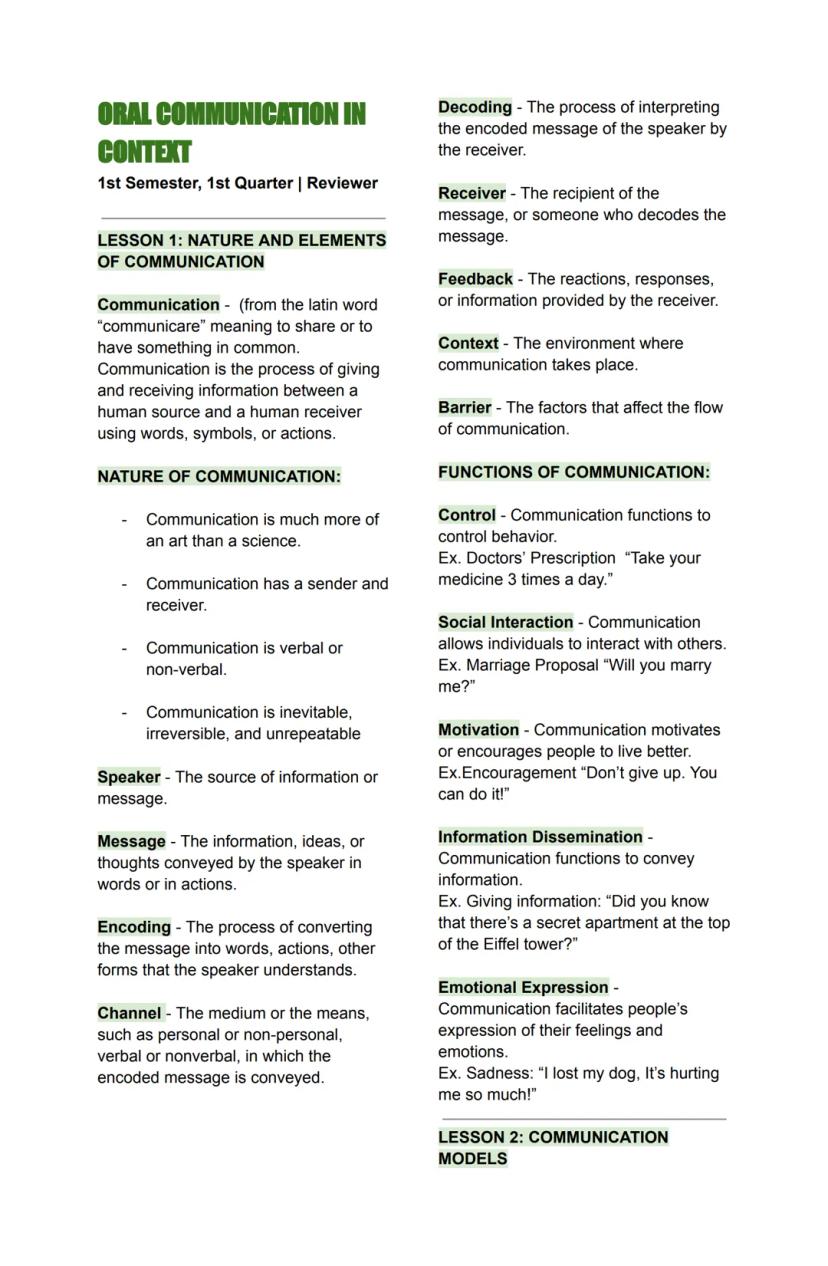


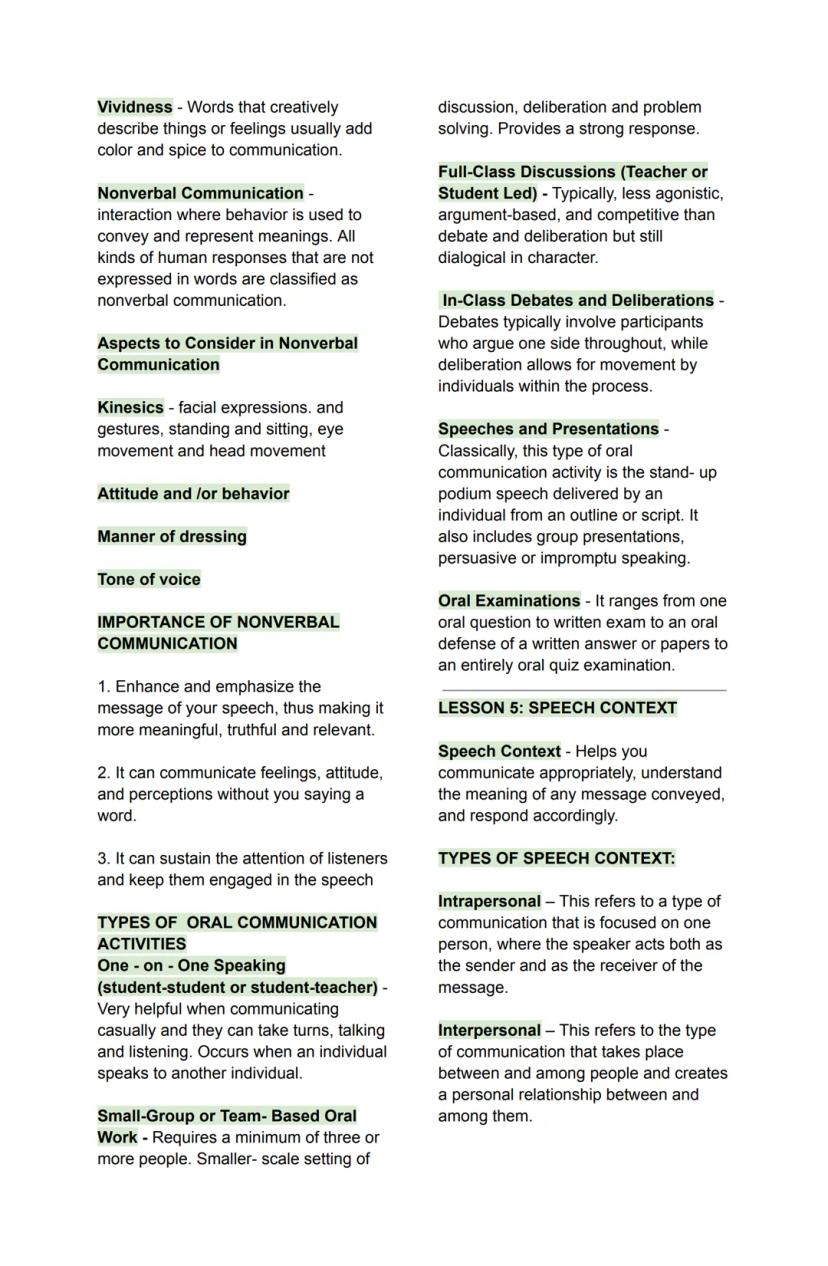

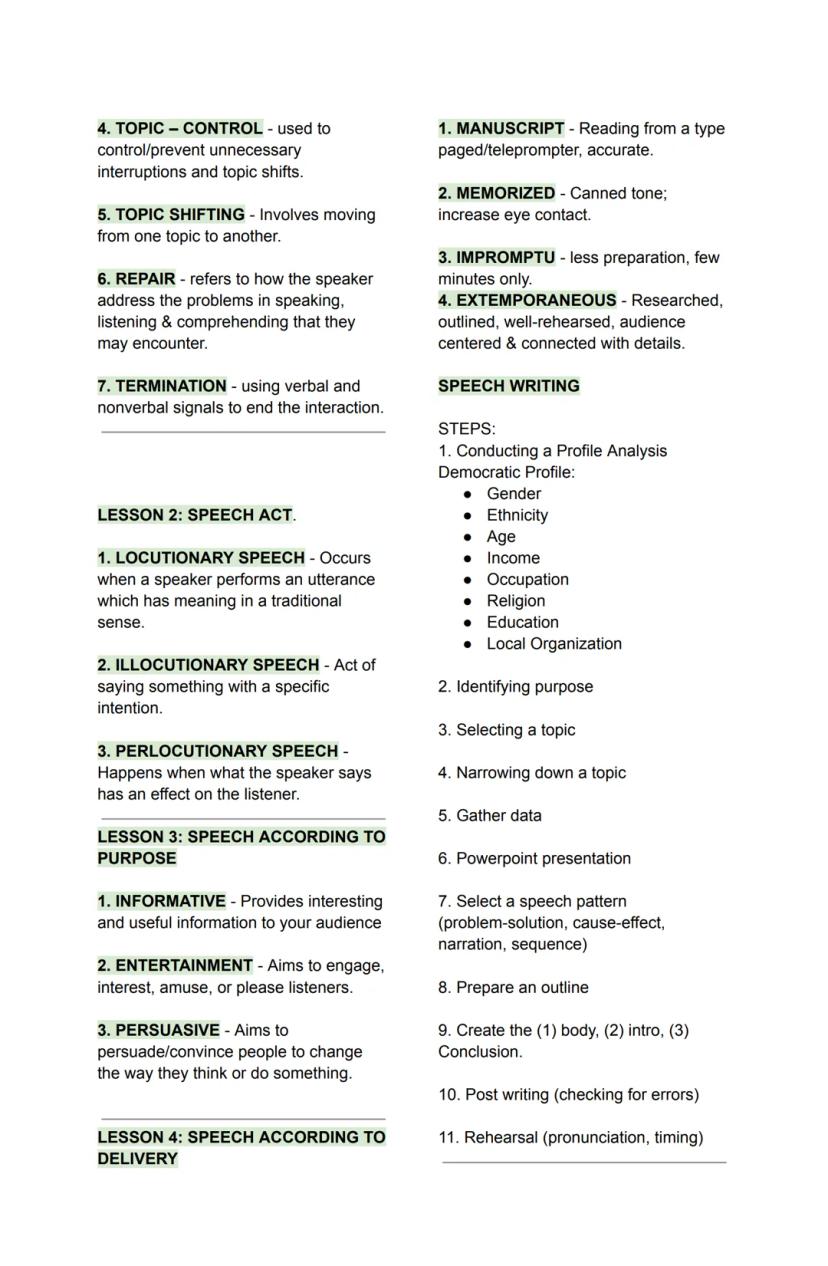

Think of communication as a two-way street where information travels back and forth between people. It comes from the Latin word "communicare," which means to share or have something in common. Pretty cool how the original meaning still applies today, right?
Communication isn't just about talking - it's inevitable, irreversible, and unrepeatable. Once you say something, you can't take it back, and you'll never have that exact same conversation again. The process involves several key players: the speaker (who sends the message), the message itself, encoding (turning thoughts into words), the channel (how it's delivered), decoding (how the receiver interprets it), and feedback.
Communication serves five main purposes that you probably use daily without realizing it. Control helps manage behavior (like when your teacher gives instructions), social interaction builds relationships, motivation encourages people, information dissemination shares knowledge, and emotional expression lets us share feelings.
Quick Tip: Every time you text, speak, or even roll your eyes, you're using these communication elements. Understanding them helps you communicate more effectively!
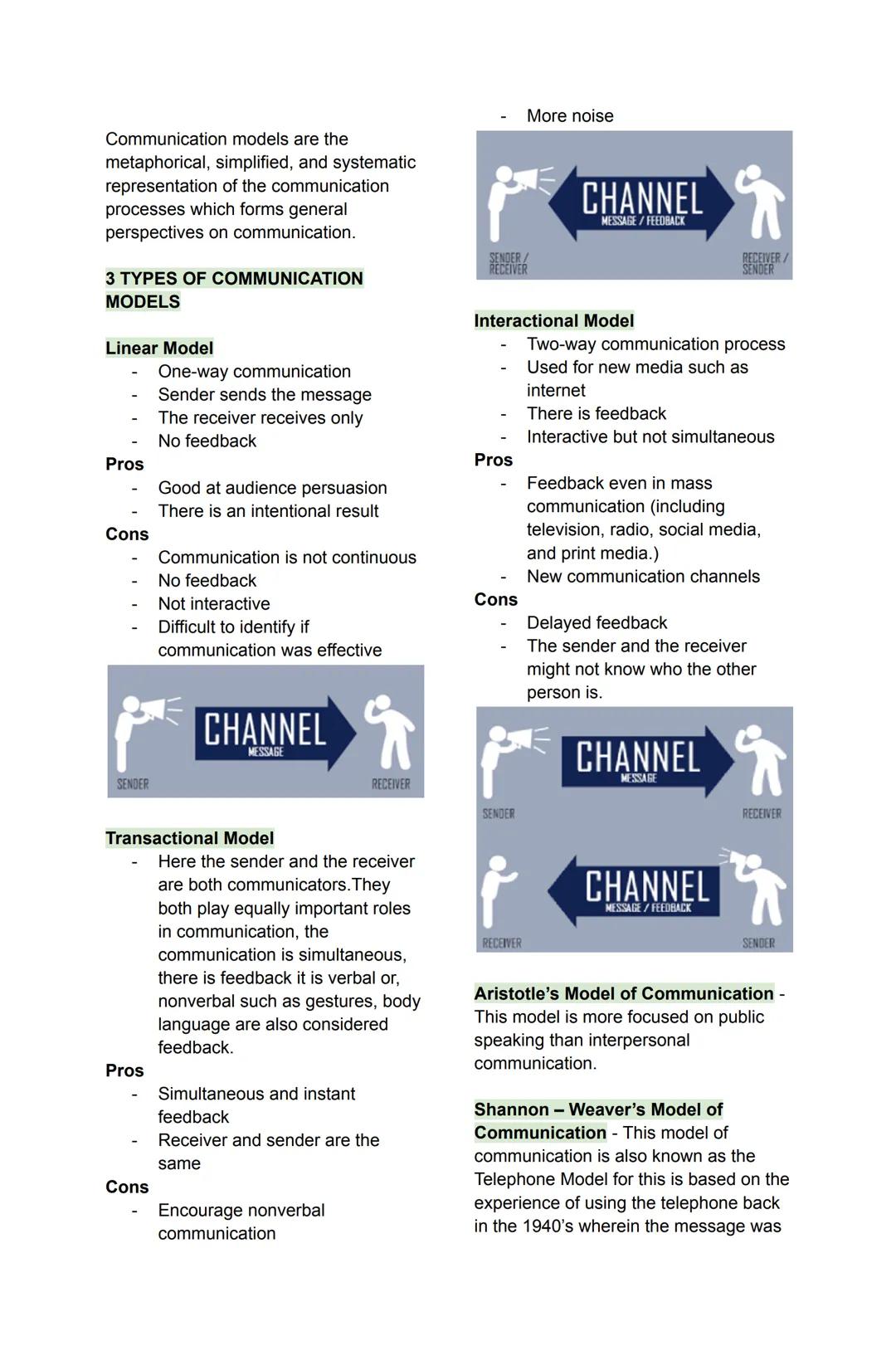
Communication models are like blueprints that show us how messages move from person to person. There are three main types, each with different levels of interaction and complexity.
The Linear Model is like sending a letter - it's one-way communication where the sender delivers a message and the receiver just takes it in. No feedback happens here. Think of a teacher lecturing or a TV broadcast. It's great for persuasion but pretty boring since there's no back-and-forth.
The Interactional Model steps it up with two-way communication and feedback, but it's not instant. This is like social media posts where you comment and get replies later. You get feedback, but there's usually a delay between messages.
The Transactional Model is where things get interesting - both people are communicators at the same time! This happens in face-to-face conversations where you're constantly giving verbal and nonverbal feedback. You might nod, smile, or interrupt while the other person is talking. It's the most natural and effective form of communication.
Real Talk: Most of your daily conversations use the transactional model - you're constantly reading body language and adjusting what you say based on reactions.
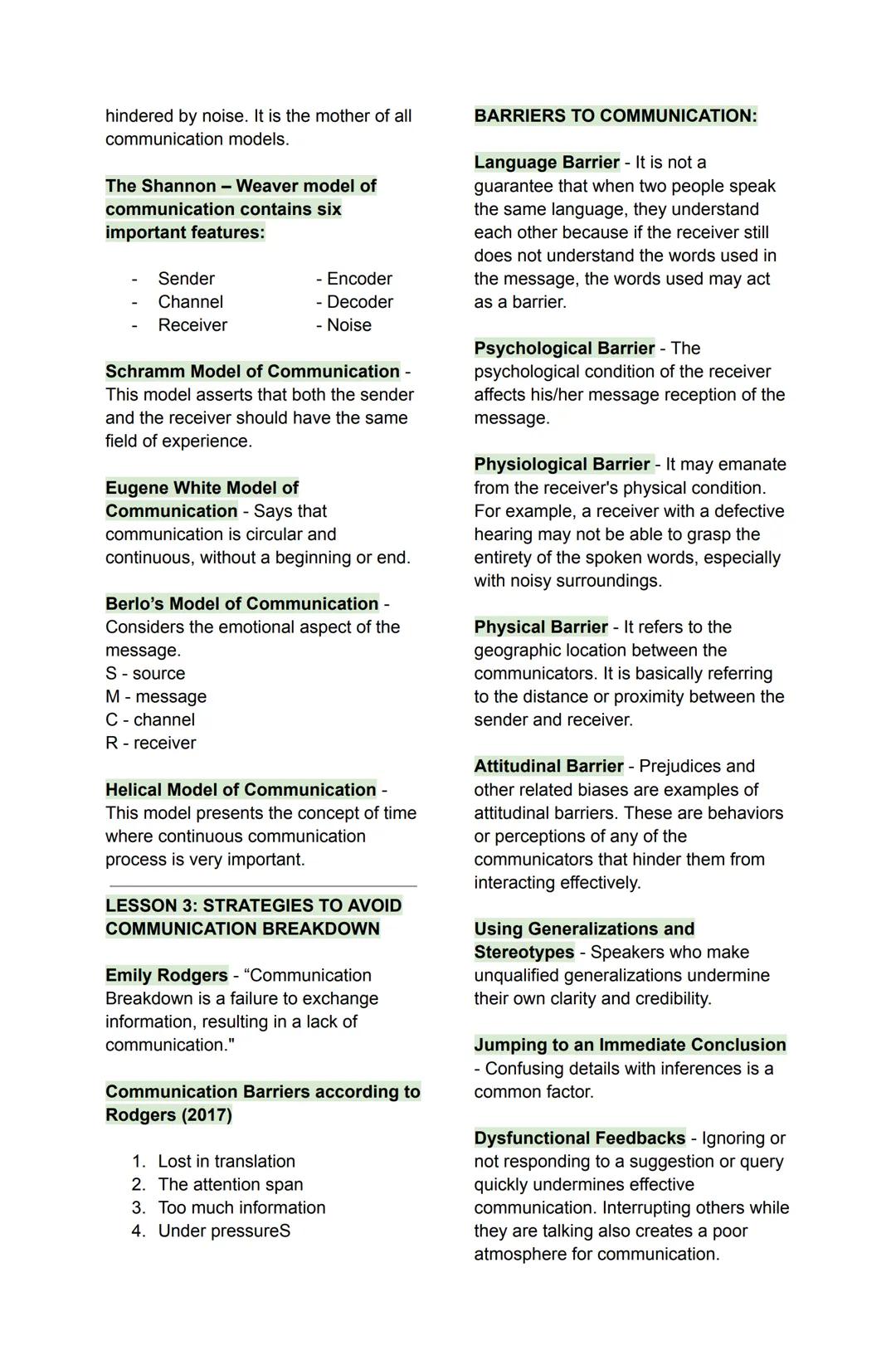
Communication barriers are like roadblocks that mess up your message. Language barriers happen when people don't understand the words being used - and this doesn't just mean different languages! Using complicated terms or slang can confuse people too.
Psychological and physiological barriers involve mental and physical conditions that affect how we receive messages. If someone's stressed, distracted, or has hearing problems, communication gets harder. Physical barriers are about distance and location, while attitudinal barriers involve prejudices and biases that block understanding.
Some of the biggest communication killers include jumping to conclusions, using stereotypes, and dysfunctional feedback like interrupting or ignoring someone. These behaviors create tension and misunderstandings that can damage relationships.
The effects of communication breakdown are pretty serious - you get loss of morale, embarrassment, anger, and stress. In relationships, it can mean lost friendships, while in business, it means lost clients and money. The good news? You can fix most communication problems by observing carefully, considering your options, sharing openly, practicing regularly, and working as a team.
Power Move: When communication breaks down, don't panic! Take a step back, observe what's happening, and try a different approach.
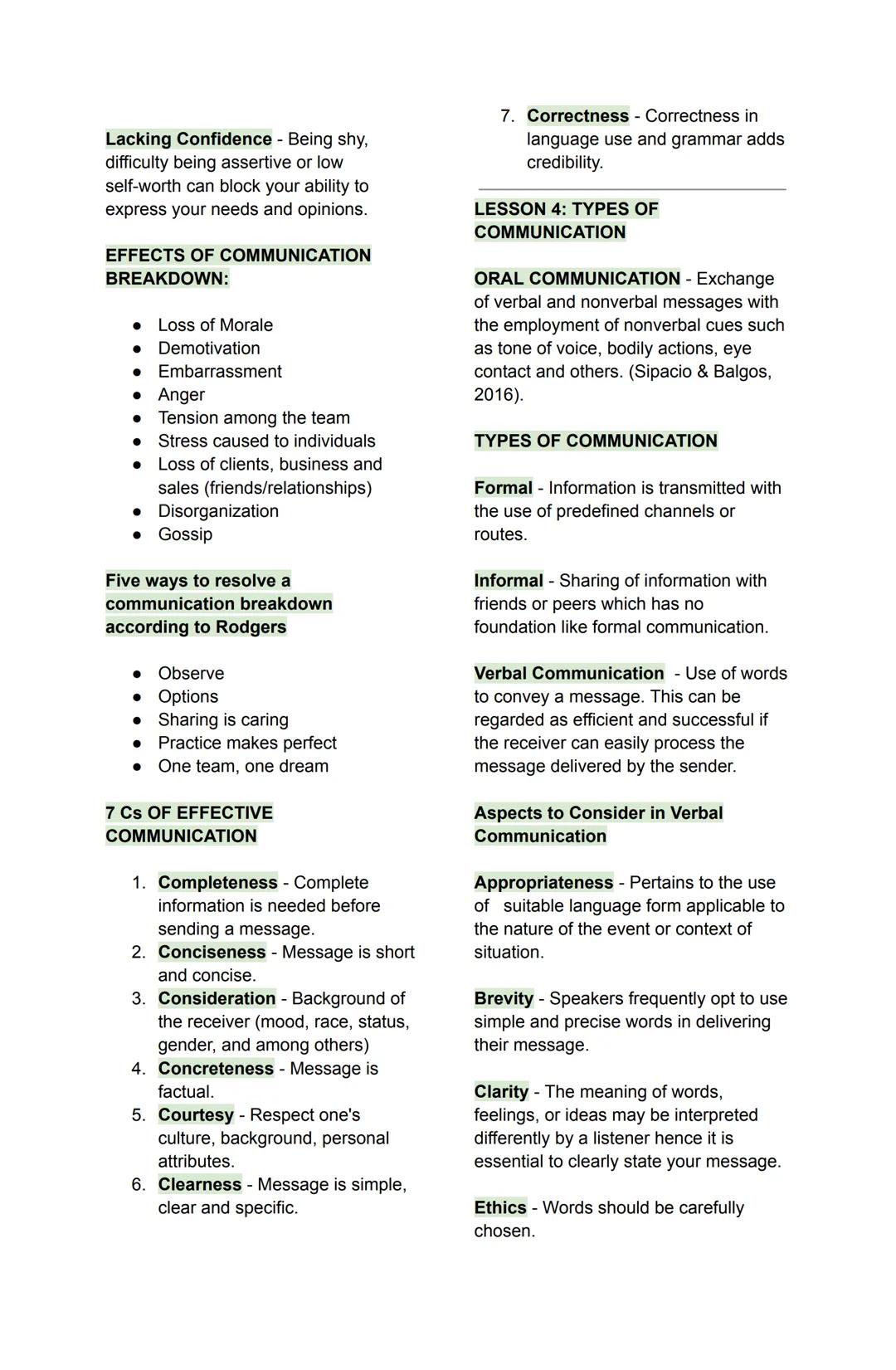
Want to nail your communication every time? Master the 7 Cs: completeness, conciseness, consideration, concreteness, courtesy, clearness, and correctness. These ensure your message hits the mark without confusion or offense.
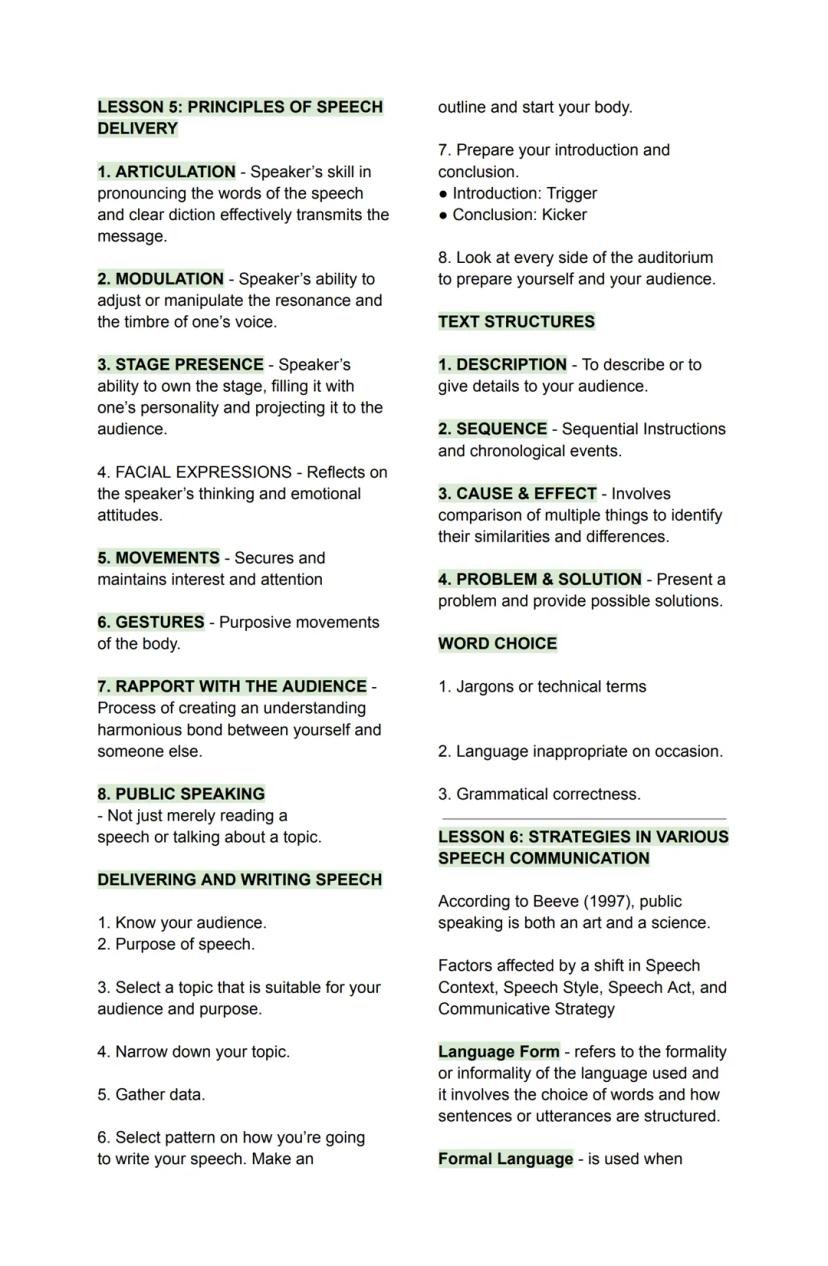
Oral communication combines verbal and nonverbal messages - it's not just what you say but how you say it. Formal communication follows official channels and rules, while informal communication is casual chatting with friends. Both have their place depending on the situation.
Verbal communication focuses on word choice and requires attention to appropriateness, brevity, clarity, ethics, and vividness. Choose words that fit the situation, keep it short and sweet, be clear about your meaning, stay ethical, and add some color to make it interesting.
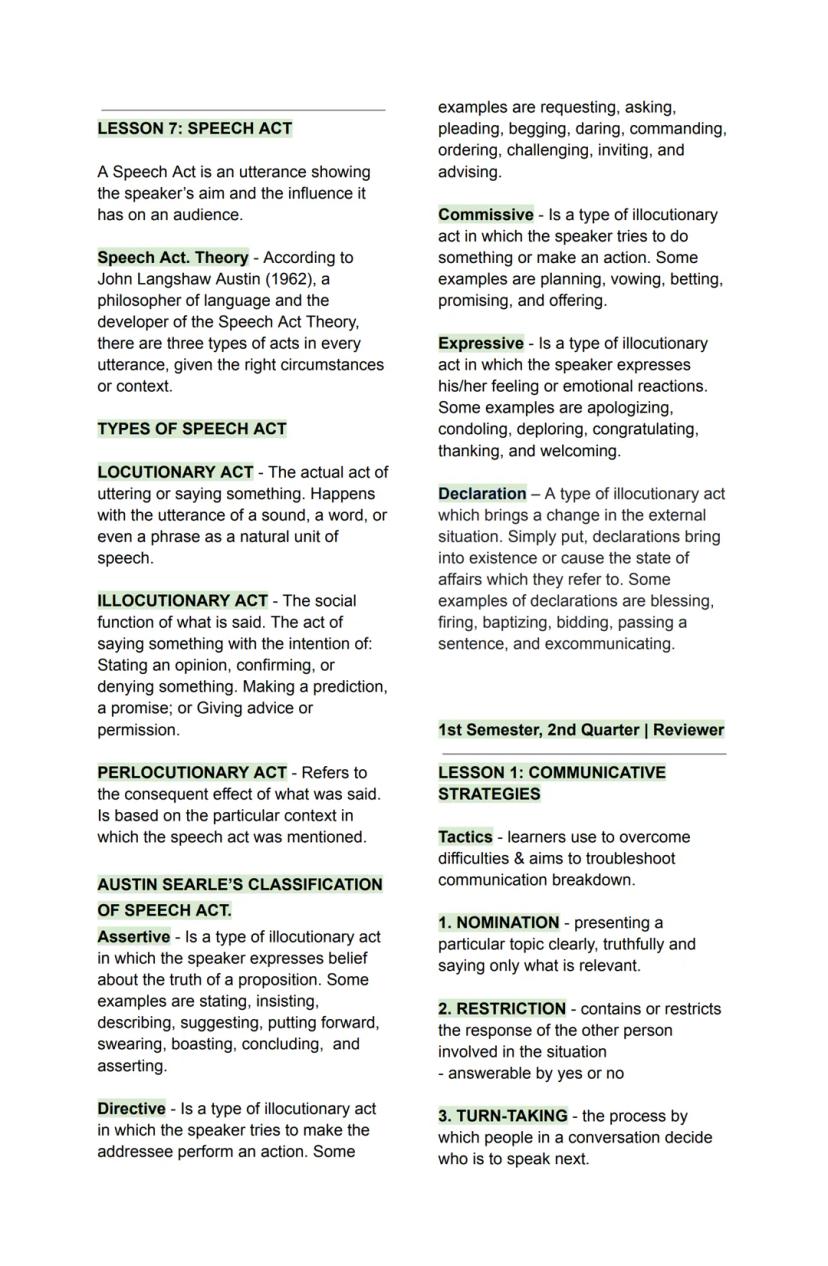
Nonverbal communication includes kinesics (facial expressions, gestures, eye movement), your attitude, how you dress, and your tone of voice. This stuff is super important because it can enhance your message, communicate feelings without words, and keep your audience engaged.
Reality Check: Studies show that nonverbal communication makes up about 55% of all communication - so your body language matters more than you think!

Speech context determines how you should communicate in different situations. Intrapersonal communication is talking to yourself (yes, that counts!), while interpersonal communication happens between people and builds relationships.
Interpersonal communication breaks down into dyad communication (two people), small group , public speaking (addressing a crowd), and mass communication (TV, radio, internet). Each requires different skills and approaches.
Speeches serve three main purposes: informative speeches educate your audience about new topics, persuasive speeches try to change minds or behaviors, and entertainment speeches aim to make people laugh and enjoy themselves.
The delivery method matters too. Manuscript speeches involve reading word-for-word, memorized speeches are recited from memory, extemporaneous speeches use brief notes for a natural conversation style, and impromptu speeches happen without preparation. Most successful speakers prefer extemporaneous delivery because it feels authentic while staying organized.
Pro Tip: Extemporaneous speaking is your best bet for most situations - you're prepared but flexible enough to adapt to your audience's reactions.
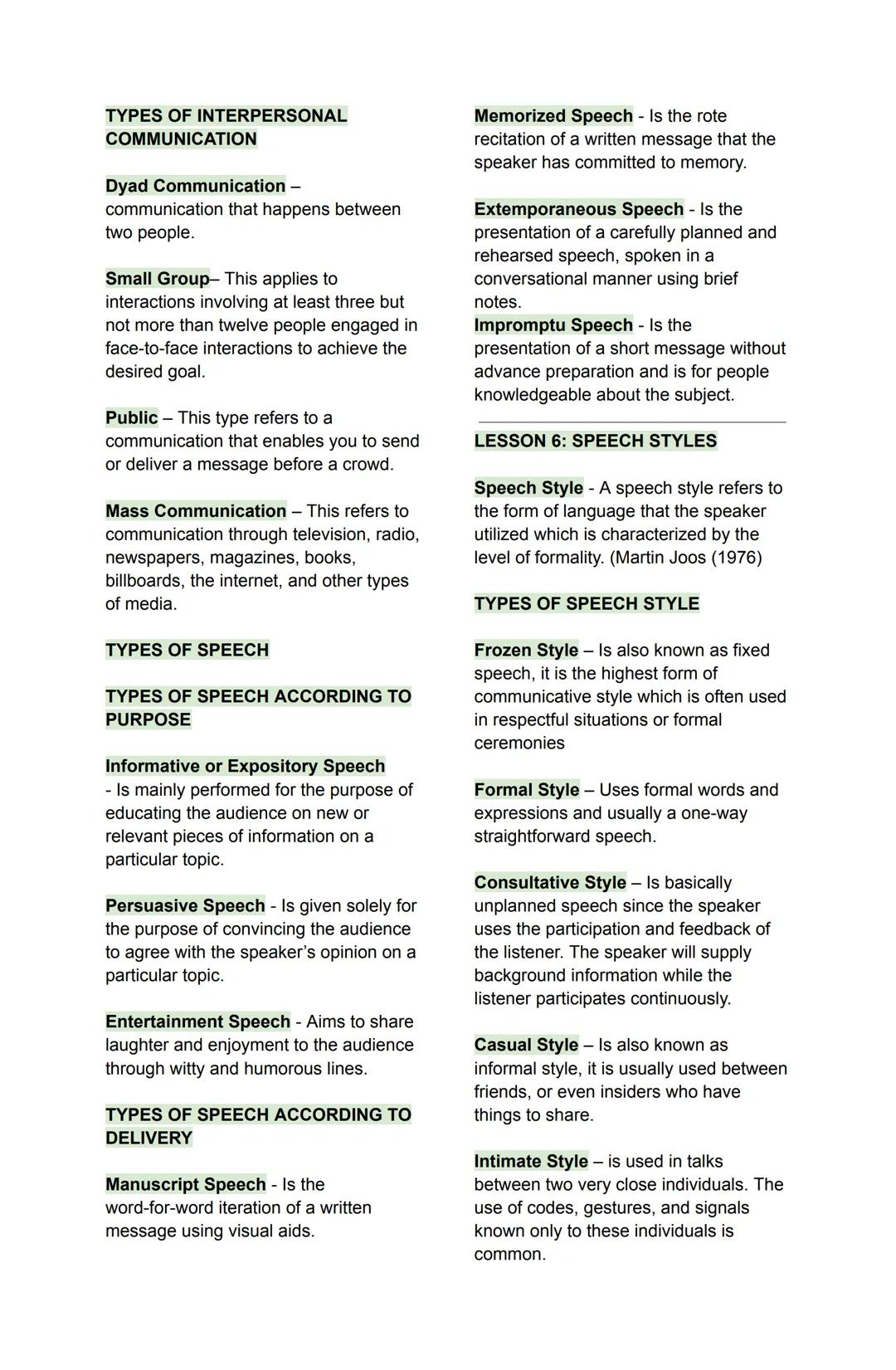
Speech styles are like different outfits - you choose based on the occasion and who you're with. Martin Joos identified five main styles that range from super formal to super casual.
Frozen style is the most formal - think wedding vows or court proceedings. Formal style uses proper language in professional settings. Consultative style involves two-way communication with background information sharing, like doctor-patient conversations.
Casual style is your everyday informal chat with friends and classmates. Intimate style happens between very close people who use private codes, inside jokes, and special gestures that only they understand.
Picking the right style prevents awkward moments and shows respect for your audience. You wouldn't use intimate style with your principal or frozen style with your best friend - that would just be weird!
Style Guide: When in doubt, start slightly more formal than you think necessary. You can always adjust to be more casual, but going the other direction is harder.
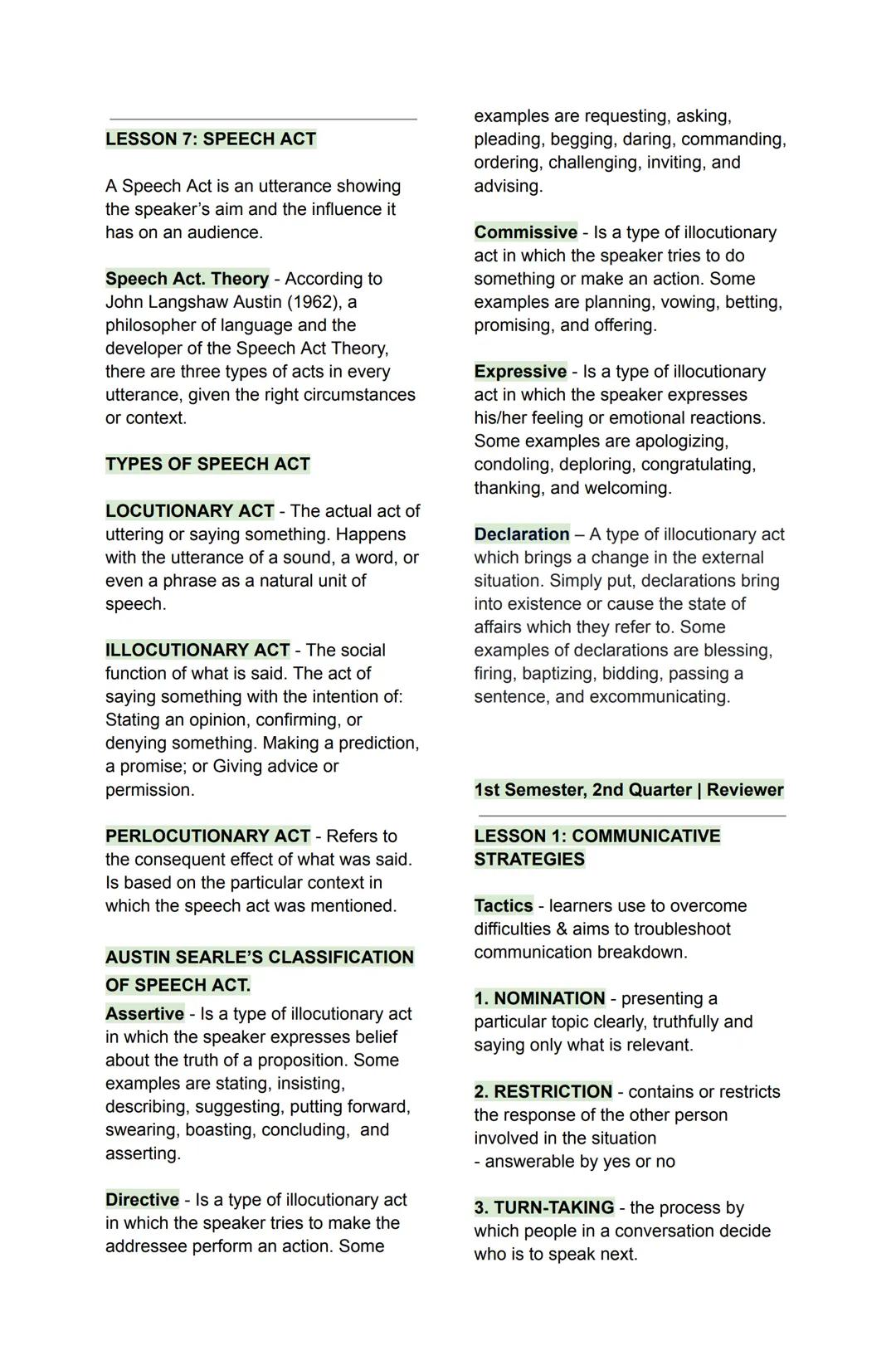
Speech acts are utterances that don't just convey information - they actually do something. John Austin identified three types that happen in every meaningful statement.
Locutionary acts are the basic act of saying something with meaning. Illocutionary acts involve the intention behind your words - are you stating a fact, making a promise, or giving a command? Perlocutionary acts focus on the effect your words have on the listener.
Austin and Searle classified speech acts into five categories: Assertives express beliefs about truth (stating, suggesting, concluding), Directives try to get someone to do something (requesting, commanding, inviting), Commissives commit the speaker to future action (promising, vowing, offering), Expressives show feelings (apologizing, congratulating, thanking), and Declarations change reality through words (firing someone, pronouncing marriage, passing sentence).
Understanding speech acts helps you communicate more intentionally and recognize what others are really trying to accomplish with their words.
Word Power: Every time you speak, you're not just sharing information - you're trying to accomplish something specific. Being aware of this makes you a more effective communicator.
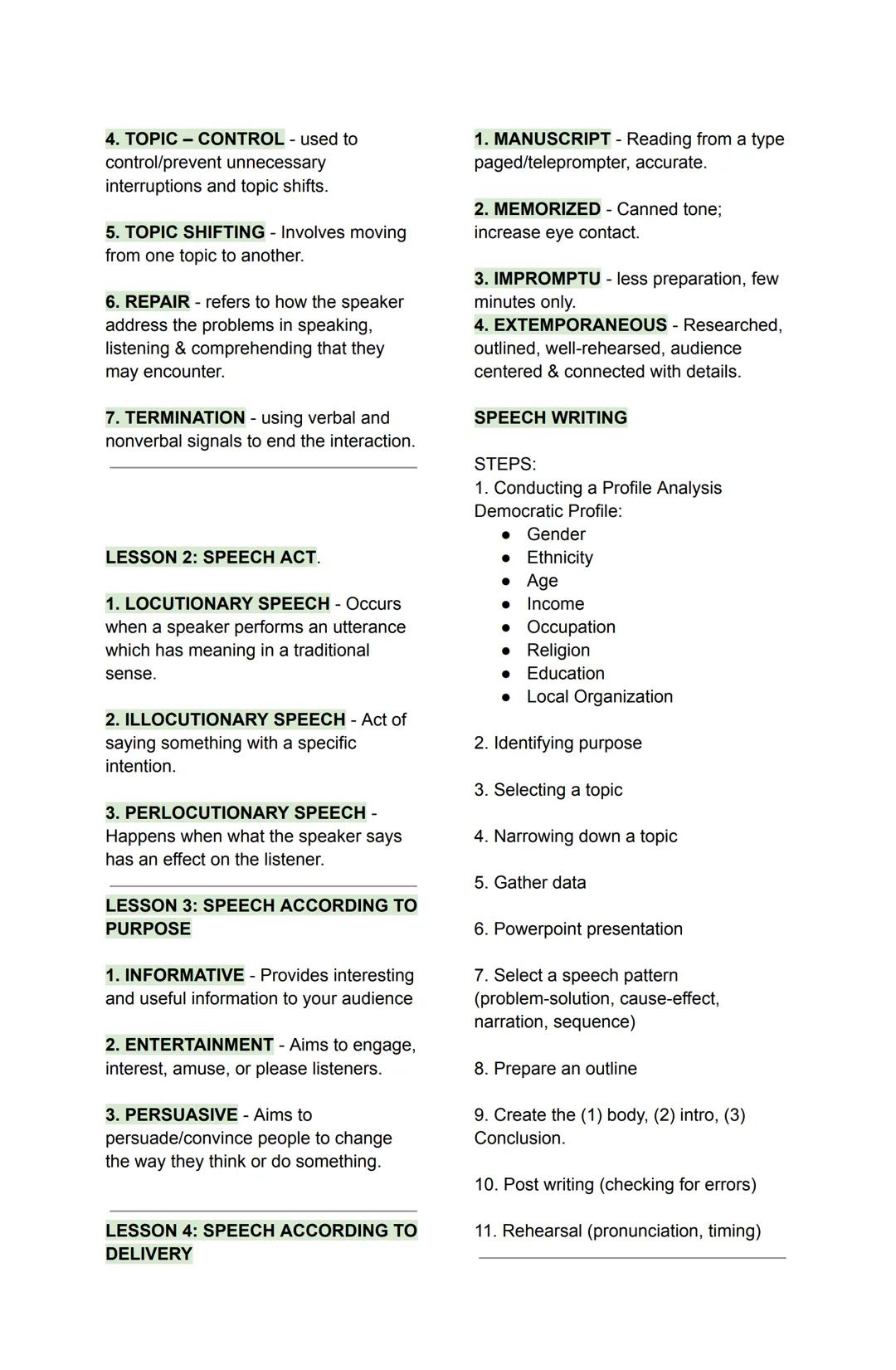
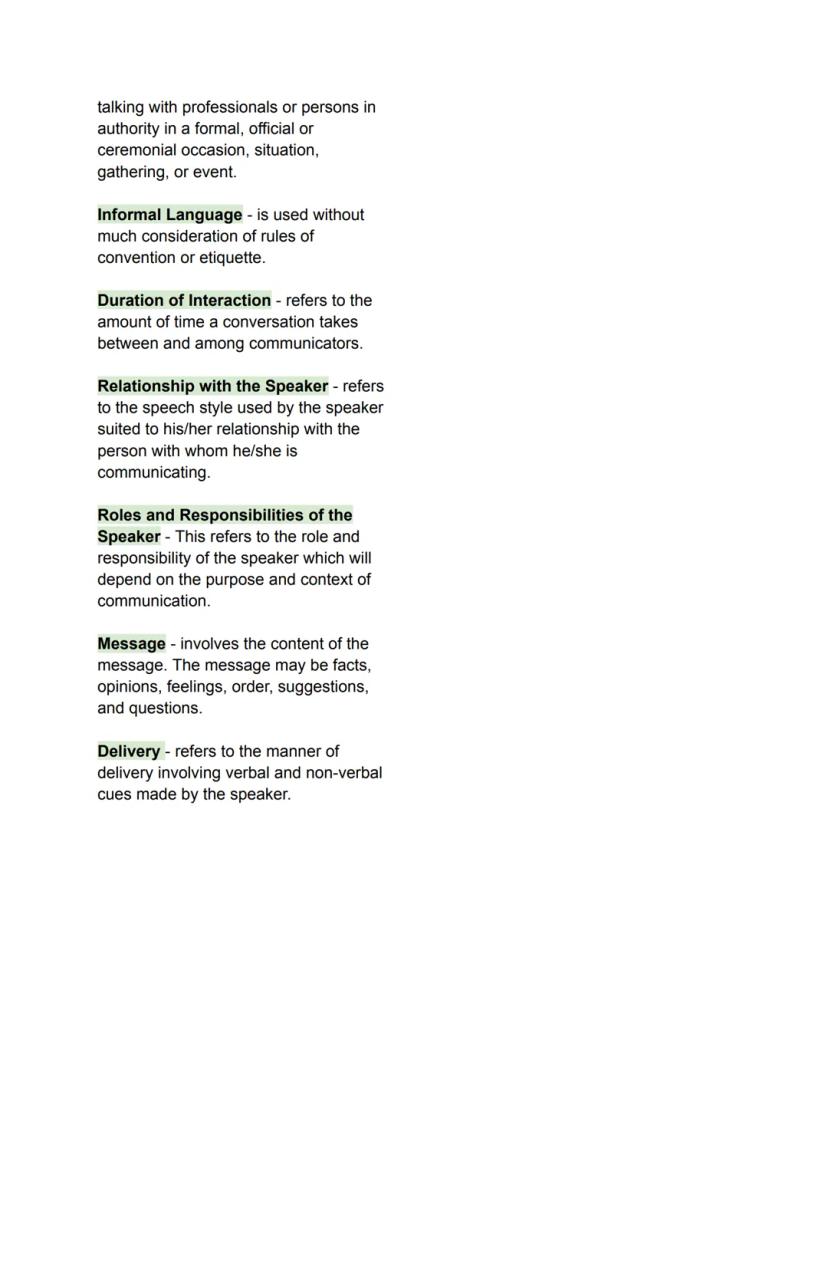
Communicative strategies are your toolkit for smooth conversations. Nomination introduces topics clearly, restriction limits responses , and turn-taking manages who speaks when. Topic control prevents interruptions, topic shifting moves between subjects, repair fixes communication problems, and termination ends conversations gracefully.
Speech writing follows a clear process starting with audience analysis - know their demographics, interests, and needs. Then identify your purpose, select and narrow your topic, gather data, choose your organizational pattern, and create an outline.
The magic formula is body first, then introduction, then conclusion. Your introduction needs a strong trigger to grab attention, while your conclusion needs a memorable kicker. Always do a final check for errors and rehearse for proper pronunciation and timing.
Text structures help organize your content: description gives details, sequence shows chronological order, cause and effect explains relationships, and problem and solution presents issues with fixes.
Writing Hack: Start with your main points in the body, then craft an intro that hooks your audience and a conclusion that leaves them thinking.
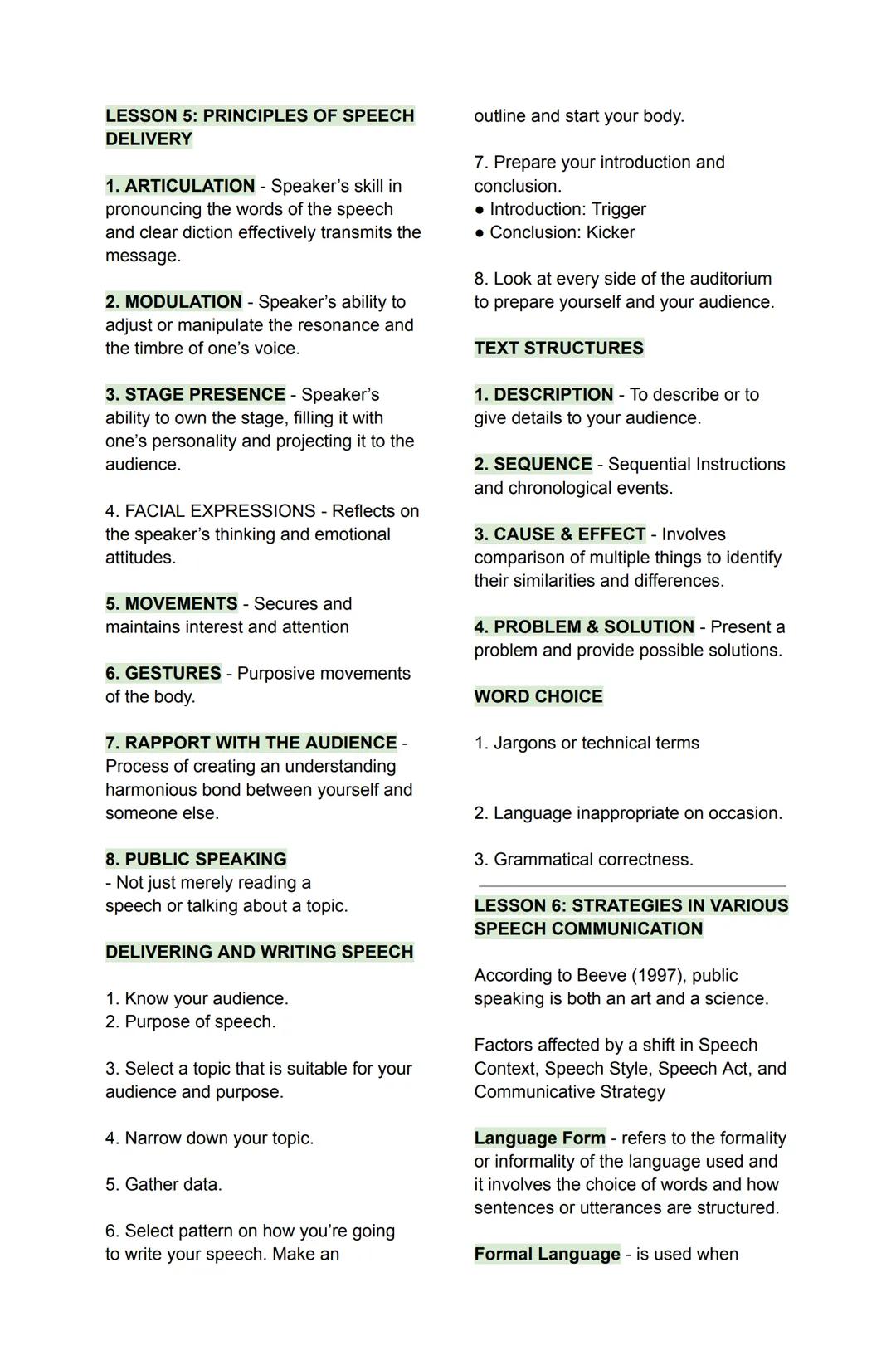
Great speech delivery combines multiple skills that work together. Articulation ensures clear pronunciation so everyone understands your words. Modulation involves adjusting your voice's tone and volume to match your message and keep things interesting.
Stage presence means owning your space and projecting confidence to your audience. Facial expressions should match your content and show your emotions authentically. Purposeful movements and gestures help emphasize points and maintain attention, but they should feel natural, not forced.
Building rapport with your audience creates connection and trust. Look at different sections of the room, make eye contact, and adjust your energy to match theirs. Remember, public speaking isn't just reading words - it's connecting with people.
Word choice matters enormously. Avoid confusing jargon, match your language to the occasion, and always check your grammar. The goal is clear, appropriate communication that serves your audience's needs.
Delivery Secret: The best speakers make it look effortless, but they've practiced extensively. Rehearsal is what transforms good content into great communication.
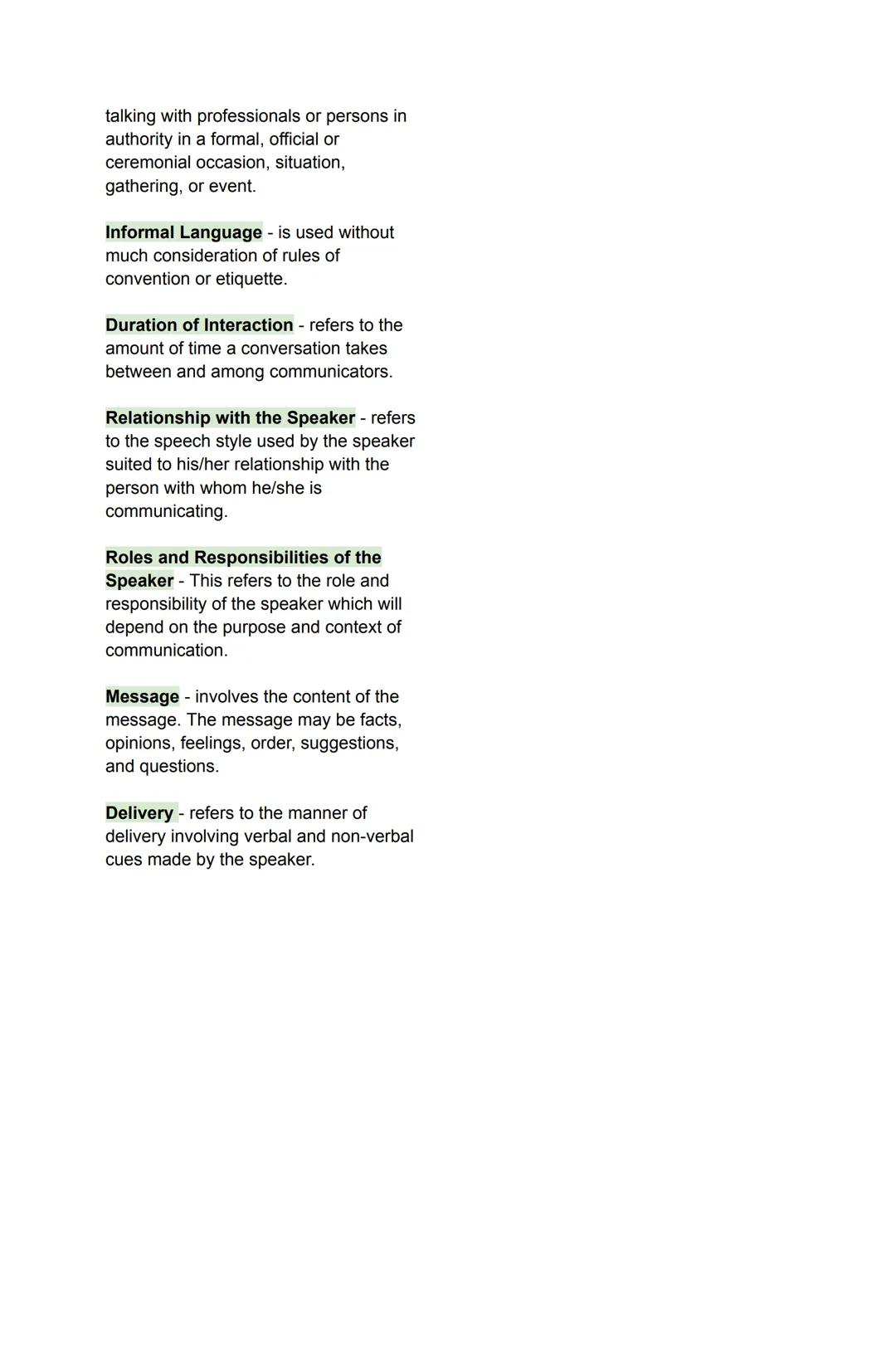
Smart communicators adjust their approach based on speech context, style, speech acts, and communicative strategies. This affects your language form - whether you use formal or informal language depends entirely on your situation and audience.
Duration of interaction varies from quick exchanges to lengthy discussions. Your relationship with the audience determines your speech style - you'll talk differently to your friends versus your teacher versus your parents.
Your roles and responsibilities shape how you communicate. As a student presenting to class, you have different obligations than when you're just chatting during break. The message content adapts too - facts, opinions, feelings, orders, and questions all require different approaches.
Delivery style encompasses both verbal and nonverbal elements. Your tone, pace, gestures, and body language should all align with your context and purpose. Master communicators seamlessly adjust all these elements without thinking about it.
Adaptation Game: Practice switching between formal and informal communication styles. The more you practice adapting, the more natural it becomes in real situations.
Our AI companion is specifically built for the needs of students. Based on the millions of content pieces we have on the platform we can provide truly meaningful and relevant answers to students. But its not only about answers, the companion is even more about guiding students through their daily learning challenges, with personalised study plans, quizzes or content pieces in the chat and 100% personalisation based on the students skills and developments.
You can download the app in the Google Play Store and in the Apple App Store.
That's right! Enjoy free access to study content, connect with fellow students, and get instant help – all at your fingertips.
App Store
Google Play
The app is very easy to use and well designed. I have found everything I was looking for so far and have been able to learn a lot from the presentations! I will definitely use the app for a class assignment! And of course it also helps a lot as an inspiration.
Stefan S
iOS user
This app is really great. There are so many study notes and help [...]. My problem subject is French, for example, and the app has so many options for help. Thanks to this app, I have improved my French. I would recommend it to anyone.
Samantha Klich
Android user
Wow, I am really amazed. I just tried the app because I've seen it advertised many times and was absolutely stunned. This app is THE HELP you want for school and above all, it offers so many things, such as workouts and fact sheets, which have been VERY helpful to me personally.
Anna
iOS user
I think it’s very much worth it and you’ll end up using it a lot once you get the hang of it and even after looking at others notes you can still ask your Artificial intelligence buddy the question and ask to simplify it if you still don’t get it!!! In the end I think it’s worth it 😊👍 ⚠️Also DID I MENTION ITS FREEE YOU DON’T HAVE TO PAY FOR ANYTHING AND STILL GET YOUR GRADES IN PERFECTLY❗️❗️⚠️
Thomas R
iOS user
Knowunity is the BEST app I’ve used in a minute. This is not an ai review or anything this is genuinely coming from a 7th grade student (I know 2011 im young) but dude this app is a 10/10 i have maintained a 3.8 gpa and have plenty of time for gaming. I love it and my mom is just happy I got good grades
Brad T
Android user
Not only did it help me find the answer but it also showed me alternative ways to solve it. I was horrible in math and science but now I have an a in both subjects. Thanks for the help🤍🤍
David K
iOS user
The app's just great! All I have to do is enter the topic in the search bar and I get the response real fast. I don't have to watch 10 YouTube videos to understand something, so I'm saving my time. Highly recommended!
Sudenaz Ocak
Android user
In school I was really bad at maths but thanks to the app, I am doing better now. I am so grateful that you made the app.
Greenlight Bonnie
Android user
I found this app a couple years ago and it has only gotten better since then. I really love it because it can help with written questions and photo questions. Also, it can find study guides that other people have made as well as flashcard sets and practice tests. The free version is also amazing for students who might not be able to afford it. Would 100% recommend
Aubrey
iOS user
Best app if you're in Highschool or Junior high. I have been using this app for 2 school years and it's the best, it's good if you don't have anyone to help you with school work.😋🩷🎀
Marco B
iOS user
THE QUIZES AND FLASHCARDS ARE SO USEFUL AND I LOVE THE SCHOOLGPT. IT ALSO IS LITREALLY LIKE CHATGPT BUT SMARTER!! HELPED ME WITH MY MASCARA PROBLEMS TOO!! AS WELL AS MY REAL SUBJECTS ! DUHHH 😍😁😲🤑💗✨🎀😮
Elisha
iOS user
This app is phenomenal down to the correct info and the various topics you can study! I greatly recommend it for people who struggle with procrastination and those who need homework help. It has been perfectly accurate for world 1 history as far as I’ve seen! Geometry too!
Paul T
iOS user
The app is very easy to use and well designed. I have found everything I was looking for so far and have been able to learn a lot from the presentations! I will definitely use the app for a class assignment! And of course it also helps a lot as an inspiration.
Stefan S
iOS user
This app is really great. There are so many study notes and help [...]. My problem subject is French, for example, and the app has so many options for help. Thanks to this app, I have improved my French. I would recommend it to anyone.
Samantha Klich
Android user
Wow, I am really amazed. I just tried the app because I've seen it advertised many times and was absolutely stunned. This app is THE HELP you want for school and above all, it offers so many things, such as workouts and fact sheets, which have been VERY helpful to me personally.
Anna
iOS user
I think it’s very much worth it and you’ll end up using it a lot once you get the hang of it and even after looking at others notes you can still ask your Artificial intelligence buddy the question and ask to simplify it if you still don’t get it!!! In the end I think it’s worth it 😊👍 ⚠️Also DID I MENTION ITS FREEE YOU DON’T HAVE TO PAY FOR ANYTHING AND STILL GET YOUR GRADES IN PERFECTLY❗️❗️⚠️
Thomas R
iOS user
Knowunity is the BEST app I’ve used in a minute. This is not an ai review or anything this is genuinely coming from a 7th grade student (I know 2011 im young) but dude this app is a 10/10 i have maintained a 3.8 gpa and have plenty of time for gaming. I love it and my mom is just happy I got good grades
Brad T
Android user
Not only did it help me find the answer but it also showed me alternative ways to solve it. I was horrible in math and science but now I have an a in both subjects. Thanks for the help🤍🤍
David K
iOS user
The app's just great! All I have to do is enter the topic in the search bar and I get the response real fast. I don't have to watch 10 YouTube videos to understand something, so I'm saving my time. Highly recommended!
Sudenaz Ocak
Android user
In school I was really bad at maths but thanks to the app, I am doing better now. I am so grateful that you made the app.
Greenlight Bonnie
Android user
I found this app a couple years ago and it has only gotten better since then. I really love it because it can help with written questions and photo questions. Also, it can find study guides that other people have made as well as flashcard sets and practice tests. The free version is also amazing for students who might not be able to afford it. Would 100% recommend
Aubrey
iOS user
Best app if you're in Highschool or Junior high. I have been using this app for 2 school years and it's the best, it's good if you don't have anyone to help you with school work.😋🩷🎀
Marco B
iOS user
THE QUIZES AND FLASHCARDS ARE SO USEFUL AND I LOVE THE SCHOOLGPT. IT ALSO IS LITREALLY LIKE CHATGPT BUT SMARTER!! HELPED ME WITH MY MASCARA PROBLEMS TOO!! AS WELL AS MY REAL SUBJECTS ! DUHHH 😍😁😲🤑💗✨🎀😮
Elisha
iOS user
This app is phenomenal down to the correct info and the various topics you can study! I greatly recommend it for people who struggle with procrastination and those who need homework help. It has been perfectly accurate for world 1 history as far as I’ve seen! Geometry too!
Paul T
iOS user
Danielle
@danielle_tewg3
Ever wondered why some conversations flow smoothly while others feel awkward? Communication is way more complex than just talking - it's an art that involves understanding different styles, contexts, and strategies to get your message across effectively.
Access to all documents
Improve your grades
Join milions of students
By signing up you accept Terms of Service and Privacy Policy
Think of communication as a two-way street where information travels back and forth between people. It comes from the Latin word "communicare," which means to share or have something in common. Pretty cool how the original meaning still applies today, right?
Communication isn't just about talking - it's inevitable, irreversible, and unrepeatable. Once you say something, you can't take it back, and you'll never have that exact same conversation again. The process involves several key players: the speaker (who sends the message), the message itself, encoding (turning thoughts into words), the channel (how it's delivered), decoding (how the receiver interprets it), and feedback.
Communication serves five main purposes that you probably use daily without realizing it. Control helps manage behavior (like when your teacher gives instructions), social interaction builds relationships, motivation encourages people, information dissemination shares knowledge, and emotional expression lets us share feelings.
Quick Tip: Every time you text, speak, or even roll your eyes, you're using these communication elements. Understanding them helps you communicate more effectively!
Access to all documents
Improve your grades
Join milions of students
By signing up you accept Terms of Service and Privacy Policy
Communication models are like blueprints that show us how messages move from person to person. There are three main types, each with different levels of interaction and complexity.
The Linear Model is like sending a letter - it's one-way communication where the sender delivers a message and the receiver just takes it in. No feedback happens here. Think of a teacher lecturing or a TV broadcast. It's great for persuasion but pretty boring since there's no back-and-forth.
The Interactional Model steps it up with two-way communication and feedback, but it's not instant. This is like social media posts where you comment and get replies later. You get feedback, but there's usually a delay between messages.
The Transactional Model is where things get interesting - both people are communicators at the same time! This happens in face-to-face conversations where you're constantly giving verbal and nonverbal feedback. You might nod, smile, or interrupt while the other person is talking. It's the most natural and effective form of communication.
Real Talk: Most of your daily conversations use the transactional model - you're constantly reading body language and adjusting what you say based on reactions.
Access to all documents
Improve your grades
Join milions of students
By signing up you accept Terms of Service and Privacy Policy
Communication barriers are like roadblocks that mess up your message. Language barriers happen when people don't understand the words being used - and this doesn't just mean different languages! Using complicated terms or slang can confuse people too.
Psychological and physiological barriers involve mental and physical conditions that affect how we receive messages. If someone's stressed, distracted, or has hearing problems, communication gets harder. Physical barriers are about distance and location, while attitudinal barriers involve prejudices and biases that block understanding.
Some of the biggest communication killers include jumping to conclusions, using stereotypes, and dysfunctional feedback like interrupting or ignoring someone. These behaviors create tension and misunderstandings that can damage relationships.
The effects of communication breakdown are pretty serious - you get loss of morale, embarrassment, anger, and stress. In relationships, it can mean lost friendships, while in business, it means lost clients and money. The good news? You can fix most communication problems by observing carefully, considering your options, sharing openly, practicing regularly, and working as a team.
Power Move: When communication breaks down, don't panic! Take a step back, observe what's happening, and try a different approach.
Access to all documents
Improve your grades
Join milions of students
By signing up you accept Terms of Service and Privacy Policy
Want to nail your communication every time? Master the 7 Cs: completeness, conciseness, consideration, concreteness, courtesy, clearness, and correctness. These ensure your message hits the mark without confusion or offense.
Oral communication combines verbal and nonverbal messages - it's not just what you say but how you say it. Formal communication follows official channels and rules, while informal communication is casual chatting with friends. Both have their place depending on the situation.
Verbal communication focuses on word choice and requires attention to appropriateness, brevity, clarity, ethics, and vividness. Choose words that fit the situation, keep it short and sweet, be clear about your meaning, stay ethical, and add some color to make it interesting.
Nonverbal communication includes kinesics (facial expressions, gestures, eye movement), your attitude, how you dress, and your tone of voice. This stuff is super important because it can enhance your message, communicate feelings without words, and keep your audience engaged.
Reality Check: Studies show that nonverbal communication makes up about 55% of all communication - so your body language matters more than you think!
Access to all documents
Improve your grades
Join milions of students
By signing up you accept Terms of Service and Privacy Policy
Speech context determines how you should communicate in different situations. Intrapersonal communication is talking to yourself (yes, that counts!), while interpersonal communication happens between people and builds relationships.
Interpersonal communication breaks down into dyad communication (two people), small group , public speaking (addressing a crowd), and mass communication (TV, radio, internet). Each requires different skills and approaches.
Speeches serve three main purposes: informative speeches educate your audience about new topics, persuasive speeches try to change minds or behaviors, and entertainment speeches aim to make people laugh and enjoy themselves.
The delivery method matters too. Manuscript speeches involve reading word-for-word, memorized speeches are recited from memory, extemporaneous speeches use brief notes for a natural conversation style, and impromptu speeches happen without preparation. Most successful speakers prefer extemporaneous delivery because it feels authentic while staying organized.
Pro Tip: Extemporaneous speaking is your best bet for most situations - you're prepared but flexible enough to adapt to your audience's reactions.
Access to all documents
Improve your grades
Join milions of students
By signing up you accept Terms of Service and Privacy Policy
Speech styles are like different outfits - you choose based on the occasion and who you're with. Martin Joos identified five main styles that range from super formal to super casual.
Frozen style is the most formal - think wedding vows or court proceedings. Formal style uses proper language in professional settings. Consultative style involves two-way communication with background information sharing, like doctor-patient conversations.
Casual style is your everyday informal chat with friends and classmates. Intimate style happens between very close people who use private codes, inside jokes, and special gestures that only they understand.
Picking the right style prevents awkward moments and shows respect for your audience. You wouldn't use intimate style with your principal or frozen style with your best friend - that would just be weird!
Style Guide: When in doubt, start slightly more formal than you think necessary. You can always adjust to be more casual, but going the other direction is harder.
Access to all documents
Improve your grades
Join milions of students
By signing up you accept Terms of Service and Privacy Policy
Speech acts are utterances that don't just convey information - they actually do something. John Austin identified three types that happen in every meaningful statement.
Locutionary acts are the basic act of saying something with meaning. Illocutionary acts involve the intention behind your words - are you stating a fact, making a promise, or giving a command? Perlocutionary acts focus on the effect your words have on the listener.
Austin and Searle classified speech acts into five categories: Assertives express beliefs about truth (stating, suggesting, concluding), Directives try to get someone to do something (requesting, commanding, inviting), Commissives commit the speaker to future action (promising, vowing, offering), Expressives show feelings (apologizing, congratulating, thanking), and Declarations change reality through words (firing someone, pronouncing marriage, passing sentence).
Understanding speech acts helps you communicate more intentionally and recognize what others are really trying to accomplish with their words.
Word Power: Every time you speak, you're not just sharing information - you're trying to accomplish something specific. Being aware of this makes you a more effective communicator.
Access to all documents
Improve your grades
Join milions of students
By signing up you accept Terms of Service and Privacy Policy
Communicative strategies are your toolkit for smooth conversations. Nomination introduces topics clearly, restriction limits responses , and turn-taking manages who speaks when. Topic control prevents interruptions, topic shifting moves between subjects, repair fixes communication problems, and termination ends conversations gracefully.
Speech writing follows a clear process starting with audience analysis - know their demographics, interests, and needs. Then identify your purpose, select and narrow your topic, gather data, choose your organizational pattern, and create an outline.
The magic formula is body first, then introduction, then conclusion. Your introduction needs a strong trigger to grab attention, while your conclusion needs a memorable kicker. Always do a final check for errors and rehearse for proper pronunciation and timing.
Text structures help organize your content: description gives details, sequence shows chronological order, cause and effect explains relationships, and problem and solution presents issues with fixes.
Writing Hack: Start with your main points in the body, then craft an intro that hooks your audience and a conclusion that leaves them thinking.
Access to all documents
Improve your grades
Join milions of students
By signing up you accept Terms of Service and Privacy Policy
Great speech delivery combines multiple skills that work together. Articulation ensures clear pronunciation so everyone understands your words. Modulation involves adjusting your voice's tone and volume to match your message and keep things interesting.
Stage presence means owning your space and projecting confidence to your audience. Facial expressions should match your content and show your emotions authentically. Purposeful movements and gestures help emphasize points and maintain attention, but they should feel natural, not forced.
Building rapport with your audience creates connection and trust. Look at different sections of the room, make eye contact, and adjust your energy to match theirs. Remember, public speaking isn't just reading words - it's connecting with people.
Word choice matters enormously. Avoid confusing jargon, match your language to the occasion, and always check your grammar. The goal is clear, appropriate communication that serves your audience's needs.
Delivery Secret: The best speakers make it look effortless, but they've practiced extensively. Rehearsal is what transforms good content into great communication.
Access to all documents
Improve your grades
Join milions of students
By signing up you accept Terms of Service and Privacy Policy
Smart communicators adjust their approach based on speech context, style, speech acts, and communicative strategies. This affects your language form - whether you use formal or informal language depends entirely on your situation and audience.
Duration of interaction varies from quick exchanges to lengthy discussions. Your relationship with the audience determines your speech style - you'll talk differently to your friends versus your teacher versus your parents.
Your roles and responsibilities shape how you communicate. As a student presenting to class, you have different obligations than when you're just chatting during break. The message content adapts too - facts, opinions, feelings, orders, and questions all require different approaches.
Delivery style encompasses both verbal and nonverbal elements. Your tone, pace, gestures, and body language should all align with your context and purpose. Master communicators seamlessly adjust all these elements without thinking about it.
Adaptation Game: Practice switching between formal and informal communication styles. The more you practice adapting, the more natural it becomes in real situations.
Our AI companion is specifically built for the needs of students. Based on the millions of content pieces we have on the platform we can provide truly meaningful and relevant answers to students. But its not only about answers, the companion is even more about guiding students through their daily learning challenges, with personalised study plans, quizzes or content pieces in the chat and 100% personalisation based on the students skills and developments.
You can download the app in the Google Play Store and in the Apple App Store.
That's right! Enjoy free access to study content, connect with fellow students, and get instant help – all at your fingertips.
238
Smart Tools NEW
Transform this note into: ✓ 50+ Practice Questions ✓ Interactive Flashcards ✓ Full Mock Exam ✓ Essay Outlines
App Store
Google Play
The app is very easy to use and well designed. I have found everything I was looking for so far and have been able to learn a lot from the presentations! I will definitely use the app for a class assignment! And of course it also helps a lot as an inspiration.
Stefan S
iOS user
This app is really great. There are so many study notes and help [...]. My problem subject is French, for example, and the app has so many options for help. Thanks to this app, I have improved my French. I would recommend it to anyone.
Samantha Klich
Android user
Wow, I am really amazed. I just tried the app because I've seen it advertised many times and was absolutely stunned. This app is THE HELP you want for school and above all, it offers so many things, such as workouts and fact sheets, which have been VERY helpful to me personally.
Anna
iOS user
I think it’s very much worth it and you’ll end up using it a lot once you get the hang of it and even after looking at others notes you can still ask your Artificial intelligence buddy the question and ask to simplify it if you still don’t get it!!! In the end I think it’s worth it 😊👍 ⚠️Also DID I MENTION ITS FREEE YOU DON’T HAVE TO PAY FOR ANYTHING AND STILL GET YOUR GRADES IN PERFECTLY❗️❗️⚠️
Thomas R
iOS user
Knowunity is the BEST app I’ve used in a minute. This is not an ai review or anything this is genuinely coming from a 7th grade student (I know 2011 im young) but dude this app is a 10/10 i have maintained a 3.8 gpa and have plenty of time for gaming. I love it and my mom is just happy I got good grades
Brad T
Android user
Not only did it help me find the answer but it also showed me alternative ways to solve it. I was horrible in math and science but now I have an a in both subjects. Thanks for the help🤍🤍
David K
iOS user
The app's just great! All I have to do is enter the topic in the search bar and I get the response real fast. I don't have to watch 10 YouTube videos to understand something, so I'm saving my time. Highly recommended!
Sudenaz Ocak
Android user
In school I was really bad at maths but thanks to the app, I am doing better now. I am so grateful that you made the app.
Greenlight Bonnie
Android user
I found this app a couple years ago and it has only gotten better since then. I really love it because it can help with written questions and photo questions. Also, it can find study guides that other people have made as well as flashcard sets and practice tests. The free version is also amazing for students who might not be able to afford it. Would 100% recommend
Aubrey
iOS user
Best app if you're in Highschool or Junior high. I have been using this app for 2 school years and it's the best, it's good if you don't have anyone to help you with school work.😋🩷🎀
Marco B
iOS user
THE QUIZES AND FLASHCARDS ARE SO USEFUL AND I LOVE THE SCHOOLGPT. IT ALSO IS LITREALLY LIKE CHATGPT BUT SMARTER!! HELPED ME WITH MY MASCARA PROBLEMS TOO!! AS WELL AS MY REAL SUBJECTS ! DUHHH 😍😁😲🤑💗✨🎀😮
Elisha
iOS user
This app is phenomenal down to the correct info and the various topics you can study! I greatly recommend it for people who struggle with procrastination and those who need homework help. It has been perfectly accurate for world 1 history as far as I’ve seen! Geometry too!
Paul T
iOS user
The app is very easy to use and well designed. I have found everything I was looking for so far and have been able to learn a lot from the presentations! I will definitely use the app for a class assignment! And of course it also helps a lot as an inspiration.
Stefan S
iOS user
This app is really great. There are so many study notes and help [...]. My problem subject is French, for example, and the app has so many options for help. Thanks to this app, I have improved my French. I would recommend it to anyone.
Samantha Klich
Android user
Wow, I am really amazed. I just tried the app because I've seen it advertised many times and was absolutely stunned. This app is THE HELP you want for school and above all, it offers so many things, such as workouts and fact sheets, which have been VERY helpful to me personally.
Anna
iOS user
I think it’s very much worth it and you’ll end up using it a lot once you get the hang of it and even after looking at others notes you can still ask your Artificial intelligence buddy the question and ask to simplify it if you still don’t get it!!! In the end I think it’s worth it 😊👍 ⚠️Also DID I MENTION ITS FREEE YOU DON’T HAVE TO PAY FOR ANYTHING AND STILL GET YOUR GRADES IN PERFECTLY❗️❗️⚠️
Thomas R
iOS user
Knowunity is the BEST app I’ve used in a minute. This is not an ai review or anything this is genuinely coming from a 7th grade student (I know 2011 im young) but dude this app is a 10/10 i have maintained a 3.8 gpa and have plenty of time for gaming. I love it and my mom is just happy I got good grades
Brad T
Android user
Not only did it help me find the answer but it also showed me alternative ways to solve it. I was horrible in math and science but now I have an a in both subjects. Thanks for the help🤍🤍
David K
iOS user
The app's just great! All I have to do is enter the topic in the search bar and I get the response real fast. I don't have to watch 10 YouTube videos to understand something, so I'm saving my time. Highly recommended!
Sudenaz Ocak
Android user
In school I was really bad at maths but thanks to the app, I am doing better now. I am so grateful that you made the app.
Greenlight Bonnie
Android user
I found this app a couple years ago and it has only gotten better since then. I really love it because it can help with written questions and photo questions. Also, it can find study guides that other people have made as well as flashcard sets and practice tests. The free version is also amazing for students who might not be able to afford it. Would 100% recommend
Aubrey
iOS user
Best app if you're in Highschool or Junior high. I have been using this app for 2 school years and it's the best, it's good if you don't have anyone to help you with school work.😋🩷🎀
Marco B
iOS user
THE QUIZES AND FLASHCARDS ARE SO USEFUL AND I LOVE THE SCHOOLGPT. IT ALSO IS LITREALLY LIKE CHATGPT BUT SMARTER!! HELPED ME WITH MY MASCARA PROBLEMS TOO!! AS WELL AS MY REAL SUBJECTS ! DUHHH 😍😁😲🤑💗✨🎀😮
Elisha
iOS user
This app is phenomenal down to the correct info and the various topics you can study! I greatly recommend it for people who struggle with procrastination and those who need homework help. It has been perfectly accurate for world 1 history as far as I’ve seen! Geometry too!
Paul T
iOS user