
Cyclones are powerful, rotating storm systems that form over warm... Show more
 Algebra
 Overige
 Algebra 1
Sign up to see the contentIt's free!
Access to all documents
Improve your grades
Join milions of students
By signing up you accept Terms of Service and Privacy Policy

Biology

Chemistry
AP Chemistry

English
AP English Literature
10
•
Dec 18, 2025
•

Thalia Fickett
@frostyfeet
Cyclones are powerful, rotating storm systems that form over warm... Show more
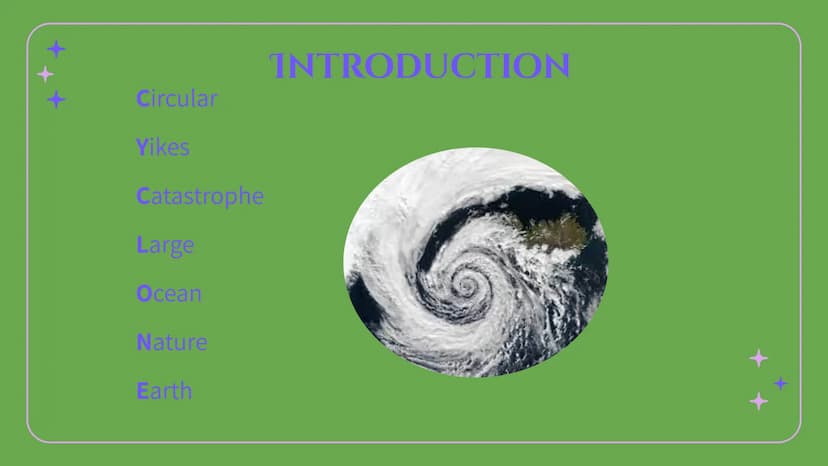
Cyclones are large, circular storm systems that can wreak havoc on communities near oceans. These powerful weather events rotate around a center of low pressure, pulling in warm, moist air and transforming it into destructive energy.
Did you know? The same storm can have different names depending on where it occurs - hurricane in the Atlantic, typhoon in the Pacific, and cyclone in the Indian Ocean!
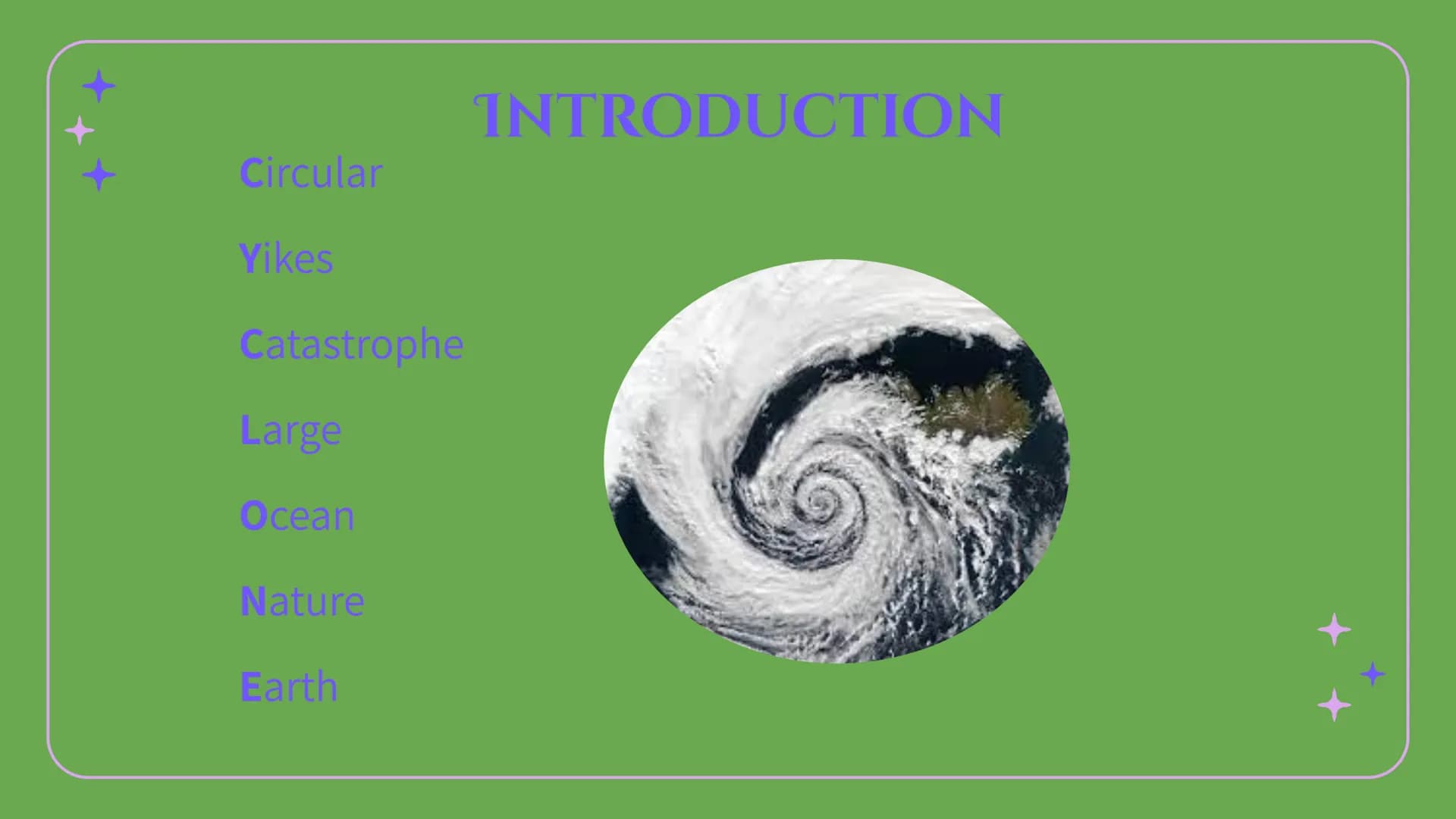
Cyclones are massive circular storms that form over warm ocean waters. These natural disasters can be catastrophic when they make landfall, causing widespread damage with their powerful winds and heavy rainfall.
When a cyclone approaches land, it brings the full force of nature with it. These weather systems are among Earth's most destructive natural phenomena, capable of reshaping coastlines and devastating communities.
Safety First! Understanding cyclones isn't just interesting science - it could help save lives if you live in a coastal region!
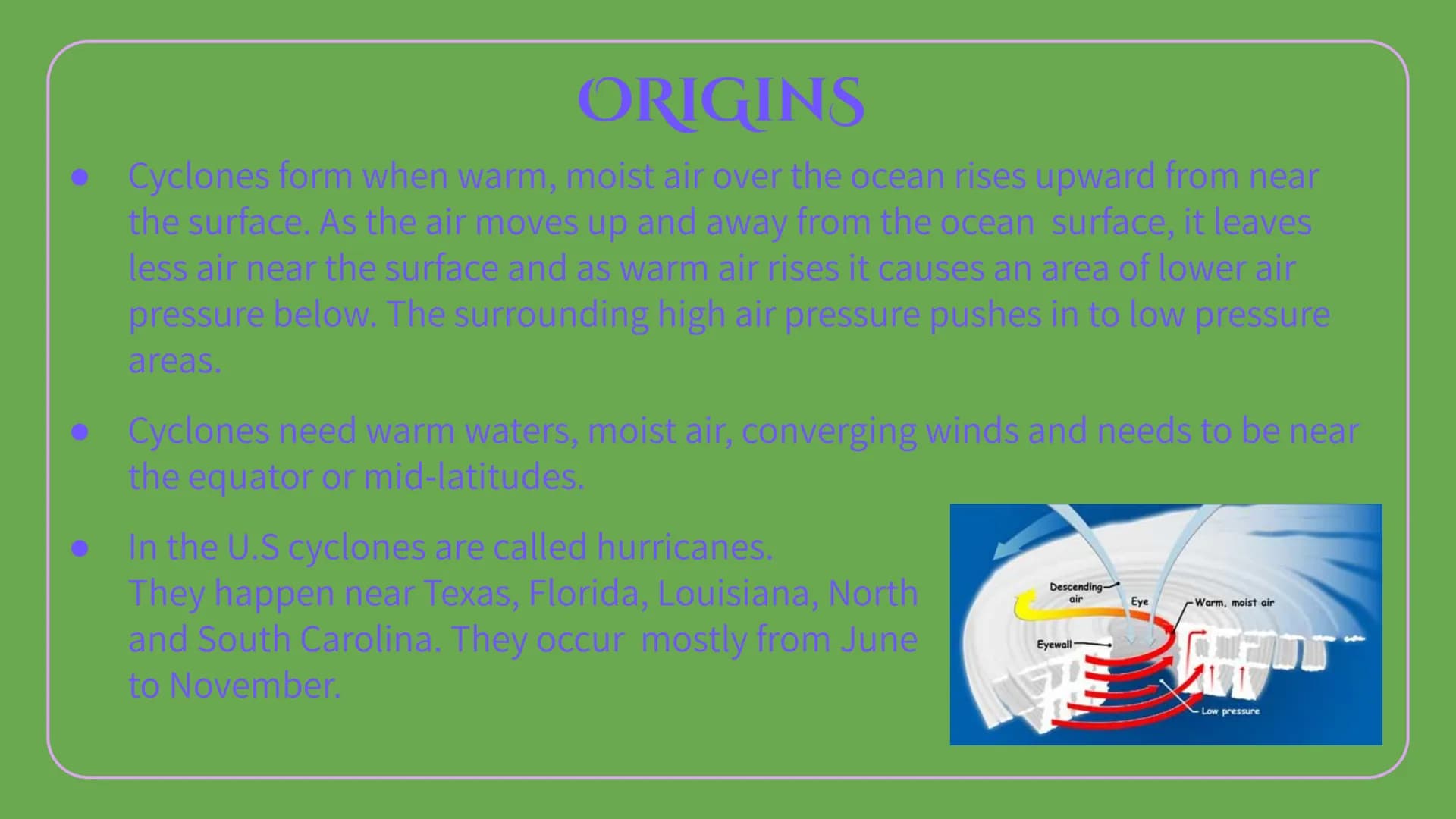
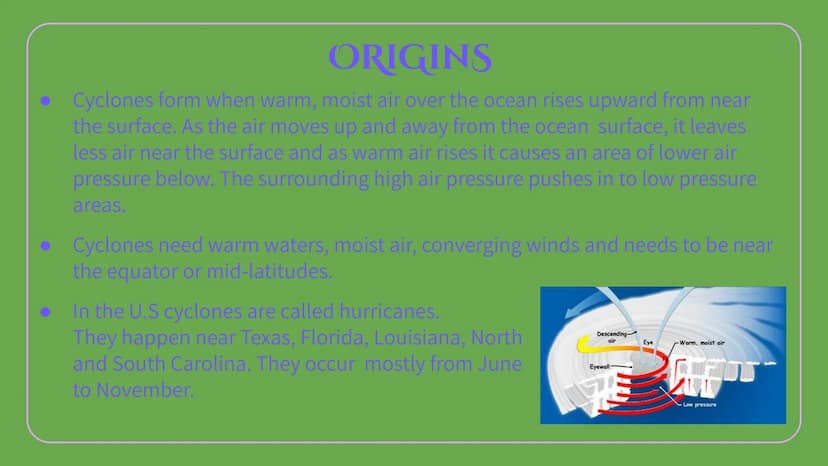
Cyclones begin when warm, moist air rises from the ocean surface. As this air moves upward, it creates an area of low pressure below, which surrounding high-pressure air rushes to fill, creating the circular wind pattern.
For a cyclone to form, it needs four key ingredients: warm ocean waters, moist air, converging winds, and a location near the equator or mid-latitudes. The warm ocean water provides the energy that fuels these powerful storms.
In the United States, cyclones are called hurricanes and typically affect coastal states like Texas, Florida, and the Carolinas. Hurricane season primarily runs from June through November when ocean temperatures are warmest.
Weather Wisdom: The eye of a cyclone might seem calm, but it's surrounded by the most violent part of the storm - the eyewall!
Scientists measure cyclone strength using the Saffir-Simpson Scale, which classifies storms based on their maximum sustained wind speed. This helps meteorologists communicate the potential danger of an approaching storm.
Cyclones, hurricanes, and typhoons are actually the same type of storm system - their different names simply reflect where they occur. What we call a cyclone in the South Pacific and Indian Ocean regions would be called a hurricane in North America.
Besides the main types, there are several variations including typhoons, monsoons, tropical cyclones, and mid-latitude cyclones. Each has unique characteristics, but all share the basic rotating storm structure.
Think About It: The energy released by an average hurricane is equivalent to 200 times the world's electrical generating capacity!
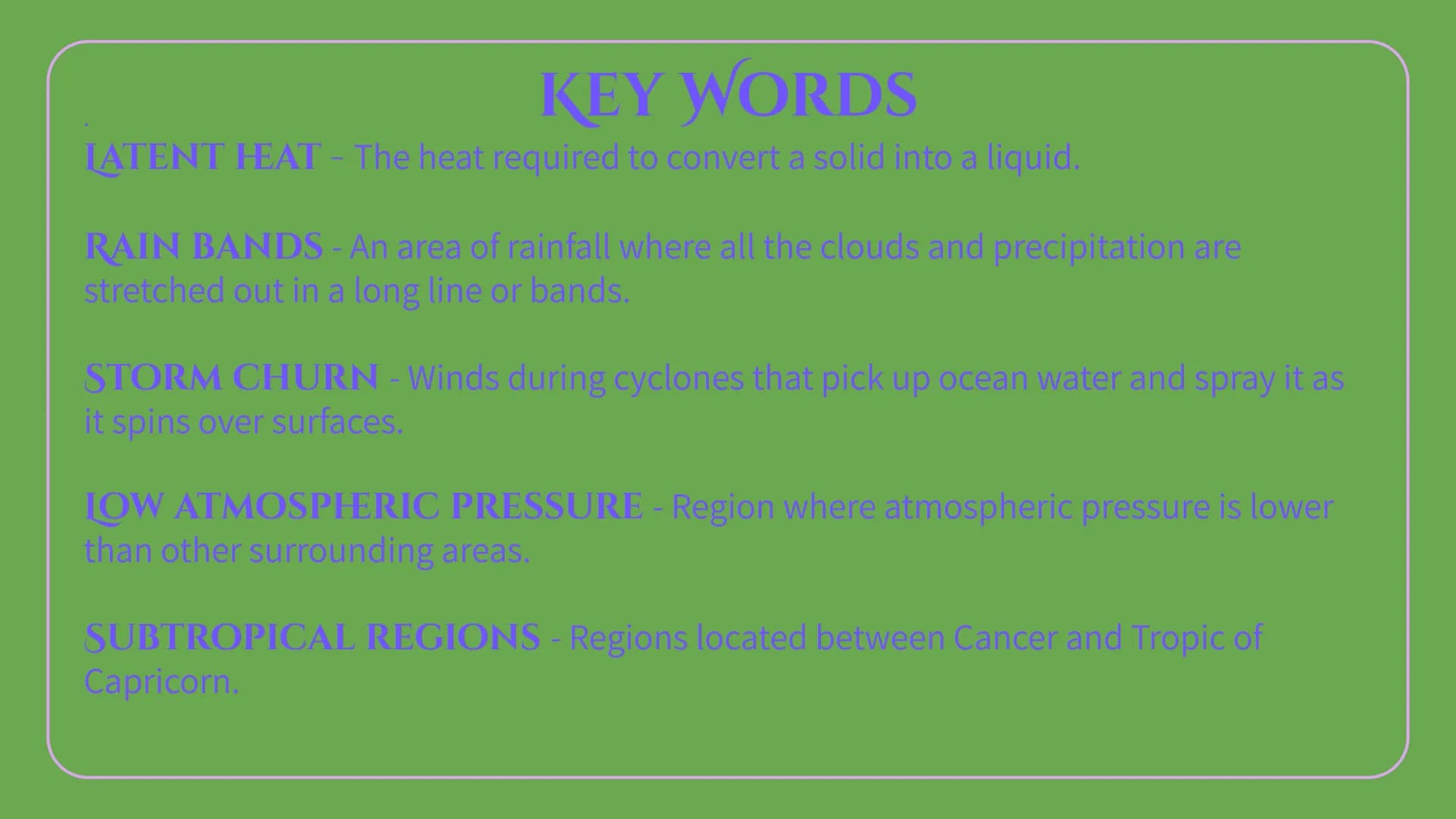
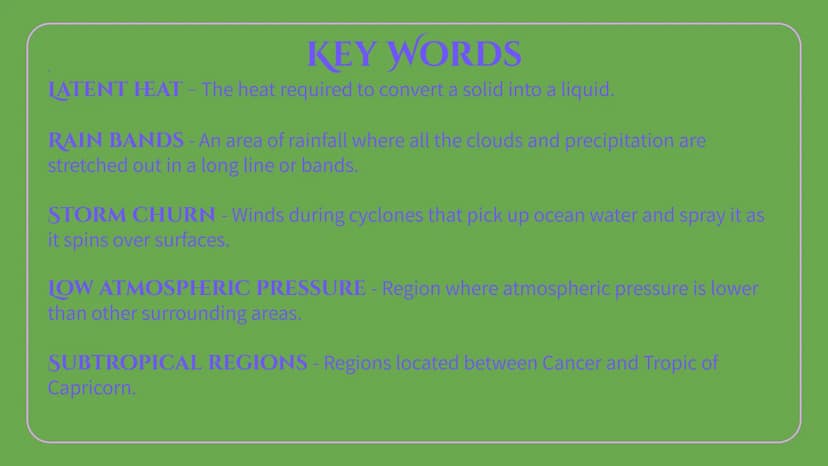
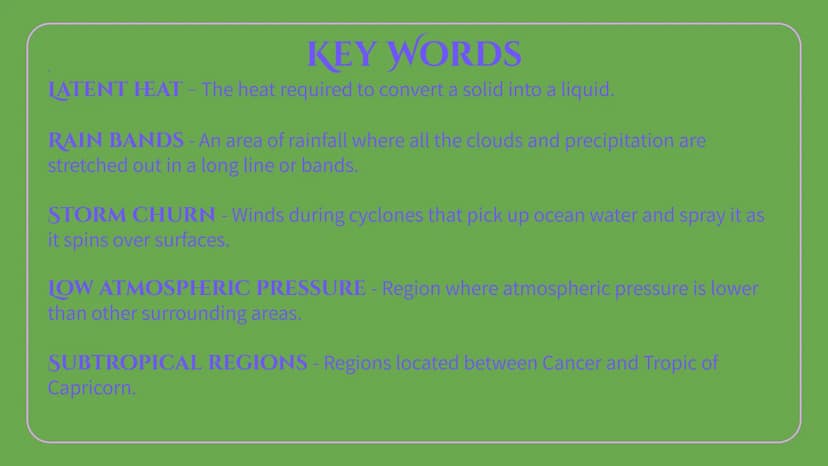
Understanding cyclone vocabulary helps you make sense of weather reports. Latent heat drives cyclones by releasing energy when water vapor condenses into clouds and rain, providing power to the storm system.
Rain bands are long lines of clouds and precipitation that spiral out from the cyclone's center. These bands can extend hundreds of miles and produce heavy rainfall even far from the storm's eye.
Storm churn describes how cyclone winds pick up and spray ocean water over surfaces. This combines with low atmospheric pressure to create dangerous storm surges that can flood coastal areas.
Learning Tip: Try explaining these terms to someone else to make sure you really understand them!
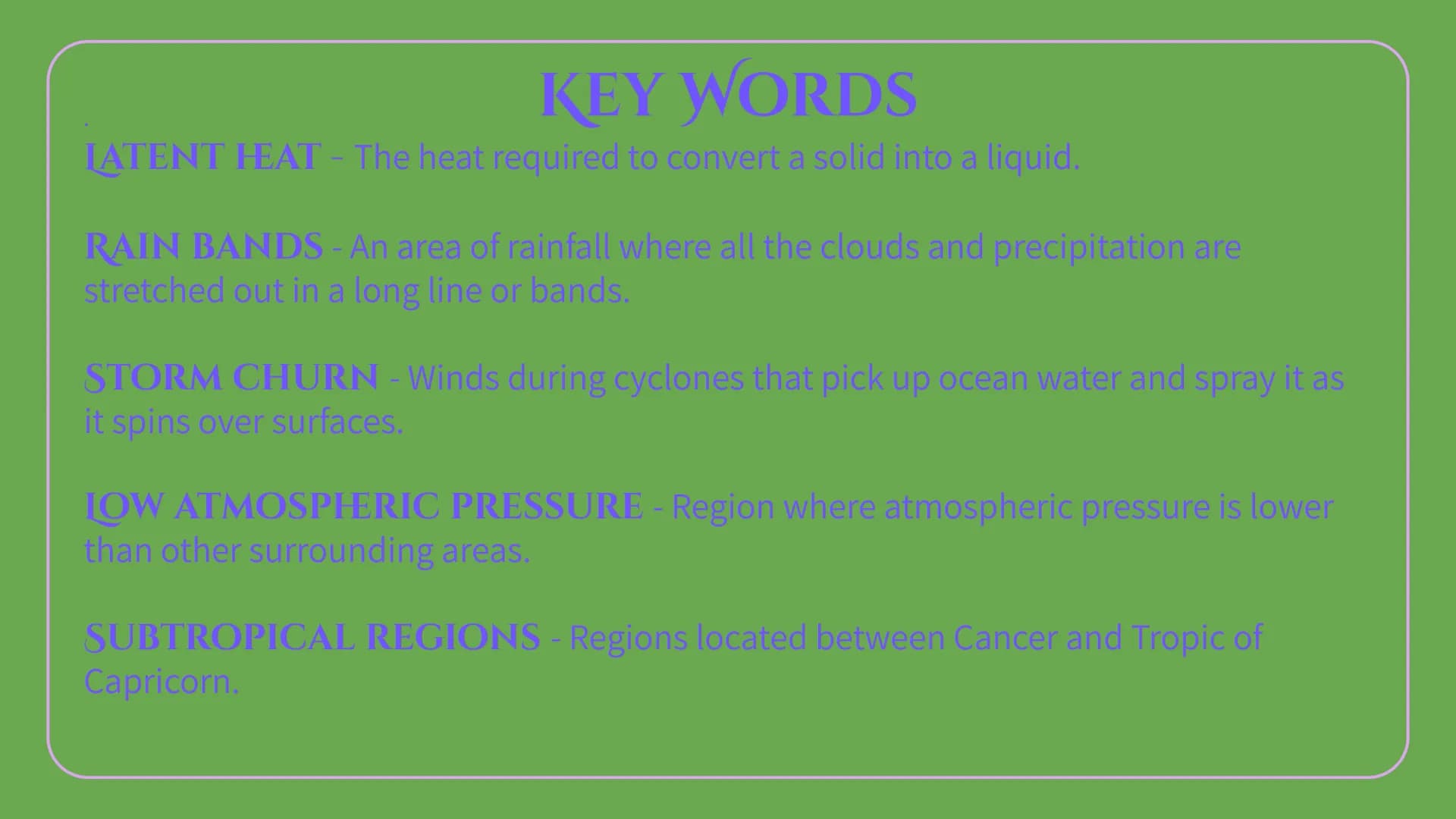
Cyclones gain tremendous energy through latent heat - the energy released when water changes from vapor to liquid during cloud formation. This process powers the storm's intense winds and rainfall.
Rain bands spiral outward from the cyclone's center, bringing periods of heavy precipitation and stronger winds. These bands can affect areas far from the storm's eye, making cyclones dangerous across wide regions.
Subtropical regions between the Tropics of Cancer and Capricorn frequently experience cyclones due to warm ocean temperatures. The combination of heat, moisture, and the Coriolis effect creates ideal conditions for cyclone formation in these areas.
Connection: Many of these terms appear in weather forecasts during hurricane season - listening for them can help you better understand storm reports!
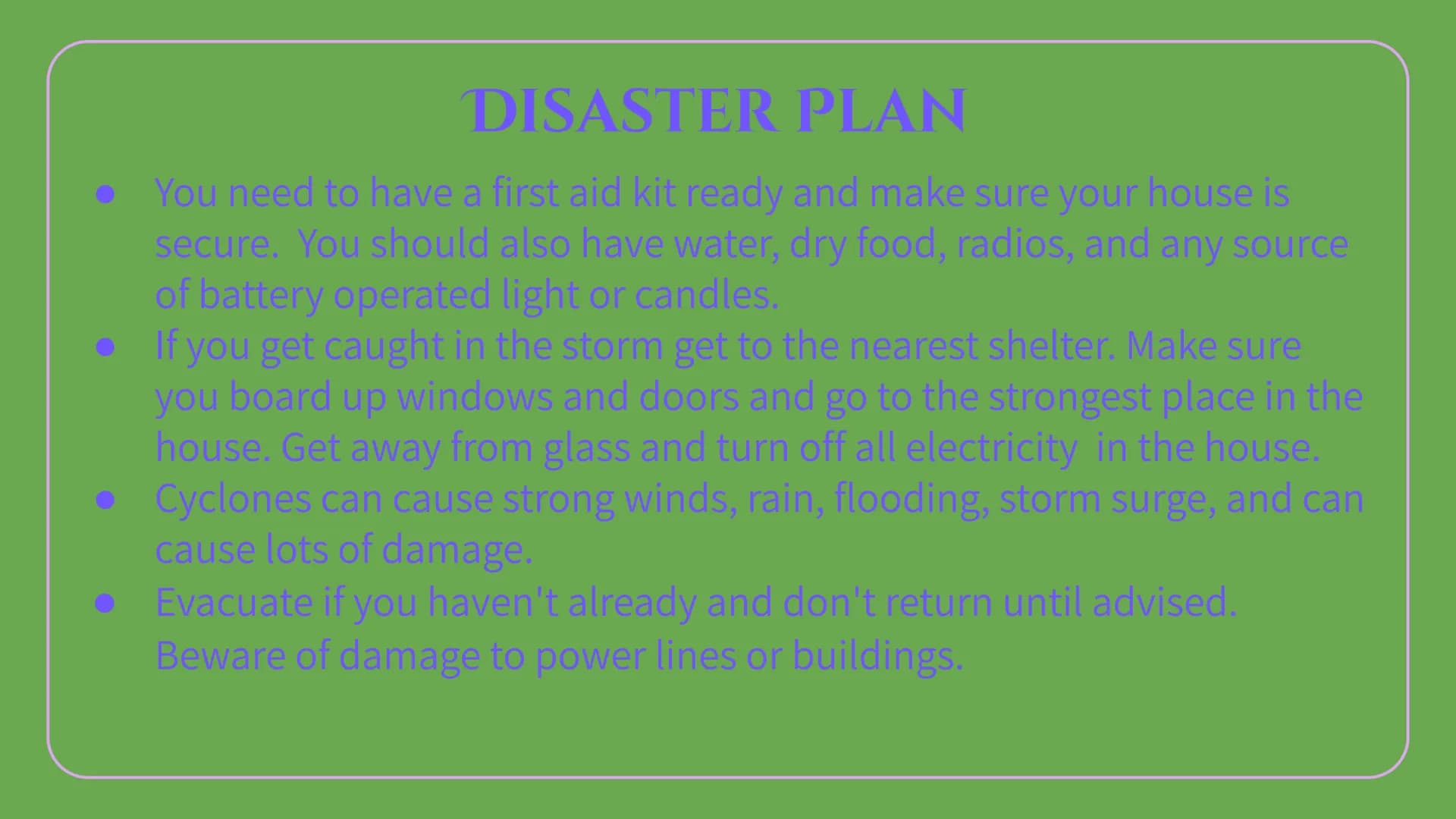
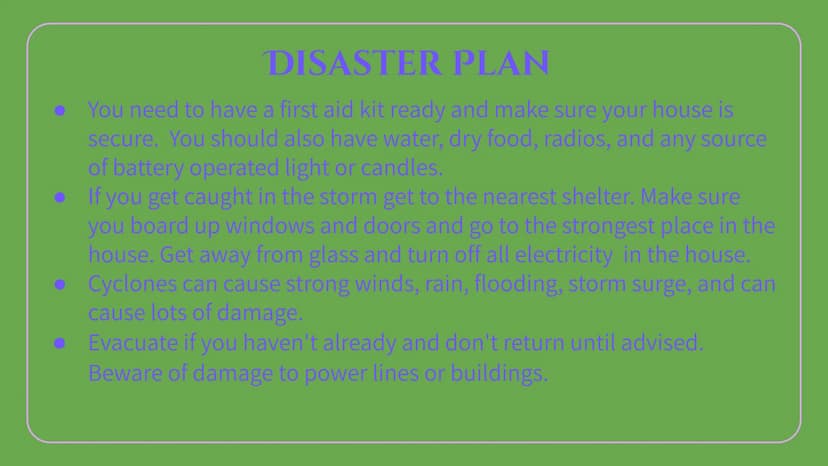
Being prepared before a cyclone hits can save lives. Assemble a disaster kit with first aid supplies, water, non-perishable food, battery-operated radio, and flashlights. Make sure your home is secure by boarding up windows and removing potential flying debris.
If a cyclone is approaching, listen to emergency broadcasts and evacuate if authorities recommend it. If you must shelter in place, move to the strongest part of your home away from windows and turn off all utilities to prevent additional hazards.
After the storm passes, don't return home until officials say it's safe. Be extremely careful around damaged buildings, downed power lines, and flooded areas. Even after winds die down, flooding often causes additional dangers.
Life-saving tip: Create and practice your family's evacuation plan before storm season begins so everyone knows exactly what to do!
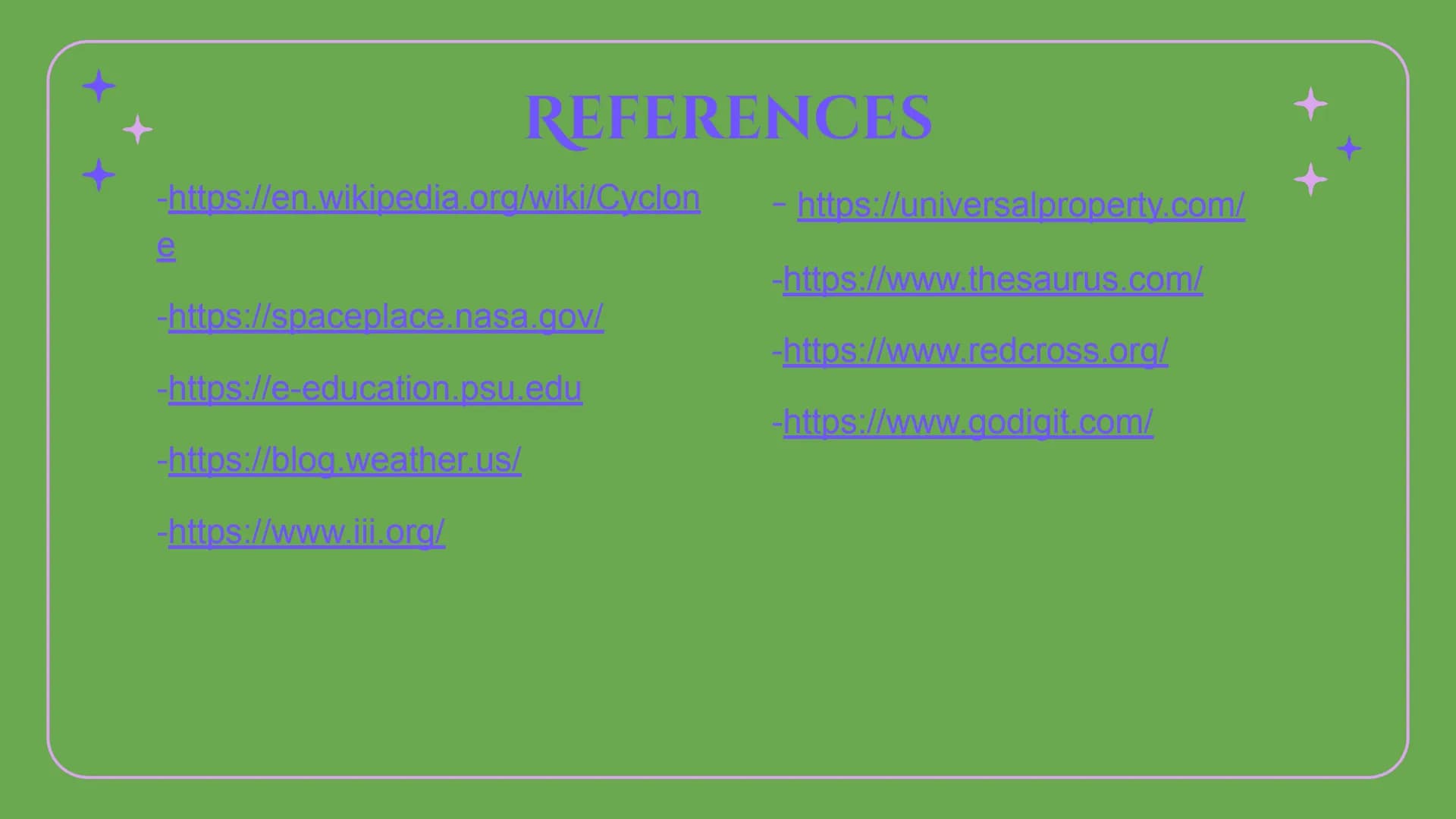
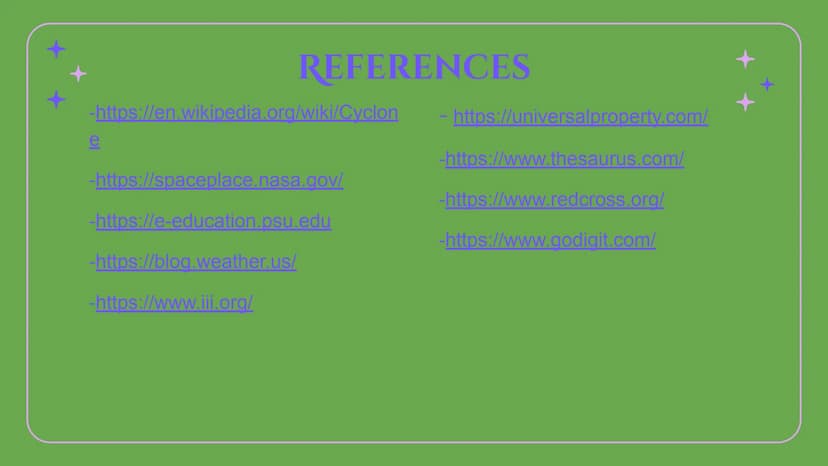
Want to learn more about cyclones? These websites offer reliable information about storm formation, tracking, and safety. The National Weather Service and Red Cross websites provide up-to-date information during active storms.
Weather apps can send alerts when cyclones threaten your area. Many emergency management agencies also offer text alerts for severe weather warnings, so consider signing up if you live in a cyclone-prone region.
Remember that understanding cyclones isn't just interesting science - it's potentially life-saving knowledge if you live near the coast!
Take Action: Bookmark a few of these resources on your phone now, before you need them in an emergency!
Our AI companion is specifically built for the needs of students. Based on the millions of content pieces we have on the platform we can provide truly meaningful and relevant answers to students. But its not only about answers, the companion is even more about guiding students through their daily learning challenges, with personalised study plans, quizzes or content pieces in the chat and 100% personalisation based on the students skills and developments.
You can download the app in the Google Play Store and in the Apple App Store.
That's right! Enjoy free access to study content, connect with fellow students, and get instant help – all at your fingertips.
App Store
Google Play
The app is very easy to use and well designed. I have found everything I was looking for so far and have been able to learn a lot from the presentations! I will definitely use the app for a class assignment! And of course it also helps a lot as an inspiration.
Stefan S
iOS user
This app is really great. There are so many study notes and help [...]. My problem subject is French, for example, and the app has so many options for help. Thanks to this app, I have improved my French. I would recommend it to anyone.
Samantha Klich
Android user
Wow, I am really amazed. I just tried the app because I've seen it advertised many times and was absolutely stunned. This app is THE HELP you want for school and above all, it offers so many things, such as workouts and fact sheets, which have been VERY helpful to me personally.
Anna
iOS user
I think it’s very much worth it and you’ll end up using it a lot once you get the hang of it and even after looking at others notes you can still ask your Artificial intelligence buddy the question and ask to simplify it if you still don’t get it!!! In the end I think it’s worth it 😊👍 ⚠️Also DID I MENTION ITS FREEE YOU DON’T HAVE TO PAY FOR ANYTHING AND STILL GET YOUR GRADES IN PERFECTLY❗️❗️⚠️
Thomas R
iOS user
Knowunity is the BEST app I’ve used in a minute. This is not an ai review or anything this is genuinely coming from a 7th grade student (I know 2011 im young) but dude this app is a 10/10 i have maintained a 3.8 gpa and have plenty of time for gaming. I love it and my mom is just happy I got good grades
Brad T
Android user
Not only did it help me find the answer but it also showed me alternative ways to solve it. I was horrible in math and science but now I have an a in both subjects. Thanks for the help🤍🤍
David K
iOS user
The app's just great! All I have to do is enter the topic in the search bar and I get the response real fast. I don't have to watch 10 YouTube videos to understand something, so I'm saving my time. Highly recommended!
Sudenaz Ocak
Android user
In school I was really bad at maths but thanks to the app, I am doing better now. I am so grateful that you made the app.
Greenlight Bonnie
Android user
I found this app a couple years ago and it has only gotten better since then. I really love it because it can help with written questions and photo questions. Also, it can find study guides that other people have made as well as flashcard sets and practice tests. The free version is also amazing for students who might not be able to afford it. Would 100% recommend
Aubrey
iOS user
Best app if you're in Highschool or Junior high. I have been using this app for 2 school years and it's the best, it's good if you don't have anyone to help you with school work.😋🩷🎀
Marco B
iOS user
THE QUIZES AND FLASHCARDS ARE SO USEFUL AND I LOVE THE SCHOOLGPT. IT ALSO IS LITREALLY LIKE CHATGPT BUT SMARTER!! HELPED ME WITH MY MASCARA PROBLEMS TOO!! AS WELL AS MY REAL SUBJECTS ! DUHHH 😍😁😲🤑💗✨🎀😮
Elisha
iOS user
This app is phenomenal down to the correct info and the various topics you can study! I greatly recommend it for people who struggle with procrastination and those who need homework help. It has been perfectly accurate for world 1 history as far as I’ve seen! Geometry too!
Paul T
iOS user
The app is very easy to use and well designed. I have found everything I was looking for so far and have been able to learn a lot from the presentations! I will definitely use the app for a class assignment! And of course it also helps a lot as an inspiration.
Stefan S
iOS user
This app is really great. There are so many study notes and help [...]. My problem subject is French, for example, and the app has so many options for help. Thanks to this app, I have improved my French. I would recommend it to anyone.
Samantha Klich
Android user
Wow, I am really amazed. I just tried the app because I've seen it advertised many times and was absolutely stunned. This app is THE HELP you want for school and above all, it offers so many things, such as workouts and fact sheets, which have been VERY helpful to me personally.
Anna
iOS user
I think it’s very much worth it and you’ll end up using it a lot once you get the hang of it and even after looking at others notes you can still ask your Artificial intelligence buddy the question and ask to simplify it if you still don’t get it!!! In the end I think it’s worth it 😊👍 ⚠️Also DID I MENTION ITS FREEE YOU DON’T HAVE TO PAY FOR ANYTHING AND STILL GET YOUR GRADES IN PERFECTLY❗️❗️⚠️
Thomas R
iOS user
Knowunity is the BEST app I’ve used in a minute. This is not an ai review or anything this is genuinely coming from a 7th grade student (I know 2011 im young) but dude this app is a 10/10 i have maintained a 3.8 gpa and have plenty of time for gaming. I love it and my mom is just happy I got good grades
Brad T
Android user
Not only did it help me find the answer but it also showed me alternative ways to solve it. I was horrible in math and science but now I have an a in both subjects. Thanks for the help🤍🤍
David K
iOS user
The app's just great! All I have to do is enter the topic in the search bar and I get the response real fast. I don't have to watch 10 YouTube videos to understand something, so I'm saving my time. Highly recommended!
Sudenaz Ocak
Android user
In school I was really bad at maths but thanks to the app, I am doing better now. I am so grateful that you made the app.
Greenlight Bonnie
Android user
I found this app a couple years ago and it has only gotten better since then. I really love it because it can help with written questions and photo questions. Also, it can find study guides that other people have made as well as flashcard sets and practice tests. The free version is also amazing for students who might not be able to afford it. Would 100% recommend
Aubrey
iOS user
Best app if you're in Highschool or Junior high. I have been using this app for 2 school years and it's the best, it's good if you don't have anyone to help you with school work.😋🩷🎀
Marco B
iOS user
THE QUIZES AND FLASHCARDS ARE SO USEFUL AND I LOVE THE SCHOOLGPT. IT ALSO IS LITREALLY LIKE CHATGPT BUT SMARTER!! HELPED ME WITH MY MASCARA PROBLEMS TOO!! AS WELL AS MY REAL SUBJECTS ! DUHHH 😍😁😲🤑💗✨🎀😮
Elisha
iOS user
This app is phenomenal down to the correct info and the various topics you can study! I greatly recommend it for people who struggle with procrastination and those who need homework help. It has been perfectly accurate for world 1 history as far as I’ve seen! Geometry too!
Paul T
iOS user
Thalia Fickett
@frostyfeet
Cyclones are powerful, rotating storm systems that form over warm ocean waters and can cause devastating damage to coastal areas. These massive weather events, also known as hurricanes or typhoons depending on location, create dangerous conditions including high winds, heavy... Show more
Access to all documents
Improve your grades
Join milions of students
By signing up you accept Terms of Service and Privacy Policy
Cyclones are large, circular storm systems that can wreak havoc on communities near oceans. These powerful weather events rotate around a center of low pressure, pulling in warm, moist air and transforming it into destructive energy.
Did you know? The same storm can have different names depending on where it occurs - hurricane in the Atlantic, typhoon in the Pacific, and cyclone in the Indian Ocean!
Access to all documents
Improve your grades
Join milions of students
By signing up you accept Terms of Service and Privacy Policy
Cyclones are massive circular storms that form over warm ocean waters. These natural disasters can be catastrophic when they make landfall, causing widespread damage with their powerful winds and heavy rainfall.
When a cyclone approaches land, it brings the full force of nature with it. These weather systems are among Earth's most destructive natural phenomena, capable of reshaping coastlines and devastating communities.
Safety First! Understanding cyclones isn't just interesting science - it could help save lives if you live in a coastal region!
Access to all documents
Improve your grades
Join milions of students
By signing up you accept Terms of Service and Privacy Policy
Cyclones begin when warm, moist air rises from the ocean surface. As this air moves upward, it creates an area of low pressure below, which surrounding high-pressure air rushes to fill, creating the circular wind pattern.
For a cyclone to form, it needs four key ingredients: warm ocean waters, moist air, converging winds, and a location near the equator or mid-latitudes. The warm ocean water provides the energy that fuels these powerful storms.
In the United States, cyclones are called hurricanes and typically affect coastal states like Texas, Florida, and the Carolinas. Hurricane season primarily runs from June through November when ocean temperatures are warmest.
Weather Wisdom: The eye of a cyclone might seem calm, but it's surrounded by the most violent part of the storm - the eyewall!
Access to all documents
Improve your grades
Join milions of students
By signing up you accept Terms of Service and Privacy Policy
Scientists measure cyclone strength using the Saffir-Simpson Scale, which classifies storms based on their maximum sustained wind speed. This helps meteorologists communicate the potential danger of an approaching storm.
Cyclones, hurricanes, and typhoons are actually the same type of storm system - their different names simply reflect where they occur. What we call a cyclone in the South Pacific and Indian Ocean regions would be called a hurricane in North America.
Besides the main types, there are several variations including typhoons, monsoons, tropical cyclones, and mid-latitude cyclones. Each has unique characteristics, but all share the basic rotating storm structure.
Think About It: The energy released by an average hurricane is equivalent to 200 times the world's electrical generating capacity!
Access to all documents
Improve your grades
Join milions of students
By signing up you accept Terms of Service and Privacy Policy
Understanding cyclone vocabulary helps you make sense of weather reports. Latent heat drives cyclones by releasing energy when water vapor condenses into clouds and rain, providing power to the storm system.
Rain bands are long lines of clouds and precipitation that spiral out from the cyclone's center. These bands can extend hundreds of miles and produce heavy rainfall even far from the storm's eye.
Storm churn describes how cyclone winds pick up and spray ocean water over surfaces. This combines with low atmospheric pressure to create dangerous storm surges that can flood coastal areas.
Learning Tip: Try explaining these terms to someone else to make sure you really understand them!
Access to all documents
Improve your grades
Join milions of students
By signing up you accept Terms of Service and Privacy Policy
Cyclones gain tremendous energy through latent heat - the energy released when water changes from vapor to liquid during cloud formation. This process powers the storm's intense winds and rainfall.
Rain bands spiral outward from the cyclone's center, bringing periods of heavy precipitation and stronger winds. These bands can affect areas far from the storm's eye, making cyclones dangerous across wide regions.
Subtropical regions between the Tropics of Cancer and Capricorn frequently experience cyclones due to warm ocean temperatures. The combination of heat, moisture, and the Coriolis effect creates ideal conditions for cyclone formation in these areas.
Connection: Many of these terms appear in weather forecasts during hurricane season - listening for them can help you better understand storm reports!
Access to all documents
Improve your grades
Join milions of students
By signing up you accept Terms of Service and Privacy Policy
Being prepared before a cyclone hits can save lives. Assemble a disaster kit with first aid supplies, water, non-perishable food, battery-operated radio, and flashlights. Make sure your home is secure by boarding up windows and removing potential flying debris.
If a cyclone is approaching, listen to emergency broadcasts and evacuate if authorities recommend it. If you must shelter in place, move to the strongest part of your home away from windows and turn off all utilities to prevent additional hazards.
After the storm passes, don't return home until officials say it's safe. Be extremely careful around damaged buildings, downed power lines, and flooded areas. Even after winds die down, flooding often causes additional dangers.
Life-saving tip: Create and practice your family's evacuation plan before storm season begins so everyone knows exactly what to do!
Access to all documents
Improve your grades
Join milions of students
By signing up you accept Terms of Service and Privacy Policy
Want to learn more about cyclones? These websites offer reliable information about storm formation, tracking, and safety. The National Weather Service and Red Cross websites provide up-to-date information during active storms.
Weather apps can send alerts when cyclones threaten your area. Many emergency management agencies also offer text alerts for severe weather warnings, so consider signing up if you live in a cyclone-prone region.
Remember that understanding cyclones isn't just interesting science - it's potentially life-saving knowledge if you live near the coast!
Take Action: Bookmark a few of these resources on your phone now, before you need them in an emergency!
Our AI companion is specifically built for the needs of students. Based on the millions of content pieces we have on the platform we can provide truly meaningful and relevant answers to students. But its not only about answers, the companion is even more about guiding students through their daily learning challenges, with personalised study plans, quizzes or content pieces in the chat and 100% personalisation based on the students skills and developments.
You can download the app in the Google Play Store and in the Apple App Store.
That's right! Enjoy free access to study content, connect with fellow students, and get instant help – all at your fingertips.
4
Smart Tools NEW
Transform this note into: ✓ 50+ Practice Questions ✓ Interactive Flashcards ✓ Full Mock Exam ✓ Essay Outlines
This sheet shows the triangle of mass, density and volume, following along with some examples. The section, “5 facts about density,” recaps almost everything the video talks about, also shows a picture example, and some more notes to review at the end.
 Earth and Space Science
This includes solutions for the problems in general science, biology, chemistry and physics.
Earth and Space ScienceThe Water Cycle | Middle School Earth and space science 6th 7th 8th grade
Earth and Space ScienceApp Store
Google Play
The app is very easy to use and well designed. I have found everything I was looking for so far and have been able to learn a lot from the presentations! I will definitely use the app for a class assignment! And of course it also helps a lot as an inspiration.
Stefan S
iOS user
This app is really great. There are so many study notes and help [...]. My problem subject is French, for example, and the app has so many options for help. Thanks to this app, I have improved my French. I would recommend it to anyone.
Samantha Klich
Android user
Wow, I am really amazed. I just tried the app because I've seen it advertised many times and was absolutely stunned. This app is THE HELP you want for school and above all, it offers so many things, such as workouts and fact sheets, which have been VERY helpful to me personally.
Anna
iOS user
I think it’s very much worth it and you’ll end up using it a lot once you get the hang of it and even after looking at others notes you can still ask your Artificial intelligence buddy the question and ask to simplify it if you still don’t get it!!! In the end I think it’s worth it 😊👍 ⚠️Also DID I MENTION ITS FREEE YOU DON’T HAVE TO PAY FOR ANYTHING AND STILL GET YOUR GRADES IN PERFECTLY❗️❗️⚠️
Thomas R
iOS user
Knowunity is the BEST app I’ve used in a minute. This is not an ai review or anything this is genuinely coming from a 7th grade student (I know 2011 im young) but dude this app is a 10/10 i have maintained a 3.8 gpa and have plenty of time for gaming. I love it and my mom is just happy I got good grades
Brad T
Android user
Not only did it help me find the answer but it also showed me alternative ways to solve it. I was horrible in math and science but now I have an a in both subjects. Thanks for the help🤍🤍
David K
iOS user
The app's just great! All I have to do is enter the topic in the search bar and I get the response real fast. I don't have to watch 10 YouTube videos to understand something, so I'm saving my time. Highly recommended!
Sudenaz Ocak
Android user
In school I was really bad at maths but thanks to the app, I am doing better now. I am so grateful that you made the app.
Greenlight Bonnie
Android user
I found this app a couple years ago and it has only gotten better since then. I really love it because it can help with written questions and photo questions. Also, it can find study guides that other people have made as well as flashcard sets and practice tests. The free version is also amazing for students who might not be able to afford it. Would 100% recommend
Aubrey
iOS user
Best app if you're in Highschool or Junior high. I have been using this app for 2 school years and it's the best, it's good if you don't have anyone to help you with school work.😋🩷🎀
Marco B
iOS user
THE QUIZES AND FLASHCARDS ARE SO USEFUL AND I LOVE THE SCHOOLGPT. IT ALSO IS LITREALLY LIKE CHATGPT BUT SMARTER!! HELPED ME WITH MY MASCARA PROBLEMS TOO!! AS WELL AS MY REAL SUBJECTS ! DUHHH 😍😁😲🤑💗✨🎀😮
Elisha
iOS user
This app is phenomenal down to the correct info and the various topics you can study! I greatly recommend it for people who struggle with procrastination and those who need homework help. It has been perfectly accurate for world 1 history as far as I’ve seen! Geometry too!
Paul T
iOS user
The app is very easy to use and well designed. I have found everything I was looking for so far and have been able to learn a lot from the presentations! I will definitely use the app for a class assignment! And of course it also helps a lot as an inspiration.
Stefan S
iOS user
This app is really great. There are so many study notes and help [...]. My problem subject is French, for example, and the app has so many options for help. Thanks to this app, I have improved my French. I would recommend it to anyone.
Samantha Klich
Android user
Wow, I am really amazed. I just tried the app because I've seen it advertised many times and was absolutely stunned. This app is THE HELP you want for school and above all, it offers so many things, such as workouts and fact sheets, which have been VERY helpful to me personally.
Anna
iOS user
I think it’s very much worth it and you’ll end up using it a lot once you get the hang of it and even after looking at others notes you can still ask your Artificial intelligence buddy the question and ask to simplify it if you still don’t get it!!! In the end I think it’s worth it 😊👍 ⚠️Also DID I MENTION ITS FREEE YOU DON’T HAVE TO PAY FOR ANYTHING AND STILL GET YOUR GRADES IN PERFECTLY❗️❗️⚠️
Thomas R
iOS user
Knowunity is the BEST app I’ve used in a minute. This is not an ai review or anything this is genuinely coming from a 7th grade student (I know 2011 im young) but dude this app is a 10/10 i have maintained a 3.8 gpa and have plenty of time for gaming. I love it and my mom is just happy I got good grades
Brad T
Android user
Not only did it help me find the answer but it also showed me alternative ways to solve it. I was horrible in math and science but now I have an a in both subjects. Thanks for the help🤍🤍
David K
iOS user
The app's just great! All I have to do is enter the topic in the search bar and I get the response real fast. I don't have to watch 10 YouTube videos to understand something, so I'm saving my time. Highly recommended!
Sudenaz Ocak
Android user
In school I was really bad at maths but thanks to the app, I am doing better now. I am so grateful that you made the app.
Greenlight Bonnie
Android user
I found this app a couple years ago and it has only gotten better since then. I really love it because it can help with written questions and photo questions. Also, it can find study guides that other people have made as well as flashcard sets and practice tests. The free version is also amazing for students who might not be able to afford it. Would 100% recommend
Aubrey
iOS user
Best app if you're in Highschool or Junior high. I have been using this app for 2 school years and it's the best, it's good if you don't have anyone to help you with school work.😋🩷🎀
Marco B
iOS user
THE QUIZES AND FLASHCARDS ARE SO USEFUL AND I LOVE THE SCHOOLGPT. IT ALSO IS LITREALLY LIKE CHATGPT BUT SMARTER!! HELPED ME WITH MY MASCARA PROBLEMS TOO!! AS WELL AS MY REAL SUBJECTS ! DUHHH 😍😁😲🤑💗✨🎀😮
Elisha
iOS user
This app is phenomenal down to the correct info and the various topics you can study! I greatly recommend it for people who struggle with procrastination and those who need homework help. It has been perfectly accurate for world 1 history as far as I’ve seen! Geometry too!
Paul T
iOS user