

Welcome to the world of Biology! This guide will take... Show more
 Algebra
 Biology
Sign up to see the contentIt's free!
Access to all documents
Improve your grades
Join milions of students
Knowunity AI
Subjects
Triangle Congruence and Similarity Theorems
Triangle Properties and Classification
Linear Equations and Graphs
Geometric Angle Relationships
Trigonometric Functions and Identities
Equation Solving Techniques
Circle Geometry Fundamentals
Division Operations and Methods
Basic Differentiation Rules
Exponent and Logarithm Properties
Show all topics
Human Organ Systems
Reproductive Cell Cycles
Biological Sciences Subdisciplines
Cellular Energy Metabolism
Autotrophic Energy Processes
Inheritance Patterns and Principles
Biomolecular Structure and Organization
Cell Cycle and Division Mechanics
Cellular Organization and Development
Biological Structural Organization
Show all topics
Chemical Sciences and Applications
Atomic Structure and Composition
Molecular Electron Structure Representation
Atomic Electron Behavior
Matter Properties and Water
Mole Concept and Calculations
Gas Laws and Behavior
Periodic Table Organization
Chemical Thermodynamics Fundamentals
Chemical Bond Types and Properties
Show all topics
European Renaissance and Enlightenment
European Cultural Movements 800-1920
American Revolution Era 1763-1797
American Civil War 1861-1865
Global Imperial Systems
Mongol and Chinese Dynasties
U.S. Presidents and World Leaders
Historical Sources and Documentation
World Wars Era and Impact
World Religious Systems
Show all topics
Classic and Contemporary Novels
Literary Character Analysis
Rhetorical Theory and Practice
Classic Literary Narratives
Reading Analysis and Interpretation
Narrative Structure and Techniques
English Language Components
Influential English-Language Authors
Basic Sentence Structure
Narrative Voice and Perspective
Show all topics
92
•
Updated Mar 23, 2026
•
Welcome to the world of Biology! This guide will take... Show more
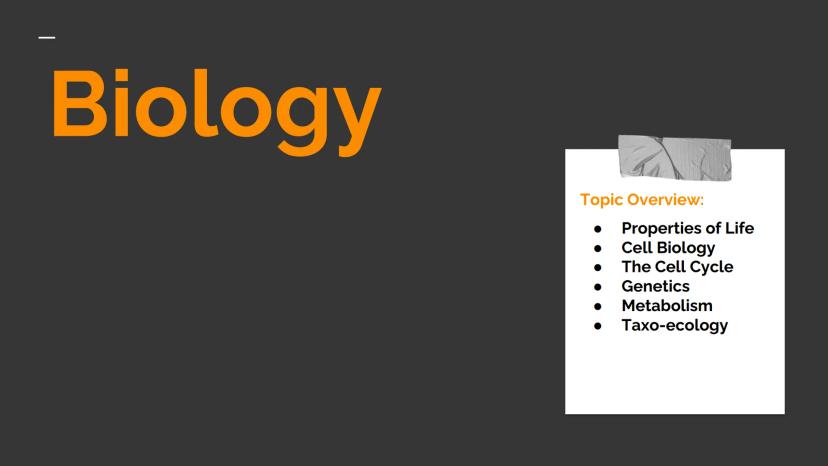
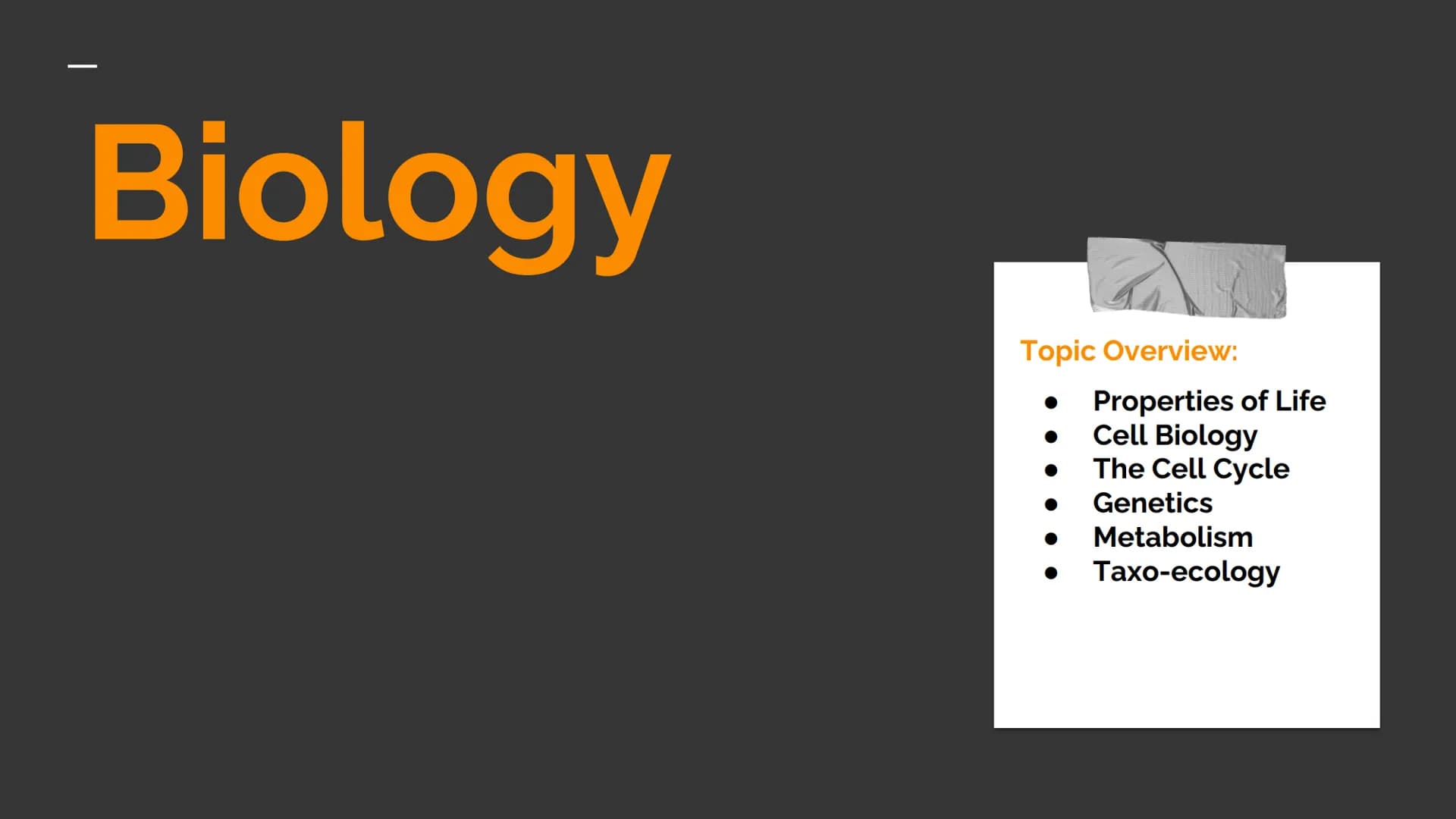
Biology explores all aspects of living organisms and how they function. The major areas we'll cover include the fundamental properties of life that distinguish living from non-living things.
We'll examine cell biology to understand the basic unit of all organisms and the fascinating processes of the cell cycle. Then we'll dive into genetics to learn how traits are passed from parents to offspring.
Metabolism will show us how organisms convert energy for survival, and finally, taxo-ecology will help us understand how organisms are classified and interact with their environment.
💡 Biology connects all these seemingly separate topics into one beautiful tapestry explaining how life works - from the tiniest cellular processes to entire ecosystems!
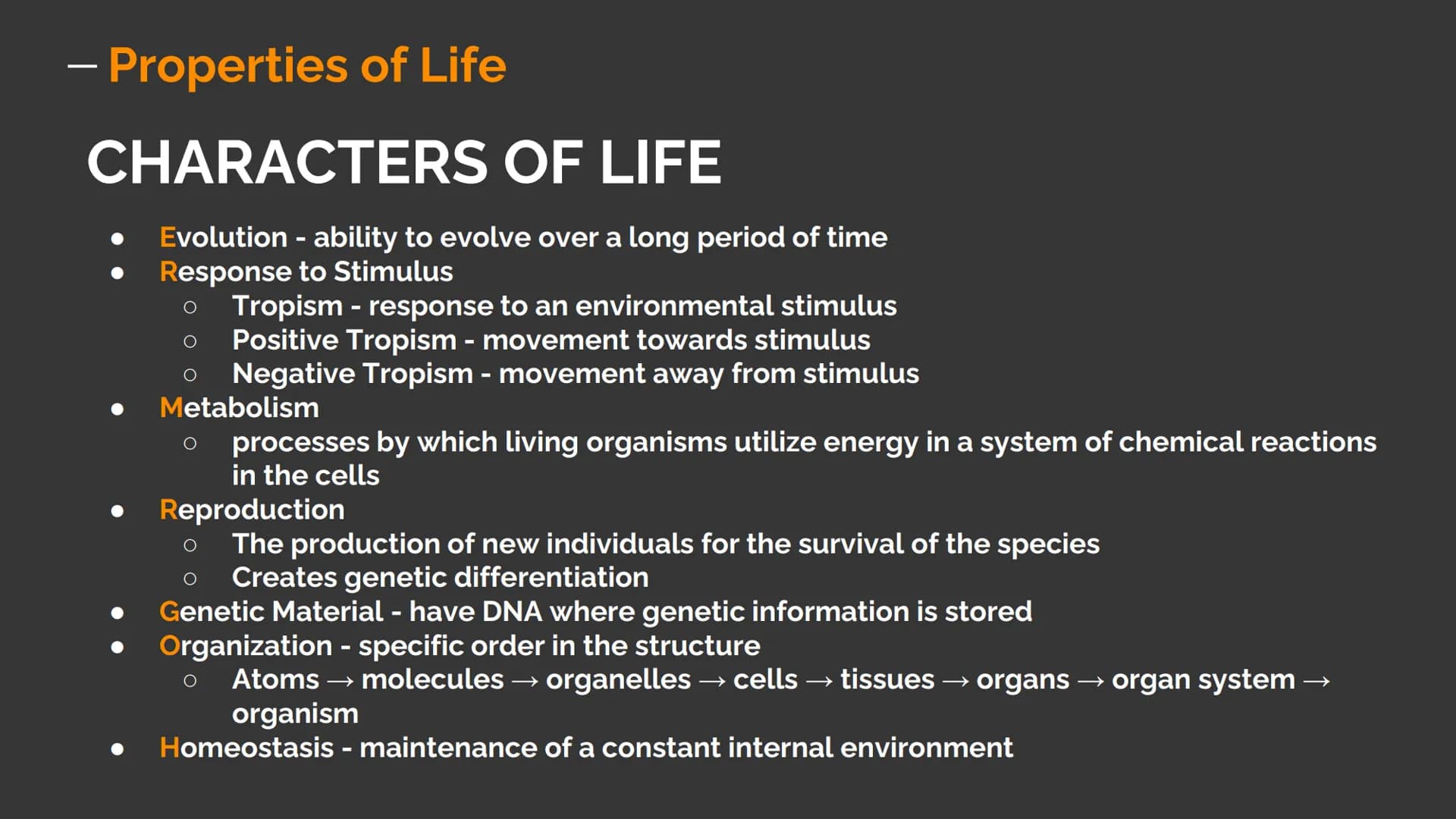
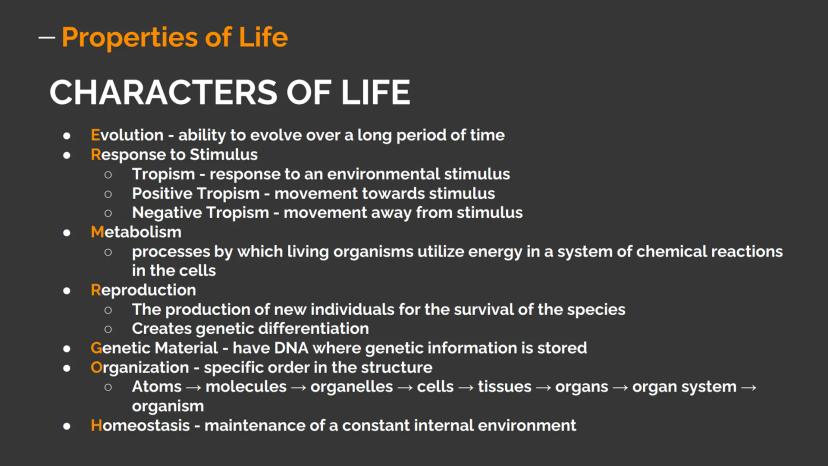
Ever wondered what makes something "alive"? All living things share seven key characteristics. Evolution means organisms can change over long periods of time, adapting to their environments. Living things also show response to stimulus - they react to their surroundings through tropisms (moving toward or away from stimuli).
Metabolism involves the chemical reactions that provide energy for life processes. Reproduction ensures species survival and creates genetic diversity among offspring. All living things contain genetic material (DNA) that stores their biological instructions.
Living organisms display incredible organization - they're structured from atoms all the way up to complex organ systems. Finally, homeostasis keeps internal conditions stable despite environmental changes.
🔬 Think of a living organism as an incredibly complex machine that can fuel itself, repair itself, and even make copies of itself - something no human-made technology can fully replicate!
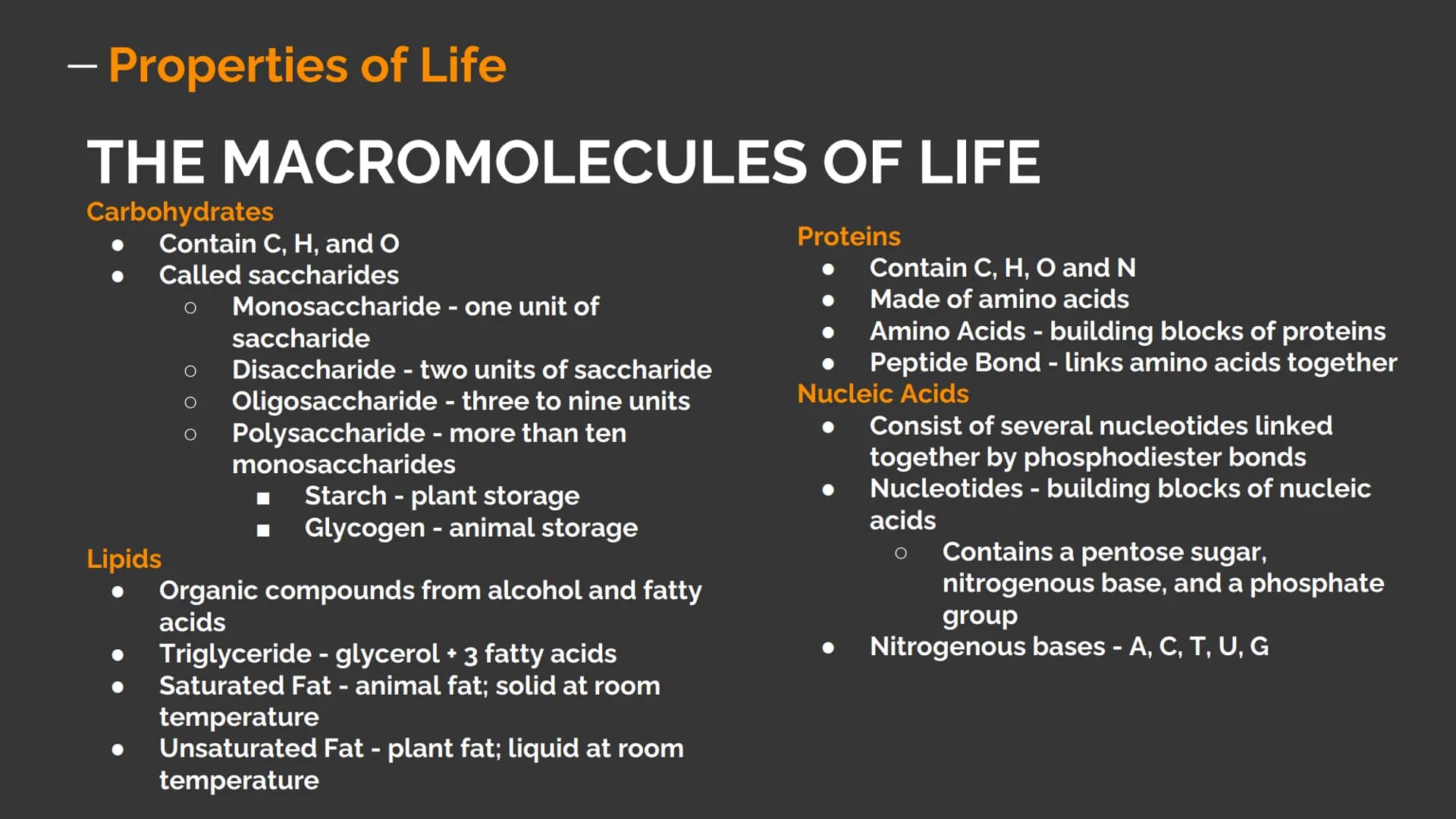
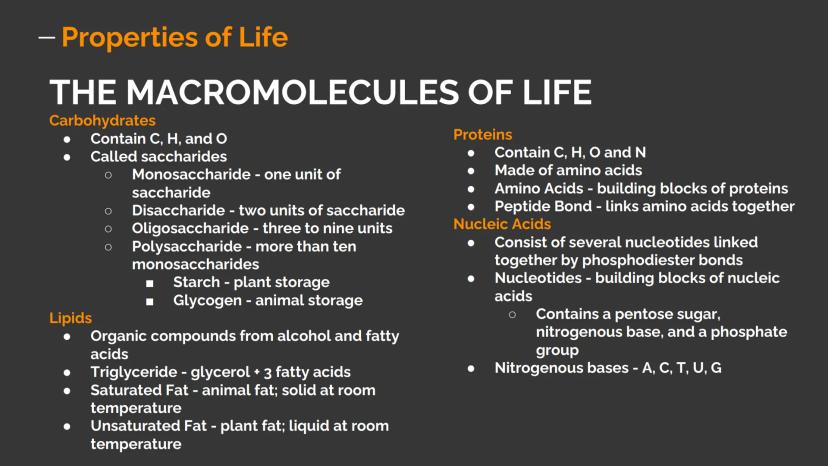
Your body is built from four main types of large biological molecules. Carbohydrates (made of carbon, hydrogen and oxygen) serve as your primary energy source and include simple sugars and complex molecules like starch and glycogen for energy storage.
Lipids are water-insoluble compounds that include fats, oils, and waxes. They store energy long-term, insulate your body, and form cell membranes. Animal fats are typically saturated (solid at room temperature) while plant oils are unsaturated (liquid).
Proteins, composed of amino acids linked by peptide bonds, perform countless functions in your body - from structural support to enzyme reactions. They contain nitrogen along with carbon, hydrogen, and oxygen.
Nucleic acids (DNA and RNA) store and transmit genetic information. They're made of nucleotides, each containing a sugar, phosphate group, and nitrogenous base (A, G, C, T or U).
🧪 These four macromolecules are like the LEGO blocks of life - with different combinations creating everything from your hair to your heart cells!
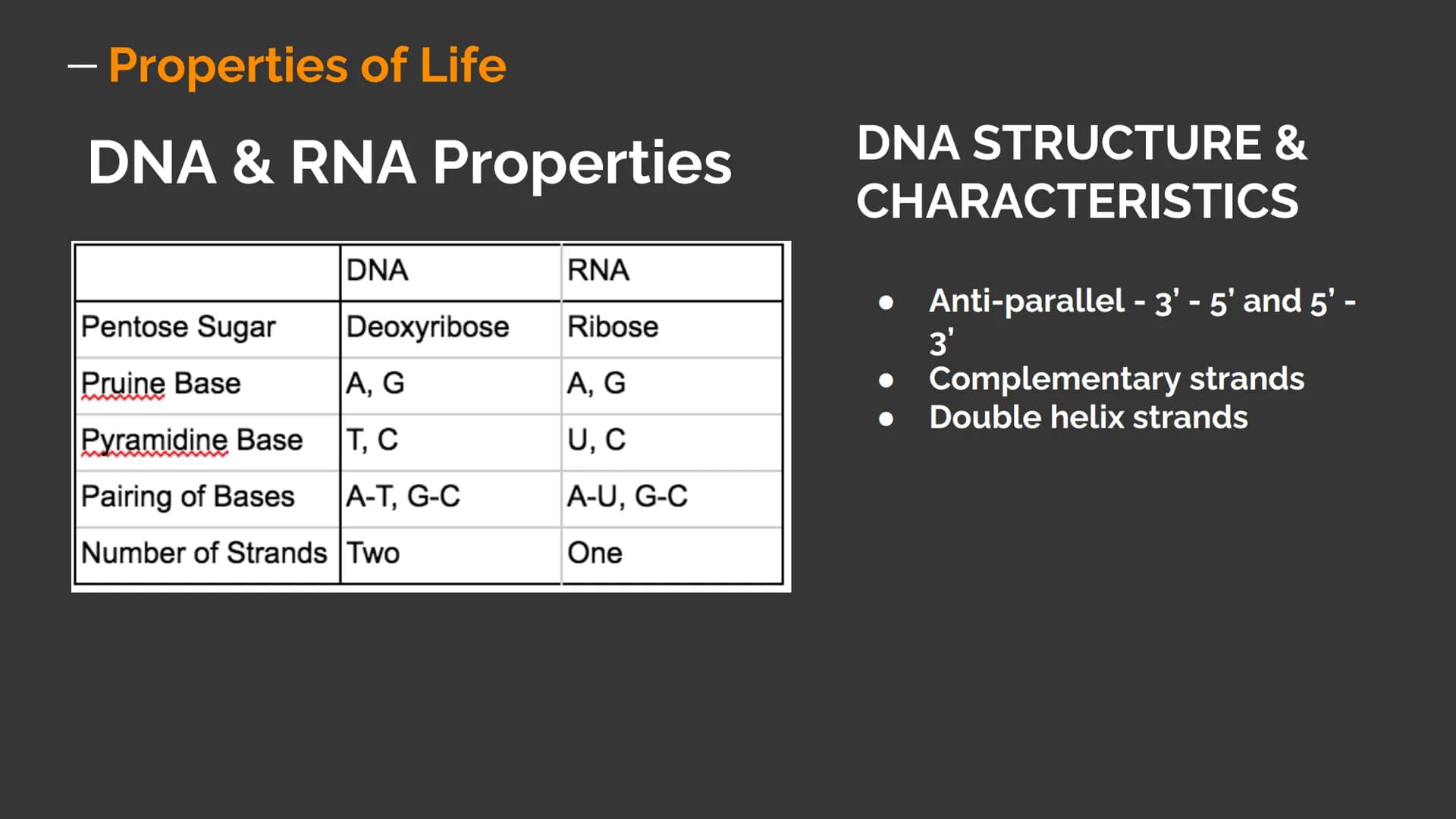
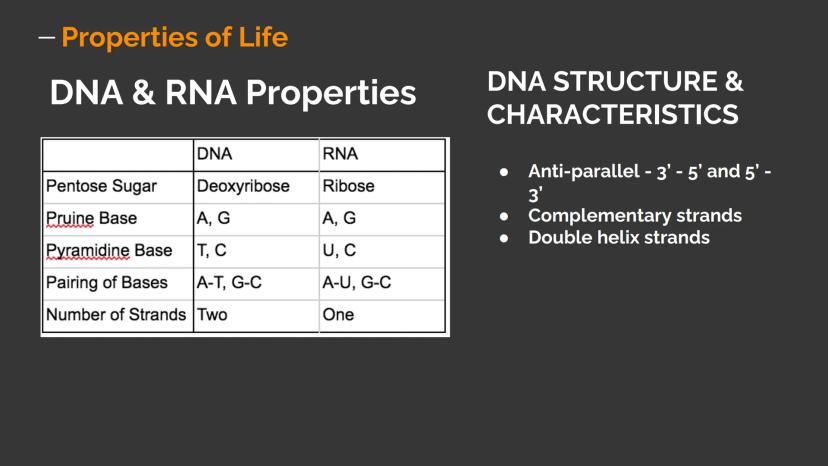
DNA and RNA are the information-carrying molecules of life, but they have key differences. DNA (deoxyribonucleic acid) forms a double-stranded helix with a deoxyribose sugar backbone, while RNA (ribonucleic acid) is typically single-stranded with a ribose sugar.
Their nitrogenous bases also differ: DNA uses adenine (A), guanine (G), thymine (T), and cytosine (C), while RNA replaces thymine with uracil (U). Base pairing is specific - A always pairs with T (in DNA) or U (in RNA), and G always pairs with C.
DNA's double helix structure is anti-parallel, meaning one strand runs 5' to 3' while the complementary strand runs 3' to 5'. This structure provides stability and allows for accurate replication of genetic information.
🧬 The DNA in just one of your cells would stretch nearly 6 feet if unwound, yet it's packaged so efficiently it fits in a microscopic nucleus!
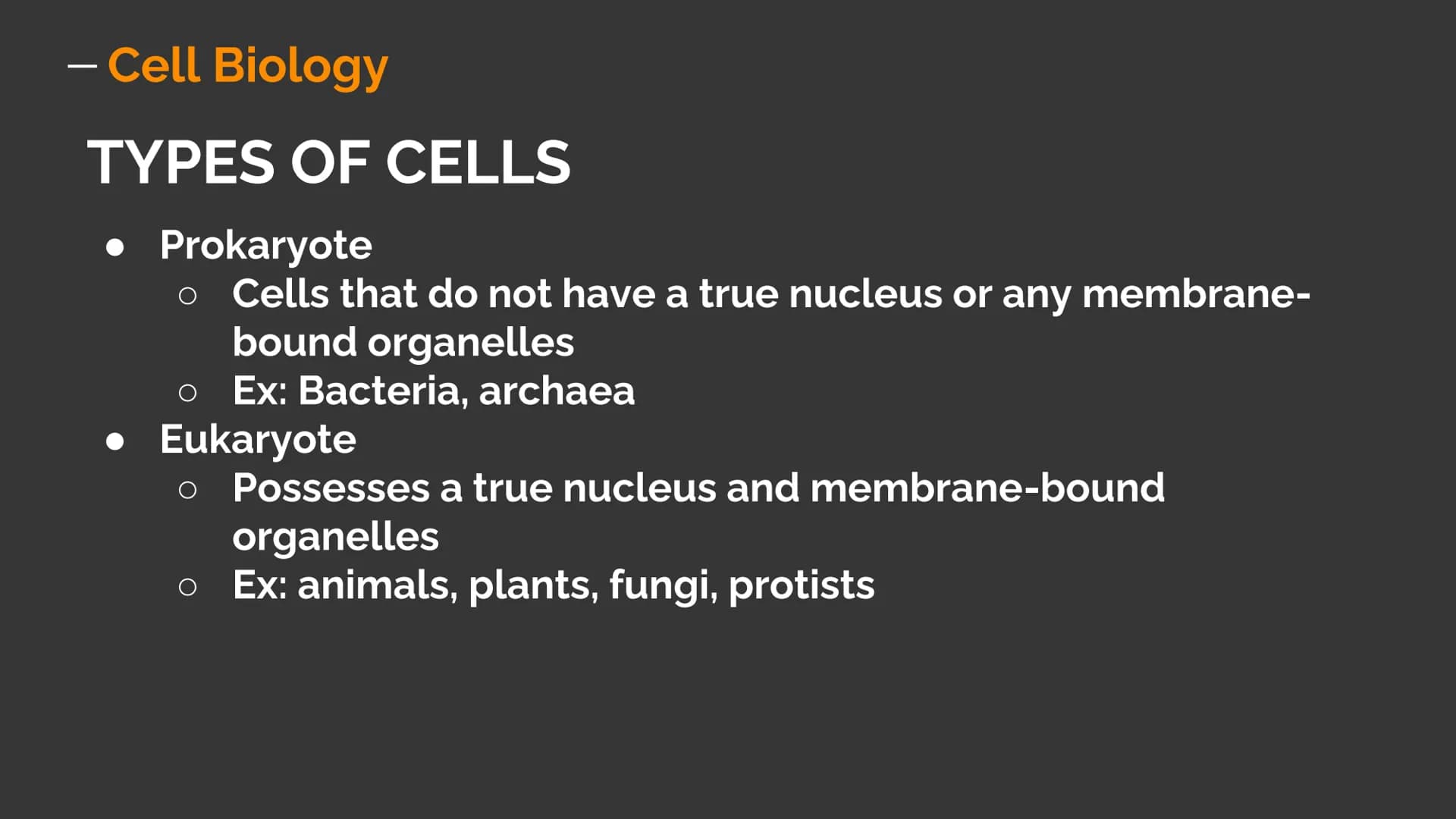
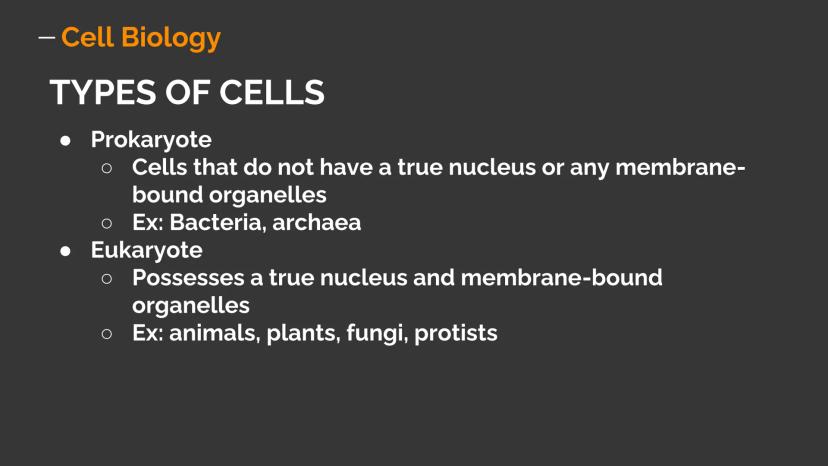
All living organisms are composed of cells, but they fall into two main categories. Prokaryotic cells lack a true nucleus and membrane-bound organelles. They're simpler, smaller, and more ancient than eukaryotic cells. Bacteria and archaea are the main prokaryotic organisms you'll encounter.
Eukaryotic cells are more complex with a true nucleus containing DNA and various membrane-bound organelles that perform specialized functions. Animals, plants, fungi, and protists all have eukaryotic cells.
This fundamental cell division is one of the most important distinctions in biology. The difference affects everything from how these organisms reproduce to how they obtain energy and respond to antibiotics.
🦠 Despite being "simpler," prokaryotic cells outnumber eukaryotic cells on Earth by a staggering margin - there are more bacteria in your mouth right now than there are people on the planet!
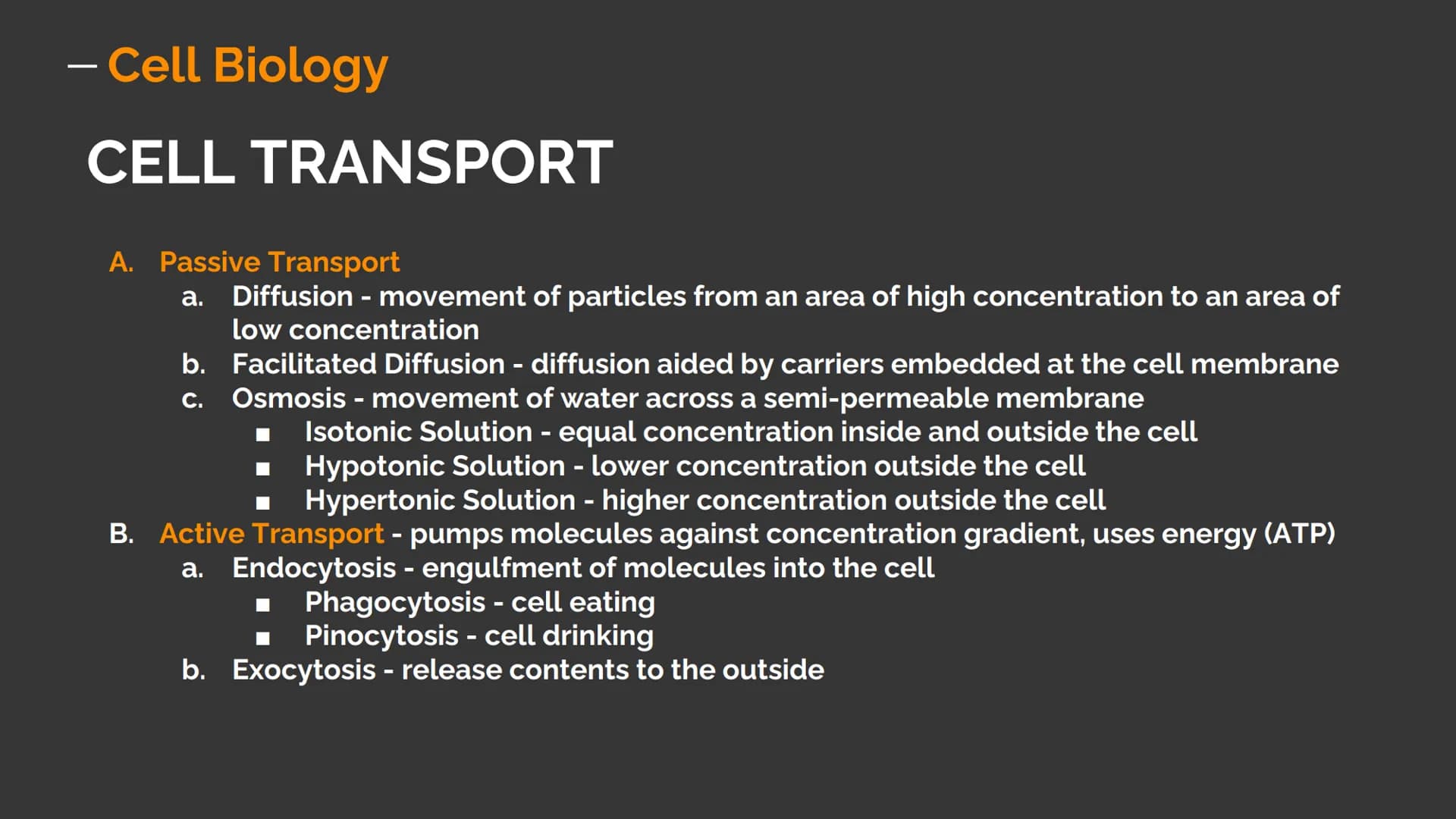
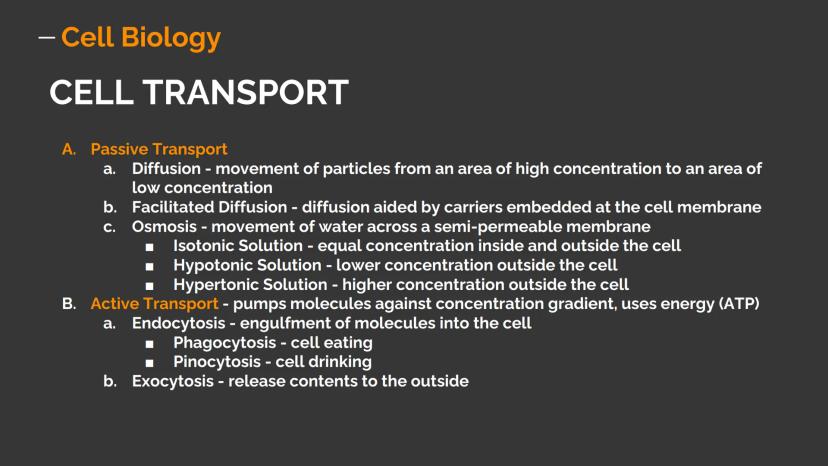
Cells constantly move materials across their membranes using different transport mechanisms. Passive transport requires no energy and moves substances from high to low concentration. This includes simple diffusion, where molecules naturally spread out, and facilitated diffusion, where proteins help specific molecules cross the membrane.
Osmosis is a special type of diffusion involving water movement across membranes. In isotonic solutions, cells maintain their shape because water moves in and out equally. In hypotonic solutions, cells swell as water rushes in, while in hypertonic solutions, cells shrink as water leaves.
Active transport moves substances against their concentration gradient using energy from ATP. This includes endocytosis, where cells engulf materials (either as solid particles in phagocytosis or liquids in pinocytosis), and exocytosis, where cells release contents to their surroundings.
🧪 Your cells perform these transport processes billions of times each day! If active transport stopped working, your cells would quickly die as crucial balances of sodium, potassium, and other ions collapsed.
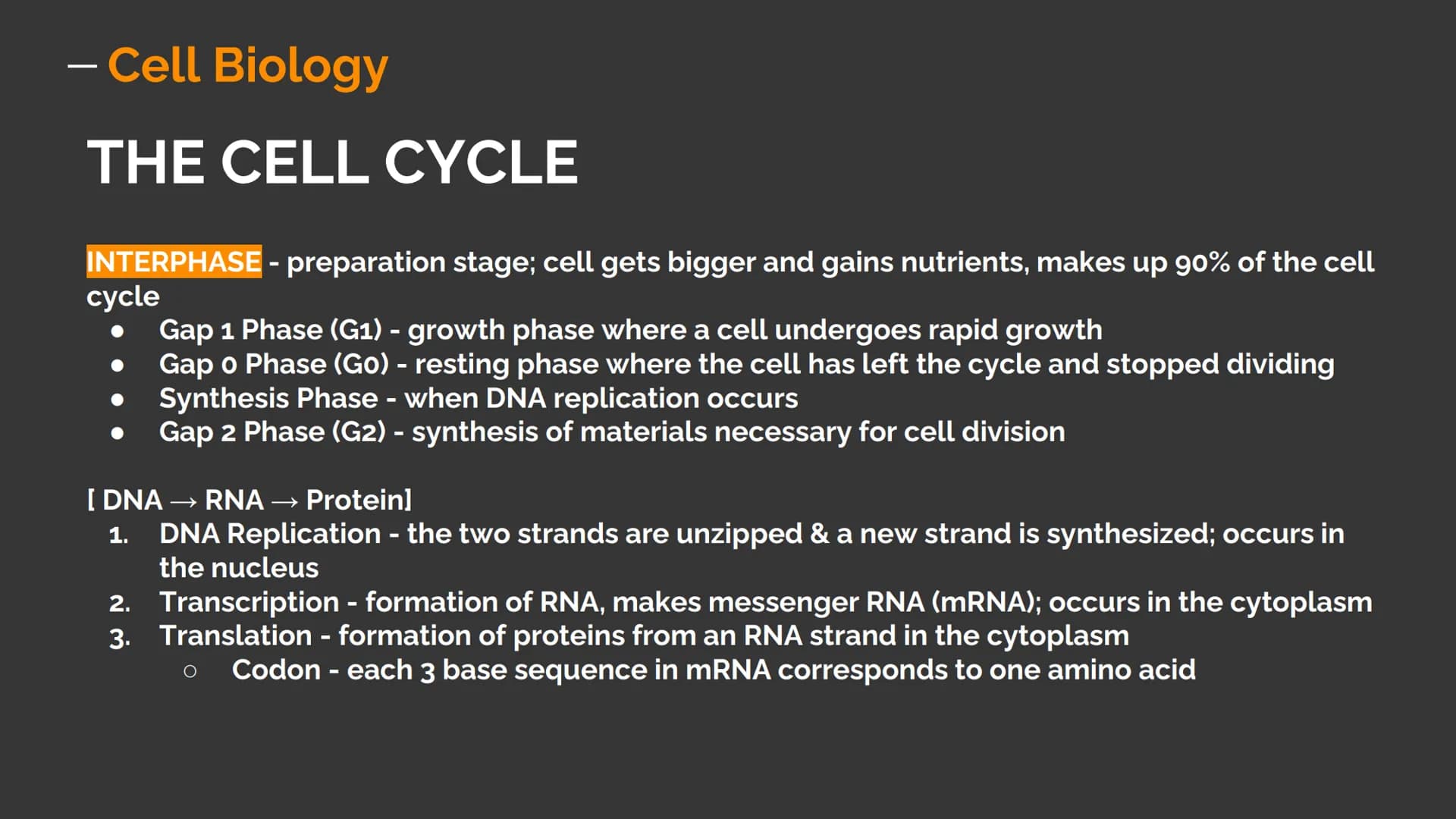
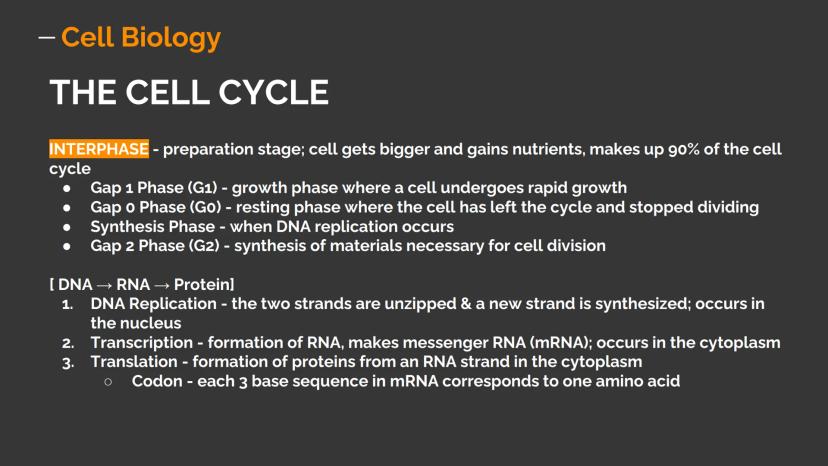
The cell cycle is how cells reproduce, with most of the time spent in interphase (about 90% of the cycle). During this preparation stage, the cell grows, duplicates its DNA, and prepares for division through three phases: G1 (first growth), S (DNA synthesis), and G2 (second growth). Some cells enter a resting state called G0 where they temporarily or permanently stop dividing.
The central dogma of molecular biology happens during interphase: DNA → RNA → Protein. First, DNA replication occurs during S phase when the double helix unzips and new complementary strands form. Next, transcription creates messenger RNA (mRNA) from the DNA template. Finally, translation uses the mRNA code to assemble proteins in the cytoplasm.
The genetic code is read in three-base units called codons, with each codon specifying one amino acid in the resulting protein. This elegant system allows your cells to create thousands of different proteins from the same DNA blueprint.
🔄 Each time one of your cells divides, it must copy about 6 billion base pairs of DNA with fewer than 10 errors - that's more accurate than any human-made copying system!
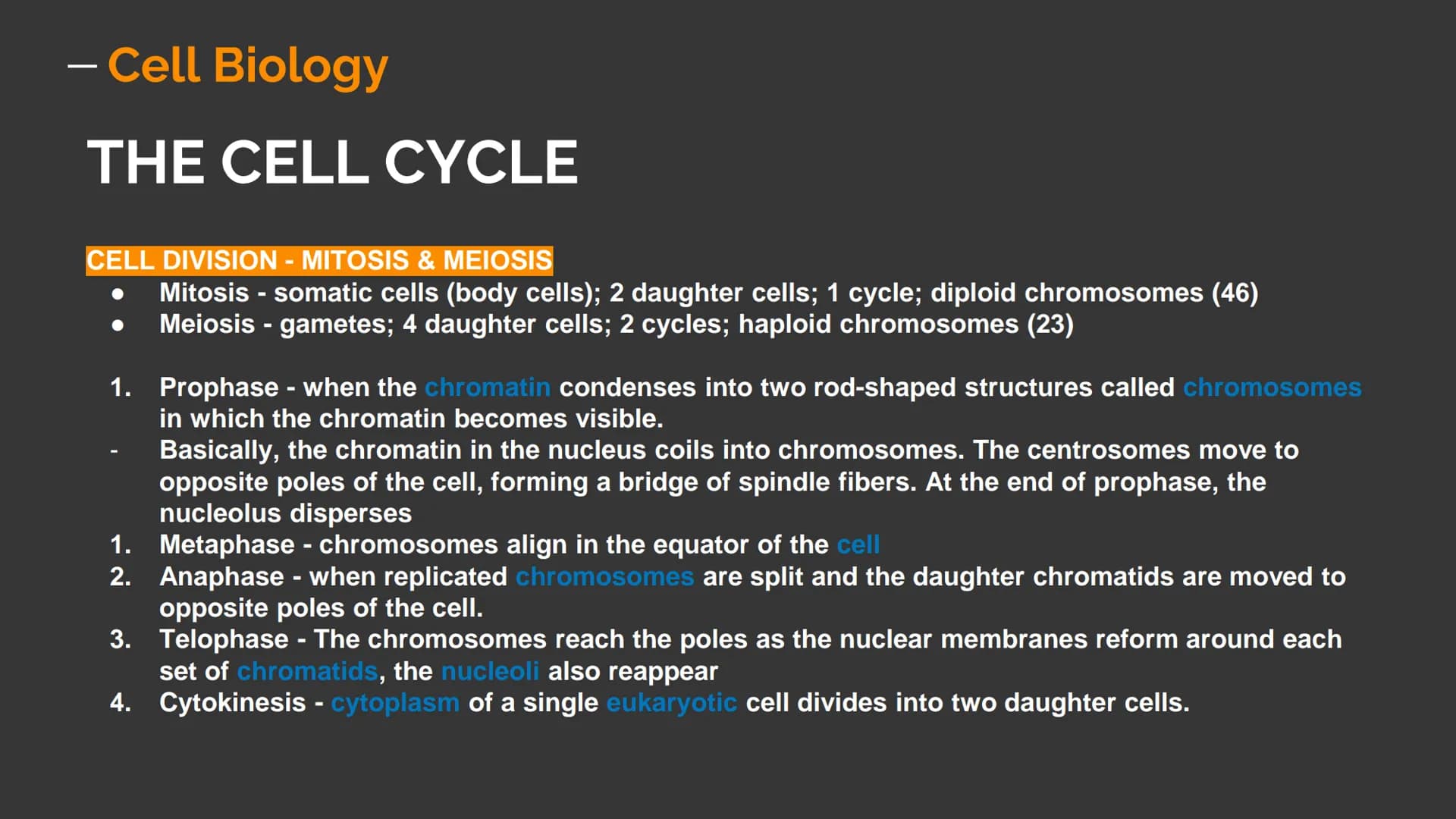
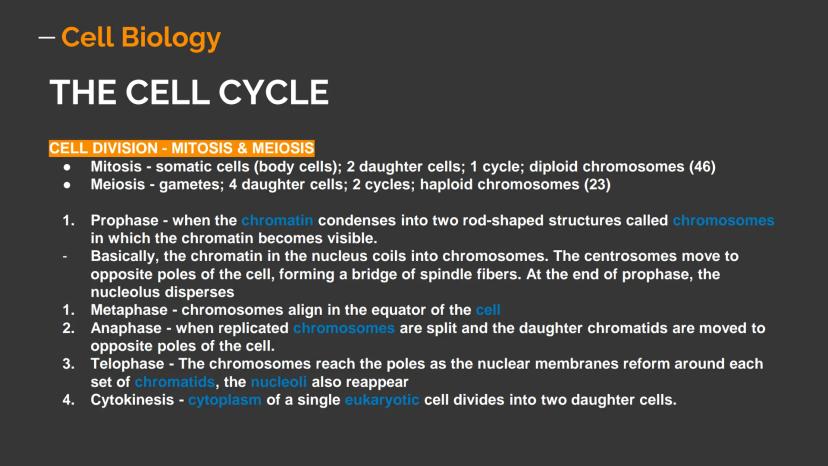
Your body uses two different types of cell division for different purposes. Mitosis produces two identical daughter cells from a single parent cell and occurs in your body (somatic) cells. Each daughter cell is diploid, containing 46 chromosomes just like the parent.
Meiosis creates four daughter cells with half the chromosome number (23 in humans) and is used only for producing gametes (sperm or eggs). This reduction in chromosome number allows the full number to be restored during fertilization.
Both processes follow similar phases. In prophase, chromosomes condense and become visible as the nuclear membrane breaks down. During metaphase, chromosomes line up at the cell's equator. Anaphase sees the chromosomes pulled to opposite poles of the cell. In telophase, new nuclear membranes form around the separated chromosomes. Finally, cytokinesis divides the cytoplasm, completing the creation of new cells.
🔬 You began as a single cell that has now divided through mitosis into approximately 37 trillion cells in your body - all coordinated to keep you alive and functioning!
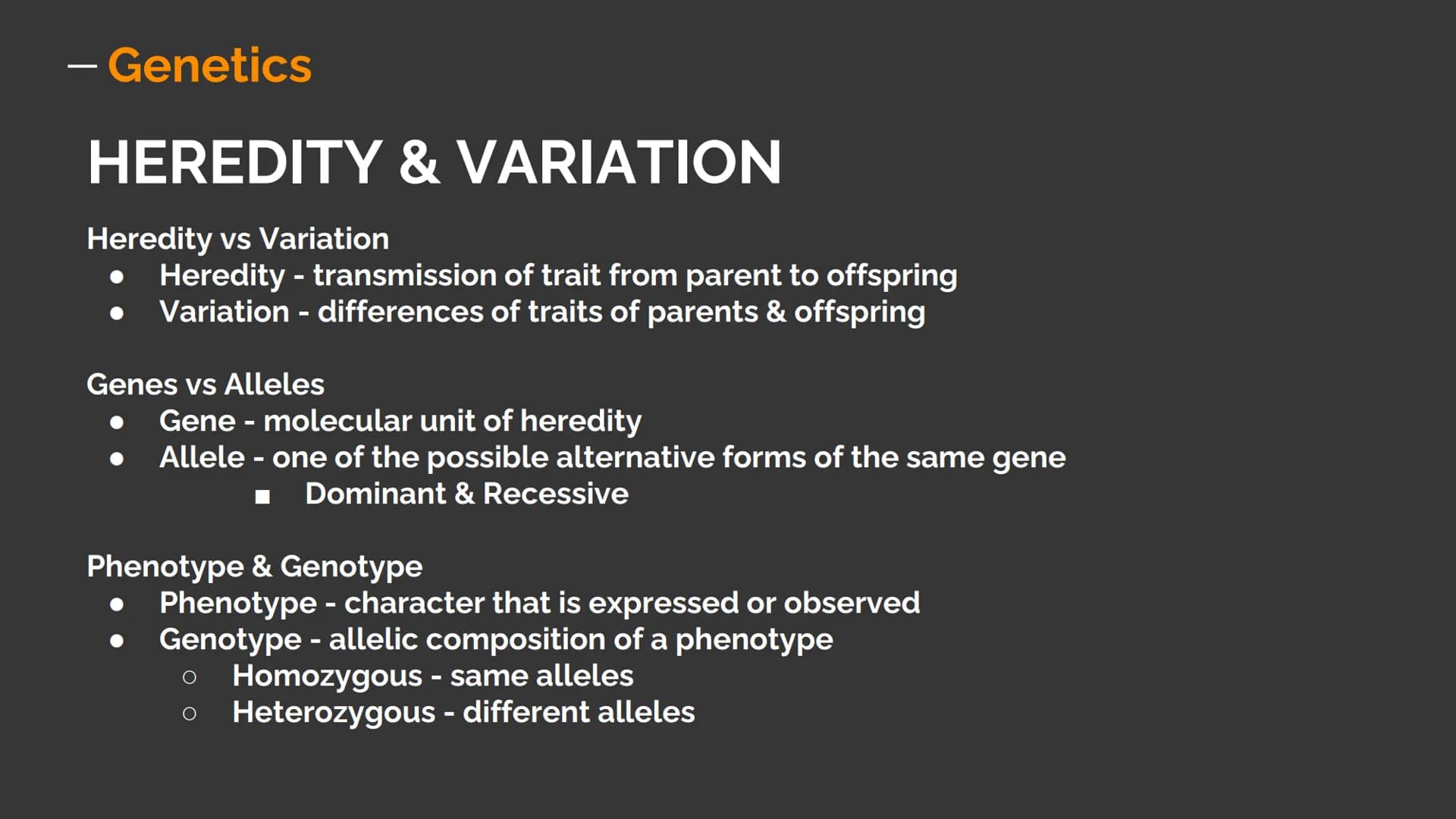
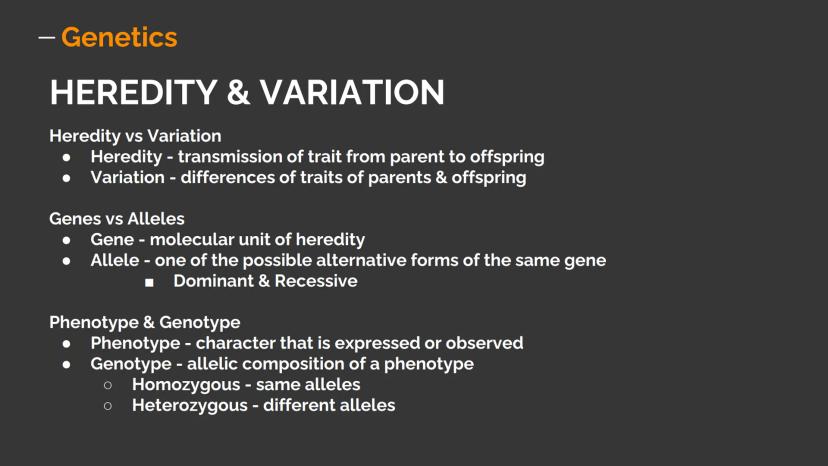
Why do you look like your family but still have your own unique traits? Heredity is the passing of traits from parents to offspring, while variation explains the differences between generations. Together, they explain family resemblances and individual uniqueness.
A gene is a segment of DNA that determines a specific trait, while an allele is a specific version of that gene. For example, the gene for eye color has multiple alleles (brown, blue, green). Some alleles are dominant (expressed when present) while others are recessive (expressed only when two copies are present).
Your phenotype is the physical expression of your genes (like brown eyes), while your genotype is your actual genetic makeup. Genotypes can be homozygous (two identical alleles for a trait) or heterozygous (two different alleles). This explains why you might carry a trait without showing it!
🧬 Think of your genome as a recipe book passed down through generations - with some recipes following tradition exactly, while others have been modified to create something new and unique!
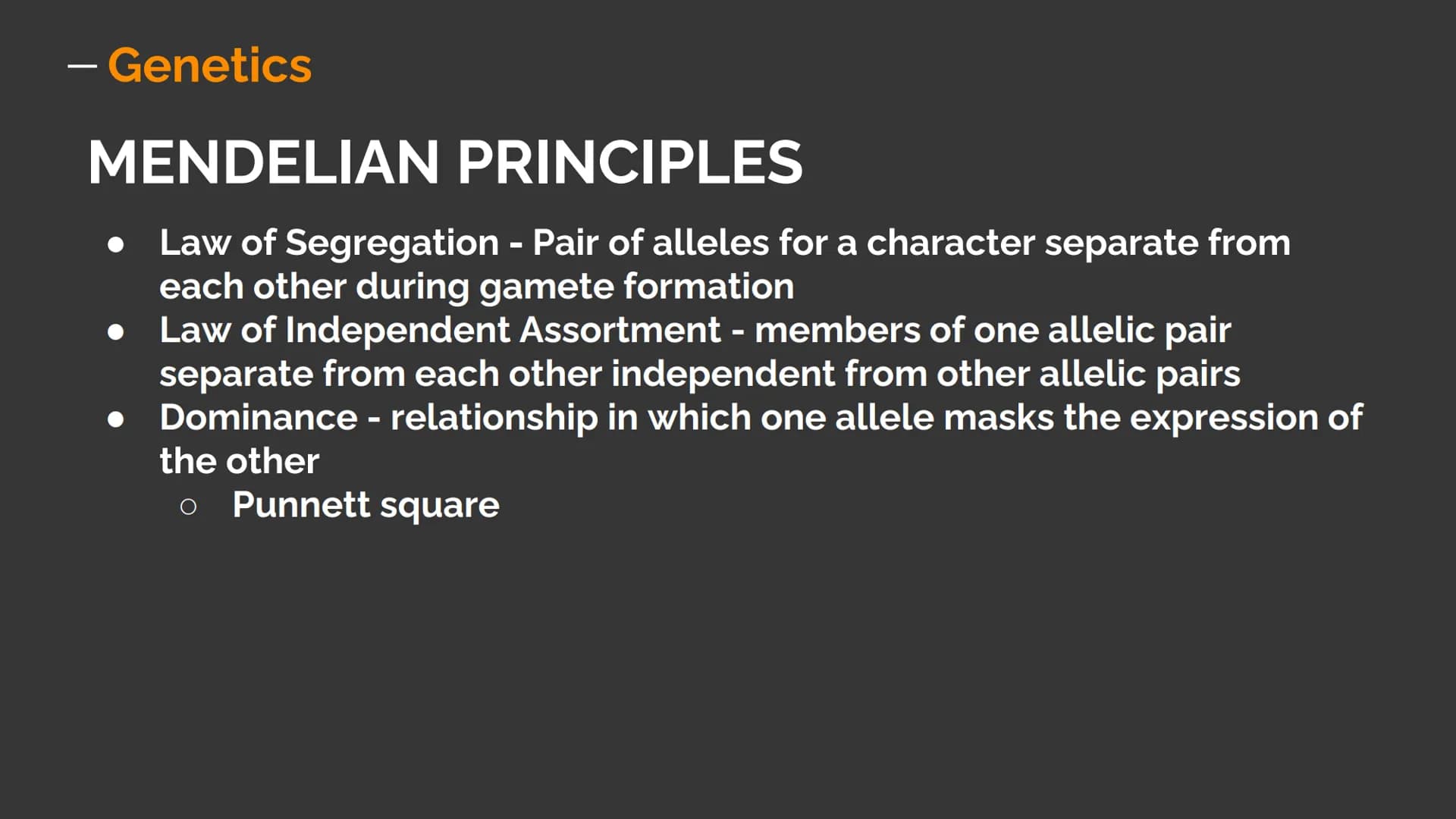
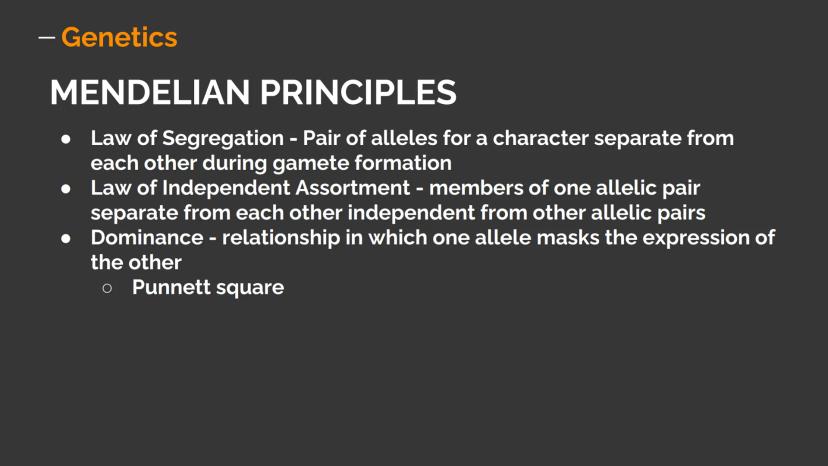
Gregor Mendel's pea plant experiments revealed the fundamental laws of inheritance. The Law of Segregation states that the two alleles for a trait separate during gamete formation, so each egg or sperm receives only one allele for each trait. This explains why you receive one allele from each parent for every gene.
The Law of Independent Assortment shows that different traits are inherited independently of one another. This creates tremendous genetic diversity since alleles for different traits can combine in countless ways.
Mendel's principle of Dominance explains how some alleles can mask the expression of others. This relationship is easily visualized using a Punnett square, a simple grid that predicts the probability of different genotypes in offspring. With this tool, you can calculate the chances of inheriting specific traits.
🌱 Mendel's genius was recognizing patterns in nature that others missed. By applying mathematical analysis to pea plants, he discovered the fundamental rules of inheritance decades before anyone even knew about DNA!
Our AI companion is specifically built for the needs of students. Based on the millions of content pieces we have on the platform we can provide truly meaningful and relevant answers to students. But its not only about answers, the companion is even more about guiding students through their daily learning challenges, with personalised study plans, quizzes or content pieces in the chat and 100% personalisation based on the students skills and developments.
You can download the app in the Google Play Store and in the Apple App Store.
That's right! Enjoy free access to study content, connect with fellow students, and get instant help – all at your fingertips.
App Store
Google Play
The app is very easy to use and well designed. I have found everything I was looking for so far and have been able to learn a lot from the presentations! I will definitely use the app for a class assignment! And of course it also helps a lot as an inspiration.
Stefan S
iOS user
This app is really great. There are so many study notes and help [...]. My problem subject is French, for example, and the app has so many options for help. Thanks to this app, I have improved my French. I would recommend it to anyone.
Samantha Klich
Android user
Wow, I am really amazed. I just tried the app because I've seen it advertised many times and was absolutely stunned. This app is THE HELP you want for school and above all, it offers so many things, such as workouts and fact sheets, which have been VERY helpful to me personally.
Anna
iOS user
I think it’s very much worth it and you’ll end up using it a lot once you get the hang of it and even after looking at others notes you can still ask your Artificial intelligence buddy the question and ask to simplify it if you still don’t get it!!! In the end I think it’s worth it 😊👍 ⚠️Also DID I MENTION ITS FREEE YOU DON’T HAVE TO PAY FOR ANYTHING AND STILL GET YOUR GRADES IN PERFECTLY❗️❗️⚠️
Thomas R
iOS user
Knowunity is the BEST app I’ve used in a minute. This is not an ai review or anything this is genuinely coming from a 7th grade student (I know 2011 im young) but dude this app is a 10/10 i have maintained a 3.8 gpa and have plenty of time for gaming. I love it and my mom is just happy I got good grades
Brad T
Android user
Not only did it help me find the answer but it also showed me alternative ways to solve it. I was horrible in math and science but now I have an a in both subjects. Thanks for the help🤍🤍
David K
iOS user
The app's just great! All I have to do is enter the topic in the search bar and I get the response real fast. I don't have to watch 10 YouTube videos to understand something, so I'm saving my time. Highly recommended!
Sudenaz Ocak
Android user
In school I was really bad at maths but thanks to the app, I am doing better now. I am so grateful that you made the app.
Greenlight Bonnie
Android user
I found this app a couple years ago and it has only gotten better since then. I really love it because it can help with written questions and photo questions. Also, it can find study guides that other people have made as well as flashcard sets and practice tests. The free version is also amazing for students who might not be able to afford it. Would 100% recommend
Aubrey
iOS user
Best app if you're in Highschool or Junior high. I have been using this app for 2 school years and it's the best, it's good if you don't have anyone to help you with school work.😋🩷🎀
Marco B
iOS user
THE QUIZES AND FLASHCARDS ARE SO USEFUL AND I LOVE Knowunity AI. IT ALSO IS LITREALLY LIKE CHATGPT BUT SMARTER!! HELPED ME WITH MY MASCARA PROBLEMS TOO!! AS WELL AS MY REAL SUBJECTS ! DUHHH 😍😁😲🤑💗✨🎀😮
Elisha
iOS user
This app is phenomenal down to the correct info and the various topics you can study! I greatly recommend it for people who struggle with procrastination and those who need homework help. It has been perfectly accurate for world 1 history as far as I’ve seen! Geometry too!
Paul T
iOS user
The app is very easy to use and well designed. I have found everything I was looking for so far and have been able to learn a lot from the presentations! I will definitely use the app for a class assignment! And of course it also helps a lot as an inspiration.
Stefan S
iOS user
This app is really great. There are so many study notes and help [...]. My problem subject is French, for example, and the app has so many options for help. Thanks to this app, I have improved my French. I would recommend it to anyone.
Samantha Klich
Android user
Wow, I am really amazed. I just tried the app because I've seen it advertised many times and was absolutely stunned. This app is THE HELP you want for school and above all, it offers so many things, such as workouts and fact sheets, which have been VERY helpful to me personally.
Anna
iOS user
I think it’s very much worth it and you’ll end up using it a lot once you get the hang of it and even after looking at others notes you can still ask your Artificial intelligence buddy the question and ask to simplify it if you still don’t get it!!! In the end I think it’s worth it 😊👍 ⚠️Also DID I MENTION ITS FREEE YOU DON’T HAVE TO PAY FOR ANYTHING AND STILL GET YOUR GRADES IN PERFECTLY❗️❗️⚠️
Thomas R
iOS user
Knowunity is the BEST app I’ve used in a minute. This is not an ai review or anything this is genuinely coming from a 7th grade student (I know 2011 im young) but dude this app is a 10/10 i have maintained a 3.8 gpa and have plenty of time for gaming. I love it and my mom is just happy I got good grades
Brad T
Android user
Not only did it help me find the answer but it also showed me alternative ways to solve it. I was horrible in math and science but now I have an a in both subjects. Thanks for the help🤍🤍
David K
iOS user
The app's just great! All I have to do is enter the topic in the search bar and I get the response real fast. I don't have to watch 10 YouTube videos to understand something, so I'm saving my time. Highly recommended!
Sudenaz Ocak
Android user
In school I was really bad at maths but thanks to the app, I am doing better now. I am so grateful that you made the app.
Greenlight Bonnie
Android user
I found this app a couple years ago and it has only gotten better since then. I really love it because it can help with written questions and photo questions. Also, it can find study guides that other people have made as well as flashcard sets and practice tests. The free version is also amazing for students who might not be able to afford it. Would 100% recommend
Aubrey
iOS user
Best app if you're in Highschool or Junior high. I have been using this app for 2 school years and it's the best, it's good if you don't have anyone to help you with school work.😋🩷🎀
Marco B
iOS user
THE QUIZES AND FLASHCARDS ARE SO USEFUL AND I LOVE Knowunity AI. IT ALSO IS LITREALLY LIKE CHATGPT BUT SMARTER!! HELPED ME WITH MY MASCARA PROBLEMS TOO!! AS WELL AS MY REAL SUBJECTS ! DUHHH 😍😁😲🤑💗✨🎀😮
Elisha
iOS user
This app is phenomenal down to the correct info and the various topics you can study! I greatly recommend it for people who struggle with procrastination and those who need homework help. It has been perfectly accurate for world 1 history as far as I’ve seen! Geometry too!
Paul T
iOS user
Welcome to the world of Biology! This guide will take you through essential concepts from the properties of life to ecology, helping you understand how living organisms function, reproduce, and interact with their environment. Whether you're preparing for a test... Show more
Access to all documents
Improve your grades
Join milions of students
Biology explores all aspects of living organisms and how they function. The major areas we'll cover include the fundamental properties of life that distinguish living from non-living things.
We'll examine cell biology to understand the basic unit of all organisms and the fascinating processes of the cell cycle. Then we'll dive into genetics to learn how traits are passed from parents to offspring.
Metabolism will show us how organisms convert energy for survival, and finally, taxo-ecology will help us understand how organisms are classified and interact with their environment.
💡 Biology connects all these seemingly separate topics into one beautiful tapestry explaining how life works - from the tiniest cellular processes to entire ecosystems!
Access to all documents
Improve your grades
Join milions of students
Ever wondered what makes something "alive"? All living things share seven key characteristics. Evolution means organisms can change over long periods of time, adapting to their environments. Living things also show response to stimulus - they react to their surroundings through tropisms (moving toward or away from stimuli).
Metabolism involves the chemical reactions that provide energy for life processes. Reproduction ensures species survival and creates genetic diversity among offspring. All living things contain genetic material (DNA) that stores their biological instructions.
Living organisms display incredible organization - they're structured from atoms all the way up to complex organ systems. Finally, homeostasis keeps internal conditions stable despite environmental changes.
🔬 Think of a living organism as an incredibly complex machine that can fuel itself, repair itself, and even make copies of itself - something no human-made technology can fully replicate!
Access to all documents
Improve your grades
Join milions of students
Your body is built from four main types of large biological molecules. Carbohydrates (made of carbon, hydrogen and oxygen) serve as your primary energy source and include simple sugars and complex molecules like starch and glycogen for energy storage.
Lipids are water-insoluble compounds that include fats, oils, and waxes. They store energy long-term, insulate your body, and form cell membranes. Animal fats are typically saturated (solid at room temperature) while plant oils are unsaturated (liquid).
Proteins, composed of amino acids linked by peptide bonds, perform countless functions in your body - from structural support to enzyme reactions. They contain nitrogen along with carbon, hydrogen, and oxygen.
Nucleic acids (DNA and RNA) store and transmit genetic information. They're made of nucleotides, each containing a sugar, phosphate group, and nitrogenous base (A, G, C, T or U).
🧪 These four macromolecules are like the LEGO blocks of life - with different combinations creating everything from your hair to your heart cells!
Access to all documents
Improve your grades
Join milions of students
DNA and RNA are the information-carrying molecules of life, but they have key differences. DNA (deoxyribonucleic acid) forms a double-stranded helix with a deoxyribose sugar backbone, while RNA (ribonucleic acid) is typically single-stranded with a ribose sugar.
Their nitrogenous bases also differ: DNA uses adenine (A), guanine (G), thymine (T), and cytosine (C), while RNA replaces thymine with uracil (U). Base pairing is specific - A always pairs with T (in DNA) or U (in RNA), and G always pairs with C.
DNA's double helix structure is anti-parallel, meaning one strand runs 5' to 3' while the complementary strand runs 3' to 5'. This structure provides stability and allows for accurate replication of genetic information.
🧬 The DNA in just one of your cells would stretch nearly 6 feet if unwound, yet it's packaged so efficiently it fits in a microscopic nucleus!
Access to all documents
Improve your grades
Join milions of students
All living organisms are composed of cells, but they fall into two main categories. Prokaryotic cells lack a true nucleus and membrane-bound organelles. They're simpler, smaller, and more ancient than eukaryotic cells. Bacteria and archaea are the main prokaryotic organisms you'll encounter.
Eukaryotic cells are more complex with a true nucleus containing DNA and various membrane-bound organelles that perform specialized functions. Animals, plants, fungi, and protists all have eukaryotic cells.
This fundamental cell division is one of the most important distinctions in biology. The difference affects everything from how these organisms reproduce to how they obtain energy and respond to antibiotics.
🦠 Despite being "simpler," prokaryotic cells outnumber eukaryotic cells on Earth by a staggering margin - there are more bacteria in your mouth right now than there are people on the planet!
Access to all documents
Improve your grades
Join milions of students
Cells constantly move materials across their membranes using different transport mechanisms. Passive transport requires no energy and moves substances from high to low concentration. This includes simple diffusion, where molecules naturally spread out, and facilitated diffusion, where proteins help specific molecules cross the membrane.
Osmosis is a special type of diffusion involving water movement across membranes. In isotonic solutions, cells maintain their shape because water moves in and out equally. In hypotonic solutions, cells swell as water rushes in, while in hypertonic solutions, cells shrink as water leaves.
Active transport moves substances against their concentration gradient using energy from ATP. This includes endocytosis, where cells engulf materials (either as solid particles in phagocytosis or liquids in pinocytosis), and exocytosis, where cells release contents to their surroundings.
🧪 Your cells perform these transport processes billions of times each day! If active transport stopped working, your cells would quickly die as crucial balances of sodium, potassium, and other ions collapsed.
Access to all documents
Improve your grades
Join milions of students
The cell cycle is how cells reproduce, with most of the time spent in interphase (about 90% of the cycle). During this preparation stage, the cell grows, duplicates its DNA, and prepares for division through three phases: G1 (first growth), S (DNA synthesis), and G2 (second growth). Some cells enter a resting state called G0 where they temporarily or permanently stop dividing.
The central dogma of molecular biology happens during interphase: DNA → RNA → Protein. First, DNA replication occurs during S phase when the double helix unzips and new complementary strands form. Next, transcription creates messenger RNA (mRNA) from the DNA template. Finally, translation uses the mRNA code to assemble proteins in the cytoplasm.
The genetic code is read in three-base units called codons, with each codon specifying one amino acid in the resulting protein. This elegant system allows your cells to create thousands of different proteins from the same DNA blueprint.
🔄 Each time one of your cells divides, it must copy about 6 billion base pairs of DNA with fewer than 10 errors - that's more accurate than any human-made copying system!
Access to all documents
Improve your grades
Join milions of students
Your body uses two different types of cell division for different purposes. Mitosis produces two identical daughter cells from a single parent cell and occurs in your body (somatic) cells. Each daughter cell is diploid, containing 46 chromosomes just like the parent.
Meiosis creates four daughter cells with half the chromosome number (23 in humans) and is used only for producing gametes (sperm or eggs). This reduction in chromosome number allows the full number to be restored during fertilization.
Both processes follow similar phases. In prophase, chromosomes condense and become visible as the nuclear membrane breaks down. During metaphase, chromosomes line up at the cell's equator. Anaphase sees the chromosomes pulled to opposite poles of the cell. In telophase, new nuclear membranes form around the separated chromosomes. Finally, cytokinesis divides the cytoplasm, completing the creation of new cells.
🔬 You began as a single cell that has now divided through mitosis into approximately 37 trillion cells in your body - all coordinated to keep you alive and functioning!
Access to all documents
Improve your grades
Join milions of students
Why do you look like your family but still have your own unique traits? Heredity is the passing of traits from parents to offspring, while variation explains the differences between generations. Together, they explain family resemblances and individual uniqueness.
A gene is a segment of DNA that determines a specific trait, while an allele is a specific version of that gene. For example, the gene for eye color has multiple alleles (brown, blue, green). Some alleles are dominant (expressed when present) while others are recessive (expressed only when two copies are present).
Your phenotype is the physical expression of your genes (like brown eyes), while your genotype is your actual genetic makeup. Genotypes can be homozygous (two identical alleles for a trait) or heterozygous (two different alleles). This explains why you might carry a trait without showing it!
🧬 Think of your genome as a recipe book passed down through generations - with some recipes following tradition exactly, while others have been modified to create something new and unique!
Access to all documents
Improve your grades
Join milions of students
Gregor Mendel's pea plant experiments revealed the fundamental laws of inheritance. The Law of Segregation states that the two alleles for a trait separate during gamete formation, so each egg or sperm receives only one allele for each trait. This explains why you receive one allele from each parent for every gene.
The Law of Independent Assortment shows that different traits are inherited independently of one another. This creates tremendous genetic diversity since alleles for different traits can combine in countless ways.
Mendel's principle of Dominance explains how some alleles can mask the expression of others. This relationship is easily visualized using a Punnett square, a simple grid that predicts the probability of different genotypes in offspring. With this tool, you can calculate the chances of inheriting specific traits.
🌱 Mendel's genius was recognizing patterns in nature that others missed. By applying mathematical analysis to pea plants, he discovered the fundamental rules of inheritance decades before anyone even knew about DNA!
Our AI companion is specifically built for the needs of students. Based on the millions of content pieces we have on the platform we can provide truly meaningful and relevant answers to students. But its not only about answers, the companion is even more about guiding students through their daily learning challenges, with personalised study plans, quizzes or content pieces in the chat and 100% personalisation based on the students skills and developments.
You can download the app in the Google Play Store and in the Apple App Store.
That's right! Enjoy free access to study content, connect with fellow students, and get instant help – all at your fingertips.
10
Smart Tools NEW
Transform this note into: ✓ 50+ Practice Questions ✓ Interactive Flashcards ✓ Full Practice Test ✓ Essay Outlines
Middle School Earth and space science 6th 7th 8th grade
 Earth and Space Science
This talks about the rock cycle, types of rocks and the energy that drives the rock cycle.
Earth and Space ScienceStructure and Function of Cells, Cell Structure
Earth and Space ScienceApp Store
Google Play
The app is very easy to use and well designed. I have found everything I was looking for so far and have been able to learn a lot from the presentations! I will definitely use the app for a class assignment! And of course it also helps a lot as an inspiration.
Stefan S
iOS user
This app is really great. There are so many study notes and help [...]. My problem subject is French, for example, and the app has so many options for help. Thanks to this app, I have improved my French. I would recommend it to anyone.
Samantha Klich
Android user
Wow, I am really amazed. I just tried the app because I've seen it advertised many times and was absolutely stunned. This app is THE HELP you want for school and above all, it offers so many things, such as workouts and fact sheets, which have been VERY helpful to me personally.
Anna
iOS user
I think it’s very much worth it and you’ll end up using it a lot once you get the hang of it and even after looking at others notes you can still ask your Artificial intelligence buddy the question and ask to simplify it if you still don’t get it!!! In the end I think it’s worth it 😊👍 ⚠️Also DID I MENTION ITS FREEE YOU DON’T HAVE TO PAY FOR ANYTHING AND STILL GET YOUR GRADES IN PERFECTLY❗️❗️⚠️
Thomas R
iOS user
Knowunity is the BEST app I’ve used in a minute. This is not an ai review or anything this is genuinely coming from a 7th grade student (I know 2011 im young) but dude this app is a 10/10 i have maintained a 3.8 gpa and have plenty of time for gaming. I love it and my mom is just happy I got good grades
Brad T
Android user
Not only did it help me find the answer but it also showed me alternative ways to solve it. I was horrible in math and science but now I have an a in both subjects. Thanks for the help🤍🤍
David K
iOS user
The app's just great! All I have to do is enter the topic in the search bar and I get the response real fast. I don't have to watch 10 YouTube videos to understand something, so I'm saving my time. Highly recommended!
Sudenaz Ocak
Android user
In school I was really bad at maths but thanks to the app, I am doing better now. I am so grateful that you made the app.
Greenlight Bonnie
Android user
I found this app a couple years ago and it has only gotten better since then. I really love it because it can help with written questions and photo questions. Also, it can find study guides that other people have made as well as flashcard sets and practice tests. The free version is also amazing for students who might not be able to afford it. Would 100% recommend
Aubrey
iOS user
Best app if you're in Highschool or Junior high. I have been using this app for 2 school years and it's the best, it's good if you don't have anyone to help you with school work.😋🩷🎀
Marco B
iOS user
THE QUIZES AND FLASHCARDS ARE SO USEFUL AND I LOVE Knowunity AI. IT ALSO IS LITREALLY LIKE CHATGPT BUT SMARTER!! HELPED ME WITH MY MASCARA PROBLEMS TOO!! AS WELL AS MY REAL SUBJECTS ! DUHHH 😍😁😲🤑💗✨🎀😮
Elisha
iOS user
This app is phenomenal down to the correct info and the various topics you can study! I greatly recommend it for people who struggle with procrastination and those who need homework help. It has been perfectly accurate for world 1 history as far as I’ve seen! Geometry too!
Paul T
iOS user
The app is very easy to use and well designed. I have found everything I was looking for so far and have been able to learn a lot from the presentations! I will definitely use the app for a class assignment! And of course it also helps a lot as an inspiration.
Stefan S
iOS user
This app is really great. There are so many study notes and help [...]. My problem subject is French, for example, and the app has so many options for help. Thanks to this app, I have improved my French. I would recommend it to anyone.
Samantha Klich
Android user
Wow, I am really amazed. I just tried the app because I've seen it advertised many times and was absolutely stunned. This app is THE HELP you want for school and above all, it offers so many things, such as workouts and fact sheets, which have been VERY helpful to me personally.
Anna
iOS user
I think it’s very much worth it and you’ll end up using it a lot once you get the hang of it and even after looking at others notes you can still ask your Artificial intelligence buddy the question and ask to simplify it if you still don’t get it!!! In the end I think it’s worth it 😊👍 ⚠️Also DID I MENTION ITS FREEE YOU DON’T HAVE TO PAY FOR ANYTHING AND STILL GET YOUR GRADES IN PERFECTLY❗️❗️⚠️
Thomas R
iOS user
Knowunity is the BEST app I’ve used in a minute. This is not an ai review or anything this is genuinely coming from a 7th grade student (I know 2011 im young) but dude this app is a 10/10 i have maintained a 3.8 gpa and have plenty of time for gaming. I love it and my mom is just happy I got good grades
Brad T
Android user
Not only did it help me find the answer but it also showed me alternative ways to solve it. I was horrible in math and science but now I have an a in both subjects. Thanks for the help🤍🤍
David K
iOS user
The app's just great! All I have to do is enter the topic in the search bar and I get the response real fast. I don't have to watch 10 YouTube videos to understand something, so I'm saving my time. Highly recommended!
Sudenaz Ocak
Android user
In school I was really bad at maths but thanks to the app, I am doing better now. I am so grateful that you made the app.
Greenlight Bonnie
Android user
I found this app a couple years ago and it has only gotten better since then. I really love it because it can help with written questions and photo questions. Also, it can find study guides that other people have made as well as flashcard sets and practice tests. The free version is also amazing for students who might not be able to afford it. Would 100% recommend
Aubrey
iOS user
Best app if you're in Highschool or Junior high. I have been using this app for 2 school years and it's the best, it's good if you don't have anyone to help you with school work.😋🩷🎀
Marco B
iOS user
THE QUIZES AND FLASHCARDS ARE SO USEFUL AND I LOVE Knowunity AI. IT ALSO IS LITREALLY LIKE CHATGPT BUT SMARTER!! HELPED ME WITH MY MASCARA PROBLEMS TOO!! AS WELL AS MY REAL SUBJECTS ! DUHHH 😍😁😲🤑💗✨🎀😮
Elisha
iOS user
This app is phenomenal down to the correct info and the various topics you can study! I greatly recommend it for people who struggle with procrastination and those who need homework help. It has been perfectly accurate for world 1 history as far as I’ve seen! Geometry too!
Paul T
iOS user