

Geologic Time explores how scientists piece together Earth's vast history... Show more
 Earth and Space Science
 Algebra
 Biology
Sign up to see the contentIt's free!
Access to all documents
Improve your grades
Join milions of students
Knowunity AI
Subjects
Triangle Congruence and Similarity Theorems
Triangle Properties and Classification
Linear Equations and Graphs
Geometric Angle Relationships
Trigonometric Functions and Identities
Equation Solving Techniques
Circle Geometry Fundamentals
Division Operations and Methods
Basic Differentiation Rules
Exponent and Logarithm Properties
Show all topics
Human Organ Systems
Reproductive Cell Cycles
Biological Sciences Subdisciplines
Cellular Energy Metabolism
Autotrophic Energy Processes
Inheritance Patterns and Principles
Biomolecular Structure and Organization
Cell Cycle and Division Mechanics
Cellular Organization and Development
Biological Structural Organization
Show all topics
Chemical Sciences and Applications
Atomic Structure and Composition
Molecular Electron Structure Representation
Atomic Electron Behavior
Matter Properties and Water
Mole Concept and Calculations
Gas Laws and Behavior
Periodic Table Organization
Chemical Thermodynamics Fundamentals
Chemical Bond Types and Properties
Show all topics
European Renaissance and Enlightenment
European Cultural Movements 800-1920
American Revolution Era 1763-1797
American Civil War 1861-1865
Global Imperial Systems
Mongol and Chinese Dynasties
U.S. Presidents and World Leaders
Historical Sources and Documentation
World Wars Era and Impact
World Religious Systems
Show all topics
Classic and Contemporary Novels
Literary Character Analysis
Rhetorical Theory and Practice
Classic Literary Narratives
Reading Analysis and Interpretation
Narrative Structure and Techniques
English Language Components
Influential English-Language Authors
Basic Sentence Structure
Narrative Voice and Perspective
Show all topics
183
•
Updated Apr 1, 2026
•
Geologic Time explores how scientists piece together Earth's vast history... Show more
When you look at rocks, you're actually looking at pages in Earth's diary! Chapter 12 introduces us to geologic time, the fascinating study of how scientists figure out Earth's history from the clues preserved in rocks.
You'll learn how to "read" these stone records to understand events that happened millions or even billions of years ago. This knowledge helps us understand not just Earth's past, but also how our planet continues to change today.
Think about it: Every rock has a story to tell - you just need to know how to listen!
Rocks are like nature's history books! They preserve evidence of ancient geological events and the changing life forms that once inhabited our planet. Every layer, mineral, and fossil tells part of Earth's story.
Through studying these rock records, scientists have made an amazing discovery - Earth is much older than anyone previously imagined. The planet we call home has existed for billions of years, not thousands as was once believed.
Perhaps most fascinating is that the geological processes we see happening today - erosion, volcanic eruptions, earthquakes - are the same ones that have been reshaping Earth throughout its entire history. The present truly is the key to understanding the past.
Amazing fact: Some of the oldest rocks on Earth are over 4 billion years old!
The concept of uniformitarianism revolutionized how we understand Earth. This principle states that the geological forces and processes we observe today - like erosion, deposition, and mountain building - have been operating in the same way for billions of years.
This idea might seem obvious to us now, but it was groundbreaking when first proposed. It means we can use present-day observations to understand events from Earth's distant past. The slow but steady processes we see today have, over enormous spans of time, created dramatic changes to our planet.
Understanding uniformitarianism helps you grasp how small changes, given enough time, can transform entire landscapes. Those towering mountains? They formed inch by inch over millions of years!
Remember: The key to uniformitarianism is "the present is the key to the past."
Ever wondered how scientists determine which rocks are older without knowing their exact age? That's where relative dating comes in! It tells us the sequence of geological events (which came first, second, etc.) without telling us exactly how long ago they occurred.
The Law of Superposition is like the basic rule of a rock layer cake. It states that in an undisturbed stack of sedimentary rocks, each layer is older than the one above it and younger than the one below it. The bottom layer was deposited first, and each subsequent layer piled on top.
This principle is super useful when examining rock formations like cliffs or canyon walls. When you see distinct layers, you can immediately tell which rocks formed first. The deeper you go, the further back in time you travel!
Pro tip: When looking at rock layers, think "older on the bottom, younger on top" - unless something has disturbed the layers.
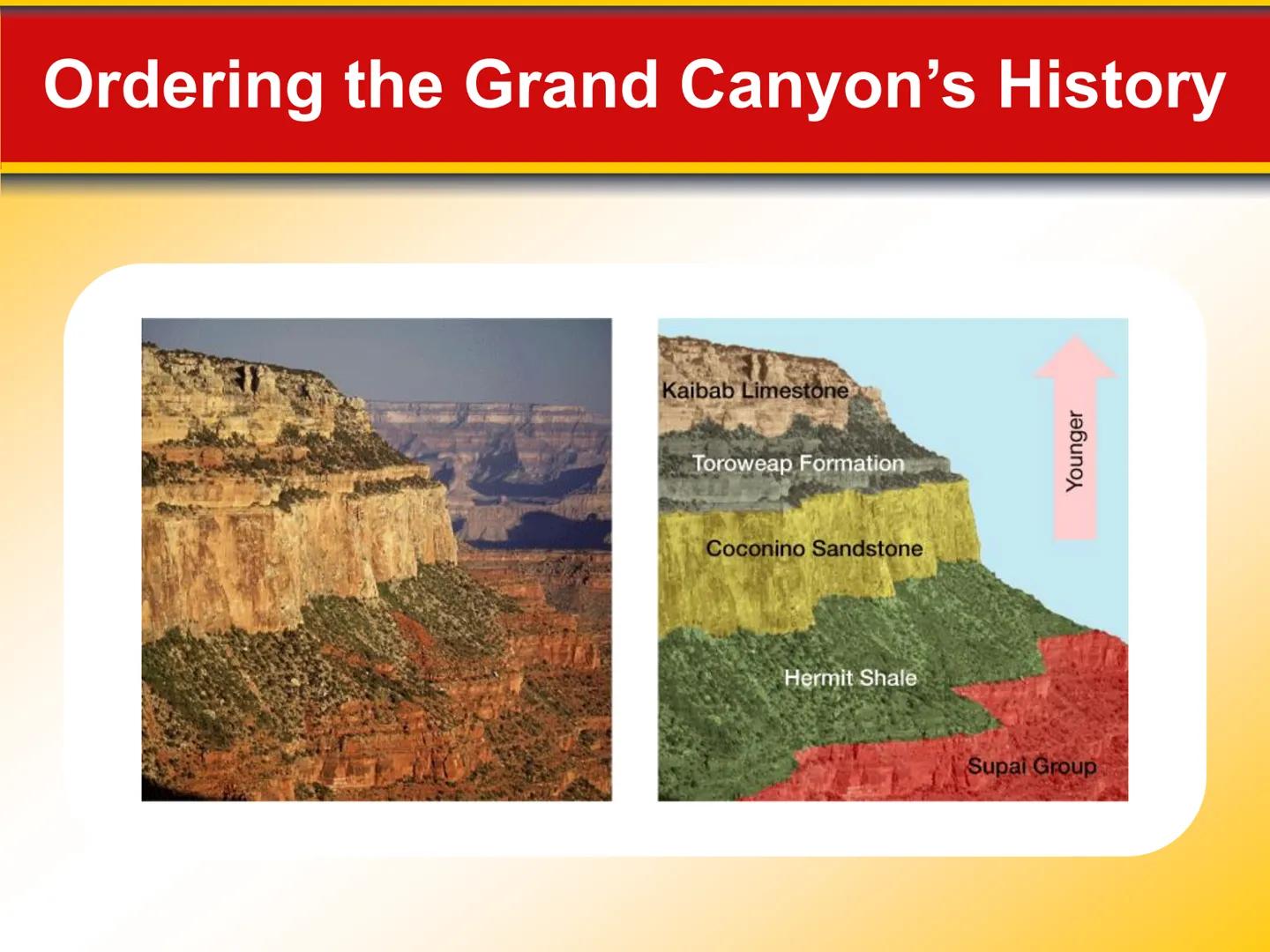
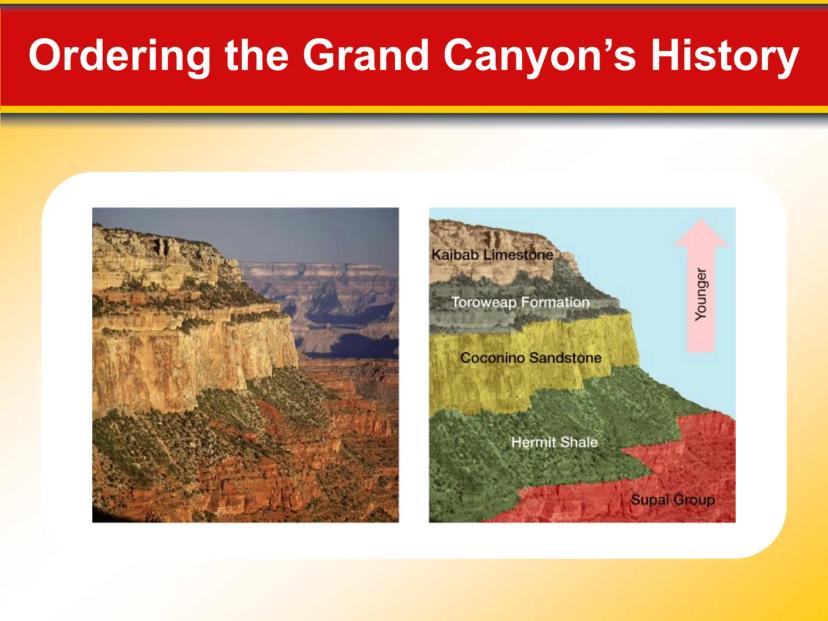
The Grand Canyon is like nature's perfect example of the Law of Superposition! Each colorful layer tells part of Earth's story, with the oldest rocks at the bottom and youngest at the top.
The Kaibab Limestone forms the rim of the canyon and is the youngest visible layer. Below that, you'll find the Toroweap Formation, then the Coconino Sandstone, followed by the Hermit Shale, and finally the Supai Group among the layers shown.
By studying these rock layers, geologists can recreate the environmental conditions that existed when each formed. Some layers were ancient seas, others desert sand dunes, and others tropical swamps - all evidence of how dramatically Earth's environments can change over time.
Wow factor: The Grand Canyon's rock layers represent over a billion years of Earth history!
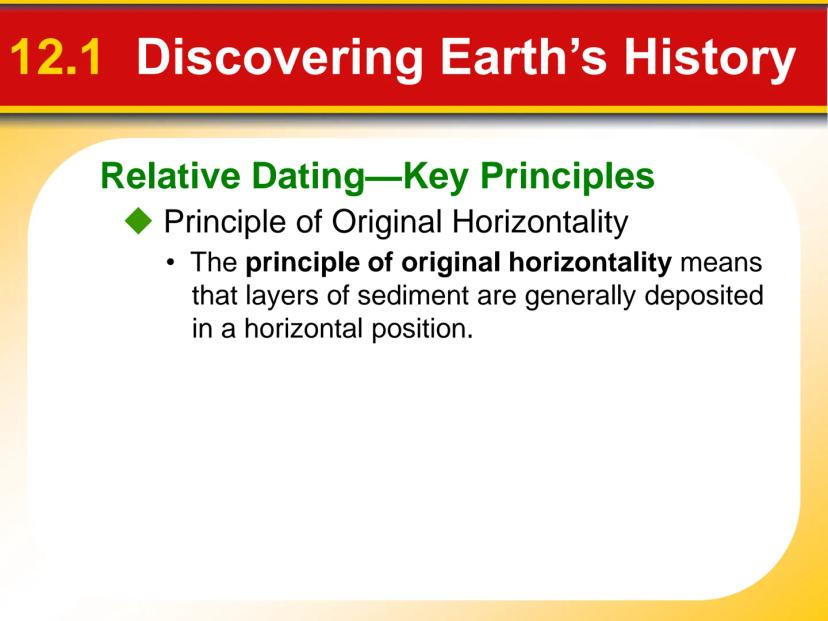
When sediment settles in water, gravity naturally pulls it into flat, horizontal layers - like how dust settles evenly on your furniture. This simple observation is the basis for the principle of original horizontality.
This principle tells us that sedimentary rock layers were originally deposited in horizontal positions. So when we see tilted, folded, or otherwise deformed rock layers, we know something must have happened to them after they formed.
Think about it - if you see rock layers that are bent like a roller coaster or standing almost vertically, those rocks were moved from their original position by powerful forces like mountain building, earthquakes, or other tectonic processes.
Try this: Next time you see layered rocks on a hillside that aren't horizontal, ask yourself: "What forces were strong enough to move these massive rocks?"
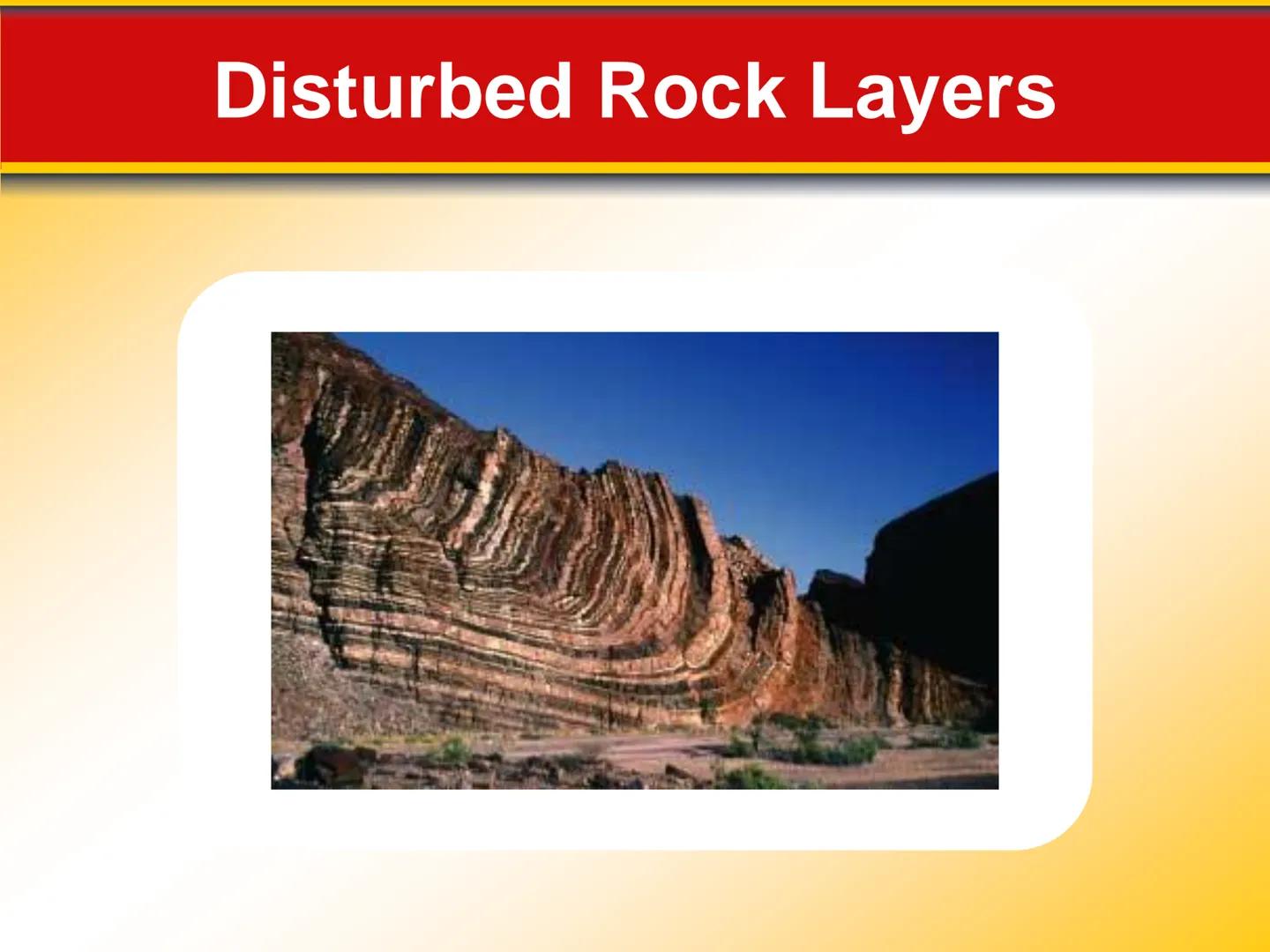
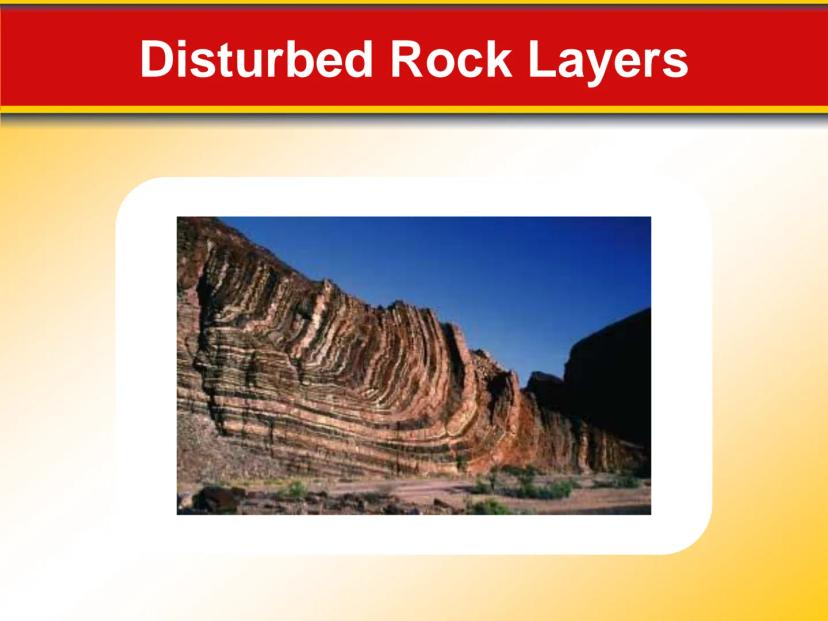
Rock layers don't always stay nice and flat! This page shows how layers can become folded, tilted, and deformed over time due to the immense forces at work within Earth.
When tectonic plates collide or slide past each other, they can crumple rock layers like paper. These disturbed patterns tell geologists about ancient mountain-building events, earthquakes, and other dramatic geological processes.
By understanding how and why rock layers become disturbed, scientists can reconstruct the movements of Earth's crust over millions of years. Those twisted rocks you see on a hike aren't just cool-looking - they're evidence of Earth's powerful internal forces!
Imagine: These rock layers were once flat at the bottom of ancient seas before powerful forces twisted them into their current positions.
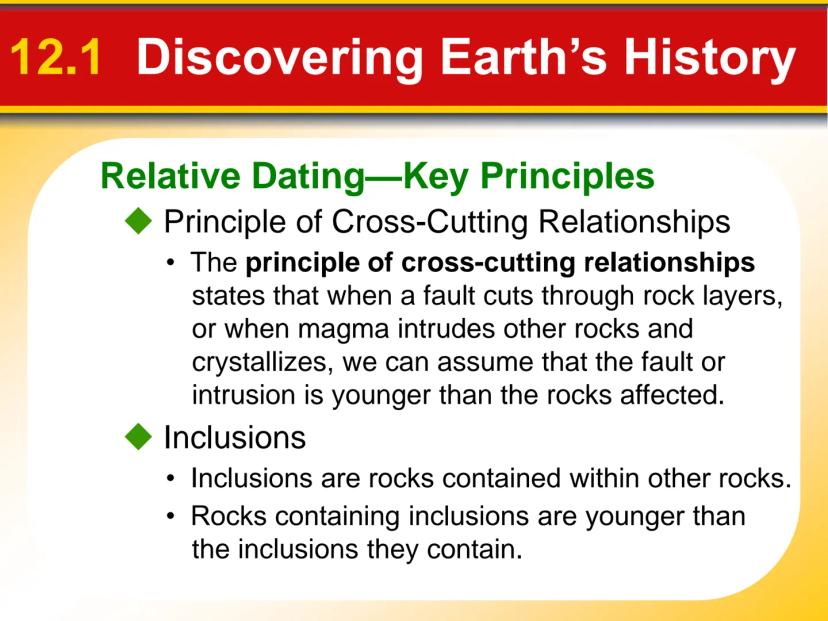
The principle of cross-cutting relationships is like figuring out who arrived at a party based on interactions. If a fault cuts across rock layers or if magma intrudes into existing rock and solidifies, the fault or intrusion must be younger than the rocks it affects. Think of it as "whatever cuts through must have come later."
Inclusions provide another clue about relative age. These are fragments of one rock contained within another rock. The rock containing the inclusions must be younger than the inclusions themselves. It's like finding an old coin inside a newer wall - the wall must have been built after the coin was made.
These principles help geologists untangle complex geological histories when rock layers have been disturbed, intruded, or eroded over time.
Helpful comparison: Cross-cutting relationships work like drawing a line through existing text - the line must have been drawn after the text was written.
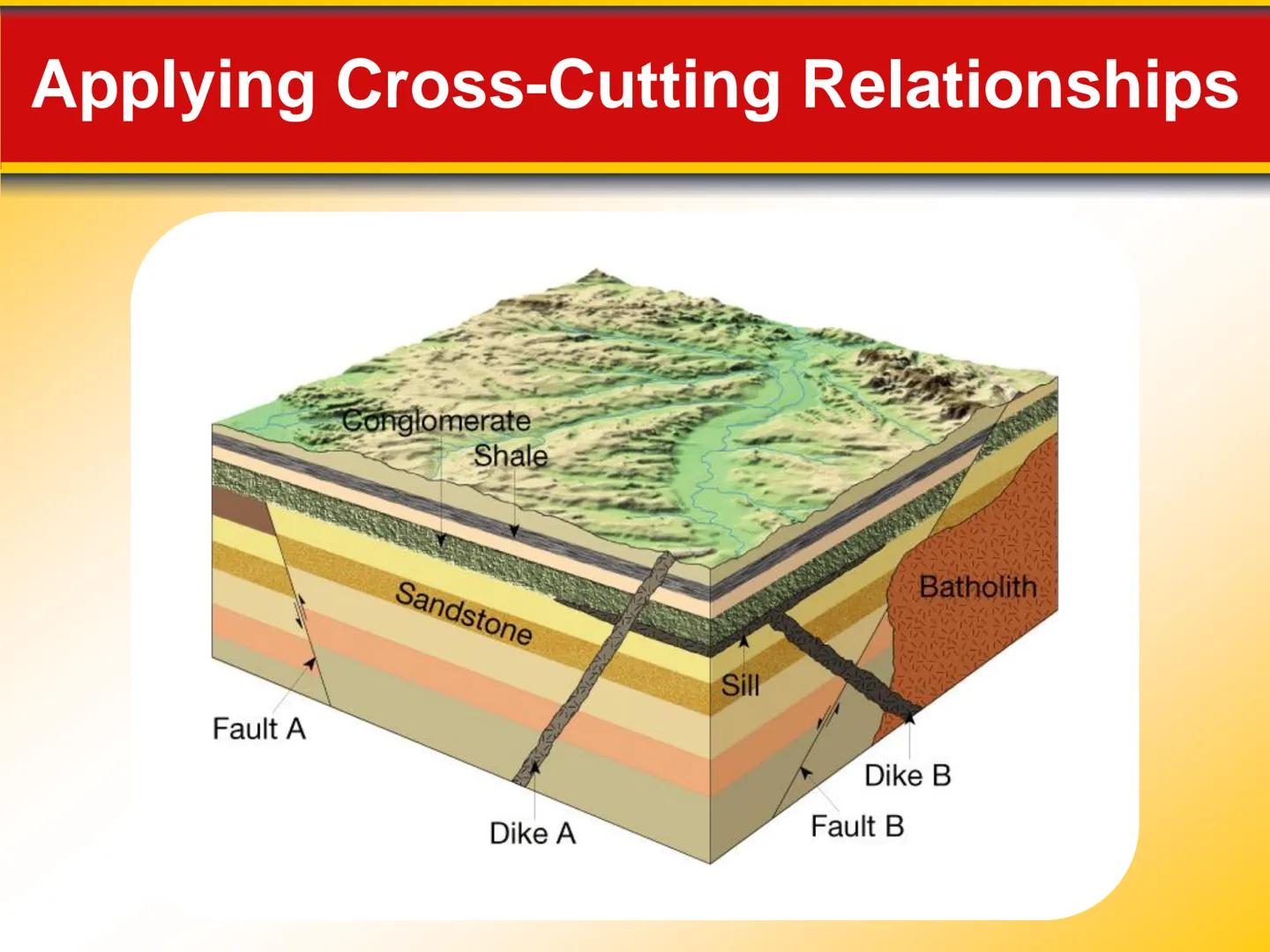
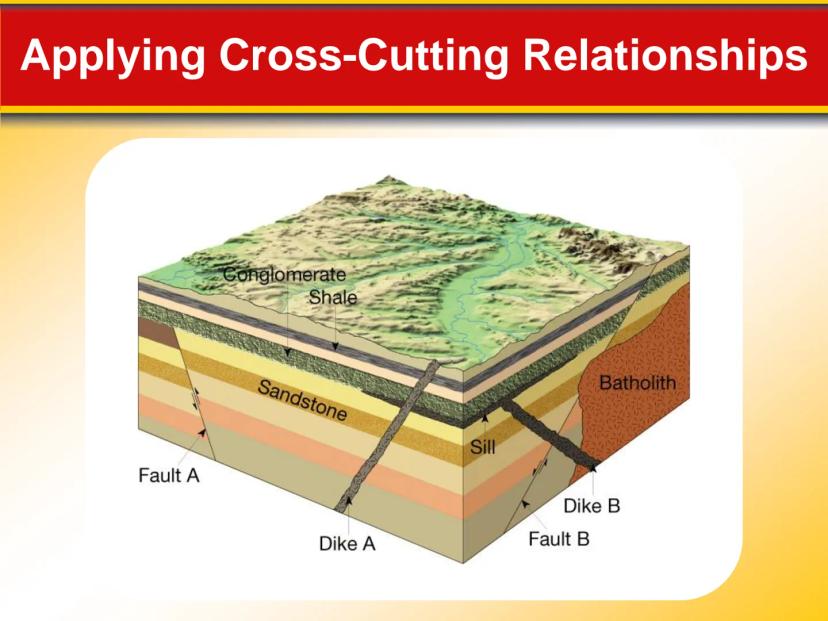
This diagram shows the practical application of cross-cutting relationships with various rock types and structures. Let's break down what's happening:
The diagram shows sedimentary layers (conglomerate, shale, and sandstone) that have been intruded by igneous features (a sill, a batholith, and two dikes) and cut by two faults. By applying the principle of cross-cutting relationships, you can determine the sequence of events.
For example, Fault A cuts through the sedimentary layers but is itself cut by Dike B, meaning Fault A formed before Dike B. The batholith intrudes into the lowest layers but is cut by Fault B, making the batholith older than Fault B.
Working through these relationships is like solving a geological puzzle that reveals the history of the area, event by event.
Think detective: When applying cross-cutting relationships, always ask "What must have existed first for this feature to cut through it?"
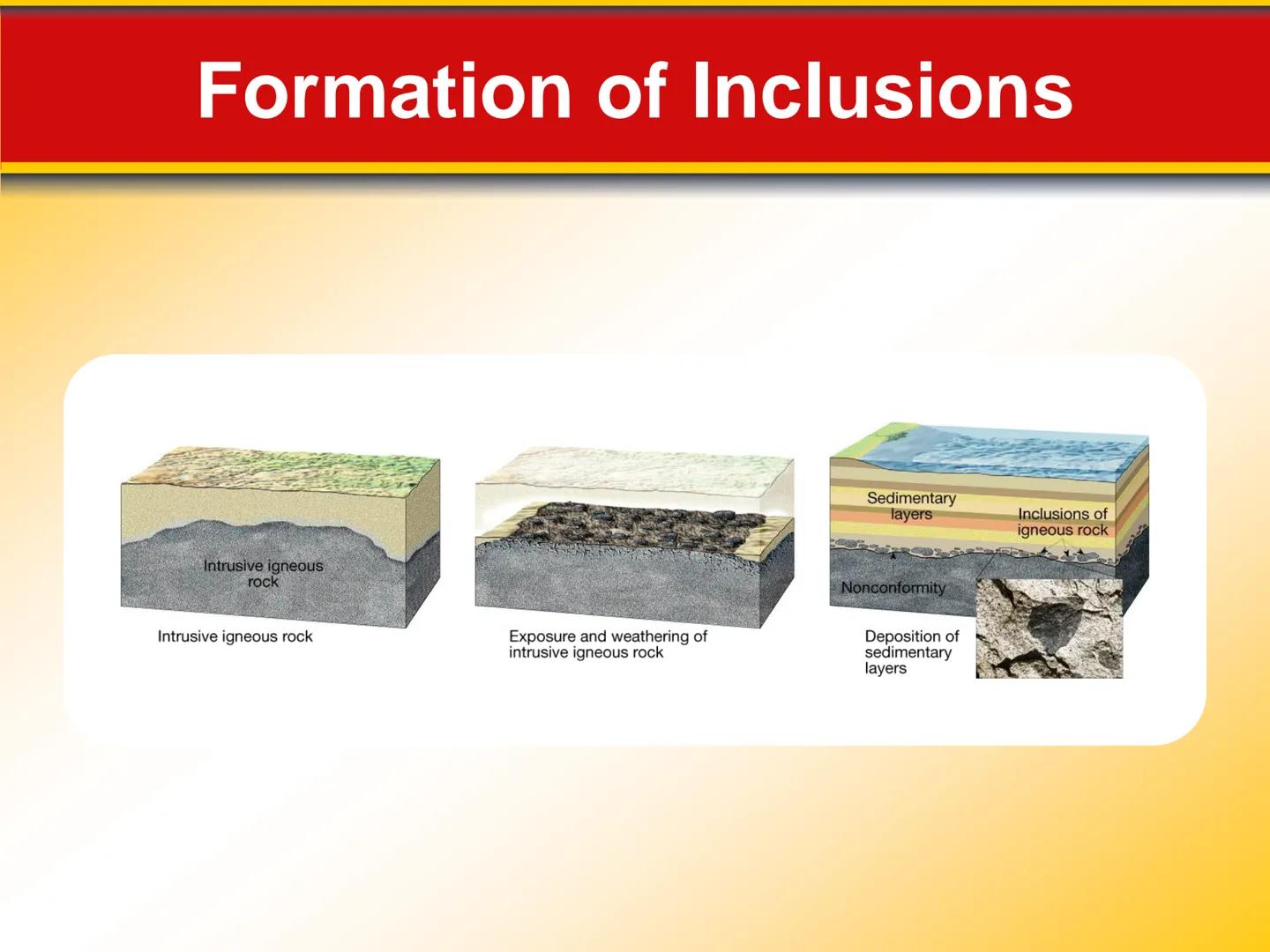
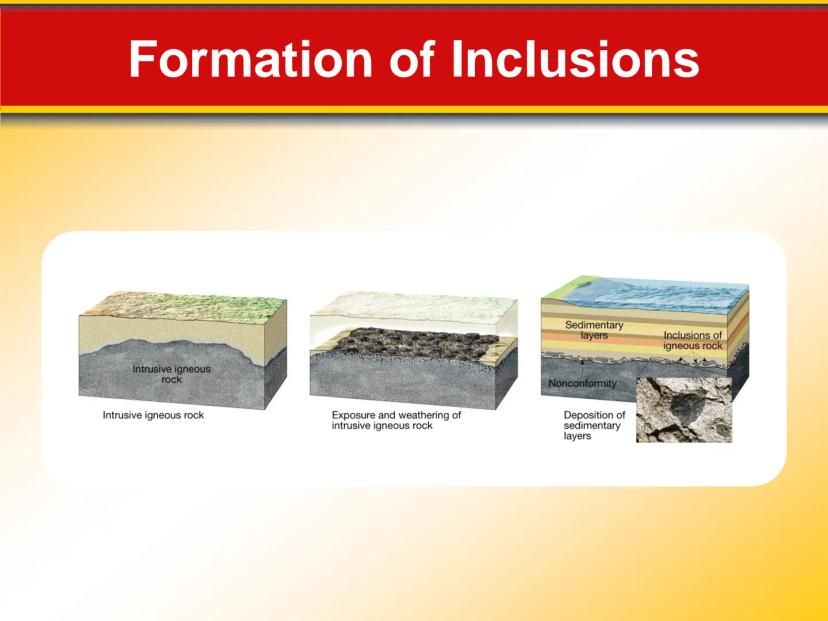
This page shows how inclusions form over time through a sequence of geological events. It's a perfect example of how Earth constantly recycles and transforms its materials.
First, intrusive igneous rock forms when magma cools slowly beneath Earth's surface. Over time, erosion exposes this igneous rock at the surface where it weathers. Later, sediments begin to cover the eroded igneous surface, sometimes incorporating broken pieces of the igneous rock.
These fragments of igneous rock become inclusions within the new sedimentary layers. The boundary between the igneous rock and sedimentary layers forms a nonconformity - a type of unconformity where sedimentary rock lies directly on igneous or metamorphic rock.
Visualize it: Inclusions are like finding pieces of an old brick wall inside newer concrete - the concrete must have been poured after the brick wall existed.
Our AI companion is specifically built for the needs of students. Based on the millions of content pieces we have on the platform we can provide truly meaningful and relevant answers to students. But its not only about answers, the companion is even more about guiding students through their daily learning challenges, with personalised study plans, quizzes or content pieces in the chat and 100% personalisation based on the students skills and developments.
You can download the app in the Google Play Store and in the Apple App Store.
That's right! Enjoy free access to study content, connect with fellow students, and get instant help – all at your fingertips.
App Store
Google Play
The app is very easy to use and well designed. I have found everything I was looking for so far and have been able to learn a lot from the presentations! I will definitely use the app for a class assignment! And of course it also helps a lot as an inspiration.
Stefan S
iOS user
This app is really great. There are so many study notes and help [...]. My problem subject is French, for example, and the app has so many options for help. Thanks to this app, I have improved my French. I would recommend it to anyone.
Samantha Klich
Android user
Wow, I am really amazed. I just tried the app because I've seen it advertised many times and was absolutely stunned. This app is THE HELP you want for school and above all, it offers so many things, such as workouts and fact sheets, which have been VERY helpful to me personally.
Anna
iOS user
I think it’s very much worth it and you’ll end up using it a lot once you get the hang of it and even after looking at others notes you can still ask your Artificial intelligence buddy the question and ask to simplify it if you still don’t get it!!! In the end I think it’s worth it 😊👍 ⚠️Also DID I MENTION ITS FREEE YOU DON’T HAVE TO PAY FOR ANYTHING AND STILL GET YOUR GRADES IN PERFECTLY❗️❗️⚠️
Thomas R
iOS user
Knowunity is the BEST app I’ve used in a minute. This is not an ai review or anything this is genuinely coming from a 7th grade student (I know 2011 im young) but dude this app is a 10/10 i have maintained a 3.8 gpa and have plenty of time for gaming. I love it and my mom is just happy I got good grades
Brad T
Android user
Not only did it help me find the answer but it also showed me alternative ways to solve it. I was horrible in math and science but now I have an a in both subjects. Thanks for the help🤍🤍
David K
iOS user
The app's just great! All I have to do is enter the topic in the search bar and I get the response real fast. I don't have to watch 10 YouTube videos to understand something, so I'm saving my time. Highly recommended!
Sudenaz Ocak
Android user
In school I was really bad at maths but thanks to the app, I am doing better now. I am so grateful that you made the app.
Greenlight Bonnie
Android user
I found this app a couple years ago and it has only gotten better since then. I really love it because it can help with written questions and photo questions. Also, it can find study guides that other people have made as well as flashcard sets and practice tests. The free version is also amazing for students who might not be able to afford it. Would 100% recommend
Aubrey
iOS user
Best app if you're in Highschool or Junior high. I have been using this app for 2 school years and it's the best, it's good if you don't have anyone to help you with school work.😋🩷🎀
Marco B
iOS user
THE QUIZES AND FLASHCARDS ARE SO USEFUL AND I LOVE Knowunity AI. IT ALSO IS LITREALLY LIKE CHATGPT BUT SMARTER!! HELPED ME WITH MY MASCARA PROBLEMS TOO!! AS WELL AS MY REAL SUBJECTS ! DUHHH 😍😁😲🤑💗✨🎀😮
Elisha
iOS user
This app is phenomenal down to the correct info and the various topics you can study! I greatly recommend it for people who struggle with procrastination and those who need homework help. It has been perfectly accurate for world 1 history as far as I’ve seen! Geometry too!
Paul T
iOS user
The app is very easy to use and well designed. I have found everything I was looking for so far and have been able to learn a lot from the presentations! I will definitely use the app for a class assignment! And of course it also helps a lot as an inspiration.
Stefan S
iOS user
This app is really great. There are so many study notes and help [...]. My problem subject is French, for example, and the app has so many options for help. Thanks to this app, I have improved my French. I would recommend it to anyone.
Samantha Klich
Android user
Wow, I am really amazed. I just tried the app because I've seen it advertised many times and was absolutely stunned. This app is THE HELP you want for school and above all, it offers so many things, such as workouts and fact sheets, which have been VERY helpful to me personally.
Anna
iOS user
I think it’s very much worth it and you’ll end up using it a lot once you get the hang of it and even after looking at others notes you can still ask your Artificial intelligence buddy the question and ask to simplify it if you still don’t get it!!! In the end I think it’s worth it 😊👍 ⚠️Also DID I MENTION ITS FREEE YOU DON’T HAVE TO PAY FOR ANYTHING AND STILL GET YOUR GRADES IN PERFECTLY❗️❗️⚠️
Thomas R
iOS user
Knowunity is the BEST app I’ve used in a minute. This is not an ai review or anything this is genuinely coming from a 7th grade student (I know 2011 im young) but dude this app is a 10/10 i have maintained a 3.8 gpa and have plenty of time for gaming. I love it and my mom is just happy I got good grades
Brad T
Android user
Not only did it help me find the answer but it also showed me alternative ways to solve it. I was horrible in math and science but now I have an a in both subjects. Thanks for the help🤍🤍
David K
iOS user
The app's just great! All I have to do is enter the topic in the search bar and I get the response real fast. I don't have to watch 10 YouTube videos to understand something, so I'm saving my time. Highly recommended!
Sudenaz Ocak
Android user
In school I was really bad at maths but thanks to the app, I am doing better now. I am so grateful that you made the app.
Greenlight Bonnie
Android user
I found this app a couple years ago and it has only gotten better since then. I really love it because it can help with written questions and photo questions. Also, it can find study guides that other people have made as well as flashcard sets and practice tests. The free version is also amazing for students who might not be able to afford it. Would 100% recommend
Aubrey
iOS user
Best app if you're in Highschool or Junior high. I have been using this app for 2 school years and it's the best, it's good if you don't have anyone to help you with school work.😋🩷🎀
Marco B
iOS user
THE QUIZES AND FLASHCARDS ARE SO USEFUL AND I LOVE Knowunity AI. IT ALSO IS LITREALLY LIKE CHATGPT BUT SMARTER!! HELPED ME WITH MY MASCARA PROBLEMS TOO!! AS WELL AS MY REAL SUBJECTS ! DUHHH 😍😁😲🤑💗✨🎀😮
Elisha
iOS user
This app is phenomenal down to the correct info and the various topics you can study! I greatly recommend it for people who struggle with procrastination and those who need homework help. It has been perfectly accurate for world 1 history as far as I’ve seen! Geometry too!
Paul T
iOS user
Geologic Time explores how scientists piece together Earth's vast history using rock layers and geologic principles. This chapter shows how rocks act as time capsules, preserving evidence of Earth's ancient past and the processes that have shaped our planet over... Show more
Access to all documents
Improve your grades
Join milions of students
When you look at rocks, you're actually looking at pages in Earth's diary! Chapter 12 introduces us to geologic time, the fascinating study of how scientists figure out Earth's history from the clues preserved in rocks.
You'll learn how to "read" these stone records to understand events that happened millions or even billions of years ago. This knowledge helps us understand not just Earth's past, but also how our planet continues to change today.
Think about it: Every rock has a story to tell - you just need to know how to listen!
Access to all documents
Improve your grades
Join milions of students
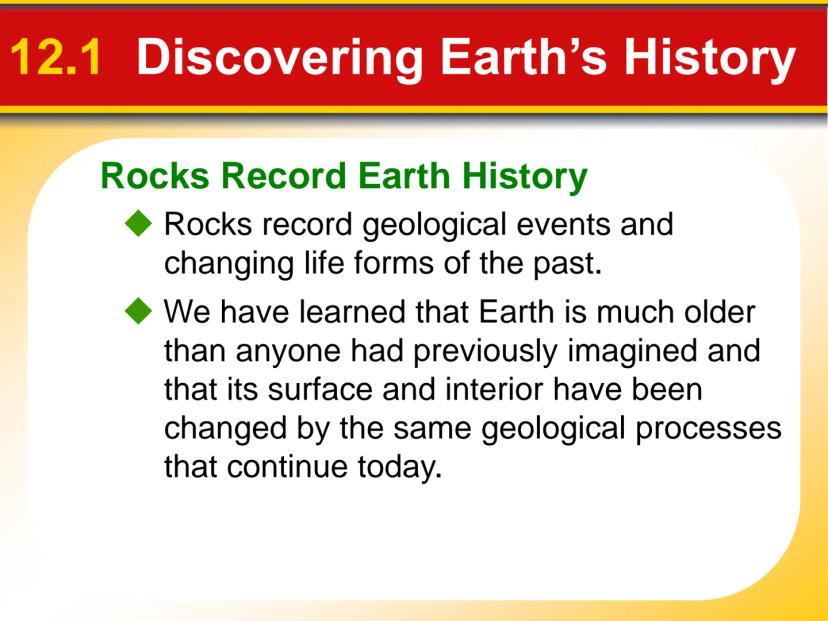
Rocks are like nature's history books! They preserve evidence of ancient geological events and the changing life forms that once inhabited our planet. Every layer, mineral, and fossil tells part of Earth's story.
Through studying these rock records, scientists have made an amazing discovery - Earth is much older than anyone previously imagined. The planet we call home has existed for billions of years, not thousands as was once believed.
Perhaps most fascinating is that the geological processes we see happening today - erosion, volcanic eruptions, earthquakes - are the same ones that have been reshaping Earth throughout its entire history. The present truly is the key to understanding the past.
Amazing fact: Some of the oldest rocks on Earth are over 4 billion years old!
Access to all documents
Improve your grades
Join milions of students
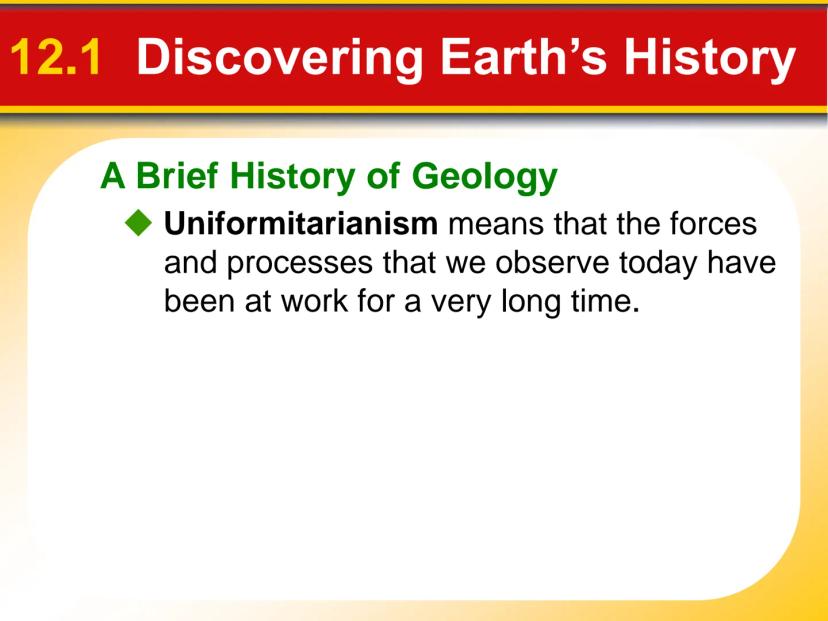
The concept of uniformitarianism revolutionized how we understand Earth. This principle states that the geological forces and processes we observe today - like erosion, deposition, and mountain building - have been operating in the same way for billions of years.
This idea might seem obvious to us now, but it was groundbreaking when first proposed. It means we can use present-day observations to understand events from Earth's distant past. The slow but steady processes we see today have, over enormous spans of time, created dramatic changes to our planet.
Understanding uniformitarianism helps you grasp how small changes, given enough time, can transform entire landscapes. Those towering mountains? They formed inch by inch over millions of years!
Remember: The key to uniformitarianism is "the present is the key to the past."
Access to all documents
Improve your grades
Join milions of students
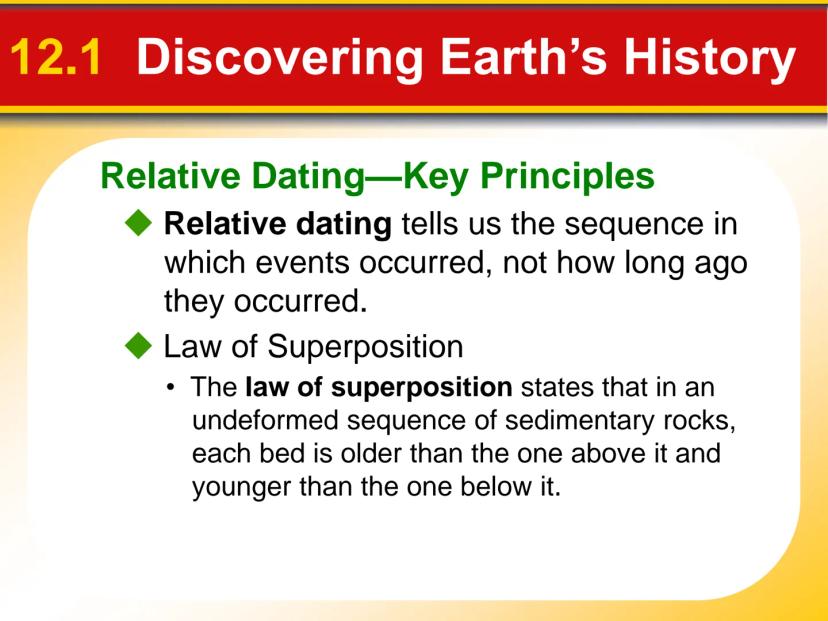
Ever wondered how scientists determine which rocks are older without knowing their exact age? That's where relative dating comes in! It tells us the sequence of geological events (which came first, second, etc.) without telling us exactly how long ago they occurred.
The Law of Superposition is like the basic rule of a rock layer cake. It states that in an undisturbed stack of sedimentary rocks, each layer is older than the one above it and younger than the one below it. The bottom layer was deposited first, and each subsequent layer piled on top.
This principle is super useful when examining rock formations like cliffs or canyon walls. When you see distinct layers, you can immediately tell which rocks formed first. The deeper you go, the further back in time you travel!
Pro tip: When looking at rock layers, think "older on the bottom, younger on top" - unless something has disturbed the layers.
Access to all documents
Improve your grades
Join milions of students
The Grand Canyon is like nature's perfect example of the Law of Superposition! Each colorful layer tells part of Earth's story, with the oldest rocks at the bottom and youngest at the top.
The Kaibab Limestone forms the rim of the canyon and is the youngest visible layer. Below that, you'll find the Toroweap Formation, then the Coconino Sandstone, followed by the Hermit Shale, and finally the Supai Group among the layers shown.
By studying these rock layers, geologists can recreate the environmental conditions that existed when each formed. Some layers were ancient seas, others desert sand dunes, and others tropical swamps - all evidence of how dramatically Earth's environments can change over time.
Wow factor: The Grand Canyon's rock layers represent over a billion years of Earth history!
Access to all documents
Improve your grades
Join milions of students
When sediment settles in water, gravity naturally pulls it into flat, horizontal layers - like how dust settles evenly on your furniture. This simple observation is the basis for the principle of original horizontality.
This principle tells us that sedimentary rock layers were originally deposited in horizontal positions. So when we see tilted, folded, or otherwise deformed rock layers, we know something must have happened to them after they formed.
Think about it - if you see rock layers that are bent like a roller coaster or standing almost vertically, those rocks were moved from their original position by powerful forces like mountain building, earthquakes, or other tectonic processes.
Try this: Next time you see layered rocks on a hillside that aren't horizontal, ask yourself: "What forces were strong enough to move these massive rocks?"
Access to all documents
Improve your grades
Join milions of students
Rock layers don't always stay nice and flat! This page shows how layers can become folded, tilted, and deformed over time due to the immense forces at work within Earth.
When tectonic plates collide or slide past each other, they can crumple rock layers like paper. These disturbed patterns tell geologists about ancient mountain-building events, earthquakes, and other dramatic geological processes.
By understanding how and why rock layers become disturbed, scientists can reconstruct the movements of Earth's crust over millions of years. Those twisted rocks you see on a hike aren't just cool-looking - they're evidence of Earth's powerful internal forces!
Imagine: These rock layers were once flat at the bottom of ancient seas before powerful forces twisted them into their current positions.
Access to all documents
Improve your grades
Join milions of students
The principle of cross-cutting relationships is like figuring out who arrived at a party based on interactions. If a fault cuts across rock layers or if magma intrudes into existing rock and solidifies, the fault or intrusion must be younger than the rocks it affects. Think of it as "whatever cuts through must have come later."
Inclusions provide another clue about relative age. These are fragments of one rock contained within another rock. The rock containing the inclusions must be younger than the inclusions themselves. It's like finding an old coin inside a newer wall - the wall must have been built after the coin was made.
These principles help geologists untangle complex geological histories when rock layers have been disturbed, intruded, or eroded over time.
Helpful comparison: Cross-cutting relationships work like drawing a line through existing text - the line must have been drawn after the text was written.
Access to all documents
Improve your grades
Join milions of students
This diagram shows the practical application of cross-cutting relationships with various rock types and structures. Let's break down what's happening:
The diagram shows sedimentary layers (conglomerate, shale, and sandstone) that have been intruded by igneous features (a sill, a batholith, and two dikes) and cut by two faults. By applying the principle of cross-cutting relationships, you can determine the sequence of events.
For example, Fault A cuts through the sedimentary layers but is itself cut by Dike B, meaning Fault A formed before Dike B. The batholith intrudes into the lowest layers but is cut by Fault B, making the batholith older than Fault B.
Working through these relationships is like solving a geological puzzle that reveals the history of the area, event by event.
Think detective: When applying cross-cutting relationships, always ask "What must have existed first for this feature to cut through it?"
Access to all documents
Improve your grades
Join milions of students
This page shows how inclusions form over time through a sequence of geological events. It's a perfect example of how Earth constantly recycles and transforms its materials.
First, intrusive igneous rock forms when magma cools slowly beneath Earth's surface. Over time, erosion exposes this igneous rock at the surface where it weathers. Later, sediments begin to cover the eroded igneous surface, sometimes incorporating broken pieces of the igneous rock.
These fragments of igneous rock become inclusions within the new sedimentary layers. The boundary between the igneous rock and sedimentary layers forms a nonconformity - a type of unconformity where sedimentary rock lies directly on igneous or metamorphic rock.
Visualize it: Inclusions are like finding pieces of an old brick wall inside newer concrete - the concrete must have been poured after the brick wall existed.
Our AI companion is specifically built for the needs of students. Based on the millions of content pieces we have on the platform we can provide truly meaningful and relevant answers to students. But its not only about answers, the companion is even more about guiding students through their daily learning challenges, with personalised study plans, quizzes or content pieces in the chat and 100% personalisation based on the students skills and developments.
You can download the app in the Google Play Store and in the Apple App Store.
That's right! Enjoy free access to study content, connect with fellow students, and get instant help – all at your fingertips.
11
Smart Tools NEW
Transform this note into: ✓ 50+ Practice Questions ✓ Interactive Flashcards ✓ Full Practice Test ✓ Essay Outlines
App Store
Google Play
The app is very easy to use and well designed. I have found everything I was looking for so far and have been able to learn a lot from the presentations! I will definitely use the app for a class assignment! And of course it also helps a lot as an inspiration.
Stefan S
iOS user
This app is really great. There are so many study notes and help [...]. My problem subject is French, for example, and the app has so many options for help. Thanks to this app, I have improved my French. I would recommend it to anyone.
Samantha Klich
Android user
Wow, I am really amazed. I just tried the app because I've seen it advertised many times and was absolutely stunned. This app is THE HELP you want for school and above all, it offers so many things, such as workouts and fact sheets, which have been VERY helpful to me personally.
Anna
iOS user
I think it’s very much worth it and you’ll end up using it a lot once you get the hang of it and even after looking at others notes you can still ask your Artificial intelligence buddy the question and ask to simplify it if you still don’t get it!!! In the end I think it’s worth it 😊👍 ⚠️Also DID I MENTION ITS FREEE YOU DON’T HAVE TO PAY FOR ANYTHING AND STILL GET YOUR GRADES IN PERFECTLY❗️❗️⚠️
Thomas R
iOS user
Knowunity is the BEST app I’ve used in a minute. This is not an ai review or anything this is genuinely coming from a 7th grade student (I know 2011 im young) but dude this app is a 10/10 i have maintained a 3.8 gpa and have plenty of time for gaming. I love it and my mom is just happy I got good grades
Brad T
Android user
Not only did it help me find the answer but it also showed me alternative ways to solve it. I was horrible in math and science but now I have an a in both subjects. Thanks for the help🤍🤍
David K
iOS user
The app's just great! All I have to do is enter the topic in the search bar and I get the response real fast. I don't have to watch 10 YouTube videos to understand something, so I'm saving my time. Highly recommended!
Sudenaz Ocak
Android user
In school I was really bad at maths but thanks to the app, I am doing better now. I am so grateful that you made the app.
Greenlight Bonnie
Android user
I found this app a couple years ago and it has only gotten better since then. I really love it because it can help with written questions and photo questions. Also, it can find study guides that other people have made as well as flashcard sets and practice tests. The free version is also amazing for students who might not be able to afford it. Would 100% recommend
Aubrey
iOS user
Best app if you're in Highschool or Junior high. I have been using this app for 2 school years and it's the best, it's good if you don't have anyone to help you with school work.😋🩷🎀
Marco B
iOS user
THE QUIZES AND FLASHCARDS ARE SO USEFUL AND I LOVE Knowunity AI. IT ALSO IS LITREALLY LIKE CHATGPT BUT SMARTER!! HELPED ME WITH MY MASCARA PROBLEMS TOO!! AS WELL AS MY REAL SUBJECTS ! DUHHH 😍😁😲🤑💗✨🎀😮
Elisha
iOS user
This app is phenomenal down to the correct info and the various topics you can study! I greatly recommend it for people who struggle with procrastination and those who need homework help. It has been perfectly accurate for world 1 history as far as I’ve seen! Geometry too!
Paul T
iOS user
The app is very easy to use and well designed. I have found everything I was looking for so far and have been able to learn a lot from the presentations! I will definitely use the app for a class assignment! And of course it also helps a lot as an inspiration.
Stefan S
iOS user
This app is really great. There are so many study notes and help [...]. My problem subject is French, for example, and the app has so many options for help. Thanks to this app, I have improved my French. I would recommend it to anyone.
Samantha Klich
Android user
Wow, I am really amazed. I just tried the app because I've seen it advertised many times and was absolutely stunned. This app is THE HELP you want for school and above all, it offers so many things, such as workouts and fact sheets, which have been VERY helpful to me personally.
Anna
iOS user
I think it’s very much worth it and you’ll end up using it a lot once you get the hang of it and even after looking at others notes you can still ask your Artificial intelligence buddy the question and ask to simplify it if you still don’t get it!!! In the end I think it’s worth it 😊👍 ⚠️Also DID I MENTION ITS FREEE YOU DON’T HAVE TO PAY FOR ANYTHING AND STILL GET YOUR GRADES IN PERFECTLY❗️❗️⚠️
Thomas R
iOS user
Knowunity is the BEST app I’ve used in a minute. This is not an ai review or anything this is genuinely coming from a 7th grade student (I know 2011 im young) but dude this app is a 10/10 i have maintained a 3.8 gpa and have plenty of time for gaming. I love it and my mom is just happy I got good grades
Brad T
Android user
Not only did it help me find the answer but it also showed me alternative ways to solve it. I was horrible in math and science but now I have an a in both subjects. Thanks for the help🤍🤍
David K
iOS user
The app's just great! All I have to do is enter the topic in the search bar and I get the response real fast. I don't have to watch 10 YouTube videos to understand something, so I'm saving my time. Highly recommended!
Sudenaz Ocak
Android user
In school I was really bad at maths but thanks to the app, I am doing better now. I am so grateful that you made the app.
Greenlight Bonnie
Android user
I found this app a couple years ago and it has only gotten better since then. I really love it because it can help with written questions and photo questions. Also, it can find study guides that other people have made as well as flashcard sets and practice tests. The free version is also amazing for students who might not be able to afford it. Would 100% recommend
Aubrey
iOS user
Best app if you're in Highschool or Junior high. I have been using this app for 2 school years and it's the best, it's good if you don't have anyone to help you with school work.😋🩷🎀
Marco B
iOS user
THE QUIZES AND FLASHCARDS ARE SO USEFUL AND I LOVE Knowunity AI. IT ALSO IS LITREALLY LIKE CHATGPT BUT SMARTER!! HELPED ME WITH MY MASCARA PROBLEMS TOO!! AS WELL AS MY REAL SUBJECTS ! DUHHH 😍😁😲🤑💗✨🎀😮
Elisha
iOS user
This app is phenomenal down to the correct info and the various topics you can study! I greatly recommend it for people who struggle with procrastination and those who need homework help. It has been perfectly accurate for world 1 history as far as I’ve seen! Geometry too!
Paul T
iOS user