

Our solar system is a fascinating cosmic neighborhood that includes... Show more
 Earth and Space Science
 Algebra
 Biology
Sign up to see the contentIt's free!
Access to all documents
Improve your grades
Join milions of students
Knowunity AI
Subjects
Triangle Congruence and Similarity Theorems
Triangle Properties and Classification
Linear Equations and Graphs
Geometric Angle Relationships
Trigonometric Functions and Identities
Equation Solving Techniques
Circle Geometry Fundamentals
Division Operations and Methods
Basic Differentiation Rules
Exponent and Logarithm Properties
Show all topics
Human Organ Systems
Reproductive Cell Cycles
Biological Sciences Subdisciplines
Cellular Energy Metabolism
Autotrophic Energy Processes
Inheritance Patterns and Principles
Biomolecular Structure and Organization
Cell Cycle and Division Mechanics
Cellular Organization and Development
Biological Structural Organization
Show all topics
Chemical Sciences and Applications
Atomic Structure and Composition
Molecular Electron Structure Representation
Atomic Electron Behavior
Matter Properties and Water
Mole Concept and Calculations
Gas Laws and Behavior
Periodic Table Organization
Chemical Thermodynamics Fundamentals
Chemical Bond Types and Properties
Show all topics
European Renaissance and Enlightenment
European Cultural Movements 800-1920
American Revolution Era 1763-1797
American Civil War 1861-1865
Global Imperial Systems
Mongol and Chinese Dynasties
U.S. Presidents and World Leaders
Historical Sources and Documentation
World Wars Era and Impact
World Religious Systems
Show all topics
Classic and Contemporary Novels
Literary Character Analysis
Rhetorical Theory and Practice
Classic Literary Narratives
Reading Analysis and Interpretation
Narrative Structure and Techniques
English Language Components
Influential English-Language Authors
Basic Sentence Structure
Narrative Voice and Perspective
Show all topics
122
•
Updated Mar 29, 2026
•
Our solar system is a fascinating cosmic neighborhood that includes... Show more
Welcome to our cosmic neighborhood! The solar system is where Earth calls home, along with seven other planets, countless moons, asteroids, comets, and of course, our star—the Sun.
As we explore this chapter, we'll discover what makes each planet unique and how they all fit into the grand design of our solar system. You'll learn about the forces that keep planets in their orbits and the characteristics that define different types of celestial bodies.
💡 Fun fact: If you were to drive a car at highway speed to the edge of our solar system, it would take you over 6,000 years to get there!
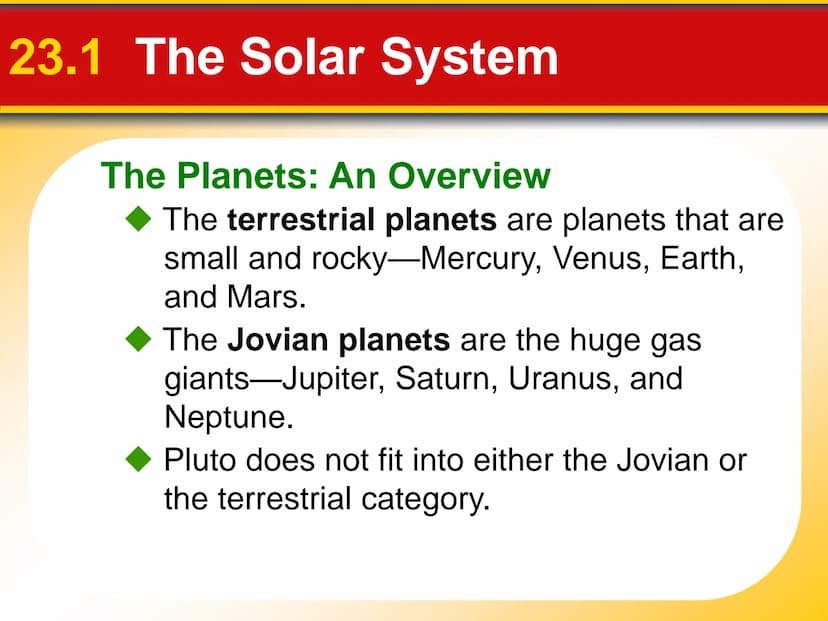
The planets in our solar system are divided into two main groups based on their composition and size.
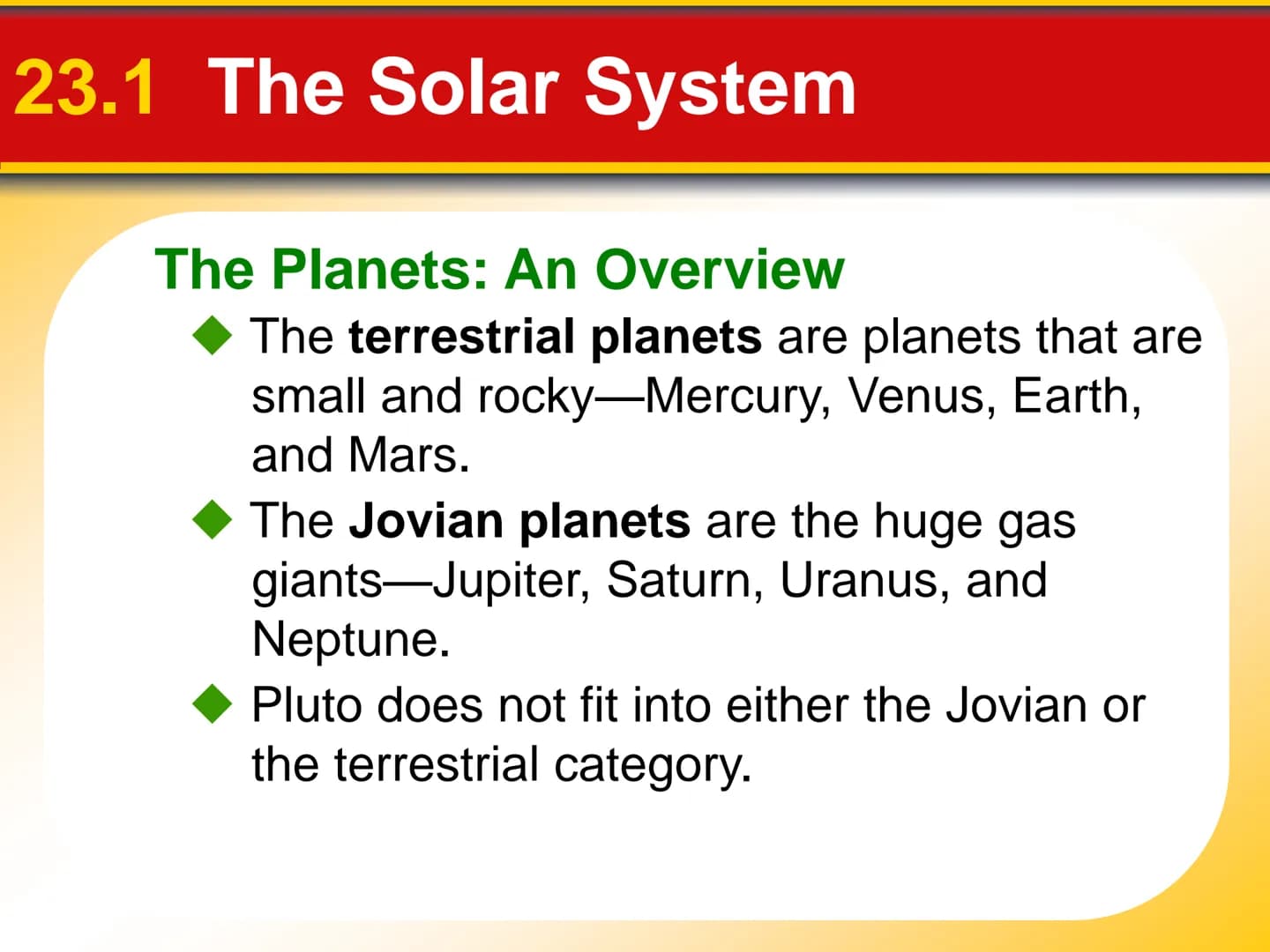
The terrestrial planets include Mercury, Venus, Earth, and Mars. These planets are relatively small and rocky, with solid surfaces you could potentially stand on. They're closer to the Sun and have fewer (if any) moons.
The Jovian planets (Jupiter, Saturn, Uranus, and Neptune) are massive gas giants composed primarily of hydrogen and helium. These giants dominate our solar system in size but not in density—they're actually less dense than the terrestrial planets.
Pluto stands alone, fitting neither category perfectly. Once classified as the ninth planet, it's now considered a dwarf planet in the Kuiper Belt.
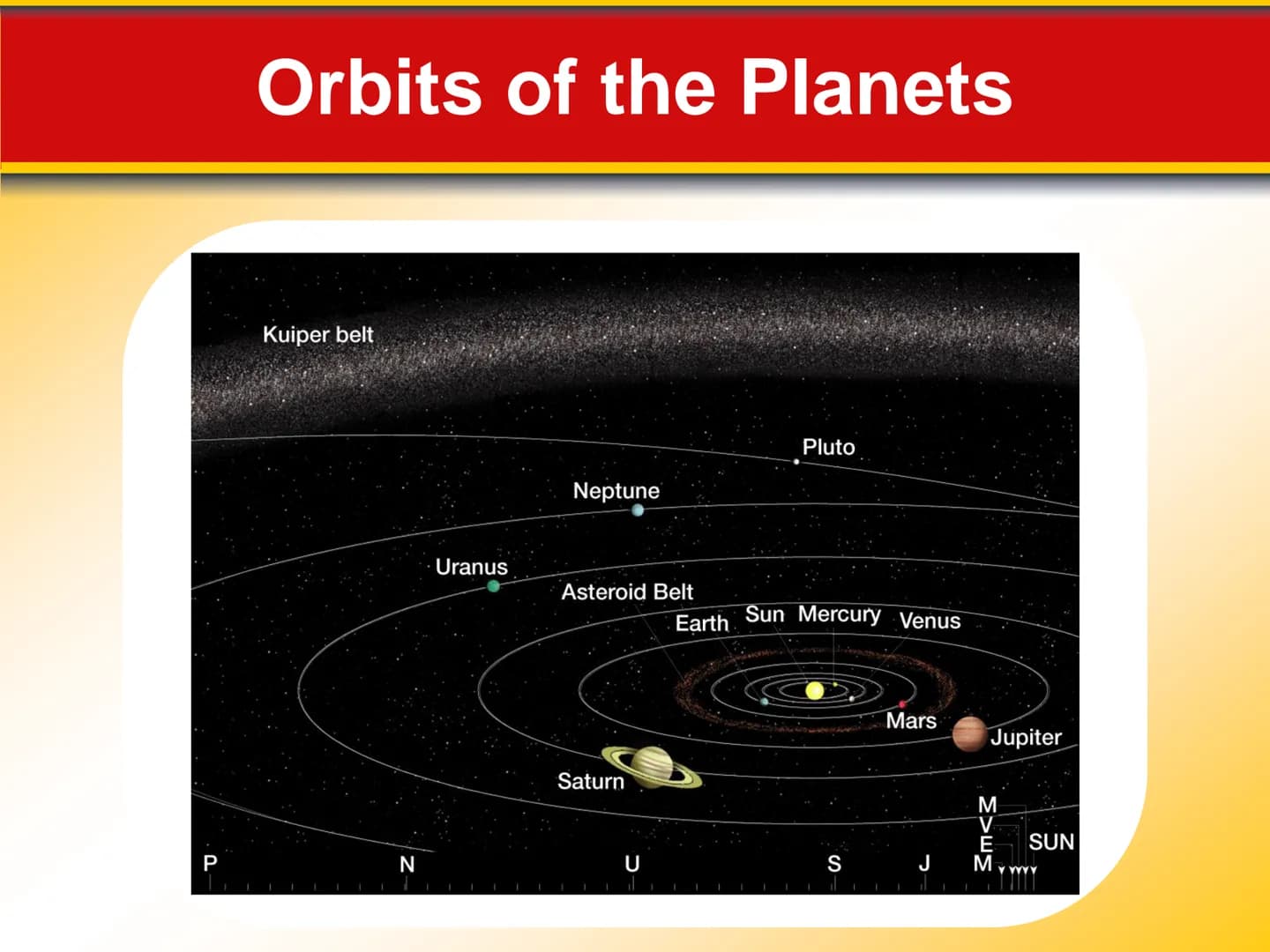
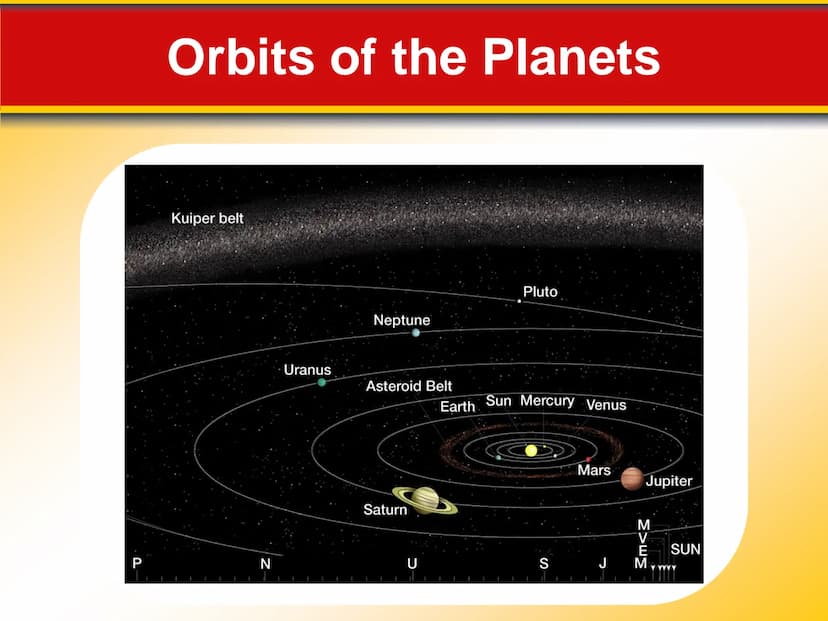
All planets follow elliptical paths around the Sun, with the Sun positioned slightly off-center of each orbit. The inner terrestrial planets have tighter, faster orbits, while the outer Jovian planets travel much longer distances at slower speeds.
Beyond Neptune lies the mysterious Kuiper Belt—a region of icy bodies including Pluto and similar dwarf planets. This donut-shaped zone marks the outer boundary of our major planetary system.
The Asteroid Belt sits between Mars and Jupiter, serving as a natural boundary between the inner terrestrial planets and the outer gas giants. It contains millions of rocky objects from tiny pebbles to dwarf planets like Ceres.
🌟 Perspective check: If the Sun were the size of a basketball, Earth would be a tiny pea about 26 yards away, while Neptune would be a marble about 800 yards (8 football fields) from the Sun!
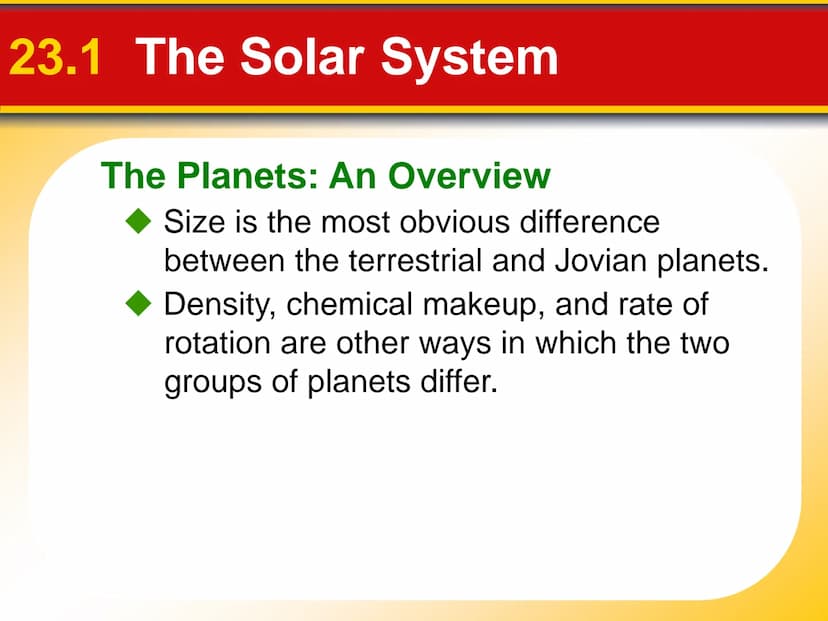
Size isn't the only difference between terrestrial and Jovian planets. The Jovian planets are enormous—Jupiter could fit over 1,300 Earths inside it!
Density reveals their internal composition. Terrestrial planets are dense and compact , while Jovian planets have much lower densities . Saturn is so light it would float in water!
Their chemical makeup differs dramatically. Terrestrial planets consist mainly of rocks and metals, while Jovian planets are primarily hydrogen and helium with smaller amounts of methane and ammonia.
The giants also have much faster rotation rates. Jupiter spins completely in less than 10 hours, despite being much larger than Earth with its 24-hour rotation.
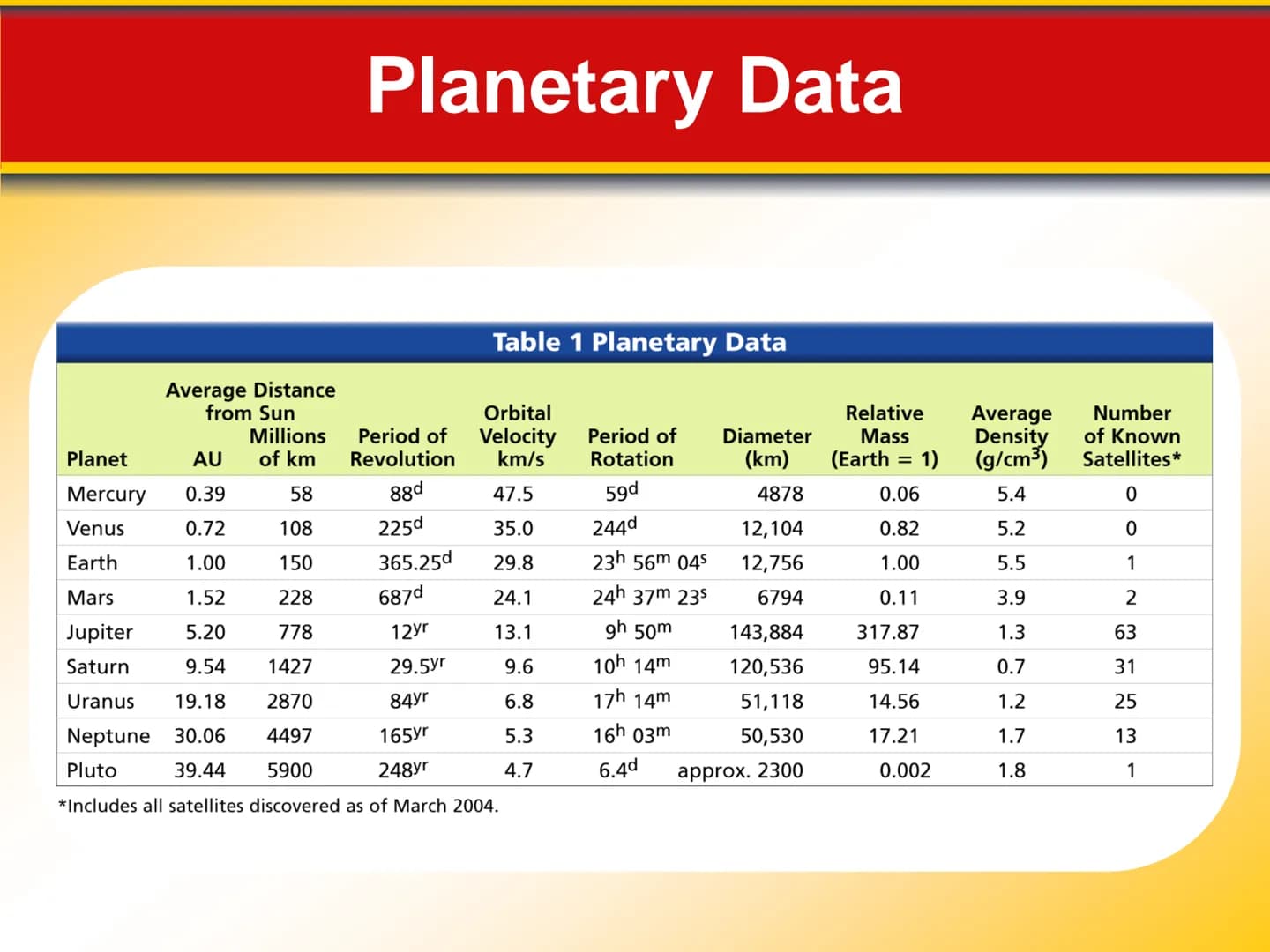
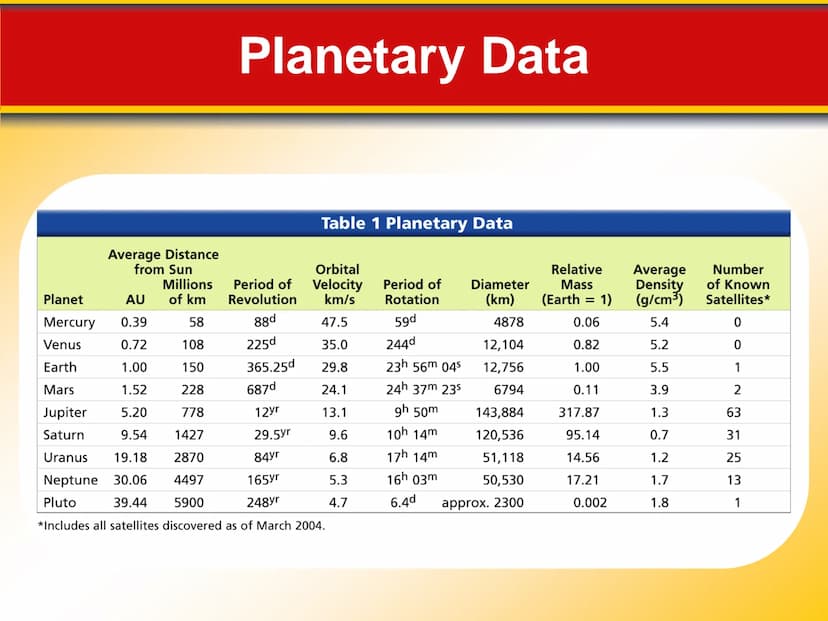
The numbers tell an amazing story about our solar system! Looking at the planetary data table, you can see patterns that help explain why planets are so different from one another.
Distance from the Sun plays a crucial role in planetary development. Mercury sits at just 0.39 AU (astronomical units) from the Sun, while Neptune is a distant 30.06 AU away. This affects everything from temperature to composition.
The period of revolution (time to orbit the Sun) increases dramatically as you move outward. Earth takes 365.25 days, while Neptune requires 165 years to complete one orbit!
Satellite counts show another pattern—terrestrial planets have few or no moons, while Jupiter boasts 63 known satellites. These numbers continue to change as we discover more moons around the outer planets.
🔍 Test tip: Pay attention to the relationships between orbital distance, period of revolution, and orbital velocity. As distance increases, orbital speed decreases and orbital period increases.
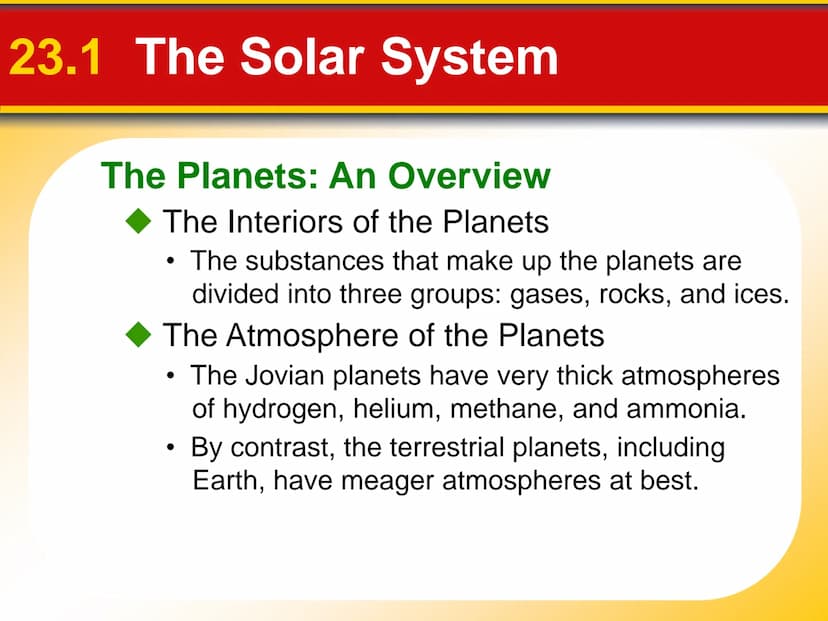
Planets contain three main substance groups: gases (like hydrogen and helium), rocks (silicates and metals), and ices (water, methane, and ammonia ice). The location and distribution of these materials help determine a planet's structure.
The Jovian planets have thick, massive atmospheres composed primarily of hydrogen and helium with traces of methane and ammonia. These atmospheres gradually transition to liquid interiors without a clear surface boundary. Jupiter's atmosphere alone is thousands of kilometers deep!
By contrast, the terrestrial planets have relatively thin atmospheres, if any at all. Mercury has virtually no atmosphere, while Venus has a dense but toxic one. Earth's life-supporting atmosphere is actually quite thin compared to our planet's size—like the skin of an apple.
These atmospheric differences directly impact surface conditions, from Venus's scorching heat to the frigid storms of Neptune.
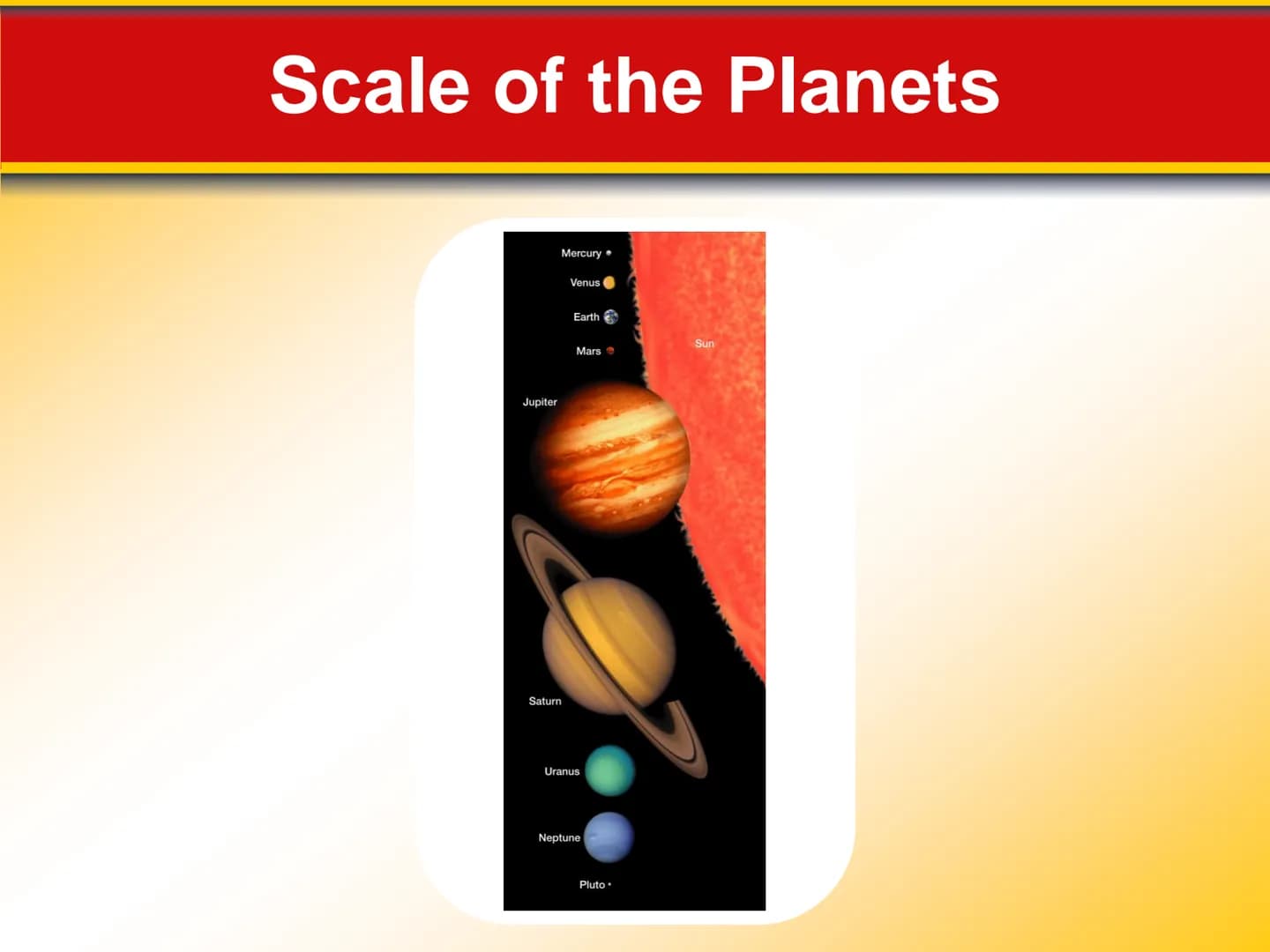
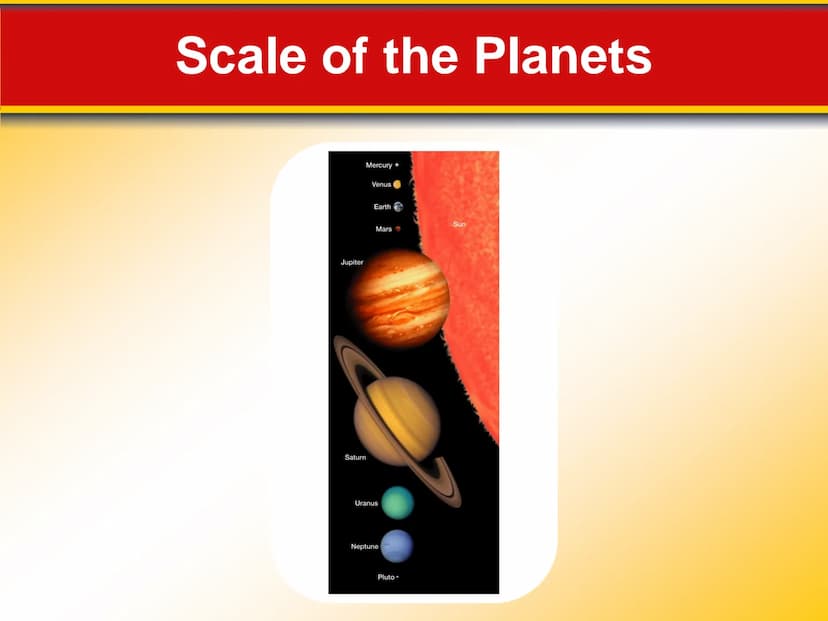
The size differences between planets are truly mind-boggling! If you could line up all the planets side by side, you'd immediately notice the dramatic difference between the tiny terrestrial worlds and the enormous gas giants.
Jupiter, the largest planet, has a diameter of nearly 143,000 km—about 11 times wider than Earth. You could fit all the terrestrial planets inside Jupiter with room to spare! Saturn, though slightly smaller, has its famous rings that extend far beyond its surface.
The terrestrial planets appear tiny in comparison. Mercury is the smallest at just 4,878 km across—smaller than some moons. Earth and Venus are nearly twins in size, while Mars is about half Earth's diameter.
✨ Cosmic perspective: If the Sun were the height of a typical front door, Jupiter would be the size of a softball, Earth would be the size of a pea, and Mercury would be the size of a pinhead!
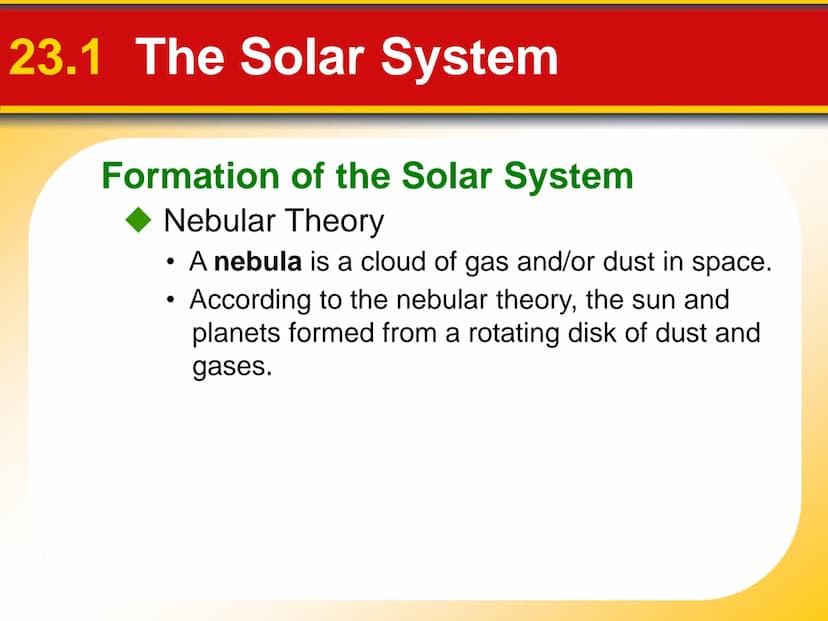
Our solar system began about 4.6 billion years ago from a massive cloud of gas and dust called a nebula. The nebular theory explains how this cloud transformed into our sun and planets.
It all started when this nebula began to collapse, possibly triggered by a nearby supernova explosion. As gravity pulled the material inward, the cloud began to spin faster (like an ice skater pulling in their arms). This rotation caused the nebula to flatten into a spinning disk.
The center of this disk became increasingly hot and dense until nuclear fusion began, creating our Sun. Meanwhile, the remaining disk material, now called a protoplanetary disk, began the process of forming planets.
The temperature gradient across this disk determined what materials could solidify at different distances from the new star, explaining why rocky planets formed close to the Sun while gas giants formed farther away.
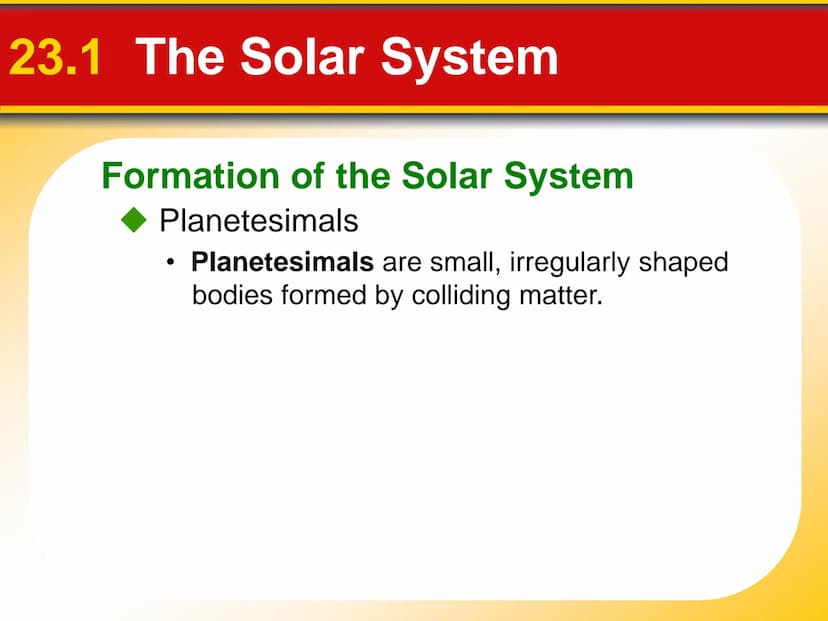
As the protoplanetary disk cooled, tiny dust particles began sticking together through a process called accretion. These growing clumps became planetesimals—small, irregularly shaped bodies ranging from a few kilometers to hundreds of kilometers across.
These planetesimals are the building blocks of planets. Over millions of years, they collided with one another, sometimes breaking apart but often merging to form larger bodies. The largest planetesimals had enough gravity to attract more and more material.
Near the Sun, only metals and rocky materials could withstand the heat, forming small, dense terrestrial planets. Farther out where temperatures were cooler, ices could form, creating larger cores that had enough gravity to capture vast amounts of hydrogen and helium gas.
🌠 Mind-blowing fact: Every atom in your body was once part of this original solar nebula—we're literally made of star stuff!
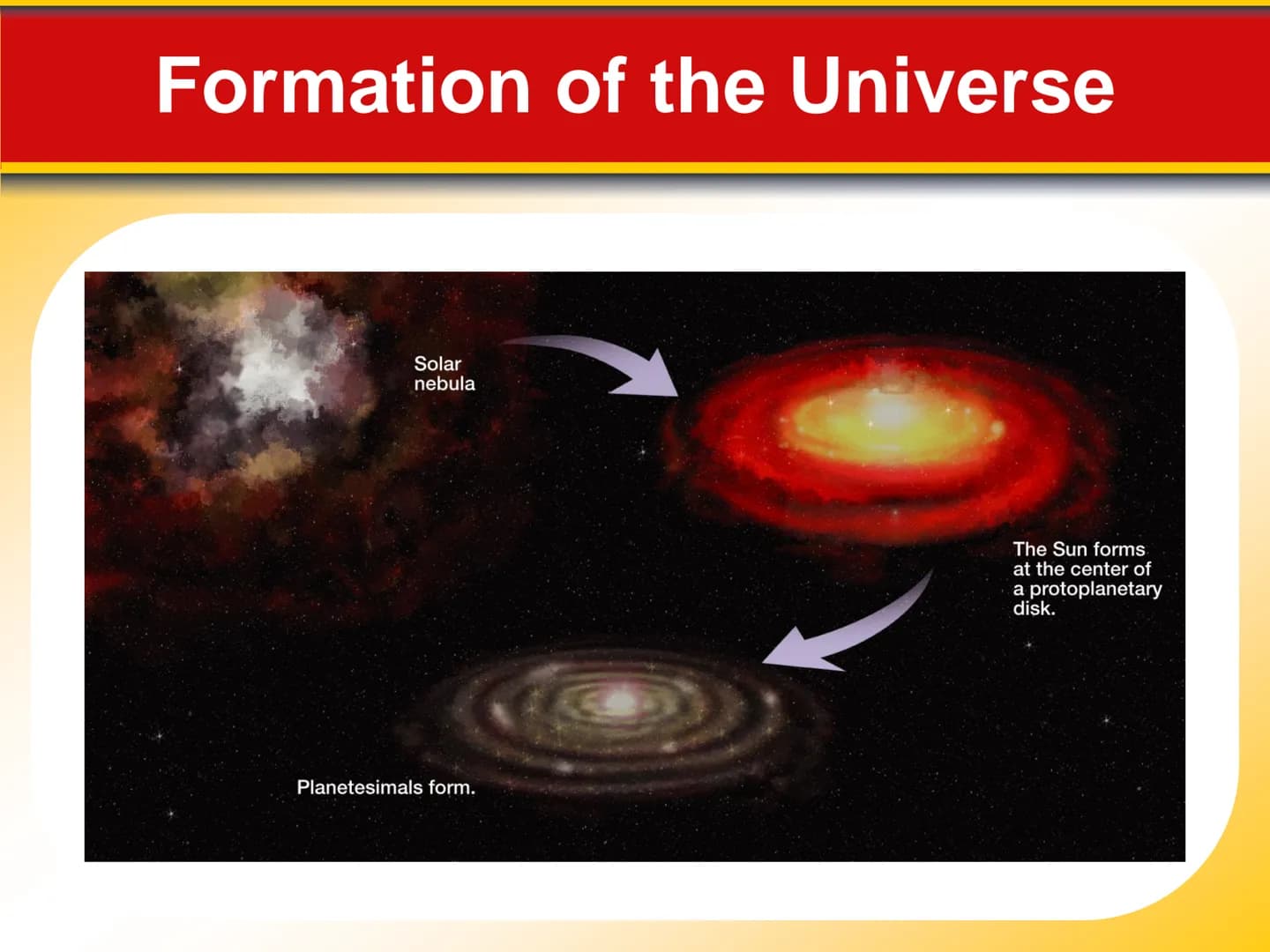
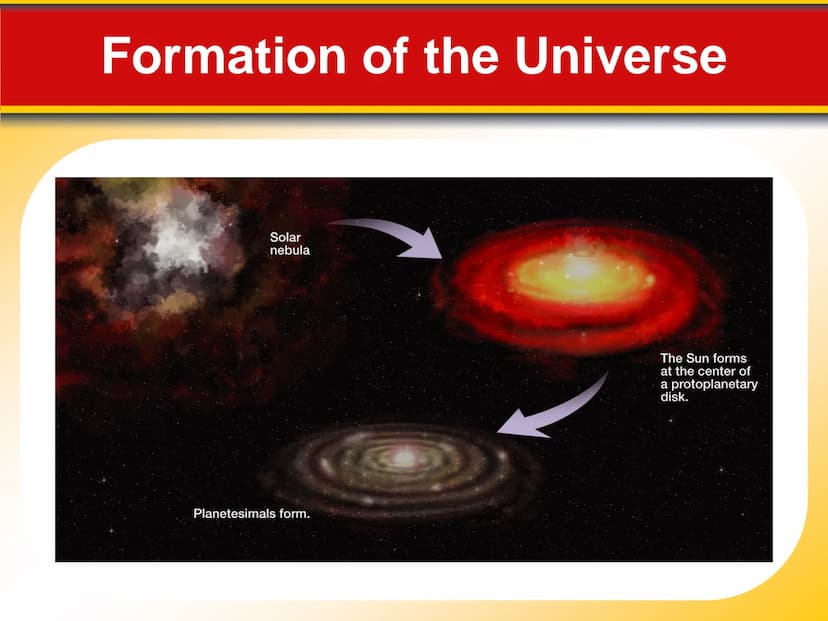
The transformation from nebula to solar system happened in distinct stages that scientists have modeled in detail. First, the solar nebula—a massive cloud of hydrogen, helium, and heavier elements—began to collapse under its own gravity.
As the collapse continued, most material gathered at the center, forming a protostar (the early Sun). The heat and pressure at the center eventually triggered nuclear fusion, and our star was born. Meanwhile, the remaining material flattened into a spinning disk around the new star.
Within this disk, tiny particles began sticking together to form the planetesimals. These grew through countless collisions until planet-sized bodies emerged. In the inner solar system, these became the terrestrial planets, while in the outer regions, they formed the cores of what would become the gas giants.
The leftover debris from this planet-building process became the asteroids, comets, and other smaller bodies in our solar system—remnants of our cosmic origins that scientists study today for clues about how we came to be.
Our AI companion is specifically built for the needs of students. Based on the millions of content pieces we have on the platform we can provide truly meaningful and relevant answers to students. But its not only about answers, the companion is even more about guiding students through their daily learning challenges, with personalised study plans, quizzes or content pieces in the chat and 100% personalisation based on the students skills and developments.
You can download the app in the Google Play Store and in the Apple App Store.
That's right! Enjoy free access to study content, connect with fellow students, and get instant help – all at your fingertips.
App Store
Google Play
The app is very easy to use and well designed. I have found everything I was looking for so far and have been able to learn a lot from the presentations! I will definitely use the app for a class assignment! And of course it also helps a lot as an inspiration.
Stefan S
iOS user
This app is really great. There are so many study notes and help [...]. My problem subject is French, for example, and the app has so many options for help. Thanks to this app, I have improved my French. I would recommend it to anyone.
Samantha Klich
Android user
Wow, I am really amazed. I just tried the app because I've seen it advertised many times and was absolutely stunned. This app is THE HELP you want for school and above all, it offers so many things, such as workouts and fact sheets, which have been VERY helpful to me personally.
Anna
iOS user
I think it’s very much worth it and you’ll end up using it a lot once you get the hang of it and even after looking at others notes you can still ask your Artificial intelligence buddy the question and ask to simplify it if you still don’t get it!!! In the end I think it’s worth it 😊👍 ⚠️Also DID I MENTION ITS FREEE YOU DON’T HAVE TO PAY FOR ANYTHING AND STILL GET YOUR GRADES IN PERFECTLY❗️❗️⚠️
Thomas R
iOS user
Knowunity is the BEST app I’ve used in a minute. This is not an ai review or anything this is genuinely coming from a 7th grade student (I know 2011 im young) but dude this app is a 10/10 i have maintained a 3.8 gpa and have plenty of time for gaming. I love it and my mom is just happy I got good grades
Brad T
Android user
Not only did it help me find the answer but it also showed me alternative ways to solve it. I was horrible in math and science but now I have an a in both subjects. Thanks for the help🤍🤍
David K
iOS user
The app's just great! All I have to do is enter the topic in the search bar and I get the response real fast. I don't have to watch 10 YouTube videos to understand something, so I'm saving my time. Highly recommended!
Sudenaz Ocak
Android user
In school I was really bad at maths but thanks to the app, I am doing better now. I am so grateful that you made the app.
Greenlight Bonnie
Android user
I found this app a couple years ago and it has only gotten better since then. I really love it because it can help with written questions and photo questions. Also, it can find study guides that other people have made as well as flashcard sets and practice tests. The free version is also amazing for students who might not be able to afford it. Would 100% recommend
Aubrey
iOS user
Best app if you're in Highschool or Junior high. I have been using this app for 2 school years and it's the best, it's good if you don't have anyone to help you with school work.😋🩷🎀
Marco B
iOS user
THE QUIZES AND FLASHCARDS ARE SO USEFUL AND I LOVE Knowunity AI. IT ALSO IS LITREALLY LIKE CHATGPT BUT SMARTER!! HELPED ME WITH MY MASCARA PROBLEMS TOO!! AS WELL AS MY REAL SUBJECTS ! DUHHH 😍😁😲🤑💗✨🎀😮
Elisha
iOS user
This app is phenomenal down to the correct info and the various topics you can study! I greatly recommend it for people who struggle with procrastination and those who need homework help. It has been perfectly accurate for world 1 history as far as I’ve seen! Geometry too!
Paul T
iOS user
The app is very easy to use and well designed. I have found everything I was looking for so far and have been able to learn a lot from the presentations! I will definitely use the app for a class assignment! And of course it also helps a lot as an inspiration.
Stefan S
iOS user
This app is really great. There are so many study notes and help [...]. My problem subject is French, for example, and the app has so many options for help. Thanks to this app, I have improved my French. I would recommend it to anyone.
Samantha Klich
Android user
Wow, I am really amazed. I just tried the app because I've seen it advertised many times and was absolutely stunned. This app is THE HELP you want for school and above all, it offers so many things, such as workouts and fact sheets, which have been VERY helpful to me personally.
Anna
iOS user
I think it’s very much worth it and you’ll end up using it a lot once you get the hang of it and even after looking at others notes you can still ask your Artificial intelligence buddy the question and ask to simplify it if you still don’t get it!!! In the end I think it’s worth it 😊👍 ⚠️Also DID I MENTION ITS FREEE YOU DON’T HAVE TO PAY FOR ANYTHING AND STILL GET YOUR GRADES IN PERFECTLY❗️❗️⚠️
Thomas R
iOS user
Knowunity is the BEST app I’ve used in a minute. This is not an ai review or anything this is genuinely coming from a 7th grade student (I know 2011 im young) but dude this app is a 10/10 i have maintained a 3.8 gpa and have plenty of time for gaming. I love it and my mom is just happy I got good grades
Brad T
Android user
Not only did it help me find the answer but it also showed me alternative ways to solve it. I was horrible in math and science but now I have an a in both subjects. Thanks for the help🤍🤍
David K
iOS user
The app's just great! All I have to do is enter the topic in the search bar and I get the response real fast. I don't have to watch 10 YouTube videos to understand something, so I'm saving my time. Highly recommended!
Sudenaz Ocak
Android user
In school I was really bad at maths but thanks to the app, I am doing better now. I am so grateful that you made the app.
Greenlight Bonnie
Android user
I found this app a couple years ago and it has only gotten better since then. I really love it because it can help with written questions and photo questions. Also, it can find study guides that other people have made as well as flashcard sets and practice tests. The free version is also amazing for students who might not be able to afford it. Would 100% recommend
Aubrey
iOS user
Best app if you're in Highschool or Junior high. I have been using this app for 2 school years and it's the best, it's good if you don't have anyone to help you with school work.😋🩷🎀
Marco B
iOS user
THE QUIZES AND FLASHCARDS ARE SO USEFUL AND I LOVE Knowunity AI. IT ALSO IS LITREALLY LIKE CHATGPT BUT SMARTER!! HELPED ME WITH MY MASCARA PROBLEMS TOO!! AS WELL AS MY REAL SUBJECTS ! DUHHH 😍😁😲🤑💗✨🎀😮
Elisha
iOS user
This app is phenomenal down to the correct info and the various topics you can study! I greatly recommend it for people who struggle with procrastination and those who need homework help. It has been perfectly accurate for world 1 history as far as I’ve seen! Geometry too!
Paul T
iOS user
Our solar system is a fascinating cosmic neighborhood that includes the Sun, planets, moons, asteroids, and more. It features two main types of planets with distinct characteristics, formed billions of years ago from a spinning cloud of gas and dust.
Access to all documents
Improve your grades
Join milions of students
Welcome to our cosmic neighborhood! The solar system is where Earth calls home, along with seven other planets, countless moons, asteroids, comets, and of course, our star—the Sun.
As we explore this chapter, we'll discover what makes each planet unique and how they all fit into the grand design of our solar system. You'll learn about the forces that keep planets in their orbits and the characteristics that define different types of celestial bodies.
💡 Fun fact: If you were to drive a car at highway speed to the edge of our solar system, it would take you over 6,000 years to get there!
Access to all documents
Improve your grades
Join milions of students
The planets in our solar system are divided into two main groups based on their composition and size.
The terrestrial planets include Mercury, Venus, Earth, and Mars. These planets are relatively small and rocky, with solid surfaces you could potentially stand on. They're closer to the Sun and have fewer (if any) moons.
The Jovian planets (Jupiter, Saturn, Uranus, and Neptune) are massive gas giants composed primarily of hydrogen and helium. These giants dominate our solar system in size but not in density—they're actually less dense than the terrestrial planets.
Pluto stands alone, fitting neither category perfectly. Once classified as the ninth planet, it's now considered a dwarf planet in the Kuiper Belt.
Access to all documents
Improve your grades
Join milions of students
All planets follow elliptical paths around the Sun, with the Sun positioned slightly off-center of each orbit. The inner terrestrial planets have tighter, faster orbits, while the outer Jovian planets travel much longer distances at slower speeds.
Beyond Neptune lies the mysterious Kuiper Belt—a region of icy bodies including Pluto and similar dwarf planets. This donut-shaped zone marks the outer boundary of our major planetary system.
The Asteroid Belt sits between Mars and Jupiter, serving as a natural boundary between the inner terrestrial planets and the outer gas giants. It contains millions of rocky objects from tiny pebbles to dwarf planets like Ceres.
🌟 Perspective check: If the Sun were the size of a basketball, Earth would be a tiny pea about 26 yards away, while Neptune would be a marble about 800 yards (8 football fields) from the Sun!
Access to all documents
Improve your grades
Join milions of students
Size isn't the only difference between terrestrial and Jovian planets. The Jovian planets are enormous—Jupiter could fit over 1,300 Earths inside it!
Density reveals their internal composition. Terrestrial planets are dense and compact , while Jovian planets have much lower densities . Saturn is so light it would float in water!
Their chemical makeup differs dramatically. Terrestrial planets consist mainly of rocks and metals, while Jovian planets are primarily hydrogen and helium with smaller amounts of methane and ammonia.
The giants also have much faster rotation rates. Jupiter spins completely in less than 10 hours, despite being much larger than Earth with its 24-hour rotation.
Access to all documents
Improve your grades
Join milions of students
The numbers tell an amazing story about our solar system! Looking at the planetary data table, you can see patterns that help explain why planets are so different from one another.
Distance from the Sun plays a crucial role in planetary development. Mercury sits at just 0.39 AU (astronomical units) from the Sun, while Neptune is a distant 30.06 AU away. This affects everything from temperature to composition.
The period of revolution (time to orbit the Sun) increases dramatically as you move outward. Earth takes 365.25 days, while Neptune requires 165 years to complete one orbit!
Satellite counts show another pattern—terrestrial planets have few or no moons, while Jupiter boasts 63 known satellites. These numbers continue to change as we discover more moons around the outer planets.
🔍 Test tip: Pay attention to the relationships between orbital distance, period of revolution, and orbital velocity. As distance increases, orbital speed decreases and orbital period increases.
Access to all documents
Improve your grades
Join milions of students
Planets contain three main substance groups: gases (like hydrogen and helium), rocks (silicates and metals), and ices (water, methane, and ammonia ice). The location and distribution of these materials help determine a planet's structure.
The Jovian planets have thick, massive atmospheres composed primarily of hydrogen and helium with traces of methane and ammonia. These atmospheres gradually transition to liquid interiors without a clear surface boundary. Jupiter's atmosphere alone is thousands of kilometers deep!
By contrast, the terrestrial planets have relatively thin atmospheres, if any at all. Mercury has virtually no atmosphere, while Venus has a dense but toxic one. Earth's life-supporting atmosphere is actually quite thin compared to our planet's size—like the skin of an apple.
These atmospheric differences directly impact surface conditions, from Venus's scorching heat to the frigid storms of Neptune.
Access to all documents
Improve your grades
Join milions of students
The size differences between planets are truly mind-boggling! If you could line up all the planets side by side, you'd immediately notice the dramatic difference between the tiny terrestrial worlds and the enormous gas giants.
Jupiter, the largest planet, has a diameter of nearly 143,000 km—about 11 times wider than Earth. You could fit all the terrestrial planets inside Jupiter with room to spare! Saturn, though slightly smaller, has its famous rings that extend far beyond its surface.
The terrestrial planets appear tiny in comparison. Mercury is the smallest at just 4,878 km across—smaller than some moons. Earth and Venus are nearly twins in size, while Mars is about half Earth's diameter.
✨ Cosmic perspective: If the Sun were the height of a typical front door, Jupiter would be the size of a softball, Earth would be the size of a pea, and Mercury would be the size of a pinhead!
Access to all documents
Improve your grades
Join milions of students
Our solar system began about 4.6 billion years ago from a massive cloud of gas and dust called a nebula. The nebular theory explains how this cloud transformed into our sun and planets.
It all started when this nebula began to collapse, possibly triggered by a nearby supernova explosion. As gravity pulled the material inward, the cloud began to spin faster (like an ice skater pulling in their arms). This rotation caused the nebula to flatten into a spinning disk.
The center of this disk became increasingly hot and dense until nuclear fusion began, creating our Sun. Meanwhile, the remaining disk material, now called a protoplanetary disk, began the process of forming planets.
The temperature gradient across this disk determined what materials could solidify at different distances from the new star, explaining why rocky planets formed close to the Sun while gas giants formed farther away.
Access to all documents
Improve your grades
Join milions of students
As the protoplanetary disk cooled, tiny dust particles began sticking together through a process called accretion. These growing clumps became planetesimals—small, irregularly shaped bodies ranging from a few kilometers to hundreds of kilometers across.
These planetesimals are the building blocks of planets. Over millions of years, they collided with one another, sometimes breaking apart but often merging to form larger bodies. The largest planetesimals had enough gravity to attract more and more material.
Near the Sun, only metals and rocky materials could withstand the heat, forming small, dense terrestrial planets. Farther out where temperatures were cooler, ices could form, creating larger cores that had enough gravity to capture vast amounts of hydrogen and helium gas.
🌠 Mind-blowing fact: Every atom in your body was once part of this original solar nebula—we're literally made of star stuff!
Access to all documents
Improve your grades
Join milions of students
The transformation from nebula to solar system happened in distinct stages that scientists have modeled in detail. First, the solar nebula—a massive cloud of hydrogen, helium, and heavier elements—began to collapse under its own gravity.
As the collapse continued, most material gathered at the center, forming a protostar (the early Sun). The heat and pressure at the center eventually triggered nuclear fusion, and our star was born. Meanwhile, the remaining material flattened into a spinning disk around the new star.
Within this disk, tiny particles began sticking together to form the planetesimals. These grew through countless collisions until planet-sized bodies emerged. In the inner solar system, these became the terrestrial planets, while in the outer regions, they formed the cores of what would become the gas giants.
The leftover debris from this planet-building process became the asteroids, comets, and other smaller bodies in our solar system—remnants of our cosmic origins that scientists study today for clues about how we came to be.
Our AI companion is specifically built for the needs of students. Based on the millions of content pieces we have on the platform we can provide truly meaningful and relevant answers to students. But its not only about answers, the companion is even more about guiding students through their daily learning challenges, with personalised study plans, quizzes or content pieces in the chat and 100% personalisation based on the students skills and developments.
You can download the app in the Google Play Store and in the Apple App Store.
That's right! Enjoy free access to study content, connect with fellow students, and get instant help – all at your fingertips.
4
Smart Tools NEW
Transform this note into: ✓ 50+ Practice Questions ✓ Interactive Flashcards ✓ Full Practice Test ✓ Essay Outlines
App Store
Google Play
The app is very easy to use and well designed. I have found everything I was looking for so far and have been able to learn a lot from the presentations! I will definitely use the app for a class assignment! And of course it also helps a lot as an inspiration.
Stefan S
iOS user
This app is really great. There are so many study notes and help [...]. My problem subject is French, for example, and the app has so many options for help. Thanks to this app, I have improved my French. I would recommend it to anyone.
Samantha Klich
Android user
Wow, I am really amazed. I just tried the app because I've seen it advertised many times and was absolutely stunned. This app is THE HELP you want for school and above all, it offers so many things, such as workouts and fact sheets, which have been VERY helpful to me personally.
Anna
iOS user
I think it’s very much worth it and you’ll end up using it a lot once you get the hang of it and even after looking at others notes you can still ask your Artificial intelligence buddy the question and ask to simplify it if you still don’t get it!!! In the end I think it’s worth it 😊👍 ⚠️Also DID I MENTION ITS FREEE YOU DON’T HAVE TO PAY FOR ANYTHING AND STILL GET YOUR GRADES IN PERFECTLY❗️❗️⚠️
Thomas R
iOS user
Knowunity is the BEST app I’ve used in a minute. This is not an ai review or anything this is genuinely coming from a 7th grade student (I know 2011 im young) but dude this app is a 10/10 i have maintained a 3.8 gpa and have plenty of time for gaming. I love it and my mom is just happy I got good grades
Brad T
Android user
Not only did it help me find the answer but it also showed me alternative ways to solve it. I was horrible in math and science but now I have an a in both subjects. Thanks for the help🤍🤍
David K
iOS user
The app's just great! All I have to do is enter the topic in the search bar and I get the response real fast. I don't have to watch 10 YouTube videos to understand something, so I'm saving my time. Highly recommended!
Sudenaz Ocak
Android user
In school I was really bad at maths but thanks to the app, I am doing better now. I am so grateful that you made the app.
Greenlight Bonnie
Android user
I found this app a couple years ago and it has only gotten better since then. I really love it because it can help with written questions and photo questions. Also, it can find study guides that other people have made as well as flashcard sets and practice tests. The free version is also amazing for students who might not be able to afford it. Would 100% recommend
Aubrey
iOS user
Best app if you're in Highschool or Junior high. I have been using this app for 2 school years and it's the best, it's good if you don't have anyone to help you with school work.😋🩷🎀
Marco B
iOS user
THE QUIZES AND FLASHCARDS ARE SO USEFUL AND I LOVE Knowunity AI. IT ALSO IS LITREALLY LIKE CHATGPT BUT SMARTER!! HELPED ME WITH MY MASCARA PROBLEMS TOO!! AS WELL AS MY REAL SUBJECTS ! DUHHH 😍😁😲🤑💗✨🎀😮
Elisha
iOS user
This app is phenomenal down to the correct info and the various topics you can study! I greatly recommend it for people who struggle with procrastination and those who need homework help. It has been perfectly accurate for world 1 history as far as I’ve seen! Geometry too!
Paul T
iOS user
The app is very easy to use and well designed. I have found everything I was looking for so far and have been able to learn a lot from the presentations! I will definitely use the app for a class assignment! And of course it also helps a lot as an inspiration.
Stefan S
iOS user
This app is really great. There are so many study notes and help [...]. My problem subject is French, for example, and the app has so many options for help. Thanks to this app, I have improved my French. I would recommend it to anyone.
Samantha Klich
Android user
Wow, I am really amazed. I just tried the app because I've seen it advertised many times and was absolutely stunned. This app is THE HELP you want for school and above all, it offers so many things, such as workouts and fact sheets, which have been VERY helpful to me personally.
Anna
iOS user
I think it’s very much worth it and you’ll end up using it a lot once you get the hang of it and even after looking at others notes you can still ask your Artificial intelligence buddy the question and ask to simplify it if you still don’t get it!!! In the end I think it’s worth it 😊👍 ⚠️Also DID I MENTION ITS FREEE YOU DON’T HAVE TO PAY FOR ANYTHING AND STILL GET YOUR GRADES IN PERFECTLY❗️❗️⚠️
Thomas R
iOS user
Knowunity is the BEST app I’ve used in a minute. This is not an ai review or anything this is genuinely coming from a 7th grade student (I know 2011 im young) but dude this app is a 10/10 i have maintained a 3.8 gpa and have plenty of time for gaming. I love it and my mom is just happy I got good grades
Brad T
Android user
Not only did it help me find the answer but it also showed me alternative ways to solve it. I was horrible in math and science but now I have an a in both subjects. Thanks for the help🤍🤍
David K
iOS user
The app's just great! All I have to do is enter the topic in the search bar and I get the response real fast. I don't have to watch 10 YouTube videos to understand something, so I'm saving my time. Highly recommended!
Sudenaz Ocak
Android user
In school I was really bad at maths but thanks to the app, I am doing better now. I am so grateful that you made the app.
Greenlight Bonnie
Android user
I found this app a couple years ago and it has only gotten better since then. I really love it because it can help with written questions and photo questions. Also, it can find study guides that other people have made as well as flashcard sets and practice tests. The free version is also amazing for students who might not be able to afford it. Would 100% recommend
Aubrey
iOS user
Best app if you're in Highschool or Junior high. I have been using this app for 2 school years and it's the best, it's good if you don't have anyone to help you with school work.😋🩷🎀
Marco B
iOS user
THE QUIZES AND FLASHCARDS ARE SO USEFUL AND I LOVE Knowunity AI. IT ALSO IS LITREALLY LIKE CHATGPT BUT SMARTER!! HELPED ME WITH MY MASCARA PROBLEMS TOO!! AS WELL AS MY REAL SUBJECTS ! DUHHH 😍😁😲🤑💗✨🎀😮
Elisha
iOS user
This app is phenomenal down to the correct info and the various topics you can study! I greatly recommend it for people who struggle with procrastination and those who need homework help. It has been perfectly accurate for world 1 history as far as I’ve seen! Geometry too!
Paul T
iOS user