

Weathering, soil formation, and mass movements are essential Earth processes... Show more
 Environmental Science
 Earth and Space Science
 Algebra
 Biology
Sign up to see the contentIt's free!
Access to all documents
Improve your grades
Join milions of students
Knowunity AI
Subjects
Triangle Congruence and Similarity Theorems
Triangle Properties and Classification
Linear Equations and Graphs
Geometric Angle Relationships
Trigonometric Functions and Identities
Equation Solving Techniques
Circle Geometry Fundamentals
Division Operations and Methods
Basic Differentiation Rules
Exponent and Logarithm Properties
Show all topics
Human Organ Systems
Reproductive Cell Cycles
Biological Sciences Subdisciplines
Cellular Energy Metabolism
Autotrophic Energy Processes
Inheritance Patterns and Principles
Biomolecular Structure and Organization
Cell Cycle and Division Mechanics
Cellular Organization and Development
Biological Structural Organization
Show all topics
Chemical Sciences and Applications
Atomic Structure and Composition
Molecular Electron Structure Representation
Atomic Electron Behavior
Matter Properties and Water
Mole Concept and Calculations
Gas Laws and Behavior
Periodic Table Organization
Chemical Thermodynamics Fundamentals
Chemical Bond Types and Properties
Show all topics
European Renaissance and Enlightenment
European Cultural Movements 800-1920
American Revolution Era 1763-1797
American Civil War 1861-1865
Global Imperial Systems
Mongol and Chinese Dynasties
U.S. Presidents and World Leaders
Historical Sources and Documentation
World Wars Era and Impact
World Religious Systems
Show all topics
Classic and Contemporary Novels
Literary Character Analysis
Rhetorical Theory and Practice
Classic Literary Narratives
Reading Analysis and Interpretation
Narrative Structure and Techniques
English Language Components
Influential English-Language Authors
Basic Sentence Structure
Narrative Voice and Perspective
Show all topics
148
•
Updated Mar 27, 2026
•
Weathering, soil formation, and mass movements are essential Earth processes... Show more
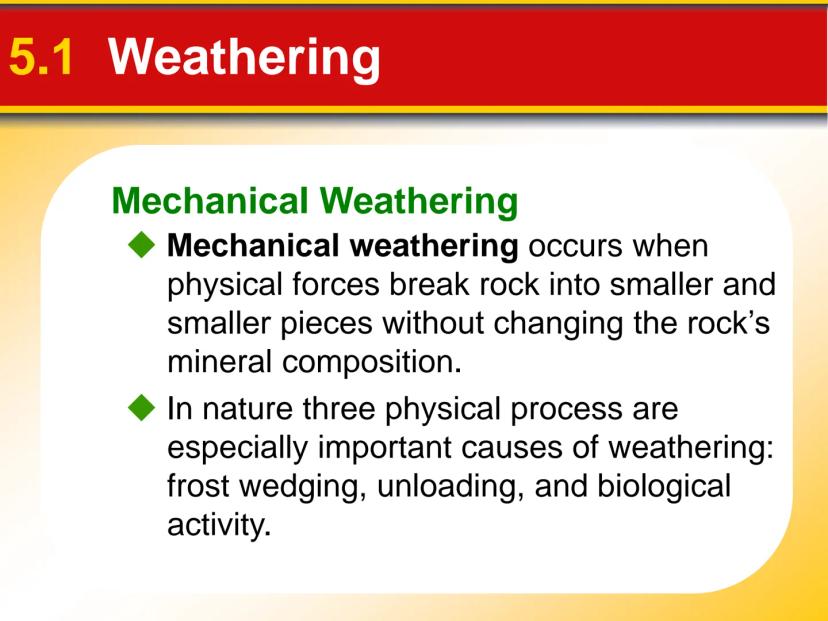
Weathering is the process that breaks down rocks at Earth's surface. There are two main types: mechanical and chemical weathering. Mechanical weathering physically breaks rocks into smaller pieces without changing their mineral composition.
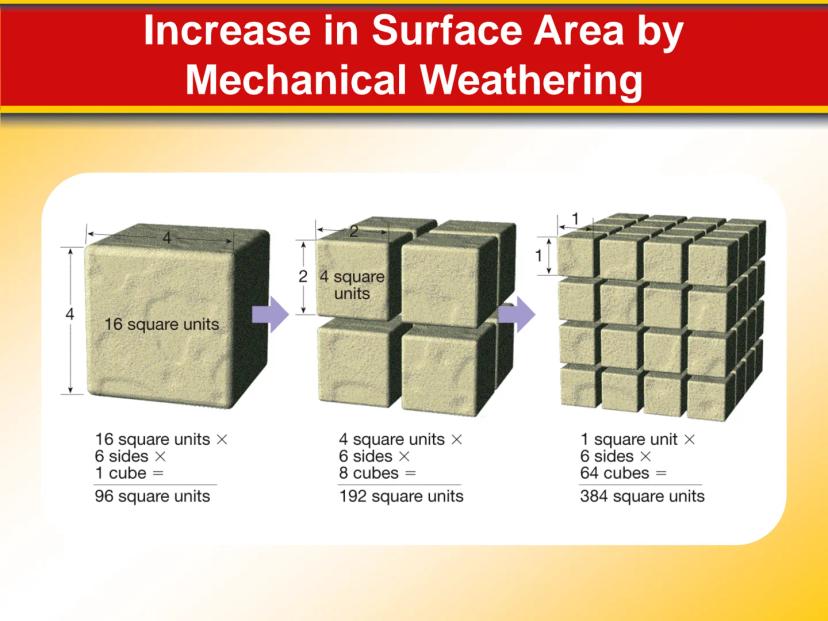
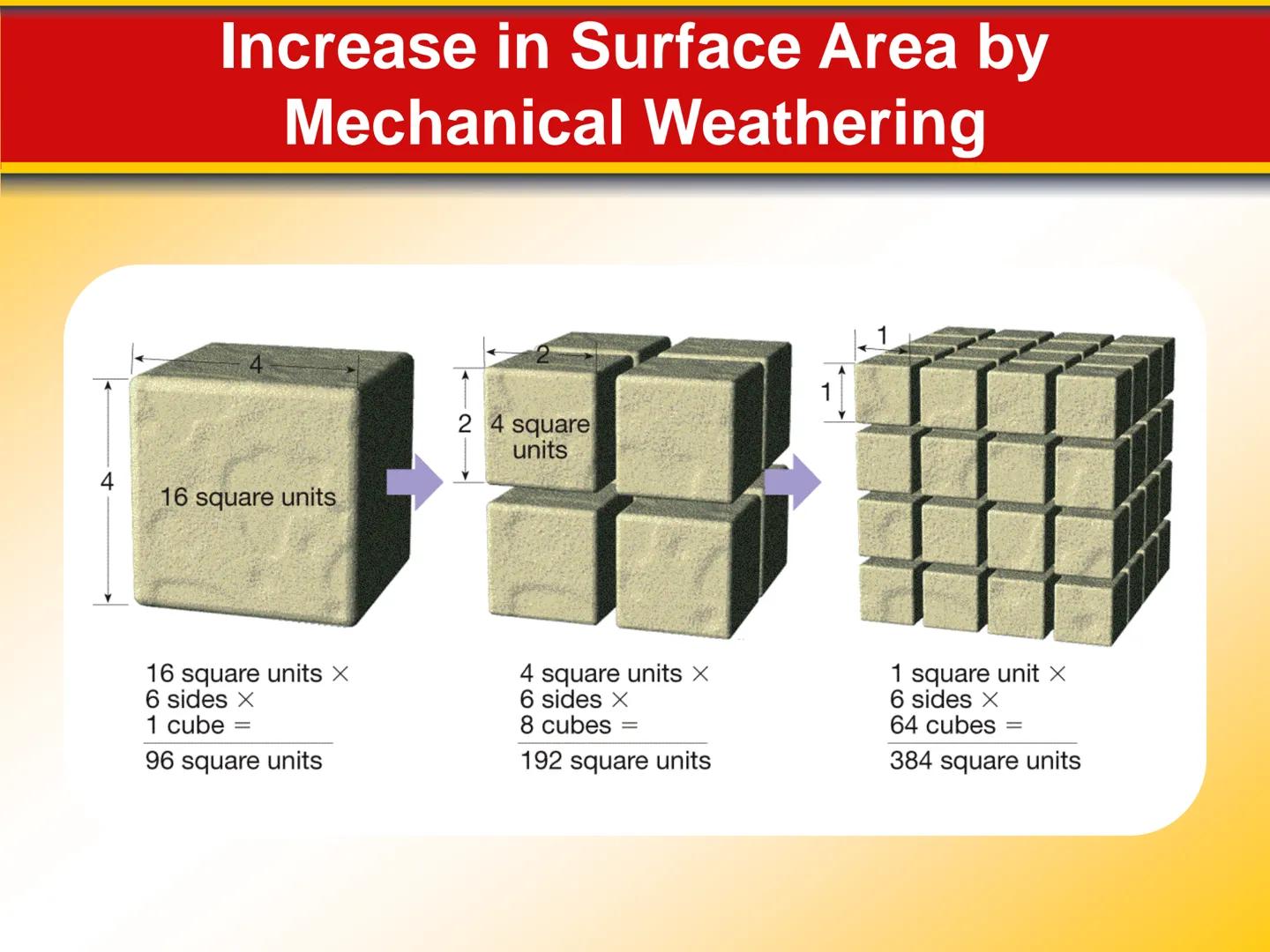
When rocks break down, their surface area increases dramatically. This is crucial because weathering acts on surfaces - the more surface area exposed, the faster weathering occurs. A single large rock cube that breaks into smaller cubes can have its surface area increase 2-4 times!
Did you know? When one large rock breaks into 64 smaller cubes, the total surface area can increase from 96 square units to 384 square units - that's 4 times more area for weathering processes to attack!
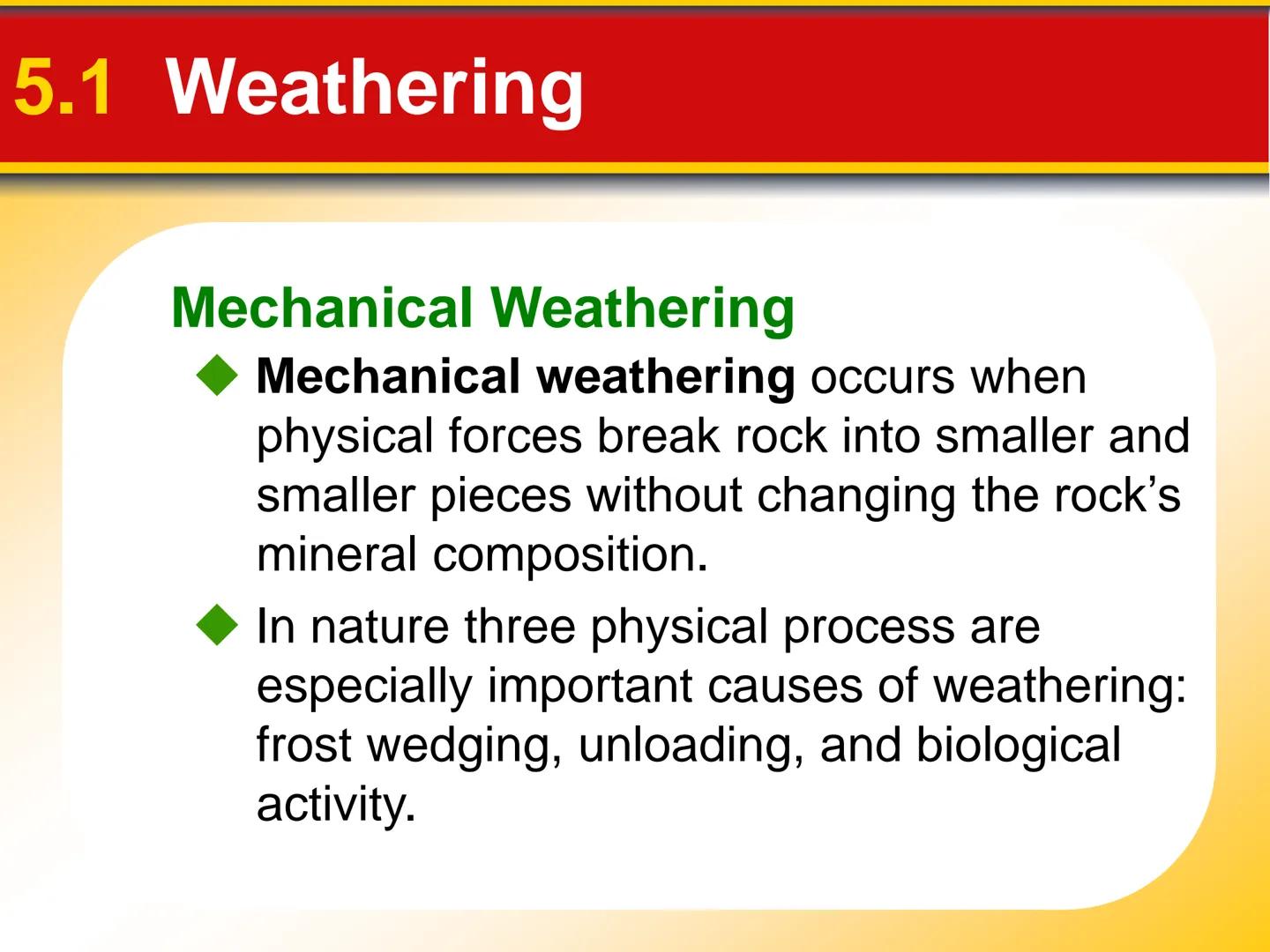
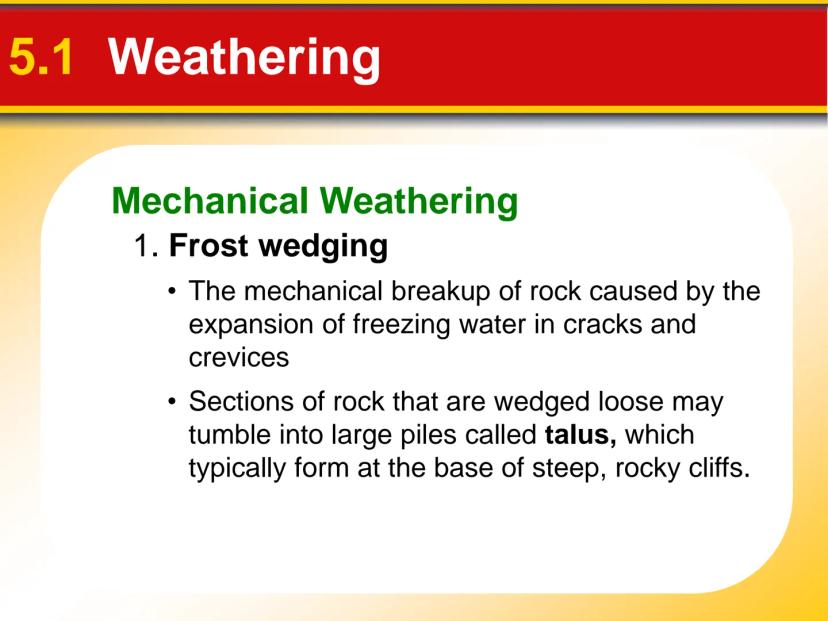
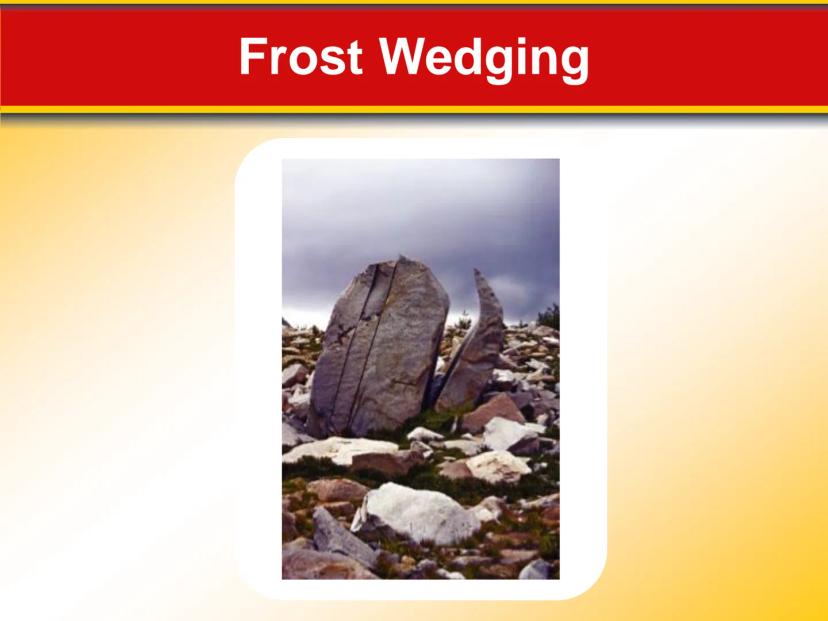
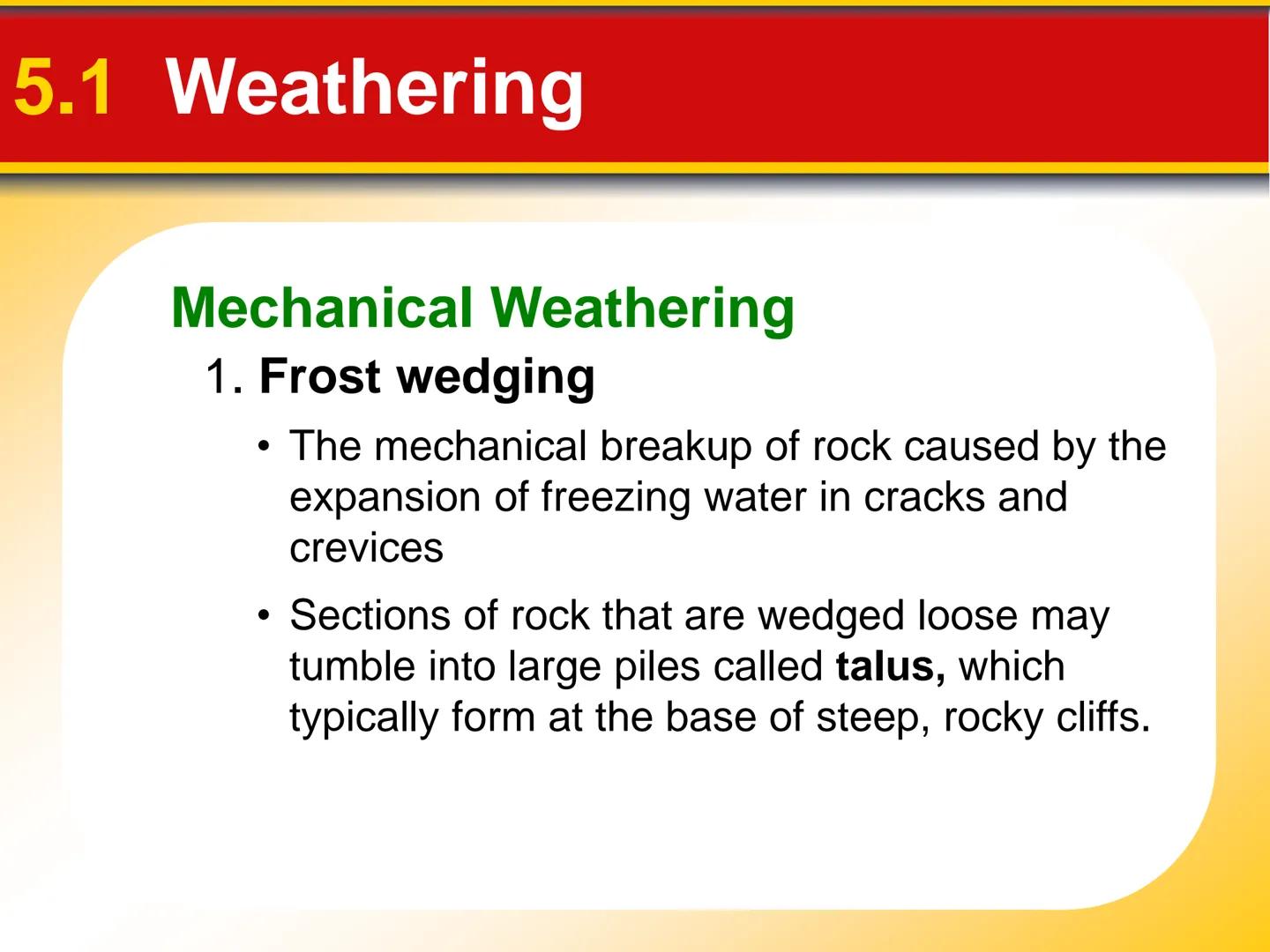
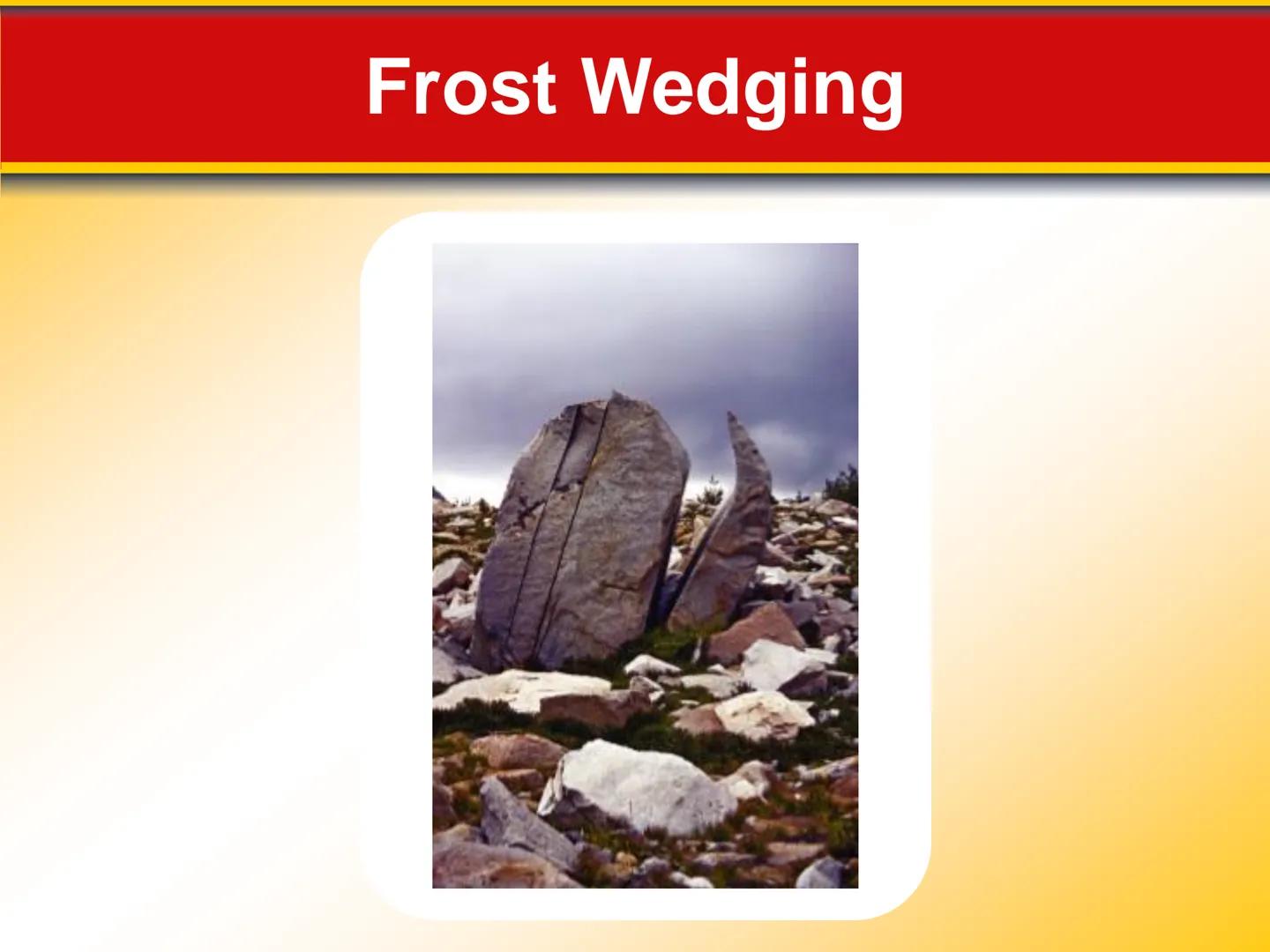
Frost wedging is a powerful form of mechanical weathering. It happens when water seeps into cracks in rocks, freezes, and expands. This expansion forces the cracks to widen. After multiple freeze-thaw cycles, pieces of rock break off completely. These broken fragments often collect at the base of cliffs in piles called talus.
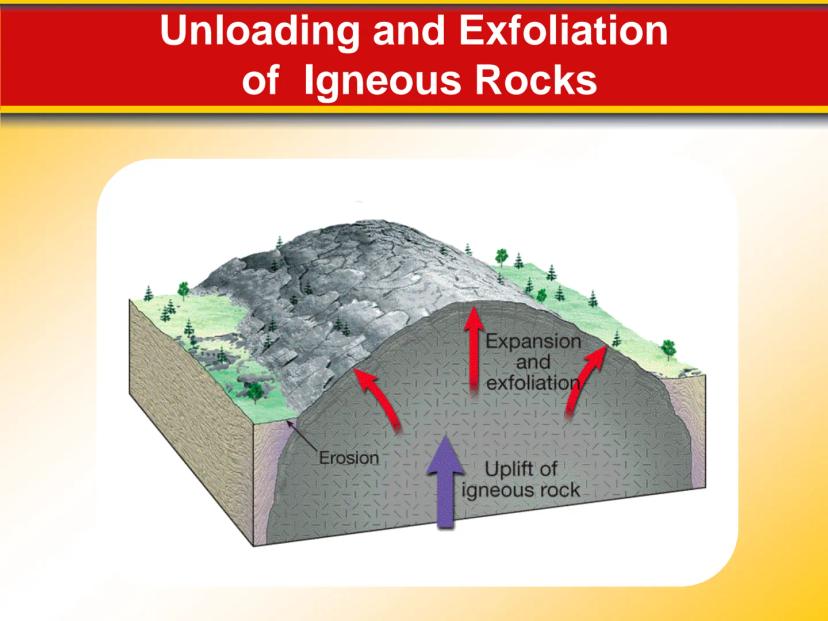
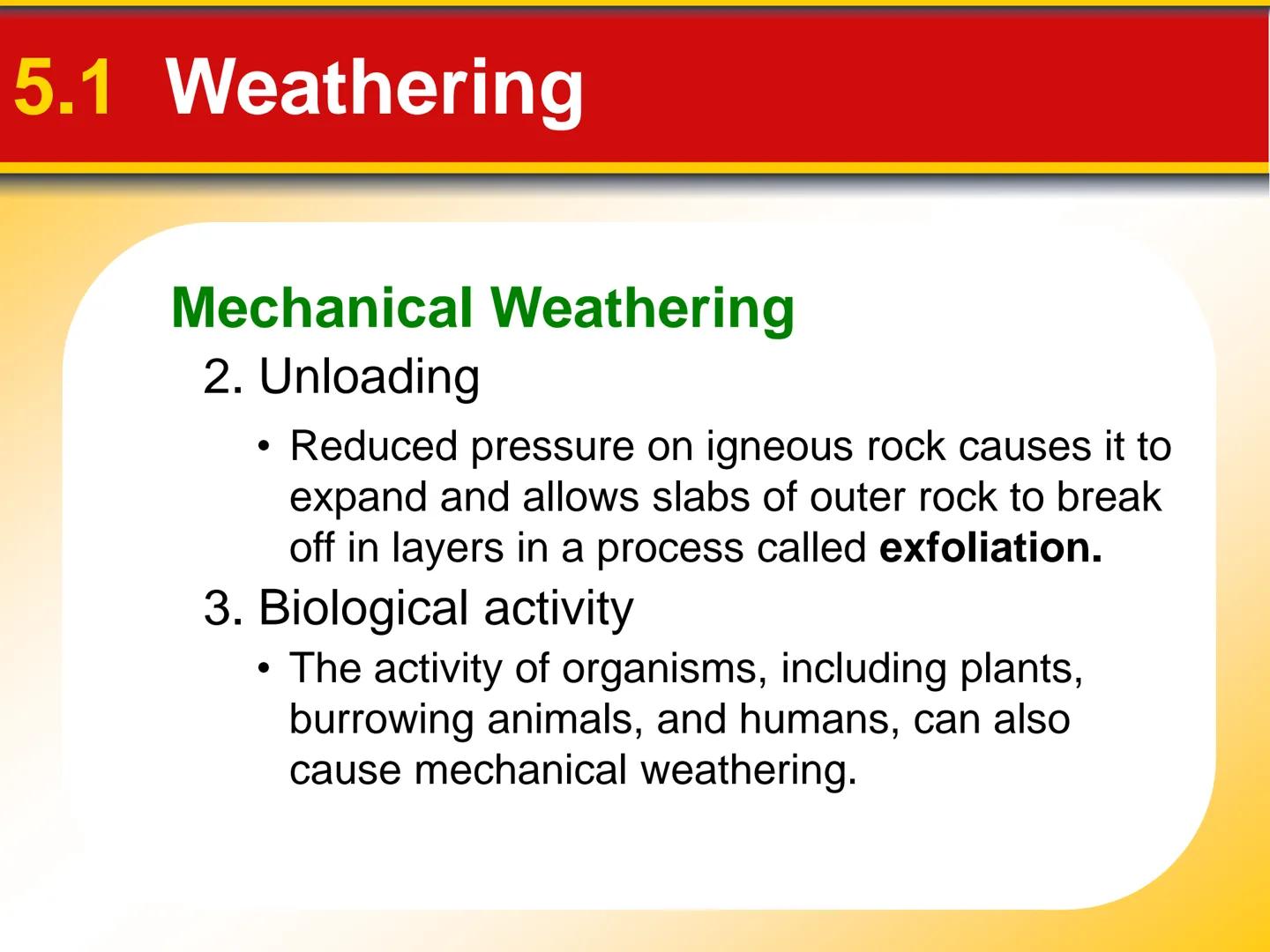
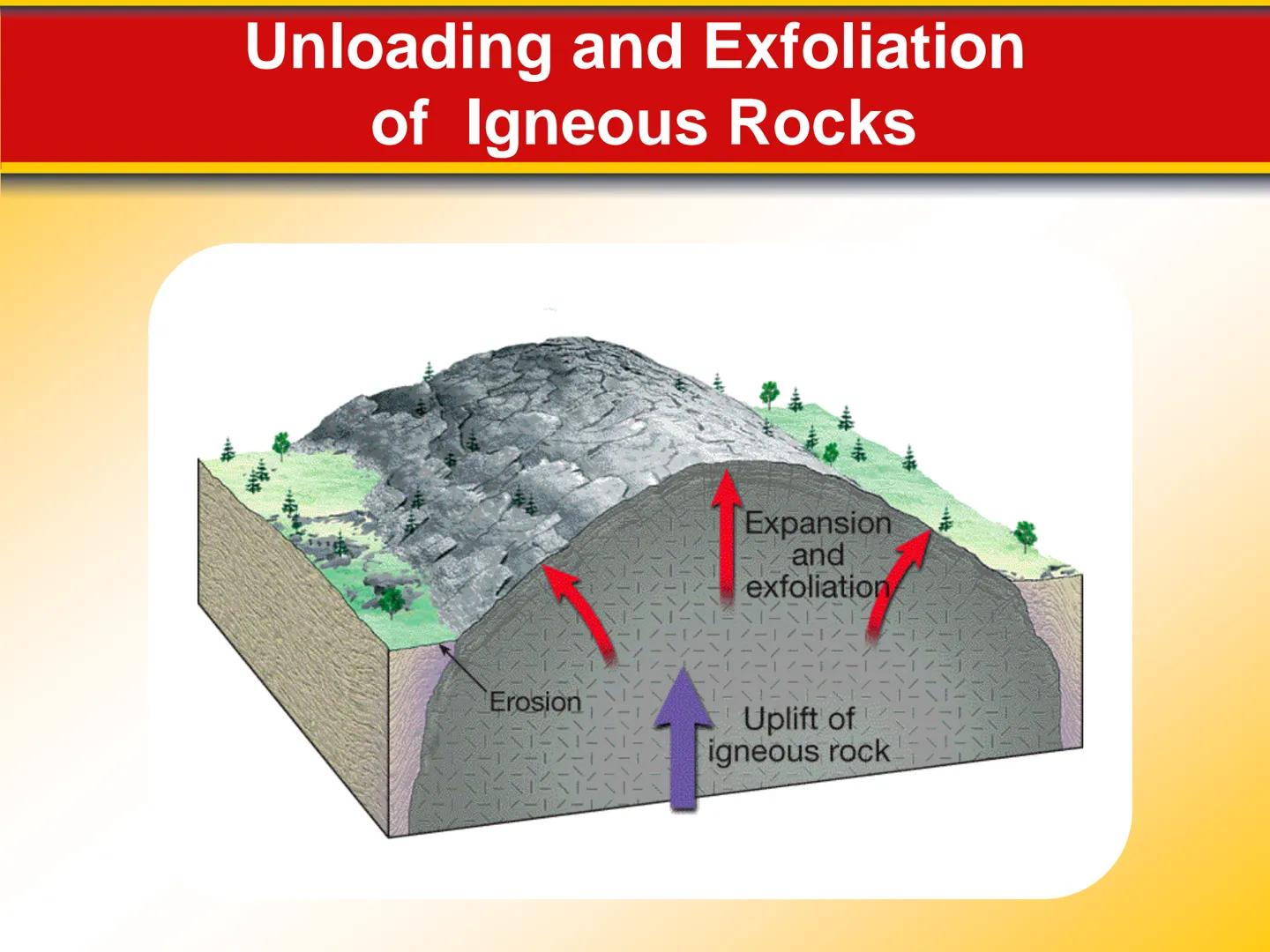
Unloading occurs when deep igneous rocks rise to the surface. As overlying rocks erode away, pressure decreases, causing the rock to expand. This expansion creates cracks parallel to the surface, and outer layers peel away like an onion in a process called exfoliation.
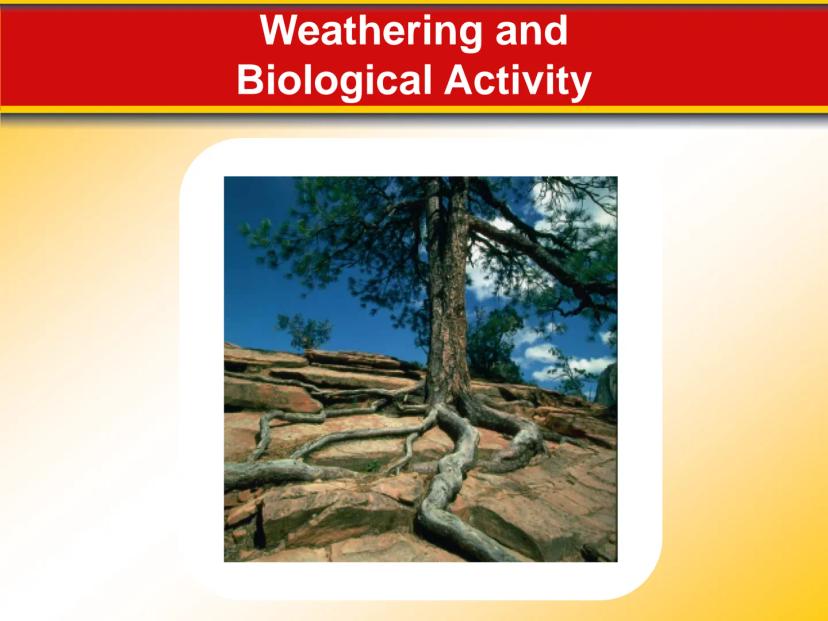
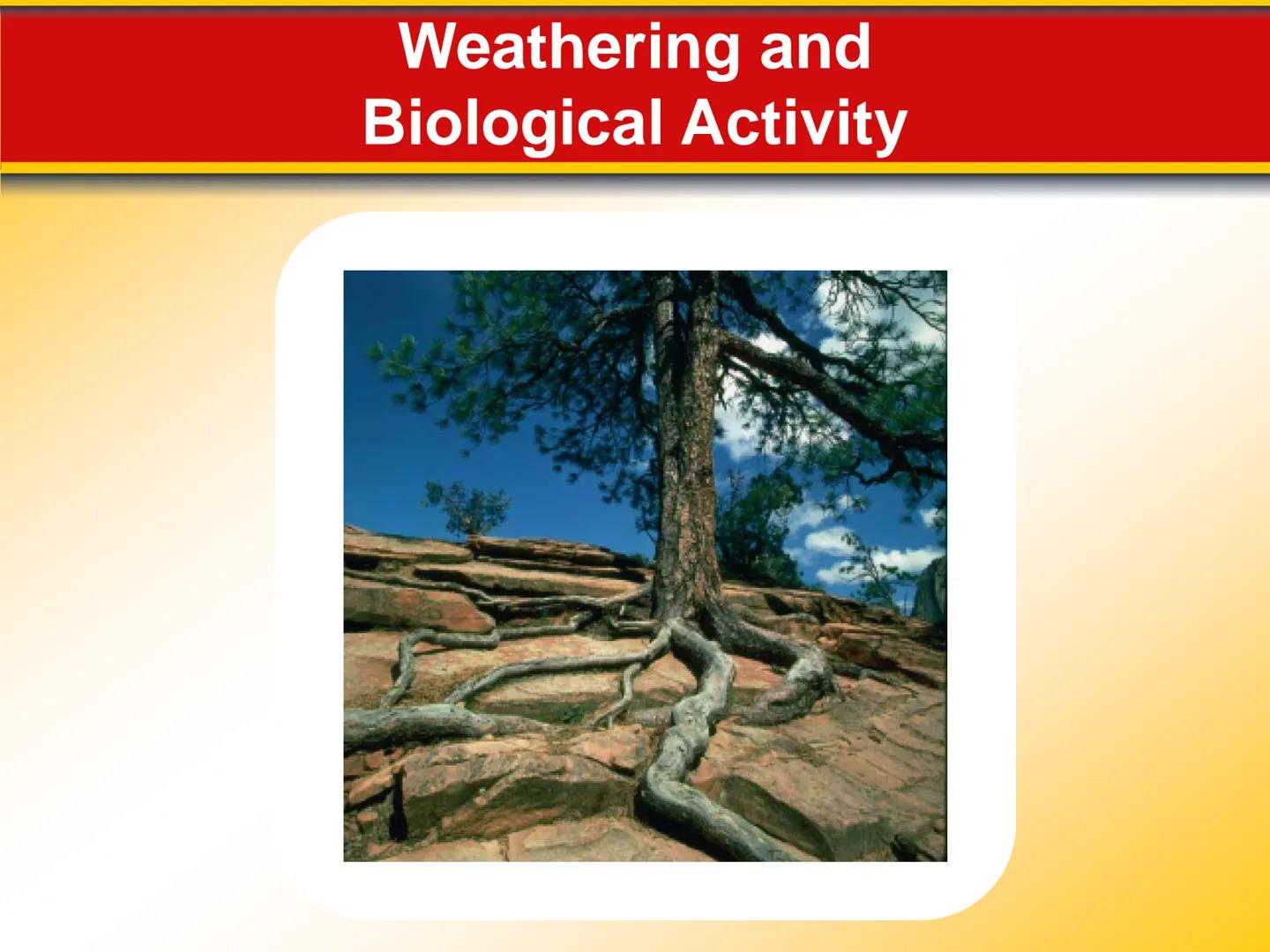
Biological activity also causes mechanical weathering. Plant roots grow into cracks and widen them, burrowing animals move soil particles, and even human activities like construction and farming break apart rocks.
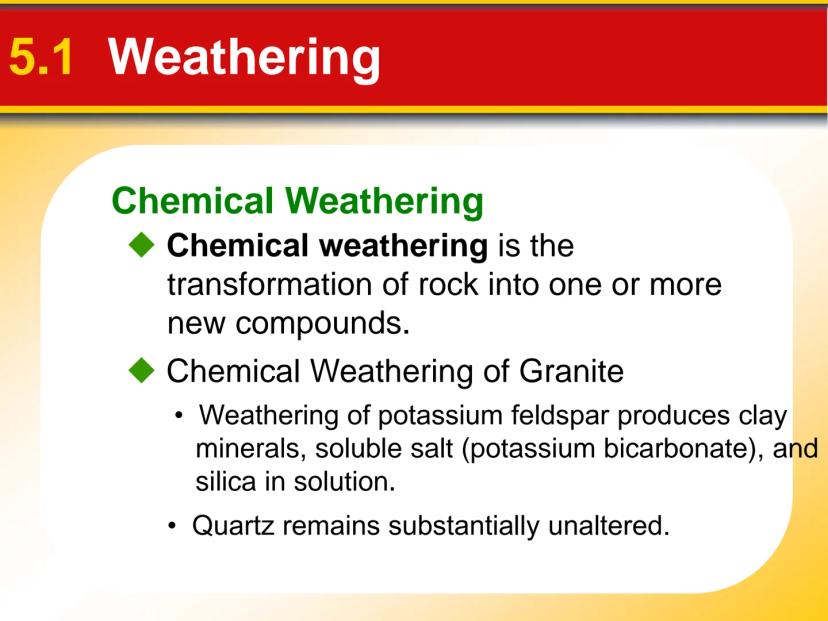
Unlike mechanical weathering, chemical weathering transforms rocks into new compounds through chemical reactions. Water is the key player here, especially when it contains acids.
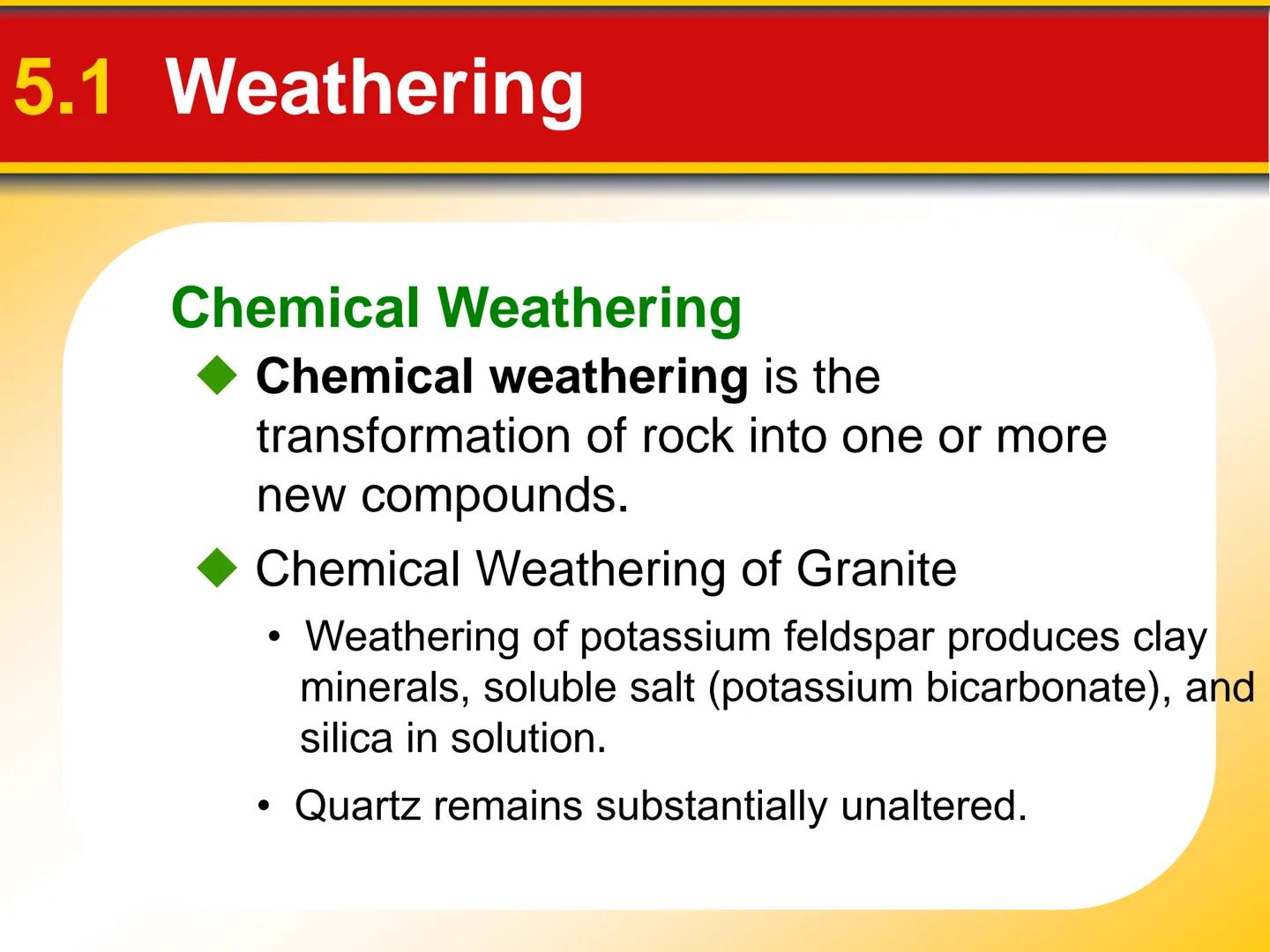
When granite weathers chemically, its minerals undergo different changes. Potassium feldspar breaks down into clay minerals, soluble salts, and dissolved silica. Quartz, however, remains largely unchanged because it's highly resistant to chemical weathering.
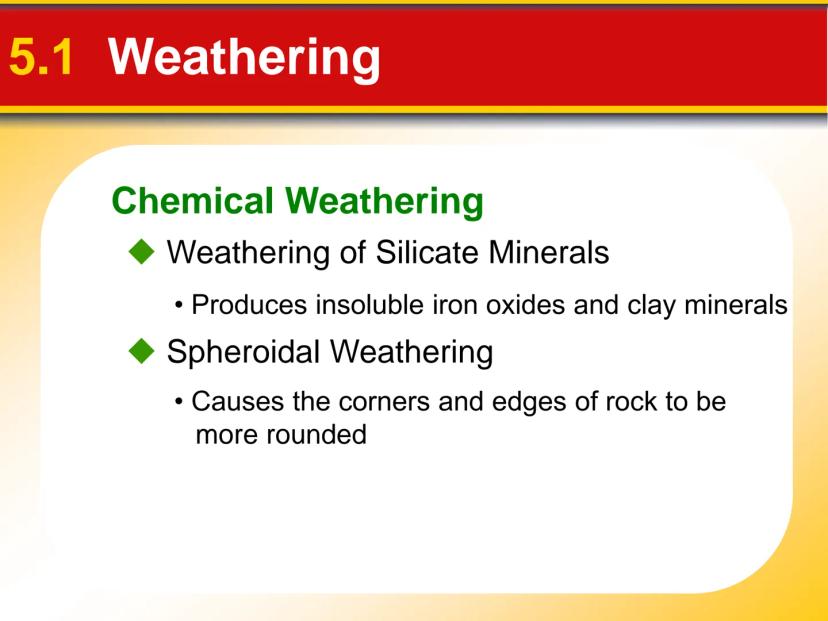
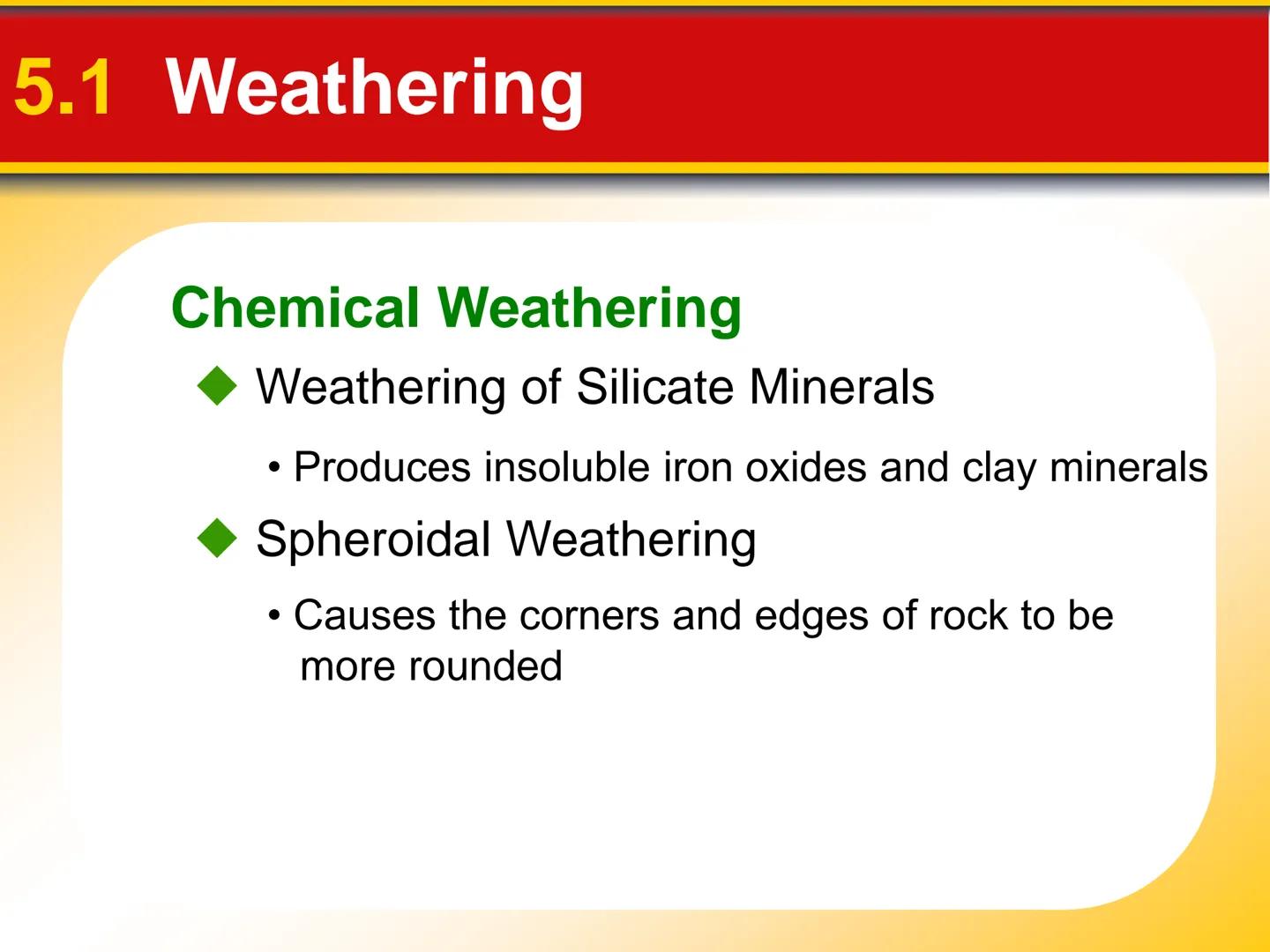
Chemical weathering of silicate minerals (the most common minerals in Earth's crust) produces clay minerals and iron oxides. Spheroidal weathering happens when chemical processes attack corners and edges of rocks more aggressively than flat surfaces, creating rounded shapes.
Important! Chemical weathering is most effective in hot, humid environments where plenty of water and heat speed up chemical reactions. That's why rocks break down much faster in tropical rainforests than in dry deserts!
Two main factors determine how quickly rocks weather: rock characteristics and climate. The mineral composition of a rock greatly affects its weathering rate - some minerals dissolve easily while others resist breakdown. Rocks with many joints (cracks) weather faster because water can penetrate more easily.
Climate plays the biggest role in weathering speed. Temperature and moisture are crucial - chemical weathering works fastest in warm, wet environments. In cold or dry regions, mechanical weathering often dominates.
Differential weathering creates some of nature's most spectacular formations. When different parts of the same rock weather at different rates (due to variations in composition), the result can be arches, towers, and other unusual landforms you might see in places like the American Southwest.
Soil is much more than just dirt - it's the foundation for terrestrial life! Soil forms the upper part of the regolith (the layer of broken rock and mineral fragments covering Earth's surface) and supports plant growth.
A good soil has four main components mixed in specific proportions. Mineral matter (about 45%) provides nutrients and comes from weathered rock. Organic matter (5%) consists of decomposed plant and animal remains called humus. The remaining 50% consists of water and air in roughly equal amounts, filling spaces between soil particles.
When studying soil, scientists look at its texture, which refers to the proportions of different-sized particles. Sand particles are largest, silt particles are medium-sized, and clay particles are smallest. The ideal soil for most plants is loam, a balanced mixture of all three sizes.
Soil science tip: You can feel soil texture with your fingers! Sandy soils feel gritty, silty soils feel smooth like flour, and clay soils feel sticky when wet and form hard clumps when dry.
Soil formation is influenced by five main factors: parent material, time, climate, organisms, and slope. Parent material is the starting point - it's the weathered rock from which soil develops. Soils can be residual (forming directly on bedrock) or transported (forming on materials carried from elsewhere).
Time is essential for soil development. Mature, well-developed soils may take thousands of years to form. The longer soil has been forming, the thicker and more distinct its layers become.
Climate has the greatest effect on soil formation. Temperature and precipitation determine the types and rates of weathering, which directly influence soil characteristics. Organisms contribute organic matter and help mix the soil through their activities.
The slope of the land affects soil formation in two ways. Steep slopes often have thin soils because erosion removes material faster than it can develop. The direction a slope faces affects the soil temperature and moisture content - in the Northern Hemisphere, south-facing slopes receive more direct sunlight and are typically warmer and drier.
If you dig a deep hole in the ground, you'll notice that soil changes as you go deeper. These distinct horizontal layers are called soil horizons, and a vertical section showing all horizons is called a soil profile.
The A horizon (topsoil) is the uppermost layer and contains a mixture of organic matter and minerals. This is where most plant roots grow and where most biological activity happens. Below this is the B horizon (subsoil), which contains clay particles and minerals that have washed down from the topsoil.
The C horizon sits between the B horizon and unweathered parent material. It consists of partially weathered bedrock or sediment. Below this is the unaltered parent material from which the soil originated.
Fascinating fact: The color of soil can tell you a lot about its properties! Red and yellow soils contain iron oxides (like rust), dark brown or black soils are rich in organic matter, and white or light-colored soils often contain calcium carbonate or quartz.
Different climates and vegetation produce distinctive soil types. Pedalfers are soils that develop best under forest vegetation in humid regions. They're characterized by the accumulation of iron oxides and aluminum-rich clays in the B horizon, often giving them a reddish or yellowish color.
Pedocals form in drier grassland regions where there's not enough rainfall to remove calcium carbonate from the soil. These soils accumulate calcium compounds and are typically lighter in color than pedalfers.
Laterites develop in hot, wet tropical climates where intense chemical weathering removes most minerals except iron and aluminum oxides. These soils have distinctive red or orange colors and can become extremely hard when exposed to air, sometimes hard enough to be used as building material!
Different soil types support different ecosystems and agricultural uses. Understanding your local soil type helps explain why certain plants thrive in your area while others struggle.
Soil erosion occurs when wind and water remove soil particles faster than new soil can form. While erosion is a natural process, human activities have dramatically accelerated it, causing serious environmental problems worldwide.
Farming, logging, construction, and other activities that remove natural vegetation have increased erosion rates by 10-40 times natural levels. When topsoil erodes, it reduces agricultural productivity and damages ecosystems. The eroded sediment often ends up in waterways, where it can fill reservoirs, damage aquatic habitats, and carry pollutants like pesticides and fertilizers.
Fortunately, there are effective methods to control soil erosion. Windbreaks (rows of trees) reduce wind erosion, while terracing hillsides creates flat areas that slow water runoff. Contour plowing (following the natural contours of hills) and crop rotation help maintain soil structure and reduce erosion on farmland.
Take action: Even in your own yard or school garden, you can fight soil erosion by planting ground covers, using mulch on bare soil, and creating rain gardens to capture runoff.
Mass movements occur when rock and soil move downslope due to gravity. Unlike erosion, which involves a transporting agent like water or wind, mass movements are driven purely by gravity. Several factors can trigger these events, including water saturation of surface materials, oversteepening of slopes, removal of vegetation, and earthquakes.
When slopes become saturated with water, the water adds weight and reduces friction between particles, making the slope unstable. Removal of vegetation is particularly problematic because plant roots help hold soil in place. This is why landslides often occur in areas where forests have been cleared.
Geologists classify mass movements based on the type of material involved, how it moves, and the speed of movement. Rockfalls happen when rocks or rock fragments fall freely through the air, often from steep cliffs. They're among the fastest and most dangerous types of mass movements.
Safety tip: Pay attention to warning signs in mountainous areas! If you notice falling rocks, fresh cracks in the ground, or tilting trees on a slope, these could be signs of an impending mass movement.
Our AI companion is specifically built for the needs of students. Based on the millions of content pieces we have on the platform we can provide truly meaningful and relevant answers to students. But its not only about answers, the companion is even more about guiding students through their daily learning challenges, with personalised study plans, quizzes or content pieces in the chat and 100% personalisation based on the students skills and developments.
You can download the app in the Google Play Store and in the Apple App Store.
That's right! Enjoy free access to study content, connect with fellow students, and get instant help – all at your fingertips.
App Store
Google Play
The app is very easy to use and well designed. I have found everything I was looking for so far and have been able to learn a lot from the presentations! I will definitely use the app for a class assignment! And of course it also helps a lot as an inspiration.
Stefan S
iOS user
This app is really great. There are so many study notes and help [...]. My problem subject is French, for example, and the app has so many options for help. Thanks to this app, I have improved my French. I would recommend it to anyone.
Samantha Klich
Android user
Wow, I am really amazed. I just tried the app because I've seen it advertised many times and was absolutely stunned. This app is THE HELP you want for school and above all, it offers so many things, such as workouts and fact sheets, which have been VERY helpful to me personally.
Anna
iOS user
I think it’s very much worth it and you’ll end up using it a lot once you get the hang of it and even after looking at others notes you can still ask your Artificial intelligence buddy the question and ask to simplify it if you still don’t get it!!! In the end I think it’s worth it 😊👍 ⚠️Also DID I MENTION ITS FREEE YOU DON’T HAVE TO PAY FOR ANYTHING AND STILL GET YOUR GRADES IN PERFECTLY❗️❗️⚠️
Thomas R
iOS user
Knowunity is the BEST app I’ve used in a minute. This is not an ai review or anything this is genuinely coming from a 7th grade student (I know 2011 im young) but dude this app is a 10/10 i have maintained a 3.8 gpa and have plenty of time for gaming. I love it and my mom is just happy I got good grades
Brad T
Android user
Not only did it help me find the answer but it also showed me alternative ways to solve it. I was horrible in math and science but now I have an a in both subjects. Thanks for the help🤍🤍
David K
iOS user
The app's just great! All I have to do is enter the topic in the search bar and I get the response real fast. I don't have to watch 10 YouTube videos to understand something, so I'm saving my time. Highly recommended!
Sudenaz Ocak
Android user
In school I was really bad at maths but thanks to the app, I am doing better now. I am so grateful that you made the app.
Greenlight Bonnie
Android user
I found this app a couple years ago and it has only gotten better since then. I really love it because it can help with written questions and photo questions. Also, it can find study guides that other people have made as well as flashcard sets and practice tests. The free version is also amazing for students who might not be able to afford it. Would 100% recommend
Aubrey
iOS user
Best app if you're in Highschool or Junior high. I have been using this app for 2 school years and it's the best, it's good if you don't have anyone to help you with school work.😋🩷🎀
Marco B
iOS user
THE QUIZES AND FLASHCARDS ARE SO USEFUL AND I LOVE Knowunity AI. IT ALSO IS LITREALLY LIKE CHATGPT BUT SMARTER!! HELPED ME WITH MY MASCARA PROBLEMS TOO!! AS WELL AS MY REAL SUBJECTS ! DUHHH 😍😁😲🤑💗✨🎀😮
Elisha
iOS user
This app is phenomenal down to the correct info and the various topics you can study! I greatly recommend it for people who struggle with procrastination and those who need homework help. It has been perfectly accurate for world 1 history as far as I’ve seen! Geometry too!
Paul T
iOS user
The app is very easy to use and well designed. I have found everything I was looking for so far and have been able to learn a lot from the presentations! I will definitely use the app for a class assignment! And of course it also helps a lot as an inspiration.
Stefan S
iOS user
This app is really great. There are so many study notes and help [...]. My problem subject is French, for example, and the app has so many options for help. Thanks to this app, I have improved my French. I would recommend it to anyone.
Samantha Klich
Android user
Wow, I am really amazed. I just tried the app because I've seen it advertised many times and was absolutely stunned. This app is THE HELP you want for school and above all, it offers so many things, such as workouts and fact sheets, which have been VERY helpful to me personally.
Anna
iOS user
I think it’s very much worth it and you’ll end up using it a lot once you get the hang of it and even after looking at others notes you can still ask your Artificial intelligence buddy the question and ask to simplify it if you still don’t get it!!! In the end I think it’s worth it 😊👍 ⚠️Also DID I MENTION ITS FREEE YOU DON’T HAVE TO PAY FOR ANYTHING AND STILL GET YOUR GRADES IN PERFECTLY❗️❗️⚠️
Thomas R
iOS user
Knowunity is the BEST app I’ve used in a minute. This is not an ai review or anything this is genuinely coming from a 7th grade student (I know 2011 im young) but dude this app is a 10/10 i have maintained a 3.8 gpa and have plenty of time for gaming. I love it and my mom is just happy I got good grades
Brad T
Android user
Not only did it help me find the answer but it also showed me alternative ways to solve it. I was horrible in math and science but now I have an a in both subjects. Thanks for the help🤍🤍
David K
iOS user
The app's just great! All I have to do is enter the topic in the search bar and I get the response real fast. I don't have to watch 10 YouTube videos to understand something, so I'm saving my time. Highly recommended!
Sudenaz Ocak
Android user
In school I was really bad at maths but thanks to the app, I am doing better now. I am so grateful that you made the app.
Greenlight Bonnie
Android user
I found this app a couple years ago and it has only gotten better since then. I really love it because it can help with written questions and photo questions. Also, it can find study guides that other people have made as well as flashcard sets and practice tests. The free version is also amazing for students who might not be able to afford it. Would 100% recommend
Aubrey
iOS user
Best app if you're in Highschool or Junior high. I have been using this app for 2 school years and it's the best, it's good if you don't have anyone to help you with school work.😋🩷🎀
Marco B
iOS user
THE QUIZES AND FLASHCARDS ARE SO USEFUL AND I LOVE Knowunity AI. IT ALSO IS LITREALLY LIKE CHATGPT BUT SMARTER!! HELPED ME WITH MY MASCARA PROBLEMS TOO!! AS WELL AS MY REAL SUBJECTS ! DUHHH 😍😁😲🤑💗✨🎀😮
Elisha
iOS user
This app is phenomenal down to the correct info and the various topics you can study! I greatly recommend it for people who struggle with procrastination and those who need homework help. It has been perfectly accurate for world 1 history as far as I’ve seen! Geometry too!
Paul T
iOS user
Weathering, soil formation, and mass movements are essential Earth processes that constantly shape our landscapes. These natural phenomena break down rocks, create the soil that supports plant life, and move materials downhill under the force of gravity. Understanding these processes... Show more
Access to all documents
Improve your grades
Join milions of students
Weathering is the process that breaks down rocks at Earth's surface. There are two main types: mechanical and chemical weathering. Mechanical weathering physically breaks rocks into smaller pieces without changing their mineral composition.
When rocks break down, their surface area increases dramatically. This is crucial because weathering acts on surfaces - the more surface area exposed, the faster weathering occurs. A single large rock cube that breaks into smaller cubes can have its surface area increase 2-4 times!
Did you know? When one large rock breaks into 64 smaller cubes, the total surface area can increase from 96 square units to 384 square units - that's 4 times more area for weathering processes to attack!
Access to all documents
Improve your grades
Join milions of students
Frost wedging is a powerful form of mechanical weathering. It happens when water seeps into cracks in rocks, freezes, and expands. This expansion forces the cracks to widen. After multiple freeze-thaw cycles, pieces of rock break off completely. These broken fragments often collect at the base of cliffs in piles called talus.
Unloading occurs when deep igneous rocks rise to the surface. As overlying rocks erode away, pressure decreases, causing the rock to expand. This expansion creates cracks parallel to the surface, and outer layers peel away like an onion in a process called exfoliation.
Biological activity also causes mechanical weathering. Plant roots grow into cracks and widen them, burrowing animals move soil particles, and even human activities like construction and farming break apart rocks.
Access to all documents
Improve your grades
Join milions of students
Unlike mechanical weathering, chemical weathering transforms rocks into new compounds through chemical reactions. Water is the key player here, especially when it contains acids.
When granite weathers chemically, its minerals undergo different changes. Potassium feldspar breaks down into clay minerals, soluble salts, and dissolved silica. Quartz, however, remains largely unchanged because it's highly resistant to chemical weathering.
Chemical weathering of silicate minerals (the most common minerals in Earth's crust) produces clay minerals and iron oxides. Spheroidal weathering happens when chemical processes attack corners and edges of rocks more aggressively than flat surfaces, creating rounded shapes.
Important! Chemical weathering is most effective in hot, humid environments where plenty of water and heat speed up chemical reactions. That's why rocks break down much faster in tropical rainforests than in dry deserts!
Access to all documents
Improve your grades
Join milions of students
Two main factors determine how quickly rocks weather: rock characteristics and climate. The mineral composition of a rock greatly affects its weathering rate - some minerals dissolve easily while others resist breakdown. Rocks with many joints (cracks) weather faster because water can penetrate more easily.
Climate plays the biggest role in weathering speed. Temperature and moisture are crucial - chemical weathering works fastest in warm, wet environments. In cold or dry regions, mechanical weathering often dominates.
Differential weathering creates some of nature's most spectacular formations. When different parts of the same rock weather at different rates (due to variations in composition), the result can be arches, towers, and other unusual landforms you might see in places like the American Southwest.
Access to all documents
Improve your grades
Join milions of students
Soil is much more than just dirt - it's the foundation for terrestrial life! Soil forms the upper part of the regolith (the layer of broken rock and mineral fragments covering Earth's surface) and supports plant growth.
A good soil has four main components mixed in specific proportions. Mineral matter (about 45%) provides nutrients and comes from weathered rock. Organic matter (5%) consists of decomposed plant and animal remains called humus. The remaining 50% consists of water and air in roughly equal amounts, filling spaces between soil particles.
When studying soil, scientists look at its texture, which refers to the proportions of different-sized particles. Sand particles are largest, silt particles are medium-sized, and clay particles are smallest. The ideal soil for most plants is loam, a balanced mixture of all three sizes.
Soil science tip: You can feel soil texture with your fingers! Sandy soils feel gritty, silty soils feel smooth like flour, and clay soils feel sticky when wet and form hard clumps when dry.
Access to all documents
Improve your grades
Join milions of students
Soil formation is influenced by five main factors: parent material, time, climate, organisms, and slope. Parent material is the starting point - it's the weathered rock from which soil develops. Soils can be residual (forming directly on bedrock) or transported (forming on materials carried from elsewhere).
Time is essential for soil development. Mature, well-developed soils may take thousands of years to form. The longer soil has been forming, the thicker and more distinct its layers become.
Climate has the greatest effect on soil formation. Temperature and precipitation determine the types and rates of weathering, which directly influence soil characteristics. Organisms contribute organic matter and help mix the soil through their activities.
The slope of the land affects soil formation in two ways. Steep slopes often have thin soils because erosion removes material faster than it can develop. The direction a slope faces affects the soil temperature and moisture content - in the Northern Hemisphere, south-facing slopes receive more direct sunlight and are typically warmer and drier.
Access to all documents
Improve your grades
Join milions of students
If you dig a deep hole in the ground, you'll notice that soil changes as you go deeper. These distinct horizontal layers are called soil horizons, and a vertical section showing all horizons is called a soil profile.
The A horizon (topsoil) is the uppermost layer and contains a mixture of organic matter and minerals. This is where most plant roots grow and where most biological activity happens. Below this is the B horizon (subsoil), which contains clay particles and minerals that have washed down from the topsoil.
The C horizon sits between the B horizon and unweathered parent material. It consists of partially weathered bedrock or sediment. Below this is the unaltered parent material from which the soil originated.
Fascinating fact: The color of soil can tell you a lot about its properties! Red and yellow soils contain iron oxides (like rust), dark brown or black soils are rich in organic matter, and white or light-colored soils often contain calcium carbonate or quartz.
Access to all documents
Improve your grades
Join milions of students
Different climates and vegetation produce distinctive soil types. Pedalfers are soils that develop best under forest vegetation in humid regions. They're characterized by the accumulation of iron oxides and aluminum-rich clays in the B horizon, often giving them a reddish or yellowish color.
Pedocals form in drier grassland regions where there's not enough rainfall to remove calcium carbonate from the soil. These soils accumulate calcium compounds and are typically lighter in color than pedalfers.
Laterites develop in hot, wet tropical climates where intense chemical weathering removes most minerals except iron and aluminum oxides. These soils have distinctive red or orange colors and can become extremely hard when exposed to air, sometimes hard enough to be used as building material!
Different soil types support different ecosystems and agricultural uses. Understanding your local soil type helps explain why certain plants thrive in your area while others struggle.
Access to all documents
Improve your grades
Join milions of students
Soil erosion occurs when wind and water remove soil particles faster than new soil can form. While erosion is a natural process, human activities have dramatically accelerated it, causing serious environmental problems worldwide.
Farming, logging, construction, and other activities that remove natural vegetation have increased erosion rates by 10-40 times natural levels. When topsoil erodes, it reduces agricultural productivity and damages ecosystems. The eroded sediment often ends up in waterways, where it can fill reservoirs, damage aquatic habitats, and carry pollutants like pesticides and fertilizers.
Fortunately, there are effective methods to control soil erosion. Windbreaks (rows of trees) reduce wind erosion, while terracing hillsides creates flat areas that slow water runoff. Contour plowing (following the natural contours of hills) and crop rotation help maintain soil structure and reduce erosion on farmland.
Take action: Even in your own yard or school garden, you can fight soil erosion by planting ground covers, using mulch on bare soil, and creating rain gardens to capture runoff.
Access to all documents
Improve your grades
Join milions of students
Mass movements occur when rock and soil move downslope due to gravity. Unlike erosion, which involves a transporting agent like water or wind, mass movements are driven purely by gravity. Several factors can trigger these events, including water saturation of surface materials, oversteepening of slopes, removal of vegetation, and earthquakes.
When slopes become saturated with water, the water adds weight and reduces friction between particles, making the slope unstable. Removal of vegetation is particularly problematic because plant roots help hold soil in place. This is why landslides often occur in areas where forests have been cleared.
Geologists classify mass movements based on the type of material involved, how it moves, and the speed of movement. Rockfalls happen when rocks or rock fragments fall freely through the air, often from steep cliffs. They're among the fastest and most dangerous types of mass movements.
Safety tip: Pay attention to warning signs in mountainous areas! If you notice falling rocks, fresh cracks in the ground, or tilting trees on a slope, these could be signs of an impending mass movement.
Our AI companion is specifically built for the needs of students. Based on the millions of content pieces we have on the platform we can provide truly meaningful and relevant answers to students. But its not only about answers, the companion is even more about guiding students through their daily learning challenges, with personalised study plans, quizzes or content pieces in the chat and 100% personalisation based on the students skills and developments.
You can download the app in the Google Play Store and in the Apple App Store.
That's right! Enjoy free access to study content, connect with fellow students, and get instant help – all at your fingertips.
4
Smart Tools NEW
Transform this note into: ✓ 50+ Practice Questions ✓ Interactive Flashcards ✓ Full Practice Test ✓ Essay Outlines
App Store
Google Play
The app is very easy to use and well designed. I have found everything I was looking for so far and have been able to learn a lot from the presentations! I will definitely use the app for a class assignment! And of course it also helps a lot as an inspiration.
Stefan S
iOS user
This app is really great. There are so many study notes and help [...]. My problem subject is French, for example, and the app has so many options for help. Thanks to this app, I have improved my French. I would recommend it to anyone.
Samantha Klich
Android user
Wow, I am really amazed. I just tried the app because I've seen it advertised many times and was absolutely stunned. This app is THE HELP you want for school and above all, it offers so many things, such as workouts and fact sheets, which have been VERY helpful to me personally.
Anna
iOS user
I think it’s very much worth it and you’ll end up using it a lot once you get the hang of it and even after looking at others notes you can still ask your Artificial intelligence buddy the question and ask to simplify it if you still don’t get it!!! In the end I think it’s worth it 😊👍 ⚠️Also DID I MENTION ITS FREEE YOU DON’T HAVE TO PAY FOR ANYTHING AND STILL GET YOUR GRADES IN PERFECTLY❗️❗️⚠️
Thomas R
iOS user
Knowunity is the BEST app I’ve used in a minute. This is not an ai review or anything this is genuinely coming from a 7th grade student (I know 2011 im young) but dude this app is a 10/10 i have maintained a 3.8 gpa and have plenty of time for gaming. I love it and my mom is just happy I got good grades
Brad T
Android user
Not only did it help me find the answer but it also showed me alternative ways to solve it. I was horrible in math and science but now I have an a in both subjects. Thanks for the help🤍🤍
David K
iOS user
The app's just great! All I have to do is enter the topic in the search bar and I get the response real fast. I don't have to watch 10 YouTube videos to understand something, so I'm saving my time. Highly recommended!
Sudenaz Ocak
Android user
In school I was really bad at maths but thanks to the app, I am doing better now. I am so grateful that you made the app.
Greenlight Bonnie
Android user
I found this app a couple years ago and it has only gotten better since then. I really love it because it can help with written questions and photo questions. Also, it can find study guides that other people have made as well as flashcard sets and practice tests. The free version is also amazing for students who might not be able to afford it. Would 100% recommend
Aubrey
iOS user
Best app if you're in Highschool or Junior high. I have been using this app for 2 school years and it's the best, it's good if you don't have anyone to help you with school work.😋🩷🎀
Marco B
iOS user
THE QUIZES AND FLASHCARDS ARE SO USEFUL AND I LOVE Knowunity AI. IT ALSO IS LITREALLY LIKE CHATGPT BUT SMARTER!! HELPED ME WITH MY MASCARA PROBLEMS TOO!! AS WELL AS MY REAL SUBJECTS ! DUHHH 😍😁😲🤑💗✨🎀😮
Elisha
iOS user
This app is phenomenal down to the correct info and the various topics you can study! I greatly recommend it for people who struggle with procrastination and those who need homework help. It has been perfectly accurate for world 1 history as far as I’ve seen! Geometry too!
Paul T
iOS user
The app is very easy to use and well designed. I have found everything I was looking for so far and have been able to learn a lot from the presentations! I will definitely use the app for a class assignment! And of course it also helps a lot as an inspiration.
Stefan S
iOS user
This app is really great. There are so many study notes and help [...]. My problem subject is French, for example, and the app has so many options for help. Thanks to this app, I have improved my French. I would recommend it to anyone.
Samantha Klich
Android user
Wow, I am really amazed. I just tried the app because I've seen it advertised many times and was absolutely stunned. This app is THE HELP you want for school and above all, it offers so many things, such as workouts and fact sheets, which have been VERY helpful to me personally.
Anna
iOS user
I think it’s very much worth it and you’ll end up using it a lot once you get the hang of it and even after looking at others notes you can still ask your Artificial intelligence buddy the question and ask to simplify it if you still don’t get it!!! In the end I think it’s worth it 😊👍 ⚠️Also DID I MENTION ITS FREEE YOU DON’T HAVE TO PAY FOR ANYTHING AND STILL GET YOUR GRADES IN PERFECTLY❗️❗️⚠️
Thomas R
iOS user
Knowunity is the BEST app I’ve used in a minute. This is not an ai review or anything this is genuinely coming from a 7th grade student (I know 2011 im young) but dude this app is a 10/10 i have maintained a 3.8 gpa and have plenty of time for gaming. I love it and my mom is just happy I got good grades
Brad T
Android user
Not only did it help me find the answer but it also showed me alternative ways to solve it. I was horrible in math and science but now I have an a in both subjects. Thanks for the help🤍🤍
David K
iOS user
The app's just great! All I have to do is enter the topic in the search bar and I get the response real fast. I don't have to watch 10 YouTube videos to understand something, so I'm saving my time. Highly recommended!
Sudenaz Ocak
Android user
In school I was really bad at maths but thanks to the app, I am doing better now. I am so grateful that you made the app.
Greenlight Bonnie
Android user
I found this app a couple years ago and it has only gotten better since then. I really love it because it can help with written questions and photo questions. Also, it can find study guides that other people have made as well as flashcard sets and practice tests. The free version is also amazing for students who might not be able to afford it. Would 100% recommend
Aubrey
iOS user
Best app if you're in Highschool or Junior high. I have been using this app for 2 school years and it's the best, it's good if you don't have anyone to help you with school work.😋🩷🎀
Marco B
iOS user
THE QUIZES AND FLASHCARDS ARE SO USEFUL AND I LOVE Knowunity AI. IT ALSO IS LITREALLY LIKE CHATGPT BUT SMARTER!! HELPED ME WITH MY MASCARA PROBLEMS TOO!! AS WELL AS MY REAL SUBJECTS ! DUHHH 😍😁😲🤑💗✨🎀😮
Elisha
iOS user
This app is phenomenal down to the correct info and the various topics you can study! I greatly recommend it for people who struggle with procrastination and those who need homework help. It has been perfectly accurate for world 1 history as far as I’ve seen! Geometry too!
Paul T
iOS user