Open the App

Subjects

Earth Science

Dec 11, 2025

29

14 pages

Exploring Philippine Minerals and Rocks: Identification and Uses

user profile picture

Knowunity Philippines @knowunityphilippines

The mineral world beneath our feet holds incredible treasures that shape our modern life. Philippine minerals, formed over... Show more

Minerals and Rocks: Identification and Uses of Common Philippine
Minerals
Study guide on identifying Philippine minerals and their
practical

Minerals and Rocks Understanding the Basics

Ever wondered what makes up the rocks you walk on every day? Minerals are naturally occurring, inorganic solids with specific chemical compositions and organized atomic structures. They're the building blocks of all rocks around us.

When studying minerals, we need to identify their unique properties that set them apart from one another. These properties help geologists and even students like you recognize minerals in the field without complex lab equipment.

Learning about Philippine minerals isn't just academic knowledge—it connects directly to our economy, environment, and daily life. From the smartphones we use (containing gold and copper) to the buildings we live in (made with limestone and clay products), minerals impact us constantly.

Remember You don't need fancy equipment to identify many minerals! Simple tests using everyday items can reveal a mineral's identity through properties like hardness, streak, and luster.

Minerals and Rocks: Identification and Uses of Common Philippine
Minerals
Study guide on identifying Philippine minerals and their
practical

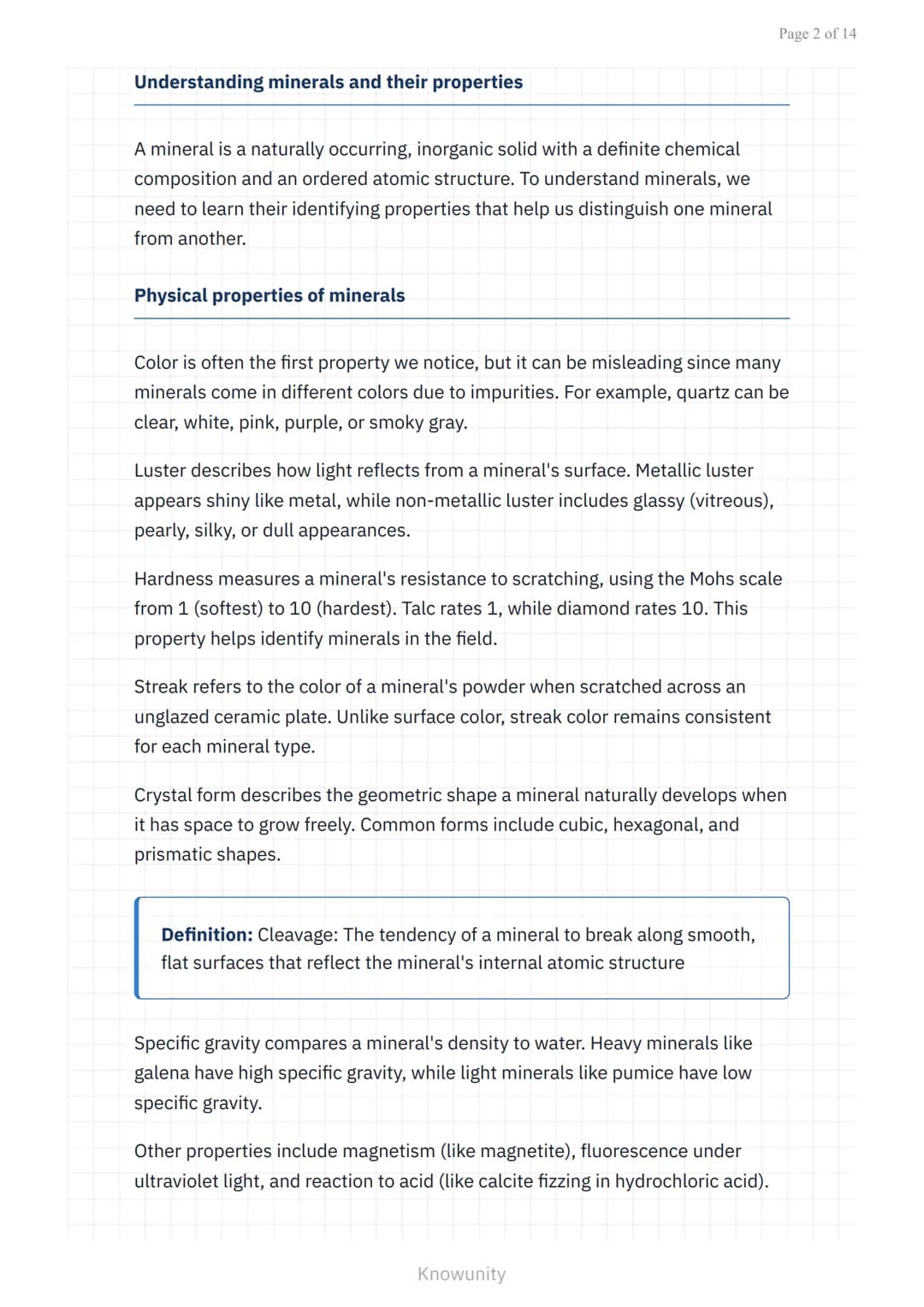
Physical Properties for Mineral Identification

When you hold a mineral sample, your eyes and basic tools can tell you a lot about what it is. Color might catch your attention first, but be careful—minerals like quartz can appear in many colors due to tiny impurities.

Luster describes how light bounces off a mineral's surface. Some minerals shine like metal (metallic luster), while others might look glassy (vitreous), pearly, silky, or even dull. This property helps narrow down possibilities quickly.

Hardness measures how resistant a mineral is to scratching. The Mohs scale ranks minerals from 1 (soft talc) to 10 (diamond). This practical test is super useful in the field—if a mineral scratches glass, it has a hardness greater than 5.5!

Other distinctive properties include streak (the color of a mineral's powder when scratched on unglazed ceramic), crystal form (geometric shapes), cleavage (how minerals break along flat planes), and specific gravity (density compared to water). Some minerals even react to acid or display magnetism!

Try this Find a nail, penny, and glass plate at home. Most quartz can scratch glass but not steel, while calcite can be scratched by a penny—instant identification clues!

Minerals and Rocks: Identification and Uses of Common Philippine
Minerals
Study guide on identifying Philippine minerals and their
practical

Understanding Mineral Chemistry

Minerals fall into different groups based on what they're made of chemically. Think of these groups like families with similar traits. The most common group is silicates (containing silicon and oxygen), making up about 90% of Earth's crust!

Other important groups include carbonates (containing carbonate ions), sulfides (containing sulfur), oxides (containing oxygen), and native elements (pure elements like gold or copper). Each group has characteristic properties based on their chemical bonds.

Most rocks you encounter daily contain silicate minerals like quartz, feldspar, and mica. These minerals form the foundation of our planet's crust and are incredibly abundant in the Philippines due to our volcanic origins.

Fun fact Your everyday table salt is actually the mineral halite, while the graphite in your pencil and the diamond in jewelry are both the same element—carbon—arranged in different crystal structures!

Minerals and Rocks: Identification and Uses of Common Philippine
Minerals
Study guide on identifying Philippine minerals and their
practical

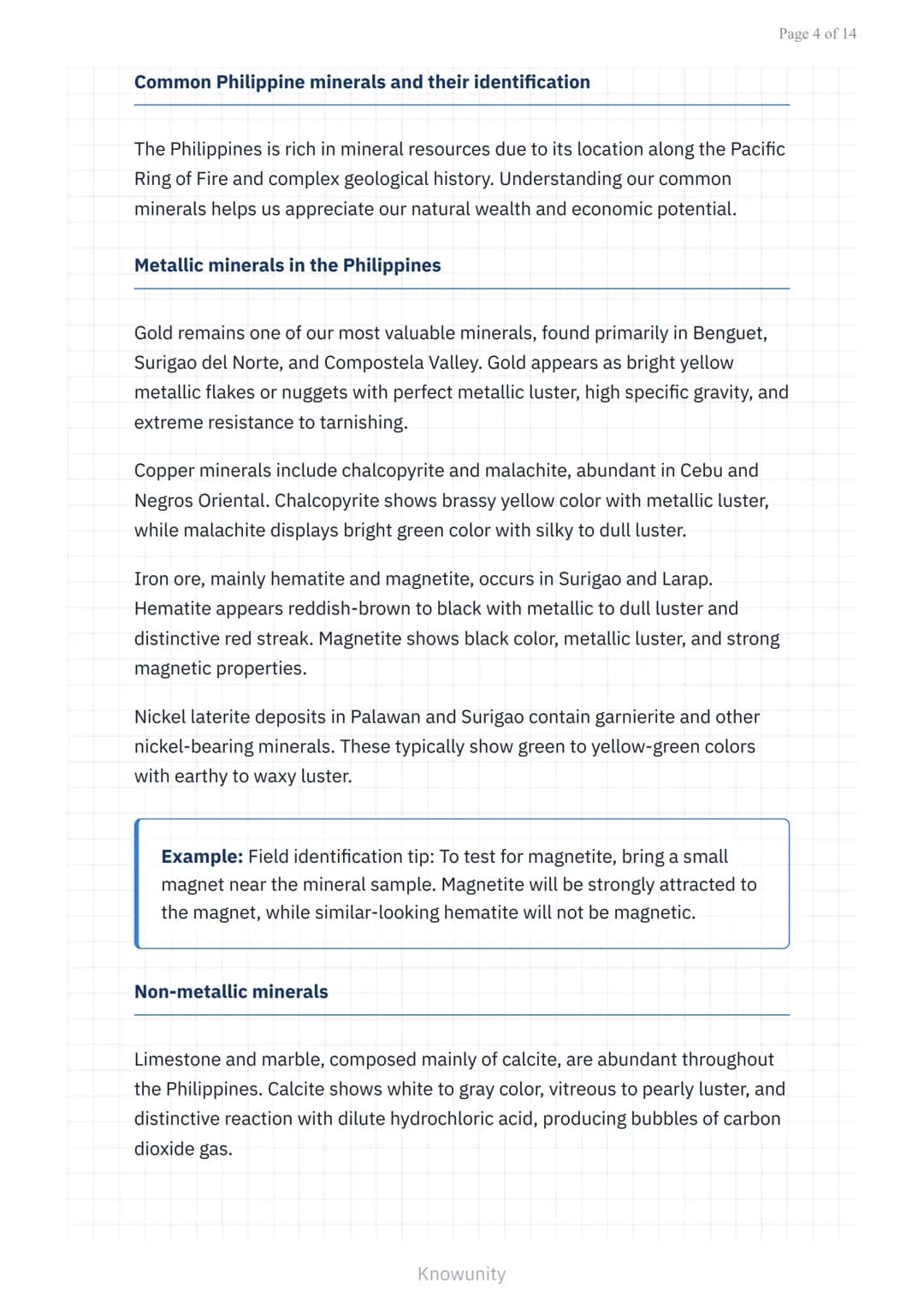
Common Philippine Metallic Minerals

The Philippines sits on the resource-rich Pacific Ring of Fire, giving us incredible mineral wealth. Our position creates perfect conditions for forming valuable metallic minerals that drive our economy.

Gold remains one of our most treasured resources, found mainly in Benguet, Surigao del Norte, and Compostela Valley. You can identify it by its bright yellow color, perfect metallic shine, high density, and resistance to tarnishing. When you hold gold, you'll notice it feels surprisingly heavy for its size!

Copper minerals like chalcopyrite (brassy yellow) and malachite (bright green) occur abundantly in Cebu and Negros Oriental. These minerals help power our modern world through electrical applications and technology.

Iron ore minerals—particularly hematite and magnetite—are found in Surigao and Larap. Hematite shows a distinctive red-brown streak regardless of its surface color, while magnetite's strong attraction to magnets makes it easy to identify in the field.

Try this field test When exploring outdoors, bring a small magnet. If a dark, metallic-looking mineral strongly sticks to your magnet, you've likely found magnetite—one of the Philippines' important iron ores!

Minerals and Rocks: Identification and Uses of Common Philippine
Minerals
Study guide on identifying Philippine minerals and their
practical

Non-Metallic Minerals of the Philippines

Beyond metals, the Philippines contains abundant non-metallic minerals that support everyday products and construction. These minerals might seem less glamorous than gold, but they're actually more important to our daily lives!

Limestone and marble, both made primarily of calcite, appear throughout the archipelago. You can identify calcite by watching it bubble when you apply dilute hydrochloric acid—a unique reaction that produces carbon dioxide gas. This simple test distinguishes calcite from similar-looking minerals.

Quartz occurs in beautiful varieties including clear crystal quartz, white milky quartz, and purple amethyst. All quartz types share a hardness of 7 (they can scratch glass) and break with curved fractures like broken glass.

Other common non-metallic minerals include feldspar (the most abundant mineral group in Earth's crust), clay minerals (formed when feldspar weathers in our tropical climate), gypsum (so soft you can scratch it with your fingernail), and halite (common salt with a cubic crystal form and salty taste).

Remember Many non-metallic minerals might look plain, but they form the backbone of our construction industry and manufacturing sectors. Without them, we wouldn't have cement, glass, ceramics, or many other essential products!

Minerals and Rocks: Identification and Uses of Common Philippine
Minerals
Study guide on identifying Philippine minerals and their
practical

Economic Uses of Philippine Minerals

The minerals beneath Filipino soil contribute enormously to our economy and daily life. From the buildings we live in to the technology we use, minerals support nearly every aspect of modern living.

Limestone serves as the foundation of our construction industry as the primary raw material for cement production. Major cement plants in Rizal, Bulacan, and Cebu transform this common rock into Portland cement for buildings and infrastructure that shape our cities.

Sand and gravel, though technically rock fragments rather than individual minerals, provide essential materials for concrete production. These seemingly simple resources literally build our nation's foundations, roads, and bridges.

Metallic minerals drive technology and manufacturing. Copper powers our electrical systems with its excellent conductivity. Nickel contributes to stainless steel and modern battery technology for electric vehicles. Gold serves both as valuable jewelry and as an essential component in sophisticated electronics and medical devices.

Did you know? The mining industry provides jobs for over 200,000 Filipinos directly, with many more employed in supporting industries. This sector contributes approximately 1% of the Philippine GDP, making mineral resources vital to our economic development.

Minerals and Rocks: Identification and Uses of Common Philippine
Minerals
Study guide on identifying Philippine minerals and their
practical

Emerging Mineral Resources and Future Potential

The Philippines holds promising reserves beyond traditional minerals. Iron ore deposits support steel production, though most require processing to increase their iron content before use in manufacturing.

Rare earth elements in some Philippine deposits represent our ticket to the renewable energy revolution. These special minerals are crucial components in wind turbines, solar panels, and other green technologies. As the world transitions to cleaner energy, these resources may become increasingly valuable.

Our volcanic geology provides excellent geothermal energy potential—though this involves heat rather than mineral extraction. Interestingly, geothermal areas often contain valuable minerals like sulfur and various sulfates that can be harvested.

Phosphate deposits support agricultural development through fertilizer production, helping farmers increase crop yields. As our population grows, these mineral resources become increasingly important for food security.

Looking forward As technology advances, minerals once considered worthless might become tomorrow's treasures. The minerals we overlook today could become crucial for technologies we haven't even invented yet!

Minerals and Rocks: Identification and Uses of Common Philippine
Minerals
Study guide on identifying Philippine minerals and their
practical

Understanding Rock Types and Mineral Formation

Rocks are essentially collections of minerals bound together, and their formation processes determine what minerals they contain. The rock cycle shows how igneous, sedimentary, and metamorphic rocks transform into one another over geological time.

Igneous rocks form from cooling magma or lava. The cooling rate determines crystal size—slow cooling underground produces large crystals as in granite, while rapid cooling at the surface creates fine-grained rocks like basalt. In the Philippines, the Cordillera region contains granite with visible quartz, feldspar, and mica crystals, while volcanic areas like Mayon and Taal feature basalt.

Bowen's Reaction Series explains the sequence of mineral crystallization from cooling magma. High-temperature minerals like olivine form first, followed by pyroxene, amphibole, biotite, and finally quartz and potassium feldspar at lower temperatures. This helps us predict which minerals we'll find together in igneous rocks.

Sedimentary rocks form from weathered material, chemical precipitation, or organic accumulation. Sandstone consists mainly of resistant quartz grains cemented together. Limestone forms from marine organisms or chemical precipitation of calcium carbonate, often containing fossils that tell stories of ancient Philippine seas.

Make the connection The type of rock in your area gives clues about what minerals you might find. Living near volcanoes? Expect igneous rocks with feldspars and possibly precious metals. Near beaches or rivers? Look for quartz-rich sandstones and possibly placer deposits of heavy minerals.

Minerals and Rocks: Identification and Uses of Common Philippine
Minerals
Study guide on identifying Philippine minerals and their
practical

Mineral Concentration and Metamorphism

Different geological processes concentrate minerals in ways that make them accessible for mining. Understanding these processes helps us locate valuable resources.

Placer deposits form when flowing water separates heavy, resistant minerals like gold from lighter materials. Wave action and streams concentrate these minerals in predictable locations, which explains why gold prospectors often search in river beds.

Evaporite deposits develop when seawater or lake water evaporates, leaving behind salt, gypsum, and other dissolved minerals. These chemical precipitates show how natural processes can concentrate resources.

Metamorphic rocks form when existing rocks undergo changes due to heat, pressure, or chemical activity without fully melting. This process creates new minerals or modifies existing ones. For example, marble forms when limestone undergoes metamorphism, recrystallizing calcite into larger, interlocking crystals that improve the rock's strength and appearance.

Other metamorphic rocks include schist, which develops from shale under moderate metamorphic conditions, and gneiss, representing high-grade metamorphism with distinctive banding. These rocks often contain valuable minerals like garnet that formed during the metamorphic process.

Think about it The beautiful marble used in luxurious buildings was once ordinary limestone that underwent intense pressure and heat deep within the Earth. The forces that create mountains also create valuable mineral resources!

Minerals and Rocks: Identification and Uses of Common Philippine
Minerals
Study guide on identifying Philippine minerals and their
practical

Environmental Impacts of Mining

Mining provides essential resources but comes with significant environmental challenges. Understanding these impacts helps us develop better practices for resource extraction.

Surface mining operations dramatically alter landscapes by removing vegetation and topsoil. Open-pit mines change drainage patterns and wildlife habitat, sometimes creating long-lasting changes to local ecosystems. The visual impact of large mines can be seen for kilometers around.

Acid mine drainage occurs when sulfide minerals like pyrite (fool's gold) react with water and oxygen, producing sulfuric acid that can contaminate streams and groundwater. This acidic water often contains dissolved heavy metals that harm aquatic life and water quality.

Tailings (waste material from mineral processing) require careful management to prevent environmental contamination. Without proper storage and treatment, heavy metals and processing chemicals can leak into water supplies, affecting communities and ecosystems far downstream.

Case study The Marcopper mining disaster in Marinduque (1996) released millions of tons of mine tailings into rivers when a drainage tunnel failed. This environmental catastrophe demonstrated why proper safeguards and responsible mining practices are essential for protecting communities and ecosystems.

We thought you’d never ask...

What is the Knowunity AI companion?

Our AI companion is specifically built for the needs of students. Based on the millions of content pieces we have on the platform we can provide truly meaningful and relevant answers to students. But its not only about answers, the companion is even more about guiding students through their daily learning challenges, with personalised study plans, quizzes or content pieces in the chat and 100% personalisation based on the students skills and developments.

Where can I download the Knowunity app?

You can download the app in the Google Play Store and in the Apple App Store.

Is Knowunity really free of charge?

That's right! Enjoy free access to study content, connect with fellow students, and get instant help – all at your fingertips.

2

Smart Tools NEW

Transform this note into: ✓ 50+ Practice Questions ✓ Interactive Flashcards ✓ Full Mock Exam ✓ Essay Outlines

Mock Exam
Quiz
Flashcards
Essay

Can't find what you're looking for? Explore other subjects.

Students love us — and so will you.

4.9/5

App Store

4.8/5

Google Play

The app is very easy to use and well designed. I have found everything I was looking for so far and have been able to learn a lot from the presentations! I will definitely use the app for a class assignment! And of course it also helps a lot as an inspiration.

Stefan S

iOS user

This app is really great. There are so many study notes and help [...]. My problem subject is French, for example, and the app has so many options for help. Thanks to this app, I have improved my French. I would recommend it to anyone.

Samantha Klich

Android user

Wow, I am really amazed. I just tried the app because I've seen it advertised many times and was absolutely stunned. This app is THE HELP you want for school and above all, it offers so many things, such as workouts and fact sheets, which have been VERY helpful to me personally.

Anna

iOS user

I think it’s very much worth it and you’ll end up using it a lot once you get the hang of it and even after looking at others notes you can still ask your Artificial intelligence buddy the question and ask to simplify it if you still don’t get it!!! In the end I think it’s worth it 😊👍 ⚠️Also DID I MENTION ITS FREEE YOU DON’T HAVE TO PAY FOR ANYTHING AND STILL GET YOUR GRADES IN PERFECTLY❗️❗️⚠️

Thomas R

iOS user

Knowunity is the BEST app I’ve used in a minute. This is not an ai review or anything this is genuinely coming from a 7th grade student (I know 2011 im young) but dude this app is a 10/10 i have maintained a 3.8 gpa and have plenty of time for gaming. I love it and my mom is just happy I got good grades

Brad T

Android user

Not only did it help me find the answer but it also showed me alternative ways to solve it. I was horrible in math and science but now I have an a in both subjects. Thanks for the help🤍🤍

David K

iOS user

The app's just great! All I have to do is enter the topic in the search bar and I get the response real fast. I don't have to watch 10 YouTube videos to understand something, so I'm saving my time. Highly recommended!

Sudenaz Ocak

Android user

In school I was really bad at maths but thanks to the app, I am doing better now. I am so grateful that you made the app.

Greenlight Bonnie

Android user

I found this app a couple years ago and it has only gotten better since then. I really love it because it can help with written questions and photo questions. Also, it can find study guides that other people have made as well as flashcard sets and practice tests. The free version is also amazing for students who might not be able to afford it. Would 100% recommend

Aubrey

iOS user

Best app if you're in Highschool or Junior high. I have been using this app for 2 school years and it's the best, it's good if you don't have anyone to help you with school work.😋🩷🎀

Marco B

iOS user

THE QUIZES AND FLASHCARDS ARE SO USEFUL AND I LOVE THE SCHOOLGPT. IT ALSO IS LITREALLY LIKE CHATGPT BUT SMARTER!! HELPED ME WITH MY MASCARA PROBLEMS TOO!! AS WELL AS MY REAL SUBJECTS ! DUHHH 😍😁😲🤑💗✨🎀😮

Elisha

iOS user

This app is phenomenal down to the correct info and the various topics you can study! I greatly recommend it for people who struggle with procrastination and those who need homework help. It has been perfectly accurate for world 1 history as far as I’ve seen! Geometry too!

Paul T

iOS user

The app is very easy to use and well designed. I have found everything I was looking for so far and have been able to learn a lot from the presentations! I will definitely use the app for a class assignment! And of course it also helps a lot as an inspiration.

Stefan S

iOS user

This app is really great. There are so many study notes and help [...]. My problem subject is French, for example, and the app has so many options for help. Thanks to this app, I have improved my French. I would recommend it to anyone.

Samantha Klich

Android user

Wow, I am really amazed. I just tried the app because I've seen it advertised many times and was absolutely stunned. This app is THE HELP you want for school and above all, it offers so many things, such as workouts and fact sheets, which have been VERY helpful to me personally.

Anna

iOS user

I think it’s very much worth it and you’ll end up using it a lot once you get the hang of it and even after looking at others notes you can still ask your Artificial intelligence buddy the question and ask to simplify it if you still don’t get it!!! In the end I think it’s worth it 😊👍 ⚠️Also DID I MENTION ITS FREEE YOU DON’T HAVE TO PAY FOR ANYTHING AND STILL GET YOUR GRADES IN PERFECTLY❗️❗️⚠️

Thomas R

iOS user

Knowunity is the BEST app I’ve used in a minute. This is not an ai review or anything this is genuinely coming from a 7th grade student (I know 2011 im young) but dude this app is a 10/10 i have maintained a 3.8 gpa and have plenty of time for gaming. I love it and my mom is just happy I got good grades

Brad T

Android user

Not only did it help me find the answer but it also showed me alternative ways to solve it. I was horrible in math and science but now I have an a in both subjects. Thanks for the help🤍🤍

David K

iOS user

The app's just great! All I have to do is enter the topic in the search bar and I get the response real fast. I don't have to watch 10 YouTube videos to understand something, so I'm saving my time. Highly recommended!

Sudenaz Ocak

Android user

In school I was really bad at maths but thanks to the app, I am doing better now. I am so grateful that you made the app.

Greenlight Bonnie

Android user

I found this app a couple years ago and it has only gotten better since then. I really love it because it can help with written questions and photo questions. Also, it can find study guides that other people have made as well as flashcard sets and practice tests. The free version is also amazing for students who might not be able to afford it. Would 100% recommend

Aubrey

iOS user

Best app if you're in Highschool or Junior high. I have been using this app for 2 school years and it's the best, it's good if you don't have anyone to help you with school work.😋🩷🎀

Marco B

iOS user

THE QUIZES AND FLASHCARDS ARE SO USEFUL AND I LOVE THE SCHOOLGPT. IT ALSO IS LITREALLY LIKE CHATGPT BUT SMARTER!! HELPED ME WITH MY MASCARA PROBLEMS TOO!! AS WELL AS MY REAL SUBJECTS ! DUHHH 😍😁😲🤑💗✨🎀😮

Elisha

iOS user

This app is phenomenal down to the correct info and the various topics you can study! I greatly recommend it for people who struggle with procrastination and those who need homework help. It has been perfectly accurate for world 1 history as far as I’ve seen! Geometry too!

Paul T

iOS user


Earth Science

29

Dec 11, 2025

14 pages

Exploring Philippine Minerals and Rocks: Identification and Uses

user profile picture

Knowunity Philippines

@knowunityphilippines

The mineral world beneath our feet holds incredible treasures that shape our modern life. Philippine minerals, formed over millions of years through geological processes, provide essential resources for construction, technology, and industry while offering fascinating insights into Earth's history and... Show more

Minerals and Rocks: Identification and Uses of Common Philippine
Minerals
Study guide on identifying Philippine minerals and their
practical

Sign up to see the contentIt's free!

Access to all documents

Improve your grades

Join milions of students

By signing up you accept Terms of Service and Privacy Policy

Minerals and Rocks: Understanding the Basics

Ever wondered what makes up the rocks you walk on every day? Minerals are naturally occurring, inorganic solids with specific chemical compositions and organized atomic structures. They're the building blocks of all rocks around us.

When studying minerals, we need to identify their unique properties that set them apart from one another. These properties help geologists and even students like you recognize minerals in the field without complex lab equipment.

Learning about Philippine minerals isn't just academic knowledge—it connects directly to our economy, environment, and daily life. From the smartphones we use (containing gold and copper) to the buildings we live in (made with limestone and clay products), minerals impact us constantly.

Remember: You don't need fancy equipment to identify many minerals! Simple tests using everyday items can reveal a mineral's identity through properties like hardness, streak, and luster.

Minerals and Rocks: Identification and Uses of Common Philippine
Minerals
Study guide on identifying Philippine minerals and their
practical

Sign up to see the contentIt's free!

Access to all documents

Improve your grades

Join milions of students

By signing up you accept Terms of Service and Privacy Policy

Physical Properties for Mineral Identification

When you hold a mineral sample, your eyes and basic tools can tell you a lot about what it is. Color might catch your attention first, but be careful—minerals like quartz can appear in many colors due to tiny impurities.

Luster describes how light bounces off a mineral's surface. Some minerals shine like metal (metallic luster), while others might look glassy (vitreous), pearly, silky, or even dull. This property helps narrow down possibilities quickly.

Hardness measures how resistant a mineral is to scratching. The Mohs scale ranks minerals from 1 (soft talc) to 10 (diamond). This practical test is super useful in the field—if a mineral scratches glass, it has a hardness greater than 5.5!

Other distinctive properties include streak (the color of a mineral's powder when scratched on unglazed ceramic), crystal form (geometric shapes), cleavage (how minerals break along flat planes), and specific gravity (density compared to water). Some minerals even react to acid or display magnetism!

Try this: Find a nail, penny, and glass plate at home. Most quartz can scratch glass but not steel, while calcite can be scratched by a penny—instant identification clues!

Minerals and Rocks: Identification and Uses of Common Philippine
Minerals
Study guide on identifying Philippine minerals and their
practical

Sign up to see the contentIt's free!

Access to all documents

Improve your grades

Join milions of students

By signing up you accept Terms of Service and Privacy Policy

Understanding Mineral Chemistry

Minerals fall into different groups based on what they're made of chemically. Think of these groups like families with similar traits. The most common group is silicates (containing silicon and oxygen), making up about 90% of Earth's crust!

Other important groups include carbonates (containing carbonate ions), sulfides (containing sulfur), oxides (containing oxygen), and native elements (pure elements like gold or copper). Each group has characteristic properties based on their chemical bonds.

Most rocks you encounter daily contain silicate minerals like quartz, feldspar, and mica. These minerals form the foundation of our planet's crust and are incredibly abundant in the Philippines due to our volcanic origins.

Fun fact: Your everyday table salt is actually the mineral halite, while the graphite in your pencil and the diamond in jewelry are both the same element—carbon—arranged in different crystal structures!

Minerals and Rocks: Identification and Uses of Common Philippine
Minerals
Study guide on identifying Philippine minerals and their
practical

Sign up to see the contentIt's free!

Access to all documents

Improve your grades

Join milions of students

By signing up you accept Terms of Service and Privacy Policy

Common Philippine Metallic Minerals

The Philippines sits on the resource-rich Pacific Ring of Fire, giving us incredible mineral wealth. Our position creates perfect conditions for forming valuable metallic minerals that drive our economy.

Gold remains one of our most treasured resources, found mainly in Benguet, Surigao del Norte, and Compostela Valley. You can identify it by its bright yellow color, perfect metallic shine, high density, and resistance to tarnishing. When you hold gold, you'll notice it feels surprisingly heavy for its size!

Copper minerals like chalcopyrite (brassy yellow) and malachite (bright green) occur abundantly in Cebu and Negros Oriental. These minerals help power our modern world through electrical applications and technology.

Iron ore minerals—particularly hematite and magnetite—are found in Surigao and Larap. Hematite shows a distinctive red-brown streak regardless of its surface color, while magnetite's strong attraction to magnets makes it easy to identify in the field.

Try this field test: When exploring outdoors, bring a small magnet. If a dark, metallic-looking mineral strongly sticks to your magnet, you've likely found magnetite—one of the Philippines' important iron ores!

Minerals and Rocks: Identification and Uses of Common Philippine
Minerals
Study guide on identifying Philippine minerals and their
practical

Sign up to see the contentIt's free!

Access to all documents

Improve your grades

Join milions of students

By signing up you accept Terms of Service and Privacy Policy

Non-Metallic Minerals of the Philippines

Beyond metals, the Philippines contains abundant non-metallic minerals that support everyday products and construction. These minerals might seem less glamorous than gold, but they're actually more important to our daily lives!

Limestone and marble, both made primarily of calcite, appear throughout the archipelago. You can identify calcite by watching it bubble when you apply dilute hydrochloric acid—a unique reaction that produces carbon dioxide gas. This simple test distinguishes calcite from similar-looking minerals.

Quartz occurs in beautiful varieties including clear crystal quartz, white milky quartz, and purple amethyst. All quartz types share a hardness of 7 (they can scratch glass) and break with curved fractures like broken glass.

Other common non-metallic minerals include feldspar (the most abundant mineral group in Earth's crust), clay minerals (formed when feldspar weathers in our tropical climate), gypsum (so soft you can scratch it with your fingernail), and halite (common salt with a cubic crystal form and salty taste).

Remember: Many non-metallic minerals might look plain, but they form the backbone of our construction industry and manufacturing sectors. Without them, we wouldn't have cement, glass, ceramics, or many other essential products!

Minerals and Rocks: Identification and Uses of Common Philippine
Minerals
Study guide on identifying Philippine minerals and their
practical

Sign up to see the contentIt's free!

Access to all documents

Improve your grades

Join milions of students

By signing up you accept Terms of Service and Privacy Policy

Economic Uses of Philippine Minerals

The minerals beneath Filipino soil contribute enormously to our economy and daily life. From the buildings we live in to the technology we use, minerals support nearly every aspect of modern living.

Limestone serves as the foundation of our construction industry as the primary raw material for cement production. Major cement plants in Rizal, Bulacan, and Cebu transform this common rock into Portland cement for buildings and infrastructure that shape our cities.

Sand and gravel, though technically rock fragments rather than individual minerals, provide essential materials for concrete production. These seemingly simple resources literally build our nation's foundations, roads, and bridges.

Metallic minerals drive technology and manufacturing. Copper powers our electrical systems with its excellent conductivity. Nickel contributes to stainless steel and modern battery technology for electric vehicles. Gold serves both as valuable jewelry and as an essential component in sophisticated electronics and medical devices.

Did you know? The mining industry provides jobs for over 200,000 Filipinos directly, with many more employed in supporting industries. This sector contributes approximately 1% of the Philippine GDP, making mineral resources vital to our economic development.

Minerals and Rocks: Identification and Uses of Common Philippine
Minerals
Study guide on identifying Philippine minerals and their
practical

Sign up to see the contentIt's free!

Access to all documents

Improve your grades

Join milions of students

By signing up you accept Terms of Service and Privacy Policy

Emerging Mineral Resources and Future Potential

The Philippines holds promising reserves beyond traditional minerals. Iron ore deposits support steel production, though most require processing to increase their iron content before use in manufacturing.

Rare earth elements in some Philippine deposits represent our ticket to the renewable energy revolution. These special minerals are crucial components in wind turbines, solar panels, and other green technologies. As the world transitions to cleaner energy, these resources may become increasingly valuable.

Our volcanic geology provides excellent geothermal energy potential—though this involves heat rather than mineral extraction. Interestingly, geothermal areas often contain valuable minerals like sulfur and various sulfates that can be harvested.

Phosphate deposits support agricultural development through fertilizer production, helping farmers increase crop yields. As our population grows, these mineral resources become increasingly important for food security.

Looking forward: As technology advances, minerals once considered worthless might become tomorrow's treasures. The minerals we overlook today could become crucial for technologies we haven't even invented yet!

Minerals and Rocks: Identification and Uses of Common Philippine
Minerals
Study guide on identifying Philippine minerals and their
practical

Sign up to see the contentIt's free!

Access to all documents

Improve your grades

Join milions of students

By signing up you accept Terms of Service and Privacy Policy

Understanding Rock Types and Mineral Formation

Rocks are essentially collections of minerals bound together, and their formation processes determine what minerals they contain. The rock cycle shows how igneous, sedimentary, and metamorphic rocks transform into one another over geological time.

Igneous rocks form from cooling magma or lava. The cooling rate determines crystal size—slow cooling underground produces large crystals as in granite, while rapid cooling at the surface creates fine-grained rocks like basalt. In the Philippines, the Cordillera region contains granite with visible quartz, feldspar, and mica crystals, while volcanic areas like Mayon and Taal feature basalt.

Bowen's Reaction Series explains the sequence of mineral crystallization from cooling magma. High-temperature minerals like olivine form first, followed by pyroxene, amphibole, biotite, and finally quartz and potassium feldspar at lower temperatures. This helps us predict which minerals we'll find together in igneous rocks.

Sedimentary rocks form from weathered material, chemical precipitation, or organic accumulation. Sandstone consists mainly of resistant quartz grains cemented together. Limestone forms from marine organisms or chemical precipitation of calcium carbonate, often containing fossils that tell stories of ancient Philippine seas.

Make the connection: The type of rock in your area gives clues about what minerals you might find. Living near volcanoes? Expect igneous rocks with feldspars and possibly precious metals. Near beaches or rivers? Look for quartz-rich sandstones and possibly placer deposits of heavy minerals.

Minerals and Rocks: Identification and Uses of Common Philippine
Minerals
Study guide on identifying Philippine minerals and their
practical

Sign up to see the contentIt's free!

Access to all documents

Improve your grades

Join milions of students

By signing up you accept Terms of Service and Privacy Policy

Mineral Concentration and Metamorphism

Different geological processes concentrate minerals in ways that make them accessible for mining. Understanding these processes helps us locate valuable resources.

Placer deposits form when flowing water separates heavy, resistant minerals like gold from lighter materials. Wave action and streams concentrate these minerals in predictable locations, which explains why gold prospectors often search in river beds.

Evaporite deposits develop when seawater or lake water evaporates, leaving behind salt, gypsum, and other dissolved minerals. These chemical precipitates show how natural processes can concentrate resources.

Metamorphic rocks form when existing rocks undergo changes due to heat, pressure, or chemical activity without fully melting. This process creates new minerals or modifies existing ones. For example, marble forms when limestone undergoes metamorphism, recrystallizing calcite into larger, interlocking crystals that improve the rock's strength and appearance.

Other metamorphic rocks include schist, which develops from shale under moderate metamorphic conditions, and gneiss, representing high-grade metamorphism with distinctive banding. These rocks often contain valuable minerals like garnet that formed during the metamorphic process.

Think about it: The beautiful marble used in luxurious buildings was once ordinary limestone that underwent intense pressure and heat deep within the Earth. The forces that create mountains also create valuable mineral resources!

Minerals and Rocks: Identification and Uses of Common Philippine
Minerals
Study guide on identifying Philippine minerals and their
practical

Sign up to see the contentIt's free!

Access to all documents

Improve your grades

Join milions of students

By signing up you accept Terms of Service and Privacy Policy

Environmental Impacts of Mining

Mining provides essential resources but comes with significant environmental challenges. Understanding these impacts helps us develop better practices for resource extraction.

Surface mining operations dramatically alter landscapes by removing vegetation and topsoil. Open-pit mines change drainage patterns and wildlife habitat, sometimes creating long-lasting changes to local ecosystems. The visual impact of large mines can be seen for kilometers around.

Acid mine drainage occurs when sulfide minerals like pyrite (fool's gold) react with water and oxygen, producing sulfuric acid that can contaminate streams and groundwater. This acidic water often contains dissolved heavy metals that harm aquatic life and water quality.

Tailings (waste material from mineral processing) require careful management to prevent environmental contamination. Without proper storage and treatment, heavy metals and processing chemicals can leak into water supplies, affecting communities and ecosystems far downstream.

Case study: The Marcopper mining disaster in Marinduque (1996) released millions of tons of mine tailings into rivers when a drainage tunnel failed. This environmental catastrophe demonstrated why proper safeguards and responsible mining practices are essential for protecting communities and ecosystems.

We thought you’d never ask...

What is the Knowunity AI companion?

Our AI companion is specifically built for the needs of students. Based on the millions of content pieces we have on the platform we can provide truly meaningful and relevant answers to students. But its not only about answers, the companion is even more about guiding students through their daily learning challenges, with personalised study plans, quizzes or content pieces in the chat and 100% personalisation based on the students skills and developments.

Where can I download the Knowunity app?

You can download the app in the Google Play Store and in the Apple App Store.

Is Knowunity really free of charge?

That's right! Enjoy free access to study content, connect with fellow students, and get instant help – all at your fingertips.

2

Smart Tools NEW

Transform this note into: ✓ 50+ Practice Questions ✓ Interactive Flashcards ✓ Full Mock Exam ✓ Essay Outlines

Mock Exam
Quiz
Flashcards
Essay

Can't find what you're looking for? Explore other subjects.

Students love us — and so will you.

4.9/5

App Store

4.8/5

Google Play

The app is very easy to use and well designed. I have found everything I was looking for so far and have been able to learn a lot from the presentations! I will definitely use the app for a class assignment! And of course it also helps a lot as an inspiration.

Stefan S

iOS user

This app is really great. There are so many study notes and help [...]. My problem subject is French, for example, and the app has so many options for help. Thanks to this app, I have improved my French. I would recommend it to anyone.

Samantha Klich

Android user

Wow, I am really amazed. I just tried the app because I've seen it advertised many times and was absolutely stunned. This app is THE HELP you want for school and above all, it offers so many things, such as workouts and fact sheets, which have been VERY helpful to me personally.

Anna

iOS user

I think it’s very much worth it and you’ll end up using it a lot once you get the hang of it and even after looking at others notes you can still ask your Artificial intelligence buddy the question and ask to simplify it if you still don’t get it!!! In the end I think it’s worth it 😊👍 ⚠️Also DID I MENTION ITS FREEE YOU DON’T HAVE TO PAY FOR ANYTHING AND STILL GET YOUR GRADES IN PERFECTLY❗️❗️⚠️

Thomas R

iOS user

Knowunity is the BEST app I’ve used in a minute. This is not an ai review or anything this is genuinely coming from a 7th grade student (I know 2011 im young) but dude this app is a 10/10 i have maintained a 3.8 gpa and have plenty of time for gaming. I love it and my mom is just happy I got good grades

Brad T

Android user

Not only did it help me find the answer but it also showed me alternative ways to solve it. I was horrible in math and science but now I have an a in both subjects. Thanks for the help🤍🤍

David K

iOS user

The app's just great! All I have to do is enter the topic in the search bar and I get the response real fast. I don't have to watch 10 YouTube videos to understand something, so I'm saving my time. Highly recommended!

Sudenaz Ocak

Android user

In school I was really bad at maths but thanks to the app, I am doing better now. I am so grateful that you made the app.

Greenlight Bonnie

Android user

I found this app a couple years ago and it has only gotten better since then. I really love it because it can help with written questions and photo questions. Also, it can find study guides that other people have made as well as flashcard sets and practice tests. The free version is also amazing for students who might not be able to afford it. Would 100% recommend

Aubrey

iOS user

Best app if you're in Highschool or Junior high. I have been using this app for 2 school years and it's the best, it's good if you don't have anyone to help you with school work.😋🩷🎀

Marco B

iOS user

THE QUIZES AND FLASHCARDS ARE SO USEFUL AND I LOVE THE SCHOOLGPT. IT ALSO IS LITREALLY LIKE CHATGPT BUT SMARTER!! HELPED ME WITH MY MASCARA PROBLEMS TOO!! AS WELL AS MY REAL SUBJECTS ! DUHHH 😍😁😲🤑💗✨🎀😮

Elisha

iOS user

This app is phenomenal down to the correct info and the various topics you can study! I greatly recommend it for people who struggle with procrastination and those who need homework help. It has been perfectly accurate for world 1 history as far as I’ve seen! Geometry too!

Paul T

iOS user

The app is very easy to use and well designed. I have found everything I was looking for so far and have been able to learn a lot from the presentations! I will definitely use the app for a class assignment! And of course it also helps a lot as an inspiration.

Stefan S

iOS user

This app is really great. There are so many study notes and help [...]. My problem subject is French, for example, and the app has so many options for help. Thanks to this app, I have improved my French. I would recommend it to anyone.

Samantha Klich

Android user

Wow, I am really amazed. I just tried the app because I've seen it advertised many times and was absolutely stunned. This app is THE HELP you want for school and above all, it offers so many things, such as workouts and fact sheets, which have been VERY helpful to me personally.

Anna

iOS user

I think it’s very much worth it and you’ll end up using it a lot once you get the hang of it and even after looking at others notes you can still ask your Artificial intelligence buddy the question and ask to simplify it if you still don’t get it!!! In the end I think it’s worth it 😊👍 ⚠️Also DID I MENTION ITS FREEE YOU DON’T HAVE TO PAY FOR ANYTHING AND STILL GET YOUR GRADES IN PERFECTLY❗️❗️⚠️

Thomas R

iOS user

Knowunity is the BEST app I’ve used in a minute. This is not an ai review or anything this is genuinely coming from a 7th grade student (I know 2011 im young) but dude this app is a 10/10 i have maintained a 3.8 gpa and have plenty of time for gaming. I love it and my mom is just happy I got good grades

Brad T

Android user

Not only did it help me find the answer but it also showed me alternative ways to solve it. I was horrible in math and science but now I have an a in both subjects. Thanks for the help🤍🤍

David K

iOS user

The app's just great! All I have to do is enter the topic in the search bar and I get the response real fast. I don't have to watch 10 YouTube videos to understand something, so I'm saving my time. Highly recommended!

Sudenaz Ocak

Android user

In school I was really bad at maths but thanks to the app, I am doing better now. I am so grateful that you made the app.

Greenlight Bonnie

Android user

I found this app a couple years ago and it has only gotten better since then. I really love it because it can help with written questions and photo questions. Also, it can find study guides that other people have made as well as flashcard sets and practice tests. The free version is also amazing for students who might not be able to afford it. Would 100% recommend

Aubrey

iOS user

Best app if you're in Highschool or Junior high. I have been using this app for 2 school years and it's the best, it's good if you don't have anyone to help you with school work.😋🩷🎀

Marco B

iOS user

THE QUIZES AND FLASHCARDS ARE SO USEFUL AND I LOVE THE SCHOOLGPT. IT ALSO IS LITREALLY LIKE CHATGPT BUT SMARTER!! HELPED ME WITH MY MASCARA PROBLEMS TOO!! AS WELL AS MY REAL SUBJECTS ! DUHHH 😍😁😲🤑💗✨🎀😮

Elisha

iOS user

This app is phenomenal down to the correct info and the various topics you can study! I greatly recommend it for people who struggle with procrastination and those who need homework help. It has been perfectly accurate for world 1 history as far as I’ve seen! Geometry too!

Paul T

iOS user