
Ever wonder why bridges are made from steel instead of... Show more
 Engineering2 views·Updated May 17, 2026·6 pages
Understanding Material Properties

1 / 6
1
of 6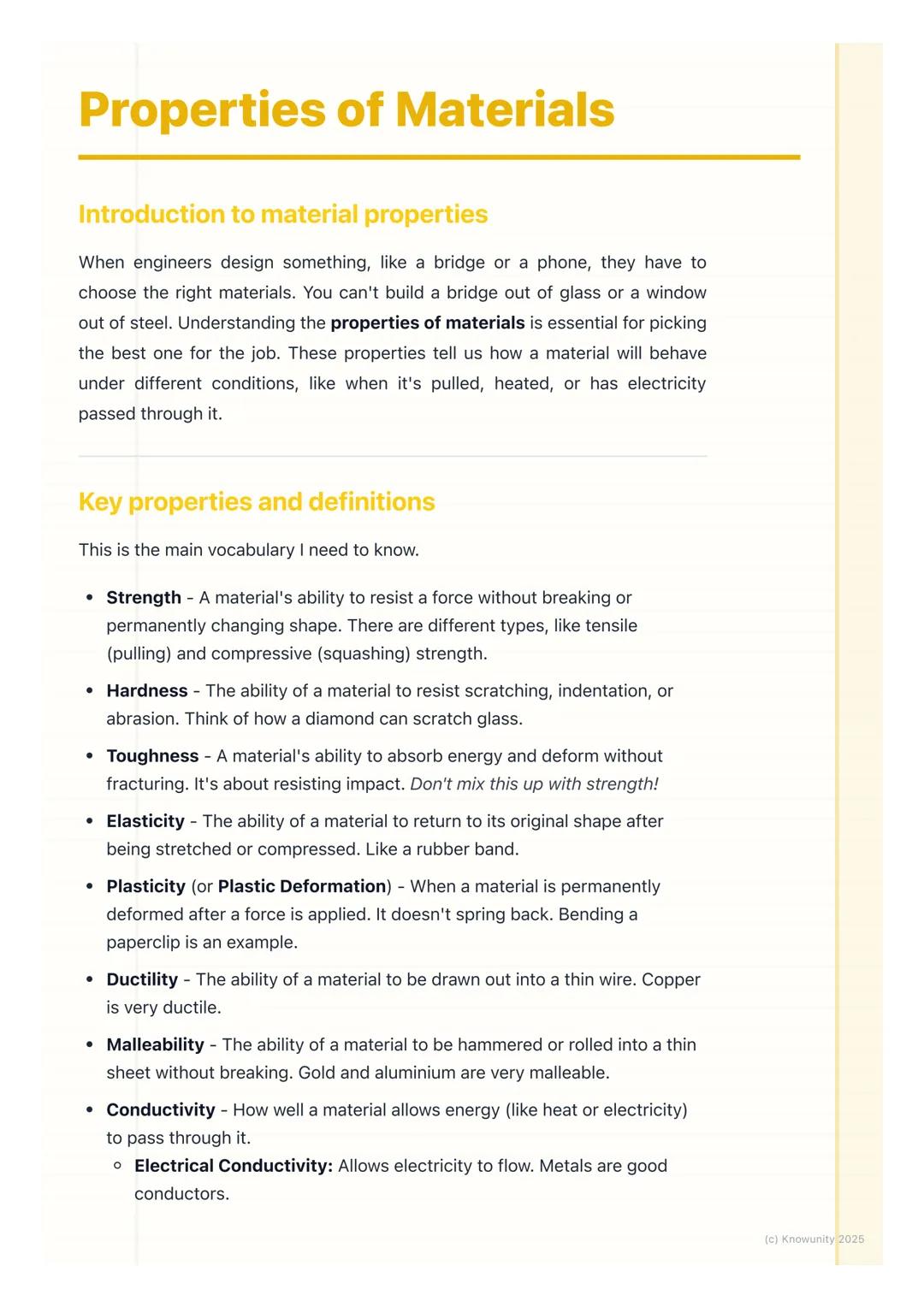
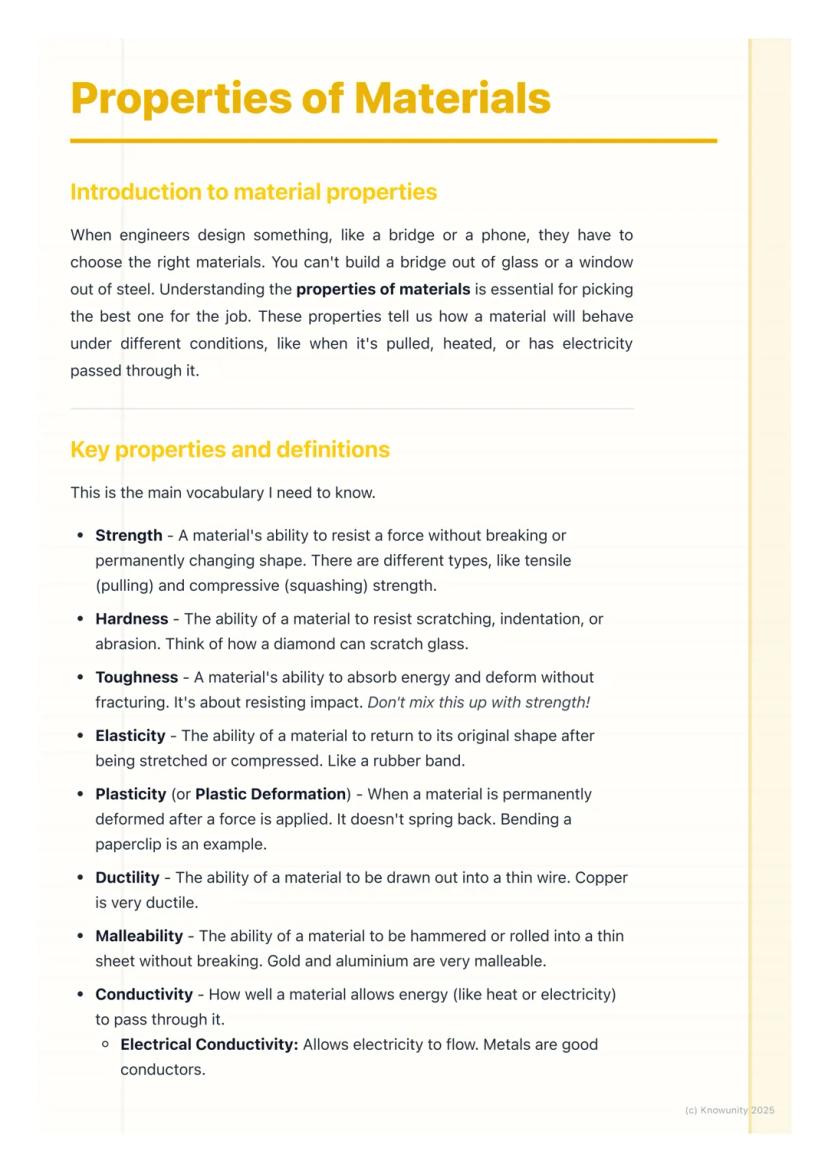
Introduction to Material Properties
Choosing the right material for any project is like picking the right tool for a job - get it wrong and everything falls apart! Material properties are the characteristics that tell us how a substance will behave under different conditions.
Understanding these properties is absolutely crucial for engineers designing everything from bridges to smartphones. They need to know whether a material will bend without breaking, conduct electricity, or withstand extreme temperatures.
The key is matching the material's natural abilities to what the job demands. You wouldn't use rubber for a building foundation or concrete for electrical wires - each material has its own superpowers and weaknesses.
Remember: Every material choice in engineering comes down to finding the perfect match between what's needed and what the material can actually do.
2
of 6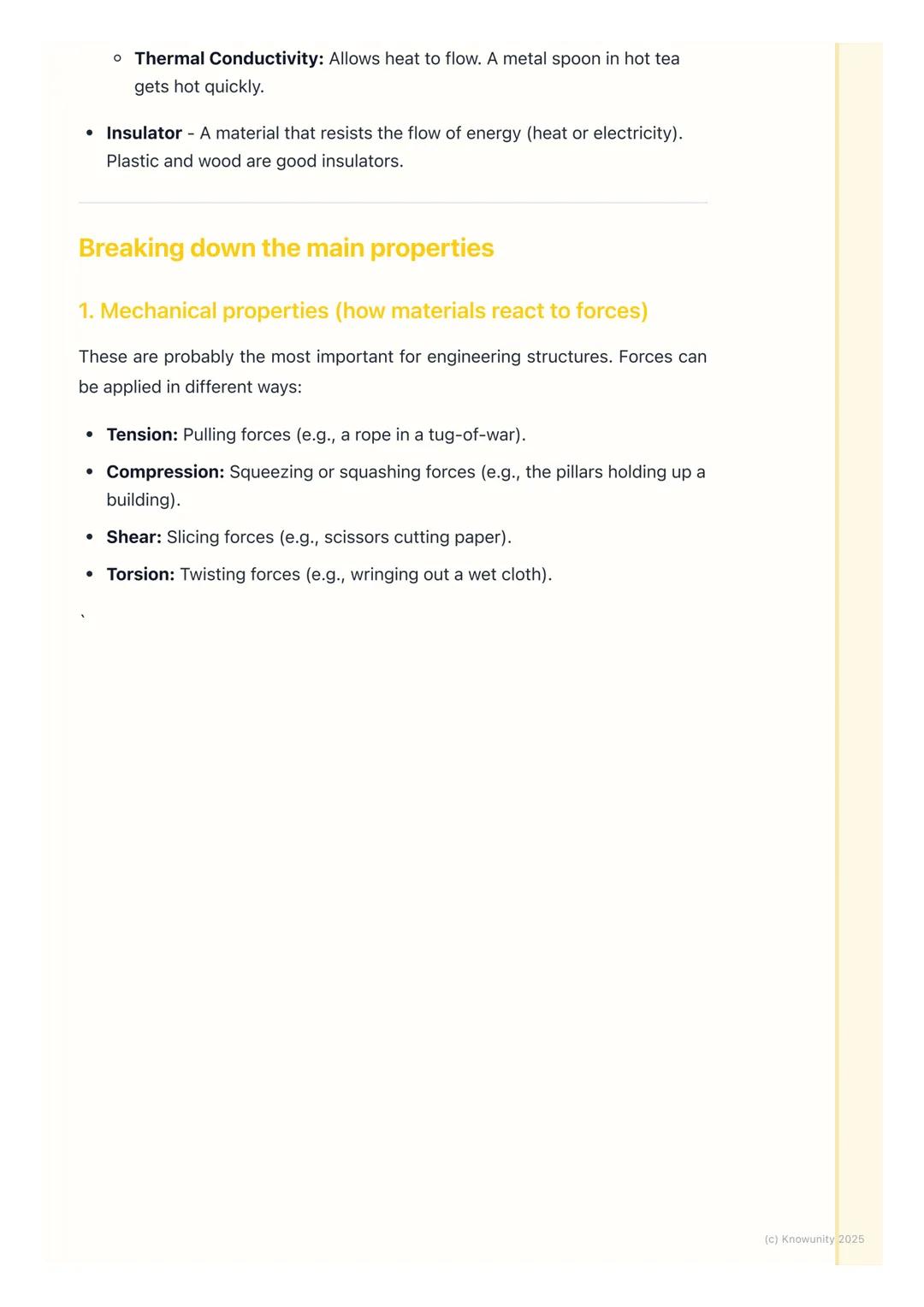
Key Mechanical Properties
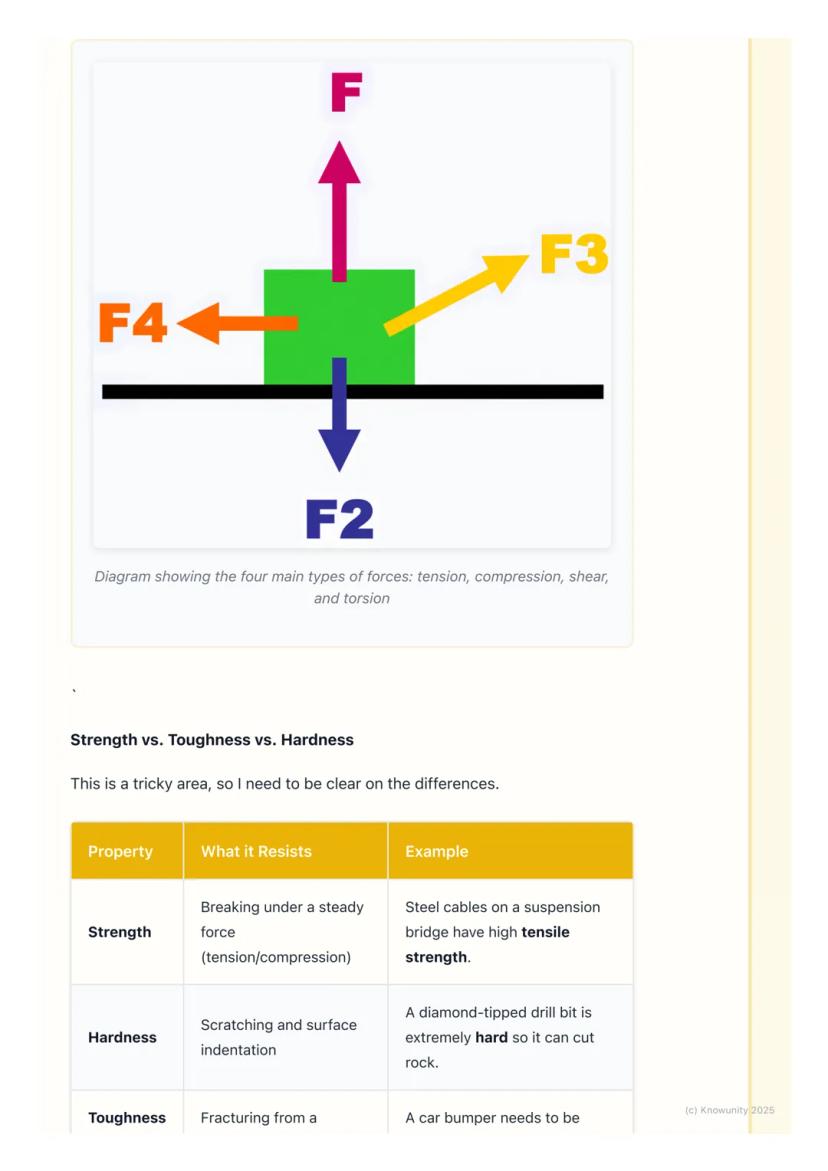
Mechanical properties are all about how materials handle forces - and there are some crucial differences you need to nail down. Strength is a material's ability to resist breaking under steady forces, whether that's tension (pulling), compression (squashing), or shear (slicing).
Don't confuse strength with toughness - that's a material's ability to absorb sudden impacts without fracturing. Think of it this way: glass is strong but not tough (it shatters when dropped), while a car bumper is tough because it absorbs crash energy.
Hardness is completely different again - it's about resisting scratches and surface damage. A diamond is incredibly hard, which is why it can cut through almost anything else.
Pro tip: Ceramic tiles are strong in compression but brittle under impact - perfect for floors but terrible for hammers!
3
of 6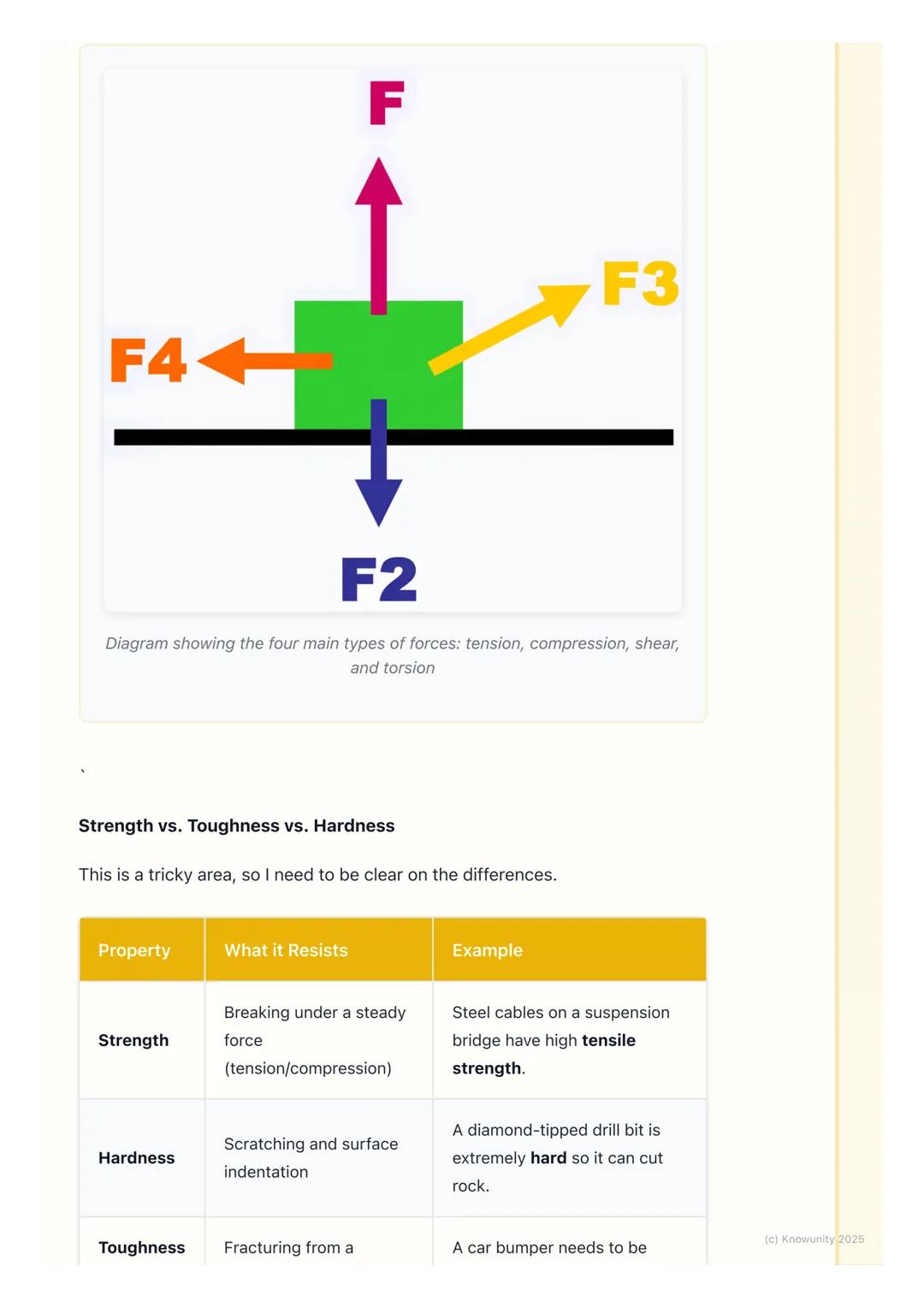
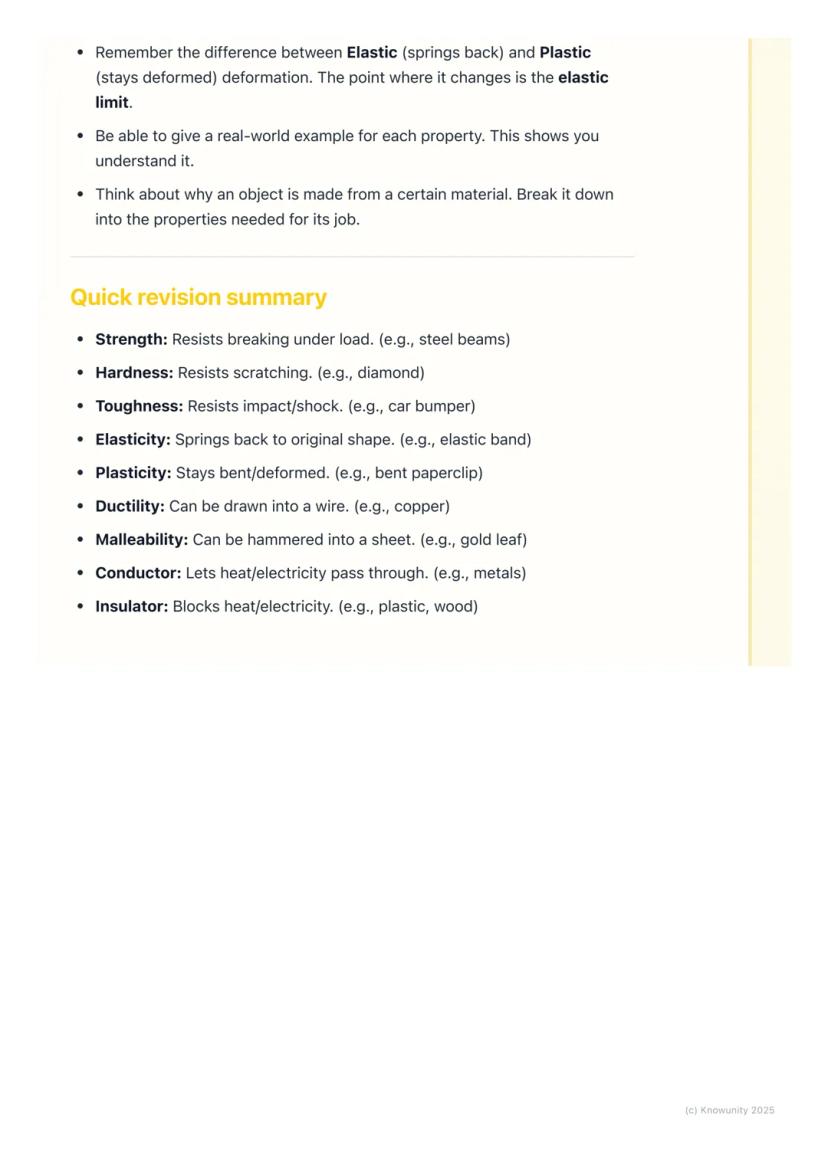
Elasticity vs Plasticity
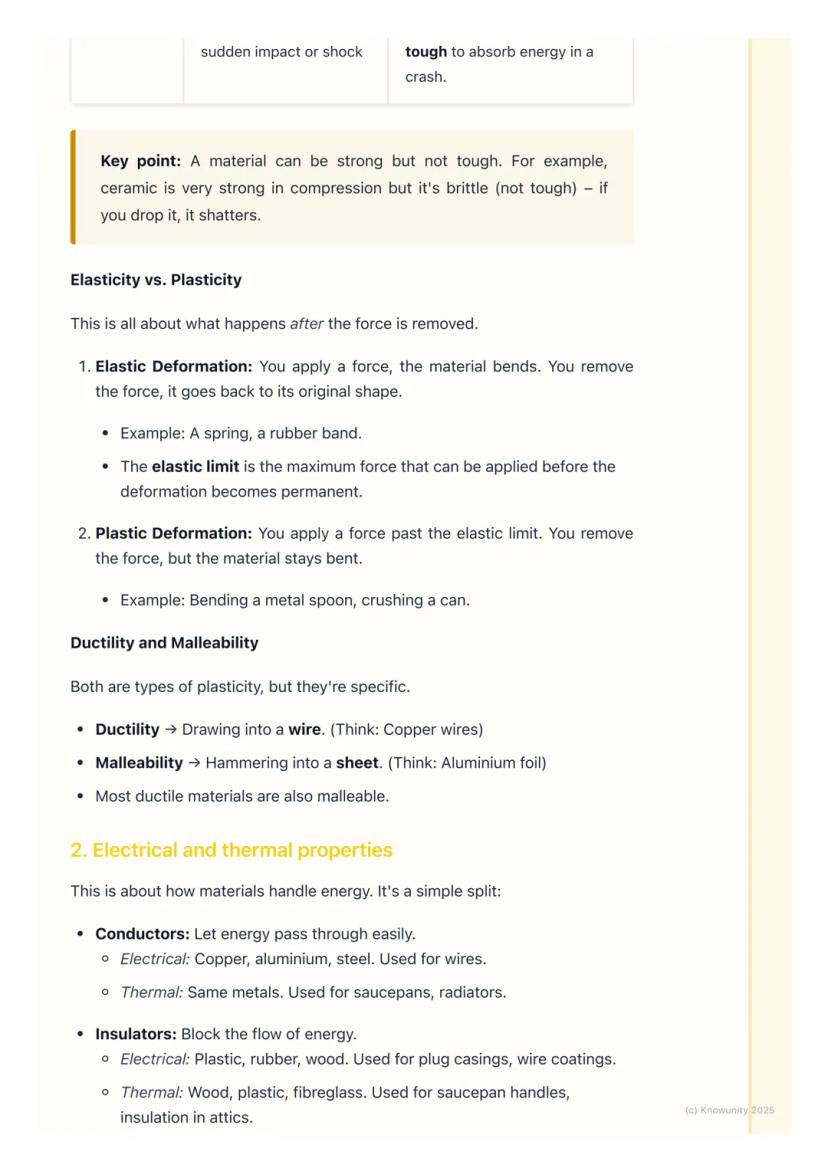
Here's where things get interesting - what happens when you remove the force? Elastic deformation means the material springs back to its original shape, like a rubber band or spring. The elastic limit is the maximum force you can apply before this stops working.
Plastic deformation is permanent - once you've bent that paperclip or crushed that can, it's staying that way. This isn't necessarily bad; sometimes you want materials to deform permanently.
Two special types of plasticity are ductility and malleability . Most materials that are good at one are good at both.
Quick check: If you can stretch it into a wire, it's ductile. If you can hammer it flat, it's malleable.
4
of 6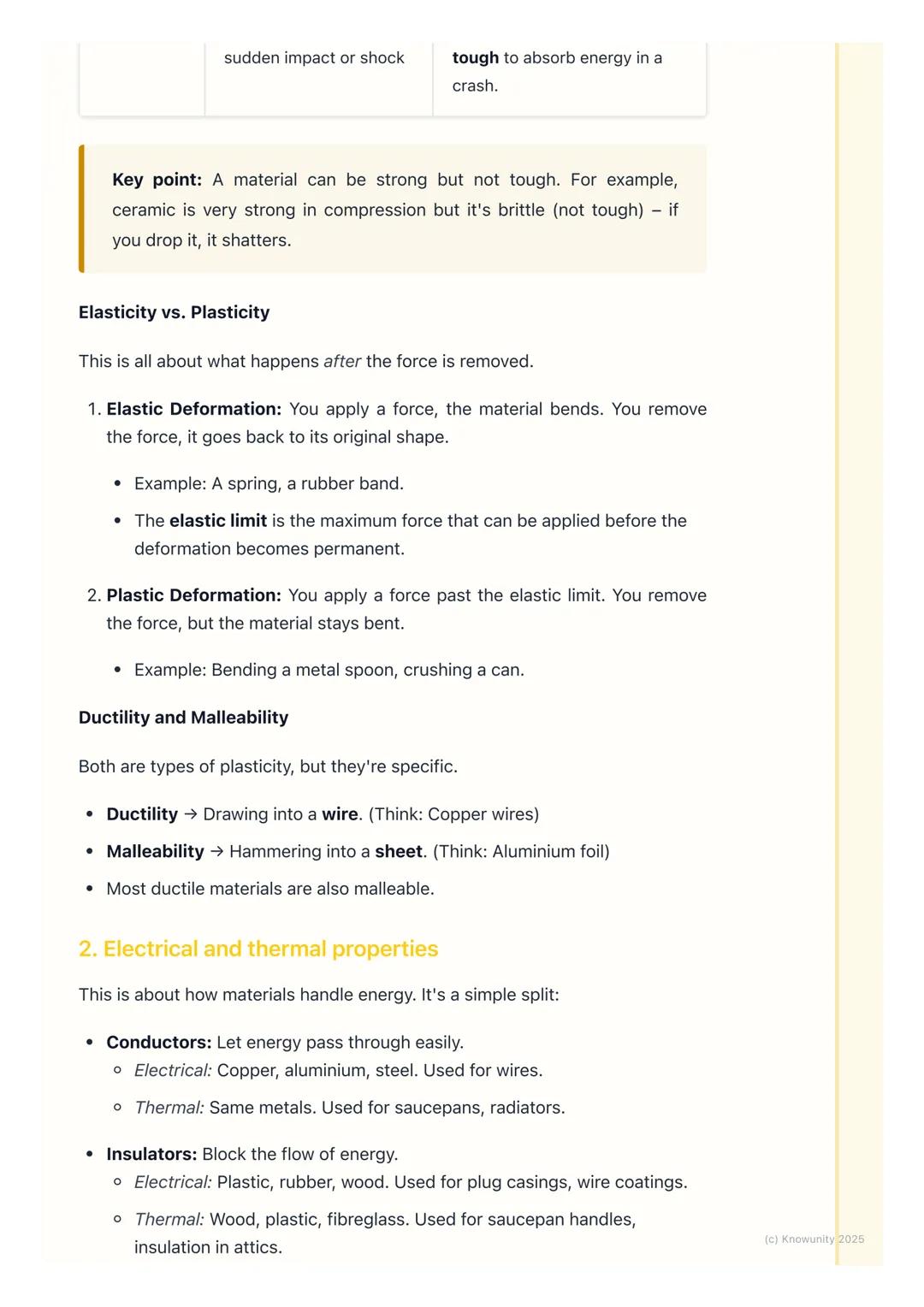
Electrical and Thermal Properties
Materials either let energy flow through them or block it - there's no middle ground here! Conductors like copper, aluminium and steel let both electricity and heat pass through easily, which is why they're used for wires and saucepans.
Insulators like plastic, rubber and wood block energy flow. That's why electrical plugs have plastic casings and saucepans have wooden handles - you don't want electricity or heat reaching you!
The same materials that conduct electricity usually conduct heat too, and the same materials that insulate against electricity also insulate against heat. This makes choosing materials much simpler.
Real-world connection: Your phone charger uses copper wires (conductor) wrapped in plastic (insulator) - perfect combo!
5
of 6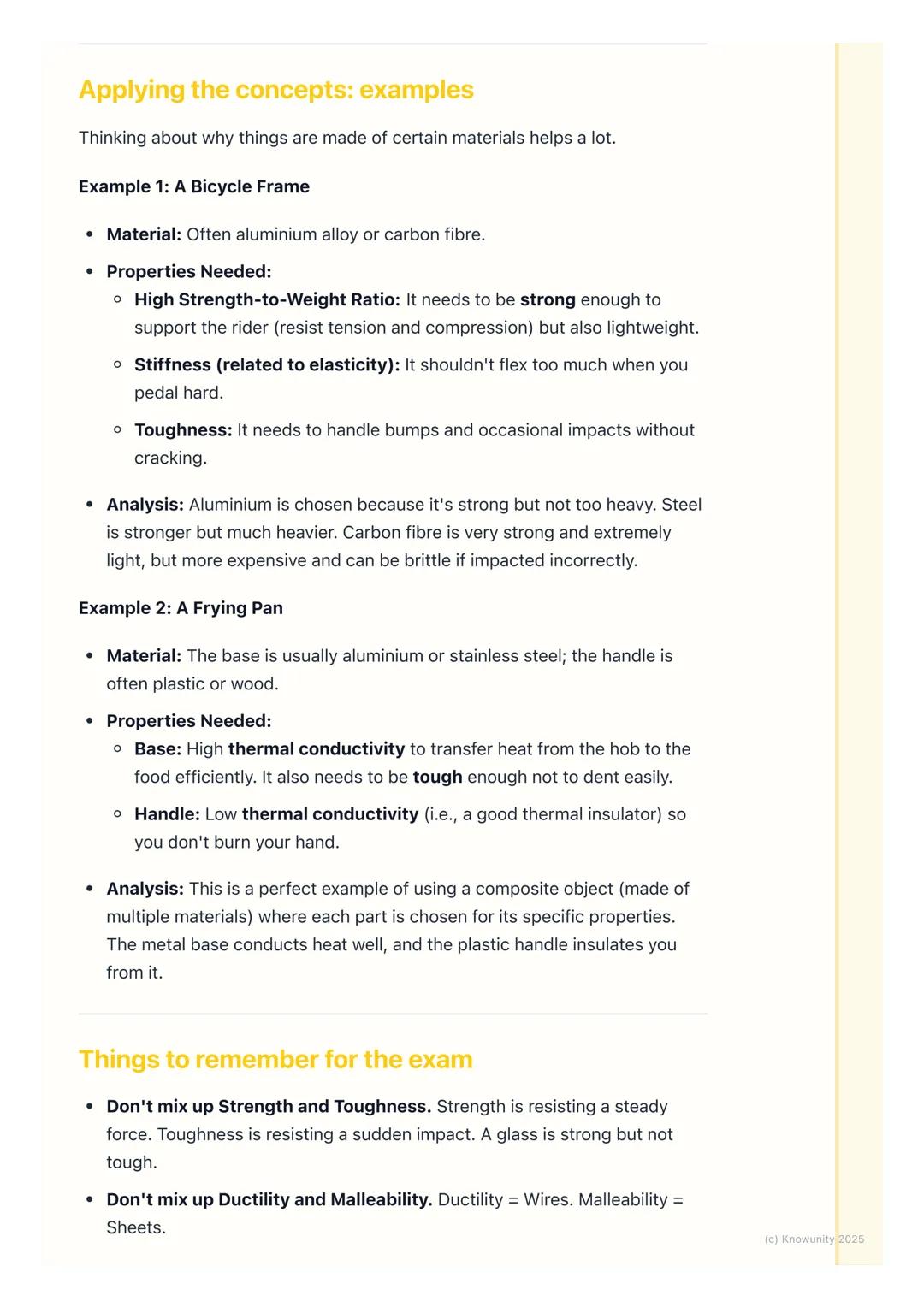
Real-World Applications
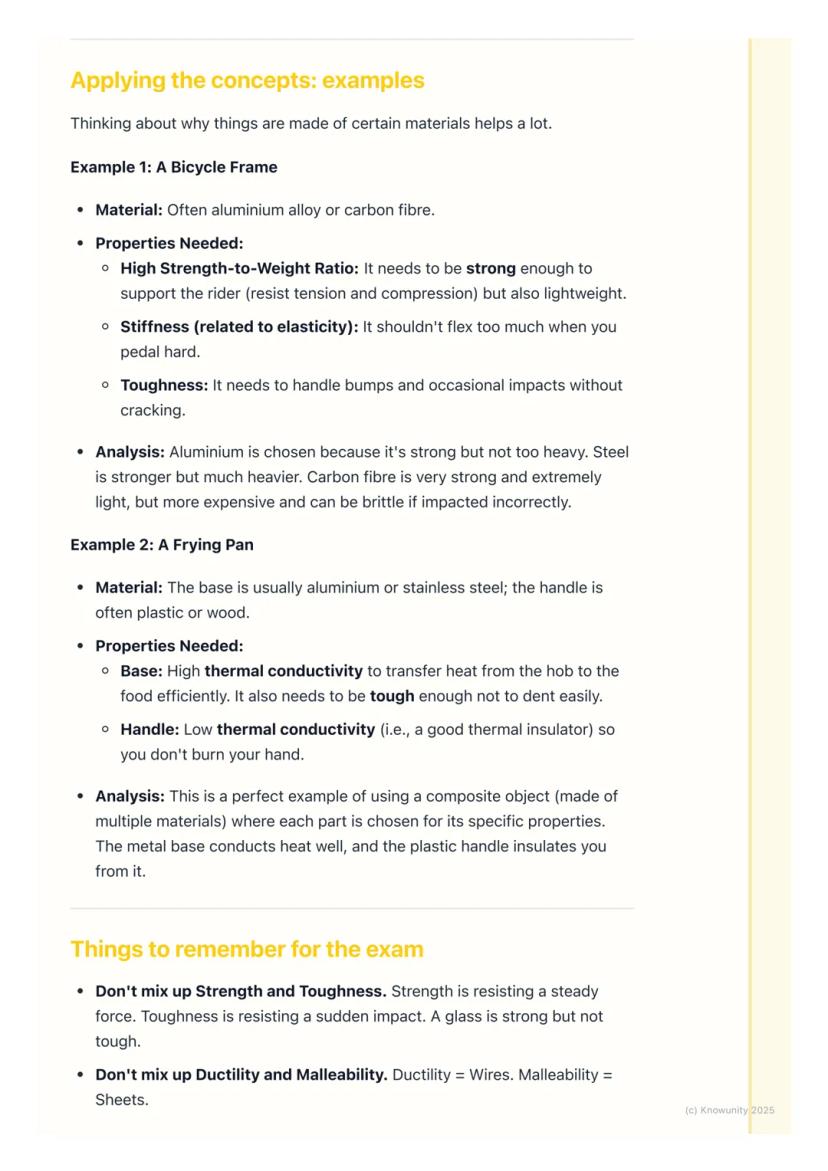
Let's see how this works in practice! A bicycle frame needs high strength-to-weight ratio (strong but light), stiffness (won't flex when pedalling), and toughness (handles bumps). That's why they use aluminium alloy or carbon fibre instead of steel or plastic.
A frying pan shows brilliant material pairing - the base is aluminium or steel for high thermal conductivity (heats food efficiently), while the handle is plastic or wood for thermal insulation (protects your hand). Each part does its specific job perfectly.
These examples show why engineers often use composite objects made from multiple materials. Instead of finding one perfect material, they combine different materials where each one's properties shine.
Think like an engineer: Always ask "What does this part need to do?" then match those needs to material properties.
6
of 6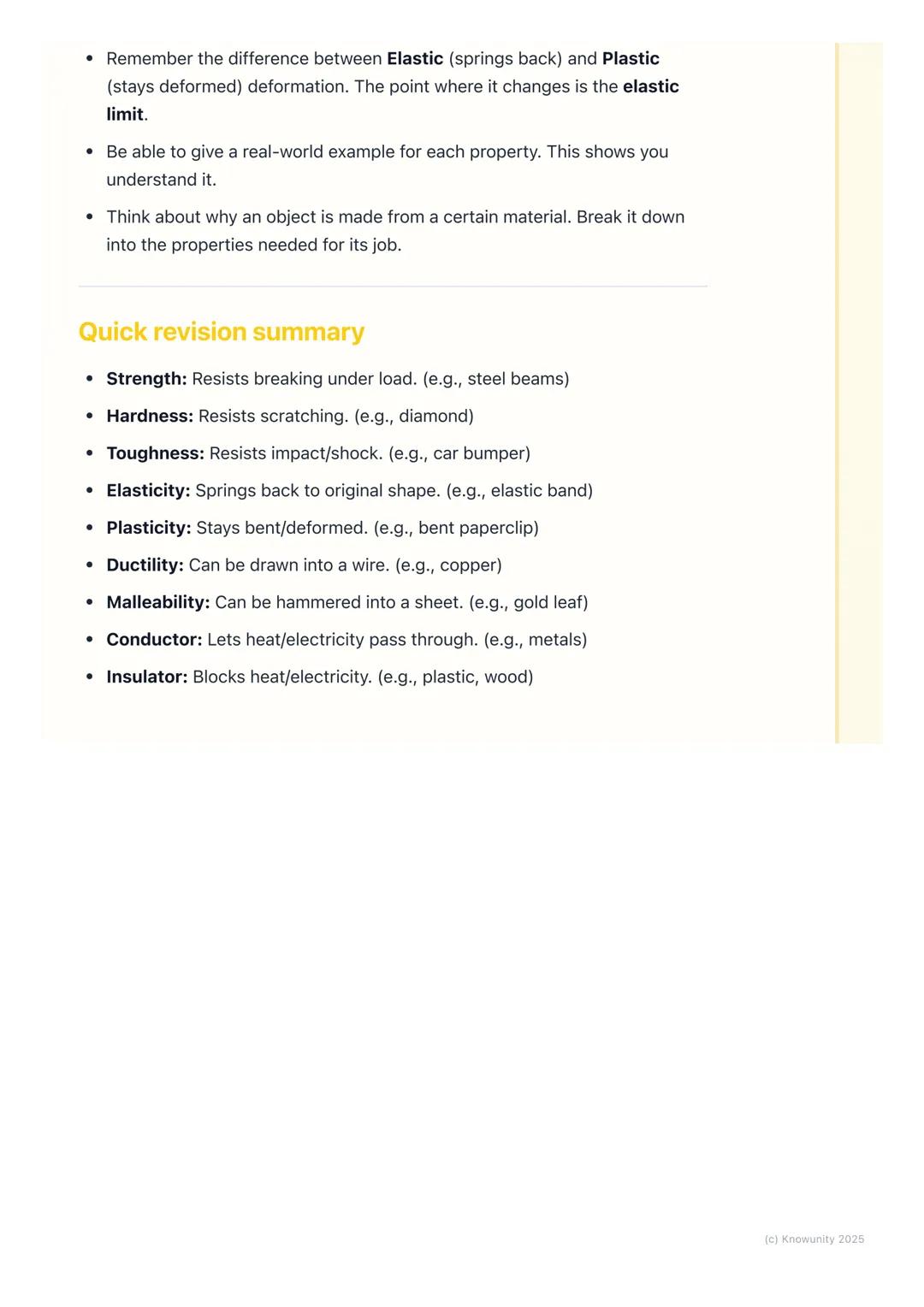
Exam Success Tips
Here are the key points that trip up students: Don't mix up strength (resists steady forces) with toughness (resists sudden impacts). Remember that ductility means wires and malleability means sheets.
The elastic limit is your friend - it's the point where materials stop springing back and start staying bent. Understanding this helps explain why springs work and why bent metal doesn't fix itself.
For any exam question about material choice, break it down systematically: what forces will act on it? Does it need to conduct or insulate? How important is weight? Then match these needs to the right properties.
Exam strategy: Always give real-world examples - they prove you understand the concept, not just the definition.
We thought you’d never ask...
What is the Knowunity AI companion?
Our AI companion is specifically built for the needs of students. Based on the millions of content pieces we have on the platform we can provide truly meaningful and relevant answers to students. But its not only about answers, the companion is even more about guiding students through their daily learning challenges, with personalised study plans, quizzes or content pieces in the chat and 100% personalisation based on the students skills and developments.
Where can I download the Knowunity app?
You can download the app in the Google Play Store and in the Apple App Store.
Is Knowunity really free of charge?
That's right! Enjoy free access to study content, connect with fellow students, and get instant help – all at your fingertips.
Most popular content in Engineering
1Most popular content
9 Irish
IrishIrish oral questions and answers
Questions and answers for the leaving cert oral
5th Year4254
IrishIrish oral questions
Outline of oral questions
5th Year2055
IrishGaeilge Grammar Office
All the basics you need to know on Irish grammar.
6th Year893
 English
Key Quotes : Sive
Key Quotes and explanations: Sive
6th Year2272
IrishAn Gaeilge Aiste
Irish Language essay
6th Year1250
IrishIrish poetry 2027
Iníon + Dínit an Bhróin
5th Year1133
IrishMé Féin & Mo Chlann (Myself & My Family)
Students will learn vocabulary to describe themselves, their family members, and daily routines. This helps in personal introductions and discussions.
TY291
IrishLC HL notes- Iníon (poem)
Includes poem in English and Irish, theme, key words & phrases
5th Year2284
 Geography
Territory, economic activities in Paris basin
essay
6th Year80
Can't find what you're looking for? Explore other subjects.
Students love us — and so will you.
4.6/5App Store
4.7/5Google Play
The app is very easy to use and well designed. I have found everything I was looking for so far and have been able to learn a lot from the presentations! I will definitely use the app for a class assignment! And of course it also helps a lot as an inspiration.
Stefan SiOS user
This app is really great. There are so many study notes and help [...]. My problem subject is French, for example, and the app has so many options for help. Thanks to this app, I have improved my French. I would recommend it to anyone.
Samantha KlichAndroid user
Wow, I am really amazed. I just tried the app because I've seen it advertised many times and was absolutely stunned. This app is THE HELP you want for school and above all, it offers so many things, such as workouts and fact sheets, which have been VERY helpful to me personally.
AnnaiOS user
Engineering2 views·Updated May 17, 2026·6 pagesUnderstanding Material Properties
Ever wonder why bridges are made from steel instead of glass, or why phone cases aren't made from metal? Engineers have to choose the perfect materials for every job, and it all comes down to understanding material properties. These properties... Show more
1
of 6Sign up to see the content. It's free!
- Access to all documents
- Improve your grades
- Join milions of students
Introduction to Material Properties
Choosing the right material for any project is like picking the right tool for a job - get it wrong and everything falls apart! Material properties are the characteristics that tell us how a substance will behave under different conditions.
Understanding these properties is absolutely crucial for engineers designing everything from bridges to smartphones. They need to know whether a material will bend without breaking, conduct electricity, or withstand extreme temperatures.
The key is matching the material's natural abilities to what the job demands. You wouldn't use rubber for a building foundation or concrete for electrical wires - each material has its own superpowers and weaknesses.
Remember: Every material choice in engineering comes down to finding the perfect match between what's needed and what the material can actually do.
2
of 6Sign up to see the content. It's free!
- Access to all documents
- Improve your grades
- Join milions of students
Key Mechanical Properties
Mechanical properties are all about how materials handle forces - and there are some crucial differences you need to nail down. Strength is a material's ability to resist breaking under steady forces, whether that's tension (pulling), compression (squashing), or shear (slicing).
Don't confuse strength with toughness - that's a material's ability to absorb sudden impacts without fracturing. Think of it this way: glass is strong but not tough (it shatters when dropped), while a car bumper is tough because it absorbs crash energy.
Hardness is completely different again - it's about resisting scratches and surface damage. A diamond is incredibly hard, which is why it can cut through almost anything else.
Pro tip: Ceramic tiles are strong in compression but brittle under impact - perfect for floors but terrible for hammers!
3
of 6Sign up to see the content. It's free!
- Access to all documents
- Improve your grades
- Join milions of students
Elasticity vs Plasticity
Here's where things get interesting - what happens when you remove the force? Elastic deformation means the material springs back to its original shape, like a rubber band or spring. The elastic limit is the maximum force you can apply before this stops working.
Plastic deformation is permanent - once you've bent that paperclip or crushed that can, it's staying that way. This isn't necessarily bad; sometimes you want materials to deform permanently.
Two special types of plasticity are ductility and malleability . Most materials that are good at one are good at both.
Quick check: If you can stretch it into a wire, it's ductile. If you can hammer it flat, it's malleable.
4
of 6Sign up to see the content. It's free!
- Access to all documents
- Improve your grades
- Join milions of students
Electrical and Thermal Properties
Materials either let energy flow through them or block it - there's no middle ground here! Conductors like copper, aluminium and steel let both electricity and heat pass through easily, which is why they're used for wires and saucepans.
Insulators like plastic, rubber and wood block energy flow. That's why electrical plugs have plastic casings and saucepans have wooden handles - you don't want electricity or heat reaching you!
The same materials that conduct electricity usually conduct heat too, and the same materials that insulate against electricity also insulate against heat. This makes choosing materials much simpler.
Real-world connection: Your phone charger uses copper wires (conductor) wrapped in plastic (insulator) - perfect combo!
5
of 6Sign up to see the content. It's free!
- Access to all documents
- Improve your grades
- Join milions of students
Real-World Applications
Let's see how this works in practice! A bicycle frame needs high strength-to-weight ratio (strong but light), stiffness (won't flex when pedalling), and toughness (handles bumps). That's why they use aluminium alloy or carbon fibre instead of steel or plastic.
A frying pan shows brilliant material pairing - the base is aluminium or steel for high thermal conductivity (heats food efficiently), while the handle is plastic or wood for thermal insulation (protects your hand). Each part does its specific job perfectly.
These examples show why engineers often use composite objects made from multiple materials. Instead of finding one perfect material, they combine different materials where each one's properties shine.
Think like an engineer: Always ask "What does this part need to do?" then match those needs to material properties.
6
of 6Sign up to see the content. It's free!
- Access to all documents
- Improve your grades
- Join milions of students
Exam Success Tips
Here are the key points that trip up students: Don't mix up strength (resists steady forces) with toughness (resists sudden impacts). Remember that ductility means wires and malleability means sheets.
The elastic limit is your friend - it's the point where materials stop springing back and start staying bent. Understanding this helps explain why springs work and why bent metal doesn't fix itself.
For any exam question about material choice, break it down systematically: what forces will act on it? Does it need to conduct or insulate? How important is weight? Then match these needs to the right properties.
Exam strategy: Always give real-world examples - they prove you understand the concept, not just the definition.
We thought you’d never ask...
What is the Knowunity AI companion?
Our AI companion is specifically built for the needs of students. Based on the millions of content pieces we have on the platform we can provide truly meaningful and relevant answers to students. But its not only about answers, the companion is even more about guiding students through their daily learning challenges, with personalised study plans, quizzes or content pieces in the chat and 100% personalisation based on the students skills and developments.
Where can I download the Knowunity app?
You can download the app in the Google Play Store and in the Apple App Store.
Is Knowunity really free of charge?
That's right! Enjoy free access to study content, connect with fellow students, and get instant help – all at your fingertips.
Most popular content in Engineering
1Most popular content
9IrishIrish oral questions and answers
Questions and answers for the leaving cert oral
5th Year4254
IrishIrish oral questions
Outline of oral questions
5th Year2055
IrishGaeilge Grammar Office
All the basics you need to know on Irish grammar.
6th Year893
EnglishKey Quotes : Sive
Key Quotes and explanations: Sive
6th Year2272
IrishAn Gaeilge Aiste
Irish Language essay
6th Year1250
IrishIrish poetry 2027
Iníon + Dínit an Bhróin
5th Year1133
IrishMé Féin & Mo Chlann (Myself & My Family)
Students will learn vocabulary to describe themselves, their family members, and daily routines. This helps in personal introductions and discussions.
TY291
IrishLC HL notes- Iníon (poem)
Includes poem in English and Irish, theme, key words & phrases
5th Year2284
GeographyTerritory, economic activities in Paris basin
essay
6th Year80
Can't find what you're looking for? Explore other subjects.
Students love us — and so will you.
4.6/5App Store
4.7/5Google Play
The app is very easy to use and well designed. I have found everything I was looking for so far and have been able to learn a lot from the presentations! I will definitely use the app for a class assignment! And of course it also helps a lot as an inspiration.
Stefan SiOS user
This app is really great. There are so many study notes and help [...]. My problem subject is French, for example, and the app has so many options for help. Thanks to this app, I have improved my French. I would recommend it to anyone.
Samantha KlichAndroid user
Wow, I am really amazed. I just tried the app because I've seen it advertised many times and was absolutely stunned. This app is THE HELP you want for school and above all, it offers so many things, such as workouts and fact sheets, which have been VERY helpful to me personally.
AnnaiOS user