
Ever wondered why we need different ways to express permission,... Show more
 Science
 Econ
Econ Araling Panlipunan (AP)
 Iba pa
 Practical Research
 DISS
DISSSign up to see the contentIt's free!
Access to all documents
Improve your grades
Join milions of students
By signing up you accept Terms of Service and Privacy Policy
Subjects

Biology

Chemistry
AP Chemistry

English
AP English Literature
25
0

Jona Mariz De Venecia
12/19/2025
English
English Grade 9 Notes 💙📒
1,744
•
Dec 19, 2025
•
Jona Mariz De Venecia
@jonadv
Ever wondered why we need different ways to express permission,... Show more
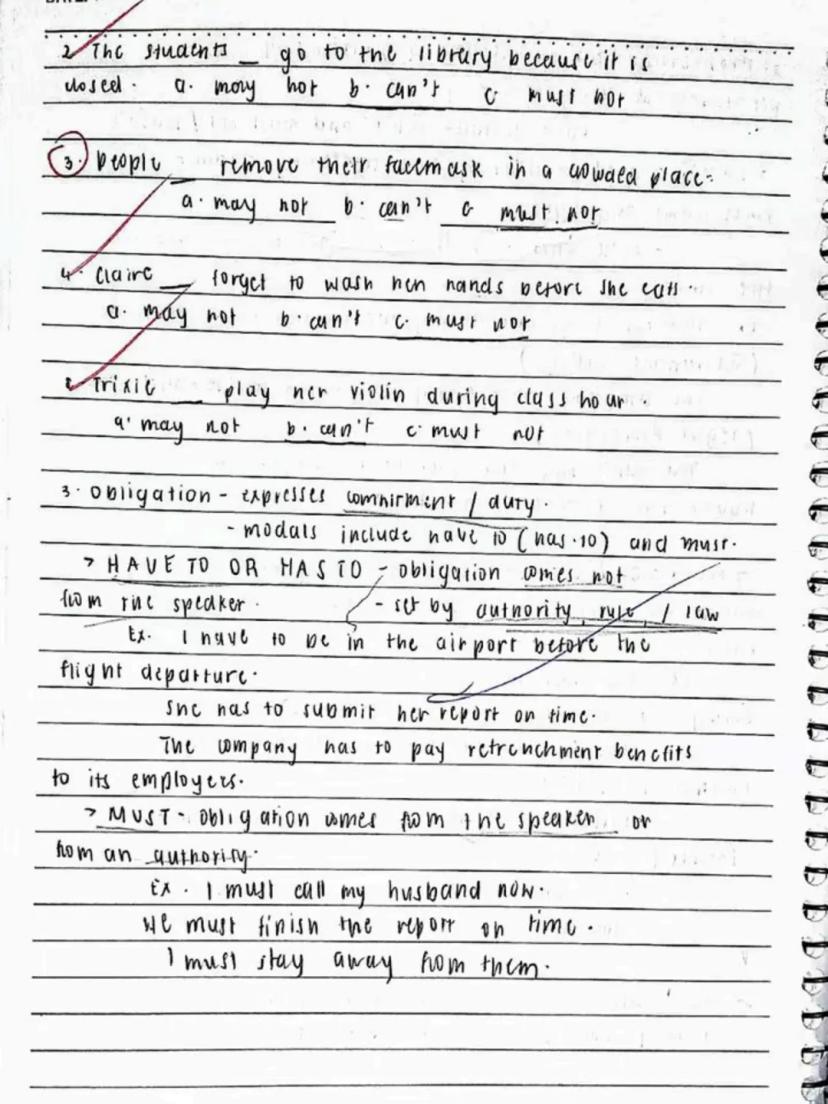
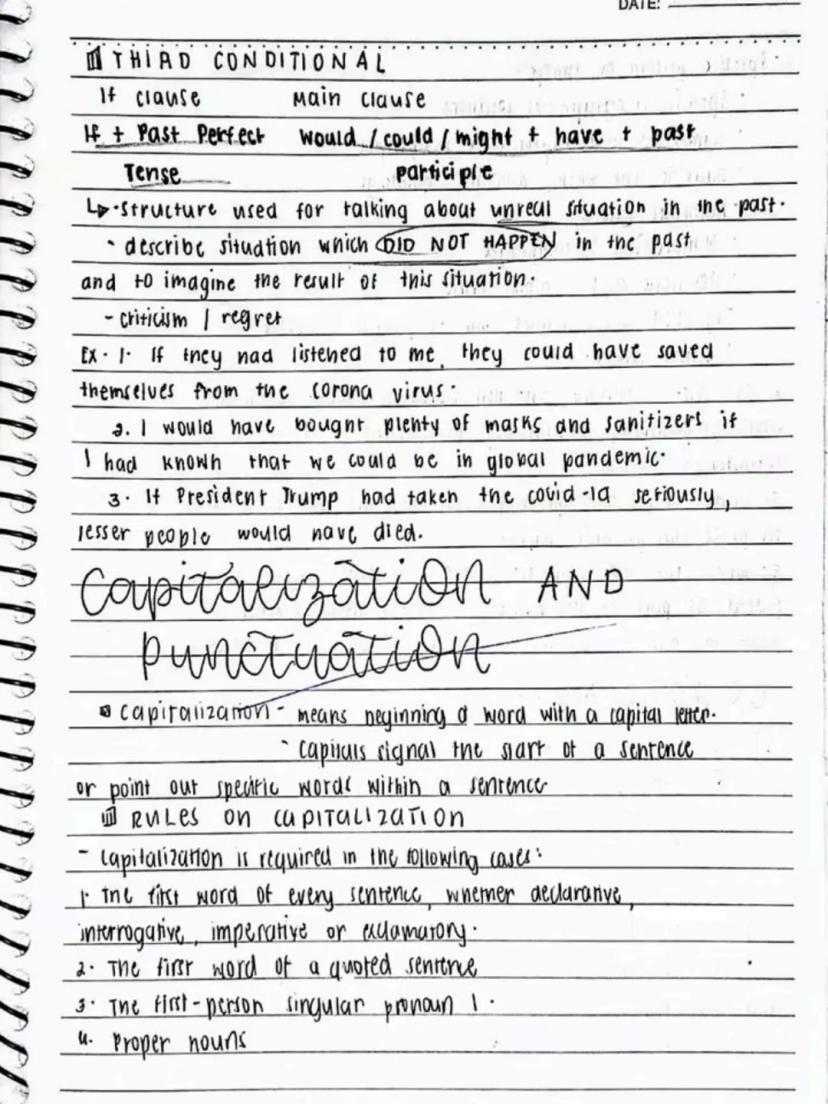
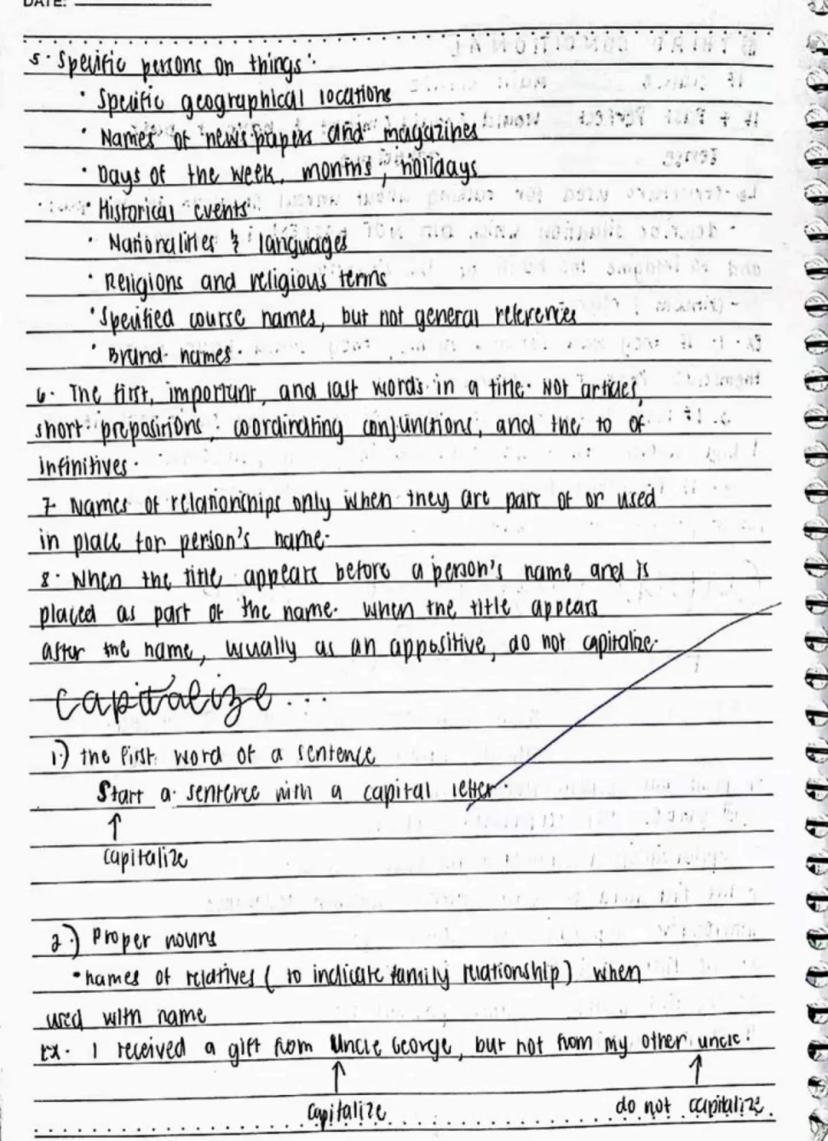
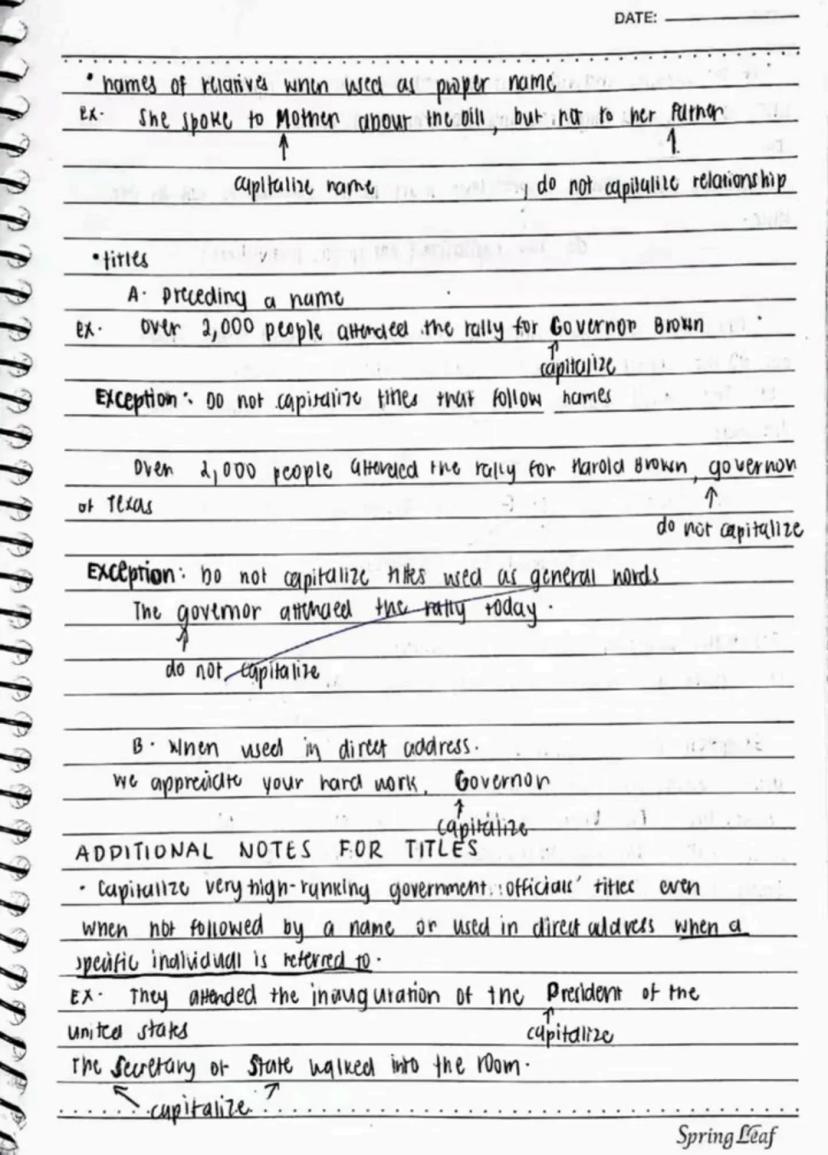
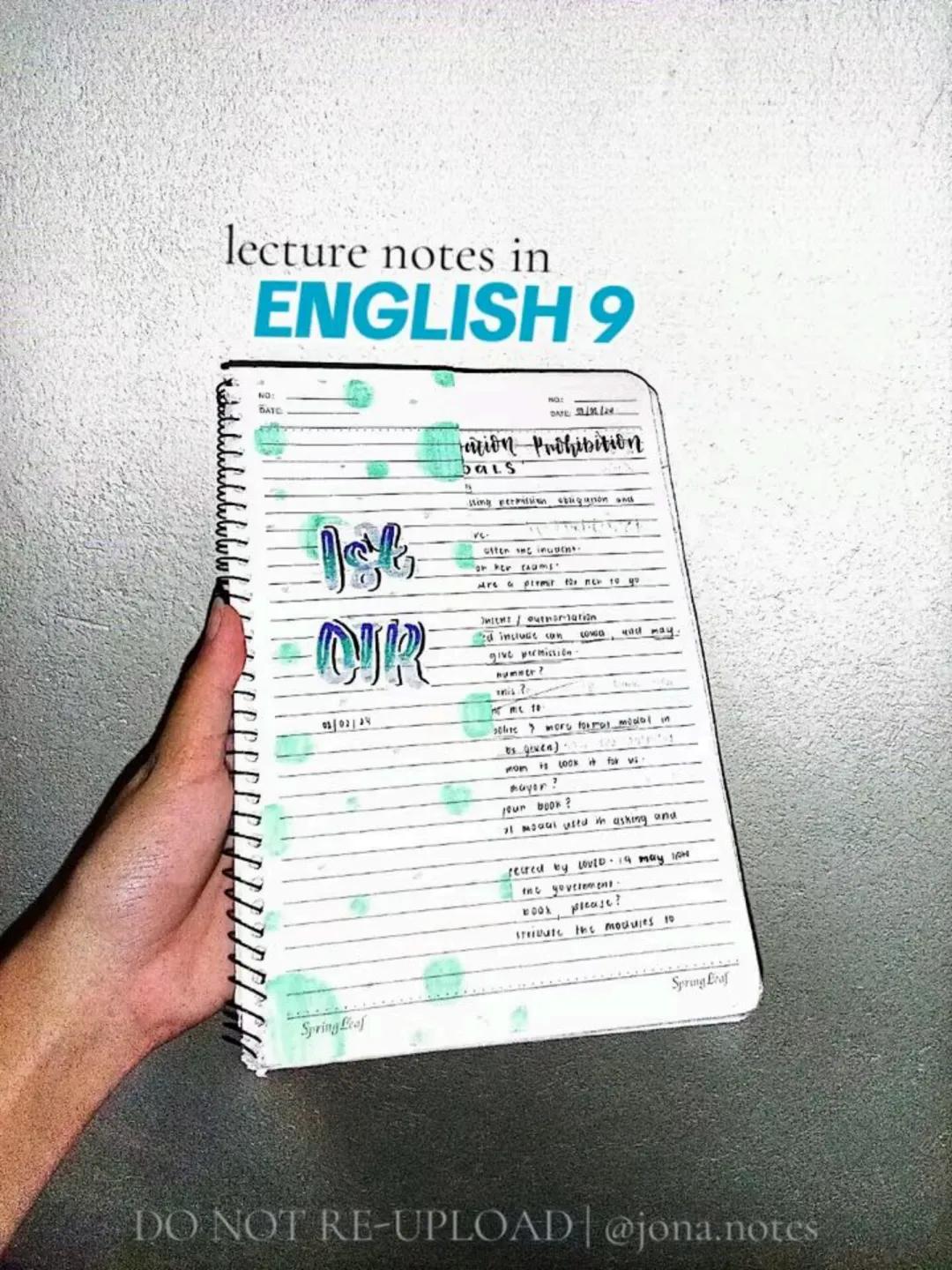
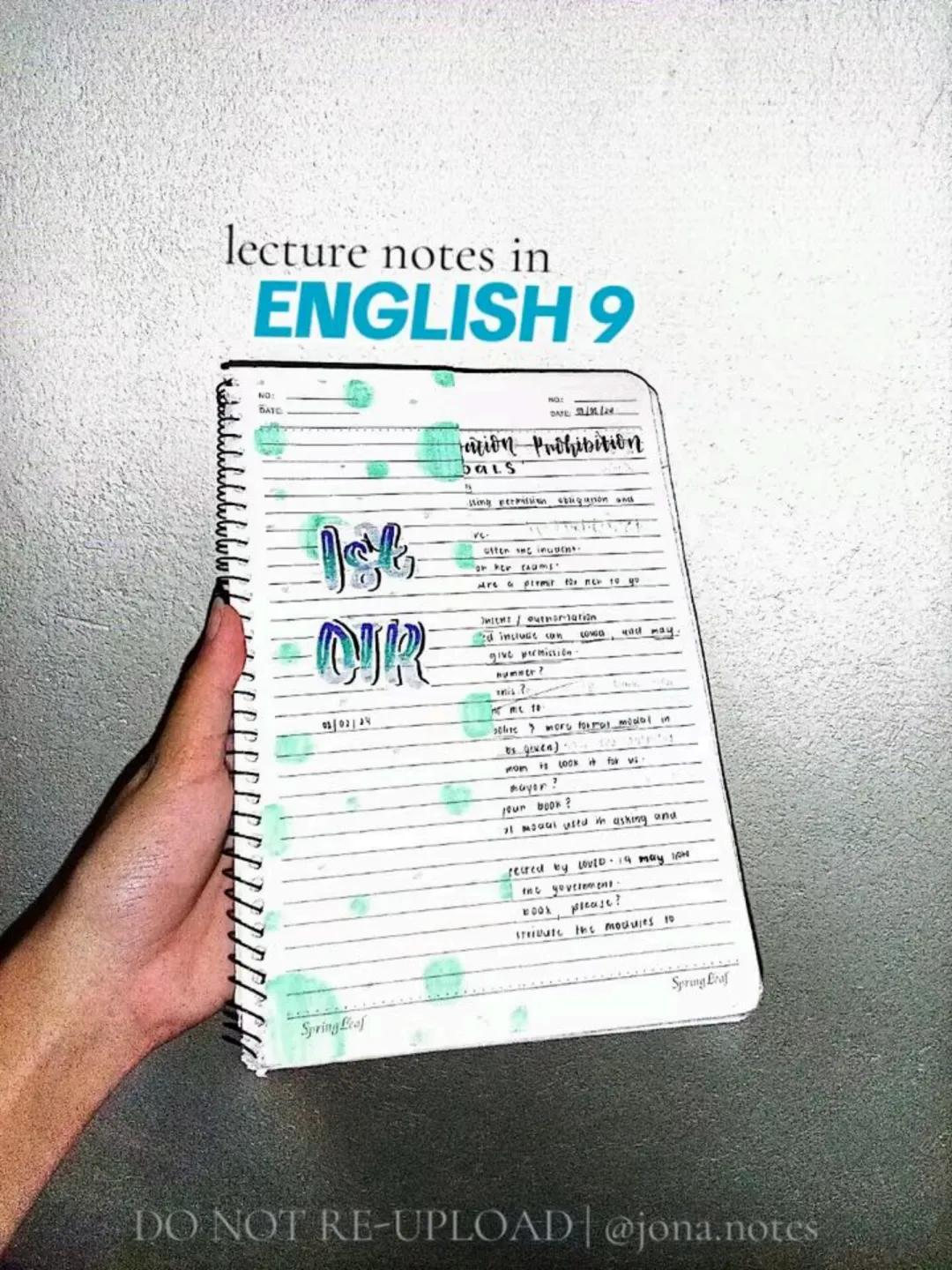
Language gives us powerful tools to express what is allowed, required, or forbidden. In English, we use special modal verbs to communicate these concepts clearly.
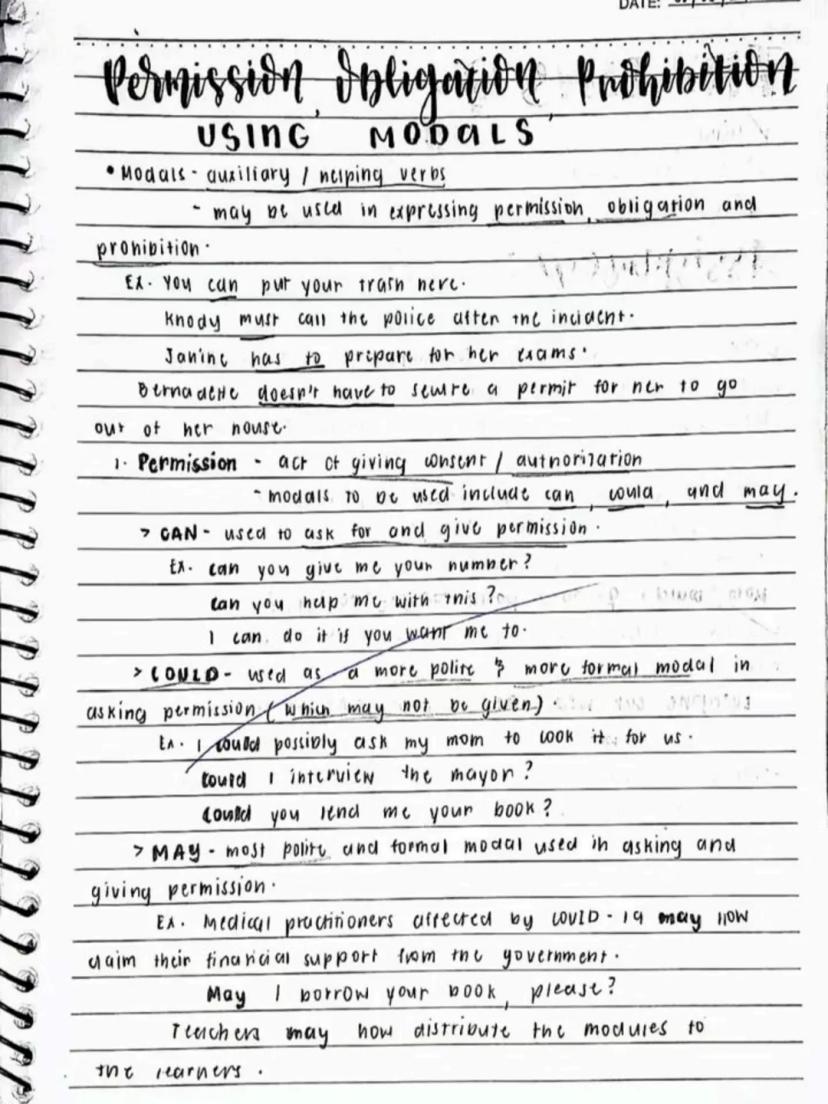
When asking for permission, we typically use "can," "could," or "may." "Can" is common and casual ("Can you give me your number?"), while "could" is more polite ("Could I borrow your book?"). "May" is the most formal option, perfect for professional settings ("May I borrow your book, please?").
Quick Tip: Choose your permission modal based on formality - "can" for friends, "could" for teachers, and "may" for very formal situations.
Modals help us express not just what's allowed, but also what's required (obligation) or forbidden (prohibition). These language tools are essential for clear communication in both casual conversations and formal writing.
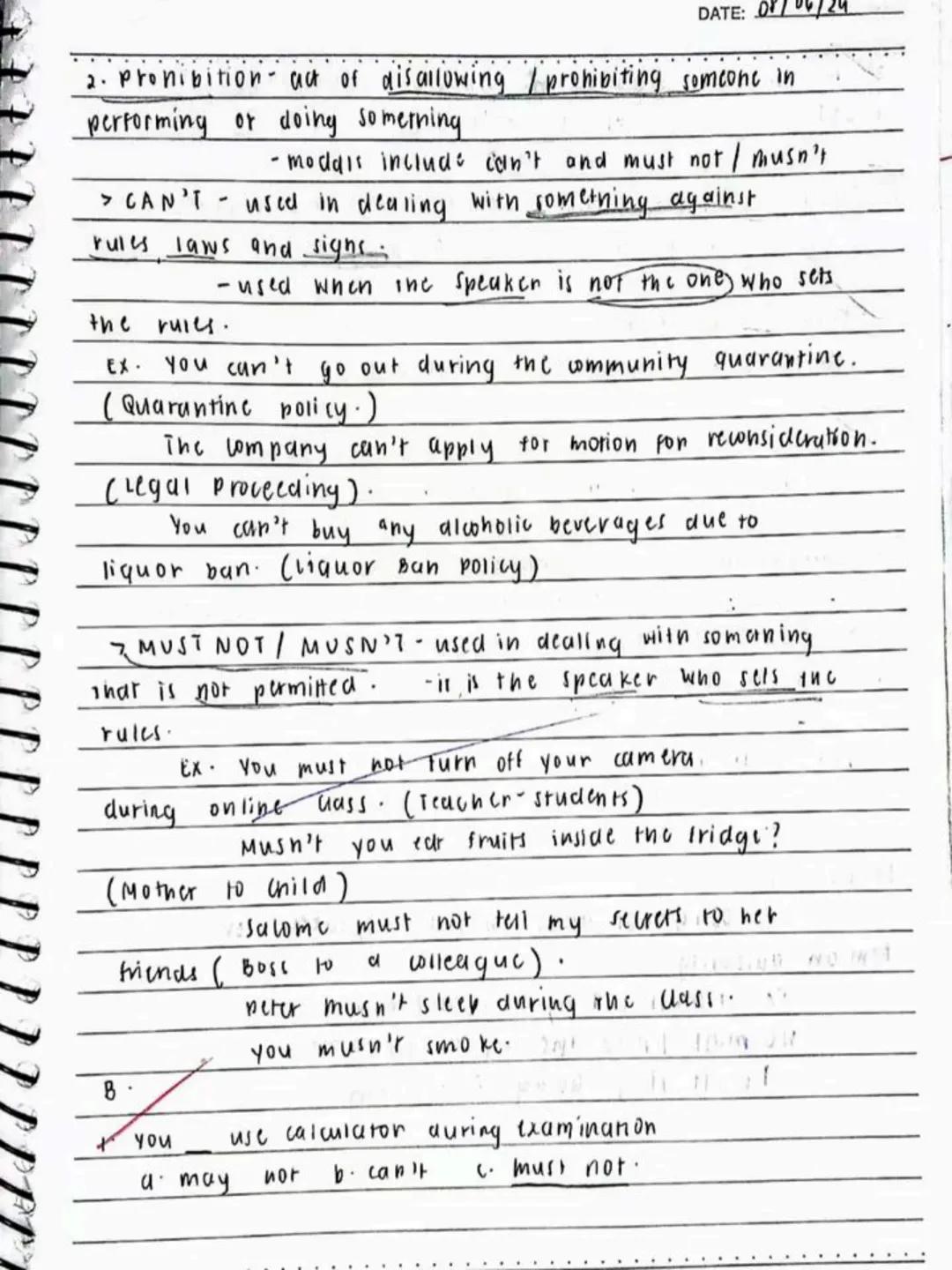
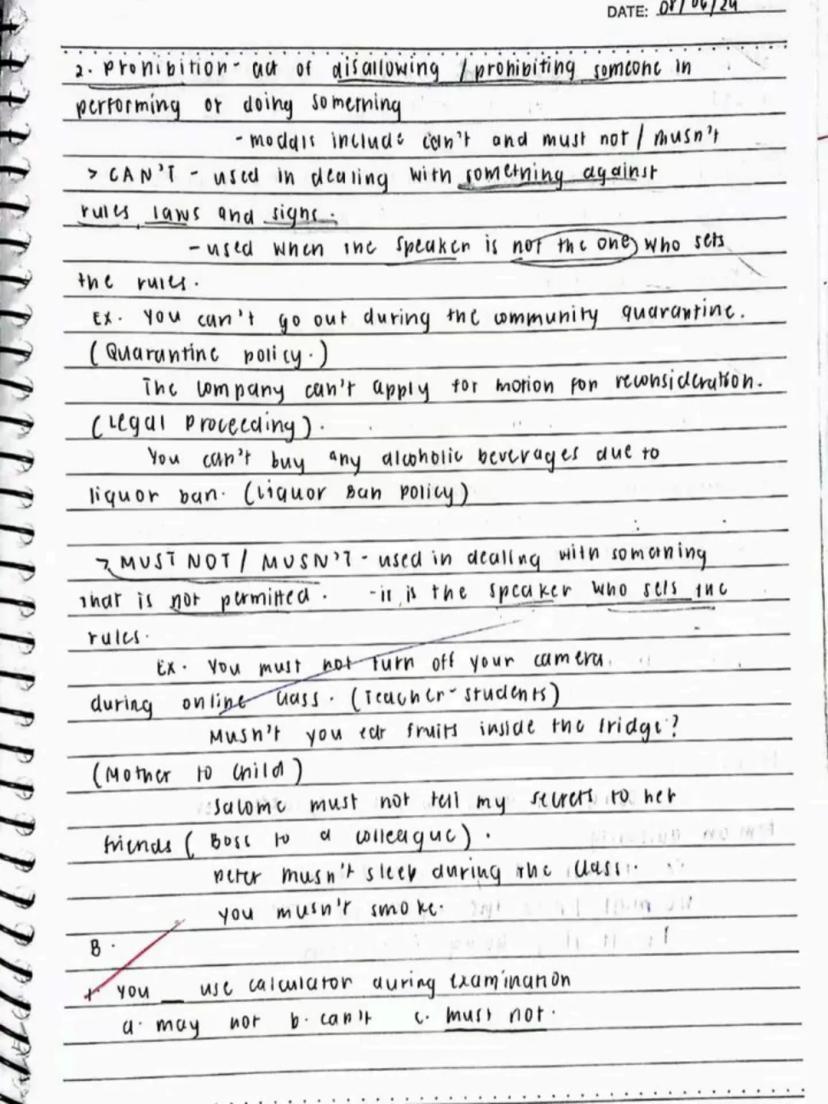
Prohibition means disallowing or preventing someone from doing something. The main modals used for prohibition are "can't" and "must not/mustn't."
Use can't when referring to rules, laws, or signs that you didn't create. For example:
Use must not/mustn't when you (the speaker) are the one setting the rules:
Remember: Use "can't" when referring to external rules, and "mustn't" when you're the authority making the rule.
The distinction is important! "Can't" suggests the prohibition comes from an outside authority, while "must not" indicates the speaker has the authority to forbid something.
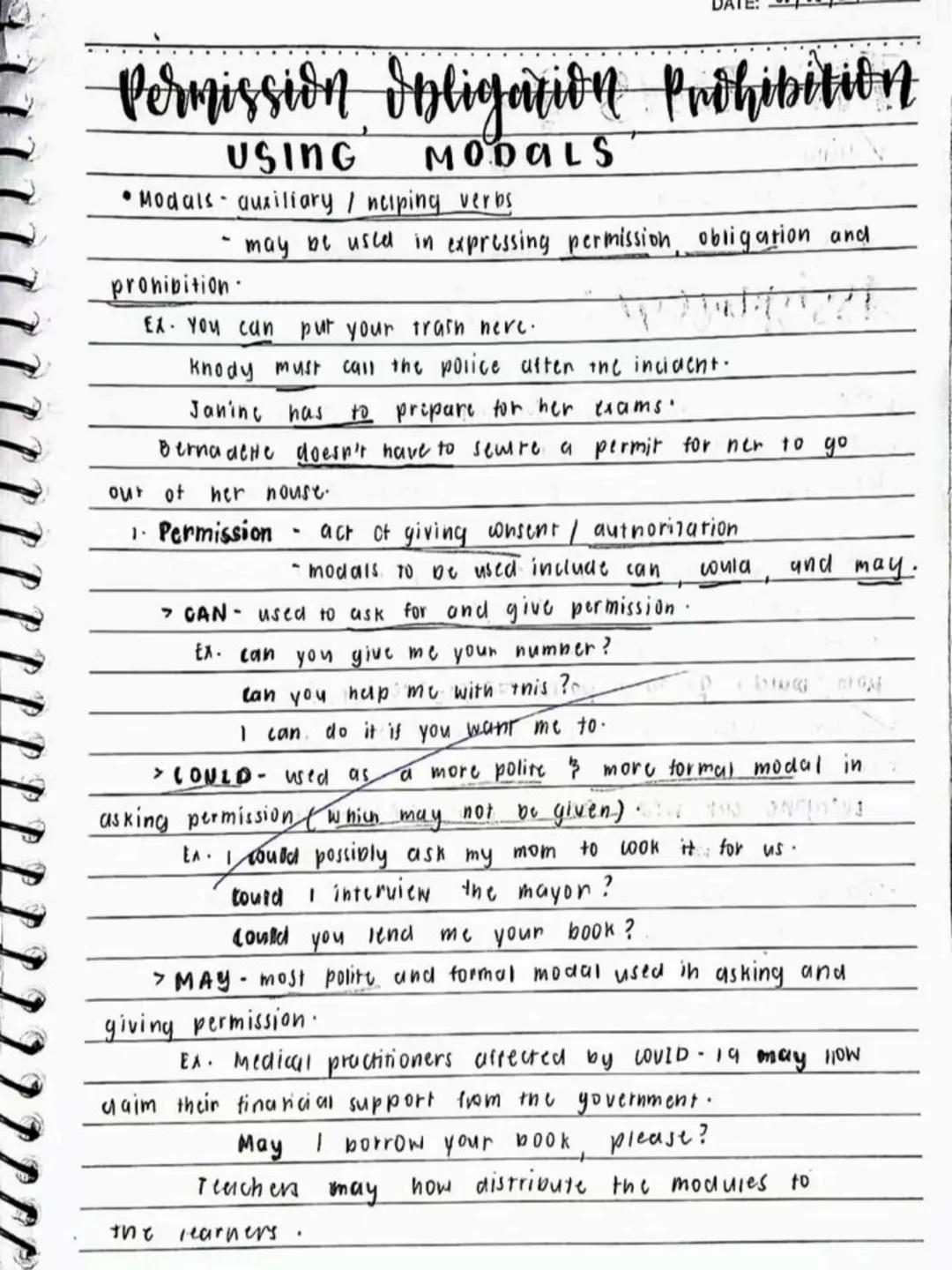
Modal verbs are auxiliary or helping verbs that express permission, obligation, and prohibition. They're essential tools for communicating what's allowed, required, or forbidden.
When giving or asking for permission, you have three main options:
Can - Used for everyday permission requests:
Could - A more polite and formal way to ask:
May - The most formal and polite modal:
Language Hack: When speaking with authority figures or in formal settings, use "may" to show respect and proper etiquette.
Understanding these permission modals helps you adjust your language to match different social situations and relationships.
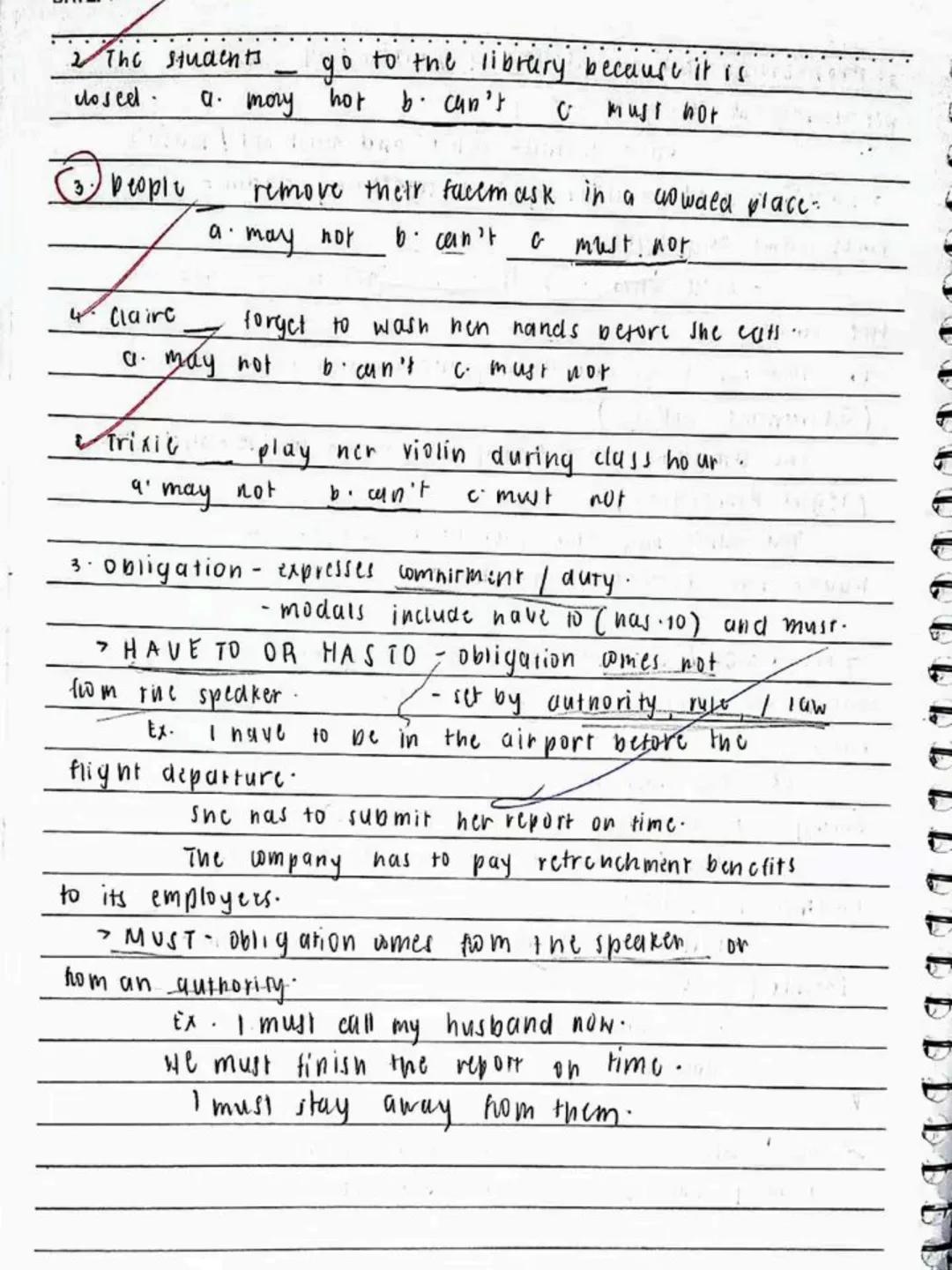
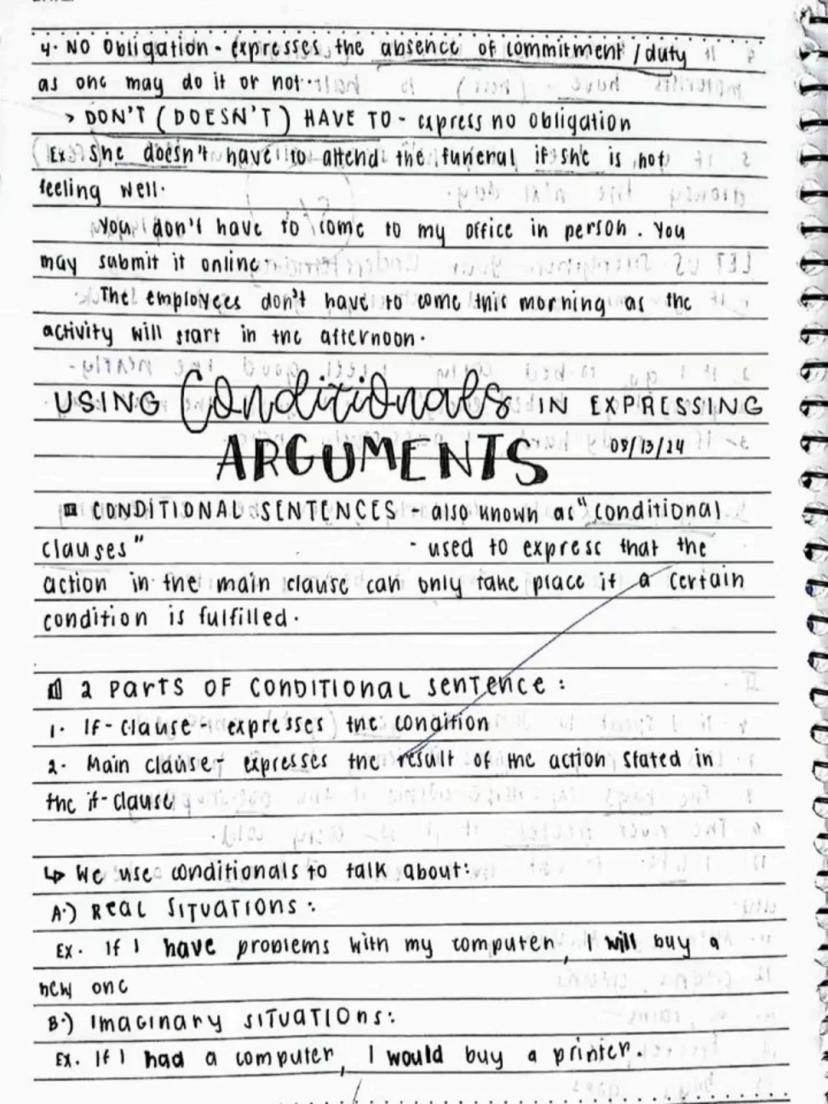
Obligation expresses duty or commitment. The main modals used are "have to/has to" and "must."
Use have to/has to when the obligation comes from an external source:
Use must when the obligation comes from the speaker or an authority:
No obligation is expressed using "don't/doesn't have to":
Pro Tip: Pay attention to who creates the obligation - if it's you, use "must"; if it's an external rule or law, use "have to."
Understanding these modals helps you communicate expectations clearly and appropriately in different contexts.
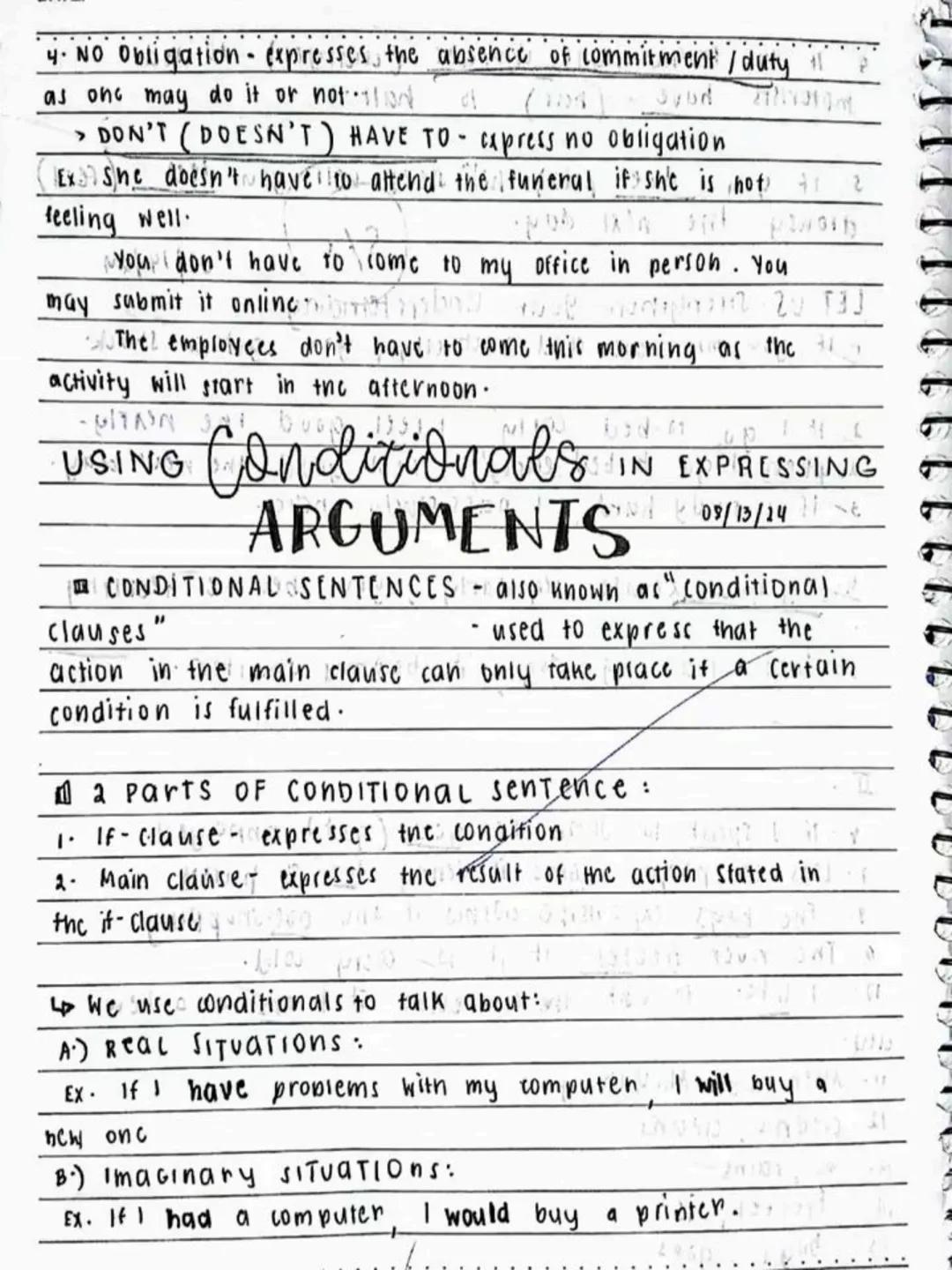
Conditional sentences help us express that one action depends on another condition being fulfilled. They have two parts:
We use conditionals to talk about both real and imaginary situations:
No obligation expressions show freedom from duty:
Think of it this way: Conditionals are like "cause and effect" statements - if this happens (cause), then this will happen (effect).
Understanding conditionals helps you express logical relationships between events and communicate both realistic and hypothetical scenarios.
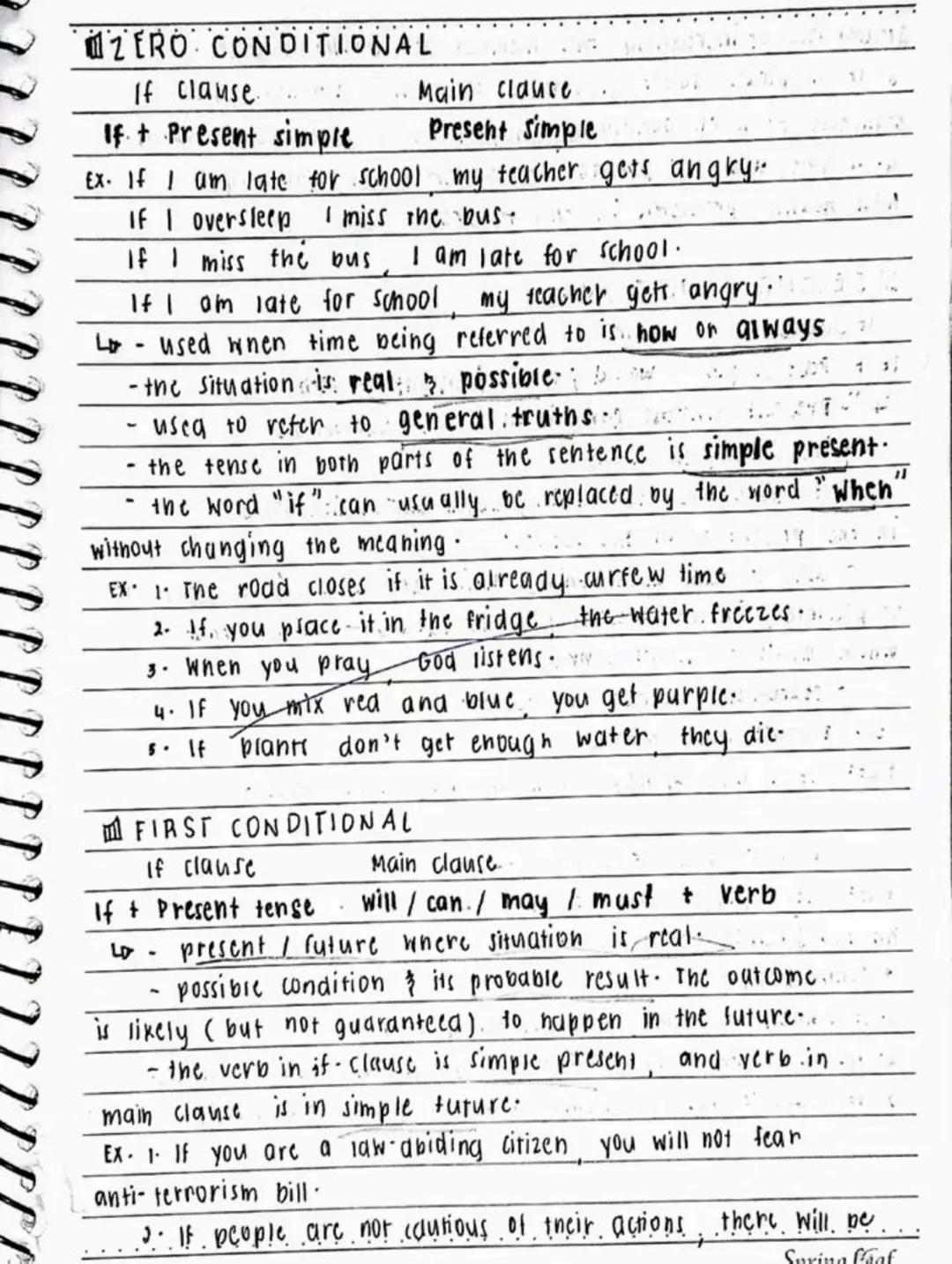
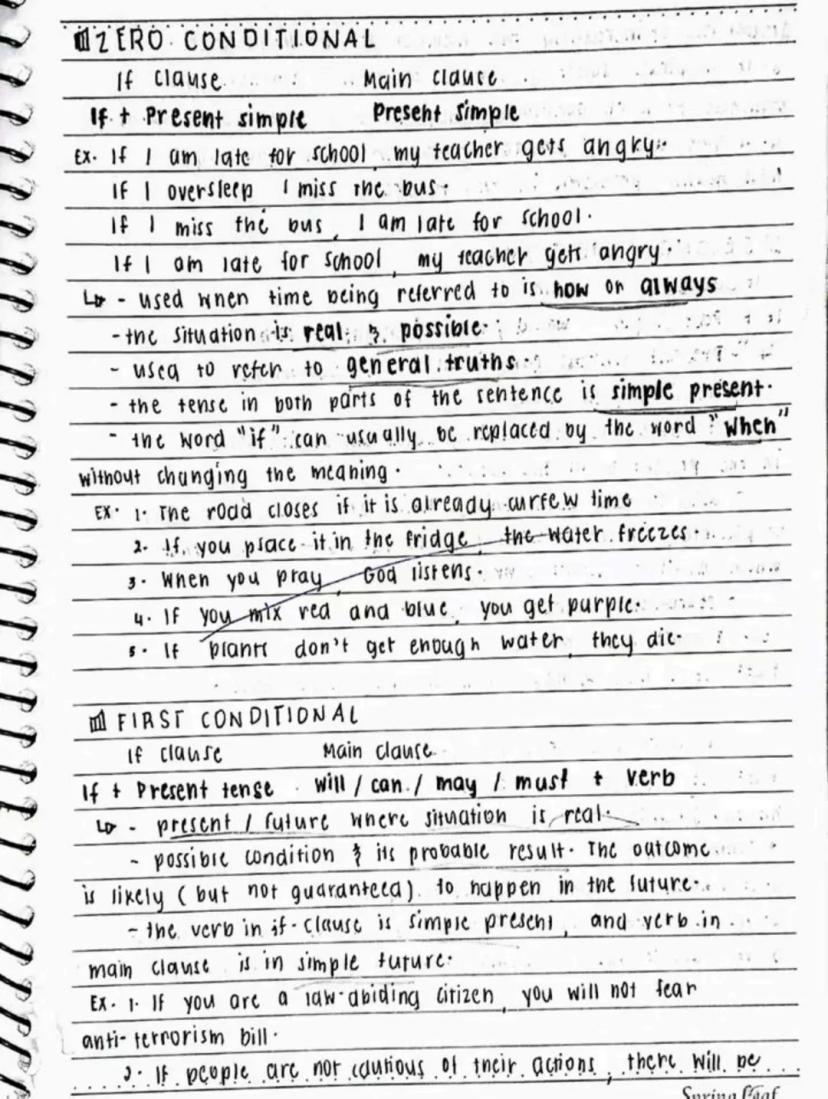
Zero Conditional is used for:
Examples:
First Conditional is used for:
Examples:
Key Difference: Zero conditional is for facts that are always true, while first conditional is for possible future situations and their likely results.
These conditional forms help you express different levels of certainty about cause-and-effect relationships.
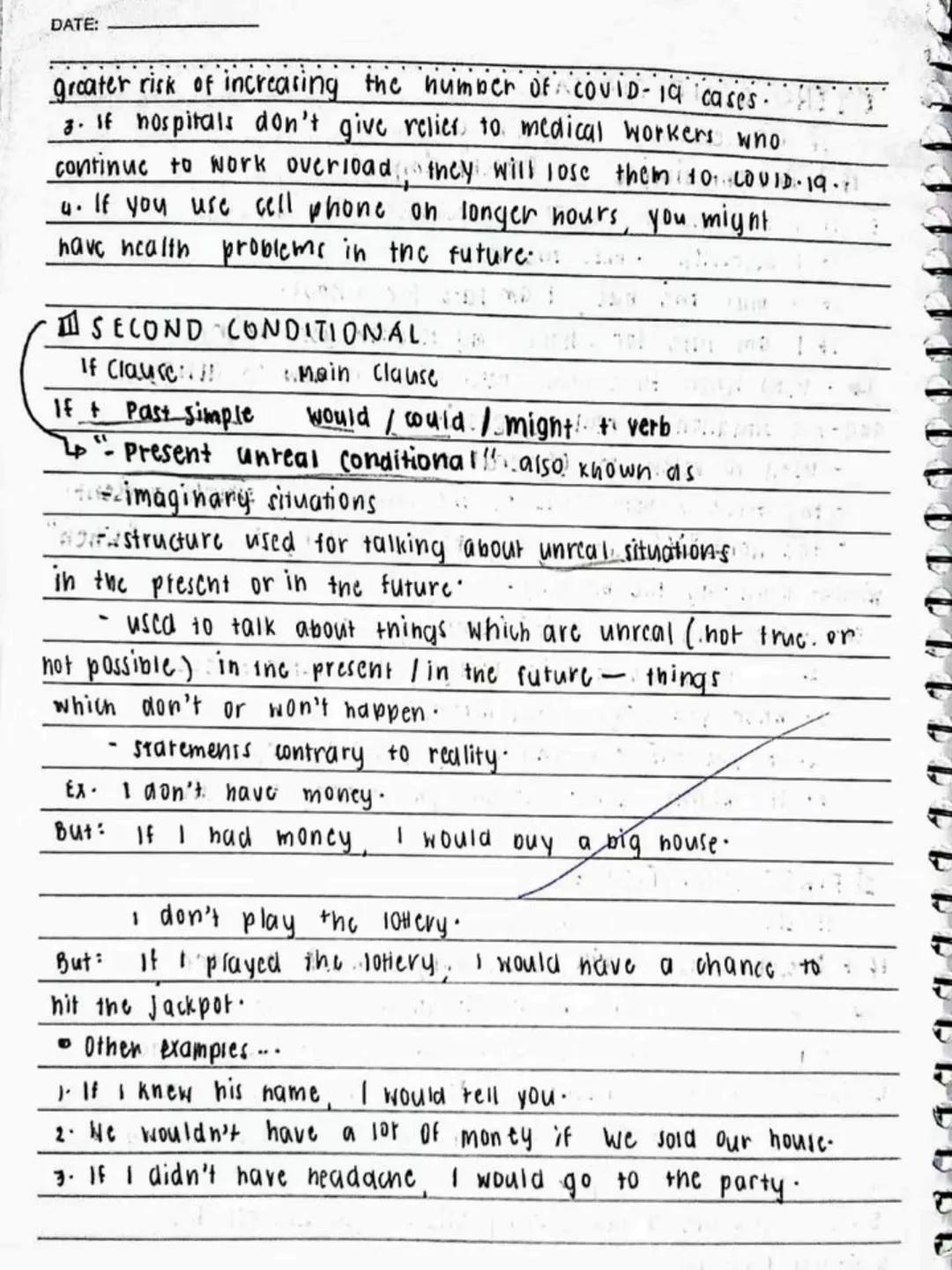
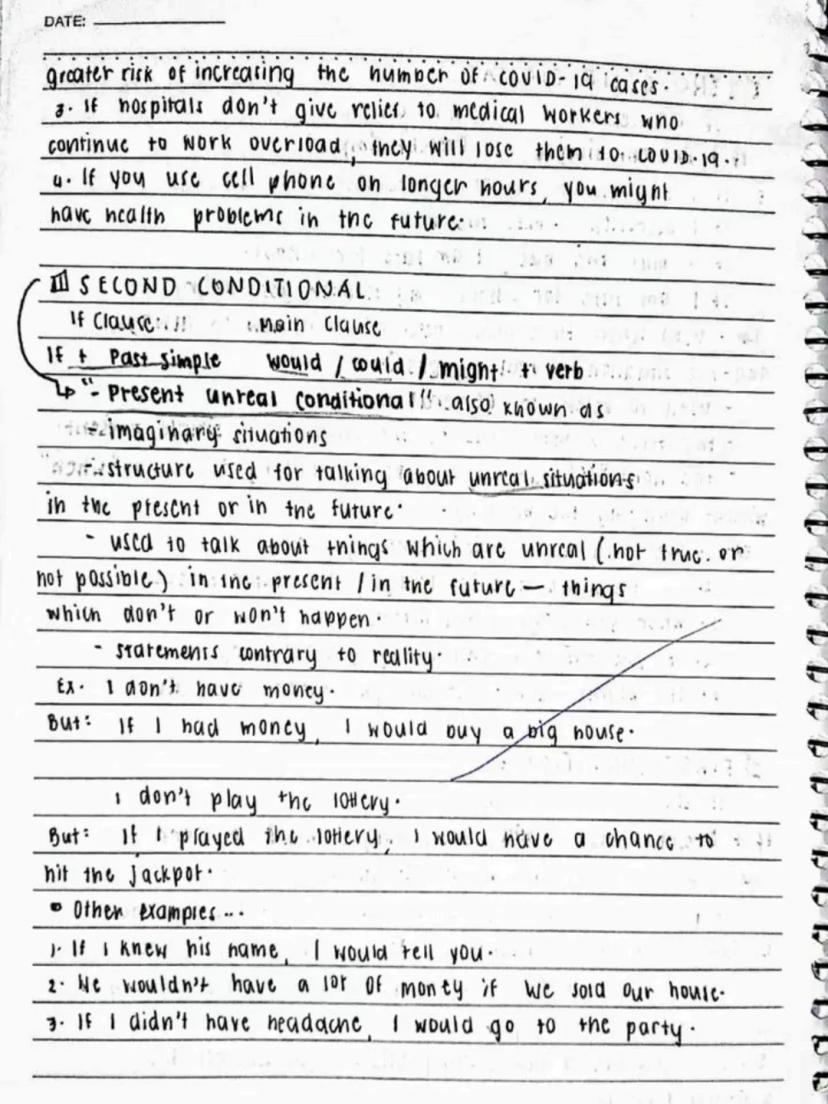
Second Conditional is used for:
Examples:
Third Conditional is used for:
Examples:
Remember: Second conditional is about imaginary present/future, while third conditional is about regrets or hypothetical past events.
These forms allow you to explore hypothetical scenarios and their consequences in sophisticated ways.
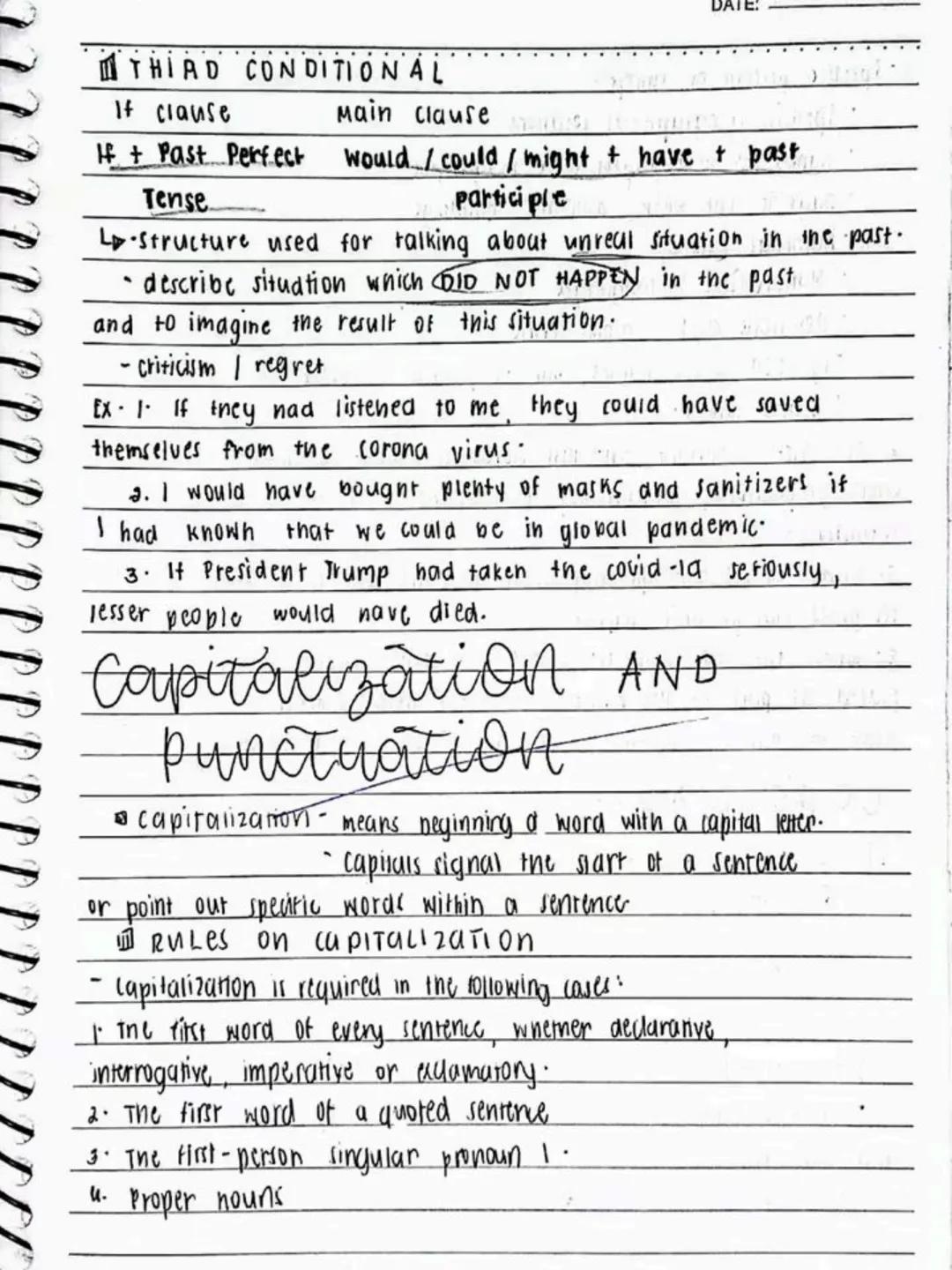
Capitalization means beginning a word with a capital letter. It helps signal the start of sentences and highlights specific words.
Capitalization is required in these key situations:
Quick Check: If you're referring to a specific person, place, or organization by name, it probably needs a capital letter.
Understanding capitalization rules helps your writing appear professional and ensures you're following standard English conventions.
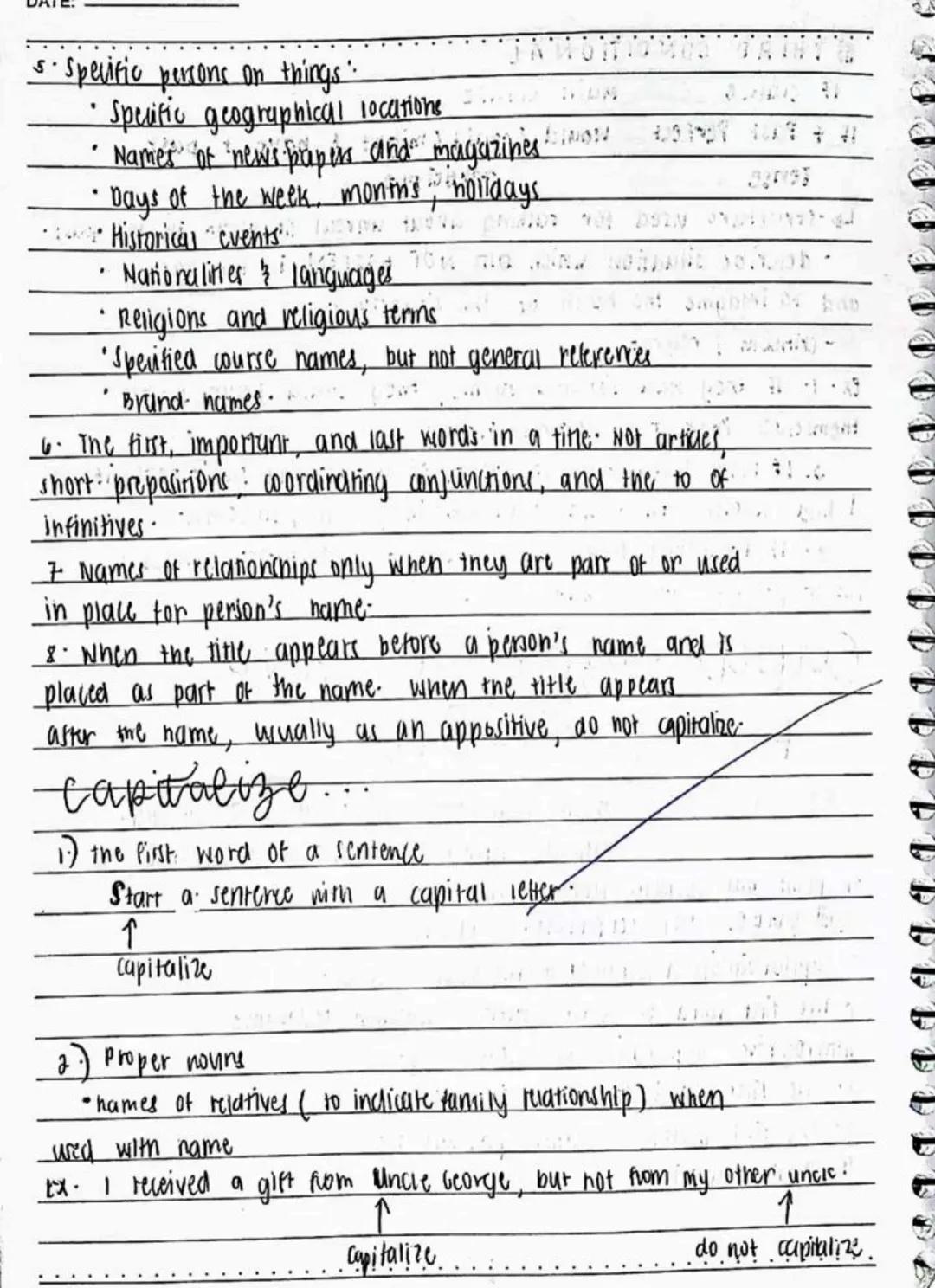
Capitalizing correctly helps make your writing clear and professional. Here are more important capitalization rules:
Capitalize the first, last, and all important words in titles (not articles, short prepositions, or coordinating conjunctions)
Names of relationships only when they're part of or used in place of a person's name:
Titles that appear before a person's name:
Handy Tip: When in doubt about a title, ask yourself: "Is this being used as part of the person's name?" If yes, capitalize it.
Proper capitalization shows attention to detail and helps readers understand the specific meaning of what you're writing.
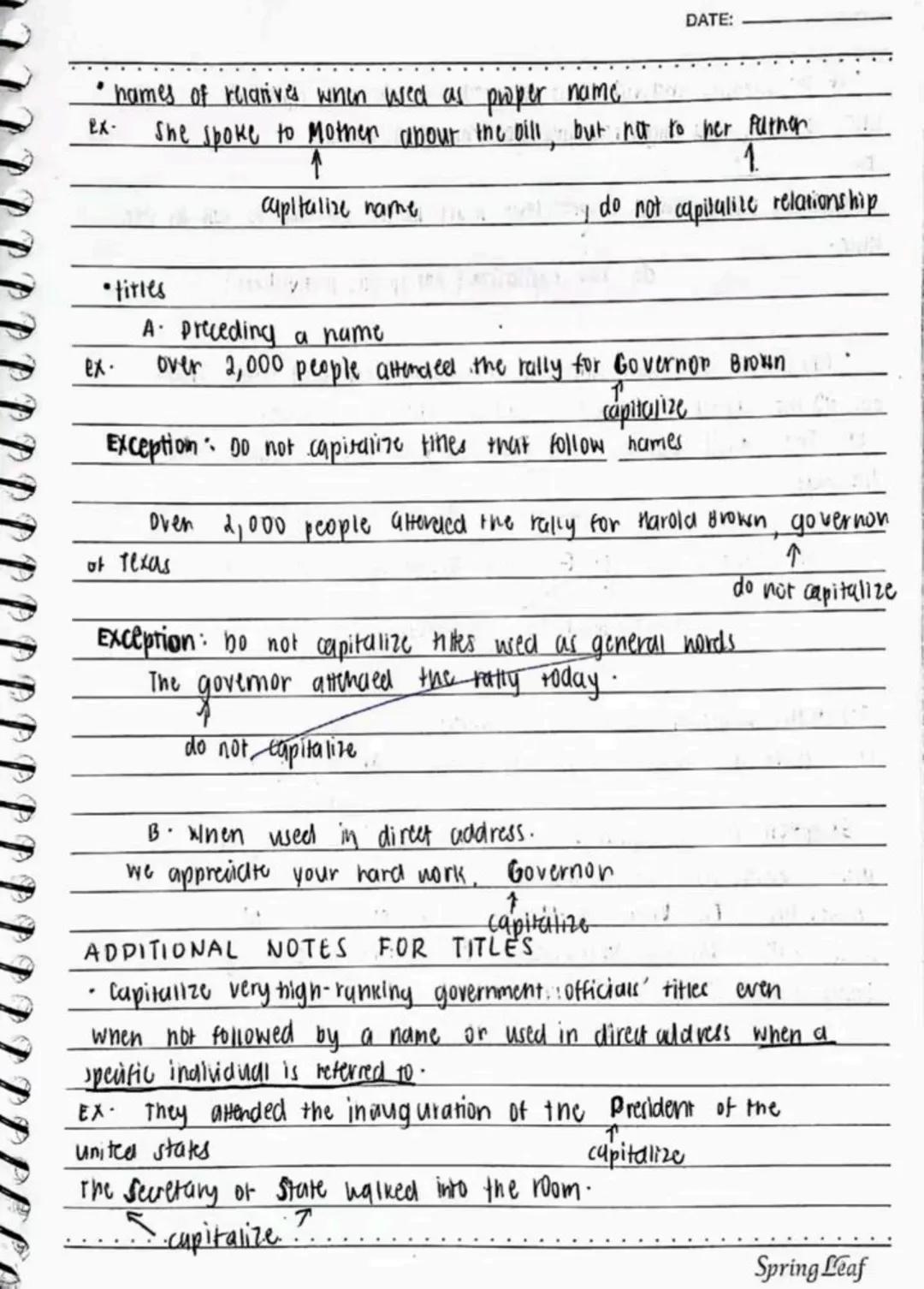
Capitalize titles of very high-ranking government officials even when not followed by a name if referring to a specific individual:
However, don't capitalize titles when no specific individual is referred to:
For compound titles with names, capitalize important words but not prefixes or suffixes:
For titles of books, articles, and songs, capitalize major words (but not short prepositions, conjunctions, or articles unless they're the first word):
Remember: Consistency is key! Choose a capitalization style and apply it throughout your writing.
These rules help maintain clarity and show proper respect in formal writing.
Our AI companion is specifically built for the needs of students. Based on the millions of content pieces we have on the platform we can provide truly meaningful and relevant answers to students. But its not only about answers, the companion is even more about guiding students through their daily learning challenges, with personalised study plans, quizzes or content pieces in the chat and 100% personalisation based on the students skills and developments.
You can download the app in the Google Play Store and in the Apple App Store.
That's right! Enjoy free access to study content, connect with fellow students, and get instant help – all at your fingertips.
App Store
Google Play
The app is very easy to use and well designed. I have found everything I was looking for so far and have been able to learn a lot from the presentations! I will definitely use the app for a class assignment! And of course it also helps a lot as an inspiration.
Stefan S
iOS user
This app is really great. There are so many study notes and help [...]. My problem subject is French, for example, and the app has so many options for help. Thanks to this app, I have improved my French. I would recommend it to anyone.
Samantha Klich
Android user
Wow, I am really amazed. I just tried the app because I've seen it advertised many times and was absolutely stunned. This app is THE HELP you want for school and above all, it offers so many things, such as workouts and fact sheets, which have been VERY helpful to me personally.
Anna
iOS user
I think it’s very much worth it and you’ll end up using it a lot once you get the hang of it and even after looking at others notes you can still ask your Artificial intelligence buddy the question and ask to simplify it if you still don’t get it!!! In the end I think it’s worth it 😊👍 ⚠️Also DID I MENTION ITS FREEE YOU DON’T HAVE TO PAY FOR ANYTHING AND STILL GET YOUR GRADES IN PERFECTLY❗️❗️⚠️
Thomas R
iOS user
Knowunity is the BEST app I’ve used in a minute. This is not an ai review or anything this is genuinely coming from a 7th grade student (I know 2011 im young) but dude this app is a 10/10 i have maintained a 3.8 gpa and have plenty of time for gaming. I love it and my mom is just happy I got good grades
Brad T
Android user
Not only did it help me find the answer but it also showed me alternative ways to solve it. I was horrible in math and science but now I have an a in both subjects. Thanks for the help🤍🤍
David K
iOS user
The app's just great! All I have to do is enter the topic in the search bar and I get the response real fast. I don't have to watch 10 YouTube videos to understand something, so I'm saving my time. Highly recommended!
Sudenaz Ocak
Android user
In school I was really bad at maths but thanks to the app, I am doing better now. I am so grateful that you made the app.
Greenlight Bonnie
Android user
I found this app a couple years ago and it has only gotten better since then. I really love it because it can help with written questions and photo questions. Also, it can find study guides that other people have made as well as flashcard sets and practice tests. The free version is also amazing for students who might not be able to afford it. Would 100% recommend
Aubrey
iOS user
Best app if you're in Highschool or Junior high. I have been using this app for 2 school years and it's the best, it's good if you don't have anyone to help you with school work.😋🩷🎀
Marco B
iOS user
THE QUIZES AND FLASHCARDS ARE SO USEFUL AND I LOVE THE SCHOOLGPT. IT ALSO IS LITREALLY LIKE CHATGPT BUT SMARTER!! HELPED ME WITH MY MASCARA PROBLEMS TOO!! AS WELL AS MY REAL SUBJECTS ! DUHHH 😍😁😲🤑💗✨🎀😮
Elisha
iOS user
This app is phenomenal down to the correct info and the various topics you can study! I greatly recommend it for people who struggle with procrastination and those who need homework help. It has been perfectly accurate for world 1 history as far as I’ve seen! Geometry too!
Paul T
iOS user
The app is very easy to use and well designed. I have found everything I was looking for so far and have been able to learn a lot from the presentations! I will definitely use the app for a class assignment! And of course it also helps a lot as an inspiration.
Stefan S
iOS user
This app is really great. There are so many study notes and help [...]. My problem subject is French, for example, and the app has so many options for help. Thanks to this app, I have improved my French. I would recommend it to anyone.
Samantha Klich
Android user
Wow, I am really amazed. I just tried the app because I've seen it advertised many times and was absolutely stunned. This app is THE HELP you want for school and above all, it offers so many things, such as workouts and fact sheets, which have been VERY helpful to me personally.
Anna
iOS user
I think it’s very much worth it and you’ll end up using it a lot once you get the hang of it and even after looking at others notes you can still ask your Artificial intelligence buddy the question and ask to simplify it if you still don’t get it!!! In the end I think it’s worth it 😊👍 ⚠️Also DID I MENTION ITS FREEE YOU DON’T HAVE TO PAY FOR ANYTHING AND STILL GET YOUR GRADES IN PERFECTLY❗️❗️⚠️
Thomas R
iOS user
Knowunity is the BEST app I’ve used in a minute. This is not an ai review or anything this is genuinely coming from a 7th grade student (I know 2011 im young) but dude this app is a 10/10 i have maintained a 3.8 gpa and have plenty of time for gaming. I love it and my mom is just happy I got good grades
Brad T
Android user
Not only did it help me find the answer but it also showed me alternative ways to solve it. I was horrible in math and science but now I have an a in both subjects. Thanks for the help🤍🤍
David K
iOS user
The app's just great! All I have to do is enter the topic in the search bar and I get the response real fast. I don't have to watch 10 YouTube videos to understand something, so I'm saving my time. Highly recommended!
Sudenaz Ocak
Android user
In school I was really bad at maths but thanks to the app, I am doing better now. I am so grateful that you made the app.
Greenlight Bonnie
Android user
I found this app a couple years ago and it has only gotten better since then. I really love it because it can help with written questions and photo questions. Also, it can find study guides that other people have made as well as flashcard sets and practice tests. The free version is also amazing for students who might not be able to afford it. Would 100% recommend
Aubrey
iOS user
Best app if you're in Highschool or Junior high. I have been using this app for 2 school years and it's the best, it's good if you don't have anyone to help you with school work.😋🩷🎀
Marco B
iOS user
THE QUIZES AND FLASHCARDS ARE SO USEFUL AND I LOVE THE SCHOOLGPT. IT ALSO IS LITREALLY LIKE CHATGPT BUT SMARTER!! HELPED ME WITH MY MASCARA PROBLEMS TOO!! AS WELL AS MY REAL SUBJECTS ! DUHHH 😍😁😲🤑💗✨🎀😮
Elisha
iOS user
This app is phenomenal down to the correct info and the various topics you can study! I greatly recommend it for people who struggle with procrastination and those who need homework help. It has been perfectly accurate for world 1 history as far as I’ve seen! Geometry too!
Paul T
iOS user
Jona Mariz De Venecia
@jonadv
Ever wondered why we need different ways to express permission, obligation, and prohibition? These language tools help us navigate social rules, clarify expectations, and communicate effectively. Let's explore how to use modals, conditionals, and proper capitalization and punctuation to express... Show more
Access to all documents
Improve your grades
Join milions of students
By signing up you accept Terms of Service and Privacy Policy
Language gives us powerful tools to express what is allowed, required, or forbidden. In English, we use special modal verbs to communicate these concepts clearly.
When asking for permission, we typically use "can," "could," or "may." "Can" is common and casual ("Can you give me your number?"), while "could" is more polite ("Could I borrow your book?"). "May" is the most formal option, perfect for professional settings ("May I borrow your book, please?").
Quick Tip: Choose your permission modal based on formality - "can" for friends, "could" for teachers, and "may" for very formal situations.
Modals help us express not just what's allowed, but also what's required (obligation) or forbidden (prohibition). These language tools are essential for clear communication in both casual conversations and formal writing.
Access to all documents
Improve your grades
Join milions of students
By signing up you accept Terms of Service and Privacy Policy
Prohibition means disallowing or preventing someone from doing something. The main modals used for prohibition are "can't" and "must not/mustn't."
Use can't when referring to rules, laws, or signs that you didn't create. For example:
Use must not/mustn't when you (the speaker) are the one setting the rules:
Remember: Use "can't" when referring to external rules, and "mustn't" when you're the authority making the rule.
The distinction is important! "Can't" suggests the prohibition comes from an outside authority, while "must not" indicates the speaker has the authority to forbid something.
Access to all documents
Improve your grades
Join milions of students
By signing up you accept Terms of Service and Privacy Policy
Modal verbs are auxiliary or helping verbs that express permission, obligation, and prohibition. They're essential tools for communicating what's allowed, required, or forbidden.
When giving or asking for permission, you have three main options:
Can - Used for everyday permission requests:
Could - A more polite and formal way to ask:
May - The most formal and polite modal:
Language Hack: When speaking with authority figures or in formal settings, use "may" to show respect and proper etiquette.
Understanding these permission modals helps you adjust your language to match different social situations and relationships.
Access to all documents
Improve your grades
Join milions of students
By signing up you accept Terms of Service and Privacy Policy
Obligation expresses duty or commitment. The main modals used are "have to/has to" and "must."
Use have to/has to when the obligation comes from an external source:
Use must when the obligation comes from the speaker or an authority:
No obligation is expressed using "don't/doesn't have to":
Pro Tip: Pay attention to who creates the obligation - if it's you, use "must"; if it's an external rule or law, use "have to."
Understanding these modals helps you communicate expectations clearly and appropriately in different contexts.
Access to all documents
Improve your grades
Join milions of students
By signing up you accept Terms of Service and Privacy Policy
Conditional sentences help us express that one action depends on another condition being fulfilled. They have two parts:
We use conditionals to talk about both real and imaginary situations:
No obligation expressions show freedom from duty:
Think of it this way: Conditionals are like "cause and effect" statements - if this happens (cause), then this will happen (effect).
Understanding conditionals helps you express logical relationships between events and communicate both realistic and hypothetical scenarios.
Access to all documents
Improve your grades
Join milions of students
By signing up you accept Terms of Service and Privacy Policy
Zero Conditional is used for:
Examples:
First Conditional is used for:
Examples:
Key Difference: Zero conditional is for facts that are always true, while first conditional is for possible future situations and their likely results.
These conditional forms help you express different levels of certainty about cause-and-effect relationships.
Access to all documents
Improve your grades
Join milions of students
By signing up you accept Terms of Service and Privacy Policy
Second Conditional is used for:
Examples:
Third Conditional is used for:
Examples:
Remember: Second conditional is about imaginary present/future, while third conditional is about regrets or hypothetical past events.
These forms allow you to explore hypothetical scenarios and their consequences in sophisticated ways.
Access to all documents
Improve your grades
Join milions of students
By signing up you accept Terms of Service and Privacy Policy
Capitalization means beginning a word with a capital letter. It helps signal the start of sentences and highlights specific words.
Capitalization is required in these key situations:
Quick Check: If you're referring to a specific person, place, or organization by name, it probably needs a capital letter.
Understanding capitalization rules helps your writing appear professional and ensures you're following standard English conventions.
Access to all documents
Improve your grades
Join milions of students
By signing up you accept Terms of Service and Privacy Policy
Capitalizing correctly helps make your writing clear and professional. Here are more important capitalization rules:
Capitalize the first, last, and all important words in titles (not articles, short prepositions, or coordinating conjunctions)
Names of relationships only when they're part of or used in place of a person's name:
Titles that appear before a person's name:
Handy Tip: When in doubt about a title, ask yourself: "Is this being used as part of the person's name?" If yes, capitalize it.
Proper capitalization shows attention to detail and helps readers understand the specific meaning of what you're writing.
Access to all documents
Improve your grades
Join milions of students
By signing up you accept Terms of Service and Privacy Policy
Capitalize titles of very high-ranking government officials even when not followed by a name if referring to a specific individual:
However, don't capitalize titles when no specific individual is referred to:
For compound titles with names, capitalize important words but not prefixes or suffixes:
For titles of books, articles, and songs, capitalize major words (but not short prepositions, conjunctions, or articles unless they're the first word):
Remember: Consistency is key! Choose a capitalization style and apply it throughout your writing.
These rules help maintain clarity and show proper respect in formal writing.
Our AI companion is specifically built for the needs of students. Based on the millions of content pieces we have on the platform we can provide truly meaningful and relevant answers to students. But its not only about answers, the companion is even more about guiding students through their daily learning challenges, with personalised study plans, quizzes or content pieces in the chat and 100% personalisation based on the students skills and developments.
You can download the app in the Google Play Store and in the Apple App Store.
That's right! Enjoy free access to study content, connect with fellow students, and get instant help – all at your fingertips.
25
Smart Tools NEW
Transform this note into: ✓ 50+ Practice Questions ✓ Interactive Flashcards ✓ Full Mock Exam ✓ Essay Outlines
App Store
Google Play
The app is very easy to use and well designed. I have found everything I was looking for so far and have been able to learn a lot from the presentations! I will definitely use the app for a class assignment! And of course it also helps a lot as an inspiration.
Stefan S
iOS user
This app is really great. There are so many study notes and help [...]. My problem subject is French, for example, and the app has so many options for help. Thanks to this app, I have improved my French. I would recommend it to anyone.
Samantha Klich
Android user
Wow, I am really amazed. I just tried the app because I've seen it advertised many times and was absolutely stunned. This app is THE HELP you want for school and above all, it offers so many things, such as workouts and fact sheets, which have been VERY helpful to me personally.
Anna
iOS user
I think it’s very much worth it and you’ll end up using it a lot once you get the hang of it and even after looking at others notes you can still ask your Artificial intelligence buddy the question and ask to simplify it if you still don’t get it!!! In the end I think it’s worth it 😊👍 ⚠️Also DID I MENTION ITS FREEE YOU DON’T HAVE TO PAY FOR ANYTHING AND STILL GET YOUR GRADES IN PERFECTLY❗️❗️⚠️
Thomas R
iOS user
Knowunity is the BEST app I’ve used in a minute. This is not an ai review or anything this is genuinely coming from a 7th grade student (I know 2011 im young) but dude this app is a 10/10 i have maintained a 3.8 gpa and have plenty of time for gaming. I love it and my mom is just happy I got good grades
Brad T
Android user
Not only did it help me find the answer but it also showed me alternative ways to solve it. I was horrible in math and science but now I have an a in both subjects. Thanks for the help🤍🤍
David K
iOS user
The app's just great! All I have to do is enter the topic in the search bar and I get the response real fast. I don't have to watch 10 YouTube videos to understand something, so I'm saving my time. Highly recommended!
Sudenaz Ocak
Android user
In school I was really bad at maths but thanks to the app, I am doing better now. I am so grateful that you made the app.
Greenlight Bonnie
Android user
I found this app a couple years ago and it has only gotten better since then. I really love it because it can help with written questions and photo questions. Also, it can find study guides that other people have made as well as flashcard sets and practice tests. The free version is also amazing for students who might not be able to afford it. Would 100% recommend
Aubrey
iOS user
Best app if you're in Highschool or Junior high. I have been using this app for 2 school years and it's the best, it's good if you don't have anyone to help you with school work.😋🩷🎀
Marco B
iOS user
THE QUIZES AND FLASHCARDS ARE SO USEFUL AND I LOVE THE SCHOOLGPT. IT ALSO IS LITREALLY LIKE CHATGPT BUT SMARTER!! HELPED ME WITH MY MASCARA PROBLEMS TOO!! AS WELL AS MY REAL SUBJECTS ! DUHHH 😍😁😲🤑💗✨🎀😮
Elisha
iOS user
This app is phenomenal down to the correct info and the various topics you can study! I greatly recommend it for people who struggle with procrastination and those who need homework help. It has been perfectly accurate for world 1 history as far as I’ve seen! Geometry too!
Paul T
iOS user
The app is very easy to use and well designed. I have found everything I was looking for so far and have been able to learn a lot from the presentations! I will definitely use the app for a class assignment! And of course it also helps a lot as an inspiration.
Stefan S
iOS user
This app is really great. There are so many study notes and help [...]. My problem subject is French, for example, and the app has so many options for help. Thanks to this app, I have improved my French. I would recommend it to anyone.
Samantha Klich
Android user
Wow, I am really amazed. I just tried the app because I've seen it advertised many times and was absolutely stunned. This app is THE HELP you want for school and above all, it offers so many things, such as workouts and fact sheets, which have been VERY helpful to me personally.
Anna
iOS user
I think it’s very much worth it and you’ll end up using it a lot once you get the hang of it and even after looking at others notes you can still ask your Artificial intelligence buddy the question and ask to simplify it if you still don’t get it!!! In the end I think it’s worth it 😊👍 ⚠️Also DID I MENTION ITS FREEE YOU DON’T HAVE TO PAY FOR ANYTHING AND STILL GET YOUR GRADES IN PERFECTLY❗️❗️⚠️
Thomas R
iOS user
Knowunity is the BEST app I’ve used in a minute. This is not an ai review or anything this is genuinely coming from a 7th grade student (I know 2011 im young) but dude this app is a 10/10 i have maintained a 3.8 gpa and have plenty of time for gaming. I love it and my mom is just happy I got good grades
Brad T
Android user
Not only did it help me find the answer but it also showed me alternative ways to solve it. I was horrible in math and science but now I have an a in both subjects. Thanks for the help🤍🤍
David K
iOS user
The app's just great! All I have to do is enter the topic in the search bar and I get the response real fast. I don't have to watch 10 YouTube videos to understand something, so I'm saving my time. Highly recommended!
Sudenaz Ocak
Android user
In school I was really bad at maths but thanks to the app, I am doing better now. I am so grateful that you made the app.
Greenlight Bonnie
Android user
I found this app a couple years ago and it has only gotten better since then. I really love it because it can help with written questions and photo questions. Also, it can find study guides that other people have made as well as flashcard sets and practice tests. The free version is also amazing for students who might not be able to afford it. Would 100% recommend
Aubrey
iOS user
Best app if you're in Highschool or Junior high. I have been using this app for 2 school years and it's the best, it's good if you don't have anyone to help you with school work.😋🩷🎀
Marco B
iOS user
THE QUIZES AND FLASHCARDS ARE SO USEFUL AND I LOVE THE SCHOOLGPT. IT ALSO IS LITREALLY LIKE CHATGPT BUT SMARTER!! HELPED ME WITH MY MASCARA PROBLEMS TOO!! AS WELL AS MY REAL SUBJECTS ! DUHHH 😍😁😲🤑💗✨🎀😮
Elisha
iOS user
This app is phenomenal down to the correct info and the various topics you can study! I greatly recommend it for people who struggle with procrastination and those who need homework help. It has been perfectly accurate for world 1 history as far as I’ve seen! Geometry too!
Paul T
iOS user