
Obligations and contracts form the backbone of our legal system,... Show more
 English Grammar
 Biology
Sign up to see the contentIt's free!
Access to all documents
Improve your grades
Join milions of students
Knowunity AI
Subjects
Triangle Congruence and Similarity Theorems
Triangle Properties and Classification
Linear Equations and Graphs
Geometric Angle Relationships
Trigonometric Functions and Identities
Equation Solving Techniques
Circle Geometry Fundamentals
Division Operations and Methods
Basic Differentiation Rules
Exponent and Logarithm Properties
Show all topics
Human Organ Systems
Reproductive Cell Cycles
Biological Sciences Subdisciplines
Cellular Energy Metabolism
Autotrophic Energy Processes
Inheritance Patterns and Principles
Biomolecular Structure and Organization
Cell Cycle and Division Mechanics
Cellular Organization and Development
Biological Structural Organization
Show all topics
Chemical Sciences and Applications
Atomic Structure and Composition
Molecular Electron Structure Representation
Atomic Electron Behavior
Matter Properties and Water
Mole Concept and Calculations
Gas Laws and Behavior
Periodic Table Organization
Chemical Thermodynamics Fundamentals
Chemical Bond Types and Properties
Show all topics
European Renaissance and Enlightenment
European Cultural Movements 800-1920
American Revolution Era 1763-1797
American Civil War 1861-1865
Global Imperial Systems
Mongol and Chinese Dynasties
U.S. Presidents and World Leaders
Historical Sources and Documentation
World Wars Era and Impact
World Religious Systems
Show all topics
Classic and Contemporary Novels
Literary Character Analysis
Rhetorical Theory and Practice
Classic Literary Narratives
Reading Analysis and Interpretation
Narrative Structure and Techniques
English Language Components
Influential English-Language Authors
Basic Sentence Structure
Narrative Voice and Perspective
Show all topics
143
•
Updated Mar 16, 2026
•
Leovic Armada
@leovicarmada
Obligations and contracts form the backbone of our legal system,... Show more
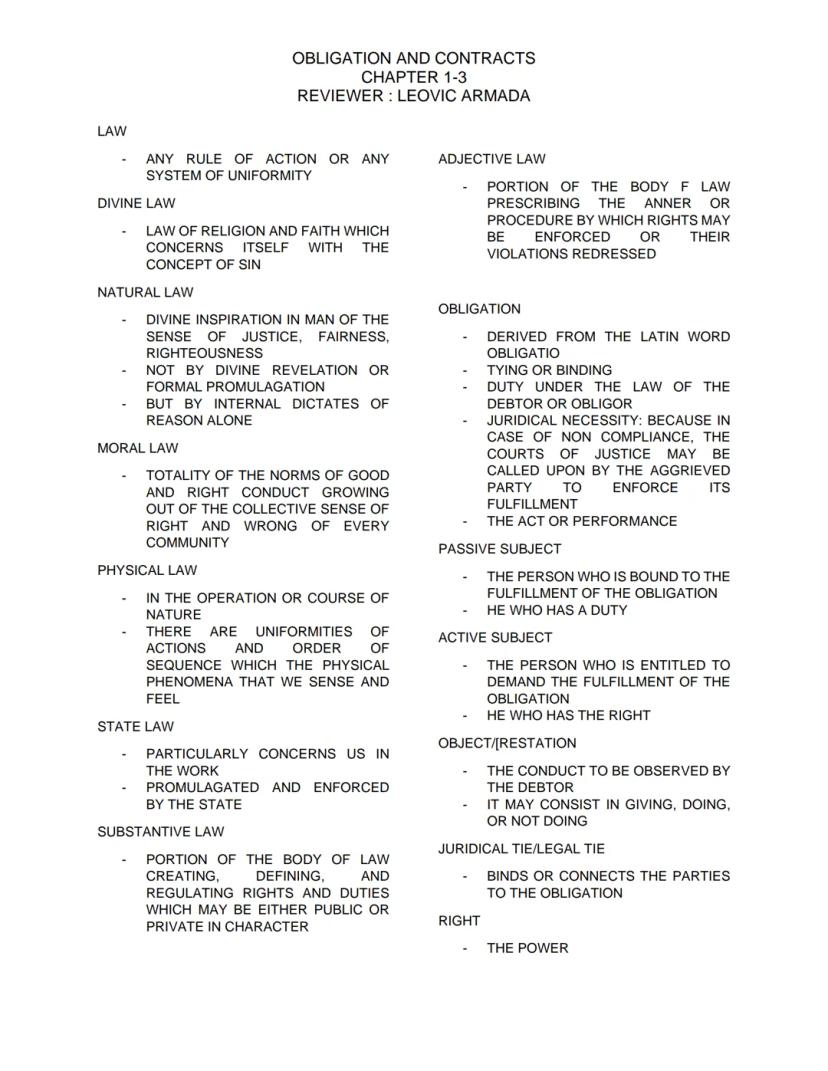
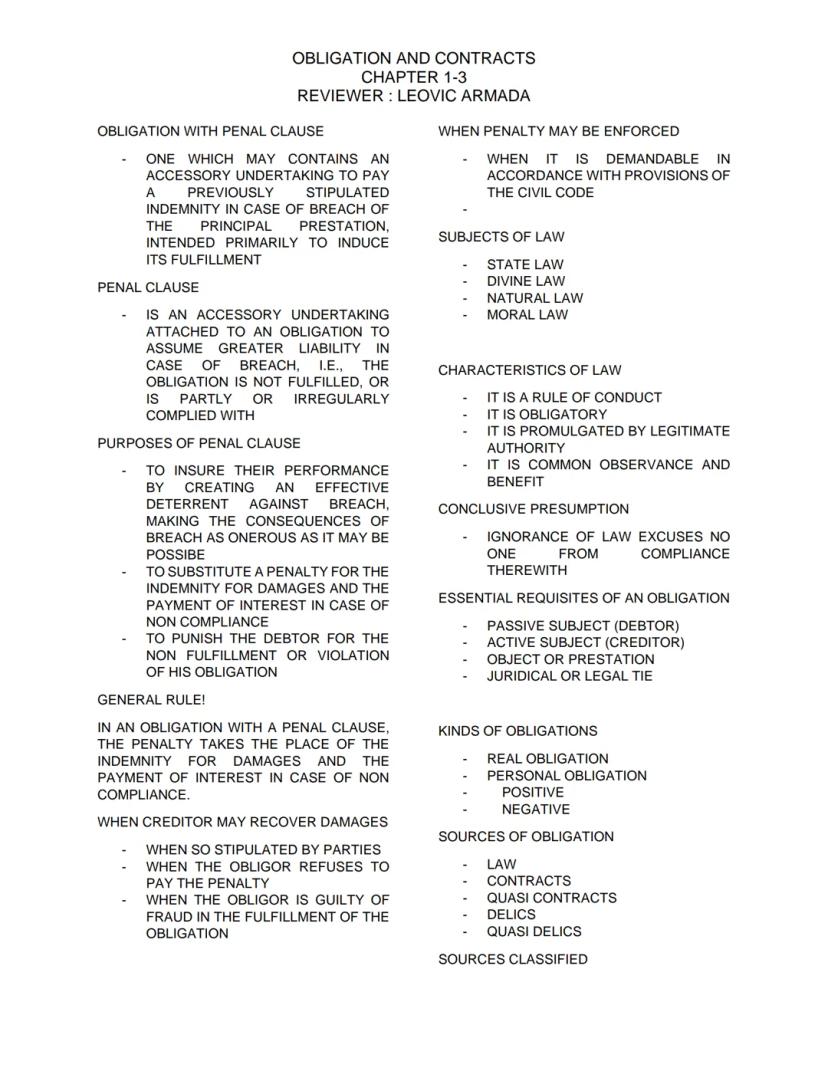
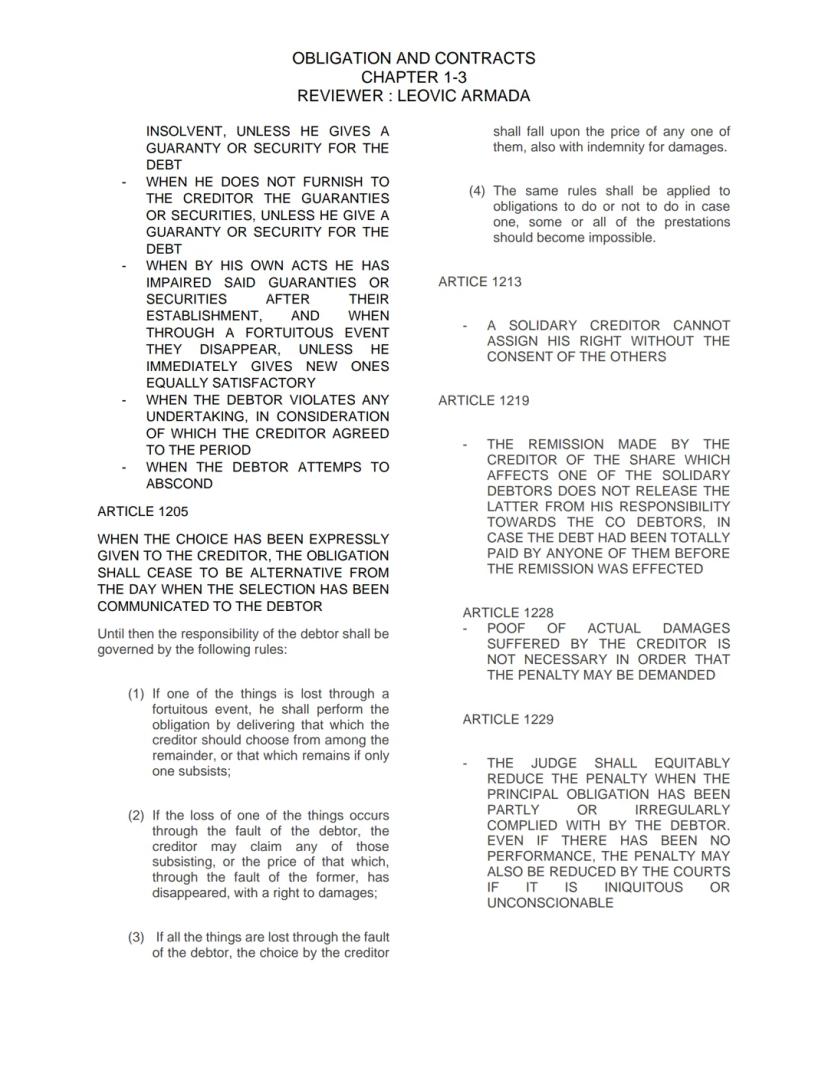
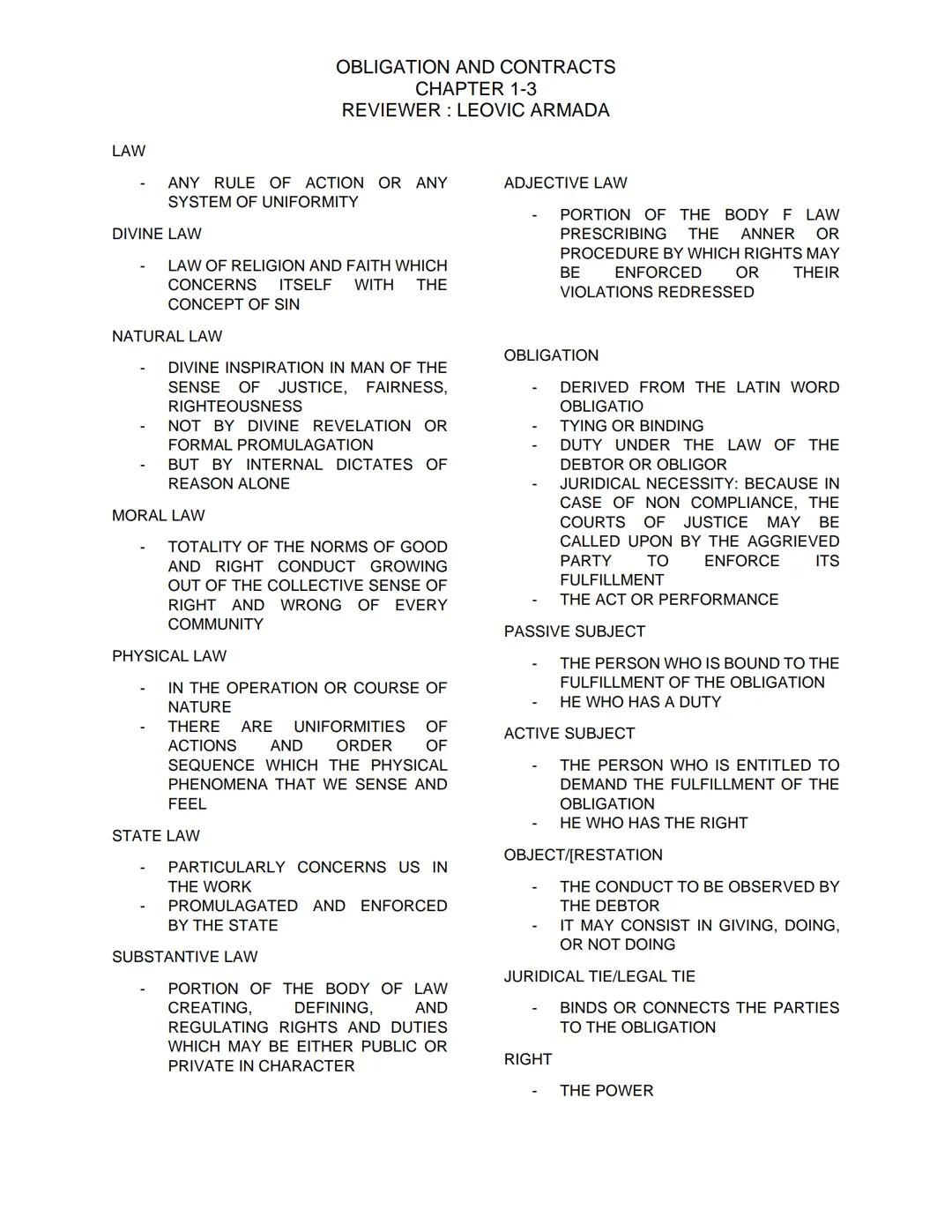
Law isn't just a bunch of rules—it's an organized system that governs our actions. There are several types of law that affect us differently:
Divine law deals with religious matters and concepts of sin, while natural law comes from our inherent sense of justice and fairness. Moral law emerges from society's collective sense of right and wrong, and physical law governs how natural phenomena operate. State law—the one we'll focus on—is officially created and enforced by government authorities.
💡 Think of state law as the "house rules" for society that everyone must follow, while moral law is more like the unwritten rules we all generally agree on.
When we talk about obligations, we're referring to legal duties that bind one person (the passive subject or debtor) to another (the active subject or creditor). The object or prestation is the specific conduct required—whether giving something, doing something, or not doing something. What makes obligations powerful is the juridical tie that legally connects the parties, allowing courts to enforce them if necessary.
Obligations can be classified as real obligations (giving something) or personal obligations (doing or not doing something). Understanding these classifications helps determine how obligations can be fulfilled and what remedies are available if they're not.
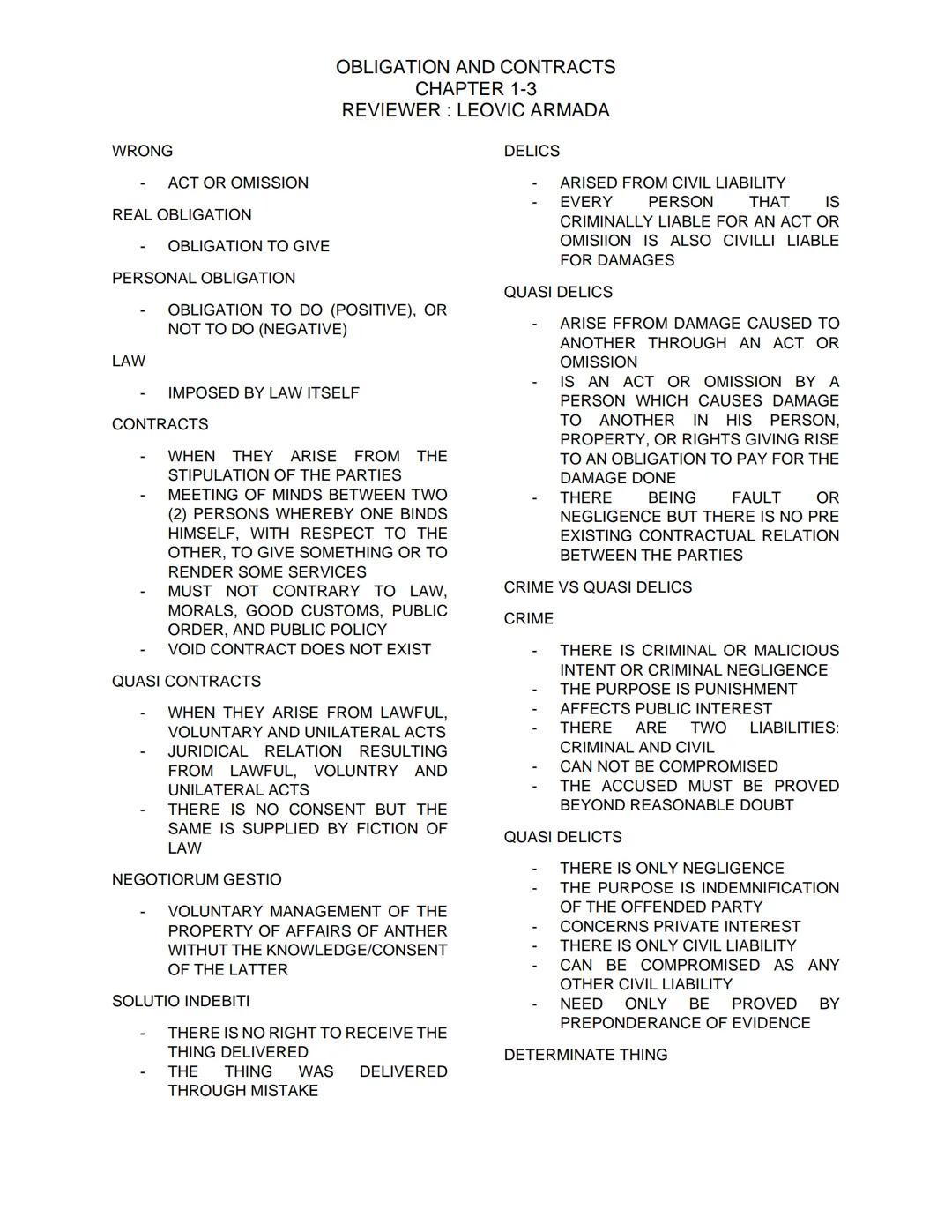
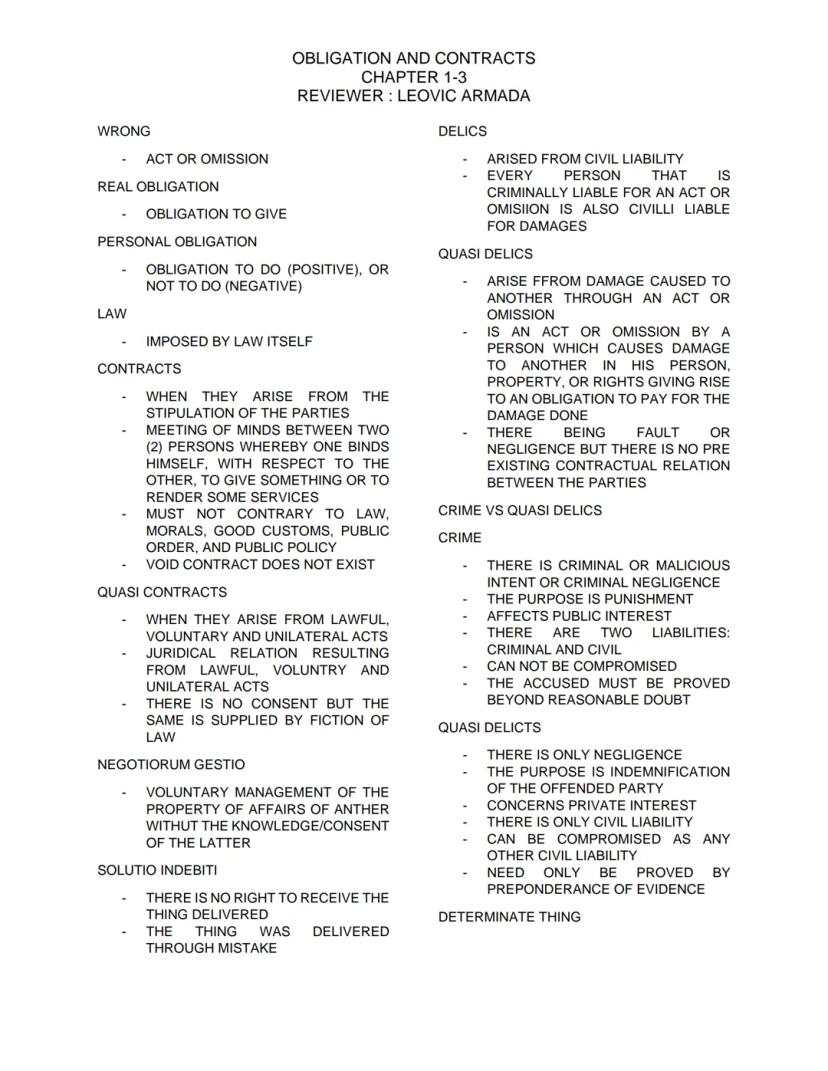
Obligations don't just appear out of nowhere—they come from specific sources recognized by law. The five main sources are:
Law itself can directly impose obligations, like paying taxes. Contracts create obligations when parties voluntarily agree to them. Quasi-contracts arise from lawful, voluntary acts where consent is supplied by legal fiction—like when someone manages another's property without permission (negotiorum gestio) or when something is mistakenly delivered and must be returned (solutio indebiti).
Delicts are civil liabilities arising from criminal acts, while quasi-delicts come from negligent acts that cause damage to others without criminal intent.
🔑 Remember the key difference: Crimes require criminal intent and can result in punishment, while quasi-delicts involve only negligence and aim for compensation.
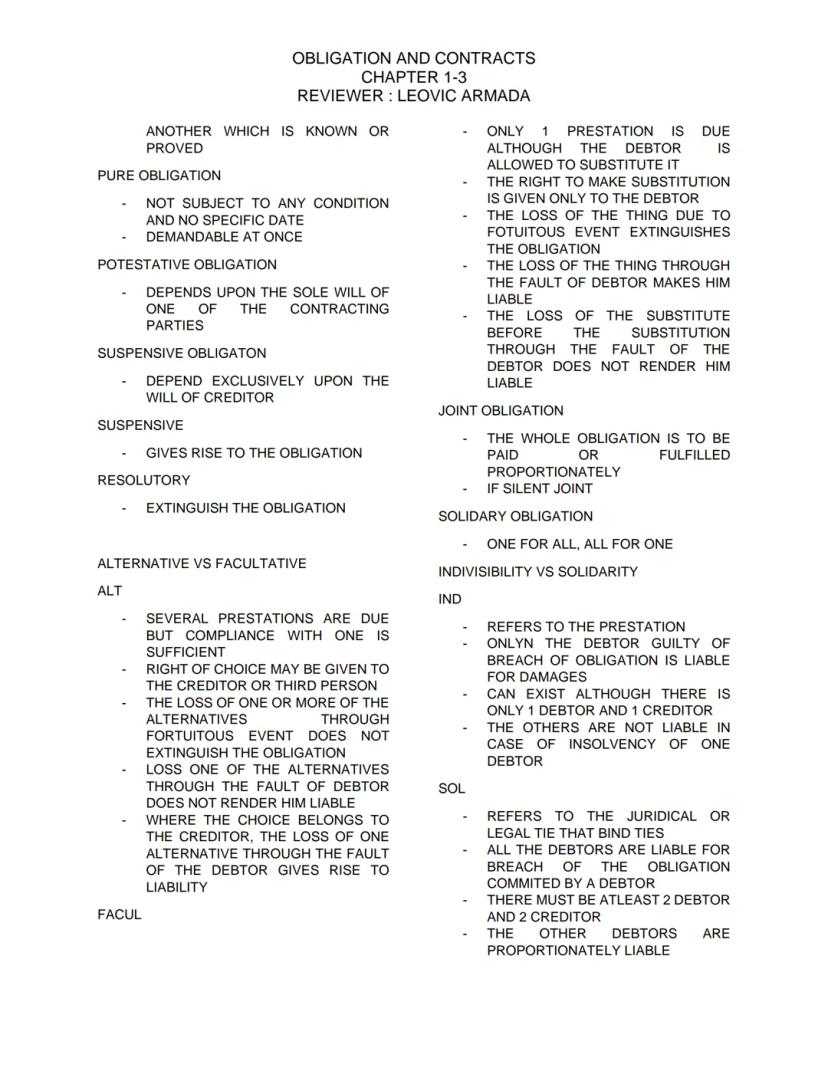
Obligations can be classified in several ways. A pure obligation is immediately demandable, while a potestative obligation depends on one party's will. Suspensive conditions give rise to obligations, while resolutory conditions extinguish them.
The difference between alternative and facultative obligations is crucial: In alternative obligations, several performances are due but fulfilling one is enough, while in facultative obligations, only one performance is due but the debtor may substitute it.
Understanding whether an obligation is joint (divided proportionately) or solidary (one for all, all for one) determines who's responsible when multiple parties are involved.
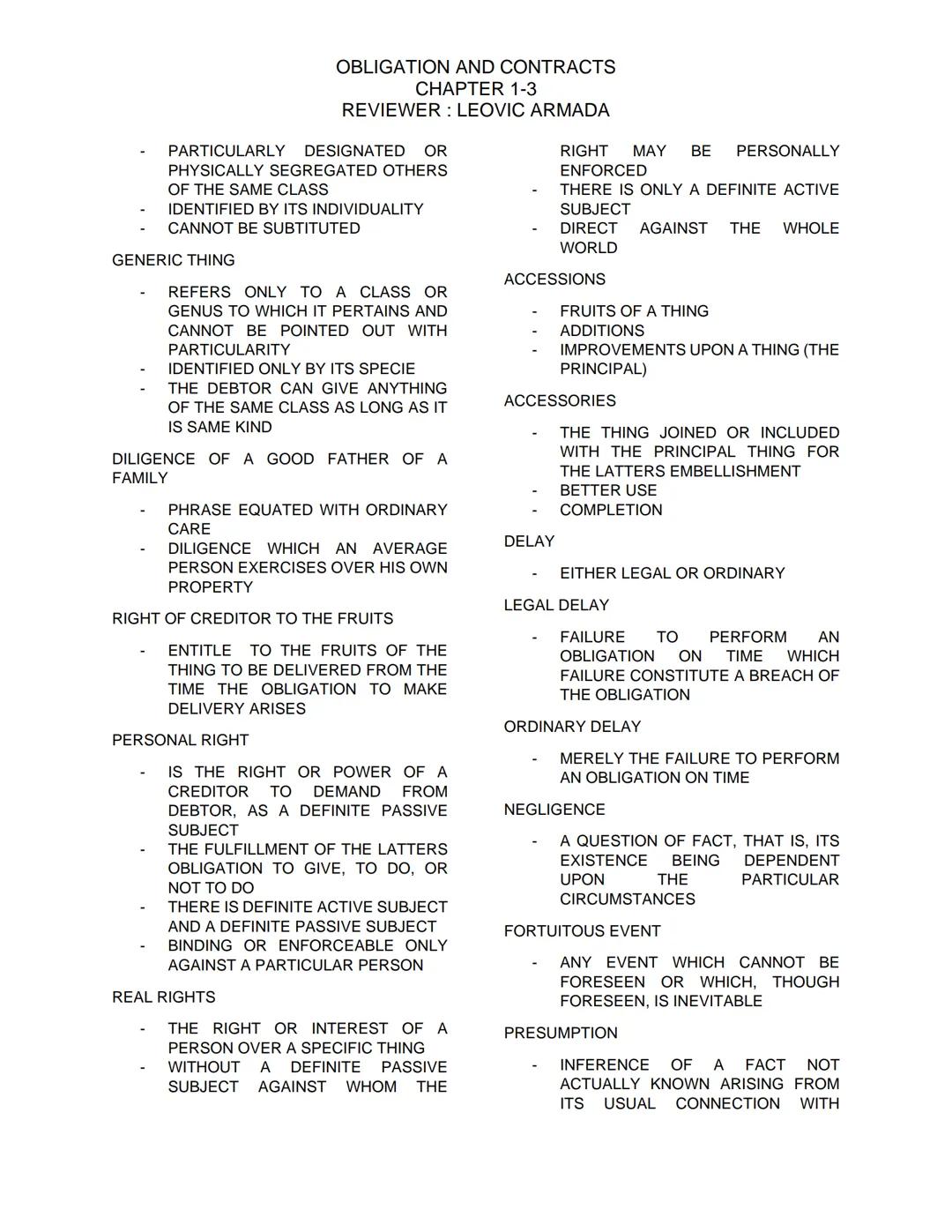
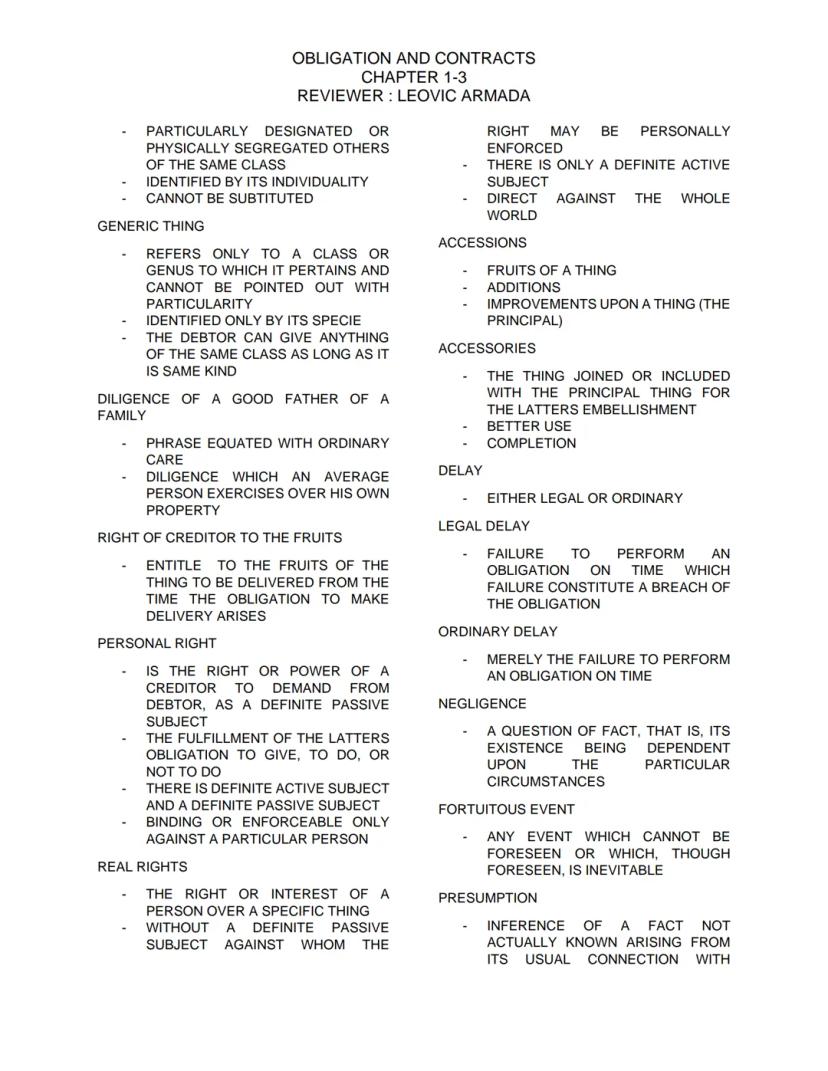
When fulfilling obligations, it matters what kind of property is involved. A determinate thing is specifically identified and can't be substituted—like your grandmother's antique watch. A generic thing is defined only by class—like "a gallon of milk"—allowing the debtor to provide any item of the same kind.
Legal standards matter too. The diligence of a good father of a family refers to the ordinary care an average person would use with their own property. This standard helps courts determine if someone has been negligent.
💡 Think of "diligence of a good father of a family" as the reasonable person standard—what would a responsible person typically do in this situation?
Creditors' rights extend to the fruits of things they're owed (like interest on money or crops from land) from the time the obligation arises. These rights can be classified as either personal rights (enforceable against specific people) or real rights (enforceable against the world regarding specific property).
Delay in fulfilling obligations can be either legal (constituting a breach) or ordinary (simply failing to perform on time). Negligence depends on specific circumstances, while a fortuitous event is something unforeseeable or inevitable that might excuse performance.
These distinctions help determine who bears responsibility when things don't go as planned in an obligation. Courts use these concepts to decide whether someone has properly fulfilled their duties or should be held liable.
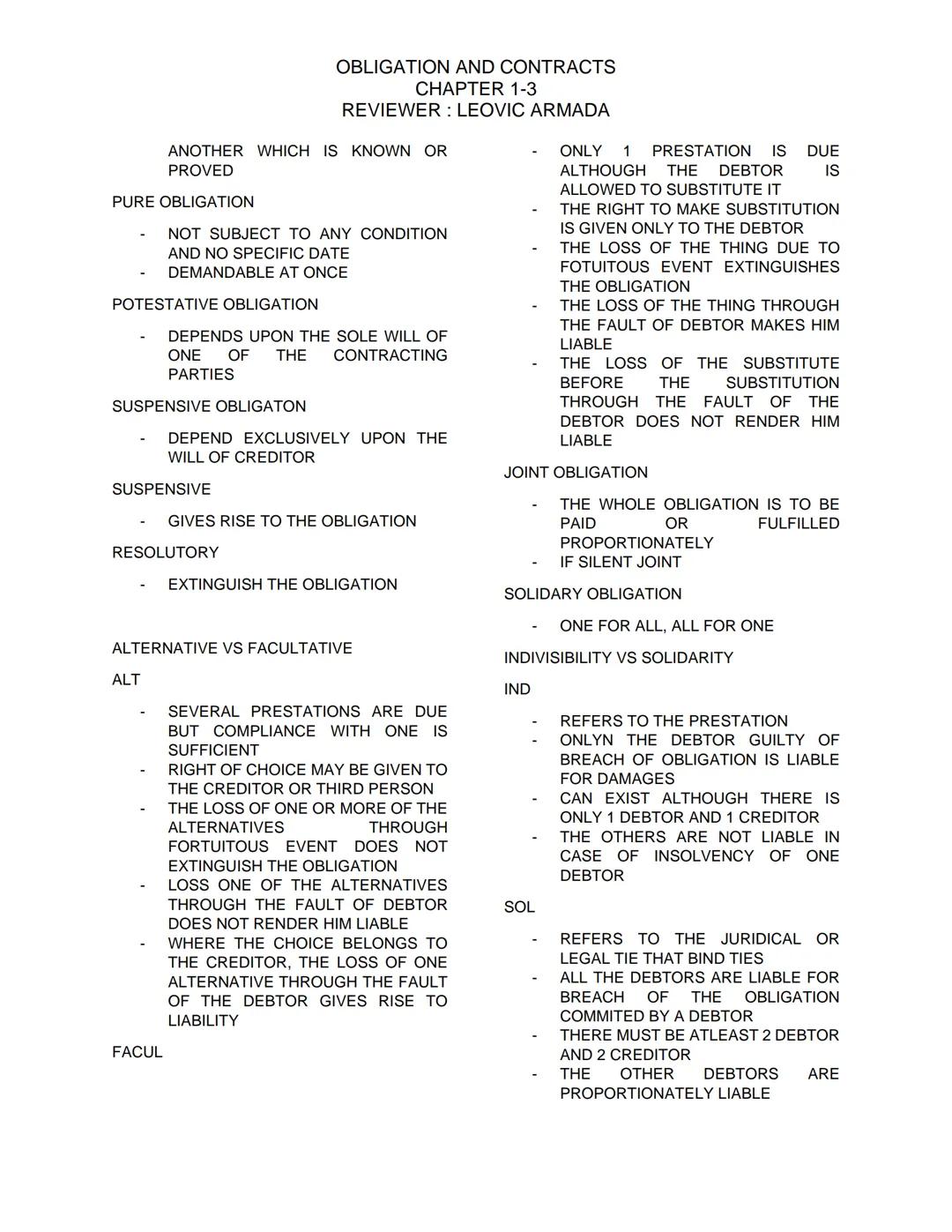
Obligations come in many forms, each with different rules about how they work. A pure obligation is straightforward—it's not subject to any condition and is immediately demandable. Other obligations have special characteristics:
Potestative obligations depend upon the sole will of one party. These are further classified as suspensive (creating the obligation) or resolutory (extinguishing it). Understanding these distinctions helps determine when obligations become effective or cease to exist.
The difference between alternative and facultative obligations is crucial. In alternative obligations, several performances are due but fulfilling one is sufficient. The right to choose may belong to the creditor, debtor, or a third person. In facultative obligations, only one performance is due, though the debtor may substitute it with something else.
⚠️ In alternative obligations, the loss of one option doesn't extinguish the obligation, but in facultative obligations, the loss of the main thing due to a fortuitous event ends the obligation entirely.
Joint obligations are divided proportionately among parties (the default when contracts are silent), while solidary obligations follow the "one for all, all for one" principle. Don't confuse indivisibility (which refers to the prestation itself) with solidarity (which refers to the legal ties between parties).
A special type is an obligation with a penal clause—it contains an accessory undertaking to pay a stipulated amount if the main obligation is breached. This serves to ensure performance, substitute for damages, and punish non-compliance.
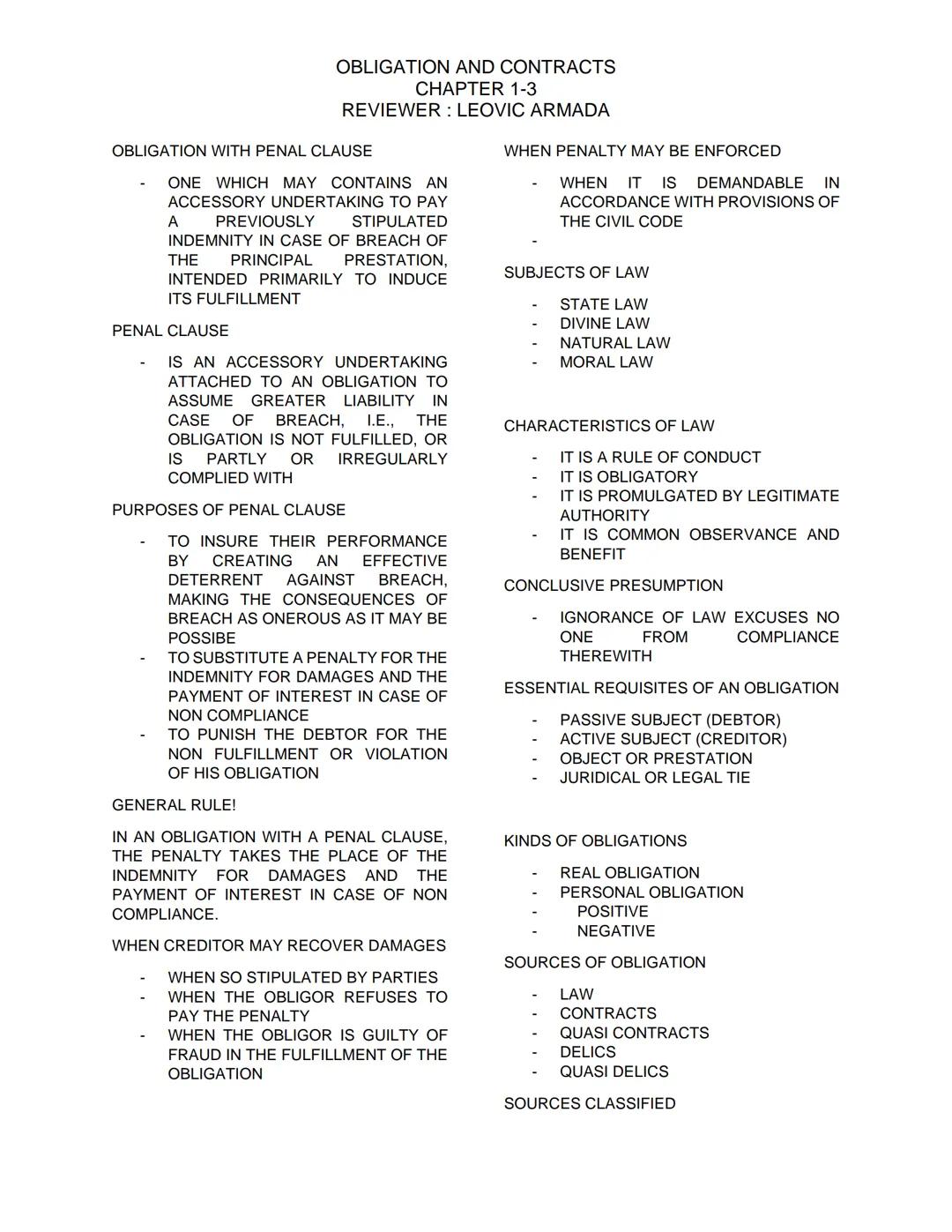
A penal clause is a powerful tool in contracts—it's an accessory undertaking that increases liability if an obligation is breached. Think of it as a built-in consequence for not following through on your promises.
The penal clause serves three main purposes: it deters breach by making consequences severe, it replaces the need to prove actual damages (which can be difficult), and it punishes the debtor for failing to fulfill obligations. The general rule is that the penalty substitutes for damages and interest when there's non-compliance.
💡 A penal clause is like setting up automatic consequences in advance—it saves time and arguments later because everyone already agreed to the penalty.
A creditor can still recover damages beyond the penalty in special cases: when specifically stipulated, when the debtor refuses to pay the penalty, or when the debtor acts fraudulently.
The law establishes several conclusive presumptions and essential requirements. Remember that ignorance of the law excuses no one—you're expected to know and follow legal rules regardless of whether you've actually read them.
Every obligation must have four essential elements: a passive subject (debtor), an active subject (creditor), an object or prestation, and a juridical or legal tie. These components form the foundation of any valid obligation.
Obligations can be classified in various ways: by type (real vs. personal), by source , and by whether they arise from lawful or unlawful acts. Understanding these classifications helps determine how obligations should be performed and what happens when they're not.
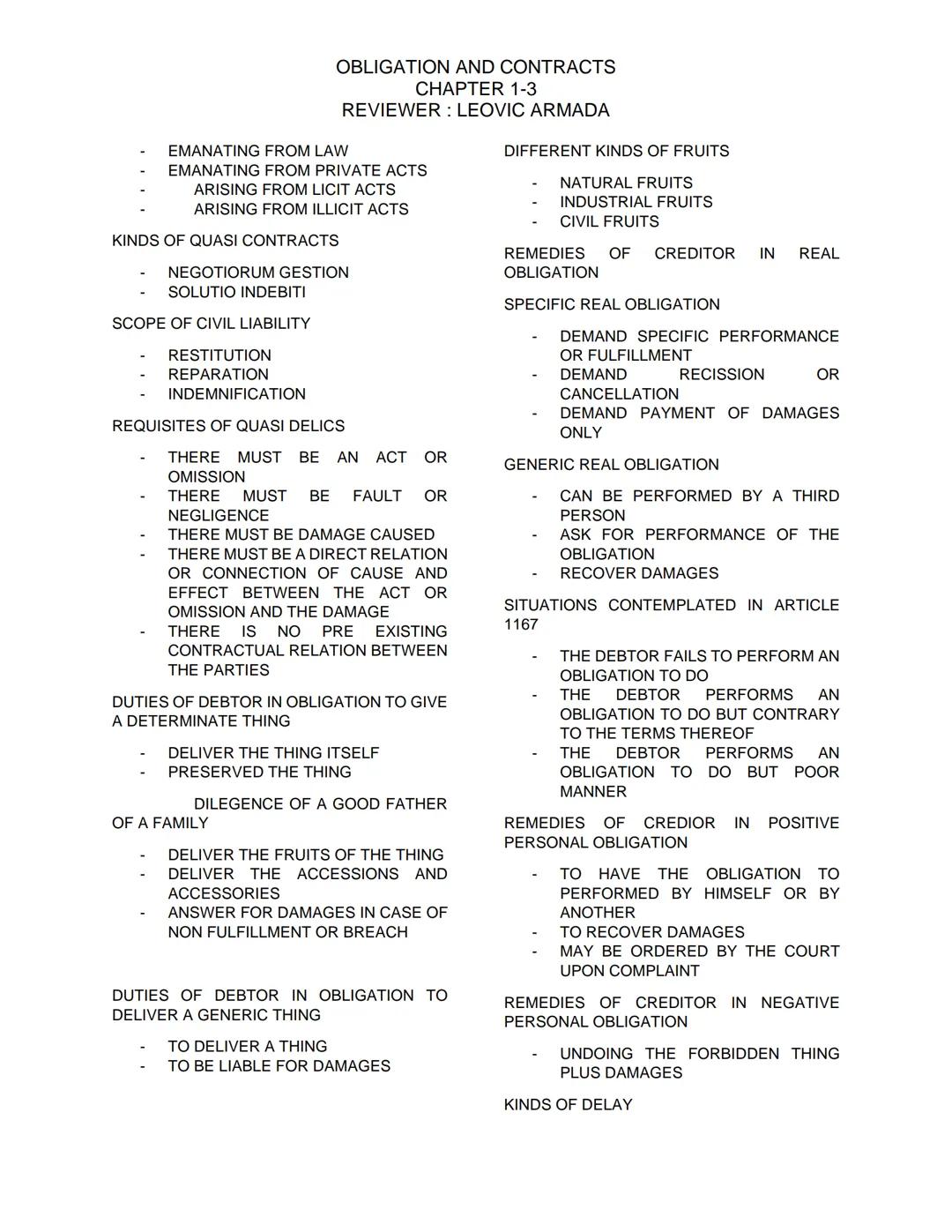
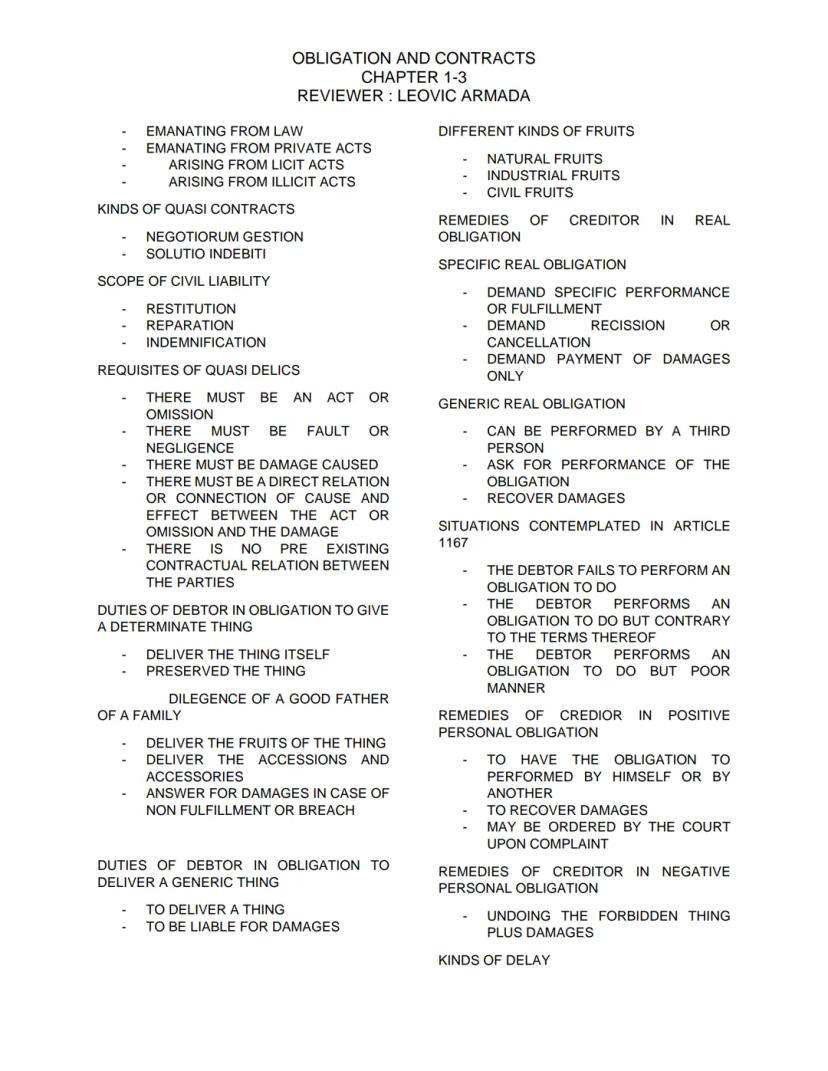
When someone owes a determinate thing, they have specific responsibilities: they must deliver the exact item, preserve it with proper care, provide any fruits (like interest or crops), include any accessories, and pay damages if they fail to fulfill the obligation. For generic things (like "a gallon of milk"), the debtor must simply deliver an item of the required kind and quality.
Different kinds of fruits may be owed with the main obligation: natural fruits (produced spontaneously), industrial fruits (produced through cultivation), or civil fruits (like rent or interest).
🔑 Knowing your rights as a creditor is crucial—you have multiple options when a debtor doesn't perform, including demanding specific performance, cancellation of the contract, or compensation for damages.
When a debtor fails to perform, creditors have various remedies depending on the type of obligation:
For real obligations (giving something), creditors can demand specific performance, cancel the contract, or seek damages. If the obligation involves a generic thing, a third person might even perform it.
For positive personal obligations (doing something), the creditor can have the task done by someone else at the debtor's expense or recover damages. For negative personal obligations (not doing something), the creditor can request undoing of the forbidden act plus damages.
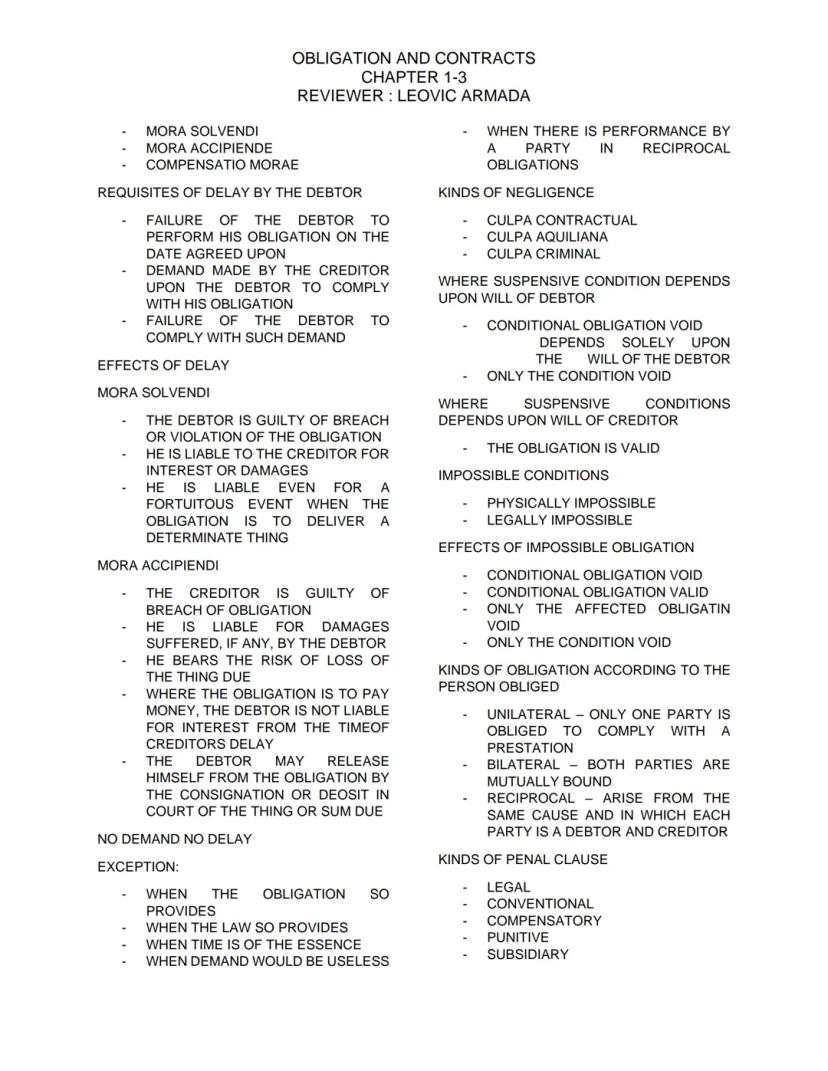
The law recognizes different kinds of delay: mora solvendi (debtor's delay), mora accipiendi (creditor's delay), and compensatio morae (both parties delay). Understanding which applies helps determine who bears responsibility for problems that arise during delay.
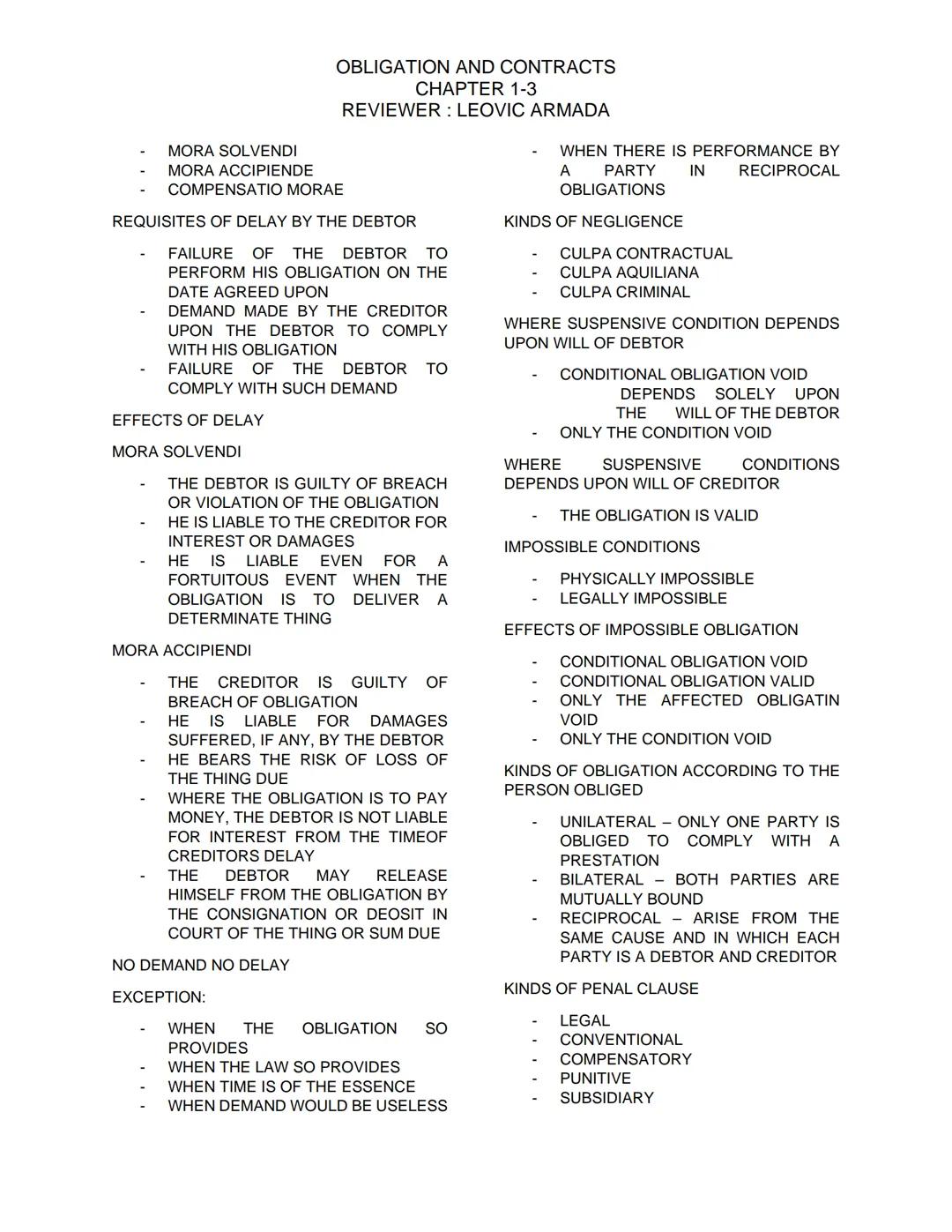
When a debtor fails to perform on time, we call this delay or mora. For the debtor to be officially in delay (mora solvendi), three things must happen: they must fail to perform on time, the creditor must demand performance, and the debtor must still fail to comply after the demand.
Being in delay has serious consequences. The debtor becomes liable for damages and interest, and in some cases, even becomes responsible for losses due to fortuitous events. Conversely, when the creditor delays in accepting performance (mora accipiendi), they may become liable for damages to the debtor.
💡 Remember "No demand, no delay"—except in special cases like when the contract specifically says demand isn't needed, when time is essential to the agreement, or when making a demand would be pointless.
Negligence comes in three forms: culpa contractual (breach of contract), culpa aquiliana (tort), and culpa criminal (related to crimes). Each type has different standards and consequences.
Conditional obligations depend on future uncertain events. If a suspensive condition depends entirely on the debtor's will, the condition is void (though the obligation itself may remain valid). Impossible conditions can be physically impossible or legally impossible, and they may void either the entire obligation or just the condition itself.
Obligations can be unilateral (binding only one party), bilateral (binding both), or reciprocal (where both parties are mutually debtor and creditor to each other). Penal clauses in contracts can be legal or conventional, compensatory or punitive, subsidiary or cumulative—each serving different purposes in enforcing obligations.
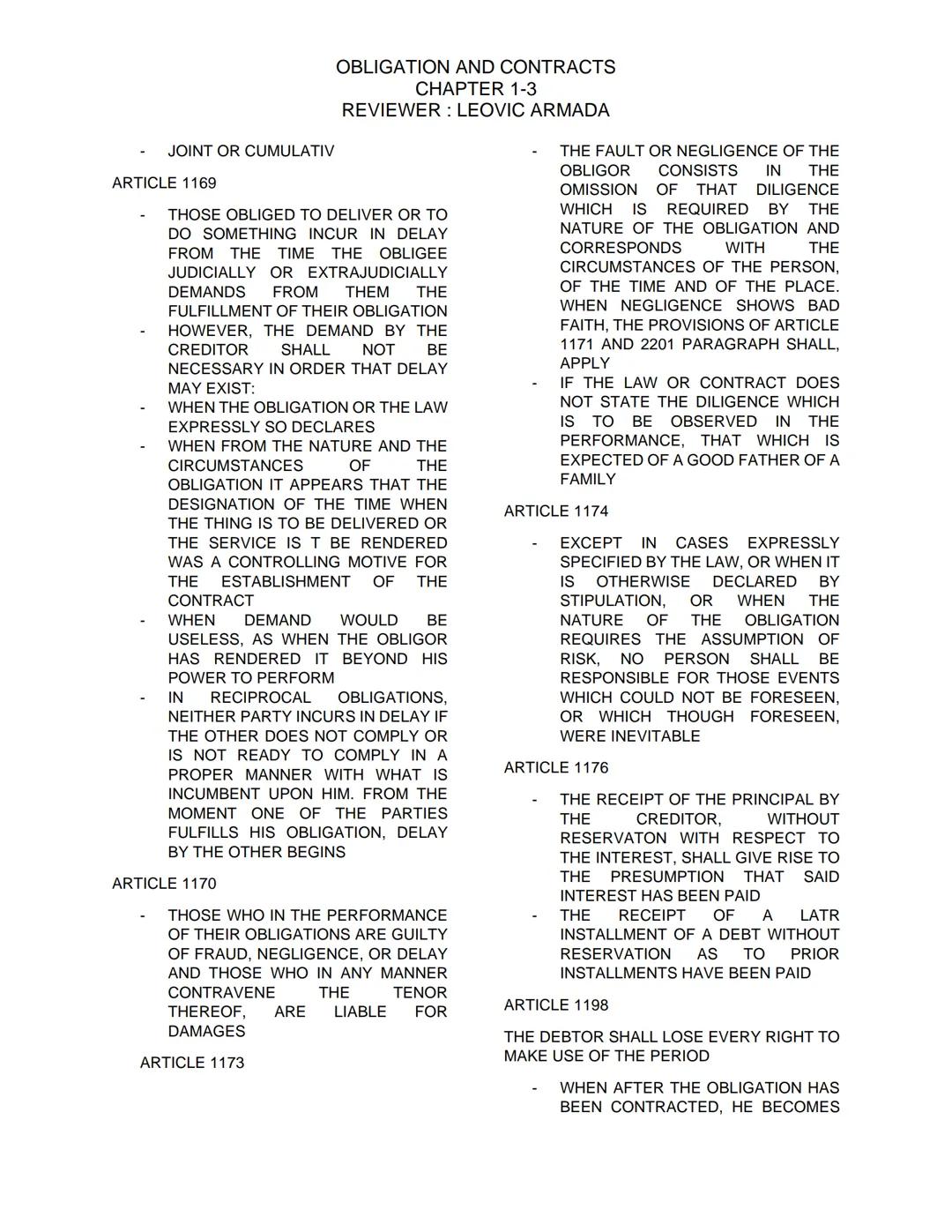
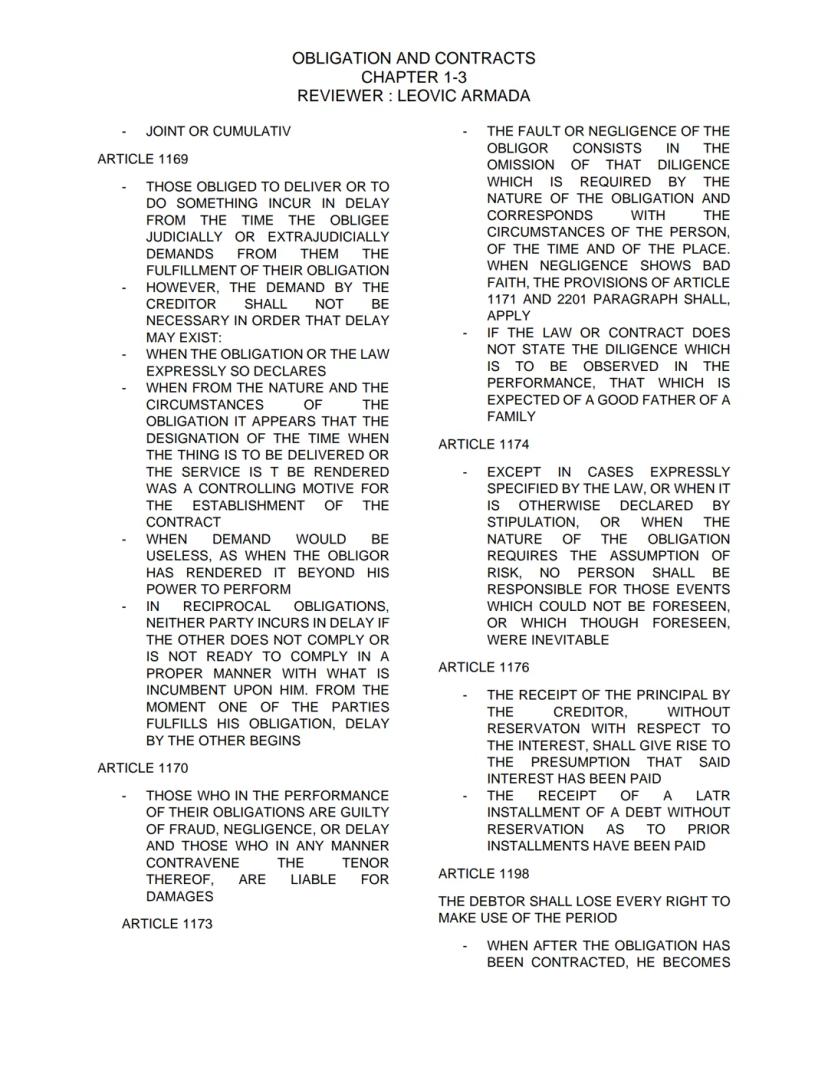
Article 1169 establishes when debtors incur delay: generally, after the creditor demands performance either judicially or extrajudicially. However, demand isn't necessary when the obligation or law explicitly states so, when time was clearly essential to the agreement, or when making a demand would be pointless.
In reciprocal obligations, neither party incurs delay if the other isn't ready to perform properly. Delay begins only when one party fulfills their obligation.
⚠️ Pay close attention to Article 1174: Generally, no one is responsible for unforeseeable or inevitable events (fortuitous events), but there are exceptions when the law specifies, when parties agree otherwise, or when the nature of the obligation requires assuming risk.
Article 1170 makes those guilty of fraud, negligence, or delay liable for damages, while Article 1173 defines negligence as omitting the diligence required by the nature of the obligation. Unless otherwise specified, the standard is the diligence of a good father of a family.
Article 1176 creates important presumptions: receiving the principal without reservation about interest presumes the interest was paid; similarly, accepting a later installment without reservation presumes prior installments were paid.
Article 1198 lists situations where debtors lose their right to a time period for performance: becoming insolvent, failing to provide promised security, impairing existing guaranties, violating agreements that were the basis for the time period, or attempting to abscond.
Article 1205 details rules for alternative obligations when the choice belongs to the creditor, including what happens when some options become impossible through fortuitous events or the debtor's fault.
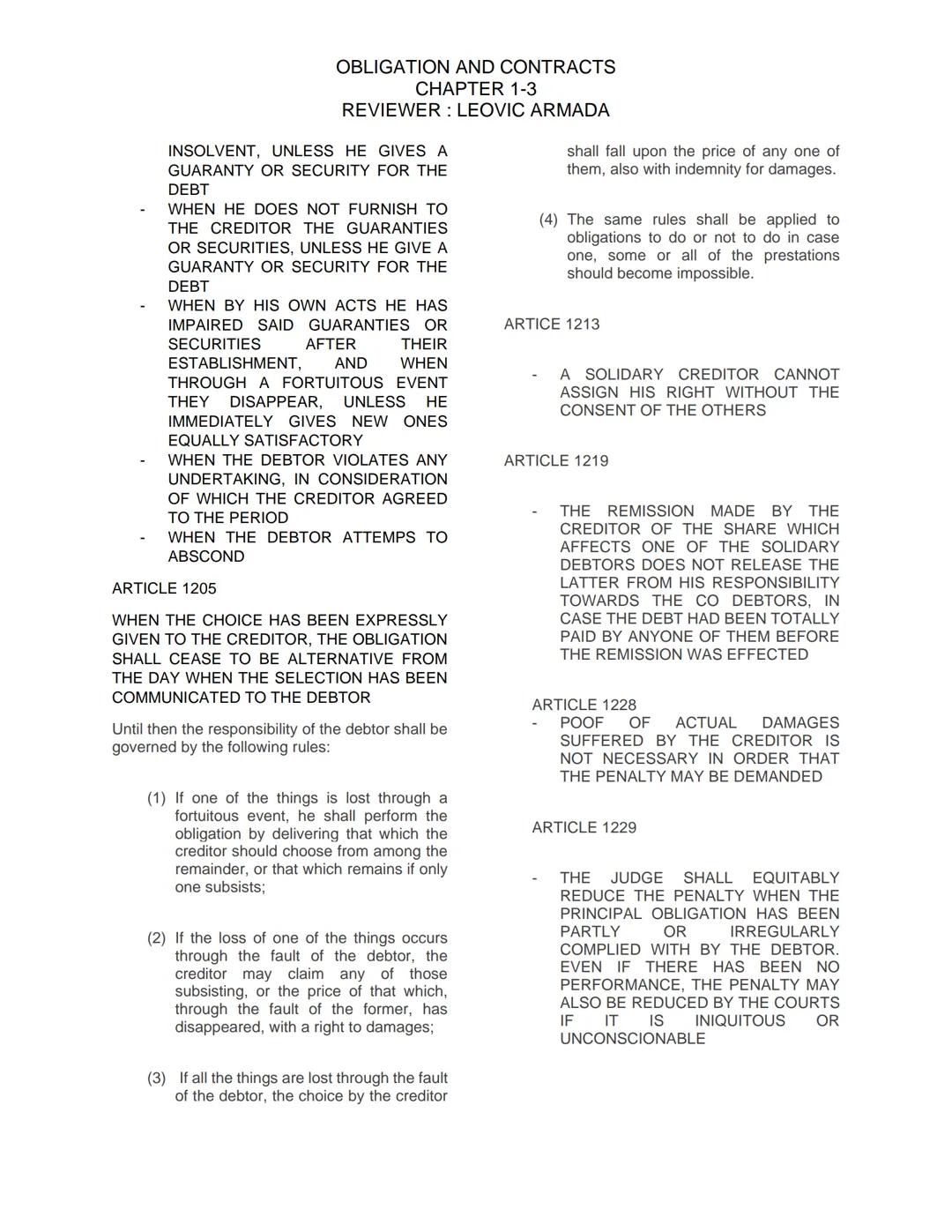
Several important legal provisions govern special situations in obligations and contracts. Article 1213 states that a solidary creditor cannot assign their rights without consent from other solidary creditors—protecting the interests of all parties involved in multi-creditor arrangements.
Article 1219 addresses remission (forgiveness) of debt in solidary obligations. If one solidary debtor's share is forgiven by the creditor, that debtor still has responsibility toward co-debtors if the debt was fully paid by another debtor before the remission.
🔑 Article 1228 provides a significant advantage to creditors: when an obligation includes a penalty clause, the creditor doesn't need to prove actual damages to demand the penalty. This simplifies enforcement and provides certainty.
However, Article 1229 balances this by allowing judges to equitably reduce penalties in two situations: when the principal obligation was partially or irregularly fulfilled, or when the penalty is iniquitous (unfair) or unconscionable (excessively harsh)—even if there was no performance at all.
These provisions demonstrate how the law tries to balance the interests of creditors and debtors. Creditors get powerful enforcement tools like penalty clauses that don't require proving actual damages, while debtors are protected from grossly unfair penalties through judicial discretion.
Understanding these legal provisions helps you navigate obligation and contract situations more effectively. They establish clear rules for special circumstances like solidarity among multiple parties and provide guidance on when penalties can be demanded or reduced.
Our AI companion is specifically built for the needs of students. Based on the millions of content pieces we have on the platform we can provide truly meaningful and relevant answers to students. But its not only about answers, the companion is even more about guiding students through their daily learning challenges, with personalised study plans, quizzes or content pieces in the chat and 100% personalisation based on the students skills and developments.
You can download the app in the Google Play Store and in the Apple App Store.
That's right! Enjoy free access to study content, connect with fellow students, and get instant help – all at your fingertips.
App Store
Google Play
The app is very easy to use and well designed. I have found everything I was looking for so far and have been able to learn a lot from the presentations! I will definitely use the app for a class assignment! And of course it also helps a lot as an inspiration.
Stefan S
iOS user
This app is really great. There are so many study notes and help [...]. My problem subject is French, for example, and the app has so many options for help. Thanks to this app, I have improved my French. I would recommend it to anyone.
Samantha Klich
Android user
Wow, I am really amazed. I just tried the app because I've seen it advertised many times and was absolutely stunned. This app is THE HELP you want for school and above all, it offers so many things, such as workouts and fact sheets, which have been VERY helpful to me personally.
Anna
iOS user
I think it’s very much worth it and you’ll end up using it a lot once you get the hang of it and even after looking at others notes you can still ask your Artificial intelligence buddy the question and ask to simplify it if you still don’t get it!!! In the end I think it’s worth it 😊👍 ⚠️Also DID I MENTION ITS FREEE YOU DON’T HAVE TO PAY FOR ANYTHING AND STILL GET YOUR GRADES IN PERFECTLY❗️❗️⚠️
Thomas R
iOS user
Knowunity is the BEST app I’ve used in a minute. This is not an ai review or anything this is genuinely coming from a 7th grade student (I know 2011 im young) but dude this app is a 10/10 i have maintained a 3.8 gpa and have plenty of time for gaming. I love it and my mom is just happy I got good grades
Brad T
Android user
Not only did it help me find the answer but it also showed me alternative ways to solve it. I was horrible in math and science but now I have an a in both subjects. Thanks for the help🤍🤍
David K
iOS user
The app's just great! All I have to do is enter the topic in the search bar and I get the response real fast. I don't have to watch 10 YouTube videos to understand something, so I'm saving my time. Highly recommended!
Sudenaz Ocak
Android user
In school I was really bad at maths but thanks to the app, I am doing better now. I am so grateful that you made the app.
Greenlight Bonnie
Android user
I found this app a couple years ago and it has only gotten better since then. I really love it because it can help with written questions and photo questions. Also, it can find study guides that other people have made as well as flashcard sets and practice tests. The free version is also amazing for students who might not be able to afford it. Would 100% recommend
Aubrey
iOS user
Best app if you're in Highschool or Junior high. I have been using this app for 2 school years and it's the best, it's good if you don't have anyone to help you with school work.😋🩷🎀
Marco B
iOS user
THE QUIZES AND FLASHCARDS ARE SO USEFUL AND I LOVE Knowunity AI. IT ALSO IS LITREALLY LIKE CHATGPT BUT SMARTER!! HELPED ME WITH MY MASCARA PROBLEMS TOO!! AS WELL AS MY REAL SUBJECTS ! DUHHH 😍😁😲🤑💗✨🎀😮
Elisha
iOS user
This app is phenomenal down to the correct info and the various topics you can study! I greatly recommend it for people who struggle with procrastination and those who need homework help. It has been perfectly accurate for world 1 history as far as I’ve seen! Geometry too!
Paul T
iOS user
The app is very easy to use and well designed. I have found everything I was looking for so far and have been able to learn a lot from the presentations! I will definitely use the app for a class assignment! And of course it also helps a lot as an inspiration.
Stefan S
iOS user
This app is really great. There are so many study notes and help [...]. My problem subject is French, for example, and the app has so many options for help. Thanks to this app, I have improved my French. I would recommend it to anyone.
Samantha Klich
Android user
Wow, I am really amazed. I just tried the app because I've seen it advertised many times and was absolutely stunned. This app is THE HELP you want for school and above all, it offers so many things, such as workouts and fact sheets, which have been VERY helpful to me personally.
Anna
iOS user
I think it’s very much worth it and you’ll end up using it a lot once you get the hang of it and even after looking at others notes you can still ask your Artificial intelligence buddy the question and ask to simplify it if you still don’t get it!!! In the end I think it’s worth it 😊👍 ⚠️Also DID I MENTION ITS FREEE YOU DON’T HAVE TO PAY FOR ANYTHING AND STILL GET YOUR GRADES IN PERFECTLY❗️❗️⚠️
Thomas R
iOS user
Knowunity is the BEST app I’ve used in a minute. This is not an ai review or anything this is genuinely coming from a 7th grade student (I know 2011 im young) but dude this app is a 10/10 i have maintained a 3.8 gpa and have plenty of time for gaming. I love it and my mom is just happy I got good grades
Brad T
Android user
Not only did it help me find the answer but it also showed me alternative ways to solve it. I was horrible in math and science but now I have an a in both subjects. Thanks for the help🤍🤍
David K
iOS user
The app's just great! All I have to do is enter the topic in the search bar and I get the response real fast. I don't have to watch 10 YouTube videos to understand something, so I'm saving my time. Highly recommended!
Sudenaz Ocak
Android user
In school I was really bad at maths but thanks to the app, I am doing better now. I am so grateful that you made the app.
Greenlight Bonnie
Android user
I found this app a couple years ago and it has only gotten better since then. I really love it because it can help with written questions and photo questions. Also, it can find study guides that other people have made as well as flashcard sets and practice tests. The free version is also amazing for students who might not be able to afford it. Would 100% recommend
Aubrey
iOS user
Best app if you're in Highschool or Junior high. I have been using this app for 2 school years and it's the best, it's good if you don't have anyone to help you with school work.😋🩷🎀
Marco B
iOS user
THE QUIZES AND FLASHCARDS ARE SO USEFUL AND I LOVE Knowunity AI. IT ALSO IS LITREALLY LIKE CHATGPT BUT SMARTER!! HELPED ME WITH MY MASCARA PROBLEMS TOO!! AS WELL AS MY REAL SUBJECTS ! DUHHH 😍😁😲🤑💗✨🎀😮
Elisha
iOS user
This app is phenomenal down to the correct info and the various topics you can study! I greatly recommend it for people who struggle with procrastination and those who need homework help. It has been perfectly accurate for world 1 history as far as I’ve seen! Geometry too!
Paul T
iOS user
Leovic Armada
@leovicarmada
Obligations and contracts form the backbone of our legal system, defining how people and entities interact when making agreements or owing duties to one another. These concepts establish who owes what to whom, when they must perform, and what happens... Show more
Access to all documents
Improve your grades
Join milions of students
Law isn't just a bunch of rules—it's an organized system that governs our actions. There are several types of law that affect us differently:
Divine law deals with religious matters and concepts of sin, while natural law comes from our inherent sense of justice and fairness. Moral law emerges from society's collective sense of right and wrong, and physical law governs how natural phenomena operate. State law—the one we'll focus on—is officially created and enforced by government authorities.
💡 Think of state law as the "house rules" for society that everyone must follow, while moral law is more like the unwritten rules we all generally agree on.
When we talk about obligations, we're referring to legal duties that bind one person (the passive subject or debtor) to another (the active subject or creditor). The object or prestation is the specific conduct required—whether giving something, doing something, or not doing something. What makes obligations powerful is the juridical tie that legally connects the parties, allowing courts to enforce them if necessary.
Obligations can be classified as real obligations (giving something) or personal obligations (doing or not doing something). Understanding these classifications helps determine how obligations can be fulfilled and what remedies are available if they're not.
Access to all documents
Improve your grades
Join milions of students
Obligations don't just appear out of nowhere—they come from specific sources recognized by law. The five main sources are:
Law itself can directly impose obligations, like paying taxes. Contracts create obligations when parties voluntarily agree to them. Quasi-contracts arise from lawful, voluntary acts where consent is supplied by legal fiction—like when someone manages another's property without permission (negotiorum gestio) or when something is mistakenly delivered and must be returned (solutio indebiti).
Delicts are civil liabilities arising from criminal acts, while quasi-delicts come from negligent acts that cause damage to others without criminal intent.
🔑 Remember the key difference: Crimes require criminal intent and can result in punishment, while quasi-delicts involve only negligence and aim for compensation.
Obligations can be classified in several ways. A pure obligation is immediately demandable, while a potestative obligation depends on one party's will. Suspensive conditions give rise to obligations, while resolutory conditions extinguish them.
The difference between alternative and facultative obligations is crucial: In alternative obligations, several performances are due but fulfilling one is enough, while in facultative obligations, only one performance is due but the debtor may substitute it.
Understanding whether an obligation is joint (divided proportionately) or solidary (one for all, all for one) determines who's responsible when multiple parties are involved.
Access to all documents
Improve your grades
Join milions of students
When fulfilling obligations, it matters what kind of property is involved. A determinate thing is specifically identified and can't be substituted—like your grandmother's antique watch. A generic thing is defined only by class—like "a gallon of milk"—allowing the debtor to provide any item of the same kind.
Legal standards matter too. The diligence of a good father of a family refers to the ordinary care an average person would use with their own property. This standard helps courts determine if someone has been negligent.
💡 Think of "diligence of a good father of a family" as the reasonable person standard—what would a responsible person typically do in this situation?
Creditors' rights extend to the fruits of things they're owed (like interest on money or crops from land) from the time the obligation arises. These rights can be classified as either personal rights (enforceable against specific people) or real rights (enforceable against the world regarding specific property).
Delay in fulfilling obligations can be either legal (constituting a breach) or ordinary (simply failing to perform on time). Negligence depends on specific circumstances, while a fortuitous event is something unforeseeable or inevitable that might excuse performance.
These distinctions help determine who bears responsibility when things don't go as planned in an obligation. Courts use these concepts to decide whether someone has properly fulfilled their duties or should be held liable.
Access to all documents
Improve your grades
Join milions of students
Obligations come in many forms, each with different rules about how they work. A pure obligation is straightforward—it's not subject to any condition and is immediately demandable. Other obligations have special characteristics:
Potestative obligations depend upon the sole will of one party. These are further classified as suspensive (creating the obligation) or resolutory (extinguishing it). Understanding these distinctions helps determine when obligations become effective or cease to exist.
The difference between alternative and facultative obligations is crucial. In alternative obligations, several performances are due but fulfilling one is sufficient. The right to choose may belong to the creditor, debtor, or a third person. In facultative obligations, only one performance is due, though the debtor may substitute it with something else.
⚠️ In alternative obligations, the loss of one option doesn't extinguish the obligation, but in facultative obligations, the loss of the main thing due to a fortuitous event ends the obligation entirely.
Joint obligations are divided proportionately among parties (the default when contracts are silent), while solidary obligations follow the "one for all, all for one" principle. Don't confuse indivisibility (which refers to the prestation itself) with solidarity (which refers to the legal ties between parties).
A special type is an obligation with a penal clause—it contains an accessory undertaking to pay a stipulated amount if the main obligation is breached. This serves to ensure performance, substitute for damages, and punish non-compliance.
Access to all documents
Improve your grades
Join milions of students
A penal clause is a powerful tool in contracts—it's an accessory undertaking that increases liability if an obligation is breached. Think of it as a built-in consequence for not following through on your promises.
The penal clause serves three main purposes: it deters breach by making consequences severe, it replaces the need to prove actual damages (which can be difficult), and it punishes the debtor for failing to fulfill obligations. The general rule is that the penalty substitutes for damages and interest when there's non-compliance.
💡 A penal clause is like setting up automatic consequences in advance—it saves time and arguments later because everyone already agreed to the penalty.
A creditor can still recover damages beyond the penalty in special cases: when specifically stipulated, when the debtor refuses to pay the penalty, or when the debtor acts fraudulently.
The law establishes several conclusive presumptions and essential requirements. Remember that ignorance of the law excuses no one—you're expected to know and follow legal rules regardless of whether you've actually read them.
Every obligation must have four essential elements: a passive subject (debtor), an active subject (creditor), an object or prestation, and a juridical or legal tie. These components form the foundation of any valid obligation.
Obligations can be classified in various ways: by type (real vs. personal), by source , and by whether they arise from lawful or unlawful acts. Understanding these classifications helps determine how obligations should be performed and what happens when they're not.
Access to all documents
Improve your grades
Join milions of students
When someone owes a determinate thing, they have specific responsibilities: they must deliver the exact item, preserve it with proper care, provide any fruits (like interest or crops), include any accessories, and pay damages if they fail to fulfill the obligation. For generic things (like "a gallon of milk"), the debtor must simply deliver an item of the required kind and quality.
Different kinds of fruits may be owed with the main obligation: natural fruits (produced spontaneously), industrial fruits (produced through cultivation), or civil fruits (like rent or interest).
🔑 Knowing your rights as a creditor is crucial—you have multiple options when a debtor doesn't perform, including demanding specific performance, cancellation of the contract, or compensation for damages.
When a debtor fails to perform, creditors have various remedies depending on the type of obligation:
For real obligations (giving something), creditors can demand specific performance, cancel the contract, or seek damages. If the obligation involves a generic thing, a third person might even perform it.
For positive personal obligations (doing something), the creditor can have the task done by someone else at the debtor's expense or recover damages. For negative personal obligations (not doing something), the creditor can request undoing of the forbidden act plus damages.
The law recognizes different kinds of delay: mora solvendi (debtor's delay), mora accipiendi (creditor's delay), and compensatio morae (both parties delay). Understanding which applies helps determine who bears responsibility for problems that arise during delay.
Access to all documents
Improve your grades
Join milions of students
When a debtor fails to perform on time, we call this delay or mora. For the debtor to be officially in delay (mora solvendi), three things must happen: they must fail to perform on time, the creditor must demand performance, and the debtor must still fail to comply after the demand.
Being in delay has serious consequences. The debtor becomes liable for damages and interest, and in some cases, even becomes responsible for losses due to fortuitous events. Conversely, when the creditor delays in accepting performance (mora accipiendi), they may become liable for damages to the debtor.
💡 Remember "No demand, no delay"—except in special cases like when the contract specifically says demand isn't needed, when time is essential to the agreement, or when making a demand would be pointless.
Negligence comes in three forms: culpa contractual (breach of contract), culpa aquiliana (tort), and culpa criminal (related to crimes). Each type has different standards and consequences.
Conditional obligations depend on future uncertain events. If a suspensive condition depends entirely on the debtor's will, the condition is void (though the obligation itself may remain valid). Impossible conditions can be physically impossible or legally impossible, and they may void either the entire obligation or just the condition itself.
Obligations can be unilateral (binding only one party), bilateral (binding both), or reciprocal (where both parties are mutually debtor and creditor to each other). Penal clauses in contracts can be legal or conventional, compensatory or punitive, subsidiary or cumulative—each serving different purposes in enforcing obligations.
Access to all documents
Improve your grades
Join milions of students
Article 1169 establishes when debtors incur delay: generally, after the creditor demands performance either judicially or extrajudicially. However, demand isn't necessary when the obligation or law explicitly states so, when time was clearly essential to the agreement, or when making a demand would be pointless.
In reciprocal obligations, neither party incurs delay if the other isn't ready to perform properly. Delay begins only when one party fulfills their obligation.
⚠️ Pay close attention to Article 1174: Generally, no one is responsible for unforeseeable or inevitable events (fortuitous events), but there are exceptions when the law specifies, when parties agree otherwise, or when the nature of the obligation requires assuming risk.
Article 1170 makes those guilty of fraud, negligence, or delay liable for damages, while Article 1173 defines negligence as omitting the diligence required by the nature of the obligation. Unless otherwise specified, the standard is the diligence of a good father of a family.
Article 1176 creates important presumptions: receiving the principal without reservation about interest presumes the interest was paid; similarly, accepting a later installment without reservation presumes prior installments were paid.
Article 1198 lists situations where debtors lose their right to a time period for performance: becoming insolvent, failing to provide promised security, impairing existing guaranties, violating agreements that were the basis for the time period, or attempting to abscond.
Article 1205 details rules for alternative obligations when the choice belongs to the creditor, including what happens when some options become impossible through fortuitous events or the debtor's fault.
Access to all documents
Improve your grades
Join milions of students
Several important legal provisions govern special situations in obligations and contracts. Article 1213 states that a solidary creditor cannot assign their rights without consent from other solidary creditors—protecting the interests of all parties involved in multi-creditor arrangements.
Article 1219 addresses remission (forgiveness) of debt in solidary obligations. If one solidary debtor's share is forgiven by the creditor, that debtor still has responsibility toward co-debtors if the debt was fully paid by another debtor before the remission.
🔑 Article 1228 provides a significant advantage to creditors: when an obligation includes a penalty clause, the creditor doesn't need to prove actual damages to demand the penalty. This simplifies enforcement and provides certainty.
However, Article 1229 balances this by allowing judges to equitably reduce penalties in two situations: when the principal obligation was partially or irregularly fulfilled, or when the penalty is iniquitous (unfair) or unconscionable (excessively harsh)—even if there was no performance at all.
These provisions demonstrate how the law tries to balance the interests of creditors and debtors. Creditors get powerful enforcement tools like penalty clauses that don't require proving actual damages, while debtors are protected from grossly unfair penalties through judicial discretion.
Understanding these legal provisions helps you navigate obligation and contract situations more effectively. They establish clear rules for special circumstances like solidarity among multiple parties and provide guidance on when penalties can be demanded or reduced.
Our AI companion is specifically built for the needs of students. Based on the millions of content pieces we have on the platform we can provide truly meaningful and relevant answers to students. But its not only about answers, the companion is even more about guiding students through their daily learning challenges, with personalised study plans, quizzes or content pieces in the chat and 100% personalisation based on the students skills and developments.
You can download the app in the Google Play Store and in the Apple App Store.
That's right! Enjoy free access to study content, connect with fellow students, and get instant help – all at your fingertips.
2
Smart Tools NEW
Transform this note into: ✓ 50+ Practice Questions ✓ Interactive Flashcards ✓ Full Practice Test ✓ Essay Outlines
App Store
Google Play
The app is very easy to use and well designed. I have found everything I was looking for so far and have been able to learn a lot from the presentations! I will definitely use the app for a class assignment! And of course it also helps a lot as an inspiration.
Stefan S
iOS user
This app is really great. There are so many study notes and help [...]. My problem subject is French, for example, and the app has so many options for help. Thanks to this app, I have improved my French. I would recommend it to anyone.
Samantha Klich
Android user
Wow, I am really amazed. I just tried the app because I've seen it advertised many times and was absolutely stunned. This app is THE HELP you want for school and above all, it offers so many things, such as workouts and fact sheets, which have been VERY helpful to me personally.
Anna
iOS user
I think it’s very much worth it and you’ll end up using it a lot once you get the hang of it and even after looking at others notes you can still ask your Artificial intelligence buddy the question and ask to simplify it if you still don’t get it!!! In the end I think it’s worth it 😊👍 ⚠️Also DID I MENTION ITS FREEE YOU DON’T HAVE TO PAY FOR ANYTHING AND STILL GET YOUR GRADES IN PERFECTLY❗️❗️⚠️
Thomas R
iOS user
Knowunity is the BEST app I’ve used in a minute. This is not an ai review or anything this is genuinely coming from a 7th grade student (I know 2011 im young) but dude this app is a 10/10 i have maintained a 3.8 gpa and have plenty of time for gaming. I love it and my mom is just happy I got good grades
Brad T
Android user
Not only did it help me find the answer but it also showed me alternative ways to solve it. I was horrible in math and science but now I have an a in both subjects. Thanks for the help🤍🤍
David K
iOS user
The app's just great! All I have to do is enter the topic in the search bar and I get the response real fast. I don't have to watch 10 YouTube videos to understand something, so I'm saving my time. Highly recommended!
Sudenaz Ocak
Android user
In school I was really bad at maths but thanks to the app, I am doing better now. I am so grateful that you made the app.
Greenlight Bonnie
Android user
I found this app a couple years ago and it has only gotten better since then. I really love it because it can help with written questions and photo questions. Also, it can find study guides that other people have made as well as flashcard sets and practice tests. The free version is also amazing for students who might not be able to afford it. Would 100% recommend
Aubrey
iOS user
Best app if you're in Highschool or Junior high. I have been using this app for 2 school years and it's the best, it's good if you don't have anyone to help you with school work.😋🩷🎀
Marco B
iOS user
THE QUIZES AND FLASHCARDS ARE SO USEFUL AND I LOVE Knowunity AI. IT ALSO IS LITREALLY LIKE CHATGPT BUT SMARTER!! HELPED ME WITH MY MASCARA PROBLEMS TOO!! AS WELL AS MY REAL SUBJECTS ! DUHHH 😍😁😲🤑💗✨🎀😮
Elisha
iOS user
This app is phenomenal down to the correct info and the various topics you can study! I greatly recommend it for people who struggle with procrastination and those who need homework help. It has been perfectly accurate for world 1 history as far as I’ve seen! Geometry too!
Paul T
iOS user
The app is very easy to use and well designed. I have found everything I was looking for so far and have been able to learn a lot from the presentations! I will definitely use the app for a class assignment! And of course it also helps a lot as an inspiration.
Stefan S
iOS user
This app is really great. There are so many study notes and help [...]. My problem subject is French, for example, and the app has so many options for help. Thanks to this app, I have improved my French. I would recommend it to anyone.
Samantha Klich
Android user
Wow, I am really amazed. I just tried the app because I've seen it advertised many times and was absolutely stunned. This app is THE HELP you want for school and above all, it offers so many things, such as workouts and fact sheets, which have been VERY helpful to me personally.
Anna
iOS user
I think it’s very much worth it and you’ll end up using it a lot once you get the hang of it and even after looking at others notes you can still ask your Artificial intelligence buddy the question and ask to simplify it if you still don’t get it!!! In the end I think it’s worth it 😊👍 ⚠️Also DID I MENTION ITS FREEE YOU DON’T HAVE TO PAY FOR ANYTHING AND STILL GET YOUR GRADES IN PERFECTLY❗️❗️⚠️
Thomas R
iOS user
Knowunity is the BEST app I’ve used in a minute. This is not an ai review or anything this is genuinely coming from a 7th grade student (I know 2011 im young) but dude this app is a 10/10 i have maintained a 3.8 gpa and have plenty of time for gaming. I love it and my mom is just happy I got good grades
Brad T
Android user
Not only did it help me find the answer but it also showed me alternative ways to solve it. I was horrible in math and science but now I have an a in both subjects. Thanks for the help🤍🤍
David K
iOS user
The app's just great! All I have to do is enter the topic in the search bar and I get the response real fast. I don't have to watch 10 YouTube videos to understand something, so I'm saving my time. Highly recommended!
Sudenaz Ocak
Android user
In school I was really bad at maths but thanks to the app, I am doing better now. I am so grateful that you made the app.
Greenlight Bonnie
Android user
I found this app a couple years ago and it has only gotten better since then. I really love it because it can help with written questions and photo questions. Also, it can find study guides that other people have made as well as flashcard sets and practice tests. The free version is also amazing for students who might not be able to afford it. Would 100% recommend
Aubrey
iOS user
Best app if you're in Highschool or Junior high. I have been using this app for 2 school years and it's the best, it's good if you don't have anyone to help you with school work.😋🩷🎀
Marco B
iOS user
THE QUIZES AND FLASHCARDS ARE SO USEFUL AND I LOVE Knowunity AI. IT ALSO IS LITREALLY LIKE CHATGPT BUT SMARTER!! HELPED ME WITH MY MASCARA PROBLEMS TOO!! AS WELL AS MY REAL SUBJECTS ! DUHHH 😍😁😲🤑💗✨🎀😮
Elisha
iOS user
This app is phenomenal down to the correct info and the various topics you can study! I greatly recommend it for people who struggle with procrastination and those who need homework help. It has been perfectly accurate for world 1 history as far as I’ve seen! Geometry too!
Paul T
iOS user