
Philosophy is the study of fundamental questions about existence, knowledge,... Show more
 English Grammar
 AP US History
 AP World History
 Biology
Sign up to see the contentIt's free!
Access to all documents
Improve your grades
Join milions of students
Knowunity AI
Subjects
Triangle Congruence and Similarity Theorems
Triangle Properties and Classification
Linear Equations and Graphs
Geometric Angle Relationships
Trigonometric Functions and Identities
Equation Solving Techniques
Circle Geometry Fundamentals
Division Operations and Methods
Basic Differentiation Rules
Exponent and Logarithm Properties
Show all topics
Human Organ Systems
Reproductive Cell Cycles
Biological Sciences Subdisciplines
Cellular Energy Metabolism
Autotrophic Energy Processes
Inheritance Patterns and Principles
Biomolecular Structure and Organization
Cell Cycle and Division Mechanics
Cellular Organization and Development
Biological Structural Organization
Show all topics
Chemical Sciences and Applications
Atomic Structure and Composition
Molecular Electron Structure Representation
Atomic Electron Behavior
Matter Properties and Water
Mole Concept and Calculations
Gas Laws and Behavior
Periodic Table Organization
Chemical Thermodynamics Fundamentals
Chemical Bond Types and Properties
Show all topics
European Renaissance and Enlightenment
European Cultural Movements 800-1920
American Revolution Era 1763-1797
American Civil War 1861-1865
Global Imperial Systems
Mongol and Chinese Dynasties
U.S. Presidents and World Leaders
Historical Sources and Documentation
World Wars Era and Impact
World Religious Systems
Show all topics
Classic and Contemporary Novels
Literary Character Analysis
Rhetorical Theory and Practice
Classic Literary Narratives
Reading Analysis and Interpretation
Narrative Structure and Techniques
English Language Components
Influential English-Language Authors
Basic Sentence Structure
Narrative Voice and Perspective
Show all topics
49
•
Updated Apr 15, 2026
•
dhiandra genise
@dhiandragenise
Philosophy is the study of fundamental questions about existence, knowledge,... Show more
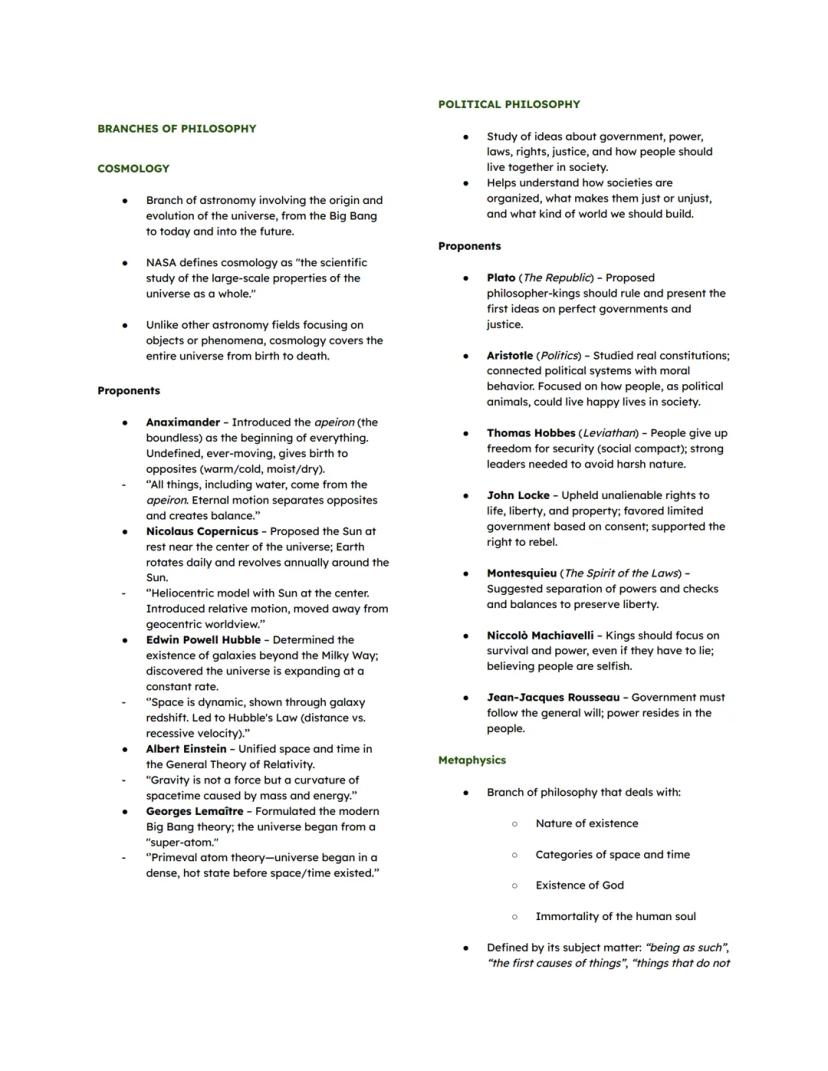
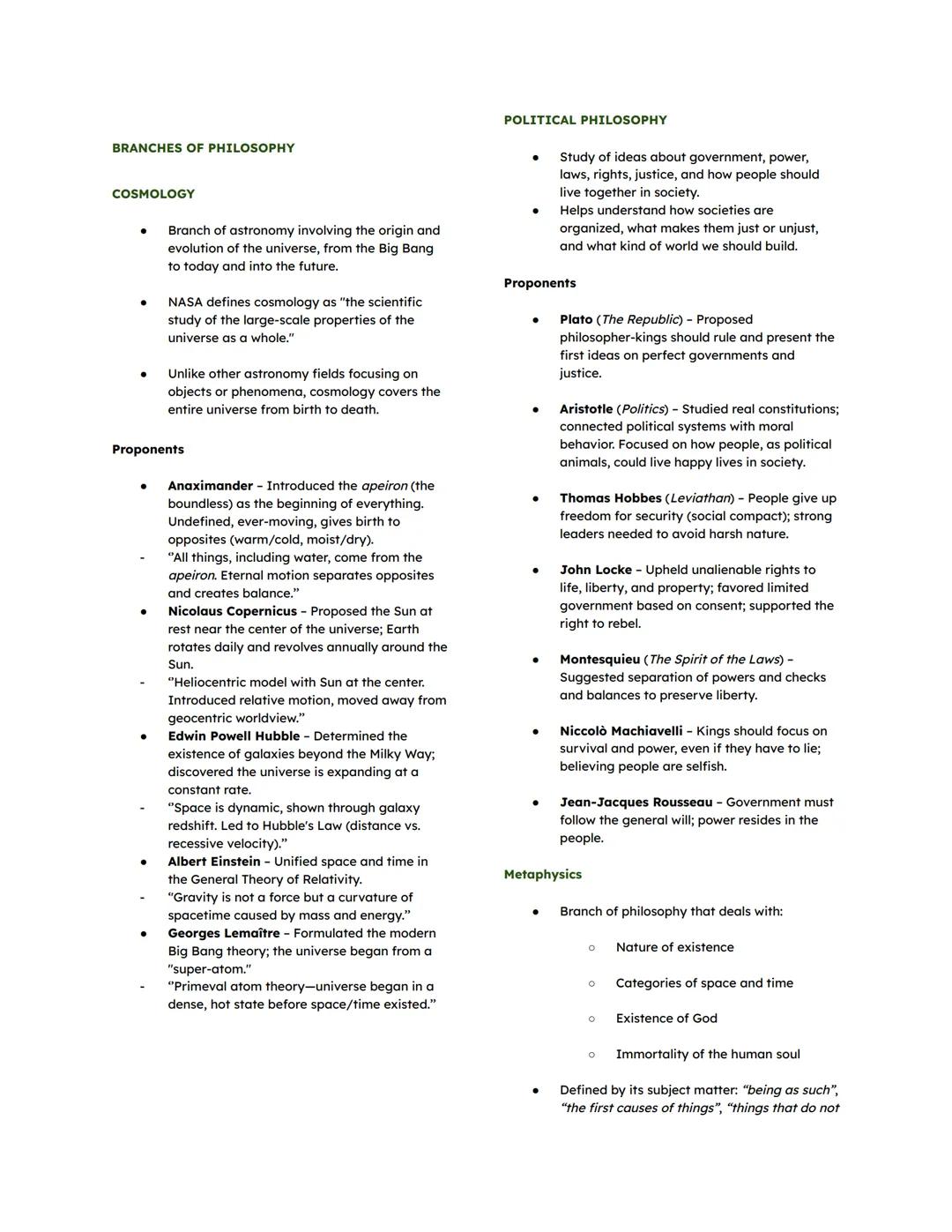
Cosmology is a branch of astronomy exploring the origin and evolution of the universe from the Big Bang to the future. Unlike other astronomy fields that focus on specific objects, cosmology examines the entire universe. Key figures like Anaximander introduced the concept of "apeiron" (the boundless) as the beginning of everything, while Nicolaus Copernicus revolutionized our understanding with his heliocentric model.
Edwin Powell Hubble made groundbreaking discoveries about galaxies beyond our own and proved the universe is expanding. Einstein's General Theory of Relativity unified space and time, showing gravity as a curvature of spacetime caused by mass and energy. Georges Lemaître formulated the modern Big Bang theory, proposing the universe began from a "super-atom."
Did you know? Cosmology is one of the oldest philosophical inquiries, but modern cosmology combines philosophy with advanced physics and astronomy to answer questions that humans have wondered about for thousands of years.
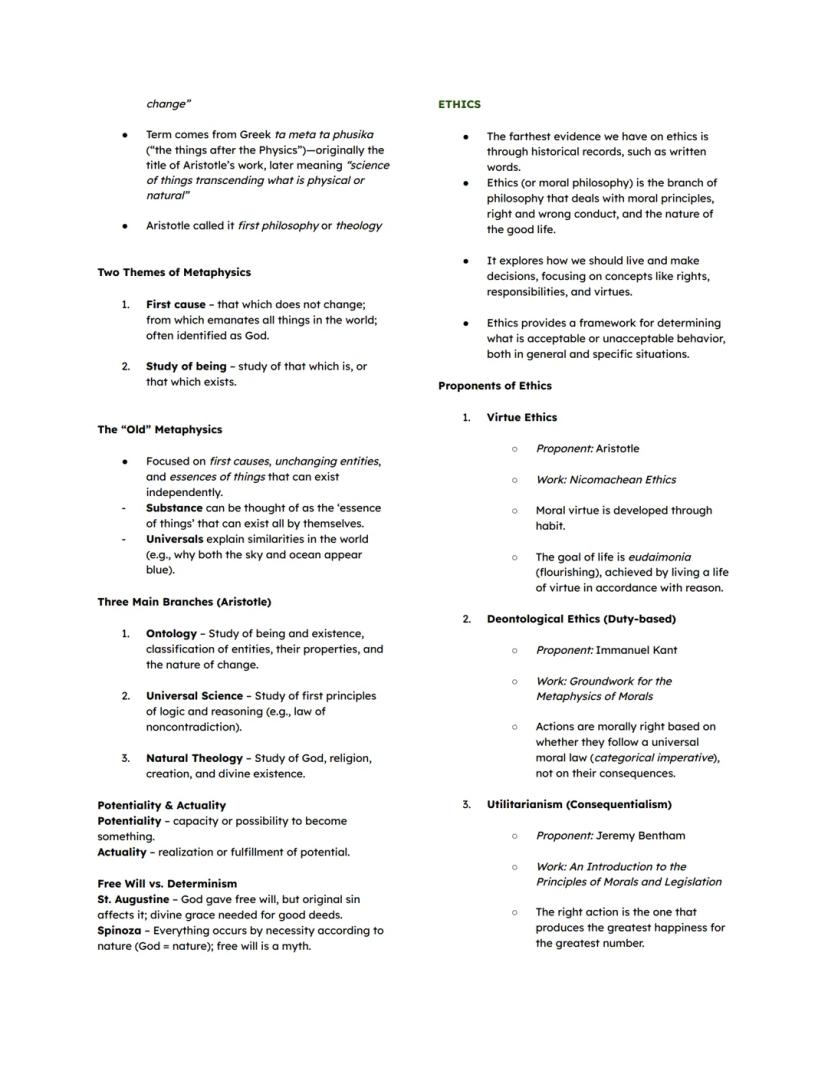
Political philosophy examines ideas about government, power, laws, rights, and justice. It helps us understand how societies are organized and what makes them just or unjust. Important thinkers include Plato, who proposed philosopher-kings should rule, and Aristotle, who studied constitutions and viewed humans as "political animals" who need society to flourish.
Later political philosophers like Thomas Hobbes argued people give up freedom for security, while John Locke championed unalienable rights and limited government. Montesquieu developed the concept of separation of powers, Machiavelli focused on political survival, and Rousseau emphasized that government must follow the "general will" of the people.
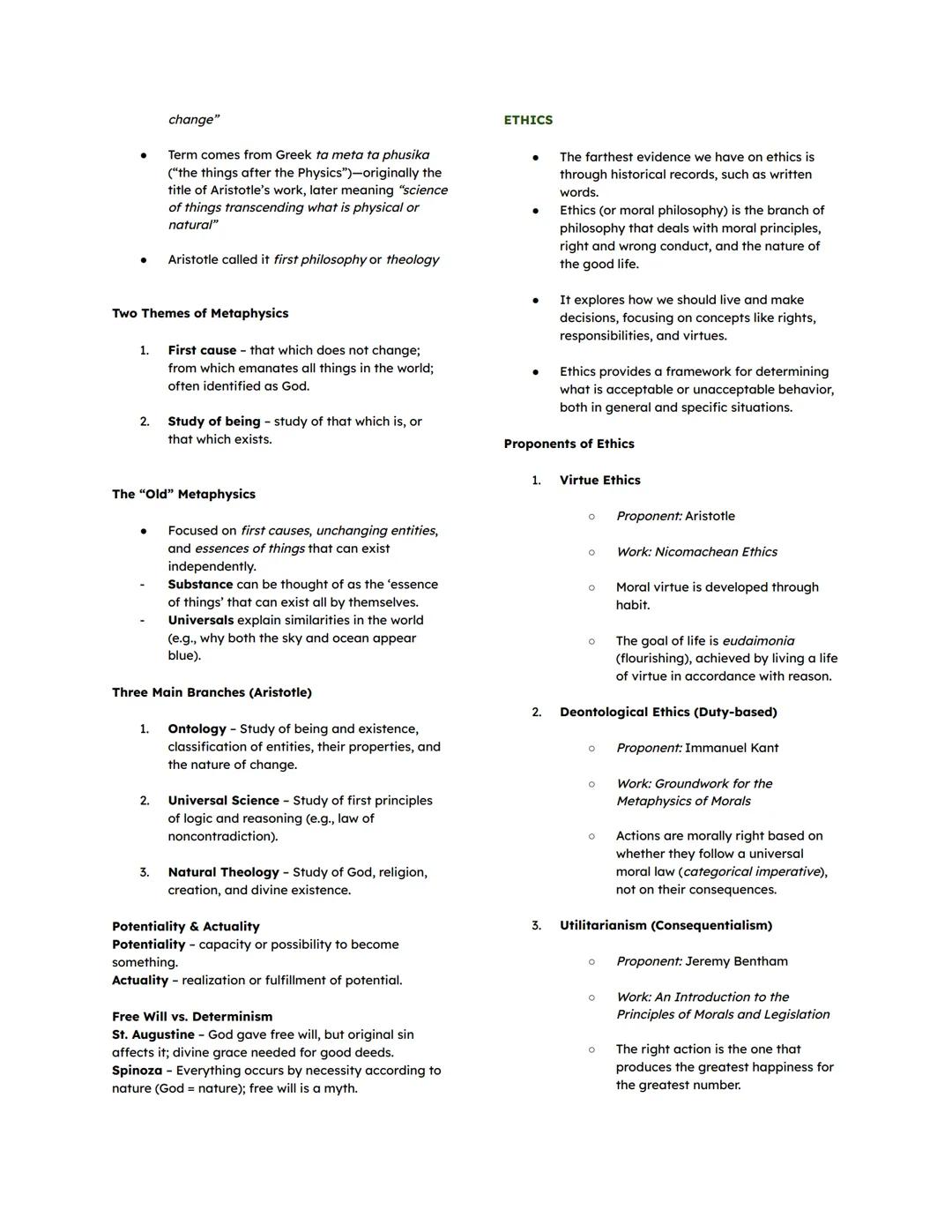
Metaphysics explores the fundamental nature of reality and existence. The term comes from Greek meaning "the things after Physics" and was originally the title of Aristotle's work. Metaphysics focuses on two main themes: first cause (that which does not change and from which all things emanate) and the study of being (what exists).
Metaphysics has three main branches according to Aristotle: ontology (study of being), universal science (study of logical principles), and natural theology (study of God and divine existence). Key concepts include substance (the essence of things), universals (explaining similarities in the world), and the relationship between potentiality (capacity to become) and actuality (realization of potential).
Think about it: The debate between free will and determinism continues today in fields ranging from neuroscience to quantum physics. Are your choices truly free or predetermined?
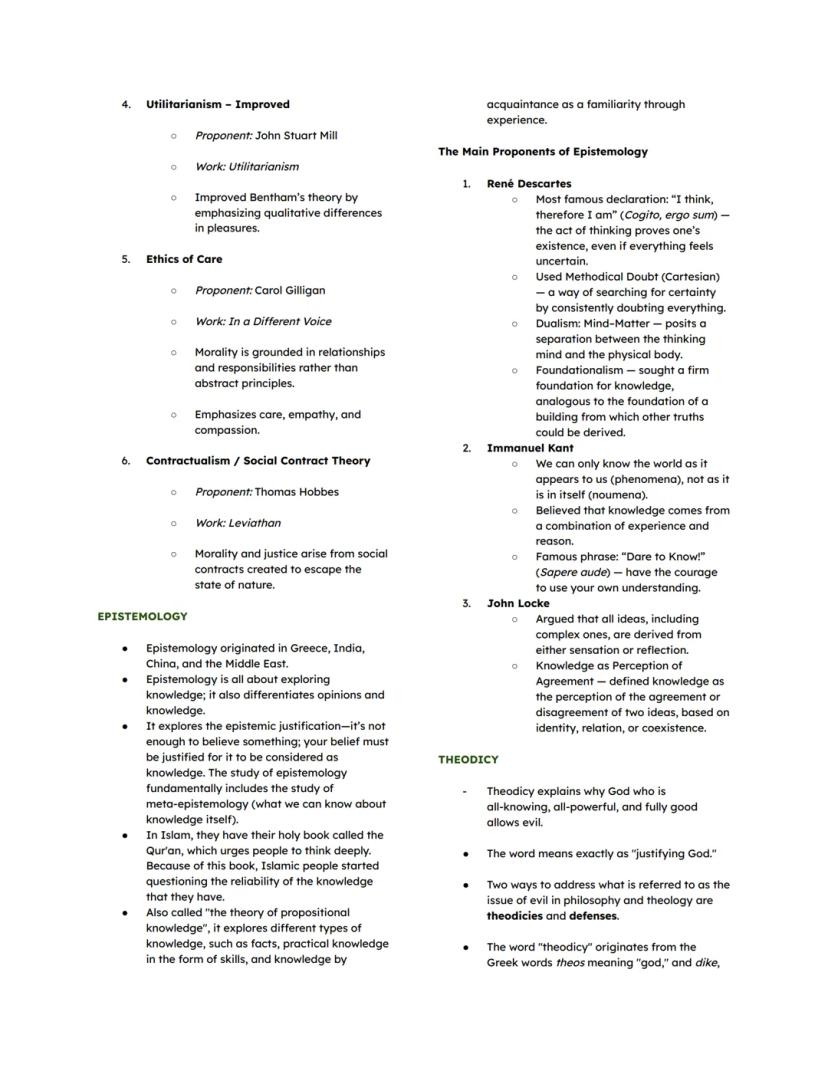
Ethics examines moral principles, right and wrong conduct, and the nature of the good life. It provides a framework for determining acceptable behavior in various situations. Different ethical approaches include Aristotle's virtue ethics (developing moral character through habit), Kant's deontological ethics (following universal moral laws regardless of consequences), and Bentham's utilitarianism (pursuing the greatest happiness for the greatest number).
John Stuart Mill improved on Bentham's theory by emphasizing qualitative differences in pleasures. Carol Gilligan's ethics of care focuses on relationships and responsibilities rather than abstract principles. Social contract theories, like those proposed by Thomas Hobbes, suggest morality arises from agreements created to escape the chaotic "state of nature."
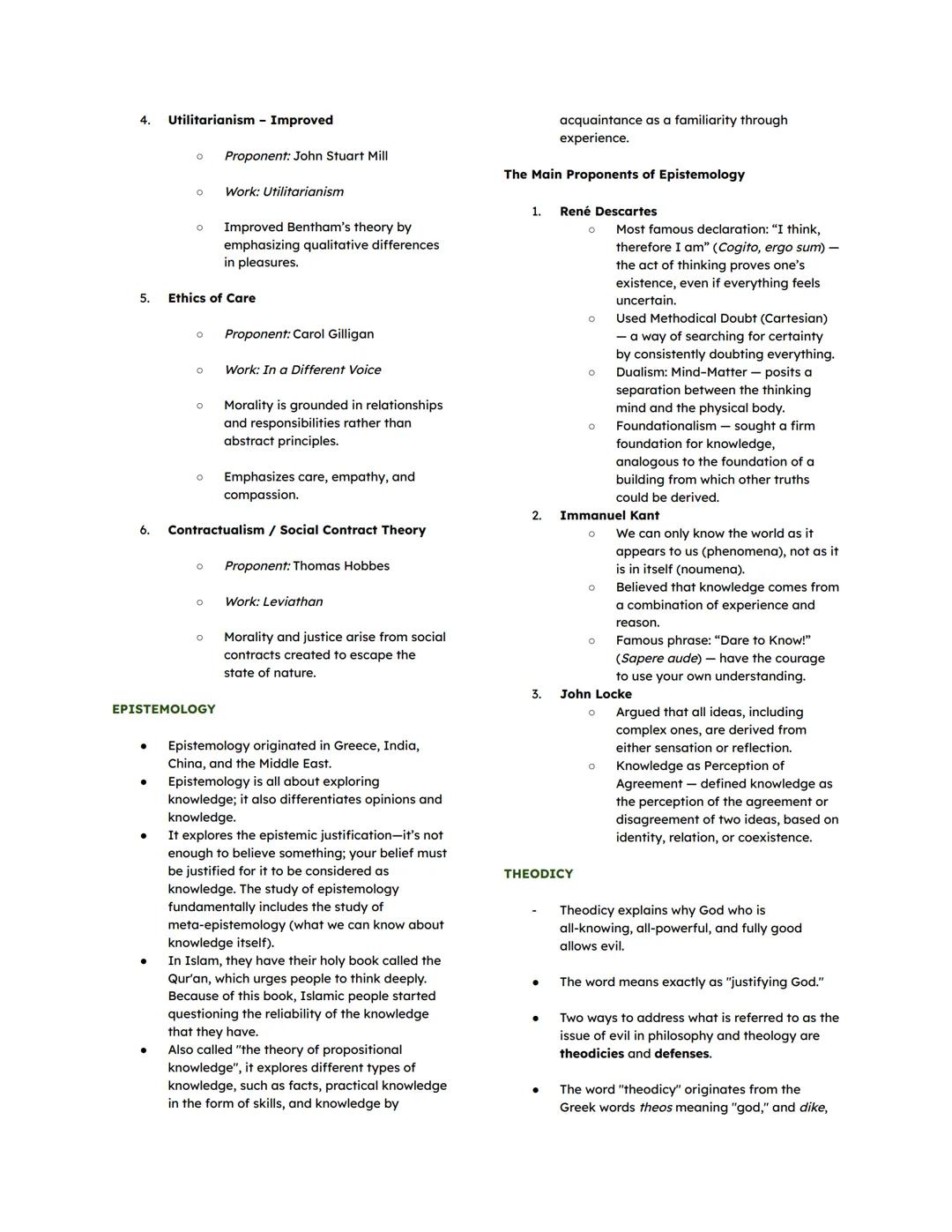
Epistemology explores the nature and limits of knowledge. Originating in Greece, India, China, and the Middle East, it distinguishes between opinions and justified knowledge. This field examines what we can know, how we know it, and what makes beliefs justified enough to count as knowledge.
René Descartes made his famous declaration "I think, therefore I am" while using methodical doubt to search for certainty. He established a dualism between mind and matter and sought a firm foundation for knowledge. Immanuel Kant argued we can only know the world as it appears to us (phenomena), not as it truly is (noumena). His famous challenge "Dare to Know!" encouraged people to use their own understanding. John Locke maintained that all ideas derive from either sensation or reflection.
Challenge yourself: Think about how you know what you know. Is it from direct experience, education, authority figures, or reasoning? How reliable are these sources?
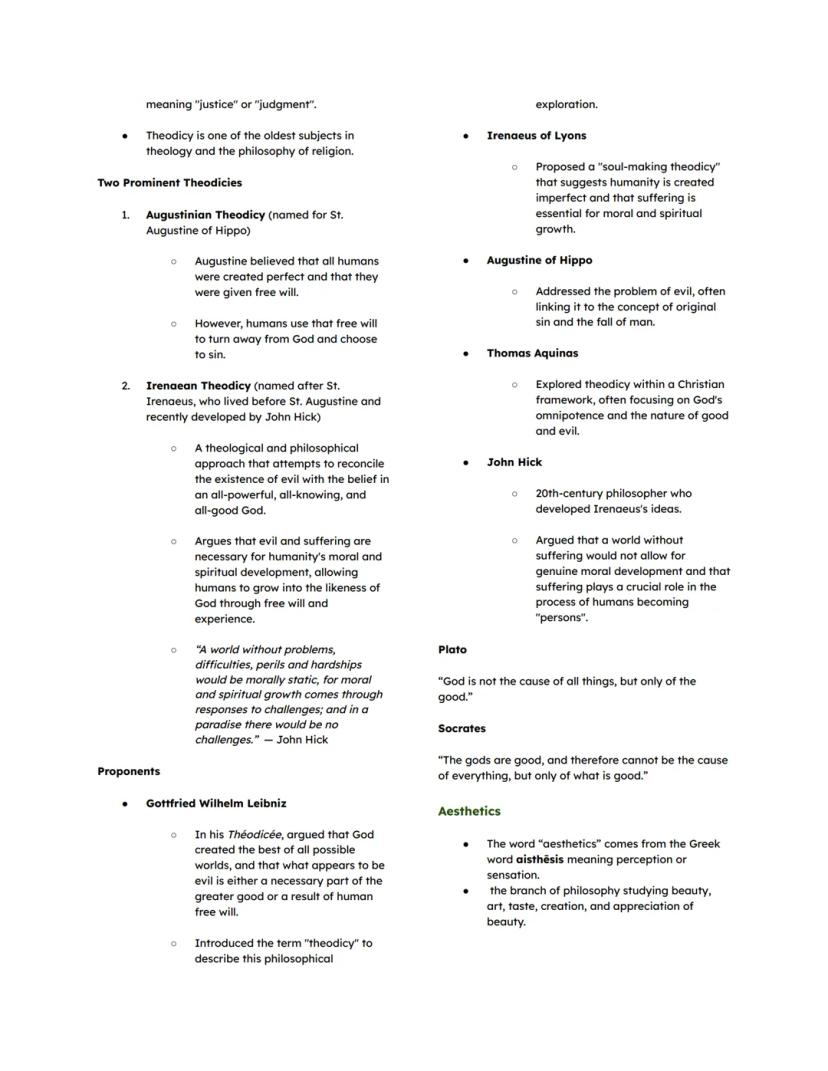
Theodicy attempts to explain why an all-knowing, all-powerful, and perfectly good God would allow evil to exist. The word literally means "justifying God." Two prominent approaches are the Augustinian theodicy, which views evil as resulting from humans misusing their free will, and the Irenaean theodicy, which sees suffering as necessary for moral and spiritual development.
Gottfried Wilhelm Leibniz (who introduced the term "theodicy") argued God created "the best of all possible worlds." John Hick, developing Irenaeus's ideas, suggested that "a world without problems, difficulties, perils and hardships would be morally static" since moral growth comes through challenges. Other important thinkers who addressed this problem include Thomas Aquinas, Plato, and Socrates, who maintained "The gods are good, and therefore cannot be the cause of everything, but only of what is good."
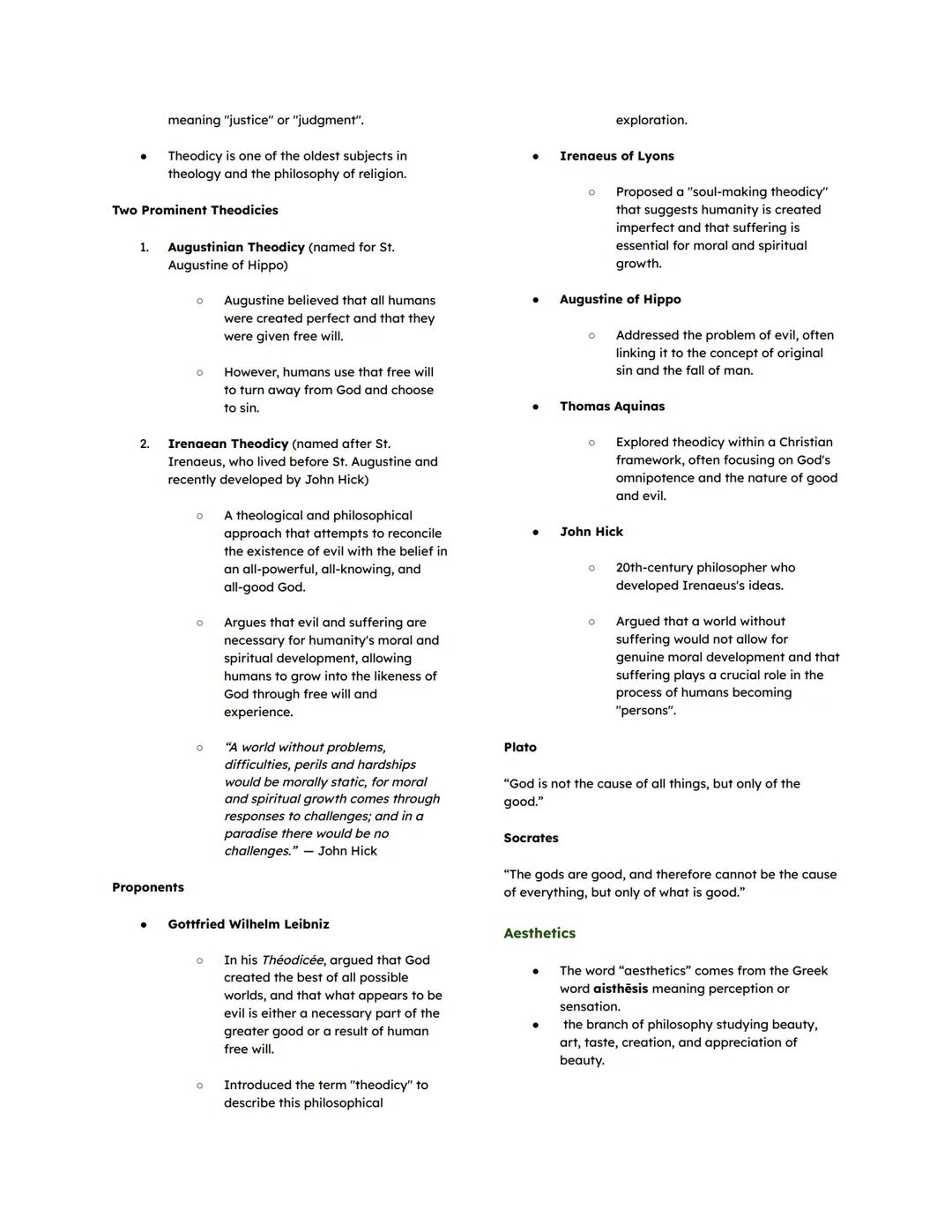
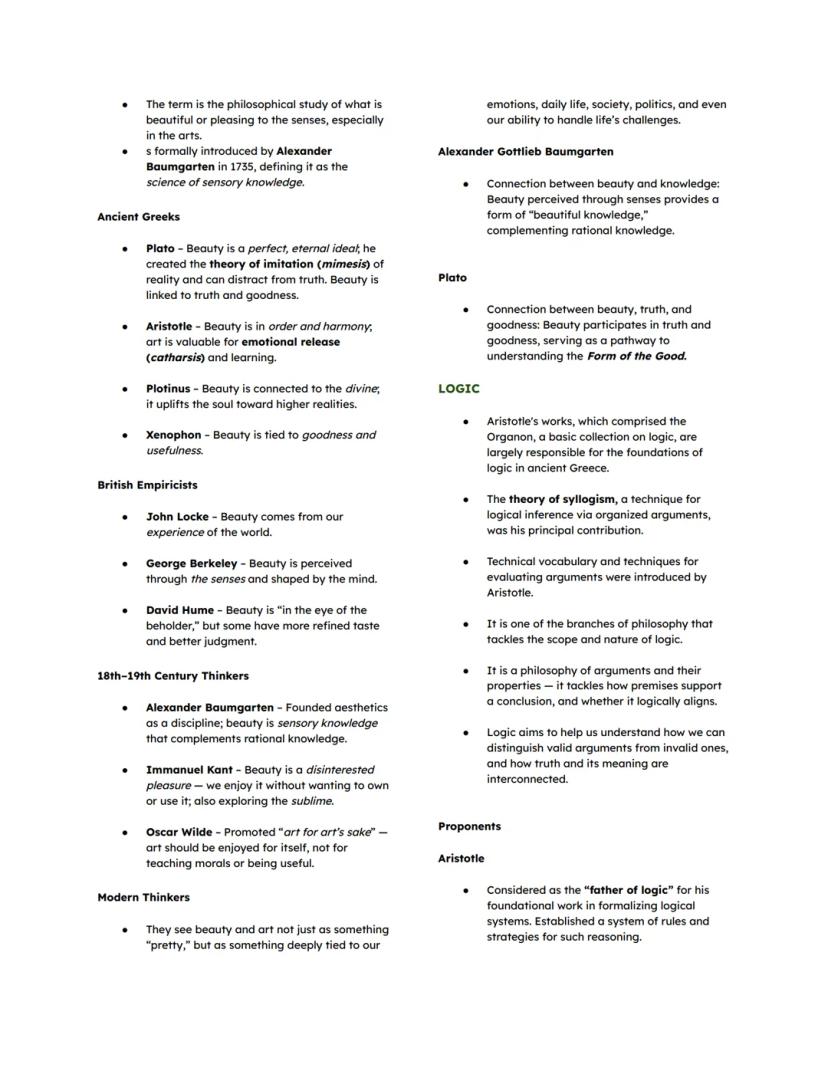
Aesthetics studies beauty, art, taste, and the appreciation of beauty. The term comes from the Greek word "aisthēsis" meaning perception or sensation. Alexander Baumgarten formally introduced aesthetics as a discipline in 1735, defining it as "the science of sensory knowledge" that complements rational understanding.
Ancient Greek philosophers had varying perspectives on beauty. Plato viewed beauty as a perfect, eternal idea connected to truth and goodness. Aristotle saw beauty in order and harmony, valuing art for emotional release (catharsis) and learning. Plotinus connected beauty to the divine, believing it uplifts the soul toward higher realities. British Empiricists like John Locke, George Berkeley, and David Hume linked beauty to experience and perception, with Hume famously suggesting beauty is "in the eye of the beholder."
Consider this: Next time you encounter something beautiful—whether art, music, or nature—pay attention to your immediate reaction. Is your appreciation based on cultural learning, personal association, or something more universal?
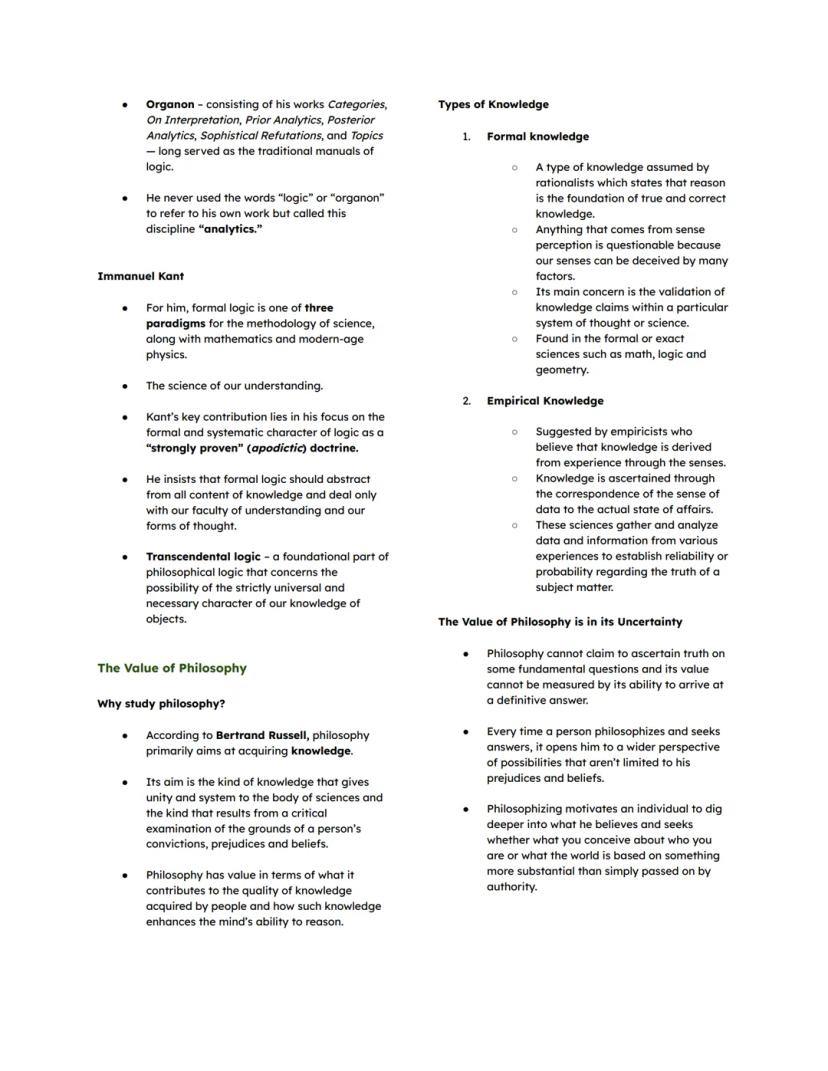
Logic examines the scope and nature of arguments and their properties. Aristotle, often considered the "father of logic," established foundational systems for logical reasoning in his works collectively known as the Organon. His theory of syllogism provided techniques for logical inference through organized arguments.
Immanuel Kant viewed formal logic as one of three paradigms for scientific methodology, alongside mathematics and physics. He described it as "the science of our understanding" and insisted that formal logic should abstract from all content of knowledge to deal only with forms of thought. Kant also developed transcendental logic, which concerns how we can have universal and necessary knowledge of objects.
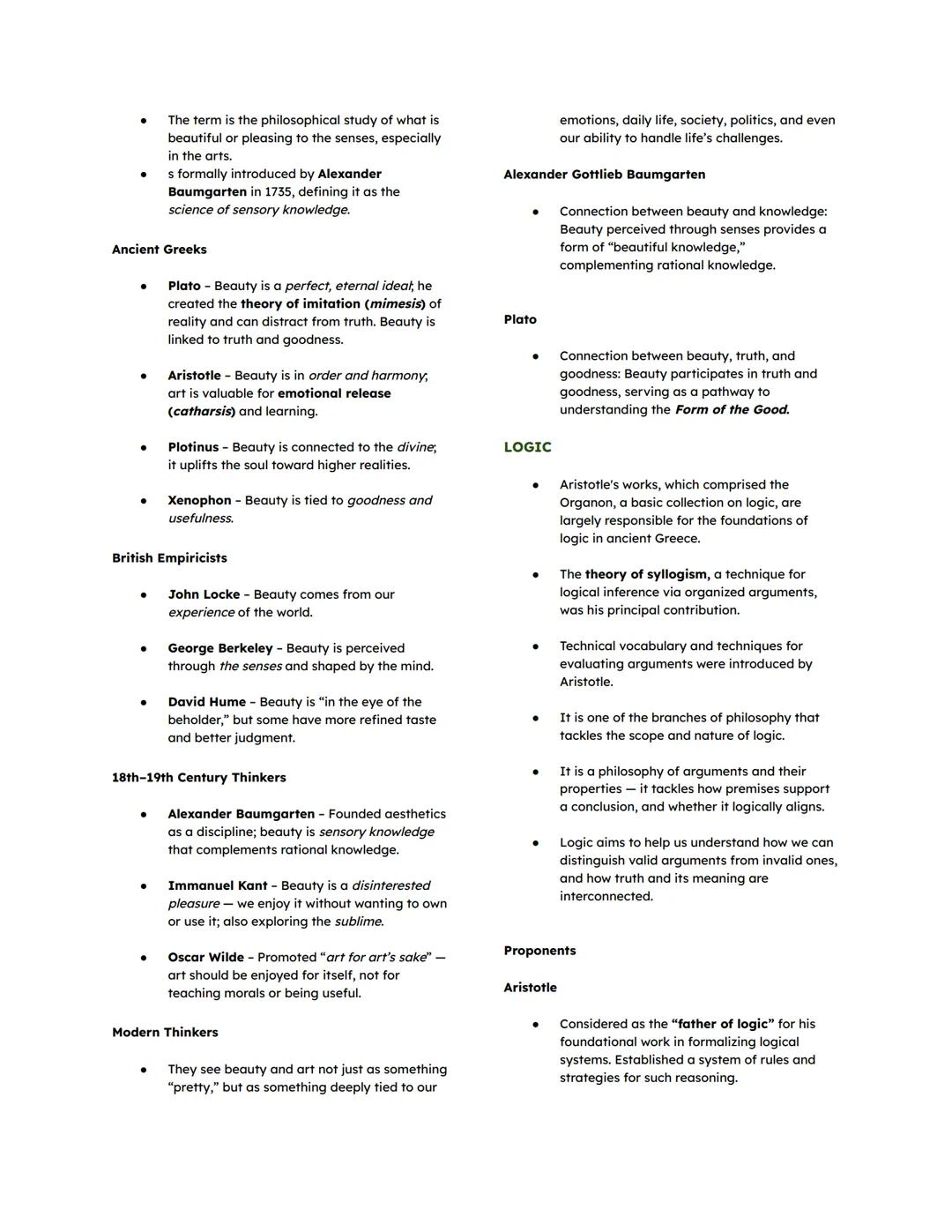
Philosophy aims to acquire knowledge that gives unity to the sciences and results from critically examining our convictions and beliefs. Its value lies in how it enhances our ability to reason and broadens our perspectives. Bertrand Russell emphasized that philosophy's value isn't in providing definitive answers but in expanding our conception of what's possible.
Philosophers distinguish between two types of knowledge: formal knowledge (based on reason, found in mathematics and logic) and empirical knowledge (derived from sensory experience). Both approaches have strengths and limitations in how they help us understand reality.
Life lesson: "Philosophy is to be studied not for definite answers, but for the sake of the questions themselves, because these questions enlarge our conception of what is possible." —Bertrand Russell
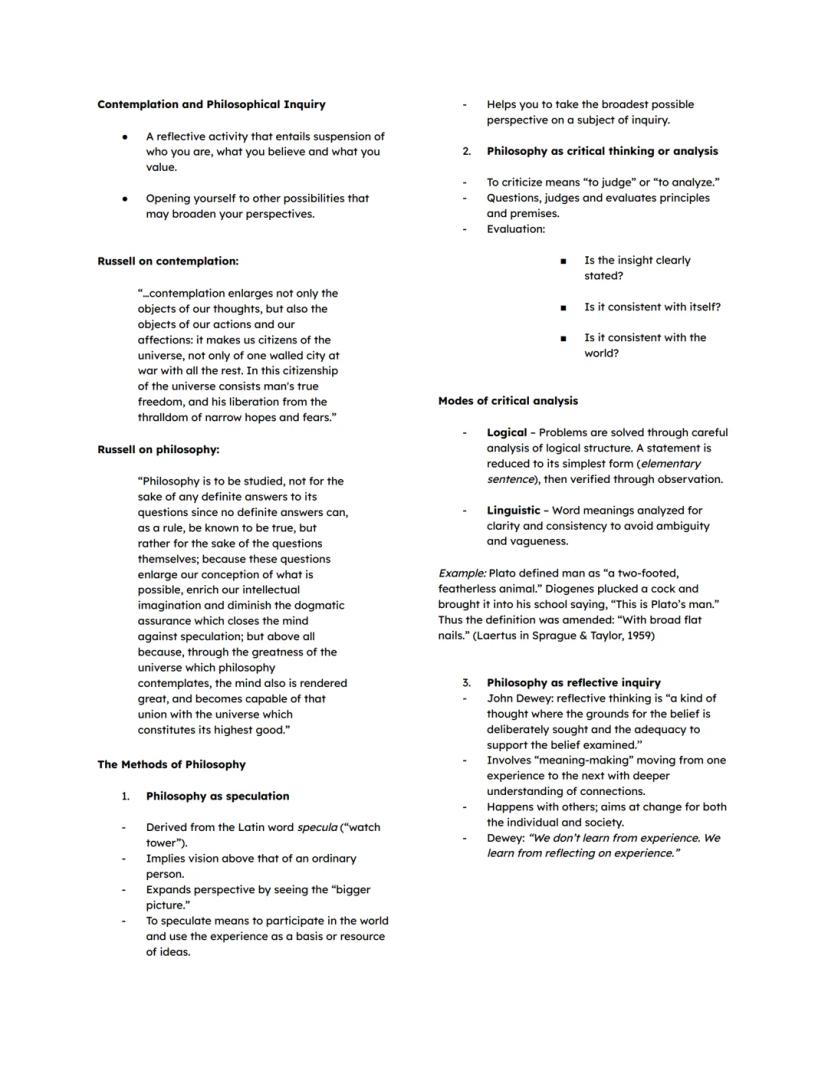
The uncertainty of philosophy is actually its strength. When we philosophize, we open ourselves to wider perspectives beyond our prejudices and inherited beliefs. Contemplation involves suspending what we believe to find new possibilities. As Russell beautifully put it, contemplation "makes us citizens of the universe, not only of one walled city at war with all the rest."
Philosophy employs several methods: speculation (seeing the bigger picture), critical thinking (analyzing premises and principles), and reflective inquiry (deliberately examining the grounds for beliefs). John Dewey noted that "we don't learn from experience; we learn from reflecting on experience." This reflective process involves identifying problems, interpreting experiences, suggesting solutions, reasoning through possibilities, and testing ideas through observation and experiment.
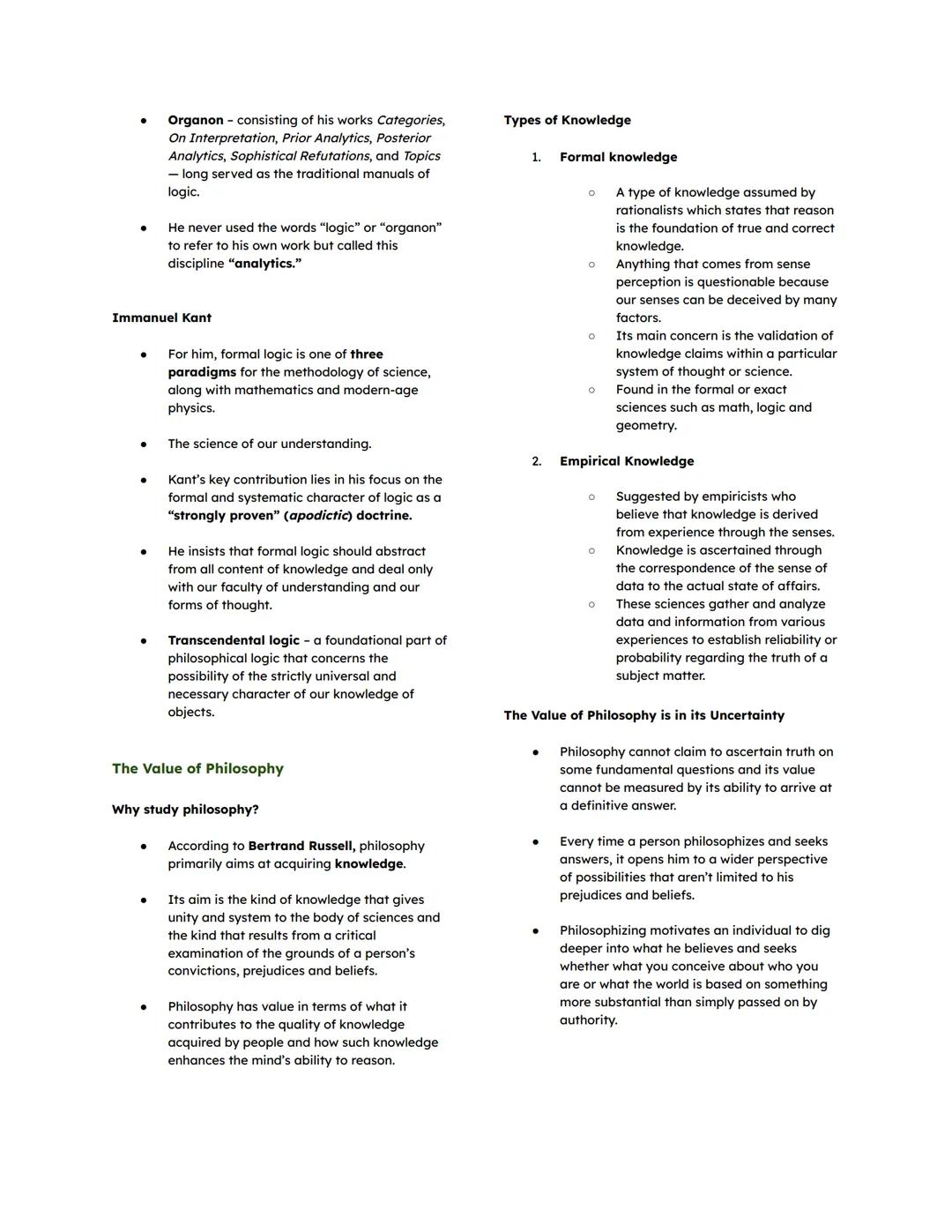
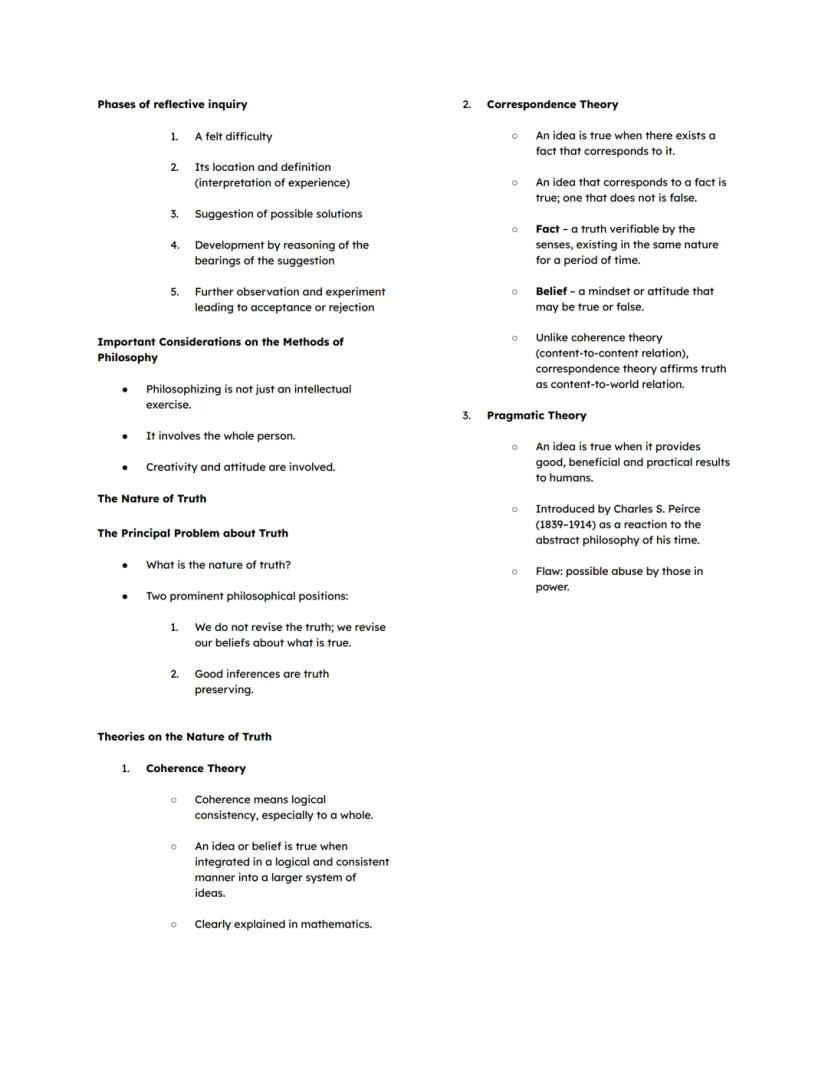
Understanding the nature of truth is a central philosophical problem. Two key positions philosophers hold are: 1) We don't revise truth itself, only our beliefs about what's true, and 2) Good logical inferences preserve truth. These positions have led to several theories about what makes something true.
The Coherence Theory defines truth as logical consistency within a system of ideas. Under this view, a belief is true when it integrates consistently into a larger framework of ideas. This approach works well in mathematics, where truths must fit logically together without contradiction.
Real-world application: When evaluating news or information, consider not just if it matches reality, but also if it's consistent with other well-established facts you know. Contradictions often signal falsehood.
The Correspondence Theory states an idea is true when there exists a fact in the world that corresponds to it. Unlike coherence theory , correspondence theory emphasizes content-to-world relations. This approach distinguishes between facts (truths verifiable by senses) and beliefs (mental attitudes that may be true or false).
The Pragmatic Theory, introduced by Charles S. Peirce, takes a different approach: an idea is true when it provides good, beneficial, and practical results. This theory emerged as a reaction to abstract philosophy, focusing instead on the real-world consequences of ideas. However, it has a potential flaw—those in power could abuse this definition to justify harmful actions that serve their interests by claiming they're "practical."
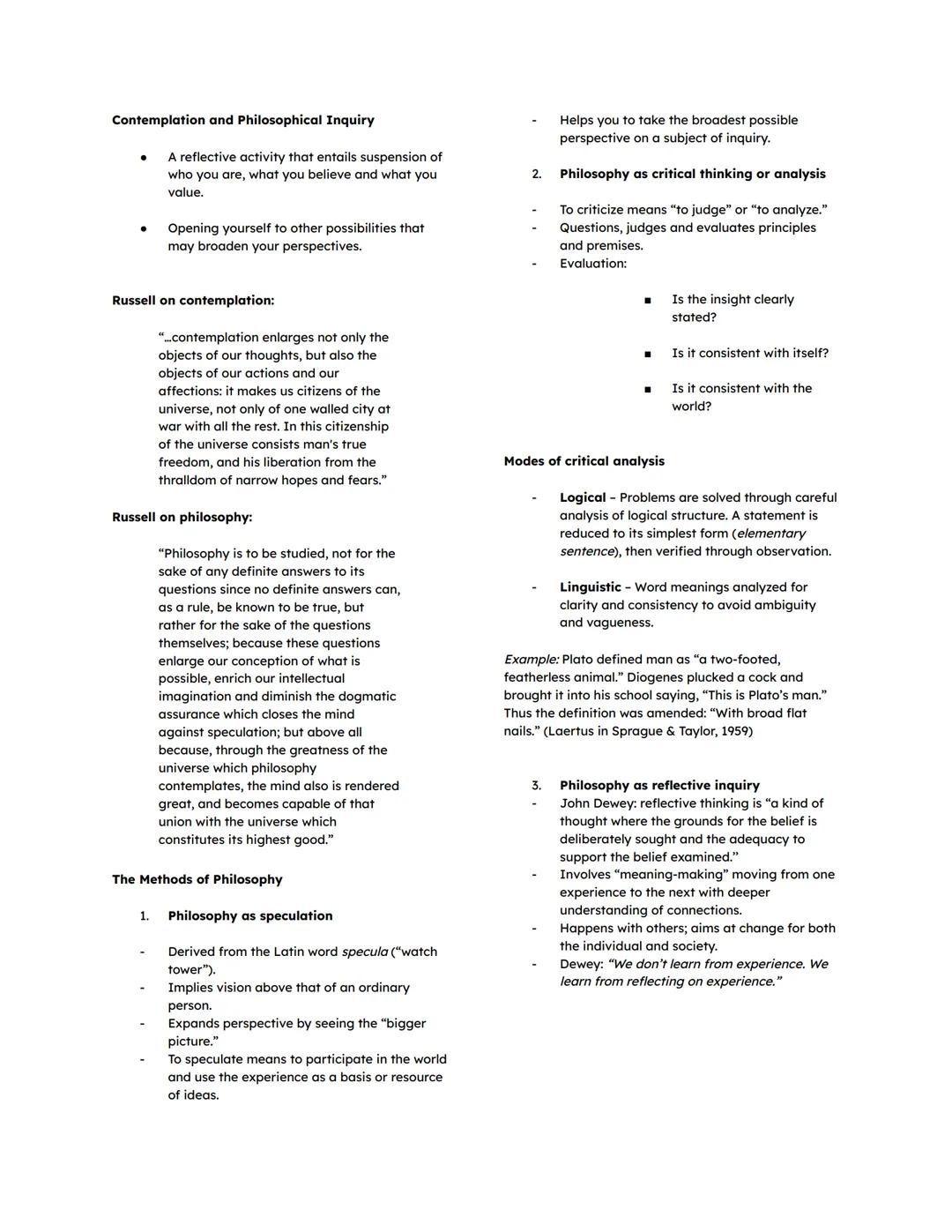
Philosophy employs three main methods to explore ideas and develop understanding. Philosophy as speculation involves taking an elevated perspective, like viewing the world from a watchtower. The term comes from the Latin "specula" (watch tower), suggesting a vision beyond that of ordinary people. When you speculate philosophically, you participate in the world and use your experiences as resources for ideas.
Philosophy as critical thinking involves judging and analyzing principles and premises. The word "criticize" originally meant "to judge," not just to find fault. This approach breaks down statements into their simplest forms and verifies them through observation. Logical analysis examines the structure of arguments, while linguistic analysis clarifies word meanings to avoid ambiguity and vagueness.
Try this: Next time you face a complex problem, practice philosophical thinking by first speculating widely about possibilities, then critically analyzing assumptions, and finally reflecting on what you've learned from the process.
Philosophy as reflective inquiry, championed by John Dewey, involves deliberately seeking the grounds for your beliefs and examining their adequacy. This "meaning-making" process connects experiences to develop deeper understanding. Dewey famously said, "We don't learn from experience. We learn from reflecting on experience."
Reflective inquiry follows specific phases: identifying a felt difficulty, defining the problem, suggesting possible solutions, reasoning through the implications, and testing ideas through observation. This process is collaborative, aiming at positive change for both individuals and society. Remember that philosophizing isn't just an intellectual exercise—it involves your whole person, including creativity and attitude.
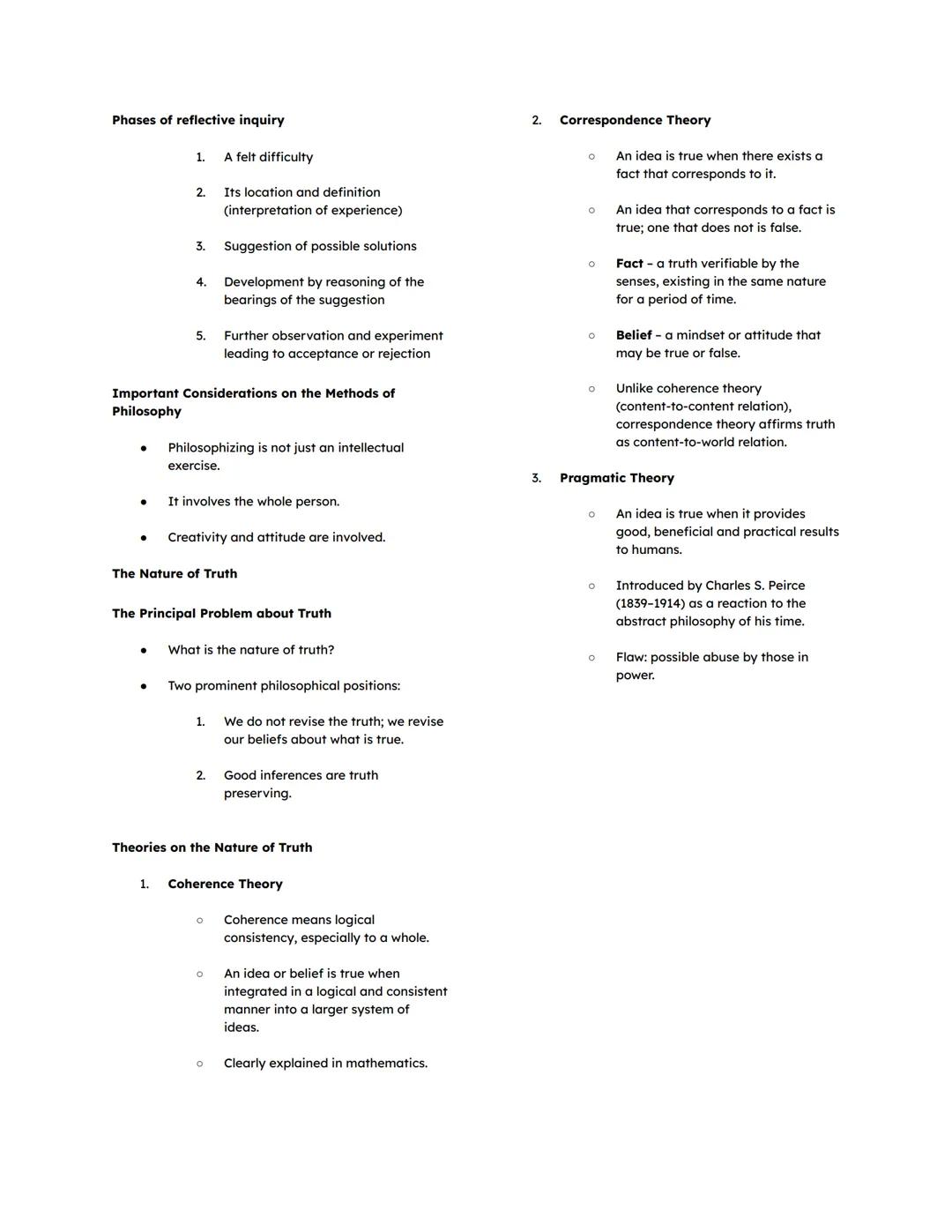
The question "What is the nature of truth?" is one of philosophy's most fundamental problems. Philosophers generally agree on two principles: we don't revise truth itself (only our beliefs about what's true), and good logical inferences preserve truth. From these foundations, three major theories have emerged.
The Coherence Theory defines truth as logical consistency within a system of ideas. A belief is true when it integrates seamlessly into a larger framework without contradiction. This approach works particularly well in mathematics, where truths must form a coherent system. Rather than comparing ideas to external reality, coherence theory examines how ideas relate to each other.
Consider this: Scientific theories are often judged not just by how well they match observations but by how coherently they connect with other established theories. This is why contradictions between theories often drive scientific progress.
The Correspondence Theory states that an idea is true when it matches or corresponds to a fact in the world. Unlike the coherence theory , correspondence theory emphasizes content-to-world relations. This approach distinguishes between facts (verifiable truths that exist in nature) and beliefs (mental attitudes that may be true or false depending on their correspondence to reality).
The Pragmatic Theory, introduced by Charles S. Peirce, takes a different approach: an idea is true when it provides beneficial and practical results. This theory emerged as a reaction against abstract philosophy, focusing instead on real-world consequences. However, it has a potential weakness—it could be abused by those in power to justify harmful actions by claiming they're "practical" or "beneficial" according to their own interests.
Our AI companion is specifically built for the needs of students. Based on the millions of content pieces we have on the platform we can provide truly meaningful and relevant answers to students. But its not only about answers, the companion is even more about guiding students through their daily learning challenges, with personalised study plans, quizzes or content pieces in the chat and 100% personalisation based on the students skills and developments.
You can download the app in the Google Play Store and in the Apple App Store.
That's right! Enjoy free access to study content, connect with fellow students, and get instant help – all at your fingertips.
App Store
Google Play
The app is very easy to use and well designed. I have found everything I was looking for so far and have been able to learn a lot from the presentations! I will definitely use the app for a class assignment! And of course it also helps a lot as an inspiration.
Stefan S
iOS user
This app is really great. There are so many study notes and help [...]. My problem subject is French, for example, and the app has so many options for help. Thanks to this app, I have improved my French. I would recommend it to anyone.
Samantha Klich
Android user
Wow, I am really amazed. I just tried the app because I've seen it advertised many times and was absolutely stunned. This app is THE HELP you want for school and above all, it offers so many things, such as workouts and fact sheets, which have been VERY helpful to me personally.
Anna
iOS user
I think it’s very much worth it and you’ll end up using it a lot once you get the hang of it and even after looking at others notes you can still ask your Artificial intelligence buddy the question and ask to simplify it if you still don’t get it!!! In the end I think it’s worth it 😊👍 ⚠️Also DID I MENTION ITS FREEE YOU DON’T HAVE TO PAY FOR ANYTHING AND STILL GET YOUR GRADES IN PERFECTLY❗️❗️⚠️
Thomas R
iOS user
Knowunity is the BEST app I’ve used in a minute. This is not an ai review or anything this is genuinely coming from a 7th grade student (I know 2011 im young) but dude this app is a 10/10 i have maintained a 3.8 gpa and have plenty of time for gaming. I love it and my mom is just happy I got good grades
Brad T
Android user
Not only did it help me find the answer but it also showed me alternative ways to solve it. I was horrible in math and science but now I have an a in both subjects. Thanks for the help🤍🤍
David K
iOS user
The app's just great! All I have to do is enter the topic in the search bar and I get the response real fast. I don't have to watch 10 YouTube videos to understand something, so I'm saving my time. Highly recommended!
Sudenaz Ocak
Android user
In school I was really bad at maths but thanks to the app, I am doing better now. I am so grateful that you made the app.
Greenlight Bonnie
Android user
I found this app a couple years ago and it has only gotten better since then. I really love it because it can help with written questions and photo questions. Also, it can find study guides that other people have made as well as flashcard sets and practice tests. The free version is also amazing for students who might not be able to afford it. Would 100% recommend
Aubrey
iOS user
Best app if you're in Highschool or Junior high. I have been using this app for 2 school years and it's the best, it's good if you don't have anyone to help you with school work.😋🩷🎀
Marco B
iOS user
THE QUIZES AND FLASHCARDS ARE SO USEFUL AND I LOVE Knowunity AI. IT ALSO IS LITREALLY LIKE CHATGPT BUT SMARTER!! HELPED ME WITH MY MASCARA PROBLEMS TOO!! AS WELL AS MY REAL SUBJECTS ! DUHHH 😍😁😲🤑💗✨🎀😮
Elisha
iOS user
This app is phenomenal down to the correct info and the various topics you can study! I greatly recommend it for people who struggle with procrastination and those who need homework help. It has been perfectly accurate for world 1 history as far as I’ve seen! Geometry too!
Paul T
iOS user
The app is very easy to use and well designed. I have found everything I was looking for so far and have been able to learn a lot from the presentations! I will definitely use the app for a class assignment! And of course it also helps a lot as an inspiration.
Stefan S
iOS user
This app is really great. There are so many study notes and help [...]. My problem subject is French, for example, and the app has so many options for help. Thanks to this app, I have improved my French. I would recommend it to anyone.
Samantha Klich
Android user
Wow, I am really amazed. I just tried the app because I've seen it advertised many times and was absolutely stunned. This app is THE HELP you want for school and above all, it offers so many things, such as workouts and fact sheets, which have been VERY helpful to me personally.
Anna
iOS user
I think it’s very much worth it and you’ll end up using it a lot once you get the hang of it and even after looking at others notes you can still ask your Artificial intelligence buddy the question and ask to simplify it if you still don’t get it!!! In the end I think it’s worth it 😊👍 ⚠️Also DID I MENTION ITS FREEE YOU DON’T HAVE TO PAY FOR ANYTHING AND STILL GET YOUR GRADES IN PERFECTLY❗️❗️⚠️
Thomas R
iOS user
Knowunity is the BEST app I’ve used in a minute. This is not an ai review or anything this is genuinely coming from a 7th grade student (I know 2011 im young) but dude this app is a 10/10 i have maintained a 3.8 gpa and have plenty of time for gaming. I love it and my mom is just happy I got good grades
Brad T
Android user
Not only did it help me find the answer but it also showed me alternative ways to solve it. I was horrible in math and science but now I have an a in both subjects. Thanks for the help🤍🤍
David K
iOS user
The app's just great! All I have to do is enter the topic in the search bar and I get the response real fast. I don't have to watch 10 YouTube videos to understand something, so I'm saving my time. Highly recommended!
Sudenaz Ocak
Android user
In school I was really bad at maths but thanks to the app, I am doing better now. I am so grateful that you made the app.
Greenlight Bonnie
Android user
I found this app a couple years ago and it has only gotten better since then. I really love it because it can help with written questions and photo questions. Also, it can find study guides that other people have made as well as flashcard sets and practice tests. The free version is also amazing for students who might not be able to afford it. Would 100% recommend
Aubrey
iOS user
Best app if you're in Highschool or Junior high. I have been using this app for 2 school years and it's the best, it's good if you don't have anyone to help you with school work.😋🩷🎀
Marco B
iOS user
THE QUIZES AND FLASHCARDS ARE SO USEFUL AND I LOVE Knowunity AI. IT ALSO IS LITREALLY LIKE CHATGPT BUT SMARTER!! HELPED ME WITH MY MASCARA PROBLEMS TOO!! AS WELL AS MY REAL SUBJECTS ! DUHHH 😍😁😲🤑💗✨🎀😮
Elisha
iOS user
This app is phenomenal down to the correct info and the various topics you can study! I greatly recommend it for people who struggle with procrastination and those who need homework help. It has been perfectly accurate for world 1 history as far as I’ve seen! Geometry too!
Paul T
iOS user
dhiandra genise
@dhiandragenise
Philosophy is the study of fundamental questions about existence, knowledge, values, reason, and reality. It's divided into several branches that explore different aspects of human thought and experience. Each branch provides unique frameworks for understanding our world and making sense... Show more
Access to all documents
Improve your grades
Join milions of students
Cosmology is a branch of astronomy exploring the origin and evolution of the universe from the Big Bang to the future. Unlike other astronomy fields that focus on specific objects, cosmology examines the entire universe. Key figures like Anaximander introduced the concept of "apeiron" (the boundless) as the beginning of everything, while Nicolaus Copernicus revolutionized our understanding with his heliocentric model.
Edwin Powell Hubble made groundbreaking discoveries about galaxies beyond our own and proved the universe is expanding. Einstein's General Theory of Relativity unified space and time, showing gravity as a curvature of spacetime caused by mass and energy. Georges Lemaître formulated the modern Big Bang theory, proposing the universe began from a "super-atom."
Did you know? Cosmology is one of the oldest philosophical inquiries, but modern cosmology combines philosophy with advanced physics and astronomy to answer questions that humans have wondered about for thousands of years.
Political philosophy examines ideas about government, power, laws, rights, and justice. It helps us understand how societies are organized and what makes them just or unjust. Important thinkers include Plato, who proposed philosopher-kings should rule, and Aristotle, who studied constitutions and viewed humans as "political animals" who need society to flourish.
Later political philosophers like Thomas Hobbes argued people give up freedom for security, while John Locke championed unalienable rights and limited government. Montesquieu developed the concept of separation of powers, Machiavelli focused on political survival, and Rousseau emphasized that government must follow the "general will" of the people.
Access to all documents
Improve your grades
Join milions of students
Metaphysics explores the fundamental nature of reality and existence. The term comes from Greek meaning "the things after Physics" and was originally the title of Aristotle's work. Metaphysics focuses on two main themes: first cause (that which does not change and from which all things emanate) and the study of being (what exists).
Metaphysics has three main branches according to Aristotle: ontology (study of being), universal science (study of logical principles), and natural theology (study of God and divine existence). Key concepts include substance (the essence of things), universals (explaining similarities in the world), and the relationship between potentiality (capacity to become) and actuality (realization of potential).
Think about it: The debate between free will and determinism continues today in fields ranging from neuroscience to quantum physics. Are your choices truly free or predetermined?
Ethics examines moral principles, right and wrong conduct, and the nature of the good life. It provides a framework for determining acceptable behavior in various situations. Different ethical approaches include Aristotle's virtue ethics (developing moral character through habit), Kant's deontological ethics (following universal moral laws regardless of consequences), and Bentham's utilitarianism (pursuing the greatest happiness for the greatest number).
John Stuart Mill improved on Bentham's theory by emphasizing qualitative differences in pleasures. Carol Gilligan's ethics of care focuses on relationships and responsibilities rather than abstract principles. Social contract theories, like those proposed by Thomas Hobbes, suggest morality arises from agreements created to escape the chaotic "state of nature."
Access to all documents
Improve your grades
Join milions of students
Epistemology explores the nature and limits of knowledge. Originating in Greece, India, China, and the Middle East, it distinguishes between opinions and justified knowledge. This field examines what we can know, how we know it, and what makes beliefs justified enough to count as knowledge.
René Descartes made his famous declaration "I think, therefore I am" while using methodical doubt to search for certainty. He established a dualism between mind and matter and sought a firm foundation for knowledge. Immanuel Kant argued we can only know the world as it appears to us (phenomena), not as it truly is (noumena). His famous challenge "Dare to Know!" encouraged people to use their own understanding. John Locke maintained that all ideas derive from either sensation or reflection.
Challenge yourself: Think about how you know what you know. Is it from direct experience, education, authority figures, or reasoning? How reliable are these sources?
Theodicy attempts to explain why an all-knowing, all-powerful, and perfectly good God would allow evil to exist. The word literally means "justifying God." Two prominent approaches are the Augustinian theodicy, which views evil as resulting from humans misusing their free will, and the Irenaean theodicy, which sees suffering as necessary for moral and spiritual development.
Gottfried Wilhelm Leibniz (who introduced the term "theodicy") argued God created "the best of all possible worlds." John Hick, developing Irenaeus's ideas, suggested that "a world without problems, difficulties, perils and hardships would be morally static" since moral growth comes through challenges. Other important thinkers who addressed this problem include Thomas Aquinas, Plato, and Socrates, who maintained "The gods are good, and therefore cannot be the cause of everything, but only of what is good."
Access to all documents
Improve your grades
Join milions of students
Aesthetics studies beauty, art, taste, and the appreciation of beauty. The term comes from the Greek word "aisthēsis" meaning perception or sensation. Alexander Baumgarten formally introduced aesthetics as a discipline in 1735, defining it as "the science of sensory knowledge" that complements rational understanding.
Ancient Greek philosophers had varying perspectives on beauty. Plato viewed beauty as a perfect, eternal idea connected to truth and goodness. Aristotle saw beauty in order and harmony, valuing art for emotional release (catharsis) and learning. Plotinus connected beauty to the divine, believing it uplifts the soul toward higher realities. British Empiricists like John Locke, George Berkeley, and David Hume linked beauty to experience and perception, with Hume famously suggesting beauty is "in the eye of the beholder."
Consider this: Next time you encounter something beautiful—whether art, music, or nature—pay attention to your immediate reaction. Is your appreciation based on cultural learning, personal association, or something more universal?
Logic examines the scope and nature of arguments and their properties. Aristotle, often considered the "father of logic," established foundational systems for logical reasoning in his works collectively known as the Organon. His theory of syllogism provided techniques for logical inference through organized arguments.
Immanuel Kant viewed formal logic as one of three paradigms for scientific methodology, alongside mathematics and physics. He described it as "the science of our understanding" and insisted that formal logic should abstract from all content of knowledge to deal only with forms of thought. Kant also developed transcendental logic, which concerns how we can have universal and necessary knowledge of objects.
Access to all documents
Improve your grades
Join milions of students
Philosophy aims to acquire knowledge that gives unity to the sciences and results from critically examining our convictions and beliefs. Its value lies in how it enhances our ability to reason and broadens our perspectives. Bertrand Russell emphasized that philosophy's value isn't in providing definitive answers but in expanding our conception of what's possible.
Philosophers distinguish between two types of knowledge: formal knowledge (based on reason, found in mathematics and logic) and empirical knowledge (derived from sensory experience). Both approaches have strengths and limitations in how they help us understand reality.
Life lesson: "Philosophy is to be studied not for definite answers, but for the sake of the questions themselves, because these questions enlarge our conception of what is possible." —Bertrand Russell
The uncertainty of philosophy is actually its strength. When we philosophize, we open ourselves to wider perspectives beyond our prejudices and inherited beliefs. Contemplation involves suspending what we believe to find new possibilities. As Russell beautifully put it, contemplation "makes us citizens of the universe, not only of one walled city at war with all the rest."
Philosophy employs several methods: speculation (seeing the bigger picture), critical thinking (analyzing premises and principles), and reflective inquiry (deliberately examining the grounds for beliefs). John Dewey noted that "we don't learn from experience; we learn from reflecting on experience." This reflective process involves identifying problems, interpreting experiences, suggesting solutions, reasoning through possibilities, and testing ideas through observation and experiment.
Access to all documents
Improve your grades
Join milions of students
Understanding the nature of truth is a central philosophical problem. Two key positions philosophers hold are: 1) We don't revise truth itself, only our beliefs about what's true, and 2) Good logical inferences preserve truth. These positions have led to several theories about what makes something true.
The Coherence Theory defines truth as logical consistency within a system of ideas. Under this view, a belief is true when it integrates consistently into a larger framework of ideas. This approach works well in mathematics, where truths must fit logically together without contradiction.
Real-world application: When evaluating news or information, consider not just if it matches reality, but also if it's consistent with other well-established facts you know. Contradictions often signal falsehood.
The Correspondence Theory states an idea is true when there exists a fact in the world that corresponds to it. Unlike coherence theory , correspondence theory emphasizes content-to-world relations. This approach distinguishes between facts (truths verifiable by senses) and beliefs (mental attitudes that may be true or false).
The Pragmatic Theory, introduced by Charles S. Peirce, takes a different approach: an idea is true when it provides good, beneficial, and practical results. This theory emerged as a reaction to abstract philosophy, focusing instead on the real-world consequences of ideas. However, it has a potential flaw—those in power could abuse this definition to justify harmful actions that serve their interests by claiming they're "practical."
Access to all documents
Improve your grades
Join milions of students
Philosophy employs three main methods to explore ideas and develop understanding. Philosophy as speculation involves taking an elevated perspective, like viewing the world from a watchtower. The term comes from the Latin "specula" (watch tower), suggesting a vision beyond that of ordinary people. When you speculate philosophically, you participate in the world and use your experiences as resources for ideas.
Philosophy as critical thinking involves judging and analyzing principles and premises. The word "criticize" originally meant "to judge," not just to find fault. This approach breaks down statements into their simplest forms and verifies them through observation. Logical analysis examines the structure of arguments, while linguistic analysis clarifies word meanings to avoid ambiguity and vagueness.
Try this: Next time you face a complex problem, practice philosophical thinking by first speculating widely about possibilities, then critically analyzing assumptions, and finally reflecting on what you've learned from the process.
Philosophy as reflective inquiry, championed by John Dewey, involves deliberately seeking the grounds for your beliefs and examining their adequacy. This "meaning-making" process connects experiences to develop deeper understanding. Dewey famously said, "We don't learn from experience. We learn from reflecting on experience."
Reflective inquiry follows specific phases: identifying a felt difficulty, defining the problem, suggesting possible solutions, reasoning through the implications, and testing ideas through observation. This process is collaborative, aiming at positive change for both individuals and society. Remember that philosophizing isn't just an intellectual exercise—it involves your whole person, including creativity and attitude.
Access to all documents
Improve your grades
Join milions of students
The question "What is the nature of truth?" is one of philosophy's most fundamental problems. Philosophers generally agree on two principles: we don't revise truth itself (only our beliefs about what's true), and good logical inferences preserve truth. From these foundations, three major theories have emerged.
The Coherence Theory defines truth as logical consistency within a system of ideas. A belief is true when it integrates seamlessly into a larger framework without contradiction. This approach works particularly well in mathematics, where truths must form a coherent system. Rather than comparing ideas to external reality, coherence theory examines how ideas relate to each other.
Consider this: Scientific theories are often judged not just by how well they match observations but by how coherently they connect with other established theories. This is why contradictions between theories often drive scientific progress.
The Correspondence Theory states that an idea is true when it matches or corresponds to a fact in the world. Unlike the coherence theory , correspondence theory emphasizes content-to-world relations. This approach distinguishes between facts (verifiable truths that exist in nature) and beliefs (mental attitudes that may be true or false depending on their correspondence to reality).
The Pragmatic Theory, introduced by Charles S. Peirce, takes a different approach: an idea is true when it provides beneficial and practical results. This theory emerged as a reaction against abstract philosophy, focusing instead on real-world consequences. However, it has a potential weakness—it could be abused by those in power to justify harmful actions by claiming they're "practical" or "beneficial" according to their own interests.
Our AI companion is specifically built for the needs of students. Based on the millions of content pieces we have on the platform we can provide truly meaningful and relevant answers to students. But its not only about answers, the companion is even more about guiding students through their daily learning challenges, with personalised study plans, quizzes or content pieces in the chat and 100% personalisation based on the students skills and developments.
You can download the app in the Google Play Store and in the Apple App Store.
That's right! Enjoy free access to study content, connect with fellow students, and get instant help – all at your fingertips.
1
Smart Tools NEW
Transform this note into: ✓ 50+ Practice Questions ✓ Interactive Flashcards ✓ Full Practice Test ✓ Essay Outlines
App Store
Google Play
The app is very easy to use and well designed. I have found everything I was looking for so far and have been able to learn a lot from the presentations! I will definitely use the app for a class assignment! And of course it also helps a lot as an inspiration.
Stefan S
iOS user
This app is really great. There are so many study notes and help [...]. My problem subject is French, for example, and the app has so many options for help. Thanks to this app, I have improved my French. I would recommend it to anyone.
Samantha Klich
Android user
Wow, I am really amazed. I just tried the app because I've seen it advertised many times and was absolutely stunned. This app is THE HELP you want for school and above all, it offers so many things, such as workouts and fact sheets, which have been VERY helpful to me personally.
Anna
iOS user
I think it’s very much worth it and you’ll end up using it a lot once you get the hang of it and even after looking at others notes you can still ask your Artificial intelligence buddy the question and ask to simplify it if you still don’t get it!!! In the end I think it’s worth it 😊👍 ⚠️Also DID I MENTION ITS FREEE YOU DON’T HAVE TO PAY FOR ANYTHING AND STILL GET YOUR GRADES IN PERFECTLY❗️❗️⚠️
Thomas R
iOS user
Knowunity is the BEST app I’ve used in a minute. This is not an ai review or anything this is genuinely coming from a 7th grade student (I know 2011 im young) but dude this app is a 10/10 i have maintained a 3.8 gpa and have plenty of time for gaming. I love it and my mom is just happy I got good grades
Brad T
Android user
Not only did it help me find the answer but it also showed me alternative ways to solve it. I was horrible in math and science but now I have an a in both subjects. Thanks for the help🤍🤍
David K
iOS user
The app's just great! All I have to do is enter the topic in the search bar and I get the response real fast. I don't have to watch 10 YouTube videos to understand something, so I'm saving my time. Highly recommended!
Sudenaz Ocak
Android user
In school I was really bad at maths but thanks to the app, I am doing better now. I am so grateful that you made the app.
Greenlight Bonnie
Android user
I found this app a couple years ago and it has only gotten better since then. I really love it because it can help with written questions and photo questions. Also, it can find study guides that other people have made as well as flashcard sets and practice tests. The free version is also amazing for students who might not be able to afford it. Would 100% recommend
Aubrey
iOS user
Best app if you're in Highschool or Junior high. I have been using this app for 2 school years and it's the best, it's good if you don't have anyone to help you with school work.😋🩷🎀
Marco B
iOS user
THE QUIZES AND FLASHCARDS ARE SO USEFUL AND I LOVE Knowunity AI. IT ALSO IS LITREALLY LIKE CHATGPT BUT SMARTER!! HELPED ME WITH MY MASCARA PROBLEMS TOO!! AS WELL AS MY REAL SUBJECTS ! DUHHH 😍😁😲🤑💗✨🎀😮
Elisha
iOS user
This app is phenomenal down to the correct info and the various topics you can study! I greatly recommend it for people who struggle with procrastination and those who need homework help. It has been perfectly accurate for world 1 history as far as I’ve seen! Geometry too!
Paul T
iOS user
The app is very easy to use and well designed. I have found everything I was looking for so far and have been able to learn a lot from the presentations! I will definitely use the app for a class assignment! And of course it also helps a lot as an inspiration.
Stefan S
iOS user
This app is really great. There are so many study notes and help [...]. My problem subject is French, for example, and the app has so many options for help. Thanks to this app, I have improved my French. I would recommend it to anyone.
Samantha Klich
Android user
Wow, I am really amazed. I just tried the app because I've seen it advertised many times and was absolutely stunned. This app is THE HELP you want for school and above all, it offers so many things, such as workouts and fact sheets, which have been VERY helpful to me personally.
Anna
iOS user
I think it’s very much worth it and you’ll end up using it a lot once you get the hang of it and even after looking at others notes you can still ask your Artificial intelligence buddy the question and ask to simplify it if you still don’t get it!!! In the end I think it’s worth it 😊👍 ⚠️Also DID I MENTION ITS FREEE YOU DON’T HAVE TO PAY FOR ANYTHING AND STILL GET YOUR GRADES IN PERFECTLY❗️❗️⚠️
Thomas R
iOS user
Knowunity is the BEST app I’ve used in a minute. This is not an ai review or anything this is genuinely coming from a 7th grade student (I know 2011 im young) but dude this app is a 10/10 i have maintained a 3.8 gpa and have plenty of time for gaming. I love it and my mom is just happy I got good grades
Brad T
Android user
Not only did it help me find the answer but it also showed me alternative ways to solve it. I was horrible in math and science but now I have an a in both subjects. Thanks for the help🤍🤍
David K
iOS user
The app's just great! All I have to do is enter the topic in the search bar and I get the response real fast. I don't have to watch 10 YouTube videos to understand something, so I'm saving my time. Highly recommended!
Sudenaz Ocak
Android user
In school I was really bad at maths but thanks to the app, I am doing better now. I am so grateful that you made the app.
Greenlight Bonnie
Android user
I found this app a couple years ago and it has only gotten better since then. I really love it because it can help with written questions and photo questions. Also, it can find study guides that other people have made as well as flashcard sets and practice tests. The free version is also amazing for students who might not be able to afford it. Would 100% recommend
Aubrey
iOS user
Best app if you're in Highschool or Junior high. I have been using this app for 2 school years and it's the best, it's good if you don't have anyone to help you with school work.😋🩷🎀
Marco B
iOS user
THE QUIZES AND FLASHCARDS ARE SO USEFUL AND I LOVE Knowunity AI. IT ALSO IS LITREALLY LIKE CHATGPT BUT SMARTER!! HELPED ME WITH MY MASCARA PROBLEMS TOO!! AS WELL AS MY REAL SUBJECTS ! DUHHH 😍😁😲🤑💗✨🎀😮
Elisha
iOS user
This app is phenomenal down to the correct info and the various topics you can study! I greatly recommend it for people who struggle with procrastination and those who need homework help. It has been perfectly accurate for world 1 history as far as I’ve seen! Geometry too!
Paul T
iOS user