
The accounting cycle is the backbone of financial reporting for... Show more
 Finance and capital markets48 views·Updated May 26, 2026·10 pages
Understanding the Accounting Cycle and Creating Financial Statements
M
mier jsro@mierjsro
1 / 10
1
of 10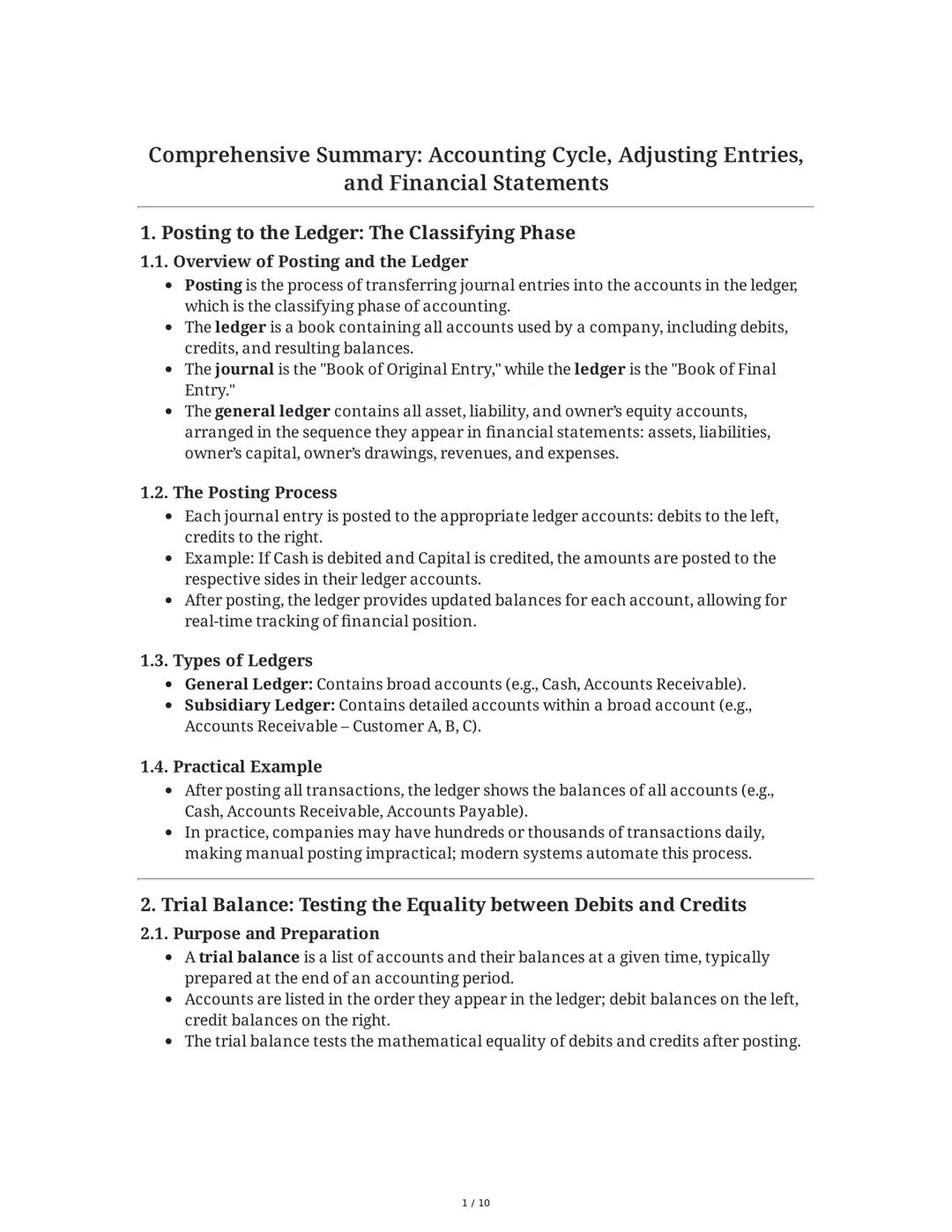
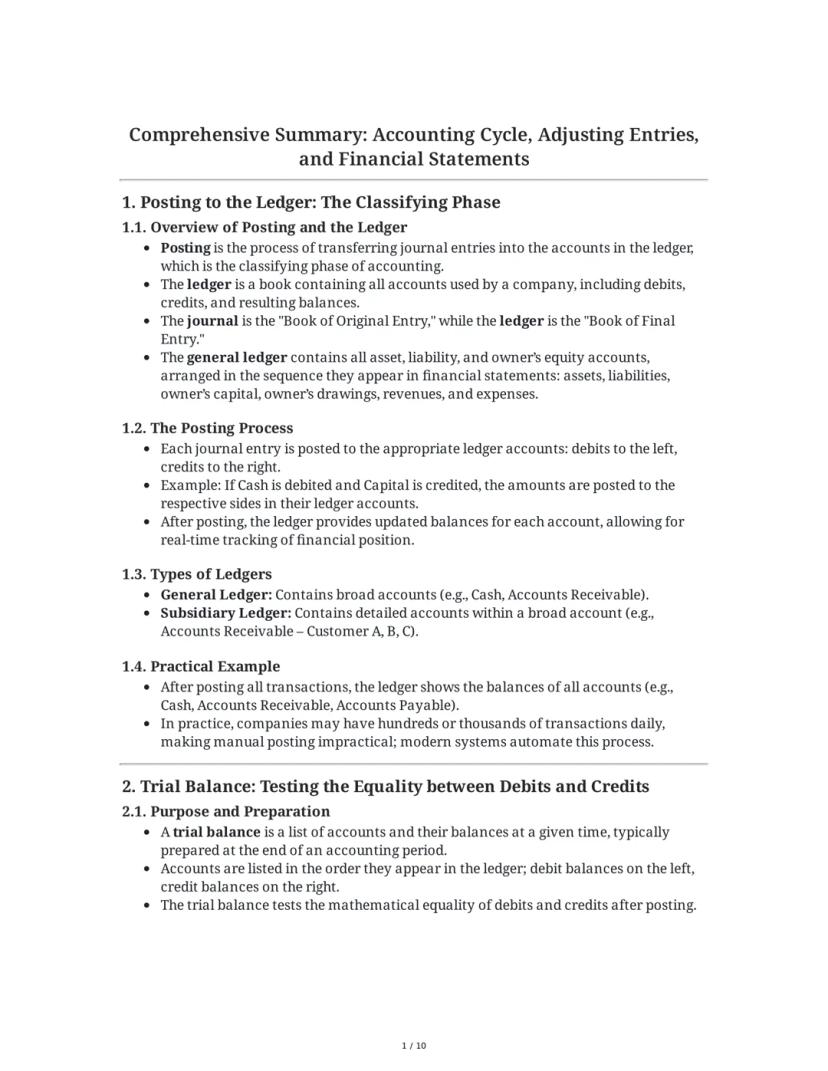
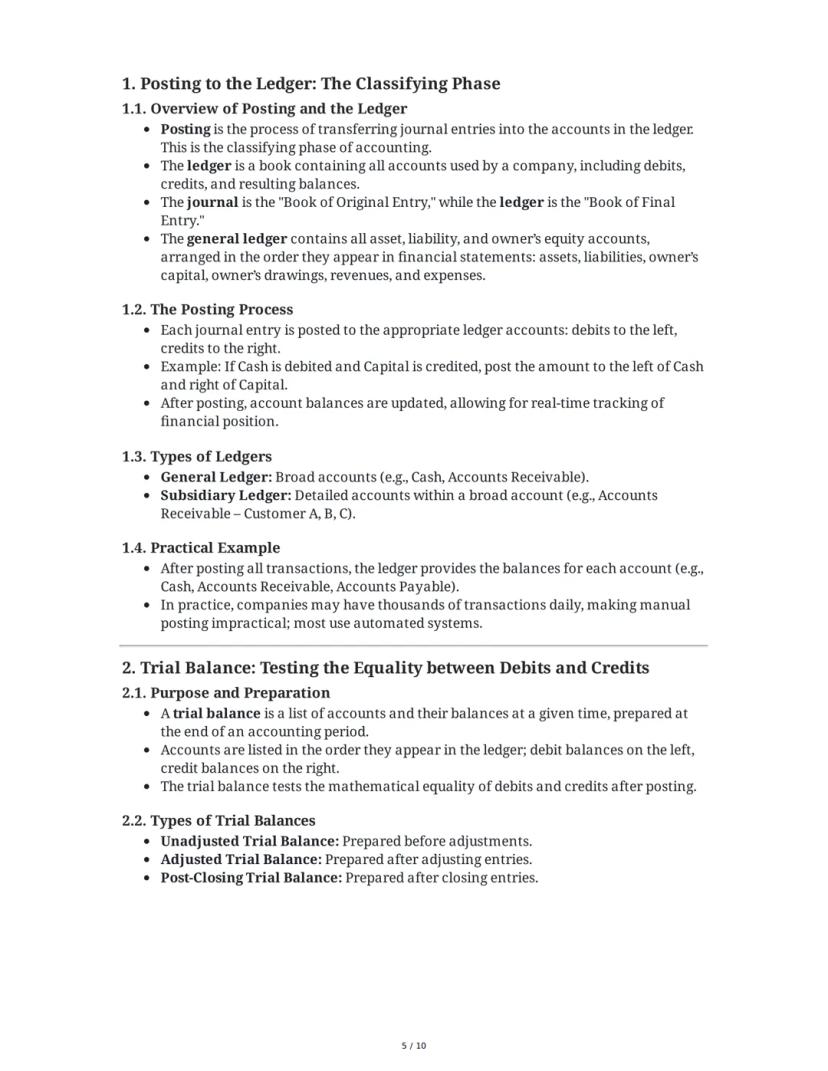
Posting to the Ledger: Organizing Financial Data
Ever wonder how businesses keep track of thousands of transactions? The answer lies in posting to the ledger. Posting is the process of transferring journal entries to accounts in the ledger, organizing financial data by category.
The general ledger is like a master filing system containing all accounts a company uses. Think of the journal as the "Book of Original Entry" where transactions are first recorded, while the ledger is the "Book of Final Entry" where information gets classified. Accounts in the ledger follow a specific order: assets, liabilities, owner's capital, owner's drawings, revenues, and expenses.
During posting, debits go on the left side of accounts and credits on the right. For example, if you record a $500 cash deposit with a debit to Cash and credit to Capital, you'd put $500 on the left side of the Cash account and $500 on the right side of the Capital account. After posting all transactions, the ledger gives you up-to-date balances for each account.
Quick Tip: Most businesses today use accounting software that automatically posts journal entries to the ledger, saving tremendous time and reducing errors!
2
of 10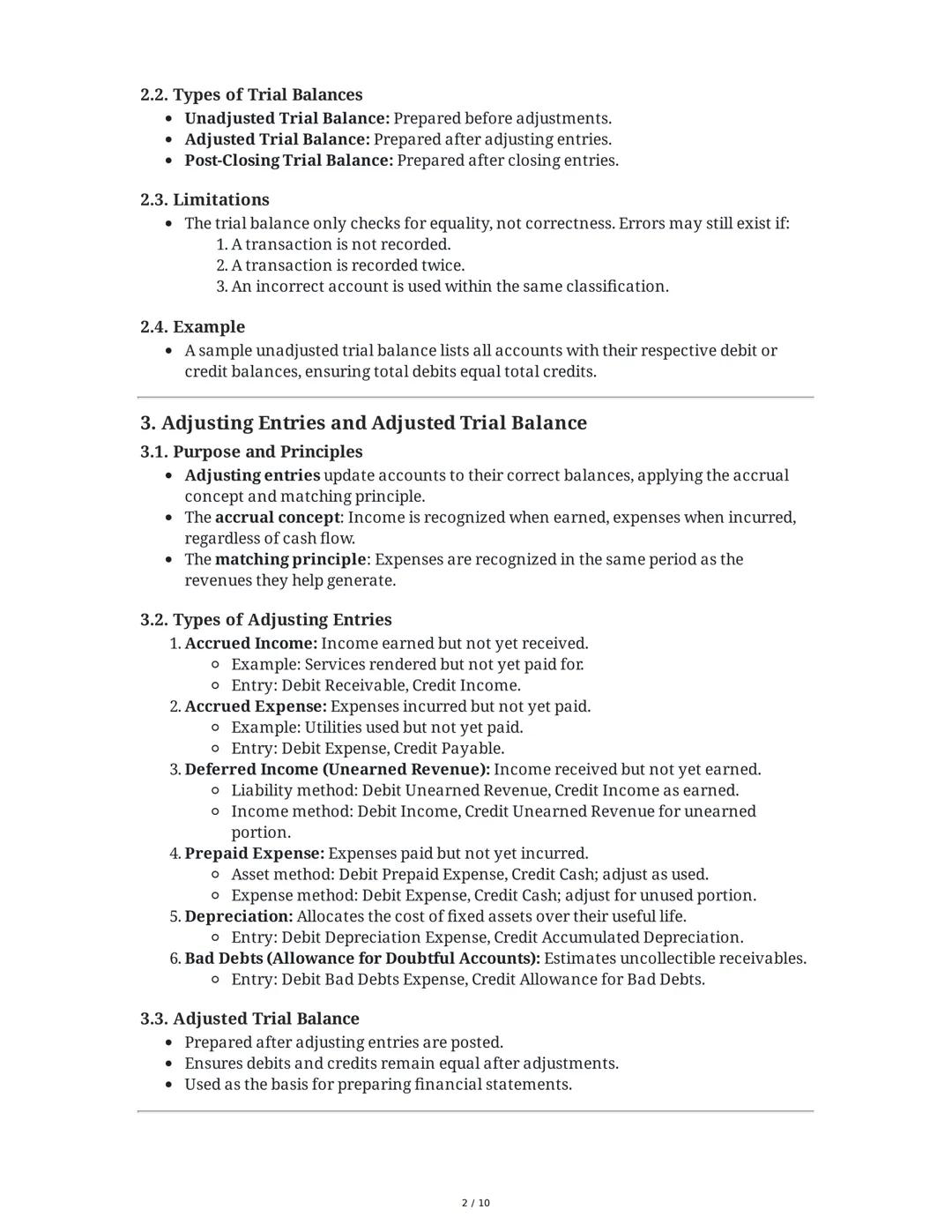
Trial Balance and Adjusting Entries
A trial balance is like a quick math check to ensure your accounting equation stays balanced. It lists all accounts with their balances - debit balances on the left, credit balances on the right - and confirms that total debits equal total credits.
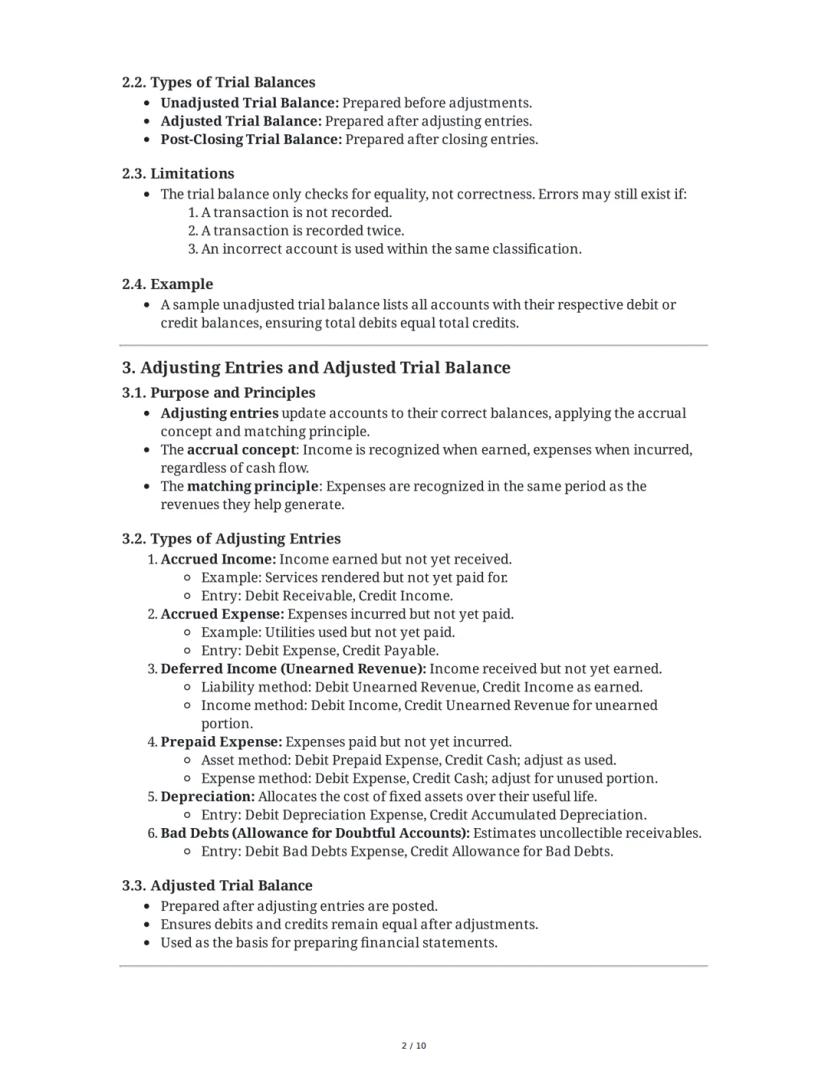
Don't be fooled by a balanced trial balance, though. It only checks for mathematical equality, not accuracy. Common errors that won't show up include omitted transactions, duplicate recordings, or using incorrect accounts within the same classification (like debiting the wrong expense account).
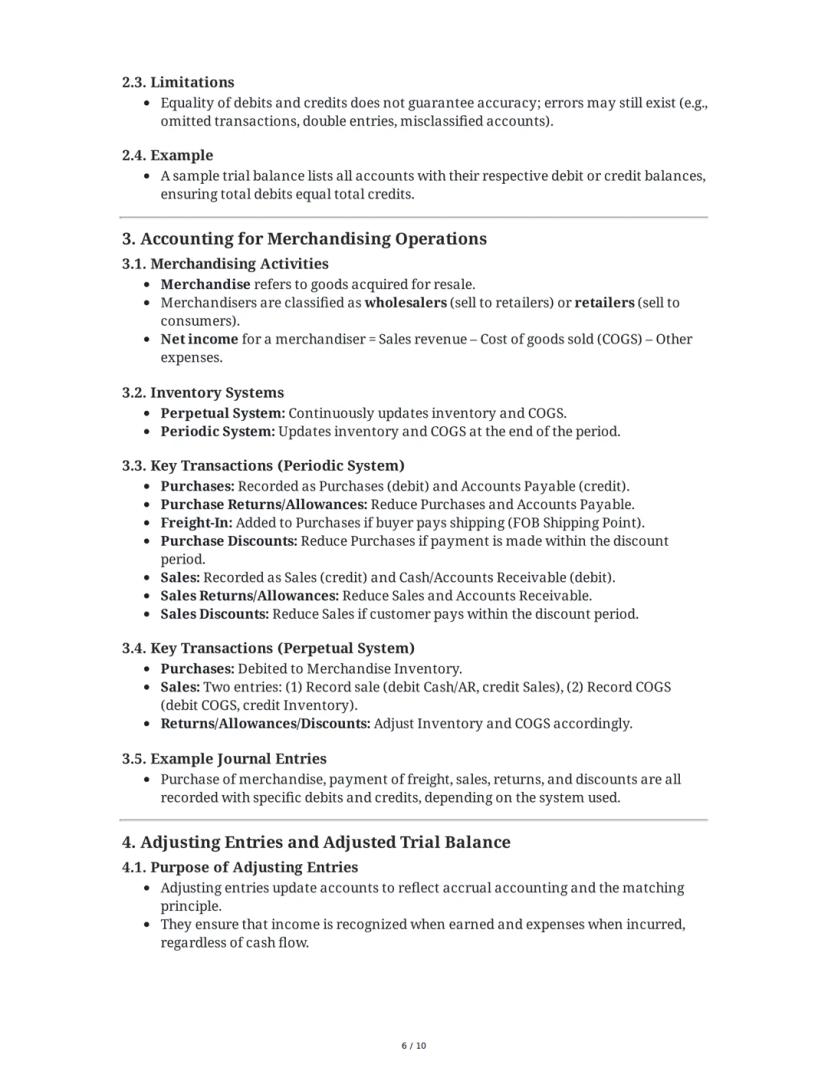
Adjusting entries are crucial for accurate financial reporting. They update accounts based on two important principles: the accrual concept (recognizing income when earned and expenses when incurred) and the matching principle (matching expenses with the revenues they help generate).
Several types of adjusting entries include:
- Accrued income (earned but not received)
- Accrued expenses (incurred but not paid)
- Deferred income (received but not earned)
- Prepaid expenses (paid but not used)
- Depreciation (allocating asset costs over time)
- Bad debts (estimating uncollectible accounts)
After adjusting entries are posted, an adjusted trial balance is prepared as the foundation for creating financial statements.
3
of 10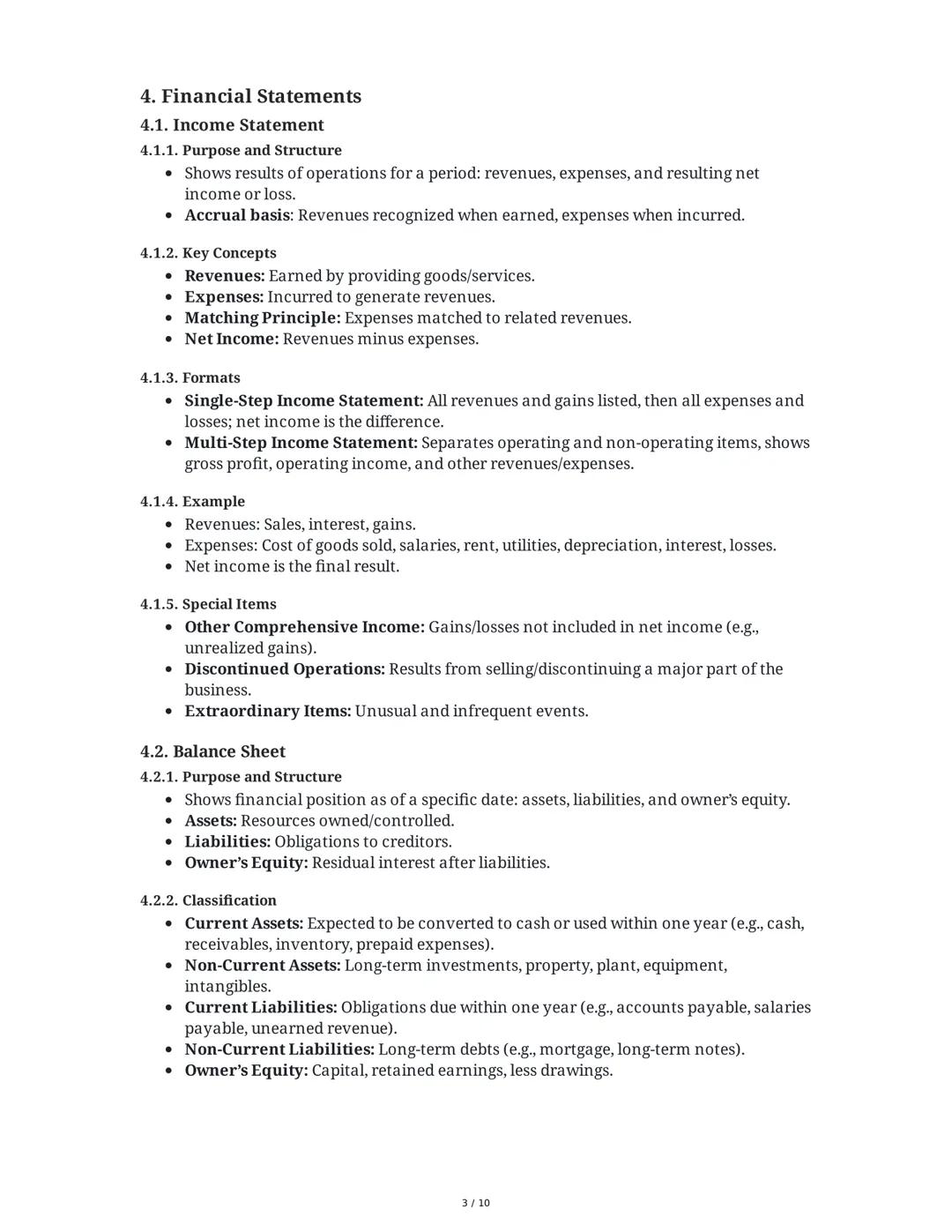
Financial Statements: The Income Statement
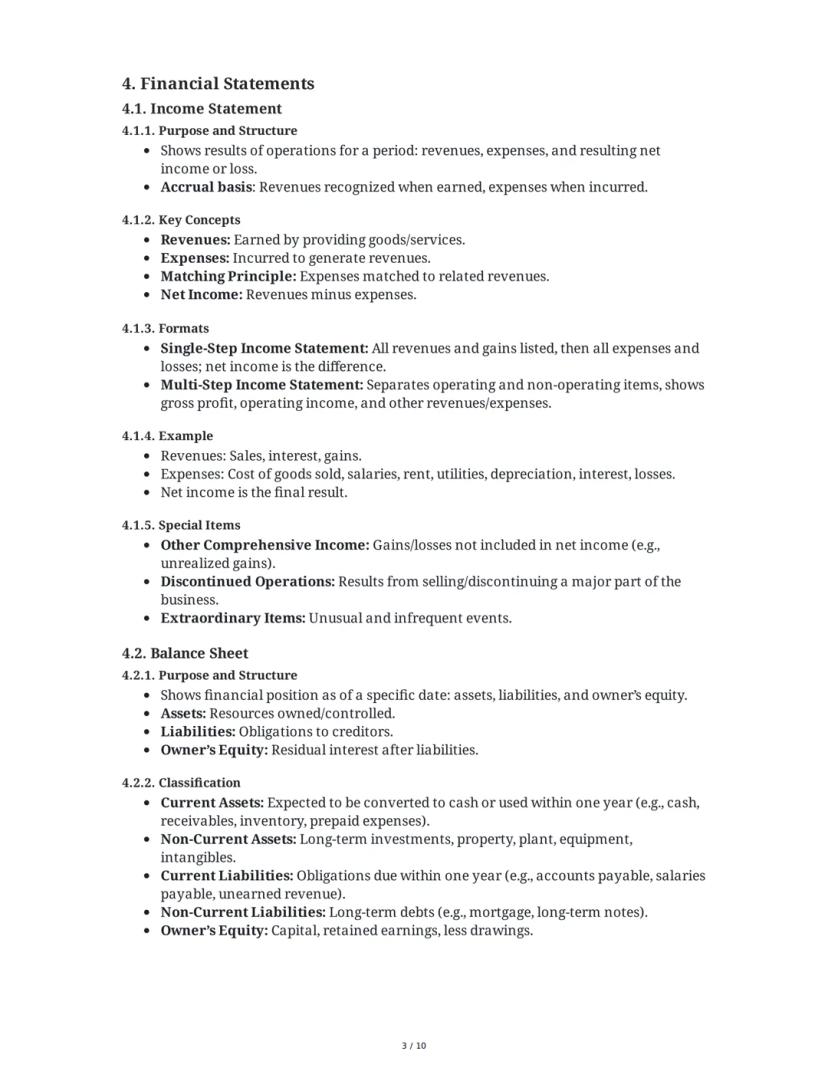
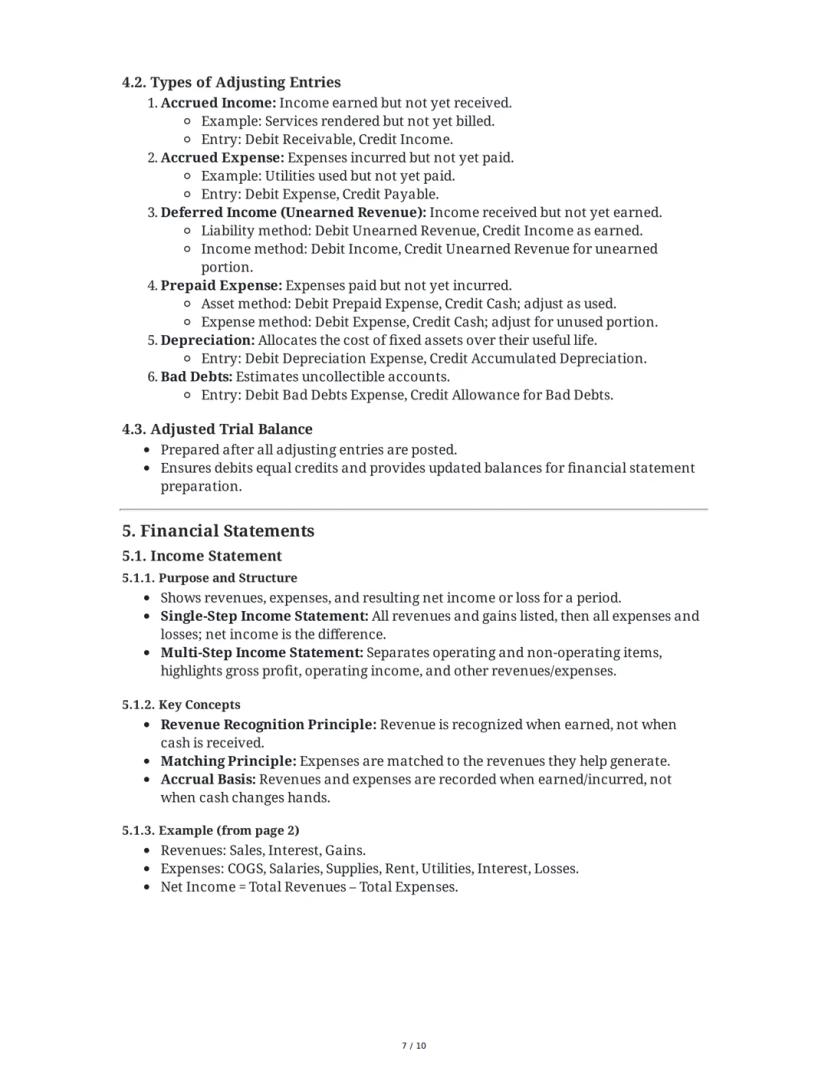
Financial statements translate all your accounting work into information people can actually use! The income statement (sometimes called a profit and loss statement) shows how much money a business made or lost over a specific period.
Income statements follow the basic formula: Revenues - Expenses = Net Income. They're based on the accrual basis of accounting, which means revenues appear when earned and expenses when incurred, regardless of when cash changes hands.
There are two main formats for income statements. A single-step income statement simply lists all revenues, then all expenses, and calculates the difference. The more detailed multi-step income statement separates operating items (main business activities) from non-operating items and shows useful subtotals like gross profit and operating income.
The balance sheet complements the income statement by showing a company's financial position at a specific moment. It's organized into three sections: assets (resources owned), liabilities (obligations owed), and owner's equity (the owner's claim after liabilities).
Remember This: The income statement answers "How profitable was the business?" while the balance sheet answers "What does the business own and owe?"
4
of 10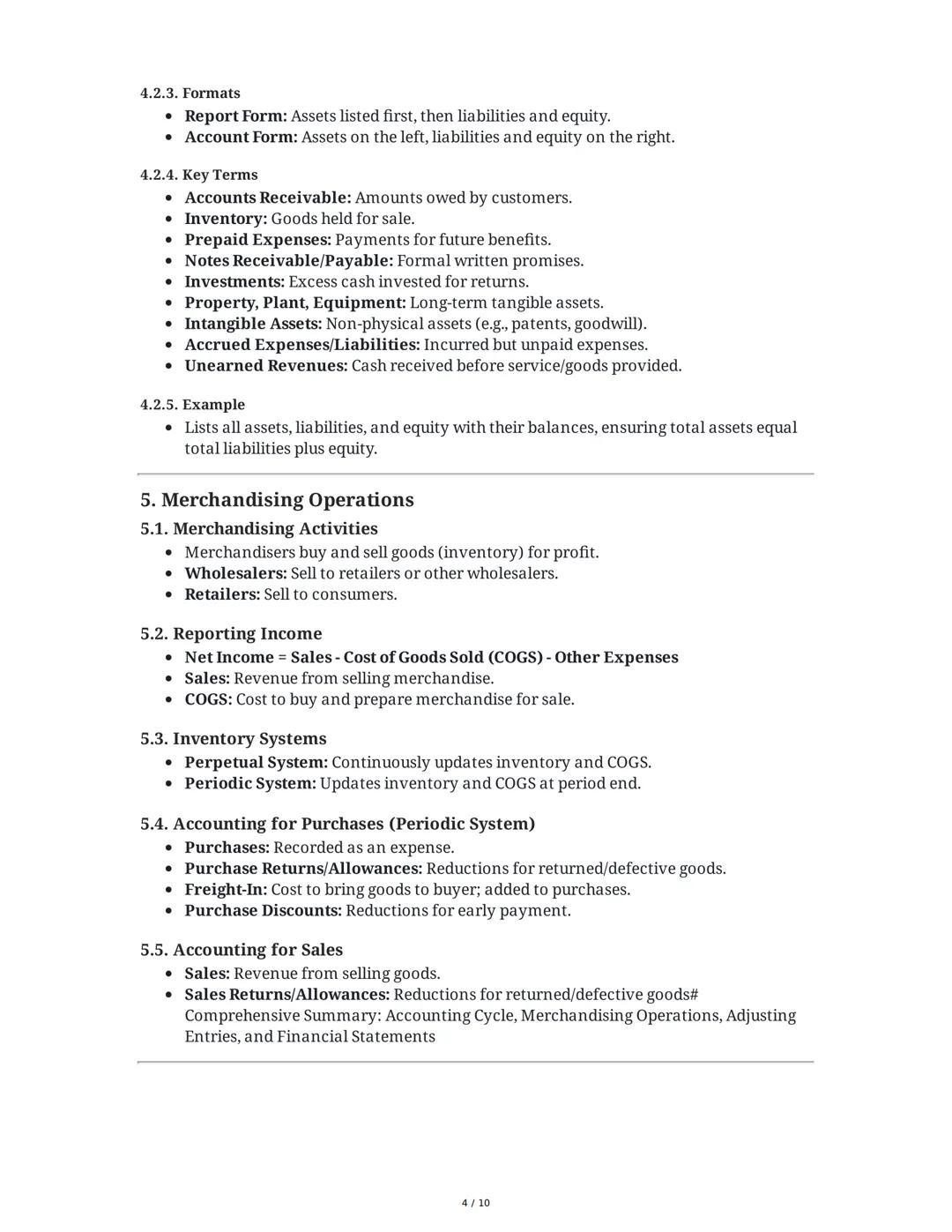
Balance Sheet and Merchandising Operations
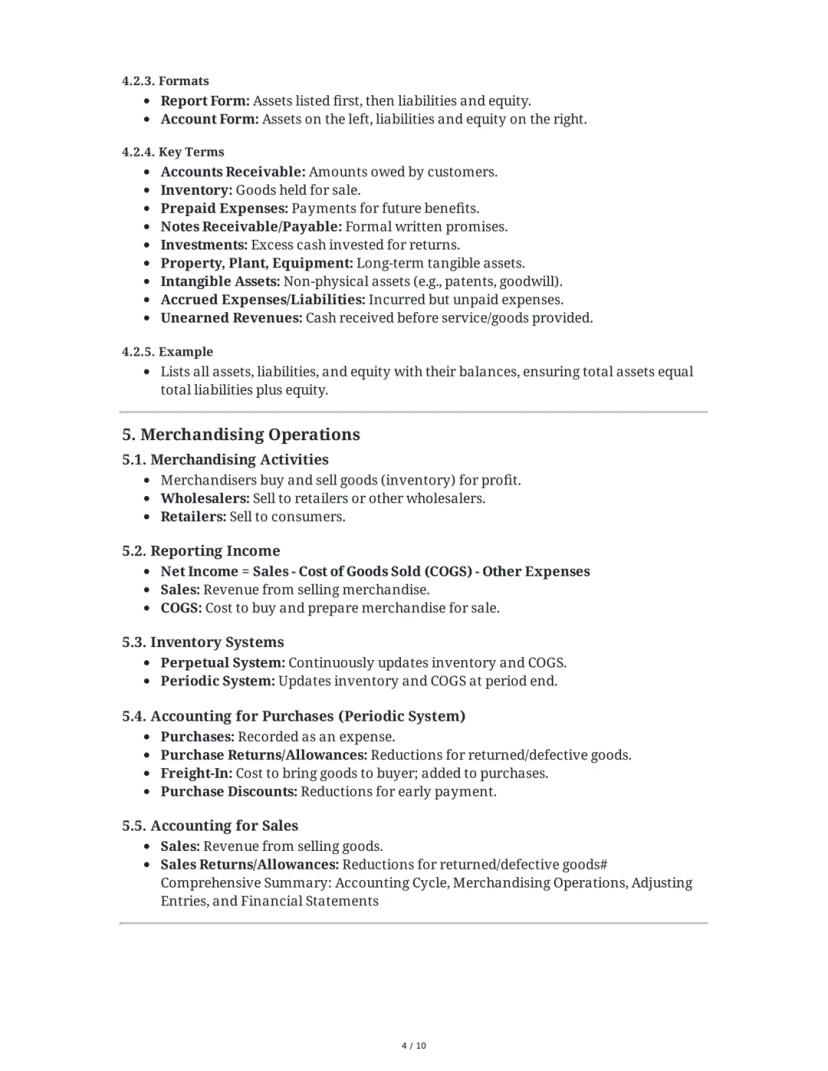
The balance sheet follows the fundamental accounting equation: Assets = Liabilities + Owner's Equity. It can be presented in two formats: report form (assets first, then liabilities and equity) or account form (assets on left, liabilities and equity on right).
Balance sheets classify items as either current or non-current. Current assets will convert to cash within one year (like cash, receivables, inventory), while non-current assets are long-term (like buildings, equipment, patents). Similarly, current liabilities are due within a year, while non-current liabilities extend beyond that timeframe.
Merchandising operations involve businesses that buy and sell inventory. Unlike service businesses, merchandisers have a key expense called Cost of Goods Sold (COGS) - the cost of inventory sold to customers. Their income formula becomes: Sales - COGS - Other Expenses = Net Income.
Merchandisers use one of two inventory systems:
- Perpetual system: Updates inventory and COGS continuously with each sale
- Periodic system: Updates inventory and calculates COGS only at the end of the period
When accounting for purchases, businesses track not just the base cost but also purchase returns/allowances (reductions for returns), freight-in (shipping costs), and purchase discounts (savings for early payment).
5
of 10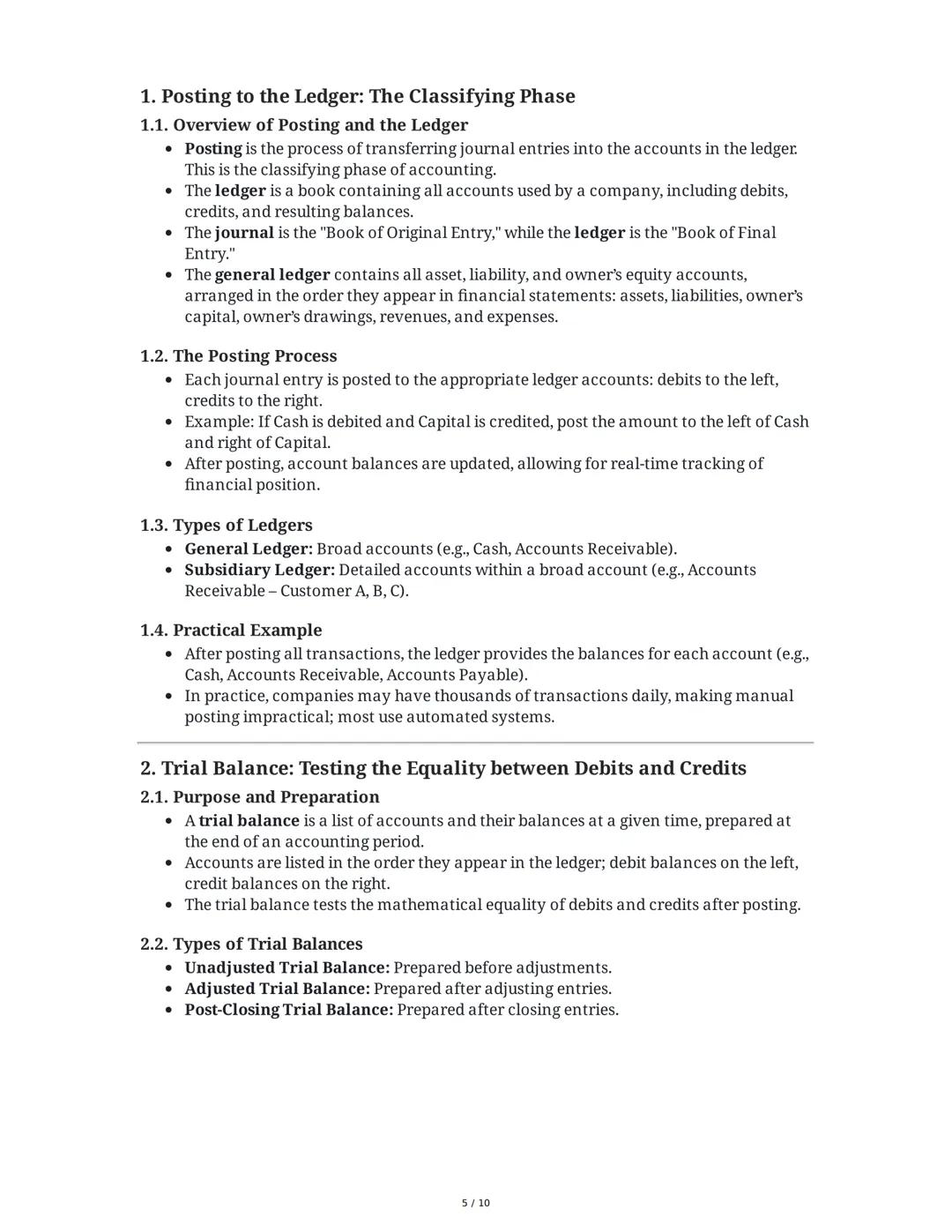
The Posting Process and Trial Balance Creation
Posting transactions keeps your ledger current and organized. When journalizing, you record events chronologically, but posting classifies them by account type. For example, all cash transactions (both increases and decreases) appear together in the Cash account after posting.
The general ledger contains broad accounts while subsidiary ledgers provide detailed breakdowns. For instance, the Accounts Receivable subsidiary ledger might have separate accounts for each customer who owes you money.
After posting all transactions, balances in each account are calculated. For accounts with normal debit balances (assets, expenses, drawings), subtract total credits from total debits. For accounts with normal credit balances (liabilities, revenue, capital), subtract total debits from total credits.
Creating a trial balance is straightforward:
- List all accounts from the ledger in their standard order
- Enter debit balances in the left column and credit balances in the right
- Total both columns - they should be equal
The trial balance serves three important purposes: it checks the equality of debits and credits, provides account balances in one place, and helps identify errors before preparing financial statements.
Study Hack: If your trial balance doesn't balance, calculate the difference between columns. If it's divisible by 9, you might have transposed digits (like writing $95 as $59) or shifted a decimal point!
6
of 10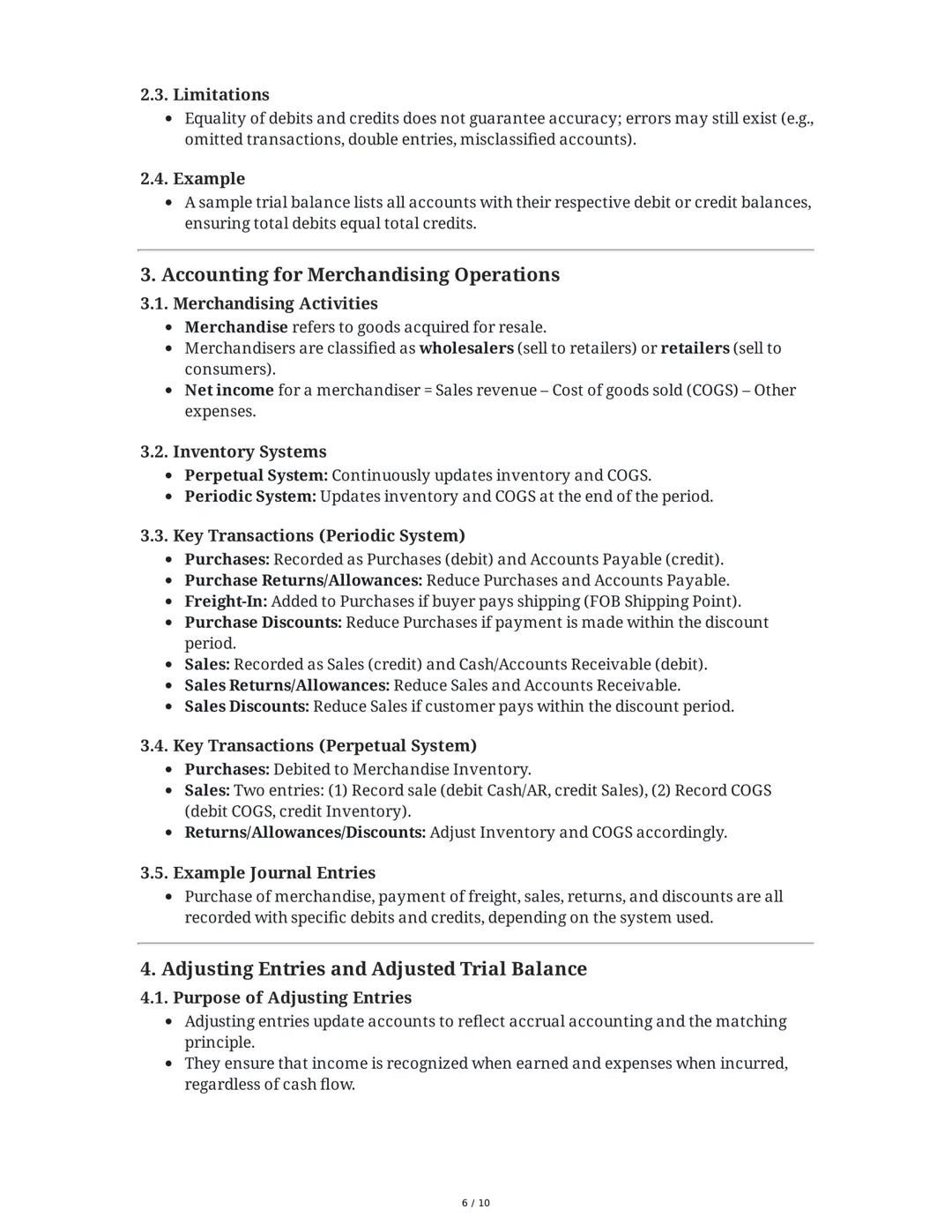
Inventory Systems and Adjusting Entries
Merchandising businesses focus on buying and selling goods for profit. Wholesalers sell to other businesses, while retailers sell directly to consumers. Both calculate profit using the formula: Net Income = Sales - COGS - Operating Expenses.
The way businesses track inventory significantly impacts their accounting:
In a periodic system:
- Purchases are recorded in a Purchases account
- COGS is calculated only at period-end
- You need a physical count to determine ending inventory
- The formula for COGS: Beginning Inventory + Purchases - Ending Inventory
In a perpetual system:
- Purchases go directly to Merchandise Inventory
- COGS is updated with each sale
- You record two entries per sale: one for the revenue, one for the cost
- Physical counts still happen periodically to verify system accuracy
Adjusting entries ensure your financial statements reflect economic reality. They implement the accrual basis of accounting by making sure revenues and expenses are recorded in the proper period.
For example, if you've earned $500 in interest that hasn't been received yet, you'd debit Interest Receivable $500 and credit Interest Revenue $500. Or if employees worked $3,000 worth of hours that haven't been paid yet, you'd debit Salaries Expense $3,000 and credit Salaries Payable $3,000.
After all adjusting entries are posted, you create an adjusted trial balance that forms the basis for your financial statements.
7
of 10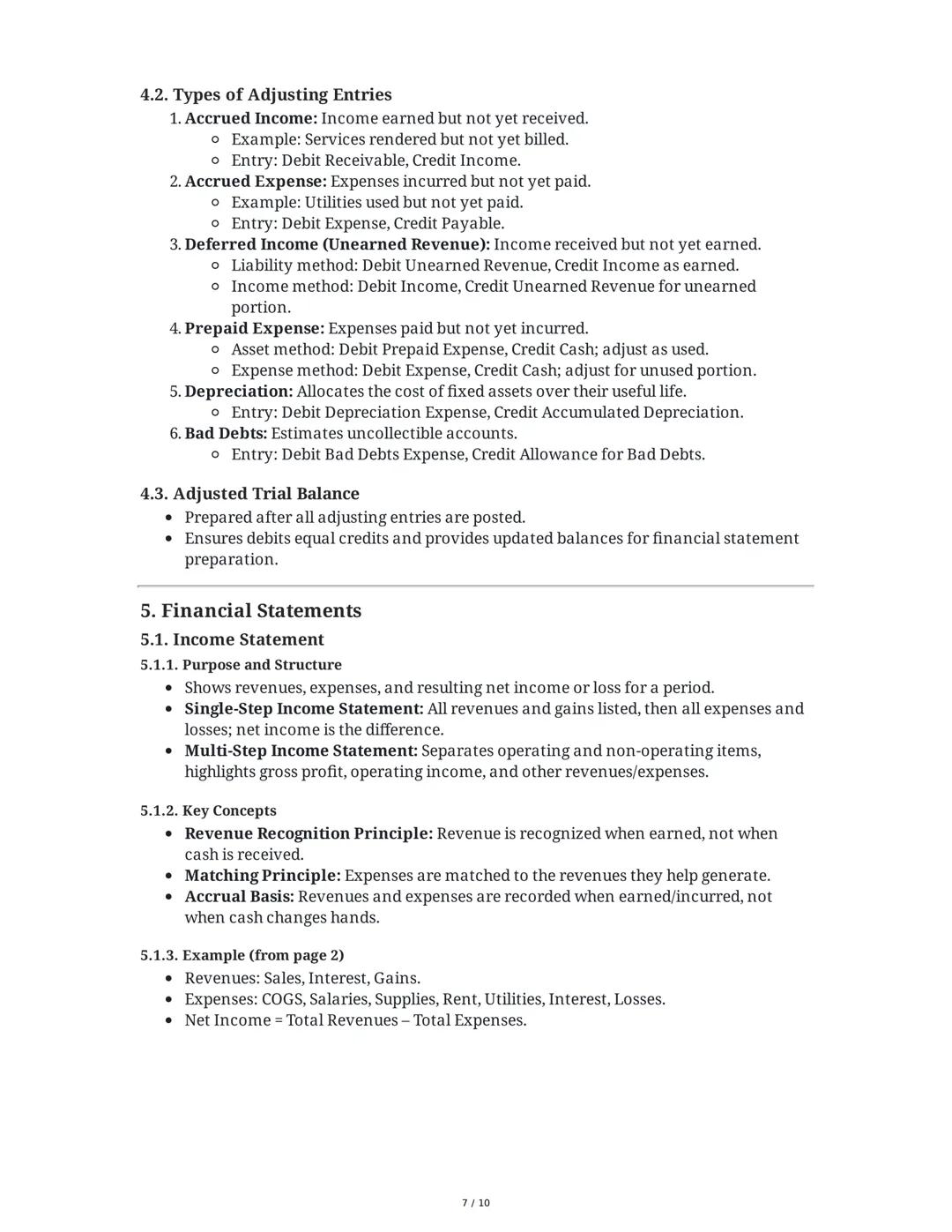
Types of Adjusting Entries and Financial Statements
Adjusting entries fall into several categories that address different timing issues:
Accrued Income: When you've earned revenue but haven't received payment. For example, if you've completed work but haven't billed the client, you'd debit Accounts Receivable and credit Service Revenue.
Accrued Expenses: When you've incurred expenses but haven't paid for them yet. For instance, if you've used electricity but haven't received the bill, you'd debit Utilities Expense and credit Utilities Payable.
Deferred Income: When customers pay you before you deliver services. Initially recorded as a liability (Unearned Revenue), you gradually recognize revenue as you provide the service.
Prepaid Expenses: When you pay for benefits before using them. These start as assets (like Prepaid Insurance) and become expenses as you use them up.
Depreciation: Allocates the cost of long-term assets over their useful lives, reflecting their gradual consumption. You debit Depreciation Expense and credit Accumulated Depreciation.
Bad Debts: Estimates uncollectible accounts receivable. You debit Bad Debts Expense and credit Allowance for Bad Debts.
The income statement comes in two formats:
- Single-step: Simply lists all revenues, then all expenses
- Multi-step: Shows important subtotals like gross profit and operating income
Real-World Relevance: Businesses prefer multi-step income statements because they show which parts of the business are performing well or poorly, making it easier to identify improvement areas!
8
of 10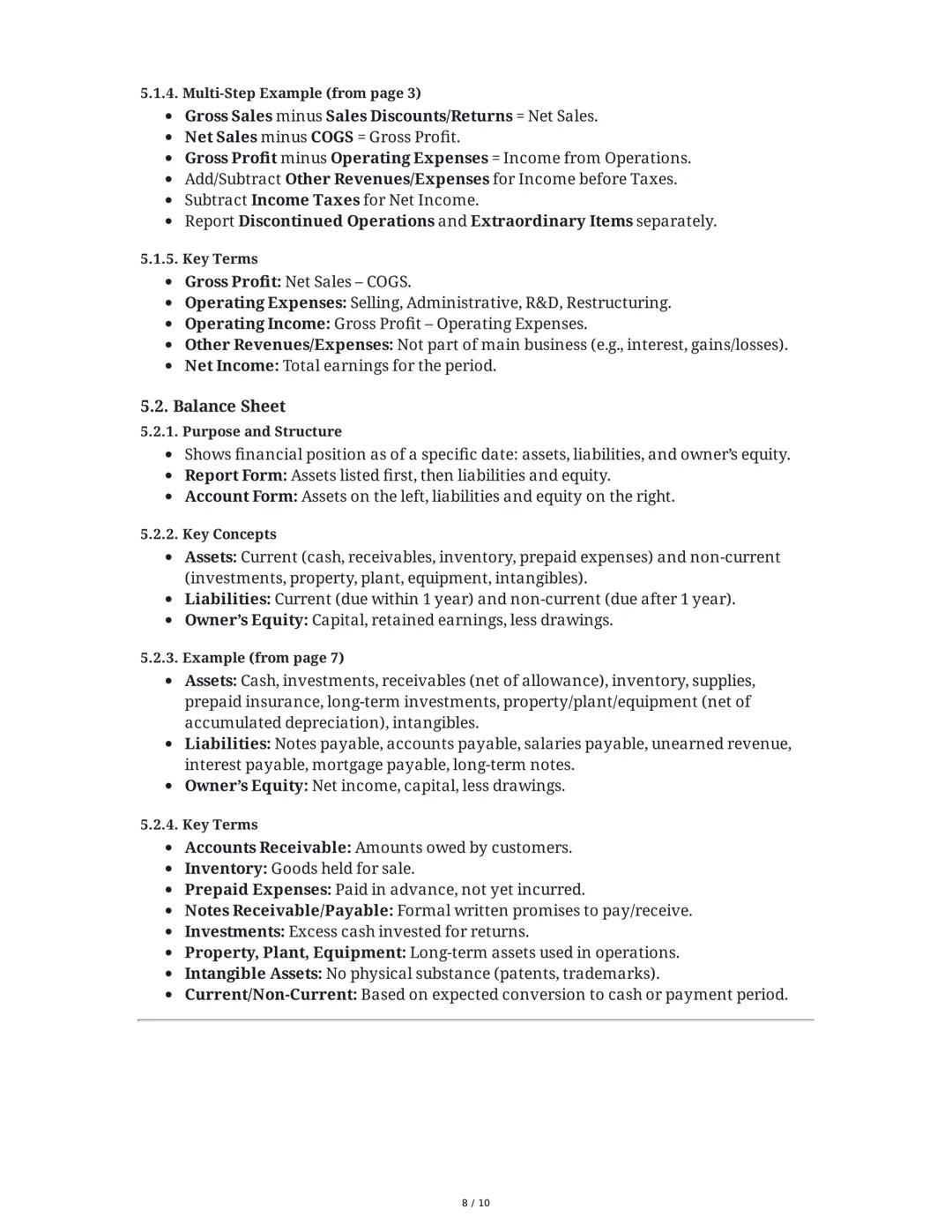
Detailed Financial Statement Components
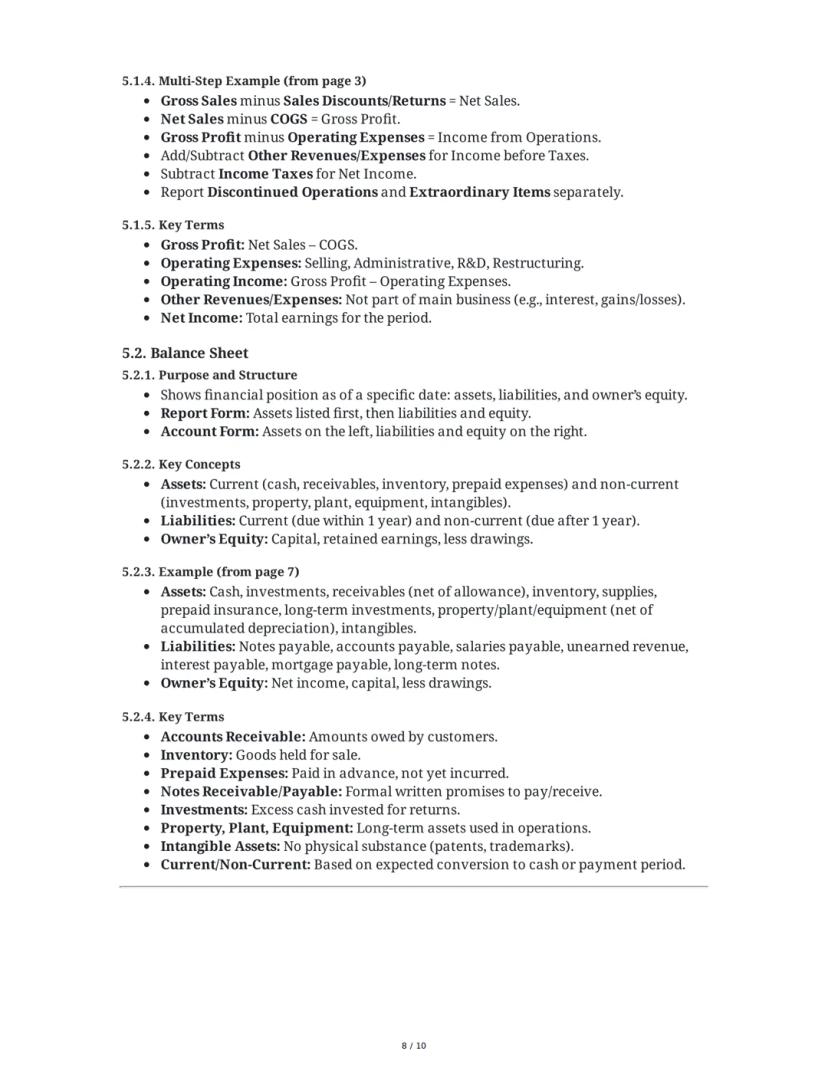
A multi-step income statement provides a detailed breakdown of a company's performance. It starts with gross sales minus returns and discounts to get net sales. Subtracting cost of goods sold gives you gross profit - the profit from just buying and selling merchandise before considering operating costs.
After subtracting operating expenses (like salaries, rent, and advertising), you get operating income - profit from normal business activities. Then you add or subtract other revenues/expenses to find income before taxes. Finally, after subtracting income taxes, you arrive at net income - the bottom line.
The balance sheet provides a snapshot of what a business owns and owes at a specific moment. Assets typically appear in order of liquidity (how quickly they can be converted to cash):
- Cash and investments (most liquid)
- Accounts receivable (amounts customers owe)
- Inventory (goods for sale)
- Prepaid expenses (like prepaid rent)
- Long-term investments
- Property, plant, and equipment (less accumulated depreciation)
- Intangible assets (like patents and trademarks)
Liabilities are listed by when they're due:
- Current liabilities (due within a year)
- Long-term liabilities (due after a year)
Owner's equity shows the owner's claim to business assets after all liabilities are paid.
Remember the fundamental accounting equation must always balance: Assets = Liabilities + Owner's Equity.
9
of 10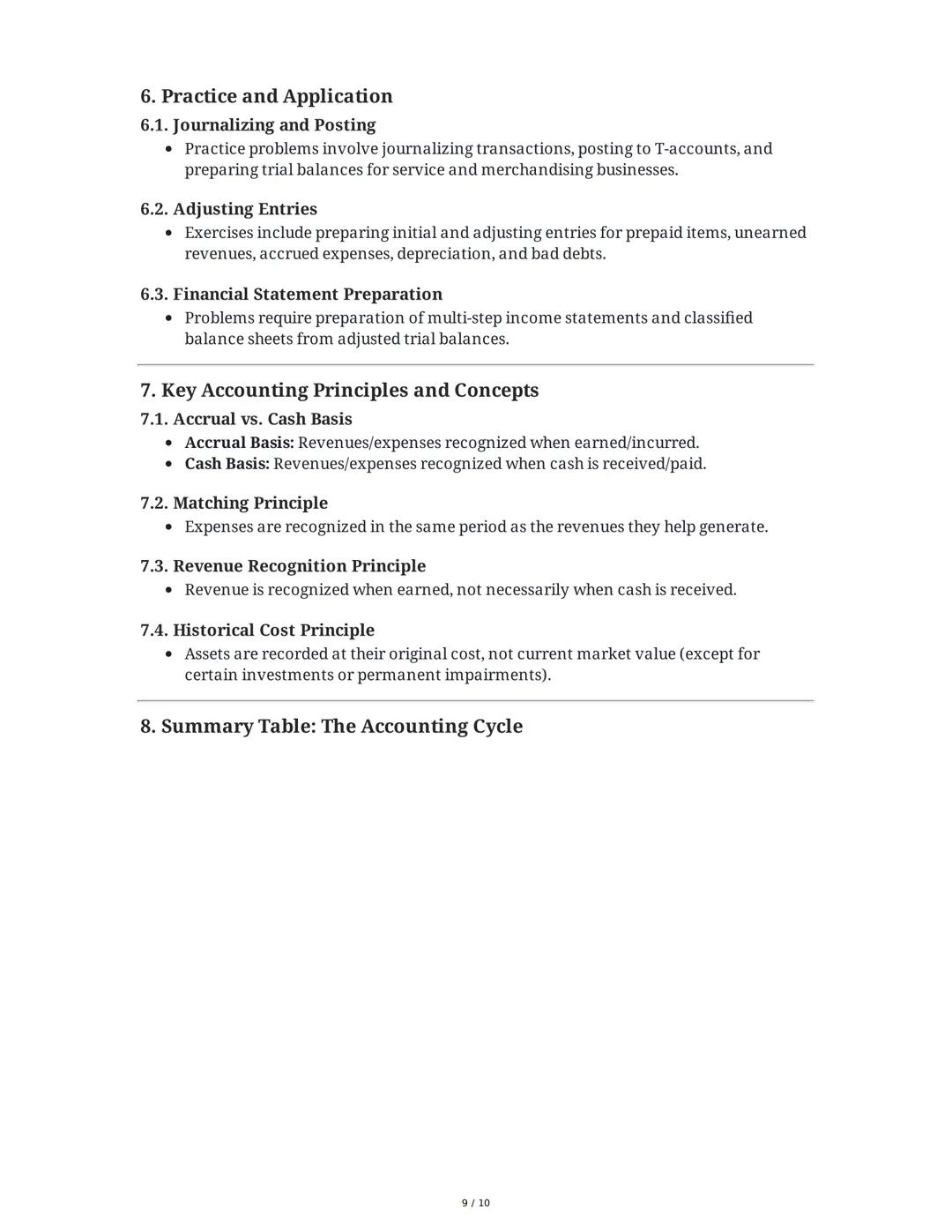
The Accounting Cycle and Key Principles
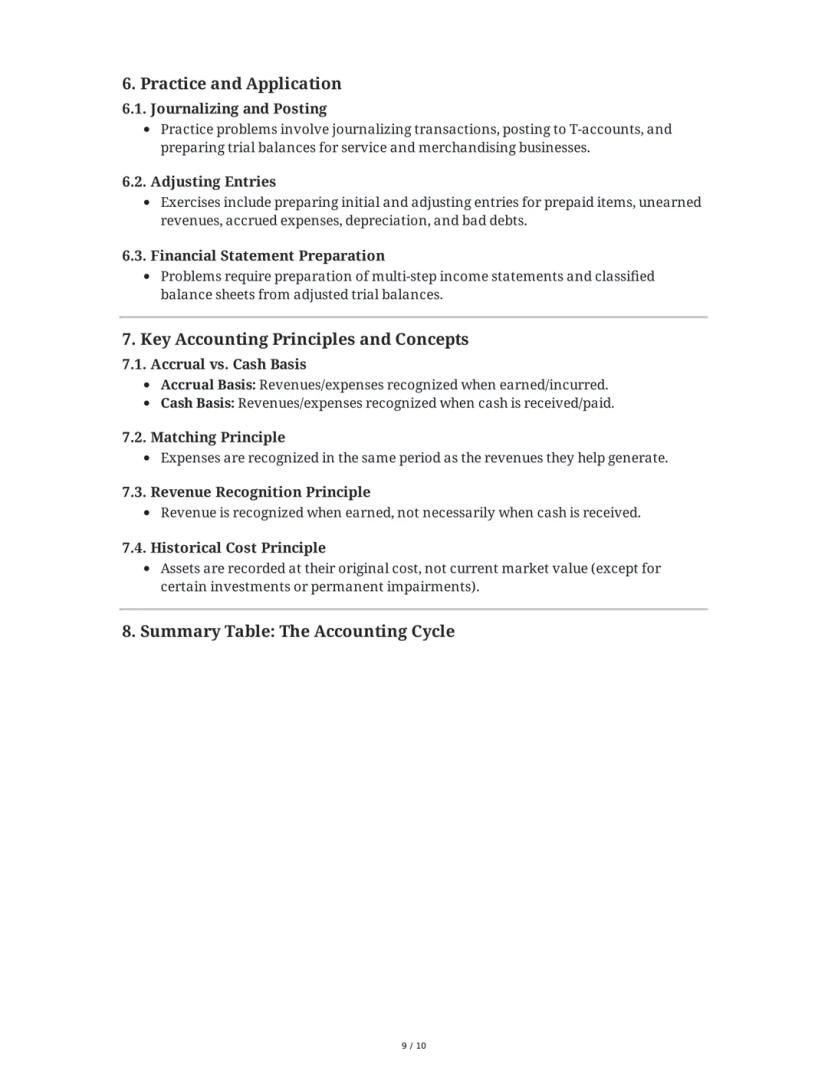
The accounting cycle is a step-by-step process that businesses follow each accounting period. Mastering these steps helps you understand how raw financial data transforms into meaningful reports:
- Analyze transactions (identify what happened financially)
- Journalize transactions (record in the journal)
- Post to ledger accounts (classify by account)
- Prepare unadjusted trial balance (check for equality)
- Prepare adjusting entries (update accounts to reflect reality)
- Prepare adjusted trial balance (verify equality after adjustments)
- Prepare financial statements (income statement, balance sheet, statement of owner's equity)
- Prepare closing entries (reset temporary accounts for the next period)
- Prepare post-closing trial balance (final check before starting new period)
Several key accounting principles guide this process:
Accrual vs. Cash Basis: The accrual basis recognizes revenues and expenses when earned/incurred, regardless of cash flow. The simpler cash basis only recognizes transactions when cash changes hands.
Matching Principle: Expenses should be recognized in the same period as the revenues they help generate.
Revenue Recognition Principle: Revenue is recorded when earned , not necessarily when payment is received.
Historical Cost Principle: Assets are typically recorded at their original purchase price, not their current market value.
Career Connection: Understanding the accounting cycle gives you valuable skills for business, whether you become an accountant or just need to understand financial reports in any career!
10
of 10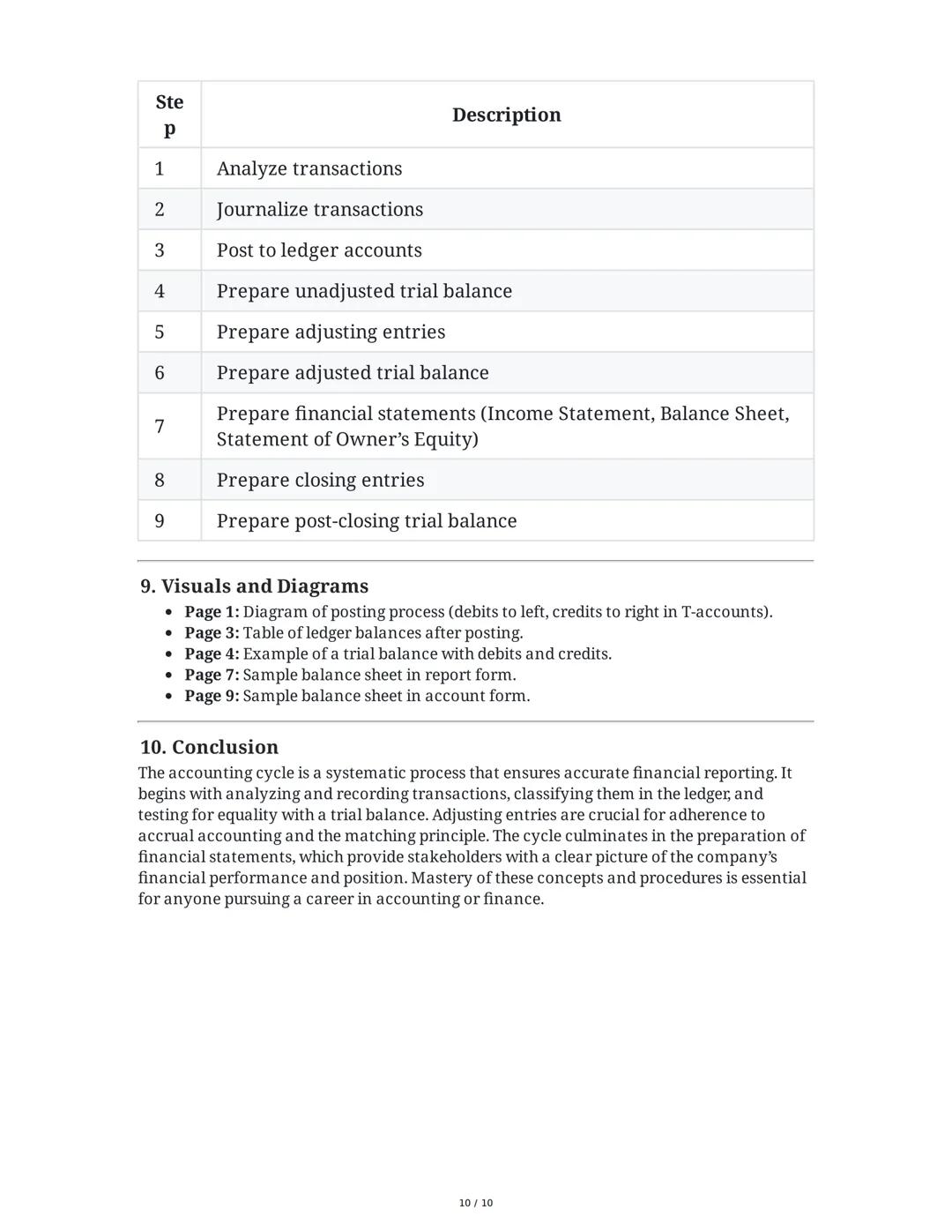
The Complete Accounting Cycle
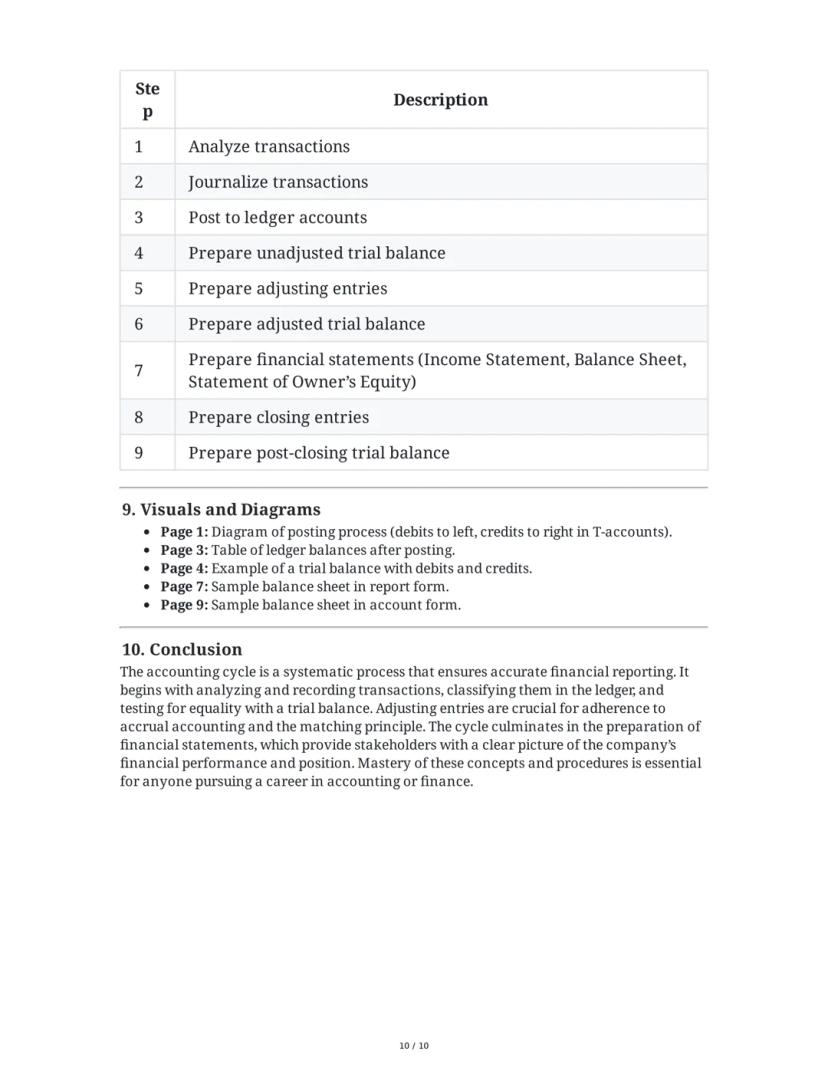
The accounting cycle is a systematic sequence that transforms financial events into useful information. Here's a clear breakdown of each step:
-
Analyze transactions: Identify business events with financial impact and determine which accounts are affected.
-
Journalize transactions: Record events chronologically in the journal with appropriate debits and credits.
-
Post to ledger: Transfer journal information to individual accounts in the ledger to track each account's balance.
-
Prepare unadjusted trial balance: List all accounts with their balances to verify debit/credit equality before adjustments.
-
Prepare adjusting entries: Record end-of-period adjustments to recognize revenues/expenses in the proper period.
-
Prepare adjusted trial balance: Create an updated list of accounts after adjustments to verify equality.
-
Prepare financial statements: Create the income statement, balance sheet, and statement of owner's equity from the adjusted trial balance.
-
Prepare closing entries: Reset revenue, expense, and drawing accounts to zero for the next period.
-
Prepare post-closing trial balance: Final check to ensure debits equal credits after closing.
Visuals like T-account diagrams, sample trial balances, and example financial statements help reinforce these concepts. Remember that while small businesses might complete this cycle manually, most companies use accounting software that automates many steps, reducing errors and saving time.
The accounting cycle isn't just a procedure - it's the foundation for reliable financial reporting that helps businesses make informed decisions, satisfy legal requirements, and communicate with stakeholders.
We thought you’d never ask...
What is the Knowunity AI companion?
Our AI companion is specifically built for the needs of students. Based on the millions of content pieces we have on the platform we can provide truly meaningful and relevant answers to students. But its not only about answers, the companion is even more about guiding students through their daily learning challenges, with personalised study plans, quizzes or content pieces in the chat and 100% personalisation based on the students skills and developments.
Where can I download the Knowunity app?
You can download the app in the Google Play Store and in the Apple App Store.
Is Knowunity really free of charge?
That's right! Enjoy free access to study content, connect with fellow students, and get instant help – all at your fingertips.
Most popular content in Finance and capital markets
4Finance and capital marketsParcor Baysa
Partnership and Corporation
College1182
World HistoryAP 10 - QUARTER 2 NOTES
Globalisasyon SDG Migrasyon Teritoryal Dinastiyang Politikal
10th730
 AP Microeconomics
Entrepreneurship
Risk and Socio-economic Benefits of Entrepreneurship. Functions of business-Production, Management, Marketing, and Finance.
23710
Finance and capital marketsIB BUSINESS HL unit 1
IB (international baccalaureate) Business management HL (high level) UNIT 1
50625
Most popular content
9O
 AP US History
Origins and Dynamics of the Columbian Exchange
Analyze the ecological and economic motivations behind the initial transfer of goods, people, and diseases between the Old and New Worlds.
9th3,1280
I
AP US HistoryIntroduction to Early Cultural Interactions
Analyze the initial social and religious encounters between Europeans, Africans, and Indigenous peoples in the colonial Americas.
9th2,7730
O
AP World HistoryOrigins of Ancient River Civilizations
Analyze the environmental factors and technological innovations that led to the rise of early states in Mesopotamia, Egypt, and the Indus Valley.
9th3,1860
M
AP US HistoryMotivations for European Exploration
Analyze the economic, religious, and political factors that drove European powers to the Americas during the 15th and 16th centuries.
9th1,7780
F
 AP Psychology
Foundations of Ethical Guidelines in Research
Practice the core principles of the APA ethical code including informed consent, debriefing, and the role of Institutional Review Boards.
9th1,3360
I
AP US HistoryIntroduction to Native American Societies
Examine the diverse social, political, and economic structures of North American indigenous groups prior to European contact.
9th1,1100
I
 AP Biology
Introduction to Biological Elements of Life
Practice identifying the essential elements including carbon, nitrogen, phosphorus, and sulfur that compose biological macromolecules.
9th1,7360
I
AP US HistoryIntroduction to the Spanish Encomienda System
Explore the fundamental economic and social structures of the Spanish colonial system, focusing on the encomienda and the casta social hierarchy.
9th8890
O
AP World HistoryOrigins and Continuity of the Byzantine Empire
Analyze the political and cultural transitions from the Roman Empire to the Byzantine Empire, focusing on the reign of Justinian I and his code.
9th1,6320
Can't find what you're looking for? Explore other subjects.
Students love us — and so will you.
4.6/5App Store
4.7/5Google Play
The app is very easy to use and well designed. I have found everything I was looking for so far and have been able to learn a lot from the presentations! I will definitely use the app for a class assignment! And of course it also helps a lot as an inspiration.
Stefan SiOS user
This app is really great. There are so many study notes and help [...]. My problem subject is French, for example, and the app has so many options for help. Thanks to this app, I have improved my French. I would recommend it to anyone.
Samantha KlichAndroid user
Wow, I am really amazed. I just tried the app because I've seen it advertised many times and was absolutely stunned. This app is THE HELP you want for school and above all, it offers so many things, such as workouts and fact sheets, which have been VERY helpful to me personally.
AnnaiOS user
Finance and capital markets48 views·Updated May 26, 2026·10 pagesUnderstanding the Accounting Cycle and Creating Financial Statements
M
mier jsro@mierjsro
The accounting cycle is the backbone of financial reporting for every business. It takes raw transaction data and transforms it into meaningful financial statements through a systematic process. Understanding this cycle helps you see how businesses track money, measure performance,... Show more
1
of 10Sign up to see the content. It's free!
- Access to all documents
- Improve your grades
- Join milions of students
Posting to the Ledger: Organizing Financial Data
Ever wonder how businesses keep track of thousands of transactions? The answer lies in posting to the ledger. Posting is the process of transferring journal entries to accounts in the ledger, organizing financial data by category.
The general ledger is like a master filing system containing all accounts a company uses. Think of the journal as the "Book of Original Entry" where transactions are first recorded, while the ledger is the "Book of Final Entry" where information gets classified. Accounts in the ledger follow a specific order: assets, liabilities, owner's capital, owner's drawings, revenues, and expenses.
During posting, debits go on the left side of accounts and credits on the right. For example, if you record a $500 cash deposit with a debit to Cash and credit to Capital, you'd put $500 on the left side of the Cash account and $500 on the right side of the Capital account. After posting all transactions, the ledger gives you up-to-date balances for each account.
Quick Tip: Most businesses today use accounting software that automatically posts journal entries to the ledger, saving tremendous time and reducing errors!
2
of 10Sign up to see the content. It's free!
- Access to all documents
- Improve your grades
- Join milions of students
Trial Balance and Adjusting Entries
A trial balance is like a quick math check to ensure your accounting equation stays balanced. It lists all accounts with their balances - debit balances on the left, credit balances on the right - and confirms that total debits equal total credits.
Don't be fooled by a balanced trial balance, though. It only checks for mathematical equality, not accuracy. Common errors that won't show up include omitted transactions, duplicate recordings, or using incorrect accounts within the same classification (like debiting the wrong expense account).
Adjusting entries are crucial for accurate financial reporting. They update accounts based on two important principles: the accrual concept (recognizing income when earned and expenses when incurred) and the matching principle (matching expenses with the revenues they help generate).
Several types of adjusting entries include:
- Accrued income (earned but not received)
- Accrued expenses (incurred but not paid)
- Deferred income (received but not earned)
- Prepaid expenses (paid but not used)
- Depreciation (allocating asset costs over time)
- Bad debts (estimating uncollectible accounts)
After adjusting entries are posted, an adjusted trial balance is prepared as the foundation for creating financial statements.
3
of 10Sign up to see the content. It's free!
- Access to all documents
- Improve your grades
- Join milions of students
Financial Statements: The Income Statement
Financial statements translate all your accounting work into information people can actually use! The income statement (sometimes called a profit and loss statement) shows how much money a business made or lost over a specific period.
Income statements follow the basic formula: Revenues - Expenses = Net Income. They're based on the accrual basis of accounting, which means revenues appear when earned and expenses when incurred, regardless of when cash changes hands.
There are two main formats for income statements. A single-step income statement simply lists all revenues, then all expenses, and calculates the difference. The more detailed multi-step income statement separates operating items (main business activities) from non-operating items and shows useful subtotals like gross profit and operating income.
The balance sheet complements the income statement by showing a company's financial position at a specific moment. It's organized into three sections: assets (resources owned), liabilities (obligations owed), and owner's equity (the owner's claim after liabilities).
Remember This: The income statement answers "How profitable was the business?" while the balance sheet answers "What does the business own and owe?"
4
of 10Sign up to see the content. It's free!
- Access to all documents
- Improve your grades
- Join milions of students
Balance Sheet and Merchandising Operations
The balance sheet follows the fundamental accounting equation: Assets = Liabilities + Owner's Equity. It can be presented in two formats: report form (assets first, then liabilities and equity) or account form (assets on left, liabilities and equity on right).
Balance sheets classify items as either current or non-current. Current assets will convert to cash within one year (like cash, receivables, inventory), while non-current assets are long-term (like buildings, equipment, patents). Similarly, current liabilities are due within a year, while non-current liabilities extend beyond that timeframe.
Merchandising operations involve businesses that buy and sell inventory. Unlike service businesses, merchandisers have a key expense called Cost of Goods Sold (COGS) - the cost of inventory sold to customers. Their income formula becomes: Sales - COGS - Other Expenses = Net Income.
Merchandisers use one of two inventory systems:
- Perpetual system: Updates inventory and COGS continuously with each sale
- Periodic system: Updates inventory and calculates COGS only at the end of the period
When accounting for purchases, businesses track not just the base cost but also purchase returns/allowances (reductions for returns), freight-in (shipping costs), and purchase discounts (savings for early payment).
5
of 10Sign up to see the content. It's free!
- Access to all documents
- Improve your grades
- Join milions of students
The Posting Process and Trial Balance Creation
Posting transactions keeps your ledger current and organized. When journalizing, you record events chronologically, but posting classifies them by account type. For example, all cash transactions (both increases and decreases) appear together in the Cash account after posting.
The general ledger contains broad accounts while subsidiary ledgers provide detailed breakdowns. For instance, the Accounts Receivable subsidiary ledger might have separate accounts for each customer who owes you money.
After posting all transactions, balances in each account are calculated. For accounts with normal debit balances (assets, expenses, drawings), subtract total credits from total debits. For accounts with normal credit balances (liabilities, revenue, capital), subtract total debits from total credits.
Creating a trial balance is straightforward:
- List all accounts from the ledger in their standard order
- Enter debit balances in the left column and credit balances in the right
- Total both columns - they should be equal
The trial balance serves three important purposes: it checks the equality of debits and credits, provides account balances in one place, and helps identify errors before preparing financial statements.
Study Hack: If your trial balance doesn't balance, calculate the difference between columns. If it's divisible by 9, you might have transposed digits (like writing $95 as $59) or shifted a decimal point!
6
of 10Sign up to see the content. It's free!
- Access to all documents
- Improve your grades
- Join milions of students
Inventory Systems and Adjusting Entries
Merchandising businesses focus on buying and selling goods for profit. Wholesalers sell to other businesses, while retailers sell directly to consumers. Both calculate profit using the formula: Net Income = Sales - COGS - Operating Expenses.
The way businesses track inventory significantly impacts their accounting:
In a periodic system:
- Purchases are recorded in a Purchases account
- COGS is calculated only at period-end
- You need a physical count to determine ending inventory
- The formula for COGS: Beginning Inventory + Purchases - Ending Inventory
In a perpetual system:
- Purchases go directly to Merchandise Inventory
- COGS is updated with each sale
- You record two entries per sale: one for the revenue, one for the cost
- Physical counts still happen periodically to verify system accuracy
Adjusting entries ensure your financial statements reflect economic reality. They implement the accrual basis of accounting by making sure revenues and expenses are recorded in the proper period.
For example, if you've earned $500 in interest that hasn't been received yet, you'd debit Interest Receivable $500 and credit Interest Revenue $500. Or if employees worked $3,000 worth of hours that haven't been paid yet, you'd debit Salaries Expense $3,000 and credit Salaries Payable $3,000.
After all adjusting entries are posted, you create an adjusted trial balance that forms the basis for your financial statements.
7
of 10Sign up to see the content. It's free!
- Access to all documents
- Improve your grades
- Join milions of students
Types of Adjusting Entries and Financial Statements
Adjusting entries fall into several categories that address different timing issues:
Accrued Income: When you've earned revenue but haven't received payment. For example, if you've completed work but haven't billed the client, you'd debit Accounts Receivable and credit Service Revenue.
Accrued Expenses: When you've incurred expenses but haven't paid for them yet. For instance, if you've used electricity but haven't received the bill, you'd debit Utilities Expense and credit Utilities Payable.
Deferred Income: When customers pay you before you deliver services. Initially recorded as a liability (Unearned Revenue), you gradually recognize revenue as you provide the service.
Prepaid Expenses: When you pay for benefits before using them. These start as assets (like Prepaid Insurance) and become expenses as you use them up.
Depreciation: Allocates the cost of long-term assets over their useful lives, reflecting their gradual consumption. You debit Depreciation Expense and credit Accumulated Depreciation.
Bad Debts: Estimates uncollectible accounts receivable. You debit Bad Debts Expense and credit Allowance for Bad Debts.
The income statement comes in two formats:
- Single-step: Simply lists all revenues, then all expenses
- Multi-step: Shows important subtotals like gross profit and operating income
Real-World Relevance: Businesses prefer multi-step income statements because they show which parts of the business are performing well or poorly, making it easier to identify improvement areas!
8
of 10Sign up to see the content. It's free!
- Access to all documents
- Improve your grades
- Join milions of students
Detailed Financial Statement Components
A multi-step income statement provides a detailed breakdown of a company's performance. It starts with gross sales minus returns and discounts to get net sales. Subtracting cost of goods sold gives you gross profit - the profit from just buying and selling merchandise before considering operating costs.
After subtracting operating expenses (like salaries, rent, and advertising), you get operating income - profit from normal business activities. Then you add or subtract other revenues/expenses to find income before taxes. Finally, after subtracting income taxes, you arrive at net income - the bottom line.
The balance sheet provides a snapshot of what a business owns and owes at a specific moment. Assets typically appear in order of liquidity (how quickly they can be converted to cash):
- Cash and investments (most liquid)
- Accounts receivable (amounts customers owe)
- Inventory (goods for sale)
- Prepaid expenses (like prepaid rent)
- Long-term investments
- Property, plant, and equipment (less accumulated depreciation)
- Intangible assets (like patents and trademarks)
Liabilities are listed by when they're due:
- Current liabilities (due within a year)
- Long-term liabilities (due after a year)
Owner's equity shows the owner's claim to business assets after all liabilities are paid.
Remember the fundamental accounting equation must always balance: Assets = Liabilities + Owner's Equity.
9
of 10Sign up to see the content. It's free!
- Access to all documents
- Improve your grades
- Join milions of students
The Accounting Cycle and Key Principles
The accounting cycle is a step-by-step process that businesses follow each accounting period. Mastering these steps helps you understand how raw financial data transforms into meaningful reports:
- Analyze transactions (identify what happened financially)
- Journalize transactions (record in the journal)
- Post to ledger accounts (classify by account)
- Prepare unadjusted trial balance (check for equality)
- Prepare adjusting entries (update accounts to reflect reality)
- Prepare adjusted trial balance (verify equality after adjustments)
- Prepare financial statements (income statement, balance sheet, statement of owner's equity)
- Prepare closing entries (reset temporary accounts for the next period)
- Prepare post-closing trial balance (final check before starting new period)
Several key accounting principles guide this process:
Accrual vs. Cash Basis: The accrual basis recognizes revenues and expenses when earned/incurred, regardless of cash flow. The simpler cash basis only recognizes transactions when cash changes hands.
Matching Principle: Expenses should be recognized in the same period as the revenues they help generate.
Revenue Recognition Principle: Revenue is recorded when earned , not necessarily when payment is received.
Historical Cost Principle: Assets are typically recorded at their original purchase price, not their current market value.
Career Connection: Understanding the accounting cycle gives you valuable skills for business, whether you become an accountant or just need to understand financial reports in any career!
10
of 10Sign up to see the content. It's free!
- Access to all documents
- Improve your grades
- Join milions of students
The Complete Accounting Cycle
The accounting cycle is a systematic sequence that transforms financial events into useful information. Here's a clear breakdown of each step:
-
Analyze transactions: Identify business events with financial impact and determine which accounts are affected.
-
Journalize transactions: Record events chronologically in the journal with appropriate debits and credits.
-
Post to ledger: Transfer journal information to individual accounts in the ledger to track each account's balance.
-
Prepare unadjusted trial balance: List all accounts with their balances to verify debit/credit equality before adjustments.
-
Prepare adjusting entries: Record end-of-period adjustments to recognize revenues/expenses in the proper period.
-
Prepare adjusted trial balance: Create an updated list of accounts after adjustments to verify equality.
-
Prepare financial statements: Create the income statement, balance sheet, and statement of owner's equity from the adjusted trial balance.
-
Prepare closing entries: Reset revenue, expense, and drawing accounts to zero for the next period.
-
Prepare post-closing trial balance: Final check to ensure debits equal credits after closing.
Visuals like T-account diagrams, sample trial balances, and example financial statements help reinforce these concepts. Remember that while small businesses might complete this cycle manually, most companies use accounting software that automates many steps, reducing errors and saving time.
The accounting cycle isn't just a procedure - it's the foundation for reliable financial reporting that helps businesses make informed decisions, satisfy legal requirements, and communicate with stakeholders.
We thought you’d never ask...
What is the Knowunity AI companion?
Our AI companion is specifically built for the needs of students. Based on the millions of content pieces we have on the platform we can provide truly meaningful and relevant answers to students. But its not only about answers, the companion is even more about guiding students through their daily learning challenges, with personalised study plans, quizzes or content pieces in the chat and 100% personalisation based on the students skills and developments.
Where can I download the Knowunity app?
You can download the app in the Google Play Store and in the Apple App Store.
Is Knowunity really free of charge?
That's right! Enjoy free access to study content, connect with fellow students, and get instant help – all at your fingertips.
Most popular content in Finance and capital markets
4Finance and capital marketsParcor Baysa
Partnership and Corporation
College1182
World HistoryAP 10 - QUARTER 2 NOTES
Globalisasyon SDG Migrasyon Teritoryal Dinastiyang Politikal
10th730
AP MicroeconomicsEntrepreneurship
Risk and Socio-economic Benefits of Entrepreneurship. Functions of business-Production, Management, Marketing, and Finance.
23710
Finance and capital marketsIB BUSINESS HL unit 1
IB (international baccalaureate) Business management HL (high level) UNIT 1
50625
Most popular content
9O
AP US HistoryOrigins and Dynamics of the Columbian Exchange
Analyze the ecological and economic motivations behind the initial transfer of goods, people, and diseases between the Old and New Worlds.
9th3,1280
I
AP US HistoryIntroduction to Early Cultural Interactions
Analyze the initial social and religious encounters between Europeans, Africans, and Indigenous peoples in the colonial Americas.
9th2,7730
O
AP World HistoryOrigins of Ancient River Civilizations
Analyze the environmental factors and technological innovations that led to the rise of early states in Mesopotamia, Egypt, and the Indus Valley.
9th3,1860
M
AP US HistoryMotivations for European Exploration
Analyze the economic, religious, and political factors that drove European powers to the Americas during the 15th and 16th centuries.
9th1,7780
F
AP PsychologyFoundations of Ethical Guidelines in Research
Practice the core principles of the APA ethical code including informed consent, debriefing, and the role of Institutional Review Boards.
9th1,3360
I
AP US HistoryIntroduction to Native American Societies
Examine the diverse social, political, and economic structures of North American indigenous groups prior to European contact.
9th1,1100
I
AP BiologyIntroduction to Biological Elements of Life
Practice identifying the essential elements including carbon, nitrogen, phosphorus, and sulfur that compose biological macromolecules.
9th1,7360
I
AP US HistoryIntroduction to the Spanish Encomienda System
Explore the fundamental economic and social structures of the Spanish colonial system, focusing on the encomienda and the casta social hierarchy.
9th8890
O
AP World HistoryOrigins and Continuity of the Byzantine Empire
Analyze the political and cultural transitions from the Roman Empire to the Byzantine Empire, focusing on the reign of Justinian I and his code.
9th1,6320
Can't find what you're looking for? Explore other subjects.
Students love us — and so will you.
4.6/5App Store
4.7/5Google Play
The app is very easy to use and well designed. I have found everything I was looking for so far and have been able to learn a lot from the presentations! I will definitely use the app for a class assignment! And of course it also helps a lot as an inspiration.
Stefan SiOS user
This app is really great. There are so many study notes and help [...]. My problem subject is French, for example, and the app has so many options for help. Thanks to this app, I have improved my French. I would recommend it to anyone.
Samantha KlichAndroid user
Wow, I am really amazed. I just tried the app because I've seen it advertised many times and was absolutely stunned. This app is THE HELP you want for school and above all, it offers so many things, such as workouts and fact sheets, which have been VERY helpful to me personally.
AnnaiOS user