
Accounting isn't just about crunching numbers—it's about telling the true... Show more
 Finance and capital markets28 views·Updated May 23, 2026·14 pages
Understanding Accrual Accounting: Basics and Financial Statements
M
my haven@myhaven
1 / 10
1
of 10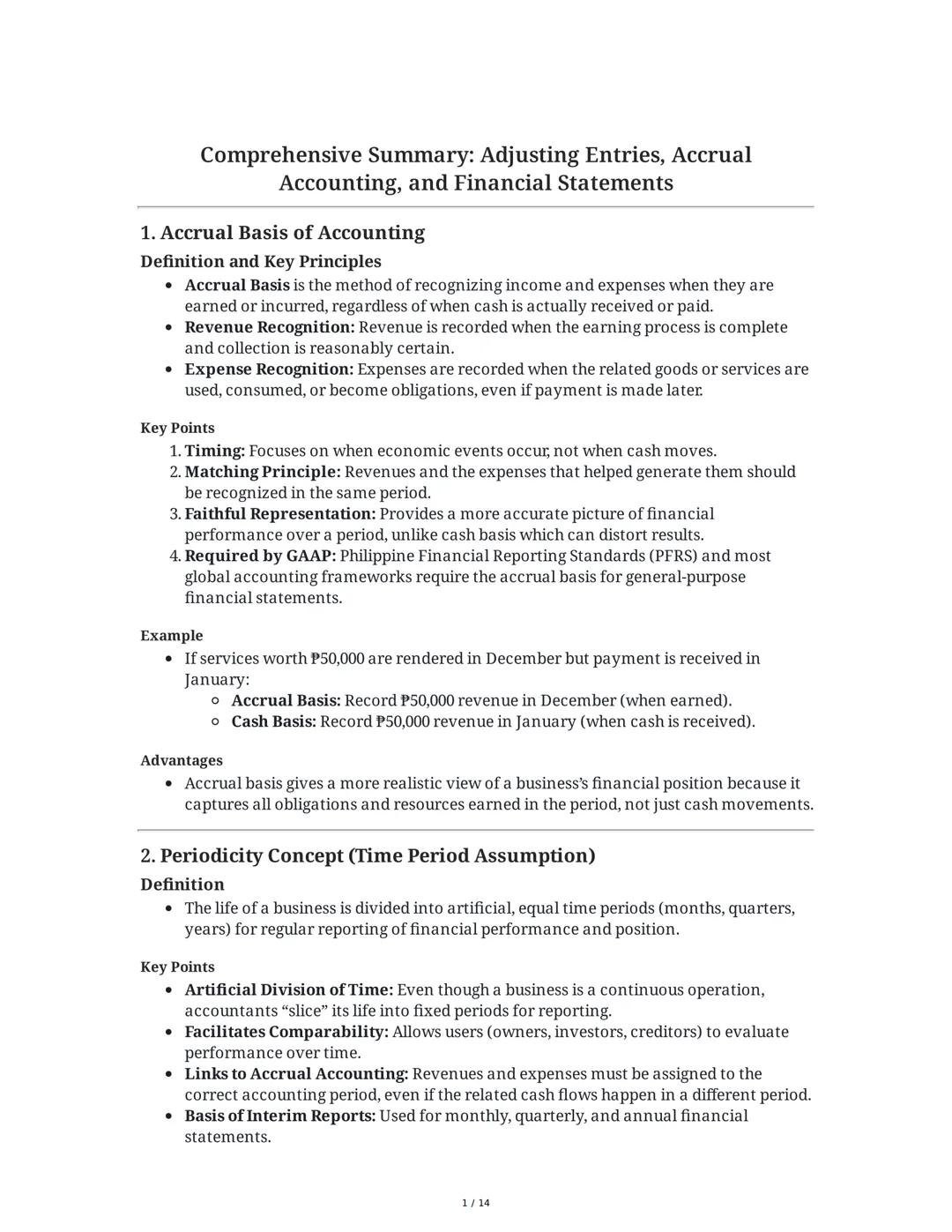
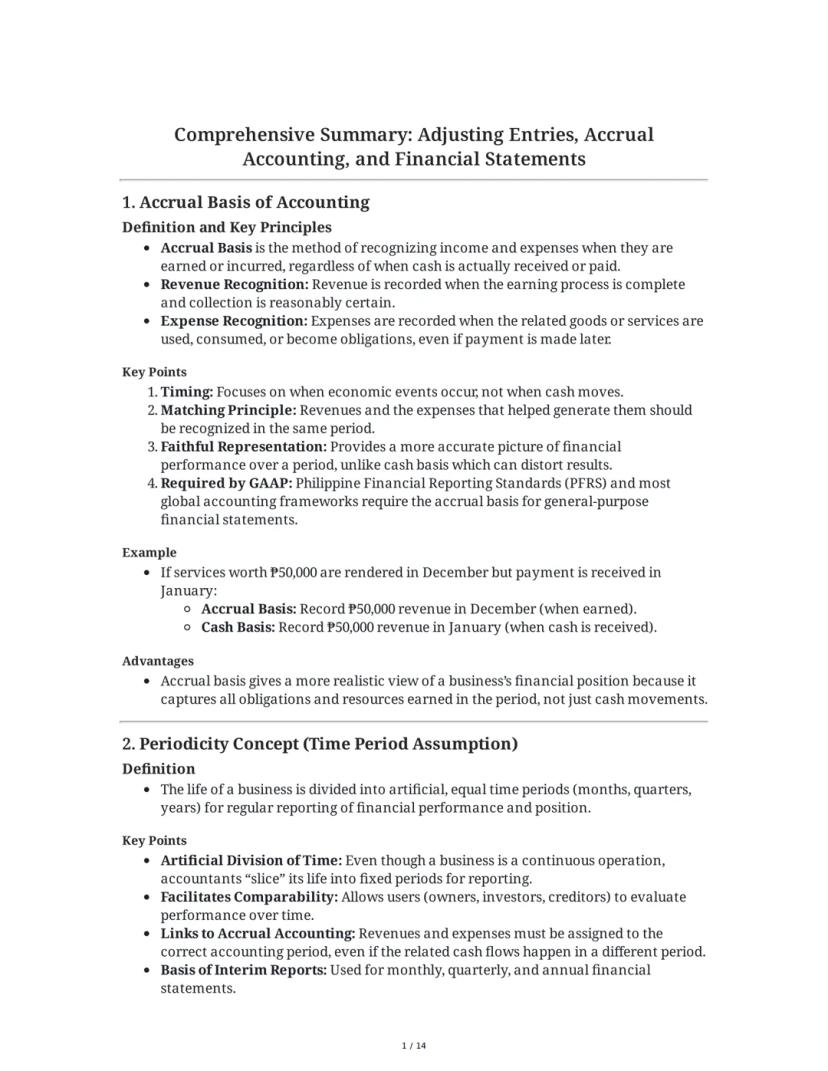
Accrual Basis Accounting: The Timing Matters
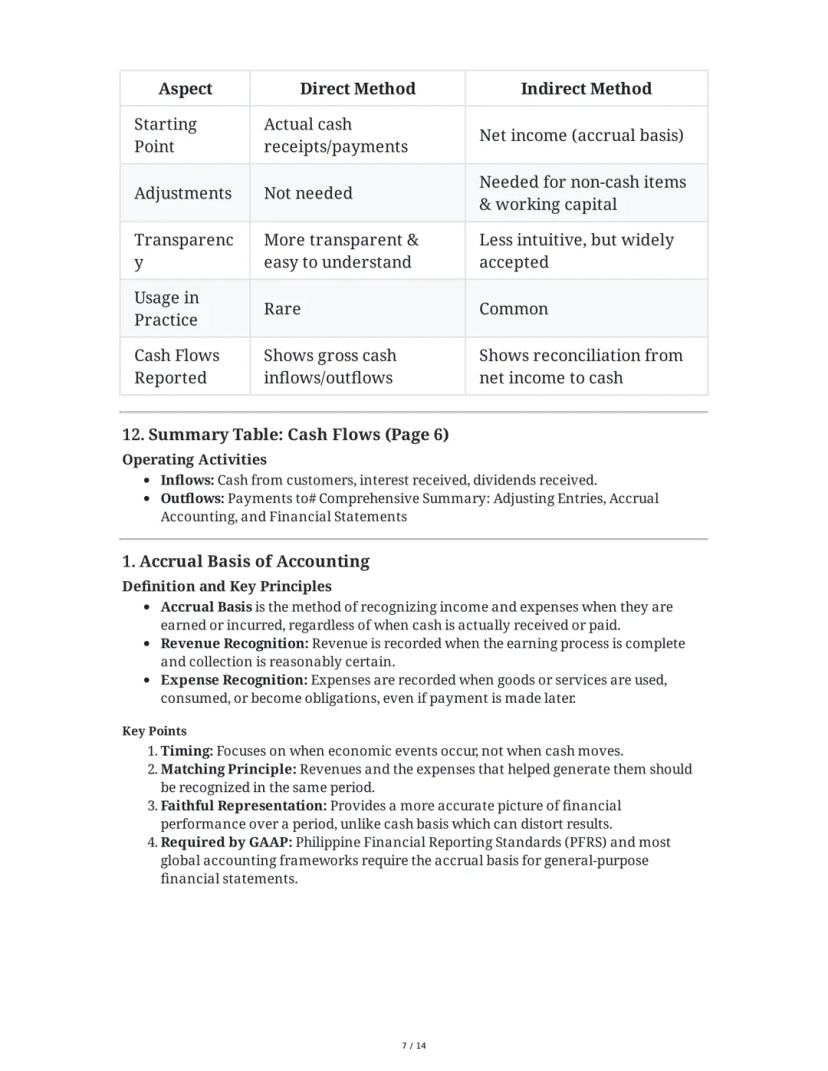
Ever wonder why businesses don't just count money when it arrives? That's because accrual accounting recognizes revenues when they're earned and expenses when they're incurred—not when cash actually changes hands. This gives a much more accurate picture of how a business is really performing.
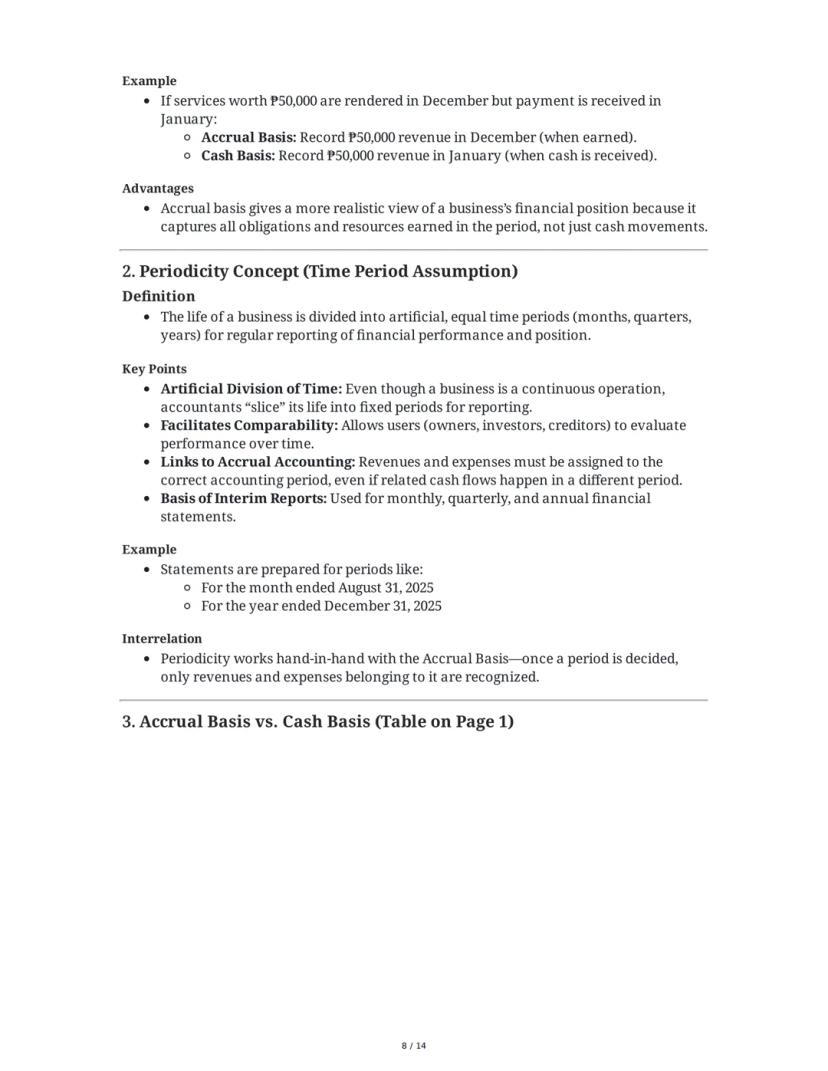
The matching principle is key here—revenues should appear in the same period as the expenses that helped generate them. For example, if your business provides a service in December but gets paid in January, accrual accounting records that revenue in December when you actually did the work.
Unlike cash basis accounting (which only records transactions when money moves), accrual accounting provides a faithful representation of financial performance by capturing all economic events when they happen. That's why it's required by Generally Accepted Accounting Principles (GAAP) for most businesses.
Think of it this way: Accrual accounting is like recording that you ate a meal when you actually ate it, not when you paid the bill. This gives you a more accurate picture of your daily nutrition than just tracking when money left your wallet!
2
of 10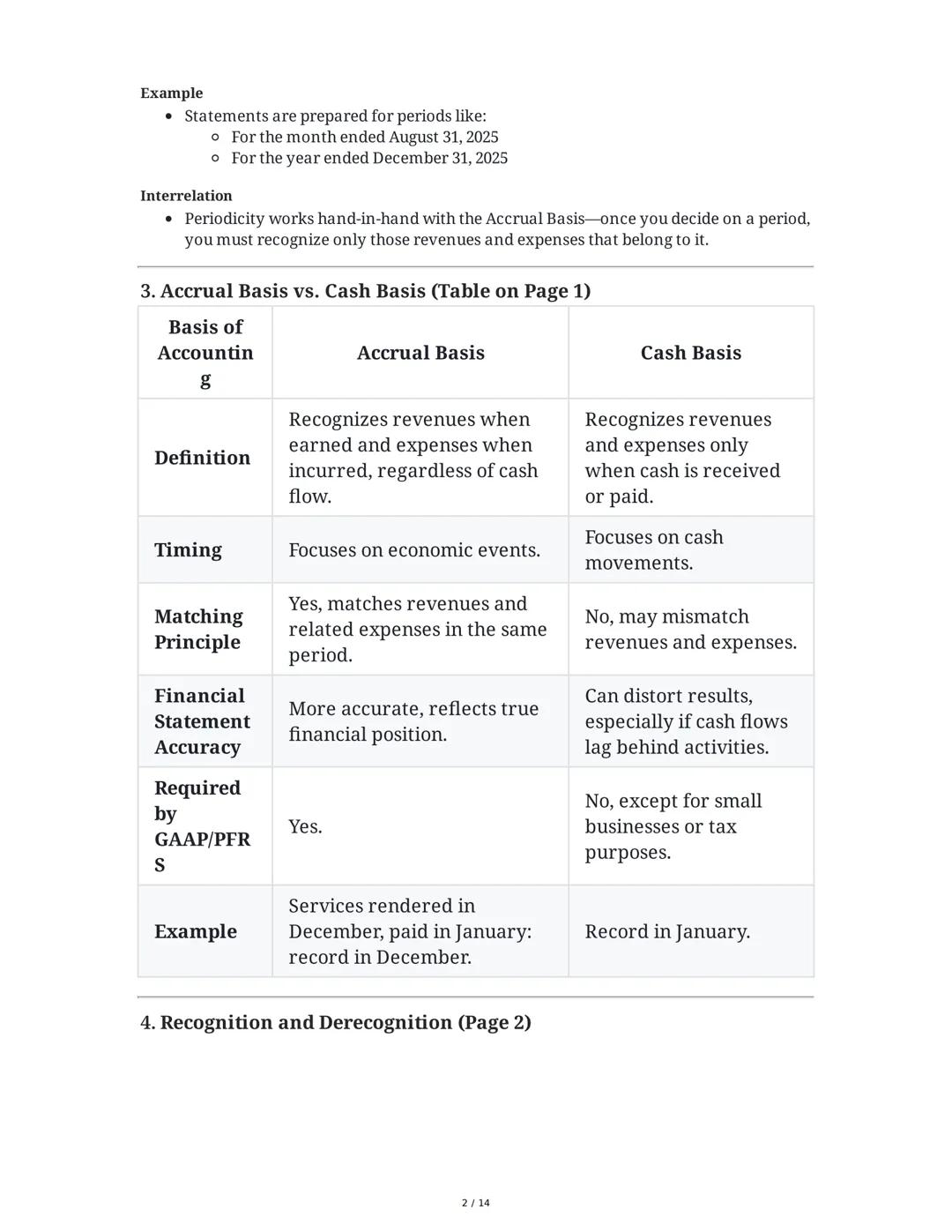
Time Periods & Recognition: Slicing Business Life
Financial reporting relies on the periodicity concept—the practice of dividing a business's continuous life into equal time segments (months, quarters, years). This artificial division allows everyone to compare performance over time and make informed decisions.
Think about your school report cards—they measure your performance over specific grading periods rather than just one big assessment at graduation. Similarly, businesses need regular "checkpoints" to evaluate their financial health.
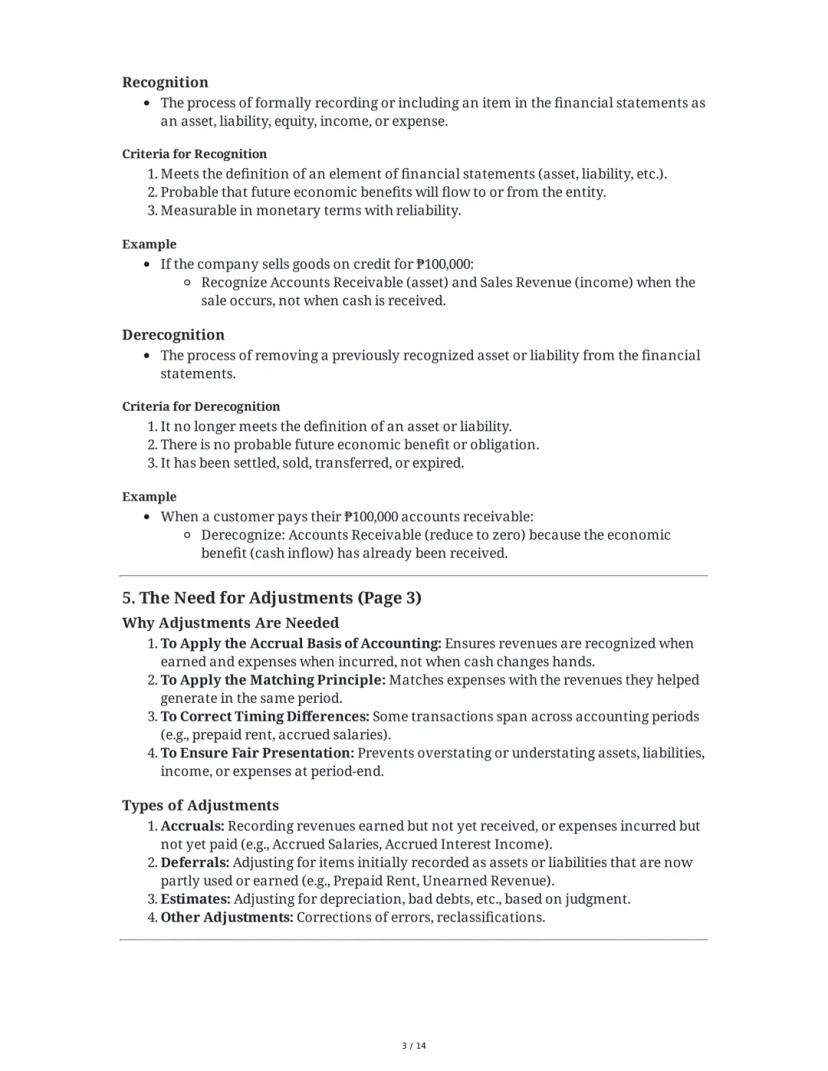
For proper financial reporting, accountants must decide when to recognize items in the financial statements. Recognition happens when: (1) the item meets the definition of a financial element, (2) future economic benefits are probable, and (3) the value can be measured reliably. For instance, when a company makes a sale on credit, they immediately recognize both the revenue and the accounts receivable—not when the customer eventually pays.
Just as important is derecognition—removing items from financial statements when they no longer represent future economic benefits. When a customer pays off their account, the receivable gets derecognized because that particular future benefit has already been received.
3
of 10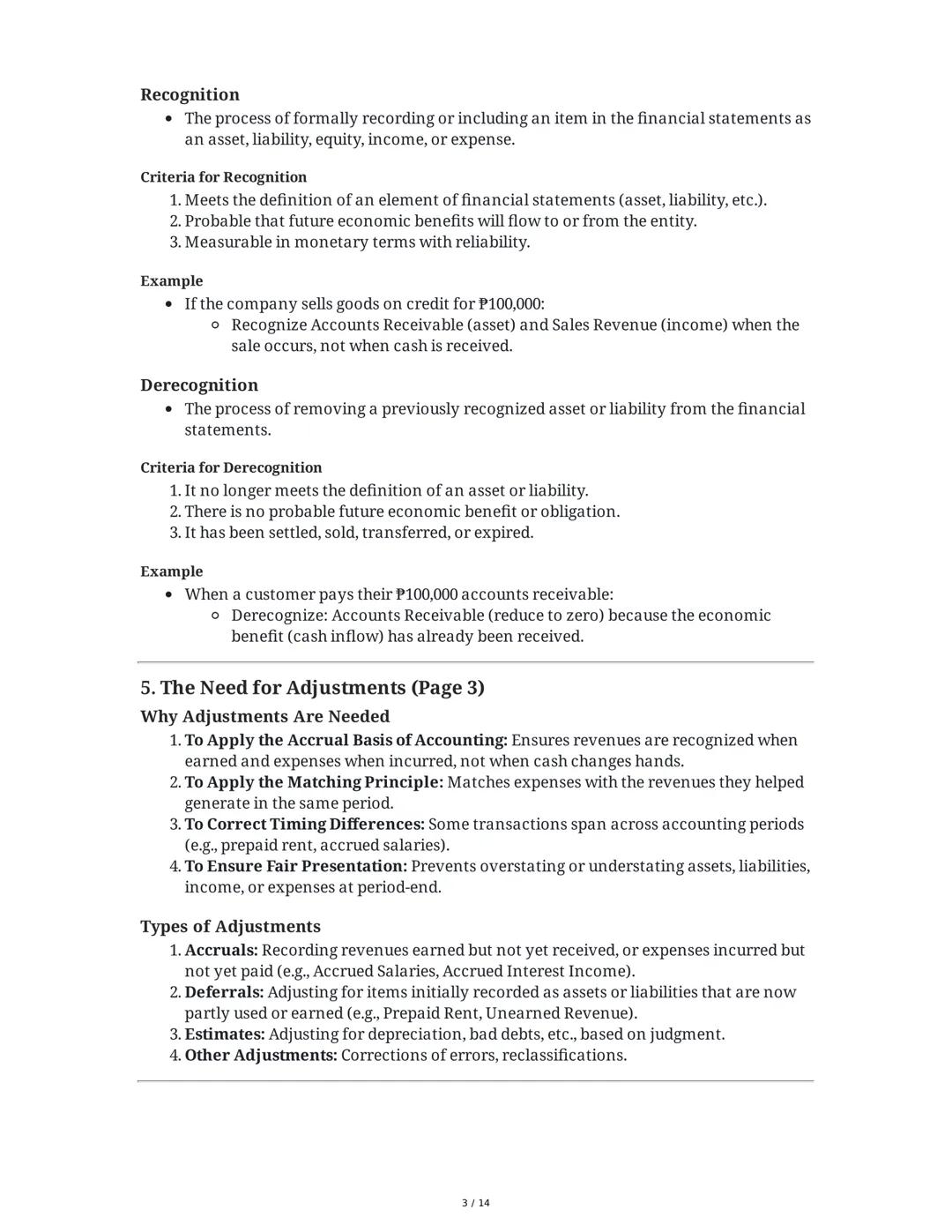
Adjusting Entries: Getting the Timing Right
Think of adjusting entries as the finishing touches on your financial portrait—they ensure everything is in the right place at the right time. Without these adjustments, your financial statements would tell an incomplete or even misleading story.
Adjustments primarily serve four purposes: applying the accrual basis, implementing the matching principle, correcting timing differences, and ensuring fair presentation. They're essential for accurate financial reporting and come in several forms:
- Accruals record revenues earned but not received or expenses incurred but not paid (like recording the electricity you've used before the bill arrives)
- Deferrals adjust prepaid items or unearned revenue (like gradually recognizing that prepaid insurance as it gets "used up")
- Estimates account for items requiring judgment (like depreciation or bad debt allowances)
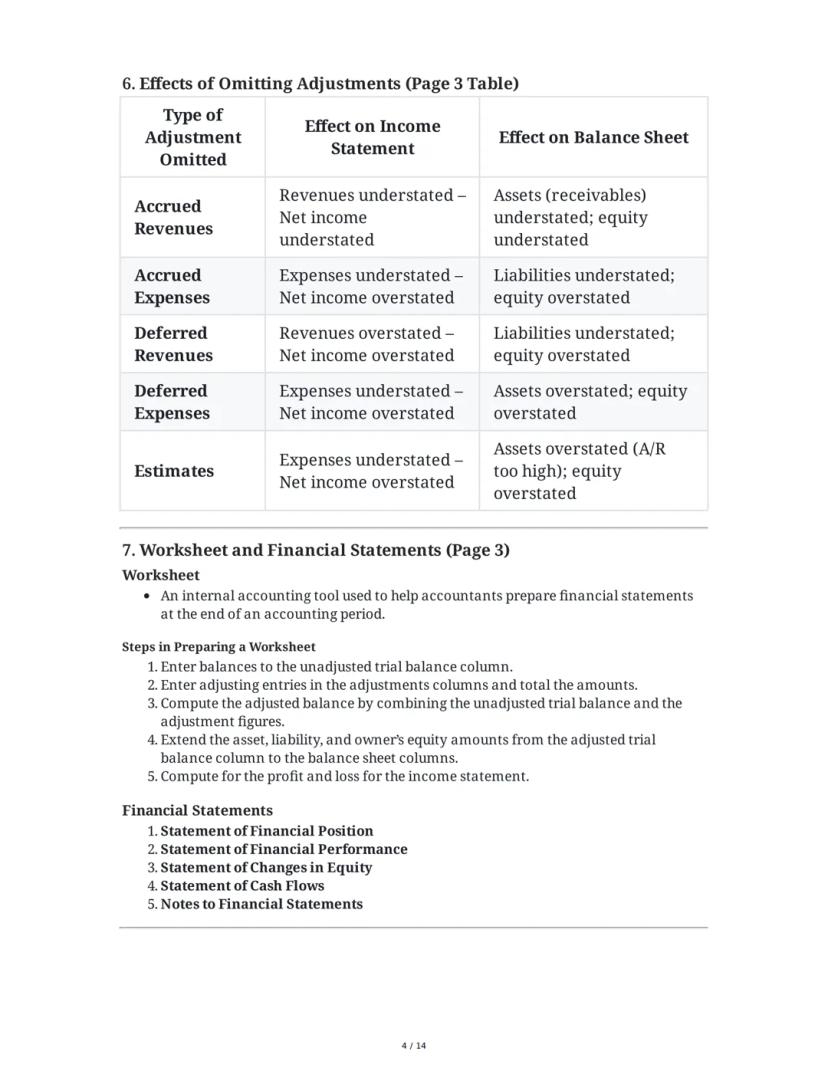
Forgetting to make these adjustments can seriously distort your financial statements. For example, if you omit accrued revenues, both your assets and net income will be understated—making your business appear less profitable and smaller than it really is.
Pro tip: Most accounting mistakes aren't about math—they're about timing! Getting the right amounts in the right periods is the true art of accounting.
4
of 10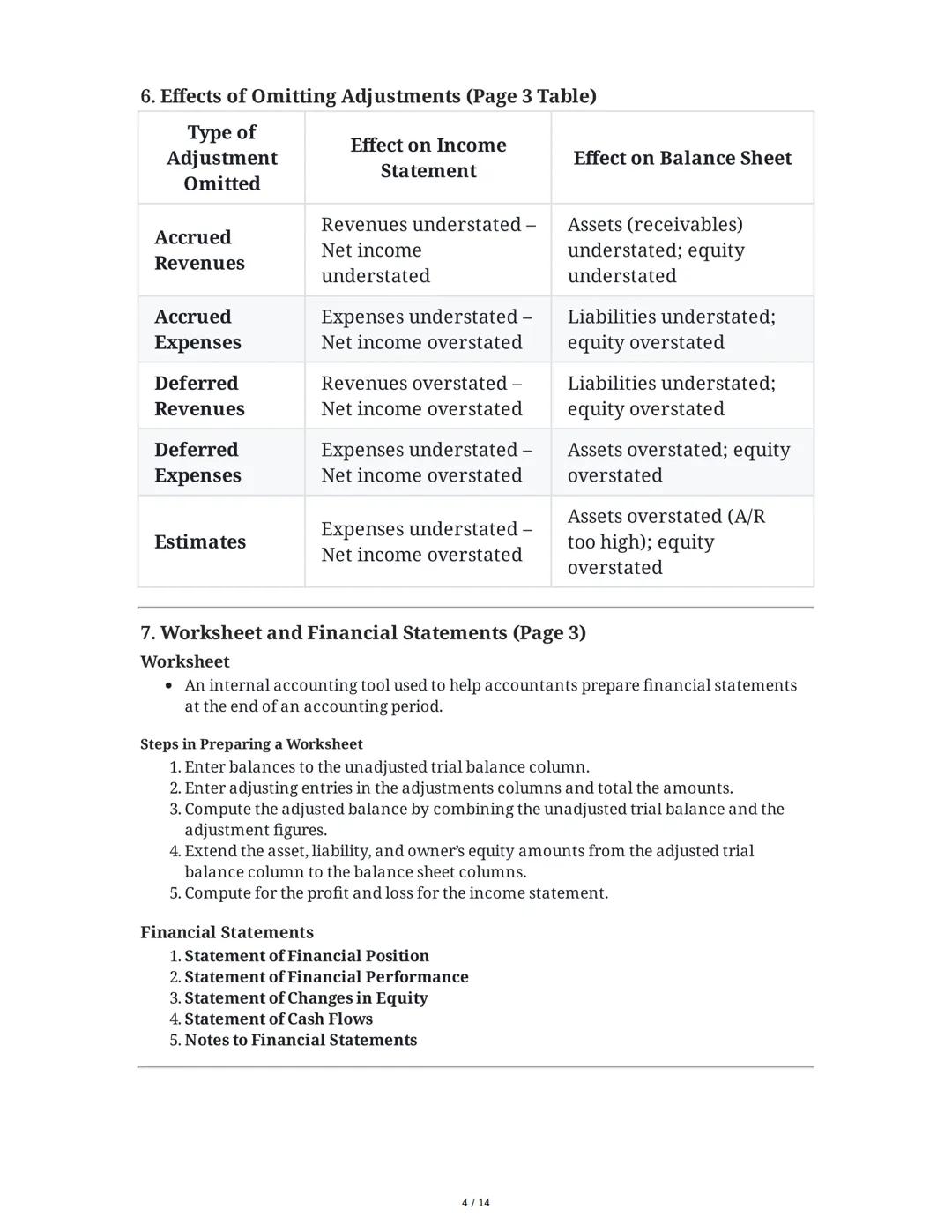
Worksheets & Financial Statement Basics
The accounting worksheet serves as a bridge between your day-to-day bookkeeping and formal financial statements. This internal tool helps accountants organize information, calculate adjustments, and prepare the final reports. The process involves listing all account balances, entering necessary adjustments, calculating new balances, and extending amounts to the appropriate financial statement columns.
Financial statements are the final output of the accounting process, telling different parts of the company's financial story:
-
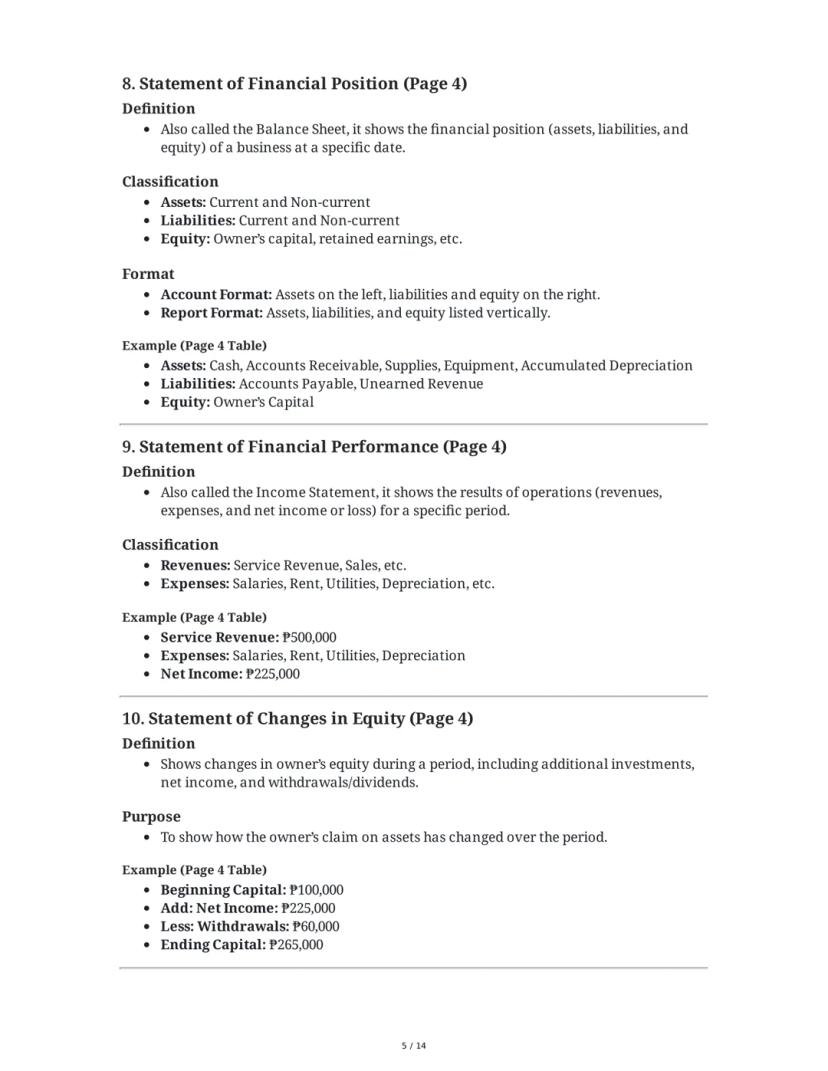
The Statement of Financial Position (Balance Sheet) shows what the company owns and owes at a specific date. Think of it as a financial snapshot organized into assets (resources owned), liabilities (obligations), and equity (owner's claims).
-
The Statement of Financial Performance (Income Statement) reveals how much money the business made or lost during a specific period. It shows revenues earned minus expenses incurred to calculate net income.
-
The Statement of Changes in Equity tracks how the owner's stake in the business changed over time through additional investments, net income, and withdrawals/dividends.
These statements work together to provide a comprehensive picture of a company's financial health and performance, making them essential tools for decision-making by owners, investors, and creditors.
5
of 10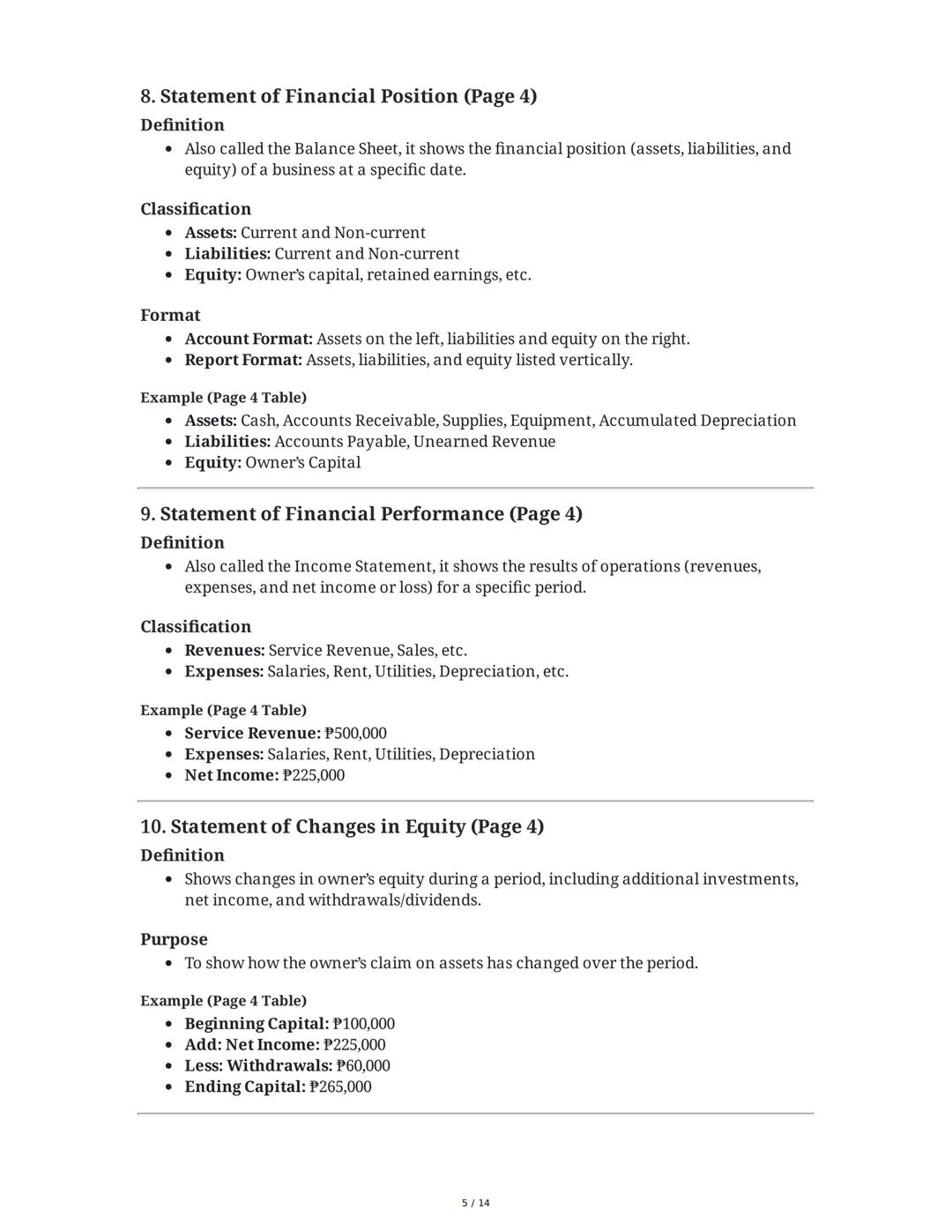
Financial Statements In Detail
The Statement of Financial Position (Balance Sheet) works like a financial photograph of your business at a precise moment. It follows the fundamental accounting equation: Assets = Liabilities + Equity. Assets might include cash, accounts receivable, inventory and equipment, while liabilities typically include accounts payable and loans. The equity section shows the owner's claim on these assets after all debts are paid.
Looking at a different angle, the Statement of Financial Performance (Income Statement) reveals your business story over time. It answers the question: "Did we make money this period?" by showing revenues earned minus all expenses incurred. For example, if your service revenue was $500,000 and total expenses were $275,000, your net income would be $225,000.
The Statement of Changes in Equity connects the income statement to the balance sheet by explaining how equity changed during the period. It starts with beginning capital, adds net income (or subtracts net loss), and subtracts any owner withdrawals or dividends. This statement helps explain why the owner's equity changed beyond just the profits or losses of the business.
Real-world relevance: Think of these statements like different views of your financial health—the balance sheet is your net worth at a moment in time, the income statement is your earning power over time, and the changes in equity shows how you're building (or using) your business wealth.
6
of 10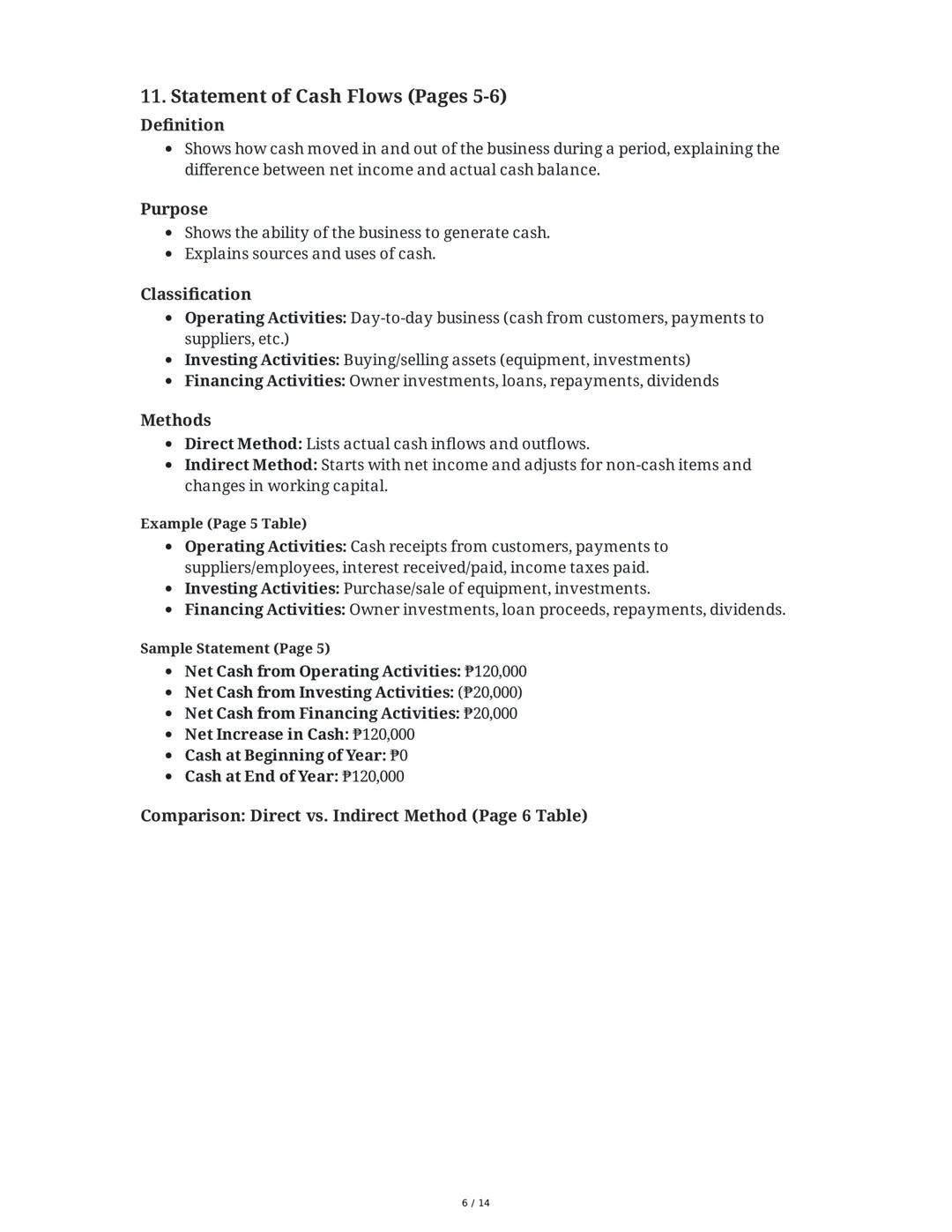
Cash Flow Statement: Following the Money
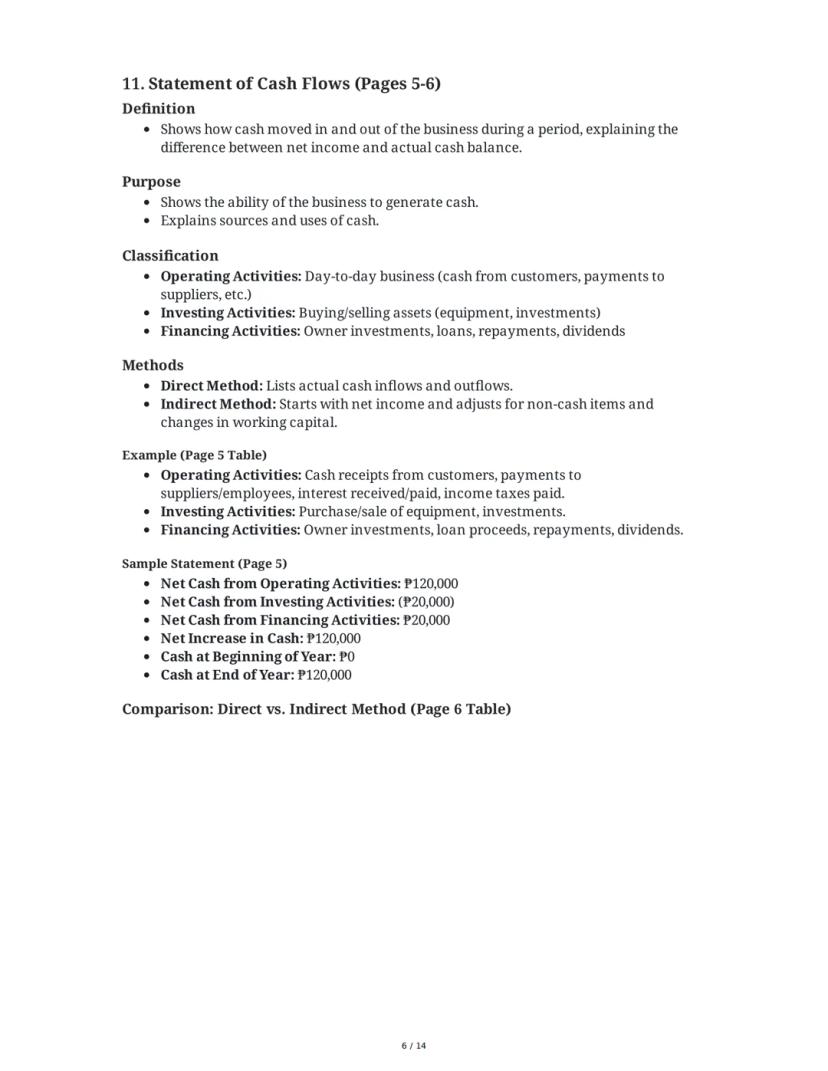
The Statement of Cash Flows answers a critical question: "Where did our cash come from and where did it go?" This statement explains the difference between reported net income and actual cash balance changes—because profit doesn't always mean cash in the bank.
Cash flows are organized into three key activities:
- Operating activities involve day-to-day business operations (collecting from customers, paying suppliers)
- Investing activities include buying/selling long-term assets or investments
- Financing activities relate to obtaining funding through owner investments, loans, or making loan payments and distributions
Companies can prepare this statement using either the direct method (showing actual cash receipts and payments) or the indirect method . While the direct method is more intuitive, the indirect method is more commonly used in practice.
For example, a company might show positive operating cash flows of $120,000, investing outflows of $20,000 (for equipment purchases), and financing inflows of $20,000 (from owner investments), resulting in a net increase in cash of $120,000 for the period.
Understanding cash flow is crucial because a company can report profits while running out of cash, or show losses while accumulating cash—the cash flow statement reveals this critical dimension of financial health.
7
of 10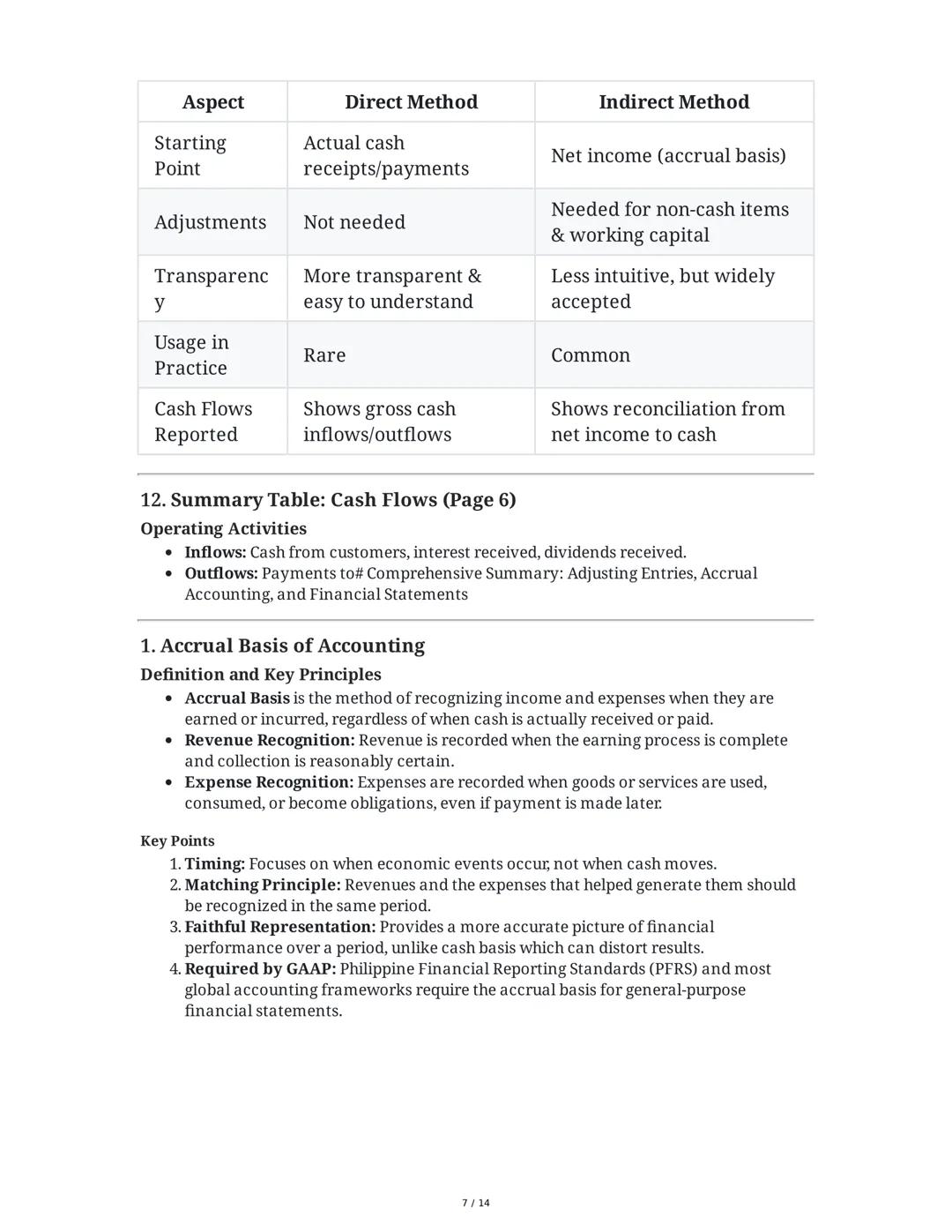
Accrual Accounting in Practice
Accrual accounting forms the foundation of reliable financial reporting by focusing on when economic events occur rather than when cash changes hands. This approach gives stakeholders a more accurate understanding of a company's performance and financial position.
The principles of accrual accounting help businesses avoid distortions in their financial story. For instance, a business that made many December sales with January payments would look unprofitable under cash accounting in December and artificially profitable in January—neither reflection being true to economic reality.
The matching principle ensures that expenses appear in the same period as the revenues they helped create. This creates a clearer picture of profitability for each period. For example, if you hire temporary help to complete a big December project, both the project revenue and the temporary labor cost should appear in December's financial statements, even if you pay the workers in January.
Why it matters to you: Understanding accrual accounting helps you see beyond simple cash movements. A business isn't necessarily successful just because money is flowing in, nor struggling just because cash is flowing out. The timing and economic substance of transactions tell the real story.
8
of 10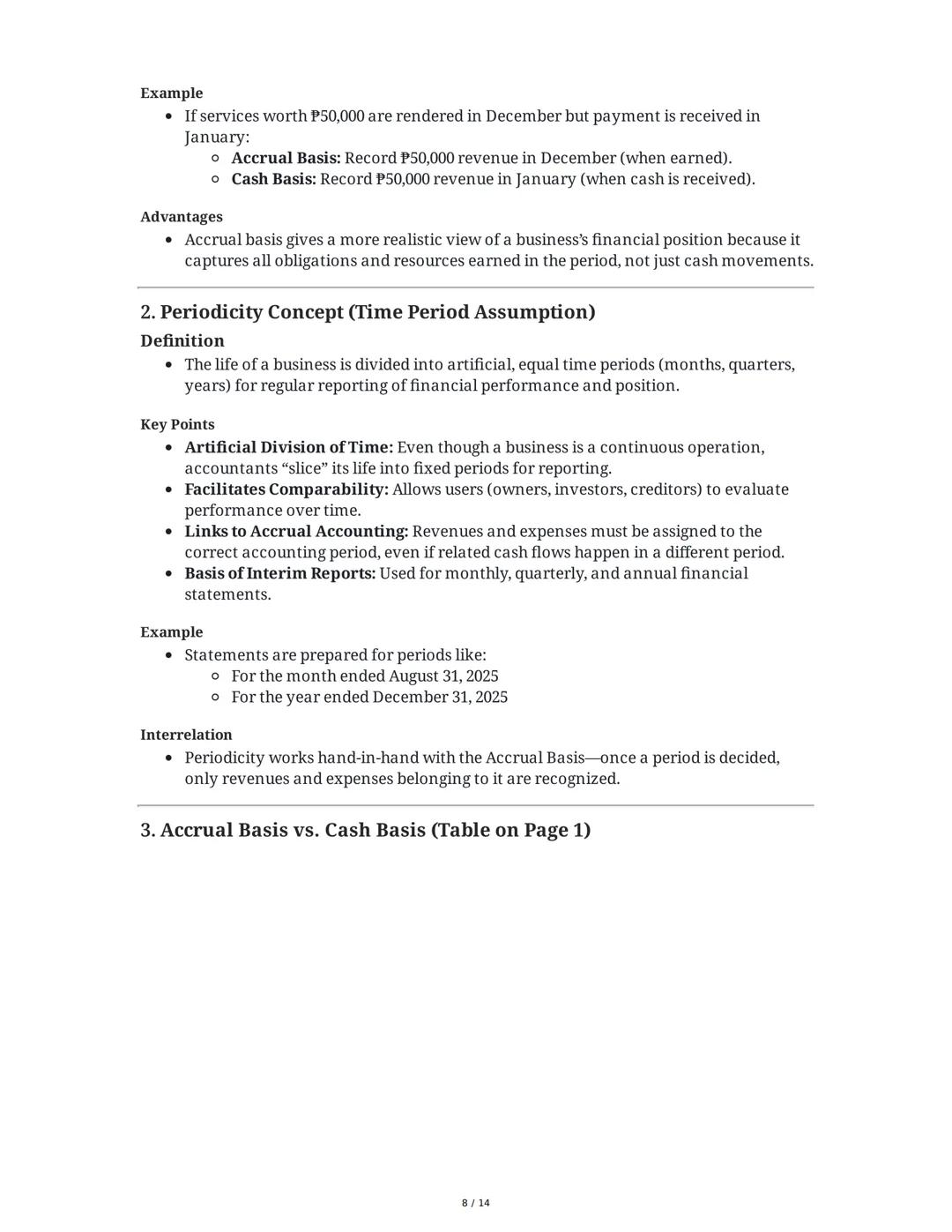
Comparing Accounting Methods
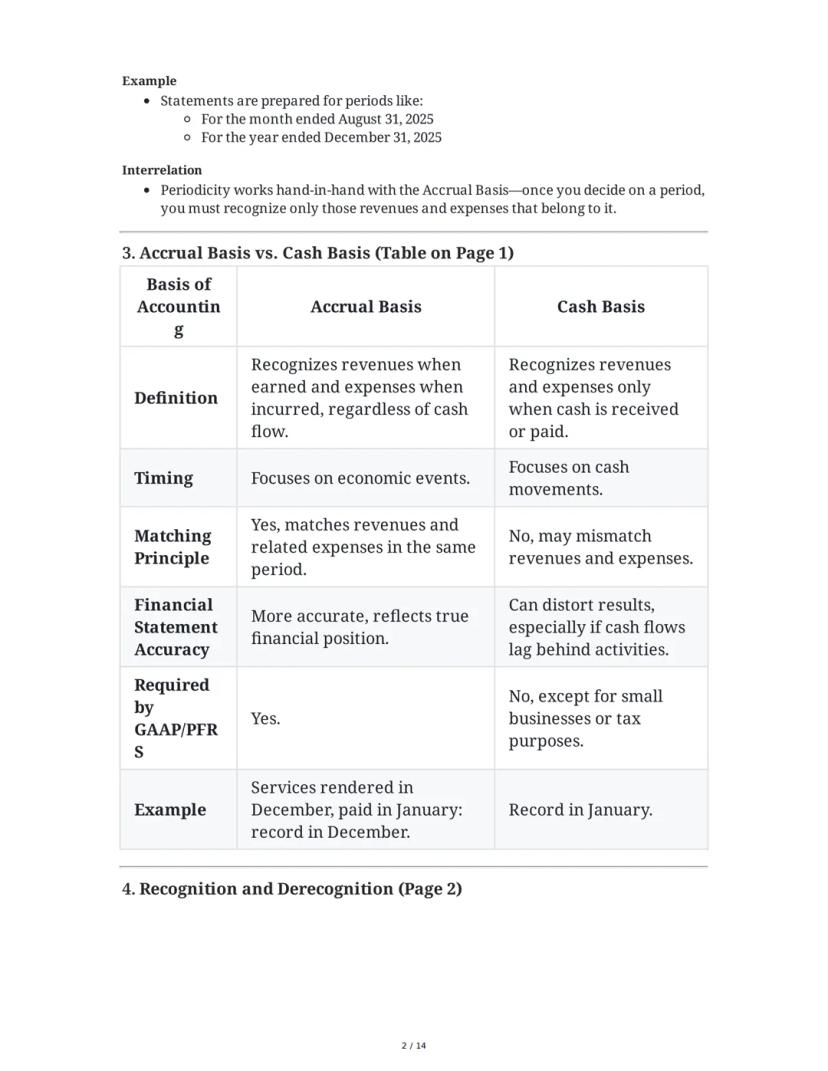
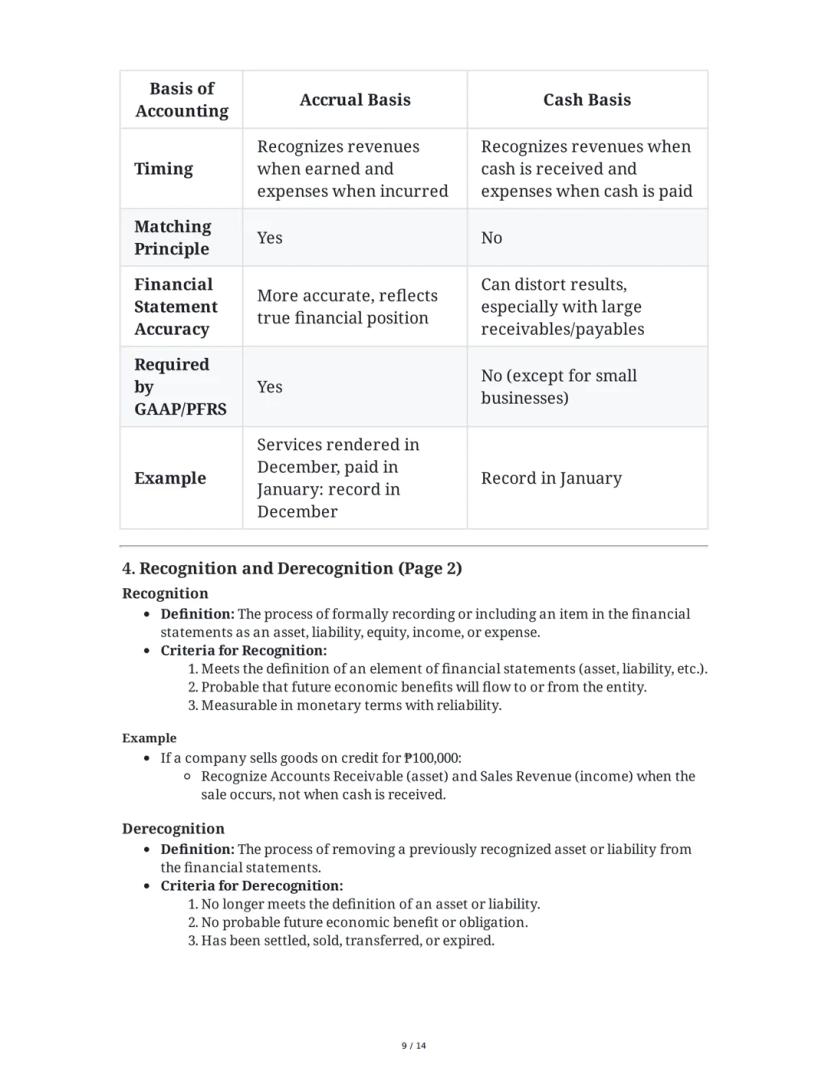
Accrual and cash basis accounting represent fundamentally different approaches to tracking business performance. The accrual basis recognizes transactions when economic events happen, while the cash basis only records them when money changes hands.
This difference in timing creates significant impacts on financial statements. Consider a landscaping business that does $50,000 of work in December but gets paid in January. Under accrual accounting, December's income statement shows $50,000 revenue (matching when the work was done), while under cash accounting, December shows $0 and January shows $50,000—creating a misleading picture of when business actually occurred.
The matching principle represents another key difference. Accrual accounting carefully matches revenues with related expenses in the same period, creating a more accurate profit picture. Cash basis might show expenses in a completely different period than the revenues they helped generate.
Most importantly, accrual accounting provides greater financial statement accuracy by showing the true economic position of the business. That's why regulatory frameworks like GAAP require accrual accounting for formal financial statements—it simply tells a more complete and accurate financial story.
9
of 10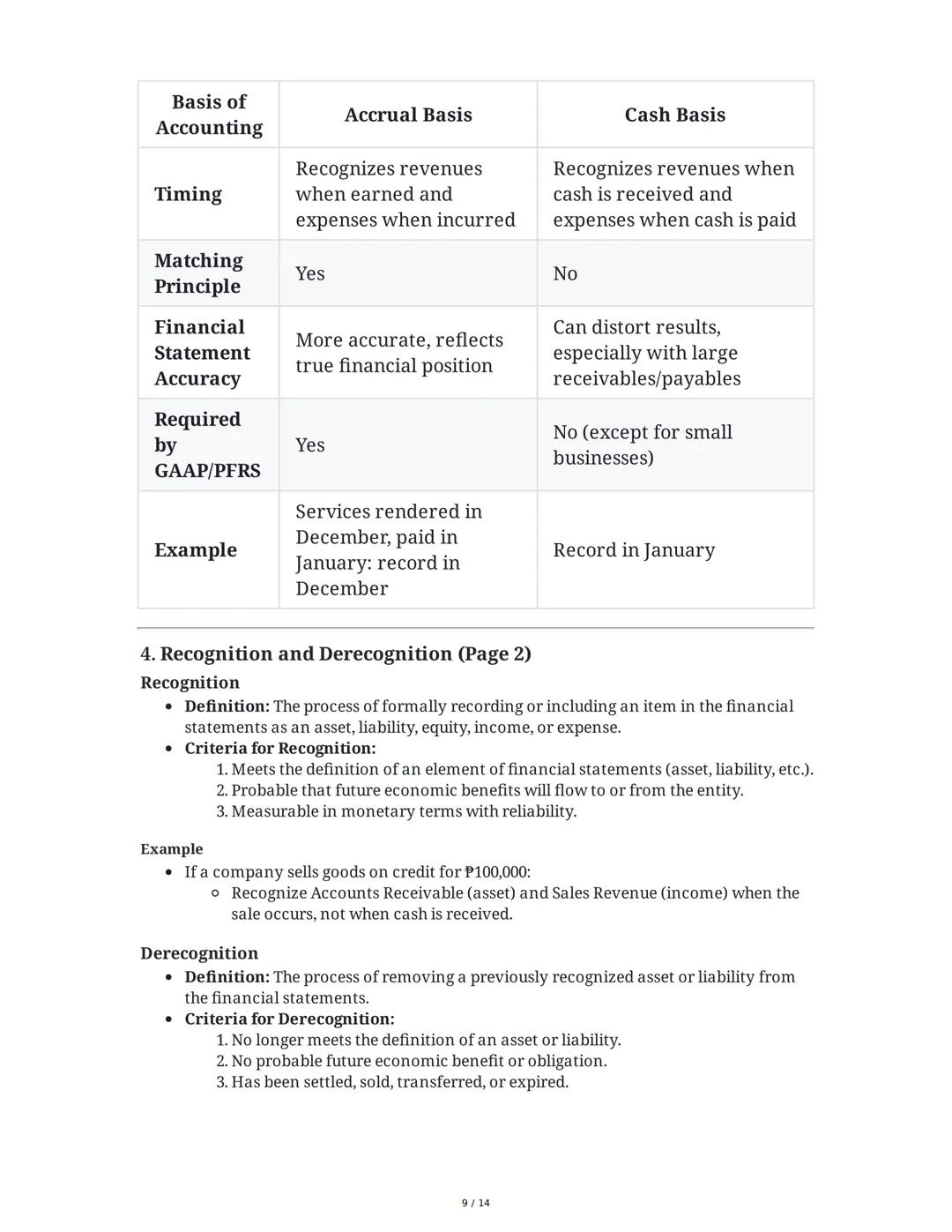
Recognition and Measurement
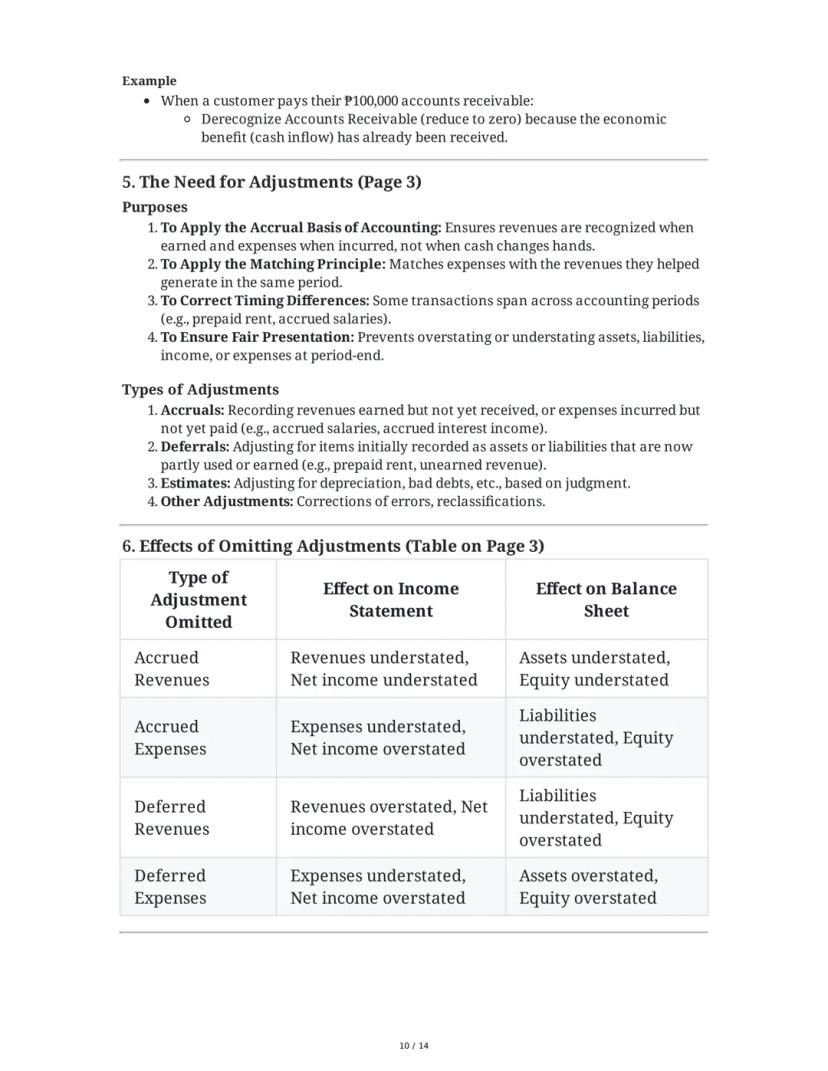
The concept of recognition serves as the gatekeeper for what enters your financial statements. For an item to be recognized (formally recorded), it must meet three key criteria: fit the definition of a financial statement element, involve probable future economic benefits, and be reliably measurable.
For example, when you sell products on credit for $100,000, you immediately recognize both an asset (Accounts Receivable) and income (Sales Revenue)—even though no cash has changed hands yet. The recognition happens because all three criteria are met: you have a valid receivable, you'll probably collect the money, and the amount is clearly measurable.
On the flip side, derecognition happens when items should be removed from financial statements. This occurs when an item no longer meets the definition of an asset or liability, when future economic benefits are no longer probable, or when the obligation has been settled or transferred.
When your customer pays their $100,000 bill, you derecognize the accounts receivable because you no longer have a right to receive future cash—you've already received it! The accounting system then shows the increase in cash instead of the receivable.
Make it concrete: Think of recognition like adding items to your backpack (financial statements) when you acquire them, and derecognition like removing items when you no longer have them. Your backpack should accurately reflect what you're actually carrying.
10
of 10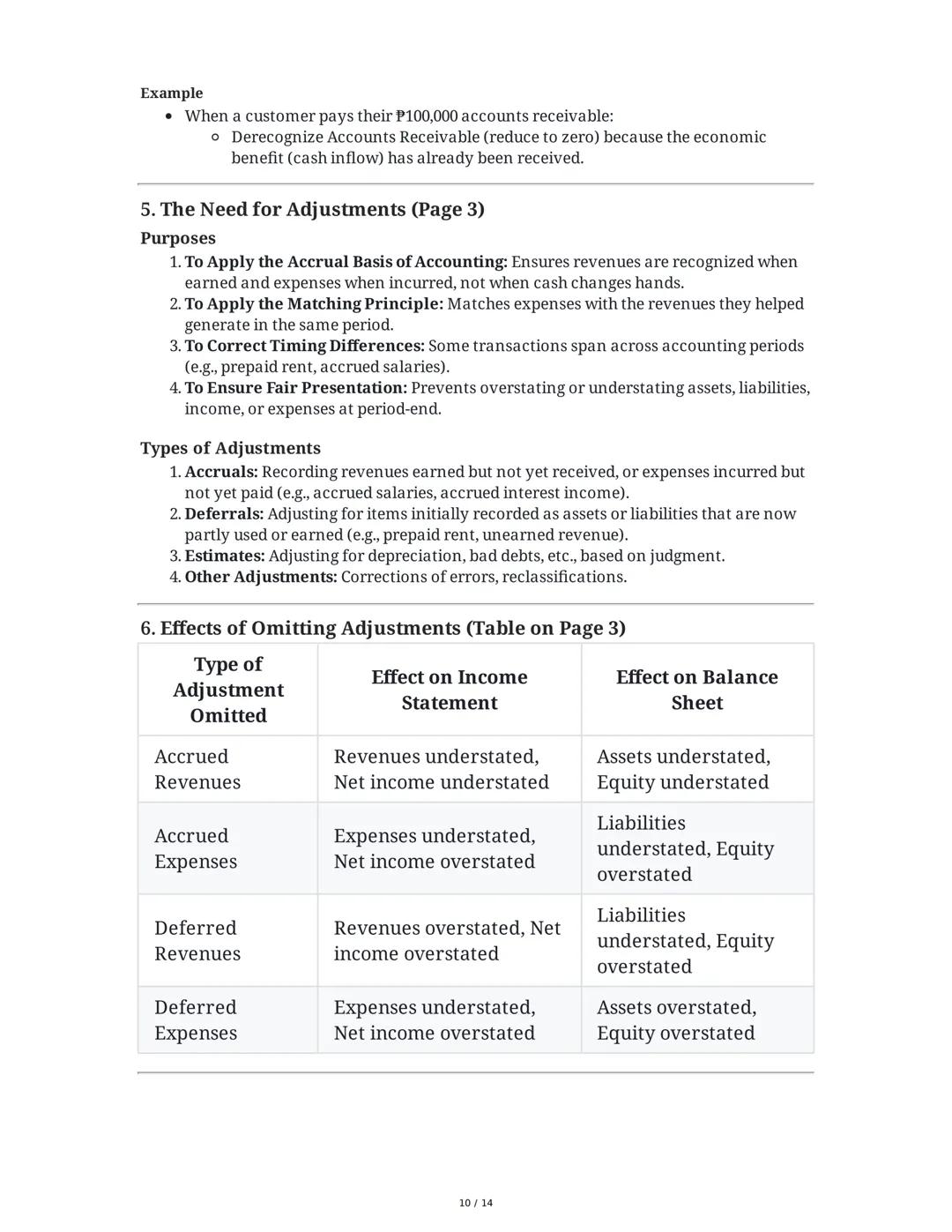
Adjustments and Their Impacts
Adjusting entries are the fine-tuning mechanism that makes accrual accounting work. Without them, financial statements would fail to capture the true economic activity of a business period. These adjustments serve to apply the accrual basis, implement the matching principle, correct timing differences, and ensure fair presentation.
Adjustments come in several forms. Accruals record revenues earned but not received (like interest earned on investments) or expenses incurred but not yet paid (like wages earned by employees). Deferrals adjust for assets already paid for but not fully used (like prepaid insurance) or liabilities where payment was received before services were provided (like customer deposits).
Omitting adjustments has serious consequences on financial statements. For example, if you forget to record accrued expenses (like unpaid wages), your expenses will be understated, making net income artificially high. This also means liabilities are understated on the balance sheet, giving a misleading picture of the company's obligations.
The pattern of effects is logical: omitting accrued revenues understates both assets and income; omitting accrued expenses understates liabilities while overstating income; omitting deferrals typically overstates assets or understates liabilities while distorting income. These effects demonstrate why proper adjustments are essential for accurate financial reporting.
We thought you’d never ask...
What is the Knowunity AI companion?
Our AI companion is specifically built for the needs of students. Based on the millions of content pieces we have on the platform we can provide truly meaningful and relevant answers to students. But its not only about answers, the companion is even more about guiding students through their daily learning challenges, with personalised study plans, quizzes or content pieces in the chat and 100% personalisation based on the students skills and developments.
Where can I download the Knowunity app?
You can download the app in the Google Play Store and in the Apple App Store.
Is Knowunity really free of charge?
That's right! Enjoy free access to study content, connect with fellow students, and get instant help – all at your fingertips.
Most popular content in Finance and capital markets
6Finance and capital marketsParcor Baysa
Partnership and Corporation
College1182
World HistoryAP 10 - QUARTER 2 NOTES
Globalisasyon SDG Migrasyon Teritoryal Dinastiyang Politikal
10th710
Finance and capital marketsAccounting Cycle and Financial Statements
This lecture explains the accounting cycle, focusing on posting to the ledger, adjusting entries, and the creation of financial statements.
480
 AP Microeconomics
Entrepreneurship
Risk and Socio-economic Benefits of Entrepreneurship. Functions of business-Production, Management, Marketing, and Finance.
23710
Finance and capital marketsIB BUSINESS HL unit 1
IB (international baccalaureate) Business management HL (high level) UNIT 1
50625
Finance and capital marketsEngineering Management
History of management, fundamentals of management, fundamentals of planning, strategic management, and decision-making process are tackled here.
2445
Most popular content
9O
 AP US History
Origins and Dynamics of the Columbian Exchange
Analyze the ecological and economic motivations behind the initial transfer of goods, people, and diseases between the Old and New Worlds.
9th3,1280
I
AP US HistoryIntroduction to Early Cultural Interactions
Analyze the initial social and religious encounters between Europeans, Africans, and Indigenous peoples in the colonial Americas.
9th2,7730
O
AP World HistoryOrigins of Ancient River Civilizations
Analyze the environmental factors and technological innovations that led to the rise of early states in Mesopotamia, Egypt, and the Indus Valley.
9th3,1860
M
AP US HistoryMotivations for European Exploration
Analyze the economic, religious, and political factors that drove European powers to the Americas during the 15th and 16th centuries.
9th1,7780
F
 AP Psychology
Foundations of Ethical Guidelines in Research
Practice the core principles of the APA ethical code including informed consent, debriefing, and the role of Institutional Review Boards.
9th1,3360
I
AP US HistoryIntroduction to Native American Societies
Examine the diverse social, political, and economic structures of North American indigenous groups prior to European contact.
9th1,1100
I
 AP Biology
Introduction to Biological Elements of Life
Practice identifying the essential elements including carbon, nitrogen, phosphorus, and sulfur that compose biological macromolecules.
9th1,7360
I
AP US HistoryIntroduction to the Spanish Encomienda System
Explore the fundamental economic and social structures of the Spanish colonial system, focusing on the encomienda and the casta social hierarchy.
9th8890
O
AP World HistoryOrigins and Continuity of the Byzantine Empire
Analyze the political and cultural transitions from the Roman Empire to the Byzantine Empire, focusing on the reign of Justinian I and his code.
9th1,6320
Can't find what you're looking for? Explore other subjects.
Students love us — and so will you.
4.6/5App Store
4.7/5Google Play
The app is very easy to use and well designed. I have found everything I was looking for so far and have been able to learn a lot from the presentations! I will definitely use the app for a class assignment! And of course it also helps a lot as an inspiration.
Stefan SiOS user
This app is really great. There are so many study notes and help [...]. My problem subject is French, for example, and the app has so many options for help. Thanks to this app, I have improved my French. I would recommend it to anyone.
Samantha KlichAndroid user
Wow, I am really amazed. I just tried the app because I've seen it advertised many times and was absolutely stunned. This app is THE HELP you want for school and above all, it offers so many things, such as workouts and fact sheets, which have been VERY helpful to me personally.
AnnaiOS user
Finance and capital markets28 views·Updated May 23, 2026·14 pagesUnderstanding Accrual Accounting: Basics and Financial Statements
M
my haven@myhaven
Accounting isn't just about crunching numbers—it's about telling the true financial story of a business. This guide explores accrual accounting, the process of making adjustments to financial records, and how these concepts come together to create meaningful financial statements that... Show more
1
of 10Sign up to see the content. It's free!
- Access to all documents
- Improve your grades
- Join milions of students
Accrual Basis Accounting: The Timing Matters
Ever wonder why businesses don't just count money when it arrives? That's because accrual accounting recognizes revenues when they're earned and expenses when they're incurred—not when cash actually changes hands. This gives a much more accurate picture of how a business is really performing.
The matching principle is key here—revenues should appear in the same period as the expenses that helped generate them. For example, if your business provides a service in December but gets paid in January, accrual accounting records that revenue in December when you actually did the work.
Unlike cash basis accounting (which only records transactions when money moves), accrual accounting provides a faithful representation of financial performance by capturing all economic events when they happen. That's why it's required by Generally Accepted Accounting Principles (GAAP) for most businesses.
Think of it this way: Accrual accounting is like recording that you ate a meal when you actually ate it, not when you paid the bill. This gives you a more accurate picture of your daily nutrition than just tracking when money left your wallet!
2
of 10Sign up to see the content. It's free!
- Access to all documents
- Improve your grades
- Join milions of students
Time Periods & Recognition: Slicing Business Life
Financial reporting relies on the periodicity concept—the practice of dividing a business's continuous life into equal time segments (months, quarters, years). This artificial division allows everyone to compare performance over time and make informed decisions.
Think about your school report cards—they measure your performance over specific grading periods rather than just one big assessment at graduation. Similarly, businesses need regular "checkpoints" to evaluate their financial health.
For proper financial reporting, accountants must decide when to recognize items in the financial statements. Recognition happens when: (1) the item meets the definition of a financial element, (2) future economic benefits are probable, and (3) the value can be measured reliably. For instance, when a company makes a sale on credit, they immediately recognize both the revenue and the accounts receivable—not when the customer eventually pays.
Just as important is derecognition—removing items from financial statements when they no longer represent future economic benefits. When a customer pays off their account, the receivable gets derecognized because that particular future benefit has already been received.
3
of 10Sign up to see the content. It's free!
- Access to all documents
- Improve your grades
- Join milions of students
Adjusting Entries: Getting the Timing Right
Think of adjusting entries as the finishing touches on your financial portrait—they ensure everything is in the right place at the right time. Without these adjustments, your financial statements would tell an incomplete or even misleading story.
Adjustments primarily serve four purposes: applying the accrual basis, implementing the matching principle, correcting timing differences, and ensuring fair presentation. They're essential for accurate financial reporting and come in several forms:
- Accruals record revenues earned but not received or expenses incurred but not paid (like recording the electricity you've used before the bill arrives)
- Deferrals adjust prepaid items or unearned revenue (like gradually recognizing that prepaid insurance as it gets "used up")
- Estimates account for items requiring judgment (like depreciation or bad debt allowances)
Forgetting to make these adjustments can seriously distort your financial statements. For example, if you omit accrued revenues, both your assets and net income will be understated—making your business appear less profitable and smaller than it really is.
Pro tip: Most accounting mistakes aren't about math—they're about timing! Getting the right amounts in the right periods is the true art of accounting.
4
of 10Sign up to see the content. It's free!
- Access to all documents
- Improve your grades
- Join milions of students
Worksheets & Financial Statement Basics
The accounting worksheet serves as a bridge between your day-to-day bookkeeping and formal financial statements. This internal tool helps accountants organize information, calculate adjustments, and prepare the final reports. The process involves listing all account balances, entering necessary adjustments, calculating new balances, and extending amounts to the appropriate financial statement columns.
Financial statements are the final output of the accounting process, telling different parts of the company's financial story:
-
The Statement of Financial Position (Balance Sheet) shows what the company owns and owes at a specific date. Think of it as a financial snapshot organized into assets (resources owned), liabilities (obligations), and equity (owner's claims).
-
The Statement of Financial Performance (Income Statement) reveals how much money the business made or lost during a specific period. It shows revenues earned minus expenses incurred to calculate net income.
-
The Statement of Changes in Equity tracks how the owner's stake in the business changed over time through additional investments, net income, and withdrawals/dividends.
These statements work together to provide a comprehensive picture of a company's financial health and performance, making them essential tools for decision-making by owners, investors, and creditors.
5
of 10Sign up to see the content. It's free!
- Access to all documents
- Improve your grades
- Join milions of students
Financial Statements In Detail
The Statement of Financial Position (Balance Sheet) works like a financial photograph of your business at a precise moment. It follows the fundamental accounting equation: Assets = Liabilities + Equity. Assets might include cash, accounts receivable, inventory and equipment, while liabilities typically include accounts payable and loans. The equity section shows the owner's claim on these assets after all debts are paid.
Looking at a different angle, the Statement of Financial Performance (Income Statement) reveals your business story over time. It answers the question: "Did we make money this period?" by showing revenues earned minus all expenses incurred. For example, if your service revenue was $500,000 and total expenses were $275,000, your net income would be $225,000.
The Statement of Changes in Equity connects the income statement to the balance sheet by explaining how equity changed during the period. It starts with beginning capital, adds net income (or subtracts net loss), and subtracts any owner withdrawals or dividends. This statement helps explain why the owner's equity changed beyond just the profits or losses of the business.
Real-world relevance: Think of these statements like different views of your financial health—the balance sheet is your net worth at a moment in time, the income statement is your earning power over time, and the changes in equity shows how you're building (or using) your business wealth.
6
of 10Sign up to see the content. It's free!
- Access to all documents
- Improve your grades
- Join milions of students
Cash Flow Statement: Following the Money
The Statement of Cash Flows answers a critical question: "Where did our cash come from and where did it go?" This statement explains the difference between reported net income and actual cash balance changes—because profit doesn't always mean cash in the bank.
Cash flows are organized into three key activities:
- Operating activities involve day-to-day business operations (collecting from customers, paying suppliers)
- Investing activities include buying/selling long-term assets or investments
- Financing activities relate to obtaining funding through owner investments, loans, or making loan payments and distributions
Companies can prepare this statement using either the direct method (showing actual cash receipts and payments) or the indirect method . While the direct method is more intuitive, the indirect method is more commonly used in practice.
For example, a company might show positive operating cash flows of $120,000, investing outflows of $20,000 (for equipment purchases), and financing inflows of $20,000 (from owner investments), resulting in a net increase in cash of $120,000 for the period.
Understanding cash flow is crucial because a company can report profits while running out of cash, or show losses while accumulating cash—the cash flow statement reveals this critical dimension of financial health.
7
of 10Sign up to see the content. It's free!
- Access to all documents
- Improve your grades
- Join milions of students
Accrual Accounting in Practice
Accrual accounting forms the foundation of reliable financial reporting by focusing on when economic events occur rather than when cash changes hands. This approach gives stakeholders a more accurate understanding of a company's performance and financial position.
The principles of accrual accounting help businesses avoid distortions in their financial story. For instance, a business that made many December sales with January payments would look unprofitable under cash accounting in December and artificially profitable in January—neither reflection being true to economic reality.
The matching principle ensures that expenses appear in the same period as the revenues they helped create. This creates a clearer picture of profitability for each period. For example, if you hire temporary help to complete a big December project, both the project revenue and the temporary labor cost should appear in December's financial statements, even if you pay the workers in January.
Why it matters to you: Understanding accrual accounting helps you see beyond simple cash movements. A business isn't necessarily successful just because money is flowing in, nor struggling just because cash is flowing out. The timing and economic substance of transactions tell the real story.
8
of 10Sign up to see the content. It's free!
- Access to all documents
- Improve your grades
- Join milions of students
Comparing Accounting Methods
Accrual and cash basis accounting represent fundamentally different approaches to tracking business performance. The accrual basis recognizes transactions when economic events happen, while the cash basis only records them when money changes hands.
This difference in timing creates significant impacts on financial statements. Consider a landscaping business that does $50,000 of work in December but gets paid in January. Under accrual accounting, December's income statement shows $50,000 revenue (matching when the work was done), while under cash accounting, December shows $0 and January shows $50,000—creating a misleading picture of when business actually occurred.
The matching principle represents another key difference. Accrual accounting carefully matches revenues with related expenses in the same period, creating a more accurate profit picture. Cash basis might show expenses in a completely different period than the revenues they helped generate.
Most importantly, accrual accounting provides greater financial statement accuracy by showing the true economic position of the business. That's why regulatory frameworks like GAAP require accrual accounting for formal financial statements—it simply tells a more complete and accurate financial story.
9
of 10Sign up to see the content. It's free!
- Access to all documents
- Improve your grades
- Join milions of students
Recognition and Measurement
The concept of recognition serves as the gatekeeper for what enters your financial statements. For an item to be recognized (formally recorded), it must meet three key criteria: fit the definition of a financial statement element, involve probable future economic benefits, and be reliably measurable.
For example, when you sell products on credit for $100,000, you immediately recognize both an asset (Accounts Receivable) and income (Sales Revenue)—even though no cash has changed hands yet. The recognition happens because all three criteria are met: you have a valid receivable, you'll probably collect the money, and the amount is clearly measurable.
On the flip side, derecognition happens when items should be removed from financial statements. This occurs when an item no longer meets the definition of an asset or liability, when future economic benefits are no longer probable, or when the obligation has been settled or transferred.
When your customer pays their $100,000 bill, you derecognize the accounts receivable because you no longer have a right to receive future cash—you've already received it! The accounting system then shows the increase in cash instead of the receivable.
Make it concrete: Think of recognition like adding items to your backpack (financial statements) when you acquire them, and derecognition like removing items when you no longer have them. Your backpack should accurately reflect what you're actually carrying.
10
of 10Sign up to see the content. It's free!
- Access to all documents
- Improve your grades
- Join milions of students
Adjustments and Their Impacts
Adjusting entries are the fine-tuning mechanism that makes accrual accounting work. Without them, financial statements would fail to capture the true economic activity of a business period. These adjustments serve to apply the accrual basis, implement the matching principle, correct timing differences, and ensure fair presentation.
Adjustments come in several forms. Accruals record revenues earned but not received (like interest earned on investments) or expenses incurred but not yet paid (like wages earned by employees). Deferrals adjust for assets already paid for but not fully used (like prepaid insurance) or liabilities where payment was received before services were provided (like customer deposits).
Omitting adjustments has serious consequences on financial statements. For example, if you forget to record accrued expenses (like unpaid wages), your expenses will be understated, making net income artificially high. This also means liabilities are understated on the balance sheet, giving a misleading picture of the company's obligations.
The pattern of effects is logical: omitting accrued revenues understates both assets and income; omitting accrued expenses understates liabilities while overstating income; omitting deferrals typically overstates assets or understates liabilities while distorting income. These effects demonstrate why proper adjustments are essential for accurate financial reporting.
We thought you’d never ask...
What is the Knowunity AI companion?
Our AI companion is specifically built for the needs of students. Based on the millions of content pieces we have on the platform we can provide truly meaningful and relevant answers to students. But its not only about answers, the companion is even more about guiding students through their daily learning challenges, with personalised study plans, quizzes or content pieces in the chat and 100% personalisation based on the students skills and developments.
Where can I download the Knowunity app?
You can download the app in the Google Play Store and in the Apple App Store.
Is Knowunity really free of charge?
That's right! Enjoy free access to study content, connect with fellow students, and get instant help – all at your fingertips.
Most popular content in Finance and capital markets
6Finance and capital marketsParcor Baysa
Partnership and Corporation
College1182
World HistoryAP 10 - QUARTER 2 NOTES
Globalisasyon SDG Migrasyon Teritoryal Dinastiyang Politikal
10th710
Finance and capital marketsAccounting Cycle and Financial Statements
This lecture explains the accounting cycle, focusing on posting to the ledger, adjusting entries, and the creation of financial statements.
480
AP MicroeconomicsEntrepreneurship
Risk and Socio-economic Benefits of Entrepreneurship. Functions of business-Production, Management, Marketing, and Finance.
23710
Finance and capital marketsIB BUSINESS HL unit 1
IB (international baccalaureate) Business management HL (high level) UNIT 1
50625
Finance and capital marketsEngineering Management
History of management, fundamentals of management, fundamentals of planning, strategic management, and decision-making process are tackled here.
2445
Most popular content
9O
AP US HistoryOrigins and Dynamics of the Columbian Exchange
Analyze the ecological and economic motivations behind the initial transfer of goods, people, and diseases between the Old and New Worlds.
9th3,1280
I
AP US HistoryIntroduction to Early Cultural Interactions
Analyze the initial social and religious encounters between Europeans, Africans, and Indigenous peoples in the colonial Americas.
9th2,7730
O
AP World HistoryOrigins of Ancient River Civilizations
Analyze the environmental factors and technological innovations that led to the rise of early states in Mesopotamia, Egypt, and the Indus Valley.
9th3,1860
M
AP US HistoryMotivations for European Exploration
Analyze the economic, religious, and political factors that drove European powers to the Americas during the 15th and 16th centuries.
9th1,7780
F
AP PsychologyFoundations of Ethical Guidelines in Research
Practice the core principles of the APA ethical code including informed consent, debriefing, and the role of Institutional Review Boards.
9th1,3360
I
AP US HistoryIntroduction to Native American Societies
Examine the diverse social, political, and economic structures of North American indigenous groups prior to European contact.
9th1,1100
I
AP BiologyIntroduction to Biological Elements of Life
Practice identifying the essential elements including carbon, nitrogen, phosphorus, and sulfur that compose biological macromolecules.
9th1,7360
I
AP US HistoryIntroduction to the Spanish Encomienda System
Explore the fundamental economic and social structures of the Spanish colonial system, focusing on the encomienda and the casta social hierarchy.
9th8890
O
AP World HistoryOrigins and Continuity of the Byzantine Empire
Analyze the political and cultural transitions from the Roman Empire to the Byzantine Empire, focusing on the reign of Justinian I and his code.
9th1,6320
Can't find what you're looking for? Explore other subjects.
Students love us — and so will you.
4.6/5App Store
4.7/5Google Play
The app is very easy to use and well designed. I have found everything I was looking for so far and have been able to learn a lot from the presentations! I will definitely use the app for a class assignment! And of course it also helps a lot as an inspiration.
Stefan SiOS user
This app is really great. There are so many study notes and help [...]. My problem subject is French, for example, and the app has so many options for help. Thanks to this app, I have improved my French. I would recommend it to anyone.
Samantha KlichAndroid user
Wow, I am really amazed. I just tried the app because I've seen it advertised many times and was absolutely stunned. This app is THE HELP you want for school and above all, it offers so many things, such as workouts and fact sheets, which have been VERY helpful to me personally.
AnnaiOS user