
Separation of mixtures is a fundamental skill in chemistry that... Show more
 Science
 Econ
Econ Araling Panlipunan (AP)
 Iba pa
 Practical Research
 DISS
DISSSign up to see the contentIt's free!
Access to all documents
Improve your grades
Join milions of students
By signing up you accept Terms of Service and Privacy Policy

Biology

Chemistry
AP Chemistry

English
AP English Literature
2
0
Knowunity Philippines
12/22/2025
GenChem
Methods of separating mixtures with Philippine examples
40
•
Dec 22, 2025
•
Knowunity Philippines
@knowunityphilippines
Separation of mixtures is a fundamental skill in chemistry that... Show more


Ever wondered how gold miners separate tiny gold particles from dirt or how coconut oil is extracted from coconut meat? These are all examples of separation techniques in action! This lesson will teach you how to identify different types of mixtures and choose the right method to separate them.
You'll learn how to apply separation techniques based on physical properties like density, size, solubility, and boiling point. These skills are practical and used extensively in Philippine industries—from food processing to mining.
By the end of this lesson, you'll be able to design separation procedures for complex mixtures and calculate how efficient and pure your separations are—valuable skills for science classes and beyond!
Remember: All separation methods take advantage of differences in physical properties between components. The key is identifying which property gives you the best separation!
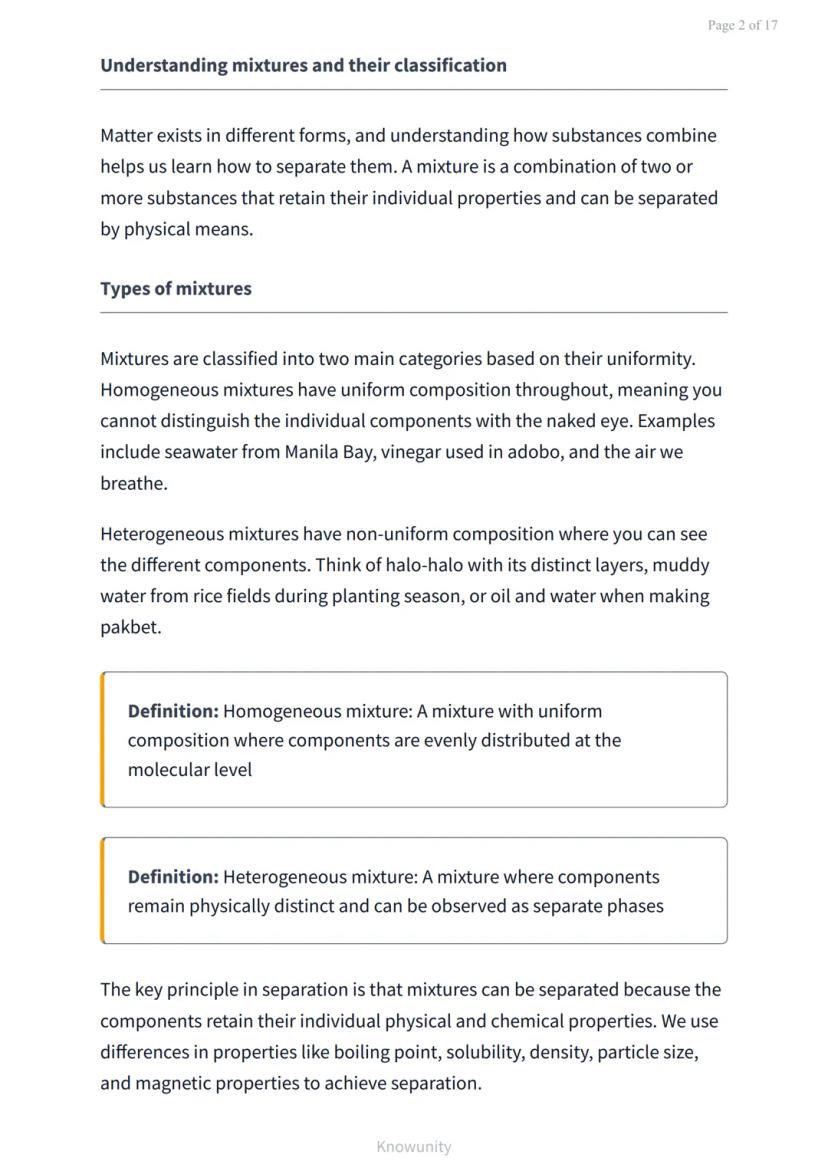
When you mix chocolate powder into milk or add sugar to your tea, you're creating a mixture! A mixture is a combination of two or more substances that keep their individual properties and can be separated by physical means.
Mixtures come in two main types based on how uniform they look. Homogeneous mixtures have the same composition throughout—you can't see the individual components with your naked eye. Examples include seawater from Manila Bay, the vinegar in your favorite adobo, and the air you're breathing right now.
Heterogeneous mixtures are non-uniform, meaning you can actually see the different components. Think about halo-halo with its distinct layers, muddy water from rice fields, or oil and water when cooking pakbet—all are heterogeneous mixtures.
The most important thing to remember is that in any mixture, each component keeps its original properties. This is why we can separate them using physical methods by exploiting differences in properties like boiling point, solubility, density, or particle size.
Quick Tip: If you can see different parts in your mixture (like oil floating on water), it's heterogeneous. If it looks the same throughout (like salt dissolved in water), it's homogeneous.

When you can visibly see different components in a mixture, you're dealing with a heterogeneous mixture. These are easier to separate using these physical methods.
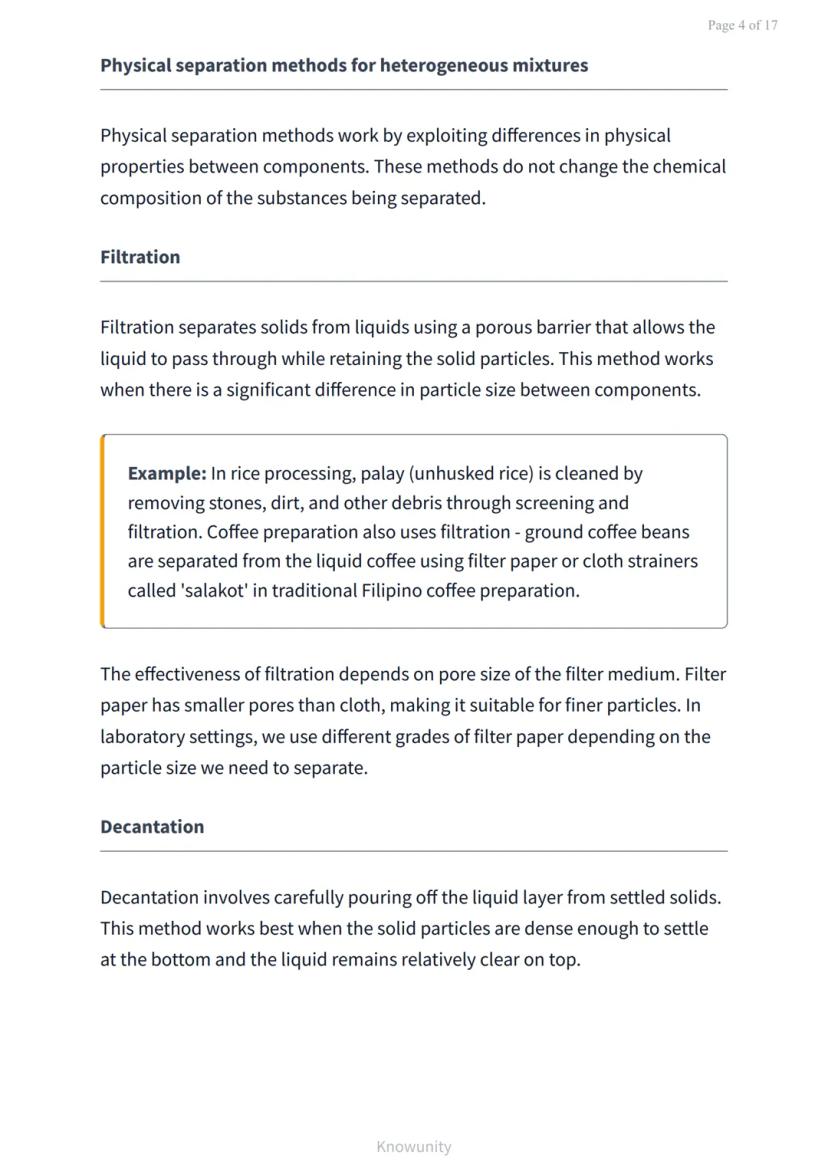
Filtration uses a porous barrier (like filter paper) that lets liquids pass through while trapping solids. Next time you're making coffee using a traditional Filipino "salakot" strainer, you're witnessing filtration in action! Rice processing facilities also use this method to remove stones and debris from rice grains. The smaller the pore size of your filter, the finer the particles it can trap.
Decantation involves carefully pouring off a liquid from settled solids. Traditional gold panners in Northern Luzon use this principle—they swirl water and sediment in a pan, letting the heavier gold settle before pouring off the water. You've probably seen this at home when thick coconut cream separates from thinner coconut milk.
Magnetic separation uses magnets to pull out magnetic materials from non-magnetic ones. Mining operations use this to concentrate iron minerals, and recycling centers across Metro Manila use magnetic separators to pull iron and steel cans from mixed waste.
Sieving separates particles of different sizes using screens with specific hole sizes. Rice mills use this to separate whole grains from broken ones, and construction sites sieve sand and gravel for concrete mixing.
Practical Application: Try filtering muddy water through a cloth at home. The cloth acts as your filter medium, allowing water to pass through while trapping the soil particles!
The key to effective separation is understanding the physical differences between your components. Let's explore more techniques used across the Philippines.
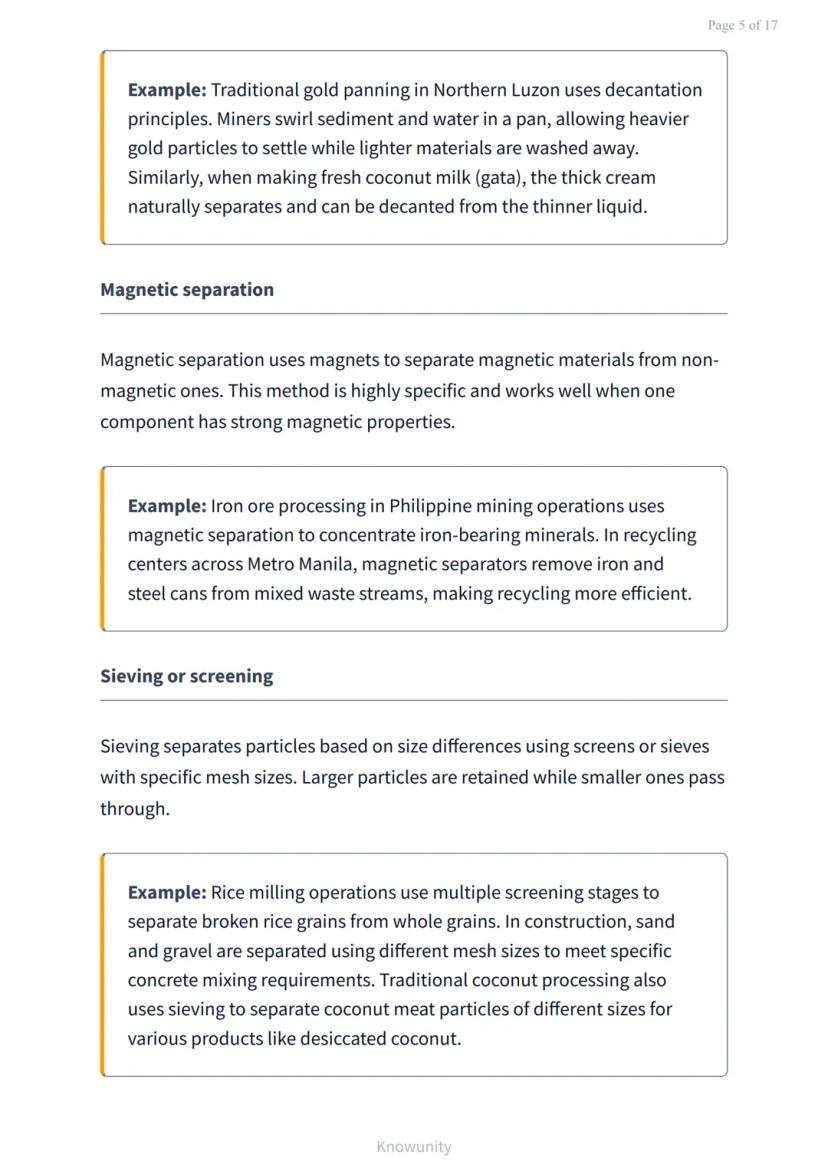
Gold panning in Northern Luzon demonstrates decantation perfectly. Miners swirl water and sediment in a pan, allowing the denser gold particles to settle while they carefully pour off the water containing lighter materials. Similarly, when making fresh coconut milk (gata), the thick cream naturally separates and can be decanted from the thinner liquid below.
Magnetic separation is highly specific and works brilliantly when one component has magnetic properties. Philippine mining operations rely on this method to concentrate iron ore. Visit any recycling center in Metro Manila and you'll see magnetic separators pulling iron and steel cans from mixed waste streams, making recycling more efficient.
The size difference between particles is the basis for sieving. Rice milling operations across the country use multiple screening stages to separate broken grains from whole ones. Construction projects use different mesh sizes to separate sand and gravel for specific concrete requirements. Even traditional coconut processing uses sieving to separate coconut meat particles for products like desiccated coconut.
Think about it: What physical property would you use to separate a mixture of sand and water? What about iron filings mixed with sugar?
When you can't see different components in your mixture (like sugar dissolved in water), you need more sophisticated techniques that exploit molecular differences between components.
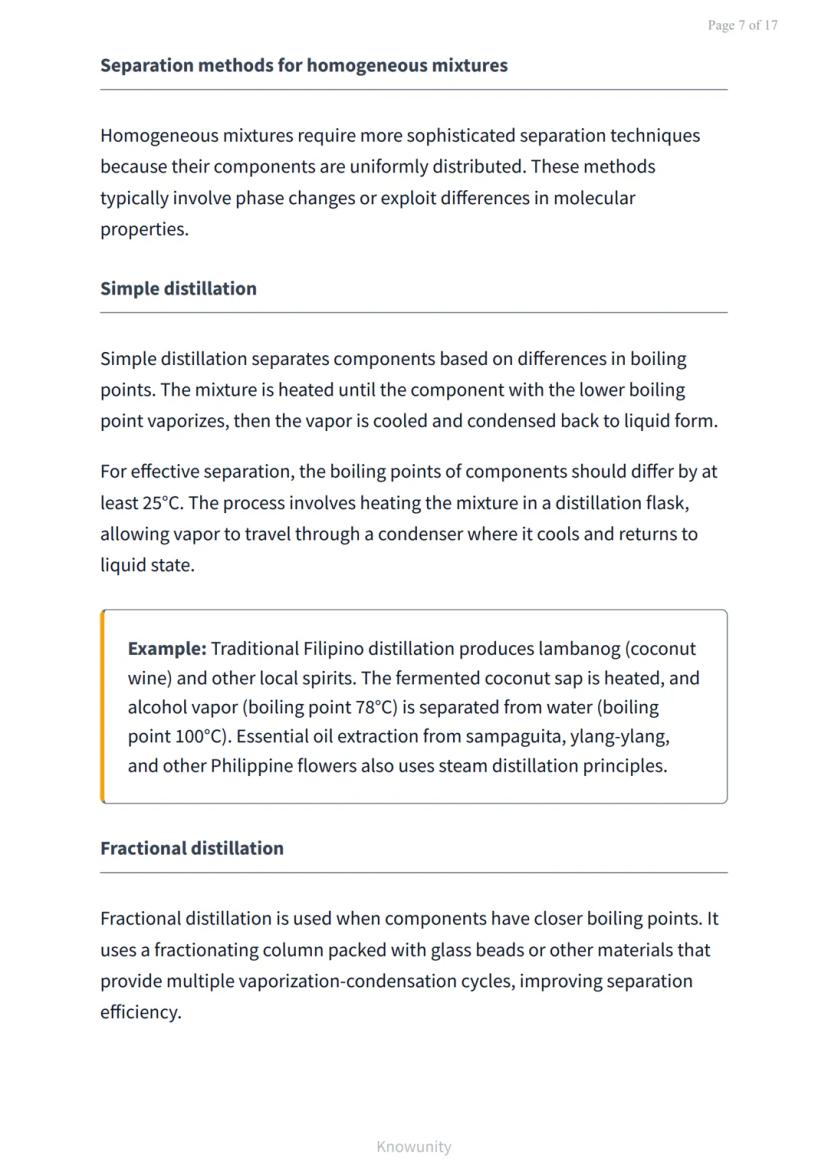
Simple distillation separates liquids with different boiling points. When you heat the mixture, the component with the lower boiling point evaporates first, then condenses back into liquid form when cooled. For this to work well, boiling points should differ by at least 25°C. Traditional Filipino distillers use this process to make lambanog (coconut wine)—the alcohol (boiling at 78°C) evaporates before the water (boiling at 100°C), creating a stronger spirit.
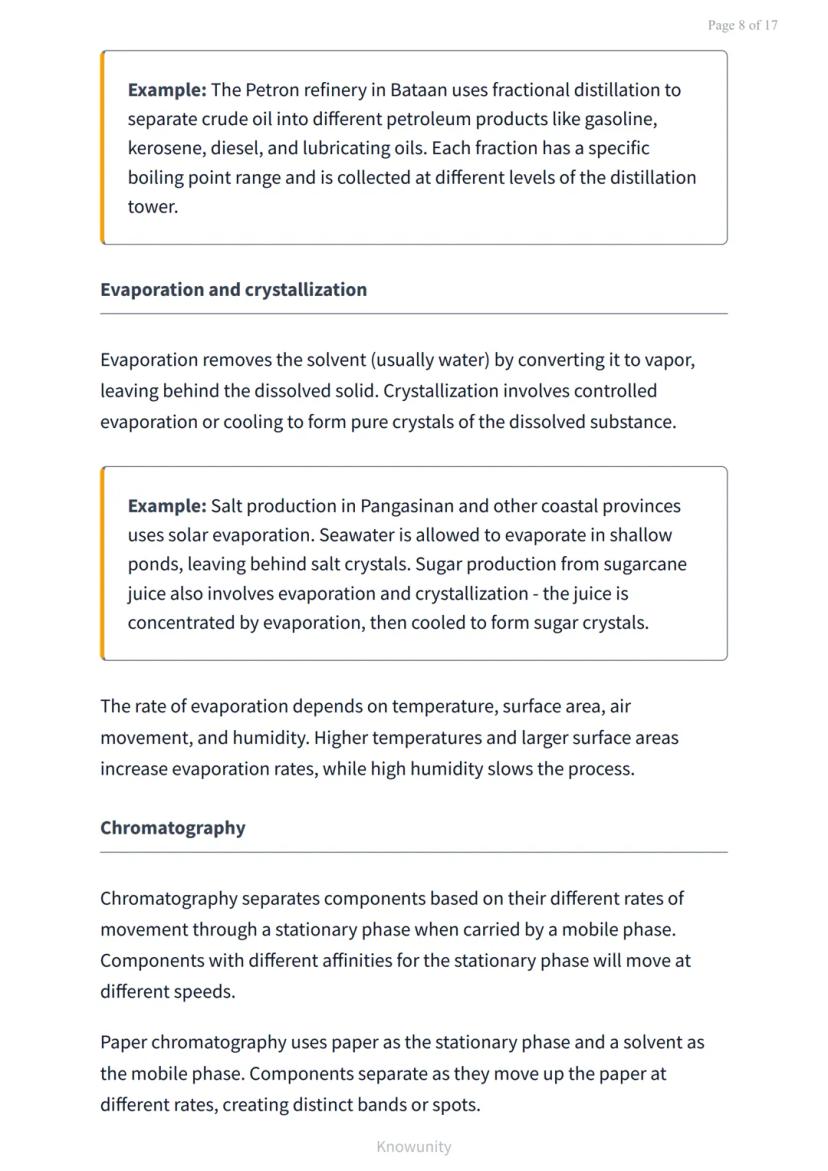
Fractional distillation works similarly but uses a special column that creates multiple evaporation-condensation cycles, making it perfect for separating liquids with closer boiling points. The Petron refinery in Bataan uses massive fractional distillation towers to separate crude oil into gasoline, diesel, kerosene, and other products.
Both methods rely on the principle that each substance has a unique boiling point—a physical property that doesn't change in a mixture. By controlling temperature carefully, you can separate components one by one.
Fun fact: The sampaguita and ylang-ylang essential oils used in Filipino perfumes are extracted using steam distillation, a variation of simple distillation!

When dealing with solutions (solids dissolved in liquids), you have additional techniques at your disposal.
Evaporation and crystallization are widely used in the Philippines. Visit the salt farms of Pangasinan, and you'll see large shallow ponds where seawater evaporates in the sun, leaving behind pure salt crystals. Similarly, sugar production from sugarcane involves evaporating water from the juice until sugar crystals form. The rate of evaporation depends on temperature, surface area, air movement, and humidity—which is why these industries thrive in hot, windy coastal areas.
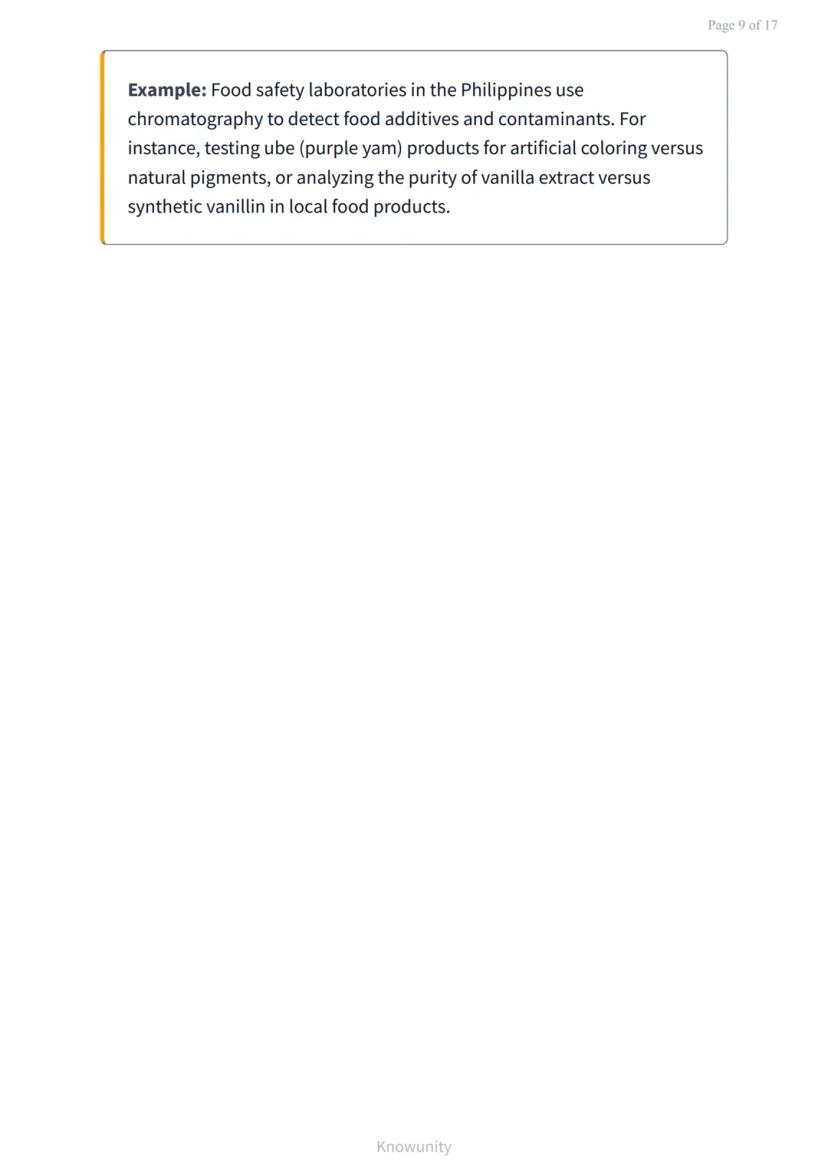
Chromatography separates components based on how quickly they travel through a medium. Think of it like a race where different molecules move at different speeds. Components that are more strongly attracted to the stationary phase (like paper) move more slowly than those attracted to the mobile phase (like a solvent). Food safety laboratories across the Philippines use this technique to detect artificial coloring in foods like ube (purple yam) products or to analyze the purity of vanilla extract in local food products.
These techniques are essential for creating pure products from complex natural sources—a critical skill in both industrial settings and laboratory work.
Challenge yourself: Next time you have a cup of colored candy (like Skittles), place one on a wet paper towel and watch chromatography in action as the different dyes separate!
Beyond basic methods, Philippine industries employ more sophisticated techniques that combine multiple principles for efficient separations.
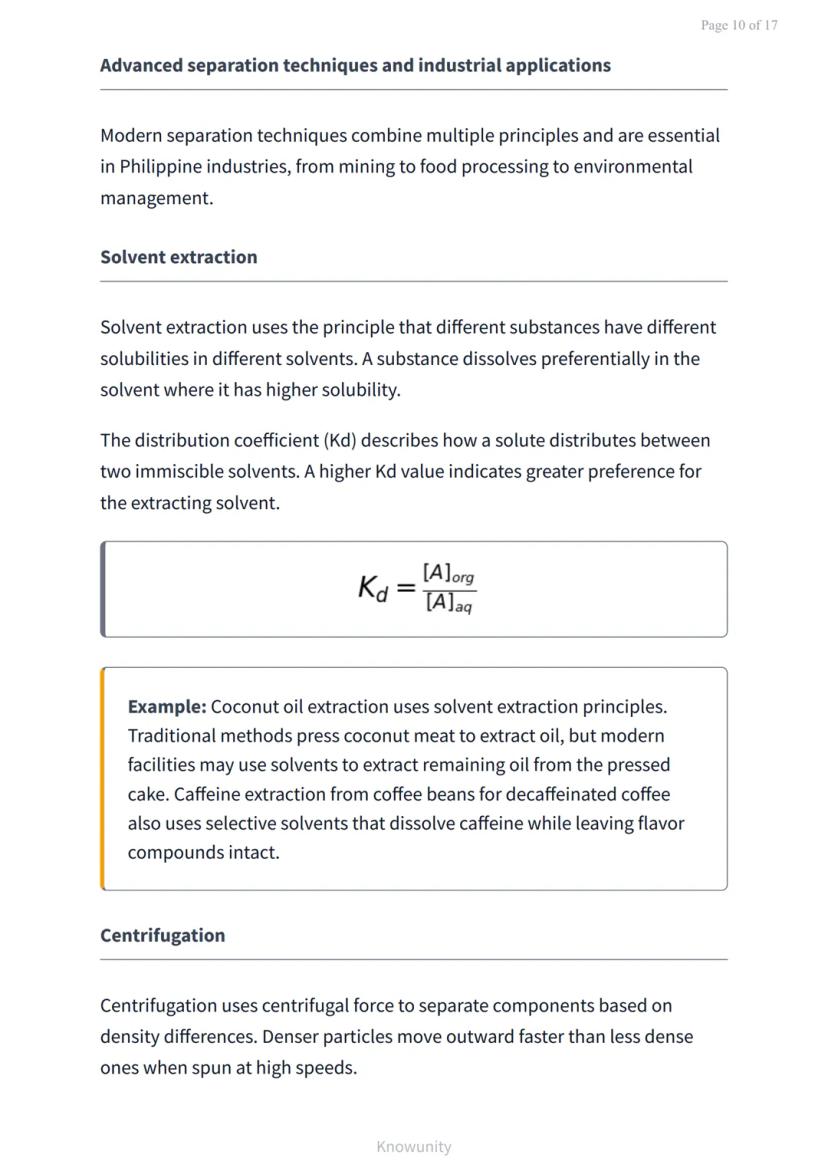
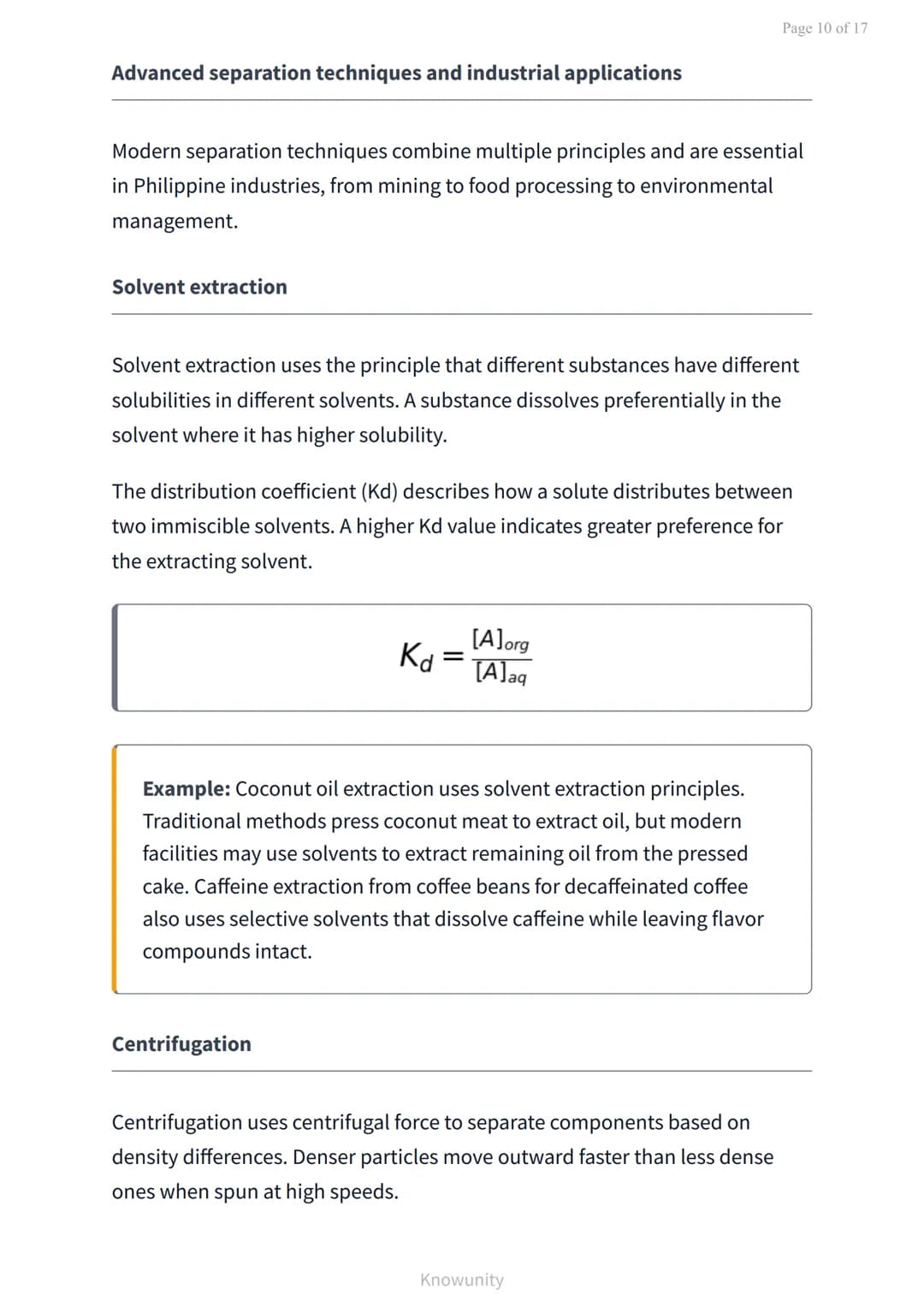
Solvent extraction uses the fact that substances dissolve better in some solvents than others. When two immiscible solvents contact a mixture, components distribute themselves according to where they're more soluble. This is represented by the distribution coefficient (Kd):
Kd = org ÷ aq
Modern coconut oil producers use this principle—after pressing coconut meat mechanically, they extract remaining oil using solvents. Similarly, decaffeinated coffee is produced by selectively dissolving caffeine while leaving flavor compounds intact.
Centrifugation amplifies gravity's effects by spinning samples at high speeds. This forces denser components outward faster than lighter ones. Blood banks across the Philippines use centrifugation to separate blood into its components (red cells, white cells, plasma, and platelets). Coconut processing plants use centrifuges to separate coconut cream from coconut water much faster than letting it settle naturally.
These advanced techniques allow for faster, more complete separations than basic methods, making them invaluable in industrial settings where time and efficiency are crucial.
Industry insight: Many Philippine food processors combine multiple separation techniques in sequence—like using centrifugation followed by filtration—to achieve higher purity products.
Modern separation technologies are revolutionizing Filipino industries from water treatment to mining.
Membrane separation uses semi-permeable barriers that allow certain molecules through while blocking others based on size, charge, or other properties. Water treatment facilities in Metro Manila use reverse osmosis membranes to remove contaminants from drinking water. This technology is also being developed for island communities to convert seawater to freshwater—a critical resource for remote areas. In food processing, ultrafiltration membranes concentrate proteins in dairy products and clarify fruit juices.
Flotation is fascinating because it uses surface chemistry to separate materials. Air bubbles are introduced into a mixture, and specific chemicals make certain particles water-repellent (hydrophobic). These particles attach to air bubbles and float to the surface while others sink. Copper mining operations across the Philippines rely on flotation to concentrate copper minerals from crushed ore. The copper-bearing minerals attach to air bubbles and rise to form a froth that's skimmed off.
These advanced methods can achieve separations that would be impossible with basic techniques, allowing industries to process complex materials efficiently and extract valuable components from low-grade sources.
Career connection: Environmental engineers in the Philippines combine multiple separation techniques to treat wastewater and extract valuable resources from waste—a growing field with excellent job prospects!
How do we know if our separation method is working well? We need to measure its effectiveness using these important calculations.
Percent recovery tells you how much of your desired component you actually managed to separate compared to what was theoretically available. The formula is:
Percent Recovery = (Amount recovered ÷ Amount originally present) × 100%
For example, if a gold mining operation in Benguet processes 1000 kg of ore containing 2% gold (20 kg total), and recovers 15 kg of gold, their percent recovery would be: (15 kg ÷ 20 kg) × 100% = 75%
This means 25% of the gold was lost during processing—an important metric for improving their methods!
Purity calculations measure how pure your separated product is:
Percent Purity = (Mass of pure component ÷ Total mass of sample) × 100%
If a sugar mill in Negros produces 500 kg of sugar crystals containing 485 kg of pure sucrose and 15 kg of other compounds, the purity would be: (485 kg ÷ 500 kg) × 100% = 97%
These calculations help industries optimize their separation processes, reducing waste and improving product quality.
Test prep tip: Separation efficiency questions frequently appear on exams—practice calculating percent recovery and purity to ensure you can handle these problems!
Understanding separation factors and practicing with real-world problems will strengthen your mastery of separation principles.
The separation factor quantifies how well two components have been separated by comparing their ratios before and after separation. A value of 1 means no separation occurred, while larger values indicate better separation. This is particularly important when designing industrial separation processes like distillation columns for alcohol production.
Let's try a practice problem: A rice mill processes 2000 kg of palay (unhusked rice) containing 75% rice grains, 20% husks, and 5% impurities. After processing, they recover 1400 kg of clean rice grains.
To solve:
This type of analysis helps mill operators optimize their processes to improve recovery rates and reduce waste—critical for profitability and sustainability.
Apply your knowledge: Try calculating the percent purity of salt recovered from seawater if 5 kg of crystals contain 4.8 kg of sodium chloride and 0.2 kg of other minerals.
Our AI companion is specifically built for the needs of students. Based on the millions of content pieces we have on the platform we can provide truly meaningful and relevant answers to students. But its not only about answers, the companion is even more about guiding students through their daily learning challenges, with personalised study plans, quizzes or content pieces in the chat and 100% personalisation based on the students skills and developments.
You can download the app in the Google Play Store and in the Apple App Store.
That's right! Enjoy free access to study content, connect with fellow students, and get instant help – all at your fingertips.
App Store
Google Play
The app is very easy to use and well designed. I have found everything I was looking for so far and have been able to learn a lot from the presentations! I will definitely use the app for a class assignment! And of course it also helps a lot as an inspiration.
Stefan S
iOS user
This app is really great. There are so many study notes and help [...]. My problem subject is French, for example, and the app has so many options for help. Thanks to this app, I have improved my French. I would recommend it to anyone.
Samantha Klich
Android user
Wow, I am really amazed. I just tried the app because I've seen it advertised many times and was absolutely stunned. This app is THE HELP you want for school and above all, it offers so many things, such as workouts and fact sheets, which have been VERY helpful to me personally.
Anna
iOS user
I think it’s very much worth it and you’ll end up using it a lot once you get the hang of it and even after looking at others notes you can still ask your Artificial intelligence buddy the question and ask to simplify it if you still don’t get it!!! In the end I think it’s worth it 😊👍 ⚠️Also DID I MENTION ITS FREEE YOU DON’T HAVE TO PAY FOR ANYTHING AND STILL GET YOUR GRADES IN PERFECTLY❗️❗️⚠️
Thomas R
iOS user
Knowunity is the BEST app I’ve used in a minute. This is not an ai review or anything this is genuinely coming from a 7th grade student (I know 2011 im young) but dude this app is a 10/10 i have maintained a 3.8 gpa and have plenty of time for gaming. I love it and my mom is just happy I got good grades
Brad T
Android user
Not only did it help me find the answer but it also showed me alternative ways to solve it. I was horrible in math and science but now I have an a in both subjects. Thanks for the help🤍🤍
David K
iOS user
The app's just great! All I have to do is enter the topic in the search bar and I get the response real fast. I don't have to watch 10 YouTube videos to understand something, so I'm saving my time. Highly recommended!
Sudenaz Ocak
Android user
In school I was really bad at maths but thanks to the app, I am doing better now. I am so grateful that you made the app.
Greenlight Bonnie
Android user
I found this app a couple years ago and it has only gotten better since then. I really love it because it can help with written questions and photo questions. Also, it can find study guides that other people have made as well as flashcard sets and practice tests. The free version is also amazing for students who might not be able to afford it. Would 100% recommend
Aubrey
iOS user
Best app if you're in Highschool or Junior high. I have been using this app for 2 school years and it's the best, it's good if you don't have anyone to help you with school work.😋🩷🎀
Marco B
iOS user
THE QUIZES AND FLASHCARDS ARE SO USEFUL AND I LOVE THE SCHOOLGPT. IT ALSO IS LITREALLY LIKE CHATGPT BUT SMARTER!! HELPED ME WITH MY MASCARA PROBLEMS TOO!! AS WELL AS MY REAL SUBJECTS ! DUHHH 😍😁😲🤑💗✨🎀😮
Elisha
iOS user
This app is phenomenal down to the correct info and the various topics you can study! I greatly recommend it for people who struggle with procrastination and those who need homework help. It has been perfectly accurate for world 1 history as far as I’ve seen! Geometry too!
Paul T
iOS user
The app is very easy to use and well designed. I have found everything I was looking for so far and have been able to learn a lot from the presentations! I will definitely use the app for a class assignment! And of course it also helps a lot as an inspiration.
Stefan S
iOS user
This app is really great. There are so many study notes and help [...]. My problem subject is French, for example, and the app has so many options for help. Thanks to this app, I have improved my French. I would recommend it to anyone.
Samantha Klich
Android user
Wow, I am really amazed. I just tried the app because I've seen it advertised many times and was absolutely stunned. This app is THE HELP you want for school and above all, it offers so many things, such as workouts and fact sheets, which have been VERY helpful to me personally.
Anna
iOS user
I think it’s very much worth it and you’ll end up using it a lot once you get the hang of it and even after looking at others notes you can still ask your Artificial intelligence buddy the question and ask to simplify it if you still don’t get it!!! In the end I think it’s worth it 😊👍 ⚠️Also DID I MENTION ITS FREEE YOU DON’T HAVE TO PAY FOR ANYTHING AND STILL GET YOUR GRADES IN PERFECTLY❗️❗️⚠️
Thomas R
iOS user
Knowunity is the BEST app I’ve used in a minute. This is not an ai review or anything this is genuinely coming from a 7th grade student (I know 2011 im young) but dude this app is a 10/10 i have maintained a 3.8 gpa and have plenty of time for gaming. I love it and my mom is just happy I got good grades
Brad T
Android user
Not only did it help me find the answer but it also showed me alternative ways to solve it. I was horrible in math and science but now I have an a in both subjects. Thanks for the help🤍🤍
David K
iOS user
The app's just great! All I have to do is enter the topic in the search bar and I get the response real fast. I don't have to watch 10 YouTube videos to understand something, so I'm saving my time. Highly recommended!
Sudenaz Ocak
Android user
In school I was really bad at maths but thanks to the app, I am doing better now. I am so grateful that you made the app.
Greenlight Bonnie
Android user
I found this app a couple years ago and it has only gotten better since then. I really love it because it can help with written questions and photo questions. Also, it can find study guides that other people have made as well as flashcard sets and practice tests. The free version is also amazing for students who might not be able to afford it. Would 100% recommend
Aubrey
iOS user
Best app if you're in Highschool or Junior high. I have been using this app for 2 school years and it's the best, it's good if you don't have anyone to help you with school work.😋🩷🎀
Marco B
iOS user
THE QUIZES AND FLASHCARDS ARE SO USEFUL AND I LOVE THE SCHOOLGPT. IT ALSO IS LITREALLY LIKE CHATGPT BUT SMARTER!! HELPED ME WITH MY MASCARA PROBLEMS TOO!! AS WELL AS MY REAL SUBJECTS ! DUHHH 😍😁😲🤑💗✨🎀😮
Elisha
iOS user
This app is phenomenal down to the correct info and the various topics you can study! I greatly recommend it for people who struggle with procrastination and those who need homework help. It has been perfectly accurate for world 1 history as far as I’ve seen! Geometry too!
Paul T
iOS user
Knowunity Philippines
@knowunityphilippines
Separation of mixtures is a fundamental skill in chemistry that has countless real-world applications. This lesson explores different techniques for separating mixtures using Filipino examples and contexts, helping you understand how physical properties can be used to separate substances efficiently... Show more
Access to all documents
Improve your grades
Join milions of students
By signing up you accept Terms of Service and Privacy Policy
Ever wondered how gold miners separate tiny gold particles from dirt or how coconut oil is extracted from coconut meat? These are all examples of separation techniques in action! This lesson will teach you how to identify different types of mixtures and choose the right method to separate them.
You'll learn how to apply separation techniques based on physical properties like density, size, solubility, and boiling point. These skills are practical and used extensively in Philippine industries—from food processing to mining.
By the end of this lesson, you'll be able to design separation procedures for complex mixtures and calculate how efficient and pure your separations are—valuable skills for science classes and beyond!
Remember: All separation methods take advantage of differences in physical properties between components. The key is identifying which property gives you the best separation!
Access to all documents
Improve your grades
Join milions of students
By signing up you accept Terms of Service and Privacy Policy
When you mix chocolate powder into milk or add sugar to your tea, you're creating a mixture! A mixture is a combination of two or more substances that keep their individual properties and can be separated by physical means.
Mixtures come in two main types based on how uniform they look. Homogeneous mixtures have the same composition throughout—you can't see the individual components with your naked eye. Examples include seawater from Manila Bay, the vinegar in your favorite adobo, and the air you're breathing right now.
Heterogeneous mixtures are non-uniform, meaning you can actually see the different components. Think about halo-halo with its distinct layers, muddy water from rice fields, or oil and water when cooking pakbet—all are heterogeneous mixtures.
The most important thing to remember is that in any mixture, each component keeps its original properties. This is why we can separate them using physical methods by exploiting differences in properties like boiling point, solubility, density, or particle size.
Quick Tip: If you can see different parts in your mixture (like oil floating on water), it's heterogeneous. If it looks the same throughout (like salt dissolved in water), it's homogeneous.
Access to all documents
Improve your grades
Join milions of students
By signing up you accept Terms of Service and Privacy Policy
When you can visibly see different components in a mixture, you're dealing with a heterogeneous mixture. These are easier to separate using these physical methods.
Filtration uses a porous barrier (like filter paper) that lets liquids pass through while trapping solids. Next time you're making coffee using a traditional Filipino "salakot" strainer, you're witnessing filtration in action! Rice processing facilities also use this method to remove stones and debris from rice grains. The smaller the pore size of your filter, the finer the particles it can trap.
Decantation involves carefully pouring off a liquid from settled solids. Traditional gold panners in Northern Luzon use this principle—they swirl water and sediment in a pan, letting the heavier gold settle before pouring off the water. You've probably seen this at home when thick coconut cream separates from thinner coconut milk.
Magnetic separation uses magnets to pull out magnetic materials from non-magnetic ones. Mining operations use this to concentrate iron minerals, and recycling centers across Metro Manila use magnetic separators to pull iron and steel cans from mixed waste.
Sieving separates particles of different sizes using screens with specific hole sizes. Rice mills use this to separate whole grains from broken ones, and construction sites sieve sand and gravel for concrete mixing.
Practical Application: Try filtering muddy water through a cloth at home. The cloth acts as your filter medium, allowing water to pass through while trapping the soil particles!
Access to all documents
Improve your grades
Join milions of students
By signing up you accept Terms of Service and Privacy Policy
The key to effective separation is understanding the physical differences between your components. Let's explore more techniques used across the Philippines.
Gold panning in Northern Luzon demonstrates decantation perfectly. Miners swirl water and sediment in a pan, allowing the denser gold particles to settle while they carefully pour off the water containing lighter materials. Similarly, when making fresh coconut milk (gata), the thick cream naturally separates and can be decanted from the thinner liquid below.
Magnetic separation is highly specific and works brilliantly when one component has magnetic properties. Philippine mining operations rely on this method to concentrate iron ore. Visit any recycling center in Metro Manila and you'll see magnetic separators pulling iron and steel cans from mixed waste streams, making recycling more efficient.
The size difference between particles is the basis for sieving. Rice milling operations across the country use multiple screening stages to separate broken grains from whole ones. Construction projects use different mesh sizes to separate sand and gravel for specific concrete requirements. Even traditional coconut processing uses sieving to separate coconut meat particles for products like desiccated coconut.
Think about it: What physical property would you use to separate a mixture of sand and water? What about iron filings mixed with sugar?
Access to all documents
Improve your grades
Join milions of students
By signing up you accept Terms of Service and Privacy Policy
When you can't see different components in your mixture (like sugar dissolved in water), you need more sophisticated techniques that exploit molecular differences between components.
Simple distillation separates liquids with different boiling points. When you heat the mixture, the component with the lower boiling point evaporates first, then condenses back into liquid form when cooled. For this to work well, boiling points should differ by at least 25°C. Traditional Filipino distillers use this process to make lambanog (coconut wine)—the alcohol (boiling at 78°C) evaporates before the water (boiling at 100°C), creating a stronger spirit.
Fractional distillation works similarly but uses a special column that creates multiple evaporation-condensation cycles, making it perfect for separating liquids with closer boiling points. The Petron refinery in Bataan uses massive fractional distillation towers to separate crude oil into gasoline, diesel, kerosene, and other products.
Both methods rely on the principle that each substance has a unique boiling point—a physical property that doesn't change in a mixture. By controlling temperature carefully, you can separate components one by one.
Fun fact: The sampaguita and ylang-ylang essential oils used in Filipino perfumes are extracted using steam distillation, a variation of simple distillation!
Access to all documents
Improve your grades
Join milions of students
By signing up you accept Terms of Service and Privacy Policy
When dealing with solutions (solids dissolved in liquids), you have additional techniques at your disposal.
Evaporation and crystallization are widely used in the Philippines. Visit the salt farms of Pangasinan, and you'll see large shallow ponds where seawater evaporates in the sun, leaving behind pure salt crystals. Similarly, sugar production from sugarcane involves evaporating water from the juice until sugar crystals form. The rate of evaporation depends on temperature, surface area, air movement, and humidity—which is why these industries thrive in hot, windy coastal areas.
Chromatography separates components based on how quickly they travel through a medium. Think of it like a race where different molecules move at different speeds. Components that are more strongly attracted to the stationary phase (like paper) move more slowly than those attracted to the mobile phase (like a solvent). Food safety laboratories across the Philippines use this technique to detect artificial coloring in foods like ube (purple yam) products or to analyze the purity of vanilla extract in local food products.
These techniques are essential for creating pure products from complex natural sources—a critical skill in both industrial settings and laboratory work.
Challenge yourself: Next time you have a cup of colored candy (like Skittles), place one on a wet paper towel and watch chromatography in action as the different dyes separate!
Access to all documents
Improve your grades
Join milions of students
By signing up you accept Terms of Service and Privacy Policy
Beyond basic methods, Philippine industries employ more sophisticated techniques that combine multiple principles for efficient separations.
Solvent extraction uses the fact that substances dissolve better in some solvents than others. When two immiscible solvents contact a mixture, components distribute themselves according to where they're more soluble. This is represented by the distribution coefficient (Kd):
Kd = org ÷ aq
Modern coconut oil producers use this principle—after pressing coconut meat mechanically, they extract remaining oil using solvents. Similarly, decaffeinated coffee is produced by selectively dissolving caffeine while leaving flavor compounds intact.
Centrifugation amplifies gravity's effects by spinning samples at high speeds. This forces denser components outward faster than lighter ones. Blood banks across the Philippines use centrifugation to separate blood into its components (red cells, white cells, plasma, and platelets). Coconut processing plants use centrifuges to separate coconut cream from coconut water much faster than letting it settle naturally.
These advanced techniques allow for faster, more complete separations than basic methods, making them invaluable in industrial settings where time and efficiency are crucial.
Industry insight: Many Philippine food processors combine multiple separation techniques in sequence—like using centrifugation followed by filtration—to achieve higher purity products.
Access to all documents
Improve your grades
Join milions of students
By signing up you accept Terms of Service and Privacy Policy
Modern separation technologies are revolutionizing Filipino industries from water treatment to mining.
Membrane separation uses semi-permeable barriers that allow certain molecules through while blocking others based on size, charge, or other properties. Water treatment facilities in Metro Manila use reverse osmosis membranes to remove contaminants from drinking water. This technology is also being developed for island communities to convert seawater to freshwater—a critical resource for remote areas. In food processing, ultrafiltration membranes concentrate proteins in dairy products and clarify fruit juices.
Flotation is fascinating because it uses surface chemistry to separate materials. Air bubbles are introduced into a mixture, and specific chemicals make certain particles water-repellent (hydrophobic). These particles attach to air bubbles and float to the surface while others sink. Copper mining operations across the Philippines rely on flotation to concentrate copper minerals from crushed ore. The copper-bearing minerals attach to air bubbles and rise to form a froth that's skimmed off.
These advanced methods can achieve separations that would be impossible with basic techniques, allowing industries to process complex materials efficiently and extract valuable components from low-grade sources.
Career connection: Environmental engineers in the Philippines combine multiple separation techniques to treat wastewater and extract valuable resources from waste—a growing field with excellent job prospects!
Access to all documents
Improve your grades
Join milions of students
By signing up you accept Terms of Service and Privacy Policy
How do we know if our separation method is working well? We need to measure its effectiveness using these important calculations.
Percent recovery tells you how much of your desired component you actually managed to separate compared to what was theoretically available. The formula is:
Percent Recovery = (Amount recovered ÷ Amount originally present) × 100%
For example, if a gold mining operation in Benguet processes 1000 kg of ore containing 2% gold (20 kg total), and recovers 15 kg of gold, their percent recovery would be: (15 kg ÷ 20 kg) × 100% = 75%
This means 25% of the gold was lost during processing—an important metric for improving their methods!
Purity calculations measure how pure your separated product is:
Percent Purity = (Mass of pure component ÷ Total mass of sample) × 100%
If a sugar mill in Negros produces 500 kg of sugar crystals containing 485 kg of pure sucrose and 15 kg of other compounds, the purity would be: (485 kg ÷ 500 kg) × 100% = 97%
These calculations help industries optimize their separation processes, reducing waste and improving product quality.
Test prep tip: Separation efficiency questions frequently appear on exams—practice calculating percent recovery and purity to ensure you can handle these problems!
Access to all documents
Improve your grades
Join milions of students
By signing up you accept Terms of Service and Privacy Policy
Understanding separation factors and practicing with real-world problems will strengthen your mastery of separation principles.
The separation factor quantifies how well two components have been separated by comparing their ratios before and after separation. A value of 1 means no separation occurred, while larger values indicate better separation. This is particularly important when designing industrial separation processes like distillation columns for alcohol production.
Let's try a practice problem: A rice mill processes 2000 kg of palay (unhusked rice) containing 75% rice grains, 20% husks, and 5% impurities. After processing, they recover 1400 kg of clean rice grains.
To solve:
This type of analysis helps mill operators optimize their processes to improve recovery rates and reduce waste—critical for profitability and sustainability.
Apply your knowledge: Try calculating the percent purity of salt recovered from seawater if 5 kg of crystals contain 4.8 kg of sodium chloride and 0.2 kg of other minerals.
Our AI companion is specifically built for the needs of students. Based on the millions of content pieces we have on the platform we can provide truly meaningful and relevant answers to students. But its not only about answers, the companion is even more about guiding students through their daily learning challenges, with personalised study plans, quizzes or content pieces in the chat and 100% personalisation based on the students skills and developments.
You can download the app in the Google Play Store and in the Apple App Store.
That's right! Enjoy free access to study content, connect with fellow students, and get instant help – all at your fingertips.
2
Smart Tools NEW
Transform this note into: ✓ 50+ Practice Questions ✓ Interactive Flashcards ✓ Full Mock Exam ✓ Essay Outlines
App Store
Google Play
The app is very easy to use and well designed. I have found everything I was looking for so far and have been able to learn a lot from the presentations! I will definitely use the app for a class assignment! And of course it also helps a lot as an inspiration.
Stefan S
iOS user
This app is really great. There are so many study notes and help [...]. My problem subject is French, for example, and the app has so many options for help. Thanks to this app, I have improved my French. I would recommend it to anyone.
Samantha Klich
Android user
Wow, I am really amazed. I just tried the app because I've seen it advertised many times and was absolutely stunned. This app is THE HELP you want for school and above all, it offers so many things, such as workouts and fact sheets, which have been VERY helpful to me personally.
Anna
iOS user
I think it’s very much worth it and you’ll end up using it a lot once you get the hang of it and even after looking at others notes you can still ask your Artificial intelligence buddy the question and ask to simplify it if you still don’t get it!!! In the end I think it’s worth it 😊👍 ⚠️Also DID I MENTION ITS FREEE YOU DON’T HAVE TO PAY FOR ANYTHING AND STILL GET YOUR GRADES IN PERFECTLY❗️❗️⚠️
Thomas R
iOS user
Knowunity is the BEST app I’ve used in a minute. This is not an ai review or anything this is genuinely coming from a 7th grade student (I know 2011 im young) but dude this app is a 10/10 i have maintained a 3.8 gpa and have plenty of time for gaming. I love it and my mom is just happy I got good grades
Brad T
Android user
Not only did it help me find the answer but it also showed me alternative ways to solve it. I was horrible in math and science but now I have an a in both subjects. Thanks for the help🤍🤍
David K
iOS user
The app's just great! All I have to do is enter the topic in the search bar and I get the response real fast. I don't have to watch 10 YouTube videos to understand something, so I'm saving my time. Highly recommended!
Sudenaz Ocak
Android user
In school I was really bad at maths but thanks to the app, I am doing better now. I am so grateful that you made the app.
Greenlight Bonnie
Android user
I found this app a couple years ago and it has only gotten better since then. I really love it because it can help with written questions and photo questions. Also, it can find study guides that other people have made as well as flashcard sets and practice tests. The free version is also amazing for students who might not be able to afford it. Would 100% recommend
Aubrey
iOS user
Best app if you're in Highschool or Junior high. I have been using this app for 2 school years and it's the best, it's good if you don't have anyone to help you with school work.😋🩷🎀
Marco B
iOS user
THE QUIZES AND FLASHCARDS ARE SO USEFUL AND I LOVE THE SCHOOLGPT. IT ALSO IS LITREALLY LIKE CHATGPT BUT SMARTER!! HELPED ME WITH MY MASCARA PROBLEMS TOO!! AS WELL AS MY REAL SUBJECTS ! DUHHH 😍😁😲🤑💗✨🎀😮
Elisha
iOS user
This app is phenomenal down to the correct info and the various topics you can study! I greatly recommend it for people who struggle with procrastination and those who need homework help. It has been perfectly accurate for world 1 history as far as I’ve seen! Geometry too!
Paul T
iOS user
The app is very easy to use and well designed. I have found everything I was looking for so far and have been able to learn a lot from the presentations! I will definitely use the app for a class assignment! And of course it also helps a lot as an inspiration.
Stefan S
iOS user
This app is really great. There are so many study notes and help [...]. My problem subject is French, for example, and the app has so many options for help. Thanks to this app, I have improved my French. I would recommend it to anyone.
Samantha Klich
Android user
Wow, I am really amazed. I just tried the app because I've seen it advertised many times and was absolutely stunned. This app is THE HELP you want for school and above all, it offers so many things, such as workouts and fact sheets, which have been VERY helpful to me personally.
Anna
iOS user
I think it’s very much worth it and you’ll end up using it a lot once you get the hang of it and even after looking at others notes you can still ask your Artificial intelligence buddy the question and ask to simplify it if you still don’t get it!!! In the end I think it’s worth it 😊👍 ⚠️Also DID I MENTION ITS FREEE YOU DON’T HAVE TO PAY FOR ANYTHING AND STILL GET YOUR GRADES IN PERFECTLY❗️❗️⚠️
Thomas R
iOS user
Knowunity is the BEST app I’ve used in a minute. This is not an ai review or anything this is genuinely coming from a 7th grade student (I know 2011 im young) but dude this app is a 10/10 i have maintained a 3.8 gpa and have plenty of time for gaming. I love it and my mom is just happy I got good grades
Brad T
Android user
Not only did it help me find the answer but it also showed me alternative ways to solve it. I was horrible in math and science but now I have an a in both subjects. Thanks for the help🤍🤍
David K
iOS user
The app's just great! All I have to do is enter the topic in the search bar and I get the response real fast. I don't have to watch 10 YouTube videos to understand something, so I'm saving my time. Highly recommended!
Sudenaz Ocak
Android user
In school I was really bad at maths but thanks to the app, I am doing better now. I am so grateful that you made the app.
Greenlight Bonnie
Android user
I found this app a couple years ago and it has only gotten better since then. I really love it because it can help with written questions and photo questions. Also, it can find study guides that other people have made as well as flashcard sets and practice tests. The free version is also amazing for students who might not be able to afford it. Would 100% recommend
Aubrey
iOS user
Best app if you're in Highschool or Junior high. I have been using this app for 2 school years and it's the best, it's good if you don't have anyone to help you with school work.😋🩷🎀
Marco B
iOS user
THE QUIZES AND FLASHCARDS ARE SO USEFUL AND I LOVE THE SCHOOLGPT. IT ALSO IS LITREALLY LIKE CHATGPT BUT SMARTER!! HELPED ME WITH MY MASCARA PROBLEMS TOO!! AS WELL AS MY REAL SUBJECTS ! DUHHH 😍😁😲🤑💗✨🎀😮
Elisha
iOS user
This app is phenomenal down to the correct info and the various topics you can study! I greatly recommend it for people who struggle with procrastination and those who need homework help. It has been perfectly accurate for world 1 history as far as I’ve seen! Geometry too!
Paul T
iOS user