Open the App

Subjects

GenMath

Dec 20, 2025

67

13 pages

Understanding Investments: Stocks, Bonds, and Financial Returns

user profile picture

Knowunity Philippines @knowunityphilippines

Business Mathematics helps you unlock the world of financial investments through numbers. In this lesson, you'll learn how... Show more

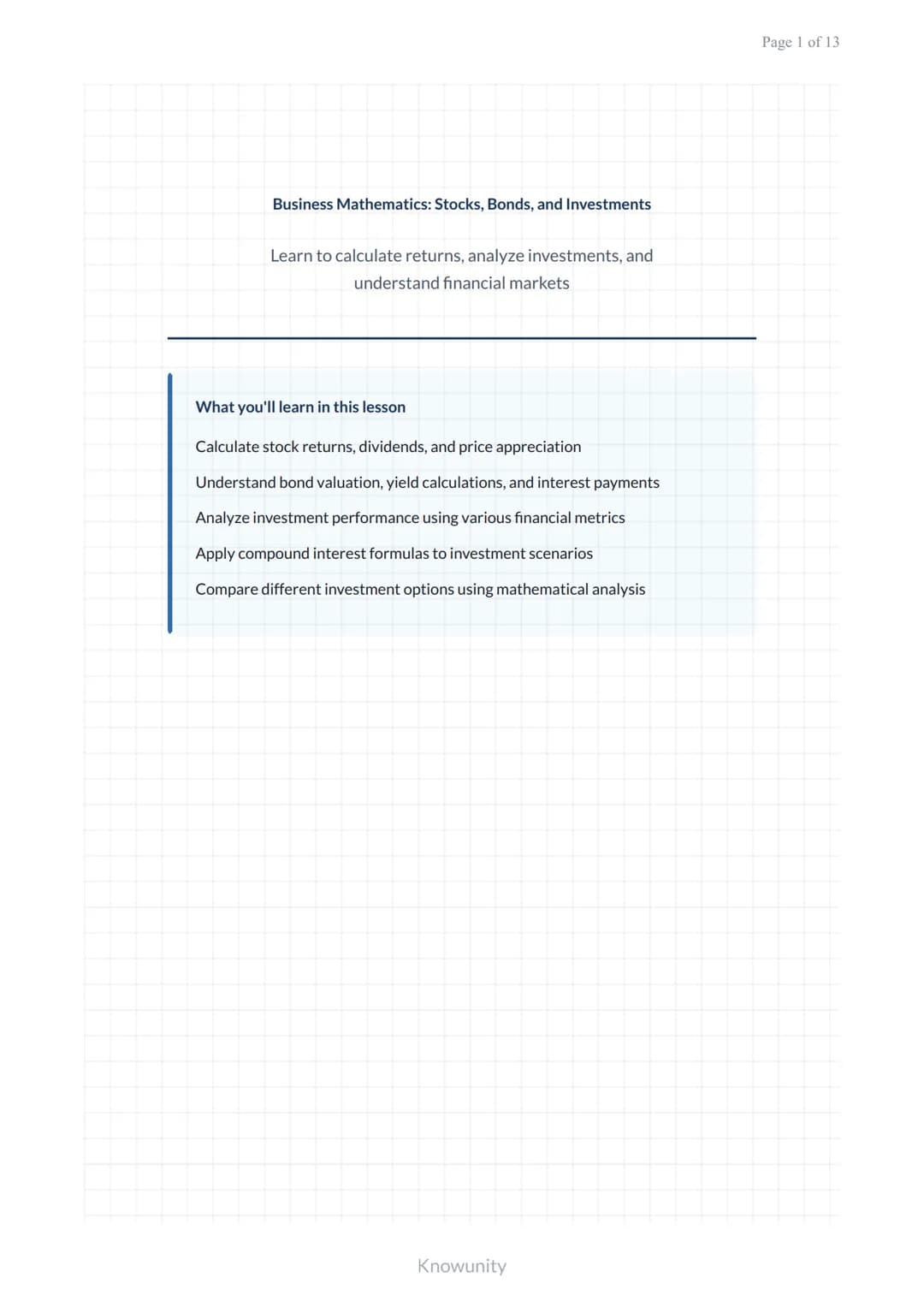
# Business Mathematics: Stocks, Bonds, and Investments

Learn to calculate returns, analyze investments, and understand financial markets

#

Business Mathematics Stocks, Bonds, and Investments

Ever wondered how people make money from the stock market? This lesson will show you exactly how to do the math behind smart investing. You'll gain practical skills to calculate exactly how much money you could make (or lose) when investing in stocks and bonds.

You'll master the calculations for stock returns and dividends, understand how bond values change with interest rates, and learn to analyze investment performance using key financial metrics. These skills will help you make informed decisions about where to put your money.

By the end of this lesson, you'll be able to compare different investment options mathematically and understand how compound interest can dramatically grow your wealth over time. These are real-world skills that can potentially help you build financial security for your future.

Pro tip Financial mathematics isn't just academic—these calculations are used daily by investors to make decisions worth millions of pounds!

# Business Mathematics: Stocks, Bonds, and Investments

Learn to calculate returns, analyze investments, and understand financial markets

#

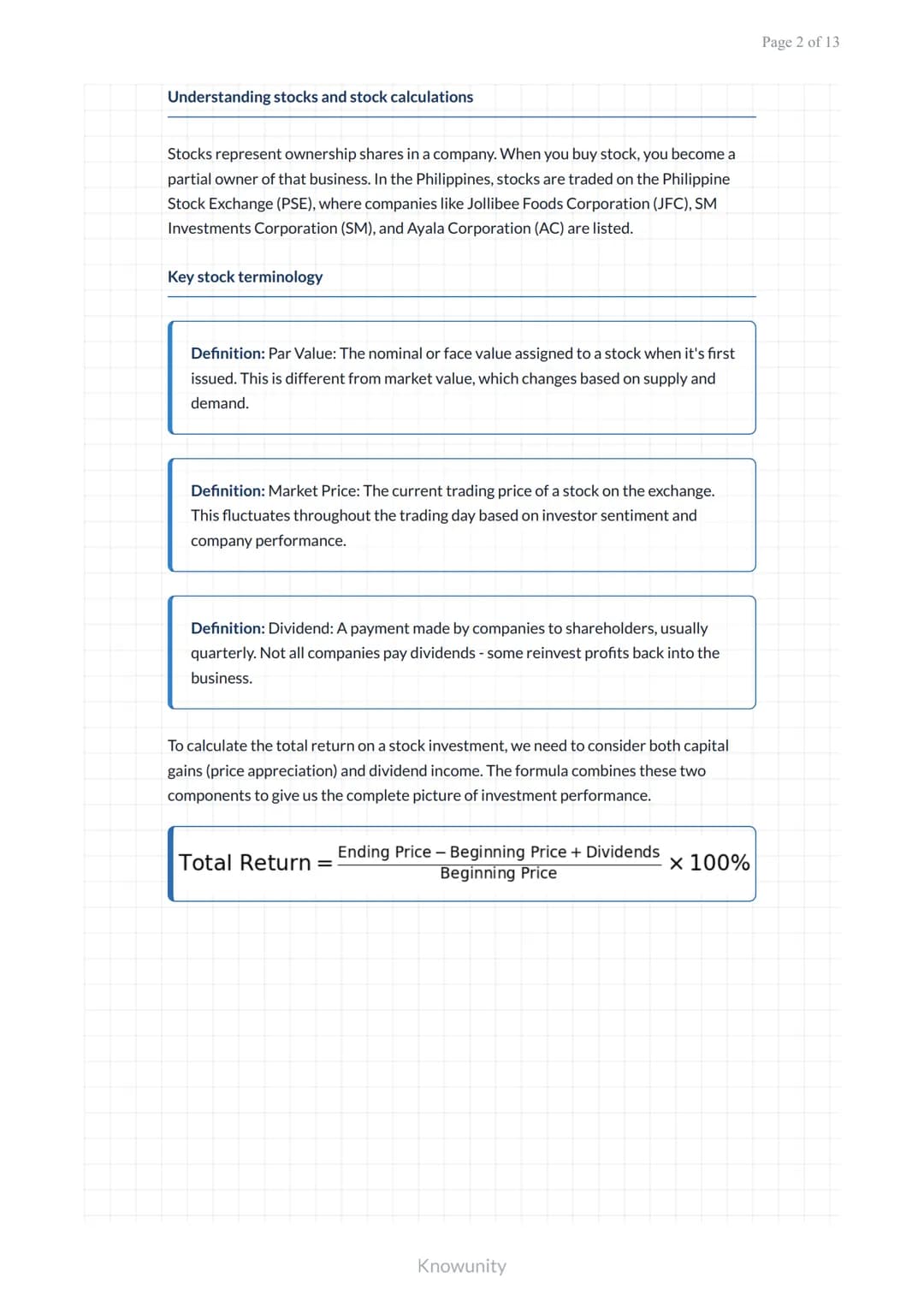
Understanding Stocks and Stock Calculations

When you buy stock, you're literally becoming a partial owner of a business. This ownership gives you the right to share in the company's profits and growth over time.

Stock terminology forms the foundation of investment analysis. The par value is the nominal value assigned when a stock is first issued, while the market price is what people are actually willing to pay for it right now (which changes constantly). Many companies pay dividends, which are regular payments to shareholders from the company's profits.

To understand how much you're really making on stocks, you need to calculate the total return. This formula combines both price changes and dividend income

Total Return = EndingPriceBeginningPrice+DividendsEnding Price - Beginning Price + Dividends / Beginning Price × 100%

This calculation gives you the complete picture of your investment performance, showing both your capital gains from price increases and income from dividends. Knowing how to calculate this helps you compare different investment opportunities effectively.

Remember Always consider both price appreciation AND dividends when evaluating stock performance—looking at just one gives an incomplete picture!

# Business Mathematics: Stocks, Bonds, and Investments

Learn to calculate returns, analyze investments, and understand financial markets

#

Stock Return Calculations in Practice

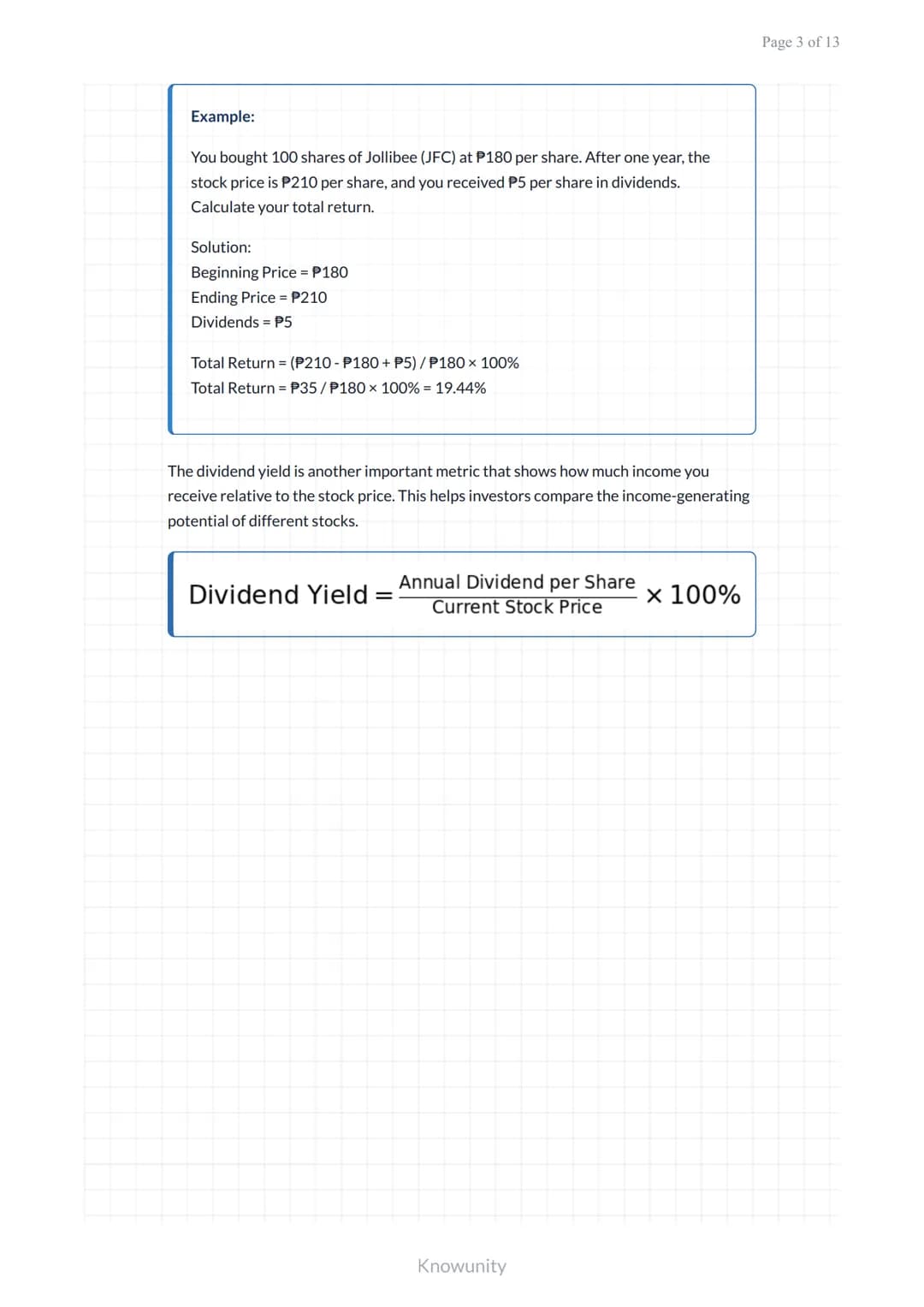
Let's see how stock returns work with real numbers. Imagine you bought 100 shares of a popular fast food company at £180 per share. After holding for a year, the stock price rose to £210, and you received £5 per share in dividends.

To calculate your total return

  • Beginning Price = £180
  • Ending Price = £210
  • Dividends = £5
  • Total Return = (£210 - £180 + £5) / £180 × 100%
  • Total Return = £35 / £180 × 100% = 19.44%

This 19.44% return is significantly better than you'd typically get from a savings account! Understanding these calculations helps you evaluate how well your investments are performing.

Another important metric is the dividend yield, which shows how much income a stock generates relative to its price

Dividend Yield = AnnualDividendperShare/CurrentStockPriceAnnual Dividend per Share / Current Stock Price × 100%

Dividend yield is particularly useful when comparing income-generating investments. It tells you what percentage return you're getting just from the dividends, ignoring any price changes.

Quick insight High-growth companies often pay little or no dividends as they reinvest profits, while established companies typically offer higher dividend yields to attract investors.

# Business Mathematics: Stocks, Bonds, and Investments

Learn to calculate returns, analyze investments, and understand financial markets

#

Bond Fundamentals and Calculations

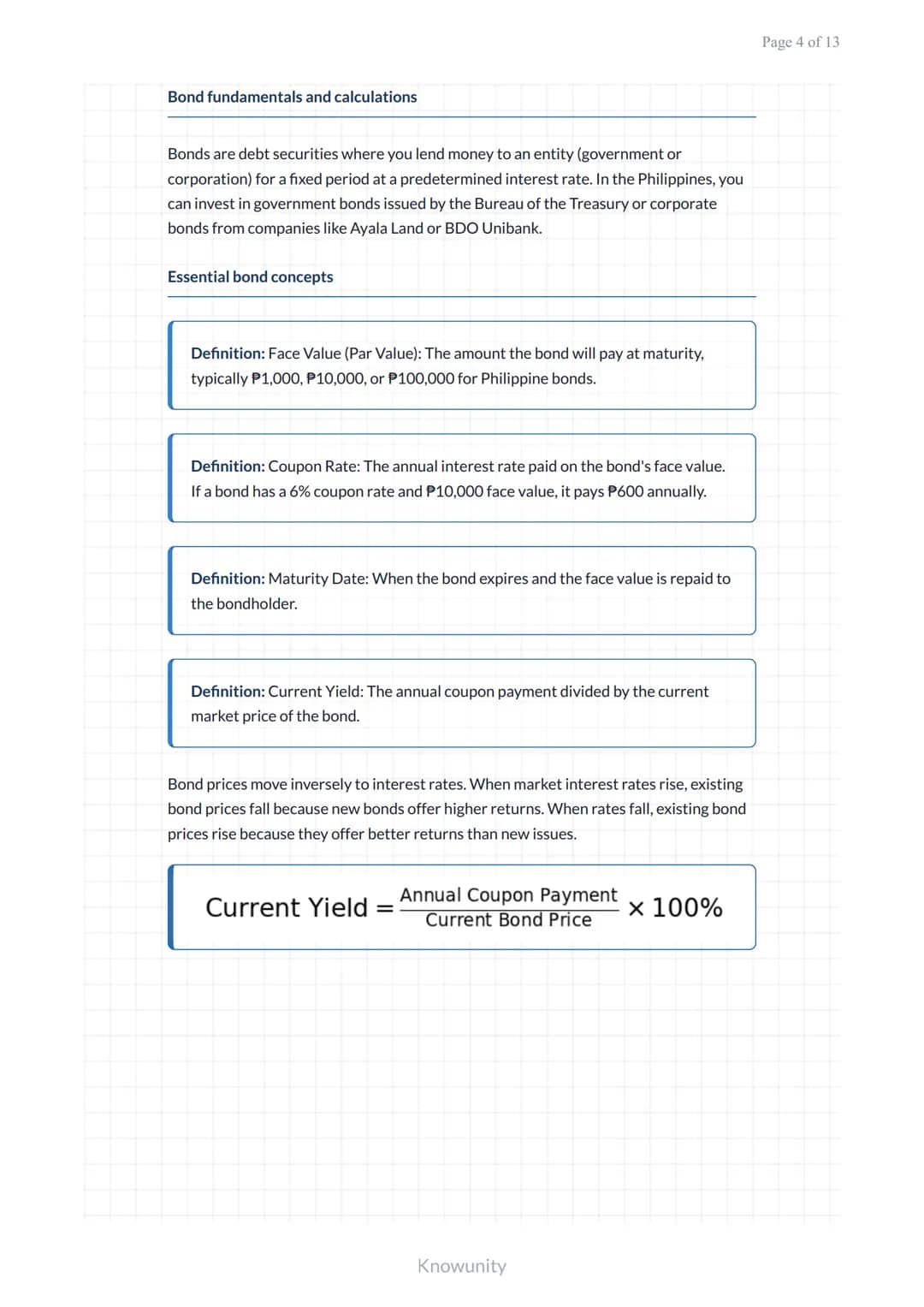
Bonds work differently from stocks—instead of buying ownership, you're lending money. When you purchase a bond, you're essentially becoming a creditor to the government or company that issued it.

Every bond has several key characteristics. The face value (or par value) is the amount you'll receive when the bond matures, typically £1,000 or more. The coupon rate is the interest percentage paid annually based on the face value. The maturity date tells you when you'll get your principal back. The current yield shows the actual return based on the market price.

One of the most important concepts in bond investing is the inverse relationship between bond prices and interest rates. When market interest rates rise, existing bond prices fall because newer bonds offer higher returns. When rates fall, existing bond prices rise because they offer better returns than newly issued bonds.

To calculate how much income a bond generates relative to its current price, use this formula Current Yield = AnnualCouponPayment/CurrentBondPriceAnnual Coupon Payment / Current Bond Price × 100%

This relationship between price and yield is crucial for understanding how bonds behave in different interest rate environments.

Real-world application During periods of falling interest rates, bondholders often see their investments increase in value, providing both income and potential capital gains.

# Business Mathematics: Stocks, Bonds, and Investments

Learn to calculate returns, analyze investments, and understand financial markets

#

Calculating Bond Yields

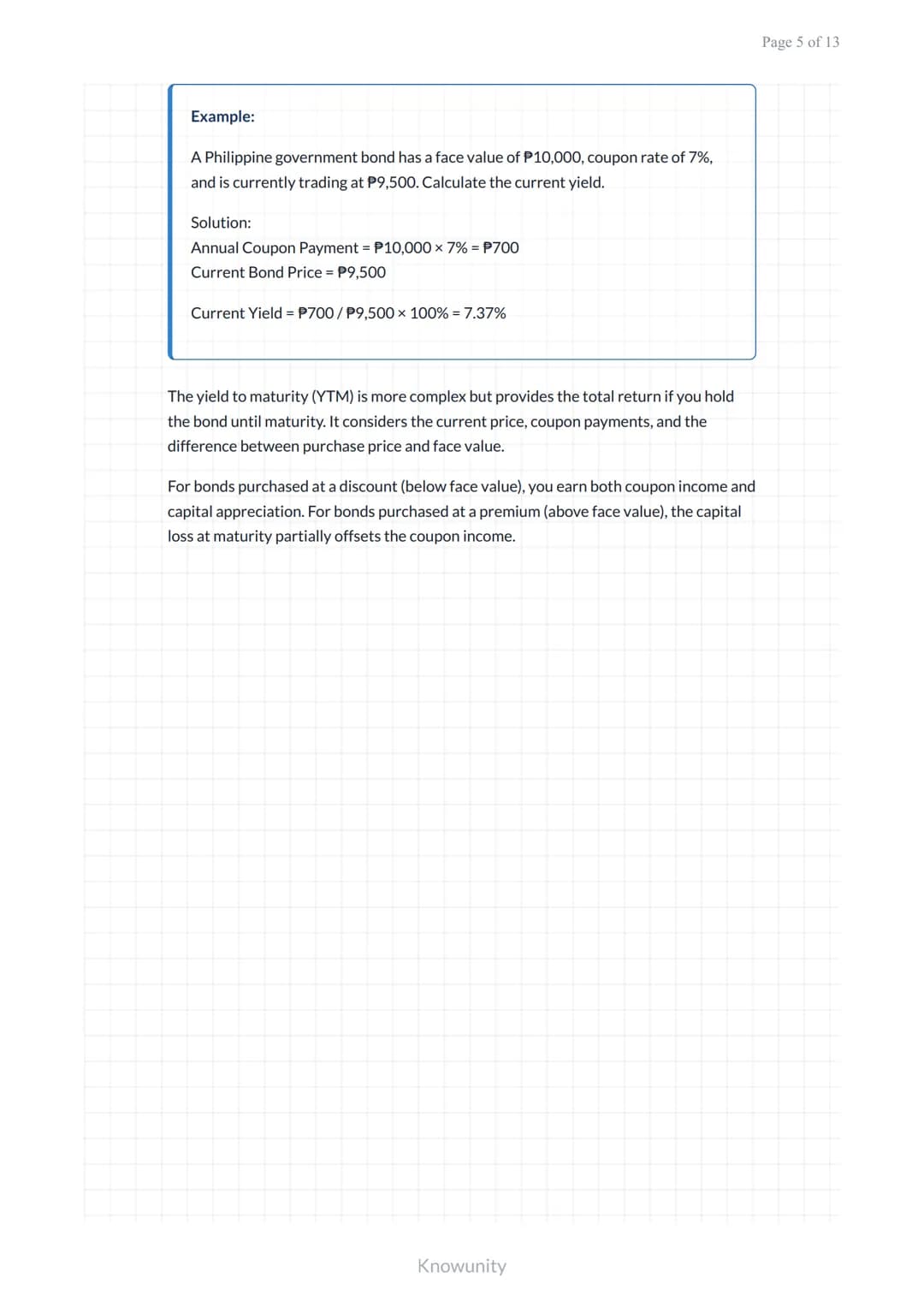
Let's work through a practical example of bond calculations. Imagine a government bond with a face value of £10,000 and a coupon rate of 7%. If it's currently trading at £9,500, what's the current yield?

First, calculate the annual coupon payment

  • Annual Coupon Payment = £10,000 × 7% = £700

Then, find the current yield

  • Current Yield = £700/£9,500 × 100% = 7.37%

Notice that the current yield (7.37%) is higher than the coupon rate (7%). This happens because the bond is trading at a discount—below its face value. When buying discounted bonds, you get both the regular interest payments and the potential price appreciation as the bond approaches maturity.

The more comprehensive measure of bond returns is the yield to maturity (YTM). This complex calculation considers the current price, coupon payments, and the difference between purchase price and face value. It represents the total return if you hold the bond until maturity.

For bonds purchased at a premium (above face value), the capital loss at maturity partially offsets the coupon income, affecting your overall return.

Remember A bond trading below face value (at a discount) offers a current yield higher than its coupon rate, which can be attractive in certain market conditions.

# Business Mathematics: Stocks, Bonds, and Investments

Learn to calculate returns, analyze investments, and understand financial markets

#

Investment Analysis and Compound Interest

Compound interest is often called the eighth wonder of the world—and for good reason! Unlike simple interest, compound interest earns returns on both your initial investment AND previously earned interest, creating exponential growth over time.

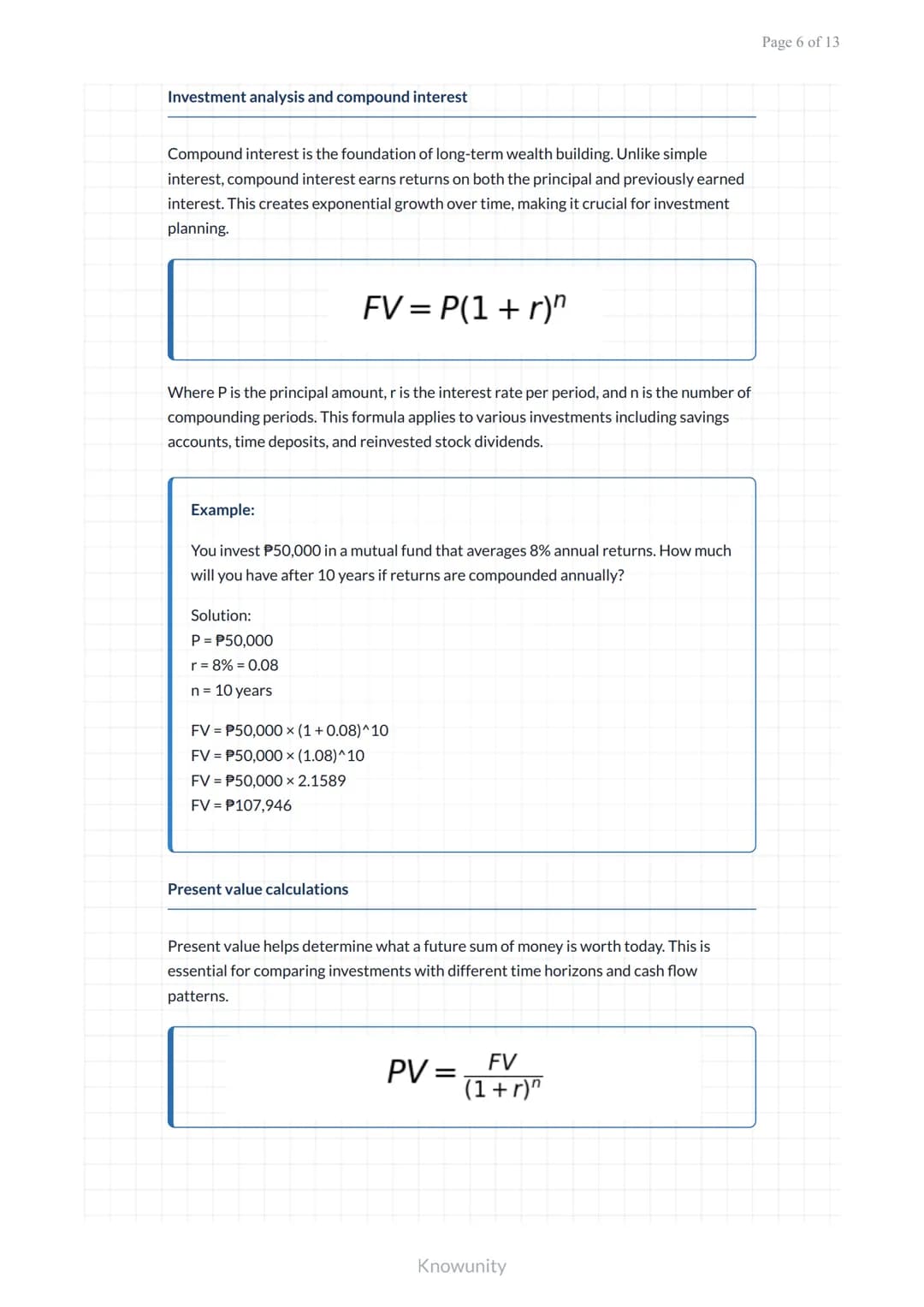
The formula for calculating compound interest is FV=P(1+r)nFV = P(1 + r)^n

Where P is your principal (starting amount), r is the interest rate per period, and n is the number of compounding periods. This simple but powerful formula is the foundation of wealth building.

Consider this example You invest £50,000 in a mutual fund averaging 8% annual returns. After 10 years with annual compounding, you'd have

  • FV = £50,000 × (1 + 0.08)^10
  • FV = £50,000 × 2.1589
  • FV = £107,946

That's an extra £57,946 without adding a single pound more to your initial investment!

For comparing investments with different time horizons, you need to understand present value. This calculation determines what a future sum of money is worth today PV=FV(1+r)nPV = \frac{FV}{(1+r)^n}

Present value helps you make apples-to-apples comparisons between different investment options with varying timeframes.

Eye-opening fact Thanks to compound interest, investing £10,000 at age 20 can yield more at retirement than £30,000 invested at age 40, even with the same interest rate!

# Business Mathematics: Stocks, Bonds, and Investments

Learn to calculate returns, analyze investments, and understand financial markets

#

Present Value and the Rule of 72

When making investment decisions, you often need to determine what a future payment is worth today. Let's work through an example

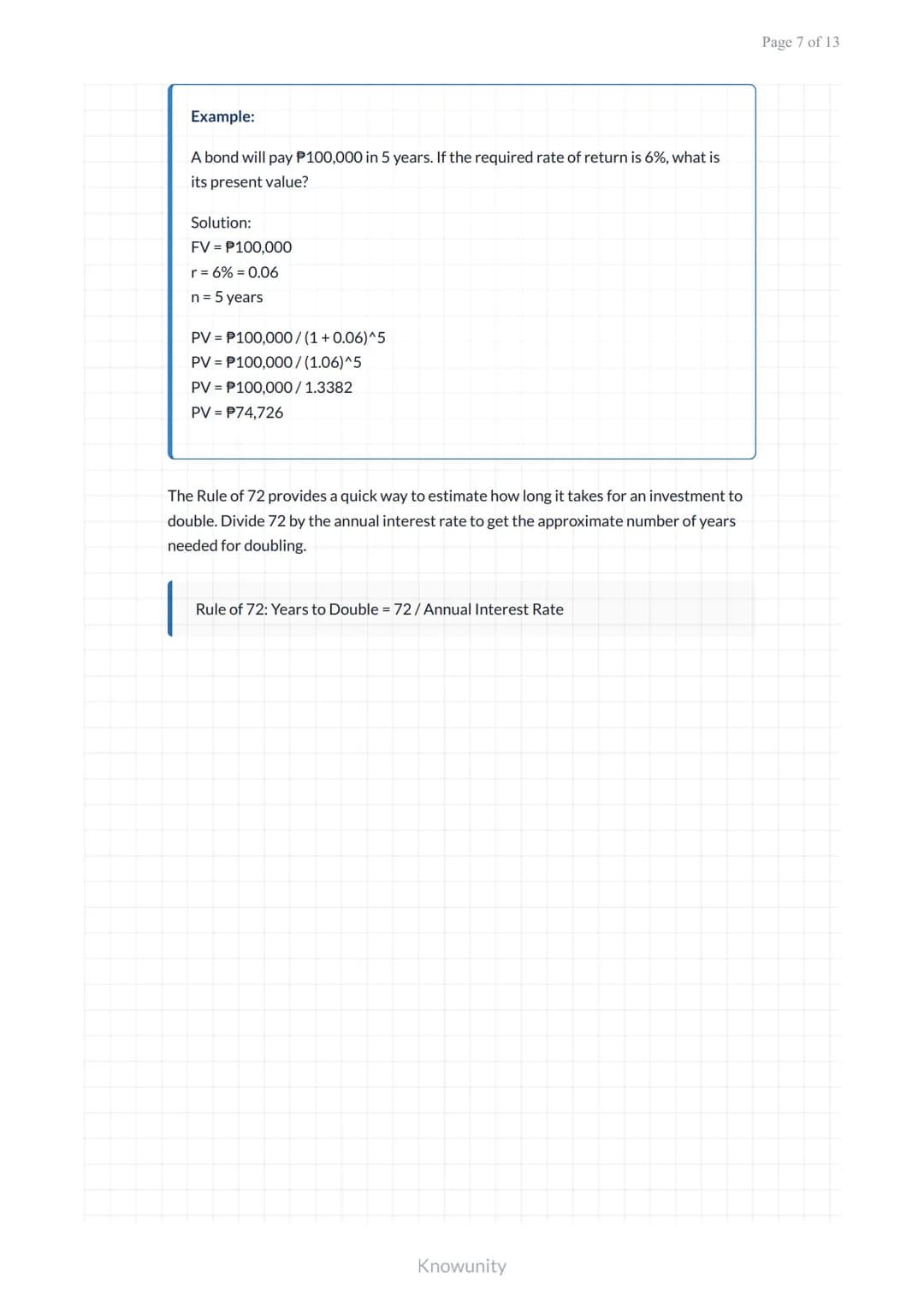
A bond will pay £100,000 in 5 years. If the required rate of return is 6%, what is its present value?

  • FV = £100,000
  • r = 6% = 0.06
  • n = 5 years
  • PV = £100,000/(1 + 0.06)^5
  • PV = £100,000/1.3382
  • PV = £74,726

This means you should pay no more than £74,726 today for an investment that will return £100,000 in 5 years, assuming a 6% required return. Present value calculations help you avoid overpaying for future cash flows.

A brilliant shortcut for investment planning is the Rule of 72. This mental math trick helps you quickly estimate how long it takes for an investment to double in value. Simply divide 72 by your annual interest rate

Years to Double = 72/Annual Interest Rate

For example, at 8% interest, your investment will double in approximately 72 ÷ 8 = 9 years. At 12% interest, it would take only 6 years to double. This rule helps you quickly compare growth rates without complex calculations.

Practical insight The Rule of 72 works in reverse too—if you want your money to double in 10 years, you need to earn approximately 72 ÷ 10 = 7.2% annually.

# Business Mathematics: Stocks, Bonds, and Investments

Learn to calculate returns, analyze investments, and understand financial markets

#

Annuities and Regular Investment Calculations

Most of us don't invest in lump sums—we save regularly from our income. These regular payments create what's known as an annuity. Understanding annuity calculations is crucial for retirement planning, mortgage payments, and investment strategies.

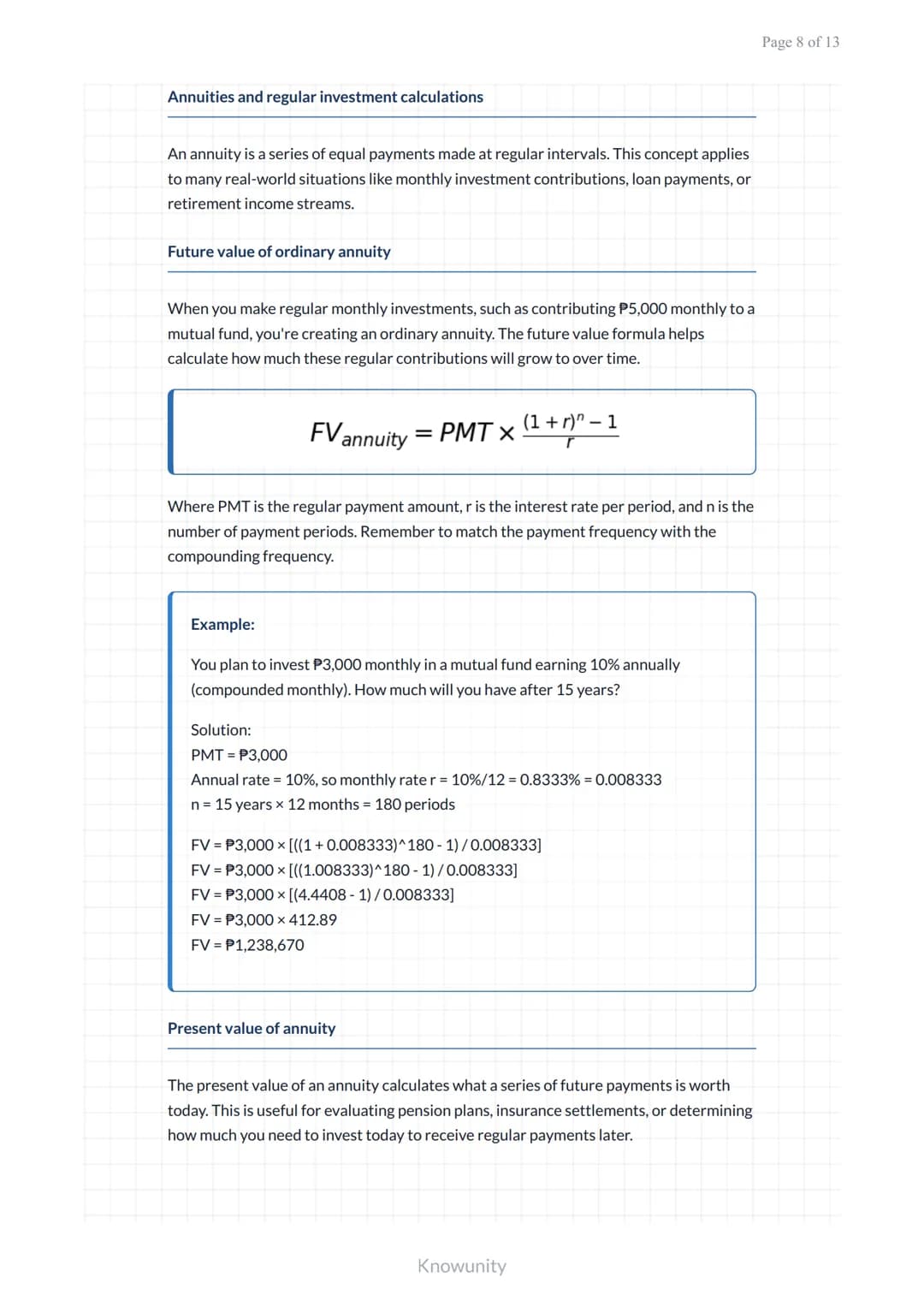
An ordinary annuity represents a series of equal payments made at regular intervals, like monthly mutual fund contributions. The future value formula for an annuity helps you calculate how much these regular investments will grow to over time

FV annuity = PMT × (1+r)n1(1+r)^n - 1/r

Where PMT is your regular payment amount, r is the interest rate per period, and n is the number of payment periods.

Let's see this in action You invest £3,000 monthly in a mutual fund earning 10% annually (compounded monthly) for 15 years.

  • Monthly rate = 10%/12 = 0.8333%
  • Number of periods = 15 years × 12 months = 180
  • FV = £3,000 × ((1.008333)1801)/0.008333((1.008333)^180 - 1)/0.008333
  • FV = £3,000 × 412.89
  • FV = £1,238,670

That's over £1.2 million from £3,000 monthly contributions! This demonstrates the incredible power of regular investing combined with compound growth.

Life-changing insight Starting small but consistent monthly investments can lead to surprisingly large sums over time due to the dual benefits of regular contributions and compound growth.

# Business Mathematics: Stocks, Bonds, and Investments

Learn to calculate returns, analyze investments, and understand financial markets

#

Present Value of Annuities

Sometimes you need to calculate what a series of future payments is worth today. This is the present value of an annuity, and it's essential for evaluating pensions, insurance settlements, or determining how much to invest now for future income.

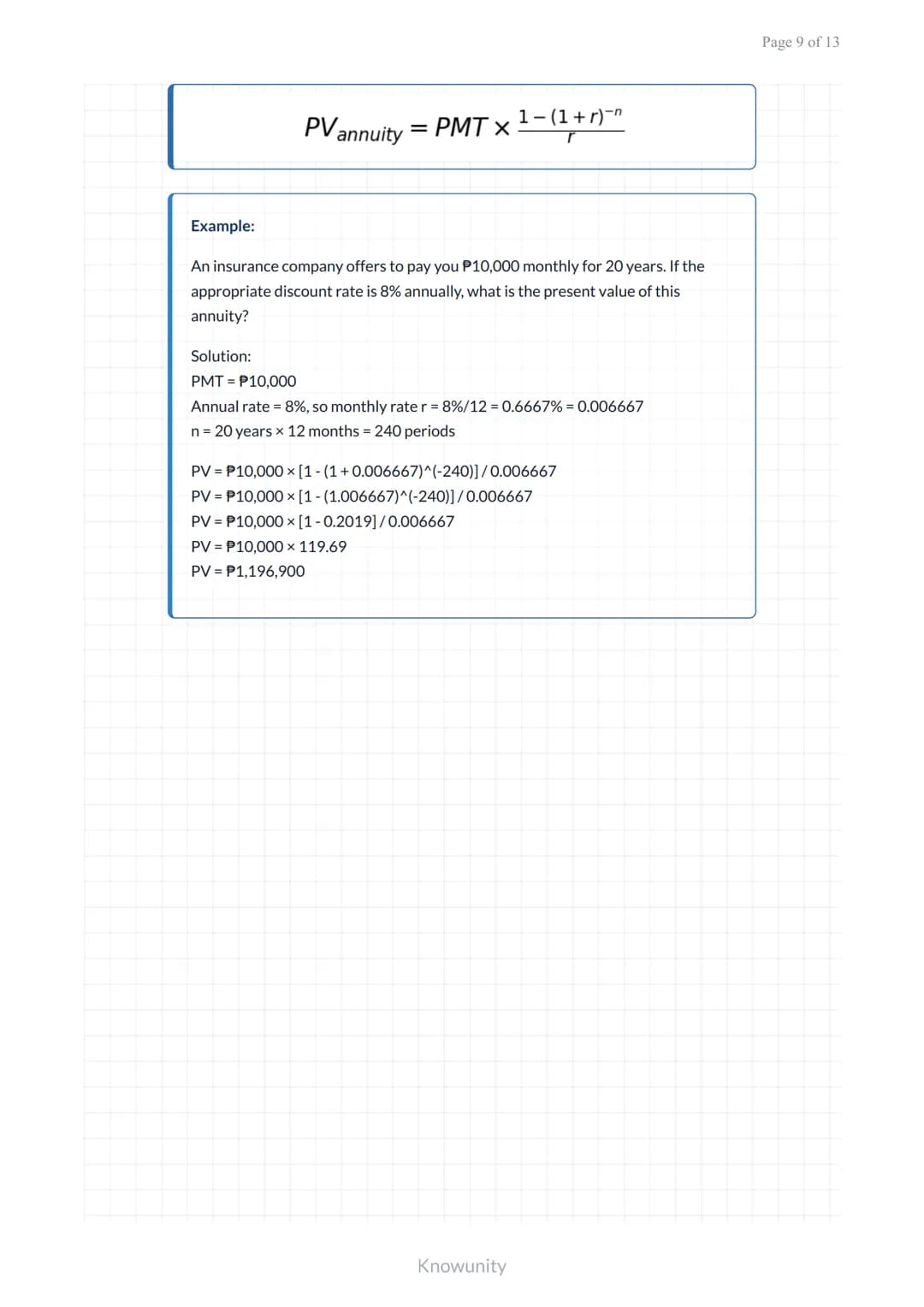
The formula is PV annuity = PMT × 1(1+r)(n)1−(1+r)^(−n)/r

Let's look at a practical example An insurance company offers to pay you £10,000 monthly for 20 years. If the discount rate is 8% annually, what is the present value?

  • Monthly rate = 8%/12 = 0.6667%
  • Number of periods = 20 years × 12 months = 240
  • PV = £10,000 × 1(1.006667)(240)1−(1.006667)^(−240)/0.006667
  • PV = £10,000 × 119.69
  • PV = £1,196,900

This means the insurance settlement is worth about £1.2 million in today's money. With this knowledge, you can compare it to other settlement options or investments to make the best financial decision.

Present value calculations help you make informed choices when faced with different payment options, like choosing between a lump sum or regular payments from a pension. They also help you determine how much to save today for specific future goals like university education or retirement.

Critical insight A stream of small regular payments over many years can be worth much more than you might expect. Always calculate the present value before accepting any long-term payment arrangement.

# Business Mathematics: Stocks, Bonds, and Investments

Learn to calculate returns, analyze investments, and understand financial markets

#

Risk Assessment and Portfolio Analysis

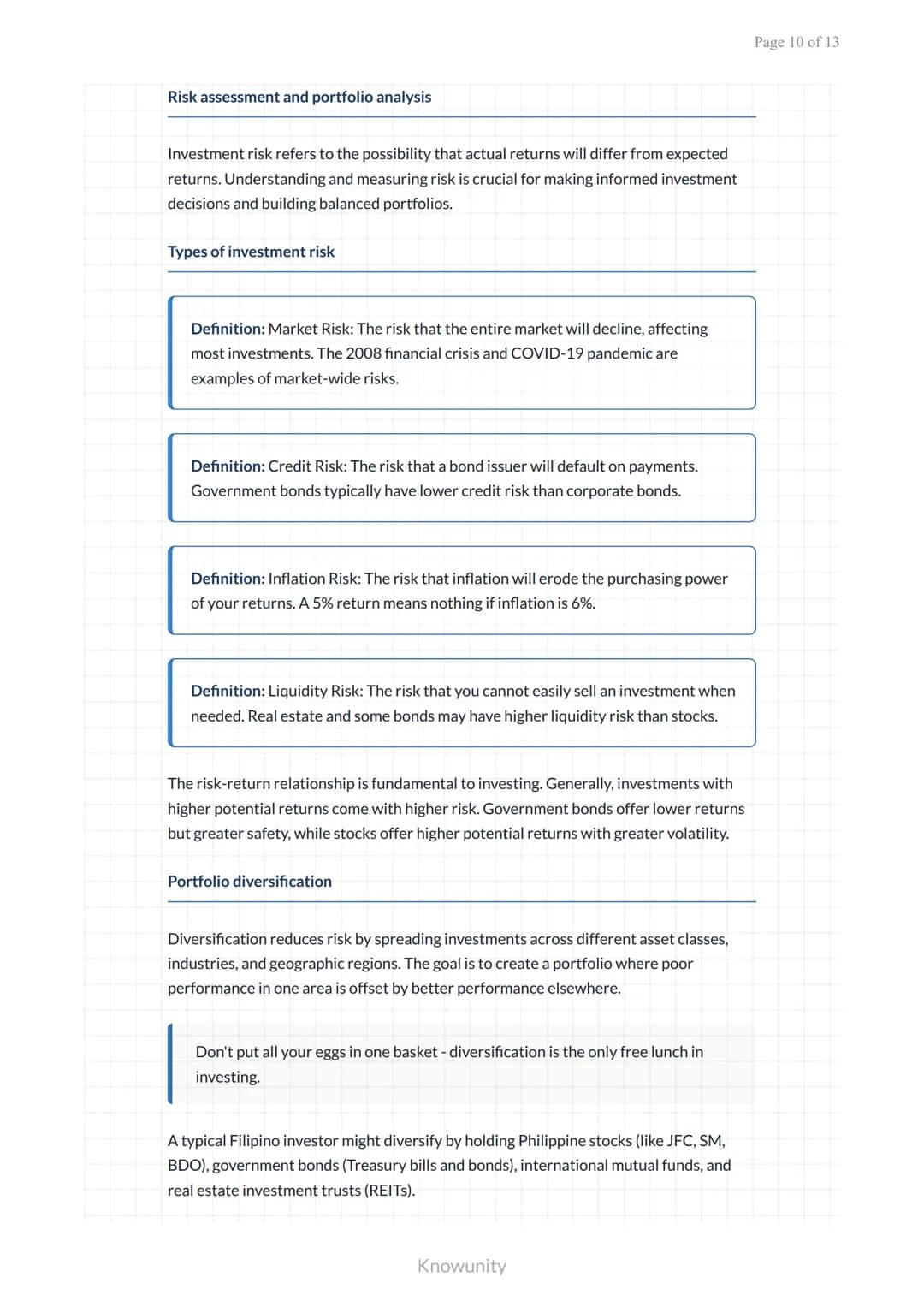
Every investment carries risk—the possibility that your actual returns will differ from what you expected. Understanding different types of risk is crucial for building a balanced investment strategy.

There are several important types of investment risk to consider. Market risk affects entire markets, like during the 2008 financial crisis. Credit risk is the chance that a bond issuer might default on payments. Inflation risk represents the erosion of purchasing power over time. Liquidity risk refers to how easily you can sell an investment when needed.

The fundamental principle of investing is the risk-return relationship higher potential returns typically come with higher risk. Government bonds offer safety but lower returns, while stocks offer higher potential returns with greater volatility.

Diversification is the investor's primary defense against excessive risk. By spreading your investments across different asset classes, industries, and geographic regions, you create a portfolio where poor performance in one area can be offset by better performance elsewhere. As the saying goes "Don't put all your eggs in one basket."

A well-diversified portfolio might include domestic stocks, government bonds, international investments, real estate investment trusts, and some cash equivalents. The specific mix depends on your personal goals, time horizon, and risk tolerance.

Smart strategy The most successful investors don't chase the highest returns—they seek the optimal balance between risk and return that helps them sleep at night while still reaching their financial goals.

We thought you’d never ask...

What is the Knowunity AI companion?

Our AI companion is specifically built for the needs of students. Based on the millions of content pieces we have on the platform we can provide truly meaningful and relevant answers to students. But its not only about answers, the companion is even more about guiding students through their daily learning challenges, with personalised study plans, quizzes or content pieces in the chat and 100% personalisation based on the students skills and developments.

Where can I download the Knowunity app?

You can download the app in the Google Play Store and in the Apple App Store.

Is Knowunity really free of charge?

That's right! Enjoy free access to study content, connect with fellow students, and get instant help – all at your fingertips.

0

Smart Tools NEW

Transform this note into: ✓ 50+ Practice Questions ✓ Interactive Flashcards ✓ Full Mock Exam ✓ Essay Outlines

Mock Exam
Quiz
Flashcards
Essay

Can't find what you're looking for? Explore other subjects.

Students love us — and so will you.

4.9/5

App Store

4.8/5

Google Play

The app is very easy to use and well designed. I have found everything I was looking for so far and have been able to learn a lot from the presentations! I will definitely use the app for a class assignment! And of course it also helps a lot as an inspiration.

Stefan S

iOS user

This app is really great. There are so many study notes and help [...]. My problem subject is French, for example, and the app has so many options for help. Thanks to this app, I have improved my French. I would recommend it to anyone.

Samantha Klich

Android user

Wow, I am really amazed. I just tried the app because I've seen it advertised many times and was absolutely stunned. This app is THE HELP you want for school and above all, it offers so many things, such as workouts and fact sheets, which have been VERY helpful to me personally.

Anna

iOS user

I think it’s very much worth it and you’ll end up using it a lot once you get the hang of it and even after looking at others notes you can still ask your Artificial intelligence buddy the question and ask to simplify it if you still don’t get it!!! In the end I think it’s worth it 😊👍 ⚠️Also DID I MENTION ITS FREEE YOU DON’T HAVE TO PAY FOR ANYTHING AND STILL GET YOUR GRADES IN PERFECTLY❗️❗️⚠️

Thomas R

iOS user

Knowunity is the BEST app I’ve used in a minute. This is not an ai review or anything this is genuinely coming from a 7th grade student (I know 2011 im young) but dude this app is a 10/10 i have maintained a 3.8 gpa and have plenty of time for gaming. I love it and my mom is just happy I got good grades

Brad T

Android user

Not only did it help me find the answer but it also showed me alternative ways to solve it. I was horrible in math and science but now I have an a in both subjects. Thanks for the help🤍🤍

David K

iOS user

The app's just great! All I have to do is enter the topic in the search bar and I get the response real fast. I don't have to watch 10 YouTube videos to understand something, so I'm saving my time. Highly recommended!

Sudenaz Ocak

Android user

In school I was really bad at maths but thanks to the app, I am doing better now. I am so grateful that you made the app.

Greenlight Bonnie

Android user

I found this app a couple years ago and it has only gotten better since then. I really love it because it can help with written questions and photo questions. Also, it can find study guides that other people have made as well as flashcard sets and practice tests. The free version is also amazing for students who might not be able to afford it. Would 100% recommend

Aubrey

iOS user

Best app if you're in Highschool or Junior high. I have been using this app for 2 school years and it's the best, it's good if you don't have anyone to help you with school work.😋🩷🎀

Marco B

iOS user

THE QUIZES AND FLASHCARDS ARE SO USEFUL AND I LOVE THE SCHOOLGPT. IT ALSO IS LITREALLY LIKE CHATGPT BUT SMARTER!! HELPED ME WITH MY MASCARA PROBLEMS TOO!! AS WELL AS MY REAL SUBJECTS ! DUHHH 😍😁😲🤑💗✨🎀😮

Elisha

iOS user

This app is phenomenal down to the correct info and the various topics you can study! I greatly recommend it for people who struggle with procrastination and those who need homework help. It has been perfectly accurate for world 1 history as far as I’ve seen! Geometry too!

Paul T

iOS user

The app is very easy to use and well designed. I have found everything I was looking for so far and have been able to learn a lot from the presentations! I will definitely use the app for a class assignment! And of course it also helps a lot as an inspiration.

Stefan S

iOS user

This app is really great. There are so many study notes and help [...]. My problem subject is French, for example, and the app has so many options for help. Thanks to this app, I have improved my French. I would recommend it to anyone.

Samantha Klich

Android user

Wow, I am really amazed. I just tried the app because I've seen it advertised many times and was absolutely stunned. This app is THE HELP you want for school and above all, it offers so many things, such as workouts and fact sheets, which have been VERY helpful to me personally.

Anna

iOS user

I think it’s very much worth it and you’ll end up using it a lot once you get the hang of it and even after looking at others notes you can still ask your Artificial intelligence buddy the question and ask to simplify it if you still don’t get it!!! In the end I think it’s worth it 😊👍 ⚠️Also DID I MENTION ITS FREEE YOU DON’T HAVE TO PAY FOR ANYTHING AND STILL GET YOUR GRADES IN PERFECTLY❗️❗️⚠️

Thomas R

iOS user

Knowunity is the BEST app I’ve used in a minute. This is not an ai review or anything this is genuinely coming from a 7th grade student (I know 2011 im young) but dude this app is a 10/10 i have maintained a 3.8 gpa and have plenty of time for gaming. I love it and my mom is just happy I got good grades

Brad T

Android user

Not only did it help me find the answer but it also showed me alternative ways to solve it. I was horrible in math and science but now I have an a in both subjects. Thanks for the help🤍🤍

David K

iOS user

The app's just great! All I have to do is enter the topic in the search bar and I get the response real fast. I don't have to watch 10 YouTube videos to understand something, so I'm saving my time. Highly recommended!

Sudenaz Ocak

Android user

In school I was really bad at maths but thanks to the app, I am doing better now. I am so grateful that you made the app.

Greenlight Bonnie

Android user

I found this app a couple years ago and it has only gotten better since then. I really love it because it can help with written questions and photo questions. Also, it can find study guides that other people have made as well as flashcard sets and practice tests. The free version is also amazing for students who might not be able to afford it. Would 100% recommend

Aubrey

iOS user

Best app if you're in Highschool or Junior high. I have been using this app for 2 school years and it's the best, it's good if you don't have anyone to help you with school work.😋🩷🎀

Marco B

iOS user

THE QUIZES AND FLASHCARDS ARE SO USEFUL AND I LOVE THE SCHOOLGPT. IT ALSO IS LITREALLY LIKE CHATGPT BUT SMARTER!! HELPED ME WITH MY MASCARA PROBLEMS TOO!! AS WELL AS MY REAL SUBJECTS ! DUHHH 😍😁😲🤑💗✨🎀😮

Elisha

iOS user

This app is phenomenal down to the correct info and the various topics you can study! I greatly recommend it for people who struggle with procrastination and those who need homework help. It has been perfectly accurate for world 1 history as far as I’ve seen! Geometry too!

Paul T

iOS user


GenMath

67

Dec 20, 2025

13 pages

Understanding Investments: Stocks, Bonds, and Financial Returns

user profile picture

Knowunity Philippines

@knowunityphilippines

Business Mathematics helps you unlock the world of financial investments through numbers. In this lesson, you'll learn how to calculate returns on stocks and bonds, analyze investment performance, and make informed financial decisions using mathematical tools that are essential for... Show more

# Business Mathematics: Stocks, Bonds, and Investments

Learn to calculate returns, analyze investments, and understand financial markets

#

Sign up to see the contentIt's free!

Access to all documents

Improve your grades

Join milions of students

By signing up you accept Terms of Service and Privacy Policy

Business Mathematics: Stocks, Bonds, and Investments

Ever wondered how people make money from the stock market? This lesson will show you exactly how to do the math behind smart investing. You'll gain practical skills to calculate exactly how much money you could make (or lose) when investing in stocks and bonds.

You'll master the calculations for stock returns and dividends, understand how bond values change with interest rates, and learn to analyze investment performance using key financial metrics. These skills will help you make informed decisions about where to put your money.

By the end of this lesson, you'll be able to compare different investment options mathematically and understand how compound interest can dramatically grow your wealth over time. These are real-world skills that can potentially help you build financial security for your future.

Pro tip: Financial mathematics isn't just academic—these calculations are used daily by investors to make decisions worth millions of pounds!

# Business Mathematics: Stocks, Bonds, and Investments

Learn to calculate returns, analyze investments, and understand financial markets

#

Sign up to see the contentIt's free!

Access to all documents

Improve your grades

Join milions of students

By signing up you accept Terms of Service and Privacy Policy

Understanding Stocks and Stock Calculations

When you buy stock, you're literally becoming a partial owner of a business. This ownership gives you the right to share in the company's profits and growth over time.

Stock terminology forms the foundation of investment analysis. The par value is the nominal value assigned when a stock is first issued, while the market price is what people are actually willing to pay for it right now (which changes constantly). Many companies pay dividends, which are regular payments to shareholders from the company's profits.

To understand how much you're really making on stocks, you need to calculate the total return. This formula combines both price changes and dividend income:

Total Return = EndingPriceBeginningPrice+DividendsEnding Price - Beginning Price + Dividends / Beginning Price × 100%

This calculation gives you the complete picture of your investment performance, showing both your capital gains from price increases and income from dividends. Knowing how to calculate this helps you compare different investment opportunities effectively.

Remember: Always consider both price appreciation AND dividends when evaluating stock performance—looking at just one gives an incomplete picture!

# Business Mathematics: Stocks, Bonds, and Investments

Learn to calculate returns, analyze investments, and understand financial markets

#

Sign up to see the contentIt's free!

Access to all documents

Improve your grades

Join milions of students

By signing up you accept Terms of Service and Privacy Policy

Stock Return Calculations in Practice

Let's see how stock returns work with real numbers. Imagine you bought 100 shares of a popular fast food company at £180 per share. After holding for a year, the stock price rose to £210, and you received £5 per share in dividends.

To calculate your total return:

  • Beginning Price = £180
  • Ending Price = £210
  • Dividends = £5
  • Total Return = (£210 - £180 + £5) / £180 × 100%
  • Total Return = £35 / £180 × 100% = 19.44%

This 19.44% return is significantly better than you'd typically get from a savings account! Understanding these calculations helps you evaluate how well your investments are performing.

Another important metric is the dividend yield, which shows how much income a stock generates relative to its price:

Dividend Yield = AnnualDividendperShare/CurrentStockPriceAnnual Dividend per Share / Current Stock Price × 100%

Dividend yield is particularly useful when comparing income-generating investments. It tells you what percentage return you're getting just from the dividends, ignoring any price changes.

Quick insight: High-growth companies often pay little or no dividends as they reinvest profits, while established companies typically offer higher dividend yields to attract investors.

# Business Mathematics: Stocks, Bonds, and Investments

Learn to calculate returns, analyze investments, and understand financial markets

#

Sign up to see the contentIt's free!

Access to all documents

Improve your grades

Join milions of students

By signing up you accept Terms of Service and Privacy Policy

Bond Fundamentals and Calculations

Bonds work differently from stocks—instead of buying ownership, you're lending money. When you purchase a bond, you're essentially becoming a creditor to the government or company that issued it.

Every bond has several key characteristics. The face value (or par value) is the amount you'll receive when the bond matures, typically £1,000 or more. The coupon rate is the interest percentage paid annually based on the face value. The maturity date tells you when you'll get your principal back. The current yield shows the actual return based on the market price.

One of the most important concepts in bond investing is the inverse relationship between bond prices and interest rates. When market interest rates rise, existing bond prices fall because newer bonds offer higher returns. When rates fall, existing bond prices rise because they offer better returns than newly issued bonds.

To calculate how much income a bond generates relative to its current price, use this formula: Current Yield = AnnualCouponPayment/CurrentBondPriceAnnual Coupon Payment / Current Bond Price × 100%

This relationship between price and yield is crucial for understanding how bonds behave in different interest rate environments.

Real-world application: During periods of falling interest rates, bondholders often see their investments increase in value, providing both income and potential capital gains.

# Business Mathematics: Stocks, Bonds, and Investments

Learn to calculate returns, analyze investments, and understand financial markets

#

Sign up to see the contentIt's free!

Access to all documents

Improve your grades

Join milions of students

By signing up you accept Terms of Service and Privacy Policy

Calculating Bond Yields

Let's work through a practical example of bond calculations. Imagine a government bond with a face value of £10,000 and a coupon rate of 7%. If it's currently trading at £9,500, what's the current yield?

First, calculate the annual coupon payment:

  • Annual Coupon Payment = £10,000 × 7% = £700

Then, find the current yield:

  • Current Yield = £700/£9,500 × 100% = 7.37%

Notice that the current yield (7.37%) is higher than the coupon rate (7%). This happens because the bond is trading at a discount—below its face value. When buying discounted bonds, you get both the regular interest payments and the potential price appreciation as the bond approaches maturity.

The more comprehensive measure of bond returns is the yield to maturity (YTM). This complex calculation considers the current price, coupon payments, and the difference between purchase price and face value. It represents the total return if you hold the bond until maturity.

For bonds purchased at a premium (above face value), the capital loss at maturity partially offsets the coupon income, affecting your overall return.

Remember: A bond trading below face value (at a discount) offers a current yield higher than its coupon rate, which can be attractive in certain market conditions.

# Business Mathematics: Stocks, Bonds, and Investments

Learn to calculate returns, analyze investments, and understand financial markets

#

Sign up to see the contentIt's free!

Access to all documents

Improve your grades

Join milions of students

By signing up you accept Terms of Service and Privacy Policy

Investment Analysis and Compound Interest

Compound interest is often called the eighth wonder of the world—and for good reason! Unlike simple interest, compound interest earns returns on both your initial investment AND previously earned interest, creating exponential growth over time.

The formula for calculating compound interest is: FV=P(1+r)nFV = P(1 + r)^n

Where P is your principal (starting amount), r is the interest rate per period, and n is the number of compounding periods. This simple but powerful formula is the foundation of wealth building.

Consider this example: You invest £50,000 in a mutual fund averaging 8% annual returns. After 10 years with annual compounding, you'd have:

  • FV = £50,000 × (1 + 0.08)^10
  • FV = £50,000 × 2.1589
  • FV = £107,946

That's an extra £57,946 without adding a single pound more to your initial investment!

For comparing investments with different time horizons, you need to understand present value. This calculation determines what a future sum of money is worth today: PV=FV(1+r)nPV = \frac{FV}{(1+r)^n}

Present value helps you make apples-to-apples comparisons between different investment options with varying timeframes.

Eye-opening fact: Thanks to compound interest, investing £10,000 at age 20 can yield more at retirement than £30,000 invested at age 40, even with the same interest rate!

# Business Mathematics: Stocks, Bonds, and Investments

Learn to calculate returns, analyze investments, and understand financial markets

#

Sign up to see the contentIt's free!

Access to all documents

Improve your grades

Join milions of students

By signing up you accept Terms of Service and Privacy Policy

Present Value and the Rule of 72

When making investment decisions, you often need to determine what a future payment is worth today. Let's work through an example:

A bond will pay £100,000 in 5 years. If the required rate of return is 6%, what is its present value?

  • FV = £100,000
  • r = 6% = 0.06
  • n = 5 years
  • PV = £100,000/(1 + 0.06)^5
  • PV = £100,000/1.3382
  • PV = £74,726

This means you should pay no more than £74,726 today for an investment that will return £100,000 in 5 years, assuming a 6% required return. Present value calculations help you avoid overpaying for future cash flows.

A brilliant shortcut for investment planning is the Rule of 72. This mental math trick helps you quickly estimate how long it takes for an investment to double in value. Simply divide 72 by your annual interest rate:

Years to Double = 72/Annual Interest Rate

For example, at 8% interest, your investment will double in approximately 72 ÷ 8 = 9 years. At 12% interest, it would take only 6 years to double. This rule helps you quickly compare growth rates without complex calculations.

Practical insight: The Rule of 72 works in reverse too—if you want your money to double in 10 years, you need to earn approximately 72 ÷ 10 = 7.2% annually.

# Business Mathematics: Stocks, Bonds, and Investments

Learn to calculate returns, analyze investments, and understand financial markets

#

Sign up to see the contentIt's free!

Access to all documents

Improve your grades

Join milions of students

By signing up you accept Terms of Service and Privacy Policy

Annuities and Regular Investment Calculations

Most of us don't invest in lump sums—we save regularly from our income. These regular payments create what's known as an annuity. Understanding annuity calculations is crucial for retirement planning, mortgage payments, and investment strategies.

An ordinary annuity represents a series of equal payments made at regular intervals, like monthly mutual fund contributions. The future value formula for an annuity helps you calculate how much these regular investments will grow to over time:

FV annuity = PMT × (1+r)n1(1+r)^n - 1/r

Where PMT is your regular payment amount, r is the interest rate per period, and n is the number of payment periods.

Let's see this in action: You invest £3,000 monthly in a mutual fund earning 10% annually (compounded monthly) for 15 years.

  • Monthly rate = 10%/12 = 0.8333%
  • Number of periods = 15 years × 12 months = 180
  • FV = £3,000 × ((1.008333)1801)/0.008333((1.008333)^180 - 1)/0.008333
  • FV = £3,000 × 412.89
  • FV = £1,238,670

That's over £1.2 million from £3,000 monthly contributions! This demonstrates the incredible power of regular investing combined with compound growth.

Life-changing insight: Starting small but consistent monthly investments can lead to surprisingly large sums over time due to the dual benefits of regular contributions and compound growth.

# Business Mathematics: Stocks, Bonds, and Investments

Learn to calculate returns, analyze investments, and understand financial markets

#

Sign up to see the contentIt's free!

Access to all documents

Improve your grades

Join milions of students

By signing up you accept Terms of Service and Privacy Policy

Present Value of Annuities

Sometimes you need to calculate what a series of future payments is worth today. This is the present value of an annuity, and it's essential for evaluating pensions, insurance settlements, or determining how much to invest now for future income.

The formula is: PV annuity = PMT × 1(1+r)(n)1−(1+r)^(−n)/r

Let's look at a practical example: An insurance company offers to pay you £10,000 monthly for 20 years. If the discount rate is 8% annually, what is the present value?

  • Monthly rate = 8%/12 = 0.6667%
  • Number of periods = 20 years × 12 months = 240
  • PV = £10,000 × 1(1.006667)(240)1−(1.006667)^(−240)/0.006667
  • PV = £10,000 × 119.69
  • PV = £1,196,900

This means the insurance settlement is worth about £1.2 million in today's money. With this knowledge, you can compare it to other settlement options or investments to make the best financial decision.

Present value calculations help you make informed choices when faced with different payment options, like choosing between a lump sum or regular payments from a pension. They also help you determine how much to save today for specific future goals like university education or retirement.

Critical insight: A stream of small regular payments over many years can be worth much more than you might expect. Always calculate the present value before accepting any long-term payment arrangement.

# Business Mathematics: Stocks, Bonds, and Investments

Learn to calculate returns, analyze investments, and understand financial markets

#

Sign up to see the contentIt's free!

Access to all documents

Improve your grades

Join milions of students

By signing up you accept Terms of Service and Privacy Policy

Risk Assessment and Portfolio Analysis

Every investment carries risk—the possibility that your actual returns will differ from what you expected. Understanding different types of risk is crucial for building a balanced investment strategy.

There are several important types of investment risk to consider. Market risk affects entire markets, like during the 2008 financial crisis. Credit risk is the chance that a bond issuer might default on payments. Inflation risk represents the erosion of purchasing power over time. Liquidity risk refers to how easily you can sell an investment when needed.

The fundamental principle of investing is the risk-return relationship: higher potential returns typically come with higher risk. Government bonds offer safety but lower returns, while stocks offer higher potential returns with greater volatility.

Diversification is the investor's primary defense against excessive risk. By spreading your investments across different asset classes, industries, and geographic regions, you create a portfolio where poor performance in one area can be offset by better performance elsewhere. As the saying goes: "Don't put all your eggs in one basket."

A well-diversified portfolio might include domestic stocks, government bonds, international investments, real estate investment trusts, and some cash equivalents. The specific mix depends on your personal goals, time horizon, and risk tolerance.

Smart strategy: The most successful investors don't chase the highest returns—they seek the optimal balance between risk and return that helps them sleep at night while still reaching their financial goals.

We thought you’d never ask...

What is the Knowunity AI companion?

Our AI companion is specifically built for the needs of students. Based on the millions of content pieces we have on the platform we can provide truly meaningful and relevant answers to students. But its not only about answers, the companion is even more about guiding students through their daily learning challenges, with personalised study plans, quizzes or content pieces in the chat and 100% personalisation based on the students skills and developments.

Where can I download the Knowunity app?

You can download the app in the Google Play Store and in the Apple App Store.

Is Knowunity really free of charge?

That's right! Enjoy free access to study content, connect with fellow students, and get instant help – all at your fingertips.

0

Smart Tools NEW

Transform this note into: ✓ 50+ Practice Questions ✓ Interactive Flashcards ✓ Full Mock Exam ✓ Essay Outlines

Mock Exam
Quiz
Flashcards
Essay

Can't find what you're looking for? Explore other subjects.

Students love us — and so will you.

4.9/5

App Store

4.8/5

Google Play

The app is very easy to use and well designed. I have found everything I was looking for so far and have been able to learn a lot from the presentations! I will definitely use the app for a class assignment! And of course it also helps a lot as an inspiration.

Stefan S

iOS user

This app is really great. There are so many study notes and help [...]. My problem subject is French, for example, and the app has so many options for help. Thanks to this app, I have improved my French. I would recommend it to anyone.

Samantha Klich

Android user

Wow, I am really amazed. I just tried the app because I've seen it advertised many times and was absolutely stunned. This app is THE HELP you want for school and above all, it offers so many things, such as workouts and fact sheets, which have been VERY helpful to me personally.

Anna

iOS user

I think it’s very much worth it and you’ll end up using it a lot once you get the hang of it and even after looking at others notes you can still ask your Artificial intelligence buddy the question and ask to simplify it if you still don’t get it!!! In the end I think it’s worth it 😊👍 ⚠️Also DID I MENTION ITS FREEE YOU DON’T HAVE TO PAY FOR ANYTHING AND STILL GET YOUR GRADES IN PERFECTLY❗️❗️⚠️

Thomas R

iOS user

Knowunity is the BEST app I’ve used in a minute. This is not an ai review or anything this is genuinely coming from a 7th grade student (I know 2011 im young) but dude this app is a 10/10 i have maintained a 3.8 gpa and have plenty of time for gaming. I love it and my mom is just happy I got good grades

Brad T

Android user

Not only did it help me find the answer but it also showed me alternative ways to solve it. I was horrible in math and science but now I have an a in both subjects. Thanks for the help🤍🤍

David K

iOS user

The app's just great! All I have to do is enter the topic in the search bar and I get the response real fast. I don't have to watch 10 YouTube videos to understand something, so I'm saving my time. Highly recommended!

Sudenaz Ocak

Android user

In school I was really bad at maths but thanks to the app, I am doing better now. I am so grateful that you made the app.

Greenlight Bonnie

Android user

I found this app a couple years ago and it has only gotten better since then. I really love it because it can help with written questions and photo questions. Also, it can find study guides that other people have made as well as flashcard sets and practice tests. The free version is also amazing for students who might not be able to afford it. Would 100% recommend

Aubrey

iOS user

Best app if you're in Highschool or Junior high. I have been using this app for 2 school years and it's the best, it's good if you don't have anyone to help you with school work.😋🩷🎀

Marco B

iOS user

THE QUIZES AND FLASHCARDS ARE SO USEFUL AND I LOVE THE SCHOOLGPT. IT ALSO IS LITREALLY LIKE CHATGPT BUT SMARTER!! HELPED ME WITH MY MASCARA PROBLEMS TOO!! AS WELL AS MY REAL SUBJECTS ! DUHHH 😍😁😲🤑💗✨🎀😮

Elisha

iOS user

This app is phenomenal down to the correct info and the various topics you can study! I greatly recommend it for people who struggle with procrastination and those who need homework help. It has been perfectly accurate for world 1 history as far as I’ve seen! Geometry too!

Paul T

iOS user

The app is very easy to use and well designed. I have found everything I was looking for so far and have been able to learn a lot from the presentations! I will definitely use the app for a class assignment! And of course it also helps a lot as an inspiration.

Stefan S

iOS user

This app is really great. There are so many study notes and help [...]. My problem subject is French, for example, and the app has so many options for help. Thanks to this app, I have improved my French. I would recommend it to anyone.

Samantha Klich

Android user

Wow, I am really amazed. I just tried the app because I've seen it advertised many times and was absolutely stunned. This app is THE HELP you want for school and above all, it offers so many things, such as workouts and fact sheets, which have been VERY helpful to me personally.

Anna

iOS user

I think it’s very much worth it and you’ll end up using it a lot once you get the hang of it and even after looking at others notes you can still ask your Artificial intelligence buddy the question and ask to simplify it if you still don’t get it!!! In the end I think it’s worth it 😊👍 ⚠️Also DID I MENTION ITS FREEE YOU DON’T HAVE TO PAY FOR ANYTHING AND STILL GET YOUR GRADES IN PERFECTLY❗️❗️⚠️

Thomas R

iOS user

Knowunity is the BEST app I’ve used in a minute. This is not an ai review or anything this is genuinely coming from a 7th grade student (I know 2011 im young) but dude this app is a 10/10 i have maintained a 3.8 gpa and have plenty of time for gaming. I love it and my mom is just happy I got good grades

Brad T

Android user

Not only did it help me find the answer but it also showed me alternative ways to solve it. I was horrible in math and science but now I have an a in both subjects. Thanks for the help🤍🤍

David K

iOS user

The app's just great! All I have to do is enter the topic in the search bar and I get the response real fast. I don't have to watch 10 YouTube videos to understand something, so I'm saving my time. Highly recommended!

Sudenaz Ocak

Android user

In school I was really bad at maths but thanks to the app, I am doing better now. I am so grateful that you made the app.

Greenlight Bonnie

Android user

I found this app a couple years ago and it has only gotten better since then. I really love it because it can help with written questions and photo questions. Also, it can find study guides that other people have made as well as flashcard sets and practice tests. The free version is also amazing for students who might not be able to afford it. Would 100% recommend

Aubrey

iOS user

Best app if you're in Highschool or Junior high. I have been using this app for 2 school years and it's the best, it's good if you don't have anyone to help you with school work.😋🩷🎀

Marco B

iOS user

THE QUIZES AND FLASHCARDS ARE SO USEFUL AND I LOVE THE SCHOOLGPT. IT ALSO IS LITREALLY LIKE CHATGPT BUT SMARTER!! HELPED ME WITH MY MASCARA PROBLEMS TOO!! AS WELL AS MY REAL SUBJECTS ! DUHHH 😍😁😲🤑💗✨🎀😮

Elisha

iOS user

This app is phenomenal down to the correct info and the various topics you can study! I greatly recommend it for people who struggle with procrastination and those who need homework help. It has been perfectly accurate for world 1 history as far as I’ve seen! Geometry too!

Paul T

iOS user