
Ever wondered what the ground beneath your feet is made... Show more
 Geography
 Irish
Irish English
 Biology
Sign up to see the contentIt's free!
Access to all documents
Improve your grades
Join milions of students
Knowunity AI
Subjects
Triangle Congruence and Similarity Theorems
Triangle Properties and Classification
Linear Equations and Graphs
Geometric Angle Relationships
Trigonometric Functions and Identities
Equation Solving Techniques
Circle Geometry Fundamentals
Division Operations and Methods
Basic Differentiation Rules
Exponent and Logarithm Properties
Show all topics
Human Organ Systems
Reproductive Cell Cycles
Biological Sciences Subdisciplines
Cellular Energy Metabolism
Autotrophic Energy Processes
Inheritance Patterns and Principles
Biomolecular Structure and Organization
Cell Cycle and Division Mechanics
Cellular Organization and Development
Biological Structural Organization
Show all topics
Chemical Sciences and Applications
Atomic Structure and Composition
Molecular Electron Structure Representation
Atomic Electron Behavior
Matter Properties and Water
Mole Concept and Calculations
Gas Laws and Behavior
Periodic Table Organization
Chemical Thermodynamics Fundamentals
Chemical Bond Types and Properties
Show all topics
European Renaissance and Enlightenment
European Cultural Movements 800-1920
American Revolution Era 1763-1797
American Civil War 1861-1865
Global Imperial Systems
Mongol and Chinese Dynasties
U.S. Presidents and World Leaders
Historical Sources and Documentation
World Wars Era and Impact
World Religious Systems
Show all topics
Classic and Contemporary Novels
Literary Character Analysis
Rhetorical Theory and Practice
Classic Literary Narratives
Reading Analysis and Interpretation
Narrative Structure and Techniques
English Language Components
Influential English-Language Authors
Basic Sentence Structure
Narrative Voice and Perspective
Show all topics
4
•
Updated Apr 15, 2026
•
Ever wondered what the ground beneath your feet is made... Show more
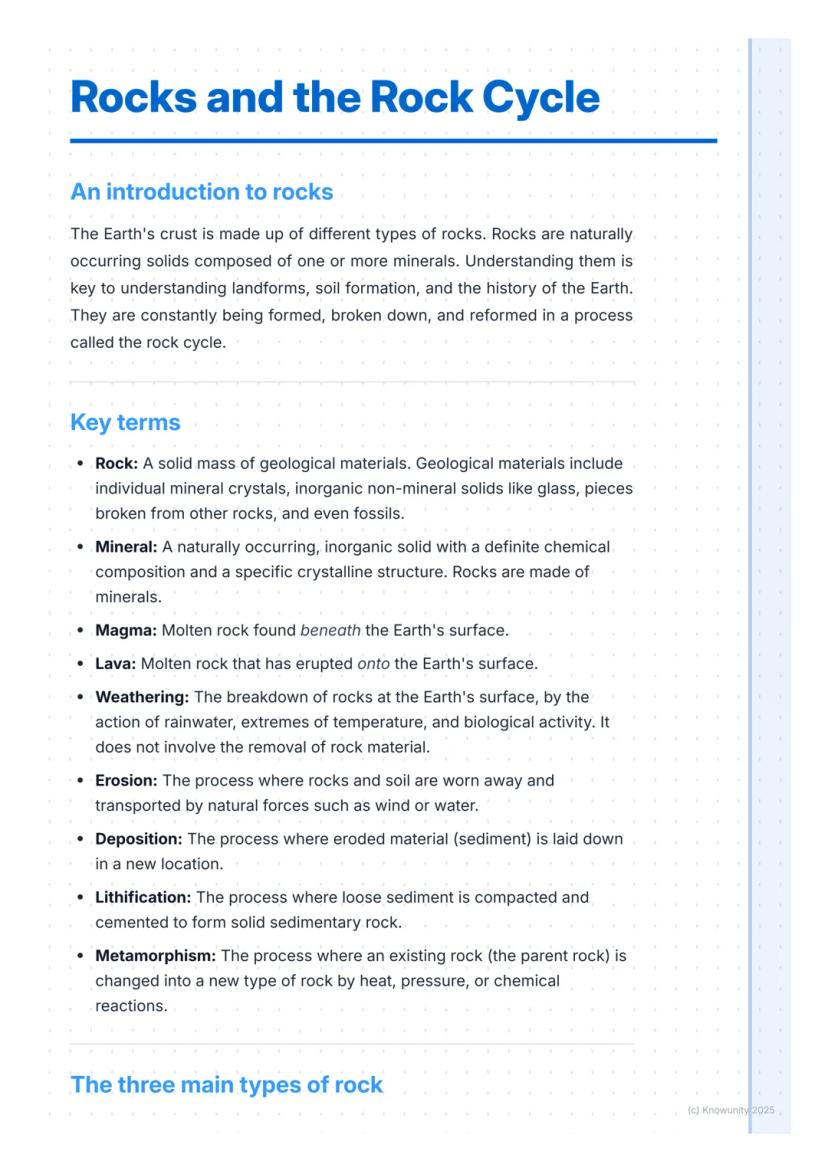

Rocks are everywhere around you – from the Cliffs of Moher to the pavements in Dublin. They're naturally occurring solids made up of minerals, which are like the building blocks of rocks. Think of minerals as ingredients and rocks as the finished recipe.
The most important thing to grasp is that rocks never stay the same forever. They're constantly being formed, broken down, and reformed through the rock cycle. This means the granite in Wicklow could eventually become sand on a beach, then turn into sandstone, and maybe even melt back into magma deep underground.
You'll need to know the difference between magma (molten rock underground) and lava (molten rock that's erupted onto the surface). Also remember that weathering breaks rocks down where they are, whilst erosion actually moves the broken pieces somewhere else.
Top Tip: Don't just memorise definitions – think about how these processes connect to create the Irish landscapes you know!
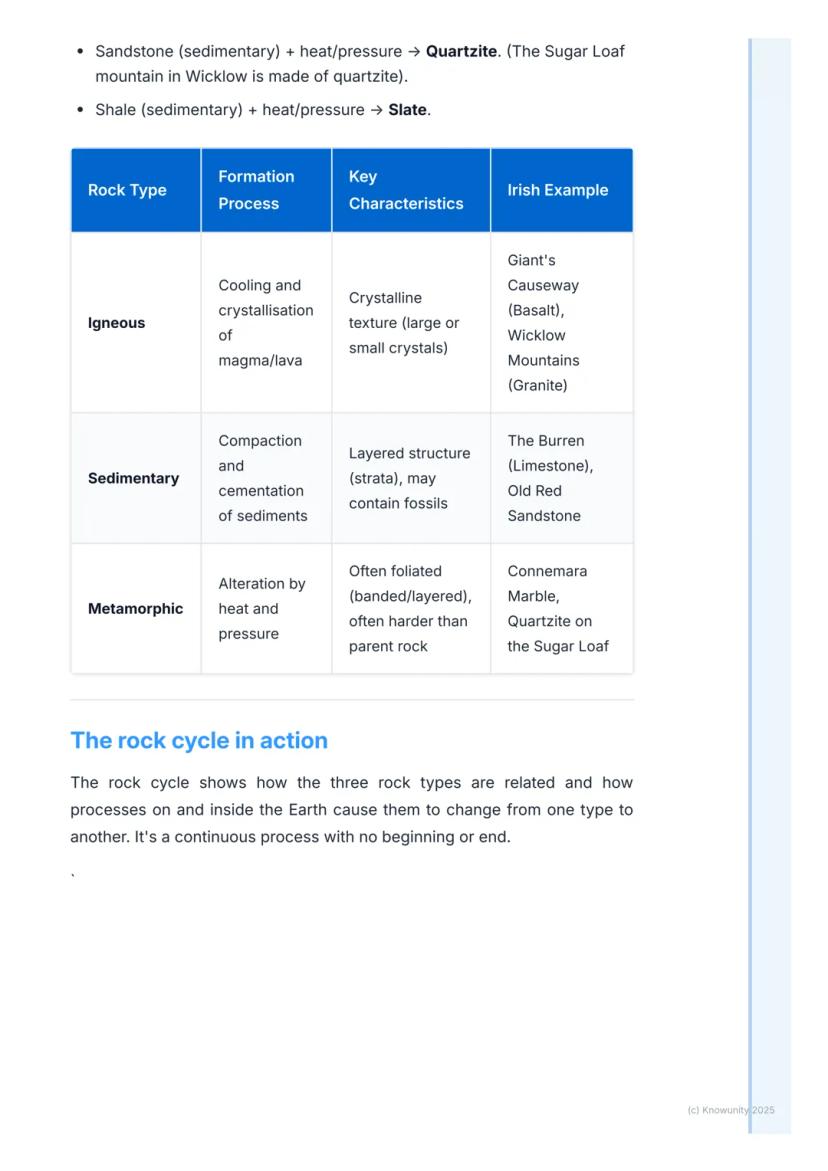
There are three main types of rocks, and they're classified by how they formed – not what they look like. Each type tells a different story about Earth's processes.
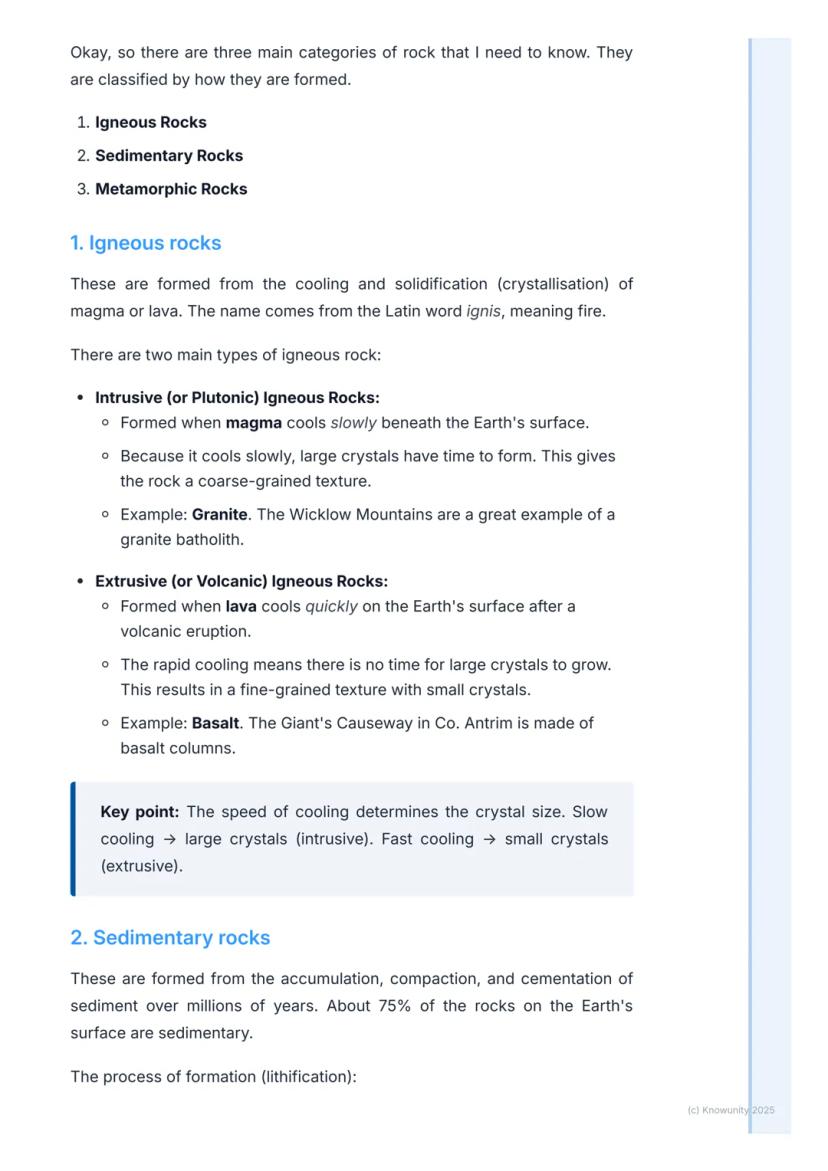
Igneous rocks form when magma or lava cools down. The key thing here is cooling speed. If magma cools slowly underground, you get large crystals (like granite in the Wicklow Mountains). If lava cools quickly on the surface, you get small crystals (like basalt at the Giant's Causeway). Remember: slow cooling = big crystals, fast cooling = tiny crystals.
Sedimentary rocks are like nature's recycling project. They form when bits of other rocks (sediment) get squashed and glued together over millions of years. About 75% of rocks on Earth's surface are sedimentary, which makes sense when you think about it – they form on the surface where we can see them.
The formation process is straightforward: weathering breaks down rocks, erosion moves the pieces, deposition drops them in layers, then compaction and cementation turn them into solid rock.
Remember: Only sedimentary rocks contain fossils – the heat and pressure that create other rock types would destroy any fossil remains.
Sedimentary rocks come in three flavours based on what they're made from. Clastic rocks like sandstone are made from rock fragments. Organic rocks like limestone come from dead sea creatures (the Burren is a massive limestone pavement). Chemical rocks form when minerals crystallise out of water.
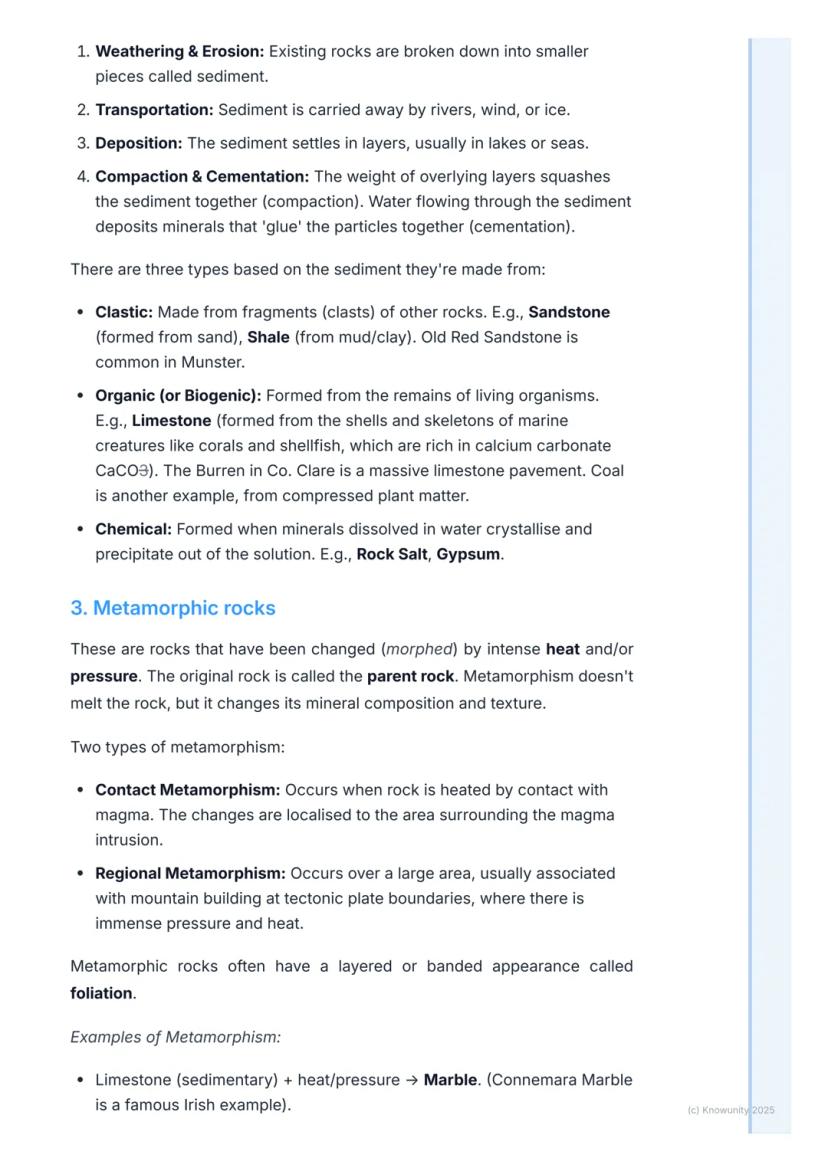
Metamorphic rocks are the shapeshifters of the rock world. They start as one type of rock (the parent rock) and get transformed by intense heat and pressure – but not enough to melt them completely. Think of it like baking a cake that changes texture and appearance but doesn't turn into liquid.
There are two ways this happens: contact metamorphism (rock gets heated by nearby magma) and regional metamorphism (huge areas get squashed during mountain building). The results often have a layered or banded appearance called foliation.
The transformations are pretty predictable: limestone becomes marble (like Connemara marble), sandstone becomes quartzite (like the Sugar Loaf mountain), and shale becomes slate.
Exam Tip: Learn the Irish examples – examiners love when you can connect geology to local landmarks!
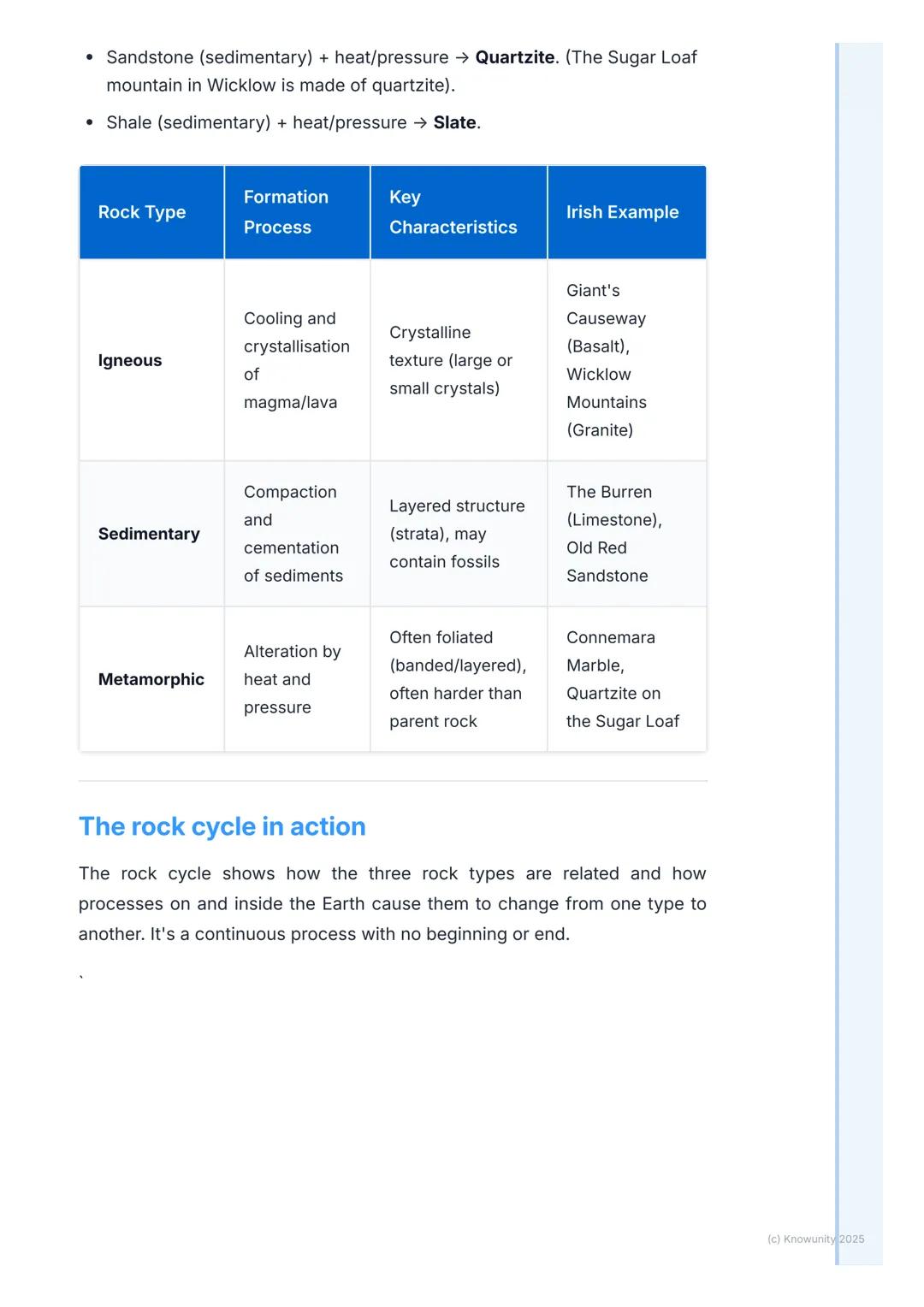
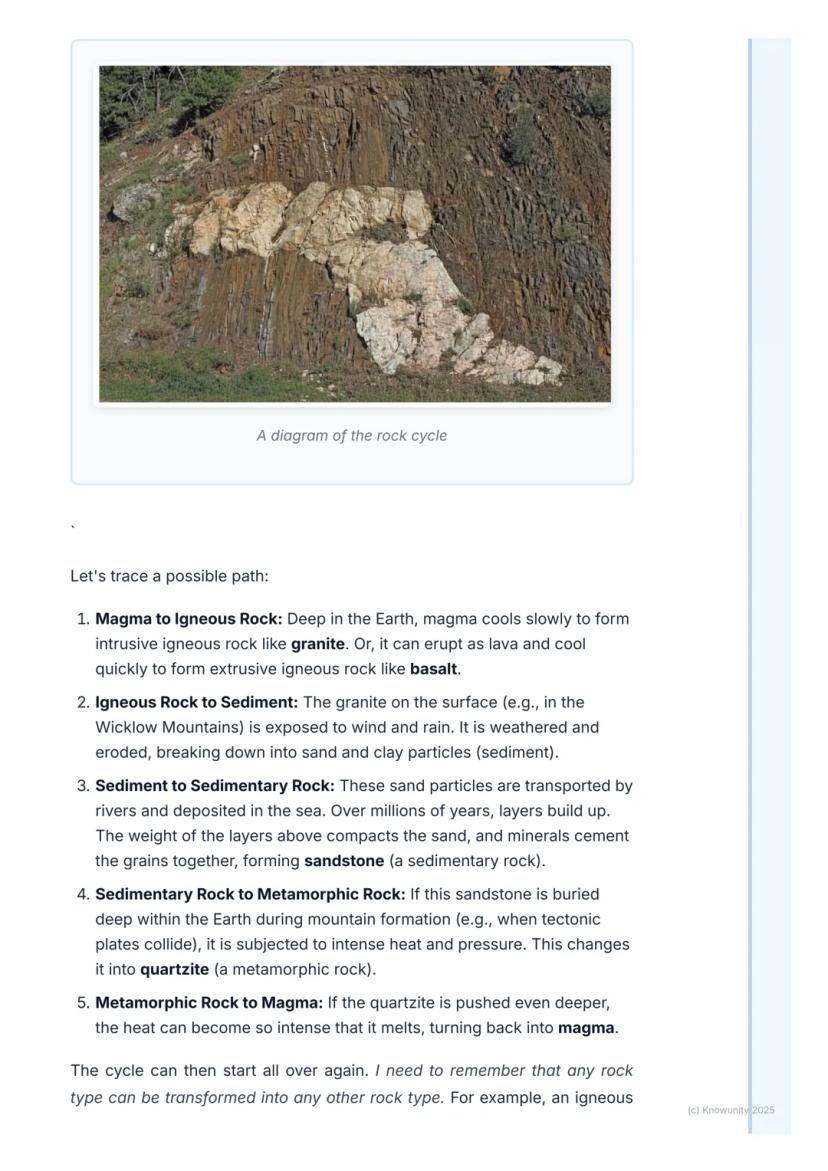
The rock cycle is like a giant recycling system with no beginning or end. Any rock type can transform into any other rock type – that's the beauty of it. A piece of granite could become sand, then sandstone, then quartzite, then melt back into magma.
Here's a typical journey: magma cools to form granite, which gets weathered into sand grains. These grains get deposited in layers and cemented into sandstone. If the sandstone gets buried deep during mountain formation, heat and pressure transform it into quartzite. Push it deeper still, and it melts back into magma.
The whole system is powered by two energy sources: heat from Earth's core (which drives melting and plate movement) and energy from the sun (which powers weather and erosion). Without these energy sources, the rock cycle would grind to a halt.
What's brilliant about this is that it explains why we see such diverse landscapes in Ireland – from volcanic basalt in Antrim to limestone pavements in Clare to granite mountains in Wicklow.
Key Point: The rock cycle connects all three rock types – understanding it helps you see the big picture of how Earth works.
Let's follow a specific example through the cycle to make it real. Imagine starting with magma deep in Earth's crust. This magma slowly cools to form granite, like what you see in the Wicklow Mountains today.
Wind and rain start attacking this granite through weathering, breaking it down into sand and clay particles. Rivers carry this sediment away (erosion) and dump it in the sea (deposition). Over millions of years, layers build up on the seabed.
The weight of new layers squashes the sand grains together (compaction), whilst minerals in seawater cement them into solid sandstone. This is lithification in action – turning loose sediment into solid rock.
If this sandstone gets caught up in mountain building (when tectonic plates crash together), it experiences intense heat and pressure. This metamorphism transforms it into quartzite – a much harder, crystalline rock.
Reality Check: These processes take millions of years, but they're happening right now around you – rocks in your local area are slowly weathering and changing.
Here's what trips up most students: confusing weathering with erosion. Weathering breaks rock down in place (like a statue crumbling), whilst erosion moves the broken pieces somewhere else (like a river carrying sand).
Crystal size in igneous rocks tells you everything about how they formed. Large crystals mean slow cooling underground (intrusive), small crystals mean fast cooling on the surface (extrusive). This is your key to identification.
Remember that magma is underground, lava is above ground – this determines whether you get intrusive or extrusive igneous rock. Also, only sedimentary rocks contain fossils because the heat and pressure that form other rock types destroy fossil remains.
For the exam, nail your Irish examples: Giant's Causeway (basalt), Wicklow Mountains (granite), the Burren (limestone), and Connemara marble. Examiners love local connections because they show you understand how geology applies to the real world.
Success Strategy: Don't just memorise – understand the processes and you'll be able to tackle any question they throw at you.

Three rock types: Igneous , Sedimentary (from compacted sediment), Metamorphic . Each tells a different story about Earth's processes.
The rock cycle connects everything – any rock can become any other rock through processes like melting, cooling, weathering, erosion, and metamorphism. It's powered by Earth's internal heat and energy from the sun.
Key processes: Weathering breaks down, erosion transports, deposition drops sediment in layers, compaction and cementation create sedimentary rocks, and metamorphism transforms existing rocks without melting them completely.
This system explains Ireland's diverse landscapes and continues shaping them today. The rocks beneath your feet have incredible stories to tell if you know how to read them.
Final Thought: Geology isn't just about memorising rock names – it's about understanding the dynamic planet we live on!
Our AI companion is specifically built for the needs of students. Based on the millions of content pieces we have on the platform we can provide truly meaningful and relevant answers to students. But its not only about answers, the companion is even more about guiding students through their daily learning challenges, with personalised study plans, quizzes or content pieces in the chat and 100% personalisation based on the students skills and developments.
You can download the app in the Google Play Store and in the Apple App Store.
That's right! Enjoy free access to study content, connect with fellow students, and get instant help – all at your fingertips.
App Store
Google Play
The app is very easy to use and well designed. I have found everything I was looking for so far and have been able to learn a lot from the presentations! I will definitely use the app for a class assignment! And of course it also helps a lot as an inspiration.
Stefan S
iOS user
This app is really great. There are so many study notes and help [...]. My problem subject is French, for example, and the app has so many options for help. Thanks to this app, I have improved my French. I would recommend it to anyone.
Samantha Klich
Android user
Wow, I am really amazed. I just tried the app because I've seen it advertised many times and was absolutely stunned. This app is THE HELP you want for school and above all, it offers so many things, such as workouts and fact sheets, which have been VERY helpful to me personally.
Anna
iOS user
I think it’s very much worth it and you’ll end up using it a lot once you get the hang of it and even after looking at others notes you can still ask your Artificial intelligence buddy the question and ask to simplify it if you still don’t get it!!! In the end I think it’s worth it 😊👍 ⚠️Also DID I MENTION ITS FREEE YOU DON’T HAVE TO PAY FOR ANYTHING AND STILL GET YOUR GRADES IN PERFECTLY❗️❗️⚠️
Thomas R
iOS user
Knowunity is the BEST app I’ve used in a minute. This is not an ai review or anything this is genuinely coming from a 7th grade student (I know 2011 im young) but dude this app is a 10/10 i have maintained a 3.8 gpa and have plenty of time for gaming. I love it and my mom is just happy I got good grades
Brad T
Android user
Not only did it help me find the answer but it also showed me alternative ways to solve it. I was horrible in math and science but now I have an a in both subjects. Thanks for the help🤍🤍
David K
iOS user
The app's just great! All I have to do is enter the topic in the search bar and I get the response real fast. I don't have to watch 10 YouTube videos to understand something, so I'm saving my time. Highly recommended!
Sudenaz Ocak
Android user
In school I was really bad at maths but thanks to the app, I am doing better now. I am so grateful that you made the app.
Greenlight Bonnie
Android user
I found this app a couple years ago and it has only gotten better since then. I really love it because it can help with written questions and photo questions. Also, it can find study guides that other people have made as well as flashcard sets and practice tests. The free version is also amazing for students who might not be able to afford it. Would 100% recommend
Aubrey
iOS user
Best app if you're in Highschool or Junior high. I have been using this app for 2 school years and it's the best, it's good if you don't have anyone to help you with school work.😋🩷🎀
Marco B
iOS user
THE QUIZES AND FLASHCARDS ARE SO USEFUL AND I LOVE Knowunity AI. IT ALSO IS LITREALLY LIKE CHATGPT BUT SMARTER!! HELPED ME WITH MY MASCARA PROBLEMS TOO!! AS WELL AS MY REAL SUBJECTS ! DUHHH 😍😁😲🤑💗✨🎀😮
Elisha
iOS user
This app is phenomenal down to the correct info and the various topics you can study! I greatly recommend it for people who struggle with procrastination and those who need homework help. It has been perfectly accurate for world 1 history as far as I’ve seen! Geometry too!
Paul T
iOS user
The app is very easy to use and well designed. I have found everything I was looking for so far and have been able to learn a lot from the presentations! I will definitely use the app for a class assignment! And of course it also helps a lot as an inspiration.
Stefan S
iOS user
This app is really great. There are so many study notes and help [...]. My problem subject is French, for example, and the app has so many options for help. Thanks to this app, I have improved my French. I would recommend it to anyone.
Samantha Klich
Android user
Wow, I am really amazed. I just tried the app because I've seen it advertised many times and was absolutely stunned. This app is THE HELP you want for school and above all, it offers so many things, such as workouts and fact sheets, which have been VERY helpful to me personally.
Anna
iOS user
I think it’s very much worth it and you’ll end up using it a lot once you get the hang of it and even after looking at others notes you can still ask your Artificial intelligence buddy the question and ask to simplify it if you still don’t get it!!! In the end I think it’s worth it 😊👍 ⚠️Also DID I MENTION ITS FREEE YOU DON’T HAVE TO PAY FOR ANYTHING AND STILL GET YOUR GRADES IN PERFECTLY❗️❗️⚠️
Thomas R
iOS user
Knowunity is the BEST app I’ve used in a minute. This is not an ai review or anything this is genuinely coming from a 7th grade student (I know 2011 im young) but dude this app is a 10/10 i have maintained a 3.8 gpa and have plenty of time for gaming. I love it and my mom is just happy I got good grades
Brad T
Android user
Not only did it help me find the answer but it also showed me alternative ways to solve it. I was horrible in math and science but now I have an a in both subjects. Thanks for the help🤍🤍
David K
iOS user
The app's just great! All I have to do is enter the topic in the search bar and I get the response real fast. I don't have to watch 10 YouTube videos to understand something, so I'm saving my time. Highly recommended!
Sudenaz Ocak
Android user
In school I was really bad at maths but thanks to the app, I am doing better now. I am so grateful that you made the app.
Greenlight Bonnie
Android user
I found this app a couple years ago and it has only gotten better since then. I really love it because it can help with written questions and photo questions. Also, it can find study guides that other people have made as well as flashcard sets and practice tests. The free version is also amazing for students who might not be able to afford it. Would 100% recommend
Aubrey
iOS user
Best app if you're in Highschool or Junior high. I have been using this app for 2 school years and it's the best, it's good if you don't have anyone to help you with school work.😋🩷🎀
Marco B
iOS user
THE QUIZES AND FLASHCARDS ARE SO USEFUL AND I LOVE Knowunity AI. IT ALSO IS LITREALLY LIKE CHATGPT BUT SMARTER!! HELPED ME WITH MY MASCARA PROBLEMS TOO!! AS WELL AS MY REAL SUBJECTS ! DUHHH 😍😁😲🤑💗✨🎀😮
Elisha
iOS user
This app is phenomenal down to the correct info and the various topics you can study! I greatly recommend it for people who struggle with procrastination and those who need homework help. It has been perfectly accurate for world 1 history as far as I’ve seen! Geometry too!
Paul T
iOS user
Ever wondered what the ground beneath your feet is made of? The Earth's crust is constantly changing through an amazing process called the rock cycle, where rocks transform from one type to another over millions of years. Understanding rocks... Show more
Access to all documents
Improve your grades
Join milions of students
Rocks are everywhere around you – from the Cliffs of Moher to the pavements in Dublin. They're naturally occurring solids made up of minerals, which are like the building blocks of rocks. Think of minerals as ingredients and rocks as the finished recipe.
The most important thing to grasp is that rocks never stay the same forever. They're constantly being formed, broken down, and reformed through the rock cycle. This means the granite in Wicklow could eventually become sand on a beach, then turn into sandstone, and maybe even melt back into magma deep underground.
You'll need to know the difference between magma (molten rock underground) and lava (molten rock that's erupted onto the surface). Also remember that weathering breaks rocks down where they are, whilst erosion actually moves the broken pieces somewhere else.
Top Tip: Don't just memorise definitions – think about how these processes connect to create the Irish landscapes you know!
Access to all documents
Improve your grades
Join milions of students
There are three main types of rocks, and they're classified by how they formed – not what they look like. Each type tells a different story about Earth's processes.
Igneous rocks form when magma or lava cools down. The key thing here is cooling speed. If magma cools slowly underground, you get large crystals (like granite in the Wicklow Mountains). If lava cools quickly on the surface, you get small crystals (like basalt at the Giant's Causeway). Remember: slow cooling = big crystals, fast cooling = tiny crystals.
Sedimentary rocks are like nature's recycling project. They form when bits of other rocks (sediment) get squashed and glued together over millions of years. About 75% of rocks on Earth's surface are sedimentary, which makes sense when you think about it – they form on the surface where we can see them.
The formation process is straightforward: weathering breaks down rocks, erosion moves the pieces, deposition drops them in layers, then compaction and cementation turn them into solid rock.
Remember: Only sedimentary rocks contain fossils – the heat and pressure that create other rock types would destroy any fossil remains.
Access to all documents
Improve your grades
Join milions of students
Sedimentary rocks come in three flavours based on what they're made from. Clastic rocks like sandstone are made from rock fragments. Organic rocks like limestone come from dead sea creatures (the Burren is a massive limestone pavement). Chemical rocks form when minerals crystallise out of water.
Metamorphic rocks are the shapeshifters of the rock world. They start as one type of rock (the parent rock) and get transformed by intense heat and pressure – but not enough to melt them completely. Think of it like baking a cake that changes texture and appearance but doesn't turn into liquid.
There are two ways this happens: contact metamorphism (rock gets heated by nearby magma) and regional metamorphism (huge areas get squashed during mountain building). The results often have a layered or banded appearance called foliation.
The transformations are pretty predictable: limestone becomes marble (like Connemara marble), sandstone becomes quartzite (like the Sugar Loaf mountain), and shale becomes slate.
Exam Tip: Learn the Irish examples – examiners love when you can connect geology to local landmarks!
Access to all documents
Improve your grades
Join milions of students
The rock cycle is like a giant recycling system with no beginning or end. Any rock type can transform into any other rock type – that's the beauty of it. A piece of granite could become sand, then sandstone, then quartzite, then melt back into magma.
Here's a typical journey: magma cools to form granite, which gets weathered into sand grains. These grains get deposited in layers and cemented into sandstone. If the sandstone gets buried deep during mountain formation, heat and pressure transform it into quartzite. Push it deeper still, and it melts back into magma.
The whole system is powered by two energy sources: heat from Earth's core (which drives melting and plate movement) and energy from the sun (which powers weather and erosion). Without these energy sources, the rock cycle would grind to a halt.
What's brilliant about this is that it explains why we see such diverse landscapes in Ireland – from volcanic basalt in Antrim to limestone pavements in Clare to granite mountains in Wicklow.
Key Point: The rock cycle connects all three rock types – understanding it helps you see the big picture of how Earth works.
Access to all documents
Improve your grades
Join milions of students
Let's follow a specific example through the cycle to make it real. Imagine starting with magma deep in Earth's crust. This magma slowly cools to form granite, like what you see in the Wicklow Mountains today.
Wind and rain start attacking this granite through weathering, breaking it down into sand and clay particles. Rivers carry this sediment away (erosion) and dump it in the sea (deposition). Over millions of years, layers build up on the seabed.
The weight of new layers squashes the sand grains together (compaction), whilst minerals in seawater cement them into solid sandstone. This is lithification in action – turning loose sediment into solid rock.
If this sandstone gets caught up in mountain building (when tectonic plates crash together), it experiences intense heat and pressure. This metamorphism transforms it into quartzite – a much harder, crystalline rock.
Reality Check: These processes take millions of years, but they're happening right now around you – rocks in your local area are slowly weathering and changing.
Access to all documents
Improve your grades
Join milions of students
Here's what trips up most students: confusing weathering with erosion. Weathering breaks rock down in place (like a statue crumbling), whilst erosion moves the broken pieces somewhere else (like a river carrying sand).
Crystal size in igneous rocks tells you everything about how they formed. Large crystals mean slow cooling underground (intrusive), small crystals mean fast cooling on the surface (extrusive). This is your key to identification.
Remember that magma is underground, lava is above ground – this determines whether you get intrusive or extrusive igneous rock. Also, only sedimentary rocks contain fossils because the heat and pressure that form other rock types destroy fossil remains.
For the exam, nail your Irish examples: Giant's Causeway (basalt), Wicklow Mountains (granite), the Burren (limestone), and Connemara marble. Examiners love local connections because they show you understand how geology applies to the real world.
Success Strategy: Don't just memorise – understand the processes and you'll be able to tackle any question they throw at you.
Access to all documents
Improve your grades
Join milions of students
Three rock types: Igneous , Sedimentary (from compacted sediment), Metamorphic . Each tells a different story about Earth's processes.
The rock cycle connects everything – any rock can become any other rock through processes like melting, cooling, weathering, erosion, and metamorphism. It's powered by Earth's internal heat and energy from the sun.
Key processes: Weathering breaks down, erosion transports, deposition drops sediment in layers, compaction and cementation create sedimentary rocks, and metamorphism transforms existing rocks without melting them completely.
This system explains Ireland's diverse landscapes and continues shaping them today. The rocks beneath your feet have incredible stories to tell if you know how to read them.
Final Thought: Geology isn't just about memorising rock names – it's about understanding the dynamic planet we live on!
Our AI companion is specifically built for the needs of students. Based on the millions of content pieces we have on the platform we can provide truly meaningful and relevant answers to students. But its not only about answers, the companion is even more about guiding students through their daily learning challenges, with personalised study plans, quizzes or content pieces in the chat and 100% personalisation based on the students skills and developments.
You can download the app in the Google Play Store and in the Apple App Store.
That's right! Enjoy free access to study content, connect with fellow students, and get instant help – all at your fingertips.
0
Smart Tools NEW
Transform this note into: ✓ 50+ Practice Questions ✓ Interactive Flashcards ✓ Full Practice Test ✓ Essay Outlines
App Store
Google Play
The app is very easy to use and well designed. I have found everything I was looking for so far and have been able to learn a lot from the presentations! I will definitely use the app for a class assignment! And of course it also helps a lot as an inspiration.
Stefan S
iOS user
This app is really great. There are so many study notes and help [...]. My problem subject is French, for example, and the app has so many options for help. Thanks to this app, I have improved my French. I would recommend it to anyone.
Samantha Klich
Android user
Wow, I am really amazed. I just tried the app because I've seen it advertised many times and was absolutely stunned. This app is THE HELP you want for school and above all, it offers so many things, such as workouts and fact sheets, which have been VERY helpful to me personally.
Anna
iOS user
I think it’s very much worth it and you’ll end up using it a lot once you get the hang of it and even after looking at others notes you can still ask your Artificial intelligence buddy the question and ask to simplify it if you still don’t get it!!! In the end I think it’s worth it 😊👍 ⚠️Also DID I MENTION ITS FREEE YOU DON’T HAVE TO PAY FOR ANYTHING AND STILL GET YOUR GRADES IN PERFECTLY❗️❗️⚠️
Thomas R
iOS user
Knowunity is the BEST app I’ve used in a minute. This is not an ai review or anything this is genuinely coming from a 7th grade student (I know 2011 im young) but dude this app is a 10/10 i have maintained a 3.8 gpa and have plenty of time for gaming. I love it and my mom is just happy I got good grades
Brad T
Android user
Not only did it help me find the answer but it also showed me alternative ways to solve it. I was horrible in math and science but now I have an a in both subjects. Thanks for the help🤍🤍
David K
iOS user
The app's just great! All I have to do is enter the topic in the search bar and I get the response real fast. I don't have to watch 10 YouTube videos to understand something, so I'm saving my time. Highly recommended!
Sudenaz Ocak
Android user
In school I was really bad at maths but thanks to the app, I am doing better now. I am so grateful that you made the app.
Greenlight Bonnie
Android user
I found this app a couple years ago and it has only gotten better since then. I really love it because it can help with written questions and photo questions. Also, it can find study guides that other people have made as well as flashcard sets and practice tests. The free version is also amazing for students who might not be able to afford it. Would 100% recommend
Aubrey
iOS user
Best app if you're in Highschool or Junior high. I have been using this app for 2 school years and it's the best, it's good if you don't have anyone to help you with school work.😋🩷🎀
Marco B
iOS user
THE QUIZES AND FLASHCARDS ARE SO USEFUL AND I LOVE Knowunity AI. IT ALSO IS LITREALLY LIKE CHATGPT BUT SMARTER!! HELPED ME WITH MY MASCARA PROBLEMS TOO!! AS WELL AS MY REAL SUBJECTS ! DUHHH 😍😁😲🤑💗✨🎀😮
Elisha
iOS user
This app is phenomenal down to the correct info and the various topics you can study! I greatly recommend it for people who struggle with procrastination and those who need homework help. It has been perfectly accurate for world 1 history as far as I’ve seen! Geometry too!
Paul T
iOS user
The app is very easy to use and well designed. I have found everything I was looking for so far and have been able to learn a lot from the presentations! I will definitely use the app for a class assignment! And of course it also helps a lot as an inspiration.
Stefan S
iOS user
This app is really great. There are so many study notes and help [...]. My problem subject is French, for example, and the app has so many options for help. Thanks to this app, I have improved my French. I would recommend it to anyone.
Samantha Klich
Android user
Wow, I am really amazed. I just tried the app because I've seen it advertised many times and was absolutely stunned. This app is THE HELP you want for school and above all, it offers so many things, such as workouts and fact sheets, which have been VERY helpful to me personally.
Anna
iOS user
I think it’s very much worth it and you’ll end up using it a lot once you get the hang of it and even after looking at others notes you can still ask your Artificial intelligence buddy the question and ask to simplify it if you still don’t get it!!! In the end I think it’s worth it 😊👍 ⚠️Also DID I MENTION ITS FREEE YOU DON’T HAVE TO PAY FOR ANYTHING AND STILL GET YOUR GRADES IN PERFECTLY❗️❗️⚠️
Thomas R
iOS user
Knowunity is the BEST app I’ve used in a minute. This is not an ai review or anything this is genuinely coming from a 7th grade student (I know 2011 im young) but dude this app is a 10/10 i have maintained a 3.8 gpa and have plenty of time for gaming. I love it and my mom is just happy I got good grades
Brad T
Android user
Not only did it help me find the answer but it also showed me alternative ways to solve it. I was horrible in math and science but now I have an a in both subjects. Thanks for the help🤍🤍
David K
iOS user
The app's just great! All I have to do is enter the topic in the search bar and I get the response real fast. I don't have to watch 10 YouTube videos to understand something, so I'm saving my time. Highly recommended!
Sudenaz Ocak
Android user
In school I was really bad at maths but thanks to the app, I am doing better now. I am so grateful that you made the app.
Greenlight Bonnie
Android user
I found this app a couple years ago and it has only gotten better since then. I really love it because it can help with written questions and photo questions. Also, it can find study guides that other people have made as well as flashcard sets and practice tests. The free version is also amazing for students who might not be able to afford it. Would 100% recommend
Aubrey
iOS user
Best app if you're in Highschool or Junior high. I have been using this app for 2 school years and it's the best, it's good if you don't have anyone to help you with school work.😋🩷🎀
Marco B
iOS user
THE QUIZES AND FLASHCARDS ARE SO USEFUL AND I LOVE Knowunity AI. IT ALSO IS LITREALLY LIKE CHATGPT BUT SMARTER!! HELPED ME WITH MY MASCARA PROBLEMS TOO!! AS WELL AS MY REAL SUBJECTS ! DUHHH 😍😁😲🤑💗✨🎀😮
Elisha
iOS user
This app is phenomenal down to the correct info and the various topics you can study! I greatly recommend it for people who struggle with procrastination and those who need homework help. It has been perfectly accurate for world 1 history as far as I’ve seen! Geometry too!
Paul T
iOS user