
Medical terminology is built upon word roots that serve as... Show more
 Algebra
Sign up to see the contentIt's free!
Access to all documents
Improve your grades
Join milions of students
Knowunity AI
Subjects
Triangle Congruence and Similarity Theorems
Triangle Properties and Classification
Linear Equations and Graphs
Geometric Angle Relationships
Trigonometric Functions and Identities
Equation Solving Techniques
Circle Geometry Fundamentals
Division Operations and Methods
Basic Differentiation Rules
Exponent and Logarithm Properties
Show all topics
Human Organ Systems
Reproductive Cell Cycles
Biological Sciences Subdisciplines
Cellular Energy Metabolism
Autotrophic Energy Processes
Inheritance Patterns and Principles
Biomolecular Structure and Organization
Cell Cycle and Division Mechanics
Cellular Organization and Development
Biological Structural Organization
Show all topics
Chemical Sciences and Applications
Atomic Structure and Composition
Molecular Electron Structure Representation
Atomic Electron Behavior
Matter Properties and Water
Mole Concept and Calculations
Gas Laws and Behavior
Periodic Table Organization
Chemical Thermodynamics Fundamentals
Chemical Bond Types and Properties
Show all topics
European Renaissance and Enlightenment
European Cultural Movements 800-1920
American Revolution Era 1763-1797
American Civil War 1861-1865
Global Imperial Systems
Mongol and Chinese Dynasties
U.S. Presidents and World Leaders
Historical Sources and Documentation
World Wars Era and Impact
World Religious Systems
Show all topics
Classic and Contemporary Novels
Literary Character Analysis
Rhetorical Theory and Practice
Classic Literary Narratives
Reading Analysis and Interpretation
Narrative Structure and Techniques
English Language Components
Influential English-Language Authors
Basic Sentence Structure
Narrative Voice and Perspective
Show all topics
68
•
Feb 23, 2026
•
Alexandra Amavizca
@lexandramavizca_yjbr
Medical terminology is built upon word roots that serve as... Show more
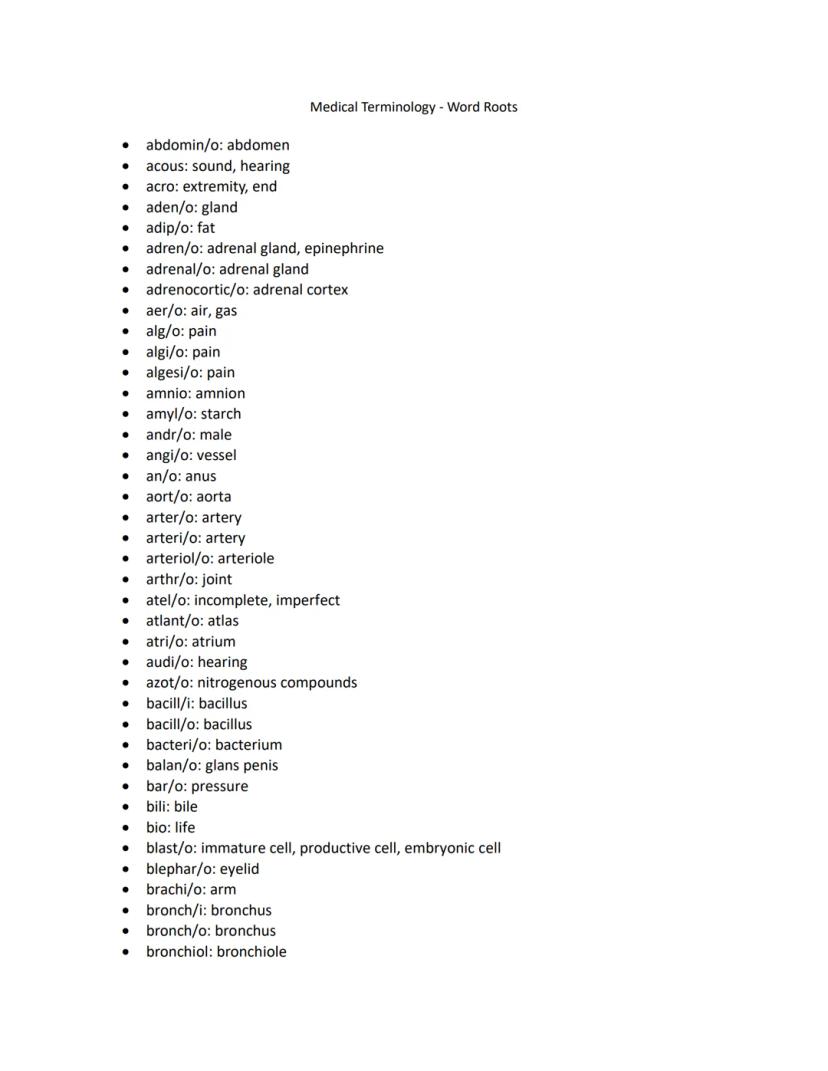
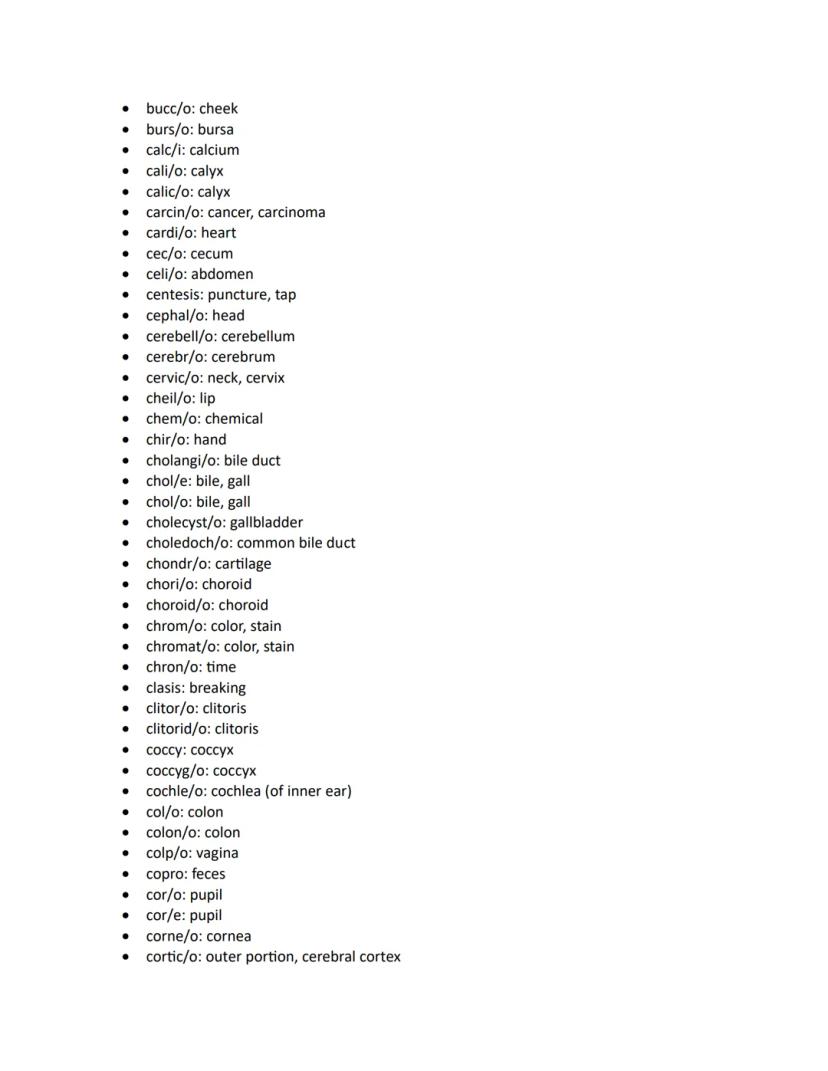
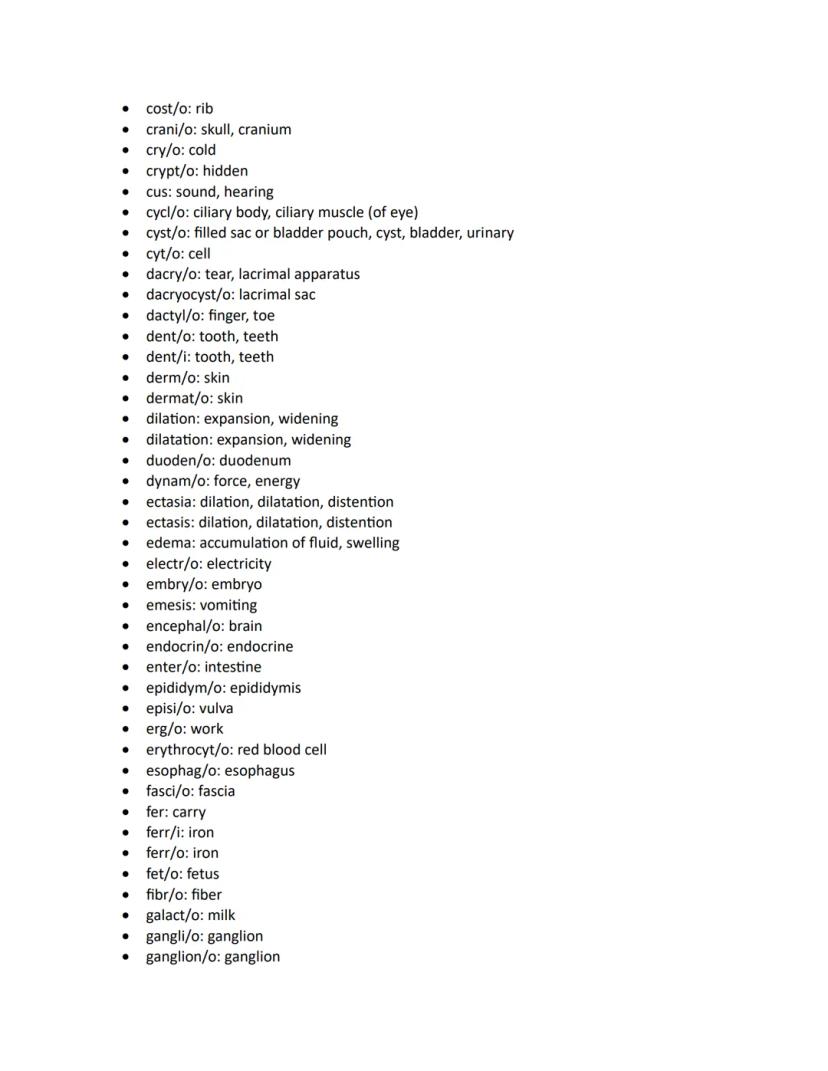
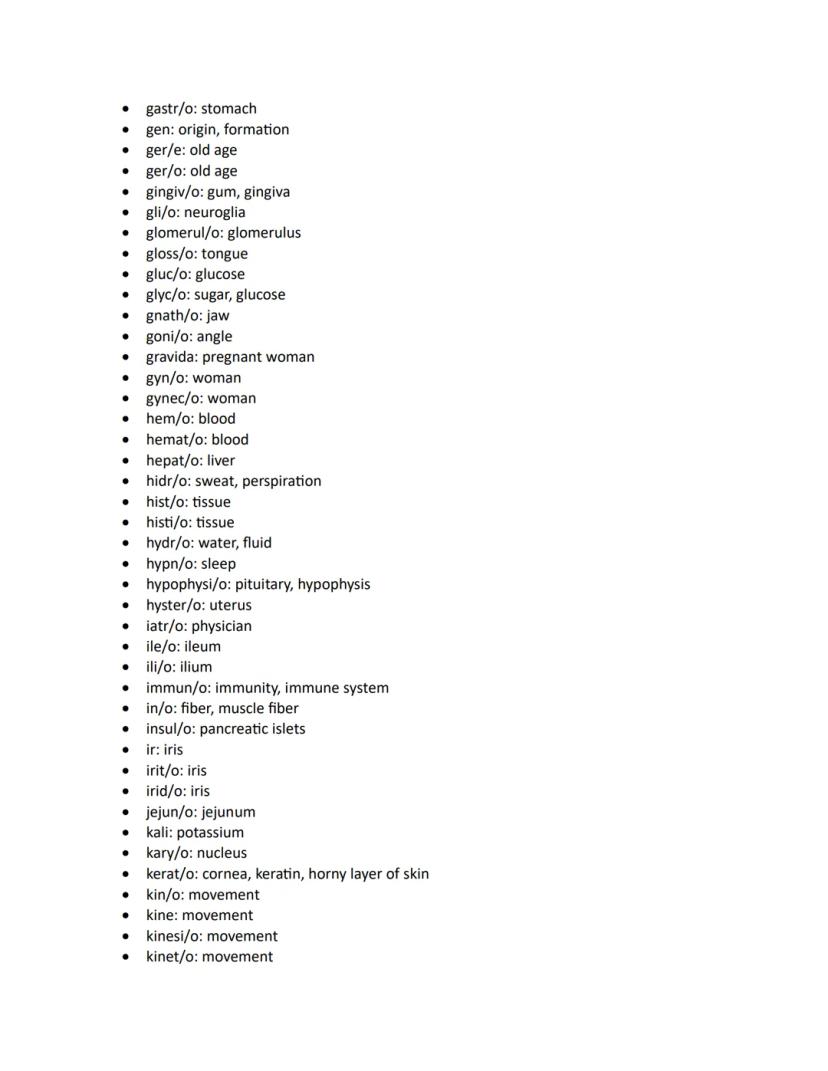
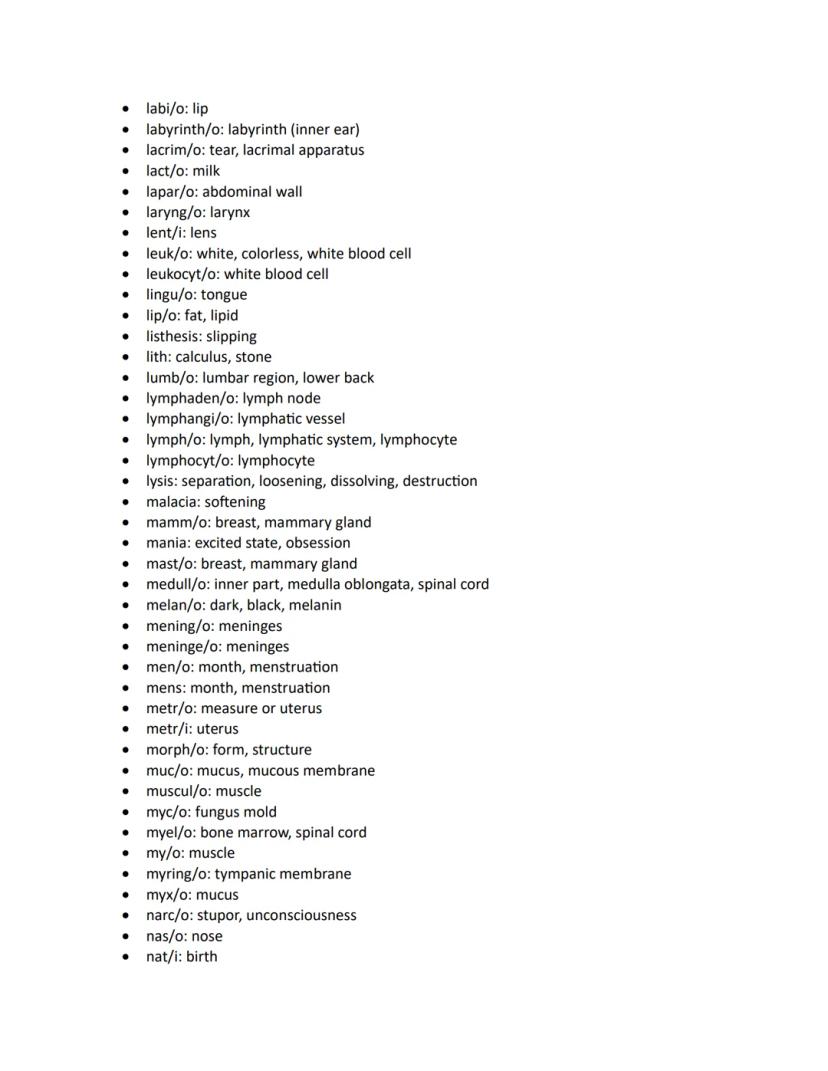
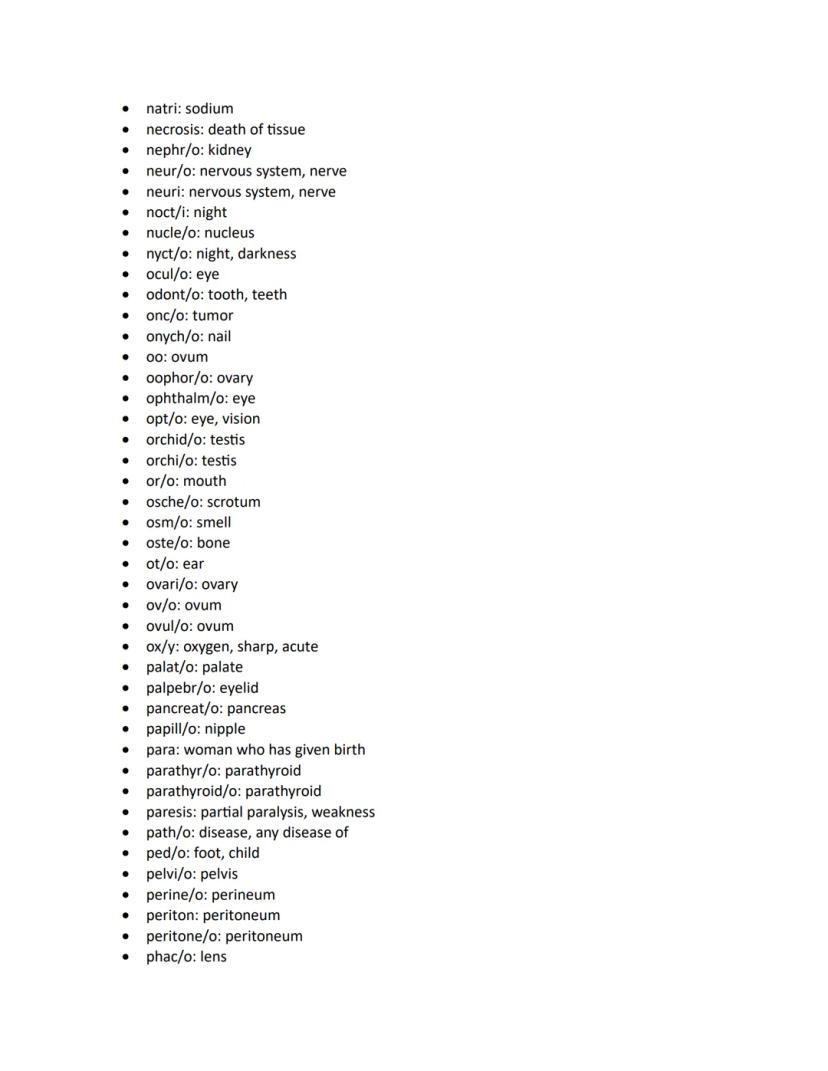
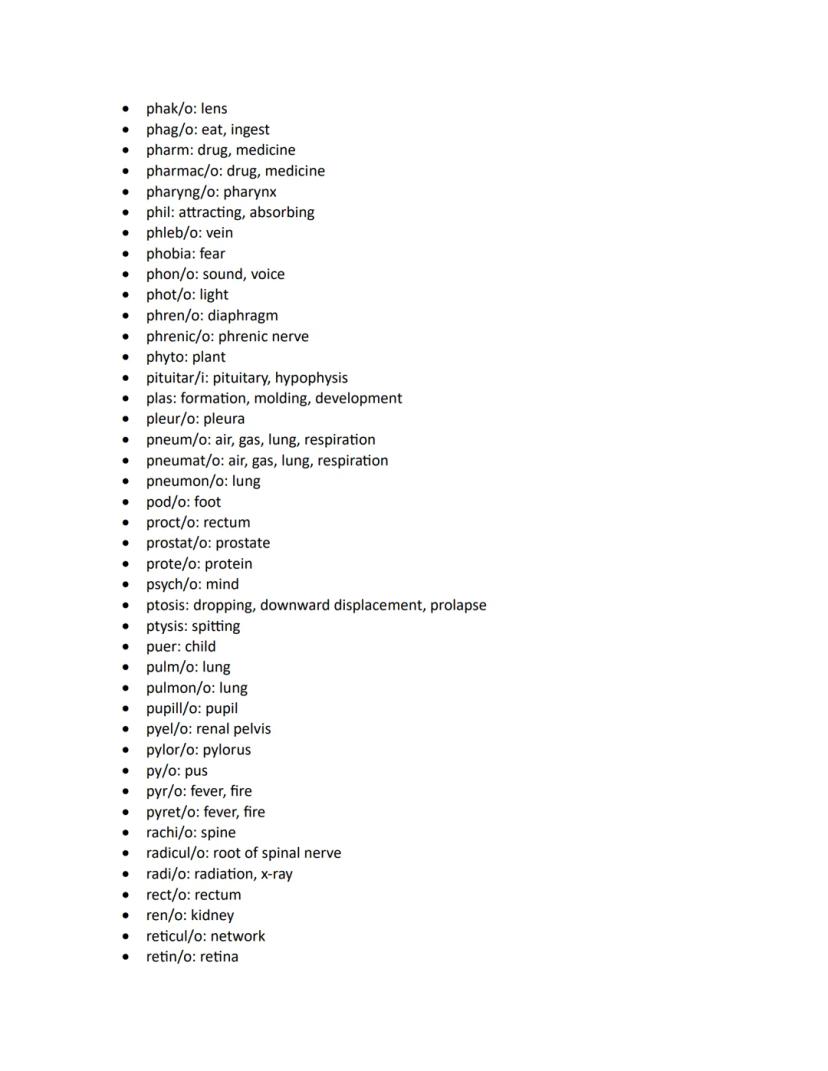
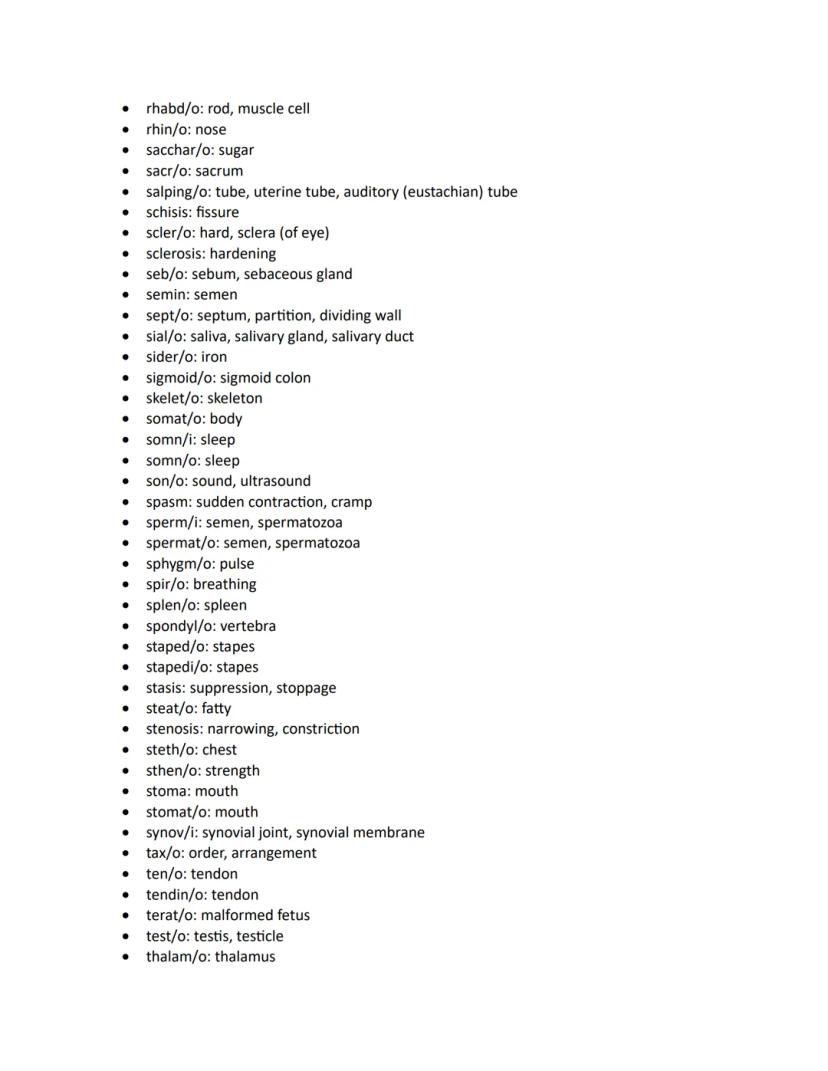
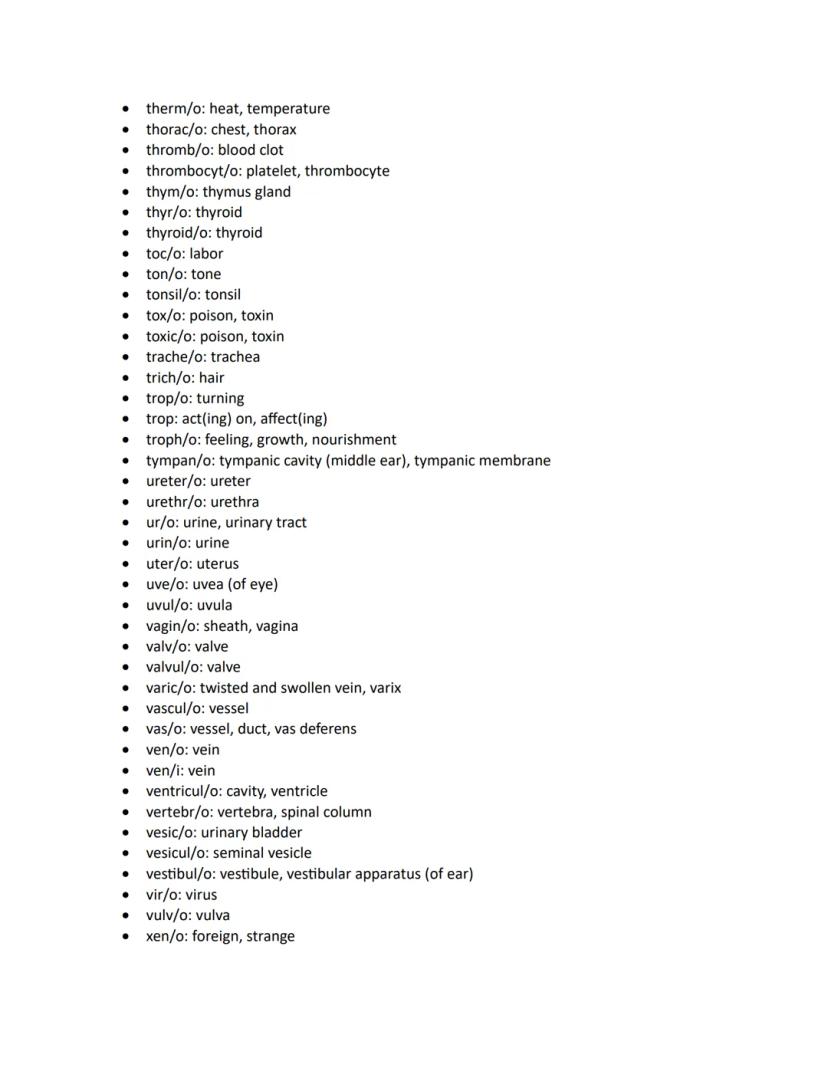
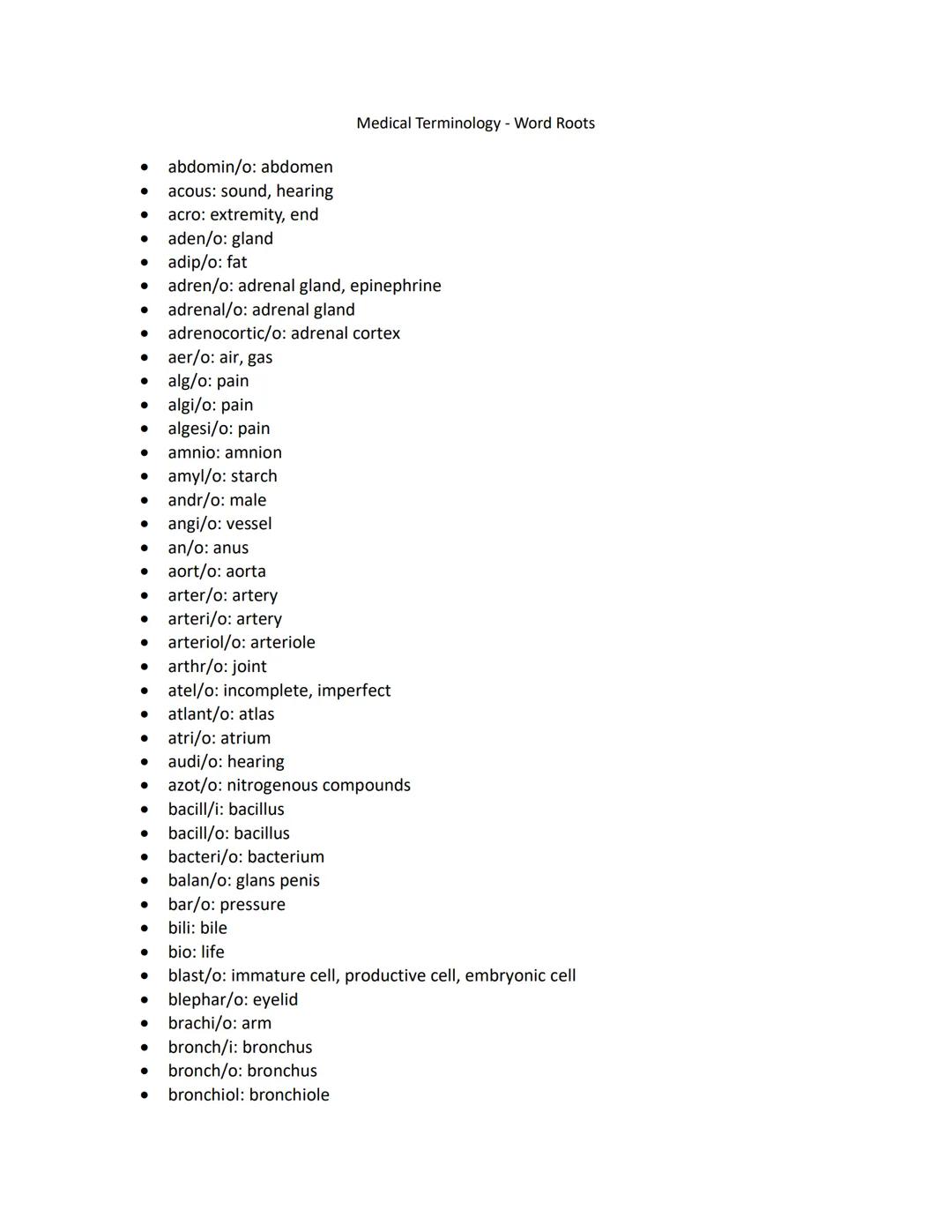
Medical word roots are the foundational elements that give medical terms their core meaning. These roots predominantly come from Greek and Latin origins and typically describe body parts, functions, or conditions. For instance, cardi/o refers to the heart, while dermat/o refers to the skin.
When learning medical terminology, remember that most medical words follow a predictable pattern: prefix + word root + suffix. The word root carries the essential meaning of the term. For example, in "cardiology," the root "cardi" identifies that this specialty deals with the heart.
Some common anatomical word roots include abdomin/o (abdomen), cephal/o (head), gastr/o (stomach), and hepat/o (liver). System-related roots include hem/o or hemat/o (blood), neur/o (nervous system), and pneum/o .
💡 Study Tip: Create flashcards with the word root on one side and its meaning on the other. Group roots by body systems to help organize your learning and make connections easier!
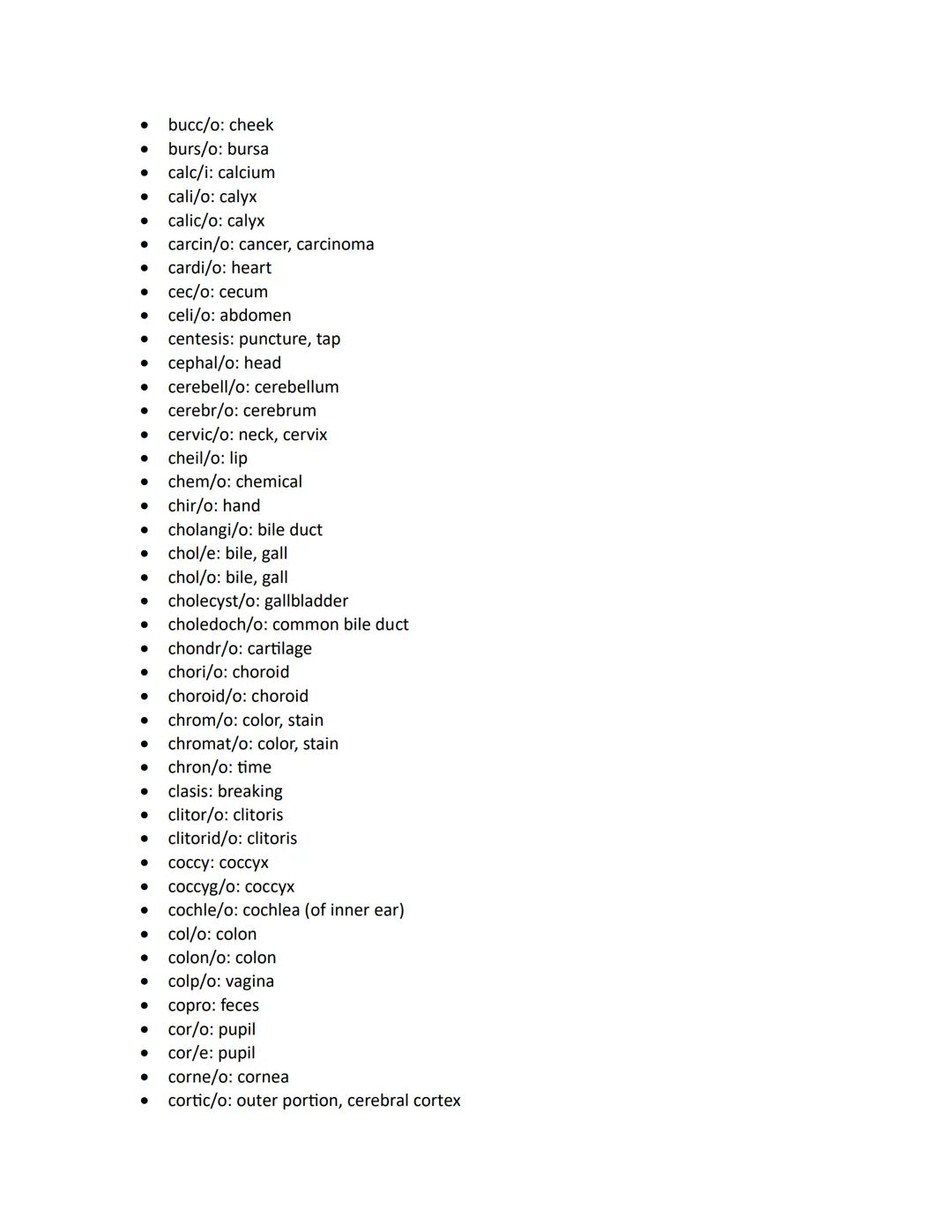
The circulatory system includes roots like angi/o (vessel), arter/o (artery), cardi/o (heart), and phleb/o (vein). These roots appear in terms describing cardiovascular conditions, procedures, and specialties. For example, angiogram combines angi/o with "-gram" to describe a vessel imaging test.
For the respiratory system, key roots include bronch/o (bronchus), laryng/o (larynx), pneumon/o (lung), and trache/o (trachea). You'll find these in terms like bronchoscopy, which combines bronch/o with "-scopy" to describe visual examination of the bronchi.
The digestive system uses roots such as gastr/o (stomach), hepat/o (liver), enter/o (intestine), and col/o (colon). These roots help form terms like gastroenteritis, which combines gastr/o and enter/o with "-itis" to indicate inflammation of the stomach and intestines.
💡 Memory Aid: Think of nephr/o (kidney) and ren/o (kidney) as cousins - they both refer to the kidney but come from different language origins (Greek and Latin respectively).
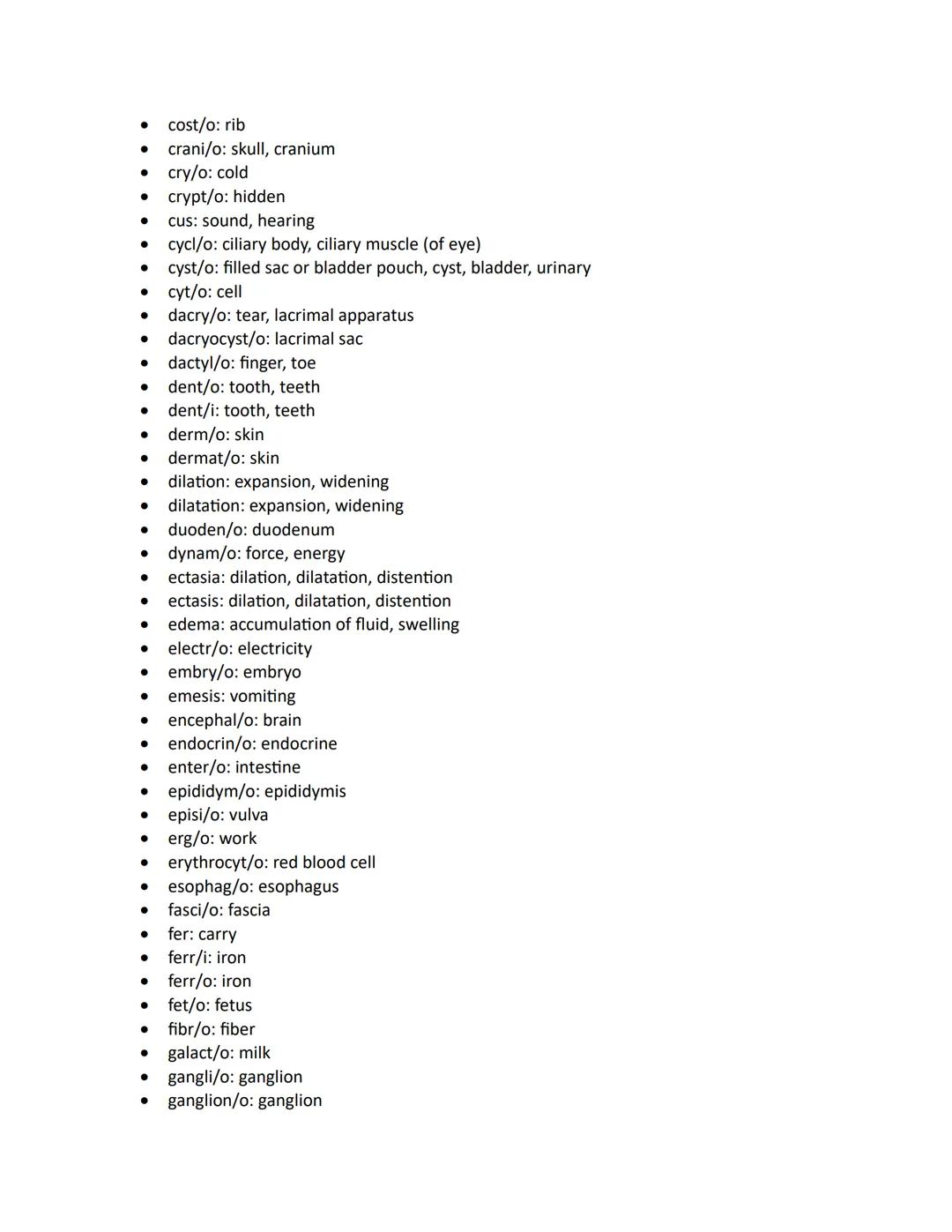
The nervous system vocabulary centers around roots like encephal/o (brain), neur/o (nerve), mening/o (meninges), and myel/o (spinal cord or bone marrow). These roots form the basis for terms describing neurological structures, conditions, and procedures that medical professionals use daily.
For the sensory organs, important roots include ophthalm/o and ocul/o (eye), ot/o (ear), nas/o (nose), and gloss/o or lingu/o (tongue). You'll encounter these in specialist terms like ophthalmologist (eye doctor) and otolaryngologist (ear, nose, and throat doctor).
The root derm/o or dermat/o (skin) is crucial when discussing the integumentary system. Terms like dermatitis (skin inflammation) and dermatology (study of skin) demonstrate how this root combines with different suffixes to create meaningful medical terms.
💡 Context Clue: Some roots have multiple meanings! For example, myel/o can refer to either bone marrow or spinal cord. The context of the complete term will help you determine the specific meaning.
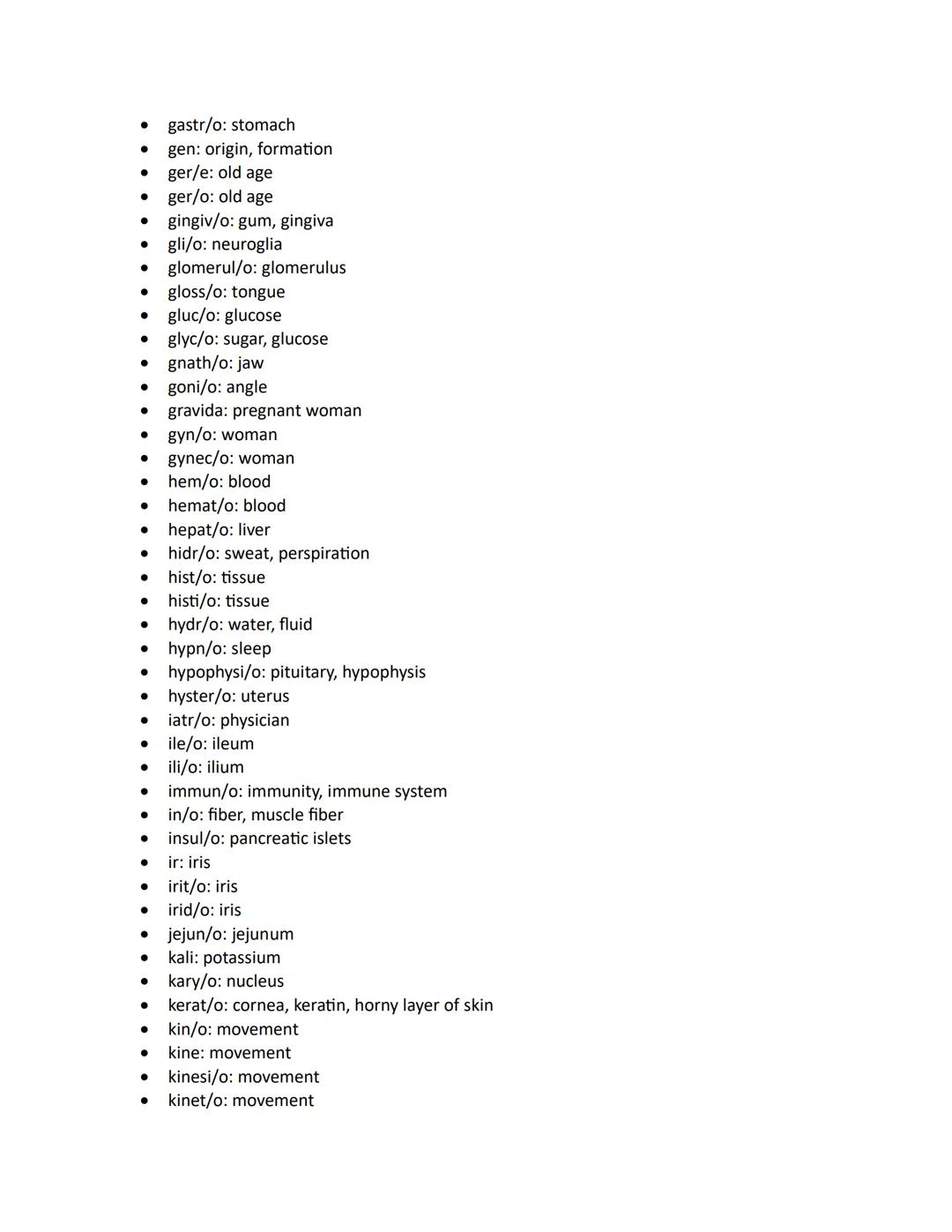
Reproductive system terminology relies on roots like gynec/o (woman), orchid/o (testis), oophor/o (ovary), and prostat/o (prostate). These roots appear in terms describing reproductive organs, conditions, and medical specialties like gynecology (the study of women's health).
For male-specific structures, roots include andr/o (male), balan/o (glans penis), and testicul/o or test/o (testis). Female-specific roots include hyster/o (uterus), mamm/o or mast/o (breast), and vagin/o (vagina).
The endocrine system vocabulary features roots like adren/o (adrenal gland), thyr/o (thyroid), pancreat/o (pancreas), and pituitar/i (pituitary gland). These roots form the foundation for terms describing hormone-producing glands and related conditions.
💡 Quick Tip: When you encounter unfamiliar medical terms, try breaking them into their component parts. Identifying the word root first will give you the core meaning of the term!
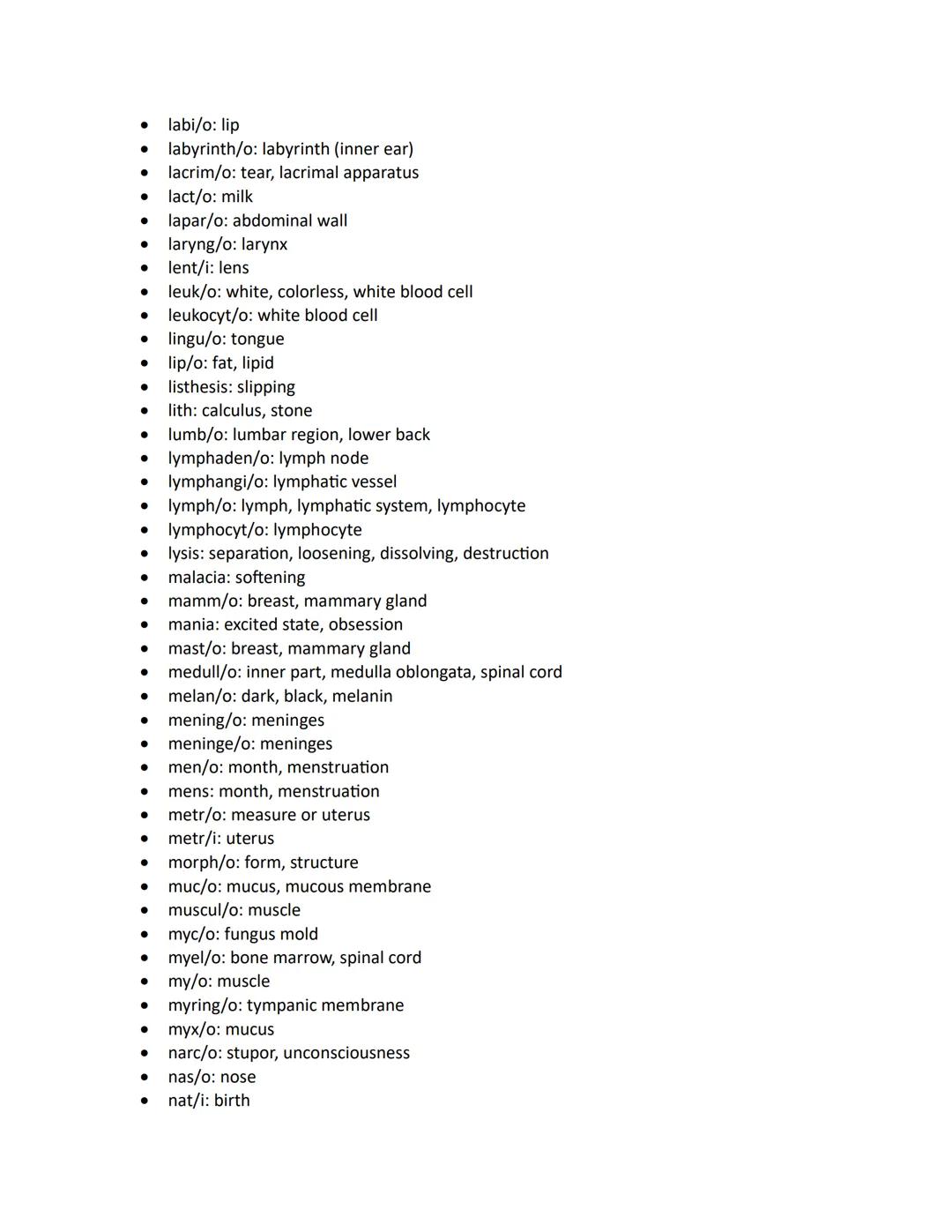
The musculoskeletal system vocabulary is built around roots like oste/o (bone), arthr/o (joint), myel/o (bone marrow), and chondr/o (cartilage). These roots help form terms that describe the skeletal framework of the body and its supporting structures.
Muscle-related roots include my/o and muscul/o (muscle), ten/o (tendon), and fasci/o (fascia). These appear in terms like myalgia (muscle pain), tendonitis (tendon inflammation), and fasciotomy (incision of fascia).
At the cellular level, important roots include cyt/o (cell), nucle/o (nucleus), hist/o (tissue), and blast/o (immature cell). These microscopic terms form the foundation for understanding cellular processes, pathology reports, and laboratory findings.
💡 Real-world Connection: Medical imaging reports frequently use these root terms. Understanding that arthr/o means joint helps you recognize that an "arthro-MRI" is specifically examining joint structures.
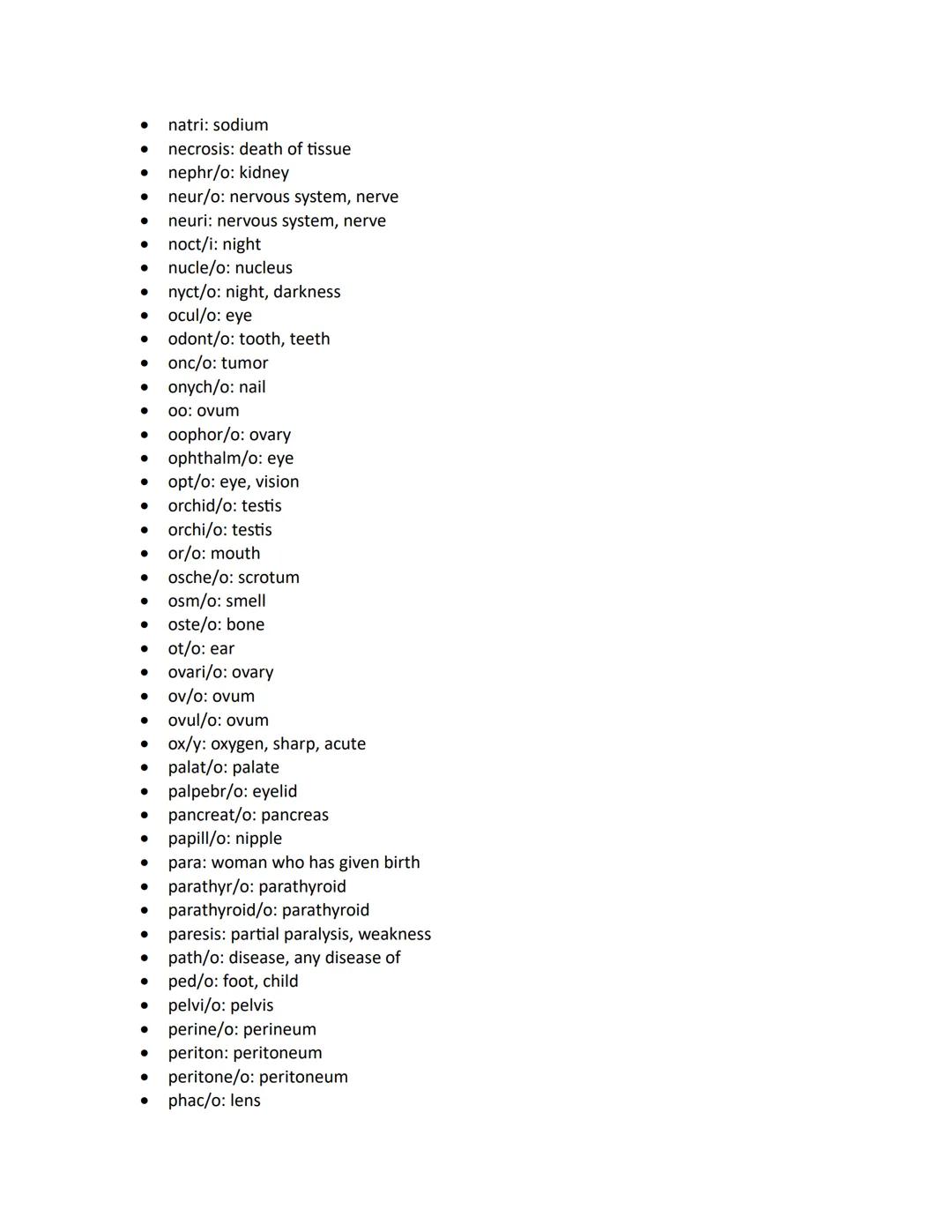
Medical terms describing pathological conditions often use roots like onc/o (tumor), path/o (disease), tox/o (poison), and necr/o (death). These roots appear in specialties like oncology (the study of tumors) and pathology (the study of disease).
Pain and sensation roots include alg/o (pain), esthe/o (sensation), and pyr/o or pyret/o (fever, fire). These roots combine with other elements to describe symptoms and sensory experiences, such as in the term neuralgia (nerve pain).
Movement-related roots like kin/o (movement), stasis (stoppage), and spasm (sudden contraction) help describe physiological actions and their disorders. For example, dyskinesia describes abnormal movement, while hemostasis refers to the stoppage of bleeding.
💡 Clinical Application: When reviewing patient records, you'll frequently encounter these pathology-related roots. Recognizing carcin/o (cancer) in "carcinoma" immediately signals a malignant condition requiring urgent attention.
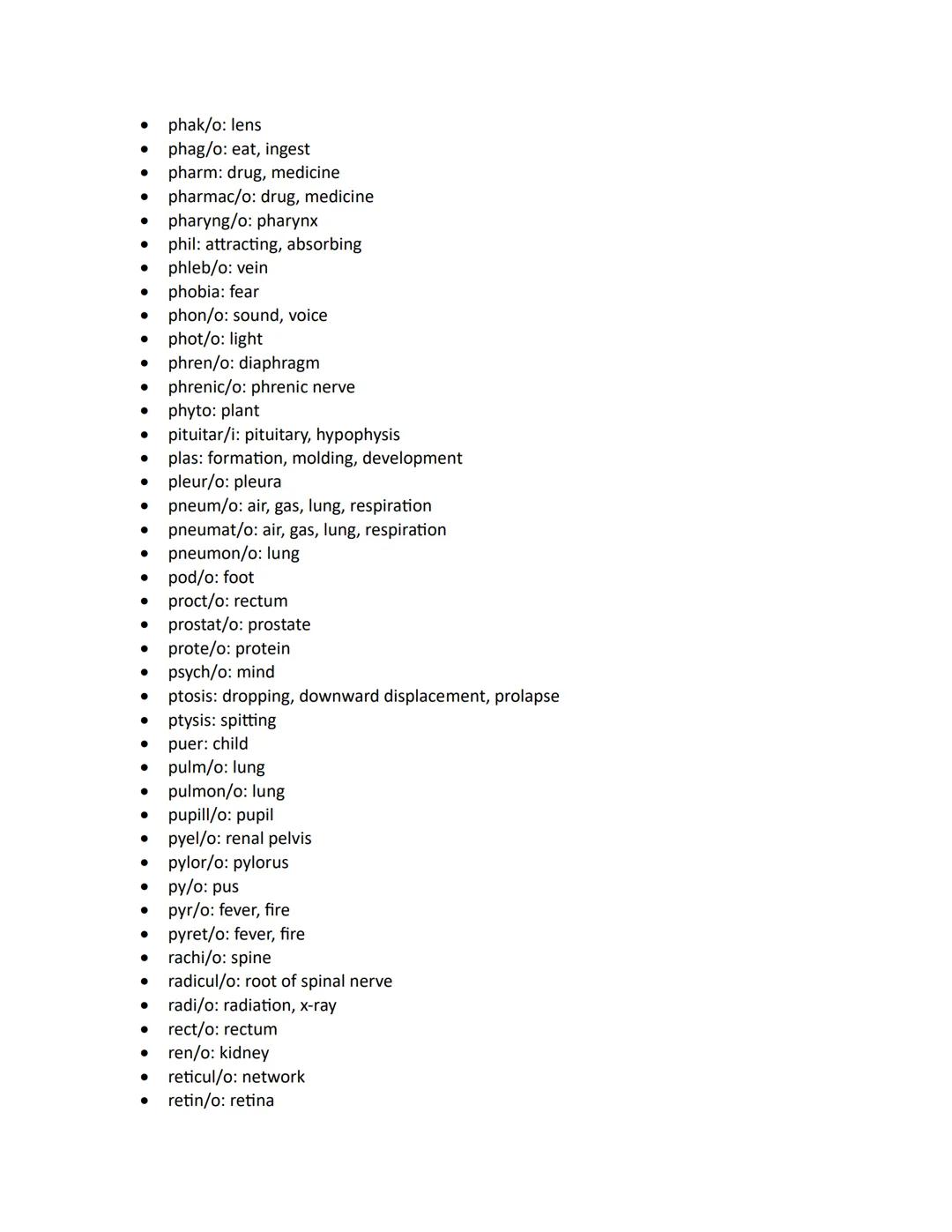
Diagnostic procedures often incorporate roots that indicate the method or target of examination. Roots like scop/o (viewing), gram/o (recording), and metr/o (measurement) combine with organ-specific roots to name various tests. For example, gastr/o + scop/o forms gastroscopy, a visual examination of the stomach.
Treatment-related roots include pharmac/o (drug, medicine), surg/o (surgery), and iatr/o (physician, treatment). These roots appear in terms describing therapeutic interventions and medical specialties, such as pharmacology (study of drugs) and pediatrics (medical care of children).
Functional roots like phas/o (speech), phag/o (eating), spir/o (breathing), and somn/o (sleep) describe physiological processes and their disorders. These roots help form terms like dysphagia (difficulty swallowing) and insomnia (inability to sleep).
💡 Pronunciation Tip: Medical terms may look intimidating, but breaking them down into roots makes them more manageable. Practice pronouncing each root separately before attempting the full term.
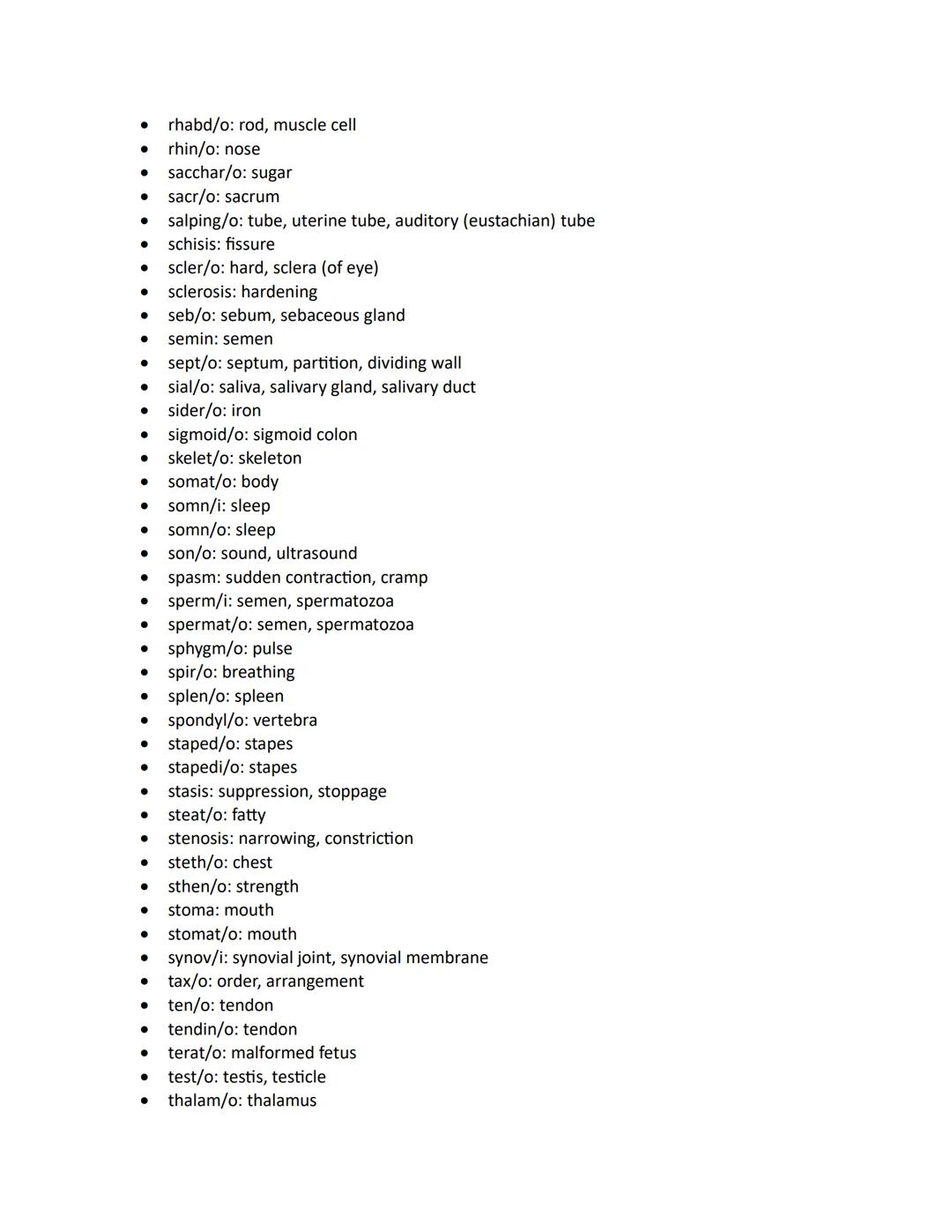
Some specialized medical roots appear in very specific contexts. Roots like terat/o (malformed fetus), kary/o (nucleus), and xen/o (foreign, strange) have narrow applications but are vital in their particular fields. For instance, terat/o is crucial in discussing birth defects and developmental abnormalities.
Color-related roots include leuk/o (white), melan/o (black, dark), erythr/o (red), and cyan/o (blue). These roots help describe visual characteristics of tissues, cells, and conditions, such as leukemia (condition involving white blood cells) or melanoma (dark tumor).
Substance-specific roots like lip/o (fat), glyc/o (sugar), ferr/o (iron), and calc/i (calcium) are used to describe biochemical components and related disorders. These roots form terms like hyperlipidemia (elevated blood fat levels) and hypocalcemia (low blood calcium).
💡 Interdisciplinary Insight: Many of these medical roots appear in everyday language too! The root therm/o (heat) appears in both medical terms like hypothermia and common words like thermometer.
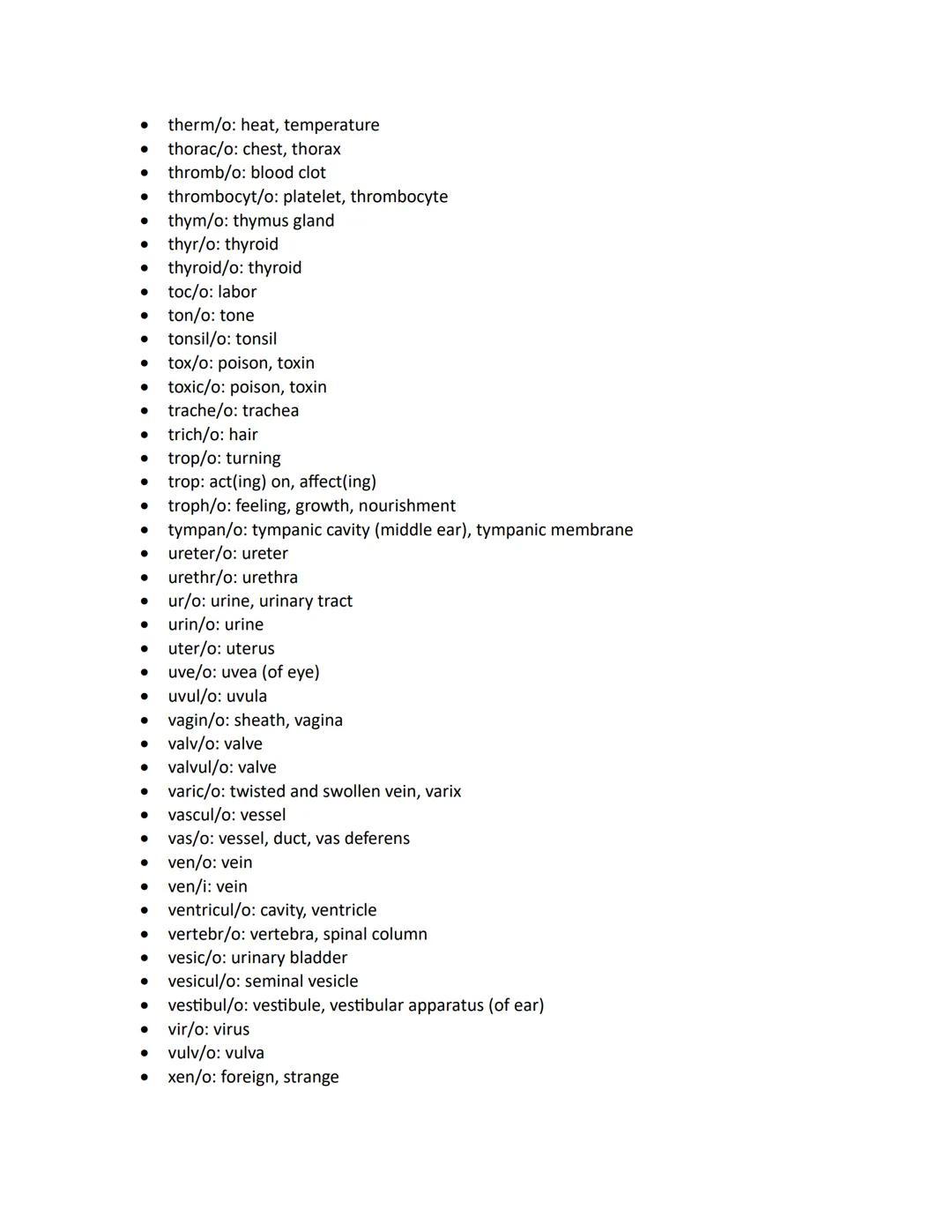
Medical word roots rarely stand alone—they combine with prefixes and suffixes to create complete medical terms. For example, cardi/o (heart) combines with "-logy" to form cardiology (study of the heart) or with "-megaly" to form cardiomegaly (enlarged heart).
Understanding word roots gives you a powerful advantage when encountering new medical vocabulary. By recognizing nephr/o (kidney) in "nephrectomy," you can immediately deduce that this procedure involves removal of a kidney, even if you've never seen the term before.
Medical documentation frequently uses abbreviated forms of these terms. Familiarizing yourself with common word roots helps you interpret abbreviations like GI (gastrointestinal), CV (cardiovascular), and CNS (central nervous system) that appear in patient charts and medical literature.
💡 Future Learning: As you progress in your medical studies, you'll naturally build associations between these root words and clinical experiences. Each patient encounter will reinforce your terminology knowledge and make these roots more meaningful!
Our AI companion is specifically built for the needs of students. Based on the millions of content pieces we have on the platform we can provide truly meaningful and relevant answers to students. But its not only about answers, the companion is even more about guiding students through their daily learning challenges, with personalised study plans, quizzes or content pieces in the chat and 100% personalisation based on the students skills and developments.
You can download the app in the Google Play Store and in the Apple App Store.
That's right! Enjoy free access to study content, connect with fellow students, and get instant help – all at your fingertips.
App Store
Google Play
The app is very easy to use and well designed. I have found everything I was looking for so far and have been able to learn a lot from the presentations! I will definitely use the app for a class assignment! And of course it also helps a lot as an inspiration.
Stefan S
iOS user
This app is really great. There are so many study notes and help [...]. My problem subject is French, for example, and the app has so many options for help. Thanks to this app, I have improved my French. I would recommend it to anyone.
Samantha Klich
Android user
Wow, I am really amazed. I just tried the app because I've seen it advertised many times and was absolutely stunned. This app is THE HELP you want for school and above all, it offers so many things, such as workouts and fact sheets, which have been VERY helpful to me personally.
Anna
iOS user
I think it’s very much worth it and you’ll end up using it a lot once you get the hang of it and even after looking at others notes you can still ask your Artificial intelligence buddy the question and ask to simplify it if you still don’t get it!!! In the end I think it’s worth it 😊👍 ⚠️Also DID I MENTION ITS FREEE YOU DON’T HAVE TO PAY FOR ANYTHING AND STILL GET YOUR GRADES IN PERFECTLY❗️❗️⚠️
Thomas R
iOS user
Knowunity is the BEST app I’ve used in a minute. This is not an ai review or anything this is genuinely coming from a 7th grade student (I know 2011 im young) but dude this app is a 10/10 i have maintained a 3.8 gpa and have plenty of time for gaming. I love it and my mom is just happy I got good grades
Brad T
Android user
Not only did it help me find the answer but it also showed me alternative ways to solve it. I was horrible in math and science but now I have an a in both subjects. Thanks for the help🤍🤍
David K
iOS user
The app's just great! All I have to do is enter the topic in the search bar and I get the response real fast. I don't have to watch 10 YouTube videos to understand something, so I'm saving my time. Highly recommended!
Sudenaz Ocak
Android user
In school I was really bad at maths but thanks to the app, I am doing better now. I am so grateful that you made the app.
Greenlight Bonnie
Android user
I found this app a couple years ago and it has only gotten better since then. I really love it because it can help with written questions and photo questions. Also, it can find study guides that other people have made as well as flashcard sets and practice tests. The free version is also amazing for students who might not be able to afford it. Would 100% recommend
Aubrey
iOS user
Best app if you're in Highschool or Junior high. I have been using this app for 2 school years and it's the best, it's good if you don't have anyone to help you with school work.😋🩷🎀
Marco B
iOS user
THE QUIZES AND FLASHCARDS ARE SO USEFUL AND I LOVE Knowunity AI. IT ALSO IS LITREALLY LIKE CHATGPT BUT SMARTER!! HELPED ME WITH MY MASCARA PROBLEMS TOO!! AS WELL AS MY REAL SUBJECTS ! DUHHH 😍😁😲🤑💗✨🎀😮
Elisha
iOS user
This app is phenomenal down to the correct info and the various topics you can study! I greatly recommend it for people who struggle with procrastination and those who need homework help. It has been perfectly accurate for world 1 history as far as I’ve seen! Geometry too!
Paul T
iOS user
The app is very easy to use and well designed. I have found everything I was looking for so far and have been able to learn a lot from the presentations! I will definitely use the app for a class assignment! And of course it also helps a lot as an inspiration.
Stefan S
iOS user
This app is really great. There are so many study notes and help [...]. My problem subject is French, for example, and the app has so many options for help. Thanks to this app, I have improved my French. I would recommend it to anyone.
Samantha Klich
Android user
Wow, I am really amazed. I just tried the app because I've seen it advertised many times and was absolutely stunned. This app is THE HELP you want for school and above all, it offers so many things, such as workouts and fact sheets, which have been VERY helpful to me personally.
Anna
iOS user
I think it’s very much worth it and you’ll end up using it a lot once you get the hang of it and even after looking at others notes you can still ask your Artificial intelligence buddy the question and ask to simplify it if you still don’t get it!!! In the end I think it’s worth it 😊👍 ⚠️Also DID I MENTION ITS FREEE YOU DON’T HAVE TO PAY FOR ANYTHING AND STILL GET YOUR GRADES IN PERFECTLY❗️❗️⚠️
Thomas R
iOS user
Knowunity is the BEST app I’ve used in a minute. This is not an ai review or anything this is genuinely coming from a 7th grade student (I know 2011 im young) but dude this app is a 10/10 i have maintained a 3.8 gpa and have plenty of time for gaming. I love it and my mom is just happy I got good grades
Brad T
Android user
Not only did it help me find the answer but it also showed me alternative ways to solve it. I was horrible in math and science but now I have an a in both subjects. Thanks for the help🤍🤍
David K
iOS user
The app's just great! All I have to do is enter the topic in the search bar and I get the response real fast. I don't have to watch 10 YouTube videos to understand something, so I'm saving my time. Highly recommended!
Sudenaz Ocak
Android user
In school I was really bad at maths but thanks to the app, I am doing better now. I am so grateful that you made the app.
Greenlight Bonnie
Android user
I found this app a couple years ago and it has only gotten better since then. I really love it because it can help with written questions and photo questions. Also, it can find study guides that other people have made as well as flashcard sets and practice tests. The free version is also amazing for students who might not be able to afford it. Would 100% recommend
Aubrey
iOS user
Best app if you're in Highschool or Junior high. I have been using this app for 2 school years and it's the best, it's good if you don't have anyone to help you with school work.😋🩷🎀
Marco B
iOS user
THE QUIZES AND FLASHCARDS ARE SO USEFUL AND I LOVE Knowunity AI. IT ALSO IS LITREALLY LIKE CHATGPT BUT SMARTER!! HELPED ME WITH MY MASCARA PROBLEMS TOO!! AS WELL AS MY REAL SUBJECTS ! DUHHH 😍😁😲🤑💗✨🎀😮
Elisha
iOS user
This app is phenomenal down to the correct info and the various topics you can study! I greatly recommend it for people who struggle with procrastination and those who need homework help. It has been perfectly accurate for world 1 history as far as I’ve seen! Geometry too!
Paul T
iOS user
Alexandra Amavizca
@lexandramavizca_yjbr
Medical terminology is built upon word roots that serve as the foundation for understanding healthcare language. These roots, derived primarily from Greek and Latin, form the core of medical terms when combined with prefixes, suffixes, and other elements. Mastering these... Show more
Access to all documents
Improve your grades
Join milions of students
Medical word roots are the foundational elements that give medical terms their core meaning. These roots predominantly come from Greek and Latin origins and typically describe body parts, functions, or conditions. For instance, cardi/o refers to the heart, while dermat/o refers to the skin.
When learning medical terminology, remember that most medical words follow a predictable pattern: prefix + word root + suffix. The word root carries the essential meaning of the term. For example, in "cardiology," the root "cardi" identifies that this specialty deals with the heart.
Some common anatomical word roots include abdomin/o (abdomen), cephal/o (head), gastr/o (stomach), and hepat/o (liver). System-related roots include hem/o or hemat/o (blood), neur/o (nervous system), and pneum/o .
💡 Study Tip: Create flashcards with the word root on one side and its meaning on the other. Group roots by body systems to help organize your learning and make connections easier!
Access to all documents
Improve your grades
Join milions of students
The circulatory system includes roots like angi/o (vessel), arter/o (artery), cardi/o (heart), and phleb/o (vein). These roots appear in terms describing cardiovascular conditions, procedures, and specialties. For example, angiogram combines angi/o with "-gram" to describe a vessel imaging test.
For the respiratory system, key roots include bronch/o (bronchus), laryng/o (larynx), pneumon/o (lung), and trache/o (trachea). You'll find these in terms like bronchoscopy, which combines bronch/o with "-scopy" to describe visual examination of the bronchi.
The digestive system uses roots such as gastr/o (stomach), hepat/o (liver), enter/o (intestine), and col/o (colon). These roots help form terms like gastroenteritis, which combines gastr/o and enter/o with "-itis" to indicate inflammation of the stomach and intestines.
💡 Memory Aid: Think of nephr/o (kidney) and ren/o (kidney) as cousins - they both refer to the kidney but come from different language origins (Greek and Latin respectively).
Access to all documents
Improve your grades
Join milions of students
The nervous system vocabulary centers around roots like encephal/o (brain), neur/o (nerve), mening/o (meninges), and myel/o (spinal cord or bone marrow). These roots form the basis for terms describing neurological structures, conditions, and procedures that medical professionals use daily.
For the sensory organs, important roots include ophthalm/o and ocul/o (eye), ot/o (ear), nas/o (nose), and gloss/o or lingu/o (tongue). You'll encounter these in specialist terms like ophthalmologist (eye doctor) and otolaryngologist (ear, nose, and throat doctor).
The root derm/o or dermat/o (skin) is crucial when discussing the integumentary system. Terms like dermatitis (skin inflammation) and dermatology (study of skin) demonstrate how this root combines with different suffixes to create meaningful medical terms.
💡 Context Clue: Some roots have multiple meanings! For example, myel/o can refer to either bone marrow or spinal cord. The context of the complete term will help you determine the specific meaning.
Access to all documents
Improve your grades
Join milions of students
Reproductive system terminology relies on roots like gynec/o (woman), orchid/o (testis), oophor/o (ovary), and prostat/o (prostate). These roots appear in terms describing reproductive organs, conditions, and medical specialties like gynecology (the study of women's health).
For male-specific structures, roots include andr/o (male), balan/o (glans penis), and testicul/o or test/o (testis). Female-specific roots include hyster/o (uterus), mamm/o or mast/o (breast), and vagin/o (vagina).
The endocrine system vocabulary features roots like adren/o (adrenal gland), thyr/o (thyroid), pancreat/o (pancreas), and pituitar/i (pituitary gland). These roots form the foundation for terms describing hormone-producing glands and related conditions.
💡 Quick Tip: When you encounter unfamiliar medical terms, try breaking them into their component parts. Identifying the word root first will give you the core meaning of the term!
Access to all documents
Improve your grades
Join milions of students
The musculoskeletal system vocabulary is built around roots like oste/o (bone), arthr/o (joint), myel/o (bone marrow), and chondr/o (cartilage). These roots help form terms that describe the skeletal framework of the body and its supporting structures.
Muscle-related roots include my/o and muscul/o (muscle), ten/o (tendon), and fasci/o (fascia). These appear in terms like myalgia (muscle pain), tendonitis (tendon inflammation), and fasciotomy (incision of fascia).
At the cellular level, important roots include cyt/o (cell), nucle/o (nucleus), hist/o (tissue), and blast/o (immature cell). These microscopic terms form the foundation for understanding cellular processes, pathology reports, and laboratory findings.
💡 Real-world Connection: Medical imaging reports frequently use these root terms. Understanding that arthr/o means joint helps you recognize that an "arthro-MRI" is specifically examining joint structures.
Access to all documents
Improve your grades
Join milions of students
Medical terms describing pathological conditions often use roots like onc/o (tumor), path/o (disease), tox/o (poison), and necr/o (death). These roots appear in specialties like oncology (the study of tumors) and pathology (the study of disease).
Pain and sensation roots include alg/o (pain), esthe/o (sensation), and pyr/o or pyret/o (fever, fire). These roots combine with other elements to describe symptoms and sensory experiences, such as in the term neuralgia (nerve pain).
Movement-related roots like kin/o (movement), stasis (stoppage), and spasm (sudden contraction) help describe physiological actions and their disorders. For example, dyskinesia describes abnormal movement, while hemostasis refers to the stoppage of bleeding.
💡 Clinical Application: When reviewing patient records, you'll frequently encounter these pathology-related roots. Recognizing carcin/o (cancer) in "carcinoma" immediately signals a malignant condition requiring urgent attention.
Access to all documents
Improve your grades
Join milions of students
Diagnostic procedures often incorporate roots that indicate the method or target of examination. Roots like scop/o (viewing), gram/o (recording), and metr/o (measurement) combine with organ-specific roots to name various tests. For example, gastr/o + scop/o forms gastroscopy, a visual examination of the stomach.
Treatment-related roots include pharmac/o (drug, medicine), surg/o (surgery), and iatr/o (physician, treatment). These roots appear in terms describing therapeutic interventions and medical specialties, such as pharmacology (study of drugs) and pediatrics (medical care of children).
Functional roots like phas/o (speech), phag/o (eating), spir/o (breathing), and somn/o (sleep) describe physiological processes and their disorders. These roots help form terms like dysphagia (difficulty swallowing) and insomnia (inability to sleep).
💡 Pronunciation Tip: Medical terms may look intimidating, but breaking them down into roots makes them more manageable. Practice pronouncing each root separately before attempting the full term.
Access to all documents
Improve your grades
Join milions of students
Some specialized medical roots appear in very specific contexts. Roots like terat/o (malformed fetus), kary/o (nucleus), and xen/o (foreign, strange) have narrow applications but are vital in their particular fields. For instance, terat/o is crucial in discussing birth defects and developmental abnormalities.
Color-related roots include leuk/o (white), melan/o (black, dark), erythr/o (red), and cyan/o (blue). These roots help describe visual characteristics of tissues, cells, and conditions, such as leukemia (condition involving white blood cells) or melanoma (dark tumor).
Substance-specific roots like lip/o (fat), glyc/o (sugar), ferr/o (iron), and calc/i (calcium) are used to describe biochemical components and related disorders. These roots form terms like hyperlipidemia (elevated blood fat levels) and hypocalcemia (low blood calcium).
💡 Interdisciplinary Insight: Many of these medical roots appear in everyday language too! The root therm/o (heat) appears in both medical terms like hypothermia and common words like thermometer.
Access to all documents
Improve your grades
Join milions of students
Medical word roots rarely stand alone—they combine with prefixes and suffixes to create complete medical terms. For example, cardi/o (heart) combines with "-logy" to form cardiology (study of the heart) or with "-megaly" to form cardiomegaly (enlarged heart).
Understanding word roots gives you a powerful advantage when encountering new medical vocabulary. By recognizing nephr/o (kidney) in "nephrectomy," you can immediately deduce that this procedure involves removal of a kidney, even if you've never seen the term before.
Medical documentation frequently uses abbreviated forms of these terms. Familiarizing yourself with common word roots helps you interpret abbreviations like GI (gastrointestinal), CV (cardiovascular), and CNS (central nervous system) that appear in patient charts and medical literature.
💡 Future Learning: As you progress in your medical studies, you'll naturally build associations between these root words and clinical experiences. Each patient encounter will reinforce your terminology knowledge and make these roots more meaningful!
Our AI companion is specifically built for the needs of students. Based on the millions of content pieces we have on the platform we can provide truly meaningful and relevant answers to students. But its not only about answers, the companion is even more about guiding students through their daily learning challenges, with personalised study plans, quizzes or content pieces in the chat and 100% personalisation based on the students skills and developments.
You can download the app in the Google Play Store and in the Apple App Store.
That's right! Enjoy free access to study content, connect with fellow students, and get instant help – all at your fingertips.
3
Smart Tools NEW
Transform this note into: ✓ 50+ Practice Questions ✓ Interactive Flashcards ✓ Full Practice Test ✓ Essay Outlines
Understanding the language of anatomy and directional terms used to describe body structures and cavities for medical professionals and students.
 Health & Medicine
How the blood circulates through the body. Description of heart rates.
Health & MedicineRoutine Urinalysis
Health & Medicinemicrobiology history
Health & MedicineLearn the basic directional terms used in anatomy to describe the position of body structures.
Health & MedicineNotes about red blood cells, white blood cells, platelets, blood types.
Health & MedicineApp Store
Google Play
The app is very easy to use and well designed. I have found everything I was looking for so far and have been able to learn a lot from the presentations! I will definitely use the app for a class assignment! And of course it also helps a lot as an inspiration.
Stefan S
iOS user
This app is really great. There are so many study notes and help [...]. My problem subject is French, for example, and the app has so many options for help. Thanks to this app, I have improved my French. I would recommend it to anyone.
Samantha Klich
Android user
Wow, I am really amazed. I just tried the app because I've seen it advertised many times and was absolutely stunned. This app is THE HELP you want for school and above all, it offers so many things, such as workouts and fact sheets, which have been VERY helpful to me personally.
Anna
iOS user
I think it’s very much worth it and you’ll end up using it a lot once you get the hang of it and even after looking at others notes you can still ask your Artificial intelligence buddy the question and ask to simplify it if you still don’t get it!!! In the end I think it’s worth it 😊👍 ⚠️Also DID I MENTION ITS FREEE YOU DON’T HAVE TO PAY FOR ANYTHING AND STILL GET YOUR GRADES IN PERFECTLY❗️❗️⚠️
Thomas R
iOS user
Knowunity is the BEST app I’ve used in a minute. This is not an ai review or anything this is genuinely coming from a 7th grade student (I know 2011 im young) but dude this app is a 10/10 i have maintained a 3.8 gpa and have plenty of time for gaming. I love it and my mom is just happy I got good grades
Brad T
Android user
Not only did it help me find the answer but it also showed me alternative ways to solve it. I was horrible in math and science but now I have an a in both subjects. Thanks for the help🤍🤍
David K
iOS user
The app's just great! All I have to do is enter the topic in the search bar and I get the response real fast. I don't have to watch 10 YouTube videos to understand something, so I'm saving my time. Highly recommended!
Sudenaz Ocak
Android user
In school I was really bad at maths but thanks to the app, I am doing better now. I am so grateful that you made the app.
Greenlight Bonnie
Android user
I found this app a couple years ago and it has only gotten better since then. I really love it because it can help with written questions and photo questions. Also, it can find study guides that other people have made as well as flashcard sets and practice tests. The free version is also amazing for students who might not be able to afford it. Would 100% recommend
Aubrey
iOS user
Best app if you're in Highschool or Junior high. I have been using this app for 2 school years and it's the best, it's good if you don't have anyone to help you with school work.😋🩷🎀
Marco B
iOS user
THE QUIZES AND FLASHCARDS ARE SO USEFUL AND I LOVE Knowunity AI. IT ALSO IS LITREALLY LIKE CHATGPT BUT SMARTER!! HELPED ME WITH MY MASCARA PROBLEMS TOO!! AS WELL AS MY REAL SUBJECTS ! DUHHH 😍😁😲🤑💗✨🎀😮
Elisha
iOS user
This app is phenomenal down to the correct info and the various topics you can study! I greatly recommend it for people who struggle with procrastination and those who need homework help. It has been perfectly accurate for world 1 history as far as I’ve seen! Geometry too!
Paul T
iOS user
The app is very easy to use and well designed. I have found everything I was looking for so far and have been able to learn a lot from the presentations! I will definitely use the app for a class assignment! And of course it also helps a lot as an inspiration.
Stefan S
iOS user
This app is really great. There are so many study notes and help [...]. My problem subject is French, for example, and the app has so many options for help. Thanks to this app, I have improved my French. I would recommend it to anyone.
Samantha Klich
Android user
Wow, I am really amazed. I just tried the app because I've seen it advertised many times and was absolutely stunned. This app is THE HELP you want for school and above all, it offers so many things, such as workouts and fact sheets, which have been VERY helpful to me personally.
Anna
iOS user
I think it’s very much worth it and you’ll end up using it a lot once you get the hang of it and even after looking at others notes you can still ask your Artificial intelligence buddy the question and ask to simplify it if you still don’t get it!!! In the end I think it’s worth it 😊👍 ⚠️Also DID I MENTION ITS FREEE YOU DON’T HAVE TO PAY FOR ANYTHING AND STILL GET YOUR GRADES IN PERFECTLY❗️❗️⚠️
Thomas R
iOS user
Knowunity is the BEST app I’ve used in a minute. This is not an ai review or anything this is genuinely coming from a 7th grade student (I know 2011 im young) but dude this app is a 10/10 i have maintained a 3.8 gpa and have plenty of time for gaming. I love it and my mom is just happy I got good grades
Brad T
Android user
Not only did it help me find the answer but it also showed me alternative ways to solve it. I was horrible in math and science but now I have an a in both subjects. Thanks for the help🤍🤍
David K
iOS user
The app's just great! All I have to do is enter the topic in the search bar and I get the response real fast. I don't have to watch 10 YouTube videos to understand something, so I'm saving my time. Highly recommended!
Sudenaz Ocak
Android user
In school I was really bad at maths but thanks to the app, I am doing better now. I am so grateful that you made the app.
Greenlight Bonnie
Android user
I found this app a couple years ago and it has only gotten better since then. I really love it because it can help with written questions and photo questions. Also, it can find study guides that other people have made as well as flashcard sets and practice tests. The free version is also amazing for students who might not be able to afford it. Would 100% recommend
Aubrey
iOS user
Best app if you're in Highschool or Junior high. I have been using this app for 2 school years and it's the best, it's good if you don't have anyone to help you with school work.😋🩷🎀
Marco B
iOS user
THE QUIZES AND FLASHCARDS ARE SO USEFUL AND I LOVE Knowunity AI. IT ALSO IS LITREALLY LIKE CHATGPT BUT SMARTER!! HELPED ME WITH MY MASCARA PROBLEMS TOO!! AS WELL AS MY REAL SUBJECTS ! DUHHH 😍😁😲🤑💗✨🎀😮
Elisha
iOS user
This app is phenomenal down to the correct info and the various topics you can study! I greatly recommend it for people who struggle with procrastination and those who need homework help. It has been perfectly accurate for world 1 history as far as I’ve seen! Geometry too!
Paul T
iOS user