
Dive into the fascinating world of microbiology, the study of...
 Health & Medicine71 views·Updated Jul 15, 2026·1 page
The Fascinating Journey Through Microbiology's History

Edna B.@dna._zvcl
1
of 1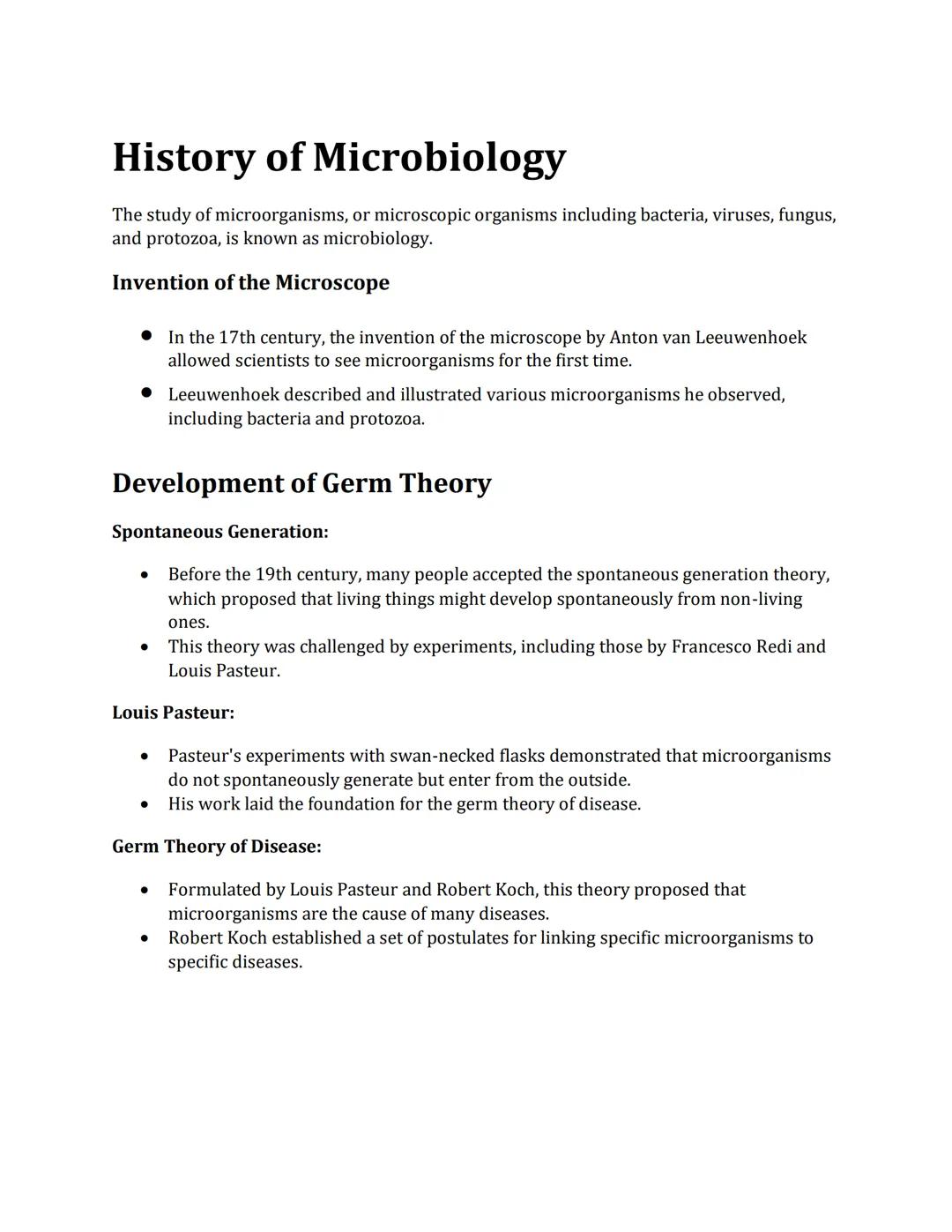
History of Microbiology
Ever wondered what caused the major shift in how we understand diseases? It all started with the invention of the microscope in the 17th century. Anton van Leeuwenhoek created powerful lenses that revealed an invisible world teeming with life. His detailed observations and illustrations of bacteria and protozoa opened the door to a new scientific frontier.
Before microscopes, people believed in spontaneous generation - the idea that living organisms could spontaneously arise from non-living matter (imagine thinking maggots just appeared from nowhere in meat!). Scientists like Francesco Redi began challenging this notion through experiments, but it was Louis Pasteur who delivered the knockout punch.
Pasteur's famous swan-necked flask experiments proved microorganisms came from other microorganisms, not from thin air. This revolutionary work established the foundation for the germ theory of disease - the understanding that tiny microbes cause specific illnesses. Robert Koch built upon this theory by developing a systematic approach (Koch's postulates) to prove which specific microorganism causes which specific disease.
Did you know? Before germ theory, doctors would often move directly from dissecting corpses to delivering babies without washing their hands - no wonder infection rates were so high! Pasteur's discoveries quite literally saved millions of lives.
We thought you’d never ask...
Our AI companion is specifically built for the needs of students. Based on the millions of content pieces we have on the platform we can provide truly meaningful and relevant answers to students. But its not only about answers, the companion is even more about guiding students through their daily learning challenges, with personalised study plans, quizzes or content pieces in the chat and 100% personalisation based on the students skills and developments.
You can download the app in the Google Play Store and in the Apple App Store.
That's right! Enjoy free access to study content, connect with fellow students, and get instant help – all at your fingertips.
Similar Content
Most popular content in Health & Medicine
9M
Health & MedicineMedical Terminology Quiz
key concepts in med terminology
11th2100
Health & MedicineMark Klimek Nclex Review
Comphrensive Nclex Review
College831
Health & MedicineED 101 Lesson 2
The Child and Adolescence Learners and Learning Principles
College1622
 Fun Stuff
Anatomy and Physiology Chapter 1
Chpater 1 : The orientation of the body / College Level Anatomy and Physiology
86938
Health & MedicineAnatomical Terminology
Understanding the language of anatomy and directional terms used to describe body structures and cavities for medical professionals and students.
10th902
Health & MedicinePharmacology - Descriptions and Terms
Medical Terminology - Learn about descriptions of things related to pharmacology and additional terms about medications.
11th1177
Health & Medicinetfn
theoretical foundation in nursing
College1460
Health & MedicineHow to give CPR
How to give CPR
966
Health & MedicineFirst Aid and Emergency Response
Notes describing first aid procedures and emergency responses
26514
Most popular content
9O
 AP US History
Origins and Dynamics of the Columbian Exchange
Analyze the ecological and economic motivations behind the initial transfer of goods, people, and diseases between the Old and New Worlds.
9th3,1280
I
AP US HistoryIntroduction to Early Cultural Interactions
Analyze the initial social and religious encounters between Europeans, Africans, and Indigenous peoples in the colonial Americas.
9th2,7730
F
 AP Psychology
Foundations of Ethical Guidelines in Research
Practice the core principles of the APA ethical code including informed consent, debriefing, and the role of Institutional Review Boards.
9th1,3360
M
AP US HistoryMotivations for European Exploration
Analyze the economic, religious, and political factors that drove European powers to the Americas during the 15th and 16th centuries.
9th1,7780
O
 AP World History
Origins of Ancient River Civilizations
Analyze the environmental factors and technological innovations that led to the rise of early states in Mesopotamia, Egypt, and the Indus Valley.
9th3,1870
F
AP PsychologyFoundations of Research Design and Methodology
Practice distinguishing between different research methods including experiments, correlations, and case studies while identifying key variables.
9th6670
I
AP US HistoryIntroduction to Native American Societies
Examine the diverse social, political, and economic structures of North American indigenous groups prior to European contact.
9th1,1100
I
 SAT®
SAT®Introduction to SAT Error Pattern Analysis
Practice identifying common reasoning traps and misinterpretations in SAT reading and math stimuli to understand why distractors are plausible.
9th2,0860
H
AP PsychologyHistorical Foundations of Psychology
Practice distinguishing between structuralism, functionalism, and the early philosophical roots of psychological science.
9th1,0940
Students love us — and so will you.
4.6/5App Store
4.7/5Google Play
The app is very easy to use and well designed. I have found everything I was looking for so far and have been able to learn a lot from the presentations! I will definitely use the app for a class assignment! And of course it also helps a lot as an inspiration.
Stefan SiOS user
This app is really great. There are so many study notes and help [...]. My problem subject is French, for example, and the app has so many options for help. Thanks to this app, I have improved my French. I would recommend it to anyone.
Samantha KlichAndroid user
Wow, I am really amazed. I just tried the app because I've seen it advertised many times and was absolutely stunned. This app is THE HELP you want for school and above all, it offers so many things, such as workouts and fact sheets, which have been VERY helpful to me personally.
AnnaiOS user
Health & Medicine71 views·Updated Jul 15, 2026·1 pageThe Fascinating Journey Through Microbiology's History
Edna B.@dna._zvcl
Dive into the fascinating world of microbiology, the study of tiny organisms invisible to the naked eye. This field revolutionized our understanding of disease and life itself, beginning with simple observations through early microscopes and evolving into the sophisticated science...
1
of 1
Sign up to see the content. It's free!
- Access to all documents
- Improve your grades
- Join milions of students
History of Microbiology
Ever wondered what caused the major shift in how we understand diseases? It all started with the invention of the microscope in the 17th century. Anton van Leeuwenhoek created powerful lenses that revealed an invisible world teeming with life. His detailed observations and illustrations of bacteria and protozoa opened the door to a new scientific frontier.
Before microscopes, people believed in spontaneous generation - the idea that living organisms could spontaneously arise from non-living matter (imagine thinking maggots just appeared from nowhere in meat!). Scientists like Francesco Redi began challenging this notion through experiments, but it was Louis Pasteur who delivered the knockout punch.
Pasteur's famous swan-necked flask experiments proved microorganisms came from other microorganisms, not from thin air. This revolutionary work established the foundation for the germ theory of disease - the understanding that tiny microbes cause specific illnesses. Robert Koch built upon this theory by developing a systematic approach (Koch's postulates) to prove which specific microorganism causes which specific disease.
Did you know? Before germ theory, doctors would often move directly from dissecting corpses to delivering babies without washing their hands - no wonder infection rates were so high! Pasteur's discoveries quite literally saved millions of lives.
We thought you’d never ask...
Our AI companion is specifically built for the needs of students. Based on the millions of content pieces we have on the platform we can provide truly meaningful and relevant answers to students. But its not only about answers, the companion is even more about guiding students through their daily learning challenges, with personalised study plans, quizzes or content pieces in the chat and 100% personalisation based on the students skills and developments.
You can download the app in the Google Play Store and in the Apple App Store.
That's right! Enjoy free access to study content, connect with fellow students, and get instant help – all at your fingertips.
Similar Content
Most popular content in Health & Medicine
9M
Health & MedicineMedical Terminology Quiz
key concepts in med terminology
11th2100
Health & MedicineMark Klimek Nclex Review
Comphrensive Nclex Review
College831
Health & MedicineED 101 Lesson 2
The Child and Adolescence Learners and Learning Principles
College1622
Fun StuffAnatomy and Physiology Chapter 1
Chpater 1 : The orientation of the body / College Level Anatomy and Physiology
86938
Health & MedicineAnatomical Terminology
Understanding the language of anatomy and directional terms used to describe body structures and cavities for medical professionals and students.
10th902
Health & MedicinePharmacology - Descriptions and Terms
Medical Terminology - Learn about descriptions of things related to pharmacology and additional terms about medications.
11th1177
Health & Medicinetfn
theoretical foundation in nursing
College1460
Health & MedicineHow to give CPR
How to give CPR
966
Health & MedicineFirst Aid and Emergency Response
Notes describing first aid procedures and emergency responses
26514
Most popular content
9O
AP US HistoryOrigins and Dynamics of the Columbian Exchange
Analyze the ecological and economic motivations behind the initial transfer of goods, people, and diseases between the Old and New Worlds.
9th3,1280
I
AP US HistoryIntroduction to Early Cultural Interactions
Analyze the initial social and religious encounters between Europeans, Africans, and Indigenous peoples in the colonial Americas.
9th2,7730
F
AP PsychologyFoundations of Ethical Guidelines in Research
Practice the core principles of the APA ethical code including informed consent, debriefing, and the role of Institutional Review Boards.
9th1,3360
M
AP US HistoryMotivations for European Exploration
Analyze the economic, religious, and political factors that drove European powers to the Americas during the 15th and 16th centuries.
9th1,7780
O
AP World HistoryOrigins of Ancient River Civilizations
Analyze the environmental factors and technological innovations that led to the rise of early states in Mesopotamia, Egypt, and the Indus Valley.
9th3,1870
F
AP PsychologyFoundations of Research Design and Methodology
Practice distinguishing between different research methods including experiments, correlations, and case studies while identifying key variables.
9th6670
I
AP US HistoryIntroduction to Native American Societies
Examine the diverse social, political, and economic structures of North American indigenous groups prior to European contact.
9th1,1100
I
SAT®Introduction to SAT Error Pattern Analysis
Practice identifying common reasoning traps and misinterpretations in SAT reading and math stimuli to understand why distractors are plausible.
9th2,0860
H
AP PsychologyHistorical Foundations of Psychology
Practice distinguishing between structuralism, functionalism, and the early philosophical roots of psychological science.
9th1,0940
Students love us — and so will you.
4.6/5App Store
4.7/5Google Play
The app is very easy to use and well designed. I have found everything I was looking for so far and have been able to learn a lot from the presentations! I will definitely use the app for a class assignment! And of course it also helps a lot as an inspiration.
Stefan SiOS user
This app is really great. There are so many study notes and help [...]. My problem subject is French, for example, and the app has so many options for help. Thanks to this app, I have improved my French. I would recommend it to anyone.
Samantha KlichAndroid user
Wow, I am really amazed. I just tried the app because I've seen it advertised many times and was absolutely stunned. This app is THE HELP you want for school and above all, it offers so many things, such as workouts and fact sheets, which have been VERY helpful to me personally.
AnnaiOS user