
Dentition is the arrangement of natural teeth in your jawbone.... Show more
 Fun Stuff
 Algebra
 Biology
Sign up to see the contentIt's free!
Access to all documents
Improve your grades
Join milions of students
Knowunity AI
Subjects
Triangle Congruence and Similarity Theorems
Triangle Properties and Classification
Linear Equations and Graphs
Geometric Angle Relationships
Trigonometric Functions and Identities
Equation Solving Techniques
Circle Geometry Fundamentals
Division Operations and Methods
Basic Differentiation Rules
Exponent and Logarithm Properties
Show all topics
Human Organ Systems
Reproductive Cell Cycles
Biological Sciences Subdisciplines
Cellular Energy Metabolism
Autotrophic Energy Processes
Inheritance Patterns and Principles
Biomolecular Structure and Organization
Cell Cycle and Division Mechanics
Cellular Organization and Development
Biological Structural Organization
Show all topics
Chemical Sciences and Applications
Atomic Structure and Composition
Molecular Electron Structure Representation
Atomic Electron Behavior
Matter Properties and Water
Mole Concept and Calculations
Gas Laws and Behavior
Periodic Table Organization
Chemical Thermodynamics Fundamentals
Chemical Bond Types and Properties
Show all topics
European Renaissance and Enlightenment
European Cultural Movements 800-1920
American Revolution Era 1763-1797
American Civil War 1861-1865
Global Imperial Systems
Mongol and Chinese Dynasties
U.S. Presidents and World Leaders
Historical Sources and Documentation
World Wars Era and Impact
World Religious Systems
Show all topics
Classic and Contemporary Novels
Literary Character Analysis
Rhetorical Theory and Practice
Classic Literary Narratives
Reading Analysis and Interpretation
Narrative Structure and Techniques
English Language Components
Influential English-Language Authors
Basic Sentence Structure
Narrative Voice and Perspective
Show all topics
74
•
Updated Mar 20, 2026
•

Lia Ventura
@cookiesgood_aktq
Dentition is the arrangement of natural teeth in your jawbone.... Show more
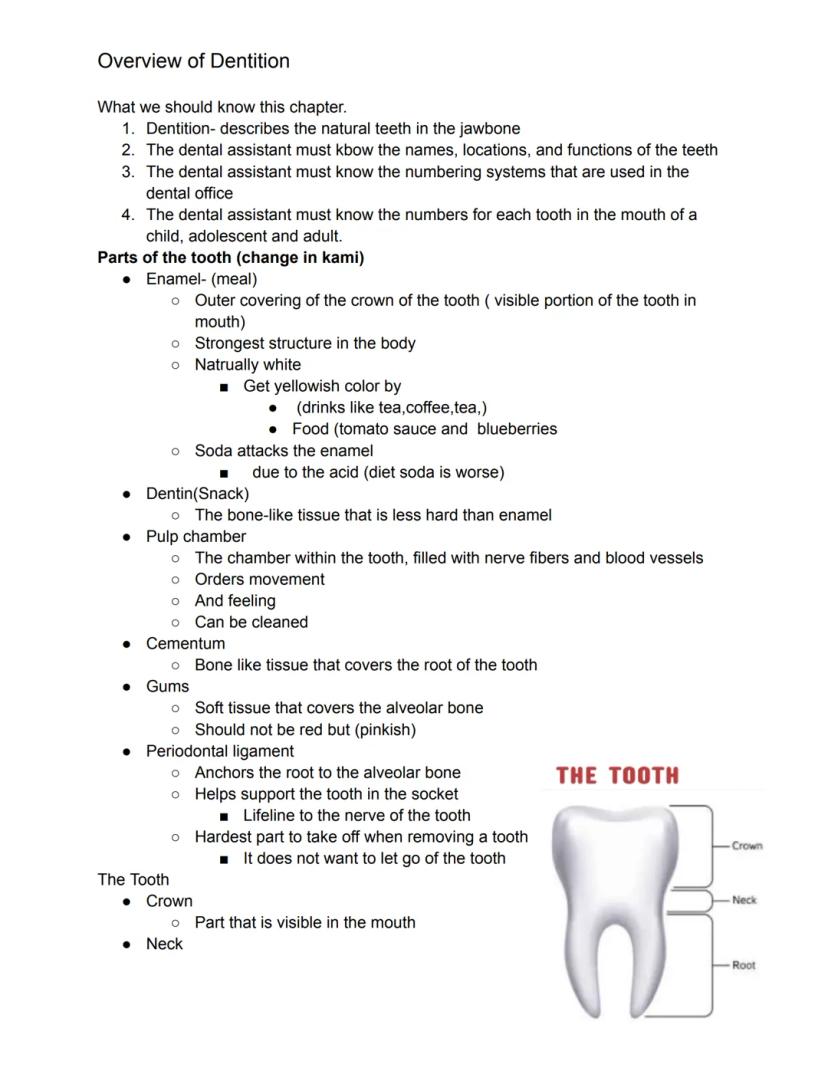



Ever wondered what your teeth are actually made of? Your teeth have several important layers, each with a specific job. The outer layer is enamel - the strongest structure in your entire body! It protects your teeth but can be stained by drinks like coffee or damaged by acidic sodas.
Beneath the enamel is dentin, which is less hard but still tough. At the center is the pulp chamber, containing nerves and blood vessels that allow you to feel temperature and pain. The cementum covers the root, while your gums (which should be pink, not red) protect the bone underneath.
The periodontal ligament acts like an anchor, holding your tooth securely in its socket. It's so strong that it's actually the hardest part to separate when removing a tooth!
Did You Know? Diet soda can actually damage your tooth enamel more than regular soda because of its high acid content. This is why dentists recommend drinking water instead!
Every tooth has three main parts: the crown (visible part above the gum), the neck (where the tooth meets the gum), and the root (the part below the gumline that anchors the tooth).

Your mouth goes through three distinct stages of dentition throughout your life. It's like your teeth have their own life journey!
Primary dentition (baby teeth) consists of 20 teeth that are already formed in your jaw at birth. They start erupting around 6-10 months of age, usually beginning with the bottom front teeth. All primary teeth are usually in place by age 3, and they play a crucial role in helping you learn to speak properly.
Mixed dentition happens between ages 6-12 when you have both baby teeth and permanent teeth in your mouth at the same time. This stage begins when your first permanent molars come in and ends when you lose your last baby tooth.
Permanent dentition is your final set of 32 adult teeth. Once you reach this stage, your jawbone growth slows significantly because you've passed puberty.
Remember This: Your mouth has two dental arches - the maxillary arch (upper jaw, which stays fixed) and the mandibular arch (lower jaw, which moves when you talk and eat).
Dentists divide your mouth into four sections called quadrants. Each quadrant in permanent dentition contains 8 teeth, while each quadrant in primary dentition has only 5 teeth.

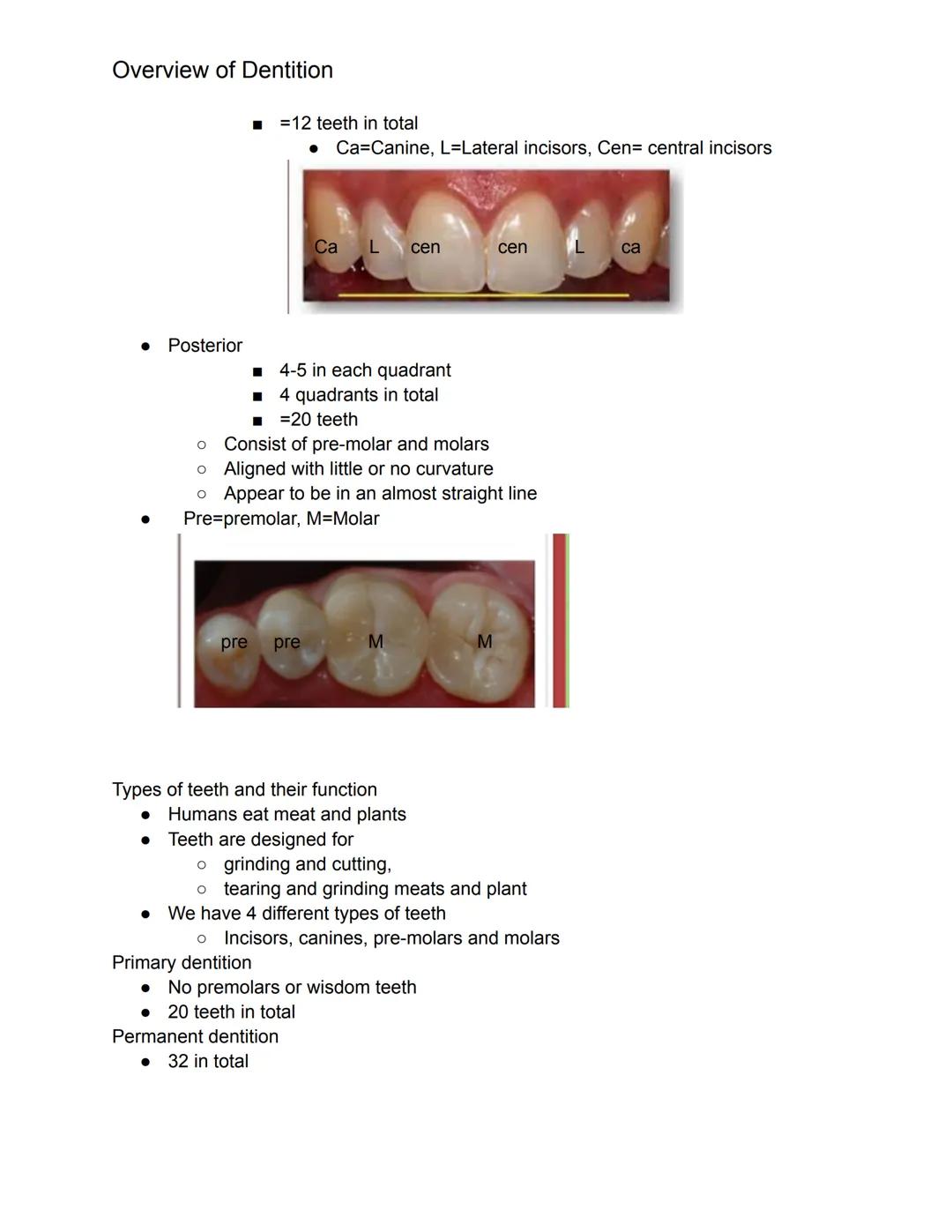
Your teeth are strategically positioned in your mouth based on their function. The front teeth are called anterior teeth, which include the incisors and canines. There are 12 anterior teeth in total across both your upper and lower jaws.
The back teeth are called posterior teeth, which include premolars and molars. These teeth appear in an almost straight line with little curvature. There are 4-5 posterior teeth in each quadrant, making about 20 teeth total.
Humans are omnivores (we eat both plants and meat), so our teeth are designed for a variety of functions - cutting, tearing, and grinding different types of food. This is why we have four different types of teeth, each specialized for specific tasks.
Fun Fact: While primary dentition (baby teeth) has 20 teeth total, permanent dentition has 32 teeth because adults have additional premolars and wisdom teeth that babies don't have!
When you look at a diagram of your mouth, you'll notice that teeth are organized by their function. The front teeth handle initial biting, while the back teeth are responsible for the heavy-duty grinding that breaks down your food.
Your mouth is like a toolbox with different tools for different jobs! Each type of tooth has a specific purpose that helps you process food efficiently.
Incisors are your eight front teeth (four on top, four on bottom) with sharp edges designed for cutting food. The word "incisor" literally means "to cut." The tongue side of these teeth is shaped like a shovel to help move food into your mouth.
Canines (also called cuspids) sit at the corners of your dental arch and have the longest roots of all your teeth. These strong teeth are designed for cutting and tearing food and are often called the "cornerstone" of your dental arch because of their important position.
Premolars (bicuspids) combine features of both canines and molars. You have eight of them in your permanent teeth, and they have a wider surface for chewing. The pointed outer cusps hold food while the inner cusps grind it.
Think About This: Your teeth are specialized tools - incisors cut like scissors, canines tear like knives, and molars grind like mortars and pestles. Together, they form a complete food processing system!
Molars are your largest teeth, located in the back of your mouth. With 4-5 cusps each, their main function is to chew and grind food thoroughly. You have 12 molars including wisdom teeth, and they differ in size, shape, and number of roots depending on whether they're in your upper or lower jaw.

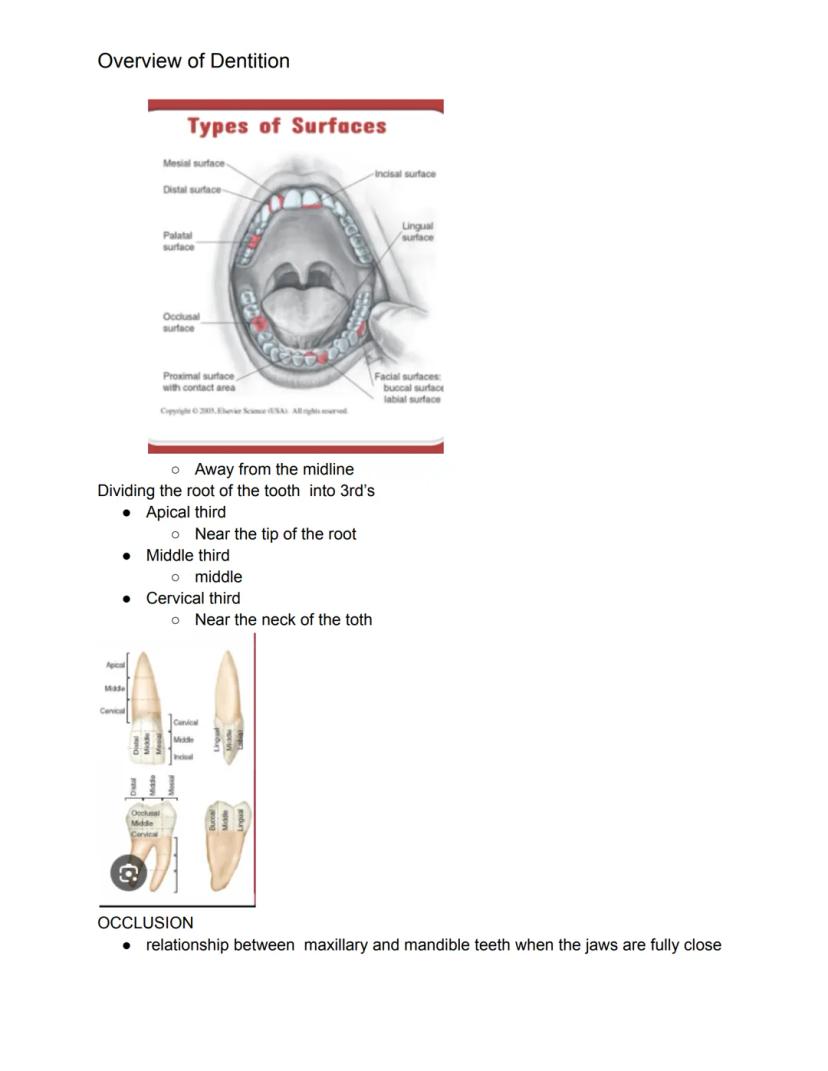
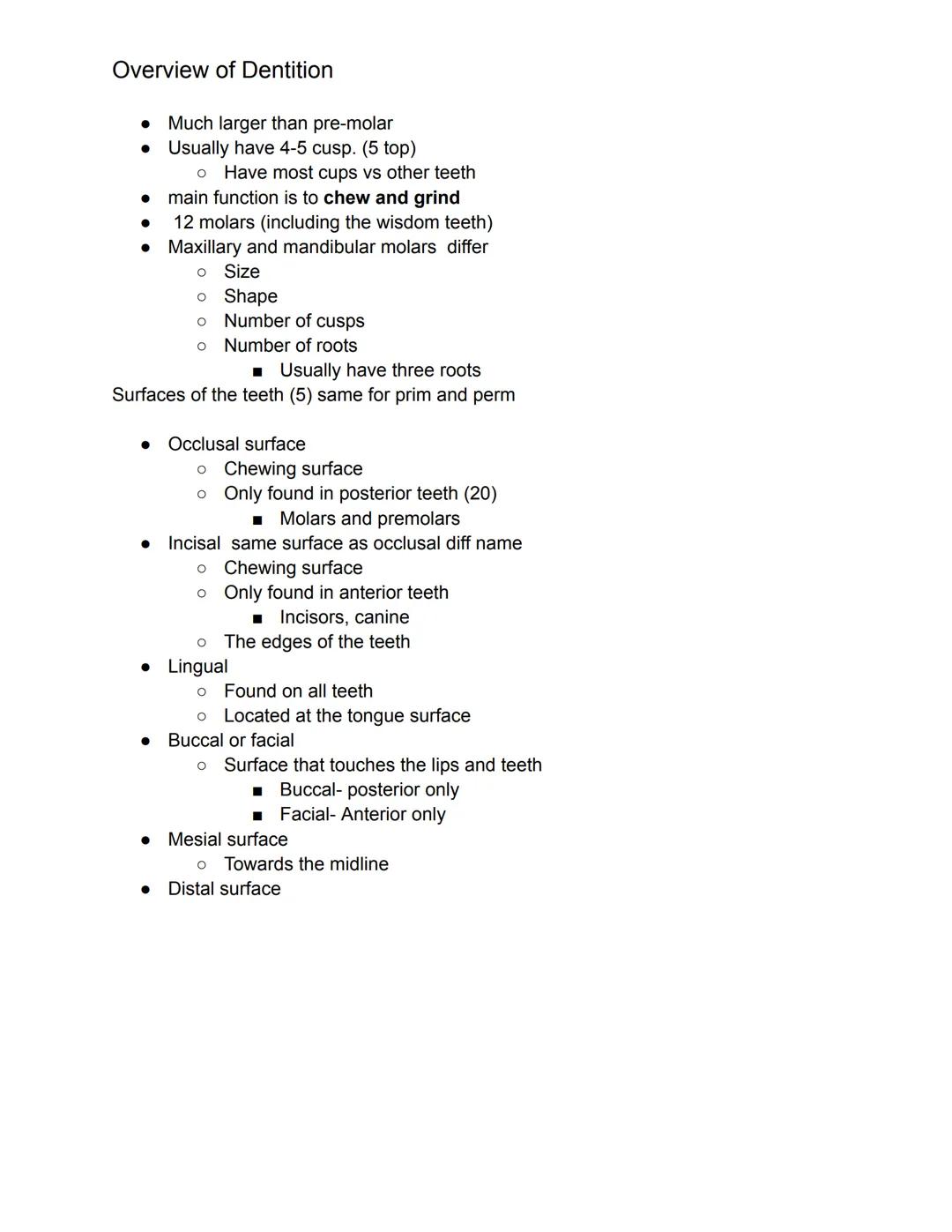
Each of your teeth has five different surfaces, and dentists use specific terms to describe these locations. Knowing these terms helps you understand what your dentist is talking about during checkups!
The occlusal surface is the chewing surface found only on posterior teeth (molars and premolars). For anterior teeth (incisors and canines), this same surface is called the incisal surface - it's the edge that does the cutting.
The lingual surface is found on all teeth and faces your tongue. On the opposite side is the buccal or facial surface which faces your cheeks and lips. Dentists use "buccal" for back teeth and "facial" for front teeth.
Mesial refers to the surface toward the middle of your dental arch, while distal refers to the surface away from the middle. These terms help dentists precisely describe locations on teeth.
Dental Tip: When dentists talk about a "mesial cavity" on tooth #9, they're referring to a cavity on the side of your upper left front tooth that faces toward the center of your smile.
Teeth can also be divided into thirds from top to bottom: the cervical third (near the neck of the tooth), the middle third, and the apical third (near the tip of the root). This helps dentists pinpoint the exact location of problems.
Occlusion refers to how your upper and lower teeth fit together when your jaws are closed. Good occlusion develops naturally as a child's teeth come in, but habits like thumb sucking can interfere with this process.
There are different types of occlusion. Centric occlusion is when your jaws close with maximum contact between teeth. Functional occlusion describes how teeth contact during biting and chewing. Malocclusion refers to abnormal alignment or positioning of teeth when the jaws are closed.
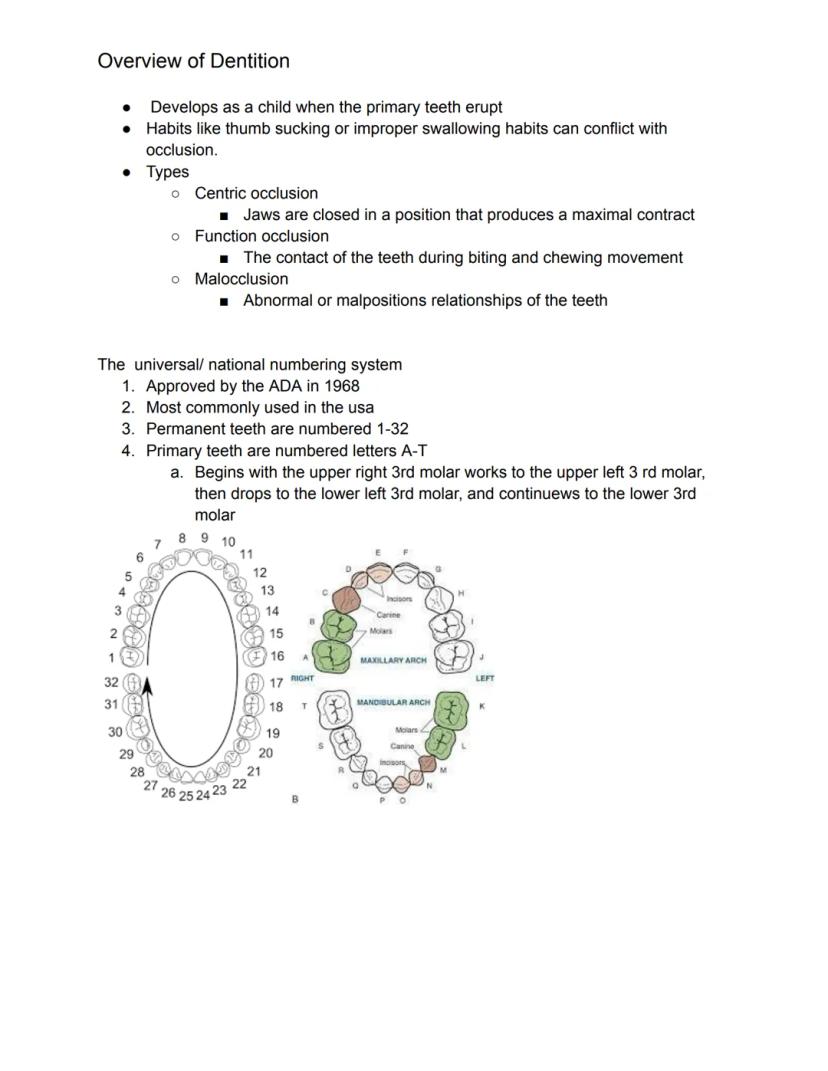
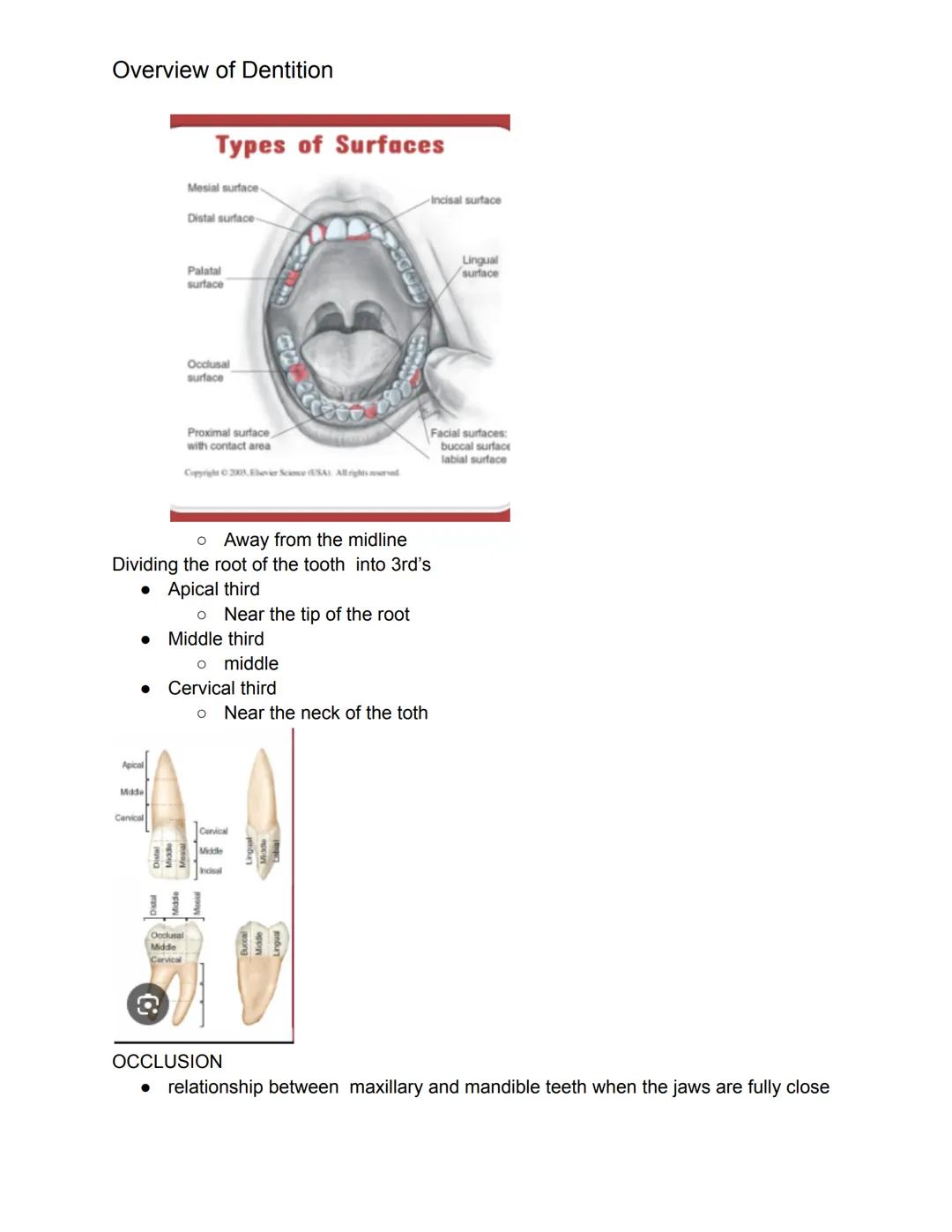
The Universal Numbering System is the standard way dentists in the USA identify teeth. Approved by the American Dental Association in 1968, this system assigns numbers 1-32 to permanent teeth and letters A-T to primary teeth.
Pro Tip: In the Universal Numbering System, counting starts at the upper right third molar (#1) and continues around to the upper left third molar (#16), then drops to the lower left third molar (#17) and continues to the lower right third molar (#32).
This numbering system makes it easy for dental professionals to communicate precisely about which tooth they're discussing. When your dentist says "we need to work on number 30," they're referring to your lower right first molar, according to this universal system.
Our AI companion is specifically built for the needs of students. Based on the millions of content pieces we have on the platform we can provide truly meaningful and relevant answers to students. But its not only about answers, the companion is even more about guiding students through their daily learning challenges, with personalised study plans, quizzes or content pieces in the chat and 100% personalisation based on the students skills and developments.
You can download the app in the Google Play Store and in the Apple App Store.
That's right! Enjoy free access to study content, connect with fellow students, and get instant help – all at your fingertips.
App Store
Google Play
The app is very easy to use and well designed. I have found everything I was looking for so far and have been able to learn a lot from the presentations! I will definitely use the app for a class assignment! And of course it also helps a lot as an inspiration.
Stefan S
iOS user
This app is really great. There are so many study notes and help [...]. My problem subject is French, for example, and the app has so many options for help. Thanks to this app, I have improved my French. I would recommend it to anyone.
Samantha Klich
Android user
Wow, I am really amazed. I just tried the app because I've seen it advertised many times and was absolutely stunned. This app is THE HELP you want for school and above all, it offers so many things, such as workouts and fact sheets, which have been VERY helpful to me personally.
Anna
iOS user
I think it’s very much worth it and you’ll end up using it a lot once you get the hang of it and even after looking at others notes you can still ask your Artificial intelligence buddy the question and ask to simplify it if you still don’t get it!!! In the end I think it’s worth it 😊👍 ⚠️Also DID I MENTION ITS FREEE YOU DON’T HAVE TO PAY FOR ANYTHING AND STILL GET YOUR GRADES IN PERFECTLY❗️❗️⚠️
Thomas R
iOS user
Knowunity is the BEST app I’ve used in a minute. This is not an ai review or anything this is genuinely coming from a 7th grade student (I know 2011 im young) but dude this app is a 10/10 i have maintained a 3.8 gpa and have plenty of time for gaming. I love it and my mom is just happy I got good grades
Brad T
Android user
Not only did it help me find the answer but it also showed me alternative ways to solve it. I was horrible in math and science but now I have an a in both subjects. Thanks for the help🤍🤍
David K
iOS user
The app's just great! All I have to do is enter the topic in the search bar and I get the response real fast. I don't have to watch 10 YouTube videos to understand something, so I'm saving my time. Highly recommended!
Sudenaz Ocak
Android user
In school I was really bad at maths but thanks to the app, I am doing better now. I am so grateful that you made the app.
Greenlight Bonnie
Android user
I found this app a couple years ago and it has only gotten better since then. I really love it because it can help with written questions and photo questions. Also, it can find study guides that other people have made as well as flashcard sets and practice tests. The free version is also amazing for students who might not be able to afford it. Would 100% recommend
Aubrey
iOS user
Best app if you're in Highschool or Junior high. I have been using this app for 2 school years and it's the best, it's good if you don't have anyone to help you with school work.😋🩷🎀
Marco B
iOS user
THE QUIZES AND FLASHCARDS ARE SO USEFUL AND I LOVE Knowunity AI. IT ALSO IS LITREALLY LIKE CHATGPT BUT SMARTER!! HELPED ME WITH MY MASCARA PROBLEMS TOO!! AS WELL AS MY REAL SUBJECTS ! DUHHH 😍😁😲🤑💗✨🎀😮
Elisha
iOS user
This app is phenomenal down to the correct info and the various topics you can study! I greatly recommend it for people who struggle with procrastination and those who need homework help. It has been perfectly accurate for world 1 history as far as I’ve seen! Geometry too!
Paul T
iOS user
The app is very easy to use and well designed. I have found everything I was looking for so far and have been able to learn a lot from the presentations! I will definitely use the app for a class assignment! And of course it also helps a lot as an inspiration.
Stefan S
iOS user
This app is really great. There are so many study notes and help [...]. My problem subject is French, for example, and the app has so many options for help. Thanks to this app, I have improved my French. I would recommend it to anyone.
Samantha Klich
Android user
Wow, I am really amazed. I just tried the app because I've seen it advertised many times and was absolutely stunned. This app is THE HELP you want for school and above all, it offers so many things, such as workouts and fact sheets, which have been VERY helpful to me personally.
Anna
iOS user
I think it’s very much worth it and you’ll end up using it a lot once you get the hang of it and even after looking at others notes you can still ask your Artificial intelligence buddy the question and ask to simplify it if you still don’t get it!!! In the end I think it’s worth it 😊👍 ⚠️Also DID I MENTION ITS FREEE YOU DON’T HAVE TO PAY FOR ANYTHING AND STILL GET YOUR GRADES IN PERFECTLY❗️❗️⚠️
Thomas R
iOS user
Knowunity is the BEST app I’ve used in a minute. This is not an ai review or anything this is genuinely coming from a 7th grade student (I know 2011 im young) but dude this app is a 10/10 i have maintained a 3.8 gpa and have plenty of time for gaming. I love it and my mom is just happy I got good grades
Brad T
Android user
Not only did it help me find the answer but it also showed me alternative ways to solve it. I was horrible in math and science but now I have an a in both subjects. Thanks for the help🤍🤍
David K
iOS user
The app's just great! All I have to do is enter the topic in the search bar and I get the response real fast. I don't have to watch 10 YouTube videos to understand something, so I'm saving my time. Highly recommended!
Sudenaz Ocak
Android user
In school I was really bad at maths but thanks to the app, I am doing better now. I am so grateful that you made the app.
Greenlight Bonnie
Android user
I found this app a couple years ago and it has only gotten better since then. I really love it because it can help with written questions and photo questions. Also, it can find study guides that other people have made as well as flashcard sets and practice tests. The free version is also amazing for students who might not be able to afford it. Would 100% recommend
Aubrey
iOS user
Best app if you're in Highschool or Junior high. I have been using this app for 2 school years and it's the best, it's good if you don't have anyone to help you with school work.😋🩷🎀
Marco B
iOS user
THE QUIZES AND FLASHCARDS ARE SO USEFUL AND I LOVE Knowunity AI. IT ALSO IS LITREALLY LIKE CHATGPT BUT SMARTER!! HELPED ME WITH MY MASCARA PROBLEMS TOO!! AS WELL AS MY REAL SUBJECTS ! DUHHH 😍😁😲🤑💗✨🎀😮
Elisha
iOS user
This app is phenomenal down to the correct info and the various topics you can study! I greatly recommend it for people who struggle with procrastination and those who need homework help. It has been perfectly accurate for world 1 history as far as I’ve seen! Geometry too!
Paul T
iOS user
Lia Ventura
@cookiesgood_aktq
Dentition is the arrangement of natural teeth in your jawbone. Understanding how your teeth are structured, named, and function is essential for dental health. This guide breaks down the key concepts about dentition that you'll need to know for science... Show more
Access to all documents
Improve your grades
Join milions of students
Ever wondered what your teeth are actually made of? Your teeth have several important layers, each with a specific job. The outer layer is enamel - the strongest structure in your entire body! It protects your teeth but can be stained by drinks like coffee or damaged by acidic sodas.
Beneath the enamel is dentin, which is less hard but still tough. At the center is the pulp chamber, containing nerves and blood vessels that allow you to feel temperature and pain. The cementum covers the root, while your gums (which should be pink, not red) protect the bone underneath.
The periodontal ligament acts like an anchor, holding your tooth securely in its socket. It's so strong that it's actually the hardest part to separate when removing a tooth!
Did You Know? Diet soda can actually damage your tooth enamel more than regular soda because of its high acid content. This is why dentists recommend drinking water instead!
Every tooth has three main parts: the crown (visible part above the gum), the neck (where the tooth meets the gum), and the root (the part below the gumline that anchors the tooth).
Access to all documents
Improve your grades
Join milions of students
Your mouth goes through three distinct stages of dentition throughout your life. It's like your teeth have their own life journey!
Primary dentition (baby teeth) consists of 20 teeth that are already formed in your jaw at birth. They start erupting around 6-10 months of age, usually beginning with the bottom front teeth. All primary teeth are usually in place by age 3, and they play a crucial role in helping you learn to speak properly.
Mixed dentition happens between ages 6-12 when you have both baby teeth and permanent teeth in your mouth at the same time. This stage begins when your first permanent molars come in and ends when you lose your last baby tooth.
Permanent dentition is your final set of 32 adult teeth. Once you reach this stage, your jawbone growth slows significantly because you've passed puberty.
Remember This: Your mouth has two dental arches - the maxillary arch (upper jaw, which stays fixed) and the mandibular arch (lower jaw, which moves when you talk and eat).
Dentists divide your mouth into four sections called quadrants. Each quadrant in permanent dentition contains 8 teeth, while each quadrant in primary dentition has only 5 teeth.
Access to all documents
Improve your grades
Join milions of students
Your teeth are strategically positioned in your mouth based on their function. The front teeth are called anterior teeth, which include the incisors and canines. There are 12 anterior teeth in total across both your upper and lower jaws.
The back teeth are called posterior teeth, which include premolars and molars. These teeth appear in an almost straight line with little curvature. There are 4-5 posterior teeth in each quadrant, making about 20 teeth total.
Humans are omnivores (we eat both plants and meat), so our teeth are designed for a variety of functions - cutting, tearing, and grinding different types of food. This is why we have four different types of teeth, each specialized for specific tasks.
Fun Fact: While primary dentition (baby teeth) has 20 teeth total, permanent dentition has 32 teeth because adults have additional premolars and wisdom teeth that babies don't have!
When you look at a diagram of your mouth, you'll notice that teeth are organized by their function. The front teeth handle initial biting, while the back teeth are responsible for the heavy-duty grinding that breaks down your food.
Access to all documents
Improve your grades
Join milions of students
Your mouth is like a toolbox with different tools for different jobs! Each type of tooth has a specific purpose that helps you process food efficiently.
Incisors are your eight front teeth (four on top, four on bottom) with sharp edges designed for cutting food. The word "incisor" literally means "to cut." The tongue side of these teeth is shaped like a shovel to help move food into your mouth.
Canines (also called cuspids) sit at the corners of your dental arch and have the longest roots of all your teeth. These strong teeth are designed for cutting and tearing food and are often called the "cornerstone" of your dental arch because of their important position.
Premolars (bicuspids) combine features of both canines and molars. You have eight of them in your permanent teeth, and they have a wider surface for chewing. The pointed outer cusps hold food while the inner cusps grind it.
Think About This: Your teeth are specialized tools - incisors cut like scissors, canines tear like knives, and molars grind like mortars and pestles. Together, they form a complete food processing system!
Molars are your largest teeth, located in the back of your mouth. With 4-5 cusps each, their main function is to chew and grind food thoroughly. You have 12 molars including wisdom teeth, and they differ in size, shape, and number of roots depending on whether they're in your upper or lower jaw.
Access to all documents
Improve your grades
Join milions of students
Each of your teeth has five different surfaces, and dentists use specific terms to describe these locations. Knowing these terms helps you understand what your dentist is talking about during checkups!
The occlusal surface is the chewing surface found only on posterior teeth (molars and premolars). For anterior teeth (incisors and canines), this same surface is called the incisal surface - it's the edge that does the cutting.
The lingual surface is found on all teeth and faces your tongue. On the opposite side is the buccal or facial surface which faces your cheeks and lips. Dentists use "buccal" for back teeth and "facial" for front teeth.
Mesial refers to the surface toward the middle of your dental arch, while distal refers to the surface away from the middle. These terms help dentists precisely describe locations on teeth.
Dental Tip: When dentists talk about a "mesial cavity" on tooth #9, they're referring to a cavity on the side of your upper left front tooth that faces toward the center of your smile.
Teeth can also be divided into thirds from top to bottom: the cervical third (near the neck of the tooth), the middle third, and the apical third (near the tip of the root). This helps dentists pinpoint the exact location of problems.
Access to all documents
Improve your grades
Join milions of students
Occlusion refers to how your upper and lower teeth fit together when your jaws are closed. Good occlusion develops naturally as a child's teeth come in, but habits like thumb sucking can interfere with this process.
There are different types of occlusion. Centric occlusion is when your jaws close with maximum contact between teeth. Functional occlusion describes how teeth contact during biting and chewing. Malocclusion refers to abnormal alignment or positioning of teeth when the jaws are closed.
The Universal Numbering System is the standard way dentists in the USA identify teeth. Approved by the American Dental Association in 1968, this system assigns numbers 1-32 to permanent teeth and letters A-T to primary teeth.
Pro Tip: In the Universal Numbering System, counting starts at the upper right third molar (#1) and continues around to the upper left third molar (#16), then drops to the lower left third molar (#17) and continues to the lower right third molar (#32).
This numbering system makes it easy for dental professionals to communicate precisely about which tooth they're discussing. When your dentist says "we need to work on number 30," they're referring to your lower right first molar, according to this universal system.
Access to all documents
Improve your grades
Join milions of students
Access to all documents
Improve your grades
Join milions of students
Our AI companion is specifically built for the needs of students. Based on the millions of content pieces we have on the platform we can provide truly meaningful and relevant answers to students. But its not only about answers, the companion is even more about guiding students through their daily learning challenges, with personalised study plans, quizzes or content pieces in the chat and 100% personalisation based on the students skills and developments.
You can download the app in the Google Play Store and in the Apple App Store.
That's right! Enjoy free access to study content, connect with fellow students, and get instant help – all at your fingertips.
3
Smart Tools NEW
Transform this note into: ✓ 50+ Practice Questions ✓ Interactive Flashcards ✓ Full Practice Test ✓ Essay Outlines
Terms related to cardiovascular
 Health & Medicine
Explore the dynamics of peer pressure, including its positive and negative effects on self-concept and social behavior. This summary covers key concepts such as social influence, conformity, and the impact of peer relationships on youth. Ideal for students seeking to understand the complexities of peer interactions and their implications for personal development.
 Health & Social Care
Medical health 2 nervous system study notes
Health & MedicineWhat it is, History, Applied Fields, etc.
Health & MedicineThis has medical terms that students can utilize
Health & MedicineCOVID-19 pandemic has had a profound impact on societies, health, and the economy around the world. It has highlighted existing inequalities and the importance of effective leadership and governance in times of crisis.
Health & MedicineApp Store
Google Play
The app is very easy to use and well designed. I have found everything I was looking for so far and have been able to learn a lot from the presentations! I will definitely use the app for a class assignment! And of course it also helps a lot as an inspiration.
Stefan S
iOS user
This app is really great. There are so many study notes and help [...]. My problem subject is French, for example, and the app has so many options for help. Thanks to this app, I have improved my French. I would recommend it to anyone.
Samantha Klich
Android user
Wow, I am really amazed. I just tried the app because I've seen it advertised many times and was absolutely stunned. This app is THE HELP you want for school and above all, it offers so many things, such as workouts and fact sheets, which have been VERY helpful to me personally.
Anna
iOS user
I think it’s very much worth it and you’ll end up using it a lot once you get the hang of it and even after looking at others notes you can still ask your Artificial intelligence buddy the question and ask to simplify it if you still don’t get it!!! In the end I think it’s worth it 😊👍 ⚠️Also DID I MENTION ITS FREEE YOU DON’T HAVE TO PAY FOR ANYTHING AND STILL GET YOUR GRADES IN PERFECTLY❗️❗️⚠️
Thomas R
iOS user
Knowunity is the BEST app I’ve used in a minute. This is not an ai review or anything this is genuinely coming from a 7th grade student (I know 2011 im young) but dude this app is a 10/10 i have maintained a 3.8 gpa and have plenty of time for gaming. I love it and my mom is just happy I got good grades
Brad T
Android user
Not only did it help me find the answer but it also showed me alternative ways to solve it. I was horrible in math and science but now I have an a in both subjects. Thanks for the help🤍🤍
David K
iOS user
The app's just great! All I have to do is enter the topic in the search bar and I get the response real fast. I don't have to watch 10 YouTube videos to understand something, so I'm saving my time. Highly recommended!
Sudenaz Ocak
Android user
In school I was really bad at maths but thanks to the app, I am doing better now. I am so grateful that you made the app.
Greenlight Bonnie
Android user
I found this app a couple years ago and it has only gotten better since then. I really love it because it can help with written questions and photo questions. Also, it can find study guides that other people have made as well as flashcard sets and practice tests. The free version is also amazing for students who might not be able to afford it. Would 100% recommend
Aubrey
iOS user
Best app if you're in Highschool or Junior high. I have been using this app for 2 school years and it's the best, it's good if you don't have anyone to help you with school work.😋🩷🎀
Marco B
iOS user
THE QUIZES AND FLASHCARDS ARE SO USEFUL AND I LOVE Knowunity AI. IT ALSO IS LITREALLY LIKE CHATGPT BUT SMARTER!! HELPED ME WITH MY MASCARA PROBLEMS TOO!! AS WELL AS MY REAL SUBJECTS ! DUHHH 😍😁😲🤑💗✨🎀😮
Elisha
iOS user
This app is phenomenal down to the correct info and the various topics you can study! I greatly recommend it for people who struggle with procrastination and those who need homework help. It has been perfectly accurate for world 1 history as far as I’ve seen! Geometry too!
Paul T
iOS user
The app is very easy to use and well designed. I have found everything I was looking for so far and have been able to learn a lot from the presentations! I will definitely use the app for a class assignment! And of course it also helps a lot as an inspiration.
Stefan S
iOS user
This app is really great. There are so many study notes and help [...]. My problem subject is French, for example, and the app has so many options for help. Thanks to this app, I have improved my French. I would recommend it to anyone.
Samantha Klich
Android user
Wow, I am really amazed. I just tried the app because I've seen it advertised many times and was absolutely stunned. This app is THE HELP you want for school and above all, it offers so many things, such as workouts and fact sheets, which have been VERY helpful to me personally.
Anna
iOS user
I think it’s very much worth it and you’ll end up using it a lot once you get the hang of it and even after looking at others notes you can still ask your Artificial intelligence buddy the question and ask to simplify it if you still don’t get it!!! In the end I think it’s worth it 😊👍 ⚠️Also DID I MENTION ITS FREEE YOU DON’T HAVE TO PAY FOR ANYTHING AND STILL GET YOUR GRADES IN PERFECTLY❗️❗️⚠️
Thomas R
iOS user
Knowunity is the BEST app I’ve used in a minute. This is not an ai review or anything this is genuinely coming from a 7th grade student (I know 2011 im young) but dude this app is a 10/10 i have maintained a 3.8 gpa and have plenty of time for gaming. I love it and my mom is just happy I got good grades
Brad T
Android user
Not only did it help me find the answer but it also showed me alternative ways to solve it. I was horrible in math and science but now I have an a in both subjects. Thanks for the help🤍🤍
David K
iOS user
The app's just great! All I have to do is enter the topic in the search bar and I get the response real fast. I don't have to watch 10 YouTube videos to understand something, so I'm saving my time. Highly recommended!
Sudenaz Ocak
Android user
In school I was really bad at maths but thanks to the app, I am doing better now. I am so grateful that you made the app.
Greenlight Bonnie
Android user
I found this app a couple years ago and it has only gotten better since then. I really love it because it can help with written questions and photo questions. Also, it can find study guides that other people have made as well as flashcard sets and practice tests. The free version is also amazing for students who might not be able to afford it. Would 100% recommend
Aubrey
iOS user
Best app if you're in Highschool or Junior high. I have been using this app for 2 school years and it's the best, it's good if you don't have anyone to help you with school work.😋🩷🎀
Marco B
iOS user
THE QUIZES AND FLASHCARDS ARE SO USEFUL AND I LOVE Knowunity AI. IT ALSO IS LITREALLY LIKE CHATGPT BUT SMARTER!! HELPED ME WITH MY MASCARA PROBLEMS TOO!! AS WELL AS MY REAL SUBJECTS ! DUHHH 😍😁😲🤑💗✨🎀😮
Elisha
iOS user
This app is phenomenal down to the correct info and the various topics you can study! I greatly recommend it for people who struggle with procrastination and those who need homework help. It has been perfectly accurate for world 1 history as far as I’ve seen! Geometry too!
Paul T
iOS user