
Memory is the complex process of retaining and accessing information... Show more
 Algebra
Sign up to see the contentIt's free!
Access to all documents
Improve your grades
Join milions of students
Knowunity AI
Subjects
Triangle Congruence and Similarity Theorems
Triangle Properties and Classification
Linear Equations and Graphs
Geometric Angle Relationships
Trigonometric Functions and Identities
Equation Solving Techniques
Circle Geometry Fundamentals
Division Operations and Methods
Basic Differentiation Rules
Exponent and Logarithm Properties
Show all topics
Human Organ Systems
Reproductive Cell Cycles
Biological Sciences Subdisciplines
Cellular Energy Metabolism
Autotrophic Energy Processes
Inheritance Patterns and Principles
Biomolecular Structure and Organization
Cell Cycle and Division Mechanics
Cellular Organization and Development
Biological Structural Organization
Show all topics
Chemical Sciences and Applications
Atomic Structure and Composition
Molecular Electron Structure Representation
Atomic Electron Behavior
Matter Properties and Water
Mole Concept and Calculations
Gas Laws and Behavior
Periodic Table Organization
Chemical Thermodynamics Fundamentals
Chemical Bond Types and Properties
Show all topics
European Renaissance and Enlightenment
European Cultural Movements 800-1920
American Revolution Era 1763-1797
American Civil War 1861-1865
Global Imperial Systems
Mongol and Chinese Dynasties
U.S. Presidents and World Leaders
Historical Sources and Documentation
World Wars Era and Impact
World Religious Systems
Show all topics
Classic and Contemporary Novels
Literary Character Analysis
Rhetorical Theory and Practice
Classic Literary Narratives
Reading Analysis and Interpretation
Narrative Structure and Techniques
English Language Components
Influential English-Language Authors
Basic Sentence Structure
Narrative Voice and Perspective
Show all topics
52
•
Feb 17, 2026
•
Liliana Mccannon
@ilianaccannon_rugzto
Memory is the complex process of retaining and accessing information... Show more
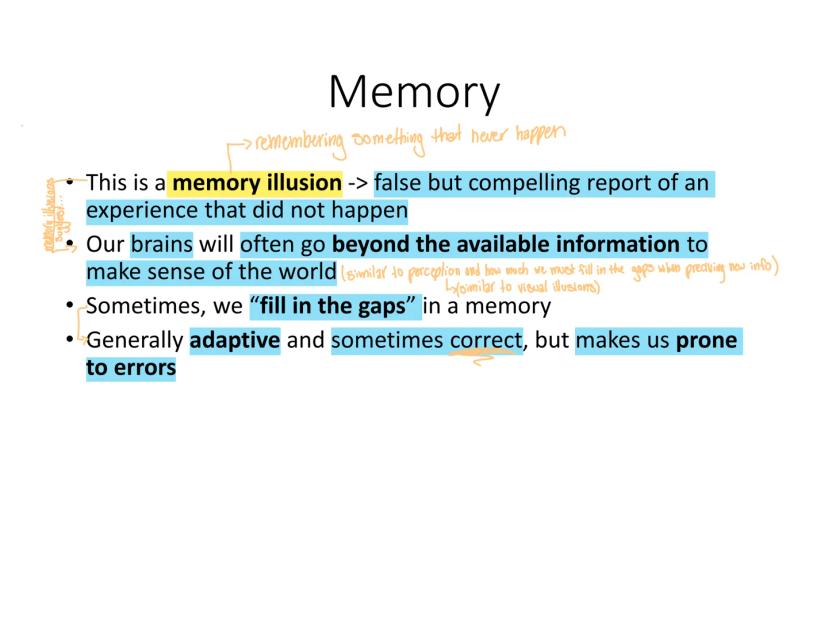
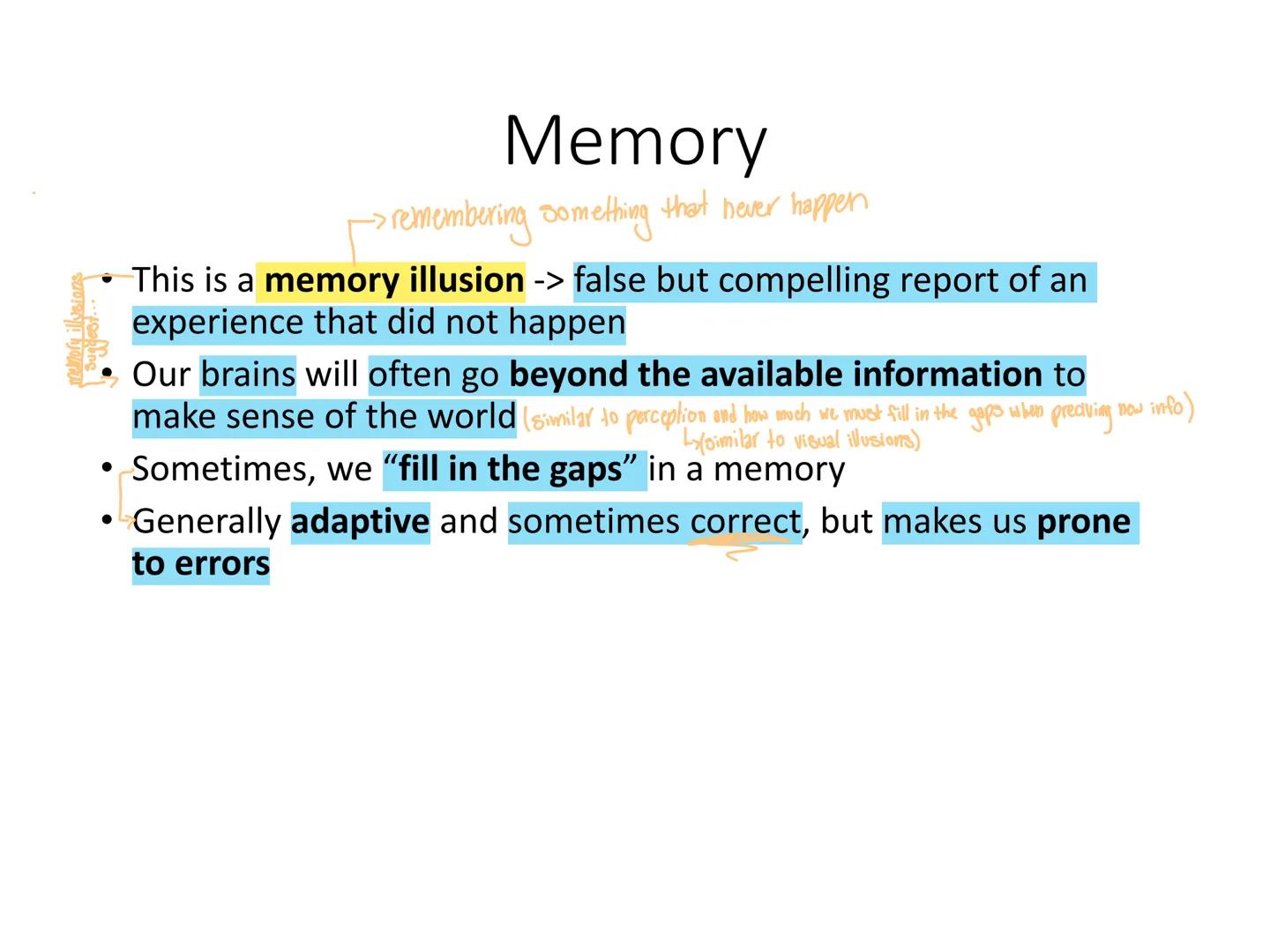
Have you ever remembered something that never actually happened? This isn't uncommon! Memory illusions are false but compelling reports of experiences that didn't occur.
Just like your brain fills in visual gaps when perceiving the world around you, it also fills in gaps in your memories. This reconstructive process is generally adaptive and helps you make sense of incomplete information. However, it also makes you prone to errors.
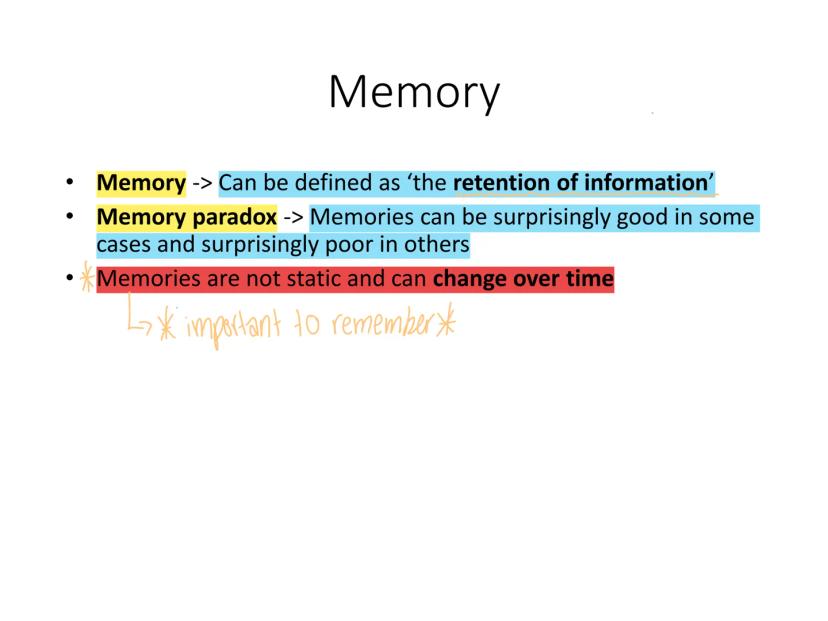
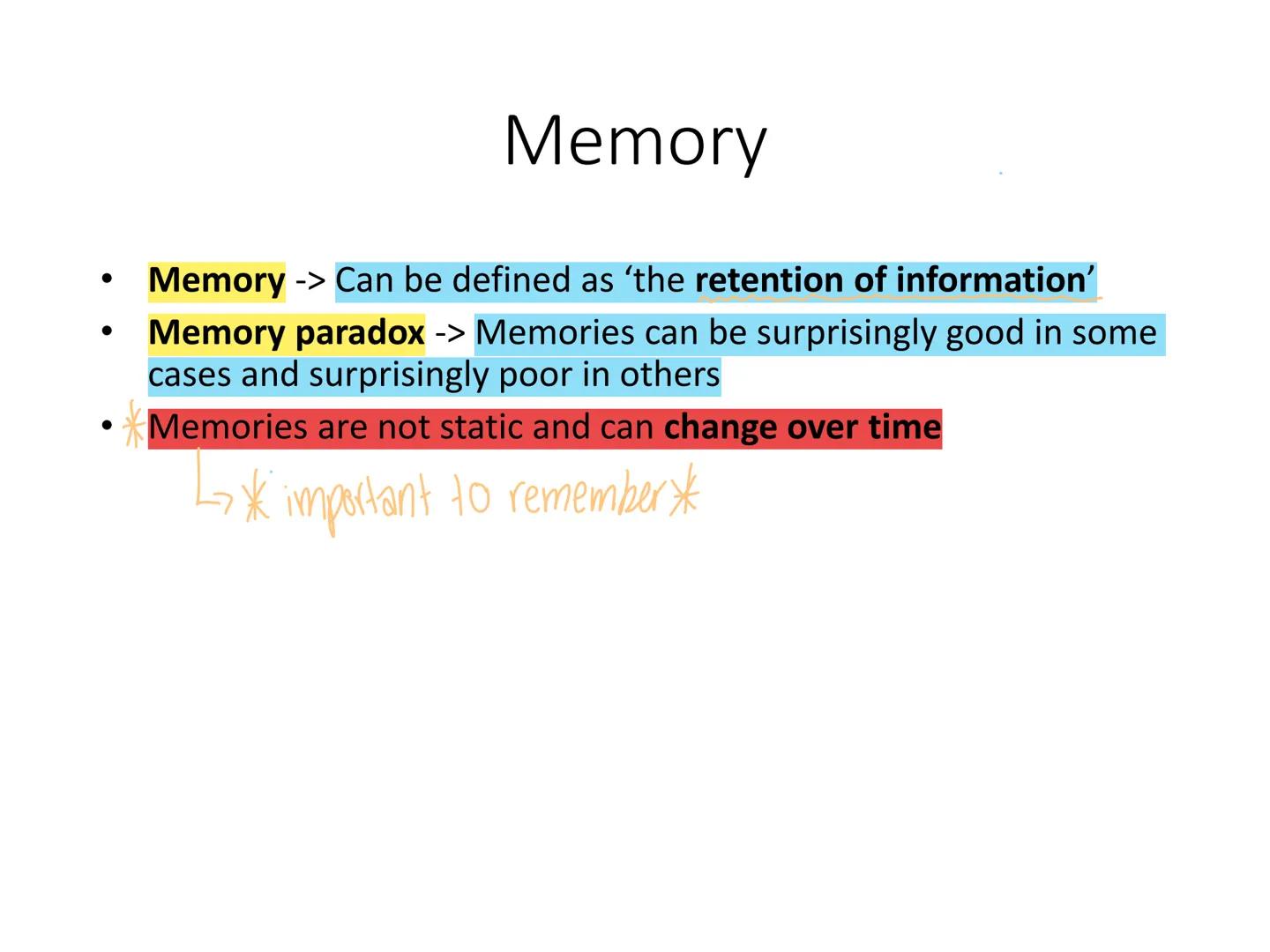
The memory paradox explains why memories can be surprisingly accurate in some cases yet frustratingly unreliable in others. Most importantly, your memories aren't static recordings - they change over time as your brain reconstructs them.
Remember This! Every time you recall a memory, you're not playing back a perfect recording - you're actively reconstructing it based on fragments of information, current beliefs, and expectations.
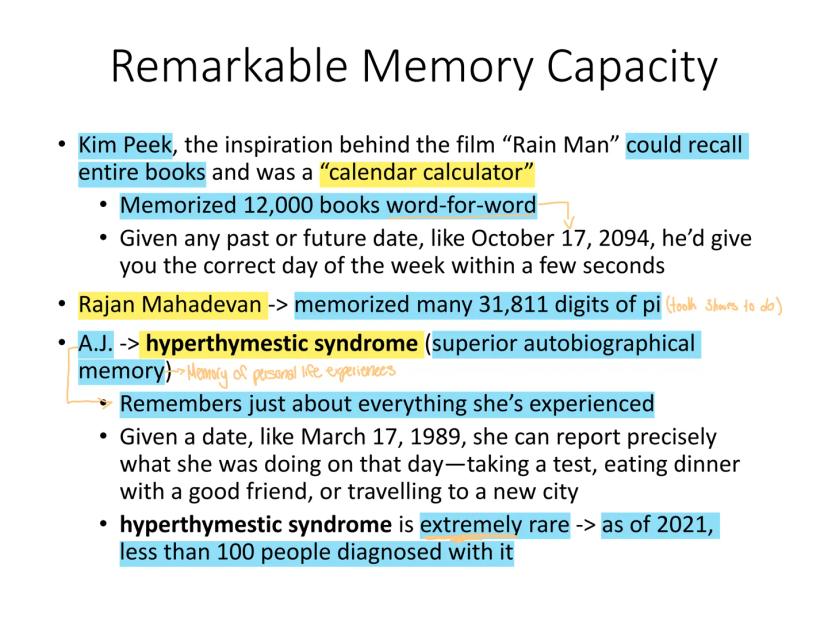
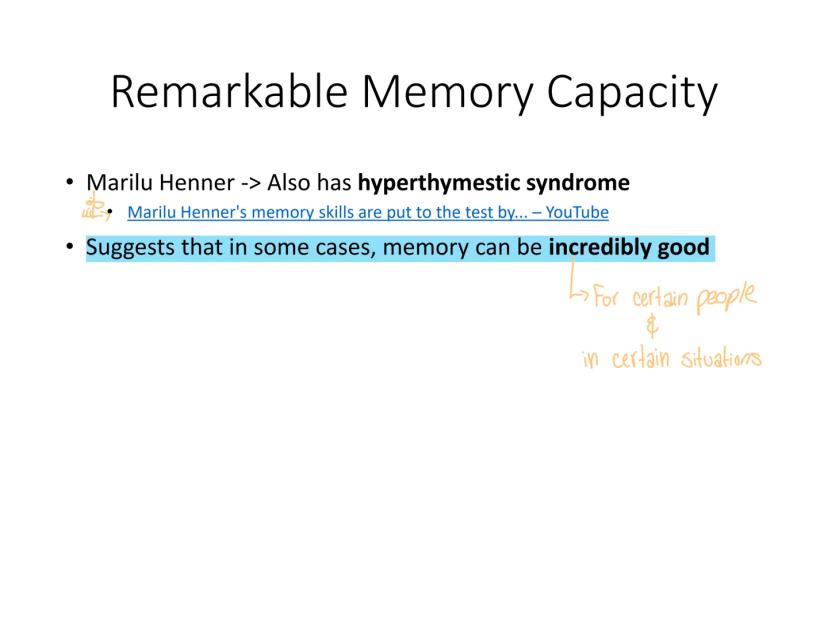
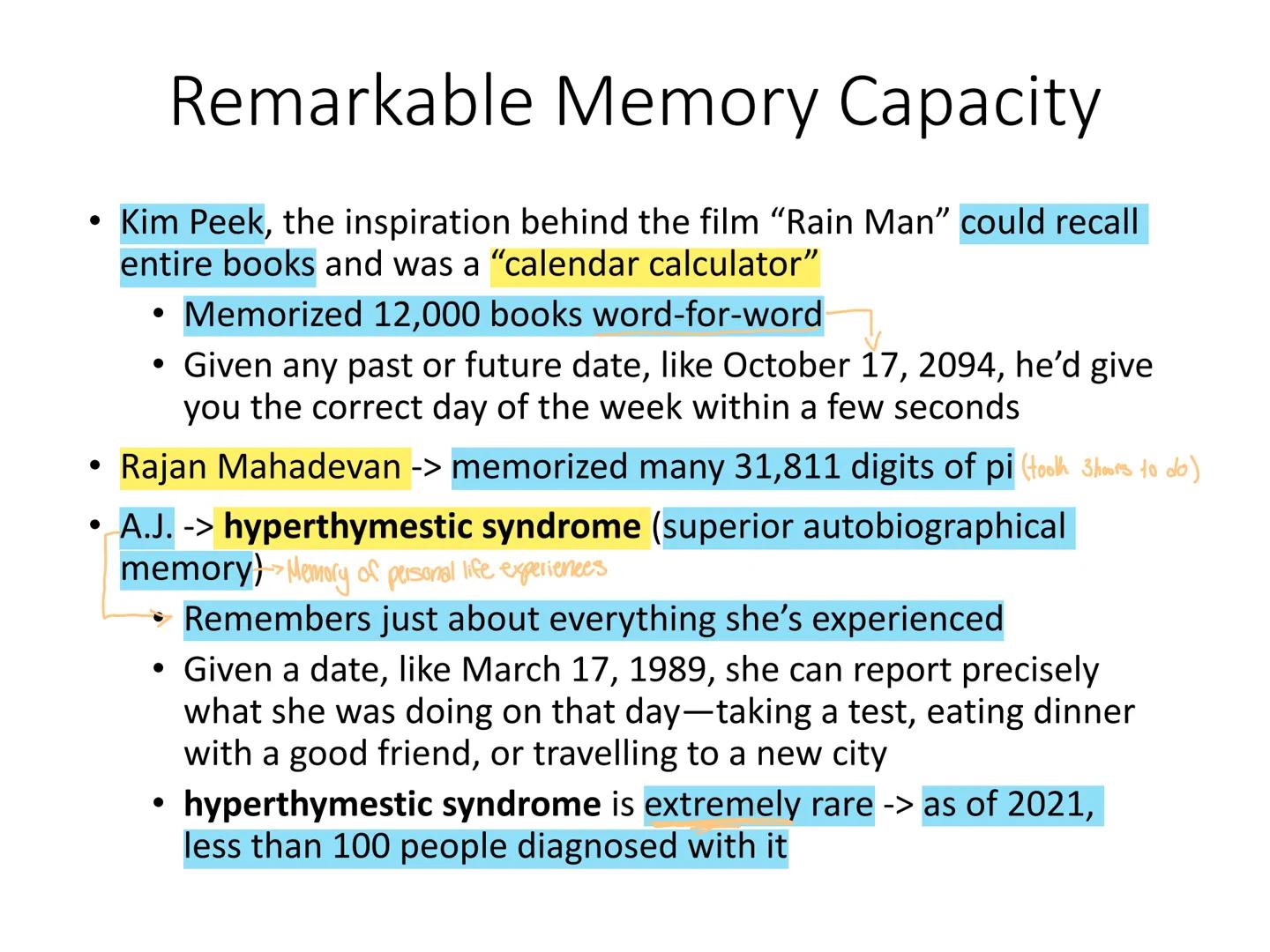
Some individuals demonstrate extraordinary memory abilities that showcase the incredible potential of human memory. Kim Peek, who inspired the movie "Rain Man," could recall entire books word-for-word and memorized about 12,000 books!
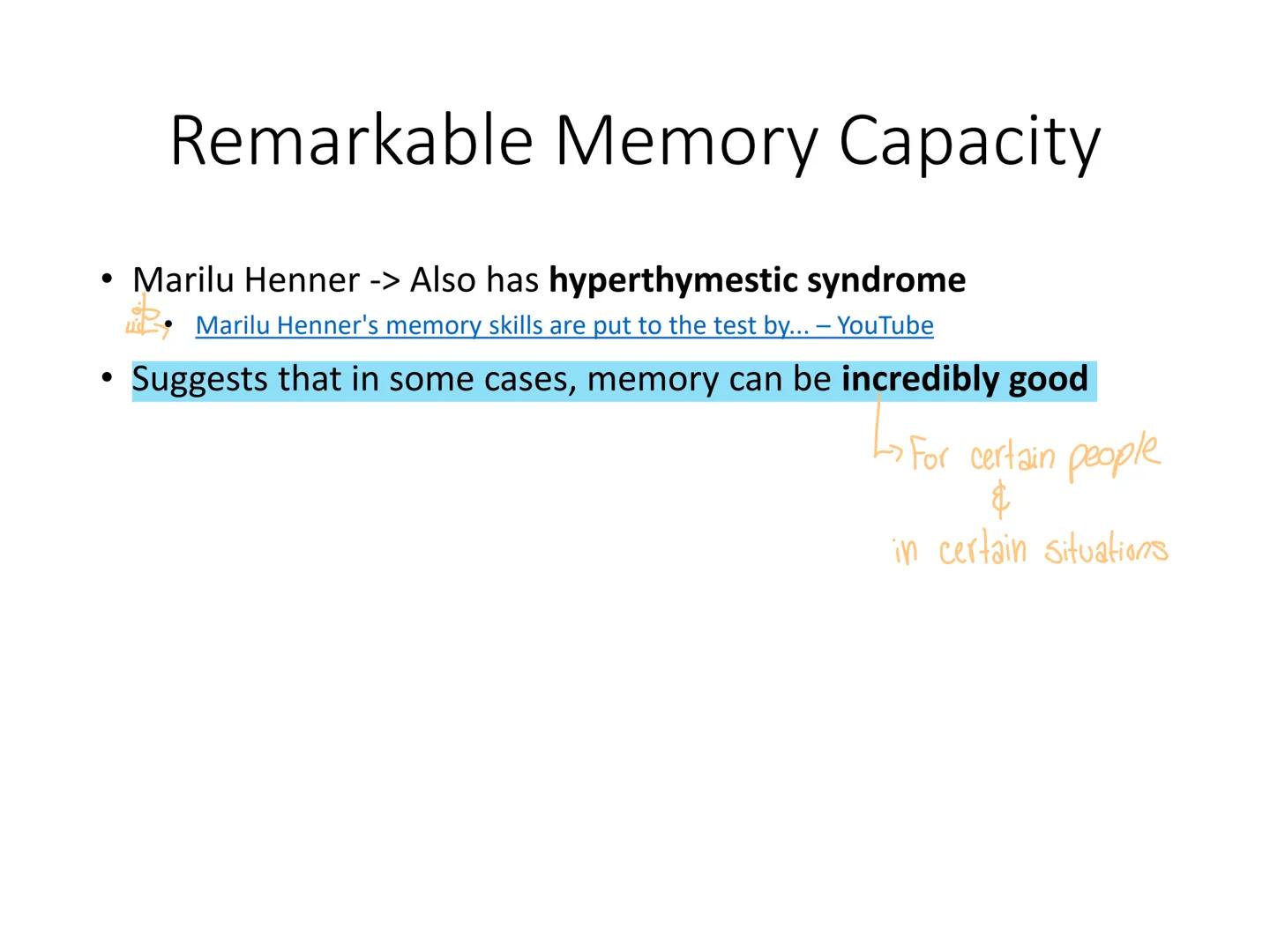
A few rare individuals have hyperthymestic syndrome (superior autobiographical memory). People like Marilu Henner can recall precisely what they were doing on almost any date in their past life. Given a specific date like March 17, 1989, they can tell you exactly what they were doing, who they were with, and even what they wore.
These exceptional cases are extremely rare - as of 2021, fewer than 100 people worldwide had been diagnosed with hyperthymestic syndrome. While most of us don't have these extraordinary abilities, these cases show that in certain situations and for certain people, memory capacity can be truly remarkable.
Fun Fact: Rajan Mahadevan memorized 31,811 digits of pi, which took him 3 hours to recite from memory!
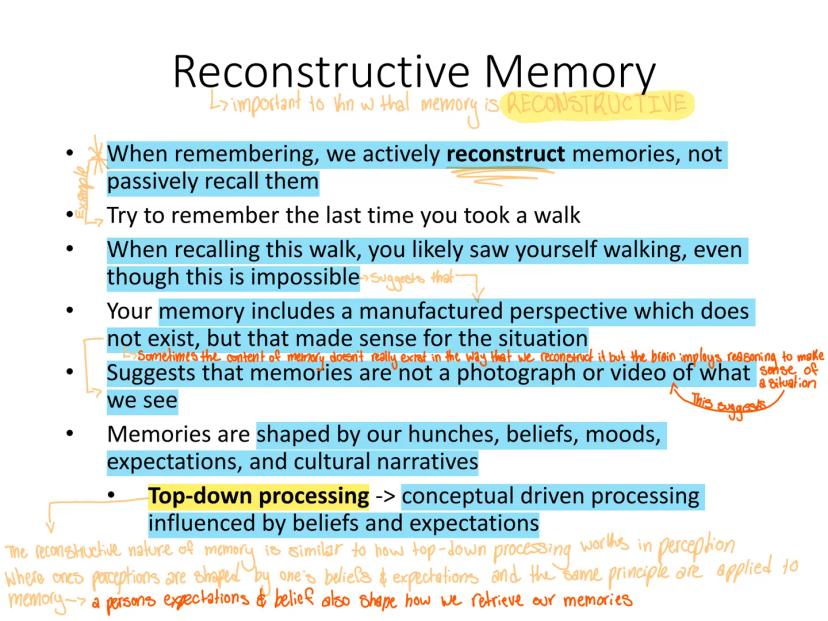
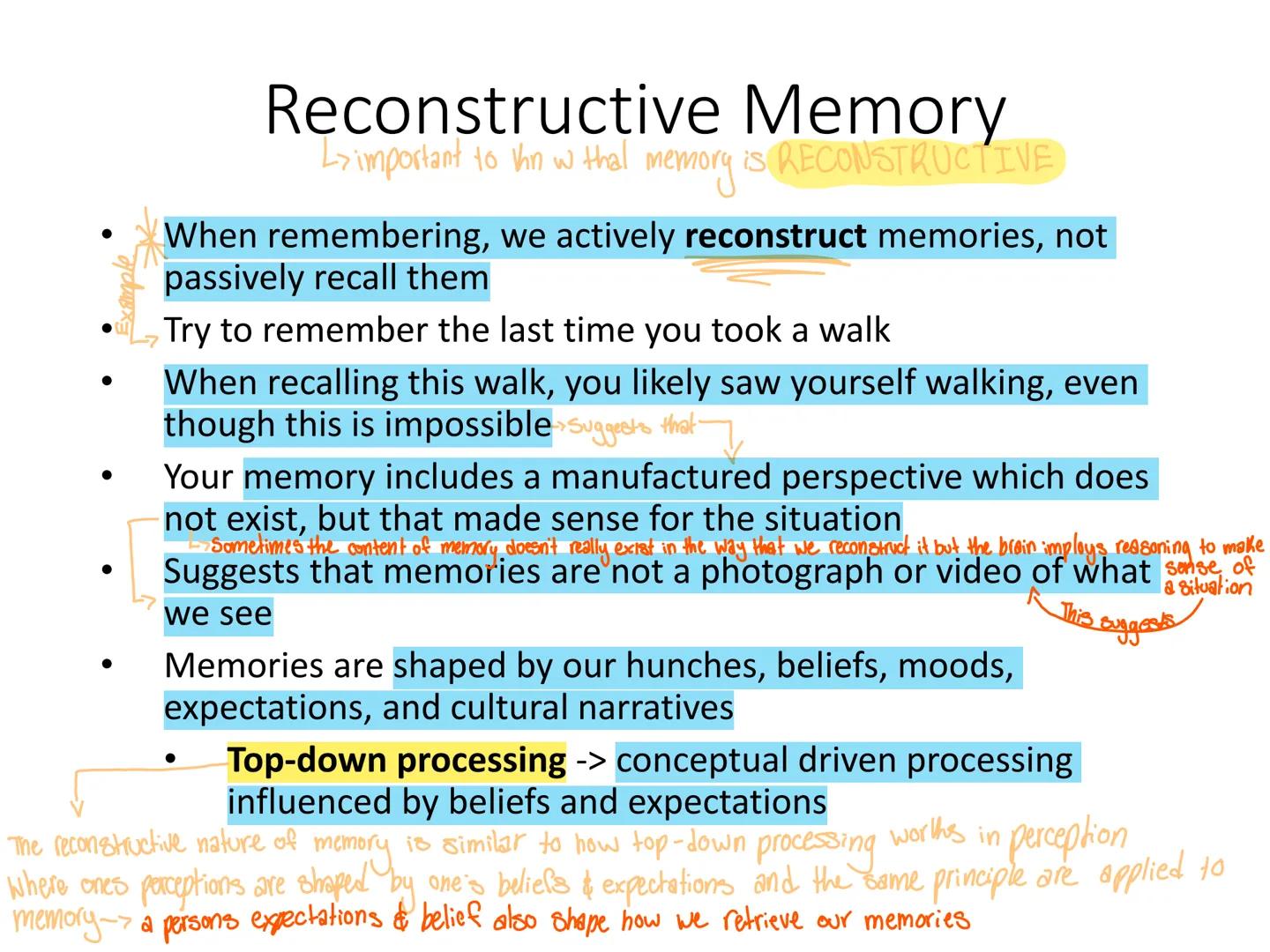
Your memory isn't like a camera capturing perfect snapshots of experiences. Instead, it's reconstructive - you actively rebuild memories using fragments of information combined with your beliefs and expectations.
Try remembering the last time you took a walk. You likely saw yourself walking from an outside perspective - something that would have been impossible during the actual experience! This manufactured perspective is a perfect example of how your brain reconstructs rather than simply replays memories.
The reconstructive nature of memory works through top-down processing, where your recollections are shaped by your beliefs, moods, expectations, and cultural narratives. Similar to how perception works, your expectations influence what and how you remember things.
Key Insight: When you remember something, you're not playing back a perfect recording - you're reconstructing an experience based on fragments of information combined with your current beliefs and knowledge.
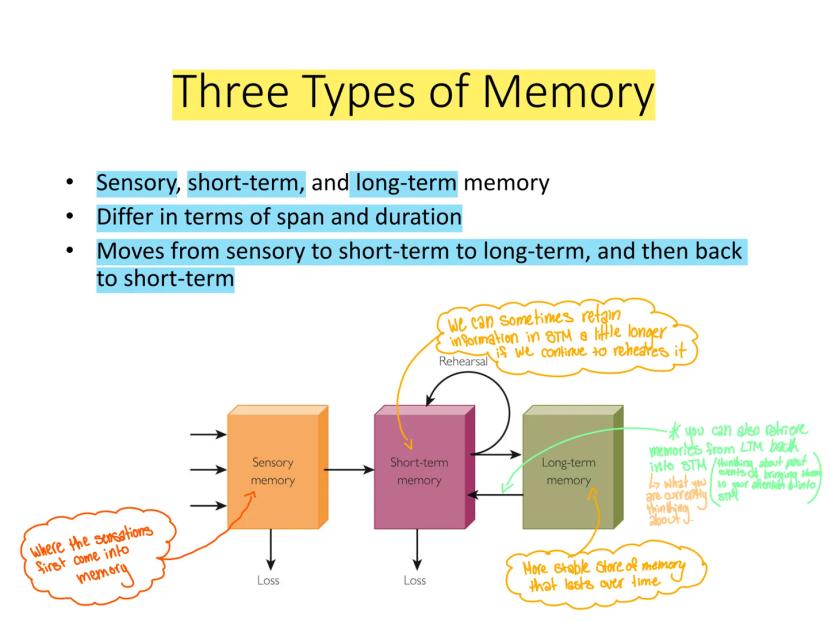
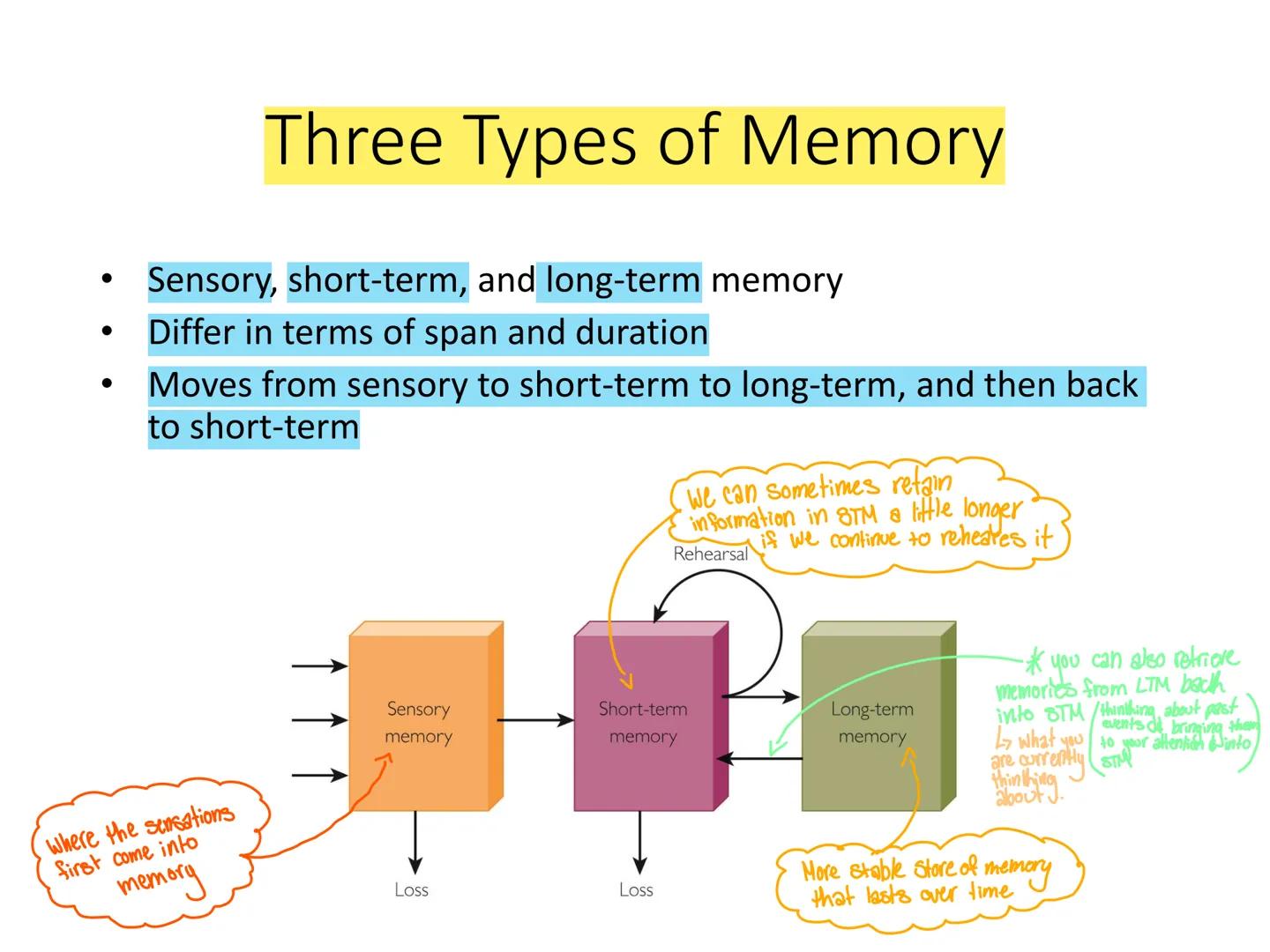
Your memory system can be divided into three major types that differ in span and duration: sensory, short-term, and long-term memory. Information typically flows from sensory to short-term to long-term memory and can be retrieved back into short-term awareness.
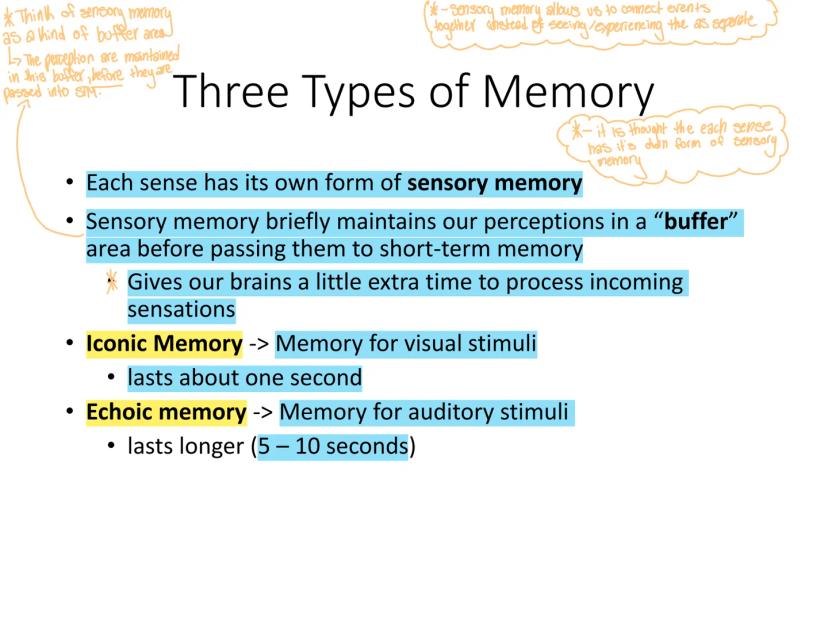
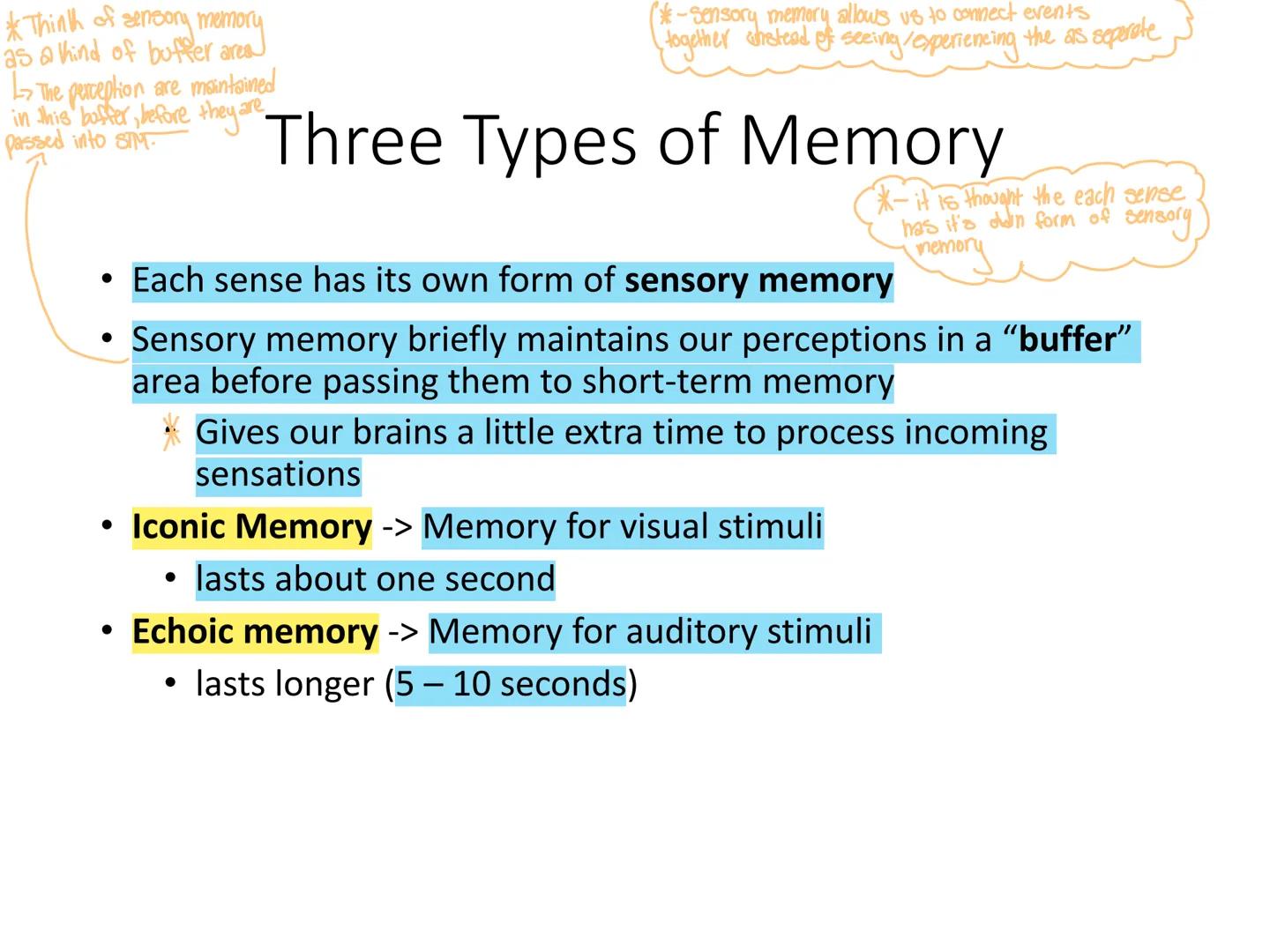
Sensory memory functions as a buffer area where perceptions are briefly maintained before passing to short-term memory. Each sense has its own form of sensory memory - iconic memory for visual stimuli (lasting about one second) and echoic memory for auditory stimuli .
This sensory buffer gives your brain extra time to process incoming information. It allows you to connect events together rather than experiencing them as separate, disjointed moments.
Try This: Notice how when someone speaks to you, you can hold the sound of their voice in your mind briefly even after they finish speaking. That's your echoic memory at work!
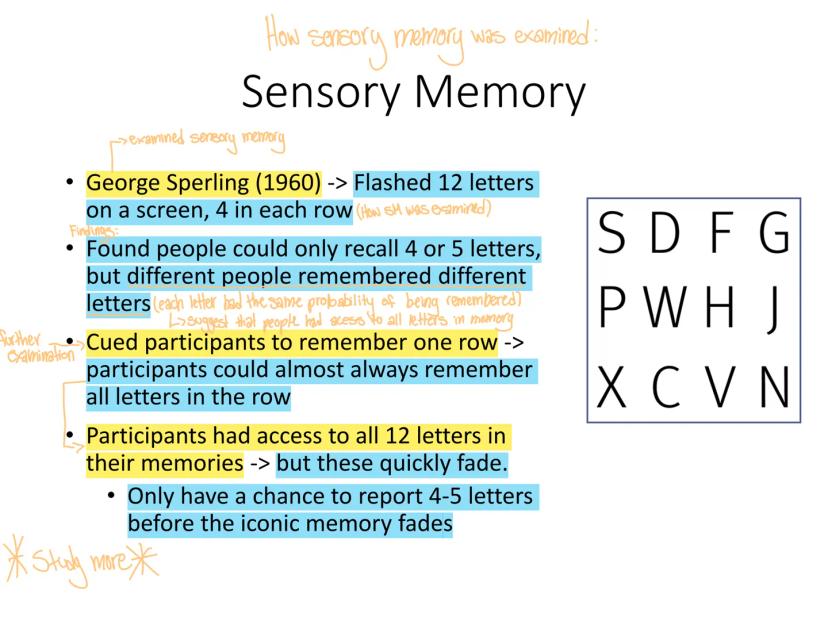
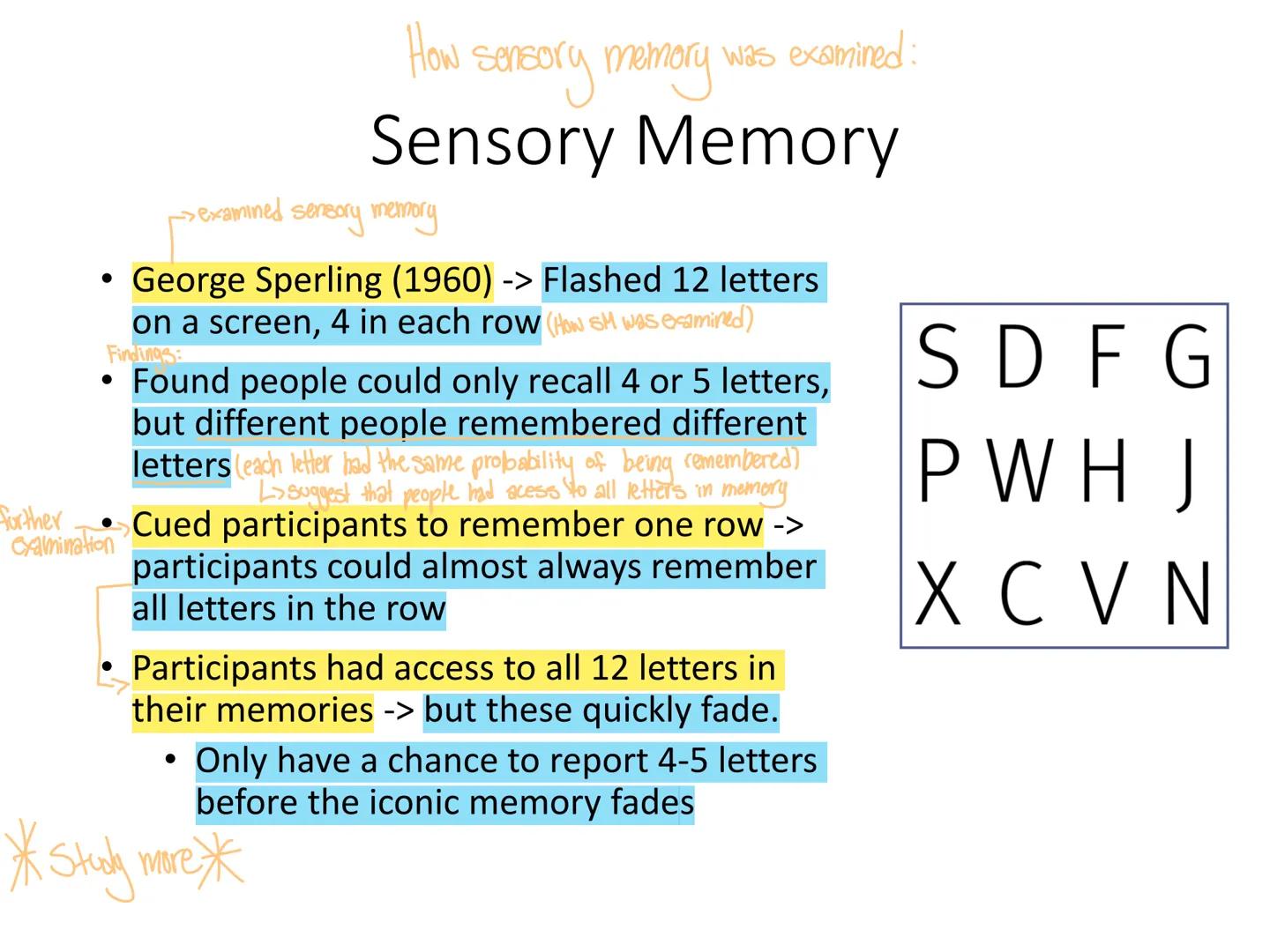
George Sperling's groundbreaking 1960 experiments revealed how sensory memory works. When he flashed 12 letters on a screen (arranged in three rows of four), people could only recall about 4-5 letters. However, different people remembered different letters, suggesting all 12 were initially available.
When Sperling cued participants to remember just one specific row after the display disappeared, they could almost always recall all letters in that row. This proved people had brief access to all 12 letters in their iconic memory before the information faded.
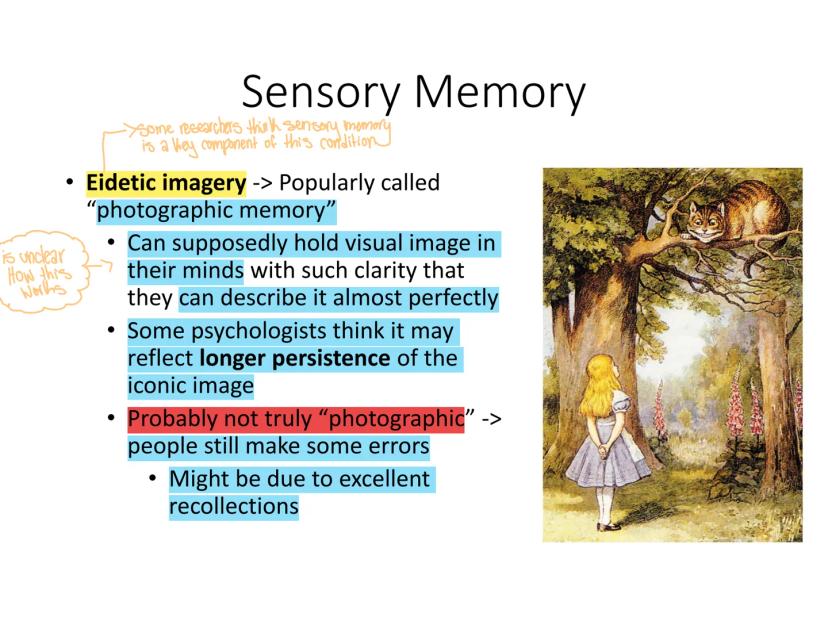
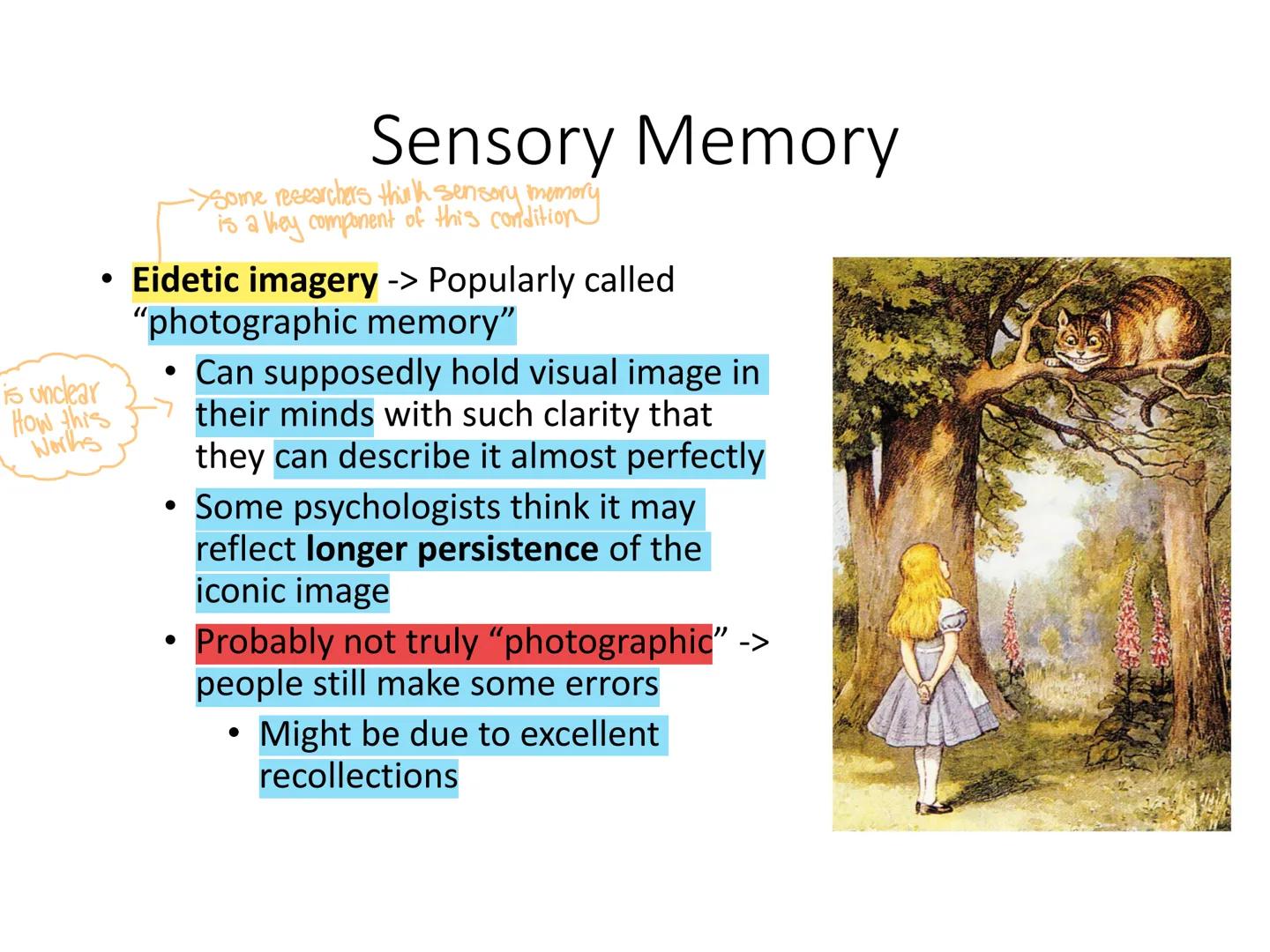
Some researchers believe that "photographic memory" (properly called eidetic imagery) might involve longer persistence of iconic memory. However, true photographic memory probably doesn't exist - even people with exceptional visual memory still make some errors.
Study Tip: Your sensory memory is very brief - this is why you need to quickly shift important information to short-term memory through attention and rehearsal if you want to remember it!
Short-term memory (STM) is the system that retains information for very brief durations - typically just 5-20 seconds. It's also called working memory when referring to information you're actively processing or thinking about.
Information flows from sensory memory into short-term memory, where the real construction work happens. From here, memories can either transfer to long-term storage or be discarded. Two processes can cause information loss in STM:
Your short-term memory has limited capacity, so when new information comes in, it competes with what's already there. This interference makes remembering things more difficult, especially when the information is similar.
Remember This: Without active rehearsal, information in your short-term memory typically disappears within 20 seconds - this is why you might forget a phone number right after hearing it!
Memory interference occurs when information competes with other information, making recall more difficult. There are two main types:
Retroactive interference happens when learning new information interferes with previously learned material. For example, after studying a new chapter on memory, you might forget details from an earlier chapter on learning because the new information "overwrites" the old.
Proactive interference occurs when earlier learning interferes with acquiring new information. For instance, information from a previous chapter might disrupt your ability to learn new, similar concepts in your current chapter.
Both types of interference are more likely when old and new information are similar. This is why studying very different subjects back-to-back (like math and history) often causes less interference than studying similar subjects (like chemistry and biology).
Study Hack: To minimize interference, try spacing out your study sessions for similar subjects rather than studying them one after another. This gives your brain time to consolidate each set of information.
The average adult can hold about 7 (plus or minus 2) pieces of information in short-term memory at once. This finding, often called George Miller's "magic number 7," explains why phone numbers were traditionally seven digits long.
You can extend your short-term memory capacity through chunking - organizing large amounts of information into smaller, more meaningful groups. For example, remembering the string "NHLNBACBCNFL" becomes easier when chunked as popular sports leagues: "NHL, NBA, CBC, NFL."
Chunking works by connecting new information to meaningful concepts already stored in your long-term memory. This is why experts in a field can remember more information in their area of expertise - they have more meaningful patterns to create chunks.
Try This: Next time you need to remember a list of items, try grouping them into meaningful categories rather than memorizing them individually. You'll be able to remember significantly more information!
You can extend the duration of short-term memory through rehearsal - the process of repeating information to keep it active. There are two main types:
Maintenance rehearsal involves simply repeating the information in the same form, like silently reciting a phone number until you can write it down. This works for brief periods but doesn't create strong long-term memories.
Elaborative rehearsal involves linking information together in meaningful ways. For example, if trying to remember the word pair "dog-shoe," you might visualize a dog wearing shoes. This creates stronger connections and is much more effective for long-term retention.
The levels of processing model explains why elaborative rehearsal works better: information is remembered better when processed deeply. Processing ranges from shallow (visual features) to intermediate to deep . The deeper the processing, the better the recall.
Study Tip: When studying, don't just repeat information mindlessly. Instead, ask yourself how it connects to what you already know or how you could explain it to someone else - this deeper processing will dramatically improve your recall!
Long-term memory (LTM) is your relatively permanent store of information that includes facts, experiences, and skills developed over time. Unlike short-term memory, LTM can last decades or even a lifetime, with some information becoming part of your "permastore."
The capacity of long-term memory is enormous - some estimate it holds the equivalent of about 500 large encyclopedias worth of information! However, accessing this vast store depends on proper encoding and retrieval processes.
Interestingly, errors in long-term memory are typically semantic , while short-term memory errors are usually acoustic . For example, in LTM you might confuse "liberty" with "freedom" (similar meanings), while in STM you might confuse "liberty" with "library" (similar sounds).
Mind Blown: Your long-term memory capacity is so vast that you're unlikely to ever "run out of space" for new memories. The challenge isn't storage but properly organizing information so you can retrieve it when needed!
Our AI companion is specifically built for the needs of students. Based on the millions of content pieces we have on the platform we can provide truly meaningful and relevant answers to students. But its not only about answers, the companion is even more about guiding students through their daily learning challenges, with personalised study plans, quizzes or content pieces in the chat and 100% personalisation based on the students skills and developments.
You can download the app in the Google Play Store and in the Apple App Store.
That's right! Enjoy free access to study content, connect with fellow students, and get instant help – all at your fingertips.
App Store
Google Play
The app is very easy to use and well designed. I have found everything I was looking for so far and have been able to learn a lot from the presentations! I will definitely use the app for a class assignment! And of course it also helps a lot as an inspiration.
Stefan S
iOS user
This app is really great. There are so many study notes and help [...]. My problem subject is French, for example, and the app has so many options for help. Thanks to this app, I have improved my French. I would recommend it to anyone.
Samantha Klich
Android user
Wow, I am really amazed. I just tried the app because I've seen it advertised many times and was absolutely stunned. This app is THE HELP you want for school and above all, it offers so many things, such as workouts and fact sheets, which have been VERY helpful to me personally.
Anna
iOS user
I think it’s very much worth it and you’ll end up using it a lot once you get the hang of it and even after looking at others notes you can still ask your Artificial intelligence buddy the question and ask to simplify it if you still don’t get it!!! In the end I think it’s worth it 😊👍 ⚠️Also DID I MENTION ITS FREEE YOU DON’T HAVE TO PAY FOR ANYTHING AND STILL GET YOUR GRADES IN PERFECTLY❗️❗️⚠️
Thomas R
iOS user
Knowunity is the BEST app I’ve used in a minute. This is not an ai review or anything this is genuinely coming from a 7th grade student (I know 2011 im young) but dude this app is a 10/10 i have maintained a 3.8 gpa and have plenty of time for gaming. I love it and my mom is just happy I got good grades
Brad T
Android user
Not only did it help me find the answer but it also showed me alternative ways to solve it. I was horrible in math and science but now I have an a in both subjects. Thanks for the help🤍🤍
David K
iOS user
The app's just great! All I have to do is enter the topic in the search bar and I get the response real fast. I don't have to watch 10 YouTube videos to understand something, so I'm saving my time. Highly recommended!
Sudenaz Ocak
Android user
In school I was really bad at maths but thanks to the app, I am doing better now. I am so grateful that you made the app.
Greenlight Bonnie
Android user
I found this app a couple years ago and it has only gotten better since then. I really love it because it can help with written questions and photo questions. Also, it can find study guides that other people have made as well as flashcard sets and practice tests. The free version is also amazing for students who might not be able to afford it. Would 100% recommend
Aubrey
iOS user
Best app if you're in Highschool or Junior high. I have been using this app for 2 school years and it's the best, it's good if you don't have anyone to help you with school work.😋🩷🎀
Marco B
iOS user
THE QUIZES AND FLASHCARDS ARE SO USEFUL AND I LOVE Knowunity AI. IT ALSO IS LITREALLY LIKE CHATGPT BUT SMARTER!! HELPED ME WITH MY MASCARA PROBLEMS TOO!! AS WELL AS MY REAL SUBJECTS ! DUHHH 😍😁😲🤑💗✨🎀😮
Elisha
iOS user
This app is phenomenal down to the correct info and the various topics you can study! I greatly recommend it for people who struggle with procrastination and those who need homework help. It has been perfectly accurate for world 1 history as far as I’ve seen! Geometry too!
Paul T
iOS user
The app is very easy to use and well designed. I have found everything I was looking for so far and have been able to learn a lot from the presentations! I will definitely use the app for a class assignment! And of course it also helps a lot as an inspiration.
Stefan S
iOS user
This app is really great. There are so many study notes and help [...]. My problem subject is French, for example, and the app has so many options for help. Thanks to this app, I have improved my French. I would recommend it to anyone.
Samantha Klich
Android user
Wow, I am really amazed. I just tried the app because I've seen it advertised many times and was absolutely stunned. This app is THE HELP you want for school and above all, it offers so many things, such as workouts and fact sheets, which have been VERY helpful to me personally.
Anna
iOS user
I think it’s very much worth it and you’ll end up using it a lot once you get the hang of it and even after looking at others notes you can still ask your Artificial intelligence buddy the question and ask to simplify it if you still don’t get it!!! In the end I think it’s worth it 😊👍 ⚠️Also DID I MENTION ITS FREEE YOU DON’T HAVE TO PAY FOR ANYTHING AND STILL GET YOUR GRADES IN PERFECTLY❗️❗️⚠️
Thomas R
iOS user
Knowunity is the BEST app I’ve used in a minute. This is not an ai review or anything this is genuinely coming from a 7th grade student (I know 2011 im young) but dude this app is a 10/10 i have maintained a 3.8 gpa and have plenty of time for gaming. I love it and my mom is just happy I got good grades
Brad T
Android user
Not only did it help me find the answer but it also showed me alternative ways to solve it. I was horrible in math and science but now I have an a in both subjects. Thanks for the help🤍🤍
David K
iOS user
The app's just great! All I have to do is enter the topic in the search bar and I get the response real fast. I don't have to watch 10 YouTube videos to understand something, so I'm saving my time. Highly recommended!
Sudenaz Ocak
Android user
In school I was really bad at maths but thanks to the app, I am doing better now. I am so grateful that you made the app.
Greenlight Bonnie
Android user
I found this app a couple years ago and it has only gotten better since then. I really love it because it can help with written questions and photo questions. Also, it can find study guides that other people have made as well as flashcard sets and practice tests. The free version is also amazing for students who might not be able to afford it. Would 100% recommend
Aubrey
iOS user
Best app if you're in Highschool or Junior high. I have been using this app for 2 school years and it's the best, it's good if you don't have anyone to help you with school work.😋🩷🎀
Marco B
iOS user
THE QUIZES AND FLASHCARDS ARE SO USEFUL AND I LOVE Knowunity AI. IT ALSO IS LITREALLY LIKE CHATGPT BUT SMARTER!! HELPED ME WITH MY MASCARA PROBLEMS TOO!! AS WELL AS MY REAL SUBJECTS ! DUHHH 😍😁😲🤑💗✨🎀😮
Elisha
iOS user
This app is phenomenal down to the correct info and the various topics you can study! I greatly recommend it for people who struggle with procrastination and those who need homework help. It has been perfectly accurate for world 1 history as far as I’ve seen! Geometry too!
Paul T
iOS user
Liliana Mccannon
@ilianaccannon_rugzto
Memory is the complex process of retaining and accessing information over time. It's not just a simple recording system - your memory actively reconstructs experiences, making it both remarkably powerful and surprisingly fallible. Understanding how your memory works will help... Show more
Access to all documents
Improve your grades
Join milions of students
Have you ever remembered something that never actually happened? This isn't uncommon! Memory illusions are false but compelling reports of experiences that didn't occur.
Just like your brain fills in visual gaps when perceiving the world around you, it also fills in gaps in your memories. This reconstructive process is generally adaptive and helps you make sense of incomplete information. However, it also makes you prone to errors.
The memory paradox explains why memories can be surprisingly accurate in some cases yet frustratingly unreliable in others. Most importantly, your memories aren't static recordings - they change over time as your brain reconstructs them.
Remember This! Every time you recall a memory, you're not playing back a perfect recording - you're actively reconstructing it based on fragments of information, current beliefs, and expectations.
Access to all documents
Improve your grades
Join milions of students
Some individuals demonstrate extraordinary memory abilities that showcase the incredible potential of human memory. Kim Peek, who inspired the movie "Rain Man," could recall entire books word-for-word and memorized about 12,000 books!
A few rare individuals have hyperthymestic syndrome (superior autobiographical memory). People like Marilu Henner can recall precisely what they were doing on almost any date in their past life. Given a specific date like March 17, 1989, they can tell you exactly what they were doing, who they were with, and even what they wore.
These exceptional cases are extremely rare - as of 2021, fewer than 100 people worldwide had been diagnosed with hyperthymestic syndrome. While most of us don't have these extraordinary abilities, these cases show that in certain situations and for certain people, memory capacity can be truly remarkable.
Fun Fact: Rajan Mahadevan memorized 31,811 digits of pi, which took him 3 hours to recite from memory!
Access to all documents
Improve your grades
Join milions of students
Your memory isn't like a camera capturing perfect snapshots of experiences. Instead, it's reconstructive - you actively rebuild memories using fragments of information combined with your beliefs and expectations.
Try remembering the last time you took a walk. You likely saw yourself walking from an outside perspective - something that would have been impossible during the actual experience! This manufactured perspective is a perfect example of how your brain reconstructs rather than simply replays memories.
The reconstructive nature of memory works through top-down processing, where your recollections are shaped by your beliefs, moods, expectations, and cultural narratives. Similar to how perception works, your expectations influence what and how you remember things.
Key Insight: When you remember something, you're not playing back a perfect recording - you're reconstructing an experience based on fragments of information combined with your current beliefs and knowledge.
Access to all documents
Improve your grades
Join milions of students
Your memory system can be divided into three major types that differ in span and duration: sensory, short-term, and long-term memory. Information typically flows from sensory to short-term to long-term memory and can be retrieved back into short-term awareness.
Sensory memory functions as a buffer area where perceptions are briefly maintained before passing to short-term memory. Each sense has its own form of sensory memory - iconic memory for visual stimuli (lasting about one second) and echoic memory for auditory stimuli .
This sensory buffer gives your brain extra time to process incoming information. It allows you to connect events together rather than experiencing them as separate, disjointed moments.
Try This: Notice how when someone speaks to you, you can hold the sound of their voice in your mind briefly even after they finish speaking. That's your echoic memory at work!
Access to all documents
Improve your grades
Join milions of students
George Sperling's groundbreaking 1960 experiments revealed how sensory memory works. When he flashed 12 letters on a screen (arranged in three rows of four), people could only recall about 4-5 letters. However, different people remembered different letters, suggesting all 12 were initially available.
When Sperling cued participants to remember just one specific row after the display disappeared, they could almost always recall all letters in that row. This proved people had brief access to all 12 letters in their iconic memory before the information faded.
Some researchers believe that "photographic memory" (properly called eidetic imagery) might involve longer persistence of iconic memory. However, true photographic memory probably doesn't exist - even people with exceptional visual memory still make some errors.
Study Tip: Your sensory memory is very brief - this is why you need to quickly shift important information to short-term memory through attention and rehearsal if you want to remember it!
Access to all documents
Improve your grades
Join milions of students
Short-term memory (STM) is the system that retains information for very brief durations - typically just 5-20 seconds. It's also called working memory when referring to information you're actively processing or thinking about.
Information flows from sensory memory into short-term memory, where the real construction work happens. From here, memories can either transfer to long-term storage or be discarded. Two processes can cause information loss in STM:
Your short-term memory has limited capacity, so when new information comes in, it competes with what's already there. This interference makes remembering things more difficult, especially when the information is similar.
Remember This: Without active rehearsal, information in your short-term memory typically disappears within 20 seconds - this is why you might forget a phone number right after hearing it!
Access to all documents
Improve your grades
Join milions of students
Memory interference occurs when information competes with other information, making recall more difficult. There are two main types:
Retroactive interference happens when learning new information interferes with previously learned material. For example, after studying a new chapter on memory, you might forget details from an earlier chapter on learning because the new information "overwrites" the old.
Proactive interference occurs when earlier learning interferes with acquiring new information. For instance, information from a previous chapter might disrupt your ability to learn new, similar concepts in your current chapter.
Both types of interference are more likely when old and new information are similar. This is why studying very different subjects back-to-back (like math and history) often causes less interference than studying similar subjects (like chemistry and biology).
Study Hack: To minimize interference, try spacing out your study sessions for similar subjects rather than studying them one after another. This gives your brain time to consolidate each set of information.
Access to all documents
Improve your grades
Join milions of students
The average adult can hold about 7 (plus or minus 2) pieces of information in short-term memory at once. This finding, often called George Miller's "magic number 7," explains why phone numbers were traditionally seven digits long.
You can extend your short-term memory capacity through chunking - organizing large amounts of information into smaller, more meaningful groups. For example, remembering the string "NHLNBACBCNFL" becomes easier when chunked as popular sports leagues: "NHL, NBA, CBC, NFL."
Chunking works by connecting new information to meaningful concepts already stored in your long-term memory. This is why experts in a field can remember more information in their area of expertise - they have more meaningful patterns to create chunks.
Try This: Next time you need to remember a list of items, try grouping them into meaningful categories rather than memorizing them individually. You'll be able to remember significantly more information!
Access to all documents
Improve your grades
Join milions of students
You can extend the duration of short-term memory through rehearsal - the process of repeating information to keep it active. There are two main types:
Maintenance rehearsal involves simply repeating the information in the same form, like silently reciting a phone number until you can write it down. This works for brief periods but doesn't create strong long-term memories.
Elaborative rehearsal involves linking information together in meaningful ways. For example, if trying to remember the word pair "dog-shoe," you might visualize a dog wearing shoes. This creates stronger connections and is much more effective for long-term retention.
The levels of processing model explains why elaborative rehearsal works better: information is remembered better when processed deeply. Processing ranges from shallow (visual features) to intermediate to deep . The deeper the processing, the better the recall.
Study Tip: When studying, don't just repeat information mindlessly. Instead, ask yourself how it connects to what you already know or how you could explain it to someone else - this deeper processing will dramatically improve your recall!
Access to all documents
Improve your grades
Join milions of students
Long-term memory (LTM) is your relatively permanent store of information that includes facts, experiences, and skills developed over time. Unlike short-term memory, LTM can last decades or even a lifetime, with some information becoming part of your "permastore."
The capacity of long-term memory is enormous - some estimate it holds the equivalent of about 500 large encyclopedias worth of information! However, accessing this vast store depends on proper encoding and retrieval processes.
Interestingly, errors in long-term memory are typically semantic , while short-term memory errors are usually acoustic . For example, in LTM you might confuse "liberty" with "freedom" (similar meanings), while in STM you might confuse "liberty" with "library" (similar sounds).
Mind Blown: Your long-term memory capacity is so vast that you're unlikely to ever "run out of space" for new memories. The challenge isn't storage but properly organizing information so you can retrieve it when needed!
Our AI companion is specifically built for the needs of students. Based on the millions of content pieces we have on the platform we can provide truly meaningful and relevant answers to students. But its not only about answers, the companion is even more about guiding students through their daily learning challenges, with personalised study plans, quizzes or content pieces in the chat and 100% personalisation based on the students skills and developments.
You can download the app in the Google Play Store and in the Apple App Store.
That's right! Enjoy free access to study content, connect with fellow students, and get instant help – all at your fingertips.
7
Smart Tools NEW
Transform this note into: ✓ 50+ Practice Questions ✓ Interactive Flashcards ✓ Full Practice Test ✓ Essay Outlines
Explore the key types of human tissues including nerve, epithelial, connective, and muscle tissues. This summary covers their structures, functions, and examples, providing a comprehensive overview for students studying anatomy and physiology. Ideal for exam preparation and understanding the relationship between tissues and organs.
 Health & Social Care
medical terminology
 Health & Medicine
An overview of the different parts of the heart including the aorta, pulmonary artery, and pulmonary veins.
Health & Medicinenotes and diagrams for the integumentary system
Health & MedicineNotes taken in medical health 2
Health & MedicineBasic diagram of the different parts of the brain, including the frontal lobe, parietal lobe, temporal lobe, occipital lobe, cerebellum, and brain stem as well as highlighting three important areas.
Health & MedicineApp Store
Google Play
The app is very easy to use and well designed. I have found everything I was looking for so far and have been able to learn a lot from the presentations! I will definitely use the app for a class assignment! And of course it also helps a lot as an inspiration.
Stefan S
iOS user
This app is really great. There are so many study notes and help [...]. My problem subject is French, for example, and the app has so many options for help. Thanks to this app, I have improved my French. I would recommend it to anyone.
Samantha Klich
Android user
Wow, I am really amazed. I just tried the app because I've seen it advertised many times and was absolutely stunned. This app is THE HELP you want for school and above all, it offers so many things, such as workouts and fact sheets, which have been VERY helpful to me personally.
Anna
iOS user
I think it’s very much worth it and you’ll end up using it a lot once you get the hang of it and even after looking at others notes you can still ask your Artificial intelligence buddy the question and ask to simplify it if you still don’t get it!!! In the end I think it’s worth it 😊👍 ⚠️Also DID I MENTION ITS FREEE YOU DON’T HAVE TO PAY FOR ANYTHING AND STILL GET YOUR GRADES IN PERFECTLY❗️❗️⚠️
Thomas R
iOS user
Knowunity is the BEST app I’ve used in a minute. This is not an ai review or anything this is genuinely coming from a 7th grade student (I know 2011 im young) but dude this app is a 10/10 i have maintained a 3.8 gpa and have plenty of time for gaming. I love it and my mom is just happy I got good grades
Brad T
Android user
Not only did it help me find the answer but it also showed me alternative ways to solve it. I was horrible in math and science but now I have an a in both subjects. Thanks for the help🤍🤍
David K
iOS user
The app's just great! All I have to do is enter the topic in the search bar and I get the response real fast. I don't have to watch 10 YouTube videos to understand something, so I'm saving my time. Highly recommended!
Sudenaz Ocak
Android user
In school I was really bad at maths but thanks to the app, I am doing better now. I am so grateful that you made the app.
Greenlight Bonnie
Android user
I found this app a couple years ago and it has only gotten better since then. I really love it because it can help with written questions and photo questions. Also, it can find study guides that other people have made as well as flashcard sets and practice tests. The free version is also amazing for students who might not be able to afford it. Would 100% recommend
Aubrey
iOS user
Best app if you're in Highschool or Junior high. I have been using this app for 2 school years and it's the best, it's good if you don't have anyone to help you with school work.😋🩷🎀
Marco B
iOS user
THE QUIZES AND FLASHCARDS ARE SO USEFUL AND I LOVE Knowunity AI. IT ALSO IS LITREALLY LIKE CHATGPT BUT SMARTER!! HELPED ME WITH MY MASCARA PROBLEMS TOO!! AS WELL AS MY REAL SUBJECTS ! DUHHH 😍😁😲🤑💗✨🎀😮
Elisha
iOS user
This app is phenomenal down to the correct info and the various topics you can study! I greatly recommend it for people who struggle with procrastination and those who need homework help. It has been perfectly accurate for world 1 history as far as I’ve seen! Geometry too!
Paul T
iOS user
The app is very easy to use and well designed. I have found everything I was looking for so far and have been able to learn a lot from the presentations! I will definitely use the app for a class assignment! And of course it also helps a lot as an inspiration.
Stefan S
iOS user
This app is really great. There are so many study notes and help [...]. My problem subject is French, for example, and the app has so many options for help. Thanks to this app, I have improved my French. I would recommend it to anyone.
Samantha Klich
Android user
Wow, I am really amazed. I just tried the app because I've seen it advertised many times and was absolutely stunned. This app is THE HELP you want for school and above all, it offers so many things, such as workouts and fact sheets, which have been VERY helpful to me personally.
Anna
iOS user
I think it’s very much worth it and you’ll end up using it a lot once you get the hang of it and even after looking at others notes you can still ask your Artificial intelligence buddy the question and ask to simplify it if you still don’t get it!!! In the end I think it’s worth it 😊👍 ⚠️Also DID I MENTION ITS FREEE YOU DON’T HAVE TO PAY FOR ANYTHING AND STILL GET YOUR GRADES IN PERFECTLY❗️❗️⚠️
Thomas R
iOS user
Knowunity is the BEST app I’ve used in a minute. This is not an ai review or anything this is genuinely coming from a 7th grade student (I know 2011 im young) but dude this app is a 10/10 i have maintained a 3.8 gpa and have plenty of time for gaming. I love it and my mom is just happy I got good grades
Brad T
Android user
Not only did it help me find the answer but it also showed me alternative ways to solve it. I was horrible in math and science but now I have an a in both subjects. Thanks for the help🤍🤍
David K
iOS user
The app's just great! All I have to do is enter the topic in the search bar and I get the response real fast. I don't have to watch 10 YouTube videos to understand something, so I'm saving my time. Highly recommended!
Sudenaz Ocak
Android user
In school I was really bad at maths but thanks to the app, I am doing better now. I am so grateful that you made the app.
Greenlight Bonnie
Android user
I found this app a couple years ago and it has only gotten better since then. I really love it because it can help with written questions and photo questions. Also, it can find study guides that other people have made as well as flashcard sets and practice tests. The free version is also amazing for students who might not be able to afford it. Would 100% recommend
Aubrey
iOS user
Best app if you're in Highschool or Junior high. I have been using this app for 2 school years and it's the best, it's good if you don't have anyone to help you with school work.😋🩷🎀
Marco B
iOS user
THE QUIZES AND FLASHCARDS ARE SO USEFUL AND I LOVE Knowunity AI. IT ALSO IS LITREALLY LIKE CHATGPT BUT SMARTER!! HELPED ME WITH MY MASCARA PROBLEMS TOO!! AS WELL AS MY REAL SUBJECTS ! DUHHH 😍😁😲🤑💗✨🎀😮
Elisha
iOS user
This app is phenomenal down to the correct info and the various topics you can study! I greatly recommend it for people who struggle with procrastination and those who need homework help. It has been perfectly accurate for world 1 history as far as I’ve seen! Geometry too!
Paul T
iOS user