
Medical terminology can seem like a whole new language, but... Show more
 Fun Stuff
 AP US History
 AP World History
 AP Biology
Sign up to see the contentIt's free!
Access to all documents
Improve your grades
Join milions of students
Knowunity AI
Subjects
Triangle Congruence and Similarity Theorems
Triangle Properties and Classification
Linear Equations and Graphs
Geometric Angle Relationships
Trigonometric Functions and Identities
Equation Solving Techniques
Circle Geometry Fundamentals
Division Operations and Methods
Basic Differentiation Rules
Exponent and Logarithm Properties
Show all topics
Human Organ Systems
Reproductive Cell Cycles
Biological Sciences Subdisciplines
Cellular Energy Metabolism
Autotrophic Energy Processes
Inheritance Patterns and Principles
Biomolecular Structure and Organization
Cell Cycle and Division Mechanics
Cellular Organization and Development
Biological Structural Organization
Show all topics
Chemical Sciences and Applications
Atomic Structure and Composition
Molecular Electron Structure Representation
Atomic Electron Behavior
Matter Properties and Water
Mole Concept and Calculations
Gas Laws and Behavior
Periodic Table Organization
Chemical Thermodynamics Fundamentals
Chemical Bond Types and Properties
Show all topics
European Renaissance and Enlightenment
European Cultural Movements 800-1920
American Revolution Era 1763-1797
American Civil War 1861-1865
Global Imperial Systems
Mongol and Chinese Dynasties
U.S. Presidents and World Leaders
Historical Sources and Documentation
World Wars Era and Impact
World Religious Systems
Show all topics
Classic and Contemporary Novels
Literary Character Analysis
Rhetorical Theory and Practice
Classic Literary Narratives
Reading Analysis and Interpretation
Narrative Structure and Techniques
English Language Components
Influential English-Language Authors
Basic Sentence Structure
Narrative Voice and Perspective
Show all topics
194
•
Updated Apr 18, 2026
•

Melody Thiel
@melodythiel_dgqo
Medical terminology can seem like a whole new language, but... Show more
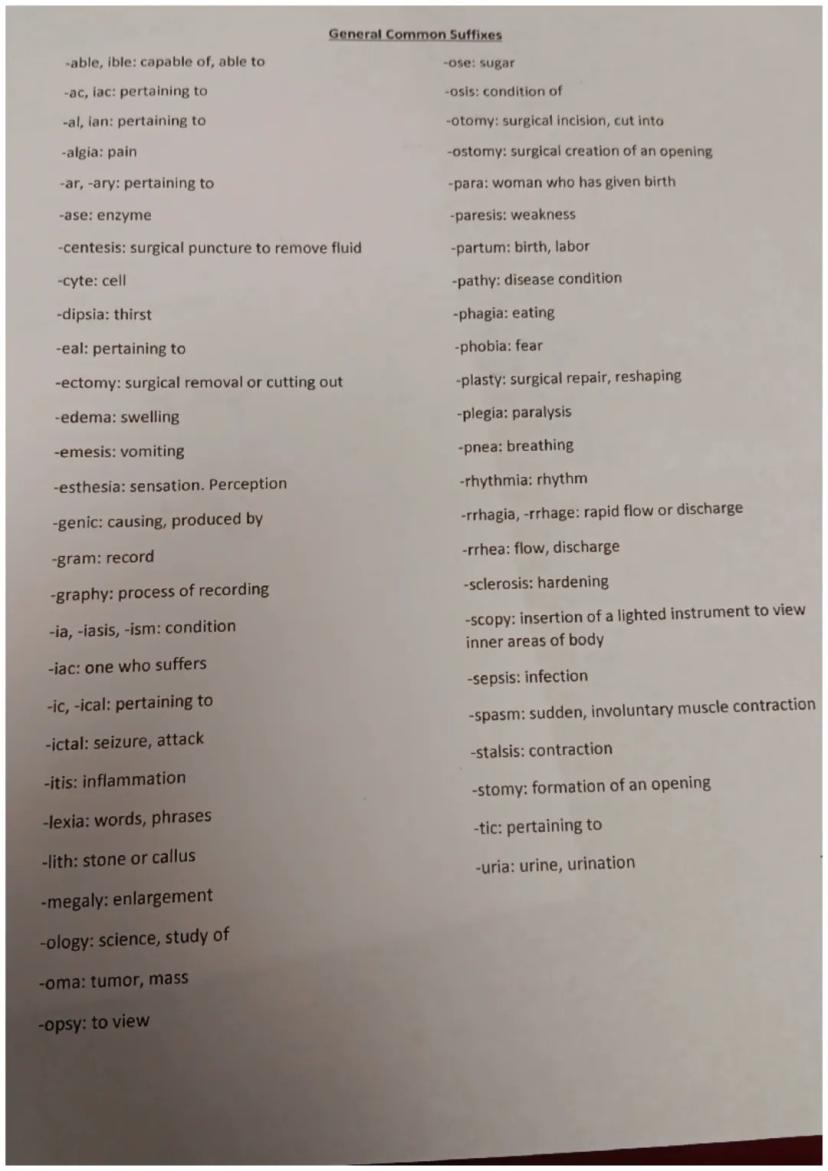
Medical suffixes are the endings that give medical terms their specific meanings. These powerful word parts instantly tell you what's happening in the body. For example, when you see -itis at the end of a word, you know it refers to inflammation—like in arthritis (joint inflammation) or bronchitis (bronchi inflammation).
Want to know if something's been surgically removed? Look for -ectomy (as in appendectomy). Need to describe a disease condition? That's where -pathy comes in (neuropathy). Suffixes like -oma tell you you're dealing with a tumor or mass, while -scopy indicates a procedure using a scope to view inside the body.
Some suffixes describe bodily functions: -pnea relates to breathing, -emesis to vomiting, and -uria to urination. Others describe physical states like -edema (swelling), -plegia (paralysis), or -megaly (enlargement).
💡 Quick Tip: When you encounter a medical term, first identify the suffix! It usually gives away the main action or condition being described.
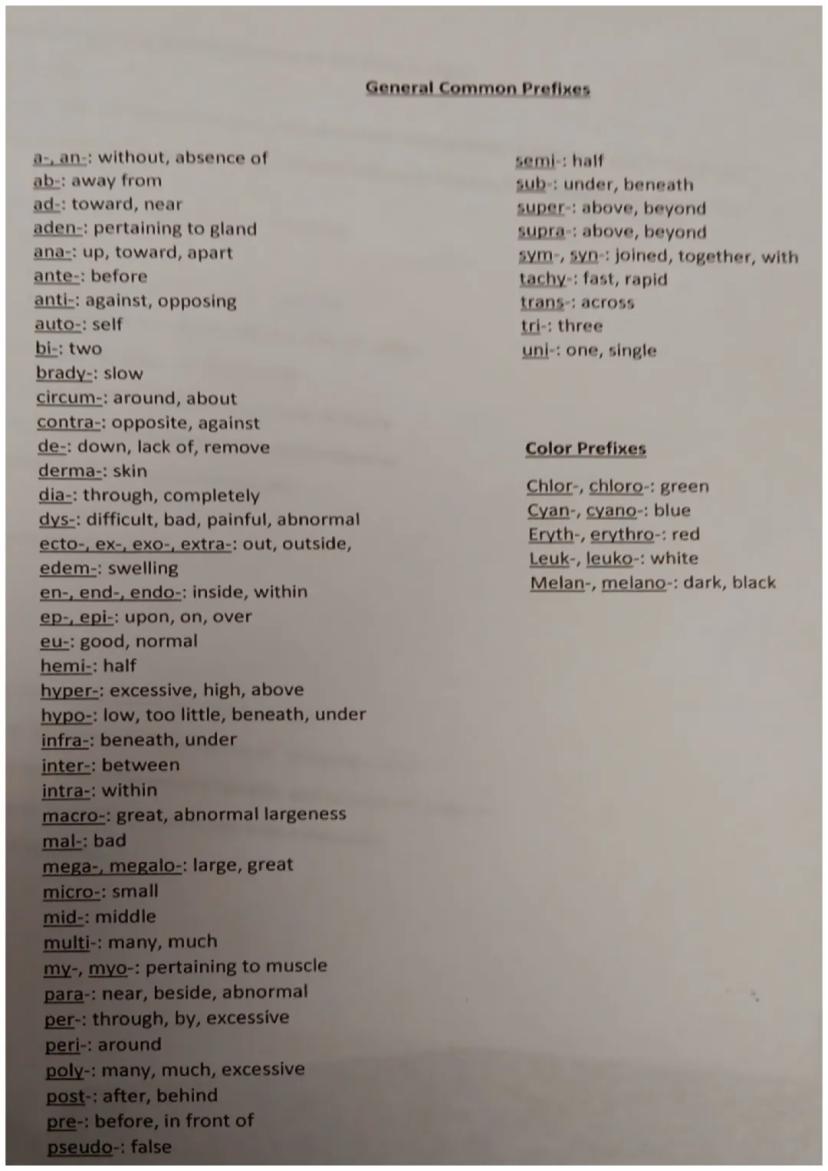
Medical prefixes appear at the beginning of terms and modify their meaning in important ways. They're like instant clues that help you understand the medical situation more clearly. For example, knowing that hyper- means "excessive" or "high" instantly tells you that hypertension means high blood pressure.
Direction and position prefixes are super helpful in medicine. Terms like endo- (within), peri- (around), and trans- (across) tell you exactly where something is happening relative to a body structure. Speed and intensity prefixes like tachy- (fast) and brady- (slow) give immediate information about rates—tachycardia means a fast heart rate.
Color prefixes can provide visual cues about conditions. Erythro- refers to red (erythrocytes are red blood cells), leuko- to white (leukocytes are white blood cells), and cyano- to blue (cyanosis is a bluish discoloration of the skin).
When these prefixes combine with root words and suffixes, they create precise medical descriptions. For instance, hypo- (low, under) + glyc (sugar) + -emia (blood condition) = hypoglycemia, or low blood sugar.
💡 Remember: Opposites are common in medical prefixes! Hyper-/hypo-, tachy-/brady-, and macro-/micro- show the range of conditions you might encounter.
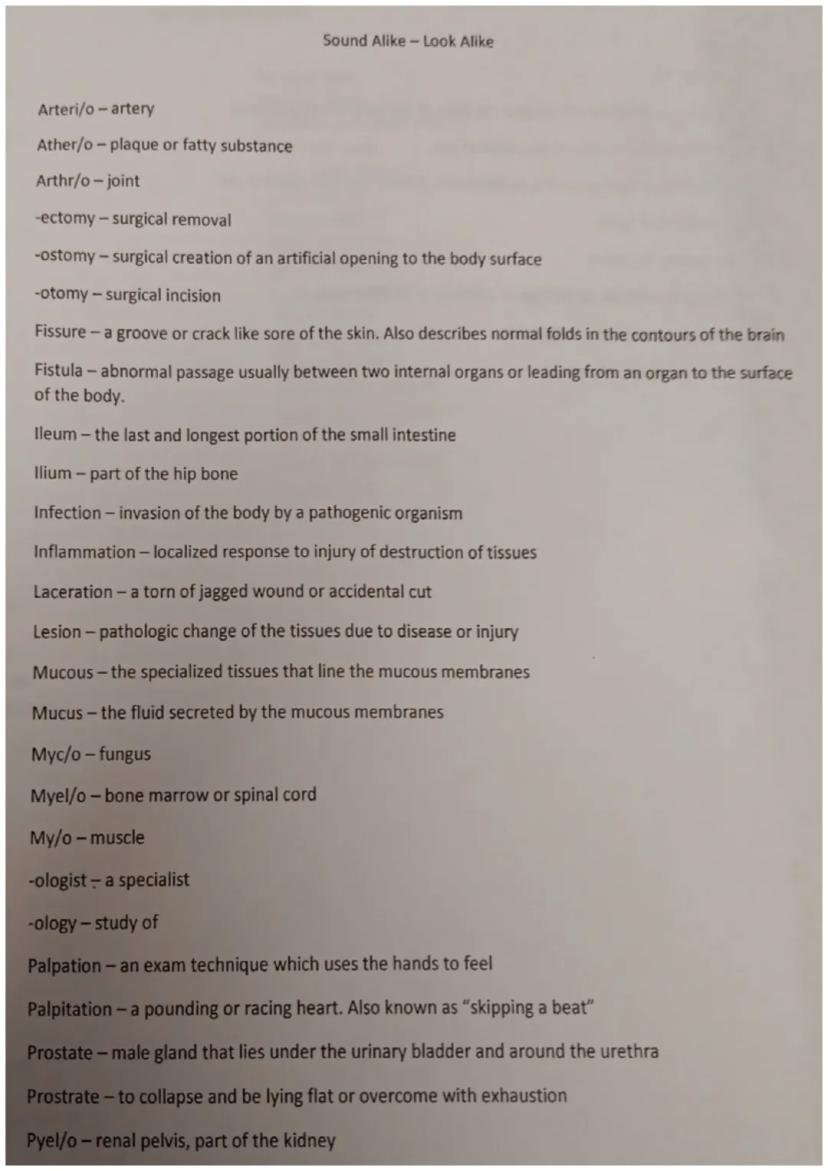
Medical terminology includes many terms that sound similar but have completely different meanings. Confusing these terms can lead to serious misunderstandings about diagnoses or treatments. For example, ileum (last part of small intestine) and ilium (part of hip bone) sound nearly identical but refer to entirely different body structures.
Some easily confused pairs involve medical procedures. -ectomy means surgical removal, while -ostomy means creating an artificial opening, and -otomy refers to a surgical incision. Mixing these up could completely change your understanding of what procedure was performed!
Other commonly confused terms have subtle but important differences. Infection refers to the invasion of pathogens, while inflammation is the body's response to injury or infection. Similarly, mucous is the tissue that lines membranes, but mucus is the fluid those membranes secrete.
When you encounter confusing medical terms, pay careful attention to spelling and context. The difference between palpation (examination by touch) and palpitation (racing heartbeat) might be just a few letters, but they describe completely different medical situations.
💡 Confusion Alert: When you encounter similar-sounding medical terms, double-check their specific meanings. Even healthcare professionals sometimes need to verify these easily confused terms!
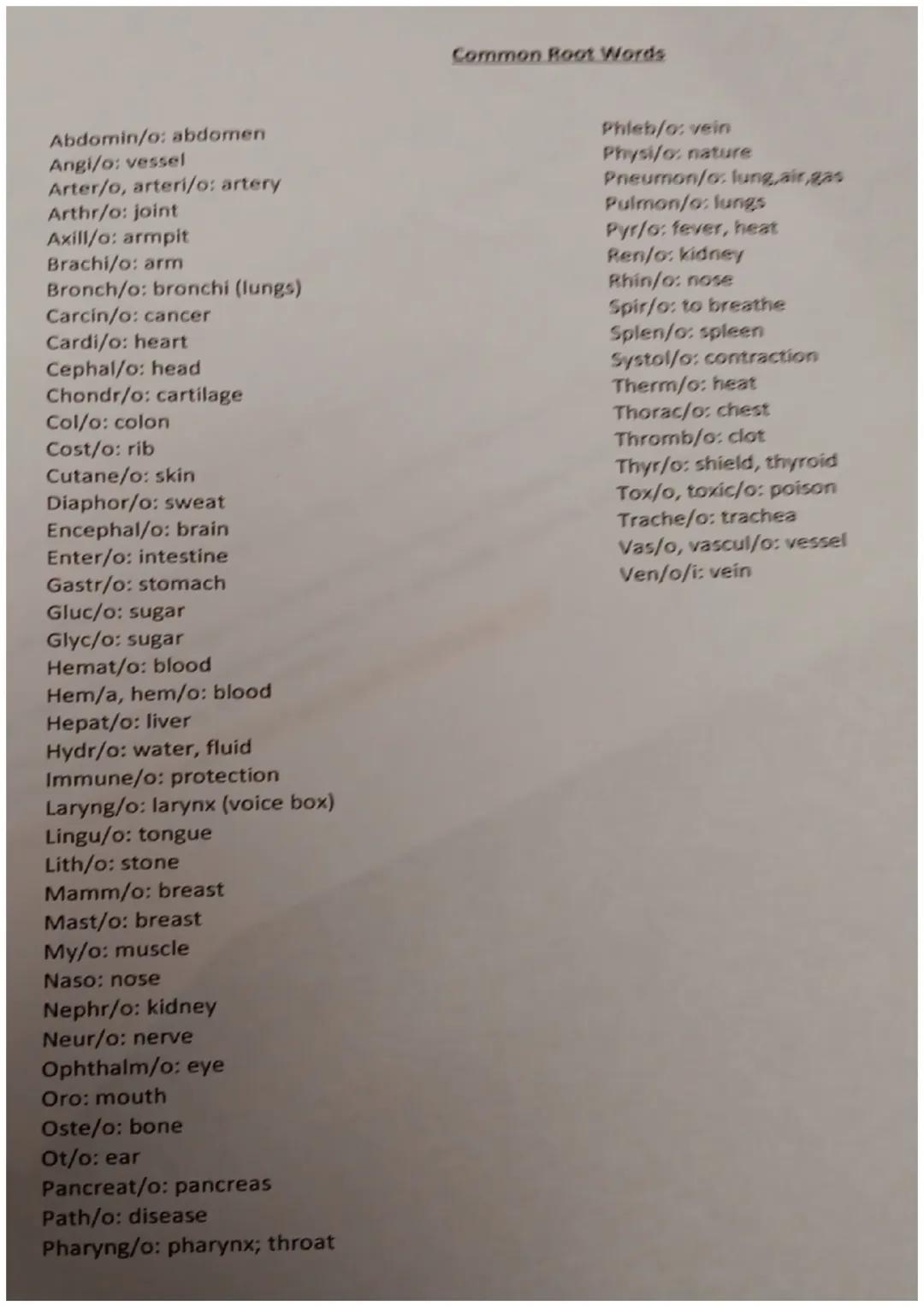
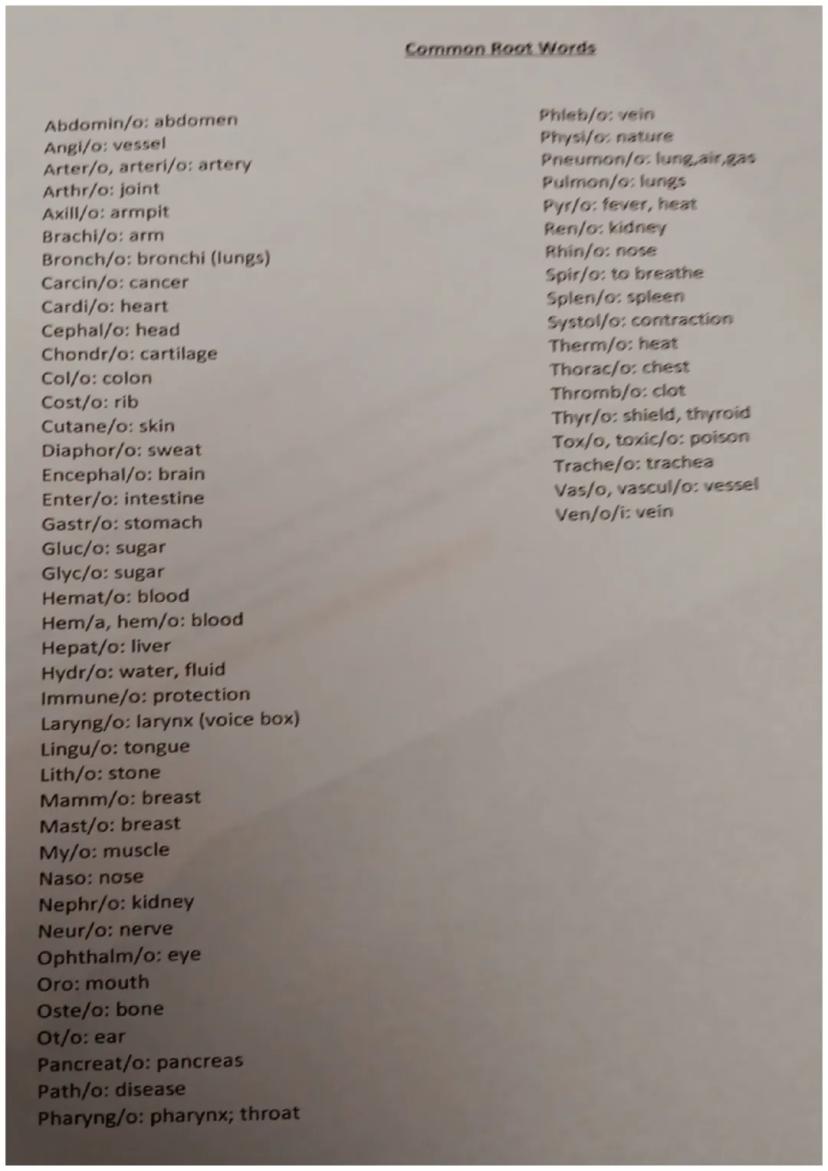
Root words form the foundation of medical terminology, providing the essential meaning of medical terms. Most root words come from Greek or Latin origins and describe specific body parts or systems. For example, cardi/o refers to the heart, while nephr/o indicates the kidney.
These root words combine with prefixes and suffixes to create precise medical terms. When you see gastr/o (stomach) combined with -itis (inflammation), you get gastritis—inflammation of the stomach. Similarly, hepat/o (liver) + -itis = hepatitis.
Some root words describe body substances or conditions. Hem/o and hemat/o both refer to blood, while glyc/o and gluc/o indicate sugar. This allows for specific descriptions of blood-related conditions (hematoma) or sugar-related conditions (hyperglycemia).
Understanding root words helps you decode complex medical terminology. When you encounter bronch/o (bronchi) + -scopy (viewing procedure), you know bronchoscopy involves examining the bronchi with a specialized instrument. Similarly, nephr/o (kidney) + -ectomy (removal) = nephrectomy, the surgical removal of a kidney.
💡 Power Tip: When you learn a new root word, try creating several medical terms by adding different prefixes and suffixes. This practice will strengthen your medical vocabulary quickly!
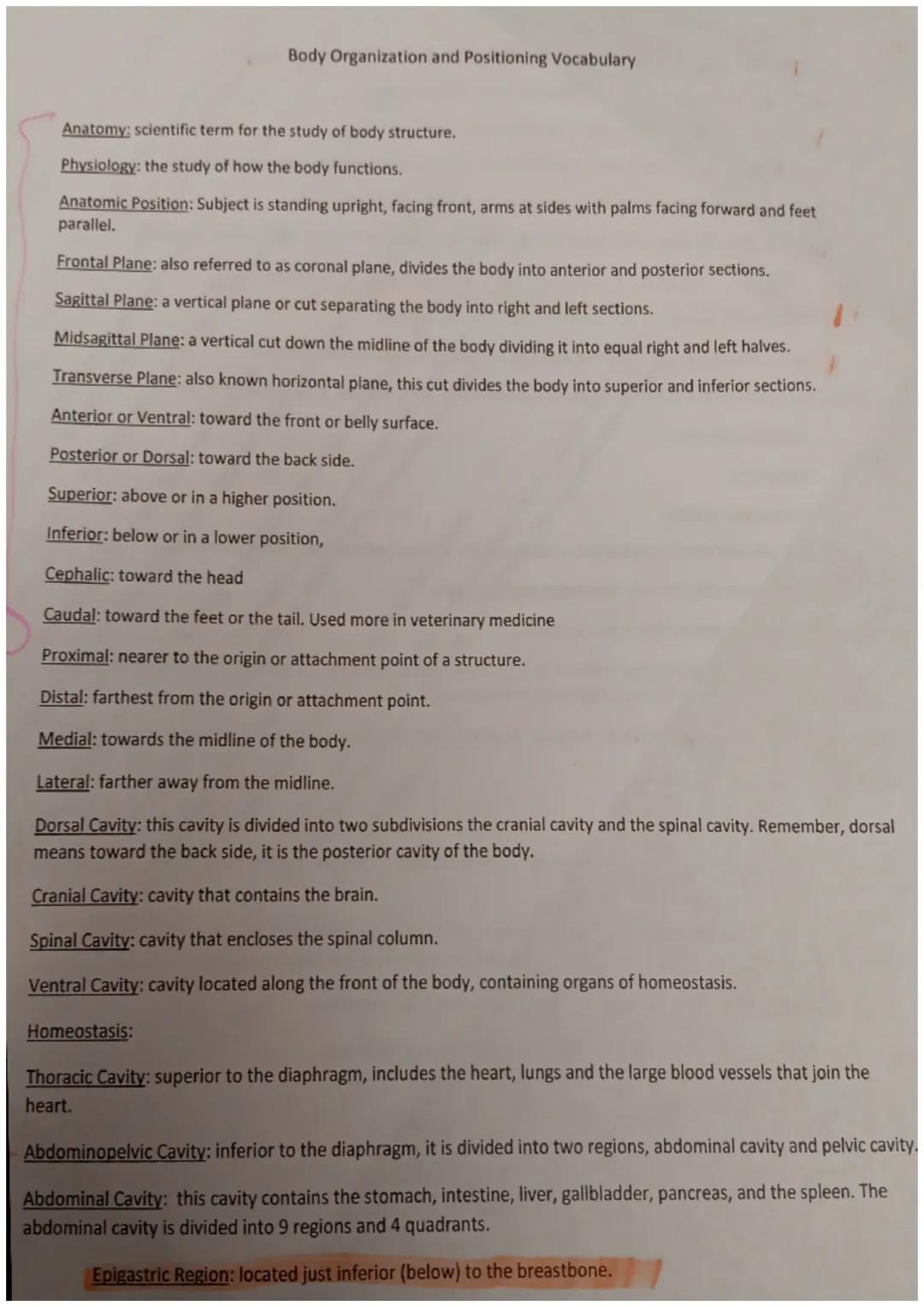
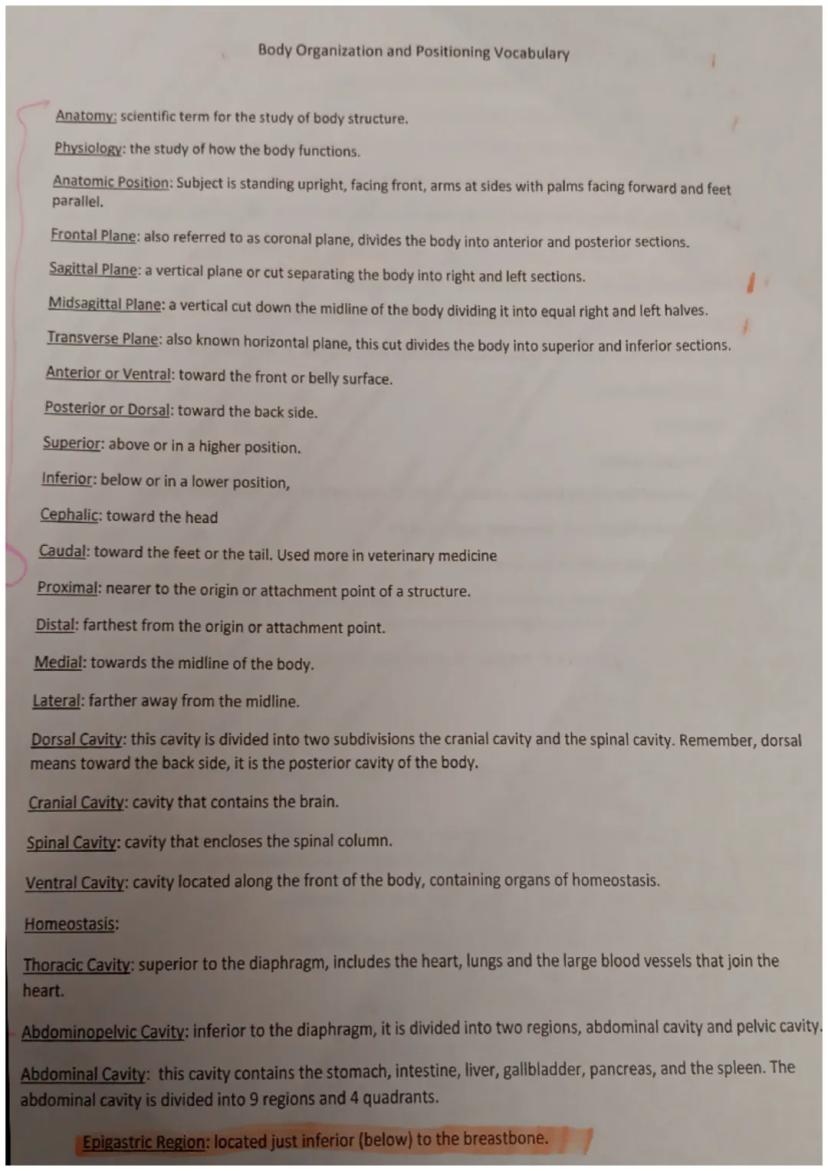
Understanding how healthcare professionals describe body positions and planes is essential for interpreting medical instructions and documentation. Anatomic position serves as the universal reference point—standing upright, facing forward, arms at sides with palms forward and feet parallel. All directional terms use this standard position regardless of how the patient is actually positioned.
Body planes help healthcare professionals communicate about specific sections of the body. The frontal plane divides the body into front and back portions, the sagittal plane separates right from left, and the transverse plane cuts horizontally to separate upper and lower body regions.
Directional terms precisely indicate locations relative to each other. Superior means above while inferior means below. Anterior (or ventral) refers to the front surface while posterior (or dorsal) indicates the back. Proximal means closer to the body's center while distal means farther away.
Body cavities organize and protect internal organs. The dorsal cavity contains the brain and spinal cord, while the ventral cavity houses organs of homeostasis. The ventral cavity is further divided into the thoracic cavity (above the diaphragm) containing the heart and lungs, and the abdominopelvic cavity (below the diaphragm) containing digestive and reproductive organs.
💡 Clinical Connection: The abdomen is divided into either 9 regions or 4 quadrants that help healthcare providers precisely locate pain, masses, or other findings during examinations.
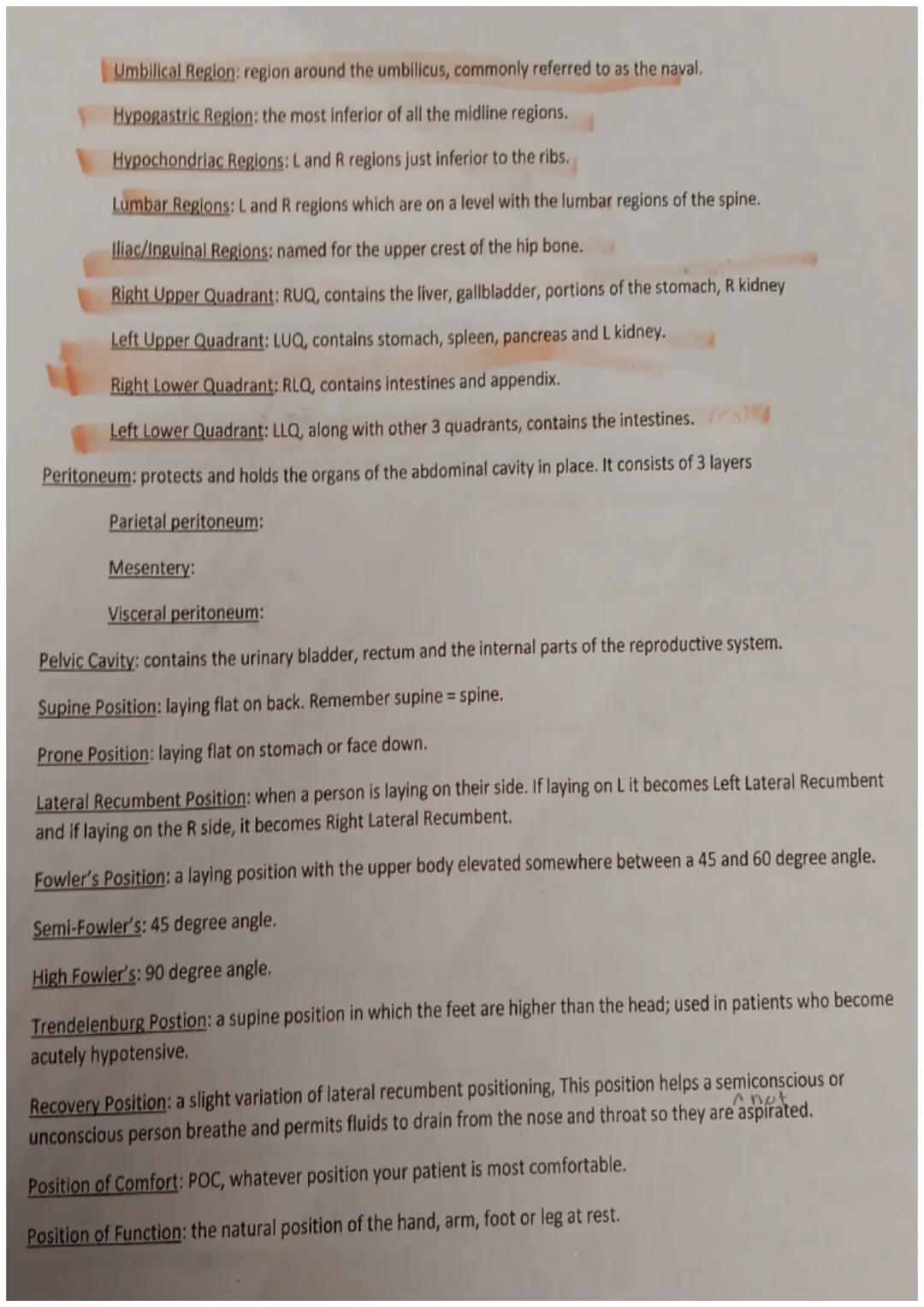
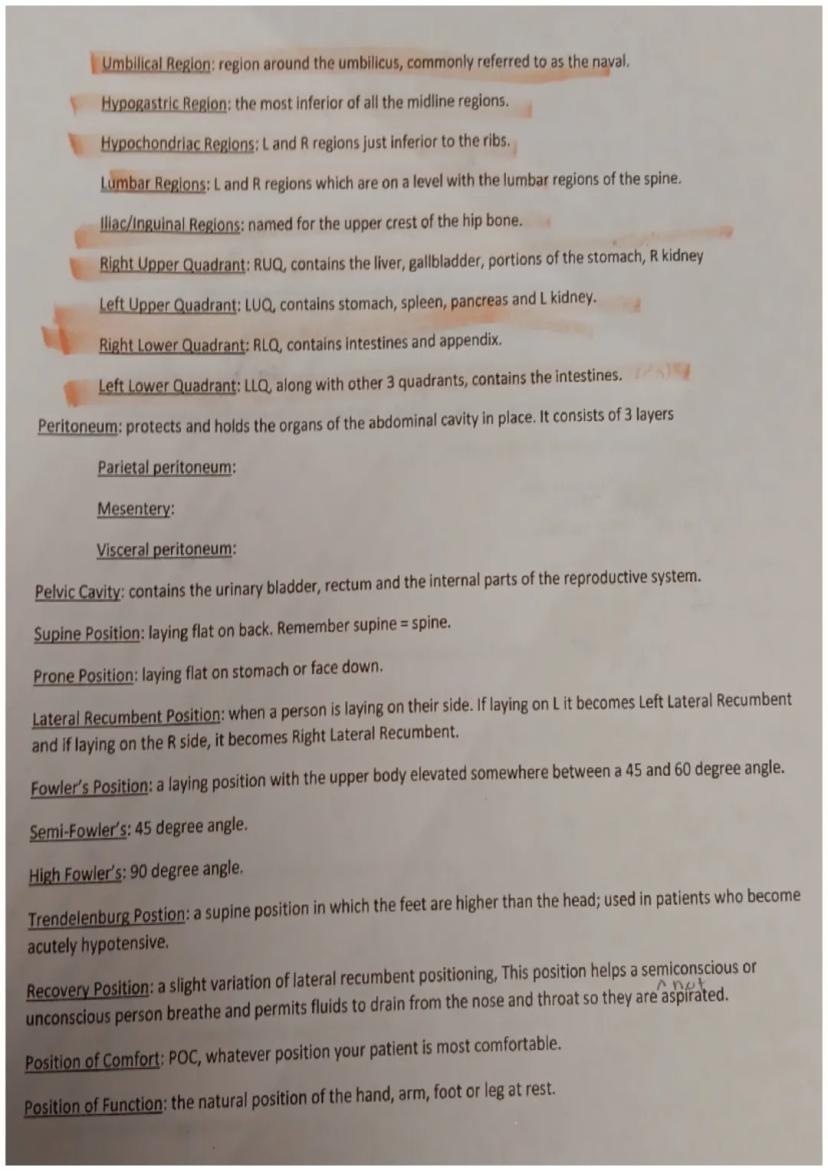
Medical professionals use specific terminology to describe how patients are positioned for procedures, examinations, or recovery. Knowing these terms helps you understand medical instructions and documentation. The most basic positions include supine (lying flat on your back) and prone (lying face down).
When a patient needs their head elevated, healthcare providers use Fowler's position, with variations including Semi-Fowler's and High Fowler's . These positions are commonly used for patients with respiratory issues or after certain surgeries to improve breathing and comfort.
Some medical situations require specialized positioning. The Trendelenburg position places patients on their backs with feet higher than their heads—useful during episodes of low blood pressure. The recovery position is a variation of lateral recumbent positioning that helps unconscious patients breathe and prevents aspiration of fluids.
Healthcare providers often document patient preferences as the position of comfort (POC), recognizing that comfort can improve healing and patient satisfaction. Meanwhile, the position of function refers to the natural resting position of limbs that promotes optimal healing after injuries or surgeries.
💡 Remember This: When you hear "supine," think "spine on the surface"—it's an easy way to remember that supine means lying on your back.
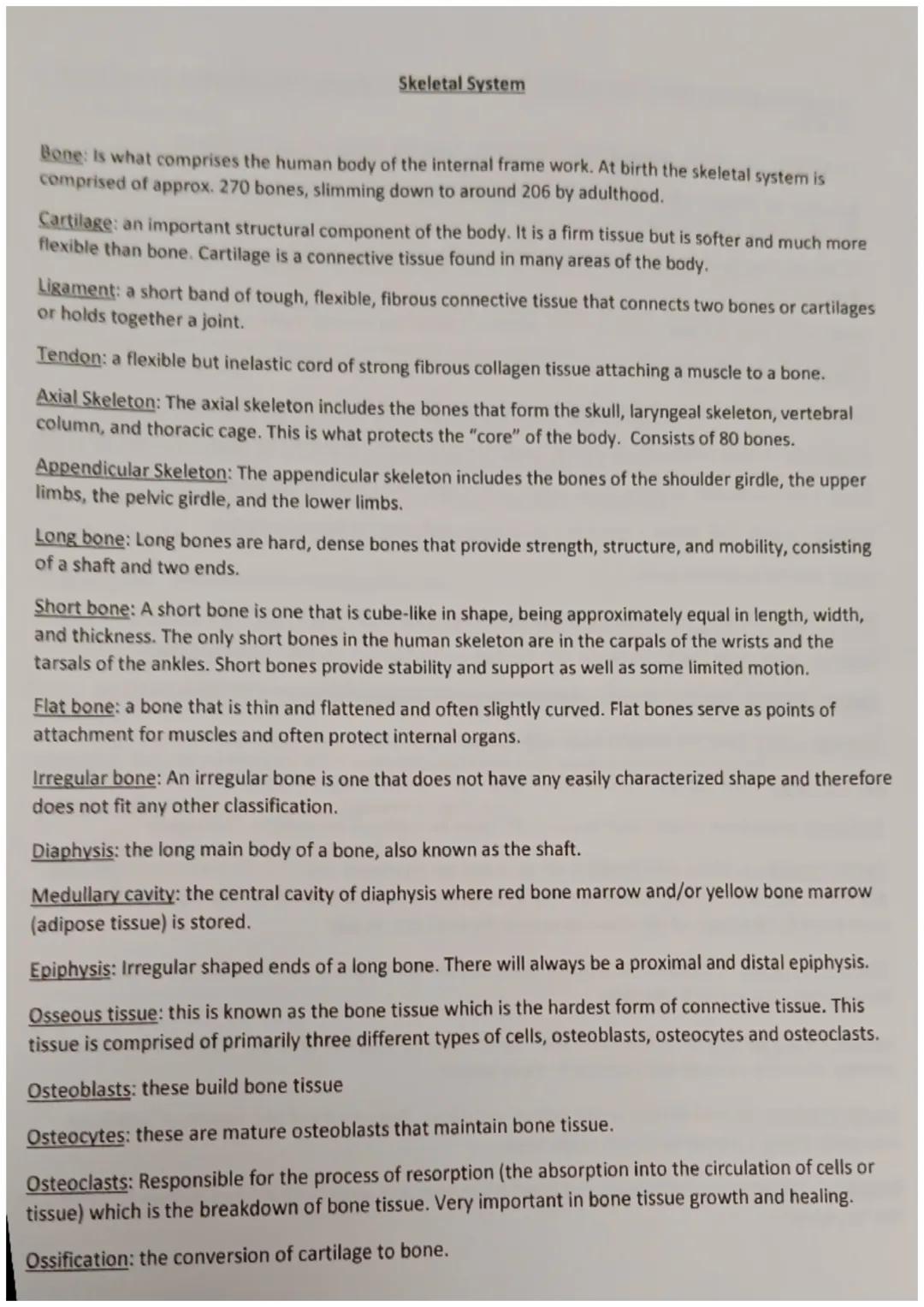
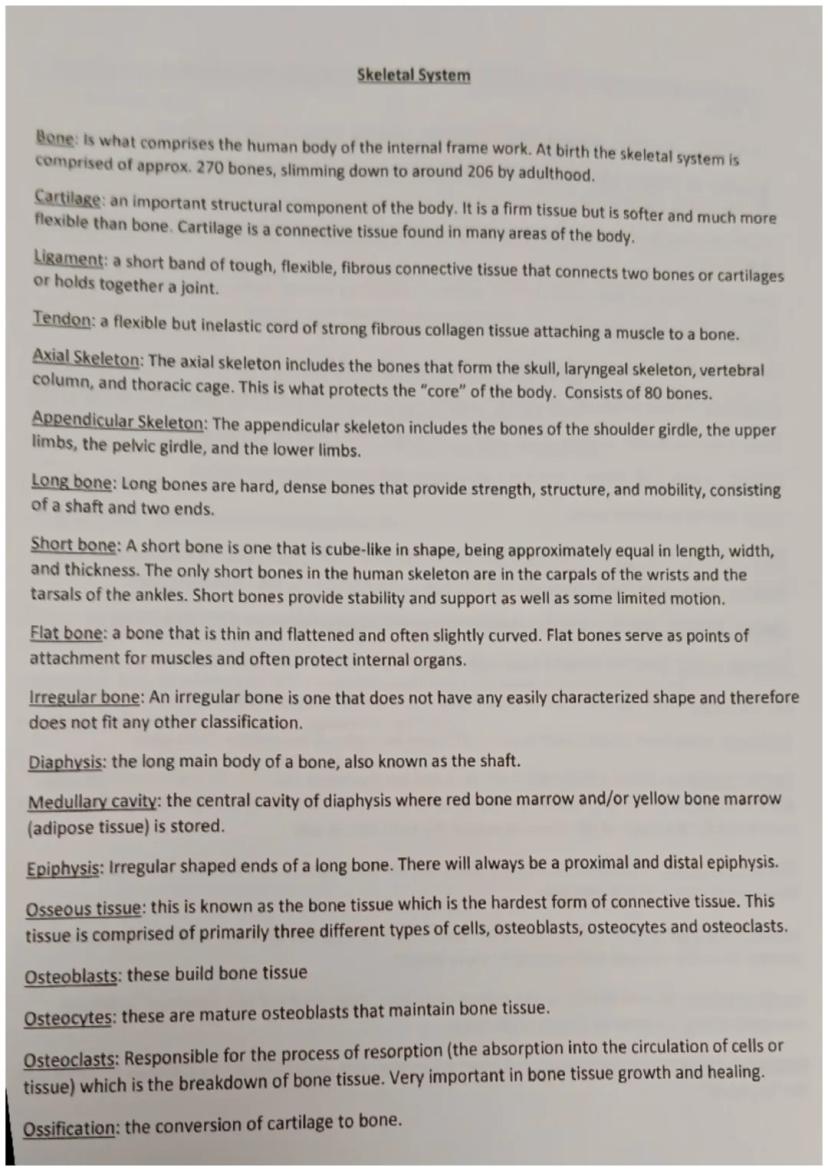
Your skeletal system provides the framework that supports your entire body. Though you start life with about 270 bones, this number decreases to around 206 in adulthood as some bones fuse during growth. Bones don't work alone—they collaborate with cartilage (flexible connective tissue), ligaments (connect bones to bones), and tendons (connect muscles to bones).
The skeletal system is divided into two main sections. The axial skeleton includes 80 bones that form your central core—the skull, vertebral column, and thoracic cage. The appendicular skeleton comprises the bones of your limbs and their attachments to the axial skeleton.
Bones come in various shapes, each designed for specific functions. Long bones like the femur provide strength and mobility, while flat bones like the scapula protect organs and provide attachment points for muscles. Short bones in your wrists and ankles provide stability with limited motion, and irregular bones like vertebrae have complex shapes for specialized functions.
Long bones have a specific structure: the diaphysis (main shaft) contains the medullary cavity filled with bone marrow, while the epiphyses (ends) form joints with other bones. The tissue that makes up bones is called osseous tissue, which contains three important cell types: osteoblasts (build bone), osteocytes (maintain bone), and osteoclasts (break down bone)—all crucial for bone health and healing.
💡 Did You Know? Your bones are constantly remodeling themselves through the balanced actions of osteoblasts and osteoclasts. This process replaces about 10% of your skeleton annually!
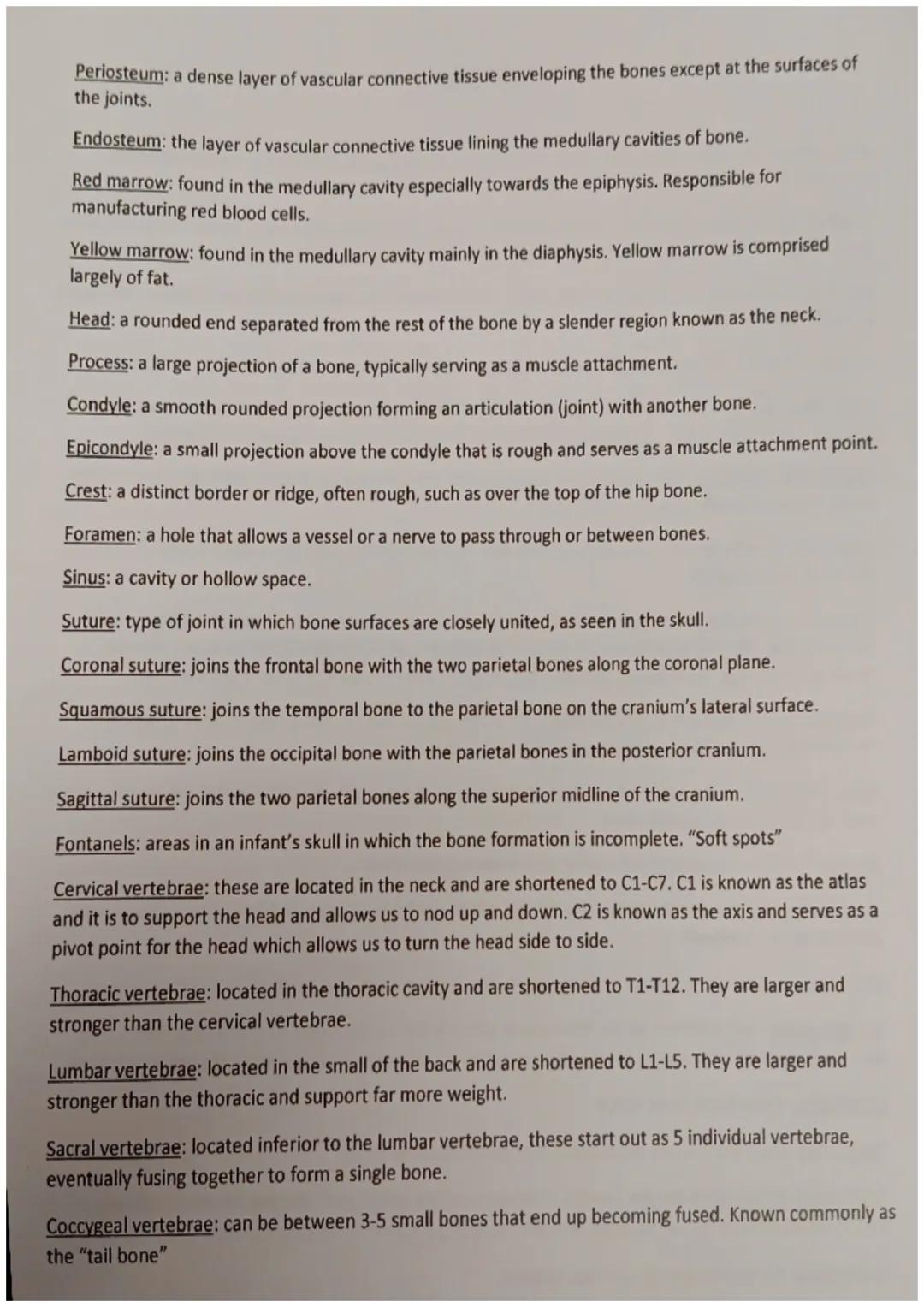
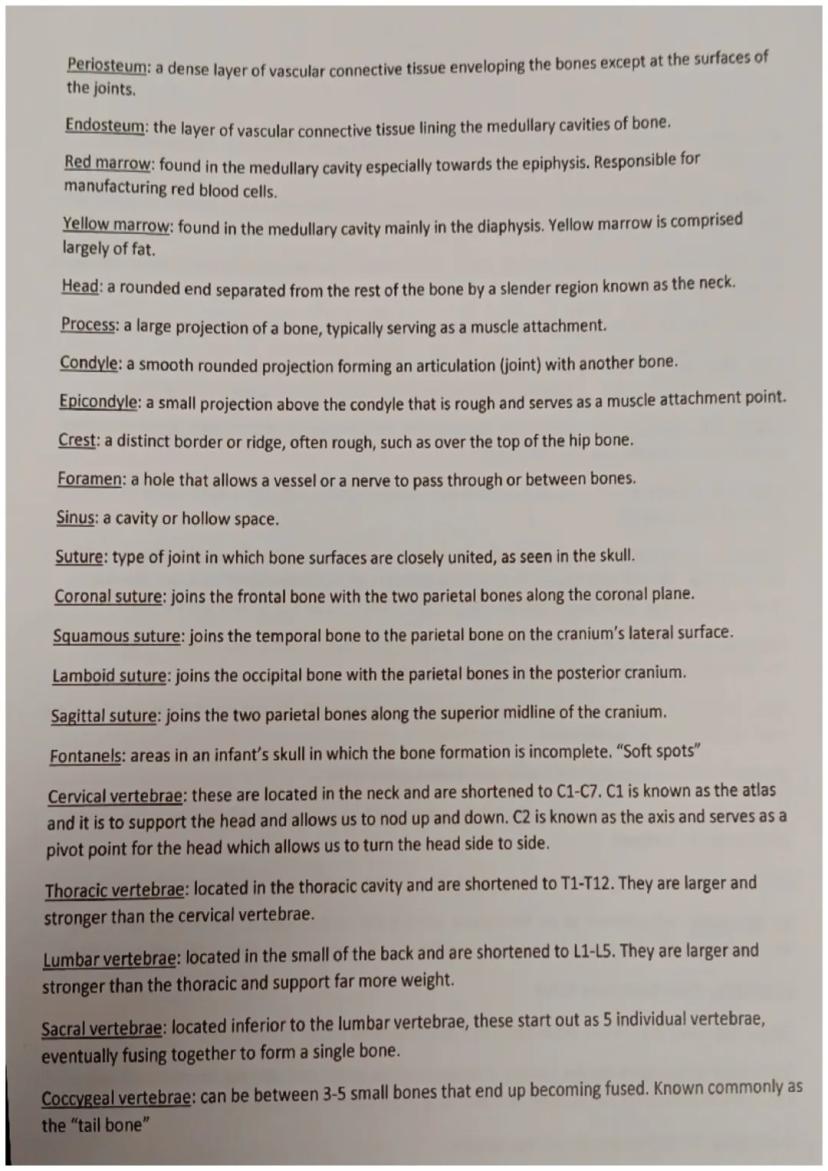
Bones have specialized features that make them uniquely suited to their functions. The outer surface is covered by the periosteum, a tough membrane containing blood vessels that nourish the bone. Inside, the endosteum lines the bone's cavities, where red marrow (which produces blood cells) and yellow marrow (primarily fat tissue) are stored.
Bone surfaces display various landmarks that serve important functions. A head is a rounded end separated by a neck, while a process is a larger projection where muscles attach. Condyles are smooth, rounded projections that form joints, and epicondyles are rougher projections where muscles connect. Other features include crests (distinct ridges), foramina (holes for vessels or nerves), and sinuses (hollow spaces).
The skull contains special joints called sutures where flat bones meet. Key examples include the coronal suture (joining frontal and parietal bones), sagittal suture (joining the two parietal bones), and lambdoid suture (joining occipital and parietal bones). In infants, incomplete bone formation creates fontanels or "soft spots" that allow for brain growth and childbirth.
Your vertebral column consists of 24 individual vertebrae plus the fused vertebrae of the sacrum and coccyx. These are divided into regions: 7 cervical vertebrae (neck), 12 thoracic vertebrae (chest), 5 lumbar vertebrae (lower back), 5 fused sacral vertebrae, and 3-5 fused coccygeal vertebrae ("tailbone"). Each region has vertebrae specially designed for that area's function and weight-bearing needs.
💡 Fun Fact: The first cervical vertebra (C1) is called the "atlas" after the Greek god who held up the sky, because it supports your head. The second vertebra (C2) is called the "axis" because it allows your head to rotate!
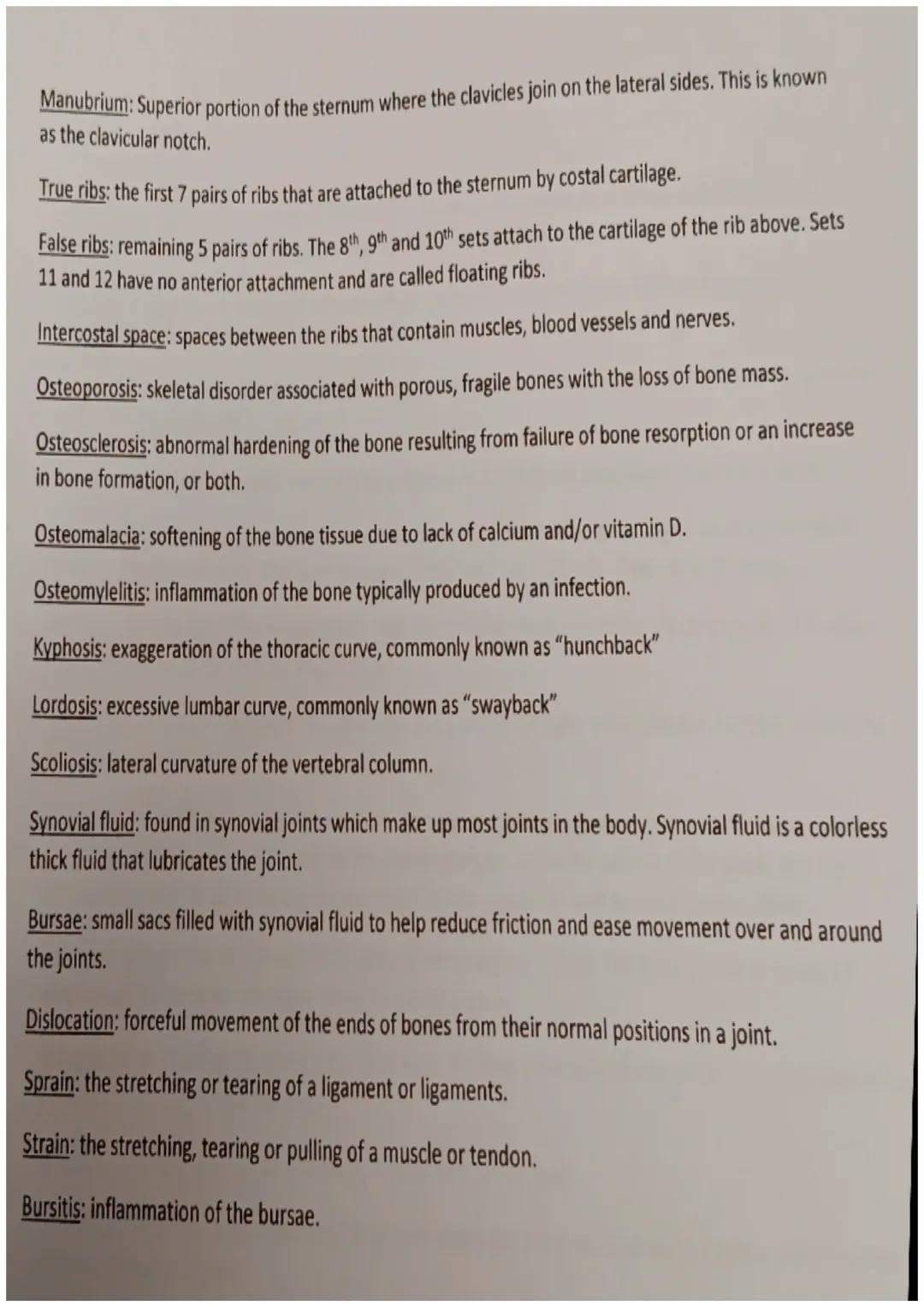
The skeletal system is susceptible to various conditions that affect bone strength and structure. Osteoporosis causes bones to become porous and fragile, increasing fracture risk, while osteosclerosis creates abnormally hardened bone. Osteomalacia results from calcium or vitamin D deficiency, causing bone softening, and osteomyelitis refers to bone inflammation typically caused by infection.
Spinal alignment problems include kyphosis (exaggerated thoracic curve or "hunchback"), lordosis (excessive lumbar curve or "swayback"), and scoliosis (lateral spine curvature). These conditions can affect posture, mobility, and even organ function if severe.
Most joints in the body are synovial joints, which contain synovial fluid—a thick, colorless lubricant that reduces friction during movement. Small fluid-filled sacs called bursae further reduce friction around joints, especially where tendons move over bones.
Common joint injuries include dislocations (bones forced out of normal joint position), sprains (stretched or torn ligaments), and strains (stretched, torn, or pulled muscles or tendons). When bursae become inflamed, the resulting condition is called bursitis, which causes pain and limited movement around the affected joint.
💡 Clinical Connection: While people often confuse sprains and strains, remember this distinction: sprains affect ligaments , while strains affect muscles or tendons .
Our AI companion is specifically built for the needs of students. Based on the millions of content pieces we have on the platform we can provide truly meaningful and relevant answers to students. But its not only about answers, the companion is even more about guiding students through their daily learning challenges, with personalised study plans, quizzes or content pieces in the chat and 100% personalisation based on the students skills and developments.
You can download the app in the Google Play Store and in the Apple App Store.
That's right! Enjoy free access to study content, connect with fellow students, and get instant help – all at your fingertips.
App Store
Google Play
The app is very easy to use and well designed. I have found everything I was looking for so far and have been able to learn a lot from the presentations! I will definitely use the app for a class assignment! And of course it also helps a lot as an inspiration.
Stefan S
iOS user
This app is really great. There are so many study notes and help [...]. My problem subject is French, for example, and the app has so many options for help. Thanks to this app, I have improved my French. I would recommend it to anyone.
Samantha Klich
Android user
Wow, I am really amazed. I just tried the app because I've seen it advertised many times and was absolutely stunned. This app is THE HELP you want for school and above all, it offers so many things, such as workouts and fact sheets, which have been VERY helpful to me personally.
Anna
iOS user
I think it’s very much worth it and you’ll end up using it a lot once you get the hang of it and even after looking at others notes you can still ask your Artificial intelligence buddy the question and ask to simplify it if you still don’t get it!!! In the end I think it’s worth it 😊👍 ⚠️Also DID I MENTION ITS FREEE YOU DON’T HAVE TO PAY FOR ANYTHING AND STILL GET YOUR GRADES IN PERFECTLY❗️❗️⚠️
Thomas R
iOS user
Knowunity is the BEST app I’ve used in a minute. This is not an ai review or anything this is genuinely coming from a 7th grade student (I know 2011 im young) but dude this app is a 10/10 i have maintained a 3.8 gpa and have plenty of time for gaming. I love it and my mom is just happy I got good grades
Brad T
Android user
Not only did it help me find the answer but it also showed me alternative ways to solve it. I was horrible in math and science but now I have an a in both subjects. Thanks for the help🤍🤍
David K
iOS user
The app's just great! All I have to do is enter the topic in the search bar and I get the response real fast. I don't have to watch 10 YouTube videos to understand something, so I'm saving my time. Highly recommended!
Sudenaz Ocak
Android user
In school I was really bad at maths but thanks to the app, I am doing better now. I am so grateful that you made the app.
Greenlight Bonnie
Android user
I found this app a couple years ago and it has only gotten better since then. I really love it because it can help with written questions and photo questions. Also, it can find study guides that other people have made as well as flashcard sets and practice tests. The free version is also amazing for students who might not be able to afford it. Would 100% recommend
Aubrey
iOS user
Best app if you're in Highschool or Junior high. I have been using this app for 2 school years and it's the best, it's good if you don't have anyone to help you with school work.😋🩷🎀
Marco B
iOS user
THE QUIZES AND FLASHCARDS ARE SO USEFUL AND I LOVE Knowunity AI. IT ALSO IS LITREALLY LIKE CHATGPT BUT SMARTER!! HELPED ME WITH MY MASCARA PROBLEMS TOO!! AS WELL AS MY REAL SUBJECTS ! DUHHH 😍😁😲🤑💗✨🎀😮
Elisha
iOS user
This app is phenomenal down to the correct info and the various topics you can study! I greatly recommend it for people who struggle with procrastination and those who need homework help. It has been perfectly accurate for world 1 history as far as I’ve seen! Geometry too!
Paul T
iOS user
The app is very easy to use and well designed. I have found everything I was looking for so far and have been able to learn a lot from the presentations! I will definitely use the app for a class assignment! And of course it also helps a lot as an inspiration.
Stefan S
iOS user
This app is really great. There are so many study notes and help [...]. My problem subject is French, for example, and the app has so many options for help. Thanks to this app, I have improved my French. I would recommend it to anyone.
Samantha Klich
Android user
Wow, I am really amazed. I just tried the app because I've seen it advertised many times and was absolutely stunned. This app is THE HELP you want for school and above all, it offers so many things, such as workouts and fact sheets, which have been VERY helpful to me personally.
Anna
iOS user
I think it’s very much worth it and you’ll end up using it a lot once you get the hang of it and even after looking at others notes you can still ask your Artificial intelligence buddy the question and ask to simplify it if you still don’t get it!!! In the end I think it’s worth it 😊👍 ⚠️Also DID I MENTION ITS FREEE YOU DON’T HAVE TO PAY FOR ANYTHING AND STILL GET YOUR GRADES IN PERFECTLY❗️❗️⚠️
Thomas R
iOS user
Knowunity is the BEST app I’ve used in a minute. This is not an ai review or anything this is genuinely coming from a 7th grade student (I know 2011 im young) but dude this app is a 10/10 i have maintained a 3.8 gpa and have plenty of time for gaming. I love it and my mom is just happy I got good grades
Brad T
Android user
Not only did it help me find the answer but it also showed me alternative ways to solve it. I was horrible in math and science but now I have an a in both subjects. Thanks for the help🤍🤍
David K
iOS user
The app's just great! All I have to do is enter the topic in the search bar and I get the response real fast. I don't have to watch 10 YouTube videos to understand something, so I'm saving my time. Highly recommended!
Sudenaz Ocak
Android user
In school I was really bad at maths but thanks to the app, I am doing better now. I am so grateful that you made the app.
Greenlight Bonnie
Android user
I found this app a couple years ago and it has only gotten better since then. I really love it because it can help with written questions and photo questions. Also, it can find study guides that other people have made as well as flashcard sets and practice tests. The free version is also amazing for students who might not be able to afford it. Would 100% recommend
Aubrey
iOS user
Best app if you're in Highschool or Junior high. I have been using this app for 2 school years and it's the best, it's good if you don't have anyone to help you with school work.😋🩷🎀
Marco B
iOS user
THE QUIZES AND FLASHCARDS ARE SO USEFUL AND I LOVE Knowunity AI. IT ALSO IS LITREALLY LIKE CHATGPT BUT SMARTER!! HELPED ME WITH MY MASCARA PROBLEMS TOO!! AS WELL AS MY REAL SUBJECTS ! DUHHH 😍😁😲🤑💗✨🎀😮
Elisha
iOS user
This app is phenomenal down to the correct info and the various topics you can study! I greatly recommend it for people who struggle with procrastination and those who need homework help. It has been perfectly accurate for world 1 history as far as I’ve seen! Geometry too!
Paul T
iOS user
Melody Thiel
@melodythiel_dgqo
Medical terminology can seem like a whole new language, but it's the key to understanding healthcare. These prefixes, suffixes, and root words form the building blocks that healthcare professionals use to precisely communicate about the human body, conditions, and procedures.
Access to all documents
Improve your grades
Join milions of students
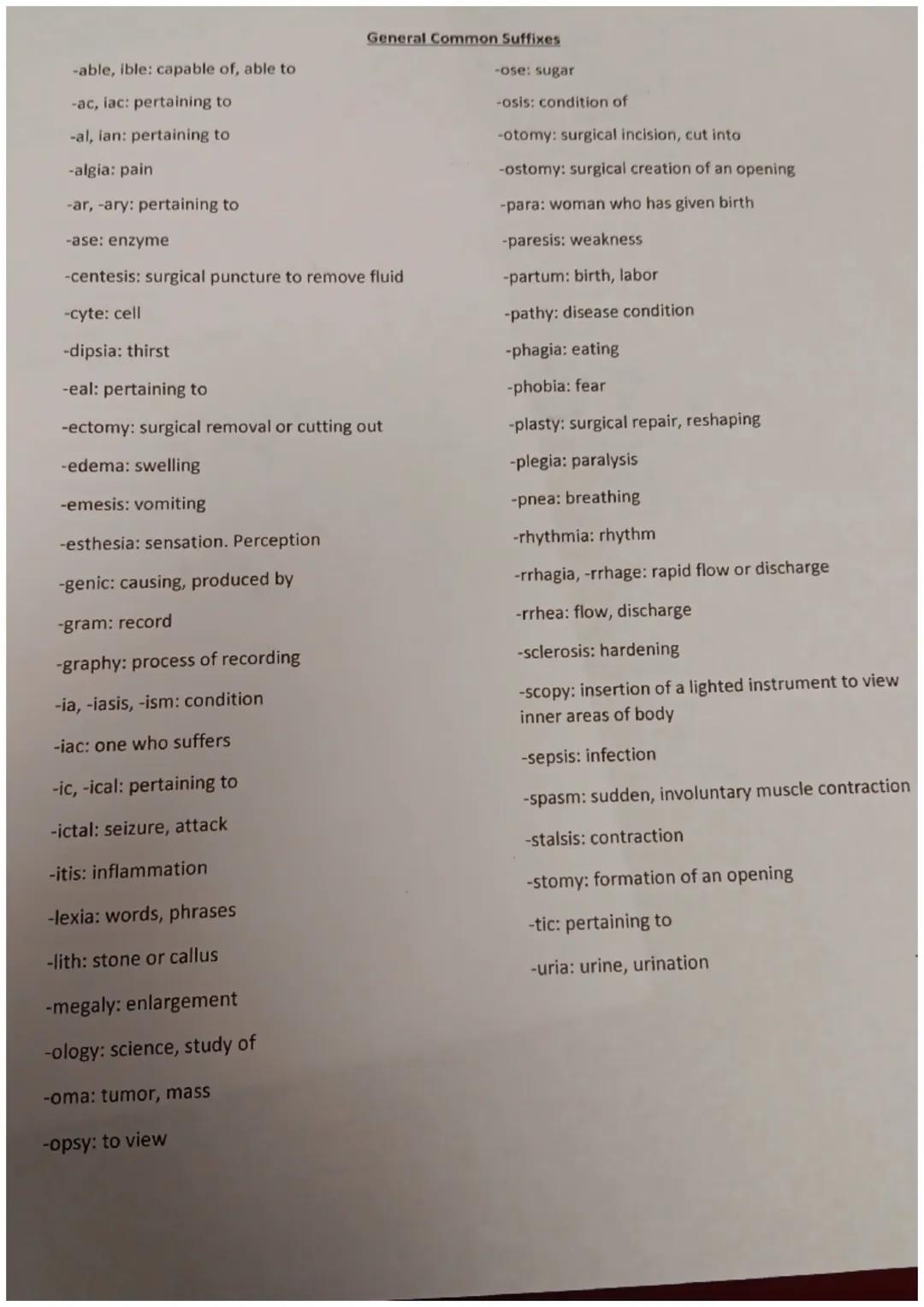
Medical suffixes are the endings that give medical terms their specific meanings. These powerful word parts instantly tell you what's happening in the body. For example, when you see -itis at the end of a word, you know it refers to inflammation—like in arthritis (joint inflammation) or bronchitis (bronchi inflammation).
Want to know if something's been surgically removed? Look for -ectomy (as in appendectomy). Need to describe a disease condition? That's where -pathy comes in (neuropathy). Suffixes like -oma tell you you're dealing with a tumor or mass, while -scopy indicates a procedure using a scope to view inside the body.
Some suffixes describe bodily functions: -pnea relates to breathing, -emesis to vomiting, and -uria to urination. Others describe physical states like -edema (swelling), -plegia (paralysis), or -megaly (enlargement).
💡 Quick Tip: When you encounter a medical term, first identify the suffix! It usually gives away the main action or condition being described.
Access to all documents
Improve your grades
Join milions of students
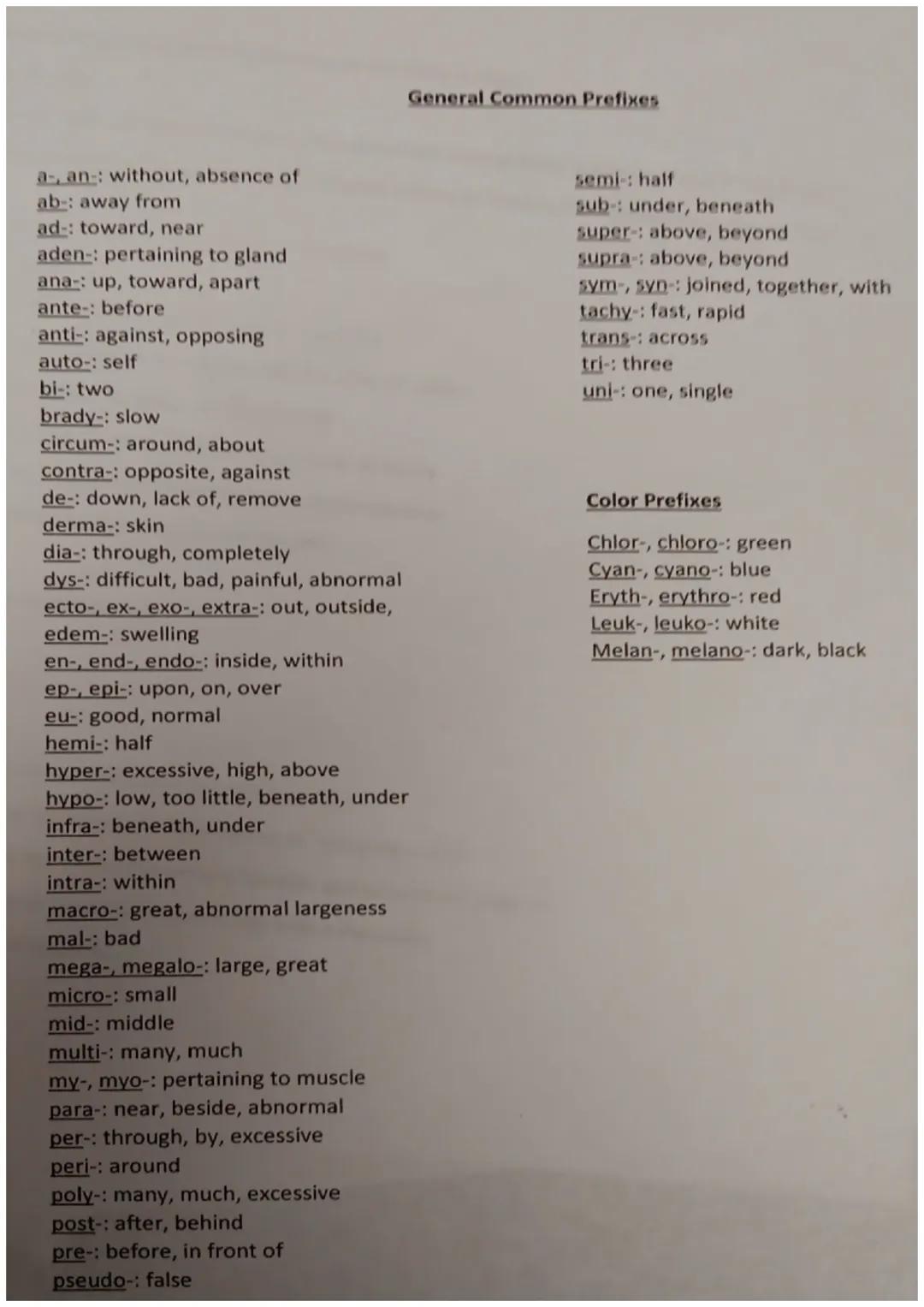
Medical prefixes appear at the beginning of terms and modify their meaning in important ways. They're like instant clues that help you understand the medical situation more clearly. For example, knowing that hyper- means "excessive" or "high" instantly tells you that hypertension means high blood pressure.
Direction and position prefixes are super helpful in medicine. Terms like endo- (within), peri- (around), and trans- (across) tell you exactly where something is happening relative to a body structure. Speed and intensity prefixes like tachy- (fast) and brady- (slow) give immediate information about rates—tachycardia means a fast heart rate.
Color prefixes can provide visual cues about conditions. Erythro- refers to red (erythrocytes are red blood cells), leuko- to white (leukocytes are white blood cells), and cyano- to blue (cyanosis is a bluish discoloration of the skin).
When these prefixes combine with root words and suffixes, they create precise medical descriptions. For instance, hypo- (low, under) + glyc (sugar) + -emia (blood condition) = hypoglycemia, or low blood sugar.
💡 Remember: Opposites are common in medical prefixes! Hyper-/hypo-, tachy-/brady-, and macro-/micro- show the range of conditions you might encounter.
Access to all documents
Improve your grades
Join milions of students
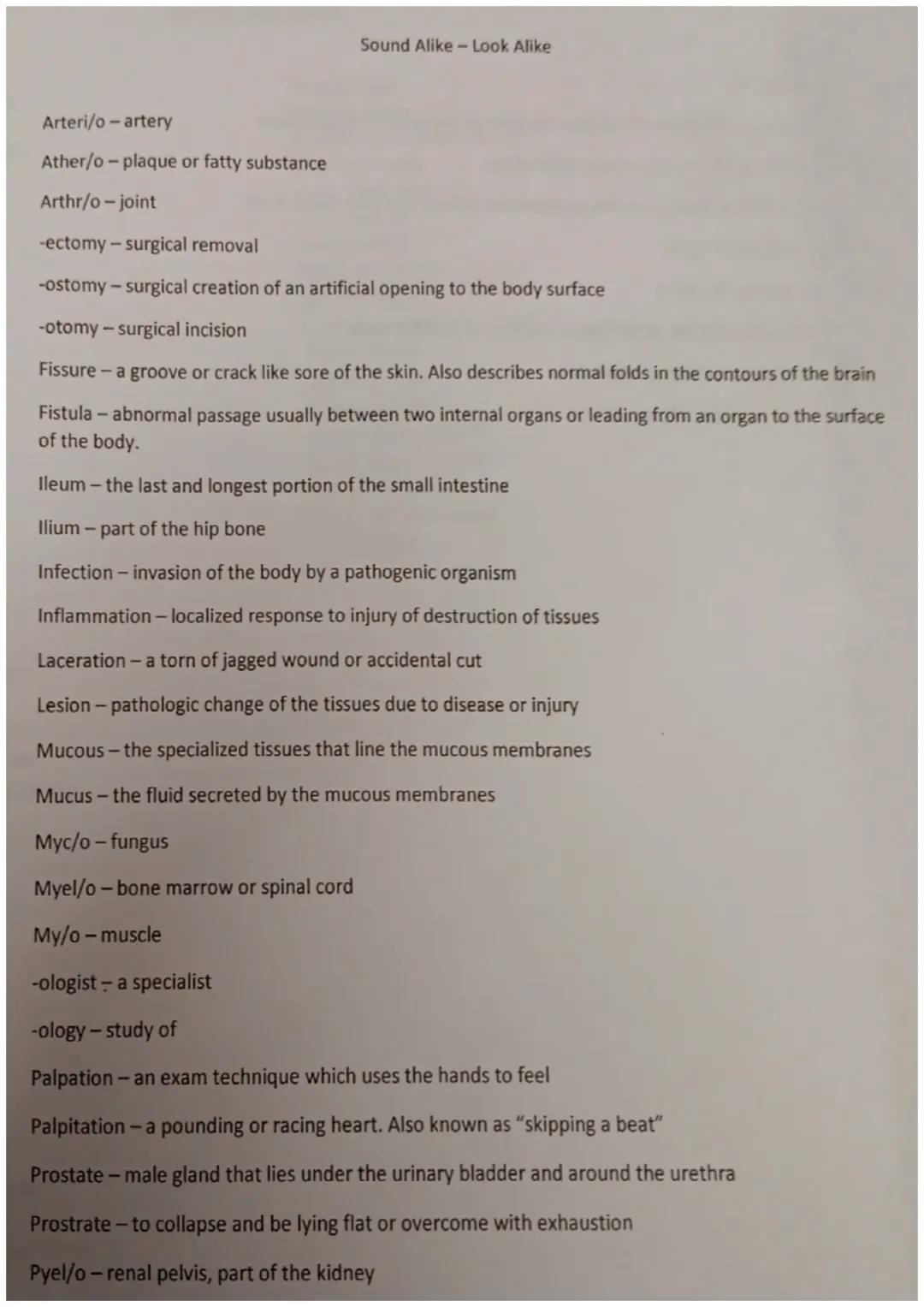
Medical terminology includes many terms that sound similar but have completely different meanings. Confusing these terms can lead to serious misunderstandings about diagnoses or treatments. For example, ileum (last part of small intestine) and ilium (part of hip bone) sound nearly identical but refer to entirely different body structures.
Some easily confused pairs involve medical procedures. -ectomy means surgical removal, while -ostomy means creating an artificial opening, and -otomy refers to a surgical incision. Mixing these up could completely change your understanding of what procedure was performed!
Other commonly confused terms have subtle but important differences. Infection refers to the invasion of pathogens, while inflammation is the body's response to injury or infection. Similarly, mucous is the tissue that lines membranes, but mucus is the fluid those membranes secrete.
When you encounter confusing medical terms, pay careful attention to spelling and context. The difference between palpation (examination by touch) and palpitation (racing heartbeat) might be just a few letters, but they describe completely different medical situations.
💡 Confusion Alert: When you encounter similar-sounding medical terms, double-check their specific meanings. Even healthcare professionals sometimes need to verify these easily confused terms!
Access to all documents
Improve your grades
Join milions of students
Root words form the foundation of medical terminology, providing the essential meaning of medical terms. Most root words come from Greek or Latin origins and describe specific body parts or systems. For example, cardi/o refers to the heart, while nephr/o indicates the kidney.
These root words combine with prefixes and suffixes to create precise medical terms. When you see gastr/o (stomach) combined with -itis (inflammation), you get gastritis—inflammation of the stomach. Similarly, hepat/o (liver) + -itis = hepatitis.
Some root words describe body substances or conditions. Hem/o and hemat/o both refer to blood, while glyc/o and gluc/o indicate sugar. This allows for specific descriptions of blood-related conditions (hematoma) or sugar-related conditions (hyperglycemia).
Understanding root words helps you decode complex medical terminology. When you encounter bronch/o (bronchi) + -scopy (viewing procedure), you know bronchoscopy involves examining the bronchi with a specialized instrument. Similarly, nephr/o (kidney) + -ectomy (removal) = nephrectomy, the surgical removal of a kidney.
💡 Power Tip: When you learn a new root word, try creating several medical terms by adding different prefixes and suffixes. This practice will strengthen your medical vocabulary quickly!
Access to all documents
Improve your grades
Join milions of students
Understanding how healthcare professionals describe body positions and planes is essential for interpreting medical instructions and documentation. Anatomic position serves as the universal reference point—standing upright, facing forward, arms at sides with palms forward and feet parallel. All directional terms use this standard position regardless of how the patient is actually positioned.
Body planes help healthcare professionals communicate about specific sections of the body. The frontal plane divides the body into front and back portions, the sagittal plane separates right from left, and the transverse plane cuts horizontally to separate upper and lower body regions.
Directional terms precisely indicate locations relative to each other. Superior means above while inferior means below. Anterior (or ventral) refers to the front surface while posterior (or dorsal) indicates the back. Proximal means closer to the body's center while distal means farther away.
Body cavities organize and protect internal organs. The dorsal cavity contains the brain and spinal cord, while the ventral cavity houses organs of homeostasis. The ventral cavity is further divided into the thoracic cavity (above the diaphragm) containing the heart and lungs, and the abdominopelvic cavity (below the diaphragm) containing digestive and reproductive organs.
💡 Clinical Connection: The abdomen is divided into either 9 regions or 4 quadrants that help healthcare providers precisely locate pain, masses, or other findings during examinations.
Access to all documents
Improve your grades
Join milions of students
Medical professionals use specific terminology to describe how patients are positioned for procedures, examinations, or recovery. Knowing these terms helps you understand medical instructions and documentation. The most basic positions include supine (lying flat on your back) and prone (lying face down).
When a patient needs their head elevated, healthcare providers use Fowler's position, with variations including Semi-Fowler's and High Fowler's . These positions are commonly used for patients with respiratory issues or after certain surgeries to improve breathing and comfort.
Some medical situations require specialized positioning. The Trendelenburg position places patients on their backs with feet higher than their heads—useful during episodes of low blood pressure. The recovery position is a variation of lateral recumbent positioning that helps unconscious patients breathe and prevents aspiration of fluids.
Healthcare providers often document patient preferences as the position of comfort (POC), recognizing that comfort can improve healing and patient satisfaction. Meanwhile, the position of function refers to the natural resting position of limbs that promotes optimal healing after injuries or surgeries.
💡 Remember This: When you hear "supine," think "spine on the surface"—it's an easy way to remember that supine means lying on your back.
Access to all documents
Improve your grades
Join milions of students
Your skeletal system provides the framework that supports your entire body. Though you start life with about 270 bones, this number decreases to around 206 in adulthood as some bones fuse during growth. Bones don't work alone—they collaborate with cartilage (flexible connective tissue), ligaments (connect bones to bones), and tendons (connect muscles to bones).
The skeletal system is divided into two main sections. The axial skeleton includes 80 bones that form your central core—the skull, vertebral column, and thoracic cage. The appendicular skeleton comprises the bones of your limbs and their attachments to the axial skeleton.
Bones come in various shapes, each designed for specific functions. Long bones like the femur provide strength and mobility, while flat bones like the scapula protect organs and provide attachment points for muscles. Short bones in your wrists and ankles provide stability with limited motion, and irregular bones like vertebrae have complex shapes for specialized functions.
Long bones have a specific structure: the diaphysis (main shaft) contains the medullary cavity filled with bone marrow, while the epiphyses (ends) form joints with other bones. The tissue that makes up bones is called osseous tissue, which contains three important cell types: osteoblasts (build bone), osteocytes (maintain bone), and osteoclasts (break down bone)—all crucial for bone health and healing.
💡 Did You Know? Your bones are constantly remodeling themselves through the balanced actions of osteoblasts and osteoclasts. This process replaces about 10% of your skeleton annually!
Access to all documents
Improve your grades
Join milions of students
Bones have specialized features that make them uniquely suited to their functions. The outer surface is covered by the periosteum, a tough membrane containing blood vessels that nourish the bone. Inside, the endosteum lines the bone's cavities, where red marrow (which produces blood cells) and yellow marrow (primarily fat tissue) are stored.
Bone surfaces display various landmarks that serve important functions. A head is a rounded end separated by a neck, while a process is a larger projection where muscles attach. Condyles are smooth, rounded projections that form joints, and epicondyles are rougher projections where muscles connect. Other features include crests (distinct ridges), foramina (holes for vessels or nerves), and sinuses (hollow spaces).
The skull contains special joints called sutures where flat bones meet. Key examples include the coronal suture (joining frontal and parietal bones), sagittal suture (joining the two parietal bones), and lambdoid suture (joining occipital and parietal bones). In infants, incomplete bone formation creates fontanels or "soft spots" that allow for brain growth and childbirth.
Your vertebral column consists of 24 individual vertebrae plus the fused vertebrae of the sacrum and coccyx. These are divided into regions: 7 cervical vertebrae (neck), 12 thoracic vertebrae (chest), 5 lumbar vertebrae (lower back), 5 fused sacral vertebrae, and 3-5 fused coccygeal vertebrae ("tailbone"). Each region has vertebrae specially designed for that area's function and weight-bearing needs.
💡 Fun Fact: The first cervical vertebra (C1) is called the "atlas" after the Greek god who held up the sky, because it supports your head. The second vertebra (C2) is called the "axis" because it allows your head to rotate!
Access to all documents
Improve your grades
Join milions of students
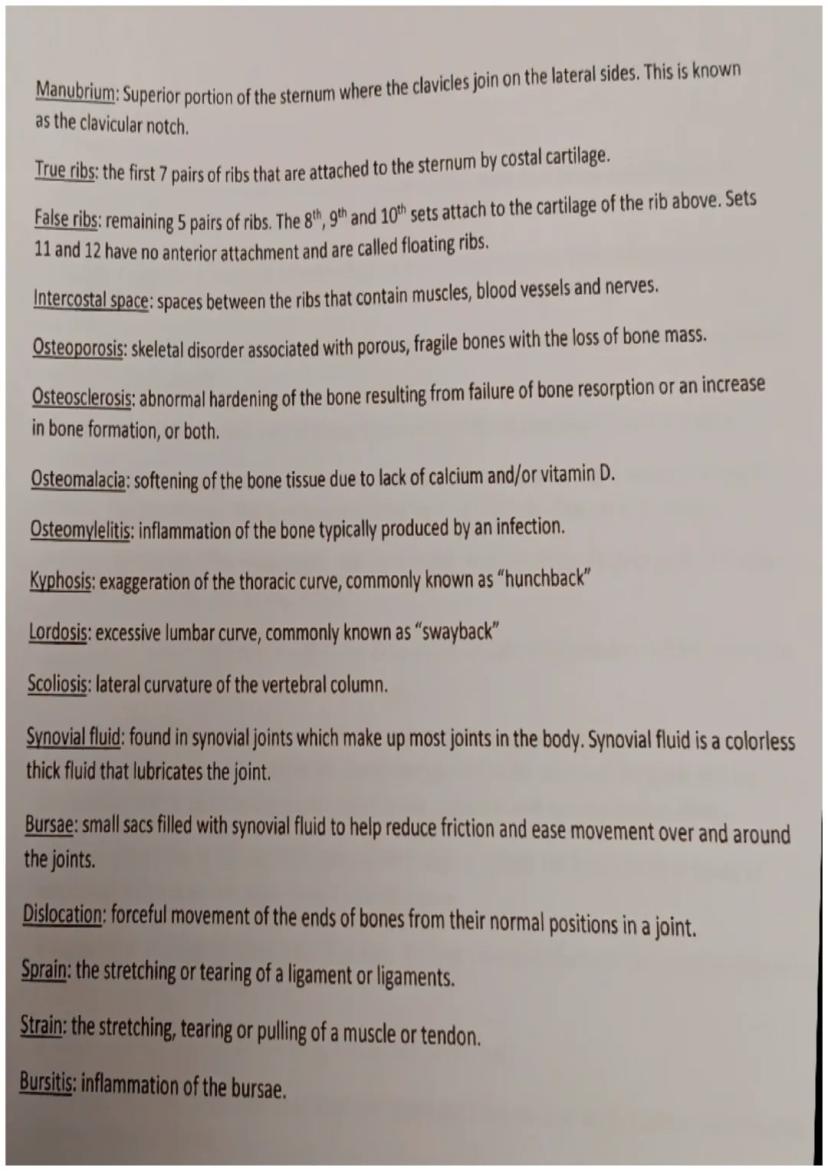
The skeletal system is susceptible to various conditions that affect bone strength and structure. Osteoporosis causes bones to become porous and fragile, increasing fracture risk, while osteosclerosis creates abnormally hardened bone. Osteomalacia results from calcium or vitamin D deficiency, causing bone softening, and osteomyelitis refers to bone inflammation typically caused by infection.
Spinal alignment problems include kyphosis (exaggerated thoracic curve or "hunchback"), lordosis (excessive lumbar curve or "swayback"), and scoliosis (lateral spine curvature). These conditions can affect posture, mobility, and even organ function if severe.
Most joints in the body are synovial joints, which contain synovial fluid—a thick, colorless lubricant that reduces friction during movement. Small fluid-filled sacs called bursae further reduce friction around joints, especially where tendons move over bones.
Common joint injuries include dislocations (bones forced out of normal joint position), sprains (stretched or torn ligaments), and strains (stretched, torn, or pulled muscles or tendons). When bursae become inflamed, the resulting condition is called bursitis, which causes pain and limited movement around the affected joint.
💡 Clinical Connection: While people often confuse sprains and strains, remember this distinction: sprains affect ligaments , while strains affect muscles or tendons .
Our AI companion is specifically built for the needs of students. Based on the millions of content pieces we have on the platform we can provide truly meaningful and relevant answers to students. But its not only about answers, the companion is even more about guiding students through their daily learning challenges, with personalised study plans, quizzes or content pieces in the chat and 100% personalisation based on the students skills and developments.
You can download the app in the Google Play Store and in the Apple App Store.
That's right! Enjoy free access to study content, connect with fellow students, and get instant help – all at your fingertips.
20
Smart Tools NEW
Transform this note into: ✓ 50+ Practice Questions ✓ Interactive Flashcards ✓ Full Practice Test ✓ Essay Outlines
microbiology history
 Health & Medicine
PDF Health
Health & MedicineRoutine Urinalysis
Health & MedicineUnderstanding the language of anatomy and directional terms used to describe body structures and cavities for medical professionals and students.
Health & MedicineJust labeling the major muscles of the muscular system
Health & MedicineExplore the key concepts of ergonomics, chair design, and evaluation criteria in this comprehensive study note. Understand the pros and cons of different chair types, their impact on health and wellbeing, and the importance of material choice. Ideal for health and social studies, this resource provides insights into workplace ergonomics and health determinants.
 Health & Social Care
App Store
Google Play
The app is very easy to use and well designed. I have found everything I was looking for so far and have been able to learn a lot from the presentations! I will definitely use the app for a class assignment! And of course it also helps a lot as an inspiration.
Stefan S
iOS user
This app is really great. There are so many study notes and help [...]. My problem subject is French, for example, and the app has so many options for help. Thanks to this app, I have improved my French. I would recommend it to anyone.
Samantha Klich
Android user
Wow, I am really amazed. I just tried the app because I've seen it advertised many times and was absolutely stunned. This app is THE HELP you want for school and above all, it offers so many things, such as workouts and fact sheets, which have been VERY helpful to me personally.
Anna
iOS user
I think it’s very much worth it and you’ll end up using it a lot once you get the hang of it and even after looking at others notes you can still ask your Artificial intelligence buddy the question and ask to simplify it if you still don’t get it!!! In the end I think it’s worth it 😊👍 ⚠️Also DID I MENTION ITS FREEE YOU DON’T HAVE TO PAY FOR ANYTHING AND STILL GET YOUR GRADES IN PERFECTLY❗️❗️⚠️
Thomas R
iOS user
Knowunity is the BEST app I’ve used in a minute. This is not an ai review or anything this is genuinely coming from a 7th grade student (I know 2011 im young) but dude this app is a 10/10 i have maintained a 3.8 gpa and have plenty of time for gaming. I love it and my mom is just happy I got good grades
Brad T
Android user
Not only did it help me find the answer but it also showed me alternative ways to solve it. I was horrible in math and science but now I have an a in both subjects. Thanks for the help🤍🤍
David K
iOS user
The app's just great! All I have to do is enter the topic in the search bar and I get the response real fast. I don't have to watch 10 YouTube videos to understand something, so I'm saving my time. Highly recommended!
Sudenaz Ocak
Android user
In school I was really bad at maths but thanks to the app, I am doing better now. I am so grateful that you made the app.
Greenlight Bonnie
Android user
I found this app a couple years ago and it has only gotten better since then. I really love it because it can help with written questions and photo questions. Also, it can find study guides that other people have made as well as flashcard sets and practice tests. The free version is also amazing for students who might not be able to afford it. Would 100% recommend
Aubrey
iOS user
Best app if you're in Highschool or Junior high. I have been using this app for 2 school years and it's the best, it's good if you don't have anyone to help you with school work.😋🩷🎀
Marco B
iOS user
THE QUIZES AND FLASHCARDS ARE SO USEFUL AND I LOVE Knowunity AI. IT ALSO IS LITREALLY LIKE CHATGPT BUT SMARTER!! HELPED ME WITH MY MASCARA PROBLEMS TOO!! AS WELL AS MY REAL SUBJECTS ! DUHHH 😍😁😲🤑💗✨🎀😮
Elisha
iOS user
This app is phenomenal down to the correct info and the various topics you can study! I greatly recommend it for people who struggle with procrastination and those who need homework help. It has been perfectly accurate for world 1 history as far as I’ve seen! Geometry too!
Paul T
iOS user
The app is very easy to use and well designed. I have found everything I was looking for so far and have been able to learn a lot from the presentations! I will definitely use the app for a class assignment! And of course it also helps a lot as an inspiration.
Stefan S
iOS user
This app is really great. There are so many study notes and help [...]. My problem subject is French, for example, and the app has so many options for help. Thanks to this app, I have improved my French. I would recommend it to anyone.
Samantha Klich
Android user
Wow, I am really amazed. I just tried the app because I've seen it advertised many times and was absolutely stunned. This app is THE HELP you want for school and above all, it offers so many things, such as workouts and fact sheets, which have been VERY helpful to me personally.
Anna
iOS user
I think it’s very much worth it and you’ll end up using it a lot once you get the hang of it and even after looking at others notes you can still ask your Artificial intelligence buddy the question and ask to simplify it if you still don’t get it!!! In the end I think it’s worth it 😊👍 ⚠️Also DID I MENTION ITS FREEE YOU DON’T HAVE TO PAY FOR ANYTHING AND STILL GET YOUR GRADES IN PERFECTLY❗️❗️⚠️
Thomas R
iOS user
Knowunity is the BEST app I’ve used in a minute. This is not an ai review or anything this is genuinely coming from a 7th grade student (I know 2011 im young) but dude this app is a 10/10 i have maintained a 3.8 gpa and have plenty of time for gaming. I love it and my mom is just happy I got good grades
Brad T
Android user
Not only did it help me find the answer but it also showed me alternative ways to solve it. I was horrible in math and science but now I have an a in both subjects. Thanks for the help🤍🤍
David K
iOS user
The app's just great! All I have to do is enter the topic in the search bar and I get the response real fast. I don't have to watch 10 YouTube videos to understand something, so I'm saving my time. Highly recommended!
Sudenaz Ocak
Android user
In school I was really bad at maths but thanks to the app, I am doing better now. I am so grateful that you made the app.
Greenlight Bonnie
Android user
I found this app a couple years ago and it has only gotten better since then. I really love it because it can help with written questions and photo questions. Also, it can find study guides that other people have made as well as flashcard sets and practice tests. The free version is also amazing for students who might not be able to afford it. Would 100% recommend
Aubrey
iOS user
Best app if you're in Highschool or Junior high. I have been using this app for 2 school years and it's the best, it's good if you don't have anyone to help you with school work.😋🩷🎀
Marco B
iOS user
THE QUIZES AND FLASHCARDS ARE SO USEFUL AND I LOVE Knowunity AI. IT ALSO IS LITREALLY LIKE CHATGPT BUT SMARTER!! HELPED ME WITH MY MASCARA PROBLEMS TOO!! AS WELL AS MY REAL SUBJECTS ! DUHHH 😍😁😲🤑💗✨🎀😮
Elisha
iOS user
This app is phenomenal down to the correct info and the various topics you can study! I greatly recommend it for people who struggle with procrastination and those who need homework help. It has been perfectly accurate for world 1 history as far as I’ve seen! Geometry too!
Paul T
iOS user