
Nursing theory forms the backbone of nursing practice, providing a... Show more
 Health & Medicine
 Algebra
Sign up to see the contentIt's free!
Access to all documents
Improve your grades
Join milions of students
Knowunity AI
Subjects
Triangle Congruence and Similarity Theorems
Triangle Properties and Classification
Linear Equations and Graphs
Geometric Angle Relationships
Trigonometric Functions and Identities
Equation Solving Techniques
Circle Geometry Fundamentals
Division Operations and Methods
Basic Differentiation Rules
Exponent and Logarithm Properties
Show all topics
Human Organ Systems
Reproductive Cell Cycles
Biological Sciences Subdisciplines
Cellular Energy Metabolism
Autotrophic Energy Processes
Inheritance Patterns and Principles
Biomolecular Structure and Organization
Cell Cycle and Division Mechanics
Cellular Organization and Development
Biological Structural Organization
Show all topics
Chemical Sciences and Applications
Atomic Structure and Composition
Molecular Electron Structure Representation
Atomic Electron Behavior
Matter Properties and Water
Mole Concept and Calculations
Gas Laws and Behavior
Periodic Table Organization
Chemical Thermodynamics Fundamentals
Chemical Bond Types and Properties
Show all topics
European Renaissance and Enlightenment
European Cultural Movements 800-1920
American Revolution Era 1763-1797
American Civil War 1861-1865
Global Imperial Systems
Mongol and Chinese Dynasties
U.S. Presidents and World Leaders
Historical Sources and Documentation
World Wars Era and Impact
World Religious Systems
Show all topics
Classic and Contemporary Novels
Literary Character Analysis
Rhetorical Theory and Practice
Classic Literary Narratives
Reading Analysis and Interpretation
Narrative Structure and Techniques
English Language Components
Influential English-Language Authors
Basic Sentence Structure
Narrative Voice and Perspective
Show all topics
130
•
Updated Feb 23, 2026
•
Hayden Santos
@haydensantos
Nursing theory forms the backbone of nursing practice, providing a... Show more
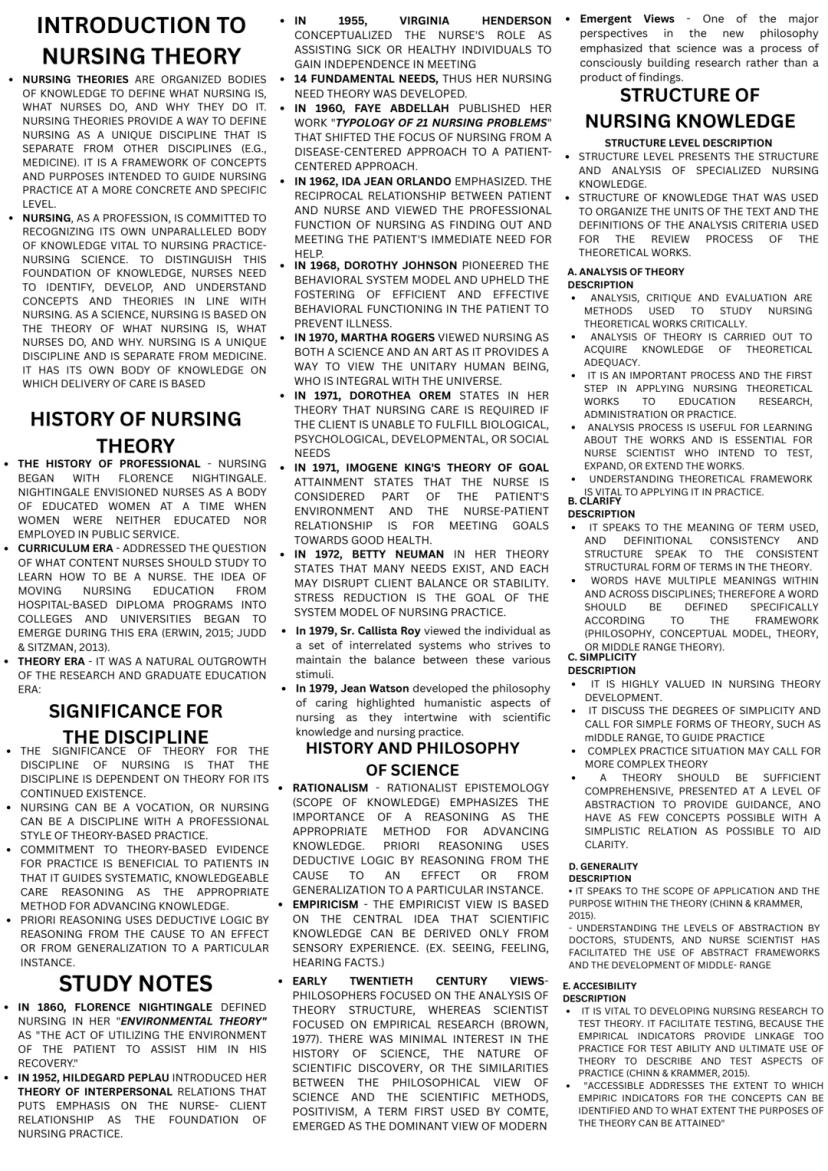
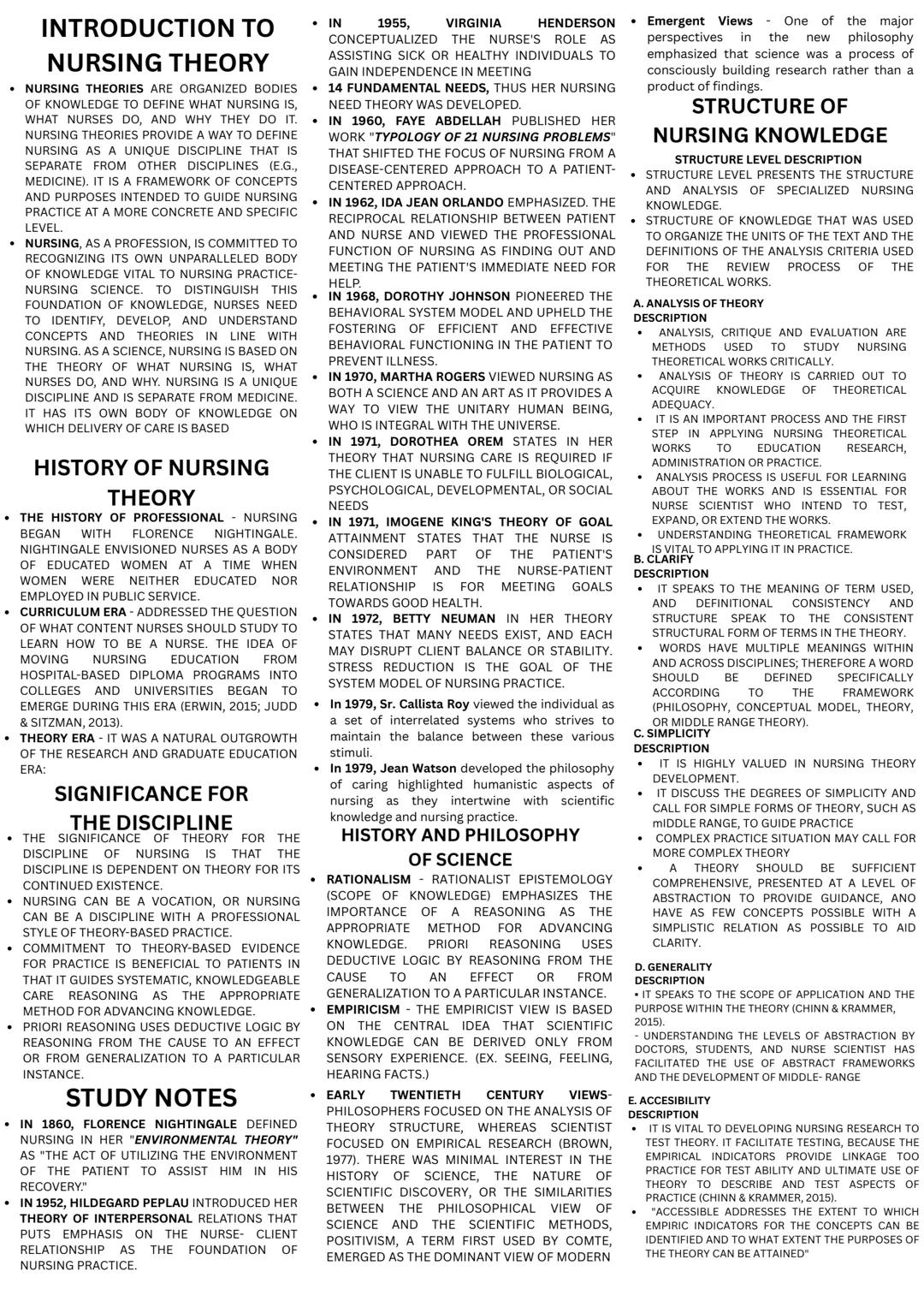
Nursing theories are organized bodies of knowledge that define nursing as a distinct discipline with its own unique focus. They provide the framework that guides professional nursing practice, separating nursing from other healthcare disciplines like medicine. These theories help nurses understand what nursing is, what nurses do, and why they do it in a systematic way.
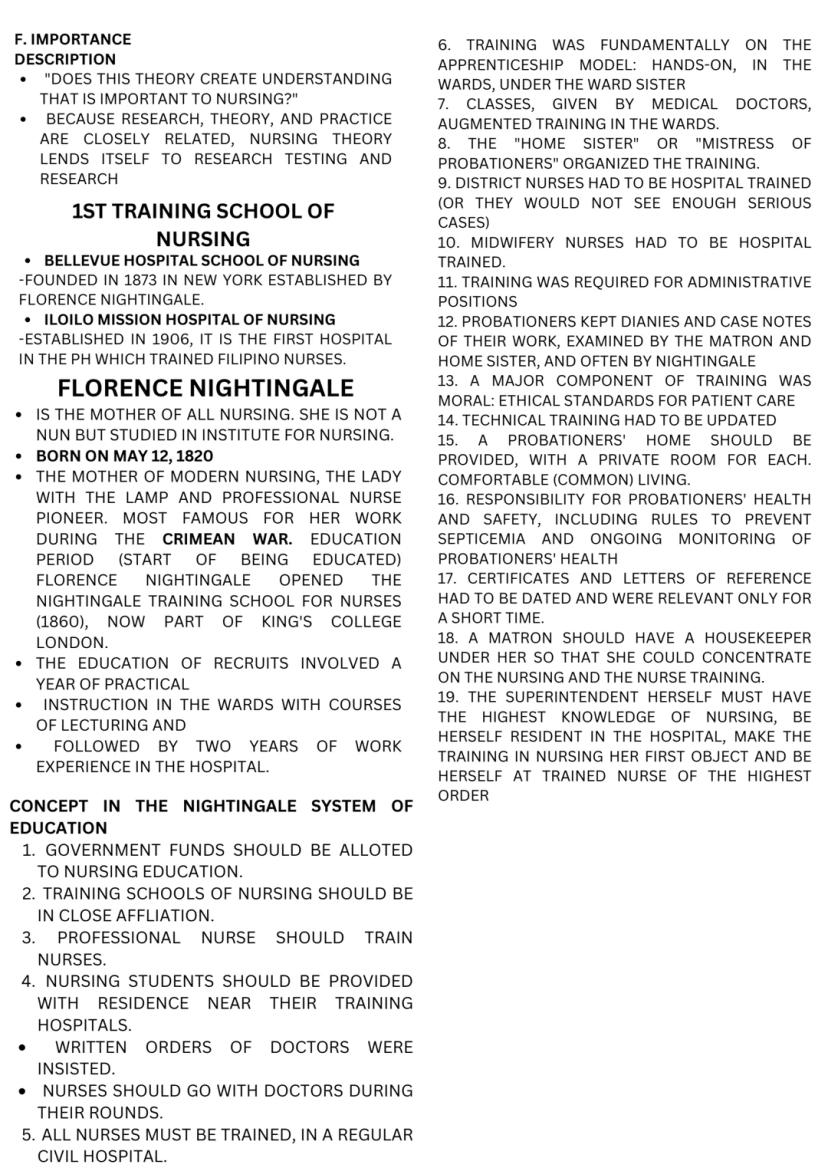
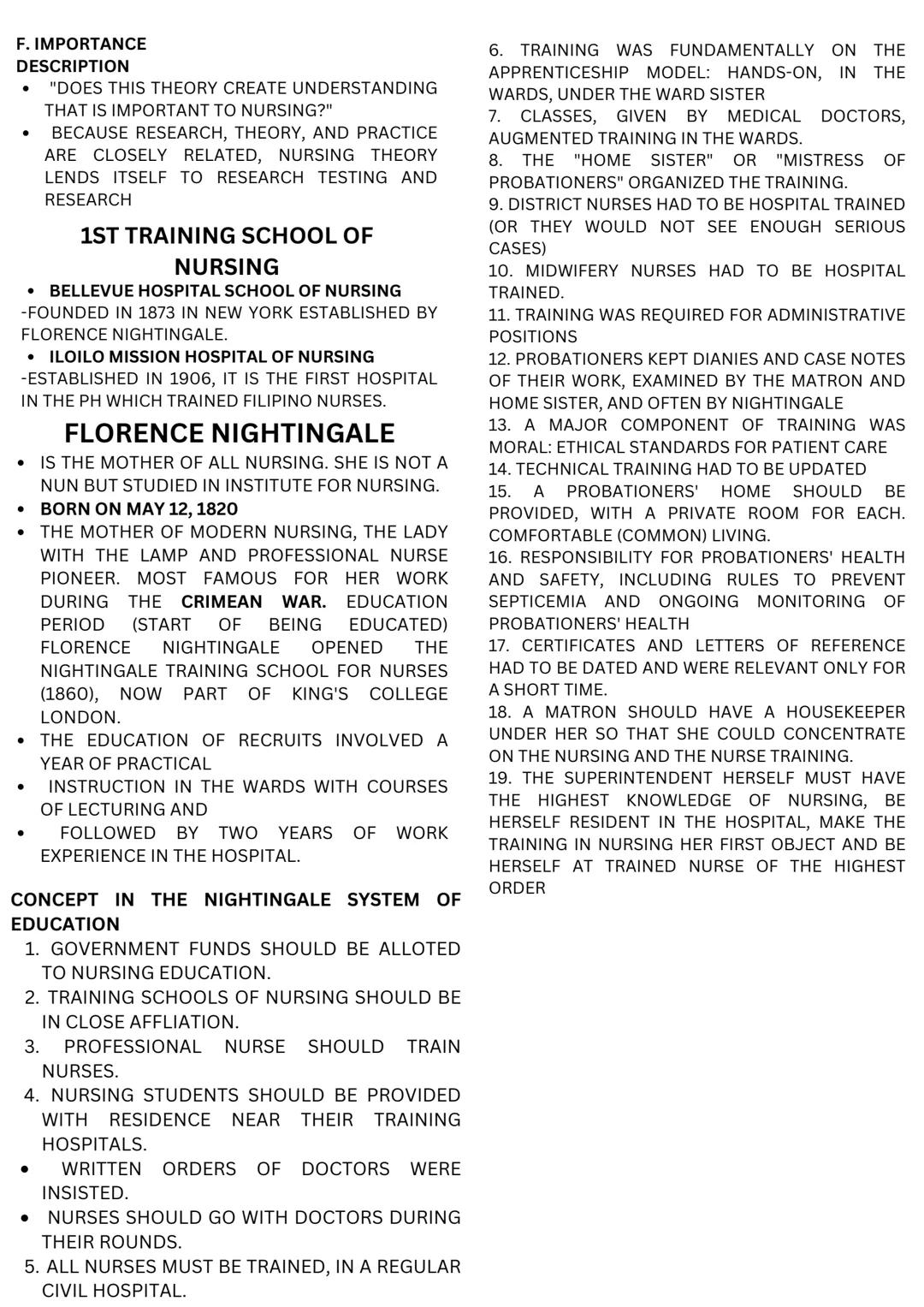
The history of professional nursing began with Florence Nightingale, who envisioned nurses as educated professionals at a time when women rarely received education or worked in public service. Over time, nursing education evolved from hospital-based programs into university settings, leading to the development of nursing theory as we know it today.
The significance of theory to nursing cannot be overstated. It transforms nursing from a simple vocation into a professional discipline with theory-based practice. This commitment to theory-guided care benefits patients by ensuring systematic, knowledgeable approaches to healthcare delivery.
Did you know? Florence Nightingale defined nursing in her "Environmental Theory" in 1860 as "the act of utilizing the environment of the patient to assist him in his recovery." This was the first formal nursing theory!
Throughout the 20th century, nursing theorists like Virginia Henderson, Dorothea Orem, and Betty Neuman developed frameworks that shifted nursing from being disease-centered to patient-centered. Each theorist contributed unique perspectives on the nurse-patient relationship and how nursing care should be delivered.
Nursing knowledge has developed through different philosophical approaches. Rationalism emphasizes reasoning and deductive logic to advance knowledge, while empiricism relies on sensory experience and observation as the foundation of scientific understanding.
Early 20th century views separated theory from practice—philosophers focused on analyzing theory structure while scientists conducted empirical research. Later, emergent views emphasized that science was an active process of consciously building research rather than just a collection of findings.
The structure of nursing knowledge requires critical analysis to ensure theoretical adequacy. Understanding theoretical frameworks is vital for applying them in practice. When evaluating nursing theories, we consider several key aspects:
Nursing theory creates important understanding that guides research and practice. The close relationship between theory, research, and practice is essential to advancing the nursing profession and improving patient care.
Remember: Good theories are simple enough to understand but comprehensive enough to guide practice in complex situations!
The theoretical foundation of nursing provides the structure upon which nursing practice is built. This foundation includes philosophies, concepts, models, and theories that guide how nurses approach patient care and make clinical decisions.
These foundations help organize nursing knowledge into a coherent system that can be taught, learned, and applied in clinical practice. Without a strong theoretical foundation, nursing would lack the scientific basis that distinguishes it as a profession.
Understanding these theoretical foundations helps you connect classroom learning with clinical practice. They provide the "why" behind nursing interventions and help you develop critical thinking skills that are essential for excellent patient care.
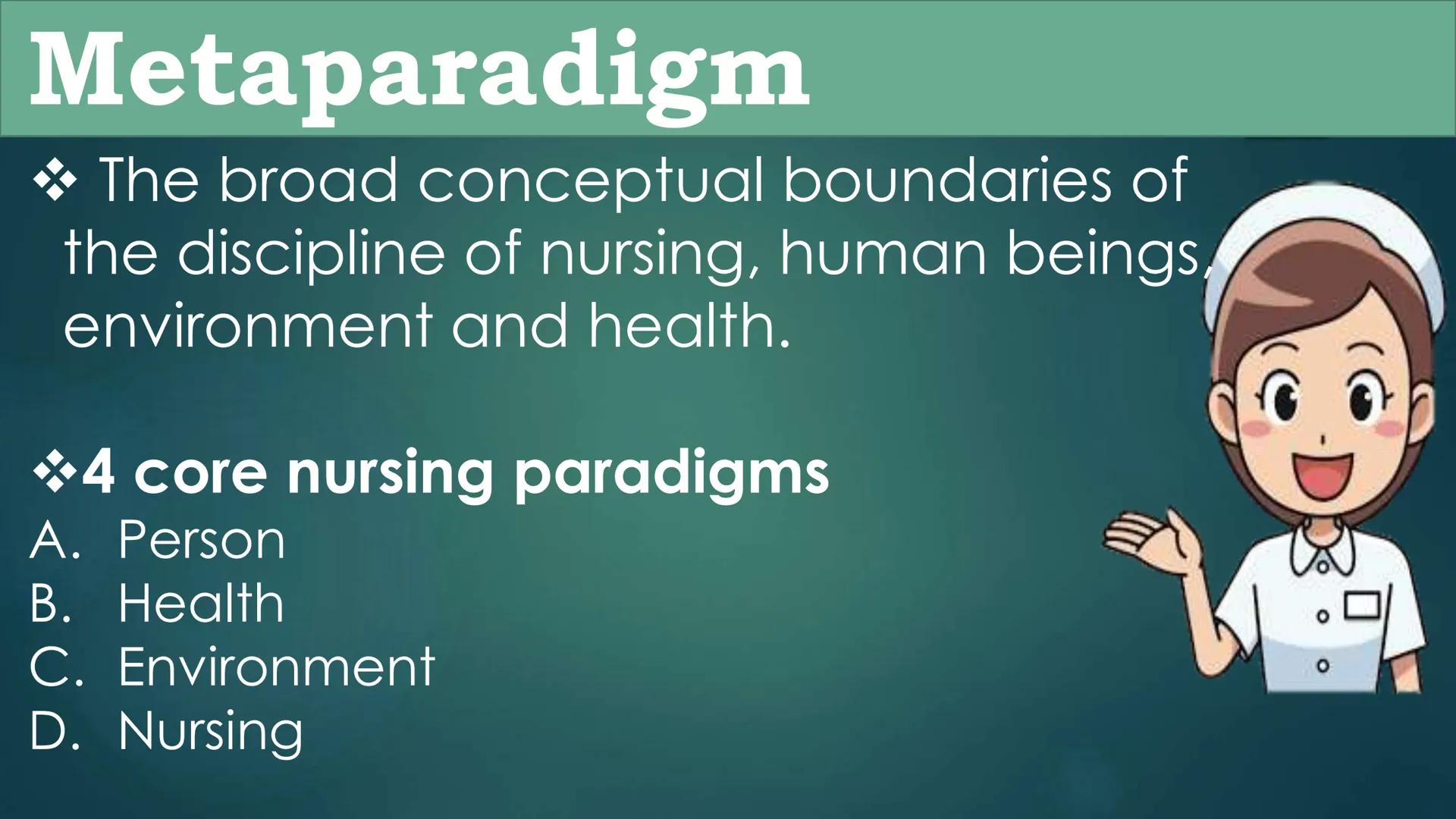
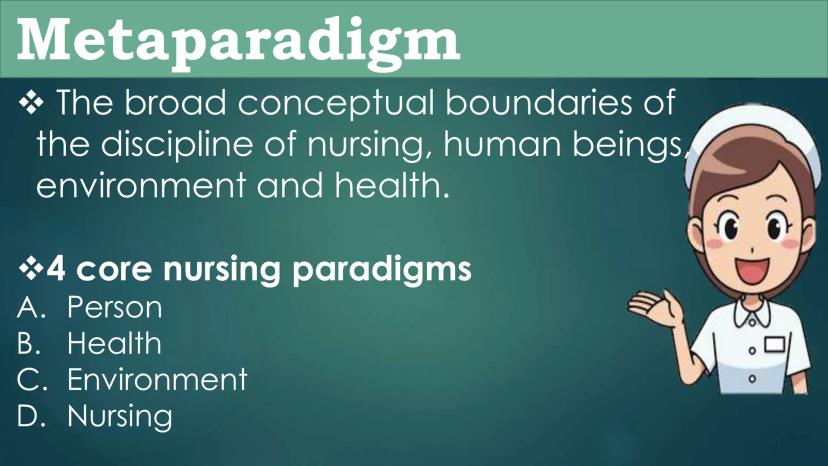
The metaparadigm represents the broad conceptual boundaries that define the discipline of nursing. It establishes the major concepts that are central to the nursing profession and provides a framework for understanding how these concepts relate to each other.
The nursing metaparadigm consists of four core concepts:
These four concepts form the foundation of nursing knowledge and practice. Every nursing theory addresses these concepts in some way, though different theorists may emphasize different aspects or relationships between them.
Quick Tip: When studying nursing theories, look for how each theorist defines and connects these four metaparadigm concepts. This will help you understand their unique perspective!
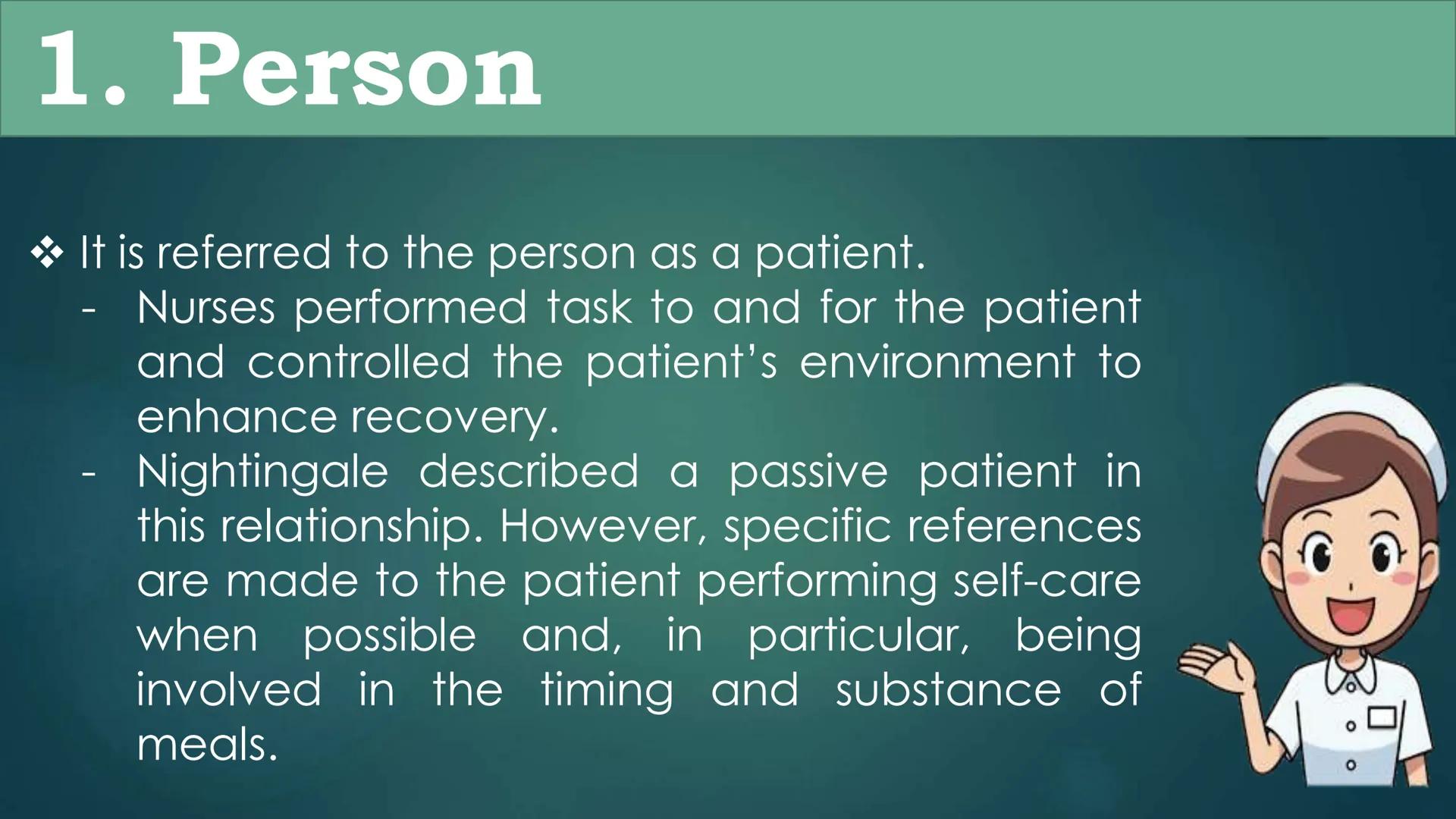
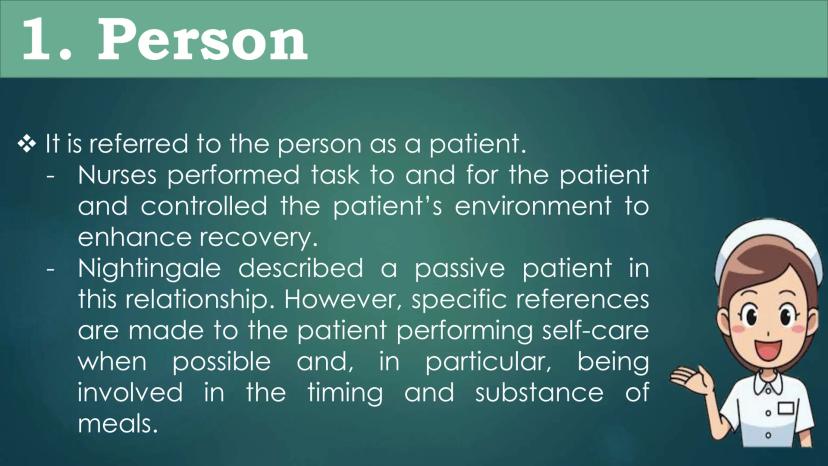
In nursing theory, the person refers to the recipient of nursing care. Early conceptualizations, like Nightingale's, viewed the person primarily as a patient—someone who received care rather than actively participated in it.
In Nightingale's view, nurses performed tasks for patients and controlled their environment to enhance recovery. This represented a somewhat passive relationship where the nurse directed care and the patient received it. Patients were expected to follow instructions rather than actively participate in care planning.
However, even in this early conceptualization, Nightingale recognized the importance of patient involvement in some aspects of care. She specifically noted that patients should perform self-care when possible and participate in decisions about the timing and content of meals.
Modern nursing theories have evolved to view the person as an active participant in care—someone with autonomy, dignity, and the right to be involved in healthcare decisions that affect them.
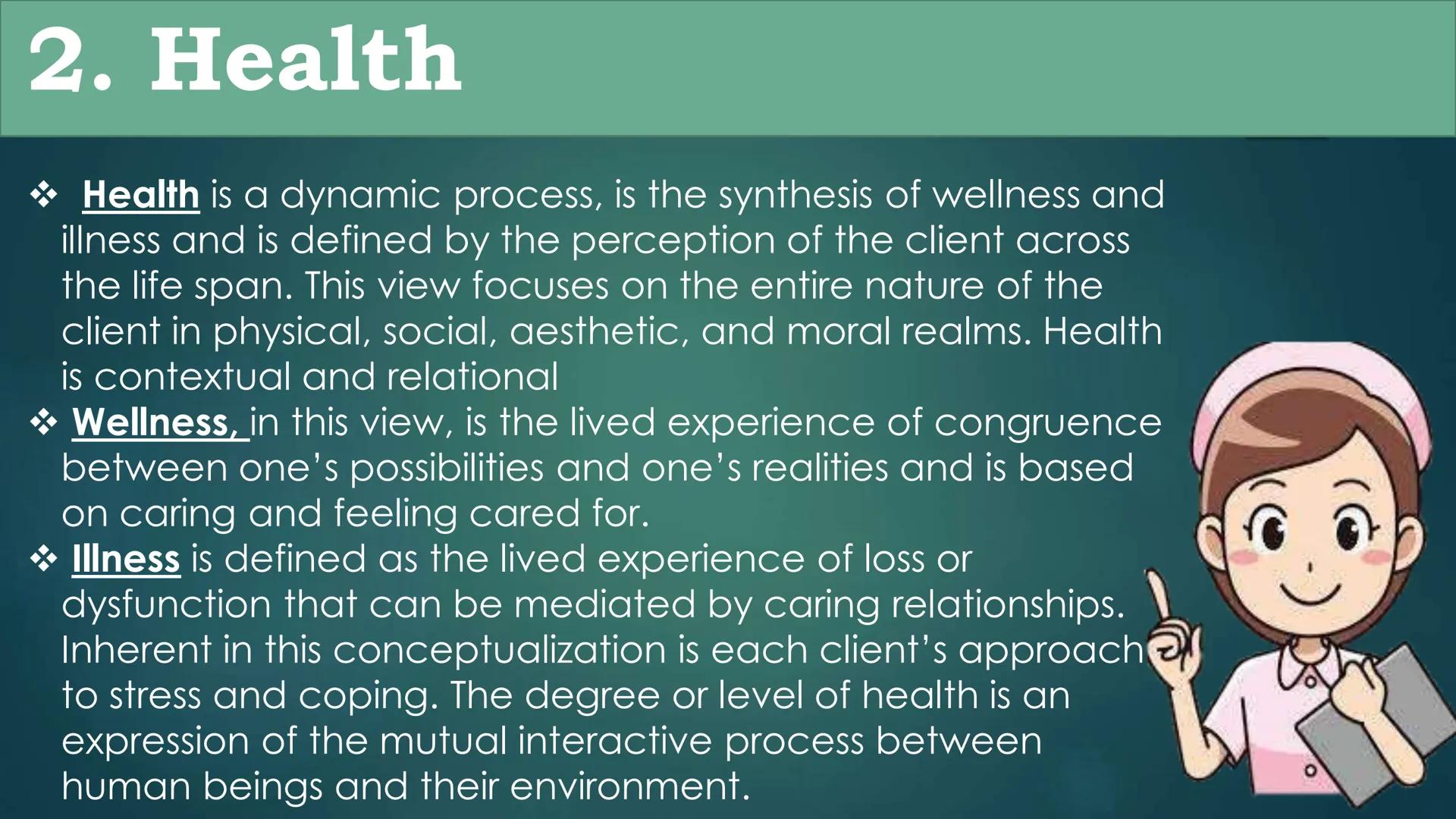
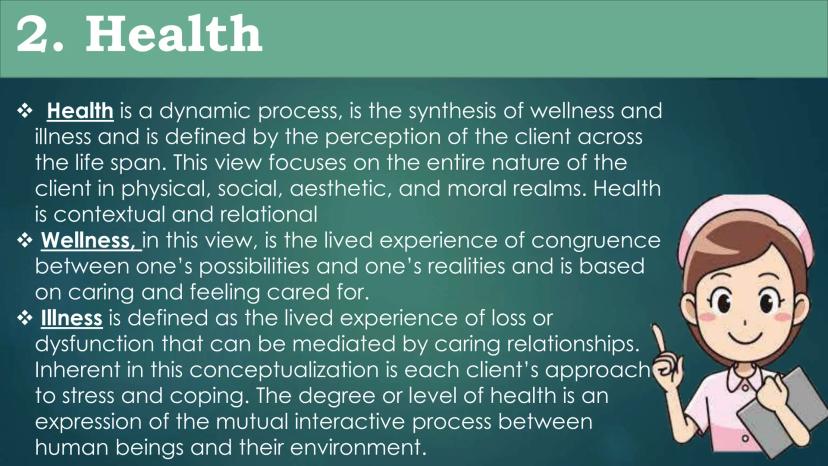
Health in nursing theory is understood as a dynamic process rather than simply the absence of disease. It represents the synthesis of wellness and illness as perceived by the client across their lifespan. This holistic view considers the person's physical, social, aesthetic, and moral dimensions.
Wellness occurs when there's congruence between a person's possibilities and their realities. It's based on caring relationships and feeling cared for. When you feel your life aligns with your potential and you have supportive relationships, you experience wellness.
Illness, by contrast, is the lived experience of loss or dysfunction. These experiences can be mediated through caring relationships. This means good nursing care can improve how a person experiences illness, even if the physical condition remains the same.
Important insight: Health isn't just a physical state but reflects the interactive process between humans and their environment. Your patients' perception of their health often matters more than clinical measurements!
Each person approaches stress and coping differently, which affects their health experience. Understanding this individual variation helps you provide personalized nursing care that truly meets each patient's needs.
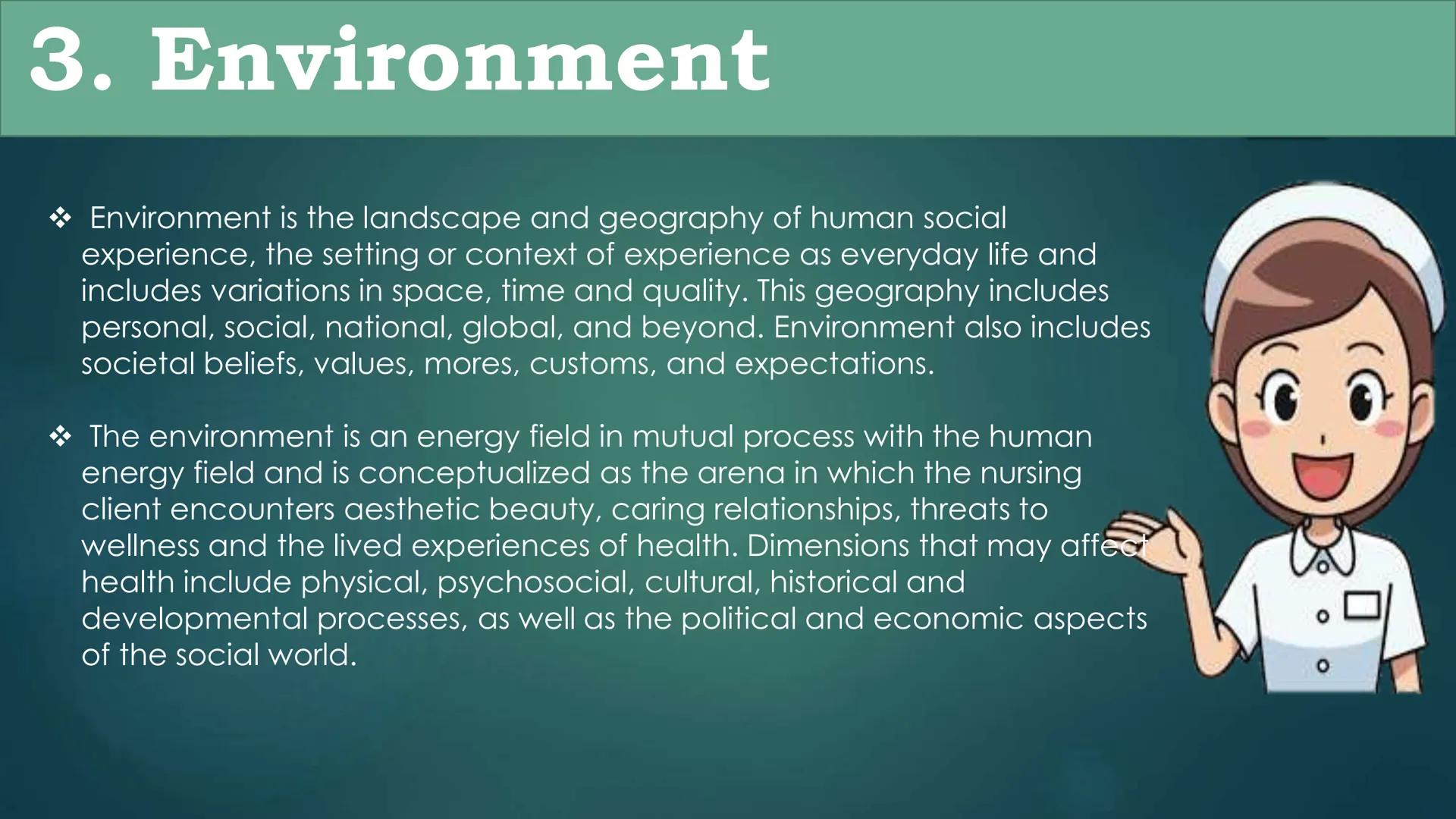
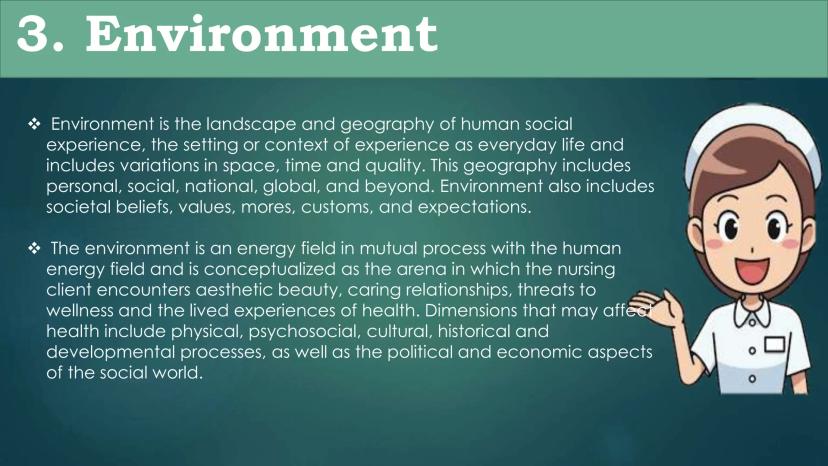
The environment in nursing theory extends far beyond the physical setting of care. It encompasses the entire landscape of human social experience—the context in which people live their everyday lives. This includes variations in space, time, and quality of surroundings.
Environment includes personal, social, national, and global dimensions. It also incorporates societal beliefs, values, customs, and expectations that shape how people experience health and illness. These cultural and social factors significantly influence healthcare needs and responses to treatment.
From an energy perspective, the environment interacts constantly with the human energy field. It's the arena where nursing clients encounter beauty, caring relationships, threats to wellness, and their lived health experiences.
Multiple dimensions of environment affect health, including physical surroundings, psychosocial factors, cultural influences, historical contexts, developmental processes, and political and economic aspects of society. As a nurse, recognizing these environmental influences helps you provide more effective, culturally competent care.
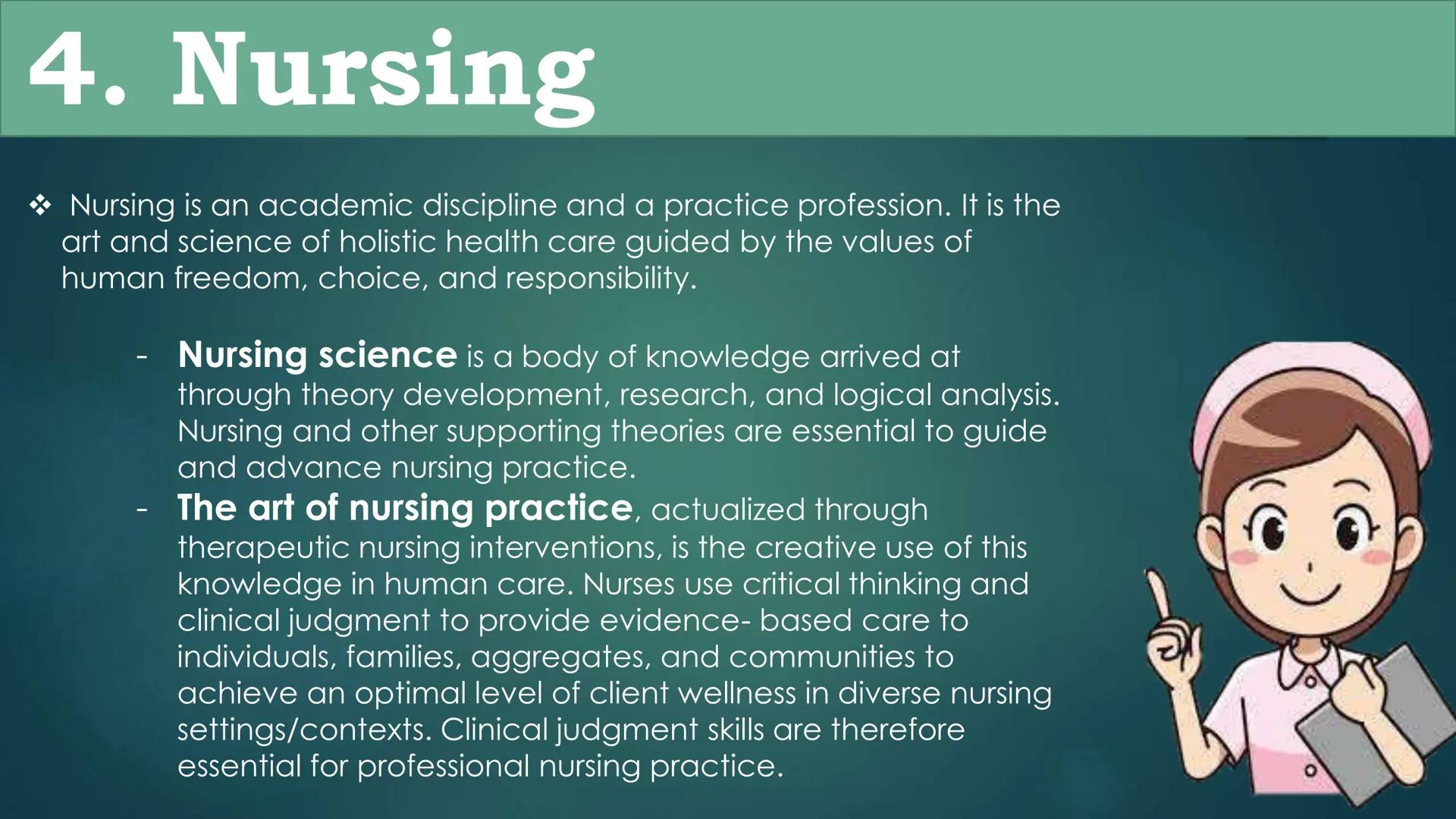
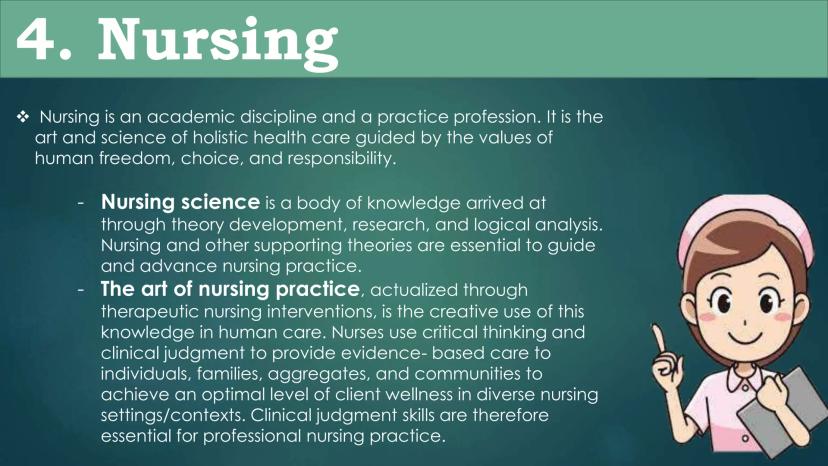
Nursing is both an academic discipline and a practice profession. It combines art and science in providing holistic health care, guided by values of human freedom, choice, and responsibility. This dual nature makes nursing uniquely positioned to bridge theory and practice.
Nursing science comprises a body of knowledge developed through theory, research, and logical analysis. These nursing theories are essential for guiding and advancing nursing practice. Without this theoretical foundation, nursing practice would lack direction and consistency.
The art of nursing involves the creative application of this knowledge in human care through therapeutic nursing interventions. Nurses use critical thinking and clinical judgment to provide evidence-based care that helps individuals, families, and communities achieve optimal wellness.
Professional tip: Strong clinical judgment skills are essential for professional nursing practice. These skills develop through both theoretical understanding and practical experience!
Nurses practice in diverse settings and contexts, adapting their care approaches to meet the specific needs of their patients. This flexibility, guided by sound theoretical understanding, is what makes nursing care both scientific and deeply human.
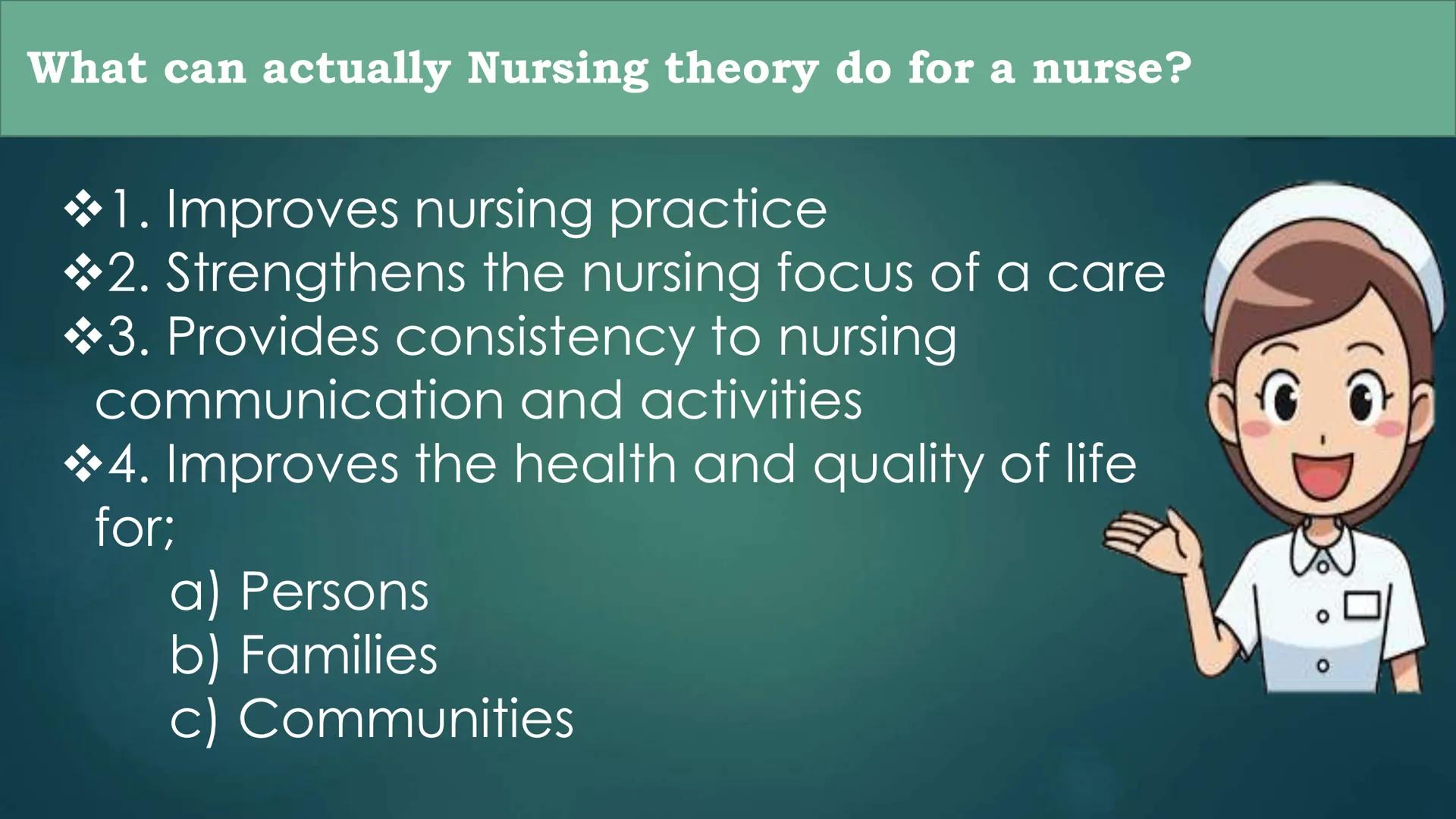
Nursing theories aren't just academic exercises—they have practical value for your everyday practice. Understanding how theories guide your work helps you provide more consistent, effective care.
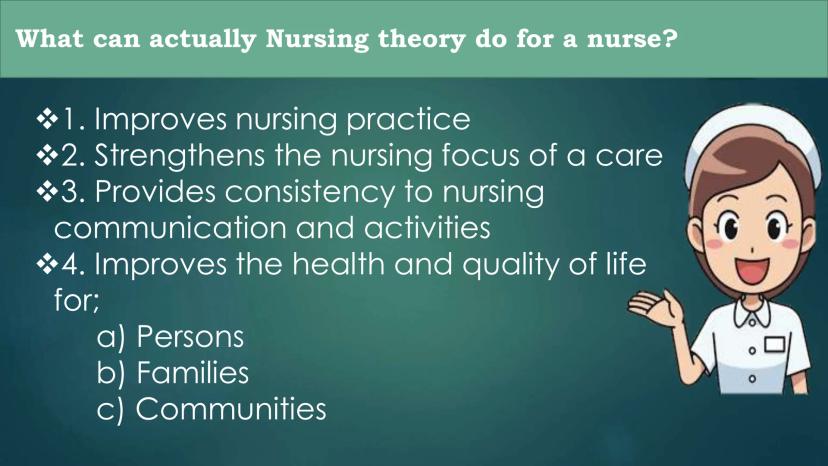
Nursing theory improves practice by providing frameworks for assessment, intervention, and evaluation. It helps you organize your observations and plan your care in a systematic way. When you apply theory to practice, you move beyond task-oriented care to purposeful nursing interventions.
Theory strengthens the nursing focus of care by highlighting what makes nursing unique from other healthcare professions. This clarity helps define nursing's distinct contribution to healthcare and guides interdisciplinary collaboration.
Nursing theories provide consistency to nursing communication and activities. When all nurses on a unit share a theoretical understanding, care becomes more coordinated and effective. This shared language improves both team communication and patient outcomes.
Most importantly, nursing theories improve health and quality of life for persons, families, and communities. By guiding evidence-based practice, theories help ensure that nursing care addresses the most important needs of those you serve.
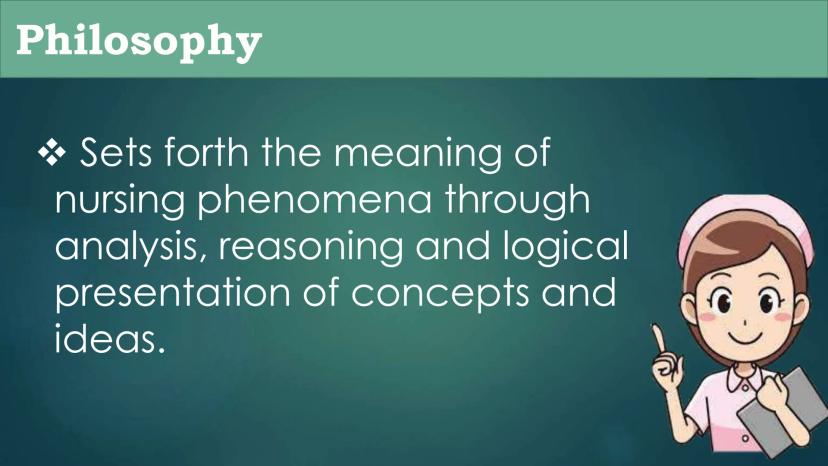
A nursing philosophy sets forth the meaning of nursing phenomena through analysis, reasoning, and logical presentation of concepts and ideas. It represents the foundational beliefs about what nursing is, what nurses do, and how nurses should approach their practice.
Nursing philosophies examine fundamental questions about the nature of human beings, health, environment, and the nursing profession. They provide the ethical and conceptual foundation upon which nursing theories and models are built.
Unlike theories, which aim to describe, explain, or predict phenomena, philosophies focus on values, beliefs, and the fundamental nature of nursing. They help nurses reflect on the meaning and purpose of their work.
Understanding nursing philosophy helps you align your personal beliefs with professional practice. When your actions reflect your philosophical commitments, your nursing practice becomes more authentic and purposeful.
Our AI companion is specifically built for the needs of students. Based on the millions of content pieces we have on the platform we can provide truly meaningful and relevant answers to students. But its not only about answers, the companion is even more about guiding students through their daily learning challenges, with personalised study plans, quizzes or content pieces in the chat and 100% personalisation based on the students skills and developments.
You can download the app in the Google Play Store and in the Apple App Store.
That's right! Enjoy free access to study content, connect with fellow students, and get instant help – all at your fingertips.
App Store
Google Play
The app is very easy to use and well designed. I have found everything I was looking for so far and have been able to learn a lot from the presentations! I will definitely use the app for a class assignment! And of course it also helps a lot as an inspiration.
Stefan S
iOS user
This app is really great. There are so many study notes and help [...]. My problem subject is French, for example, and the app has so many options for help. Thanks to this app, I have improved my French. I would recommend it to anyone.
Samantha Klich
Android user
Wow, I am really amazed. I just tried the app because I've seen it advertised many times and was absolutely stunned. This app is THE HELP you want for school and above all, it offers so many things, such as workouts and fact sheets, which have been VERY helpful to me personally.
Anna
iOS user
I think it’s very much worth it and you’ll end up using it a lot once you get the hang of it and even after looking at others notes you can still ask your Artificial intelligence buddy the question and ask to simplify it if you still don’t get it!!! In the end I think it’s worth it 😊👍 ⚠️Also DID I MENTION ITS FREEE YOU DON’T HAVE TO PAY FOR ANYTHING AND STILL GET YOUR GRADES IN PERFECTLY❗️❗️⚠️
Thomas R
iOS user
Knowunity is the BEST app I’ve used in a minute. This is not an ai review or anything this is genuinely coming from a 7th grade student (I know 2011 im young) but dude this app is a 10/10 i have maintained a 3.8 gpa and have plenty of time for gaming. I love it and my mom is just happy I got good grades
Brad T
Android user
Not only did it help me find the answer but it also showed me alternative ways to solve it. I was horrible in math and science but now I have an a in both subjects. Thanks for the help🤍🤍
David K
iOS user
The app's just great! All I have to do is enter the topic in the search bar and I get the response real fast. I don't have to watch 10 YouTube videos to understand something, so I'm saving my time. Highly recommended!
Sudenaz Ocak
Android user
In school I was really bad at maths but thanks to the app, I am doing better now. I am so grateful that you made the app.
Greenlight Bonnie
Android user
I found this app a couple years ago and it has only gotten better since then. I really love it because it can help with written questions and photo questions. Also, it can find study guides that other people have made as well as flashcard sets and practice tests. The free version is also amazing for students who might not be able to afford it. Would 100% recommend
Aubrey
iOS user
Best app if you're in Highschool or Junior high. I have been using this app for 2 school years and it's the best, it's good if you don't have anyone to help you with school work.😋🩷🎀
Marco B
iOS user
THE QUIZES AND FLASHCARDS ARE SO USEFUL AND I LOVE Knowunity AI. IT ALSO IS LITREALLY LIKE CHATGPT BUT SMARTER!! HELPED ME WITH MY MASCARA PROBLEMS TOO!! AS WELL AS MY REAL SUBJECTS ! DUHHH 😍😁😲🤑💗✨🎀😮
Elisha
iOS user
This app is phenomenal down to the correct info and the various topics you can study! I greatly recommend it for people who struggle with procrastination and those who need homework help. It has been perfectly accurate for world 1 history as far as I’ve seen! Geometry too!
Paul T
iOS user
The app is very easy to use and well designed. I have found everything I was looking for so far and have been able to learn a lot from the presentations! I will definitely use the app for a class assignment! And of course it also helps a lot as an inspiration.
Stefan S
iOS user
This app is really great. There are so many study notes and help [...]. My problem subject is French, for example, and the app has so many options for help. Thanks to this app, I have improved my French. I would recommend it to anyone.
Samantha Klich
Android user
Wow, I am really amazed. I just tried the app because I've seen it advertised many times and was absolutely stunned. This app is THE HELP you want for school and above all, it offers so many things, such as workouts and fact sheets, which have been VERY helpful to me personally.
Anna
iOS user
I think it’s very much worth it and you’ll end up using it a lot once you get the hang of it and even after looking at others notes you can still ask your Artificial intelligence buddy the question and ask to simplify it if you still don’t get it!!! In the end I think it’s worth it 😊👍 ⚠️Also DID I MENTION ITS FREEE YOU DON’T HAVE TO PAY FOR ANYTHING AND STILL GET YOUR GRADES IN PERFECTLY❗️❗️⚠️
Thomas R
iOS user
Knowunity is the BEST app I’ve used in a minute. This is not an ai review or anything this is genuinely coming from a 7th grade student (I know 2011 im young) but dude this app is a 10/10 i have maintained a 3.8 gpa and have plenty of time for gaming. I love it and my mom is just happy I got good grades
Brad T
Android user
Not only did it help me find the answer but it also showed me alternative ways to solve it. I was horrible in math and science but now I have an a in both subjects. Thanks for the help🤍🤍
David K
iOS user
The app's just great! All I have to do is enter the topic in the search bar and I get the response real fast. I don't have to watch 10 YouTube videos to understand something, so I'm saving my time. Highly recommended!
Sudenaz Ocak
Android user
In school I was really bad at maths but thanks to the app, I am doing better now. I am so grateful that you made the app.
Greenlight Bonnie
Android user
I found this app a couple years ago and it has only gotten better since then. I really love it because it can help with written questions and photo questions. Also, it can find study guides that other people have made as well as flashcard sets and practice tests. The free version is also amazing for students who might not be able to afford it. Would 100% recommend
Aubrey
iOS user
Best app if you're in Highschool or Junior high. I have been using this app for 2 school years and it's the best, it's good if you don't have anyone to help you with school work.😋🩷🎀
Marco B
iOS user
THE QUIZES AND FLASHCARDS ARE SO USEFUL AND I LOVE Knowunity AI. IT ALSO IS LITREALLY LIKE CHATGPT BUT SMARTER!! HELPED ME WITH MY MASCARA PROBLEMS TOO!! AS WELL AS MY REAL SUBJECTS ! DUHHH 😍😁😲🤑💗✨🎀😮
Elisha
iOS user
This app is phenomenal down to the correct info and the various topics you can study! I greatly recommend it for people who struggle with procrastination and those who need homework help. It has been perfectly accurate for world 1 history as far as I’ve seen! Geometry too!
Paul T
iOS user
Hayden Santos
@haydensantos
Nursing theory forms the backbone of nursing practice, providing a structured framework that defines what nursing is, what nurses do, and why they do it. These theoretical foundations distinguish nursing as a unique discipline separate from medicine and guide professional... Show more
Access to all documents
Improve your grades
Join milions of students
Nursing theories are organized bodies of knowledge that define nursing as a distinct discipline with its own unique focus. They provide the framework that guides professional nursing practice, separating nursing from other healthcare disciplines like medicine. These theories help nurses understand what nursing is, what nurses do, and why they do it in a systematic way.
The history of professional nursing began with Florence Nightingale, who envisioned nurses as educated professionals at a time when women rarely received education or worked in public service. Over time, nursing education evolved from hospital-based programs into university settings, leading to the development of nursing theory as we know it today.
The significance of theory to nursing cannot be overstated. It transforms nursing from a simple vocation into a professional discipline with theory-based practice. This commitment to theory-guided care benefits patients by ensuring systematic, knowledgeable approaches to healthcare delivery.
Did you know? Florence Nightingale defined nursing in her "Environmental Theory" in 1860 as "the act of utilizing the environment of the patient to assist him in his recovery." This was the first formal nursing theory!
Throughout the 20th century, nursing theorists like Virginia Henderson, Dorothea Orem, and Betty Neuman developed frameworks that shifted nursing from being disease-centered to patient-centered. Each theorist contributed unique perspectives on the nurse-patient relationship and how nursing care should be delivered.
Access to all documents
Improve your grades
Join milions of students
Nursing knowledge has developed through different philosophical approaches. Rationalism emphasizes reasoning and deductive logic to advance knowledge, while empiricism relies on sensory experience and observation as the foundation of scientific understanding.
Early 20th century views separated theory from practice—philosophers focused on analyzing theory structure while scientists conducted empirical research. Later, emergent views emphasized that science was an active process of consciously building research rather than just a collection of findings.
The structure of nursing knowledge requires critical analysis to ensure theoretical adequacy. Understanding theoretical frameworks is vital for applying them in practice. When evaluating nursing theories, we consider several key aspects:
Nursing theory creates important understanding that guides research and practice. The close relationship between theory, research, and practice is essential to advancing the nursing profession and improving patient care.
Remember: Good theories are simple enough to understand but comprehensive enough to guide practice in complex situations!
Access to all documents
Improve your grades
Join milions of students
The theoretical foundation of nursing provides the structure upon which nursing practice is built. This foundation includes philosophies, concepts, models, and theories that guide how nurses approach patient care and make clinical decisions.
These foundations help organize nursing knowledge into a coherent system that can be taught, learned, and applied in clinical practice. Without a strong theoretical foundation, nursing would lack the scientific basis that distinguishes it as a profession.
Understanding these theoretical foundations helps you connect classroom learning with clinical practice. They provide the "why" behind nursing interventions and help you develop critical thinking skills that are essential for excellent patient care.
Access to all documents
Improve your grades
Join milions of students
The metaparadigm represents the broad conceptual boundaries that define the discipline of nursing. It establishes the major concepts that are central to the nursing profession and provides a framework for understanding how these concepts relate to each other.
The nursing metaparadigm consists of four core concepts:
These four concepts form the foundation of nursing knowledge and practice. Every nursing theory addresses these concepts in some way, though different theorists may emphasize different aspects or relationships between them.
Quick Tip: When studying nursing theories, look for how each theorist defines and connects these four metaparadigm concepts. This will help you understand their unique perspective!
Access to all documents
Improve your grades
Join milions of students
In nursing theory, the person refers to the recipient of nursing care. Early conceptualizations, like Nightingale's, viewed the person primarily as a patient—someone who received care rather than actively participated in it.
In Nightingale's view, nurses performed tasks for patients and controlled their environment to enhance recovery. This represented a somewhat passive relationship where the nurse directed care and the patient received it. Patients were expected to follow instructions rather than actively participate in care planning.
However, even in this early conceptualization, Nightingale recognized the importance of patient involvement in some aspects of care. She specifically noted that patients should perform self-care when possible and participate in decisions about the timing and content of meals.
Modern nursing theories have evolved to view the person as an active participant in care—someone with autonomy, dignity, and the right to be involved in healthcare decisions that affect them.
Access to all documents
Improve your grades
Join milions of students
Health in nursing theory is understood as a dynamic process rather than simply the absence of disease. It represents the synthesis of wellness and illness as perceived by the client across their lifespan. This holistic view considers the person's physical, social, aesthetic, and moral dimensions.
Wellness occurs when there's congruence between a person's possibilities and their realities. It's based on caring relationships and feeling cared for. When you feel your life aligns with your potential and you have supportive relationships, you experience wellness.
Illness, by contrast, is the lived experience of loss or dysfunction. These experiences can be mediated through caring relationships. This means good nursing care can improve how a person experiences illness, even if the physical condition remains the same.
Important insight: Health isn't just a physical state but reflects the interactive process between humans and their environment. Your patients' perception of their health often matters more than clinical measurements!
Each person approaches stress and coping differently, which affects their health experience. Understanding this individual variation helps you provide personalized nursing care that truly meets each patient's needs.
Access to all documents
Improve your grades
Join milions of students
The environment in nursing theory extends far beyond the physical setting of care. It encompasses the entire landscape of human social experience—the context in which people live their everyday lives. This includes variations in space, time, and quality of surroundings.
Environment includes personal, social, national, and global dimensions. It also incorporates societal beliefs, values, customs, and expectations that shape how people experience health and illness. These cultural and social factors significantly influence healthcare needs and responses to treatment.
From an energy perspective, the environment interacts constantly with the human energy field. It's the arena where nursing clients encounter beauty, caring relationships, threats to wellness, and their lived health experiences.
Multiple dimensions of environment affect health, including physical surroundings, psychosocial factors, cultural influences, historical contexts, developmental processes, and political and economic aspects of society. As a nurse, recognizing these environmental influences helps you provide more effective, culturally competent care.
Access to all documents
Improve your grades
Join milions of students
Nursing is both an academic discipline and a practice profession. It combines art and science in providing holistic health care, guided by values of human freedom, choice, and responsibility. This dual nature makes nursing uniquely positioned to bridge theory and practice.
Nursing science comprises a body of knowledge developed through theory, research, and logical analysis. These nursing theories are essential for guiding and advancing nursing practice. Without this theoretical foundation, nursing practice would lack direction and consistency.
The art of nursing involves the creative application of this knowledge in human care through therapeutic nursing interventions. Nurses use critical thinking and clinical judgment to provide evidence-based care that helps individuals, families, and communities achieve optimal wellness.
Professional tip: Strong clinical judgment skills are essential for professional nursing practice. These skills develop through both theoretical understanding and practical experience!
Nurses practice in diverse settings and contexts, adapting their care approaches to meet the specific needs of their patients. This flexibility, guided by sound theoretical understanding, is what makes nursing care both scientific and deeply human.
Access to all documents
Improve your grades
Join milions of students
Nursing theories aren't just academic exercises—they have practical value for your everyday practice. Understanding how theories guide your work helps you provide more consistent, effective care.
Nursing theory improves practice by providing frameworks for assessment, intervention, and evaluation. It helps you organize your observations and plan your care in a systematic way. When you apply theory to practice, you move beyond task-oriented care to purposeful nursing interventions.
Theory strengthens the nursing focus of care by highlighting what makes nursing unique from other healthcare professions. This clarity helps define nursing's distinct contribution to healthcare and guides interdisciplinary collaboration.
Nursing theories provide consistency to nursing communication and activities. When all nurses on a unit share a theoretical understanding, care becomes more coordinated and effective. This shared language improves both team communication and patient outcomes.
Most importantly, nursing theories improve health and quality of life for persons, families, and communities. By guiding evidence-based practice, theories help ensure that nursing care addresses the most important needs of those you serve.
Access to all documents
Improve your grades
Join milions of students
A nursing philosophy sets forth the meaning of nursing phenomena through analysis, reasoning, and logical presentation of concepts and ideas. It represents the foundational beliefs about what nursing is, what nurses do, and how nurses should approach their practice.
Nursing philosophies examine fundamental questions about the nature of human beings, health, environment, and the nursing profession. They provide the ethical and conceptual foundation upon which nursing theories and models are built.
Unlike theories, which aim to describe, explain, or predict phenomena, philosophies focus on values, beliefs, and the fundamental nature of nursing. They help nurses reflect on the meaning and purpose of their work.
Understanding nursing philosophy helps you align your personal beliefs with professional practice. When your actions reflect your philosophical commitments, your nursing practice becomes more authentic and purposeful.
Our AI companion is specifically built for the needs of students. Based on the millions of content pieces we have on the platform we can provide truly meaningful and relevant answers to students. But its not only about answers, the companion is even more about guiding students through their daily learning challenges, with personalised study plans, quizzes or content pieces in the chat and 100% personalisation based on the students skills and developments.
You can download the app in the Google Play Store and in the Apple App Store.
That's right! Enjoy free access to study content, connect with fellow students, and get instant help – all at your fingertips.
0
Smart Tools NEW
Transform this note into: ✓ 50+ Practice Questions ✓ Interactive Flashcards ✓ Full Practice Test ✓ Essay Outlines
App Store
Google Play
The app is very easy to use and well designed. I have found everything I was looking for so far and have been able to learn a lot from the presentations! I will definitely use the app for a class assignment! And of course it also helps a lot as an inspiration.
Stefan S
iOS user
This app is really great. There are so many study notes and help [...]. My problem subject is French, for example, and the app has so many options for help. Thanks to this app, I have improved my French. I would recommend it to anyone.
Samantha Klich
Android user
Wow, I am really amazed. I just tried the app because I've seen it advertised many times and was absolutely stunned. This app is THE HELP you want for school and above all, it offers so many things, such as workouts and fact sheets, which have been VERY helpful to me personally.
Anna
iOS user
I think it’s very much worth it and you’ll end up using it a lot once you get the hang of it and even after looking at others notes you can still ask your Artificial intelligence buddy the question and ask to simplify it if you still don’t get it!!! In the end I think it’s worth it 😊👍 ⚠️Also DID I MENTION ITS FREEE YOU DON’T HAVE TO PAY FOR ANYTHING AND STILL GET YOUR GRADES IN PERFECTLY❗️❗️⚠️
Thomas R
iOS user
Knowunity is the BEST app I’ve used in a minute. This is not an ai review or anything this is genuinely coming from a 7th grade student (I know 2011 im young) but dude this app is a 10/10 i have maintained a 3.8 gpa and have plenty of time for gaming. I love it and my mom is just happy I got good grades
Brad T
Android user
Not only did it help me find the answer but it also showed me alternative ways to solve it. I was horrible in math and science but now I have an a in both subjects. Thanks for the help🤍🤍
David K
iOS user
The app's just great! All I have to do is enter the topic in the search bar and I get the response real fast. I don't have to watch 10 YouTube videos to understand something, so I'm saving my time. Highly recommended!
Sudenaz Ocak
Android user
In school I was really bad at maths but thanks to the app, I am doing better now. I am so grateful that you made the app.
Greenlight Bonnie
Android user
I found this app a couple years ago and it has only gotten better since then. I really love it because it can help with written questions and photo questions. Also, it can find study guides that other people have made as well as flashcard sets and practice tests. The free version is also amazing for students who might not be able to afford it. Would 100% recommend
Aubrey
iOS user
Best app if you're in Highschool or Junior high. I have been using this app for 2 school years and it's the best, it's good if you don't have anyone to help you with school work.😋🩷🎀
Marco B
iOS user
THE QUIZES AND FLASHCARDS ARE SO USEFUL AND I LOVE Knowunity AI. IT ALSO IS LITREALLY LIKE CHATGPT BUT SMARTER!! HELPED ME WITH MY MASCARA PROBLEMS TOO!! AS WELL AS MY REAL SUBJECTS ! DUHHH 😍😁😲🤑💗✨🎀😮
Elisha
iOS user
This app is phenomenal down to the correct info and the various topics you can study! I greatly recommend it for people who struggle with procrastination and those who need homework help. It has been perfectly accurate for world 1 history as far as I’ve seen! Geometry too!
Paul T
iOS user
The app is very easy to use and well designed. I have found everything I was looking for so far and have been able to learn a lot from the presentations! I will definitely use the app for a class assignment! And of course it also helps a lot as an inspiration.
Stefan S
iOS user
This app is really great. There are so many study notes and help [...]. My problem subject is French, for example, and the app has so many options for help. Thanks to this app, I have improved my French. I would recommend it to anyone.
Samantha Klich
Android user
Wow, I am really amazed. I just tried the app because I've seen it advertised many times and was absolutely stunned. This app is THE HELP you want for school and above all, it offers so many things, such as workouts and fact sheets, which have been VERY helpful to me personally.
Anna
iOS user
I think it’s very much worth it and you’ll end up using it a lot once you get the hang of it and even after looking at others notes you can still ask your Artificial intelligence buddy the question and ask to simplify it if you still don’t get it!!! In the end I think it’s worth it 😊👍 ⚠️Also DID I MENTION ITS FREEE YOU DON’T HAVE TO PAY FOR ANYTHING AND STILL GET YOUR GRADES IN PERFECTLY❗️❗️⚠️
Thomas R
iOS user
Knowunity is the BEST app I’ve used in a minute. This is not an ai review or anything this is genuinely coming from a 7th grade student (I know 2011 im young) but dude this app is a 10/10 i have maintained a 3.8 gpa and have plenty of time for gaming. I love it and my mom is just happy I got good grades
Brad T
Android user
Not only did it help me find the answer but it also showed me alternative ways to solve it. I was horrible in math and science but now I have an a in both subjects. Thanks for the help🤍🤍
David K
iOS user
The app's just great! All I have to do is enter the topic in the search bar and I get the response real fast. I don't have to watch 10 YouTube videos to understand something, so I'm saving my time. Highly recommended!
Sudenaz Ocak
Android user
In school I was really bad at maths but thanks to the app, I am doing better now. I am so grateful that you made the app.
Greenlight Bonnie
Android user
I found this app a couple years ago and it has only gotten better since then. I really love it because it can help with written questions and photo questions. Also, it can find study guides that other people have made as well as flashcard sets and practice tests. The free version is also amazing for students who might not be able to afford it. Would 100% recommend
Aubrey
iOS user
Best app if you're in Highschool or Junior high. I have been using this app for 2 school years and it's the best, it's good if you don't have anyone to help you with school work.😋🩷🎀
Marco B
iOS user
THE QUIZES AND FLASHCARDS ARE SO USEFUL AND I LOVE Knowunity AI. IT ALSO IS LITREALLY LIKE CHATGPT BUT SMARTER!! HELPED ME WITH MY MASCARA PROBLEMS TOO!! AS WELL AS MY REAL SUBJECTS ! DUHHH 😍😁😲🤑💗✨🎀😮
Elisha
iOS user
This app is phenomenal down to the correct info and the various topics you can study! I greatly recommend it for people who struggle with procrastination and those who need homework help. It has been perfectly accurate for world 1 history as far as I’ve seen! Geometry too!
Paul T
iOS user