
The nervous system is your body's command center, coordinating everything... Show more
 Fun Stuff
 Algebra
 Biology
Sign up to see the contentIt's free!
Access to all documents
Improve your grades
Join milions of students
Knowunity AI
Subjects
Triangle Congruence and Similarity Theorems
Triangle Properties and Classification
Linear Equations and Graphs
Geometric Angle Relationships
Trigonometric Functions and Identities
Equation Solving Techniques
Circle Geometry Fundamentals
Division Operations and Methods
Basic Differentiation Rules
Exponent and Logarithm Properties
Show all topics
Human Organ Systems
Reproductive Cell Cycles
Biological Sciences Subdisciplines
Cellular Energy Metabolism
Autotrophic Energy Processes
Inheritance Patterns and Principles
Biomolecular Structure and Organization
Cell Cycle and Division Mechanics
Cellular Organization and Development
Biological Structural Organization
Show all topics
Chemical Sciences and Applications
Atomic Structure and Composition
Molecular Electron Structure Representation
Atomic Electron Behavior
Matter Properties and Water
Mole Concept and Calculations
Gas Laws and Behavior
Periodic Table Organization
Chemical Thermodynamics Fundamentals
Chemical Bond Types and Properties
Show all topics
European Renaissance and Enlightenment
European Cultural Movements 800-1920
American Revolution Era 1763-1797
American Civil War 1861-1865
Global Imperial Systems
Mongol and Chinese Dynasties
U.S. Presidents and World Leaders
Historical Sources and Documentation
World Wars Era and Impact
World Religious Systems
Show all topics
Classic and Contemporary Novels
Literary Character Analysis
Rhetorical Theory and Practice
Classic Literary Narratives
Reading Analysis and Interpretation
Narrative Structure and Techniques
English Language Components
Influential English-Language Authors
Basic Sentence Structure
Narrative Voice and Perspective
Show all topics
96
•
Updated Mar 21, 2026
•

Lia Ventura
@cookiesgood_aktq
The nervous system is your body's command center, coordinating everything... Show more
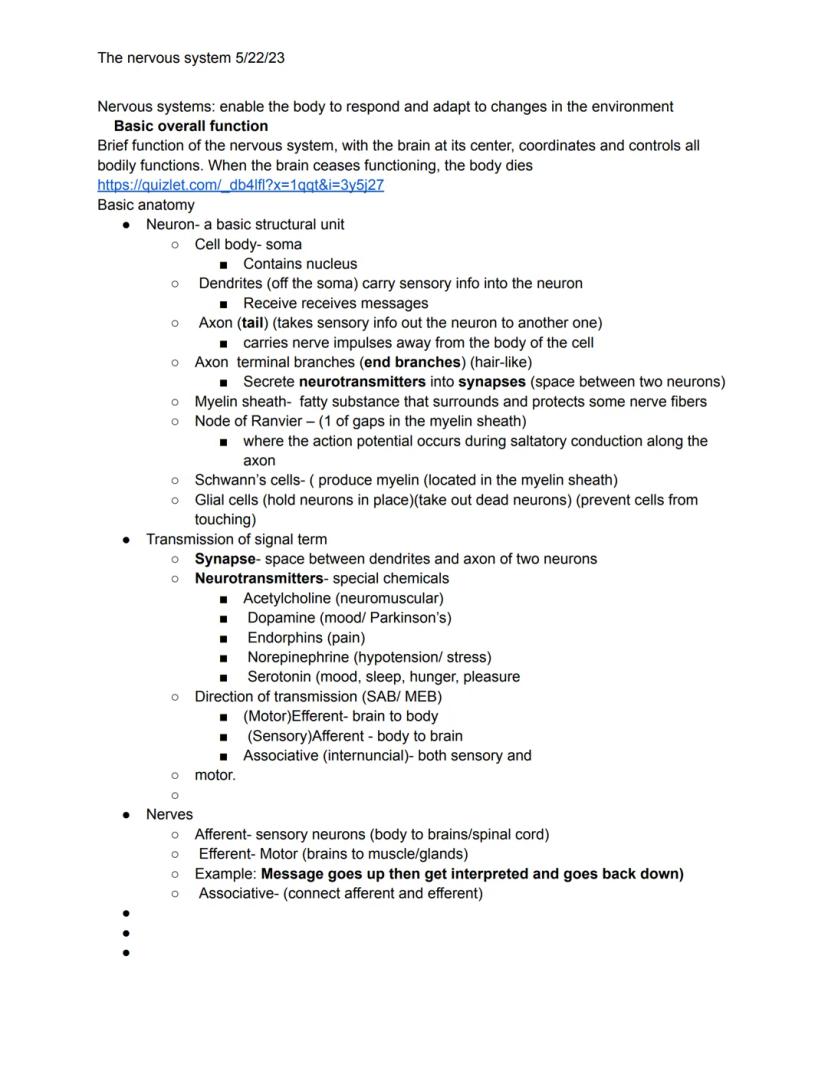

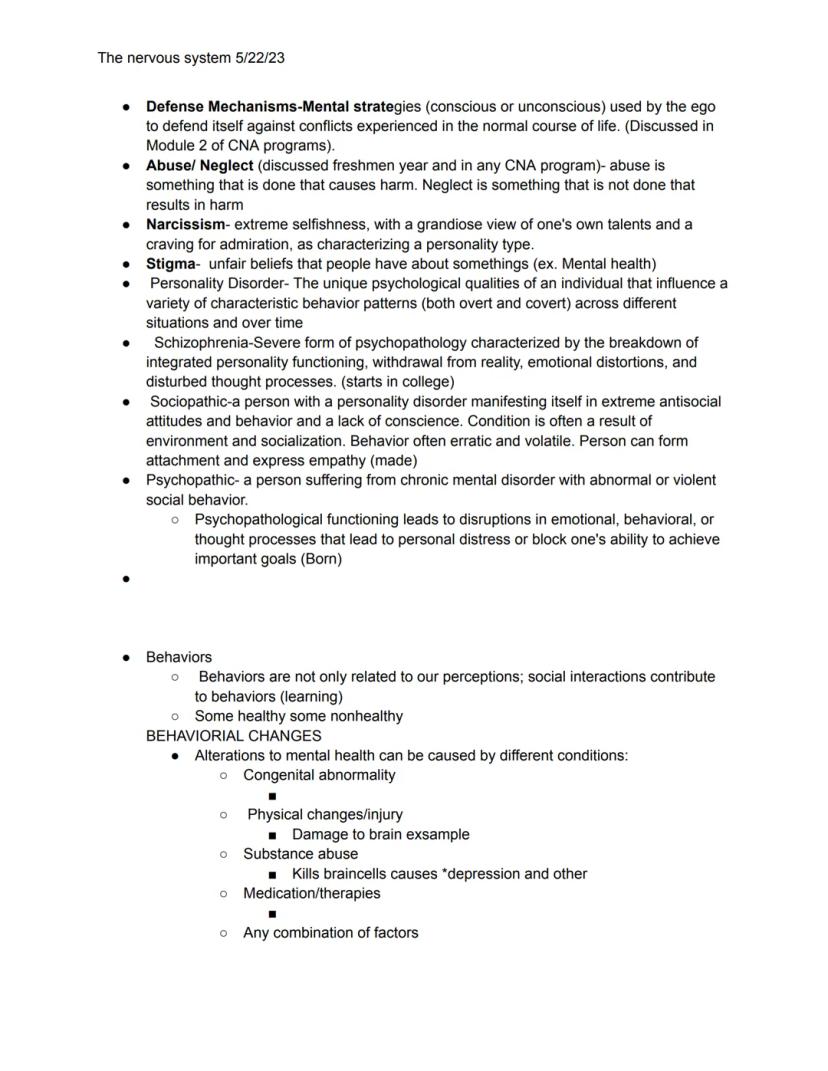


Your nervous system helps your body adapt to changes in the environment through a network of specialized cells. At its center is the brain, which coordinates all bodily functions—when it stops working, life ends.
The basic unit of the nervous system is the neuron. Each neuron has a cell body (soma) containing the nucleus, dendrites that receive messages, and an axon that carries signals away. Axon terminals release neurotransmitters into synapses—the gaps between neurons. These chemicals like dopamine, serotonin, and endorphins control everything from mood to pain perception.
Neurons are protected by a fatty myelin sheath, which helps signals travel faster. Between sections of myelin are Nodes of Ranvier, where action potentials occur during signal transmission. Supporting cells called glial cells hold neurons in place and remove dead cells.
💡 Think of neurons like a text message system: dendrites receive messages, the cell body processes them, and the axon sends them to the next neuron through neurotransmitters!
Information travels in specific directions: afferent (sensory) signals go from body to brain, while efferent (motor) signals travel from brain to muscles and glands. Associative neurons connect these pathways to create complete responses.
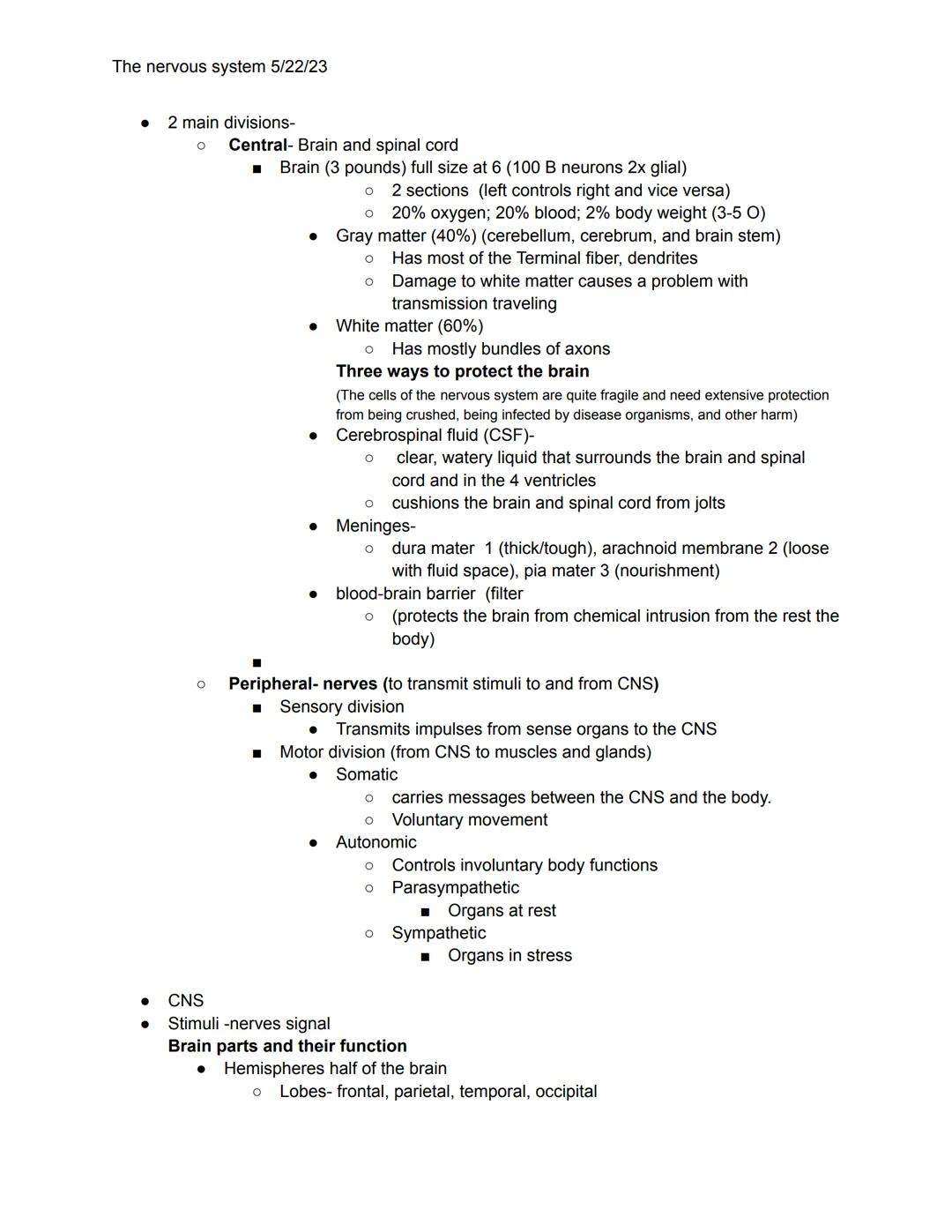
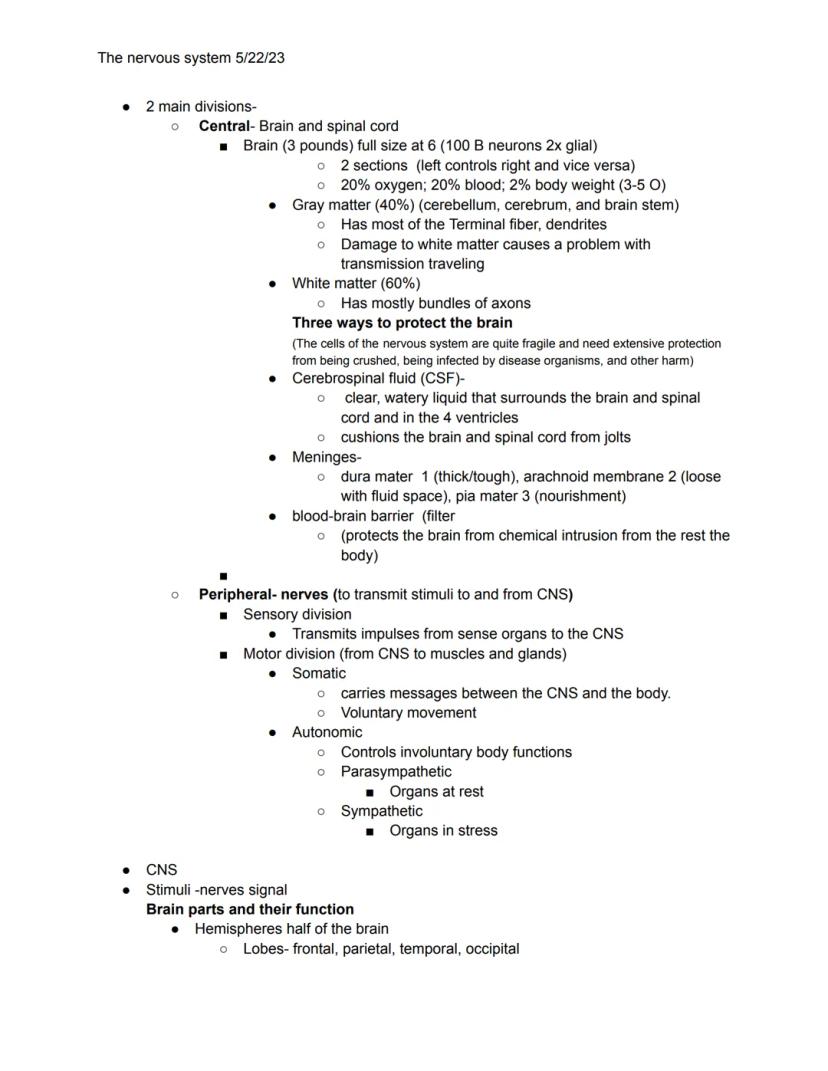
Your nervous system divides into two main parts: central and peripheral. The central nervous system (CNS) includes your brain and spinal cord. Your brain, weighing about 3 pounds, reaches full size by age 6 and contains about 100 billion neurons. It uses 20% of your body's oxygen despite being only 2% of your body weight!
The brain has gray matter (containing cell bodies and dendrites) and white matter (mostly axon bundles). Three protective layers keep your brain safe:
The peripheral nervous system connects your CNS to the rest of your body. It splits into sensory division (carrying information to the CNS) and motor division (carrying commands from the CNS). The motor division further divides into somatic (voluntary movements) and autonomic (involuntary functions).
🧠 Your autonomic system has two opposing parts: the sympathetic system activates your "fight-or-flight" response during stress, while the parasympathetic system promotes "rest-and-digest" when you're calm!
The brain itself organizes into lobes with specialized functions—frontal, parietal, temporal, and occipital—each handling different aspects of your experience.

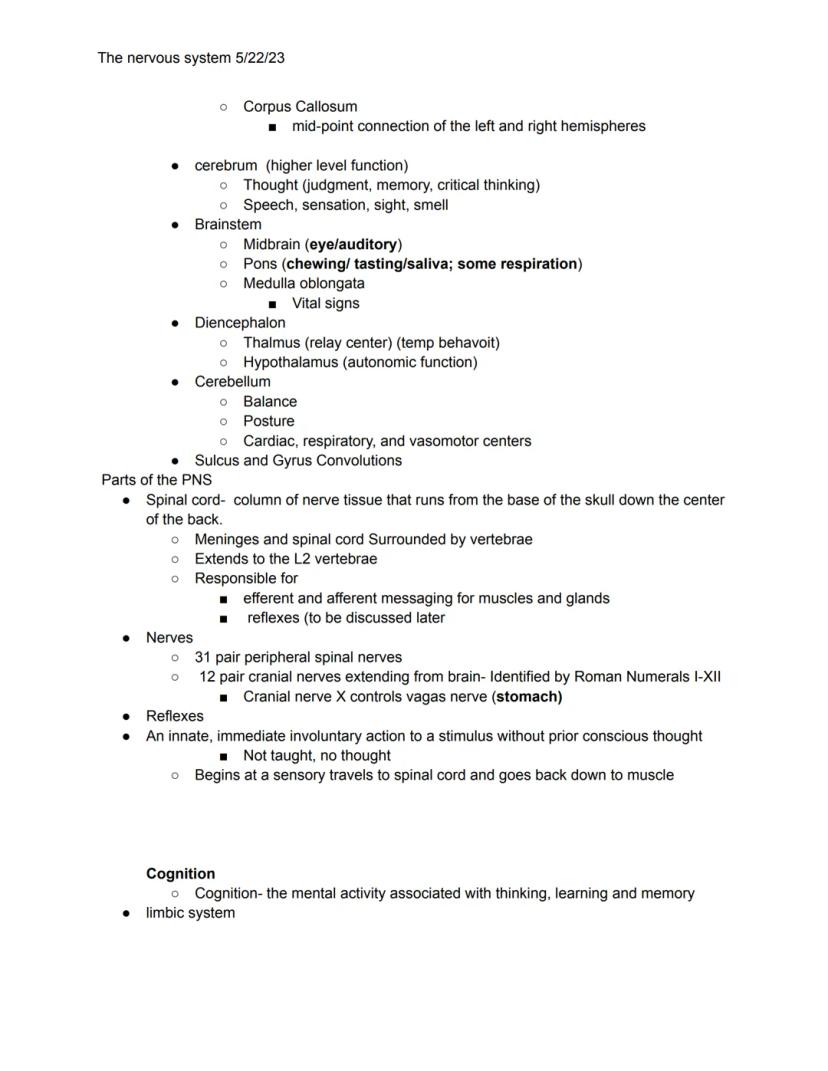
Your brain's hemispheres connect through the corpus callosum, allowing the left and right sides to communicate. The cerebrum handles higher-level functions like thinking, judgment, memory, and speech.
Beneath it, the brainstem contains three critical regions:
The diencephalon houses the thalamus (a sensory relay center) and hypothalamus (controls autonomic functions like temperature). Your cerebellum coordinates balance and posture, while also helping with cardiac and respiratory functions.
The spinal cord extends from the base of your skull down to the L2 vertebra. It's protected by vertebrae and meninges, and serves as the highway for messages traveling between your brain and body. From it emerge 31 pairs of spinal nerves, while 12 pairs of cranial nerves extend directly from the brain.
🔄 Reflexes are automatic reactions that don't require conscious thought—they take a shortcut pathway through the spinal cord rather than traveling all the way to the brain for processing!
The limbic system, located beneath the cerebrum, handles emotions, learning, and memory formation, connecting your thoughts with your feelings.
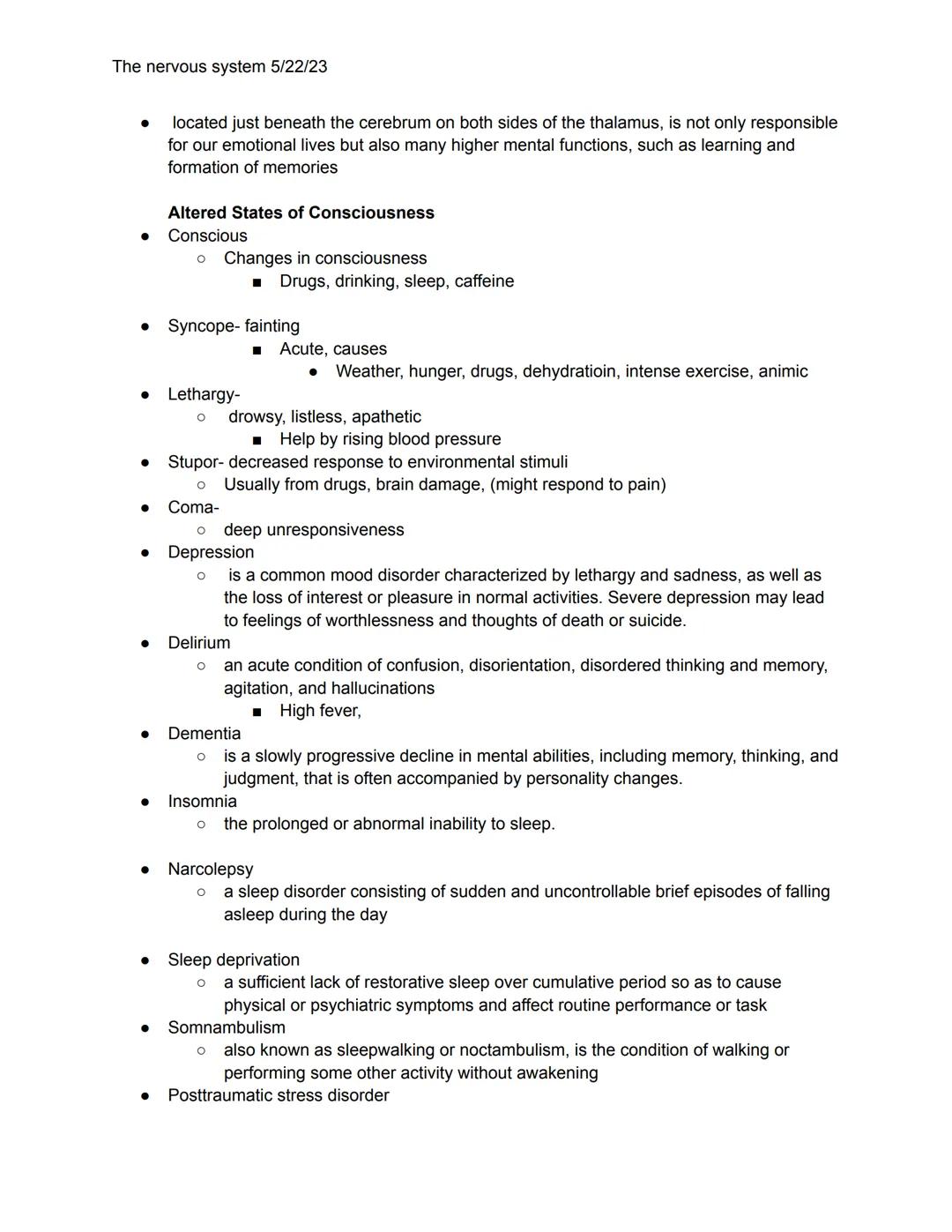
Your level of consciousness can change dramatically based on various factors. Altered states range from temporary conditions like syncope (fainting due to weather, hunger, or dehydration) to more serious states like coma (deep unresponsiveness).
In between are conditions like lethargy (drowsiness and apathy), stupor (decreased response to stimuli), and delirium (acute confusion with disorientation and hallucinations). Each represents different levels of brain function disruption.
Sleep disorders affect your consciousness too. Insomnia is the inability to sleep, while narcolepsy involves sudden episodes of falling asleep during the day. Sleep deprivation accumulates over time, affecting performance and health. Some people even experience somnambulism (sleepwalking)—performing activities without waking up!
😴 Your brain needs quality sleep to function properly! Most teens need 8-10 hours of sleep each night, but many get much less, which can affect memory, mood, and learning ability.
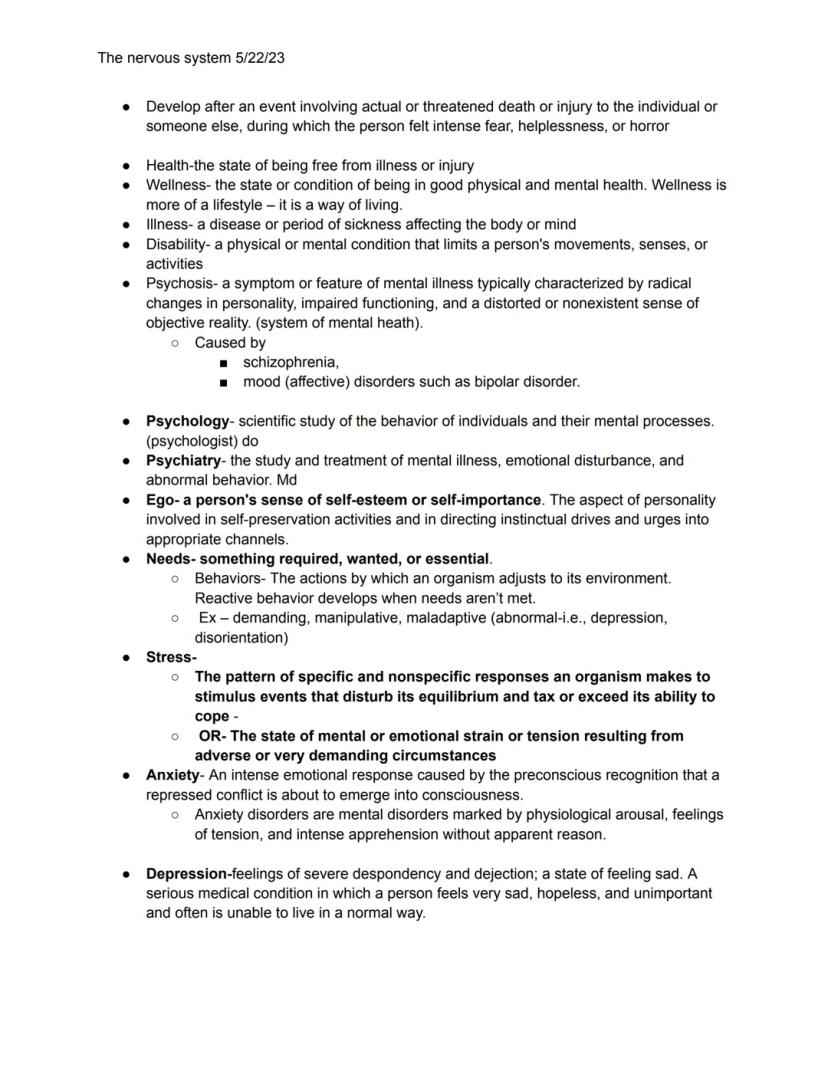
Mental health conditions also alter consciousness. Depression causes persistent sadness and lethargy, while dementia leads to progressive decline in mental abilities. Posttraumatic stress disorder develops after experiencing threatening events, causing ongoing distress and altered awareness.

Health means being free from illness, but wellness represents a more holistic lifestyle of good physical and mental functioning. Mental health conditions can significantly impact your overall wellness.
Psychosis involves radical personality changes and distorted reality perception, often seen in conditions like schizophrenia and bipolar disorder. These conditions are studied by professionals in different fields: psychologists (who study behavior and mental processes) and psychiatrists (medical doctors who treat mental illness).
Your ego (sense of self) plays an important role in mental health. When basic needs aren't met, reactive behaviors can develop—including demanding or manipulative actions, or maladaptive responses like depression.
Stress occurs when circumstances tax your ability to cope, creating mental and emotional strain. It can lead to anxiety—intense feelings of tension and apprehension without clear cause. Severe cases become anxiety disorders, characterized by physiological arousal and intense worry.
🛡️ Your mind naturally develops defense mechanisms to protect itself from uncomfortable thoughts or feelings. These unconscious strategies help manage internal conflicts but can become problematic if overused.
Depression involves persistent sadness, hopelessness, and difficulty functioning normally. Despite its prevalence, mental health conditions often carry stigma—unfair beliefs that can prevent people from seeking help when they need it.
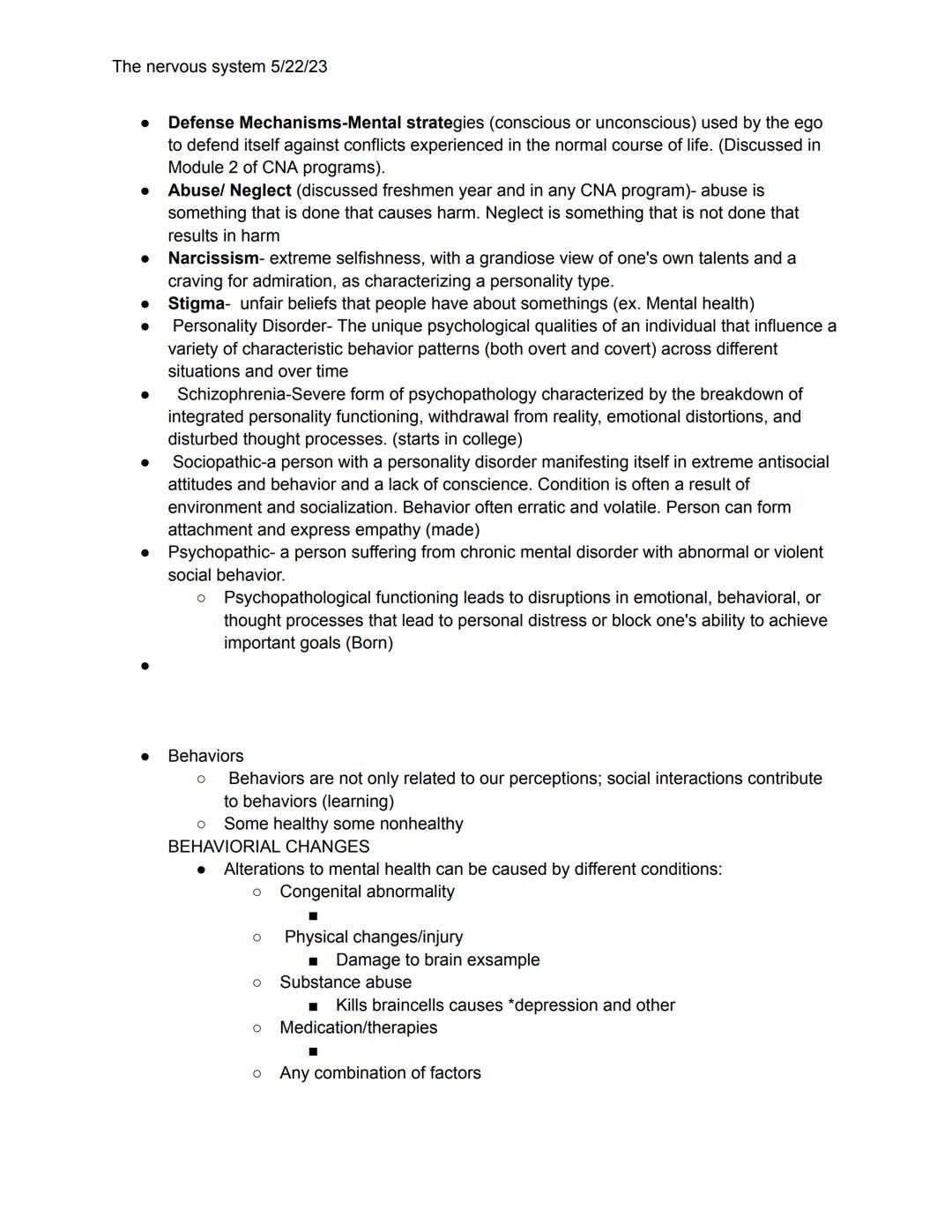
Mental health affects behavior in profound ways. Personality disorders involve characteristic patterns of behavior that persist across situations and time. One severe condition is schizophrenia, a form of psychopathology characterized by disturbed thought processes and withdrawal from reality.
Some behavioral disorders involve antisocial patterns. Sociopathic individuals show extreme antisocial attitudes and lack of conscience, often due to environmental factors. Their behavior tends to be erratic, though they can form attachments. Psychopathic individuals have chronic disorders with abnormal social behavior that may be present from birth.
Our behaviors aren't just about our individual perceptions—they're influenced by social interactions and learning. Some behaviors promote health, while others don't.
Mental health changes can stem from various sources:
⚠️ Substance abuse is particularly damaging to the teenage brain, which is still developing. Drugs and alcohol can permanently alter brain structure and function during these critical years.
These factors rarely act alone—most behavioral changes result from a combination of influences that affect brain function. Understanding these causes helps us approach mental health with compassion rather than judgment.

Our AI companion is specifically built for the needs of students. Based on the millions of content pieces we have on the platform we can provide truly meaningful and relevant answers to students. But its not only about answers, the companion is even more about guiding students through their daily learning challenges, with personalised study plans, quizzes or content pieces in the chat and 100% personalisation based on the students skills and developments.
You can download the app in the Google Play Store and in the Apple App Store.
That's right! Enjoy free access to study content, connect with fellow students, and get instant help – all at your fingertips.
App Store
Google Play
The app is very easy to use and well designed. I have found everything I was looking for so far and have been able to learn a lot from the presentations! I will definitely use the app for a class assignment! And of course it also helps a lot as an inspiration.
Stefan S
iOS user
This app is really great. There are so many study notes and help [...]. My problem subject is French, for example, and the app has so many options for help. Thanks to this app, I have improved my French. I would recommend it to anyone.
Samantha Klich
Android user
Wow, I am really amazed. I just tried the app because I've seen it advertised many times and was absolutely stunned. This app is THE HELP you want for school and above all, it offers so many things, such as workouts and fact sheets, which have been VERY helpful to me personally.
Anna
iOS user
I think it’s very much worth it and you’ll end up using it a lot once you get the hang of it and even after looking at others notes you can still ask your Artificial intelligence buddy the question and ask to simplify it if you still don’t get it!!! In the end I think it’s worth it 😊👍 ⚠️Also DID I MENTION ITS FREEE YOU DON’T HAVE TO PAY FOR ANYTHING AND STILL GET YOUR GRADES IN PERFECTLY❗️❗️⚠️
Thomas R
iOS user
Knowunity is the BEST app I’ve used in a minute. This is not an ai review or anything this is genuinely coming from a 7th grade student (I know 2011 im young) but dude this app is a 10/10 i have maintained a 3.8 gpa and have plenty of time for gaming. I love it and my mom is just happy I got good grades
Brad T
Android user
Not only did it help me find the answer but it also showed me alternative ways to solve it. I was horrible in math and science but now I have an a in both subjects. Thanks for the help🤍🤍
David K
iOS user
The app's just great! All I have to do is enter the topic in the search bar and I get the response real fast. I don't have to watch 10 YouTube videos to understand something, so I'm saving my time. Highly recommended!
Sudenaz Ocak
Android user
In school I was really bad at maths but thanks to the app, I am doing better now. I am so grateful that you made the app.
Greenlight Bonnie
Android user
I found this app a couple years ago and it has only gotten better since then. I really love it because it can help with written questions and photo questions. Also, it can find study guides that other people have made as well as flashcard sets and practice tests. The free version is also amazing for students who might not be able to afford it. Would 100% recommend
Aubrey
iOS user
Best app if you're in Highschool or Junior high. I have been using this app for 2 school years and it's the best, it's good if you don't have anyone to help you with school work.😋🩷🎀
Marco B
iOS user
THE QUIZES AND FLASHCARDS ARE SO USEFUL AND I LOVE Knowunity AI. IT ALSO IS LITREALLY LIKE CHATGPT BUT SMARTER!! HELPED ME WITH MY MASCARA PROBLEMS TOO!! AS WELL AS MY REAL SUBJECTS ! DUHHH 😍😁😲🤑💗✨🎀😮
Elisha
iOS user
This app is phenomenal down to the correct info and the various topics you can study! I greatly recommend it for people who struggle with procrastination and those who need homework help. It has been perfectly accurate for world 1 history as far as I’ve seen! Geometry too!
Paul T
iOS user
The app is very easy to use and well designed. I have found everything I was looking for so far and have been able to learn a lot from the presentations! I will definitely use the app for a class assignment! And of course it also helps a lot as an inspiration.
Stefan S
iOS user
This app is really great. There are so many study notes and help [...]. My problem subject is French, for example, and the app has so many options for help. Thanks to this app, I have improved my French. I would recommend it to anyone.
Samantha Klich
Android user
Wow, I am really amazed. I just tried the app because I've seen it advertised many times and was absolutely stunned. This app is THE HELP you want for school and above all, it offers so many things, such as workouts and fact sheets, which have been VERY helpful to me personally.
Anna
iOS user
I think it’s very much worth it and you’ll end up using it a lot once you get the hang of it and even after looking at others notes you can still ask your Artificial intelligence buddy the question and ask to simplify it if you still don’t get it!!! In the end I think it’s worth it 😊👍 ⚠️Also DID I MENTION ITS FREEE YOU DON’T HAVE TO PAY FOR ANYTHING AND STILL GET YOUR GRADES IN PERFECTLY❗️❗️⚠️
Thomas R
iOS user
Knowunity is the BEST app I’ve used in a minute. This is not an ai review or anything this is genuinely coming from a 7th grade student (I know 2011 im young) but dude this app is a 10/10 i have maintained a 3.8 gpa and have plenty of time for gaming. I love it and my mom is just happy I got good grades
Brad T
Android user
Not only did it help me find the answer but it also showed me alternative ways to solve it. I was horrible in math and science but now I have an a in both subjects. Thanks for the help🤍🤍
David K
iOS user
The app's just great! All I have to do is enter the topic in the search bar and I get the response real fast. I don't have to watch 10 YouTube videos to understand something, so I'm saving my time. Highly recommended!
Sudenaz Ocak
Android user
In school I was really bad at maths but thanks to the app, I am doing better now. I am so grateful that you made the app.
Greenlight Bonnie
Android user
I found this app a couple years ago and it has only gotten better since then. I really love it because it can help with written questions and photo questions. Also, it can find study guides that other people have made as well as flashcard sets and practice tests. The free version is also amazing for students who might not be able to afford it. Would 100% recommend
Aubrey
iOS user
Best app if you're in Highschool or Junior high. I have been using this app for 2 school years and it's the best, it's good if you don't have anyone to help you with school work.😋🩷🎀
Marco B
iOS user
THE QUIZES AND FLASHCARDS ARE SO USEFUL AND I LOVE Knowunity AI. IT ALSO IS LITREALLY LIKE CHATGPT BUT SMARTER!! HELPED ME WITH MY MASCARA PROBLEMS TOO!! AS WELL AS MY REAL SUBJECTS ! DUHHH 😍😁😲🤑💗✨🎀😮
Elisha
iOS user
This app is phenomenal down to the correct info and the various topics you can study! I greatly recommend it for people who struggle with procrastination and those who need homework help. It has been perfectly accurate for world 1 history as far as I’ve seen! Geometry too!
Paul T
iOS user
Lia Ventura
@cookiesgood_aktq
The nervous system is your body's command center, coordinating everything from thoughts and movements to automatic functions like breathing. This complex network of cells enables you to respond to your environment, process information, and control all bodily activities. Understanding how... Show more
Access to all documents
Improve your grades
Join milions of students
Your nervous system helps your body adapt to changes in the environment through a network of specialized cells. At its center is the brain, which coordinates all bodily functions—when it stops working, life ends.
The basic unit of the nervous system is the neuron. Each neuron has a cell body (soma) containing the nucleus, dendrites that receive messages, and an axon that carries signals away. Axon terminals release neurotransmitters into synapses—the gaps between neurons. These chemicals like dopamine, serotonin, and endorphins control everything from mood to pain perception.
Neurons are protected by a fatty myelin sheath, which helps signals travel faster. Between sections of myelin are Nodes of Ranvier, where action potentials occur during signal transmission. Supporting cells called glial cells hold neurons in place and remove dead cells.
💡 Think of neurons like a text message system: dendrites receive messages, the cell body processes them, and the axon sends them to the next neuron through neurotransmitters!
Information travels in specific directions: afferent (sensory) signals go from body to brain, while efferent (motor) signals travel from brain to muscles and glands. Associative neurons connect these pathways to create complete responses.
Access to all documents
Improve your grades
Join milions of students
Your nervous system divides into two main parts: central and peripheral. The central nervous system (CNS) includes your brain and spinal cord. Your brain, weighing about 3 pounds, reaches full size by age 6 and contains about 100 billion neurons. It uses 20% of your body's oxygen despite being only 2% of your body weight!
The brain has gray matter (containing cell bodies and dendrites) and white matter (mostly axon bundles). Three protective layers keep your brain safe:
The peripheral nervous system connects your CNS to the rest of your body. It splits into sensory division (carrying information to the CNS) and motor division (carrying commands from the CNS). The motor division further divides into somatic (voluntary movements) and autonomic (involuntary functions).
🧠 Your autonomic system has two opposing parts: the sympathetic system activates your "fight-or-flight" response during stress, while the parasympathetic system promotes "rest-and-digest" when you're calm!
The brain itself organizes into lobes with specialized functions—frontal, parietal, temporal, and occipital—each handling different aspects of your experience.
Access to all documents
Improve your grades
Join milions of students
Your brain's hemispheres connect through the corpus callosum, allowing the left and right sides to communicate. The cerebrum handles higher-level functions like thinking, judgment, memory, and speech.
Beneath it, the brainstem contains three critical regions:
The diencephalon houses the thalamus (a sensory relay center) and hypothalamus (controls autonomic functions like temperature). Your cerebellum coordinates balance and posture, while also helping with cardiac and respiratory functions.
The spinal cord extends from the base of your skull down to the L2 vertebra. It's protected by vertebrae and meninges, and serves as the highway for messages traveling between your brain and body. From it emerge 31 pairs of spinal nerves, while 12 pairs of cranial nerves extend directly from the brain.
🔄 Reflexes are automatic reactions that don't require conscious thought—they take a shortcut pathway through the spinal cord rather than traveling all the way to the brain for processing!
The limbic system, located beneath the cerebrum, handles emotions, learning, and memory formation, connecting your thoughts with your feelings.
Access to all documents
Improve your grades
Join milions of students
Your level of consciousness can change dramatically based on various factors. Altered states range from temporary conditions like syncope (fainting due to weather, hunger, or dehydration) to more serious states like coma (deep unresponsiveness).
In between are conditions like lethargy (drowsiness and apathy), stupor (decreased response to stimuli), and delirium (acute confusion with disorientation and hallucinations). Each represents different levels of brain function disruption.
Sleep disorders affect your consciousness too. Insomnia is the inability to sleep, while narcolepsy involves sudden episodes of falling asleep during the day. Sleep deprivation accumulates over time, affecting performance and health. Some people even experience somnambulism (sleepwalking)—performing activities without waking up!
😴 Your brain needs quality sleep to function properly! Most teens need 8-10 hours of sleep each night, but many get much less, which can affect memory, mood, and learning ability.
Mental health conditions also alter consciousness. Depression causes persistent sadness and lethargy, while dementia leads to progressive decline in mental abilities. Posttraumatic stress disorder develops after experiencing threatening events, causing ongoing distress and altered awareness.
Access to all documents
Improve your grades
Join milions of students
Health means being free from illness, but wellness represents a more holistic lifestyle of good physical and mental functioning. Mental health conditions can significantly impact your overall wellness.
Psychosis involves radical personality changes and distorted reality perception, often seen in conditions like schizophrenia and bipolar disorder. These conditions are studied by professionals in different fields: psychologists (who study behavior and mental processes) and psychiatrists (medical doctors who treat mental illness).
Your ego (sense of self) plays an important role in mental health. When basic needs aren't met, reactive behaviors can develop—including demanding or manipulative actions, or maladaptive responses like depression.
Stress occurs when circumstances tax your ability to cope, creating mental and emotional strain. It can lead to anxiety—intense feelings of tension and apprehension without clear cause. Severe cases become anxiety disorders, characterized by physiological arousal and intense worry.
🛡️ Your mind naturally develops defense mechanisms to protect itself from uncomfortable thoughts or feelings. These unconscious strategies help manage internal conflicts but can become problematic if overused.
Depression involves persistent sadness, hopelessness, and difficulty functioning normally. Despite its prevalence, mental health conditions often carry stigma—unfair beliefs that can prevent people from seeking help when they need it.
Access to all documents
Improve your grades
Join milions of students
Mental health affects behavior in profound ways. Personality disorders involve characteristic patterns of behavior that persist across situations and time. One severe condition is schizophrenia, a form of psychopathology characterized by disturbed thought processes and withdrawal from reality.
Some behavioral disorders involve antisocial patterns. Sociopathic individuals show extreme antisocial attitudes and lack of conscience, often due to environmental factors. Their behavior tends to be erratic, though they can form attachments. Psychopathic individuals have chronic disorders with abnormal social behavior that may be present from birth.
Our behaviors aren't just about our individual perceptions—they're influenced by social interactions and learning. Some behaviors promote health, while others don't.
Mental health changes can stem from various sources:
⚠️ Substance abuse is particularly damaging to the teenage brain, which is still developing. Drugs and alcohol can permanently alter brain structure and function during these critical years.
These factors rarely act alone—most behavioral changes result from a combination of influences that affect brain function. Understanding these causes helps us approach mental health with compassion rather than judgment.
Access to all documents
Improve your grades
Join milions of students
Our AI companion is specifically built for the needs of students. Based on the millions of content pieces we have on the platform we can provide truly meaningful and relevant answers to students. But its not only about answers, the companion is even more about guiding students through their daily learning challenges, with personalised study plans, quizzes or content pieces in the chat and 100% personalisation based on the students skills and developments.
You can download the app in the Google Play Store and in the Apple App Store.
That's right! Enjoy free access to study content, connect with fellow students, and get instant help – all at your fingertips.
2
Smart Tools NEW
Transform this note into: ✓ 50+ Practice Questions ✓ Interactive Flashcards ✓ Full Practice Test ✓ Essay Outlines
What it is, History, Applied Fields, etc.
 Health & Medicine
This has medical terms that students can utilize
Health & MedicineCOVID-19 pandemic has had a profound impact on societies, health, and the economy around the world. It has highlighted existing inequalities and the importance of effective leadership and governance in times of crisis.
Health & MedicineExplore the key psychological perspectives including cognitive, behavioral, and humanistic approaches to understand human behavior and mental health. This comprehensive study note covers essential theories such as Maslow's hierarchy of needs, Bandura's social learning theory, and the psychodynamic approach, providing insights into personality disorders, trauma, and therapeutic interventions. Ideal for students aiming for distinction in health and social care.
 Health & Social Care
Intro to Healthcare
Health & MedicineExplore the advantages and disadvantages of Multidisciplinary Teams (MDTs) in addressing the holistic needs of service users. This summary covers the collaborative methods used by healthcare professionals, the importance of a person-centred approach, and the challenges faced in delivering comprehensive care. Ideal for students studying case management and the biopsychosocial approach in healthcare.
Health & Social CareApp Store
Google Play
The app is very easy to use and well designed. I have found everything I was looking for so far and have been able to learn a lot from the presentations! I will definitely use the app for a class assignment! And of course it also helps a lot as an inspiration.
Stefan S
iOS user
This app is really great. There are so many study notes and help [...]. My problem subject is French, for example, and the app has so many options for help. Thanks to this app, I have improved my French. I would recommend it to anyone.
Samantha Klich
Android user
Wow, I am really amazed. I just tried the app because I've seen it advertised many times and was absolutely stunned. This app is THE HELP you want for school and above all, it offers so many things, such as workouts and fact sheets, which have been VERY helpful to me personally.
Anna
iOS user
I think it’s very much worth it and you’ll end up using it a lot once you get the hang of it and even after looking at others notes you can still ask your Artificial intelligence buddy the question and ask to simplify it if you still don’t get it!!! In the end I think it’s worth it 😊👍 ⚠️Also DID I MENTION ITS FREEE YOU DON’T HAVE TO PAY FOR ANYTHING AND STILL GET YOUR GRADES IN PERFECTLY❗️❗️⚠️
Thomas R
iOS user
Knowunity is the BEST app I’ve used in a minute. This is not an ai review or anything this is genuinely coming from a 7th grade student (I know 2011 im young) but dude this app is a 10/10 i have maintained a 3.8 gpa and have plenty of time for gaming. I love it and my mom is just happy I got good grades
Brad T
Android user
Not only did it help me find the answer but it also showed me alternative ways to solve it. I was horrible in math and science but now I have an a in both subjects. Thanks for the help🤍🤍
David K
iOS user
The app's just great! All I have to do is enter the topic in the search bar and I get the response real fast. I don't have to watch 10 YouTube videos to understand something, so I'm saving my time. Highly recommended!
Sudenaz Ocak
Android user
In school I was really bad at maths but thanks to the app, I am doing better now. I am so grateful that you made the app.
Greenlight Bonnie
Android user
I found this app a couple years ago and it has only gotten better since then. I really love it because it can help with written questions and photo questions. Also, it can find study guides that other people have made as well as flashcard sets and practice tests. The free version is also amazing for students who might not be able to afford it. Would 100% recommend
Aubrey
iOS user
Best app if you're in Highschool or Junior high. I have been using this app for 2 school years and it's the best, it's good if you don't have anyone to help you with school work.😋🩷🎀
Marco B
iOS user
THE QUIZES AND FLASHCARDS ARE SO USEFUL AND I LOVE Knowunity AI. IT ALSO IS LITREALLY LIKE CHATGPT BUT SMARTER!! HELPED ME WITH MY MASCARA PROBLEMS TOO!! AS WELL AS MY REAL SUBJECTS ! DUHHH 😍😁😲🤑💗✨🎀😮
Elisha
iOS user
This app is phenomenal down to the correct info and the various topics you can study! I greatly recommend it for people who struggle with procrastination and those who need homework help. It has been perfectly accurate for world 1 history as far as I’ve seen! Geometry too!
Paul T
iOS user
The app is very easy to use and well designed. I have found everything I was looking for so far and have been able to learn a lot from the presentations! I will definitely use the app for a class assignment! And of course it also helps a lot as an inspiration.
Stefan S
iOS user
This app is really great. There are so many study notes and help [...]. My problem subject is French, for example, and the app has so many options for help. Thanks to this app, I have improved my French. I would recommend it to anyone.
Samantha Klich
Android user
Wow, I am really amazed. I just tried the app because I've seen it advertised many times and was absolutely stunned. This app is THE HELP you want for school and above all, it offers so many things, such as workouts and fact sheets, which have been VERY helpful to me personally.
Anna
iOS user
I think it’s very much worth it and you’ll end up using it a lot once you get the hang of it and even after looking at others notes you can still ask your Artificial intelligence buddy the question and ask to simplify it if you still don’t get it!!! In the end I think it’s worth it 😊👍 ⚠️Also DID I MENTION ITS FREEE YOU DON’T HAVE TO PAY FOR ANYTHING AND STILL GET YOUR GRADES IN PERFECTLY❗️❗️⚠️
Thomas R
iOS user
Knowunity is the BEST app I’ve used in a minute. This is not an ai review or anything this is genuinely coming from a 7th grade student (I know 2011 im young) but dude this app is a 10/10 i have maintained a 3.8 gpa and have plenty of time for gaming. I love it and my mom is just happy I got good grades
Brad T
Android user
Not only did it help me find the answer but it also showed me alternative ways to solve it. I was horrible in math and science but now I have an a in both subjects. Thanks for the help🤍🤍
David K
iOS user
The app's just great! All I have to do is enter the topic in the search bar and I get the response real fast. I don't have to watch 10 YouTube videos to understand something, so I'm saving my time. Highly recommended!
Sudenaz Ocak
Android user
In school I was really bad at maths but thanks to the app, I am doing better now. I am so grateful that you made the app.
Greenlight Bonnie
Android user
I found this app a couple years ago and it has only gotten better since then. I really love it because it can help with written questions and photo questions. Also, it can find study guides that other people have made as well as flashcard sets and practice tests. The free version is also amazing for students who might not be able to afford it. Would 100% recommend
Aubrey
iOS user
Best app if you're in Highschool or Junior high. I have been using this app for 2 school years and it's the best, it's good if you don't have anyone to help you with school work.😋🩷🎀
Marco B
iOS user
THE QUIZES AND FLASHCARDS ARE SO USEFUL AND I LOVE Knowunity AI. IT ALSO IS LITREALLY LIKE CHATGPT BUT SMARTER!! HELPED ME WITH MY MASCARA PROBLEMS TOO!! AS WELL AS MY REAL SUBJECTS ! DUHHH 😍😁😲🤑💗✨🎀😮
Elisha
iOS user
This app is phenomenal down to the correct info and the various topics you can study! I greatly recommend it for people who struggle with procrastination and those who need homework help. It has been perfectly accurate for world 1 history as far as I’ve seen! Geometry too!
Paul T
iOS user