
The human skeletal system is an amazing framework that does... Show more
 Health & Medicine
 Algebra
Sign up to see the contentIt's free!
Access to all documents
Improve your grades
Join milions of students
Knowunity AI
Subjects
Triangle Congruence and Similarity Theorems
Triangle Properties and Classification
Linear Equations and Graphs
Geometric Angle Relationships
Trigonometric Functions and Identities
Equation Solving Techniques
Circle Geometry Fundamentals
Division Operations and Methods
Basic Differentiation Rules
Exponent and Logarithm Properties
Show all topics
Human Organ Systems
Reproductive Cell Cycles
Biological Sciences Subdisciplines
Cellular Energy Metabolism
Autotrophic Energy Processes
Inheritance Patterns and Principles
Biomolecular Structure and Organization
Cell Cycle and Division Mechanics
Cellular Organization and Development
Biological Structural Organization
Show all topics
Chemical Sciences and Applications
Atomic Structure and Composition
Molecular Electron Structure Representation
Atomic Electron Behavior
Matter Properties and Water
Mole Concept and Calculations
Gas Laws and Behavior
Periodic Table Organization
Chemical Thermodynamics Fundamentals
Chemical Bond Types and Properties
Show all topics
European Renaissance and Enlightenment
European Cultural Movements 800-1920
American Revolution Era 1763-1797
American Civil War 1861-1865
Global Imperial Systems
Mongol and Chinese Dynasties
U.S. Presidents and World Leaders
Historical Sources and Documentation
World Wars Era and Impact
World Religious Systems
Show all topics
Classic and Contemporary Novels
Literary Character Analysis
Rhetorical Theory and Practice
Classic Literary Narratives
Reading Analysis and Interpretation
Narrative Structure and Techniques
English Language Components
Influential English-Language Authors
Basic Sentence Structure
Narrative Voice and Perspective
Show all topics
51
•
Feb 14, 2026
•

Kylie Zaleski
@kylie_zaleski
The human skeletal system is an amazing framework that does... Show more
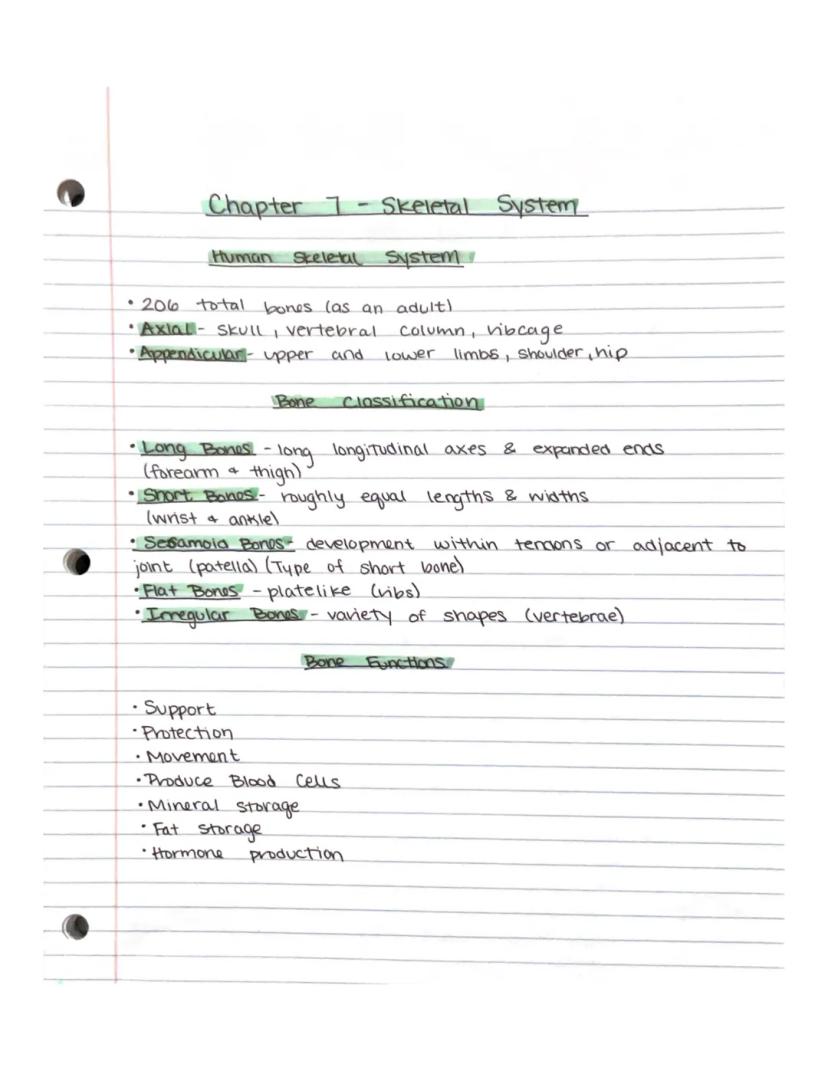
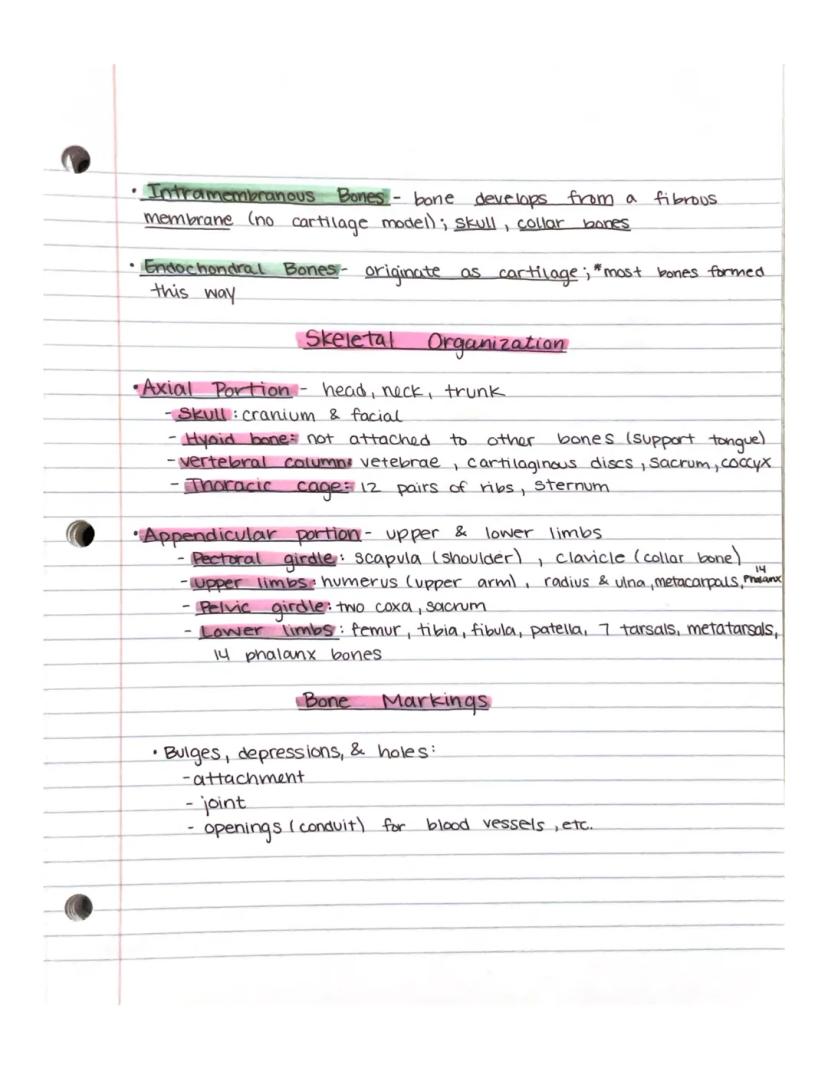
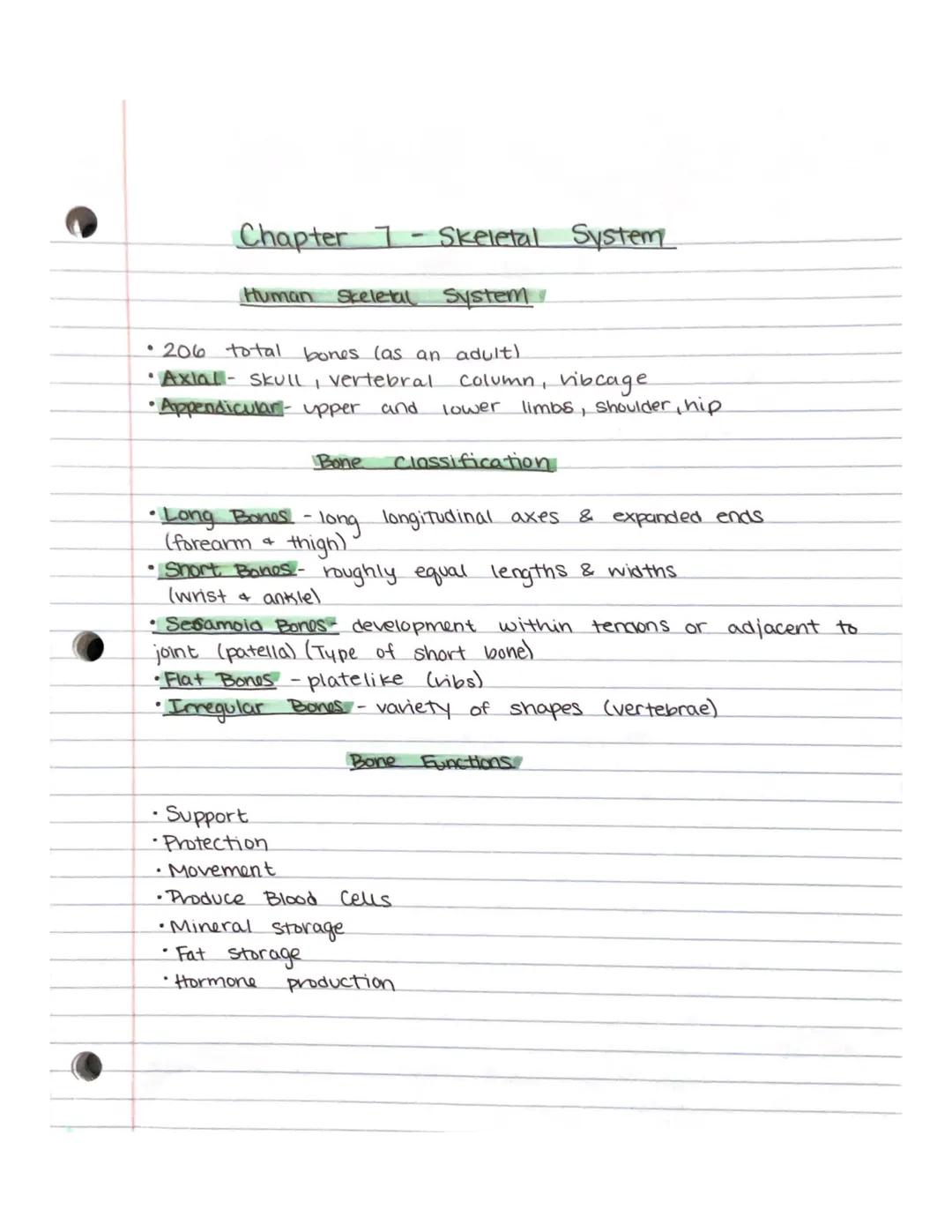
Your skeleton isn't just a Halloween decoration—it's a living, dynamic system with 206 bones that serve crucial functions in your body. These bones are organized into two main divisions: the axial skeleton (skull, vertebral column, ribcage) and the appendicular skeleton (limbs, shoulders, and hips).
Bones come in five different shapes, each designed for specific purposes. Long bones like those in your arms and legs have expanded ends and provide leverage. Short bones found in your wrists and ankles have roughly equal dimensions. Other types include flat bones (like ribs), irregular bones (vertebrae), and sesamoid bones (like the kneecap) that develop within tendons.
Your skeletal system performs many vital functions beyond just giving you structure. It protects delicate organs, enables movement through muscle attachments, and even acts as a factory for blood cells. Your bones also serve as storage depots for minerals and fat while participating in hormone production.
Did you know? Your skeleton is constantly changing! Throughout your life, bones continuously break down and rebuild themselves in a process called remodeling.
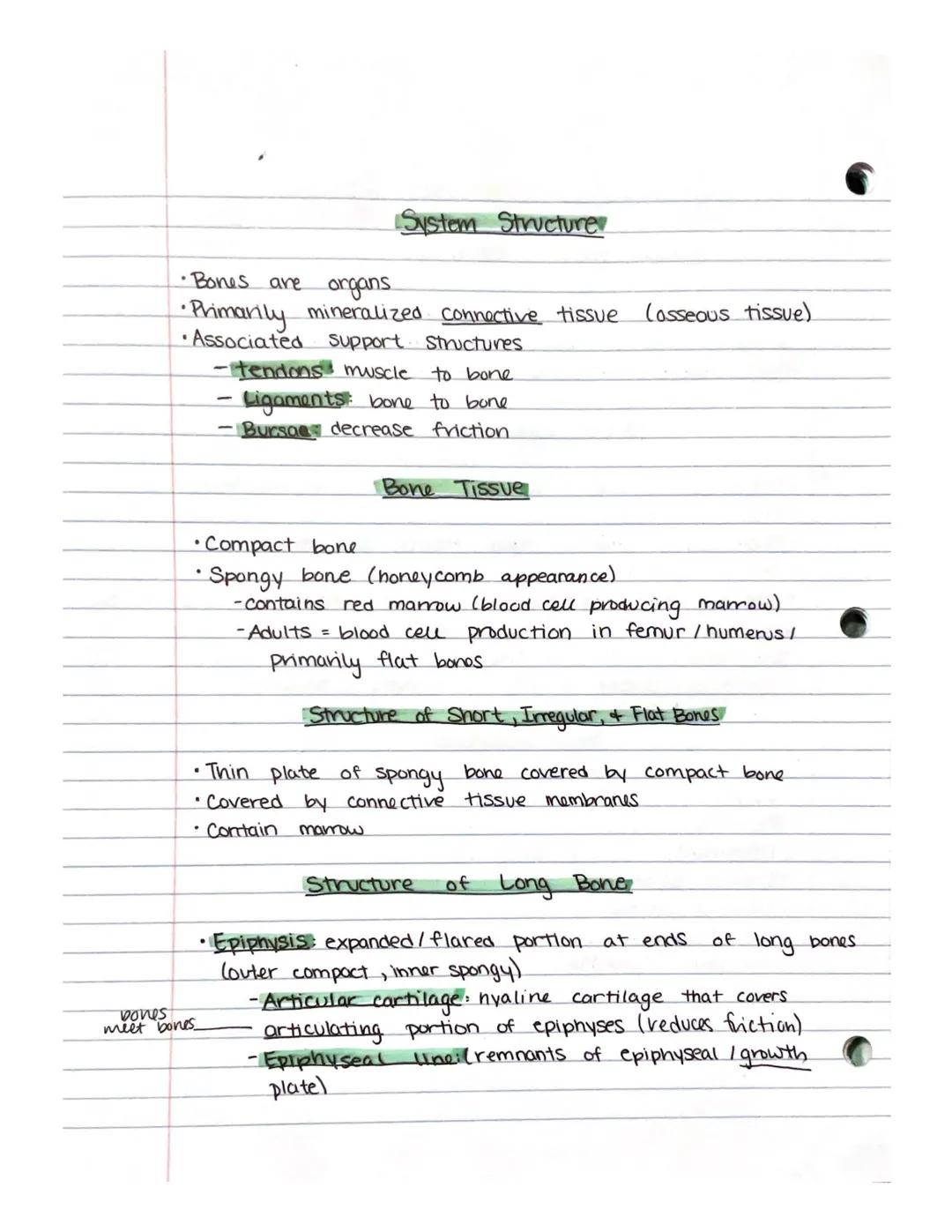
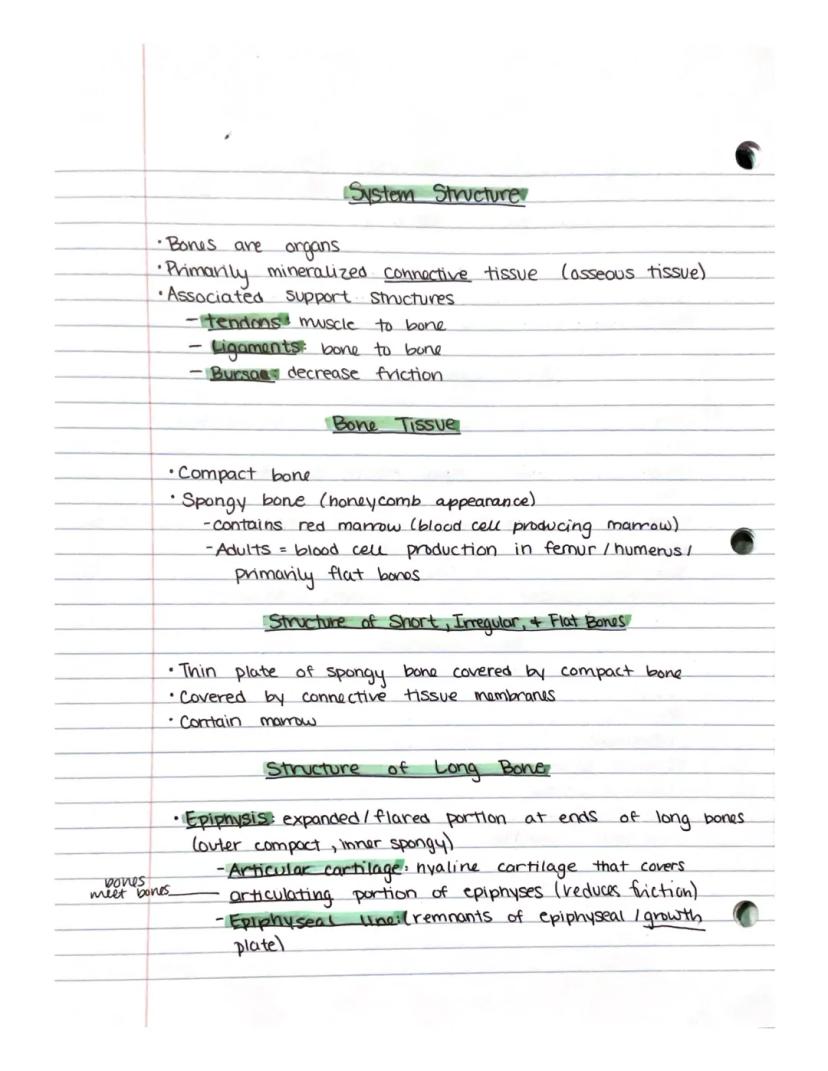
Bones aren't just solid sticks—they're complex organs made of mineralized connective tissue called osseous tissue. They work with other structures like tendons (connecting muscle to bone), ligaments (connecting bone to bone), and bursae .
When you look at bone tissue itself, you'll find two main types. Compact bone is dense and strong, while spongy bone has a honeycomb appearance and contains red marrow where blood cells are produced. In adults, blood cell production happens primarily in the femur, humerus, and flat bones.
Different bone types have specific structures. Short, irregular, and flat bones consist of spongy bone sandwiched between layers of compact bone. Long bones have more complex architecture with expanded ends (epiphyses) covered by articular cartilage to reduce friction at joints. The epiphyseal line marks where growth occurred during development.
Remember this: Think of your bones as living skyscrapers—they have different structural elements working together, with outer support walls (compact bone) and inner framework (spongy bone) all designed for maximum strength with minimum weight!
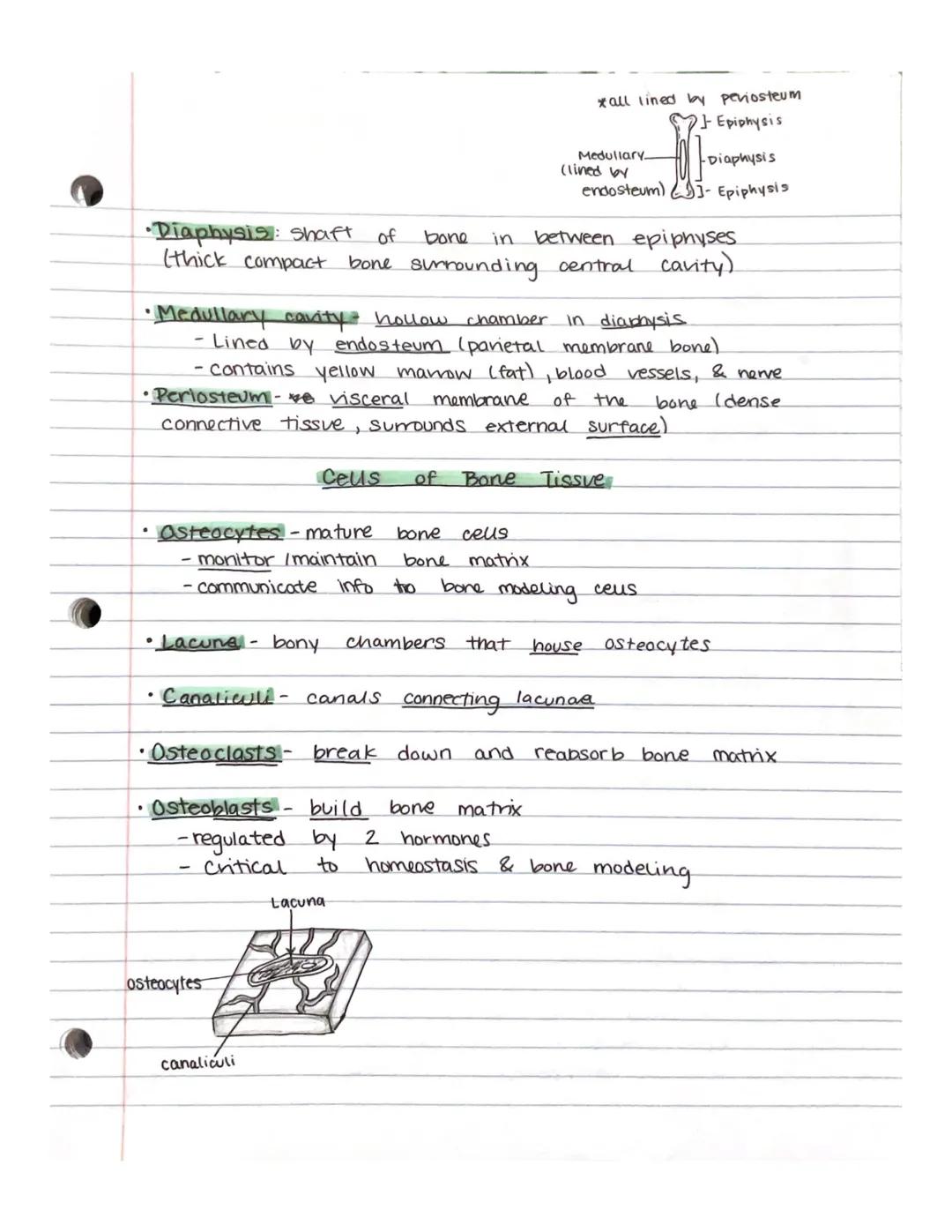
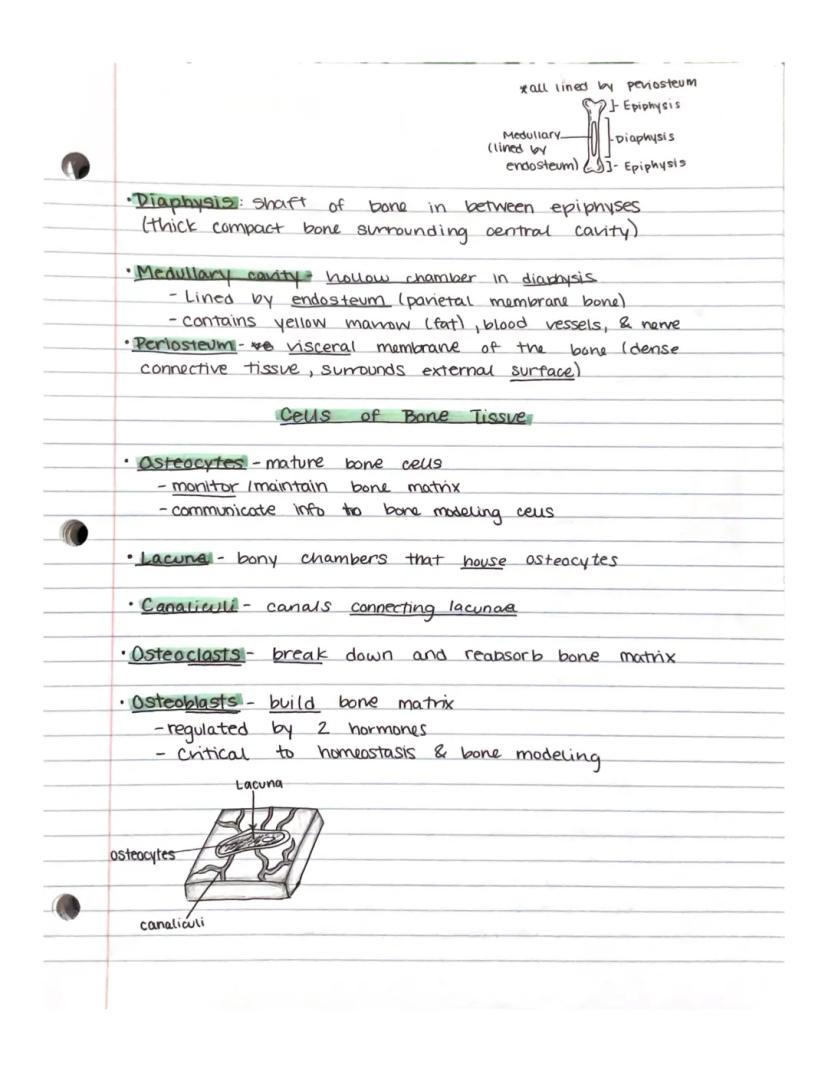
Long bones have a distinctive structure that maximizes strength while minimizing weight. The diaphysis (shaft) consists of thick compact bone surrounding a central medullary cavity filled with yellow marrow (fat), blood vessels, and nerves. This cavity is lined with endosteum, while the bone's external surface is covered by a tough connective tissue called periosteum.
The cellular team that maintains your bones includes several key players. Osteocytes are mature bone cells that monitor and maintain the bone matrix from their homes in small chambers called lacunae. These cells communicate through tiny channels called canaliculi. Meanwhile, osteoclasts break down old bone tissue, and osteoblasts build new bone matrix—both crucial for bone remodeling and homeostasis.
These cells work together in a carefully balanced process regulated by hormones. When osteoblasts build bone faster than osteoclasts break it down, bones grow stronger—this is why weight-bearing exercise is so good for bone health!
Fascinating fact: Your bone cells communicate with each other through an intricate network of tiny channels, allowing them to coordinate responses to stress and damage—it's like your bones have their own internal internet!
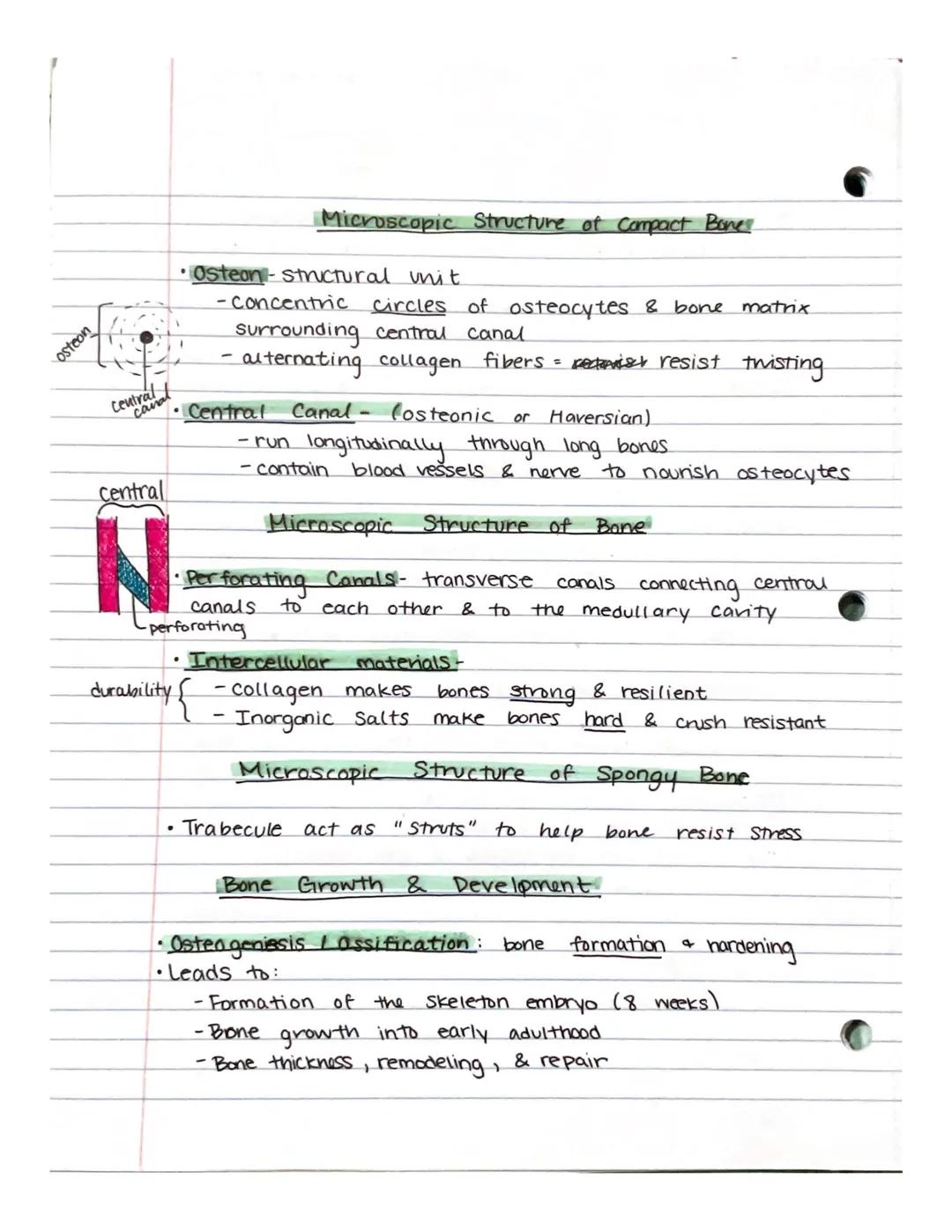
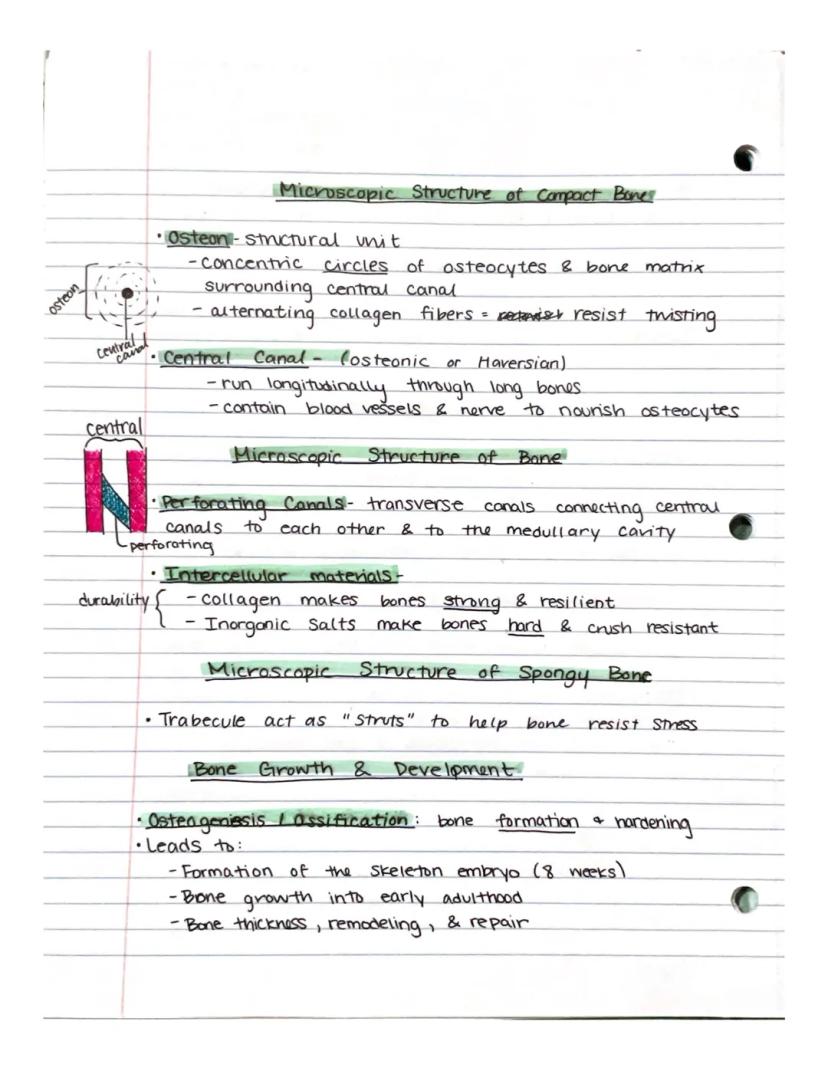
If you could zoom in on compact bone, you'd see amazing structural units called osteons. These are concentric circles of osteocytes and bone matrix surrounding a central canal that contains blood vessels and nerves. The alternating pattern of collagen fibers within osteons helps bones resist twisting forces. Perforating canals connect these central canals to each other and to the medullary cavity.
The material making up bones gives them their unique properties. Collagen provides strength and resilience (ability to spring back), while inorganic salts contribute hardness and crush resistance. In spongy bone, rod-like structures called trabeculae act as internal supports, helping bones resist stress.
Bone formation, called osteogenesis or ossification, is a fascinating process that begins in the embryo around 8 weeks and continues into early adulthood. There are two main types: intramembranous ossification (bones develop directly from fibrous membranes, like in the skull) and endochondral ossification (bones develop from cartilage models, which is how most bones form).
Study tip: Think of osteons as tiny cylindrical pillars running through your bones. Their design is perfect for handling the stresses your bones face every day—nature's own architectural masterpiece!
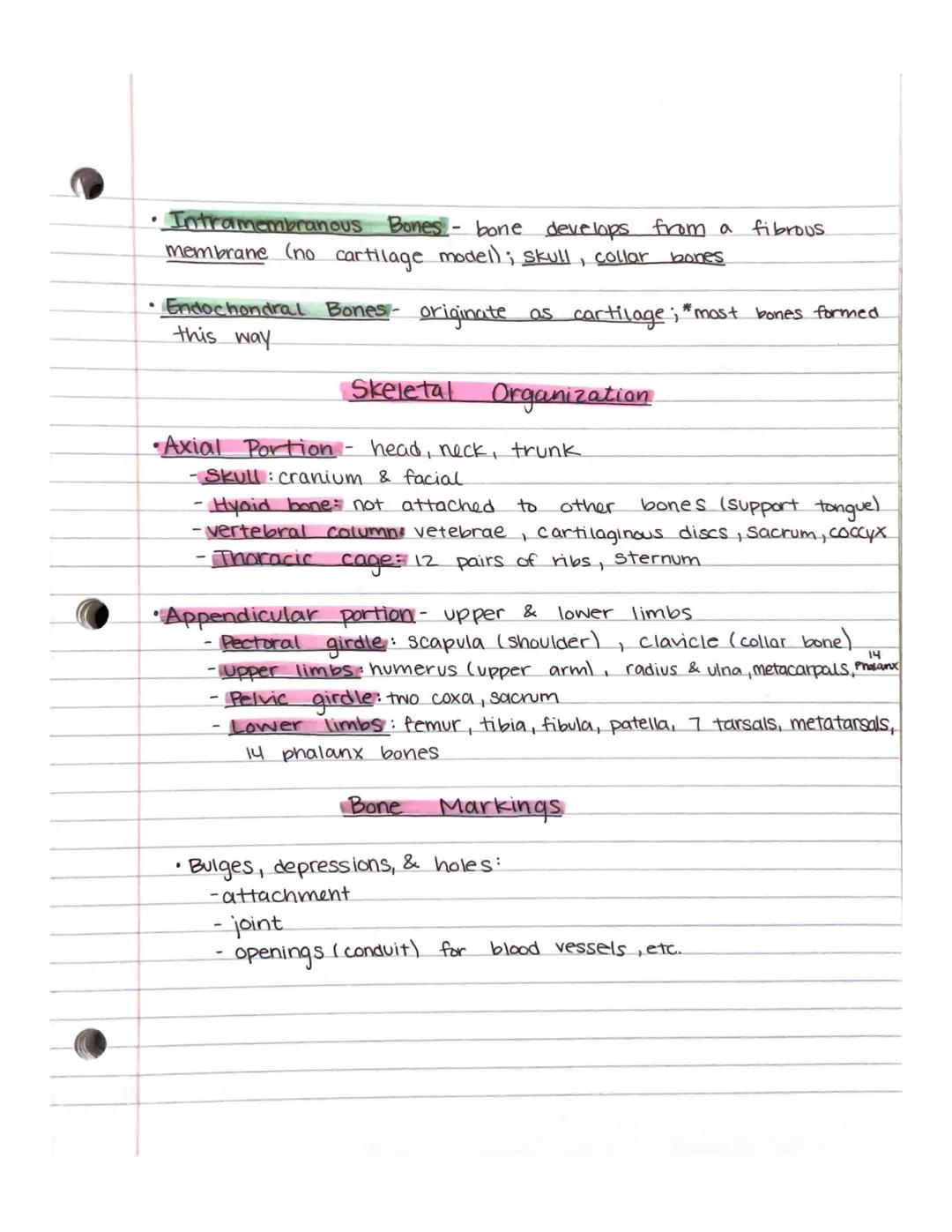
Your skeleton is divided into two major sections, each with specialized functions. The axial skeleton forms the central core of your body, including your skull (cranium and facial bones), hyoid bone (which uniquely doesn't attach to other bones), vertebral column, and thoracic cage (ribs and sternum).
The appendicular skeleton consists of your limbs and their attachments. This includes the pectoral girdle (scapula and clavicle), upper limbs (humerus, radius, ulna, wrist bones, metacarpals, and phalanges), pelvic girdle (two coxal bones and sacrum), and lower limbs (femur, tibia, fibula, patella, tarsals, metatarsals, and phalanges).
When examining bones closely, you'll notice various markings—bulges, depressions, and holes that serve specific purposes. Some provide attachment points for muscles and ligaments, some form parts of joints, and others create openings for blood vessels and nerves to pass through.
Quick check: Look at your wrist and wiggle your fingers—you're seeing the appendicular skeleton in action! The complex arrangement of bones allows for the incredible range of motion you need for everything from texting to playing instruments.
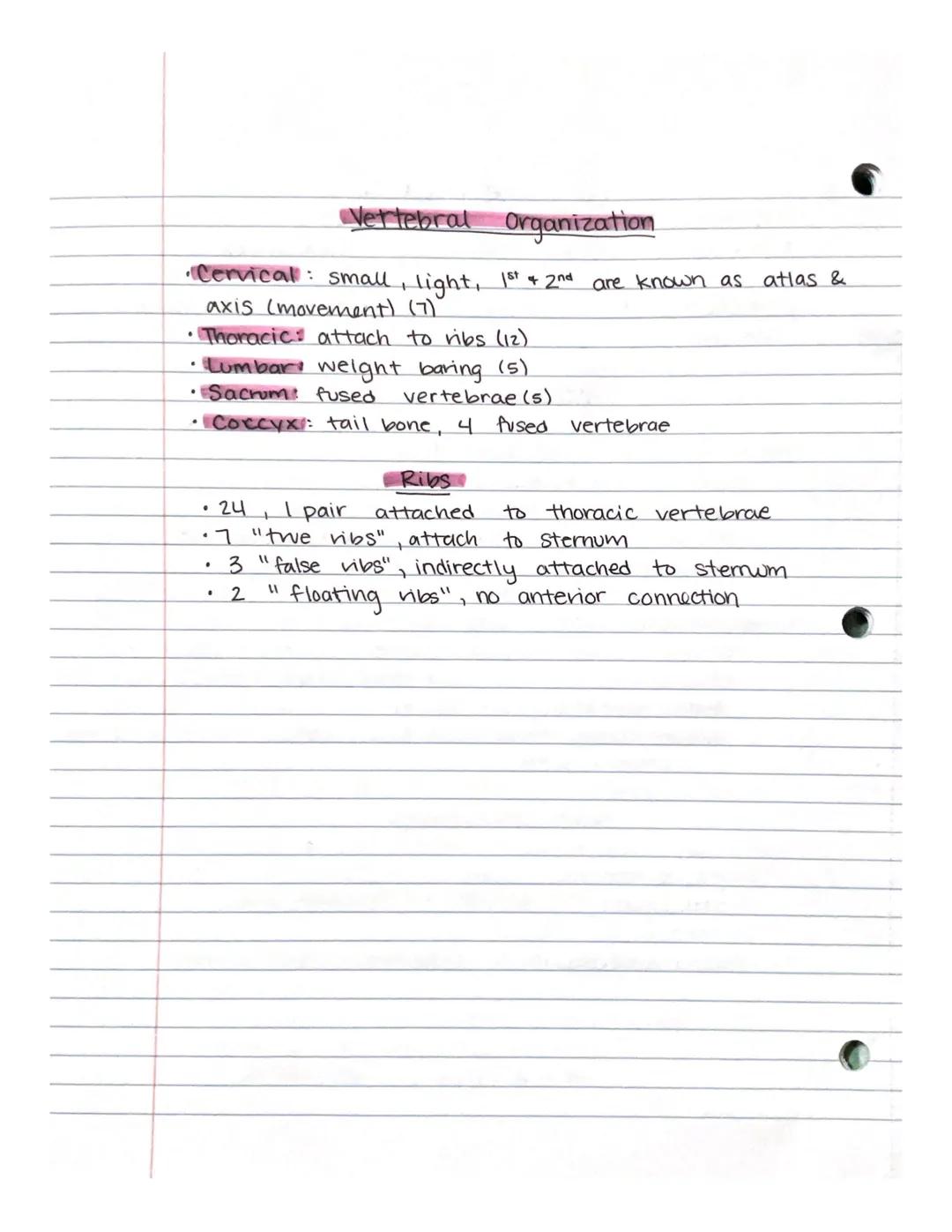
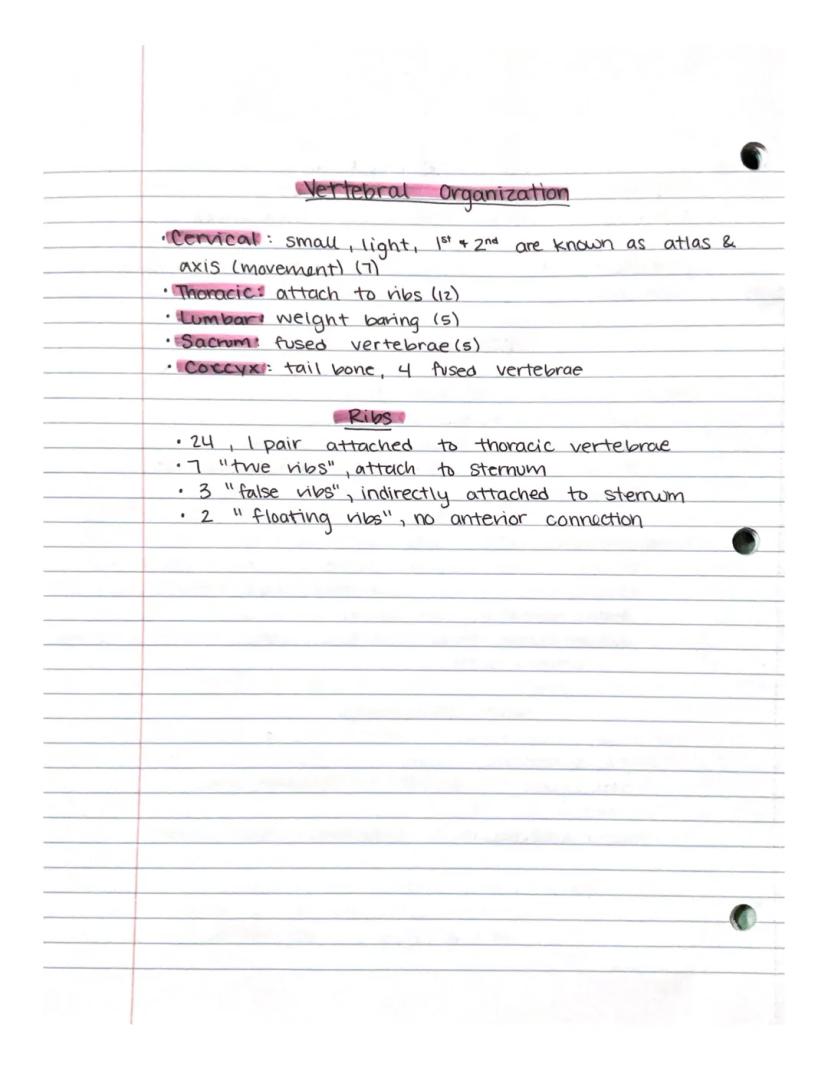
Your vertebral column isn't just one long bone—it's a complex structure made of different types of vertebrae, each specialized for specific functions. Starting from the top, you have seven cervical vertebrae in your neck (including the atlas and axis that allow head movement), twelve thoracic vertebrae that attach to your ribs, and five sturdy lumbar vertebrae that bear most of your body's weight.
At the base of your spine are two fused structures: the sacrum (five fused vertebrae) and the coccyx or tailbone (four fused vertebrae). This arrangement provides both stability and flexibility, allowing you to bend and twist while protecting your spinal cord.
Your thoracic cage includes 24 ribs (12 pairs), all attached to thoracic vertebrae. The upper seven pairs are called "true ribs" because they connect directly to the sternum. The next three pairs are "false ribs" that connect indirectly to the sternum, while the bottom two pairs are "floating ribs" with no anterior connection at all.
Movement matters: The next time you take a deep breath, notice how your ribs move outward and upward, increasing the volume of your chest cavity—this is possible because of the flexible joints where ribs meet vertebrae and cartilage!
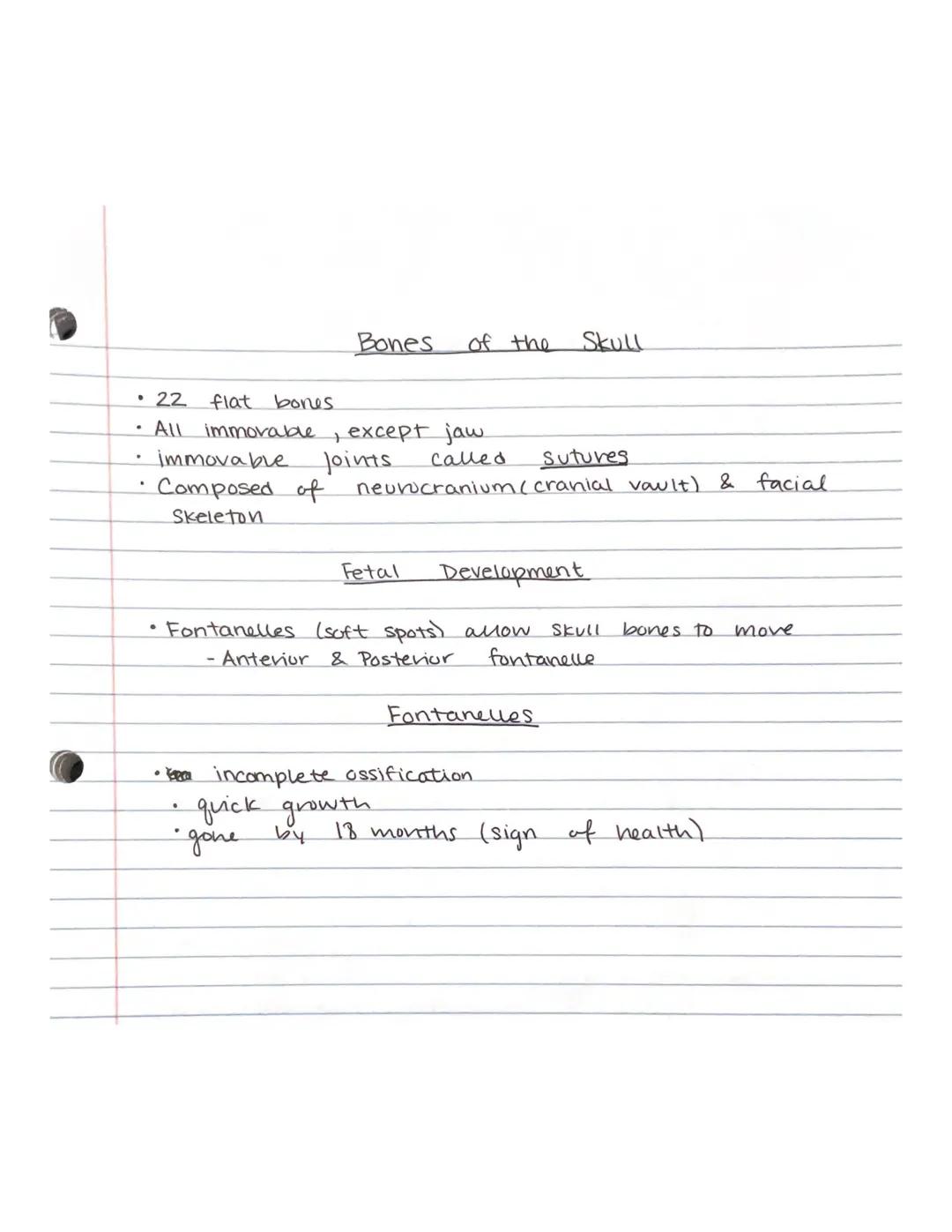
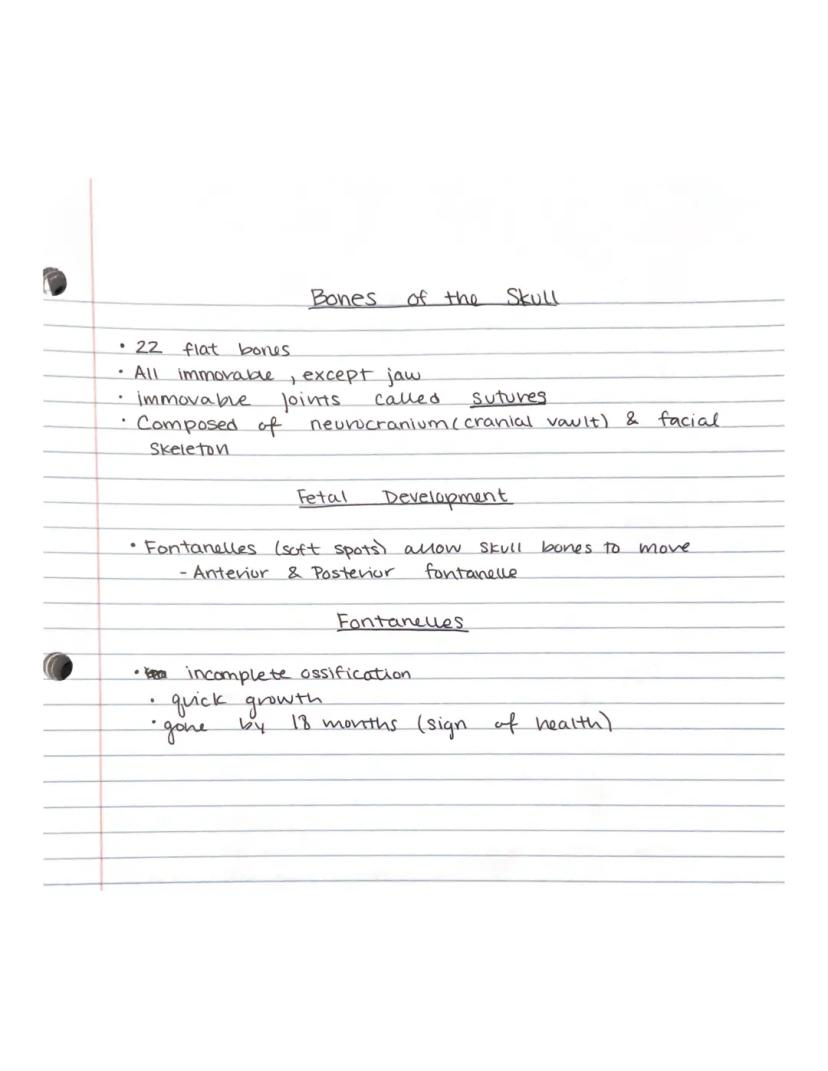
Your skull is an architectural marvel composed of 22 flat bones that fit together like a 3D puzzle. Except for your jaw, these bones don't move—they're connected by immovable joints called sutures. The skull has two main sections: the neurocranium (brain case) and the facial skeleton.
During fetal development, the skull forms with gaps called fontanelles or "soft spots" that allow the skull bones to shift during birth and accommodate rapid brain growth in early infancy. The most noticeable are the anterior and posterior fontanelles.
These fontanelles are areas where ossification isn't complete, creating flexible regions in the newborn's skull. By about 18 months of age, these soft spots usually close completely as the bones grow together—an important developmental milestone that doctors check as a sign of healthy growth.
Growth perspective: When you were born, your skull had proportionally more "construction zones" (fontanelles) than finished "buildings" (fully ossified bone). This design brilliantly solves the problem of fitting a large brain through a narrow birth canal while allowing for continued brain growth!
Our AI companion is specifically built for the needs of students. Based on the millions of content pieces we have on the platform we can provide truly meaningful and relevant answers to students. But its not only about answers, the companion is even more about guiding students through their daily learning challenges, with personalised study plans, quizzes or content pieces in the chat and 100% personalisation based on the students skills and developments.
You can download the app in the Google Play Store and in the Apple App Store.
That's right! Enjoy free access to study content, connect with fellow students, and get instant help – all at your fingertips.
App Store
Google Play
The app is very easy to use and well designed. I have found everything I was looking for so far and have been able to learn a lot from the presentations! I will definitely use the app for a class assignment! And of course it also helps a lot as an inspiration.
Stefan S
iOS user
This app is really great. There are so many study notes and help [...]. My problem subject is French, for example, and the app has so many options for help. Thanks to this app, I have improved my French. I would recommend it to anyone.
Samantha Klich
Android user
Wow, I am really amazed. I just tried the app because I've seen it advertised many times and was absolutely stunned. This app is THE HELP you want for school and above all, it offers so many things, such as workouts and fact sheets, which have been VERY helpful to me personally.
Anna
iOS user
I think it’s very much worth it and you’ll end up using it a lot once you get the hang of it and even after looking at others notes you can still ask your Artificial intelligence buddy the question and ask to simplify it if you still don’t get it!!! In the end I think it’s worth it 😊👍 ⚠️Also DID I MENTION ITS FREEE YOU DON’T HAVE TO PAY FOR ANYTHING AND STILL GET YOUR GRADES IN PERFECTLY❗️❗️⚠️
Thomas R
iOS user
Knowunity is the BEST app I’ve used in a minute. This is not an ai review or anything this is genuinely coming from a 7th grade student (I know 2011 im young) but dude this app is a 10/10 i have maintained a 3.8 gpa and have plenty of time for gaming. I love it and my mom is just happy I got good grades
Brad T
Android user
Not only did it help me find the answer but it also showed me alternative ways to solve it. I was horrible in math and science but now I have an a in both subjects. Thanks for the help🤍🤍
David K
iOS user
The app's just great! All I have to do is enter the topic in the search bar and I get the response real fast. I don't have to watch 10 YouTube videos to understand something, so I'm saving my time. Highly recommended!
Sudenaz Ocak
Android user
In school I was really bad at maths but thanks to the app, I am doing better now. I am so grateful that you made the app.
Greenlight Bonnie
Android user
I found this app a couple years ago and it has only gotten better since then. I really love it because it can help with written questions and photo questions. Also, it can find study guides that other people have made as well as flashcard sets and practice tests. The free version is also amazing for students who might not be able to afford it. Would 100% recommend
Aubrey
iOS user
Best app if you're in Highschool or Junior high. I have been using this app for 2 school years and it's the best, it's good if you don't have anyone to help you with school work.😋🩷🎀
Marco B
iOS user
THE QUIZES AND FLASHCARDS ARE SO USEFUL AND I LOVE Knowunity AI. IT ALSO IS LITREALLY LIKE CHATGPT BUT SMARTER!! HELPED ME WITH MY MASCARA PROBLEMS TOO!! AS WELL AS MY REAL SUBJECTS ! DUHHH 😍😁😲🤑💗✨🎀😮
Elisha
iOS user
This app is phenomenal down to the correct info and the various topics you can study! I greatly recommend it for people who struggle with procrastination and those who need homework help. It has been perfectly accurate for world 1 history as far as I’ve seen! Geometry too!
Paul T
iOS user
The app is very easy to use and well designed. I have found everything I was looking for so far and have been able to learn a lot from the presentations! I will definitely use the app for a class assignment! And of course it also helps a lot as an inspiration.
Stefan S
iOS user
This app is really great. There are so many study notes and help [...]. My problem subject is French, for example, and the app has so many options for help. Thanks to this app, I have improved my French. I would recommend it to anyone.
Samantha Klich
Android user
Wow, I am really amazed. I just tried the app because I've seen it advertised many times and was absolutely stunned. This app is THE HELP you want for school and above all, it offers so many things, such as workouts and fact sheets, which have been VERY helpful to me personally.
Anna
iOS user
I think it’s very much worth it and you’ll end up using it a lot once you get the hang of it and even after looking at others notes you can still ask your Artificial intelligence buddy the question and ask to simplify it if you still don’t get it!!! In the end I think it’s worth it 😊👍 ⚠️Also DID I MENTION ITS FREEE YOU DON’T HAVE TO PAY FOR ANYTHING AND STILL GET YOUR GRADES IN PERFECTLY❗️❗️⚠️
Thomas R
iOS user
Knowunity is the BEST app I’ve used in a minute. This is not an ai review or anything this is genuinely coming from a 7th grade student (I know 2011 im young) but dude this app is a 10/10 i have maintained a 3.8 gpa and have plenty of time for gaming. I love it and my mom is just happy I got good grades
Brad T
Android user
Not only did it help me find the answer but it also showed me alternative ways to solve it. I was horrible in math and science but now I have an a in both subjects. Thanks for the help🤍🤍
David K
iOS user
The app's just great! All I have to do is enter the topic in the search bar and I get the response real fast. I don't have to watch 10 YouTube videos to understand something, so I'm saving my time. Highly recommended!
Sudenaz Ocak
Android user
In school I was really bad at maths but thanks to the app, I am doing better now. I am so grateful that you made the app.
Greenlight Bonnie
Android user
I found this app a couple years ago and it has only gotten better since then. I really love it because it can help with written questions and photo questions. Also, it can find study guides that other people have made as well as flashcard sets and practice tests. The free version is also amazing for students who might not be able to afford it. Would 100% recommend
Aubrey
iOS user
Best app if you're in Highschool or Junior high. I have been using this app for 2 school years and it's the best, it's good if you don't have anyone to help you with school work.😋🩷🎀
Marco B
iOS user
THE QUIZES AND FLASHCARDS ARE SO USEFUL AND I LOVE Knowunity AI. IT ALSO IS LITREALLY LIKE CHATGPT BUT SMARTER!! HELPED ME WITH MY MASCARA PROBLEMS TOO!! AS WELL AS MY REAL SUBJECTS ! DUHHH 😍😁😲🤑💗✨🎀😮
Elisha
iOS user
This app is phenomenal down to the correct info and the various topics you can study! I greatly recommend it for people who struggle with procrastination and those who need homework help. It has been perfectly accurate for world 1 history as far as I’ve seen! Geometry too!
Paul T
iOS user
Kylie Zaleski
@kylie_zaleski
The human skeletal system is an amazing framework that does much more than just hold you up. With 206 bones divided into axial and appendicular sections, your skeleton provides support, protection, and even helps produce blood cells. Understanding how this... Show more
Access to all documents
Improve your grades
Join milions of students
Your skeleton isn't just a Halloween decoration—it's a living, dynamic system with 206 bones that serve crucial functions in your body. These bones are organized into two main divisions: the axial skeleton (skull, vertebral column, ribcage) and the appendicular skeleton (limbs, shoulders, and hips).
Bones come in five different shapes, each designed for specific purposes. Long bones like those in your arms and legs have expanded ends and provide leverage. Short bones found in your wrists and ankles have roughly equal dimensions. Other types include flat bones (like ribs), irregular bones (vertebrae), and sesamoid bones (like the kneecap) that develop within tendons.
Your skeletal system performs many vital functions beyond just giving you structure. It protects delicate organs, enables movement through muscle attachments, and even acts as a factory for blood cells. Your bones also serve as storage depots for minerals and fat while participating in hormone production.
Did you know? Your skeleton is constantly changing! Throughout your life, bones continuously break down and rebuild themselves in a process called remodeling.
Access to all documents
Improve your grades
Join milions of students
Bones aren't just solid sticks—they're complex organs made of mineralized connective tissue called osseous tissue. They work with other structures like tendons (connecting muscle to bone), ligaments (connecting bone to bone), and bursae .
When you look at bone tissue itself, you'll find two main types. Compact bone is dense and strong, while spongy bone has a honeycomb appearance and contains red marrow where blood cells are produced. In adults, blood cell production happens primarily in the femur, humerus, and flat bones.
Different bone types have specific structures. Short, irregular, and flat bones consist of spongy bone sandwiched between layers of compact bone. Long bones have more complex architecture with expanded ends (epiphyses) covered by articular cartilage to reduce friction at joints. The epiphyseal line marks where growth occurred during development.
Remember this: Think of your bones as living skyscrapers—they have different structural elements working together, with outer support walls (compact bone) and inner framework (spongy bone) all designed for maximum strength with minimum weight!
Access to all documents
Improve your grades
Join milions of students
Long bones have a distinctive structure that maximizes strength while minimizing weight. The diaphysis (shaft) consists of thick compact bone surrounding a central medullary cavity filled with yellow marrow (fat), blood vessels, and nerves. This cavity is lined with endosteum, while the bone's external surface is covered by a tough connective tissue called periosteum.
The cellular team that maintains your bones includes several key players. Osteocytes are mature bone cells that monitor and maintain the bone matrix from their homes in small chambers called lacunae. These cells communicate through tiny channels called canaliculi. Meanwhile, osteoclasts break down old bone tissue, and osteoblasts build new bone matrix—both crucial for bone remodeling and homeostasis.
These cells work together in a carefully balanced process regulated by hormones. When osteoblasts build bone faster than osteoclasts break it down, bones grow stronger—this is why weight-bearing exercise is so good for bone health!
Fascinating fact: Your bone cells communicate with each other through an intricate network of tiny channels, allowing them to coordinate responses to stress and damage—it's like your bones have their own internal internet!
Access to all documents
Improve your grades
Join milions of students
If you could zoom in on compact bone, you'd see amazing structural units called osteons. These are concentric circles of osteocytes and bone matrix surrounding a central canal that contains blood vessels and nerves. The alternating pattern of collagen fibers within osteons helps bones resist twisting forces. Perforating canals connect these central canals to each other and to the medullary cavity.
The material making up bones gives them their unique properties. Collagen provides strength and resilience (ability to spring back), while inorganic salts contribute hardness and crush resistance. In spongy bone, rod-like structures called trabeculae act as internal supports, helping bones resist stress.
Bone formation, called osteogenesis or ossification, is a fascinating process that begins in the embryo around 8 weeks and continues into early adulthood. There are two main types: intramembranous ossification (bones develop directly from fibrous membranes, like in the skull) and endochondral ossification (bones develop from cartilage models, which is how most bones form).
Study tip: Think of osteons as tiny cylindrical pillars running through your bones. Their design is perfect for handling the stresses your bones face every day—nature's own architectural masterpiece!
Access to all documents
Improve your grades
Join milions of students
Your skeleton is divided into two major sections, each with specialized functions. The axial skeleton forms the central core of your body, including your skull (cranium and facial bones), hyoid bone (which uniquely doesn't attach to other bones), vertebral column, and thoracic cage (ribs and sternum).
The appendicular skeleton consists of your limbs and their attachments. This includes the pectoral girdle (scapula and clavicle), upper limbs (humerus, radius, ulna, wrist bones, metacarpals, and phalanges), pelvic girdle (two coxal bones and sacrum), and lower limbs (femur, tibia, fibula, patella, tarsals, metatarsals, and phalanges).
When examining bones closely, you'll notice various markings—bulges, depressions, and holes that serve specific purposes. Some provide attachment points for muscles and ligaments, some form parts of joints, and others create openings for blood vessels and nerves to pass through.
Quick check: Look at your wrist and wiggle your fingers—you're seeing the appendicular skeleton in action! The complex arrangement of bones allows for the incredible range of motion you need for everything from texting to playing instruments.
Access to all documents
Improve your grades
Join milions of students
Your vertebral column isn't just one long bone—it's a complex structure made of different types of vertebrae, each specialized for specific functions. Starting from the top, you have seven cervical vertebrae in your neck (including the atlas and axis that allow head movement), twelve thoracic vertebrae that attach to your ribs, and five sturdy lumbar vertebrae that bear most of your body's weight.
At the base of your spine are two fused structures: the sacrum (five fused vertebrae) and the coccyx or tailbone (four fused vertebrae). This arrangement provides both stability and flexibility, allowing you to bend and twist while protecting your spinal cord.
Your thoracic cage includes 24 ribs (12 pairs), all attached to thoracic vertebrae. The upper seven pairs are called "true ribs" because they connect directly to the sternum. The next three pairs are "false ribs" that connect indirectly to the sternum, while the bottom two pairs are "floating ribs" with no anterior connection at all.
Movement matters: The next time you take a deep breath, notice how your ribs move outward and upward, increasing the volume of your chest cavity—this is possible because of the flexible joints where ribs meet vertebrae and cartilage!
Access to all documents
Improve your grades
Join milions of students
Your skull is an architectural marvel composed of 22 flat bones that fit together like a 3D puzzle. Except for your jaw, these bones don't move—they're connected by immovable joints called sutures. The skull has two main sections: the neurocranium (brain case) and the facial skeleton.
During fetal development, the skull forms with gaps called fontanelles or "soft spots" that allow the skull bones to shift during birth and accommodate rapid brain growth in early infancy. The most noticeable are the anterior and posterior fontanelles.
These fontanelles are areas where ossification isn't complete, creating flexible regions in the newborn's skull. By about 18 months of age, these soft spots usually close completely as the bones grow together—an important developmental milestone that doctors check as a sign of healthy growth.
Growth perspective: When you were born, your skull had proportionally more "construction zones" (fontanelles) than finished "buildings" (fully ossified bone). This design brilliantly solves the problem of fitting a large brain through a narrow birth canal while allowing for continued brain growth!
Our AI companion is specifically built for the needs of students. Based on the millions of content pieces we have on the platform we can provide truly meaningful and relevant answers to students. But its not only about answers, the companion is even more about guiding students through their daily learning challenges, with personalised study plans, quizzes or content pieces in the chat and 100% personalisation based on the students skills and developments.
You can download the app in the Google Play Store and in the Apple App Store.
That's right! Enjoy free access to study content, connect with fellow students, and get instant help – all at your fingertips.
1
Smart Tools NEW
Transform this note into: ✓ 50+ Practice Questions ✓ Interactive Flashcards ✓ Full Practice Test ✓ Essay Outlines
App Store
Google Play
The app is very easy to use and well designed. I have found everything I was looking for so far and have been able to learn a lot from the presentations! I will definitely use the app for a class assignment! And of course it also helps a lot as an inspiration.
Stefan S
iOS user
This app is really great. There are so many study notes and help [...]. My problem subject is French, for example, and the app has so many options for help. Thanks to this app, I have improved my French. I would recommend it to anyone.
Samantha Klich
Android user
Wow, I am really amazed. I just tried the app because I've seen it advertised many times and was absolutely stunned. This app is THE HELP you want for school and above all, it offers so many things, such as workouts and fact sheets, which have been VERY helpful to me personally.
Anna
iOS user
I think it’s very much worth it and you’ll end up using it a lot once you get the hang of it and even after looking at others notes you can still ask your Artificial intelligence buddy the question and ask to simplify it if you still don’t get it!!! In the end I think it’s worth it 😊👍 ⚠️Also DID I MENTION ITS FREEE YOU DON’T HAVE TO PAY FOR ANYTHING AND STILL GET YOUR GRADES IN PERFECTLY❗️❗️⚠️
Thomas R
iOS user
Knowunity is the BEST app I’ve used in a minute. This is not an ai review or anything this is genuinely coming from a 7th grade student (I know 2011 im young) but dude this app is a 10/10 i have maintained a 3.8 gpa and have plenty of time for gaming. I love it and my mom is just happy I got good grades
Brad T
Android user
Not only did it help me find the answer but it also showed me alternative ways to solve it. I was horrible in math and science but now I have an a in both subjects. Thanks for the help🤍🤍
David K
iOS user
The app's just great! All I have to do is enter the topic in the search bar and I get the response real fast. I don't have to watch 10 YouTube videos to understand something, so I'm saving my time. Highly recommended!
Sudenaz Ocak
Android user
In school I was really bad at maths but thanks to the app, I am doing better now. I am so grateful that you made the app.
Greenlight Bonnie
Android user
I found this app a couple years ago and it has only gotten better since then. I really love it because it can help with written questions and photo questions. Also, it can find study guides that other people have made as well as flashcard sets and practice tests. The free version is also amazing for students who might not be able to afford it. Would 100% recommend
Aubrey
iOS user
Best app if you're in Highschool or Junior high. I have been using this app for 2 school years and it's the best, it's good if you don't have anyone to help you with school work.😋🩷🎀
Marco B
iOS user
THE QUIZES AND FLASHCARDS ARE SO USEFUL AND I LOVE Knowunity AI. IT ALSO IS LITREALLY LIKE CHATGPT BUT SMARTER!! HELPED ME WITH MY MASCARA PROBLEMS TOO!! AS WELL AS MY REAL SUBJECTS ! DUHHH 😍😁😲🤑💗✨🎀😮
Elisha
iOS user
This app is phenomenal down to the correct info and the various topics you can study! I greatly recommend it for people who struggle with procrastination and those who need homework help. It has been perfectly accurate for world 1 history as far as I’ve seen! Geometry too!
Paul T
iOS user
The app is very easy to use and well designed. I have found everything I was looking for so far and have been able to learn a lot from the presentations! I will definitely use the app for a class assignment! And of course it also helps a lot as an inspiration.
Stefan S
iOS user
This app is really great. There are so many study notes and help [...]. My problem subject is French, for example, and the app has so many options for help. Thanks to this app, I have improved my French. I would recommend it to anyone.
Samantha Klich
Android user
Wow, I am really amazed. I just tried the app because I've seen it advertised many times and was absolutely stunned. This app is THE HELP you want for school and above all, it offers so many things, such as workouts and fact sheets, which have been VERY helpful to me personally.
Anna
iOS user
I think it’s very much worth it and you’ll end up using it a lot once you get the hang of it and even after looking at others notes you can still ask your Artificial intelligence buddy the question and ask to simplify it if you still don’t get it!!! In the end I think it’s worth it 😊👍 ⚠️Also DID I MENTION ITS FREEE YOU DON’T HAVE TO PAY FOR ANYTHING AND STILL GET YOUR GRADES IN PERFECTLY❗️❗️⚠️
Thomas R
iOS user
Knowunity is the BEST app I’ve used in a minute. This is not an ai review or anything this is genuinely coming from a 7th grade student (I know 2011 im young) but dude this app is a 10/10 i have maintained a 3.8 gpa and have plenty of time for gaming. I love it and my mom is just happy I got good grades
Brad T
Android user
Not only did it help me find the answer but it also showed me alternative ways to solve it. I was horrible in math and science but now I have an a in both subjects. Thanks for the help🤍🤍
David K
iOS user
The app's just great! All I have to do is enter the topic in the search bar and I get the response real fast. I don't have to watch 10 YouTube videos to understand something, so I'm saving my time. Highly recommended!
Sudenaz Ocak
Android user
In school I was really bad at maths but thanks to the app, I am doing better now. I am so grateful that you made the app.
Greenlight Bonnie
Android user
I found this app a couple years ago and it has only gotten better since then. I really love it because it can help with written questions and photo questions. Also, it can find study guides that other people have made as well as flashcard sets and practice tests. The free version is also amazing for students who might not be able to afford it. Would 100% recommend
Aubrey
iOS user
Best app if you're in Highschool or Junior high. I have been using this app for 2 school years and it's the best, it's good if you don't have anyone to help you with school work.😋🩷🎀
Marco B
iOS user
THE QUIZES AND FLASHCARDS ARE SO USEFUL AND I LOVE Knowunity AI. IT ALSO IS LITREALLY LIKE CHATGPT BUT SMARTER!! HELPED ME WITH MY MASCARA PROBLEMS TOO!! AS WELL AS MY REAL SUBJECTS ! DUHHH 😍😁😲🤑💗✨🎀😮
Elisha
iOS user
This app is phenomenal down to the correct info and the various topics you can study! I greatly recommend it for people who struggle with procrastination and those who need homework help. It has been perfectly accurate for world 1 history as far as I’ve seen! Geometry too!
Paul T
iOS user