
Anatomy and physiology form the foundation of understanding how our... Show more
 Health & Medicine
 Algebra
Sign up to see the contentIt's free!
Access to all documents
Improve your grades
Join milions of students
Knowunity AI
Subjects
Triangle Congruence and Similarity Theorems
Triangle Properties and Classification
Linear Equations and Graphs
Geometric Angle Relationships
Trigonometric Functions and Identities
Equation Solving Techniques
Circle Geometry Fundamentals
Division Operations and Methods
Basic Differentiation Rules
Exponent and Logarithm Properties
Show all topics
Human Organ Systems
Reproductive Cell Cycles
Biological Sciences Subdisciplines
Cellular Energy Metabolism
Autotrophic Energy Processes
Inheritance Patterns and Principles
Biomolecular Structure and Organization
Cell Cycle and Division Mechanics
Cellular Organization and Development
Biological Structural Organization
Show all topics
Chemical Sciences and Applications
Atomic Structure and Composition
Molecular Electron Structure Representation
Atomic Electron Behavior
Matter Properties and Water
Mole Concept and Calculations
Gas Laws and Behavior
Periodic Table Organization
Chemical Thermodynamics Fundamentals
Chemical Bond Types and Properties
Show all topics
European Renaissance and Enlightenment
European Cultural Movements 800-1920
American Revolution Era 1763-1797
American Civil War 1861-1865
Global Imperial Systems
Mongol and Chinese Dynasties
U.S. Presidents and World Leaders
Historical Sources and Documentation
World Wars Era and Impact
World Religious Systems
Show all topics
Classic and Contemporary Novels
Literary Character Analysis
Rhetorical Theory and Practice
Classic Literary Narratives
Reading Analysis and Interpretation
Narrative Structure and Techniques
English Language Components
Influential English-Language Authors
Basic Sentence Structure
Narrative Voice and Perspective
Show all topics
70
•
Updated Feb 25, 2026
•

Kailey Truman
@aileyruman_j70qfy0ca
Anatomy and physiology form the foundation of understanding how our... Show more
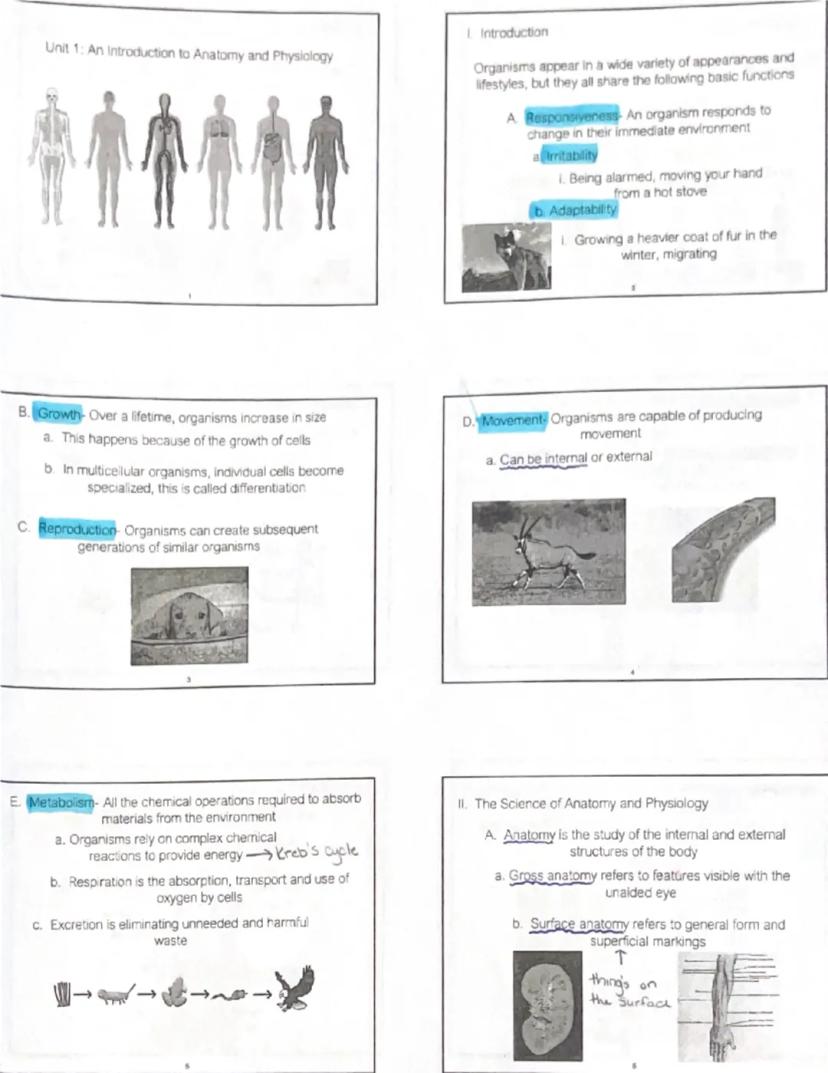


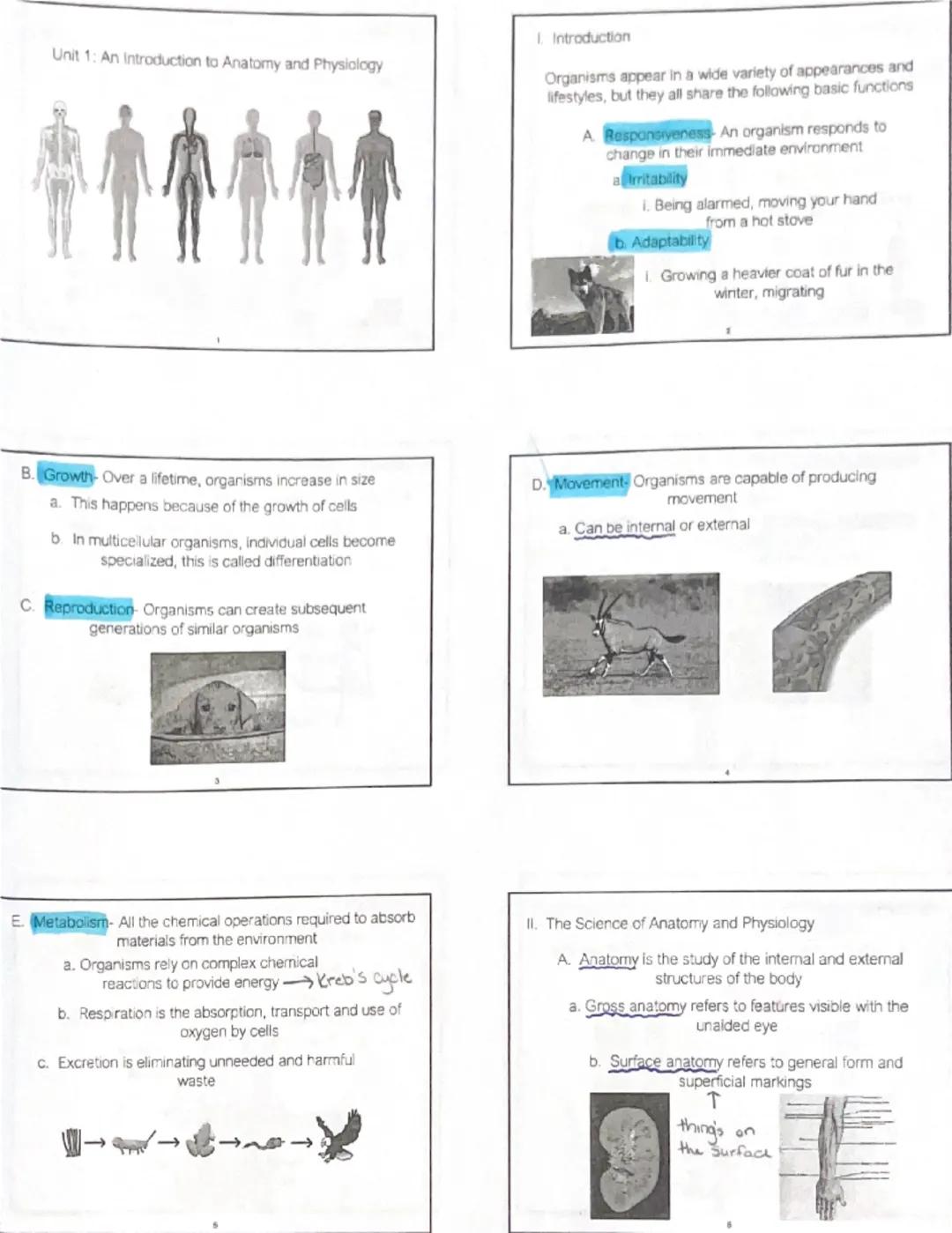
All living organisms share fundamental functions that keep them alive. Responsiveness allows organisms to react to changes in their environment, whether through irritability (like pulling your hand away from a hot stove) or adaptability (like growing thicker fur in winter). Growth occurs as cells increase in size and become specialized through differentiation.
Every organism can create new generations through reproduction and produce movement, either internally or externally. Metabolism encompasses all chemical operations needed to absorb materials from the environment, including energy production through complex reactions like the Kreb's cycle.
Anatomy is the study of body structures, which can be examined at different levels. Gross anatomy looks at features visible to the naked eye, while surface anatomy focuses on external form. Microscopic anatomy requires magnification to study cells (cytology) and tissues (histology).
💡 Think of anatomy as the "what" and physiology as the "how" of your body. Anatomy identifies the structures, while physiology explains how those structures actually work!
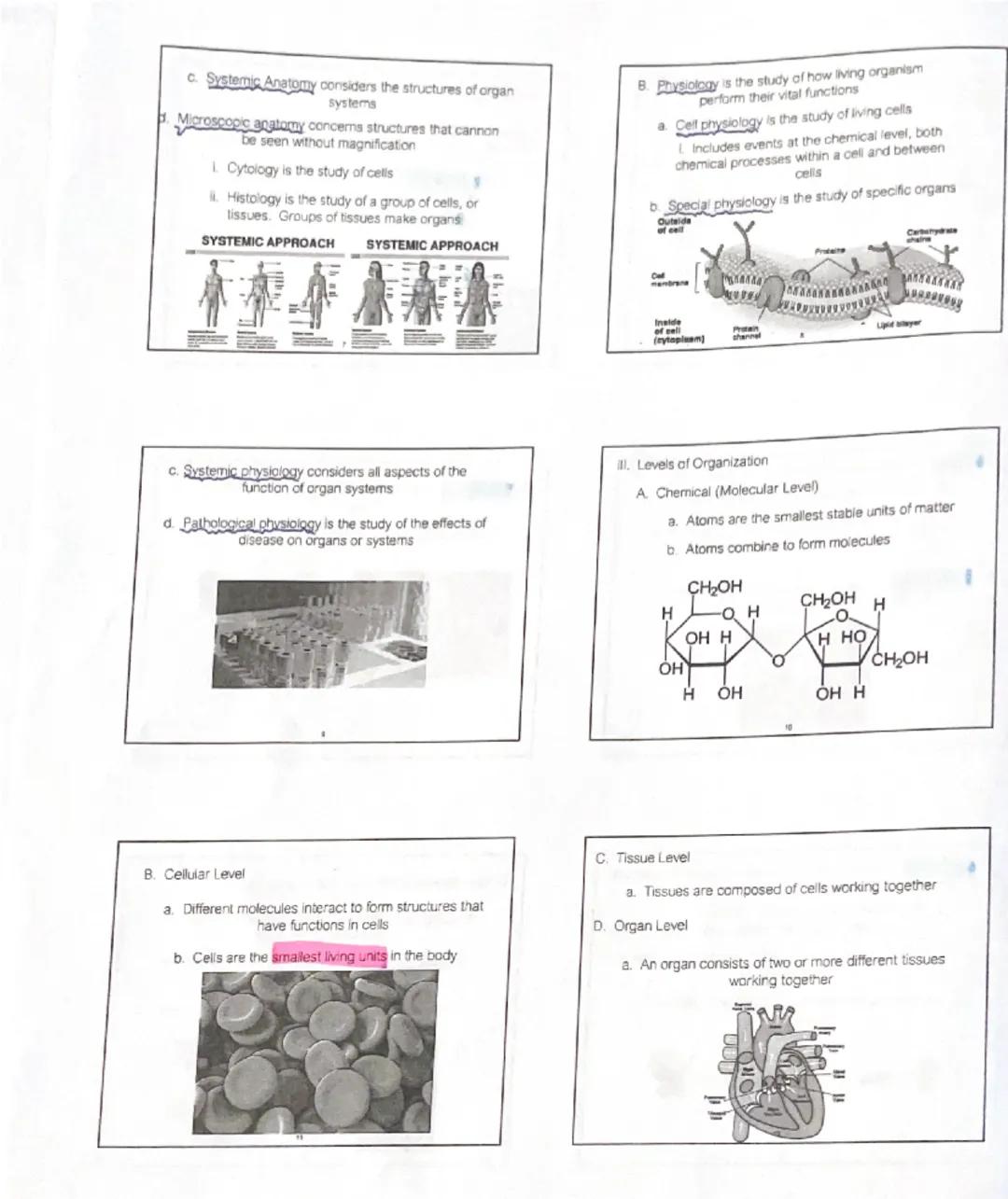
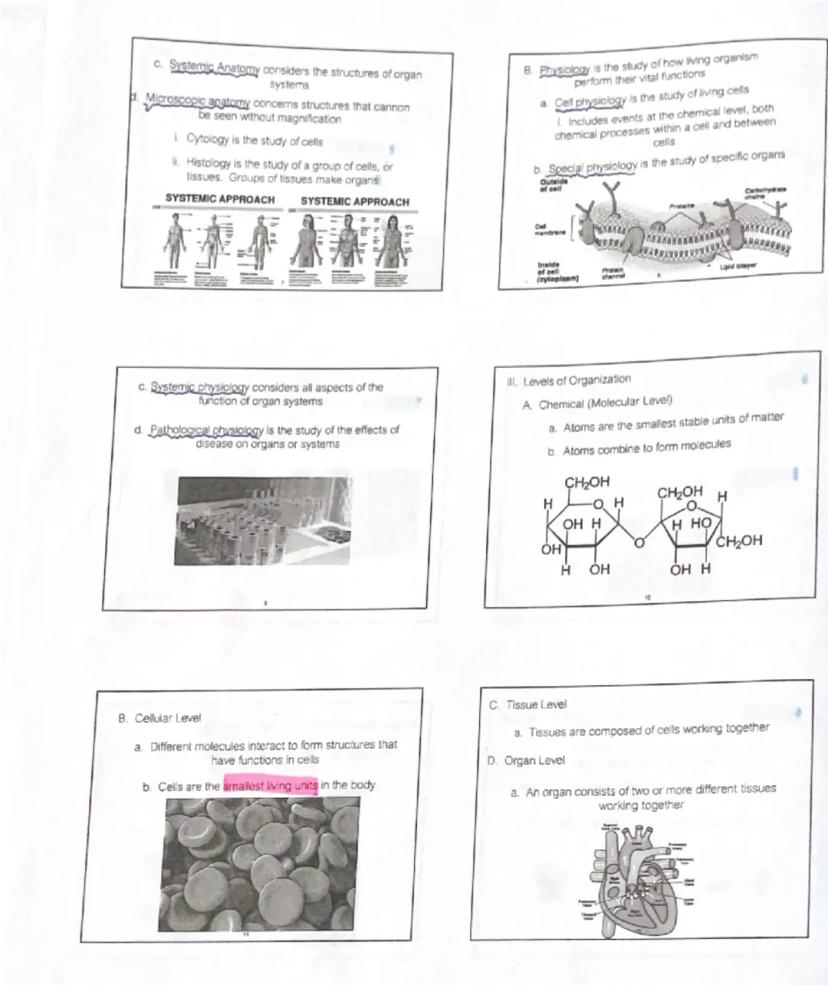
Physiology examines how organisms perform vital functions. This ranges from cell physiology (studying living cells and chemical processes) to special physiology (focusing on specific organs) and systemic physiology (examining entire organ systems).
The human body is organized in increasing levels of complexity. At the most basic level, atoms combine to form molecules. These molecules interact to create cellular structures with specific functions. Cells, the smallest living units in the body, work together to form tissues.
Different types of tissues collaborate to create organs with specific functions. Multiple organs interact as organ systems to perform complex tasks. Finally, all organ systems function together at the organism level to maintain life.
🔍 Your body is like a well-organized company! Atoms and molecules are like the raw materials, cells are the workers, tissues are departments, organs are divisions, and organ systems are the major branches all working together to keep the company (your body) running smoothly.
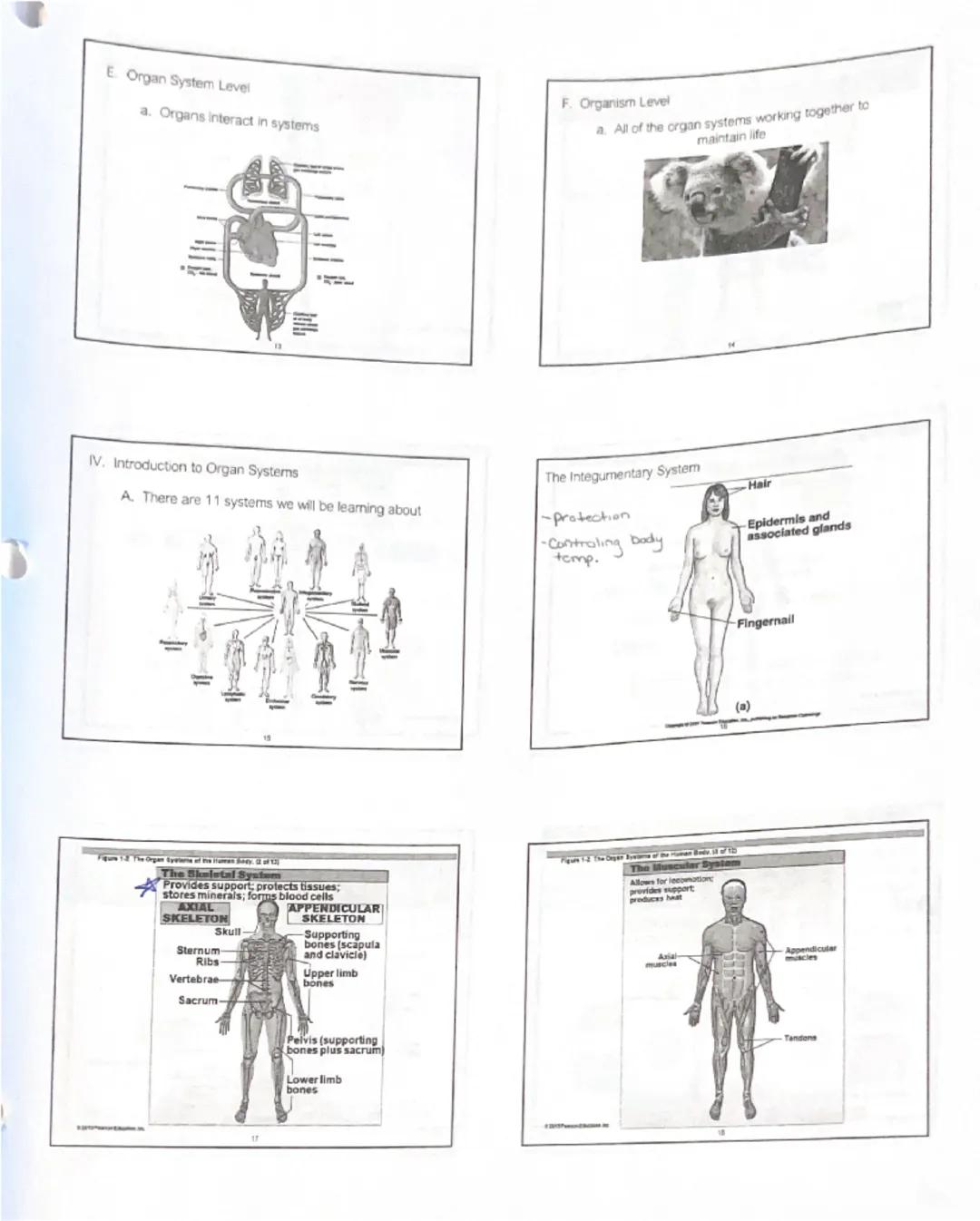
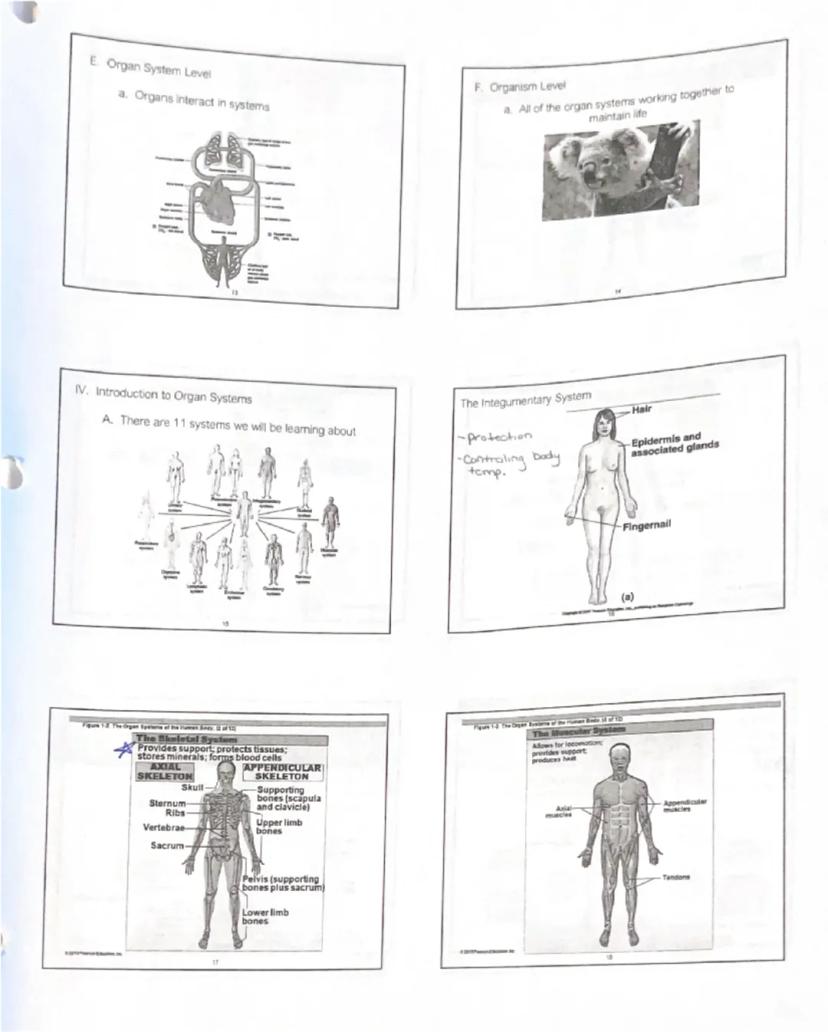
Your body contains 11 major organ systems that work together to keep you alive. The integumentary system (skin, hair, nails) protects you and helps control body temperature. The skeletal system provides support, protects tissues, stores minerals, and forms blood cells through both the axial skeleton (skull, ribs, vertebrae) and appendicular skeleton (limbs and supporting bones).
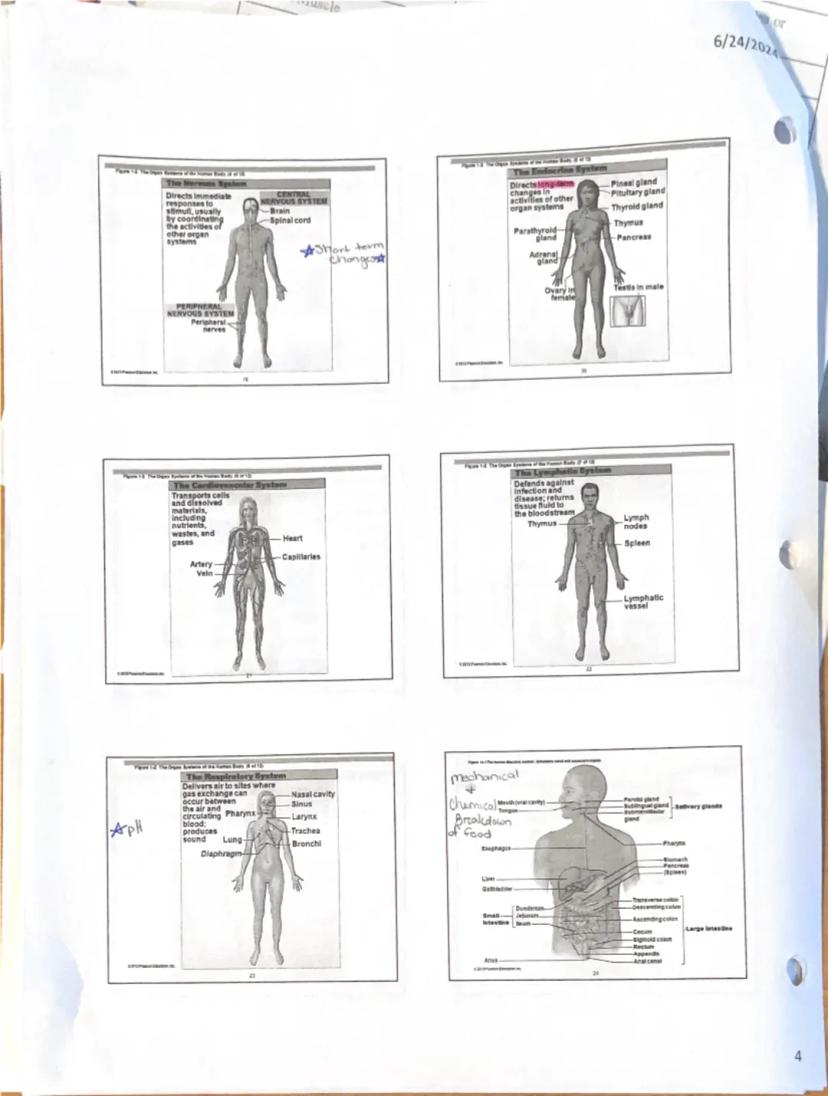
The muscular system allows for movement through axial muscles (attached to the skeleton) and other muscle groups. The nervous system directs most activities of other organ systems through the brain, spinal cord, and peripheral nerves. Meanwhile, the circulatory system transports cells, nutrients, and wastes throughout the body via the heart, arteries, veins, and capillaries.
The respiratory system delivers air to sites where gas exchange can occur between air and circulating blood, involving structures like the nasal cavity, trachea, and lungs. All these systems function together in a remarkable biological symphony.
🌟 Every organ system depends on others to function properly. When you exercise, your muscular, respiratory, circulatory, and nervous systems all work together to keep your body moving efficiently!
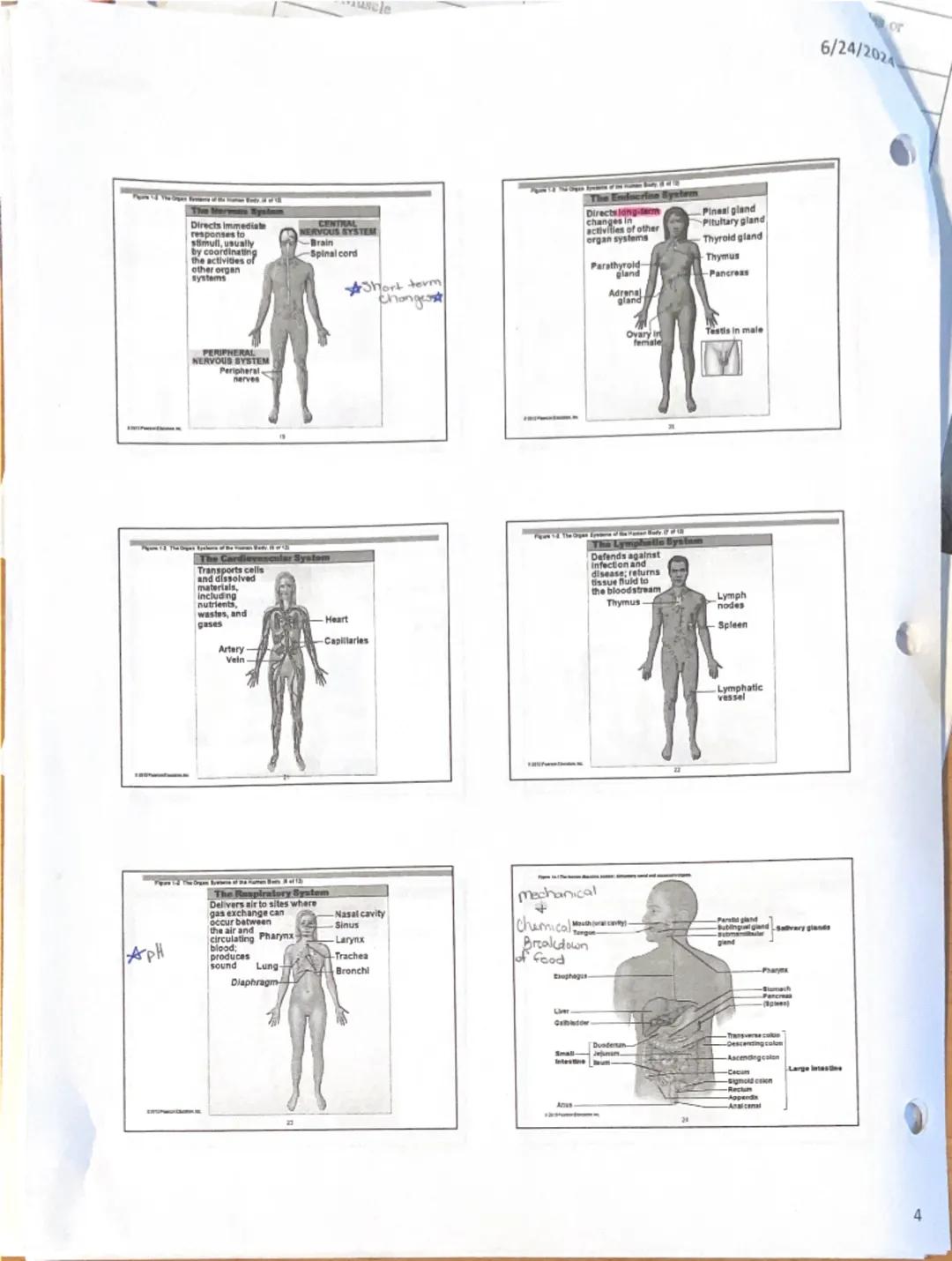
The endocrine system influences the activities of other systems through hormones released by glands like the pituitary, thyroid, adrenal glands, and pancreas. These chemical messengers travel through your bloodstream to create both short-term and long-term changes in your body.
Your lymphatic system defends against infection and disease while returning tissue fluid to the bloodstream. Key structures include lymph nodes, the spleen, and the thymus. The digestive system breaks down food both mechanically and chemically, involving the esophagus and other specialized structures.
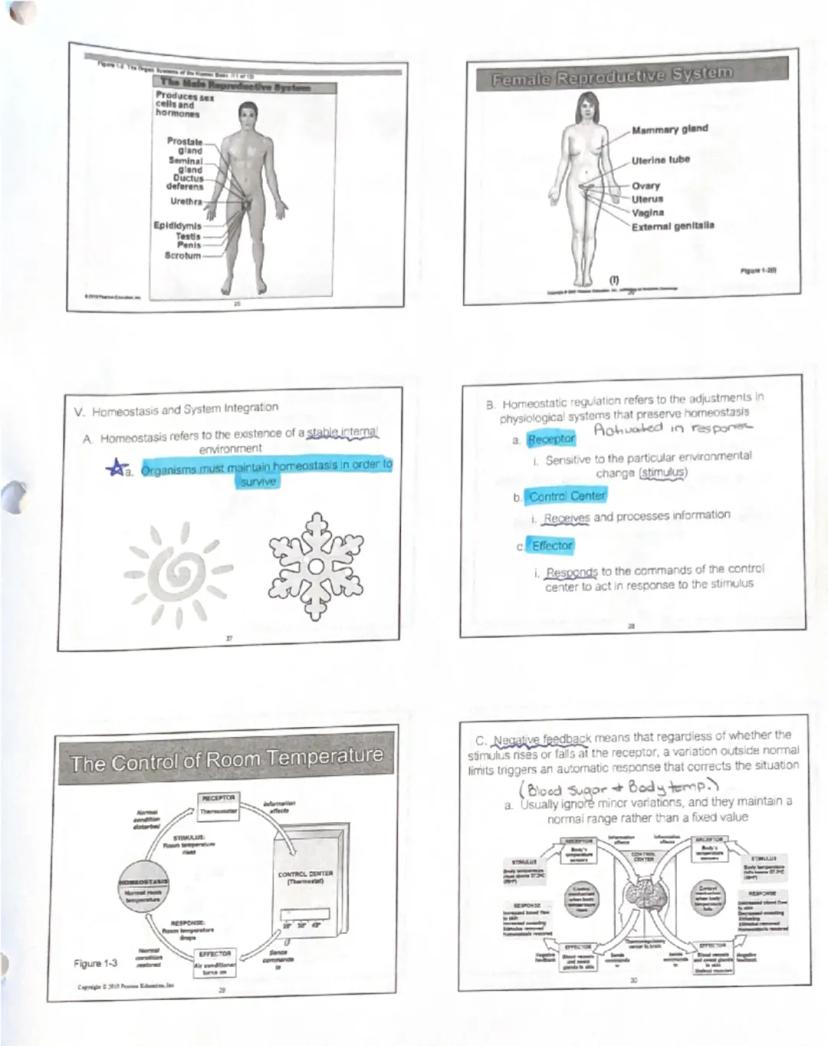
The urinary system removes wastes from the blood and regulates water, electrolyte, and acid-base balance in your body fluids. The reproductive system produces sex cells and hormones, with different structures in males (testes, prostate gland) and females (ovaries, uterus, mammary glands).
🧠 Your endocrine and nervous systems work like your body's communication networks - the nervous system sends rapid electrical messages like text messages, while the endocrine system sends slower-acting hormonal messages like emails that have longer-lasting effects!

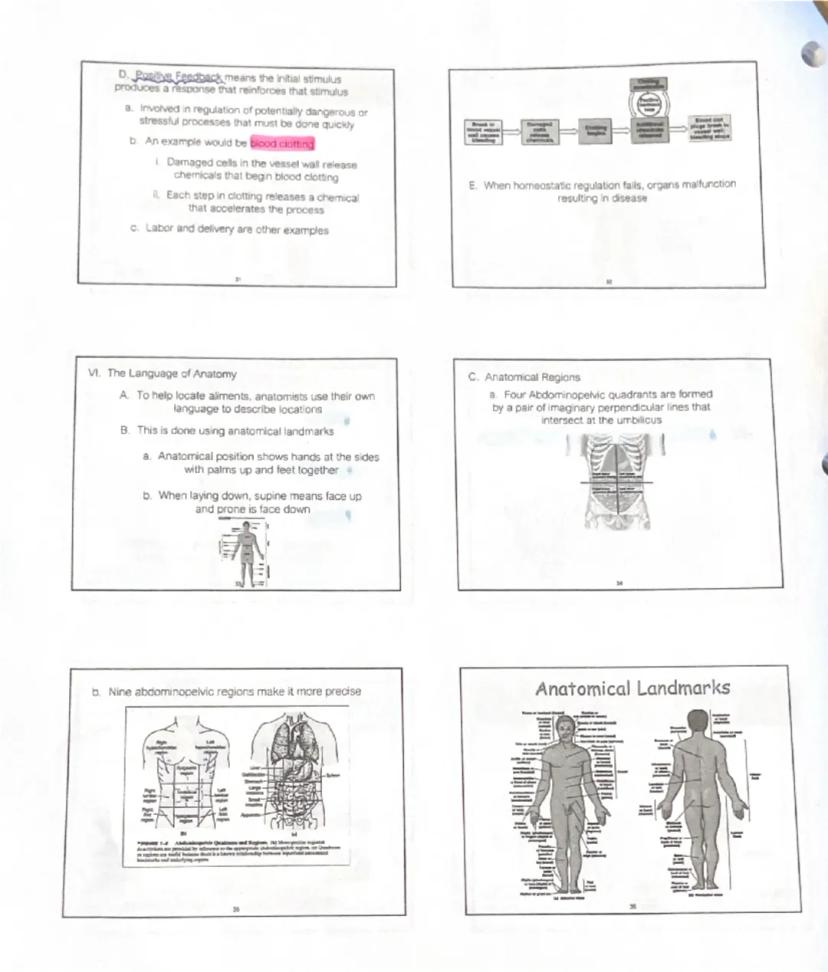
Homeostasis refers to maintaining a stable internal environment, which is essential for survival. Homeostatic regulation involves adjustments in physiological systems to preserve this stability through a three-part process: receptors sense environmental changes, control centers process this information, and effectors respond with corrective actions.
Most body functions maintain balance through negative feedback systems. When a stimulus (like high blood sugar or body temperature) deviates from normal range, automatic responses trigger to counteract and correct the variation. These systems typically ignore minor fluctuations and maintain values within a normal range rather than at an exact fixed point.
Positive feedback systems, unlike negative feedback, reinforce the original stimulus. This accelerating response is reserved for processes that must happen quickly, like blood clotting or childbirth. When damaged blood vessels release clotting chemicals, each step releases more chemicals to speed up the process until completion.
⚖️ Your body is constantly balancing thousands of variables! Think of negative feedback like a thermostat - when your body temperature rises too high, you sweat to cool down; when it drops too low, you shiver to warm up.
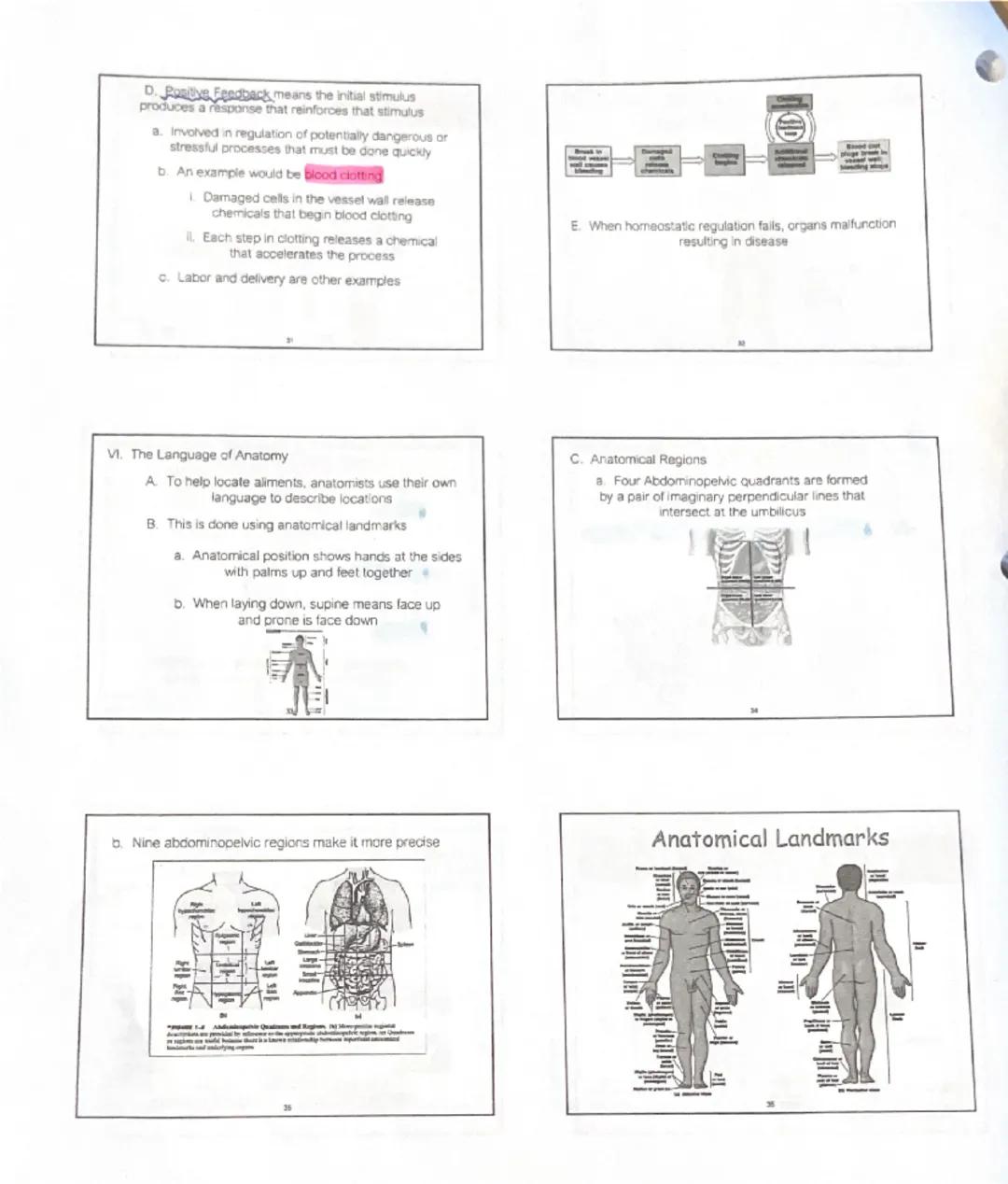
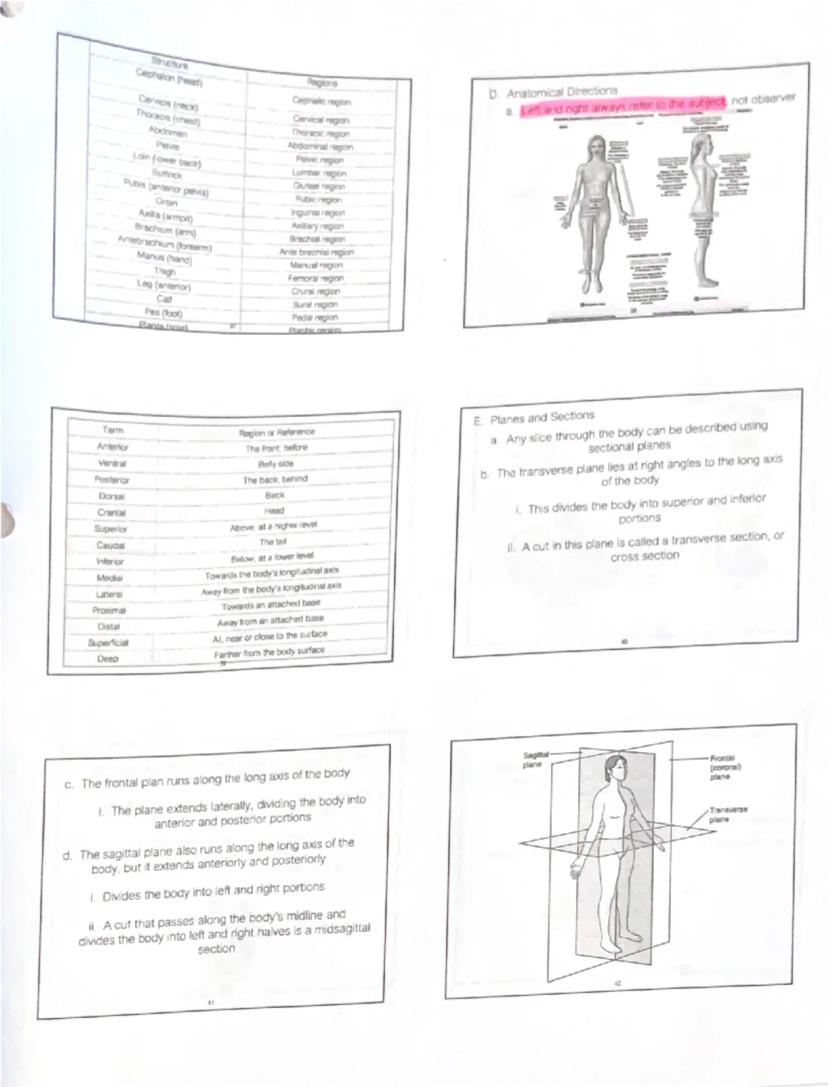
Anatomists use a specialized vocabulary to precisely describe body locations. The anatomical position serves as a universal reference point, with the body standing upright, hands at the sides with palms forward, and feet together. When lying down, "supine" means face up and "prone" means face down.
To identify specific areas, the body is divided into regions using anatomical landmarks. Four abdominopelvic quadrants are formed by imaginary perpendicular lines intersecting at the navel, while nine more detailed abdominopelvic regions provide greater precision for locating internal structures.
When describing directions in the body, terms are always from the subject's perspective, not the observer's. For example, "anterior" means toward the front, "posterior" means toward the back, "superior" refers to above, and "inferior" means below. "Medial" indicates toward the midline while "lateral" means away from it.
🗺️ Anatomical terminology is like having a GPS for the body! By using precise terms like "proximal" (closer to the attachment point) and "distal" (farther from the attachment point), healthcare professionals can communicate exactly where something is located.
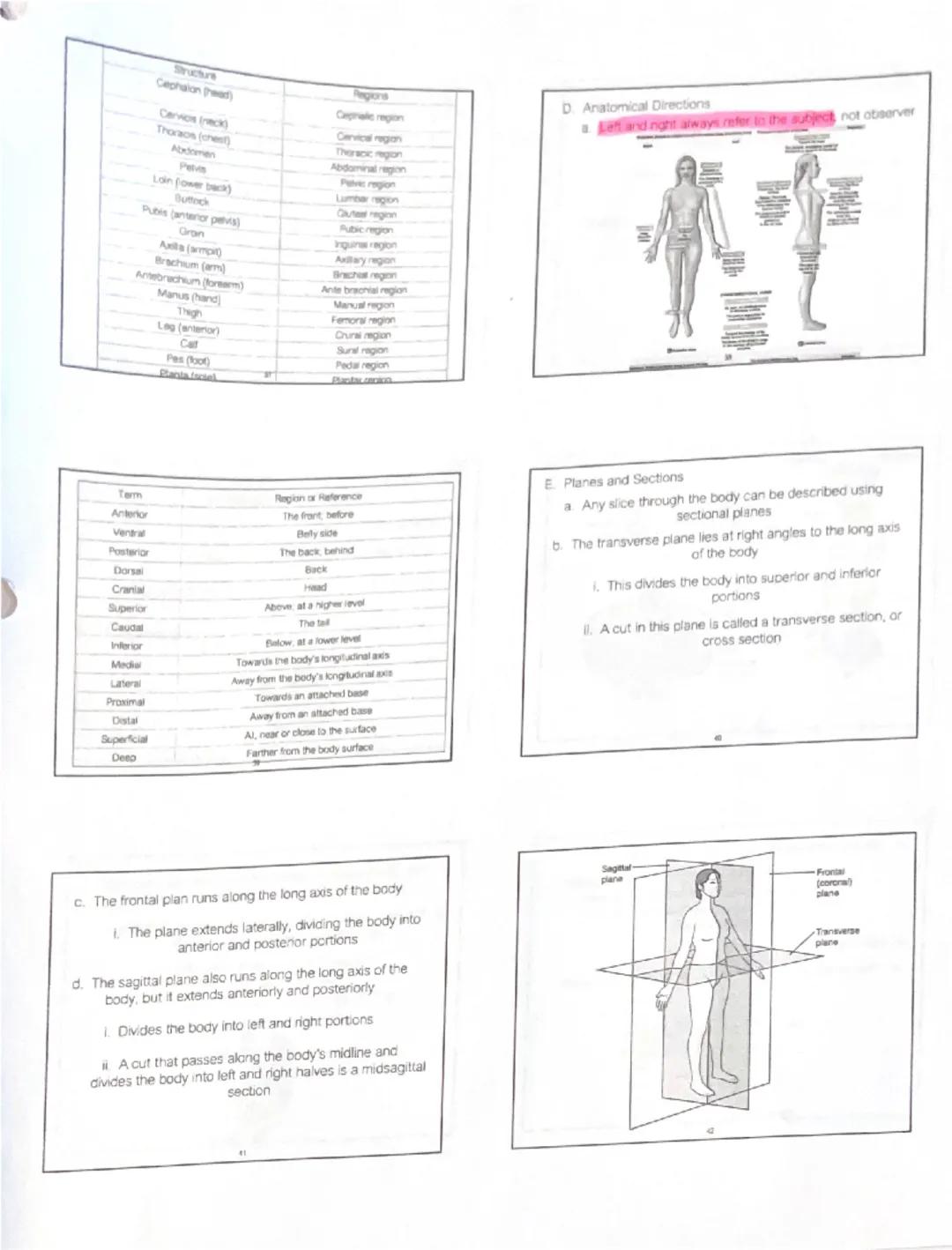
The body can be divided into major regions with specific names. The cephalic region refers to the head, cervical to the neck, thoracic to the chest, and so on. Each area has a proper anatomical term that precisely identifies its location.
Anatomical directions always use the subject as reference. For example, anterior or ventral refers to the front side, while posterior or dorsal indicates the back. Superior (cranial) points toward the head, and inferior (caudal) points toward the feet. Medial means toward the midline, while lateral refers to away from it.
Sectional planes describe specific slices through the body. The transverse plane runs perpendicular to the body's long axis, dividing it into superior and inferior portions. The frontal plane extends laterally along the long axis, separating anterior and posterior sections. The sagittal plane runs anteriorly and posteriorly along the long axis, dividing the body into left and right portions.
📏 Medical imaging like MRI and CT scans use these planes to create "slices" of your body! When doctors look at a transverse slice, they're seeing a cross-section as if they cut horizontally through your body at that point.
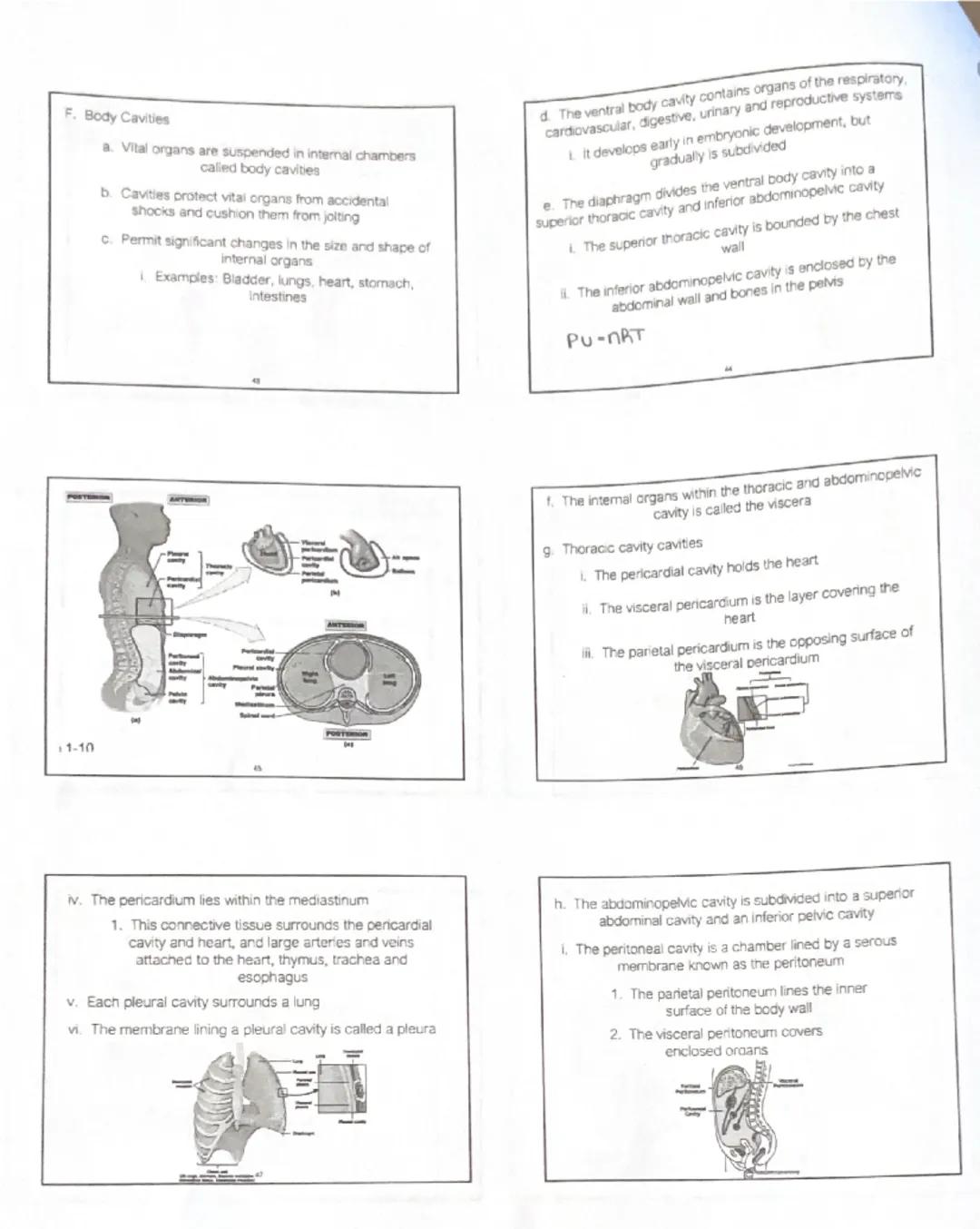
Vital organs are housed within body cavities that provide protection from accidental impacts and allow for changes in organ size and shape. The ventral body cavity contains organs of the respiratory, cardiovascular, digestive, urinary, and reproductive systems.
The diaphragm divides the ventral cavity into two main sections: the superior thoracic cavity (enclosed by the chest wall) and the inferior abdominopelvic cavity (surrounded by the abdominal wall and pelvic bones). The organs within these cavities are collectively called viscera.
The thoracic cavity contains several smaller cavities. The pericardial cavity houses the heart, covered by membranes called the visceral and parietal pericardium. The mediastinum is connective tissue surrounding the heart and major blood vessels. Each pleural cavity surrounds a lung and is lined by a membrane called the pleura.
🫁 Your body cavities are like specialized rooms in a house! The thoracic cavity is like an upstairs room containing your "breathing equipment" (lungs) and "pumping system" (heart), while the abdominopelvic cavity is like the downstairs area with your "processing plant" (digestive organs) and "filtering system" (kidneys).
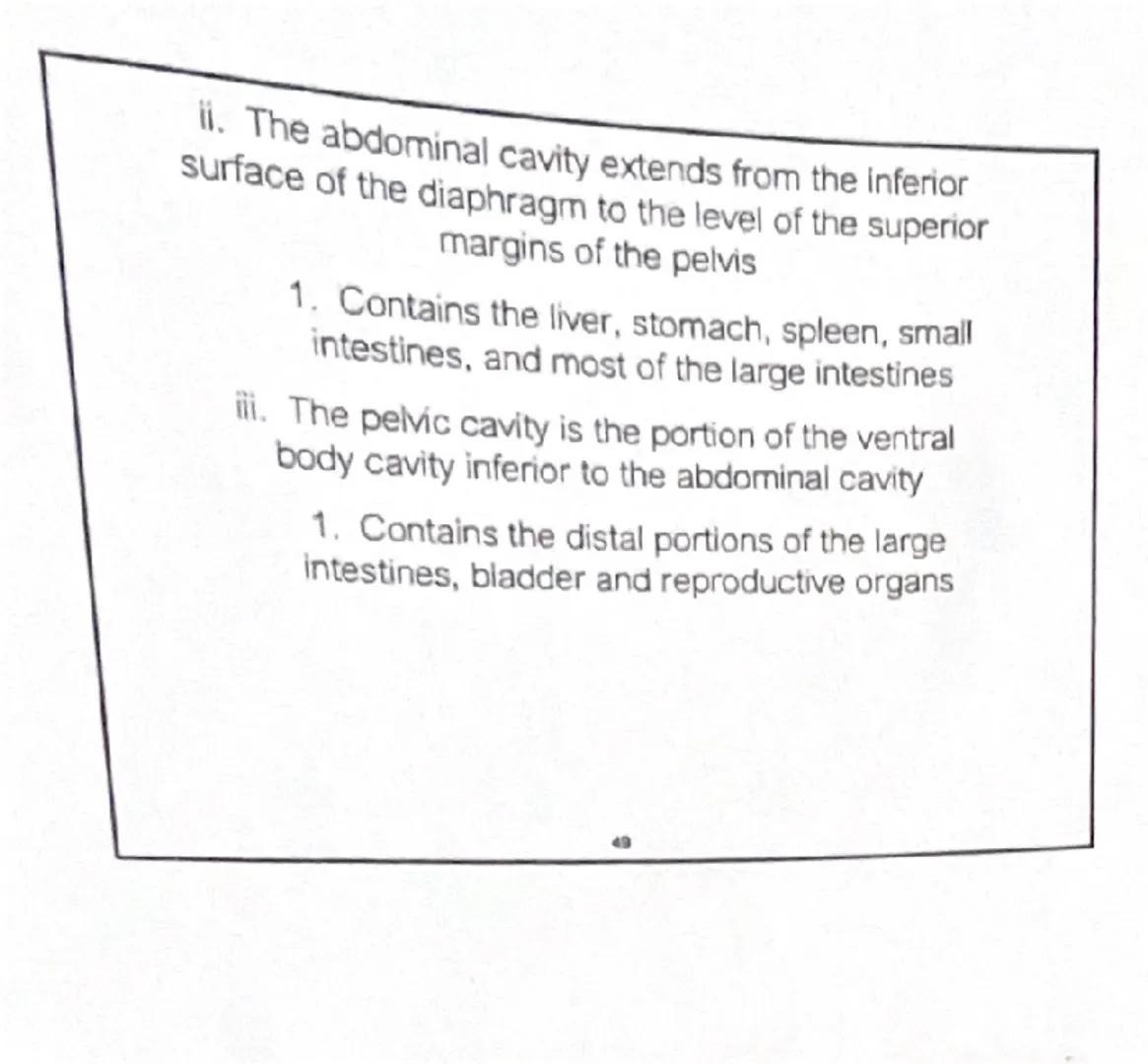
The abdominopelvic cavity is divided into the superior abdominal cavity and the inferior pelvic cavity. Within this space is the peritoneal cavity, which is lined by a serous membrane called the peritoneum. The parietal peritoneum lines the inner body wall, while the visceral peritoneum covers the enclosed organs.
The abdominal cavity stretches from the diaphragm's inferior surface to the top edges of the pelvis. This area contains critical organs including the liver, stomach, spleen, small intestines, and most of the large intestines—all essential for digestion and nutrient processing.
The pelvic cavity lies below the abdominal cavity and houses the final portions of the large intestines, the bladder, and reproductive organs. This lower compartment is protected by the bones of the pelvis, providing extra security for these vital structures.
📌 Understanding body cavities is crucial for medical professionals! When someone has "abdominal pain," doctors need to determine which specific region and which organs might be affected to make an accurate diagnosis.
Our AI companion is specifically built for the needs of students. Based on the millions of content pieces we have on the platform we can provide truly meaningful and relevant answers to students. But its not only about answers, the companion is even more about guiding students through their daily learning challenges, with personalised study plans, quizzes or content pieces in the chat and 100% personalisation based on the students skills and developments.
You can download the app in the Google Play Store and in the Apple App Store.
That's right! Enjoy free access to study content, connect with fellow students, and get instant help – all at your fingertips.
App Store
Google Play
The app is very easy to use and well designed. I have found everything I was looking for so far and have been able to learn a lot from the presentations! I will definitely use the app for a class assignment! And of course it also helps a lot as an inspiration.
Stefan S
iOS user
This app is really great. There are so many study notes and help [...]. My problem subject is French, for example, and the app has so many options for help. Thanks to this app, I have improved my French. I would recommend it to anyone.
Samantha Klich
Android user
Wow, I am really amazed. I just tried the app because I've seen it advertised many times and was absolutely stunned. This app is THE HELP you want for school and above all, it offers so many things, such as workouts and fact sheets, which have been VERY helpful to me personally.
Anna
iOS user
I think it’s very much worth it and you’ll end up using it a lot once you get the hang of it and even after looking at others notes you can still ask your Artificial intelligence buddy the question and ask to simplify it if you still don’t get it!!! In the end I think it’s worth it 😊👍 ⚠️Also DID I MENTION ITS FREEE YOU DON’T HAVE TO PAY FOR ANYTHING AND STILL GET YOUR GRADES IN PERFECTLY❗️❗️⚠️
Thomas R
iOS user
Knowunity is the BEST app I’ve used in a minute. This is not an ai review or anything this is genuinely coming from a 7th grade student (I know 2011 im young) but dude this app is a 10/10 i have maintained a 3.8 gpa and have plenty of time for gaming. I love it and my mom is just happy I got good grades
Brad T
Android user
Not only did it help me find the answer but it also showed me alternative ways to solve it. I was horrible in math and science but now I have an a in both subjects. Thanks for the help🤍🤍
David K
iOS user
The app's just great! All I have to do is enter the topic in the search bar and I get the response real fast. I don't have to watch 10 YouTube videos to understand something, so I'm saving my time. Highly recommended!
Sudenaz Ocak
Android user
In school I was really bad at maths but thanks to the app, I am doing better now. I am so grateful that you made the app.
Greenlight Bonnie
Android user
I found this app a couple years ago and it has only gotten better since then. I really love it because it can help with written questions and photo questions. Also, it can find study guides that other people have made as well as flashcard sets and practice tests. The free version is also amazing for students who might not be able to afford it. Would 100% recommend
Aubrey
iOS user
Best app if you're in Highschool or Junior high. I have been using this app for 2 school years and it's the best, it's good if you don't have anyone to help you with school work.😋🩷🎀
Marco B
iOS user
THE QUIZES AND FLASHCARDS ARE SO USEFUL AND I LOVE Knowunity AI. IT ALSO IS LITREALLY LIKE CHATGPT BUT SMARTER!! HELPED ME WITH MY MASCARA PROBLEMS TOO!! AS WELL AS MY REAL SUBJECTS ! DUHHH 😍😁😲🤑💗✨🎀😮
Elisha
iOS user
This app is phenomenal down to the correct info and the various topics you can study! I greatly recommend it for people who struggle with procrastination and those who need homework help. It has been perfectly accurate for world 1 history as far as I’ve seen! Geometry too!
Paul T
iOS user
The app is very easy to use and well designed. I have found everything I was looking for so far and have been able to learn a lot from the presentations! I will definitely use the app for a class assignment! And of course it also helps a lot as an inspiration.
Stefan S
iOS user
This app is really great. There are so many study notes and help [...]. My problem subject is French, for example, and the app has so many options for help. Thanks to this app, I have improved my French. I would recommend it to anyone.
Samantha Klich
Android user
Wow, I am really amazed. I just tried the app because I've seen it advertised many times and was absolutely stunned. This app is THE HELP you want for school and above all, it offers so many things, such as workouts and fact sheets, which have been VERY helpful to me personally.
Anna
iOS user
I think it’s very much worth it and you’ll end up using it a lot once you get the hang of it and even after looking at others notes you can still ask your Artificial intelligence buddy the question and ask to simplify it if you still don’t get it!!! In the end I think it’s worth it 😊👍 ⚠️Also DID I MENTION ITS FREEE YOU DON’T HAVE TO PAY FOR ANYTHING AND STILL GET YOUR GRADES IN PERFECTLY❗️❗️⚠️
Thomas R
iOS user
Knowunity is the BEST app I’ve used in a minute. This is not an ai review or anything this is genuinely coming from a 7th grade student (I know 2011 im young) but dude this app is a 10/10 i have maintained a 3.8 gpa and have plenty of time for gaming. I love it and my mom is just happy I got good grades
Brad T
Android user
Not only did it help me find the answer but it also showed me alternative ways to solve it. I was horrible in math and science but now I have an a in both subjects. Thanks for the help🤍🤍
David K
iOS user
The app's just great! All I have to do is enter the topic in the search bar and I get the response real fast. I don't have to watch 10 YouTube videos to understand something, so I'm saving my time. Highly recommended!
Sudenaz Ocak
Android user
In school I was really bad at maths but thanks to the app, I am doing better now. I am so grateful that you made the app.
Greenlight Bonnie
Android user
I found this app a couple years ago and it has only gotten better since then. I really love it because it can help with written questions and photo questions. Also, it can find study guides that other people have made as well as flashcard sets and practice tests. The free version is also amazing for students who might not be able to afford it. Would 100% recommend
Aubrey
iOS user
Best app if you're in Highschool or Junior high. I have been using this app for 2 school years and it's the best, it's good if you don't have anyone to help you with school work.😋🩷🎀
Marco B
iOS user
THE QUIZES AND FLASHCARDS ARE SO USEFUL AND I LOVE Knowunity AI. IT ALSO IS LITREALLY LIKE CHATGPT BUT SMARTER!! HELPED ME WITH MY MASCARA PROBLEMS TOO!! AS WELL AS MY REAL SUBJECTS ! DUHHH 😍😁😲🤑💗✨🎀😮
Elisha
iOS user
This app is phenomenal down to the correct info and the various topics you can study! I greatly recommend it for people who struggle with procrastination and those who need homework help. It has been perfectly accurate for world 1 history as far as I’ve seen! Geometry too!
Paul T
iOS user
Kailey Truman
@aileyruman_j70qfy0ca
Anatomy and physiology form the foundation of understanding how our bodies work. These interconnected sciences explore both the structures within our bodies and how these structures function together to keep us alive. This introduction will help you grasp the essential... Show more
Access to all documents
Improve your grades
Join milions of students
All living organisms share fundamental functions that keep them alive. Responsiveness allows organisms to react to changes in their environment, whether through irritability (like pulling your hand away from a hot stove) or adaptability (like growing thicker fur in winter). Growth occurs as cells increase in size and become specialized through differentiation.
Every organism can create new generations through reproduction and produce movement, either internally or externally. Metabolism encompasses all chemical operations needed to absorb materials from the environment, including energy production through complex reactions like the Kreb's cycle.
Anatomy is the study of body structures, which can be examined at different levels. Gross anatomy looks at features visible to the naked eye, while surface anatomy focuses on external form. Microscopic anatomy requires magnification to study cells (cytology) and tissues (histology).
💡 Think of anatomy as the "what" and physiology as the "how" of your body. Anatomy identifies the structures, while physiology explains how those structures actually work!
Access to all documents
Improve your grades
Join milions of students
Physiology examines how organisms perform vital functions. This ranges from cell physiology (studying living cells and chemical processes) to special physiology (focusing on specific organs) and systemic physiology (examining entire organ systems).
The human body is organized in increasing levels of complexity. At the most basic level, atoms combine to form molecules. These molecules interact to create cellular structures with specific functions. Cells, the smallest living units in the body, work together to form tissues.
Different types of tissues collaborate to create organs with specific functions. Multiple organs interact as organ systems to perform complex tasks. Finally, all organ systems function together at the organism level to maintain life.
🔍 Your body is like a well-organized company! Atoms and molecules are like the raw materials, cells are the workers, tissues are departments, organs are divisions, and organ systems are the major branches all working together to keep the company (your body) running smoothly.
Access to all documents
Improve your grades
Join milions of students
Your body contains 11 major organ systems that work together to keep you alive. The integumentary system (skin, hair, nails) protects you and helps control body temperature. The skeletal system provides support, protects tissues, stores minerals, and forms blood cells through both the axial skeleton (skull, ribs, vertebrae) and appendicular skeleton (limbs and supporting bones).
The muscular system allows for movement through axial muscles (attached to the skeleton) and other muscle groups. The nervous system directs most activities of other organ systems through the brain, spinal cord, and peripheral nerves. Meanwhile, the circulatory system transports cells, nutrients, and wastes throughout the body via the heart, arteries, veins, and capillaries.
The respiratory system delivers air to sites where gas exchange can occur between air and circulating blood, involving structures like the nasal cavity, trachea, and lungs. All these systems function together in a remarkable biological symphony.
🌟 Every organ system depends on others to function properly. When you exercise, your muscular, respiratory, circulatory, and nervous systems all work together to keep your body moving efficiently!
Access to all documents
Improve your grades
Join milions of students
The endocrine system influences the activities of other systems through hormones released by glands like the pituitary, thyroid, adrenal glands, and pancreas. These chemical messengers travel through your bloodstream to create both short-term and long-term changes in your body.
Your lymphatic system defends against infection and disease while returning tissue fluid to the bloodstream. Key structures include lymph nodes, the spleen, and the thymus. The digestive system breaks down food both mechanically and chemically, involving the esophagus and other specialized structures.
The urinary system removes wastes from the blood and regulates water, electrolyte, and acid-base balance in your body fluids. The reproductive system produces sex cells and hormones, with different structures in males (testes, prostate gland) and females (ovaries, uterus, mammary glands).
🧠 Your endocrine and nervous systems work like your body's communication networks - the nervous system sends rapid electrical messages like text messages, while the endocrine system sends slower-acting hormonal messages like emails that have longer-lasting effects!
Access to all documents
Improve your grades
Join milions of students
Homeostasis refers to maintaining a stable internal environment, which is essential for survival. Homeostatic regulation involves adjustments in physiological systems to preserve this stability through a three-part process: receptors sense environmental changes, control centers process this information, and effectors respond with corrective actions.
Most body functions maintain balance through negative feedback systems. When a stimulus (like high blood sugar or body temperature) deviates from normal range, automatic responses trigger to counteract and correct the variation. These systems typically ignore minor fluctuations and maintain values within a normal range rather than at an exact fixed point.
Positive feedback systems, unlike negative feedback, reinforce the original stimulus. This accelerating response is reserved for processes that must happen quickly, like blood clotting or childbirth. When damaged blood vessels release clotting chemicals, each step releases more chemicals to speed up the process until completion.
⚖️ Your body is constantly balancing thousands of variables! Think of negative feedback like a thermostat - when your body temperature rises too high, you sweat to cool down; when it drops too low, you shiver to warm up.
Access to all documents
Improve your grades
Join milions of students
Anatomists use a specialized vocabulary to precisely describe body locations. The anatomical position serves as a universal reference point, with the body standing upright, hands at the sides with palms forward, and feet together. When lying down, "supine" means face up and "prone" means face down.
To identify specific areas, the body is divided into regions using anatomical landmarks. Four abdominopelvic quadrants are formed by imaginary perpendicular lines intersecting at the navel, while nine more detailed abdominopelvic regions provide greater precision for locating internal structures.
When describing directions in the body, terms are always from the subject's perspective, not the observer's. For example, "anterior" means toward the front, "posterior" means toward the back, "superior" refers to above, and "inferior" means below. "Medial" indicates toward the midline while "lateral" means away from it.
🗺️ Anatomical terminology is like having a GPS for the body! By using precise terms like "proximal" (closer to the attachment point) and "distal" (farther from the attachment point), healthcare professionals can communicate exactly where something is located.
Access to all documents
Improve your grades
Join milions of students
The body can be divided into major regions with specific names. The cephalic region refers to the head, cervical to the neck, thoracic to the chest, and so on. Each area has a proper anatomical term that precisely identifies its location.
Anatomical directions always use the subject as reference. For example, anterior or ventral refers to the front side, while posterior or dorsal indicates the back. Superior (cranial) points toward the head, and inferior (caudal) points toward the feet. Medial means toward the midline, while lateral refers to away from it.
Sectional planes describe specific slices through the body. The transverse plane runs perpendicular to the body's long axis, dividing it into superior and inferior portions. The frontal plane extends laterally along the long axis, separating anterior and posterior sections. The sagittal plane runs anteriorly and posteriorly along the long axis, dividing the body into left and right portions.
📏 Medical imaging like MRI and CT scans use these planes to create "slices" of your body! When doctors look at a transverse slice, they're seeing a cross-section as if they cut horizontally through your body at that point.
Access to all documents
Improve your grades
Join milions of students
Vital organs are housed within body cavities that provide protection from accidental impacts and allow for changes in organ size and shape. The ventral body cavity contains organs of the respiratory, cardiovascular, digestive, urinary, and reproductive systems.
The diaphragm divides the ventral cavity into two main sections: the superior thoracic cavity (enclosed by the chest wall) and the inferior abdominopelvic cavity (surrounded by the abdominal wall and pelvic bones). The organs within these cavities are collectively called viscera.
The thoracic cavity contains several smaller cavities. The pericardial cavity houses the heart, covered by membranes called the visceral and parietal pericardium. The mediastinum is connective tissue surrounding the heart and major blood vessels. Each pleural cavity surrounds a lung and is lined by a membrane called the pleura.
🫁 Your body cavities are like specialized rooms in a house! The thoracic cavity is like an upstairs room containing your "breathing equipment" (lungs) and "pumping system" (heart), while the abdominopelvic cavity is like the downstairs area with your "processing plant" (digestive organs) and "filtering system" (kidneys).
Access to all documents
Improve your grades
Join milions of students
The abdominopelvic cavity is divided into the superior abdominal cavity and the inferior pelvic cavity. Within this space is the peritoneal cavity, which is lined by a serous membrane called the peritoneum. The parietal peritoneum lines the inner body wall, while the visceral peritoneum covers the enclosed organs.
The abdominal cavity stretches from the diaphragm's inferior surface to the top edges of the pelvis. This area contains critical organs including the liver, stomach, spleen, small intestines, and most of the large intestines—all essential for digestion and nutrient processing.
The pelvic cavity lies below the abdominal cavity and houses the final portions of the large intestines, the bladder, and reproductive organs. This lower compartment is protected by the bones of the pelvis, providing extra security for these vital structures.
📌 Understanding body cavities is crucial for medical professionals! When someone has "abdominal pain," doctors need to determine which specific region and which organs might be affected to make an accurate diagnosis.
Our AI companion is specifically built for the needs of students. Based on the millions of content pieces we have on the platform we can provide truly meaningful and relevant answers to students. But its not only about answers, the companion is even more about guiding students through their daily learning challenges, with personalised study plans, quizzes or content pieces in the chat and 100% personalisation based on the students skills and developments.
You can download the app in the Google Play Store and in the Apple App Store.
That's right! Enjoy free access to study content, connect with fellow students, and get instant help – all at your fingertips.
0
Smart Tools NEW
Transform this note into: ✓ 50+ Practice Questions ✓ Interactive Flashcards ✓ Full Practice Test ✓ Essay Outlines
App Store
Google Play
The app is very easy to use and well designed. I have found everything I was looking for so far and have been able to learn a lot from the presentations! I will definitely use the app for a class assignment! And of course it also helps a lot as an inspiration.
Stefan S
iOS user
This app is really great. There are so many study notes and help [...]. My problem subject is French, for example, and the app has so many options for help. Thanks to this app, I have improved my French. I would recommend it to anyone.
Samantha Klich
Android user
Wow, I am really amazed. I just tried the app because I've seen it advertised many times and was absolutely stunned. This app is THE HELP you want for school and above all, it offers so many things, such as workouts and fact sheets, which have been VERY helpful to me personally.
Anna
iOS user
I think it’s very much worth it and you’ll end up using it a lot once you get the hang of it and even after looking at others notes you can still ask your Artificial intelligence buddy the question and ask to simplify it if you still don’t get it!!! In the end I think it’s worth it 😊👍 ⚠️Also DID I MENTION ITS FREEE YOU DON’T HAVE TO PAY FOR ANYTHING AND STILL GET YOUR GRADES IN PERFECTLY❗️❗️⚠️
Thomas R
iOS user
Knowunity is the BEST app I’ve used in a minute. This is not an ai review or anything this is genuinely coming from a 7th grade student (I know 2011 im young) but dude this app is a 10/10 i have maintained a 3.8 gpa and have plenty of time for gaming. I love it and my mom is just happy I got good grades
Brad T
Android user
Not only did it help me find the answer but it also showed me alternative ways to solve it. I was horrible in math and science but now I have an a in both subjects. Thanks for the help🤍🤍
David K
iOS user
The app's just great! All I have to do is enter the topic in the search bar and I get the response real fast. I don't have to watch 10 YouTube videos to understand something, so I'm saving my time. Highly recommended!
Sudenaz Ocak
Android user
In school I was really bad at maths but thanks to the app, I am doing better now. I am so grateful that you made the app.
Greenlight Bonnie
Android user
I found this app a couple years ago and it has only gotten better since then. I really love it because it can help with written questions and photo questions. Also, it can find study guides that other people have made as well as flashcard sets and practice tests. The free version is also amazing for students who might not be able to afford it. Would 100% recommend
Aubrey
iOS user
Best app if you're in Highschool or Junior high. I have been using this app for 2 school years and it's the best, it's good if you don't have anyone to help you with school work.😋🩷🎀
Marco B
iOS user
THE QUIZES AND FLASHCARDS ARE SO USEFUL AND I LOVE Knowunity AI. IT ALSO IS LITREALLY LIKE CHATGPT BUT SMARTER!! HELPED ME WITH MY MASCARA PROBLEMS TOO!! AS WELL AS MY REAL SUBJECTS ! DUHHH 😍😁😲🤑💗✨🎀😮
Elisha
iOS user
This app is phenomenal down to the correct info and the various topics you can study! I greatly recommend it for people who struggle with procrastination and those who need homework help. It has been perfectly accurate for world 1 history as far as I’ve seen! Geometry too!
Paul T
iOS user
The app is very easy to use and well designed. I have found everything I was looking for so far and have been able to learn a lot from the presentations! I will definitely use the app for a class assignment! And of course it also helps a lot as an inspiration.
Stefan S
iOS user
This app is really great. There are so many study notes and help [...]. My problem subject is French, for example, and the app has so many options for help. Thanks to this app, I have improved my French. I would recommend it to anyone.
Samantha Klich
Android user
Wow, I am really amazed. I just tried the app because I've seen it advertised many times and was absolutely stunned. This app is THE HELP you want for school and above all, it offers so many things, such as workouts and fact sheets, which have been VERY helpful to me personally.
Anna
iOS user
I think it’s very much worth it and you’ll end up using it a lot once you get the hang of it and even after looking at others notes you can still ask your Artificial intelligence buddy the question and ask to simplify it if you still don’t get it!!! In the end I think it’s worth it 😊👍 ⚠️Also DID I MENTION ITS FREEE YOU DON’T HAVE TO PAY FOR ANYTHING AND STILL GET YOUR GRADES IN PERFECTLY❗️❗️⚠️
Thomas R
iOS user
Knowunity is the BEST app I’ve used in a minute. This is not an ai review or anything this is genuinely coming from a 7th grade student (I know 2011 im young) but dude this app is a 10/10 i have maintained a 3.8 gpa and have plenty of time for gaming. I love it and my mom is just happy I got good grades
Brad T
Android user
Not only did it help me find the answer but it also showed me alternative ways to solve it. I was horrible in math and science but now I have an a in both subjects. Thanks for the help🤍🤍
David K
iOS user
The app's just great! All I have to do is enter the topic in the search bar and I get the response real fast. I don't have to watch 10 YouTube videos to understand something, so I'm saving my time. Highly recommended!
Sudenaz Ocak
Android user
In school I was really bad at maths but thanks to the app, I am doing better now. I am so grateful that you made the app.
Greenlight Bonnie
Android user
I found this app a couple years ago and it has only gotten better since then. I really love it because it can help with written questions and photo questions. Also, it can find study guides that other people have made as well as flashcard sets and practice tests. The free version is also amazing for students who might not be able to afford it. Would 100% recommend
Aubrey
iOS user
Best app if you're in Highschool or Junior high. I have been using this app for 2 school years and it's the best, it's good if you don't have anyone to help you with school work.😋🩷🎀
Marco B
iOS user
THE QUIZES AND FLASHCARDS ARE SO USEFUL AND I LOVE Knowunity AI. IT ALSO IS LITREALLY LIKE CHATGPT BUT SMARTER!! HELPED ME WITH MY MASCARA PROBLEMS TOO!! AS WELL AS MY REAL SUBJECTS ! DUHHH 😍😁😲🤑💗✨🎀😮
Elisha
iOS user
This app is phenomenal down to the correct info and the various topics you can study! I greatly recommend it for people who struggle with procrastination and those who need homework help. It has been perfectly accurate for world 1 history as far as I’ve seen! Geometry too!
Paul T
iOS user