
Post-World War I Italy was a tinderbox of economic crisis,... Show more
 History
 Irish
Irish English
 Biology
Sign up to see the contentIt's free!
Access to all documents
Improve your grades
Join milions of students
Knowunity AI
Subjects
Triangle Congruence and Similarity Theorems
Triangle Properties and Classification
Linear Equations and Graphs
Geometric Angle Relationships
Trigonometric Functions and Identities
Equation Solving Techniques
Circle Geometry Fundamentals
Division Operations and Methods
Basic Differentiation Rules
Exponent and Logarithm Properties
Show all topics
Human Organ Systems
Reproductive Cell Cycles
Biological Sciences Subdisciplines
Cellular Energy Metabolism
Autotrophic Energy Processes
Inheritance Patterns and Principles
Biomolecular Structure and Organization
Cell Cycle and Division Mechanics
Cellular Organization and Development
Biological Structural Organization
Show all topics
Chemical Sciences and Applications
Atomic Structure and Composition
Molecular Electron Structure Representation
Atomic Electron Behavior
Matter Properties and Water
Mole Concept and Calculations
Gas Laws and Behavior
Periodic Table Organization
Chemical Thermodynamics Fundamentals
Chemical Bond Types and Properties
Show all topics
European Renaissance and Enlightenment
European Cultural Movements 800-1920
American Revolution Era 1763-1797
American Civil War 1861-1865
Global Imperial Systems
Mongol and Chinese Dynasties
U.S. Presidents and World Leaders
Historical Sources and Documentation
World Wars Era and Impact
World Religious Systems
Show all topics
Classic and Contemporary Novels
Literary Character Analysis
Rhetorical Theory and Practice
Classic Literary Narratives
Reading Analysis and Interpretation
Narrative Structure and Techniques
English Language Components
Influential English-Language Authors
Basic Sentence Structure
Narrative Voice and Perspective
Show all topics
6
•
Updated Mar 31, 2026
•
Post-World War I Italy was a tinderbox of economic crisis,... Show more
Ever wondered how a radical movement like Fascism could take over a European democracy? The answer lies in the chaos of post-WWI Italy. Despite being on the winning side, Italy faced a perfect storm of crises that created fertile ground for extremism.
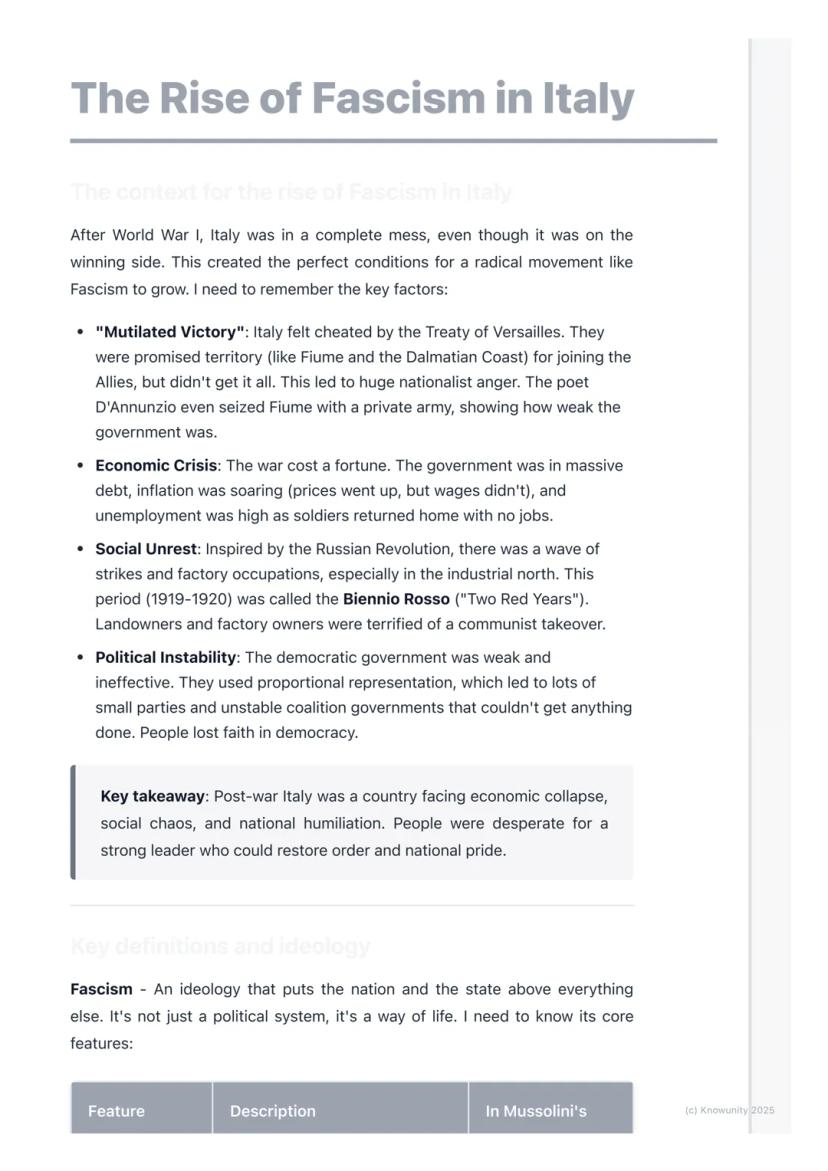
The "Mutilated Victory" left Italians feeling betrayed by the Treaty of Versailles. They had been promised significant territories for joining the Allies but received far less than expected. This national humiliation was dramatically highlighted when the poet D'Annunzio seized the city of Fiume with a private army—demonstrating just how weak the government had become.
The economic situation was equally dire. Massive war debts, soaring inflation, and high unemployment created widespread suffering. Meanwhile, inspired by Russia's revolution, workers launched waves of strikes and factory occupations during the Biennio Rosso , terrifying business owners and the middle class.
Remember this: Italy's democratic government was paralysed by proportional representation, which created fragmented parliaments and unstable coalitions that couldn't address the nation's problems. This political deadlock made many Italians willing to sacrifice democracy for stability and national pride.
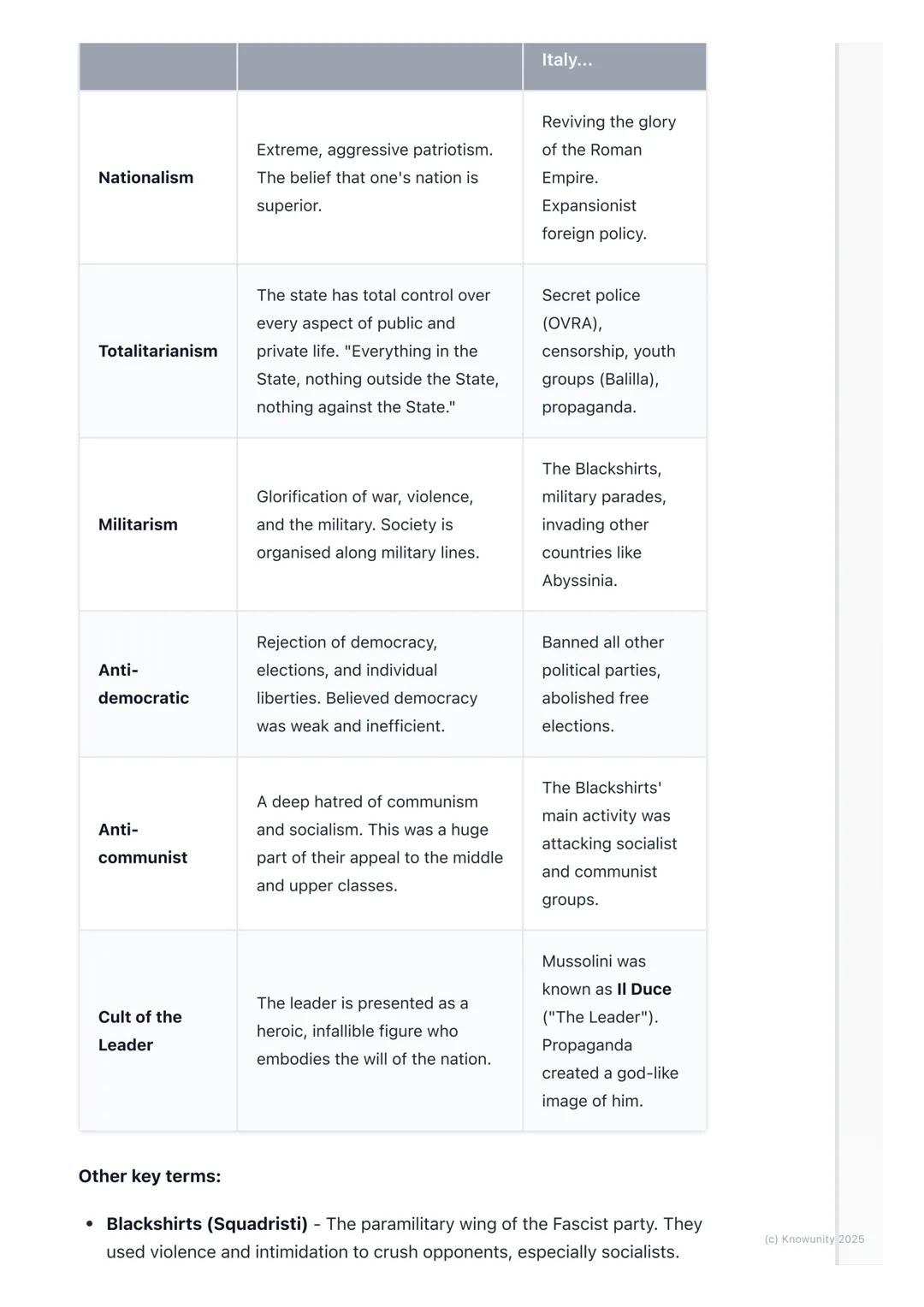
Fascism isn't just another political system—it's an all-encompassing worldview that demands total loyalty. At its core, it puts the nation and state above everything else, including individual rights and freedoms.
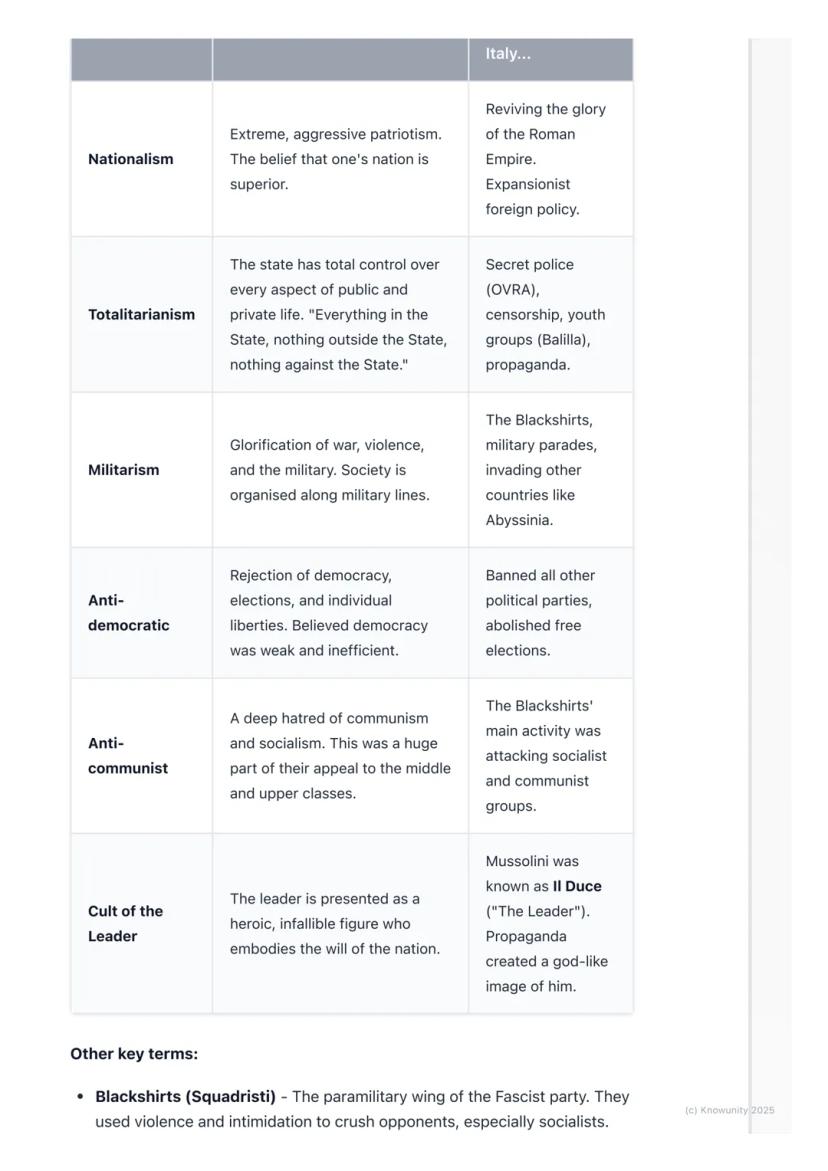
Extreme nationalism formed Fascism's beating heart, with Mussolini promising to revive the glory of the Roman Empire. This tied directly to totalitarianism, the idea that the state should control every aspect of life—as Mussolini famously declared, "Everything in the State, nothing outside the State, nothing against the State."
Fascism glorified violence and military values while fiercely opposing both democracy and communism. This dual opposition made it attractive to the wealthy and middle classes who feared a communist revolution but were disappointed with democratic ineffectiveness. The cult of the leader presented Mussolini as an infallible, heroic figure who embodied Italy's will.
The Blackshirts (Squadristi) were Fascism's muscle—the paramilitary wing that attacked political opponents, particularly socialists. Their violence wasn't random but strategic, creating fear while positioning Fascists as the only force capable of restoring order to a chaotic nation.
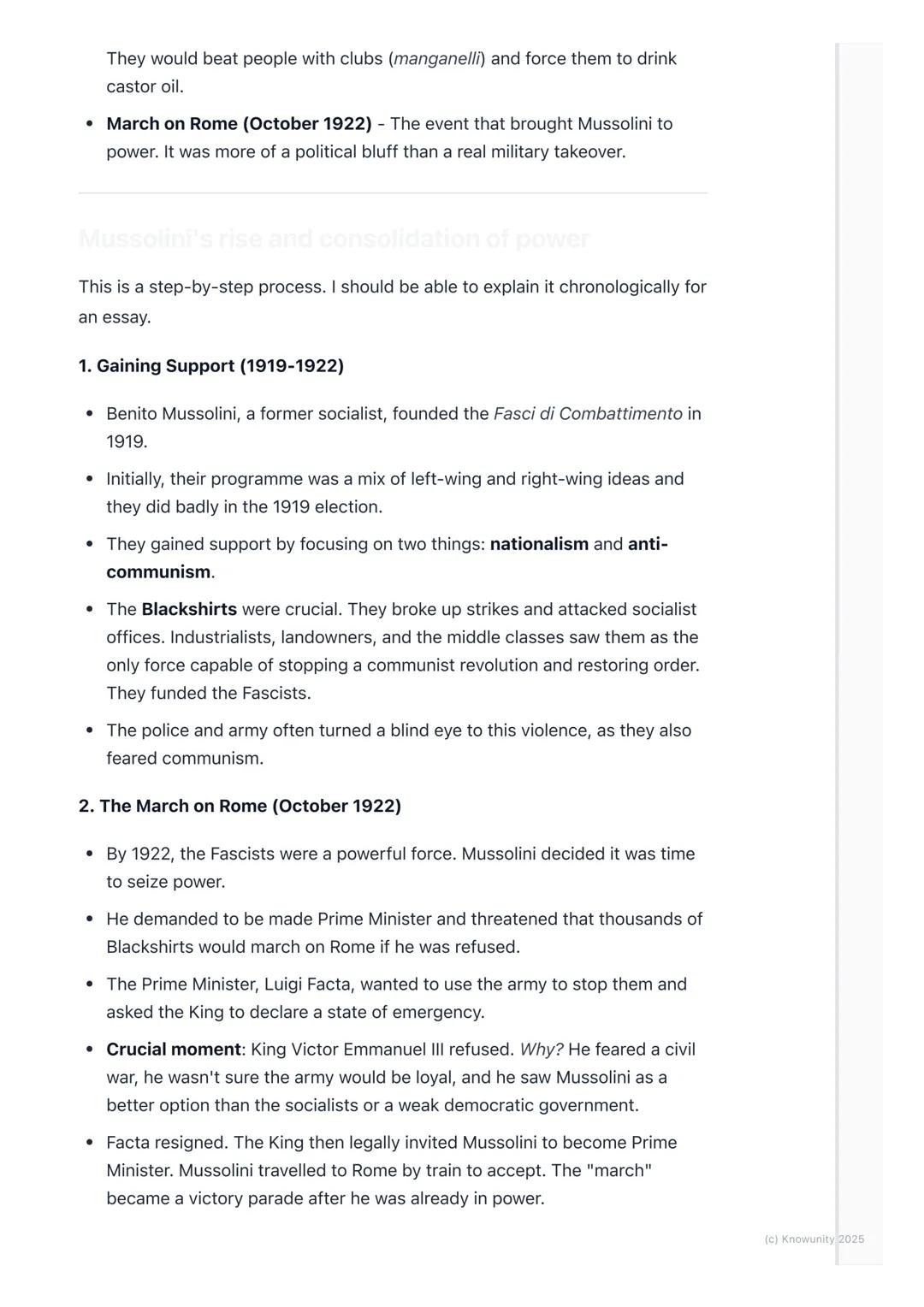
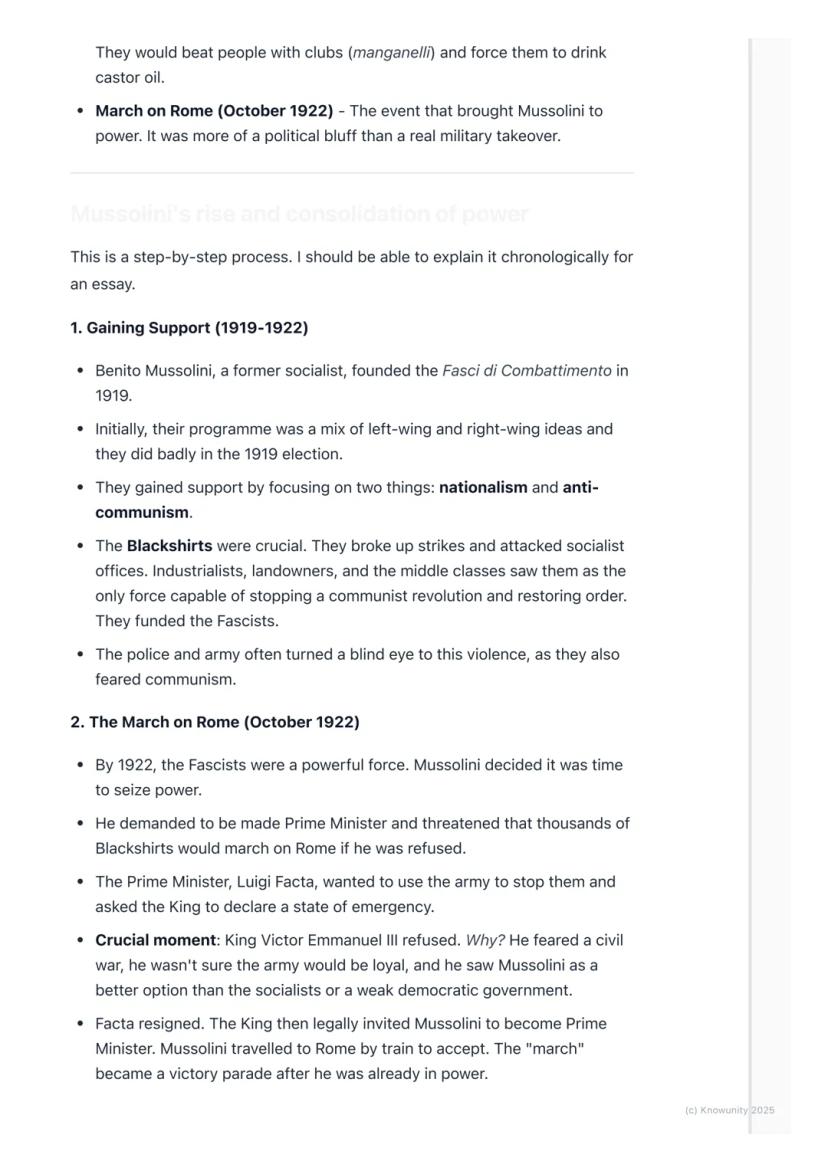
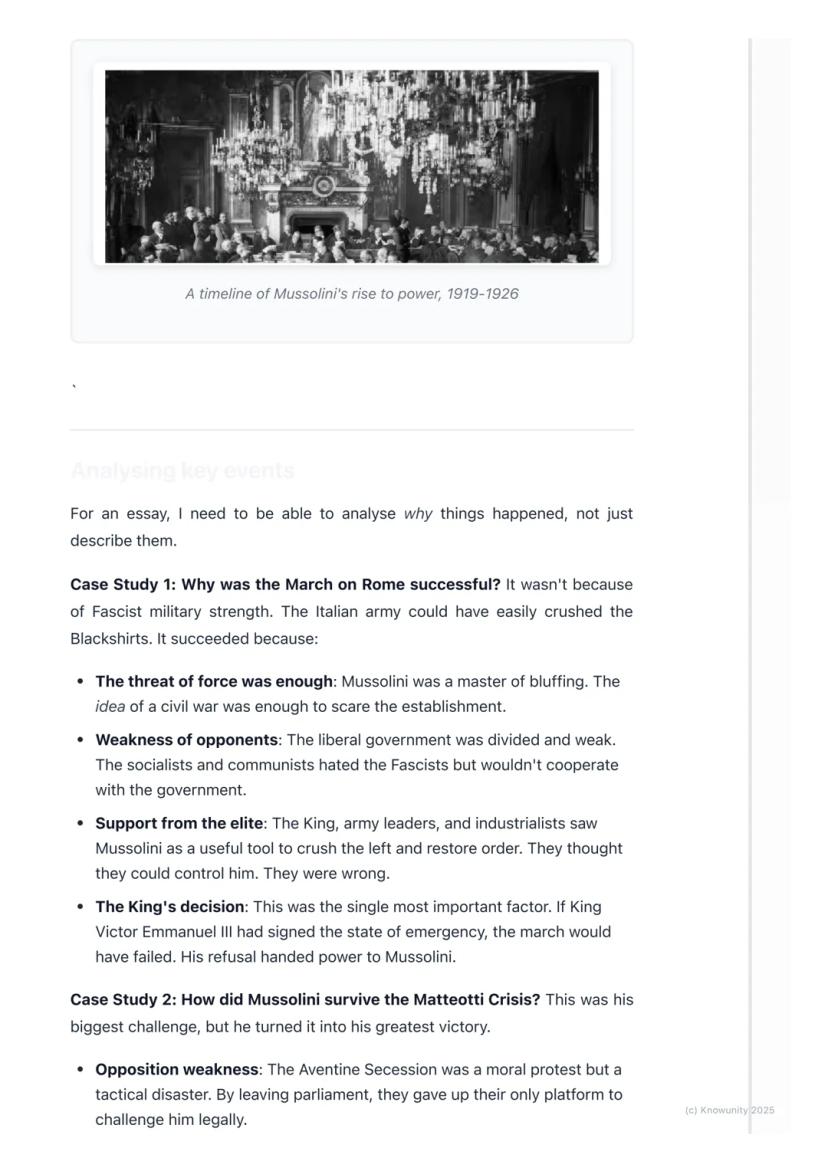
How did a former socialist journalist become Italy's dictator? Mussolini's journey to power shows a masterful blend of intimidation and political calculation.
The Fasci di Combattimento, founded by Mussolini in 1919, initially attracted little support. The turning point came when Mussolini recognised two powerful appeals: anti-communism and nationalism. By positioning his Fascists as the only force capable of stopping a "red revolution," he gained crucial funding from industrialists, landowners, and the middle classes who feared losing everything.
The Blackshirts proved essential to this strategy, breaking strikes and attacking socialist offices while police often looked the other way. By 1922, the Fascists had become powerful enough that Mussolini made his boldest move: the March on Rome. He demanded to be made Prime Minister, threatening that thousands of Blackshirts would march on the capital if refused.
Critical moment: When King Victor Emmanuel III refused to declare a state of emergency to stop the Blackshirts, he effectively handed power to Mussolini. The King feared civil war and saw Mussolini as preferable to either socialists or ineffective democratic leaders—a miscalculation that would transform Italy into a dictatorship.
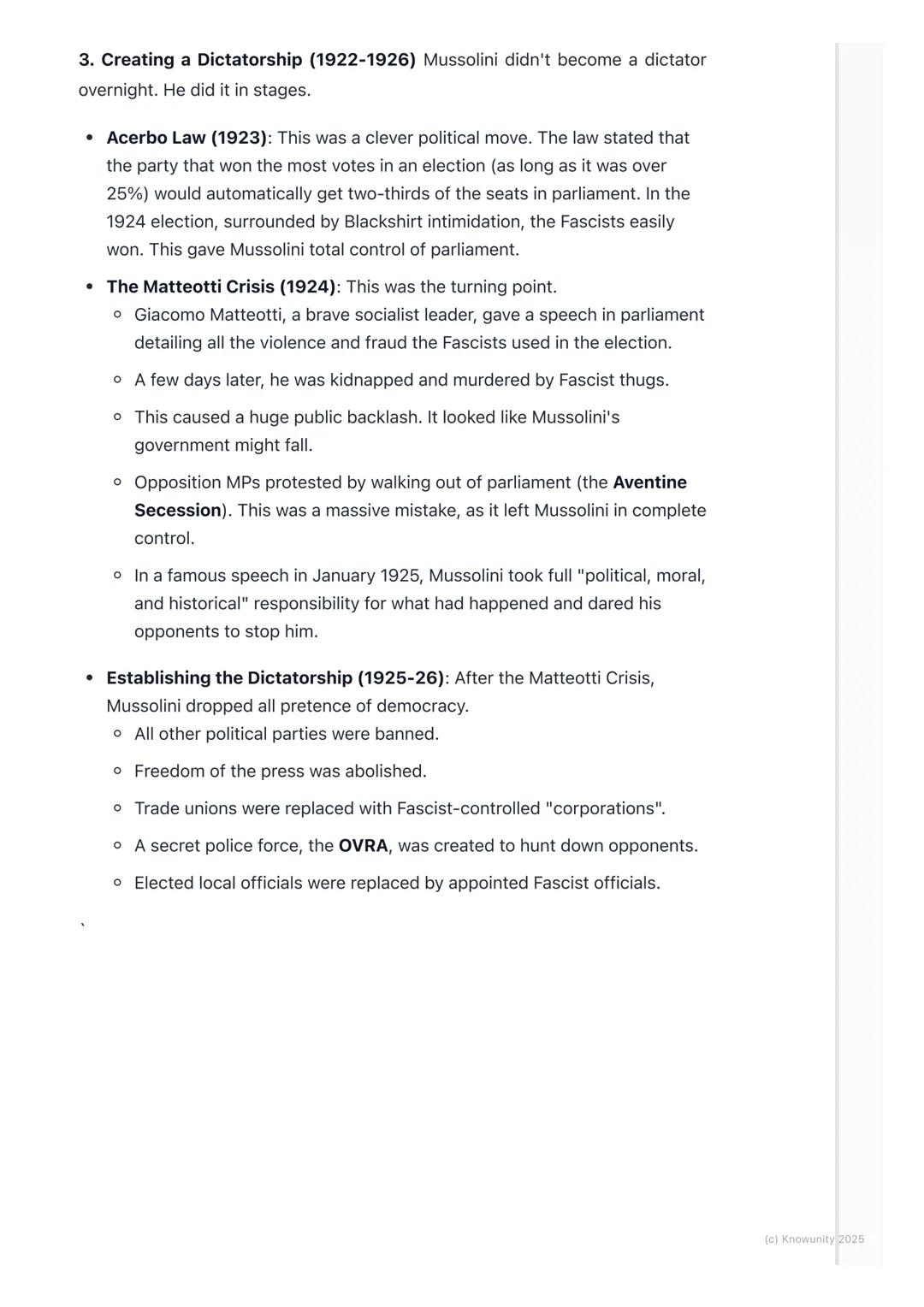
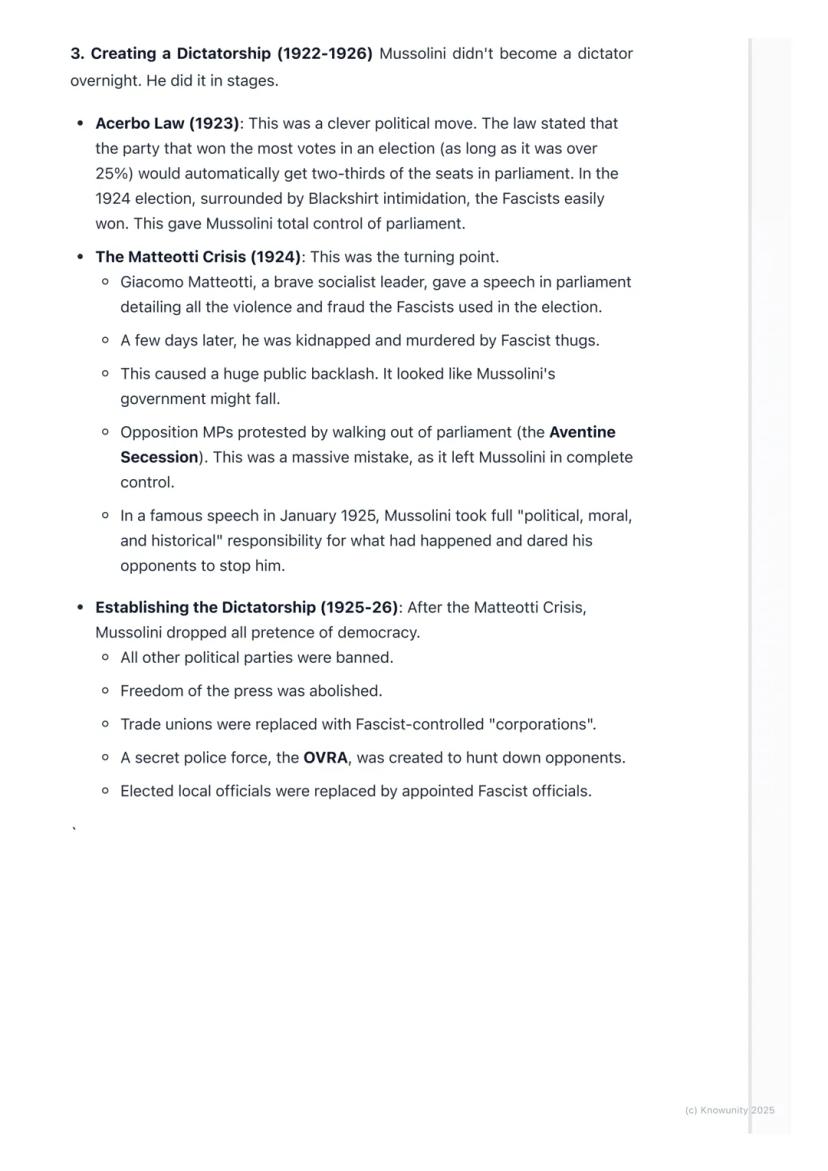
Mussolini didn't create a dictatorship overnight—he dismantled democracy step by step, using both legal means and intimidation.
His first clever move was the Acerbo Law (1923), which guaranteed that any party winning at least 25% of votes would receive two-thirds of parliamentary seats. In the 1924 election, with Blackshirts intimidating voters, the Fascists easily secured a parliamentary majority, giving Mussolini control of the legislature.
The Matteotti Crisis became the pivotal moment in Fascism's consolidation. When socialist leader Giacomo Matteotti was murdered after denouncing Fascist electoral fraud, public outrage threatened Mussolini's government. The opposition's response—walking out of parliament in protest (the Aventine Secession)—proved disastrous, as it removed the last institutional obstacle to Mussolini's power.
Seizing this opportunity, Mussolini boldly claimed "political, moral, and historical responsibility" for the crisis while rapidly establishing a full dictatorship. By 1926, he had banned all opposition parties, abolished press freedom, replaced independent trade unions with Fascist-controlled "corporations," and created the OVRA secret police to eliminate dissent. Democracy in Italy was dead.
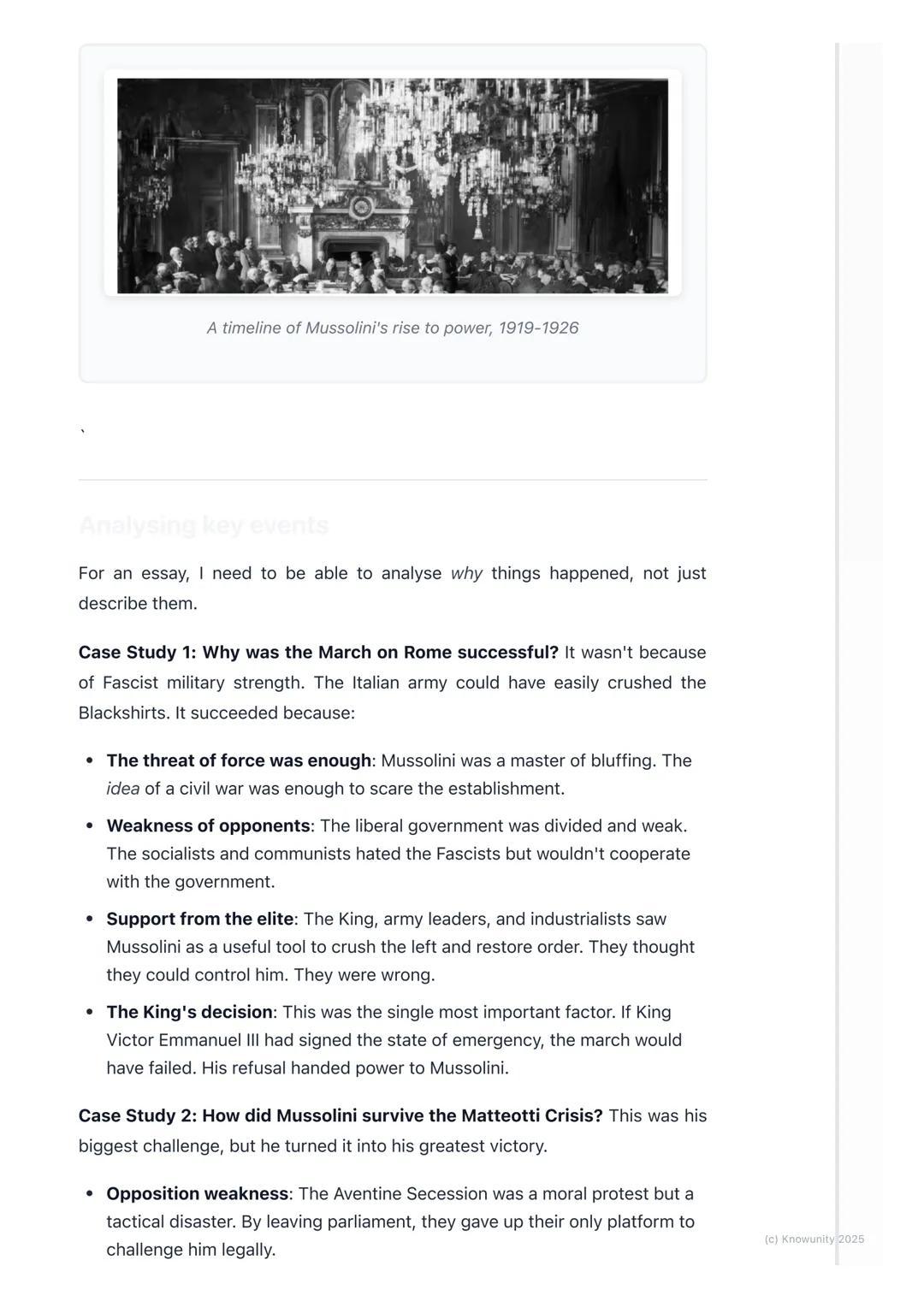
Why did Fascism succeed when other radical movements failed? The answer lies not just in what Fascists did, but in how other institutions responded to them.
The March on Rome succeeded primarily because of establishment complicity, not Fascist strength. The Italian army could easily have crushed the poorly-armed Blackshirts, but elites—including the King, military leaders, and industrialists—saw Mussolini as a useful tool against socialism. They believed they could control him while he restored order and protected their interests. This miscalculation proved catastrophic.
Similarly, during the Matteotti Crisis—Mussolini's most vulnerable moment—opposition leaders made a fatal error with their Aventine Secession. By abandoning parliament as a protest, they surrendered their only legal platform for resistance. Meanwhile, the King once again failed to act, despite having the constitutional power to dismiss Mussolini.
Think critically: Mussolini's success wasn't inevitable—it depended on specific decisions by key players. The King's refusal to declare a state of emergency in 1922 and the opposition's tactical blunder in 1924 were turning points where history could have taken a different course. Democratic institutions collapsed not just from Fascist attacks but from their own defenders' failures.
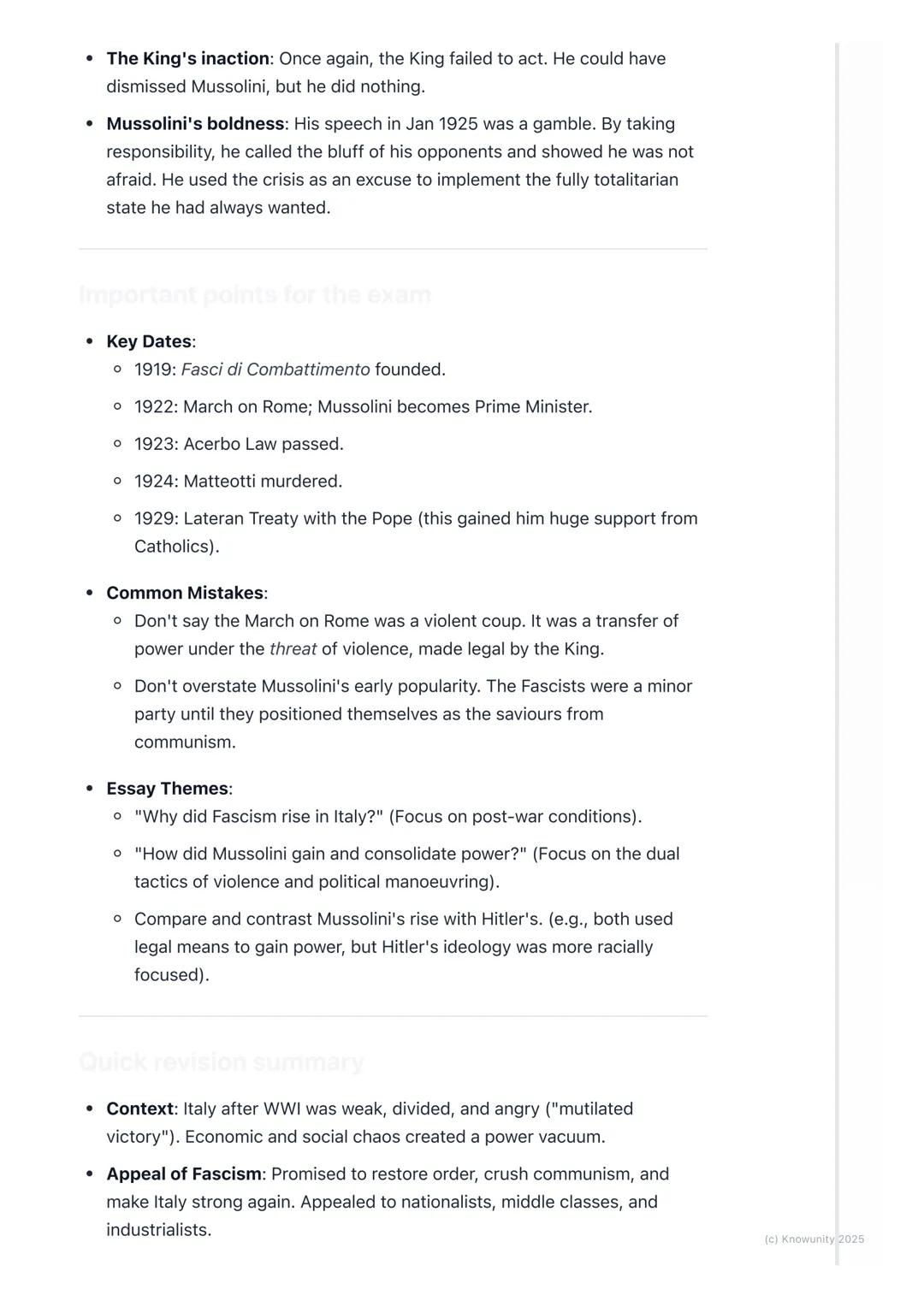
When preparing for exams on Fascist Italy, focus on these key developments and avoid common misconceptions that could cost you marks.
Timeline mastery is crucial—know that the Fasci di Combattimento was founded in 1919, the March on Rome occurred in 1922, the Acerbo Law passed in 1923, and Matteotti was murdered in 1924. Remember that by 1926, Italy had become a full dictatorship, though Mussolini would later increase his popularity through achievements like the 1929 Lateran Treaty with the Vatican.
Avoid the common mistake of describing the March on Rome as a violent coup—it was actually a transfer of power under threat of violence, made legal by the King's invitation. Also, don't overstate Mussolini's early popularity; the Fascists were a minor party until they positioned themselves as saviours from communism.
For essays, be prepared to address themes like "Why did Fascism rise in Italy?" or "How did Mussolini consolidate power?" (focus on his combination of violence and legal manoeuvring). Comparative questions often ask you to contrast Mussolini with Hitler—note that both used legal pathways to power, though Hitler's ideology was more racially focused.
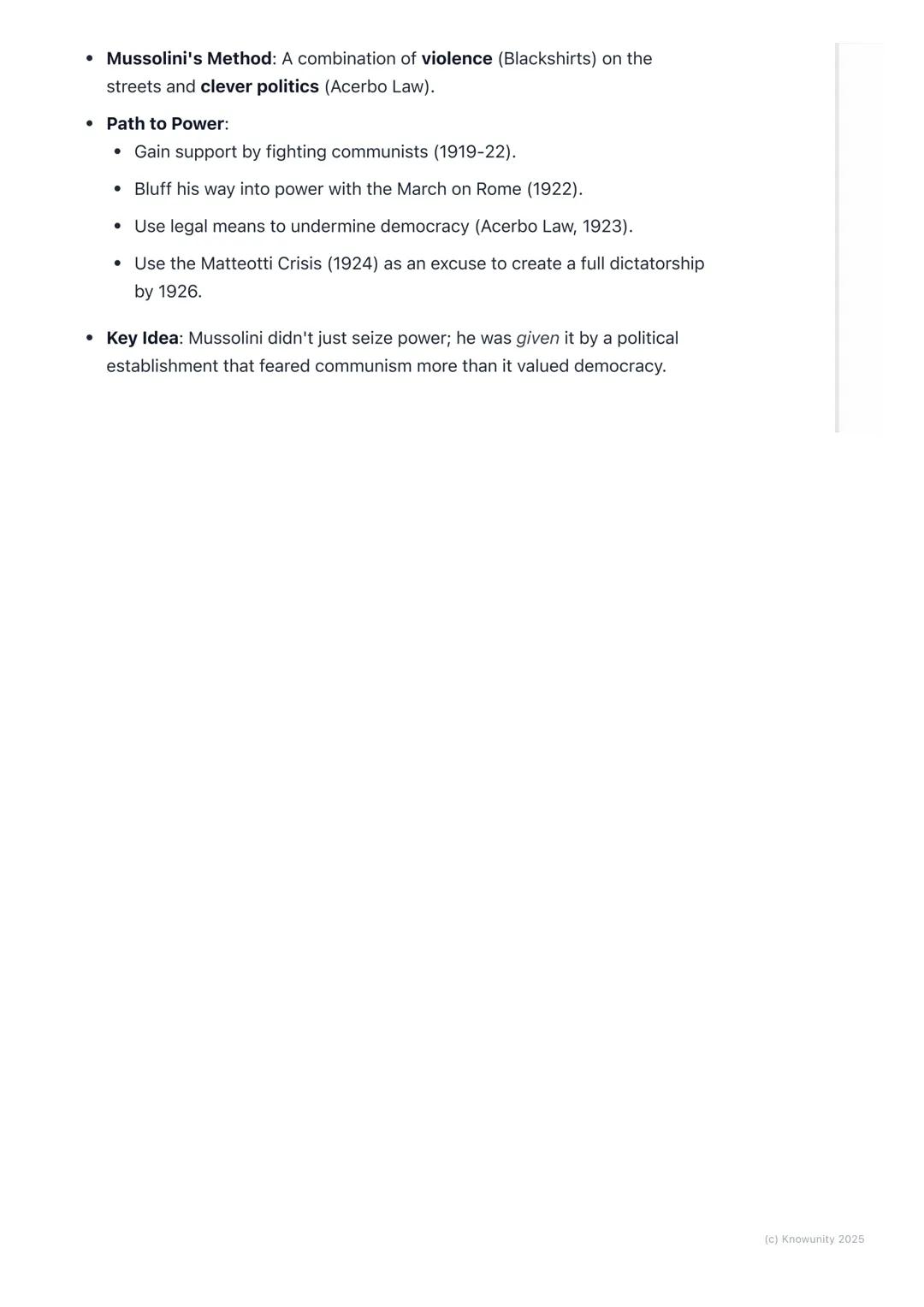
You've got this! Here's what to remember about Fascism's rise in Italy when you're revising for exams.
The context is essential—post-WWI Italy was a broken nation suffering from economic crisis, political paralysis, and the humiliation of a "mutilated victory." This created perfect conditions for radical solutions. Fascism's appeal lay in its promises to restore order, crush communism, and make Italy powerful again—attractive propositions to nationalists, the middle class, and business owners frightened by socialist unrest.
Mussolini's method combined street violence through the Blackshirts with clever political manoeuvring. His path to power followed a clear progression: first gaining support by fighting communists (1919-22), then bluffing his way into power with the March on Rome (1922), using legal means to undermine democracy (Acerbo Law, 1923), and finally using the Matteotti Crisis (1924) as justification for establishing a full dictatorship by 1926.
The big picture: Mussolini didn't simply seize power—he was effectively handed it by a political establishment that feared communism more than it valued democracy. This crucial insight helps explain not just Italian Fascism but how democracies can collapse when faced with crisis and extremism.
Our AI companion is specifically built for the needs of students. Based on the millions of content pieces we have on the platform we can provide truly meaningful and relevant answers to students. But its not only about answers, the companion is even more about guiding students through their daily learning challenges, with personalised study plans, quizzes or content pieces in the chat and 100% personalisation based on the students skills and developments.
You can download the app in the Google Play Store and in the Apple App Store.
That's right! Enjoy free access to study content, connect with fellow students, and get instant help – all at your fingertips.
App Store
Google Play
The app is very easy to use and well designed. I have found everything I was looking for so far and have been able to learn a lot from the presentations! I will definitely use the app for a class assignment! And of course it also helps a lot as an inspiration.
Stefan S
iOS user
This app is really great. There are so many study notes and help [...]. My problem subject is French, for example, and the app has so many options for help. Thanks to this app, I have improved my French. I would recommend it to anyone.
Samantha Klich
Android user
Wow, I am really amazed. I just tried the app because I've seen it advertised many times and was absolutely stunned. This app is THE HELP you want for school and above all, it offers so many things, such as workouts and fact sheets, which have been VERY helpful to me personally.
Anna
iOS user
I think it’s very much worth it and you’ll end up using it a lot once you get the hang of it and even after looking at others notes you can still ask your Artificial intelligence buddy the question and ask to simplify it if you still don’t get it!!! In the end I think it’s worth it 😊👍 ⚠️Also DID I MENTION ITS FREEE YOU DON’T HAVE TO PAY FOR ANYTHING AND STILL GET YOUR GRADES IN PERFECTLY❗️❗️⚠️
Thomas R
iOS user
Knowunity is the BEST app I’ve used in a minute. This is not an ai review or anything this is genuinely coming from a 7th grade student (I know 2011 im young) but dude this app is a 10/10 i have maintained a 3.8 gpa and have plenty of time for gaming. I love it and my mom is just happy I got good grades
Brad T
Android user
Not only did it help me find the answer but it also showed me alternative ways to solve it. I was horrible in math and science but now I have an a in both subjects. Thanks for the help🤍🤍
David K
iOS user
The app's just great! All I have to do is enter the topic in the search bar and I get the response real fast. I don't have to watch 10 YouTube videos to understand something, so I'm saving my time. Highly recommended!
Sudenaz Ocak
Android user
In school I was really bad at maths but thanks to the app, I am doing better now. I am so grateful that you made the app.
Greenlight Bonnie
Android user
I found this app a couple years ago and it has only gotten better since then. I really love it because it can help with written questions and photo questions. Also, it can find study guides that other people have made as well as flashcard sets and practice tests. The free version is also amazing for students who might not be able to afford it. Would 100% recommend
Aubrey
iOS user
Best app if you're in Highschool or Junior high. I have been using this app for 2 school years and it's the best, it's good if you don't have anyone to help you with school work.😋🩷🎀
Marco B
iOS user
THE QUIZES AND FLASHCARDS ARE SO USEFUL AND I LOVE Knowunity AI. IT ALSO IS LITREALLY LIKE CHATGPT BUT SMARTER!! HELPED ME WITH MY MASCARA PROBLEMS TOO!! AS WELL AS MY REAL SUBJECTS ! DUHHH 😍😁😲🤑💗✨🎀😮
Elisha
iOS user
This app is phenomenal down to the correct info and the various topics you can study! I greatly recommend it for people who struggle with procrastination and those who need homework help. It has been perfectly accurate for world 1 history as far as I’ve seen! Geometry too!
Paul T
iOS user
The app is very easy to use and well designed. I have found everything I was looking for so far and have been able to learn a lot from the presentations! I will definitely use the app for a class assignment! And of course it also helps a lot as an inspiration.
Stefan S
iOS user
This app is really great. There are so many study notes and help [...]. My problem subject is French, for example, and the app has so many options for help. Thanks to this app, I have improved my French. I would recommend it to anyone.
Samantha Klich
Android user
Wow, I am really amazed. I just tried the app because I've seen it advertised many times and was absolutely stunned. This app is THE HELP you want for school and above all, it offers so many things, such as workouts and fact sheets, which have been VERY helpful to me personally.
Anna
iOS user
I think it’s very much worth it and you’ll end up using it a lot once you get the hang of it and even after looking at others notes you can still ask your Artificial intelligence buddy the question and ask to simplify it if you still don’t get it!!! In the end I think it’s worth it 😊👍 ⚠️Also DID I MENTION ITS FREEE YOU DON’T HAVE TO PAY FOR ANYTHING AND STILL GET YOUR GRADES IN PERFECTLY❗️❗️⚠️
Thomas R
iOS user
Knowunity is the BEST app I’ve used in a minute. This is not an ai review or anything this is genuinely coming from a 7th grade student (I know 2011 im young) but dude this app is a 10/10 i have maintained a 3.8 gpa and have plenty of time for gaming. I love it and my mom is just happy I got good grades
Brad T
Android user
Not only did it help me find the answer but it also showed me alternative ways to solve it. I was horrible in math and science but now I have an a in both subjects. Thanks for the help🤍🤍
David K
iOS user
The app's just great! All I have to do is enter the topic in the search bar and I get the response real fast. I don't have to watch 10 YouTube videos to understand something, so I'm saving my time. Highly recommended!
Sudenaz Ocak
Android user
In school I was really bad at maths but thanks to the app, I am doing better now. I am so grateful that you made the app.
Greenlight Bonnie
Android user
I found this app a couple years ago and it has only gotten better since then. I really love it because it can help with written questions and photo questions. Also, it can find study guides that other people have made as well as flashcard sets and practice tests. The free version is also amazing for students who might not be able to afford it. Would 100% recommend
Aubrey
iOS user
Best app if you're in Highschool or Junior high. I have been using this app for 2 school years and it's the best, it's good if you don't have anyone to help you with school work.😋🩷🎀
Marco B
iOS user
THE QUIZES AND FLASHCARDS ARE SO USEFUL AND I LOVE Knowunity AI. IT ALSO IS LITREALLY LIKE CHATGPT BUT SMARTER!! HELPED ME WITH MY MASCARA PROBLEMS TOO!! AS WELL AS MY REAL SUBJECTS ! DUHHH 😍😁😲🤑💗✨🎀😮
Elisha
iOS user
This app is phenomenal down to the correct info and the various topics you can study! I greatly recommend it for people who struggle with procrastination and those who need homework help. It has been perfectly accurate for world 1 history as far as I’ve seen! Geometry too!
Paul T
iOS user
Post-World War I Italy was a tinderbox of economic crisis, social unrest, and national humiliation—the perfect breeding ground for Fascism to take root. Benito Mussolini's rise from political outsider to Il Duce shows how a struggling democracy can be dismantled... Show more
Access to all documents
Improve your grades
Join milions of students
Ever wondered how a radical movement like Fascism could take over a European democracy? The answer lies in the chaos of post-WWI Italy. Despite being on the winning side, Italy faced a perfect storm of crises that created fertile ground for extremism.
The "Mutilated Victory" left Italians feeling betrayed by the Treaty of Versailles. They had been promised significant territories for joining the Allies but received far less than expected. This national humiliation was dramatically highlighted when the poet D'Annunzio seized the city of Fiume with a private army—demonstrating just how weak the government had become.
The economic situation was equally dire. Massive war debts, soaring inflation, and high unemployment created widespread suffering. Meanwhile, inspired by Russia's revolution, workers launched waves of strikes and factory occupations during the Biennio Rosso , terrifying business owners and the middle class.
Remember this: Italy's democratic government was paralysed by proportional representation, which created fragmented parliaments and unstable coalitions that couldn't address the nation's problems. This political deadlock made many Italians willing to sacrifice democracy for stability and national pride.
Access to all documents
Improve your grades
Join milions of students
Fascism isn't just another political system—it's an all-encompassing worldview that demands total loyalty. At its core, it puts the nation and state above everything else, including individual rights and freedoms.
Extreme nationalism formed Fascism's beating heart, with Mussolini promising to revive the glory of the Roman Empire. This tied directly to totalitarianism, the idea that the state should control every aspect of life—as Mussolini famously declared, "Everything in the State, nothing outside the State, nothing against the State."
Fascism glorified violence and military values while fiercely opposing both democracy and communism. This dual opposition made it attractive to the wealthy and middle classes who feared a communist revolution but were disappointed with democratic ineffectiveness. The cult of the leader presented Mussolini as an infallible, heroic figure who embodied Italy's will.
The Blackshirts (Squadristi) were Fascism's muscle—the paramilitary wing that attacked political opponents, particularly socialists. Their violence wasn't random but strategic, creating fear while positioning Fascists as the only force capable of restoring order to a chaotic nation.
Access to all documents
Improve your grades
Join milions of students
How did a former socialist journalist become Italy's dictator? Mussolini's journey to power shows a masterful blend of intimidation and political calculation.
The Fasci di Combattimento, founded by Mussolini in 1919, initially attracted little support. The turning point came when Mussolini recognised two powerful appeals: anti-communism and nationalism. By positioning his Fascists as the only force capable of stopping a "red revolution," he gained crucial funding from industrialists, landowners, and the middle classes who feared losing everything.
The Blackshirts proved essential to this strategy, breaking strikes and attacking socialist offices while police often looked the other way. By 1922, the Fascists had become powerful enough that Mussolini made his boldest move: the March on Rome. He demanded to be made Prime Minister, threatening that thousands of Blackshirts would march on the capital if refused.
Critical moment: When King Victor Emmanuel III refused to declare a state of emergency to stop the Blackshirts, he effectively handed power to Mussolini. The King feared civil war and saw Mussolini as preferable to either socialists or ineffective democratic leaders—a miscalculation that would transform Italy into a dictatorship.
Access to all documents
Improve your grades
Join milions of students
Mussolini didn't create a dictatorship overnight—he dismantled democracy step by step, using both legal means and intimidation.
His first clever move was the Acerbo Law (1923), which guaranteed that any party winning at least 25% of votes would receive two-thirds of parliamentary seats. In the 1924 election, with Blackshirts intimidating voters, the Fascists easily secured a parliamentary majority, giving Mussolini control of the legislature.
The Matteotti Crisis became the pivotal moment in Fascism's consolidation. When socialist leader Giacomo Matteotti was murdered after denouncing Fascist electoral fraud, public outrage threatened Mussolini's government. The opposition's response—walking out of parliament in protest (the Aventine Secession)—proved disastrous, as it removed the last institutional obstacle to Mussolini's power.
Seizing this opportunity, Mussolini boldly claimed "political, moral, and historical responsibility" for the crisis while rapidly establishing a full dictatorship. By 1926, he had banned all opposition parties, abolished press freedom, replaced independent trade unions with Fascist-controlled "corporations," and created the OVRA secret police to eliminate dissent. Democracy in Italy was dead.
Access to all documents
Improve your grades
Join milions of students
Why did Fascism succeed when other radical movements failed? The answer lies not just in what Fascists did, but in how other institutions responded to them.
The March on Rome succeeded primarily because of establishment complicity, not Fascist strength. The Italian army could easily have crushed the poorly-armed Blackshirts, but elites—including the King, military leaders, and industrialists—saw Mussolini as a useful tool against socialism. They believed they could control him while he restored order and protected their interests. This miscalculation proved catastrophic.
Similarly, during the Matteotti Crisis—Mussolini's most vulnerable moment—opposition leaders made a fatal error with their Aventine Secession. By abandoning parliament as a protest, they surrendered their only legal platform for resistance. Meanwhile, the King once again failed to act, despite having the constitutional power to dismiss Mussolini.
Think critically: Mussolini's success wasn't inevitable—it depended on specific decisions by key players. The King's refusal to declare a state of emergency in 1922 and the opposition's tactical blunder in 1924 were turning points where history could have taken a different course. Democratic institutions collapsed not just from Fascist attacks but from their own defenders' failures.
Access to all documents
Improve your grades
Join milions of students
When preparing for exams on Fascist Italy, focus on these key developments and avoid common misconceptions that could cost you marks.
Timeline mastery is crucial—know that the Fasci di Combattimento was founded in 1919, the March on Rome occurred in 1922, the Acerbo Law passed in 1923, and Matteotti was murdered in 1924. Remember that by 1926, Italy had become a full dictatorship, though Mussolini would later increase his popularity through achievements like the 1929 Lateran Treaty with the Vatican.
Avoid the common mistake of describing the March on Rome as a violent coup—it was actually a transfer of power under threat of violence, made legal by the King's invitation. Also, don't overstate Mussolini's early popularity; the Fascists were a minor party until they positioned themselves as saviours from communism.
For essays, be prepared to address themes like "Why did Fascism rise in Italy?" or "How did Mussolini consolidate power?" (focus on his combination of violence and legal manoeuvring). Comparative questions often ask you to contrast Mussolini with Hitler—note that both used legal pathways to power, though Hitler's ideology was more racially focused.
Access to all documents
Improve your grades
Join milions of students
You've got this! Here's what to remember about Fascism's rise in Italy when you're revising for exams.
The context is essential—post-WWI Italy was a broken nation suffering from economic crisis, political paralysis, and the humiliation of a "mutilated victory." This created perfect conditions for radical solutions. Fascism's appeal lay in its promises to restore order, crush communism, and make Italy powerful again—attractive propositions to nationalists, the middle class, and business owners frightened by socialist unrest.
Mussolini's method combined street violence through the Blackshirts with clever political manoeuvring. His path to power followed a clear progression: first gaining support by fighting communists (1919-22), then bluffing his way into power with the March on Rome (1922), using legal means to undermine democracy (Acerbo Law, 1923), and finally using the Matteotti Crisis (1924) as justification for establishing a full dictatorship by 1926.
The big picture: Mussolini didn't simply seize power—he was effectively handed it by a political establishment that feared communism more than it valued democracy. This crucial insight helps explain not just Italian Fascism but how democracies can collapse when faced with crisis and extremism.
Our AI companion is specifically built for the needs of students. Based on the millions of content pieces we have on the platform we can provide truly meaningful and relevant answers to students. But its not only about answers, the companion is even more about guiding students through their daily learning challenges, with personalised study plans, quizzes or content pieces in the chat and 100% personalisation based on the students skills and developments.
You can download the app in the Google Play Store and in the Apple App Store.
That's right! Enjoy free access to study content, connect with fellow students, and get instant help – all at your fingertips.
0
Smart Tools NEW
Transform this note into: ✓ 50+ Practice Questions ✓ Interactive Flashcards ✓ Full Practice Test ✓ Essay Outlines
App Store
Google Play
The app is very easy to use and well designed. I have found everything I was looking for so far and have been able to learn a lot from the presentations! I will definitely use the app for a class assignment! And of course it also helps a lot as an inspiration.
Stefan S
iOS user
This app is really great. There are so many study notes and help [...]. My problem subject is French, for example, and the app has so many options for help. Thanks to this app, I have improved my French. I would recommend it to anyone.
Samantha Klich
Android user
Wow, I am really amazed. I just tried the app because I've seen it advertised many times and was absolutely stunned. This app is THE HELP you want for school and above all, it offers so many things, such as workouts and fact sheets, which have been VERY helpful to me personally.
Anna
iOS user
I think it’s very much worth it and you’ll end up using it a lot once you get the hang of it and even after looking at others notes you can still ask your Artificial intelligence buddy the question and ask to simplify it if you still don’t get it!!! In the end I think it’s worth it 😊👍 ⚠️Also DID I MENTION ITS FREEE YOU DON’T HAVE TO PAY FOR ANYTHING AND STILL GET YOUR GRADES IN PERFECTLY❗️❗️⚠️
Thomas R
iOS user
Knowunity is the BEST app I’ve used in a minute. This is not an ai review or anything this is genuinely coming from a 7th grade student (I know 2011 im young) but dude this app is a 10/10 i have maintained a 3.8 gpa and have plenty of time for gaming. I love it and my mom is just happy I got good grades
Brad T
Android user
Not only did it help me find the answer but it also showed me alternative ways to solve it. I was horrible in math and science but now I have an a in both subjects. Thanks for the help🤍🤍
David K
iOS user
The app's just great! All I have to do is enter the topic in the search bar and I get the response real fast. I don't have to watch 10 YouTube videos to understand something, so I'm saving my time. Highly recommended!
Sudenaz Ocak
Android user
In school I was really bad at maths but thanks to the app, I am doing better now. I am so grateful that you made the app.
Greenlight Bonnie
Android user
I found this app a couple years ago and it has only gotten better since then. I really love it because it can help with written questions and photo questions. Also, it can find study guides that other people have made as well as flashcard sets and practice tests. The free version is also amazing for students who might not be able to afford it. Would 100% recommend
Aubrey
iOS user
Best app if you're in Highschool or Junior high. I have been using this app for 2 school years and it's the best, it's good if you don't have anyone to help you with school work.😋🩷🎀
Marco B
iOS user
THE QUIZES AND FLASHCARDS ARE SO USEFUL AND I LOVE Knowunity AI. IT ALSO IS LITREALLY LIKE CHATGPT BUT SMARTER!! HELPED ME WITH MY MASCARA PROBLEMS TOO!! AS WELL AS MY REAL SUBJECTS ! DUHHH 😍😁😲🤑💗✨🎀😮
Elisha
iOS user
This app is phenomenal down to the correct info and the various topics you can study! I greatly recommend it for people who struggle with procrastination and those who need homework help. It has been perfectly accurate for world 1 history as far as I’ve seen! Geometry too!
Paul T
iOS user
The app is very easy to use and well designed. I have found everything I was looking for so far and have been able to learn a lot from the presentations! I will definitely use the app for a class assignment! And of course it also helps a lot as an inspiration.
Stefan S
iOS user
This app is really great. There are so many study notes and help [...]. My problem subject is French, for example, and the app has so many options for help. Thanks to this app, I have improved my French. I would recommend it to anyone.
Samantha Klich
Android user
Wow, I am really amazed. I just tried the app because I've seen it advertised many times and was absolutely stunned. This app is THE HELP you want for school and above all, it offers so many things, such as workouts and fact sheets, which have been VERY helpful to me personally.
Anna
iOS user
I think it’s very much worth it and you’ll end up using it a lot once you get the hang of it and even after looking at others notes you can still ask your Artificial intelligence buddy the question and ask to simplify it if you still don’t get it!!! In the end I think it’s worth it 😊👍 ⚠️Also DID I MENTION ITS FREEE YOU DON’T HAVE TO PAY FOR ANYTHING AND STILL GET YOUR GRADES IN PERFECTLY❗️❗️⚠️
Thomas R
iOS user
Knowunity is the BEST app I’ve used in a minute. This is not an ai review or anything this is genuinely coming from a 7th grade student (I know 2011 im young) but dude this app is a 10/10 i have maintained a 3.8 gpa and have plenty of time for gaming. I love it and my mom is just happy I got good grades
Brad T
Android user
Not only did it help me find the answer but it also showed me alternative ways to solve it. I was horrible in math and science but now I have an a in both subjects. Thanks for the help🤍🤍
David K
iOS user
The app's just great! All I have to do is enter the topic in the search bar and I get the response real fast. I don't have to watch 10 YouTube videos to understand something, so I'm saving my time. Highly recommended!
Sudenaz Ocak
Android user
In school I was really bad at maths but thanks to the app, I am doing better now. I am so grateful that you made the app.
Greenlight Bonnie
Android user
I found this app a couple years ago and it has only gotten better since then. I really love it because it can help with written questions and photo questions. Also, it can find study guides that other people have made as well as flashcard sets and practice tests. The free version is also amazing for students who might not be able to afford it. Would 100% recommend
Aubrey
iOS user
Best app if you're in Highschool or Junior high. I have been using this app for 2 school years and it's the best, it's good if you don't have anyone to help you with school work.😋🩷🎀
Marco B
iOS user
THE QUIZES AND FLASHCARDS ARE SO USEFUL AND I LOVE Knowunity AI. IT ALSO IS LITREALLY LIKE CHATGPT BUT SMARTER!! HELPED ME WITH MY MASCARA PROBLEMS TOO!! AS WELL AS MY REAL SUBJECTS ! DUHHH 😍😁😲🤑💗✨🎀😮
Elisha
iOS user
This app is phenomenal down to the correct info and the various topics you can study! I greatly recommend it for people who struggle with procrastination and those who need homework help. It has been perfectly accurate for world 1 history as far as I’ve seen! Geometry too!
Paul T
iOS user