
AP Human Geography Unit 4: Political Patterns and Processesexplores... Show more
 AP Human Geography1,090 views·Updated May 20, 2026·19 pages
AP Human Geography Unit 4: Political Patterns, Nation-States, and Stateless Nations

Abbie@nyssaling
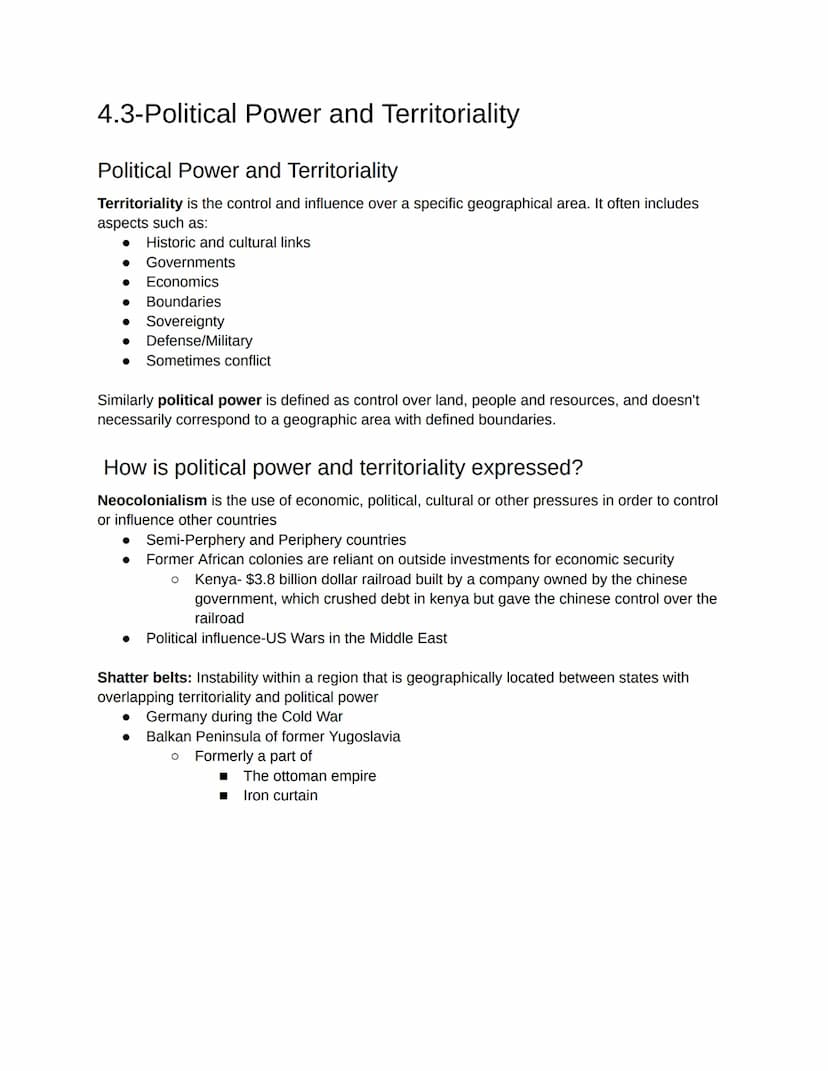
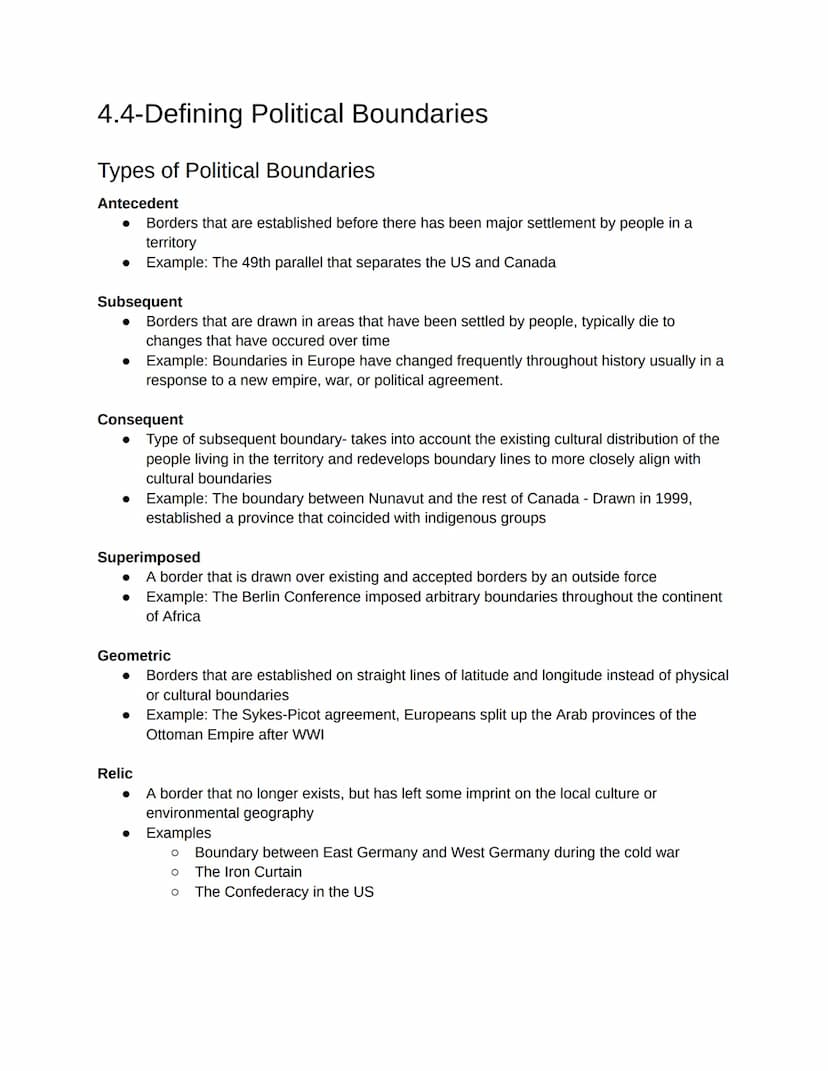
1 / 10
1
of 10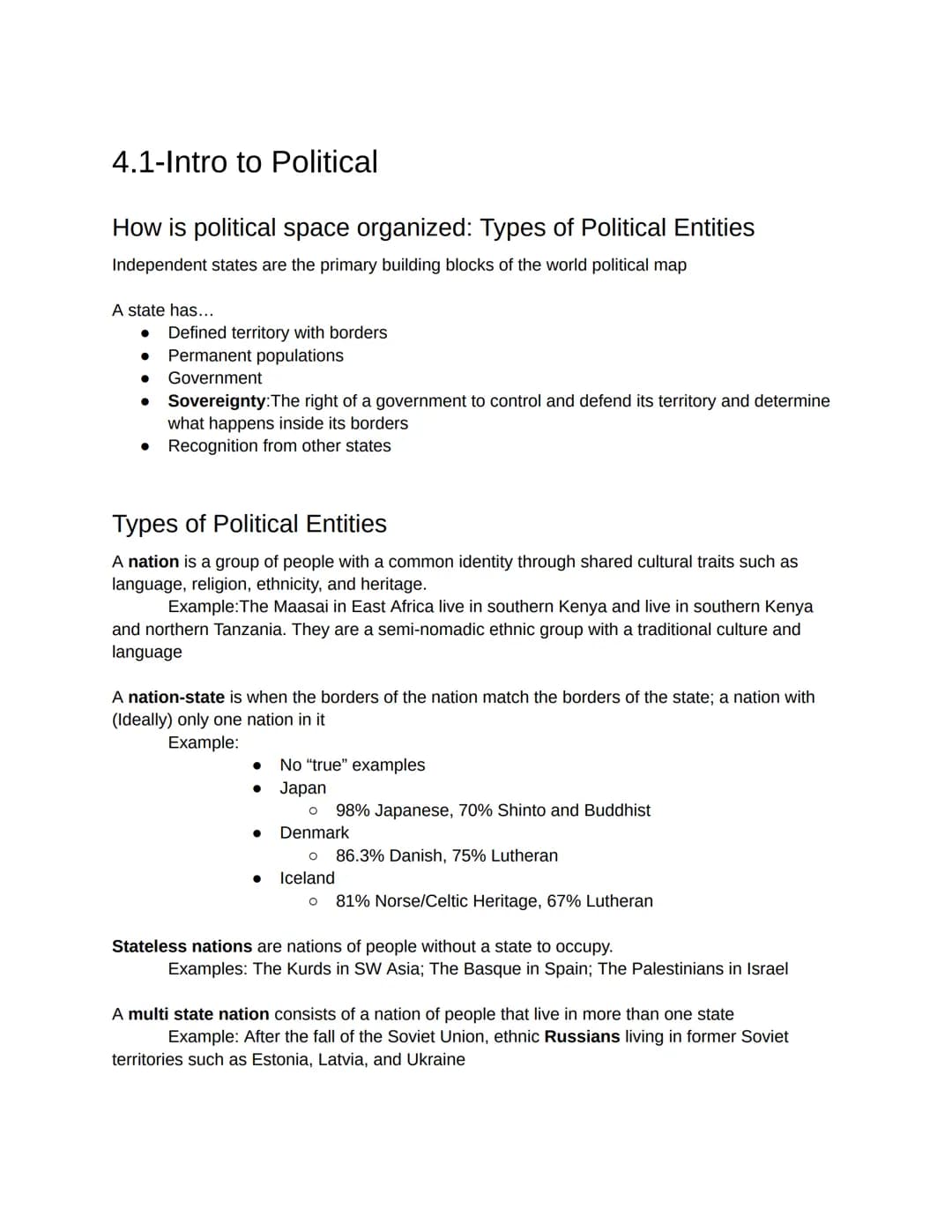
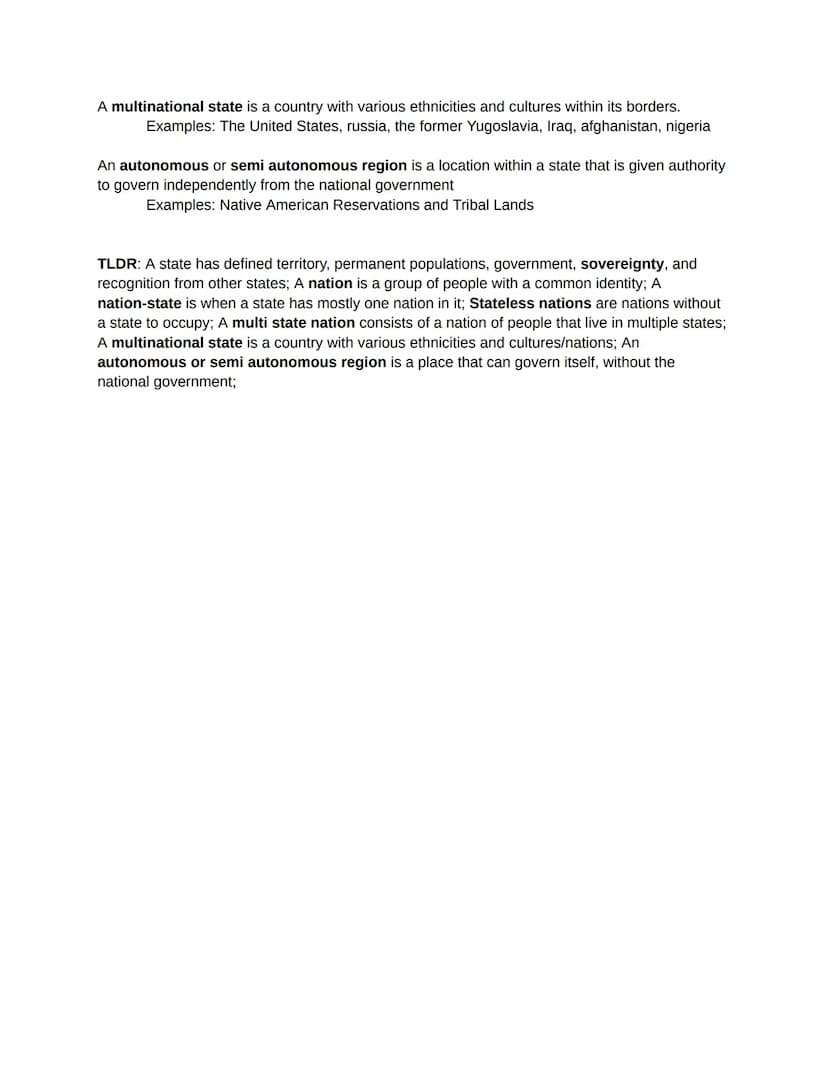
Types of Political Entities (Continued)
This section continues the exploration of political entities in AP Human Geography Unit 4: Political Patterns and Processes, focusing on multinational states and autonomous regions.
Definition: A multinational state is a country with various ethnicities and cultures within its borders.
Example: The United States, Russia, the former Yugoslavia, Iraq, Afghanistan, and Nigeria are examples of multinational states.
Vocabulary: An autonomous or semi-autonomous region is a location within a state that is given authority to govern independently from the national government.
Example: Native American Reservations and Tribal Lands in the United States are examples of autonomous regions.
The section concludes with a summary of key concepts:
- A state has defined territory, permanent populations, government, sovereignty, and recognition from other states.
- A nation is a group of people with a common identity.
- A nation-state is when a state has mostly one nation in it.
- Stateless nations are nations without a state to occupy.
- A multi-state nation consists of a nation of people that live in multiple states.
- A multinational state is a country with various ethnicities and cultures/nations.
- An autonomous or semi-autonomous region is a place that can govern itself, without the national government.
These concepts are crucial for understanding the complex political geography covered in Unit 4 AP Human Geography.
2
of 10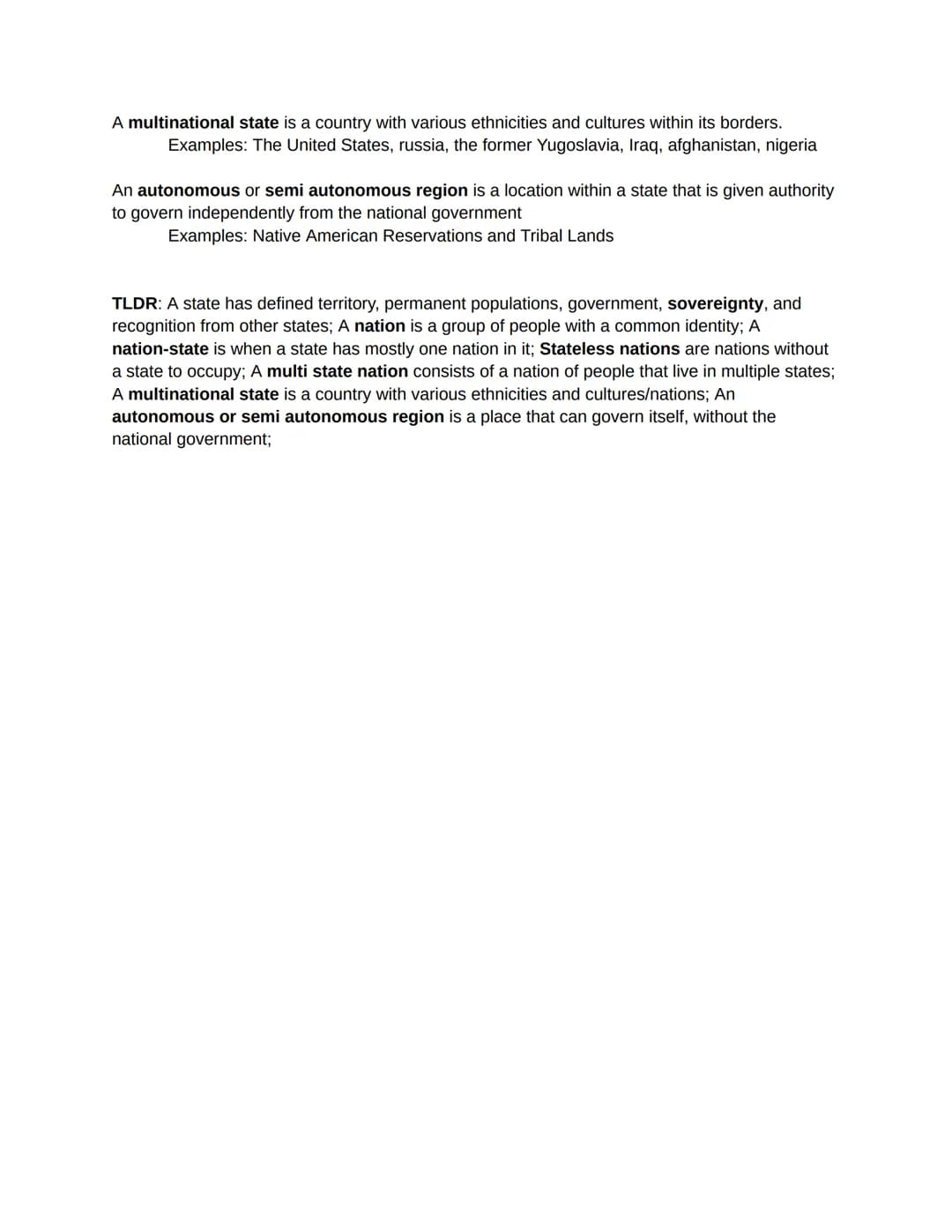
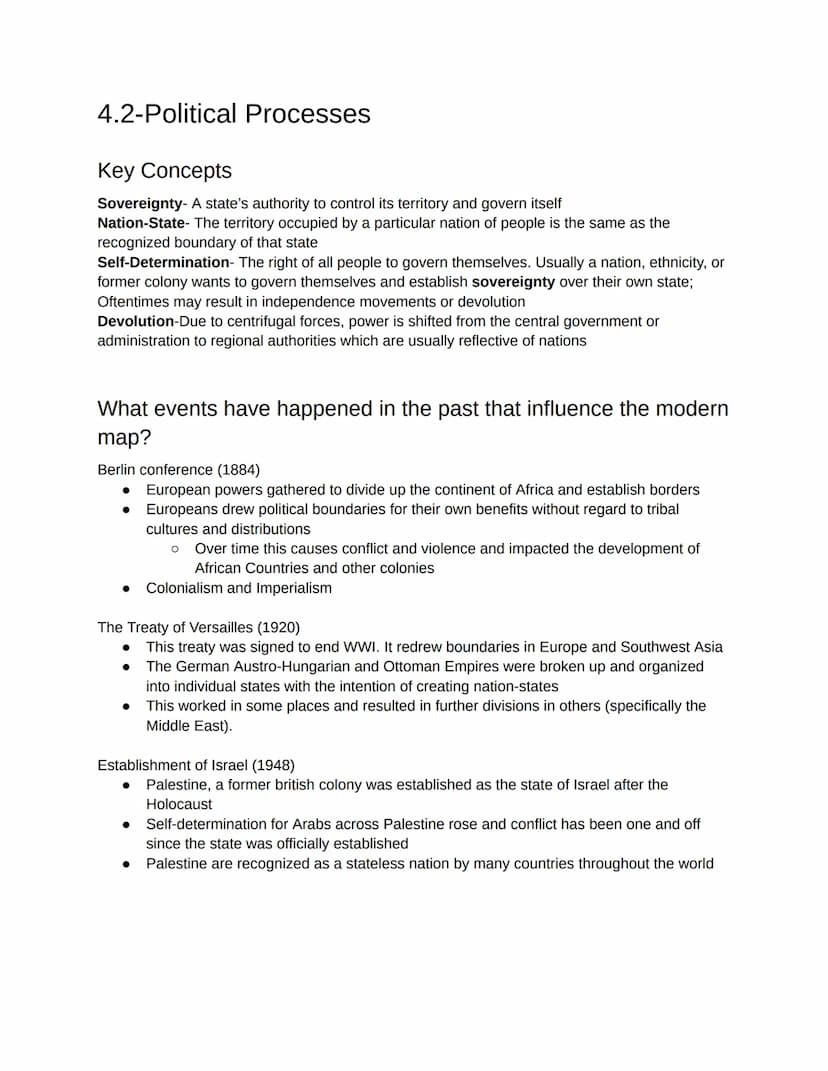
Political Processes
This section of AP Human Geography Unit 4: Political Patterns and Processes focuses on key concepts and historical events that have shaped the modern political map.
Key Concepts:
Vocabulary: Sovereignty is a state's authority to control its territory and govern itself.
Definition: A nation-state is when the territory occupied by a particular nation of people is the same as the recognized boundary of that state.
Vocabulary: Self-determination is the right of all people to govern themselves. It often involves a nation, ethnicity, or former colony wanting to establish sovereignty over their own state, which may result in independence movements or devolution.
Vocabulary: Devolution occurs when power is shifted from the central government or administration to regional authorities, usually reflective of nations, due to centrifugal forces.
Historical Events Influencing the Modern Map:
-
Berlin Conference (1884):
- European powers divided up Africa, establishing borders without regard to tribal cultures.
- This led to conflict and impacted the development of African countries and other colonies.
-
Colonialism and Imperialism
-
Treaty of Versailles (1920):
- Ended World War I and redrew boundaries in Europe and Southwest Asia.
- Broke up German, Austro-Hungarian, and Ottoman Empires into individual states.
-
Establishment of Israel (1948):
- Palestine, a former British colony, became the state of Israel.
- Led to ongoing conflict and the recognition of Palestine as a stateless nation by many countries.
These events and concepts are crucial for understanding the complex political geography covered in Unit 4 AP Human Geography.
3
of 10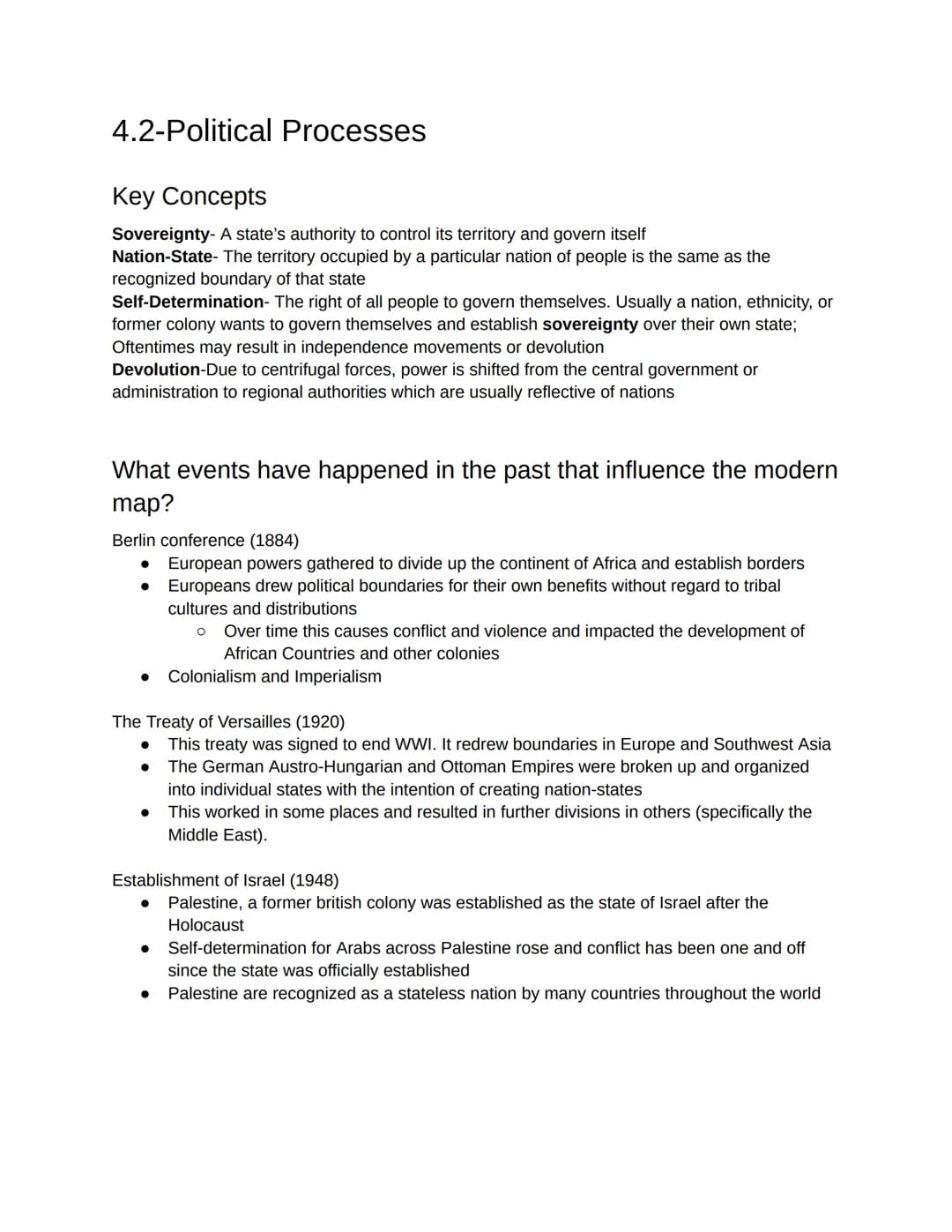
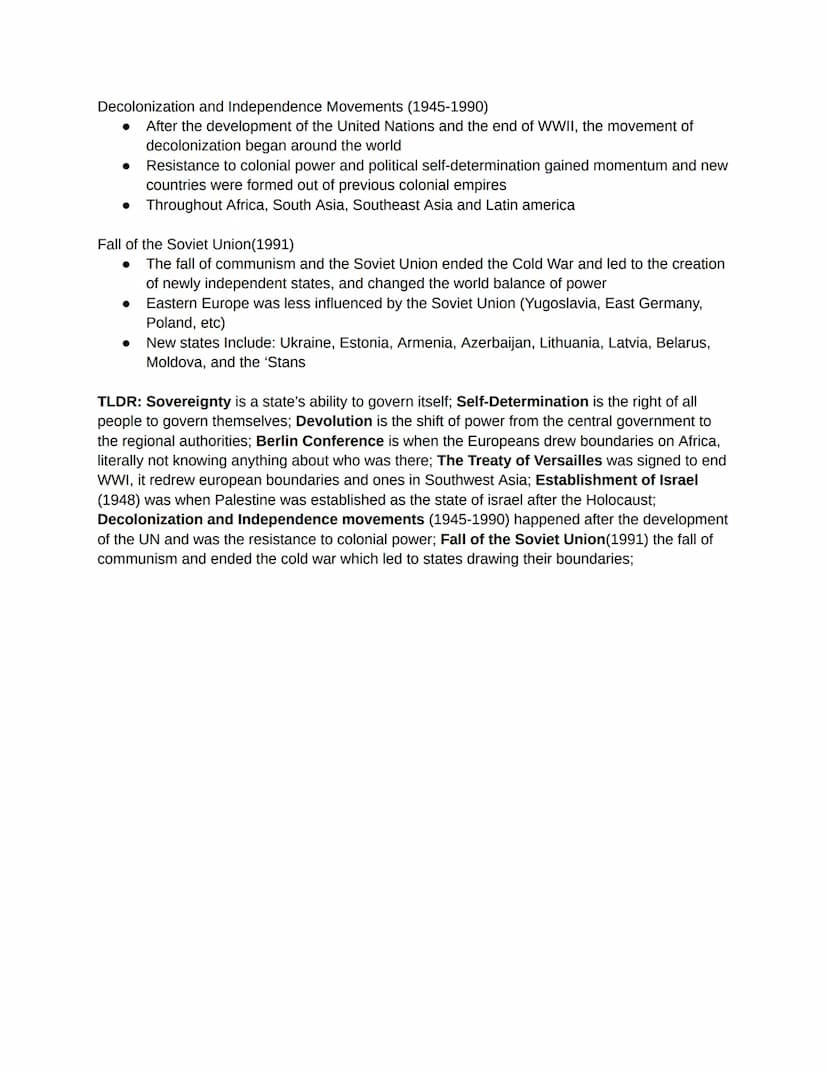
Historical Events Shaping Political Geography (Continued)
This section of AP Human Geography Unit 4: Political Patterns and Processes continues to explore significant historical events that have influenced the modern political map.
Decolonization and Independence Movements (1945-1990):
- After the development of the United Nations and the end of World War II, the movement of decolonization began worldwide.
- Resistance to colonial power and political self-determination gained momentum.
- New countries were formed out of previous colonial empires throughout Africa, South Asia, Southeast Asia, and Latin America.
Highlight: The decolonization period marked a significant shift in global political geography, leading to the creation of numerous new independent states.
Fall of the Soviet Union (1991):
- The collapse of communism and the Soviet Union ended the Cold War and led to the creation of newly independent states.
- This event changed the world balance of power significantly.
- Eastern Europe became less influenced by the Soviet Union (e.g., Yugoslavia, East Germany, Poland).
- New states emerged, including Ukraine, Estonia, Armenia, Azerbaijan, Lithuania, Latvia, Belarus, Moldova, and the Central Asian republics often referred to as the 'Stans'.
Highlight: The fall of the Soviet Union reshaped the political map of Eastern Europe and Central Asia, creating new opportunities for self-determination and devolution.
The section concludes by reiterating the importance of sovereignty in political geography:
Definition: Sovereignty is a state's ability to govern itself.
Understanding these historical events and their impacts on political geography is crucial for students studying AP Human Geography Unit 4: Political Patterns and Processes. These events demonstrate how concepts like self-determination, devolution, and the formation of nation-states play out in real-world scenarios, shaping the global political landscape we see today.
4
of 10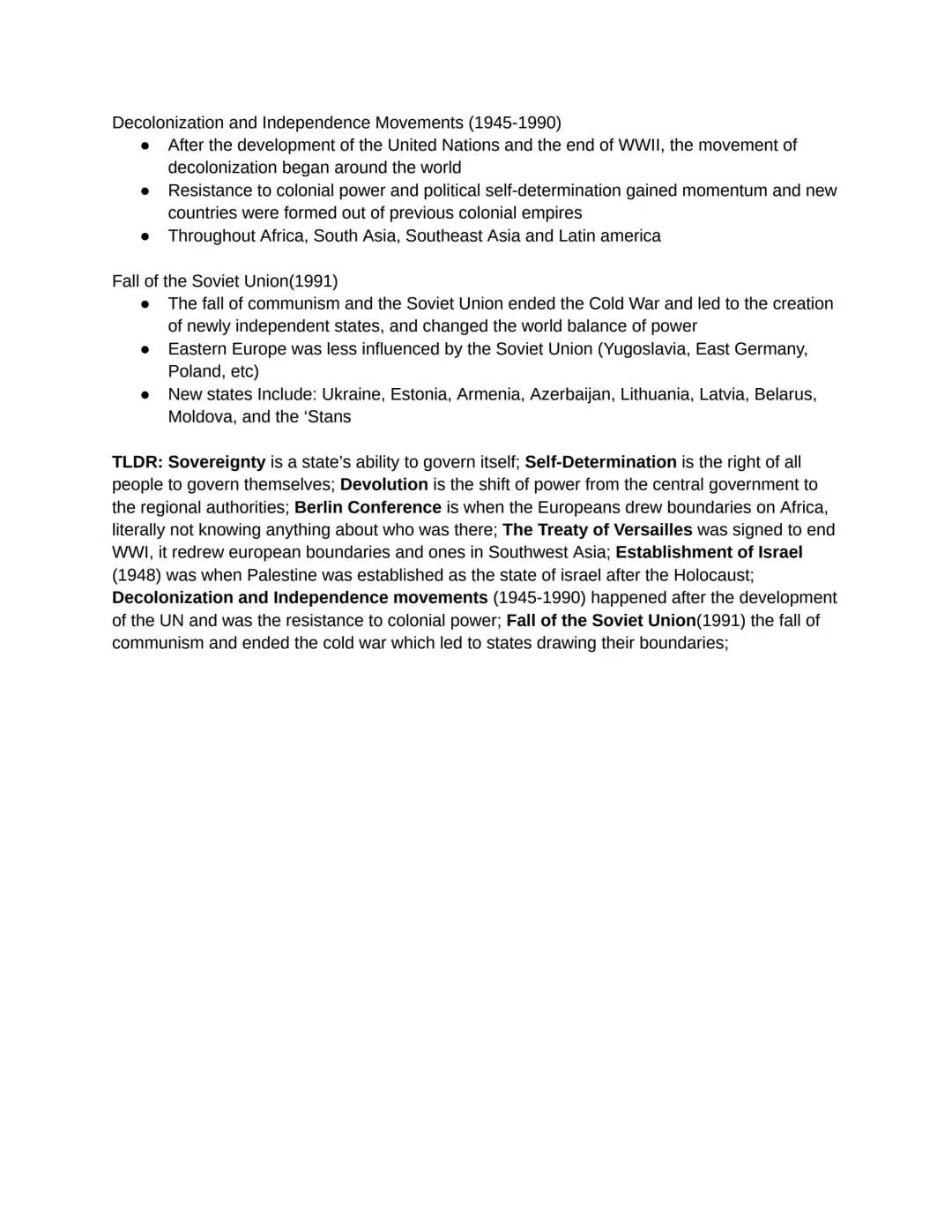
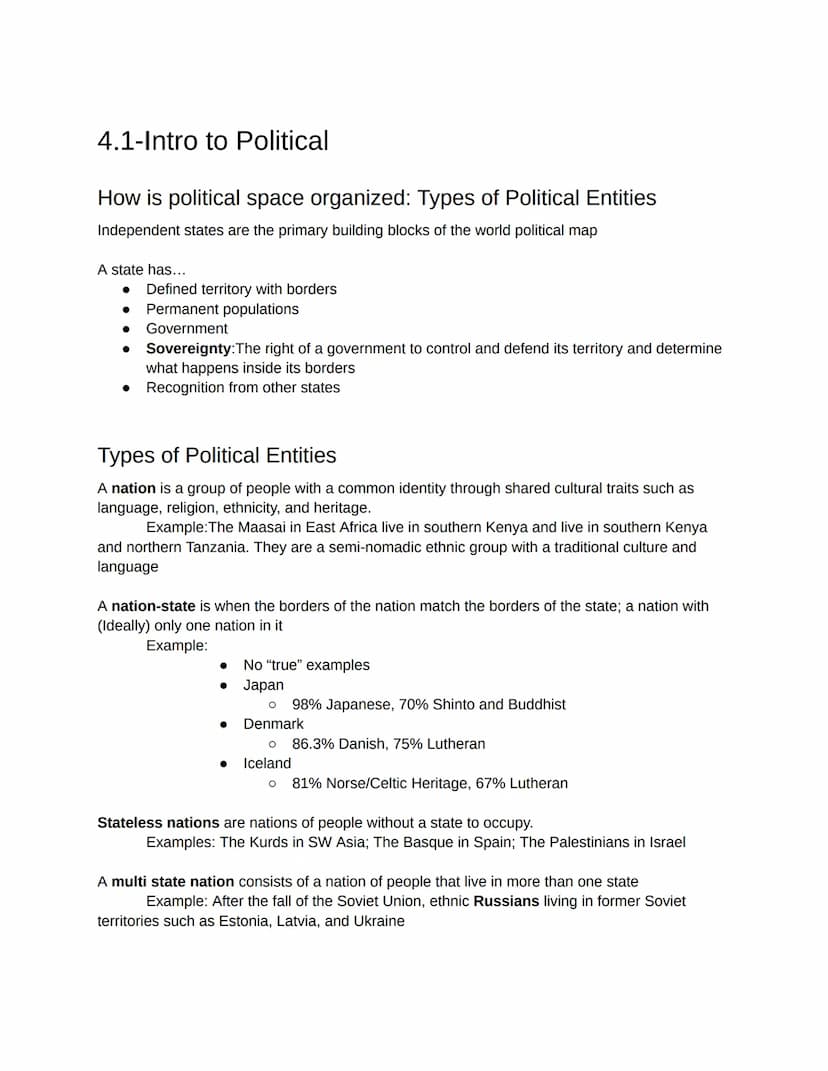
Introduction to Political Geography
This section introduces the fundamental concepts of political geography in AP Human Geography Unit 4: Political Patterns and Processes. It explores how political space is organized through various types of political entities.
The primary building blocks of the world political map are independent states. A state is characterized by:
- Defined territory with borders
- Permanent populations
- Government
- Sovereignty, which is the right of a government to control and defend its territory
- Recognition from other states
The section then delves into different types of political entities:
Definition: A nation is a group of people with a common identity through shared cultural traits such as language, religion, ethnicity, and heritage.
Example: The Maasai in East Africa, living in southern Kenya and northern Tanzania, are a semi-nomadic ethnic group with a traditional culture and language.
Definition: A nation-state is when the borders of the nation match the borders of the state, ideally containing only one nation.
Example: While there are no "true" examples, countries like Japan (98% Japanese, 70% Shinto and Buddhist), Denmark (86.3% Danish, 75% Lutheran), and Iceland come close to the ideal of a nation-state.
Vocabulary: Stateless nations are nations of people without a state to occupy.
Example: The Kurds in Southwest Asia, the Basque in Spain, and the Palestinians in Israel are examples of stateless nations.
Definition: A multi-state nation consists of a nation of people that live in more than one state.
Example: After the fall of the Soviet Union, ethnic Russians living in former Soviet territories such as Estonia, Latvia, and Ukraine became a multi-state nation.
5
of 10
6
of 10
7
of 10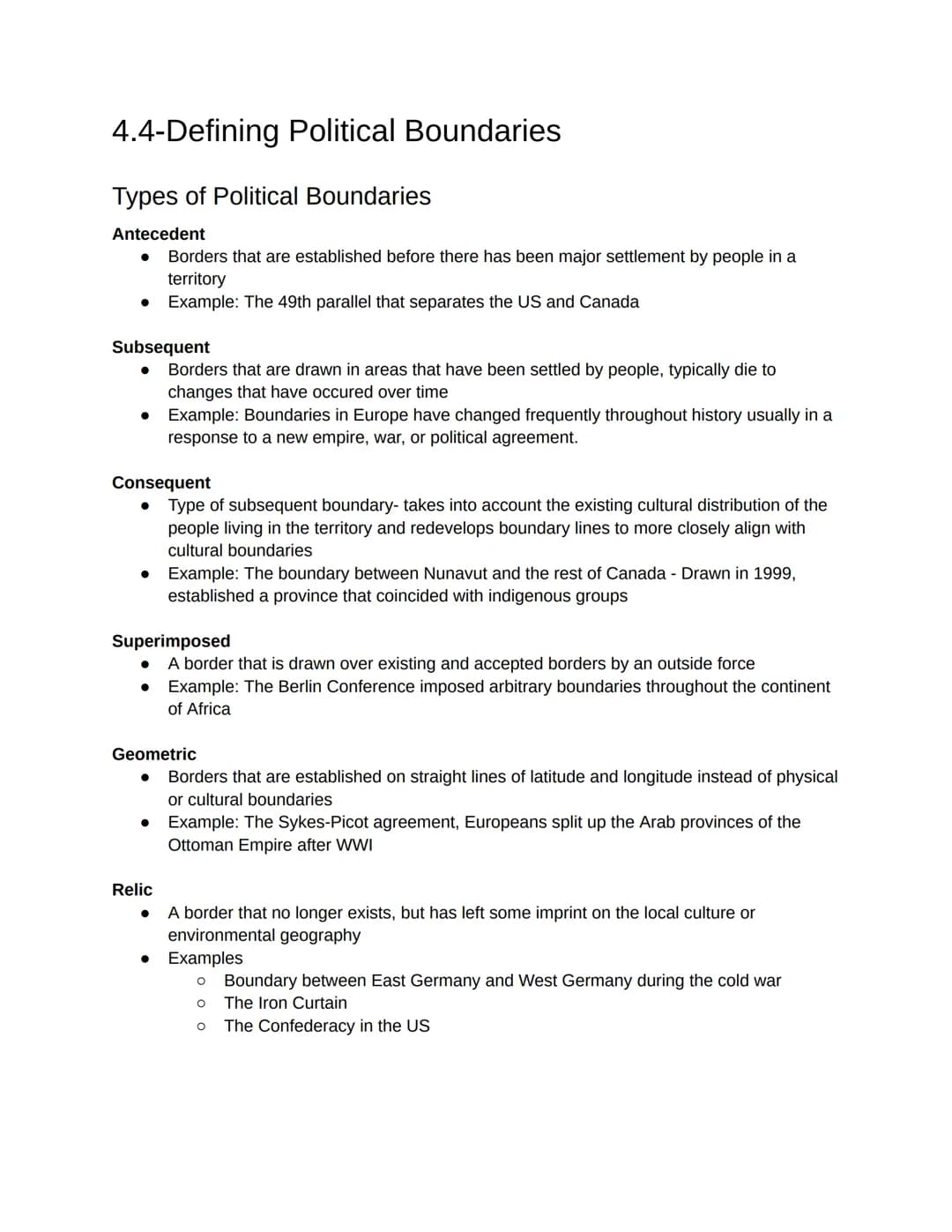
8
of 10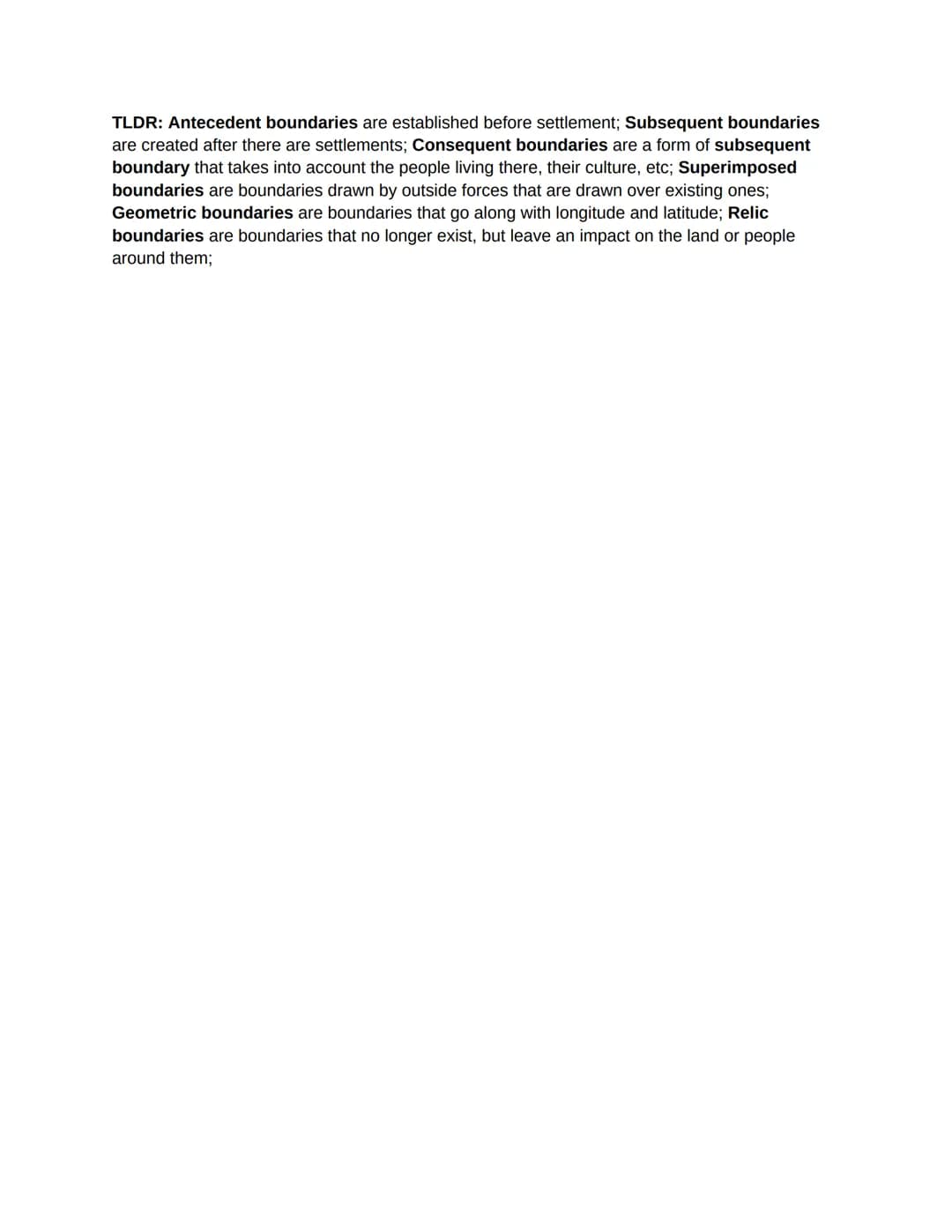
9
of 10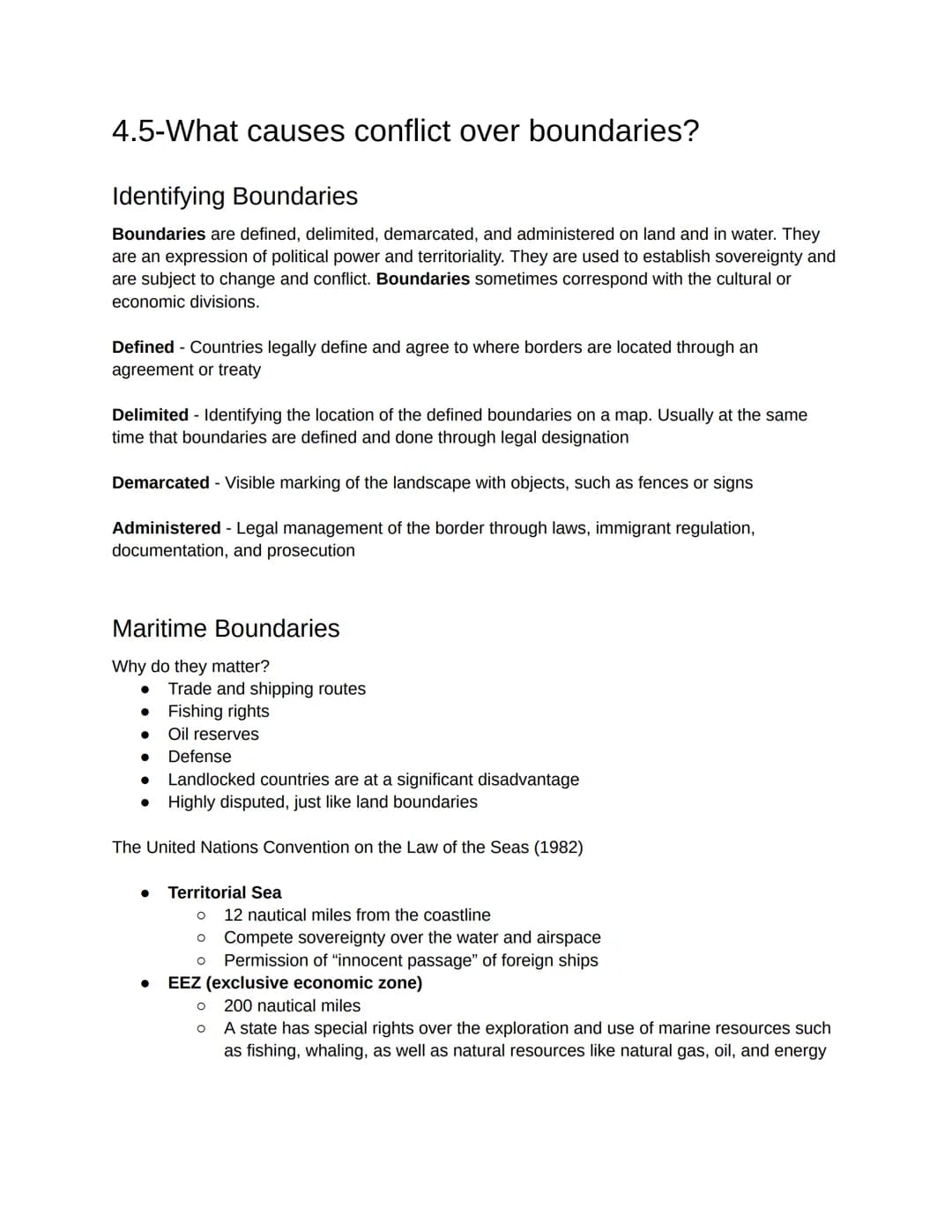
10
of 10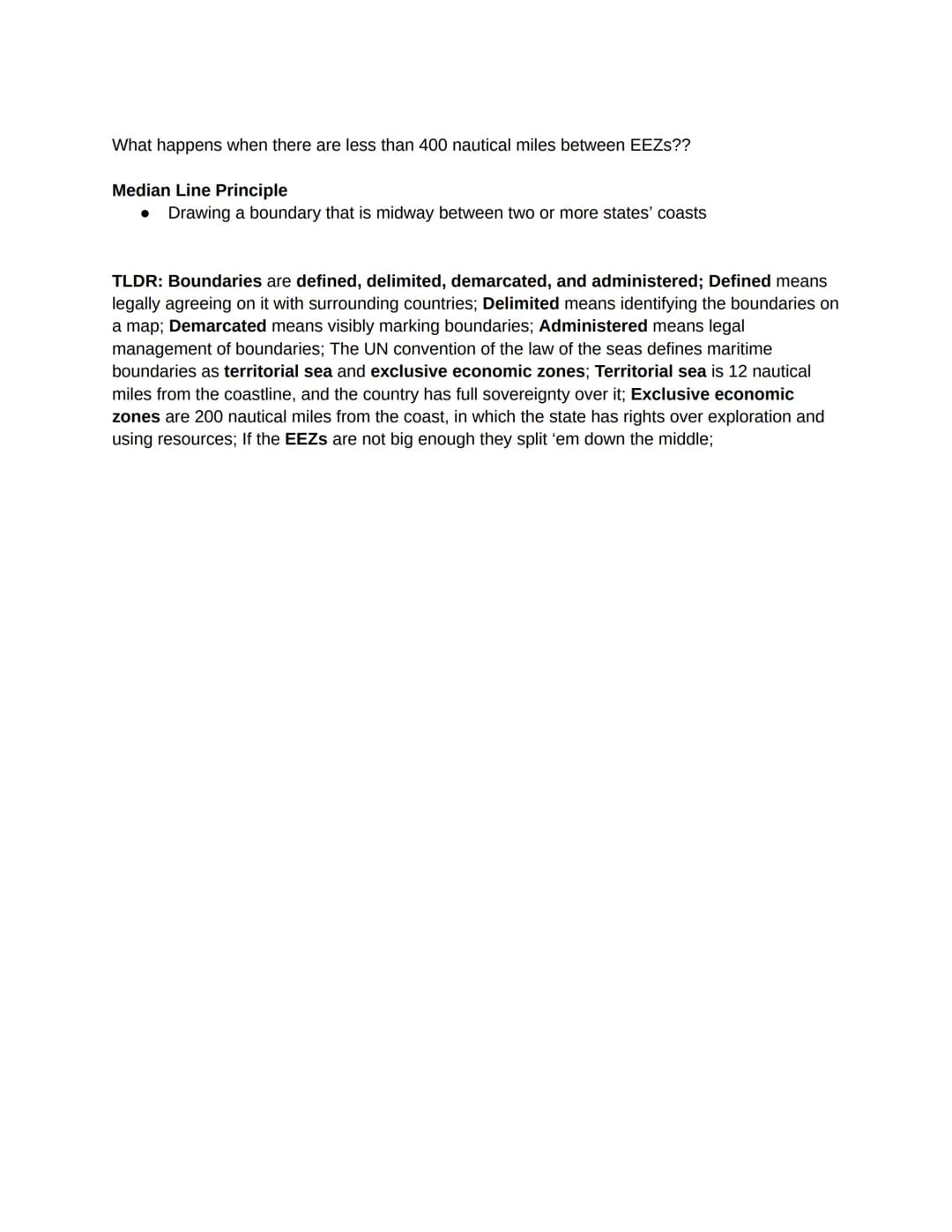
We thought you’d never ask...
What is the Knowunity AI companion?
Our AI companion is specifically built for the needs of students. Based on the millions of content pieces we have on the platform we can provide truly meaningful and relevant answers to students. But its not only about answers, the companion is even more about guiding students through their daily learning challenges, with personalised study plans, quizzes or content pieces in the chat and 100% personalisation based on the students skills and developments.
Where can I download the Knowunity app?
You can download the app in the Google Play Store and in the Apple App Store.
Is Knowunity really free of charge?
That's right! Enjoy free access to study content, connect with fellow students, and get instant help – all at your fingertips.
Similar Content
Most popular content in AP Human Geography
9I
AP Human GeographyIntroduction to Geographic Data
Practice identifying types of geographic data, including qualitative and quantitative sources like census data and satellite imagery.
9th5500
I
AP Human GeographyIntroduction to Human-Environmental Interaction
Practice the foundational concepts of environmental determinism and possibilism and their influence on early geographic thought.
9th4520
I
AP Human GeographyIntroduction to Map Properties and Scale
Practice identifying types of map distortion and calculating map scale to understand how physical reality is represented on a flat surface.
9th2860
P
AP Human GeographyPopulation: quiz #1!
Master the fundamentals of population with these easy flashcards designed for high school students. Explore key concepts, terms, and examples to ace your exams!
9th1860
U
AP Human GeographyUnit 2 Measuring Population Density quiz
Measuring Population Density
9th1710
A
AP Human GeographyAP HUG UNIT 1
This is a little test to help you practice for AP HUG
10th1840
I
AP Human GeographyIntroduction to Geographic Data Scales
Practice identifying and differentiating between local, regional, national, and global scales of analysis using maps and data sets.
9th1810
A
AP Human GeographyAPHUG Unit 1
10 questions just general info you should know if you have listened in your class :D
9th1570
AP Human GeographyFull Year APHG (Human Geography) Notes
My full Freshman year’s APHG notes compiled on a document.
9th1,910236
Most popular content
9O
 AP US History
Origins and Dynamics of the Columbian Exchange
Analyze the ecological and economic motivations behind the initial transfer of goods, people, and diseases between the Old and New Worlds.
9th3,1280
I
AP US HistoryIntroduction to Early Cultural Interactions
Analyze the initial social and religious encounters between Europeans, Africans, and Indigenous peoples in the colonial Americas.
9th2,7730
O
 AP World History
Origins of Ancient River Civilizations
Analyze the environmental factors and technological innovations that led to the rise of early states in Mesopotamia, Egypt, and the Indus Valley.
9th3,1860
M
AP US HistoryMotivations for European Exploration
Analyze the economic, religious, and political factors that drove European powers to the Americas during the 15th and 16th centuries.
9th1,7780
F
AP PsychologyFoundations of Ethical Guidelines in Research
Practice the core principles of the APA ethical code including informed consent, debriefing, and the role of Institutional Review Boards.
9th1,3360
I
AP US HistoryIntroduction to Native American Societies
Examine the diverse social, political, and economic structures of North American indigenous groups prior to European contact.
9th1,1100
I
 AP Biology
Introduction to Biological Elements of Life
Practice identifying the essential elements including carbon, nitrogen, phosphorus, and sulfur that compose biological macromolecules.
9th1,7360
I
AP US HistoryIntroduction to the Spanish Encomienda System
Explore the fundamental economic and social structures of the Spanish colonial system, focusing on the encomienda and the casta social hierarchy.
9th8890
O
AP World HistoryOrigins and Continuity of the Byzantine Empire
Analyze the political and cultural transitions from the Roman Empire to the Byzantine Empire, focusing on the reign of Justinian I and his code.
9th1,6320
Can't find what you're looking for? Explore other subjects.
Students love us — and so will you.
4.6/5App Store
4.7/5Google Play
The app is very easy to use and well designed. I have found everything I was looking for so far and have been able to learn a lot from the presentations! I will definitely use the app for a class assignment! And of course it also helps a lot as an inspiration.
Stefan SiOS user
This app is really great. There are so many study notes and help [...]. My problem subject is French, for example, and the app has so many options for help. Thanks to this app, I have improved my French. I would recommend it to anyone.
Samantha KlichAndroid user
Wow, I am really amazed. I just tried the app because I've seen it advertised many times and was absolutely stunned. This app is THE HELP you want for school and above all, it offers so many things, such as workouts and fact sheets, which have been VERY helpful to me personally.
AnnaiOS user
AP Human Geography1,090 views·Updated May 20, 2026·19 pagesAP Human Geography Unit 4: Political Patterns, Nation-States, and Stateless Nations
Abbie@nyssaling
AP Human Geography Unit 4: Political Patterns and Processesexplores how political space is organized through various types of political entities. This unit covers key concepts like sovereignty, nation-states, and self-determination, examining historical events that have shaped the modern political... Show more
1
of 10Sign up to see the content. It's free!
- Access to all documents
- Improve your grades
- Join milions of students
Types of Political Entities (Continued)
This section continues the exploration of political entities in AP Human Geography Unit 4: Political Patterns and Processes, focusing on multinational states and autonomous regions.
Definition: A multinational state is a country with various ethnicities and cultures within its borders.
Example: The United States, Russia, the former Yugoslavia, Iraq, Afghanistan, and Nigeria are examples of multinational states.
Vocabulary: An autonomous or semi-autonomous region is a location within a state that is given authority to govern independently from the national government.
Example: Native American Reservations and Tribal Lands in the United States are examples of autonomous regions.
The section concludes with a summary of key concepts:
- A state has defined territory, permanent populations, government, sovereignty, and recognition from other states.
- A nation is a group of people with a common identity.
- A nation-state is when a state has mostly one nation in it.
- Stateless nations are nations without a state to occupy.
- A multi-state nation consists of a nation of people that live in multiple states.
- A multinational state is a country with various ethnicities and cultures/nations.
- An autonomous or semi-autonomous region is a place that can govern itself, without the national government.
These concepts are crucial for understanding the complex political geography covered in Unit 4 AP Human Geography.
2
of 10Sign up to see the content. It's free!
- Access to all documents
- Improve your grades
- Join milions of students
Political Processes
This section of AP Human Geography Unit 4: Political Patterns and Processes focuses on key concepts and historical events that have shaped the modern political map.
Key Concepts:
Vocabulary: Sovereignty is a state's authority to control its territory and govern itself.
Definition: A nation-state is when the territory occupied by a particular nation of people is the same as the recognized boundary of that state.
Vocabulary: Self-determination is the right of all people to govern themselves. It often involves a nation, ethnicity, or former colony wanting to establish sovereignty over their own state, which may result in independence movements or devolution.
Vocabulary: Devolution occurs when power is shifted from the central government or administration to regional authorities, usually reflective of nations, due to centrifugal forces.
Historical Events Influencing the Modern Map:
-
Berlin Conference (1884):
- European powers divided up Africa, establishing borders without regard to tribal cultures.
- This led to conflict and impacted the development of African countries and other colonies.
-
Colonialism and Imperialism
-
Treaty of Versailles (1920):
- Ended World War I and redrew boundaries in Europe and Southwest Asia.
- Broke up German, Austro-Hungarian, and Ottoman Empires into individual states.
-
Establishment of Israel (1948):
- Palestine, a former British colony, became the state of Israel.
- Led to ongoing conflict and the recognition of Palestine as a stateless nation by many countries.
These events and concepts are crucial for understanding the complex political geography covered in Unit 4 AP Human Geography.
3
of 10Sign up to see the content. It's free!
- Access to all documents
- Improve your grades
- Join milions of students
Historical Events Shaping Political Geography (Continued)
This section of AP Human Geography Unit 4: Political Patterns and Processes continues to explore significant historical events that have influenced the modern political map.
Decolonization and Independence Movements (1945-1990):
- After the development of the United Nations and the end of World War II, the movement of decolonization began worldwide.
- Resistance to colonial power and political self-determination gained momentum.
- New countries were formed out of previous colonial empires throughout Africa, South Asia, Southeast Asia, and Latin America.
Highlight: The decolonization period marked a significant shift in global political geography, leading to the creation of numerous new independent states.
Fall of the Soviet Union (1991):
- The collapse of communism and the Soviet Union ended the Cold War and led to the creation of newly independent states.
- This event changed the world balance of power significantly.
- Eastern Europe became less influenced by the Soviet Union (e.g., Yugoslavia, East Germany, Poland).
- New states emerged, including Ukraine, Estonia, Armenia, Azerbaijan, Lithuania, Latvia, Belarus, Moldova, and the Central Asian republics often referred to as the 'Stans'.
Highlight: The fall of the Soviet Union reshaped the political map of Eastern Europe and Central Asia, creating new opportunities for self-determination and devolution.
The section concludes by reiterating the importance of sovereignty in political geography:
Definition: Sovereignty is a state's ability to govern itself.
Understanding these historical events and their impacts on political geography is crucial for students studying AP Human Geography Unit 4: Political Patterns and Processes. These events demonstrate how concepts like self-determination, devolution, and the formation of nation-states play out in real-world scenarios, shaping the global political landscape we see today.
4
of 10Sign up to see the content. It's free!
- Access to all documents
- Improve your grades
- Join milions of students
Introduction to Political Geography
This section introduces the fundamental concepts of political geography in AP Human Geography Unit 4: Political Patterns and Processes. It explores how political space is organized through various types of political entities.
The primary building blocks of the world political map are independent states. A state is characterized by:
- Defined territory with borders
- Permanent populations
- Government
- Sovereignty, which is the right of a government to control and defend its territory
- Recognition from other states
The section then delves into different types of political entities:
Definition: A nation is a group of people with a common identity through shared cultural traits such as language, religion, ethnicity, and heritage.
Example: The Maasai in East Africa, living in southern Kenya and northern Tanzania, are a semi-nomadic ethnic group with a traditional culture and language.
Definition: A nation-state is when the borders of the nation match the borders of the state, ideally containing only one nation.
Example: While there are no "true" examples, countries like Japan (98% Japanese, 70% Shinto and Buddhist), Denmark (86.3% Danish, 75% Lutheran), and Iceland come close to the ideal of a nation-state.
Vocabulary: Stateless nations are nations of people without a state to occupy.
Example: The Kurds in Southwest Asia, the Basque in Spain, and the Palestinians in Israel are examples of stateless nations.
Definition: A multi-state nation consists of a nation of people that live in more than one state.
Example: After the fall of the Soviet Union, ethnic Russians living in former Soviet territories such as Estonia, Latvia, and Ukraine became a multi-state nation.
5
of 10Sign up to see the content. It's free!
- Access to all documents
- Improve your grades
- Join milions of students
6
of 10Sign up to see the content. It's free!
- Access to all documents
- Improve your grades
- Join milions of students
7
of 10Sign up to see the content. It's free!
- Access to all documents
- Improve your grades
- Join milions of students
8
of 10Sign up to see the content. It's free!
- Access to all documents
- Improve your grades
- Join milions of students
9
of 10Sign up to see the content. It's free!
- Access to all documents
- Improve your grades
- Join milions of students
10
of 10Sign up to see the content. It's free!
- Access to all documents
- Improve your grades
- Join milions of students
We thought you’d never ask...
What is the Knowunity AI companion?
Our AI companion is specifically built for the needs of students. Based on the millions of content pieces we have on the platform we can provide truly meaningful and relevant answers to students. But its not only about answers, the companion is even more about guiding students through their daily learning challenges, with personalised study plans, quizzes or content pieces in the chat and 100% personalisation based on the students skills and developments.
Where can I download the Knowunity app?
You can download the app in the Google Play Store and in the Apple App Store.
Is Knowunity really free of charge?
That's right! Enjoy free access to study content, connect with fellow students, and get instant help – all at your fingertips.
Similar Content
Most popular content in AP Human Geography
9I
AP Human GeographyIntroduction to Geographic Data
Practice identifying types of geographic data, including qualitative and quantitative sources like census data and satellite imagery.
9th5500
I
AP Human GeographyIntroduction to Human-Environmental Interaction
Practice the foundational concepts of environmental determinism and possibilism and their influence on early geographic thought.
9th4520
I
AP Human GeographyIntroduction to Map Properties and Scale
Practice identifying types of map distortion and calculating map scale to understand how physical reality is represented on a flat surface.
9th2860
P
AP Human GeographyPopulation: quiz #1!
Master the fundamentals of population with these easy flashcards designed for high school students. Explore key concepts, terms, and examples to ace your exams!
9th1860
U
AP Human GeographyUnit 2 Measuring Population Density quiz
Measuring Population Density
9th1710
A
AP Human GeographyAP HUG UNIT 1
This is a little test to help you practice for AP HUG
10th1840
I
AP Human GeographyIntroduction to Geographic Data Scales
Practice identifying and differentiating between local, regional, national, and global scales of analysis using maps and data sets.
9th1810
A
AP Human GeographyAPHUG Unit 1
10 questions just general info you should know if you have listened in your class :D
9th1570
AP Human GeographyFull Year APHG (Human Geography) Notes
My full Freshman year’s APHG notes compiled on a document.
9th1,910236
Most popular content
9O
AP US HistoryOrigins and Dynamics of the Columbian Exchange
Analyze the ecological and economic motivations behind the initial transfer of goods, people, and diseases between the Old and New Worlds.
9th3,1280
I
AP US HistoryIntroduction to Early Cultural Interactions
Analyze the initial social and religious encounters between Europeans, Africans, and Indigenous peoples in the colonial Americas.
9th2,7730
O
AP World HistoryOrigins of Ancient River Civilizations
Analyze the environmental factors and technological innovations that led to the rise of early states in Mesopotamia, Egypt, and the Indus Valley.
9th3,1860
M
AP US HistoryMotivations for European Exploration
Analyze the economic, religious, and political factors that drove European powers to the Americas during the 15th and 16th centuries.
9th1,7780
F
AP PsychologyFoundations of Ethical Guidelines in Research
Practice the core principles of the APA ethical code including informed consent, debriefing, and the role of Institutional Review Boards.
9th1,3360
I
AP US HistoryIntroduction to Native American Societies
Examine the diverse social, political, and economic structures of North American indigenous groups prior to European contact.
9th1,1100
I
AP BiologyIntroduction to Biological Elements of Life
Practice identifying the essential elements including carbon, nitrogen, phosphorus, and sulfur that compose biological macromolecules.
9th1,7360
I
AP US HistoryIntroduction to the Spanish Encomienda System
Explore the fundamental economic and social structures of the Spanish colonial system, focusing on the encomienda and the casta social hierarchy.
9th8890
O
AP World HistoryOrigins and Continuity of the Byzantine Empire
Analyze the political and cultural transitions from the Roman Empire to the Byzantine Empire, focusing on the reign of Justinian I and his code.
9th1,6320
Can't find what you're looking for? Explore other subjects.
Students love us — and so will you.
4.6/5App Store
4.7/5Google Play
The app is very easy to use and well designed. I have found everything I was looking for so far and have been able to learn a lot from the presentations! I will definitely use the app for a class assignment! And of course it also helps a lot as an inspiration.
Stefan SiOS user
This app is really great. There are so many study notes and help [...]. My problem subject is French, for example, and the app has so many options for help. Thanks to this app, I have improved my French. I would recommend it to anyone.
Samantha KlichAndroid user
Wow, I am really amazed. I just tried the app because I've seen it advertised many times and was absolutely stunned. This app is THE HELP you want for school and above all, it offers so many things, such as workouts and fact sheets, which have been VERY helpful to me personally.
AnnaiOS user