
The Irish future tense (an aimsir fháistineach) is your tool... Show more
 Irish5 views·Updated May 21, 2026·5 pages
Learn About An Aimsir Fháistineach: Forming Future Tense in Irish
1 / 5
1
of 5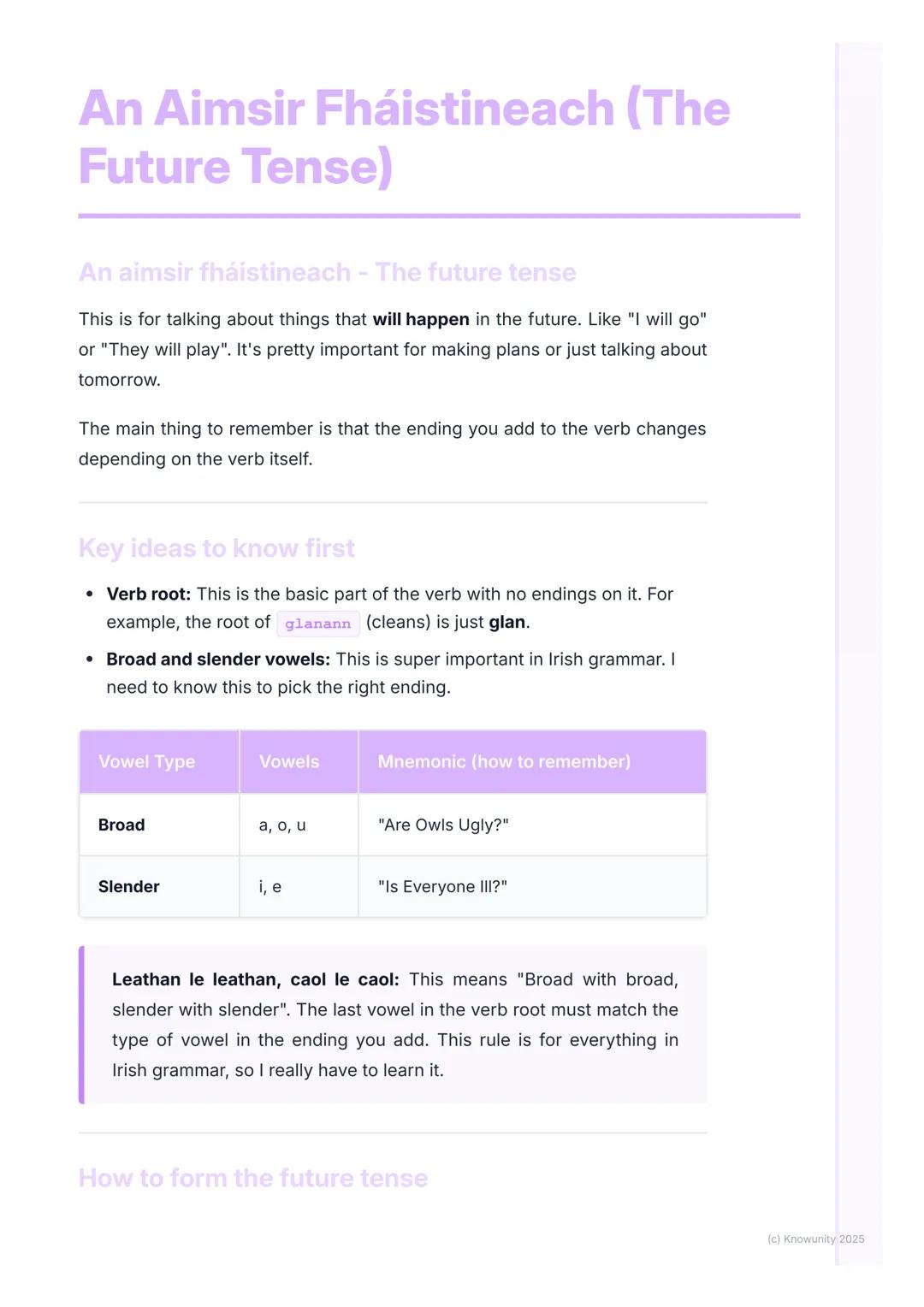
An Aimsir Fháistineach - Getting Started
Think of the future tense as your planning language - it's how you say "I will go" or "they will play" in Irish. The trick is knowing which ending to stick on your verb, and that depends on the vowels inside it.
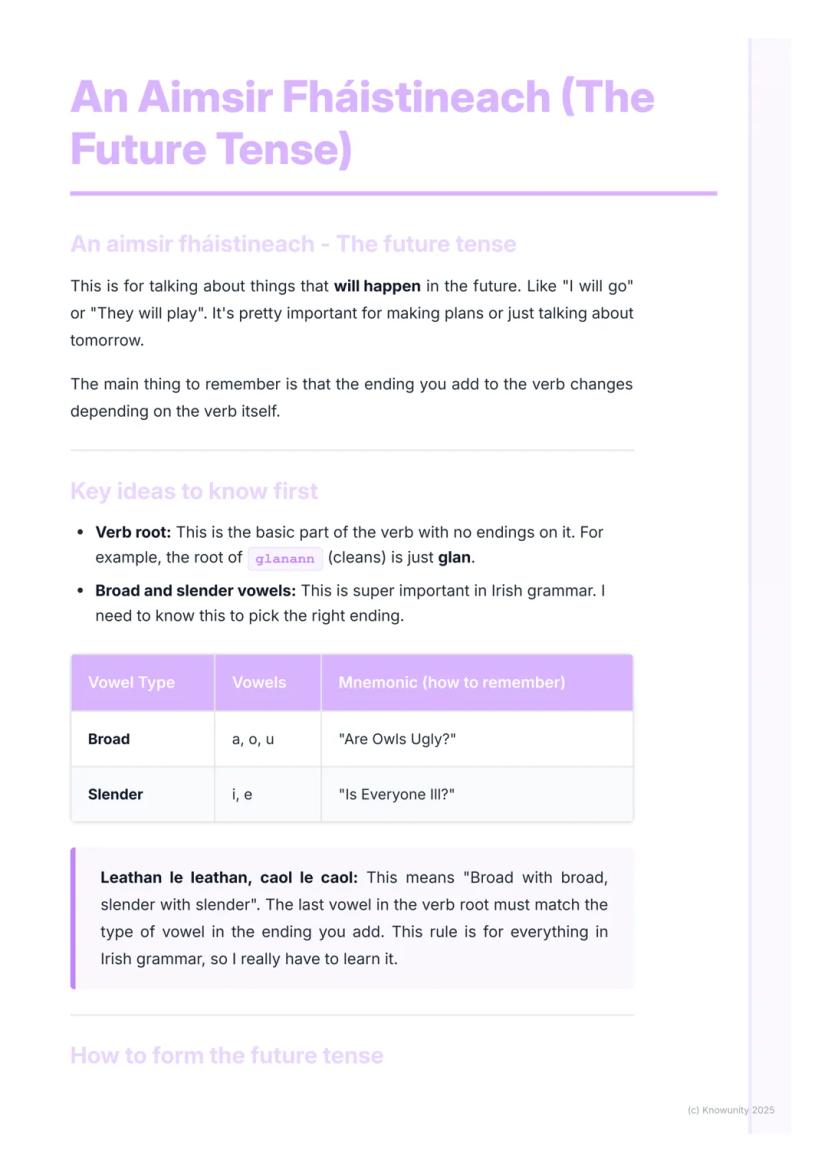
Before diving in, you need to master broad and slender vowels. Broad vowels are a, o, u (remember: "Are Owls Ugly?") and slender vowels are i, e ("Is Everyone Ill?"). This matters because of the golden rule: leathan le leathan, caol le caol - broad with broad, slender with slender.
The verb root is your starting point - it's the basic form without any endings. For example, glanann (cleans) has the root glan. Once you've got your root, check its last vowel to decide which ending fits.
Quick tip: Master the vowel types first - they're used throughout Irish grammar, not just the future tense!
2
of 5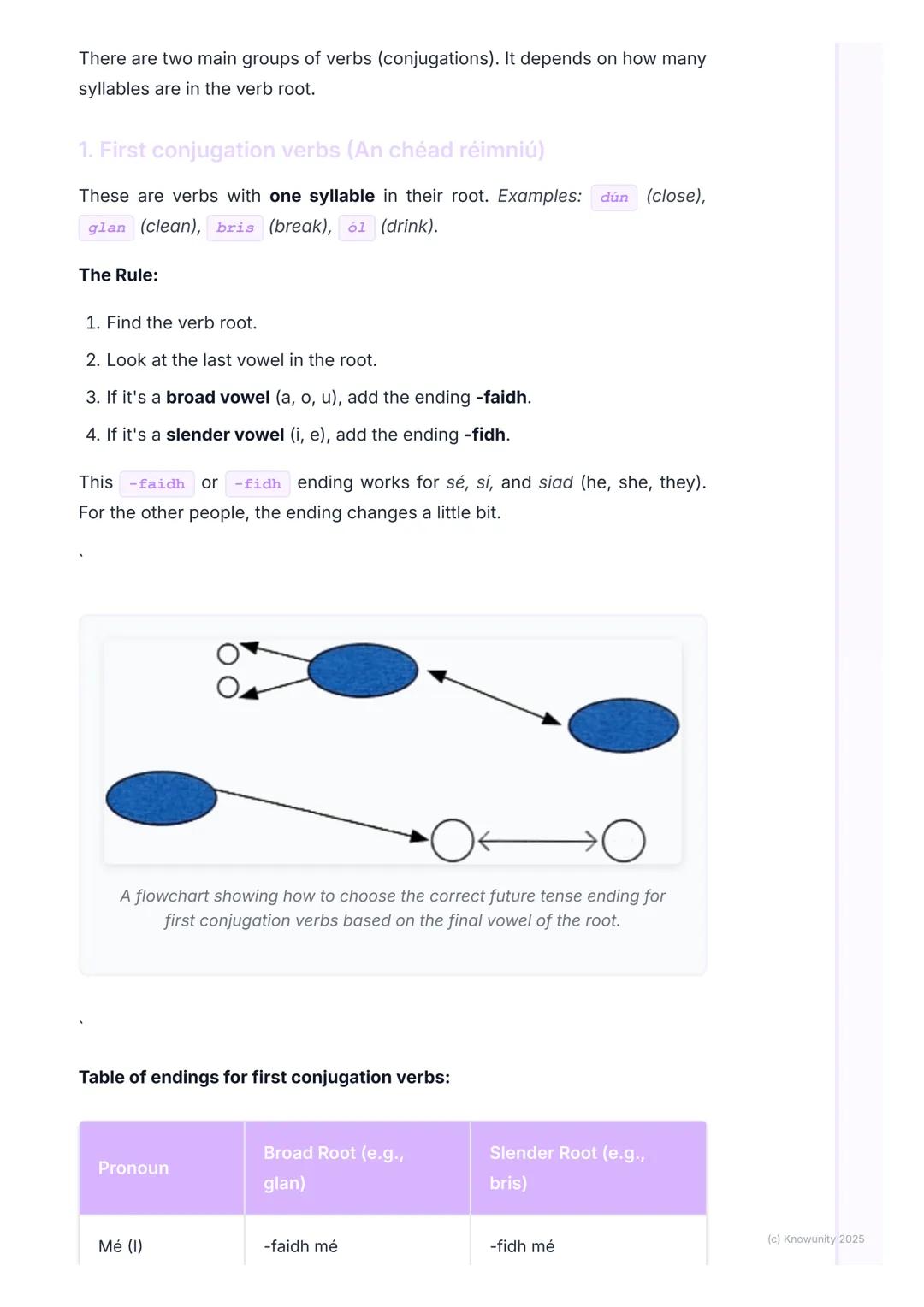
First Conjugation Verbs - The One-Syllable Gang
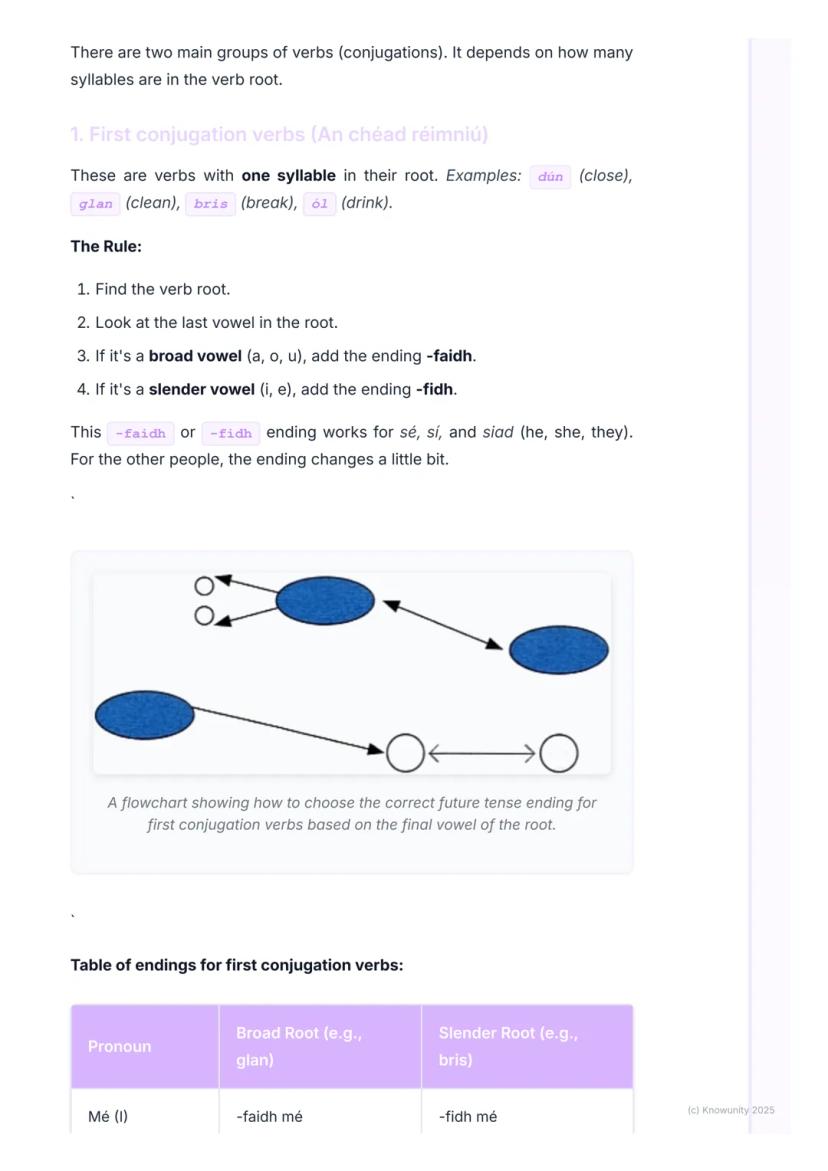
First conjugation verbs have just one syllable in their root - words like dún (close), glan (clean), bris (break), and ól (drink). These are actually the easiest once you get the pattern.
Here's the system: if your verb root ends with a broad vowel (a, o, u), you add -faidh. If it ends with a slender vowel (i, e), you add -fidh. So glan becomes glanfaidh and bris becomes brisfidh.
The endings work perfectly for sé, sí, and siad (he, she, they). For other pronouns like mé and tú, you just add the pronoun after: glanfaidh mé, glanfaidh tú. The only special case is sinn (we) - it gets its own endings: -faimid for broad roots and -fimid for slender ones.
Remember: The broad/slender rule applies to every single verb - there are no exceptions here!
3
of 5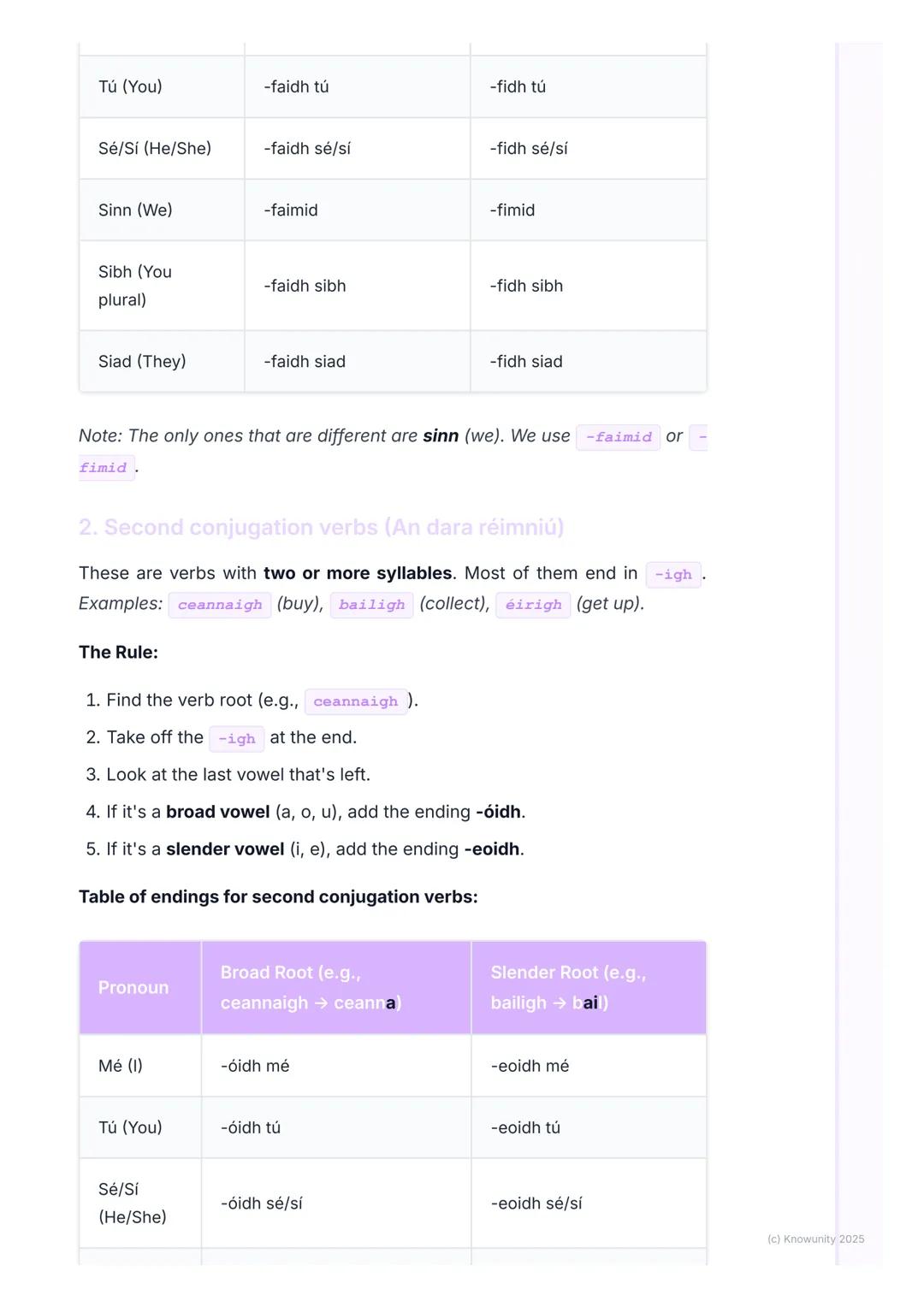
Second Conjugation Verbs - The Multi-Syllable Squad
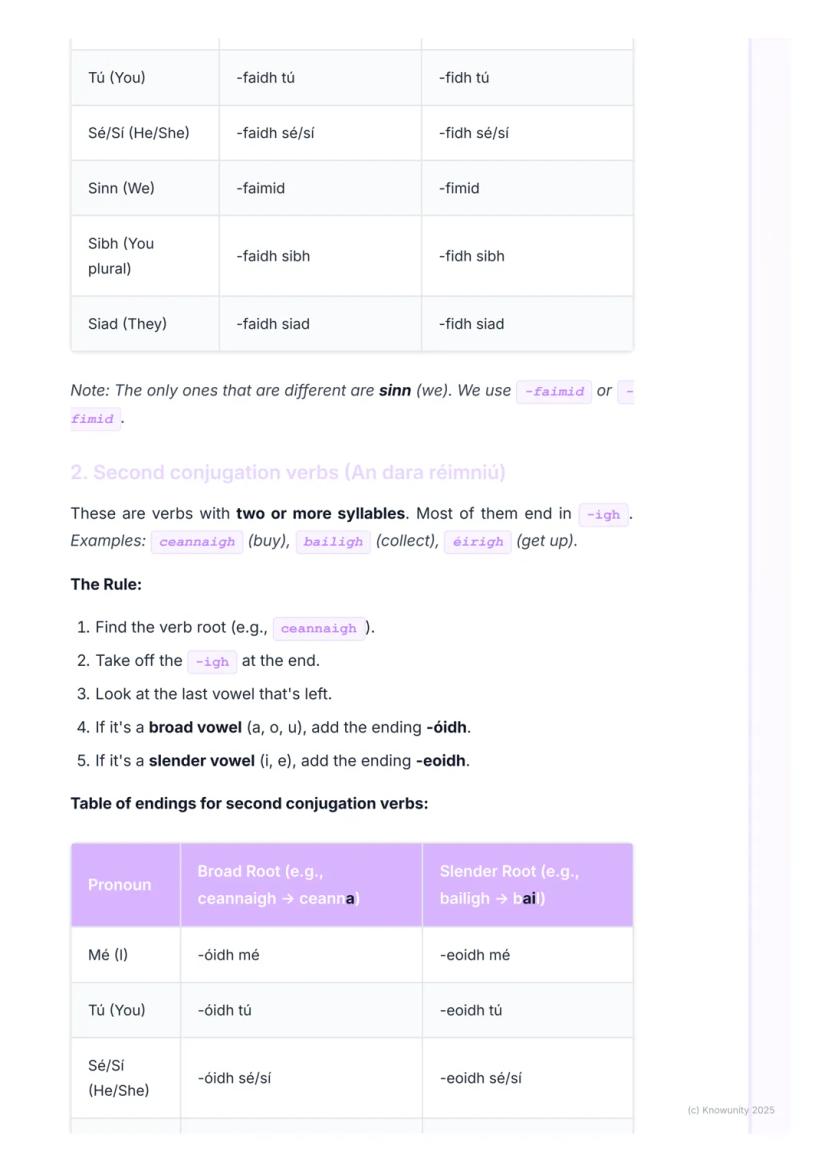
Second conjugation verbs have two or more syllables and usually end in -igh. Think ceannaigh (buy), bailigh (collect), or éirigh (get up) - they're longer words that need a different approach.
The process is straightforward: chop off the -igh ending first. Then check what vowel you're left with at the end. If it's broad (a, o, u), add -óidh. If it's slender (i, e), add -eoidh.
So ceannaigh loses its -igh to become ceanna (ending in broad 'a'), then gets -óidh to make ceannóidh. Bailigh becomes bail (ending in slender 'i'), then gets -eoidh to make baileoidh.
Just like first conjugation, sinn (we) is special again. It uses -óimid for broad roots and -eoimid for slender ones instead of the regular endings.
Pro tip: Most verbs you'll meet ending in -igh follow this pattern - it's more common than you might think!
4
of 5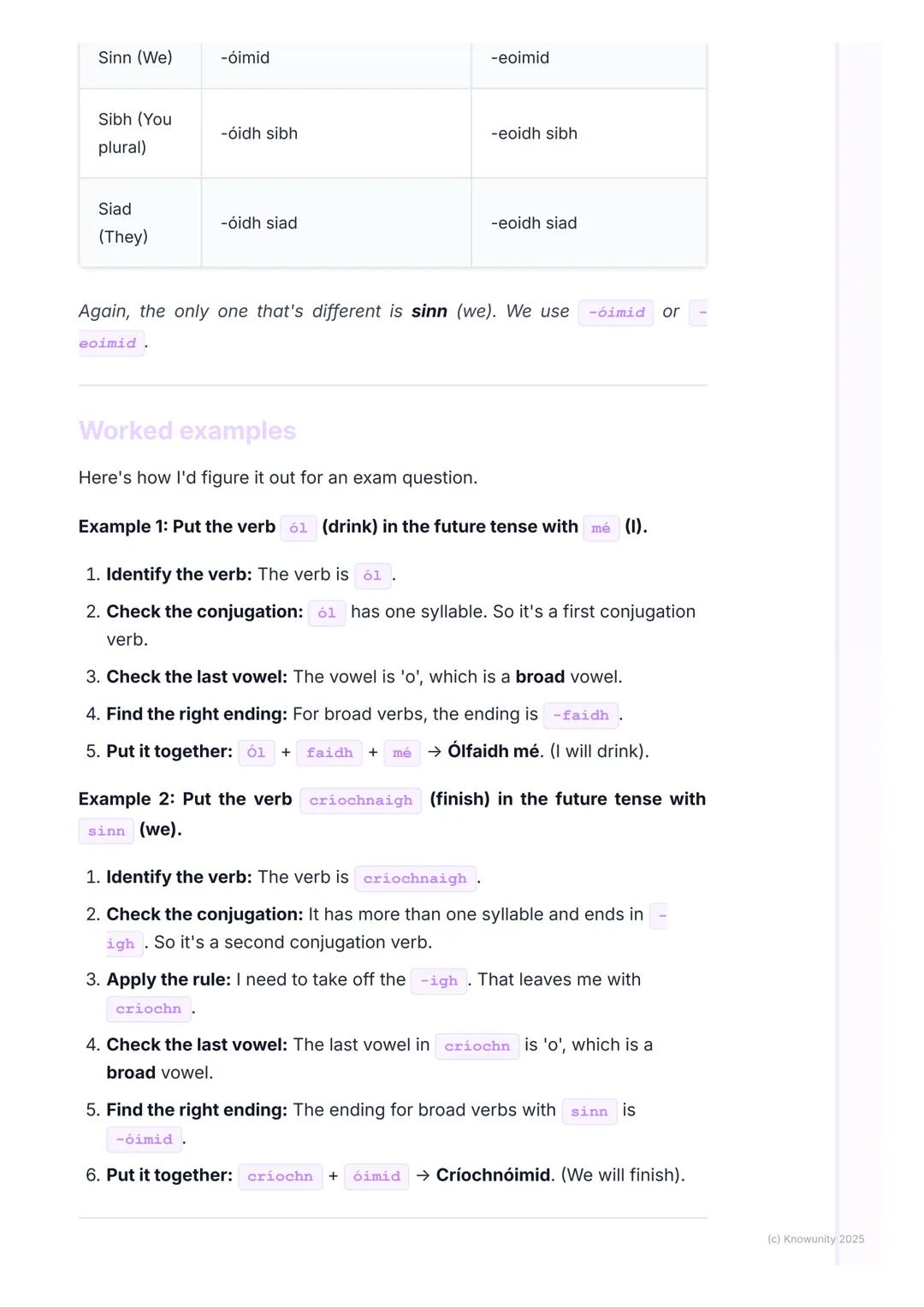
Working Through Examples
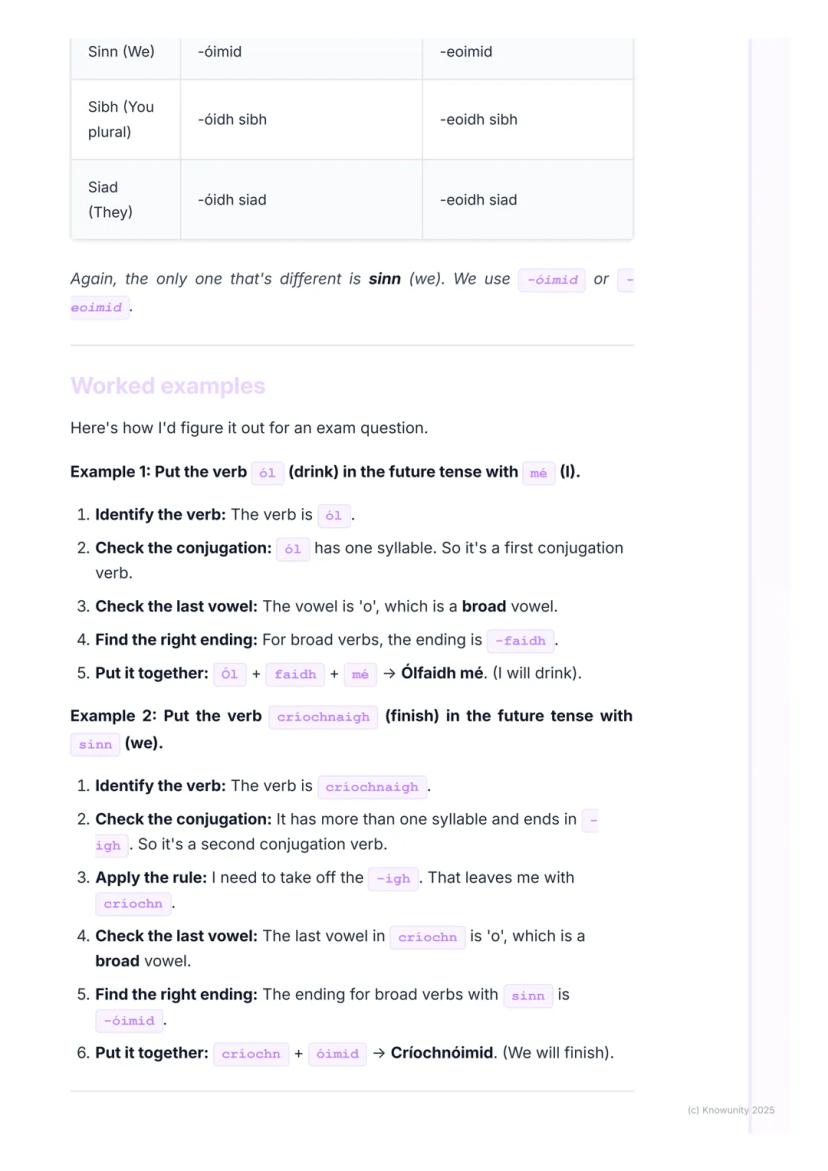
Let's tackle some exam-style questions to see how this works in practice. Take ól (drink) with mé (I) - it's one syllable, so it's first conjugation. The 'o' is broad, so we add -faidh: ólfaidh mé (I will drink).
For something trickier, try críochnaigh (finish) with sinn (we). It's multi-syllable and ends in -igh, so it's second conjugation. Drop the -igh to get críochn, which ends in broad 'o'. Since it's sinn, we use -óimid: críochnóimid (we will finish).
The key is taking it step by step: identify the conjugation type, find the root, check the vowel type, pick the right ending. Once you've done a few, the pattern becomes automatic.
Questions and negatives change things slightly - they start with An (will...?) or Ní (will not...), but the verb endings stay the same. An ólfaidh tú? (Will you drink?) and Ní ólfaidh mé (I will not drink).
Exam hack: Always identify conjugation type first - it saves you from mixing up the ending patterns!
5
of 5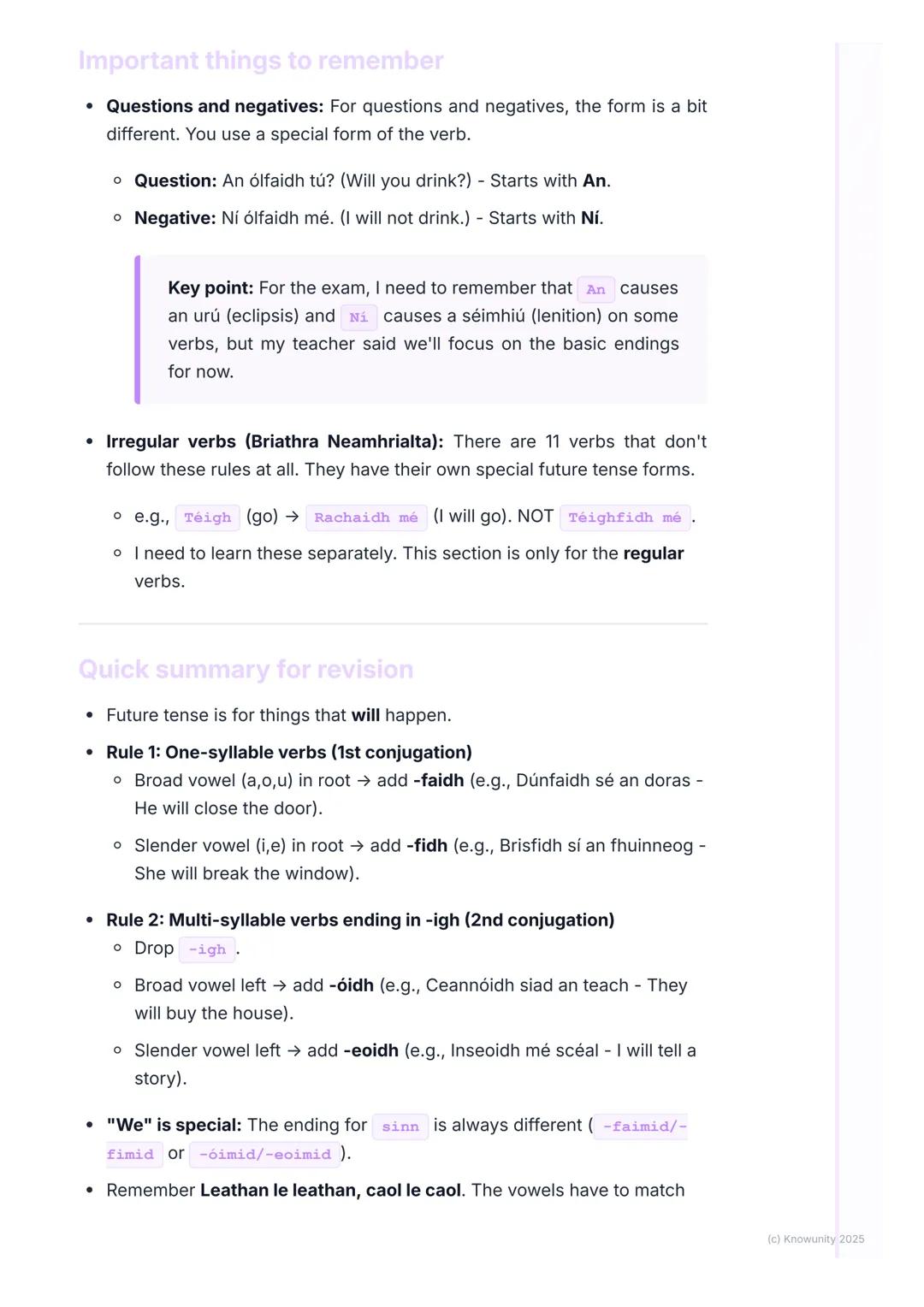
Quick Revision Summary
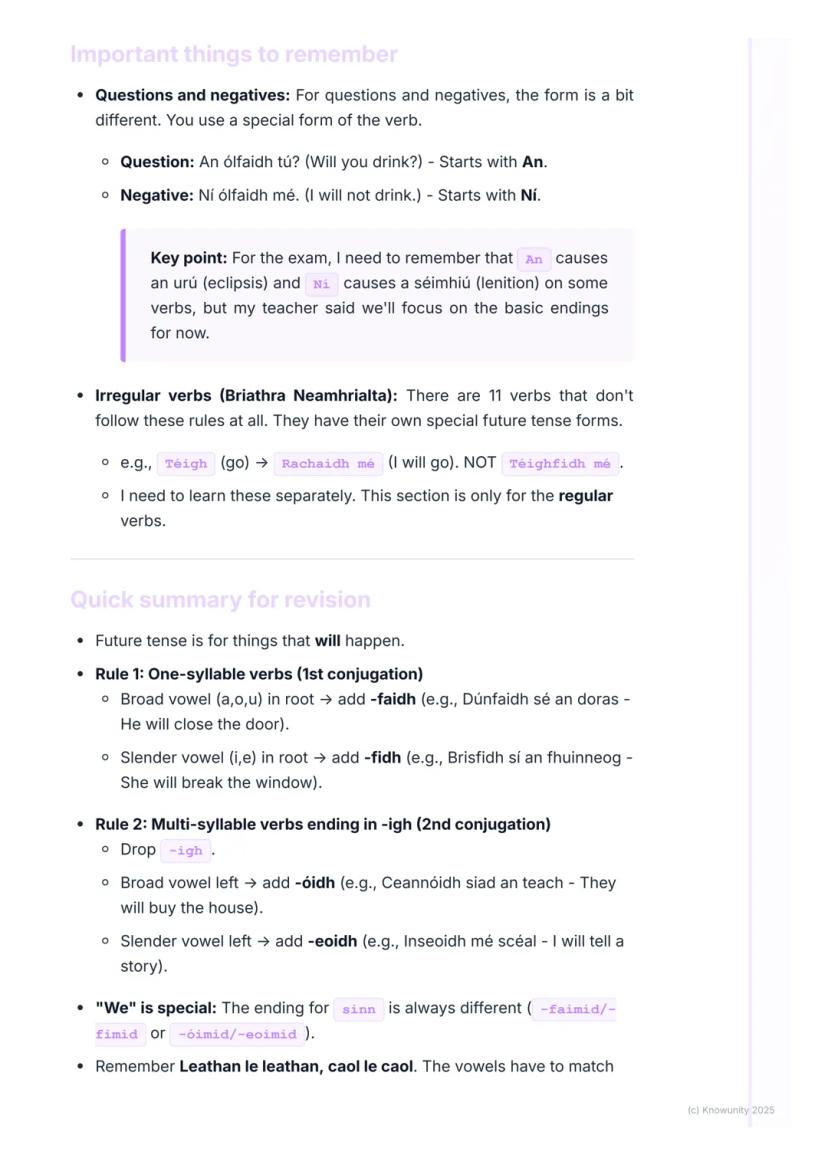
You've got two main patterns to remember. First conjugation : broad vowel gets -faidh, slender vowel gets -fidh. Second conjugation : drop the -igh, then broad gets -óidh, slender gets -eoidh.
The pronoun sinn (we) always gets special treatment with its own endings: -faimid/-fimid for first conjugation, -óimid/-eoimid for second conjugation. Every other pronoun just tags along after the main verb form.
Remember that irregular verbs like téigh (go) completely ignore these rules - téigh becomes rachaidh mé (I will go), not téighfidh mé. You'll need to learn those 11 irregular verbs separately.
The leathan le leathan, caol le caol rule is your safety net - if your vowels don't match up, you've made a mistake somewhere. This future tense system works for the vast majority of Irish verbs once you've mastered the basics.
Final reminder: Practice with regular verbs first - once these patterns are automatic, irregular verbs become much easier to handle!
We thought you’d never ask...
What is the Knowunity AI companion?
Our AI companion is specifically built for the needs of students. Based on the millions of content pieces we have on the platform we can provide truly meaningful and relevant answers to students. But its not only about answers, the companion is even more about guiding students through their daily learning challenges, with personalised study plans, quizzes or content pieces in the chat and 100% personalisation based on the students skills and developments.
Where can I download the Knowunity app?
You can download the app in the Google Play Store and in the Apple App Store.
Is Knowunity really free of charge?
That's right! Enjoy free access to study content, connect with fellow students, and get instant help – all at your fingertips.
Most popular content in Irish
9IrishIrish oral questions and answers
Questions and answers for the leaving cert oral
5th Year4254
IrishIrish oral questions
Outline of oral questions
5th Year2055
IrishIníon- le hÁine Durkin
Aine Durkin’s poem, Iníon: Themes & summary
5th Year850
IrishIrish poetry 2027
Iníon + Dínit an Bhróin
5th Year1133
IrishLC HL notes- Iníon (poem)
Includes poem in English and Irish, theme, key words & phrases
5th Year2284
IrishGaeilge Grammar Office
All the basics you need to know on Irish grammar.
6th Year943
IrishAn Gaeilge Aiste
Irish Language essay
6th Year1290
IrishMo Ghrá-sa (Idir Lúibíní)
Notes on mo ghrá-sa
5th Year350
IrishMé Féin & Mo Chlann (Myself & My Family)
Students will learn vocabulary to describe themselves, their family members, and daily routines. This helps in personal introductions and discussions.
TY291
Most popular content
9IrishIrish oral questions and answers
Questions and answers for the leaving cert oral
5th Year4254
IrishIrish oral questions
Outline of oral questions
5th Year2055
IrishIníon- le hÁine Durkin
Aine Durkin’s poem, Iníon: Themes & summary
5th Year850
 English
Key Quotes : Sive
Key Quotes and explanations: Sive
6th Year2702
IrishIrish poetry 2027
Iníon + Dínit an Bhróin
5th Year1133
IrishLC HL notes- Iníon (poem)
Includes poem in English and Irish, theme, key words & phrases
5th Year2284
IrishGaeilge Grammar Office
All the basics you need to know on Irish grammar.
6th Year943
IrishMo Ghrá-sa (Idir Lúibíní)
Notes on mo ghrá-sa
5th Year350
IrishAn Gaeilge Aiste
Irish Language essay
6th Year1290
Can't find what you're looking for? Explore other subjects.
Students love us — and so will you.
4.6/5App Store
4.7/5Google Play
The app is very easy to use and well designed. I have found everything I was looking for so far and have been able to learn a lot from the presentations! I will definitely use the app for a class assignment! And of course it also helps a lot as an inspiration.
Stefan SiOS user
This app is really great. There are so many study notes and help [...]. My problem subject is French, for example, and the app has so many options for help. Thanks to this app, I have improved my French. I would recommend it to anyone.
Samantha KlichAndroid user
Wow, I am really amazed. I just tried the app because I've seen it advertised many times and was absolutely stunned. This app is THE HELP you want for school and above all, it offers so many things, such as workouts and fact sheets, which have been VERY helpful to me personally.
AnnaiOS user
Irish5 views·Updated May 21, 2026·5 pagesLearn About An Aimsir Fháistineach: Forming Future Tense in Irish
The Irish future tense (an aimsir fháistineach) is your tool for talking about things that will happen - from tomorrow's plans to next year's goals. It's built on a simple system of adding specific endings to verb roots, but you... Show more
1
of 5Sign up to see the content. It's free!
- Access to all documents
- Improve your grades
- Join milions of students
An Aimsir Fháistineach - Getting Started
Think of the future tense as your planning language - it's how you say "I will go" or "they will play" in Irish. The trick is knowing which ending to stick on your verb, and that depends on the vowels inside it.
Before diving in, you need to master broad and slender vowels. Broad vowels are a, o, u (remember: "Are Owls Ugly?") and slender vowels are i, e ("Is Everyone Ill?"). This matters because of the golden rule: leathan le leathan, caol le caol - broad with broad, slender with slender.
The verb root is your starting point - it's the basic form without any endings. For example, glanann (cleans) has the root glan. Once you've got your root, check its last vowel to decide which ending fits.
Quick tip: Master the vowel types first - they're used throughout Irish grammar, not just the future tense!
2
of 5Sign up to see the content. It's free!
- Access to all documents
- Improve your grades
- Join milions of students
First Conjugation Verbs - The One-Syllable Gang
First conjugation verbs have just one syllable in their root - words like dún (close), glan (clean), bris (break), and ól (drink). These are actually the easiest once you get the pattern.
Here's the system: if your verb root ends with a broad vowel (a, o, u), you add -faidh. If it ends with a slender vowel (i, e), you add -fidh. So glan becomes glanfaidh and bris becomes brisfidh.
The endings work perfectly for sé, sí, and siad (he, she, they). For other pronouns like mé and tú, you just add the pronoun after: glanfaidh mé, glanfaidh tú. The only special case is sinn (we) - it gets its own endings: -faimid for broad roots and -fimid for slender ones.
Remember: The broad/slender rule applies to every single verb - there are no exceptions here!
3
of 5Sign up to see the content. It's free!
- Access to all documents
- Improve your grades
- Join milions of students
Second Conjugation Verbs - The Multi-Syllable Squad
Second conjugation verbs have two or more syllables and usually end in -igh. Think ceannaigh (buy), bailigh (collect), or éirigh (get up) - they're longer words that need a different approach.
The process is straightforward: chop off the -igh ending first. Then check what vowel you're left with at the end. If it's broad (a, o, u), add -óidh. If it's slender (i, e), add -eoidh.
So ceannaigh loses its -igh to become ceanna (ending in broad 'a'), then gets -óidh to make ceannóidh. Bailigh becomes bail (ending in slender 'i'), then gets -eoidh to make baileoidh.
Just like first conjugation, sinn (we) is special again. It uses -óimid for broad roots and -eoimid for slender ones instead of the regular endings.
Pro tip: Most verbs you'll meet ending in -igh follow this pattern - it's more common than you might think!
4
of 5Sign up to see the content. It's free!
- Access to all documents
- Improve your grades
- Join milions of students
Working Through Examples
Let's tackle some exam-style questions to see how this works in practice. Take ól (drink) with mé (I) - it's one syllable, so it's first conjugation. The 'o' is broad, so we add -faidh: ólfaidh mé (I will drink).
For something trickier, try críochnaigh (finish) with sinn (we). It's multi-syllable and ends in -igh, so it's second conjugation. Drop the -igh to get críochn, which ends in broad 'o'. Since it's sinn, we use -óimid: críochnóimid (we will finish).
The key is taking it step by step: identify the conjugation type, find the root, check the vowel type, pick the right ending. Once you've done a few, the pattern becomes automatic.
Questions and negatives change things slightly - they start with An (will...?) or Ní (will not...), but the verb endings stay the same. An ólfaidh tú? (Will you drink?) and Ní ólfaidh mé (I will not drink).
Exam hack: Always identify conjugation type first - it saves you from mixing up the ending patterns!
5
of 5Sign up to see the content. It's free!
- Access to all documents
- Improve your grades
- Join milions of students
Quick Revision Summary
You've got two main patterns to remember. First conjugation : broad vowel gets -faidh, slender vowel gets -fidh. Second conjugation : drop the -igh, then broad gets -óidh, slender gets -eoidh.
The pronoun sinn (we) always gets special treatment with its own endings: -faimid/-fimid for first conjugation, -óimid/-eoimid for second conjugation. Every other pronoun just tags along after the main verb form.
Remember that irregular verbs like téigh (go) completely ignore these rules - téigh becomes rachaidh mé (I will go), not téighfidh mé. You'll need to learn those 11 irregular verbs separately.
The leathan le leathan, caol le caol rule is your safety net - if your vowels don't match up, you've made a mistake somewhere. This future tense system works for the vast majority of Irish verbs once you've mastered the basics.
Final reminder: Practice with regular verbs first - once these patterns are automatic, irregular verbs become much easier to handle!
We thought you’d never ask...
What is the Knowunity AI companion?
Our AI companion is specifically built for the needs of students. Based on the millions of content pieces we have on the platform we can provide truly meaningful and relevant answers to students. But its not only about answers, the companion is even more about guiding students through their daily learning challenges, with personalised study plans, quizzes or content pieces in the chat and 100% personalisation based on the students skills and developments.
Where can I download the Knowunity app?
You can download the app in the Google Play Store and in the Apple App Store.
Is Knowunity really free of charge?
That's right! Enjoy free access to study content, connect with fellow students, and get instant help – all at your fingertips.
Most popular content in Irish
9IrishIrish oral questions and answers
Questions and answers for the leaving cert oral
5th Year4254
IrishIrish oral questions
Outline of oral questions
5th Year2055
IrishIníon- le hÁine Durkin
Aine Durkin’s poem, Iníon: Themes & summary
5th Year850
IrishIrish poetry 2027
Iníon + Dínit an Bhróin
5th Year1133
IrishLC HL notes- Iníon (poem)
Includes poem in English and Irish, theme, key words & phrases
5th Year2284
IrishGaeilge Grammar Office
All the basics you need to know on Irish grammar.
6th Year943
IrishAn Gaeilge Aiste
Irish Language essay
6th Year1290
IrishMo Ghrá-sa (Idir Lúibíní)
Notes on mo ghrá-sa
5th Year350
IrishMé Féin & Mo Chlann (Myself & My Family)
Students will learn vocabulary to describe themselves, their family members, and daily routines. This helps in personal introductions and discussions.
TY291
Most popular content
9IrishIrish oral questions and answers
Questions and answers for the leaving cert oral
5th Year4254
IrishIrish oral questions
Outline of oral questions
5th Year2055
IrishIníon- le hÁine Durkin
Aine Durkin’s poem, Iníon: Themes & summary
5th Year850
EnglishKey Quotes : Sive
Key Quotes and explanations: Sive
6th Year2702
IrishIrish poetry 2027
Iníon + Dínit an Bhróin
5th Year1133
IrishLC HL notes- Iníon (poem)
Includes poem in English and Irish, theme, key words & phrases
5th Year2284
IrishGaeilge Grammar Office
All the basics you need to know on Irish grammar.
6th Year943
IrishMo Ghrá-sa (Idir Lúibíní)
Notes on mo ghrá-sa
5th Year350
IrishAn Gaeilge Aiste
Irish Language essay
6th Year1290
Can't find what you're looking for? Explore other subjects.
Students love us — and so will you.
4.6/5App Store
4.7/5Google Play
The app is very easy to use and well designed. I have found everything I was looking for so far and have been able to learn a lot from the presentations! I will definitely use the app for a class assignment! And of course it also helps a lot as an inspiration.
Stefan SiOS user
This app is really great. There are so many study notes and help [...]. My problem subject is French, for example, and the app has so many options for help. Thanks to this app, I have improved my French. I would recommend it to anyone.
Samantha KlichAndroid user
Wow, I am really amazed. I just tried the app because I've seen it advertised many times and was absolutely stunned. This app is THE HELP you want for school and above all, it offers so many things, such as workouts and fact sheets, which have been VERY helpful to me personally.
AnnaiOS user