
Understanding how your body moves during sport is absolutely crucial... Show more
 LCPE
LCPE Irish
Irish English
 Geography
Sign up to see the contentIt's free!
Access to all documents
Improve your grades
Join milions of students
Knowunity AI
Subjects
Triangle Congruence and Similarity Theorems
Triangle Properties and Classification
Linear Equations and Graphs
Geometric Angle Relationships
Trigonometric Functions and Identities
Equation Solving Techniques
Circle Geometry Fundamentals
Division Operations and Methods
Basic Differentiation Rules
Exponent and Logarithm Properties
Show all topics
Human Organ Systems
Reproductive Cell Cycles
Biological Sciences Subdisciplines
Cellular Energy Metabolism
Autotrophic Energy Processes
Inheritance Patterns and Principles
Biomolecular Structure and Organization
Cell Cycle and Division Mechanics
Cellular Organization and Development
Biological Structural Organization
Show all topics
Chemical Sciences and Applications
Atomic Structure and Composition
Molecular Electron Structure Representation
Atomic Electron Behavior
Matter Properties and Water
Mole Concept and Calculations
Gas Laws and Behavior
Periodic Table Organization
Chemical Thermodynamics Fundamentals
Chemical Bond Types and Properties
Show all topics
European Renaissance and Enlightenment
European Cultural Movements 800-1920
American Revolution Era 1763-1797
American Civil War 1861-1865
Global Imperial Systems
Mongol and Chinese Dynasties
U.S. Presidents and World Leaders
Historical Sources and Documentation
World Wars Era and Impact
World Religious Systems
Show all topics
Classic and Contemporary Novels
Literary Character Analysis
Rhetorical Theory and Practice
Classic Literary Narratives
Reading Analysis and Interpretation
Narrative Structure and Techniques
English Language Components
Influential English-Language Authors
Basic Sentence Structure
Narrative Voice and Perspective
Show all topics
3
•
Updated May 14, 2026
•
Understanding how your body moves during sport is absolutely crucial... Show more
Think about every sporting movement you make - from shooting a basketball to tackling in rugby. Your musculoskeletal system makes it all possible by combining your skeleton (the framework) with your muscles (the power).
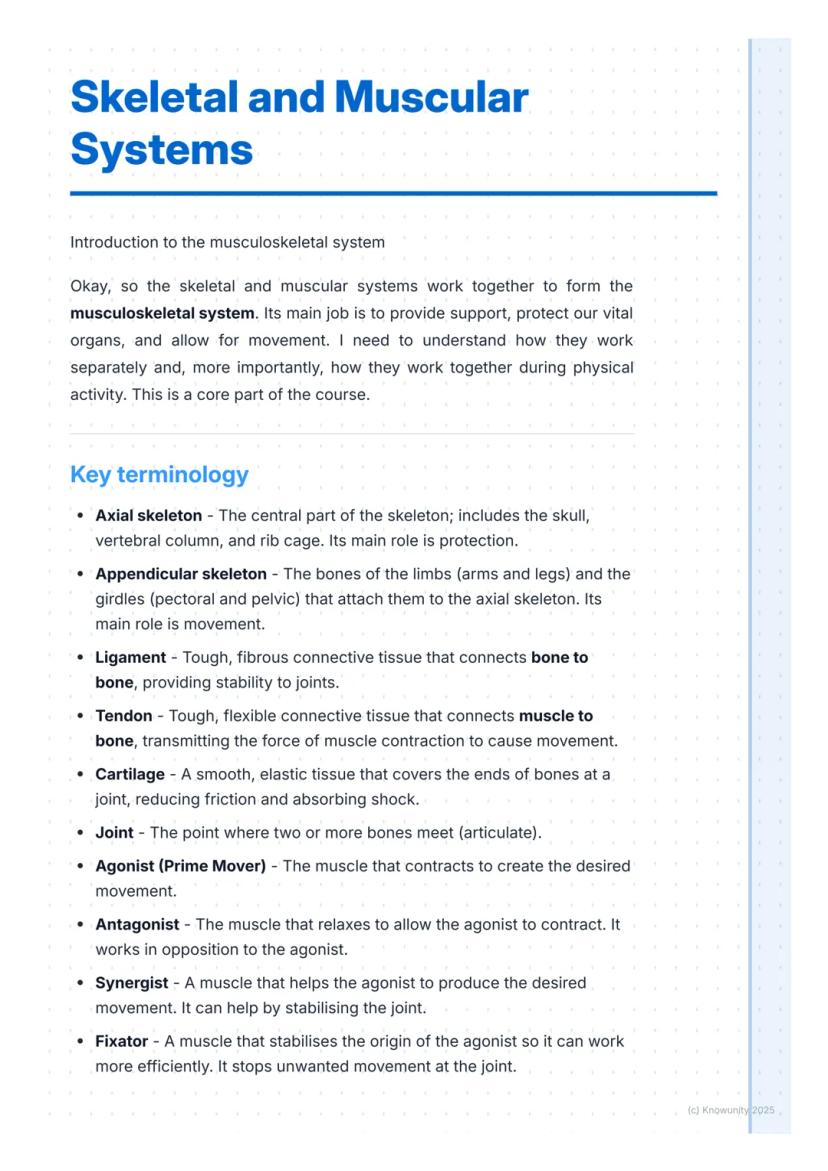
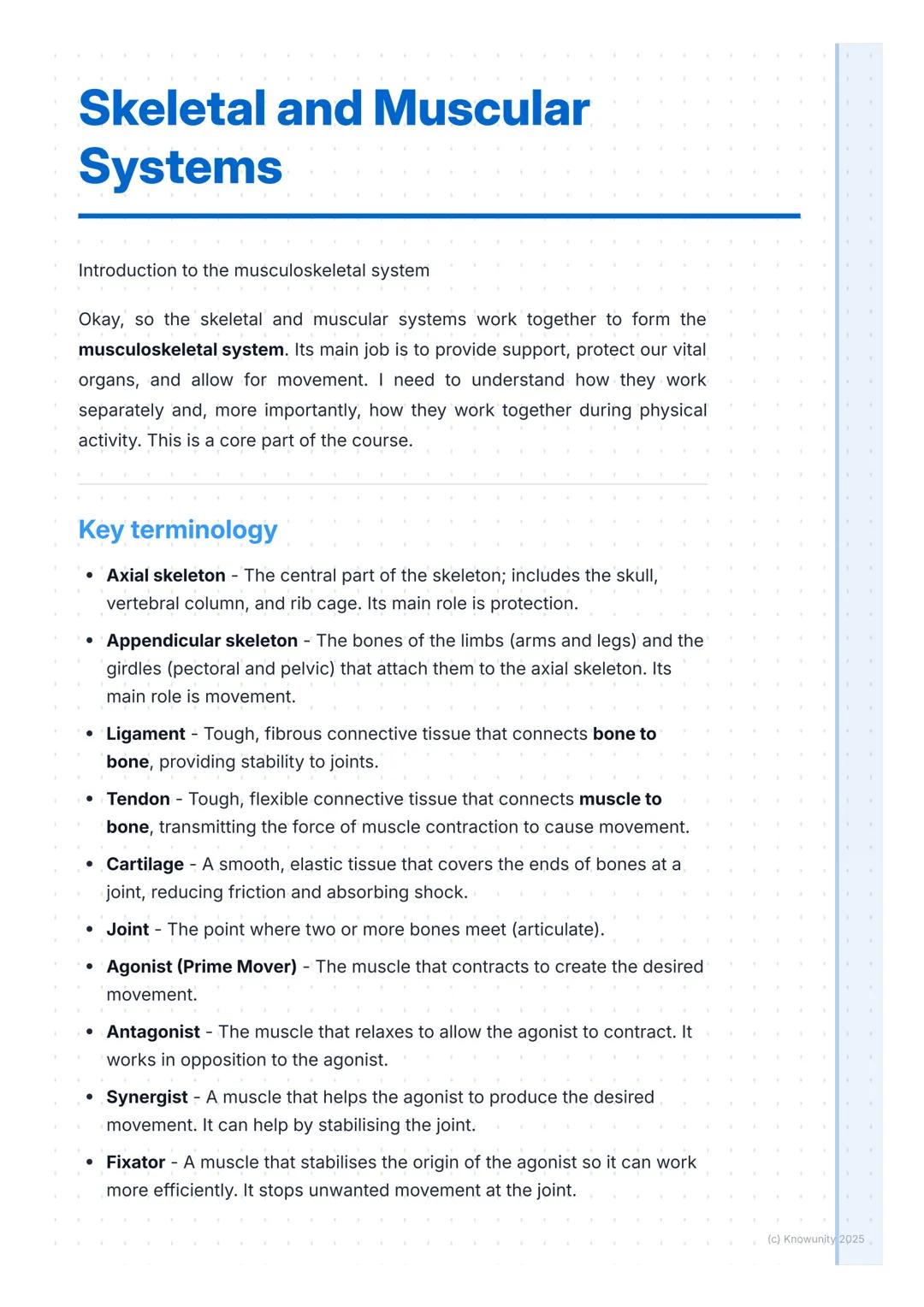
The skeleton divides into two main parts. The axial skeleton includes your skull, spine, and rib cage - basically your central protective core. The appendicular skeleton covers your arms, legs, and the bits that connect them to your body - this is your movement centre.
Here's a memory trick that'll save you in exams: Ligaments Link Bone to Bone (LBB), whilst Tendons Tie Muscle to Bone (TMB). Don't mix these up! Cartilage acts like a cushion between bones, reducing friction when you move.
When muscles work together, they have specific roles. The agonist (prime mover) does the main work, whilst the antagonist relaxes to allow movement. Synergists help out, and fixators keep everything stable.
Quick Tip: Understanding muscle roles is guaranteed to come up in your exam - make sure you can identify each one in any sporting action.
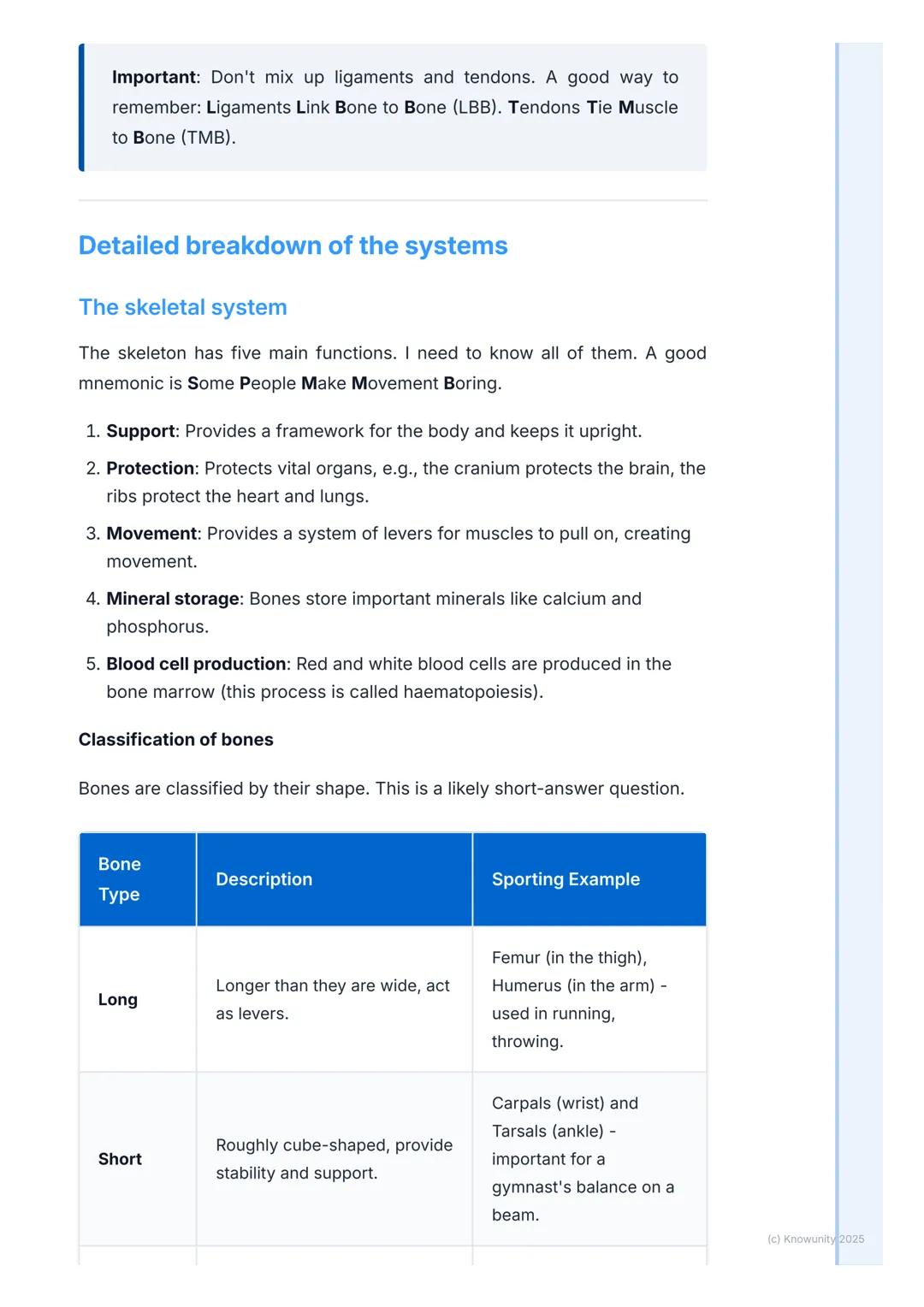
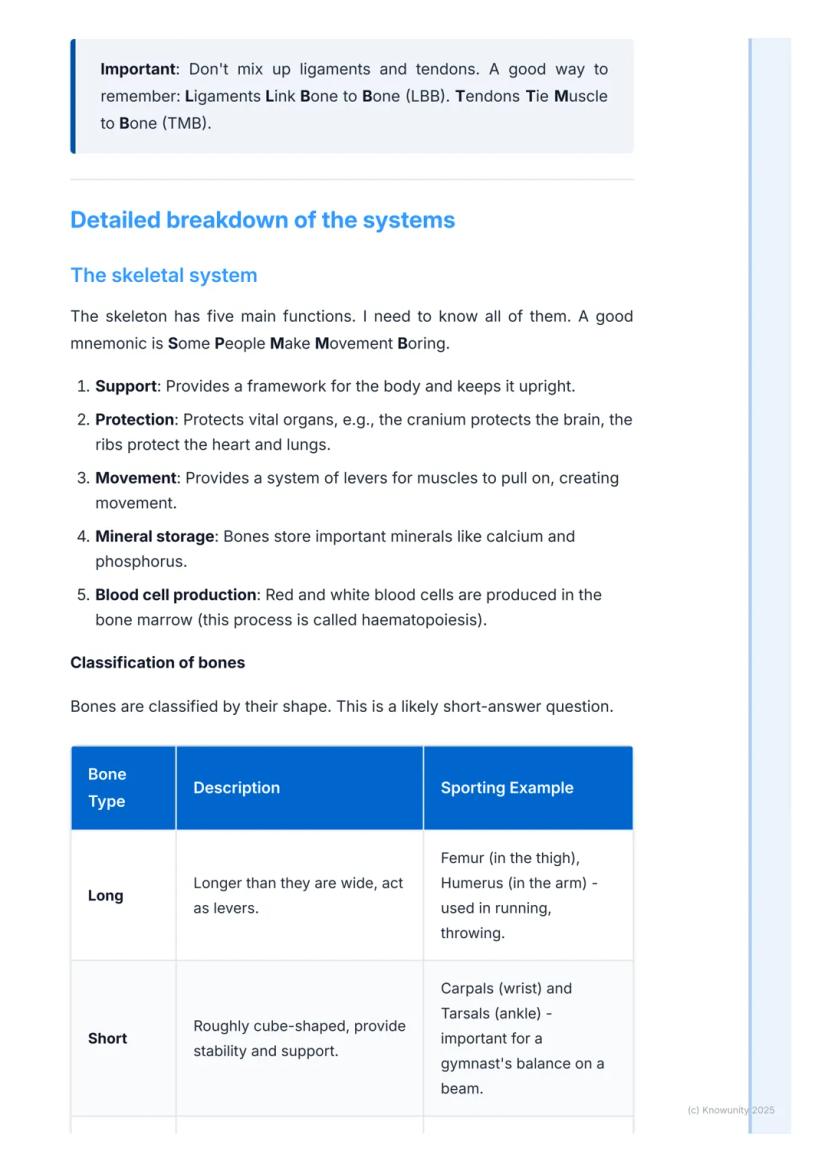
Your skeleton does five essential jobs, and there's a handy memory trick: Some People Make Movement Boring. That's Support (keeps you upright), Protection (guards vital organs), Movement (provides levers for muscles), Mineral storage (calcium and phosphorus), and Blood cell production (happens in bone marrow).
Bone classification is a likely short-answer question, so learn this well. Long bones like your femur and humerus work as levers for major movements. Short bones in your hands and feet provide stability and fine motor control.
Flat bones such as your skull and ribs offer protection and muscle attachment sites. Irregular bones like vertebrae have complex shapes for specific jobs. Sesamoid bones like your kneecap (patella) sit within tendons to improve leverage.
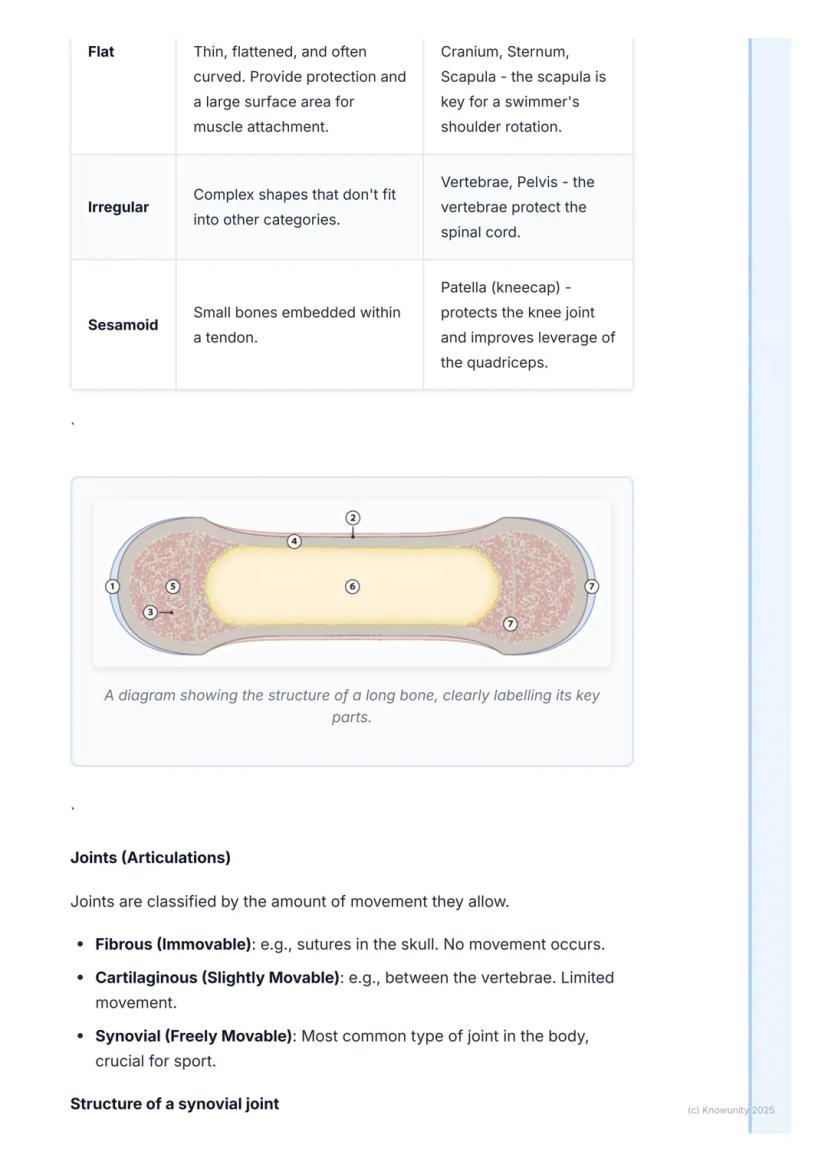
The structure matters too. Long bones have a shaft (diaphysis) and enlarged ends (epiphyses) where growth occurs. This knowledge helps explain why young athletes need to be careful about overtraining during growth periods.
Remember: Bone classification by shape is one of the most predictable exam questions - make sure you know an example of each type.
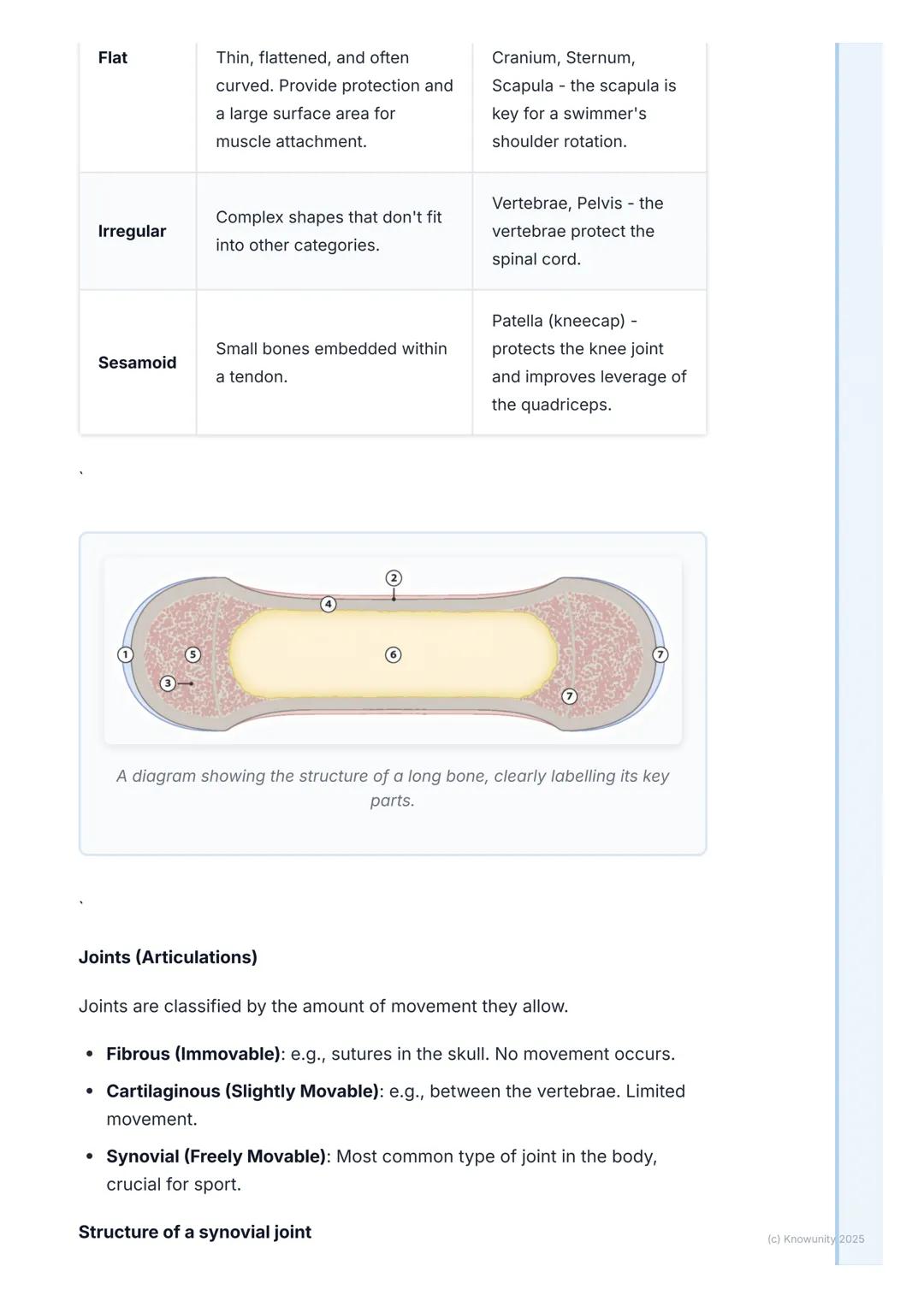
Joints determine how much you can move, and they're classified by mobility. Fibrous joints (like skull sutures) don't move at all. Cartilaginous joints (between vertebrae) allow slight movement. But synovial joints are your sporting superstars - they're freely movable.
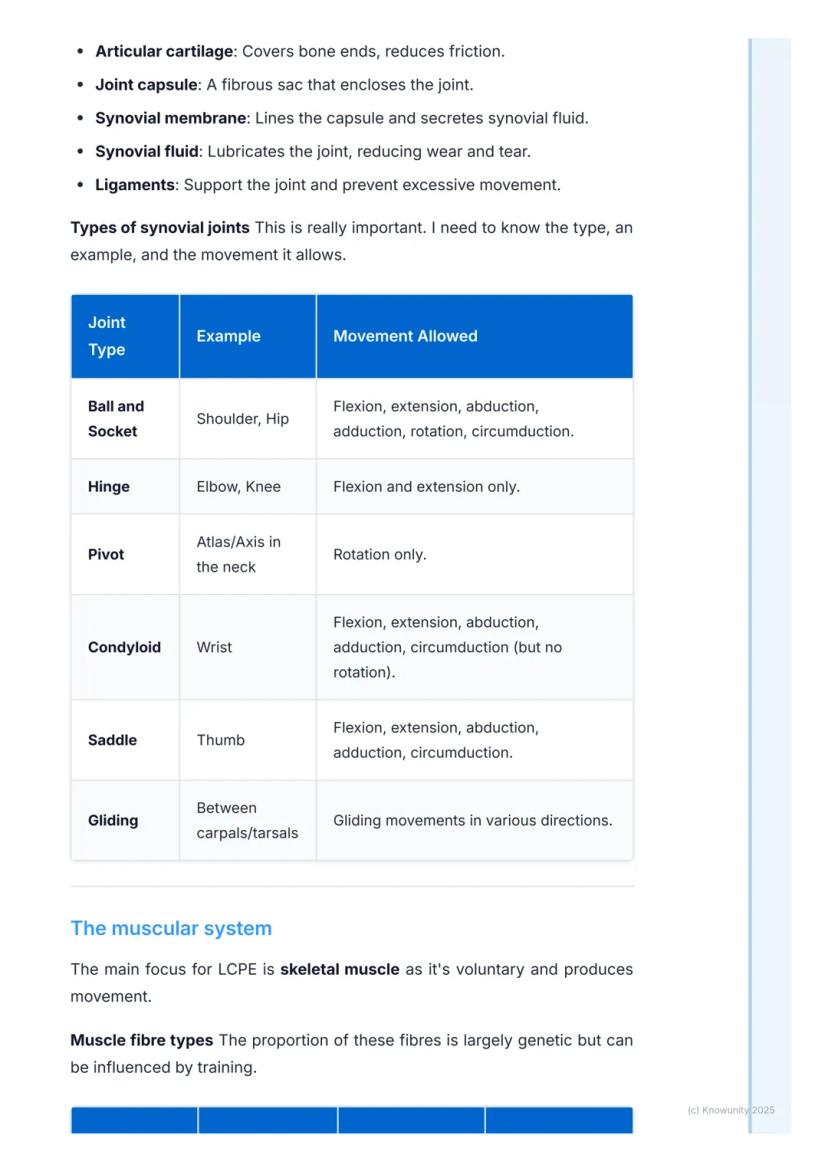
Synovial joint structure is crucial knowledge. Articular cartilage covers bone ends to reduce friction. The joint capsule wraps around everything, whilst the synovial membrane produces synovial fluid for lubrication. Ligaments provide stability and prevent excessive movement.
You need to know six types of synovial joints. Ball and socket joints (shoulder, hip) allow movement in all directions. Hinge joints (elbow, knee) work like a door - flexion and extension only. Pivot joints (neck) rotate, whilst condyloid joints (wrist) move in most directions except rotation.
Saddle joints (thumb) allow complex movements for gripping, and gliding joints (between small bones) permit sliding movements. Each joint type determines what sporting actions are possible.
Exam Focus: Be ready to identify joint types, give examples, and explain what movements they allow - this comes up every year.
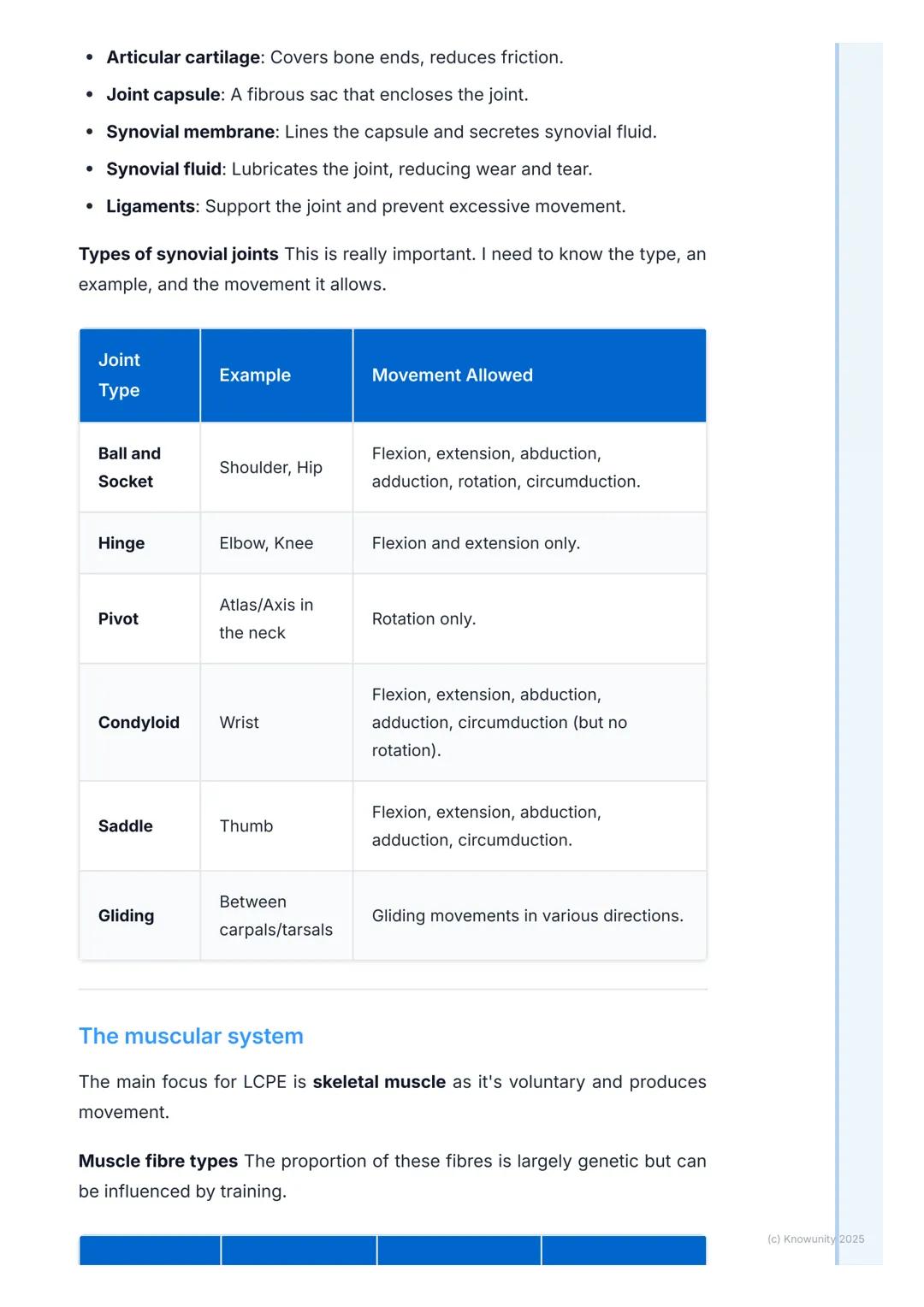
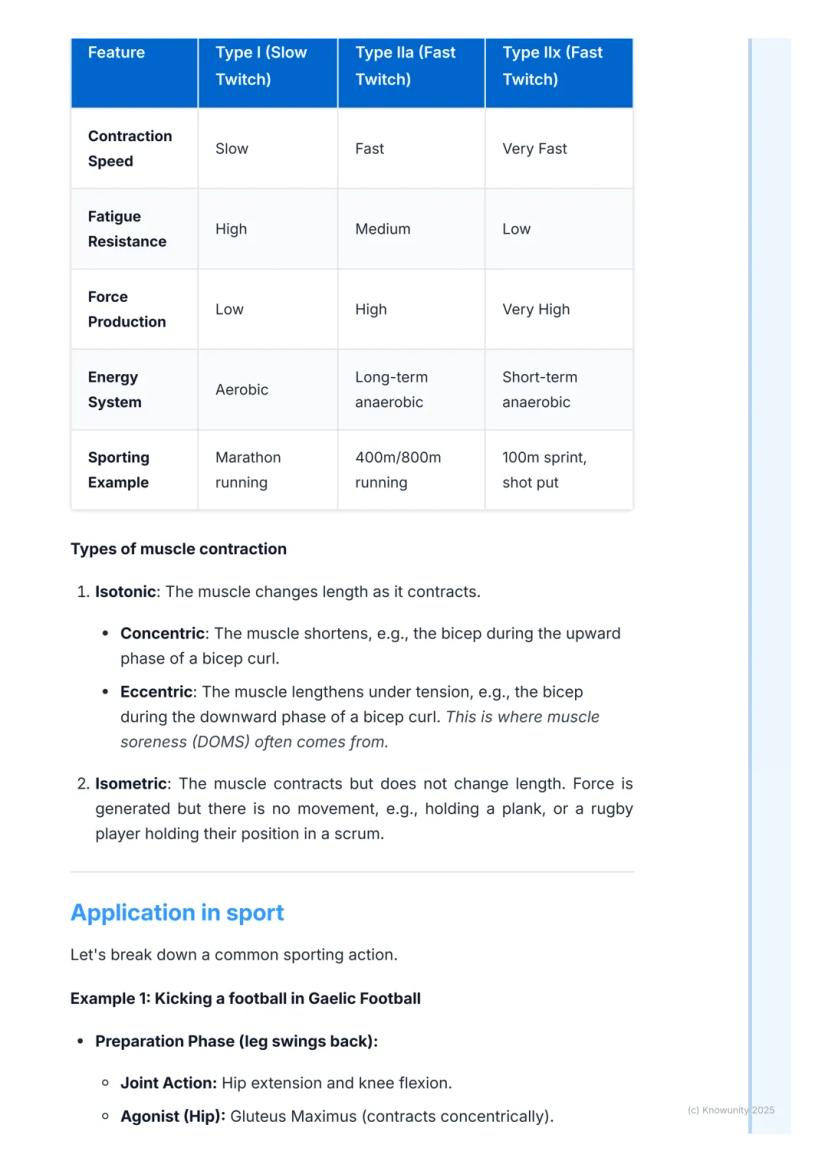
Your muscles contain different fibre types that determine your sporting strengths. Type I (slow twitch) fibres resist fatigue brilliantly - perfect for marathon running or long football matches. Type IIa (fast twitch) fibres are the all-rounders, great for 400m or 800m running. Type IIx (fast twitch) fibres produce explosive power for sprinting or shot putting.
The proportion of these fibres is largely genetic, but training can influence them. Endurance training improves Type I efficiency, whilst power training develops Type II capabilities.
Muscle contractions work in three ways. Isotonic contractions involve length changes - concentric means shortening (bicep curl up), eccentric means lengthening under tension (bicep curl down). This eccentric phase often causes muscle soreness (DOMS).
Isometric contractions generate force without movement - think holding a plank or maintaining position in a rugby scrum. These are crucial for stability and strength development.
Training Tip: Understanding fibre types explains why some athletes excel at different events - it's not just training, it's biology too.
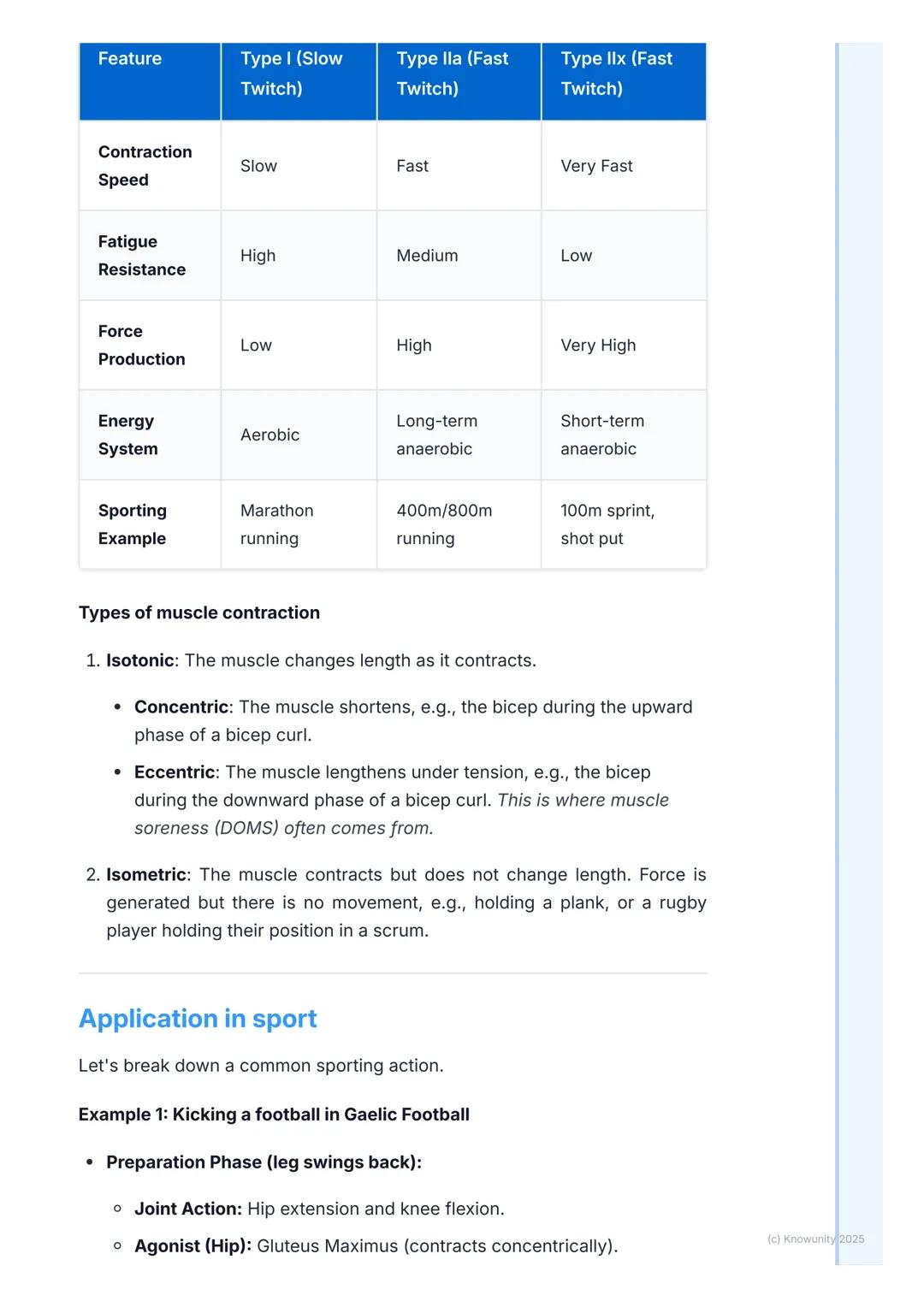
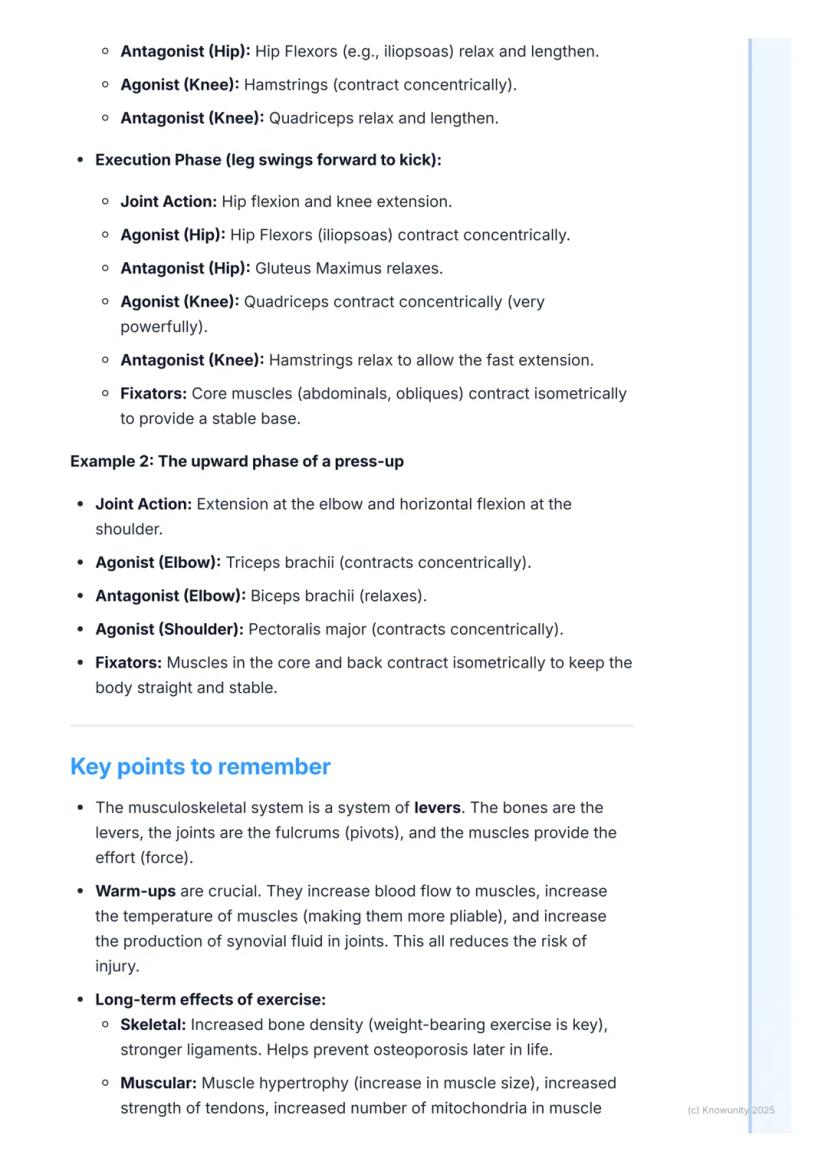
Let's break down a Gaelic football kick to understand muscle teamwork. During the preparation phase (leg swings back), your hip extends using the gluteus maximus as agonist, whilst hip flexors act as antagonists and relax.
Your knee flexes using hamstrings as agonists, with quadriceps as relaxed antagonists. This coordination creates the backswing.
In the execution phase (leg swings forward), everything reverses. Hip flexors become the agonists for hip flexion, whilst quadriceps contract powerfully for knee extension. The gluteus maximus and hamstrings now act as antagonists.
Throughout this action, your core muscles work as fixators, contracting isometrically to provide a stable base. Without this stability, your kick would be weak and inaccurate.
Exam Strategy: Practice analysing different sporting movements using this agonist-antagonist-fixator approach - it's a guaranteed exam topic.
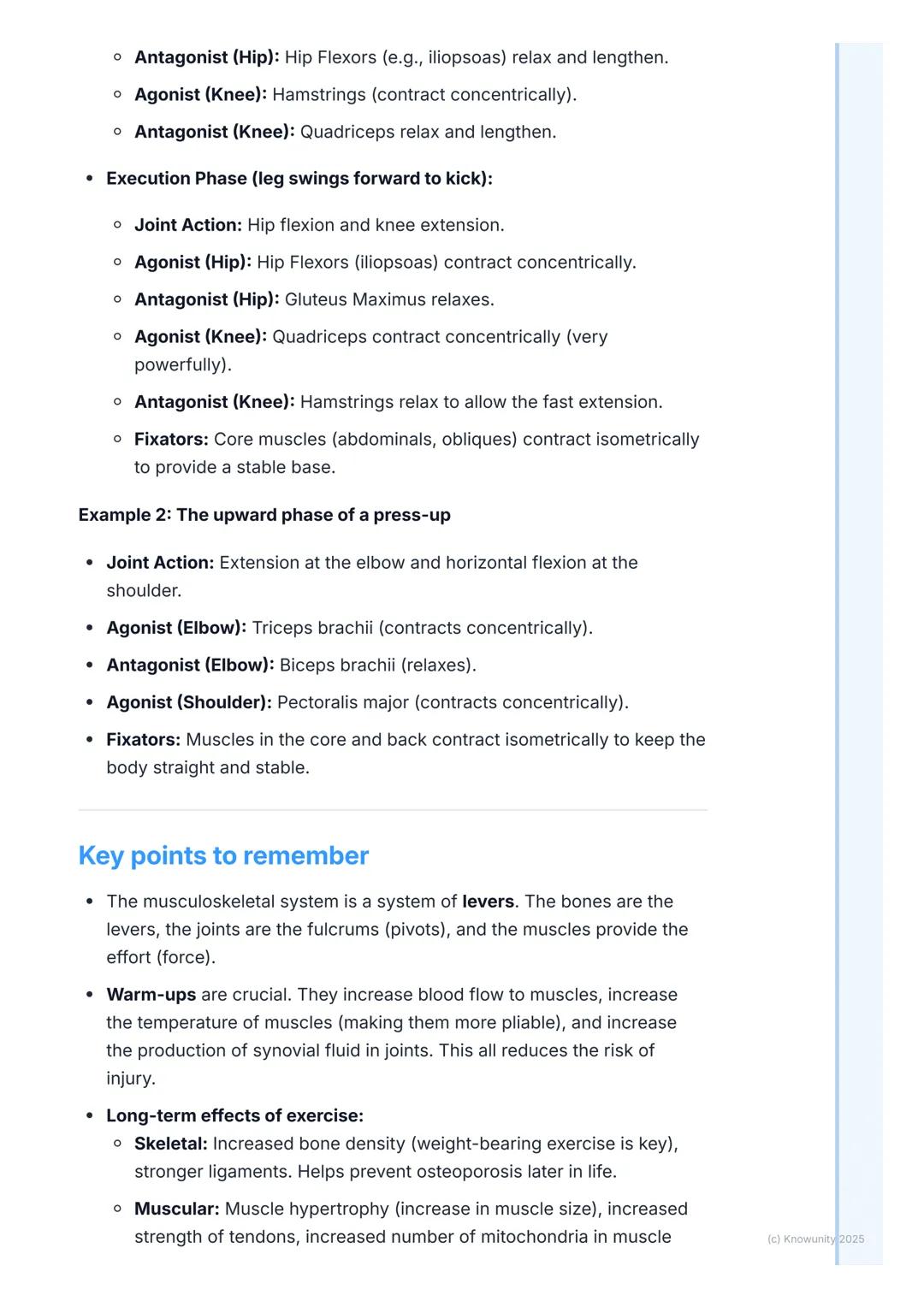
A press-up demonstrates multiple joint actions working together. During the upward phase, your elbows extend using triceps brachii as agonists, whilst biceps brachii relax as antagonists. Your shoulders perform horizontal flexion with pectoralis major as the prime mover.
Core and back muscles work isometrically as fixators, maintaining that straight body position. This coordination between different muscle groups creates efficient, powerful movement.
The musculoskeletal system works as a lever system. Bones are the levers, joints are the fulcrums (pivot points), and muscles provide the effort. Understanding this helps explain why technique matters so much in sport.
Warm-ups become essential when you understand the science. They increase blood flow and muscle temperature, making muscles more pliable. They also boost synovial fluid production, lubricating joints and reducing injury risk.
Long-term exercise creates positive adaptations. Your bones become denser , preventing osteoporosis later. Muscles grow larger (hypertrophy), tendons strengthen, and muscle cells develop more mitochondria for better energy production.
Injury Prevention: Remember the difference - strains affect muscles/tendons, sprains affect ligaments. The 'T' in strain helps you remember Tendon.
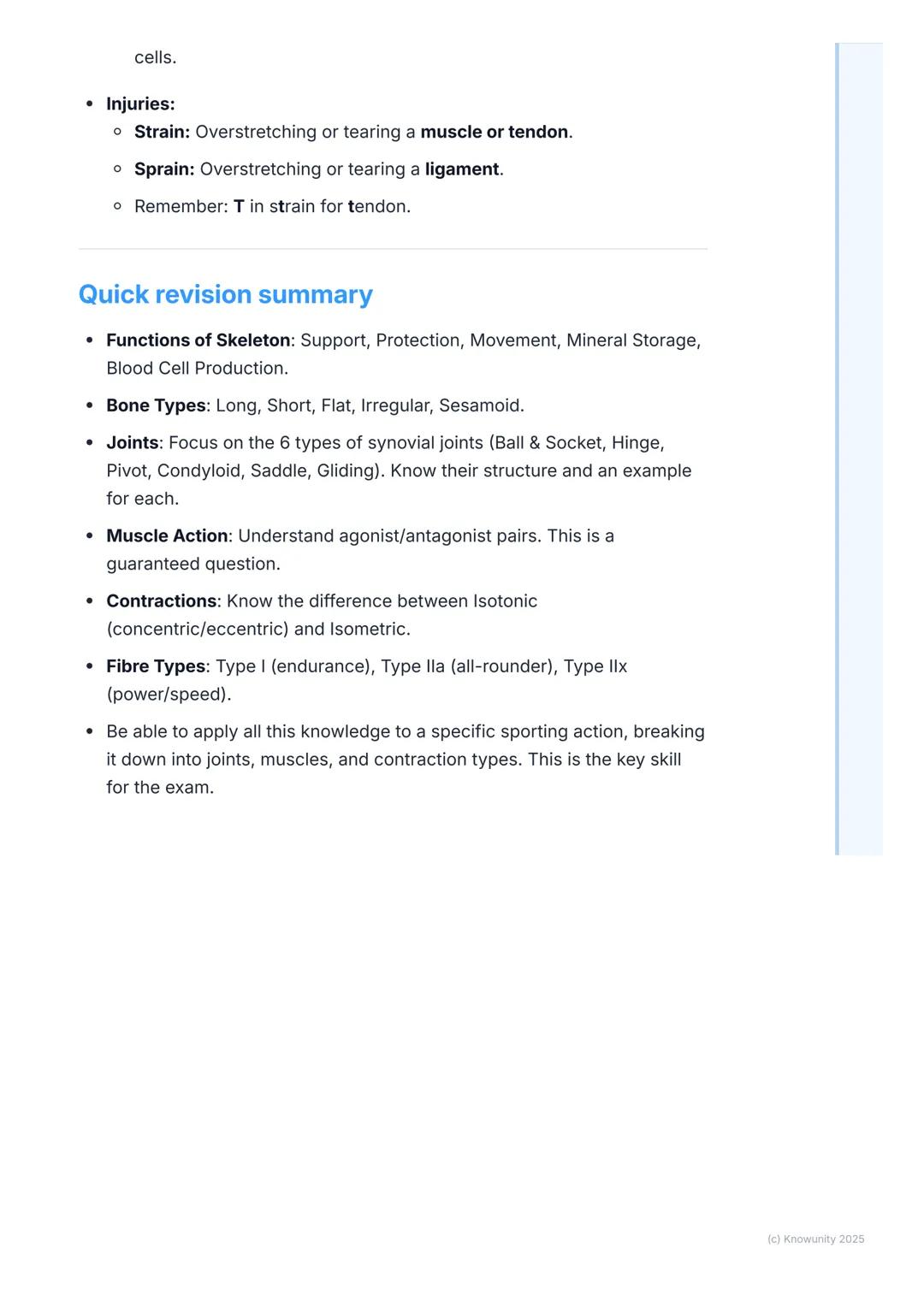
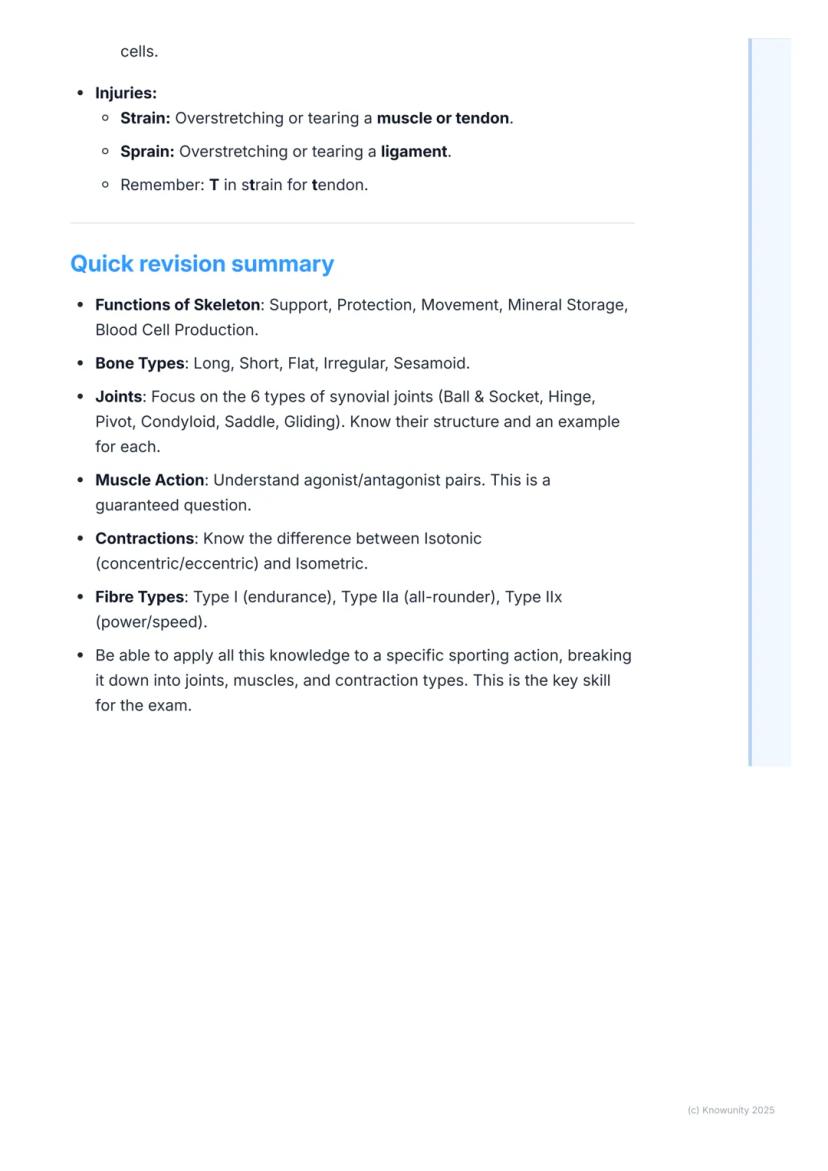
Master these key points for exam success. The five functions of skeleton spell out "Some People Make Movement Boring" - Support, Protection, Movement, Mineral storage, Blood cell production. Know your bone types with examples: long (femur), short (carpals), flat (skull), irregular (vertebrae), sesamoid (patella).
Synovial joints are exam gold - memorise all six types with examples and movements. Ball and socket (shoulder) allows everything, hinge (elbow) allows flexion/extension only, pivot (neck) rotates, and so on.
Muscle action analysis is guaranteed to appear. Identify agonists (main workers), antagonists (relaxers), and fixators (stabilisers) for any sporting movement. Understanding contraction types - isotonic (concentric and eccentric) versus isometric - completes the picture.
Fibre types explain athletic performance: Type I for endurance, Type IIa for middle distances, Type IIx for power and speed. Apply this knowledge to real sporting examples.
Practice breaking down sporting actions into joint movements, muscle actions, and contraction types. This analytical skill is what separates top students from the rest.
Final Tip: The examiners love seeing you apply anatomical knowledge to real sporting situations - always use specific examples from Irish sports when possible.
Our AI companion is specifically built for the needs of students. Based on the millions of content pieces we have on the platform we can provide truly meaningful and relevant answers to students. But its not only about answers, the companion is even more about guiding students through their daily learning challenges, with personalised study plans, quizzes or content pieces in the chat and 100% personalisation based on the students skills and developments.
You can download the app in the Google Play Store and in the Apple App Store.
That's right! Enjoy free access to study content, connect with fellow students, and get instant help – all at your fingertips.
App Store
Google Play
The app is very easy to use and well designed. I have found everything I was looking for so far and have been able to learn a lot from the presentations! I will definitely use the app for a class assignment! And of course it also helps a lot as an inspiration.
Stefan S
iOS user
This app is really great. There are so many study notes and help [...]. My problem subject is French, for example, and the app has so many options for help. Thanks to this app, I have improved my French. I would recommend it to anyone.
Samantha Klich
Android user
Wow, I am really amazed. I just tried the app because I've seen it advertised many times and was absolutely stunned. This app is THE HELP you want for school and above all, it offers so many things, such as workouts and fact sheets, which have been VERY helpful to me personally.
Anna
iOS user
I think it’s very much worth it and you’ll end up using it a lot once you get the hang of it and even after looking at others notes you can still ask your Artificial intelligence buddy the question and ask to simplify it if you still don’t get it!!! In the end I think it’s worth it 😊👍 ⚠️Also DID I MENTION ITS FREEE YOU DON’T HAVE TO PAY FOR ANYTHING AND STILL GET YOUR GRADES IN PERFECTLY❗️❗️⚠️
Thomas R
iOS user
Knowunity is the BEST app I’ve used in a minute. This is not an ai review or anything this is genuinely coming from a 7th grade student (I know 2011 im young) but dude this app is a 10/10 i have maintained a 3.8 gpa and have plenty of time for gaming. I love it and my mom is just happy I got good grades
Brad T
Android user
Not only did it help me find the answer but it also showed me alternative ways to solve it. I was horrible in math and science but now I have an a in both subjects. Thanks for the help🤍🤍
David K
iOS user
The app's just great! All I have to do is enter the topic in the search bar and I get the response real fast. I don't have to watch 10 YouTube videos to understand something, so I'm saving my time. Highly recommended!
Sudenaz Ocak
Android user
In school I was really bad at maths but thanks to the app, I am doing better now. I am so grateful that you made the app.
Greenlight Bonnie
Android user
I found this app a couple years ago and it has only gotten better since then. I really love it because it can help with written questions and photo questions. Also, it can find study guides that other people have made as well as flashcard sets and practice tests. The free version is also amazing for students who might not be able to afford it. Would 100% recommend
Aubrey
iOS user
Best app if you're in Highschool or Junior high. I have been using this app for 2 school years and it's the best, it's good if you don't have anyone to help you with school work.😋🩷🎀
Marco B
iOS user
THE QUIZES AND FLASHCARDS ARE SO USEFUL AND I LOVE Knowunity AI. IT ALSO IS LITREALLY LIKE CHATGPT BUT SMARTER!! HELPED ME WITH MY MASCARA PROBLEMS TOO!! AS WELL AS MY REAL SUBJECTS ! DUHHH 😍😁😲🤑💗✨🎀😮
Elisha
iOS user
This app is phenomenal down to the correct info and the various topics you can study! I greatly recommend it for people who struggle with procrastination and those who need homework help. It has been perfectly accurate for world 1 history as far as I’ve seen! Geometry too!
Paul T
iOS user
The app is very easy to use and well designed. I have found everything I was looking for so far and have been able to learn a lot from the presentations! I will definitely use the app for a class assignment! And of course it also helps a lot as an inspiration.
Stefan S
iOS user
This app is really great. There are so many study notes and help [...]. My problem subject is French, for example, and the app has so many options for help. Thanks to this app, I have improved my French. I would recommend it to anyone.
Samantha Klich
Android user
Wow, I am really amazed. I just tried the app because I've seen it advertised many times and was absolutely stunned. This app is THE HELP you want for school and above all, it offers so many things, such as workouts and fact sheets, which have been VERY helpful to me personally.
Anna
iOS user
I think it’s very much worth it and you’ll end up using it a lot once you get the hang of it and even after looking at others notes you can still ask your Artificial intelligence buddy the question and ask to simplify it if you still don’t get it!!! In the end I think it’s worth it 😊👍 ⚠️Also DID I MENTION ITS FREEE YOU DON’T HAVE TO PAY FOR ANYTHING AND STILL GET YOUR GRADES IN PERFECTLY❗️❗️⚠️
Thomas R
iOS user
Knowunity is the BEST app I’ve used in a minute. This is not an ai review or anything this is genuinely coming from a 7th grade student (I know 2011 im young) but dude this app is a 10/10 i have maintained a 3.8 gpa and have plenty of time for gaming. I love it and my mom is just happy I got good grades
Brad T
Android user
Not only did it help me find the answer but it also showed me alternative ways to solve it. I was horrible in math and science but now I have an a in both subjects. Thanks for the help🤍🤍
David K
iOS user
The app's just great! All I have to do is enter the topic in the search bar and I get the response real fast. I don't have to watch 10 YouTube videos to understand something, so I'm saving my time. Highly recommended!
Sudenaz Ocak
Android user
In school I was really bad at maths but thanks to the app, I am doing better now. I am so grateful that you made the app.
Greenlight Bonnie
Android user
I found this app a couple years ago and it has only gotten better since then. I really love it because it can help with written questions and photo questions. Also, it can find study guides that other people have made as well as flashcard sets and practice tests. The free version is also amazing for students who might not be able to afford it. Would 100% recommend
Aubrey
iOS user
Best app if you're in Highschool or Junior high. I have been using this app for 2 school years and it's the best, it's good if you don't have anyone to help you with school work.😋🩷🎀
Marco B
iOS user
THE QUIZES AND FLASHCARDS ARE SO USEFUL AND I LOVE Knowunity AI. IT ALSO IS LITREALLY LIKE CHATGPT BUT SMARTER!! HELPED ME WITH MY MASCARA PROBLEMS TOO!! AS WELL AS MY REAL SUBJECTS ! DUHHH 😍😁😲🤑💗✨🎀😮
Elisha
iOS user
This app is phenomenal down to the correct info and the various topics you can study! I greatly recommend it for people who struggle with procrastination and those who need homework help. It has been perfectly accurate for world 1 history as far as I’ve seen! Geometry too!
Paul T
iOS user
Understanding how your body moves during sport is absolutely crucial for your Leaving Cert PE exam. The skeletal and muscular systems work together as the musculoskeletal system to provide support, protect vital organs, and create all movement in sport.
Access to all documents
Improve your grades
Join milions of students
Think about every sporting movement you make - from shooting a basketball to tackling in rugby. Your musculoskeletal system makes it all possible by combining your skeleton (the framework) with your muscles (the power).
The skeleton divides into two main parts. The axial skeleton includes your skull, spine, and rib cage - basically your central protective core. The appendicular skeleton covers your arms, legs, and the bits that connect them to your body - this is your movement centre.
Here's a memory trick that'll save you in exams: Ligaments Link Bone to Bone (LBB), whilst Tendons Tie Muscle to Bone (TMB). Don't mix these up! Cartilage acts like a cushion between bones, reducing friction when you move.
When muscles work together, they have specific roles. The agonist (prime mover) does the main work, whilst the antagonist relaxes to allow movement. Synergists help out, and fixators keep everything stable.
Quick Tip: Understanding muscle roles is guaranteed to come up in your exam - make sure you can identify each one in any sporting action.
Access to all documents
Improve your grades
Join milions of students
Your skeleton does five essential jobs, and there's a handy memory trick: Some People Make Movement Boring. That's Support (keeps you upright), Protection (guards vital organs), Movement (provides levers for muscles), Mineral storage (calcium and phosphorus), and Blood cell production (happens in bone marrow).
Bone classification is a likely short-answer question, so learn this well. Long bones like your femur and humerus work as levers for major movements. Short bones in your hands and feet provide stability and fine motor control.
Flat bones such as your skull and ribs offer protection and muscle attachment sites. Irregular bones like vertebrae have complex shapes for specific jobs. Sesamoid bones like your kneecap (patella) sit within tendons to improve leverage.
The structure matters too. Long bones have a shaft (diaphysis) and enlarged ends (epiphyses) where growth occurs. This knowledge helps explain why young athletes need to be careful about overtraining during growth periods.
Remember: Bone classification by shape is one of the most predictable exam questions - make sure you know an example of each type.
Access to all documents
Improve your grades
Join milions of students
Joints determine how much you can move, and they're classified by mobility. Fibrous joints (like skull sutures) don't move at all. Cartilaginous joints (between vertebrae) allow slight movement. But synovial joints are your sporting superstars - they're freely movable.
Synovial joint structure is crucial knowledge. Articular cartilage covers bone ends to reduce friction. The joint capsule wraps around everything, whilst the synovial membrane produces synovial fluid for lubrication. Ligaments provide stability and prevent excessive movement.
You need to know six types of synovial joints. Ball and socket joints (shoulder, hip) allow movement in all directions. Hinge joints (elbow, knee) work like a door - flexion and extension only. Pivot joints (neck) rotate, whilst condyloid joints (wrist) move in most directions except rotation.
Saddle joints (thumb) allow complex movements for gripping, and gliding joints (between small bones) permit sliding movements. Each joint type determines what sporting actions are possible.
Exam Focus: Be ready to identify joint types, give examples, and explain what movements they allow - this comes up every year.
Access to all documents
Improve your grades
Join milions of students
Your muscles contain different fibre types that determine your sporting strengths. Type I (slow twitch) fibres resist fatigue brilliantly - perfect for marathon running or long football matches. Type IIa (fast twitch) fibres are the all-rounders, great for 400m or 800m running. Type IIx (fast twitch) fibres produce explosive power for sprinting or shot putting.
The proportion of these fibres is largely genetic, but training can influence them. Endurance training improves Type I efficiency, whilst power training develops Type II capabilities.
Muscle contractions work in three ways. Isotonic contractions involve length changes - concentric means shortening (bicep curl up), eccentric means lengthening under tension (bicep curl down). This eccentric phase often causes muscle soreness (DOMS).
Isometric contractions generate force without movement - think holding a plank or maintaining position in a rugby scrum. These are crucial for stability and strength development.
Training Tip: Understanding fibre types explains why some athletes excel at different events - it's not just training, it's biology too.
Access to all documents
Improve your grades
Join milions of students
Let's break down a Gaelic football kick to understand muscle teamwork. During the preparation phase (leg swings back), your hip extends using the gluteus maximus as agonist, whilst hip flexors act as antagonists and relax.
Your knee flexes using hamstrings as agonists, with quadriceps as relaxed antagonists. This coordination creates the backswing.
In the execution phase (leg swings forward), everything reverses. Hip flexors become the agonists for hip flexion, whilst quadriceps contract powerfully for knee extension. The gluteus maximus and hamstrings now act as antagonists.
Throughout this action, your core muscles work as fixators, contracting isometrically to provide a stable base. Without this stability, your kick would be weak and inaccurate.
Exam Strategy: Practice analysing different sporting movements using this agonist-antagonist-fixator approach - it's a guaranteed exam topic.
Access to all documents
Improve your grades
Join milions of students
A press-up demonstrates multiple joint actions working together. During the upward phase, your elbows extend using triceps brachii as agonists, whilst biceps brachii relax as antagonists. Your shoulders perform horizontal flexion with pectoralis major as the prime mover.
Core and back muscles work isometrically as fixators, maintaining that straight body position. This coordination between different muscle groups creates efficient, powerful movement.
The musculoskeletal system works as a lever system. Bones are the levers, joints are the fulcrums (pivot points), and muscles provide the effort. Understanding this helps explain why technique matters so much in sport.
Warm-ups become essential when you understand the science. They increase blood flow and muscle temperature, making muscles more pliable. They also boost synovial fluid production, lubricating joints and reducing injury risk.
Long-term exercise creates positive adaptations. Your bones become denser , preventing osteoporosis later. Muscles grow larger (hypertrophy), tendons strengthen, and muscle cells develop more mitochondria for better energy production.
Injury Prevention: Remember the difference - strains affect muscles/tendons, sprains affect ligaments. The 'T' in strain helps you remember Tendon.
Access to all documents
Improve your grades
Join milions of students
Master these key points for exam success. The five functions of skeleton spell out "Some People Make Movement Boring" - Support, Protection, Movement, Mineral storage, Blood cell production. Know your bone types with examples: long (femur), short (carpals), flat (skull), irregular (vertebrae), sesamoid (patella).
Synovial joints are exam gold - memorise all six types with examples and movements. Ball and socket (shoulder) allows everything, hinge (elbow) allows flexion/extension only, pivot (neck) rotates, and so on.
Muscle action analysis is guaranteed to appear. Identify agonists (main workers), antagonists (relaxers), and fixators (stabilisers) for any sporting movement. Understanding contraction types - isotonic (concentric and eccentric) versus isometric - completes the picture.
Fibre types explain athletic performance: Type I for endurance, Type IIa for middle distances, Type IIx for power and speed. Apply this knowledge to real sporting examples.
Practice breaking down sporting actions into joint movements, muscle actions, and contraction types. This analytical skill is what separates top students from the rest.
Final Tip: The examiners love seeing you apply anatomical knowledge to real sporting situations - always use specific examples from Irish sports when possible.
Our AI companion is specifically built for the needs of students. Based on the millions of content pieces we have on the platform we can provide truly meaningful and relevant answers to students. But its not only about answers, the companion is even more about guiding students through their daily learning challenges, with personalised study plans, quizzes or content pieces in the chat and 100% personalisation based on the students skills and developments.
You can download the app in the Google Play Store and in the Apple App Store.
That's right! Enjoy free access to study content, connect with fellow students, and get instant help – all at your fingertips.
0
Smart Tools NEW
Transform this note into: ✓ 50+ Practice Questions ✓ Interactive Flashcards ✓ Full Practice Test ✓ Essay Outlines
App Store
Google Play
The app is very easy to use and well designed. I have found everything I was looking for so far and have been able to learn a lot from the presentations! I will definitely use the app for a class assignment! And of course it also helps a lot as an inspiration.
Stefan S
iOS user
This app is really great. There are so many study notes and help [...]. My problem subject is French, for example, and the app has so many options for help. Thanks to this app, I have improved my French. I would recommend it to anyone.
Samantha Klich
Android user
Wow, I am really amazed. I just tried the app because I've seen it advertised many times and was absolutely stunned. This app is THE HELP you want for school and above all, it offers so many things, such as workouts and fact sheets, which have been VERY helpful to me personally.
Anna
iOS user
I think it’s very much worth it and you’ll end up using it a lot once you get the hang of it and even after looking at others notes you can still ask your Artificial intelligence buddy the question and ask to simplify it if you still don’t get it!!! In the end I think it’s worth it 😊👍 ⚠️Also DID I MENTION ITS FREEE YOU DON’T HAVE TO PAY FOR ANYTHING AND STILL GET YOUR GRADES IN PERFECTLY❗️❗️⚠️
Thomas R
iOS user
Knowunity is the BEST app I’ve used in a minute. This is not an ai review or anything this is genuinely coming from a 7th grade student (I know 2011 im young) but dude this app is a 10/10 i have maintained a 3.8 gpa and have plenty of time for gaming. I love it and my mom is just happy I got good grades
Brad T
Android user
Not only did it help me find the answer but it also showed me alternative ways to solve it. I was horrible in math and science but now I have an a in both subjects. Thanks for the help🤍🤍
David K
iOS user
The app's just great! All I have to do is enter the topic in the search bar and I get the response real fast. I don't have to watch 10 YouTube videos to understand something, so I'm saving my time. Highly recommended!
Sudenaz Ocak
Android user
In school I was really bad at maths but thanks to the app, I am doing better now. I am so grateful that you made the app.
Greenlight Bonnie
Android user
I found this app a couple years ago and it has only gotten better since then. I really love it because it can help with written questions and photo questions. Also, it can find study guides that other people have made as well as flashcard sets and practice tests. The free version is also amazing for students who might not be able to afford it. Would 100% recommend
Aubrey
iOS user
Best app if you're in Highschool or Junior high. I have been using this app for 2 school years and it's the best, it's good if you don't have anyone to help you with school work.😋🩷🎀
Marco B
iOS user
THE QUIZES AND FLASHCARDS ARE SO USEFUL AND I LOVE Knowunity AI. IT ALSO IS LITREALLY LIKE CHATGPT BUT SMARTER!! HELPED ME WITH MY MASCARA PROBLEMS TOO!! AS WELL AS MY REAL SUBJECTS ! DUHHH 😍😁😲🤑💗✨🎀😮
Elisha
iOS user
This app is phenomenal down to the correct info and the various topics you can study! I greatly recommend it for people who struggle with procrastination and those who need homework help. It has been perfectly accurate for world 1 history as far as I’ve seen! Geometry too!
Paul T
iOS user
The app is very easy to use and well designed. I have found everything I was looking for so far and have been able to learn a lot from the presentations! I will definitely use the app for a class assignment! And of course it also helps a lot as an inspiration.
Stefan S
iOS user
This app is really great. There are so many study notes and help [...]. My problem subject is French, for example, and the app has so many options for help. Thanks to this app, I have improved my French. I would recommend it to anyone.
Samantha Klich
Android user
Wow, I am really amazed. I just tried the app because I've seen it advertised many times and was absolutely stunned. This app is THE HELP you want for school and above all, it offers so many things, such as workouts and fact sheets, which have been VERY helpful to me personally.
Anna
iOS user
I think it’s very much worth it and you’ll end up using it a lot once you get the hang of it and even after looking at others notes you can still ask your Artificial intelligence buddy the question and ask to simplify it if you still don’t get it!!! In the end I think it’s worth it 😊👍 ⚠️Also DID I MENTION ITS FREEE YOU DON’T HAVE TO PAY FOR ANYTHING AND STILL GET YOUR GRADES IN PERFECTLY❗️❗️⚠️
Thomas R
iOS user
Knowunity is the BEST app I’ve used in a minute. This is not an ai review or anything this is genuinely coming from a 7th grade student (I know 2011 im young) but dude this app is a 10/10 i have maintained a 3.8 gpa and have plenty of time for gaming. I love it and my mom is just happy I got good grades
Brad T
Android user
Not only did it help me find the answer but it also showed me alternative ways to solve it. I was horrible in math and science but now I have an a in both subjects. Thanks for the help🤍🤍
David K
iOS user
The app's just great! All I have to do is enter the topic in the search bar and I get the response real fast. I don't have to watch 10 YouTube videos to understand something, so I'm saving my time. Highly recommended!
Sudenaz Ocak
Android user
In school I was really bad at maths but thanks to the app, I am doing better now. I am so grateful that you made the app.
Greenlight Bonnie
Android user
I found this app a couple years ago and it has only gotten better since then. I really love it because it can help with written questions and photo questions. Also, it can find study guides that other people have made as well as flashcard sets and practice tests. The free version is also amazing for students who might not be able to afford it. Would 100% recommend
Aubrey
iOS user
Best app if you're in Highschool or Junior high. I have been using this app for 2 school years and it's the best, it's good if you don't have anyone to help you with school work.😋🩷🎀
Marco B
iOS user
THE QUIZES AND FLASHCARDS ARE SO USEFUL AND I LOVE Knowunity AI. IT ALSO IS LITREALLY LIKE CHATGPT BUT SMARTER!! HELPED ME WITH MY MASCARA PROBLEMS TOO!! AS WELL AS MY REAL SUBJECTS ! DUHHH 😍😁😲🤑💗✨🎀😮
Elisha
iOS user
This app is phenomenal down to the correct info and the various topics you can study! I greatly recommend it for people who struggle with procrastination and those who need homework help. It has been perfectly accurate for world 1 history as far as I’ve seen! Geometry too!
Paul T
iOS user