
Linear inequalities are like regular equations, but instead of finding... Show more
 Mathematics5 views·Updated May 31, 2026·6 pages
Mastering Linear Inequalities Easily
1 / 6
1
of 6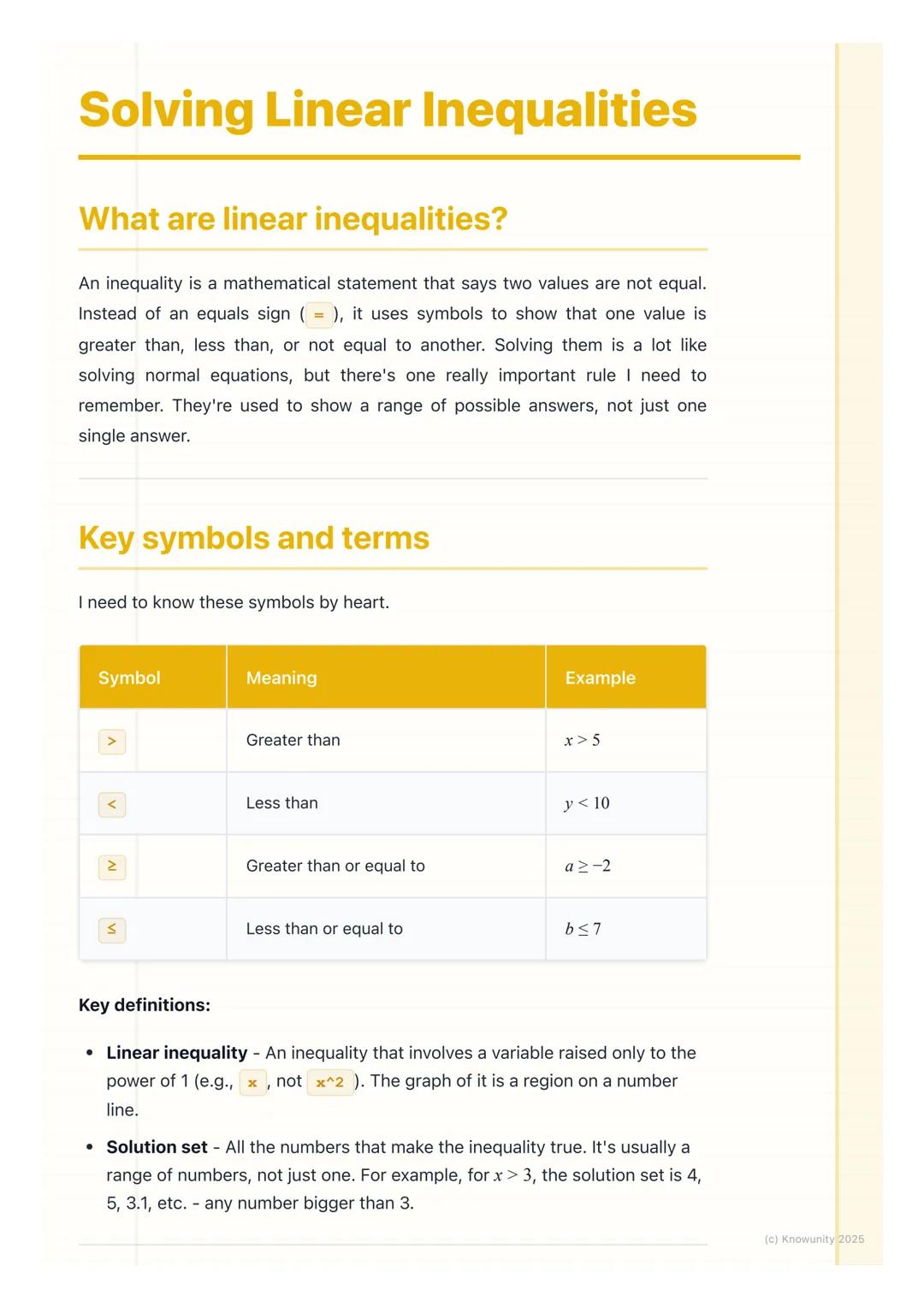
Understanding Linear Inequalities
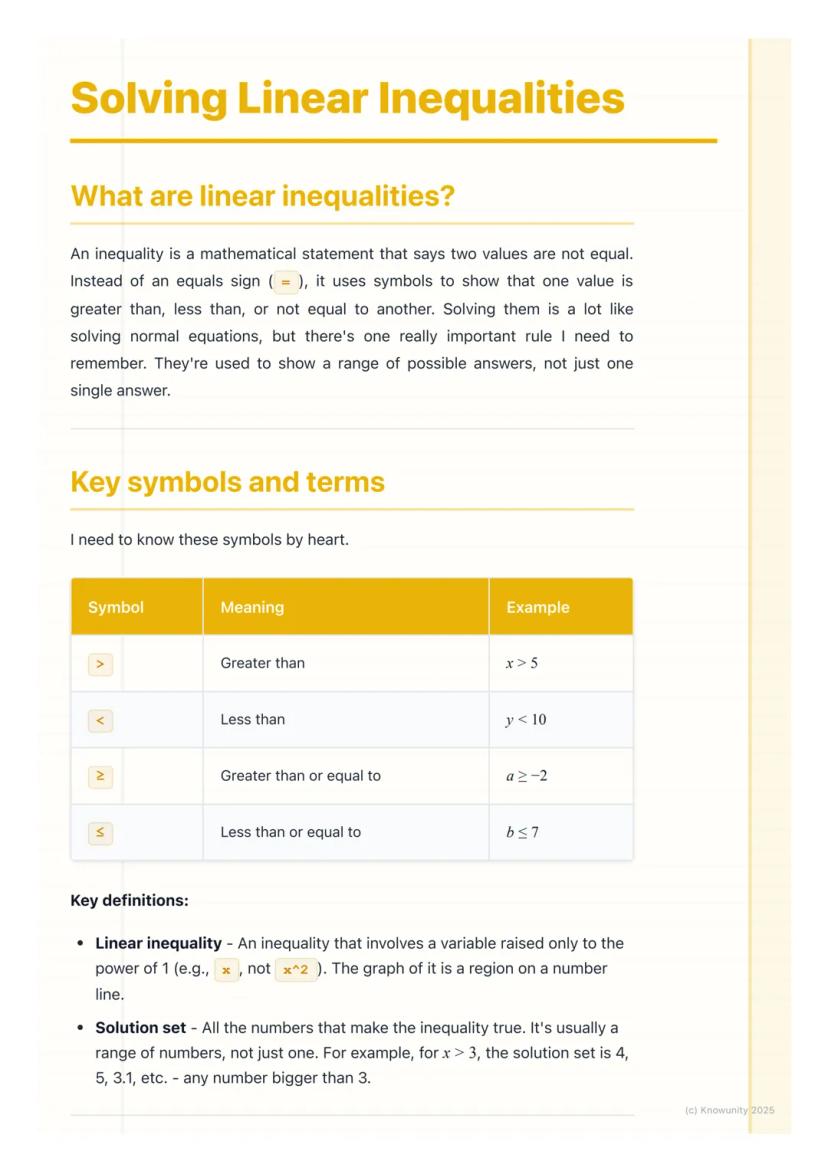
Think of inequalities as equations that don't believe in equality - they're all about showing which side is bigger! Instead of that boring equals sign, you get symbols that actually tell a story about the relationship between numbers.
The four key symbols you absolutely need to memorise are: > (greater than), < (less than), ≥ (greater than or equal to), and ≤ (less than or equal to). These aren't just random squiggles - they're your roadmap to solving problems.
A linear inequality is basically an inequality with a variable that's only raised to the power of 1 (so just x, not x²). The brilliant thing about these is that your solution set isn't just one lonely number - it's usually a whole range of values that work.
Quick Tip: Remember that inequalities give you ranges, not single answers - much more generous than regular equations!
2
of 6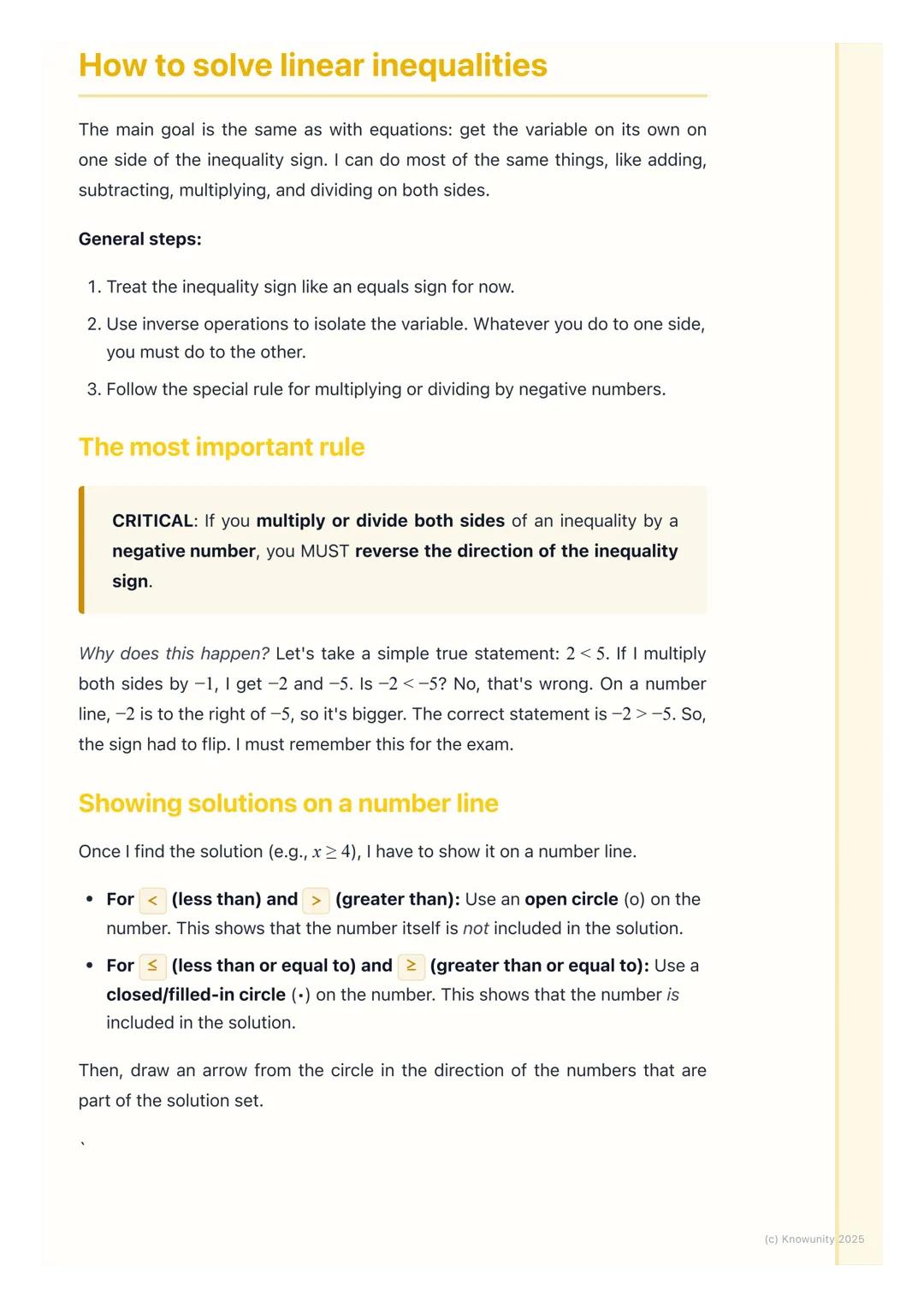
The Golden Rules for Solving
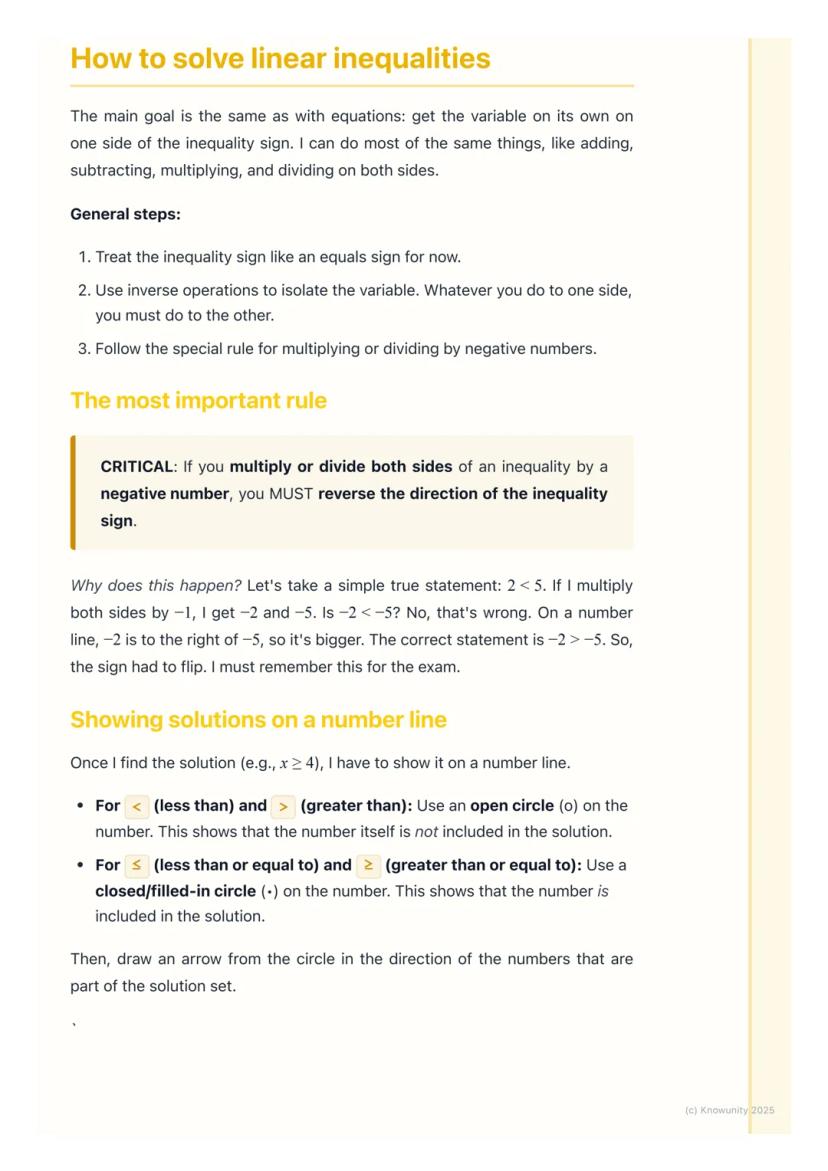
Solving linear inequalities is almost identical to solving equations, with one absolutely crucial difference that'll save your marks in exams. You can add, subtract, and use inverse operations just like normal - treat that inequality sign like an equals sign for most steps.
Here's the game-changing rule: when you multiply or divide both sides by a negative number, you must flip the inequality sign. So > becomes < and ≥ becomes ≤. This happens because negative numbers reverse the order on a number line.
Think about it this way: 2 < 5 is true, but when you multiply both by -1, you get -2 and -5. Since -2 is actually greater than -5, the sign flips to -2 > -5. Missing this step is the fastest way to lose marks!
Exam Alert: The negative number rule is tested constantly - practise it until it's automatic!
3
of 6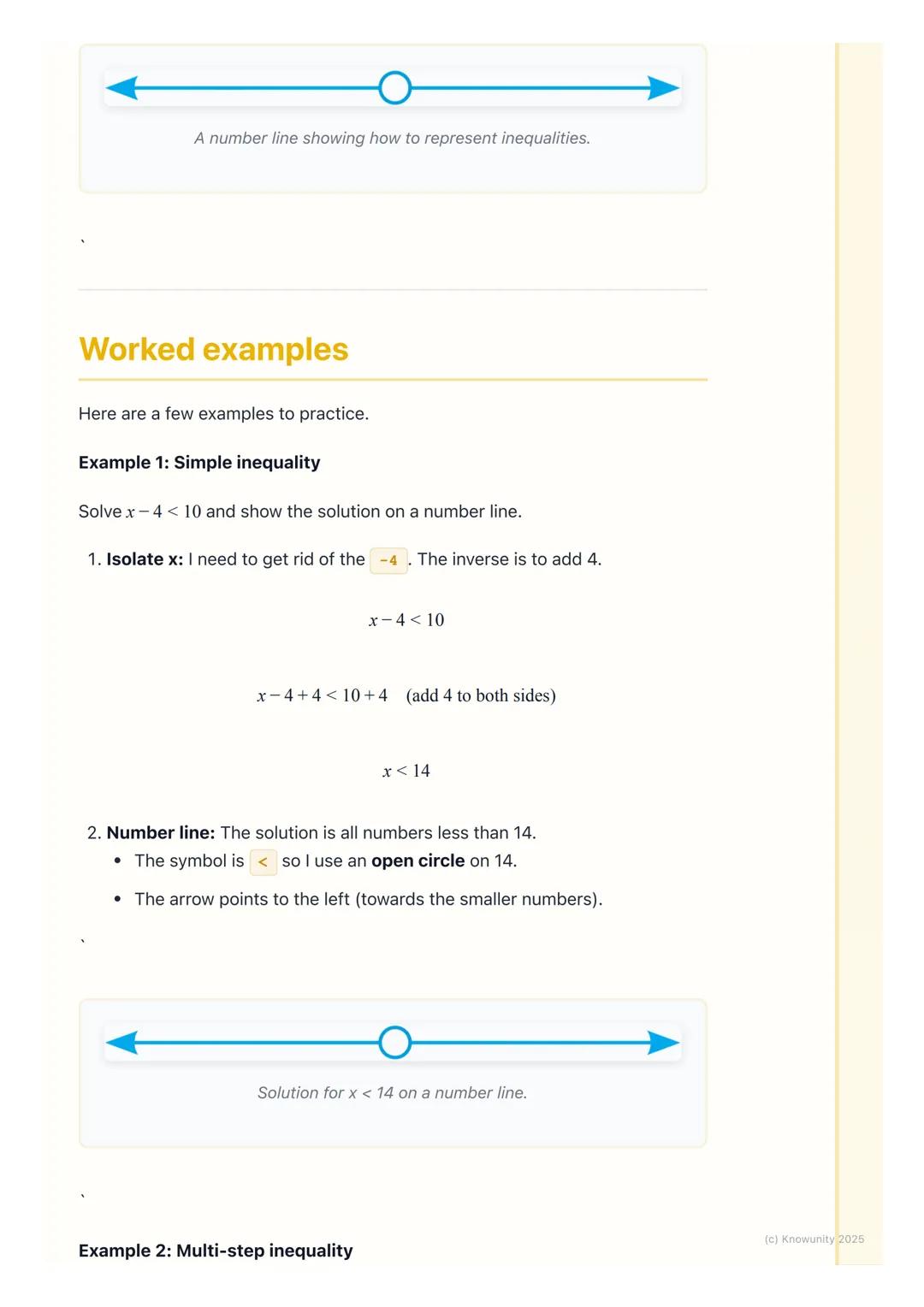
Showing Solutions on Number Lines
Once you've solved your inequality, you need to show it visually on a number line - and there's a simple system that makes perfect sense. The type of circle you draw tells the whole story about whether your boundary number is included or not.
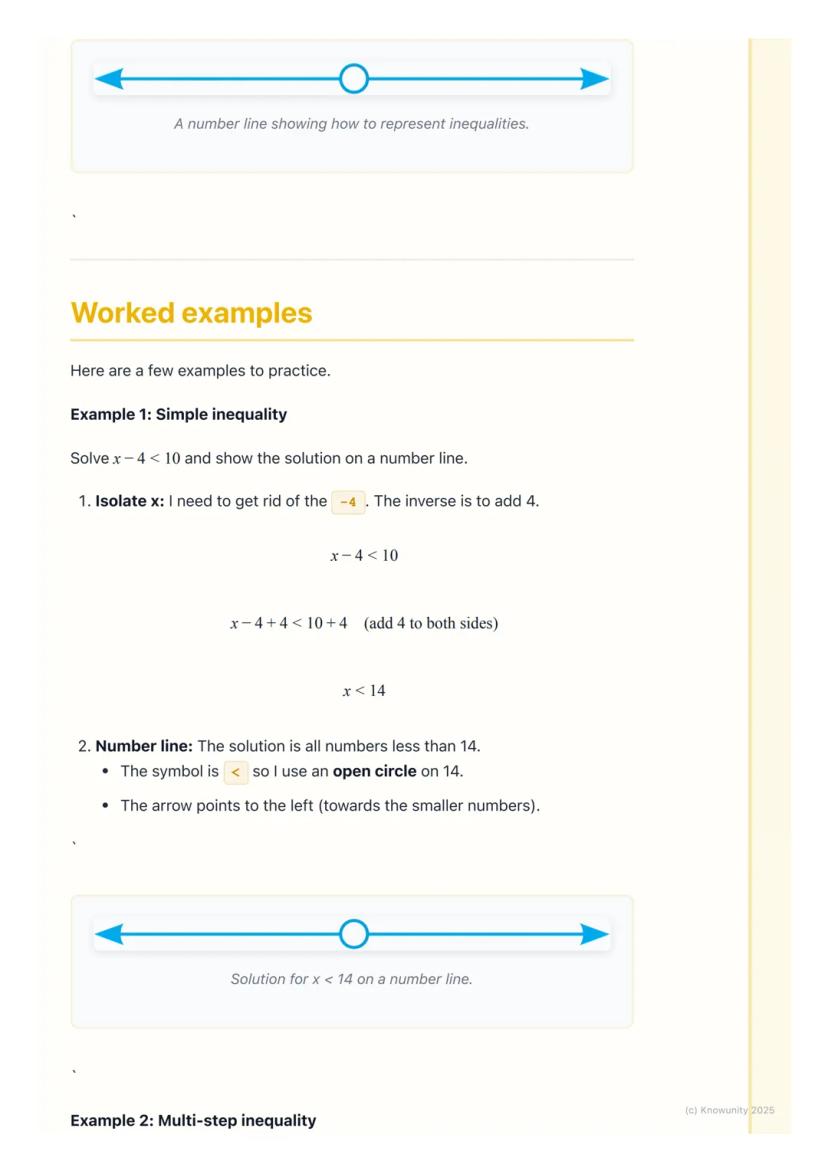
For < and > (strict inequalities), use an open circle because the exact number isn't part of your solution. For ≤ and ≥ (inclusive inequalities), use a filled-in circle because that number counts too.
Then just draw an arrow pointing towards all the numbers that work. Left for smaller values, right for larger values. It's like giving directions to anyone reading your solution!
Example: For x < 14, you'd put an open circle on 14 and draw an arrow pointing left towards all the smaller numbers that make the inequality true.
Memory Trick: The 'equal to' inequalities (≤, ≥) have extra lines, just like filled circles have extra ink!
4
of 6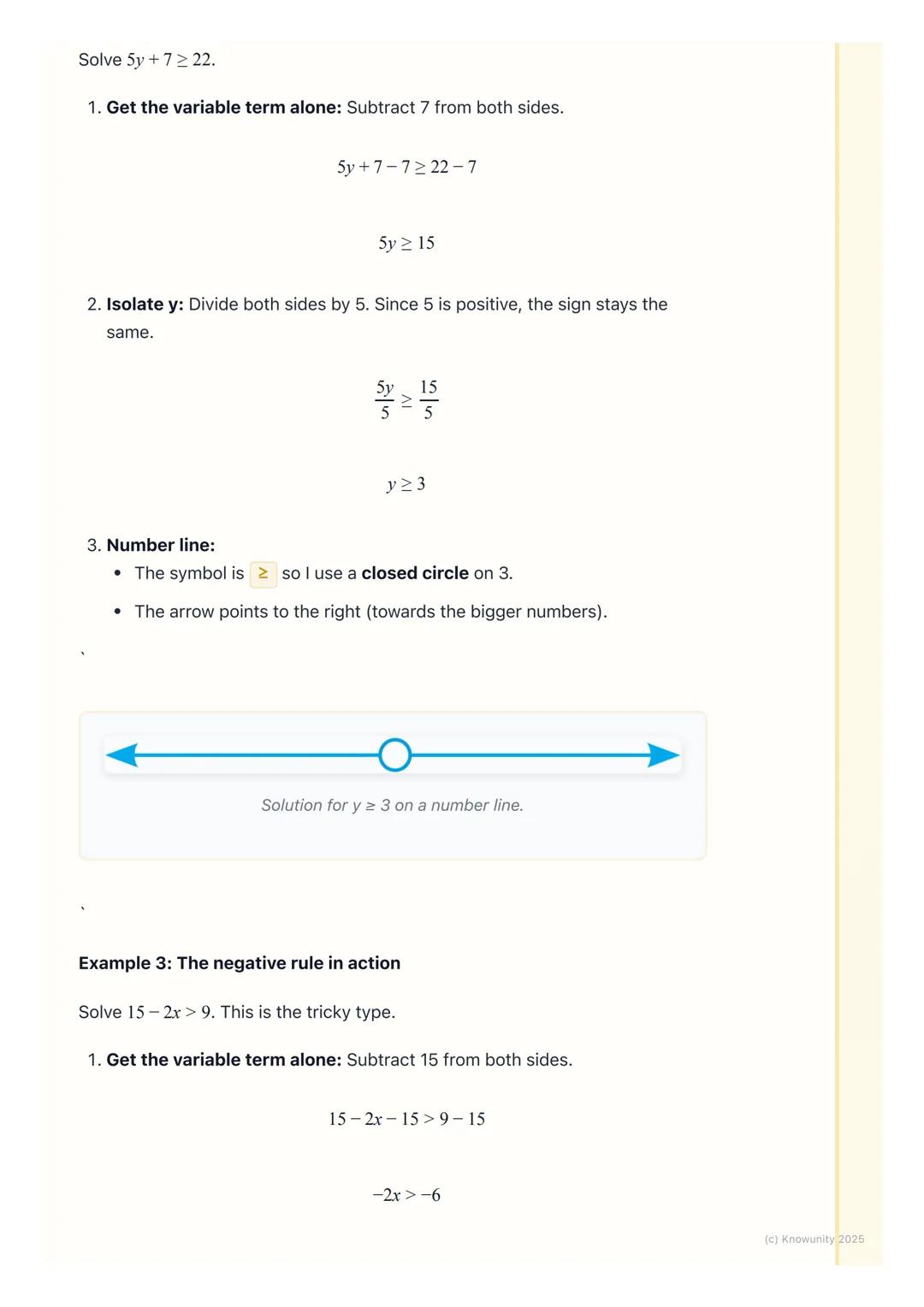
Step-by-Step Examples
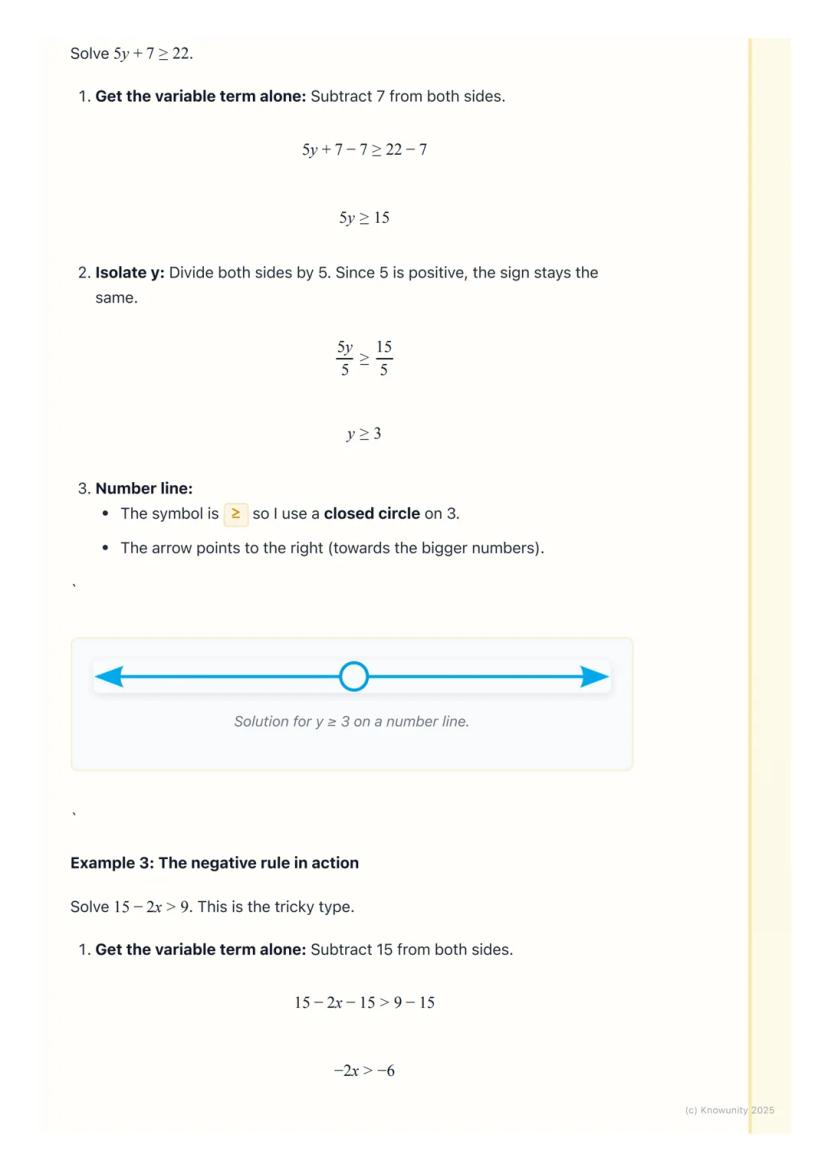
Let's tackle a straightforward one first: 5y + 7 ≥ 22. Start by getting the variable term alone - subtract 7 from both sides to get 5y ≥ 15. Since you're dividing by positive 5, the sign stays put, giving you y ≥ 3.
On your number line, you'd draw a filled circle on 3 (because of the ≥) with an arrow pointing right. Simple as that - you've found that y can be 3 or any number greater than 3.
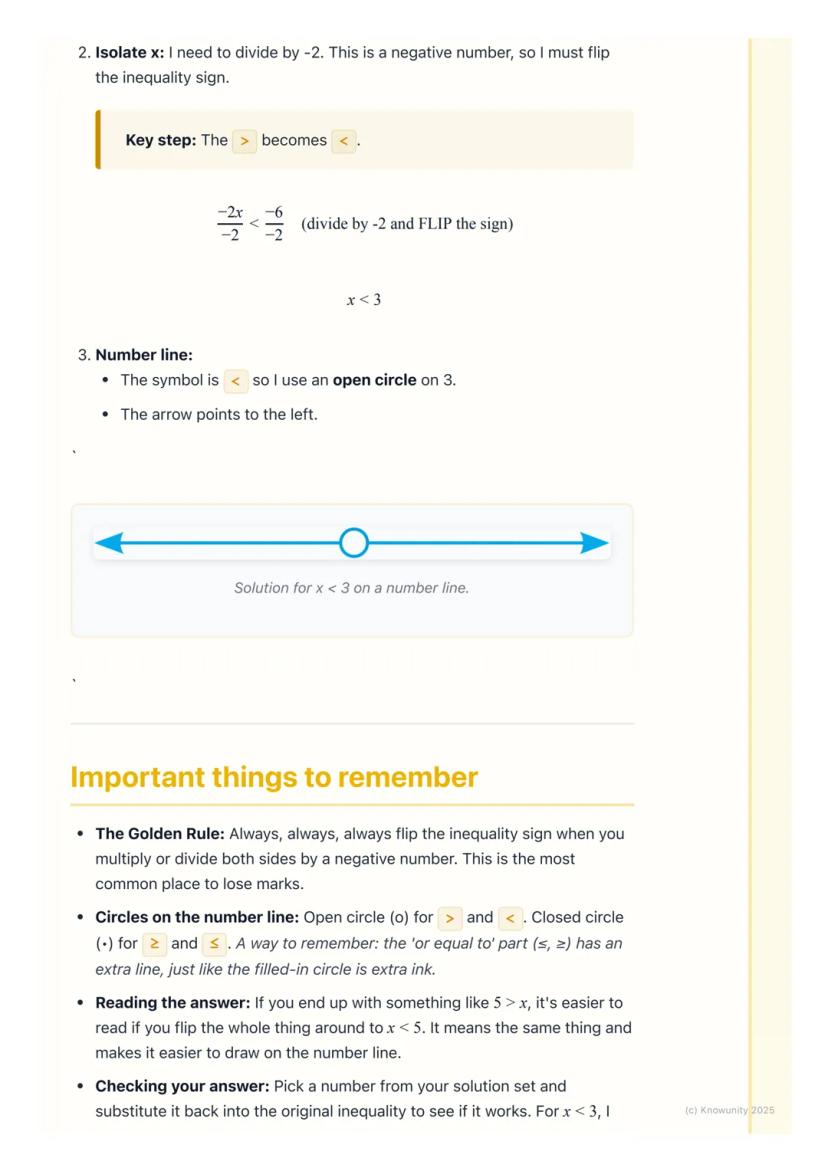
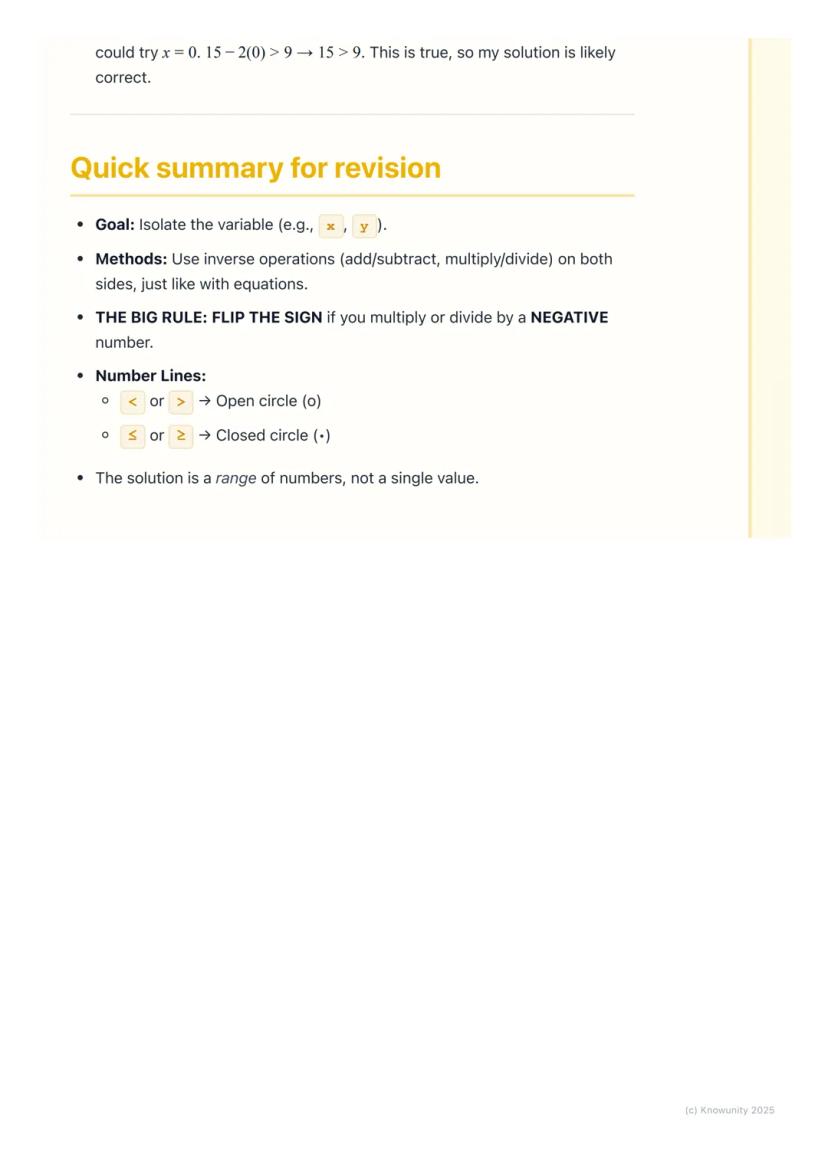
The trickier example is 15 - 2x > 9. Subtract 15 from both sides to get -2x > -6. Now here's where that golden rule kicks in - divide by -2 and flip the sign! You end up with x < 3, not x > 3.
Double-Check Tip: Always test your answer by picking a number from your solution and plugging it back into the original inequality!
5
of 6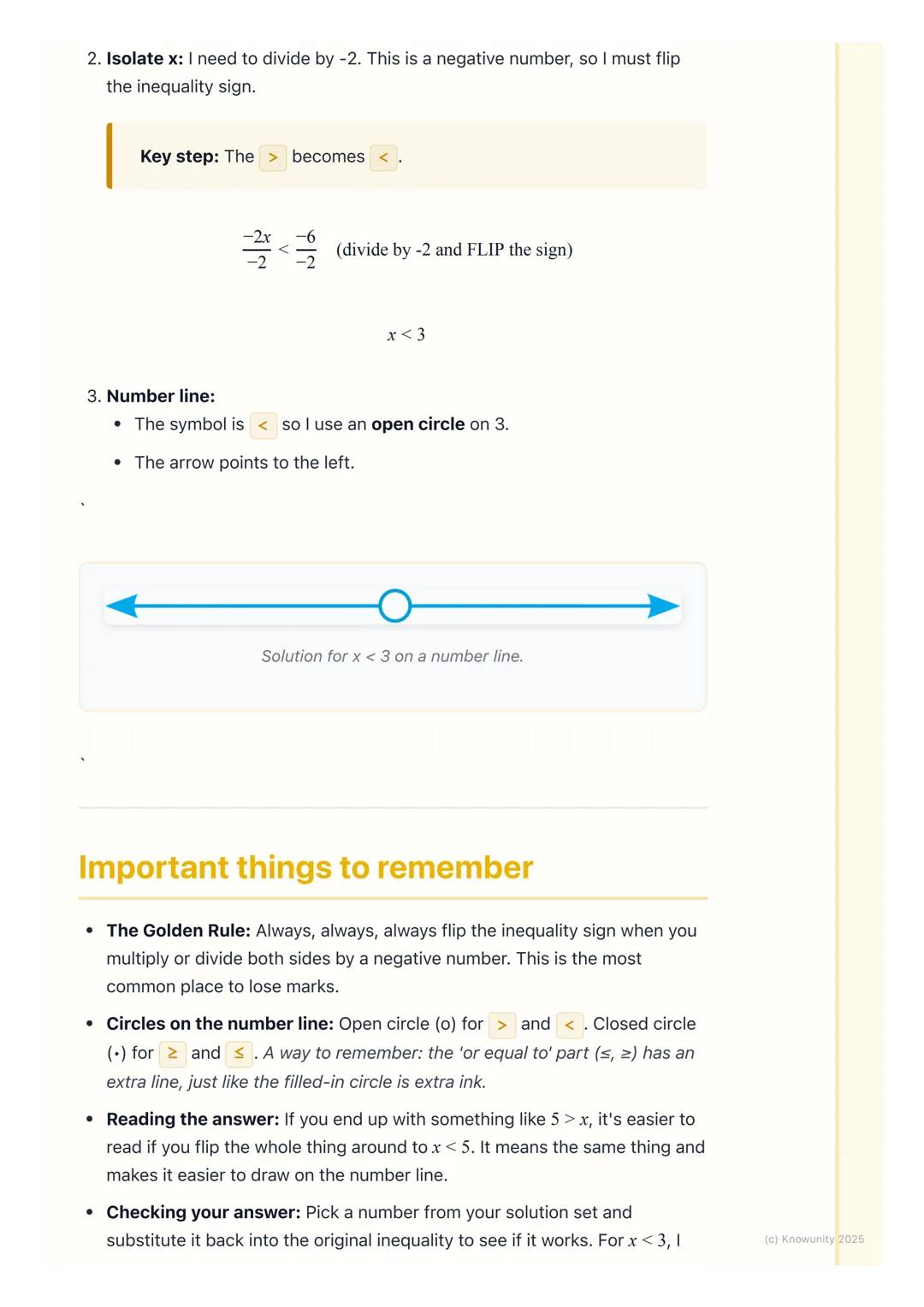
Common Mistakes and Quick Fixes
The biggest trap students fall into is forgetting to flip the inequality sign when working with negative numbers. It's so common that teachers practically expect it - don't give them the satisfaction! When you see a negative coefficient, mentally highlight it and prepare to flip.
Another sneaky mistake is getting confused about which circle to use on number lines. Remember: open circles for strict inequalities (< and >), filled circles for inclusive inequalities (≤ and ≥). The logic is bulletproof once you get it.
If you end up with something backwards like 5 > x, just flip the whole thing to x < 5. It means exactly the same thing but makes drawing your number line much easier. Your brain will thank you for the clarity.
Quick check method: Pick any number from your solution set and substitute it back into the original problem. If it works, you're golden. If not, you probably missed the sign flip!
Confidence Booster: Once you master the negative number rule, linear inequalities become easier than regular equations!
6
of 6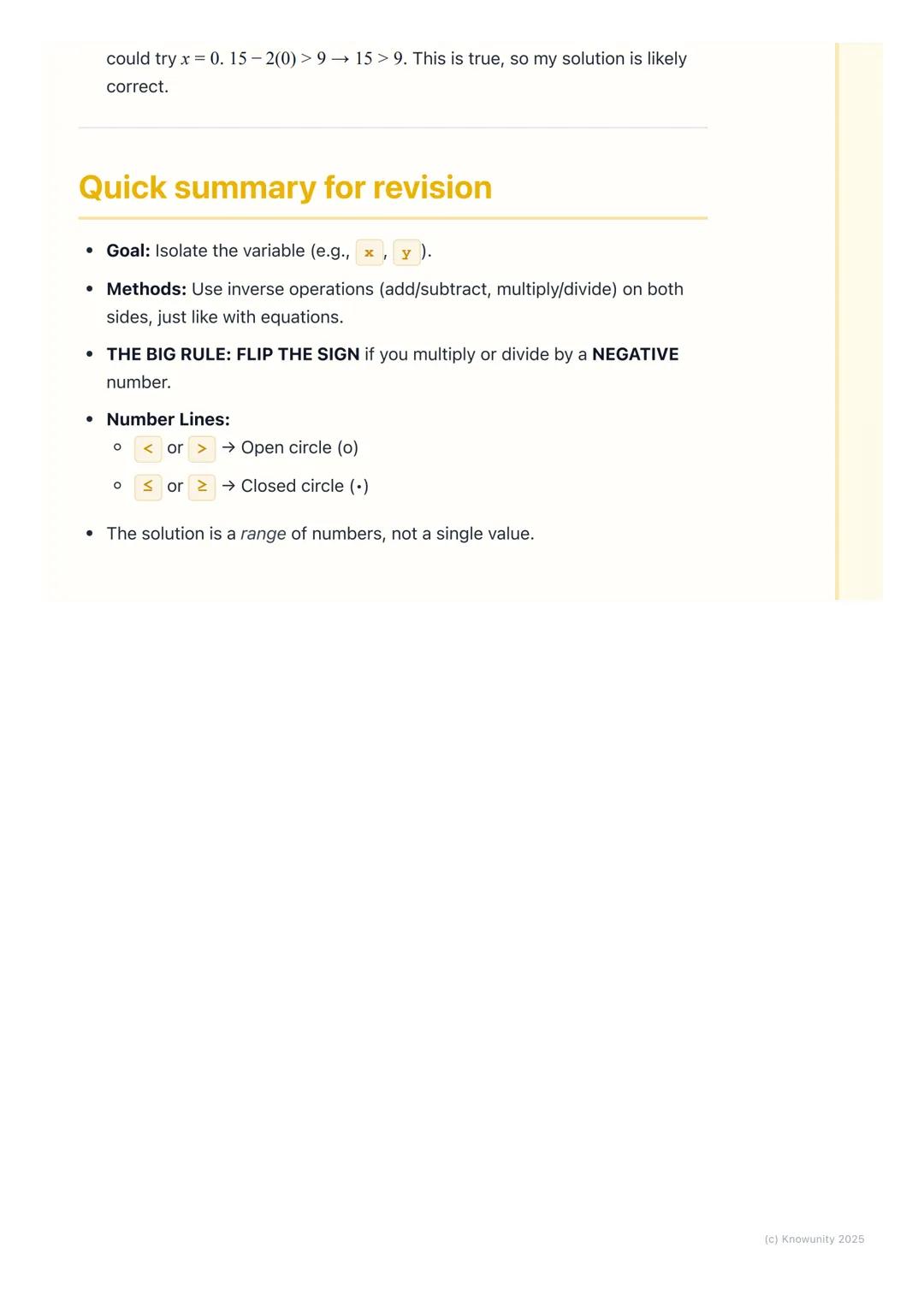
Revision Summary
Here's everything you need for exam success in one place. Your goal is always the same: isolate the variable using inverse operations on both sides. The process mirrors solving equations perfectly, with just one crucial difference.
The make-or-break rule: Flip the inequality sign whenever you multiply or divide by a negative number. This single rule separates the top students from everyone else, so make it automatic.
For number lines, stick to the simple system: open circles (○) for < and >, filled circles (●) for ≤ and ≥. Then arrow towards your solution set - left for smaller, right for larger.
Remember that your final answer represents a range of values, not just one number. That's what makes inequalities so powerful for real-world applications - they show you all the possibilities that work.
Final Reminder: Linear inequalities are just equations with attitude - master the negative number rule and you've cracked the code!
We thought you’d never ask...
What is the Knowunity AI companion?
Our AI companion is specifically built for the needs of students. Based on the millions of content pieces we have on the platform we can provide truly meaningful and relevant answers to students. But its not only about answers, the companion is even more about guiding students through their daily learning challenges, with personalised study plans, quizzes or content pieces in the chat and 100% personalisation based on the students skills and developments.
Where can I download the Knowunity app?
You can download the app in the Google Play Store and in the Apple App Store.
Is Knowunity really free of charge?
That's right! Enjoy free access to study content, connect with fellow students, and get instant help – all at your fingertips.
Most popular content in Mathematics
8Most popular content
9Can't find what you're looking for? Explore other subjects.
Students love us — and so will you.
4.6/5App Store
4.7/5Google Play
The app is very easy to use and well designed. I have found everything I was looking for so far and have been able to learn a lot from the presentations! I will definitely use the app for a class assignment! And of course it also helps a lot as an inspiration.
Stefan SiOS user
This app is really great. There are so many study notes and help [...]. My problem subject is French, for example, and the app has so many options for help. Thanks to this app, I have improved my French. I would recommend it to anyone.
Samantha KlichAndroid user
Wow, I am really amazed. I just tried the app because I've seen it advertised many times and was absolutely stunned. This app is THE HELP you want for school and above all, it offers so many things, such as workouts and fact sheets, which have been VERY helpful to me personally.
AnnaiOS user
Mathematics5 views·Updated May 31, 2026·6 pagesMastering Linear Inequalities Easily
Linear inequalities are like regular equations, but instead of finding one answer, you're finding a whole range of possible values. They're dead useful for real-world problems where you need to know "at least" or "at most" something - like how... Show more
1
of 6Sign up to see the content. It's free!
- Access to all documents
- Improve your grades
- Join milions of students
Understanding Linear Inequalities
Think of inequalities as equations that don't believe in equality - they're all about showing which side is bigger! Instead of that boring equals sign, you get symbols that actually tell a story about the relationship between numbers.
The four key symbols you absolutely need to memorise are: > (greater than), < (less than), ≥ (greater than or equal to), and ≤ (less than or equal to). These aren't just random squiggles - they're your roadmap to solving problems.
A linear inequality is basically an inequality with a variable that's only raised to the power of 1 (so just x, not x²). The brilliant thing about these is that your solution set isn't just one lonely number - it's usually a whole range of values that work.
Quick Tip: Remember that inequalities give you ranges, not single answers - much more generous than regular equations!
2
of 6Sign up to see the content. It's free!
- Access to all documents
- Improve your grades
- Join milions of students
The Golden Rules for Solving
Solving linear inequalities is almost identical to solving equations, with one absolutely crucial difference that'll save your marks in exams. You can add, subtract, and use inverse operations just like normal - treat that inequality sign like an equals sign for most steps.
Here's the game-changing rule: when you multiply or divide both sides by a negative number, you must flip the inequality sign. So > becomes < and ≥ becomes ≤. This happens because negative numbers reverse the order on a number line.
Think about it this way: 2 < 5 is true, but when you multiply both by -1, you get -2 and -5. Since -2 is actually greater than -5, the sign flips to -2 > -5. Missing this step is the fastest way to lose marks!
Exam Alert: The negative number rule is tested constantly - practise it until it's automatic!
3
of 6Sign up to see the content. It's free!
- Access to all documents
- Improve your grades
- Join milions of students
Showing Solutions on Number Lines
Once you've solved your inequality, you need to show it visually on a number line - and there's a simple system that makes perfect sense. The type of circle you draw tells the whole story about whether your boundary number is included or not.
For < and > (strict inequalities), use an open circle because the exact number isn't part of your solution. For ≤ and ≥ (inclusive inequalities), use a filled-in circle because that number counts too.
Then just draw an arrow pointing towards all the numbers that work. Left for smaller values, right for larger values. It's like giving directions to anyone reading your solution!
Example: For x < 14, you'd put an open circle on 14 and draw an arrow pointing left towards all the smaller numbers that make the inequality true.
Memory Trick: The 'equal to' inequalities (≤, ≥) have extra lines, just like filled circles have extra ink!
4
of 6Sign up to see the content. It's free!
- Access to all documents
- Improve your grades
- Join milions of students
Step-by-Step Examples
Let's tackle a straightforward one first: 5y + 7 ≥ 22. Start by getting the variable term alone - subtract 7 from both sides to get 5y ≥ 15. Since you're dividing by positive 5, the sign stays put, giving you y ≥ 3.
On your number line, you'd draw a filled circle on 3 (because of the ≥) with an arrow pointing right. Simple as that - you've found that y can be 3 or any number greater than 3.
The trickier example is 15 - 2x > 9. Subtract 15 from both sides to get -2x > -6. Now here's where that golden rule kicks in - divide by -2 and flip the sign! You end up with x < 3, not x > 3.
Double-Check Tip: Always test your answer by picking a number from your solution and plugging it back into the original inequality!
5
of 6Sign up to see the content. It's free!
- Access to all documents
- Improve your grades
- Join milions of students
Common Mistakes and Quick Fixes
The biggest trap students fall into is forgetting to flip the inequality sign when working with negative numbers. It's so common that teachers practically expect it - don't give them the satisfaction! When you see a negative coefficient, mentally highlight it and prepare to flip.
Another sneaky mistake is getting confused about which circle to use on number lines. Remember: open circles for strict inequalities (< and >), filled circles for inclusive inequalities (≤ and ≥). The logic is bulletproof once you get it.
If you end up with something backwards like 5 > x, just flip the whole thing to x < 5. It means exactly the same thing but makes drawing your number line much easier. Your brain will thank you for the clarity.
Quick check method: Pick any number from your solution set and substitute it back into the original problem. If it works, you're golden. If not, you probably missed the sign flip!
Confidence Booster: Once you master the negative number rule, linear inequalities become easier than regular equations!
6
of 6Sign up to see the content. It's free!
- Access to all documents
- Improve your grades
- Join milions of students
Revision Summary
Here's everything you need for exam success in one place. Your goal is always the same: isolate the variable using inverse operations on both sides. The process mirrors solving equations perfectly, with just one crucial difference.
The make-or-break rule: Flip the inequality sign whenever you multiply or divide by a negative number. This single rule separates the top students from everyone else, so make it automatic.
For number lines, stick to the simple system: open circles (○) for < and >, filled circles (●) for ≤ and ≥. Then arrow towards your solution set - left for smaller, right for larger.
Remember that your final answer represents a range of values, not just one number. That's what makes inequalities so powerful for real-world applications - they show you all the possibilities that work.
Final Reminder: Linear inequalities are just equations with attitude - master the negative number rule and you've cracked the code!
We thought you’d never ask...
What is the Knowunity AI companion?
Our AI companion is specifically built for the needs of students. Based on the millions of content pieces we have on the platform we can provide truly meaningful and relevant answers to students. But its not only about answers, the companion is even more about guiding students through their daily learning challenges, with personalised study plans, quizzes or content pieces in the chat and 100% personalisation based on the students skills and developments.
Where can I download the Knowunity app?
You can download the app in the Google Play Store and in the Apple App Store.
Is Knowunity really free of charge?
That's right! Enjoy free access to study content, connect with fellow students, and get instant help – all at your fingertips.
Most popular content in Mathematics
8Most popular content
9Can't find what you're looking for? Explore other subjects.
Students love us — and so will you.
4.6/5App Store
4.7/5Google Play
The app is very easy to use and well designed. I have found everything I was looking for so far and have been able to learn a lot from the presentations! I will definitely use the app for a class assignment! And of course it also helps a lot as an inspiration.
Stefan SiOS user
This app is really great. There are so many study notes and help [...]. My problem subject is French, for example, and the app has so many options for help. Thanks to this app, I have improved my French. I would recommend it to anyone.
Samantha KlichAndroid user
Wow, I am really amazed. I just tried the app because I've seen it advertised many times and was absolutely stunned. This app is THE HELP you want for school and above all, it offers so many things, such as workouts and fact sheets, which have been VERY helpful to me personally.
AnnaiOS user