Understanding Trigonometry
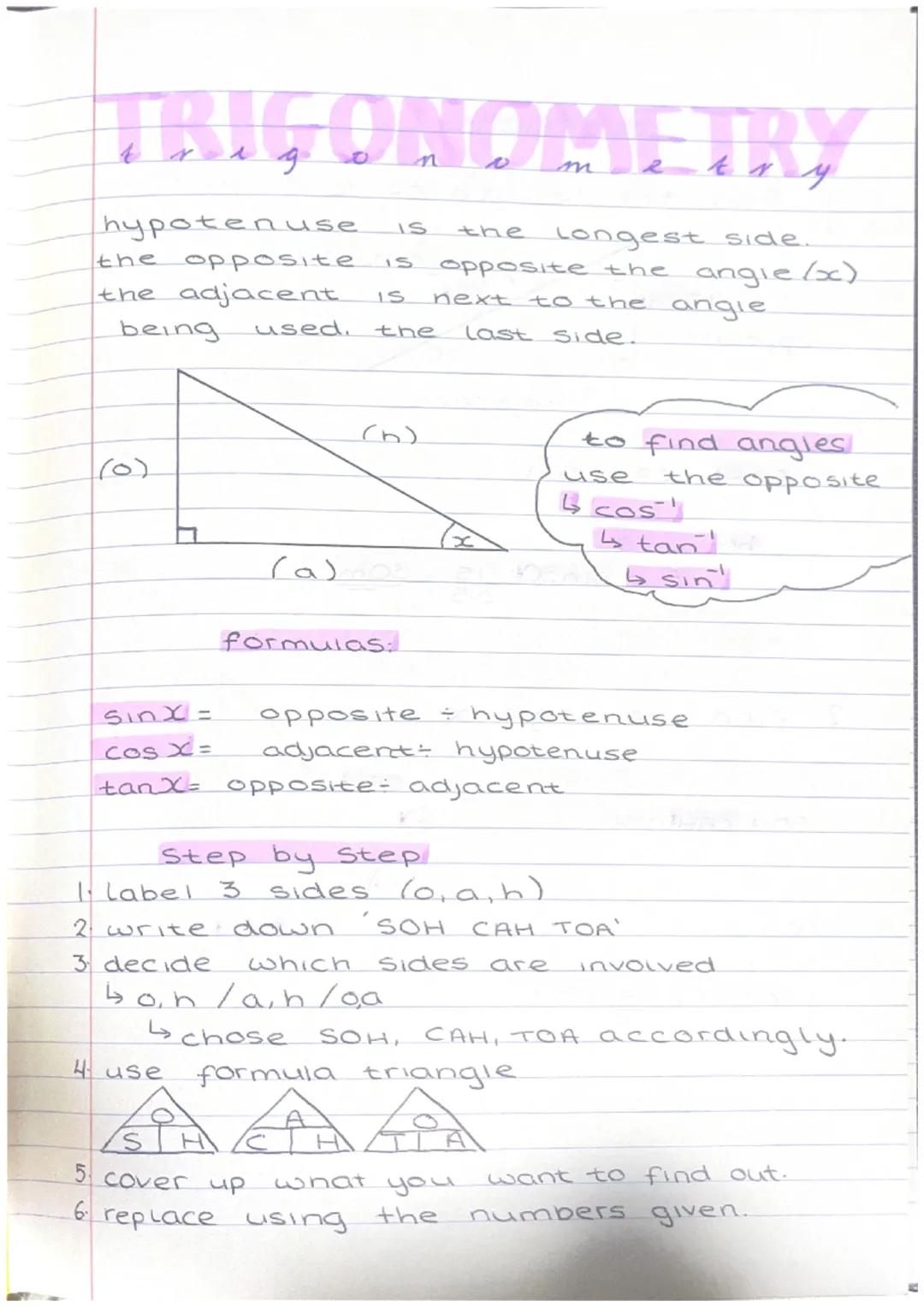
Trigonometry works by identifying three key sides in a right-angled triangle. The hypotenuse is always the longest side (opposite the right angle). The opposite side is directly across from the angle you're working with, while the adjacent side is next to your angle.
The three essential trigonometric ratios are simple fractions relating these sides:
- Sine (sin): opposite ÷ hypotenuse
- Cosine (cos): adjacent ÷ hypotenuse
- Tangent (tan): opposite ÷ adjacent
To solve trigonometry problems, follow these simple steps: First, label all three sides of your triangle (o, a, h). Then, remember the mnemonic "SOH CAH TOA" to help you choose the right formula. Finally, substitute your values and solve!
Pro tip: When you need to find angles rather than sides, use the inverse functions: sin⁻¹, cos⁻¹, or tan⁻¹ on your calculator. These tell you "what angle has this trigonometric value?"
You can also use a handy triangle method to remember the formulas. Arrange S, O, H in one column; C, A, H in the second; and O, A, T in the third. When solving, cover the value you're looking for, and the remaining letters show you what to do with your known values.


 Maths
Maths English Literature
 Biology
 Sociology
 Algebra 2
 Pre-Calculus