
Ever wonder how human thinking evolved from ancient myths to... Show more
 Econ
Econ GenBio
 Other
Other Pre-Cal
 Oral Communication
 Practical Research
 DISS
DISSSign up to see the contentIt's free!
Access to all documents
Improve your grades
Join milions of students
By signing up you accept Terms of Service and Privacy Policy

Biology

Chemistry
AP Chemistry

English
AP English Literature
244
•
Dec 20, 2025
•
Isabel Cuevas
@isabelcue_vqe15
Ever wonder how human thinking evolved from ancient myths to... Show more
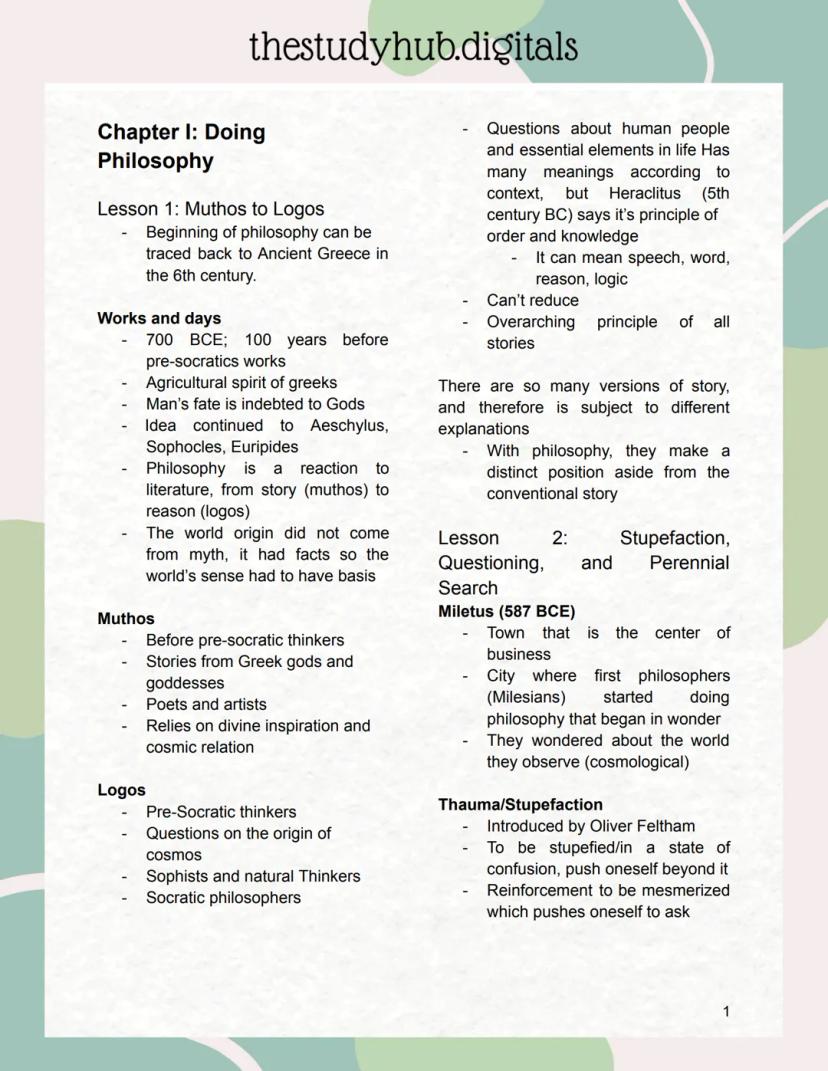
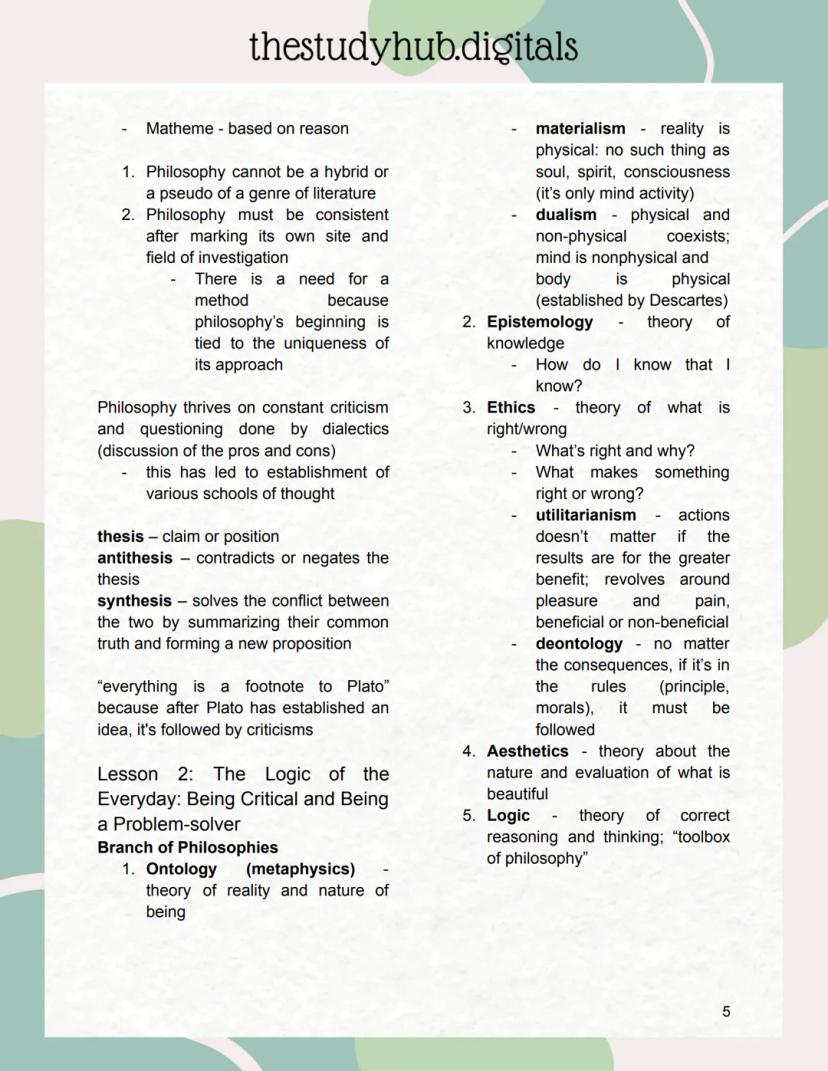
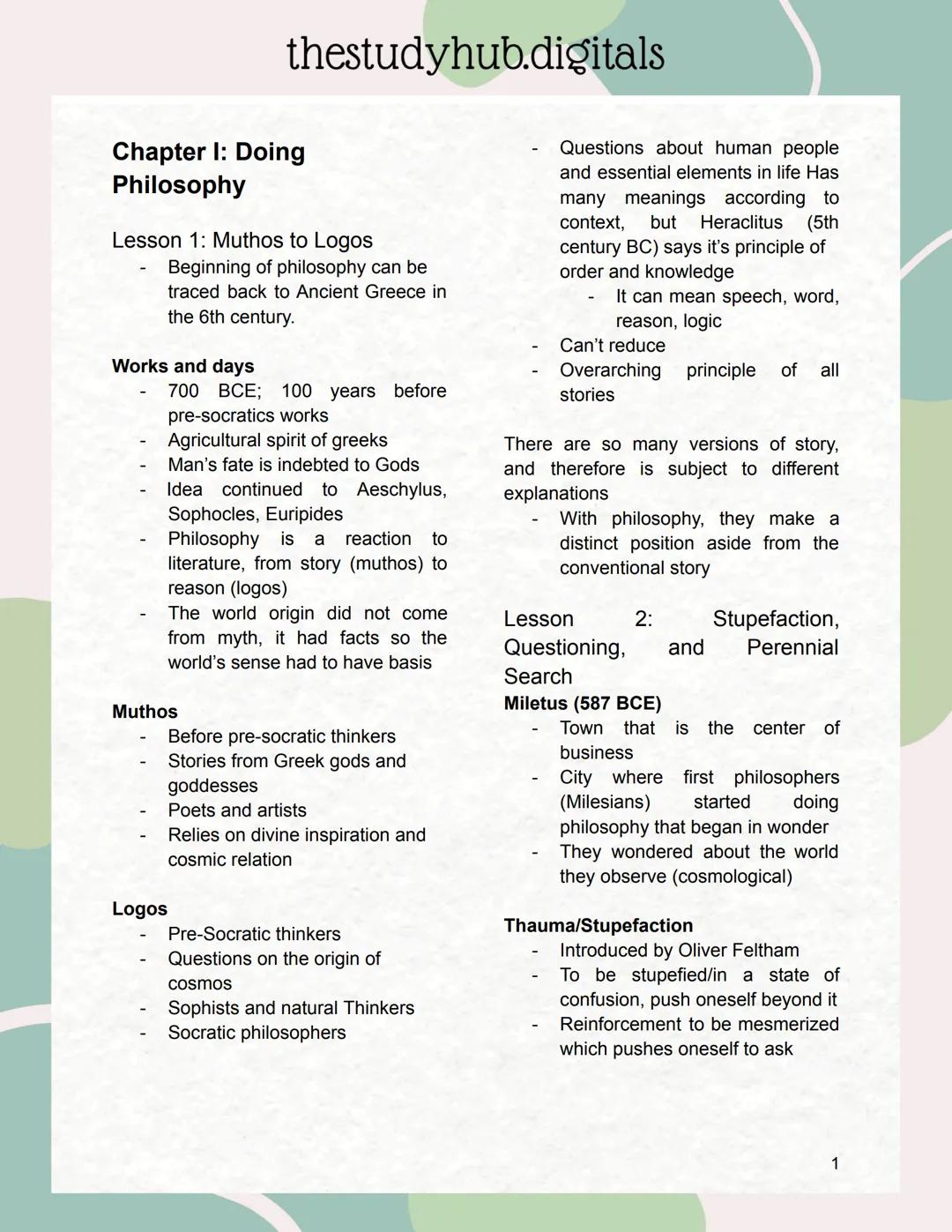
Philosophy kicked off in ancient Greece around the 6th century BCE when people got tired of explaining everything through myths about gods and goddesses. Before this, Greeks relied on epic poems like "Works and Days" that said humans were basically at the mercy of divine beings.
The game-changer happened when thinkers decided that muthos (mythical stories told by poets) wasn't cutting it anymore. They wanted logos - actual reasons and logic to explain how the world worked. Instead of saying "Zeus made it rain," they started asking "What really causes rain?"
Muthos was all about divine inspiration and cosmic relationships - pretty much letting poets and artists create explanations based on what felt right. Logos, on the other hand, demanded evidence and reasoning. Heraclitus called it the "principle of order and knowledge" that could mean speech, word, reason, or logic depending on the situation.
Key Point: This shift from accepting stories to demanding explanations is exactly what you do every time you question something instead of just believing it!
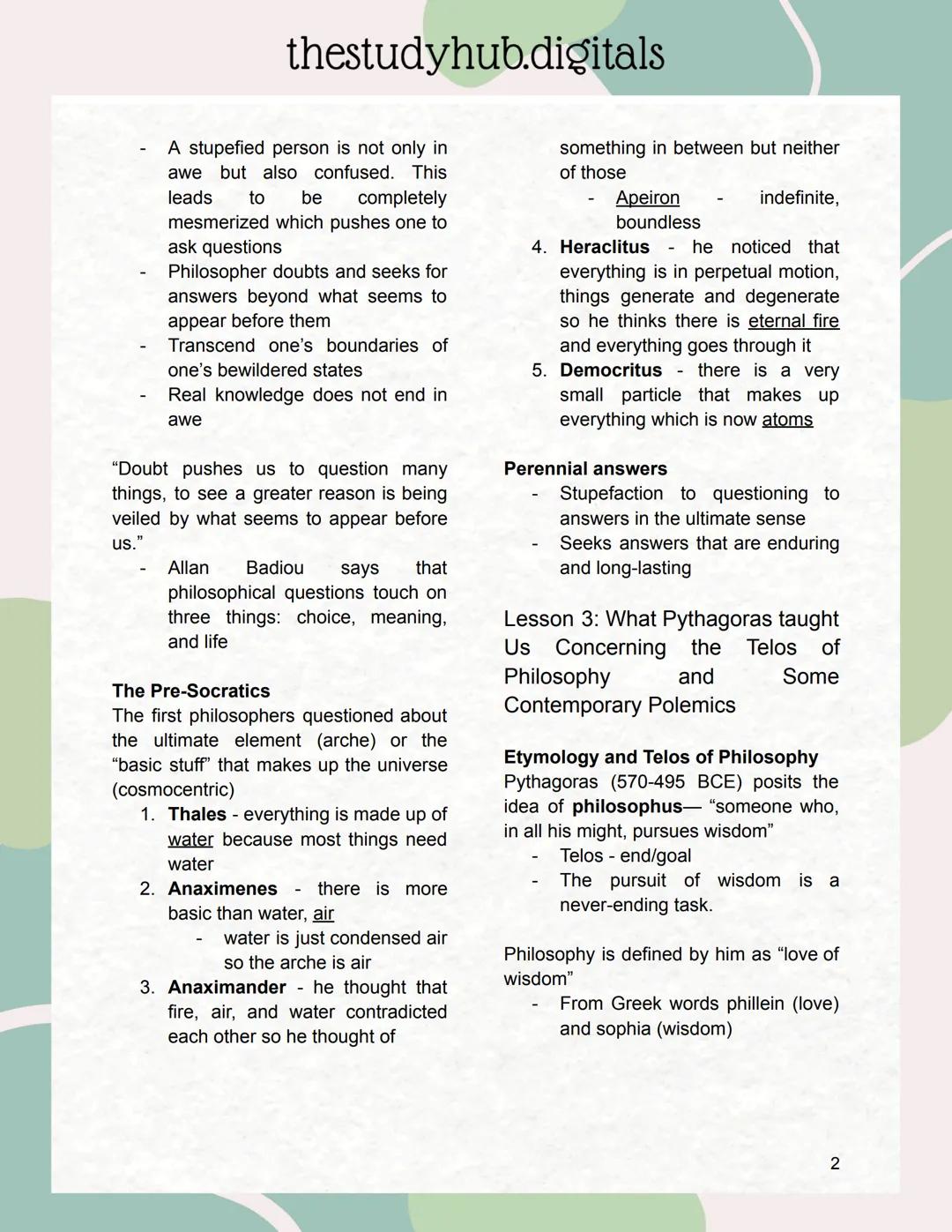
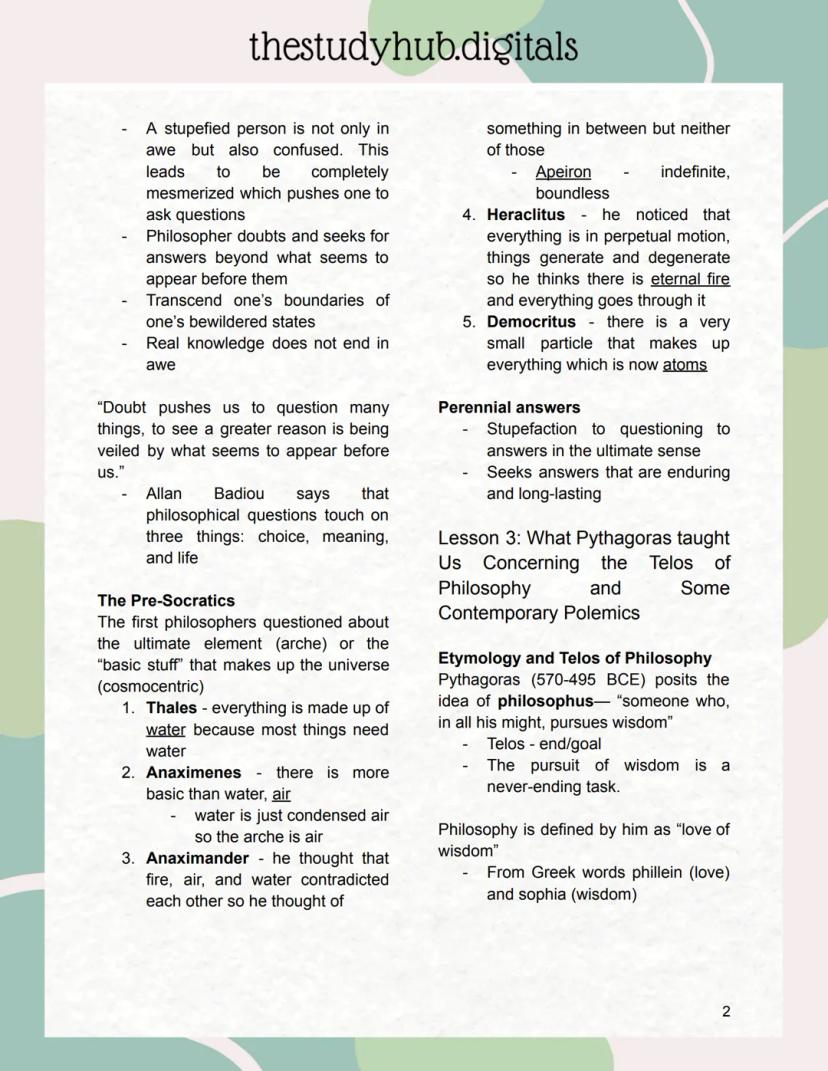
Picture this: you're in Miletus, a bustling trade city in 587 BCE, and suddenly people start getting stupefied (completely amazed and confused) by everyday things around them. This stupefaction wasn't just being impressed - it was being so puzzled that you absolutely had to find answers.
Thauma or stupefaction pushes you beyond just being confused. A truly stupefied person doesn't stop at "wow, that's cool" but goes straight to "wait, how does that actually work?" Real philosophers doubt what seems obvious and dig deeper for hidden truths.
The Pre-Socratics were the first to ask the ultimate question: what's the basic stuff (arche) that makes up everything? Thales said water, Anaximenes argued for air, Anaximander proposed something indefinite called Apeiron, Heraclitus went with eternal fire, and Democritus theorized about tiny particles (basically atoms).
Remember: The best questions often matter more than having perfect answers - doubt pushes us to discover what's really going on beneath the surface.
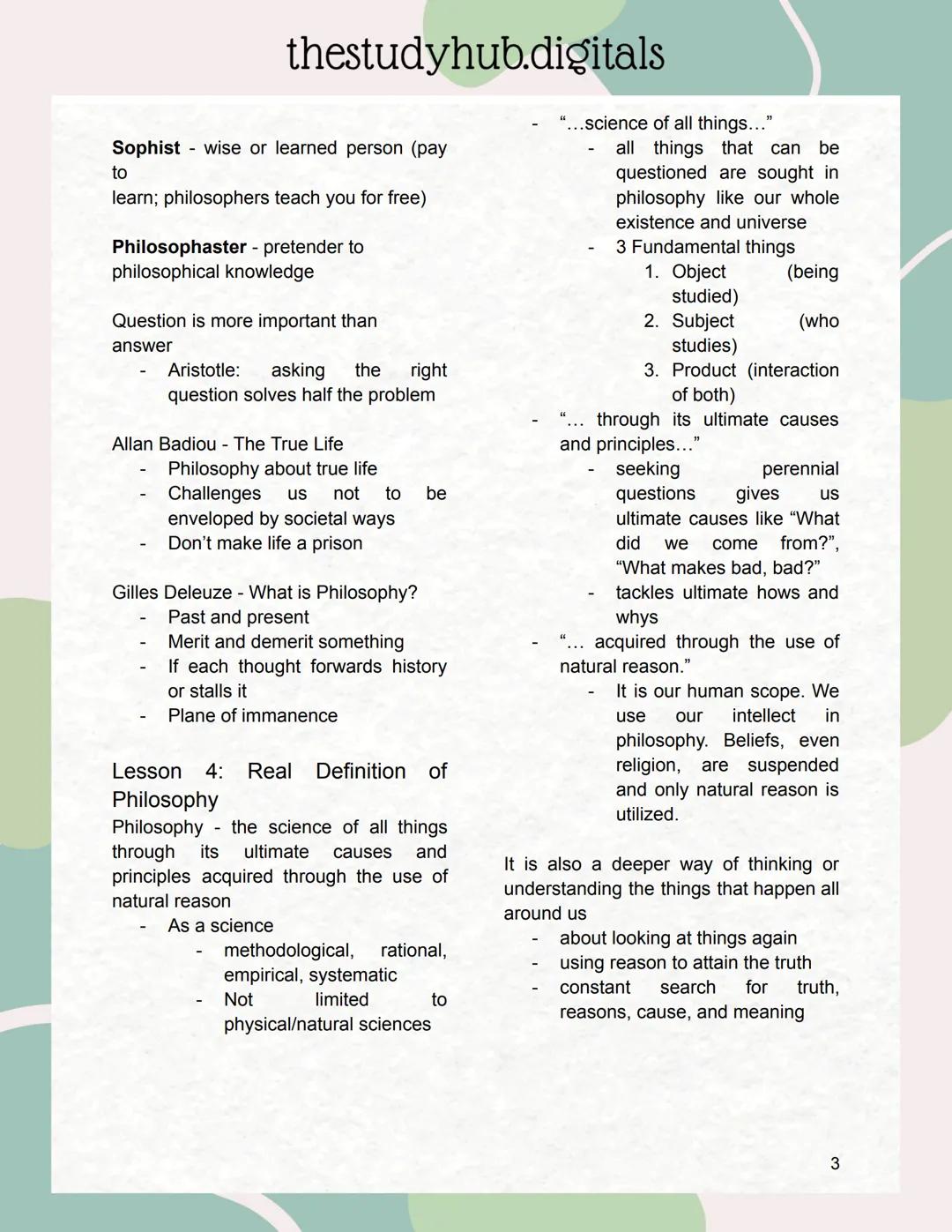
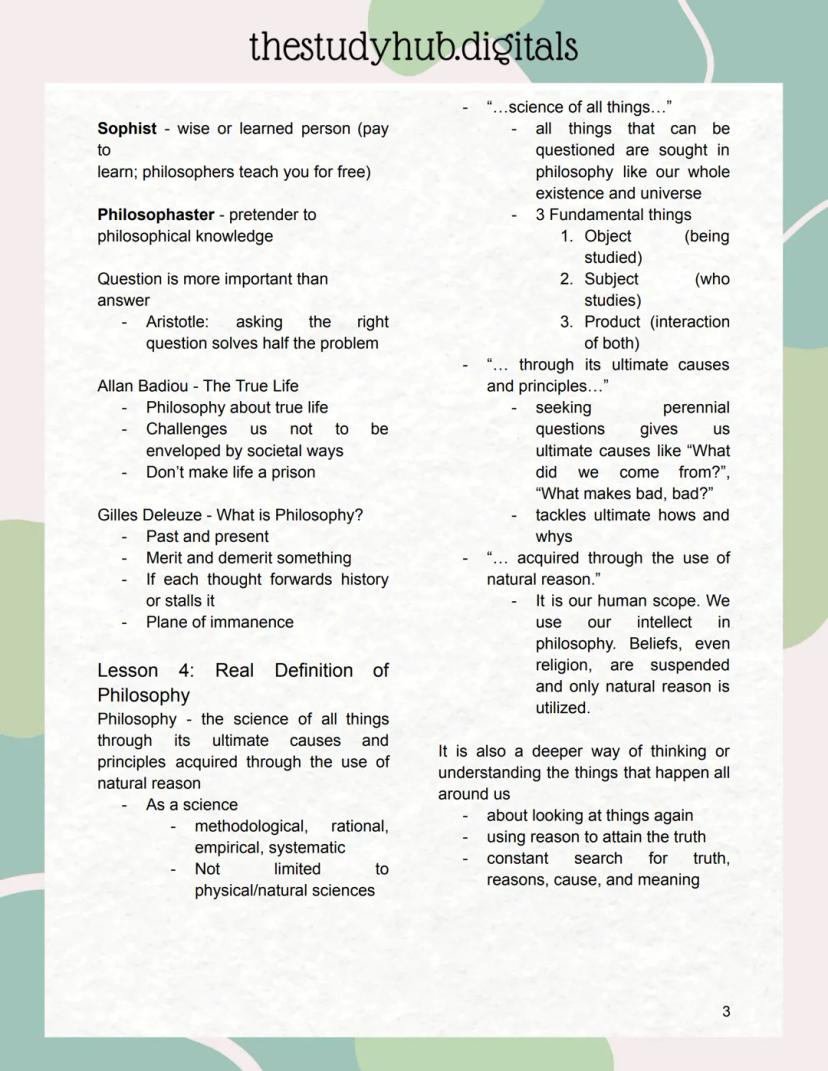
Pythagoras gave us the word "philosophy" - combining "phillein" (love) and "sophia" (wisdom) to mean "love of wisdom." Unlike sophists who charged money to teach, real philosophers shared knowledge freely because they understood that pursuing wisdom never actually ends.
Here's the real definition: Philosophy is the science of all things through their ultimate causes and principles, acquired through natural reason. It's methodical like science, covers everything that can be questioned, seeks the deepest "why" answers, and relies purely on human intellect - no blind faith allowed.
The telos (goal) of philosophy isn't to become a know-it-all, but to keep asking better questions. As Aristotle said, asking the right question solves half the problem. Philosophy challenges you to think about true living and not just go along with whatever society tells you.
Think About It: When you question why something is "just the way it is," you're doing exactly what philosophers have done for over 2,000 years.
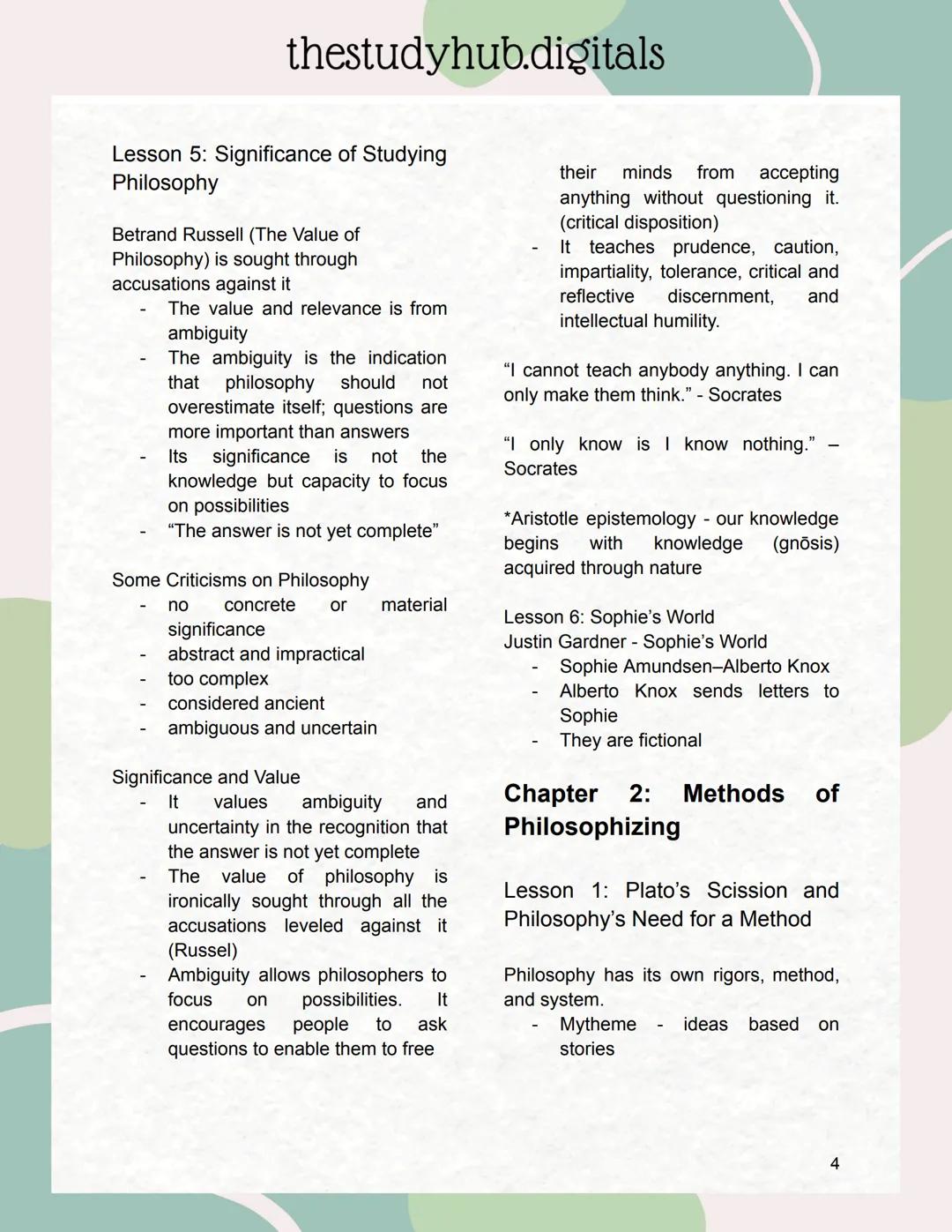
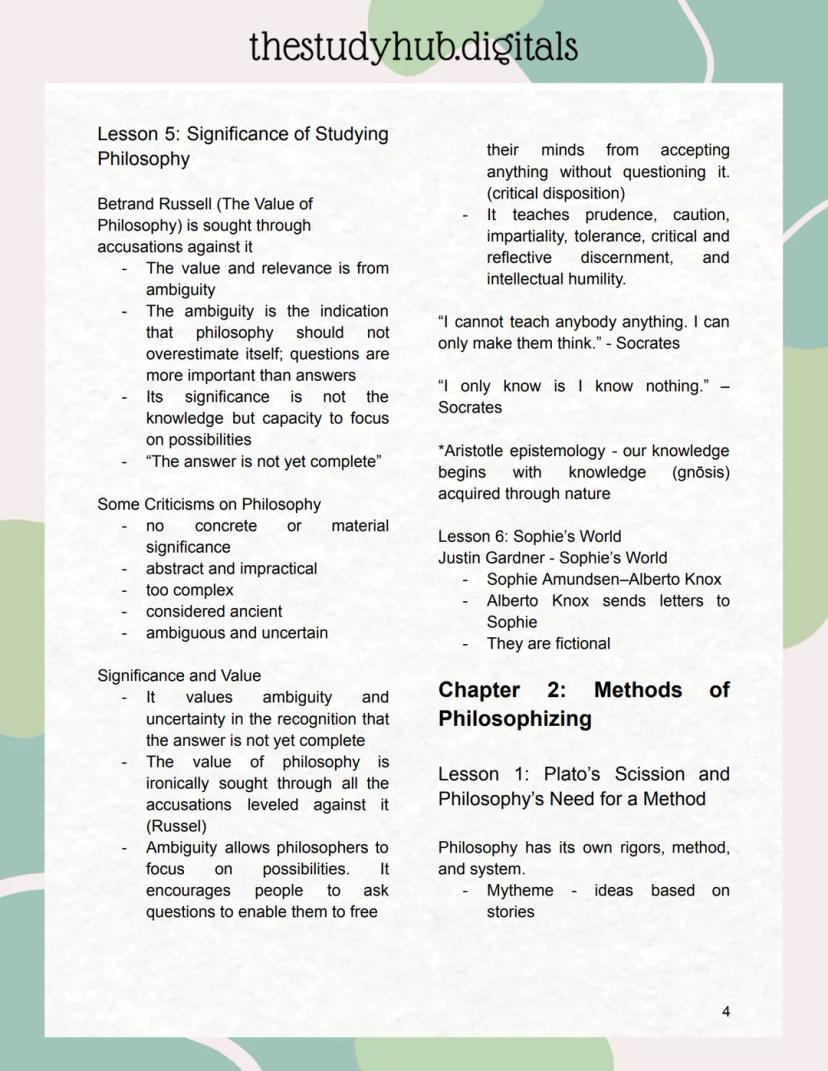
People love criticizing philosophy for being too abstract, impractical, complex, ancient, and uncertain. Bertrand Russell flipped this around, arguing that philosophy's value comes precisely from these "weaknesses." The ambiguity and uncertainty mean we haven't found complete answers yet - and that's exactly the point.
Philosophy's significance isn't in giving you final answers but in developing your capacity to focus on possibilities. It teaches you prudence, critical thinking, tolerance, and intellectual humility. When everything seems certain, philosophy reminds you to keep questioning.
The dialectical method shows how philosophy thrives on criticism through thesis (a claim), antithesis (the opposite claim), and synthesis (combining the best of both). This constant back-and-forth creates stronger ideas and better understanding.
Socrates' Wisdom: "I cannot teach anybody anything. I can only make them think" - and sometimes realizing "I know that I know nothing" is the smartest thing you can do.
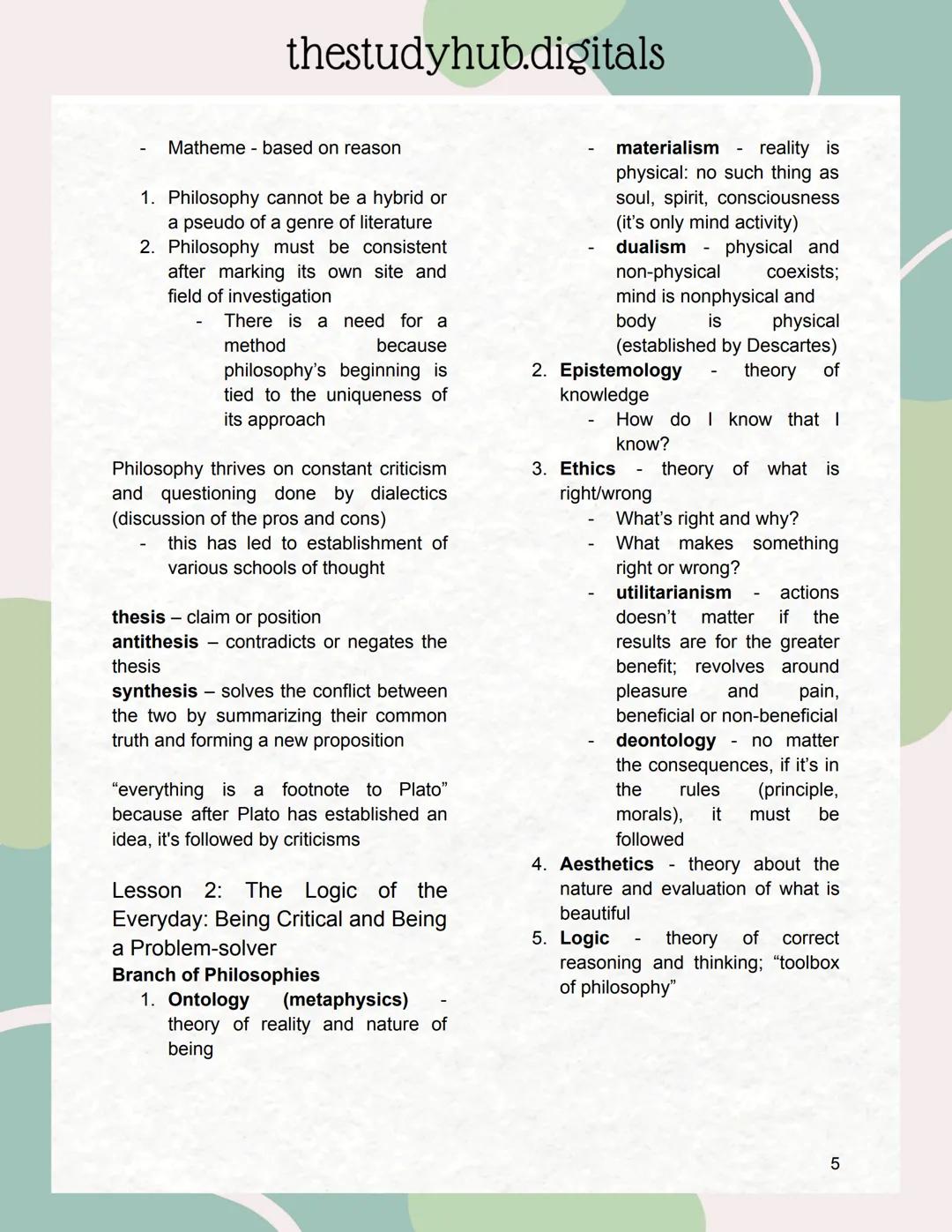
Philosophy splits into five main branches that cover everything humans can think about. Ontology deals with what's real (like whether minds and bodies are separate things). Epistemology asks how we know what we know. Ethics tackles what's right and wrong - whether consequences matter most (utilitarianism) or principles do (deontology).
Aesthetics explores what makes things beautiful, while logic serves as philosophy's toolbox for correct reasoning. These branches work together because life's biggest questions usually involve multiple areas at once.
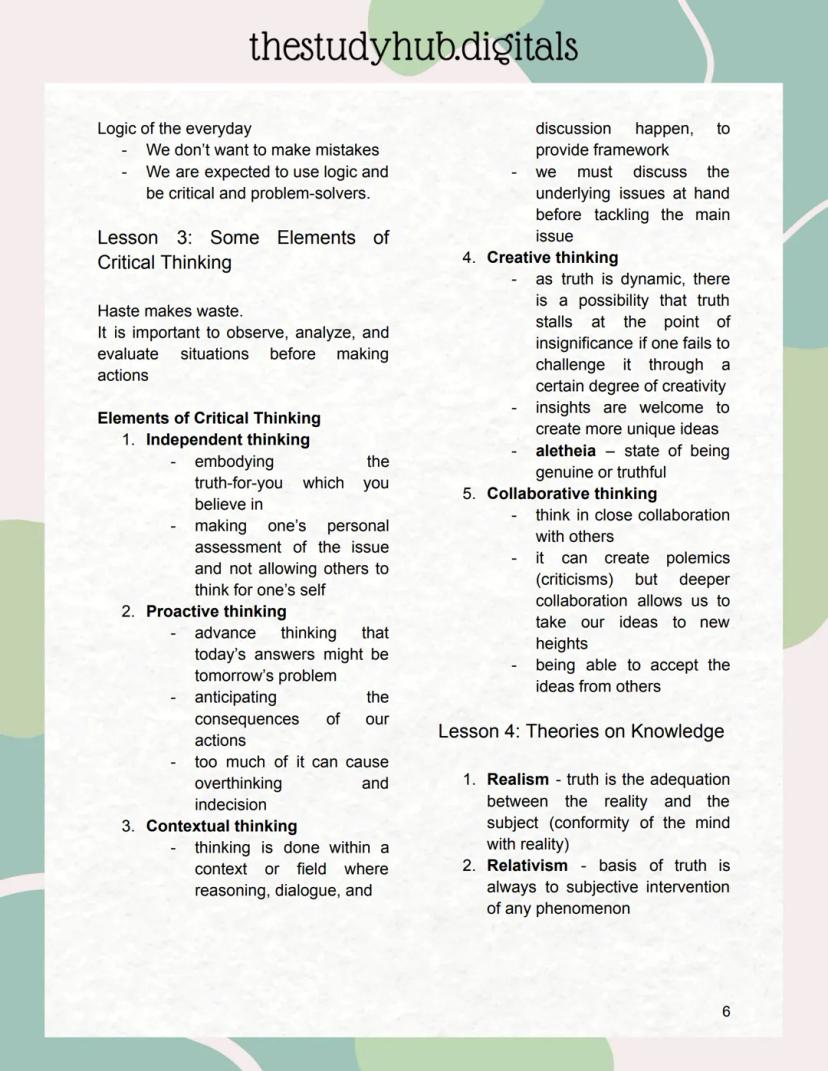
Critical thinking requires five key elements: independent thinking (forming your own assessments), proactive thinking (anticipating consequences), contextual thinking (understanding the bigger picture), creative thinking (challenging stale ideas), and collaborative thinking (working with others while staying true to your principles).
Daily Application: Every time you analyze a situation before acting instead of just reacting, you're using the logic of everyday philosophy.
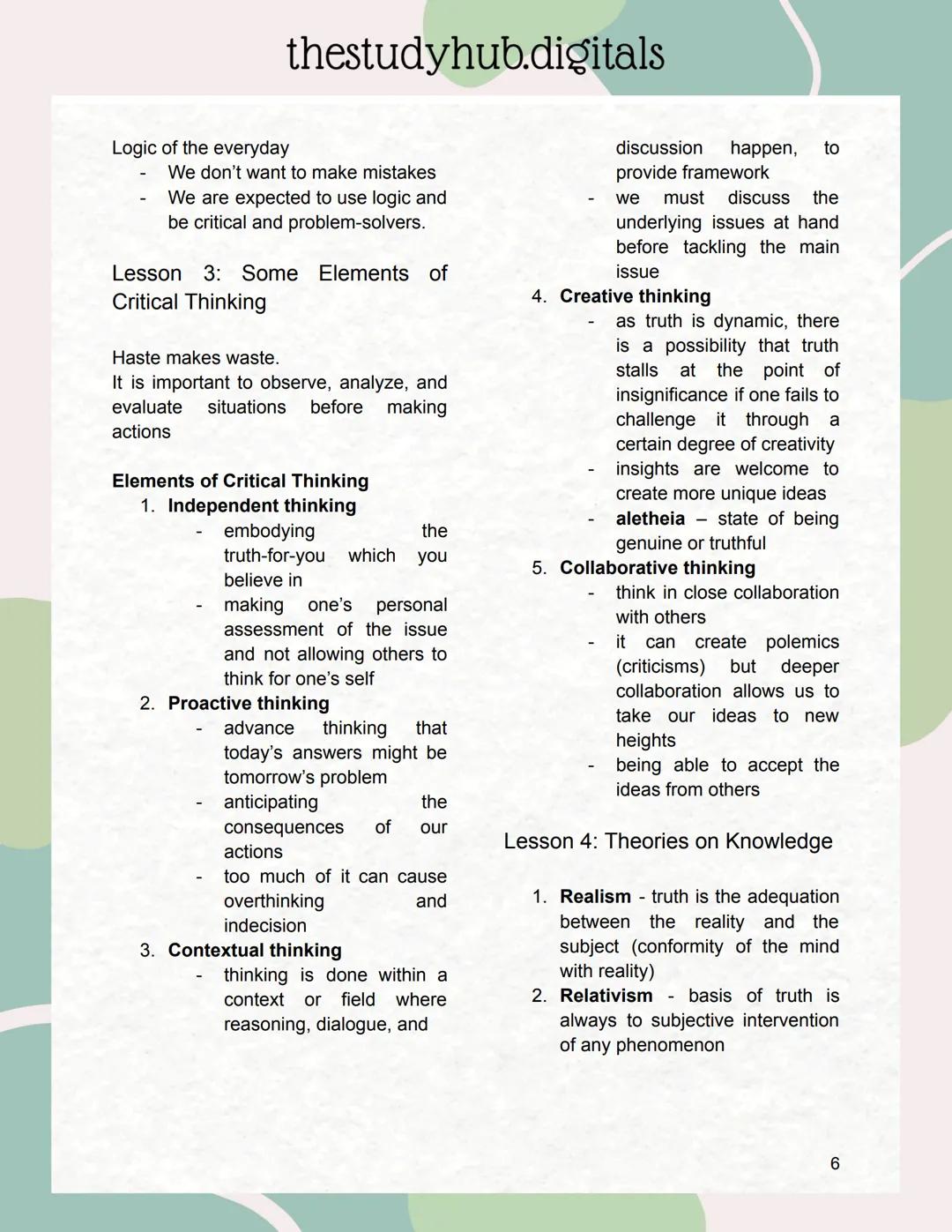
How do we figure out what's actually true? Realism says truth happens when your mind matches up with reality - pretty straightforward. Relativism argues that truth depends on personal perspective and subjective interpretation.
Pragmatism focuses on practical results - if an idea works and produces beneficial consequences, it's true enough. Phenomenology wants you to see the world fresh, like experiencing everything for the first time, focusing on how things appear to consciousness.
Axioms uses mathematical principles to understand reality, looking for universal truths that work like mathematical formulas. Each theory offers different tools for understanding knowledge, and philosophers often combine approaches depending on the situation.
Real Talk: You probably use multiple theories every day - checking facts (realism), considering different viewpoints (relativism), and focusing on what works (pragmatism).
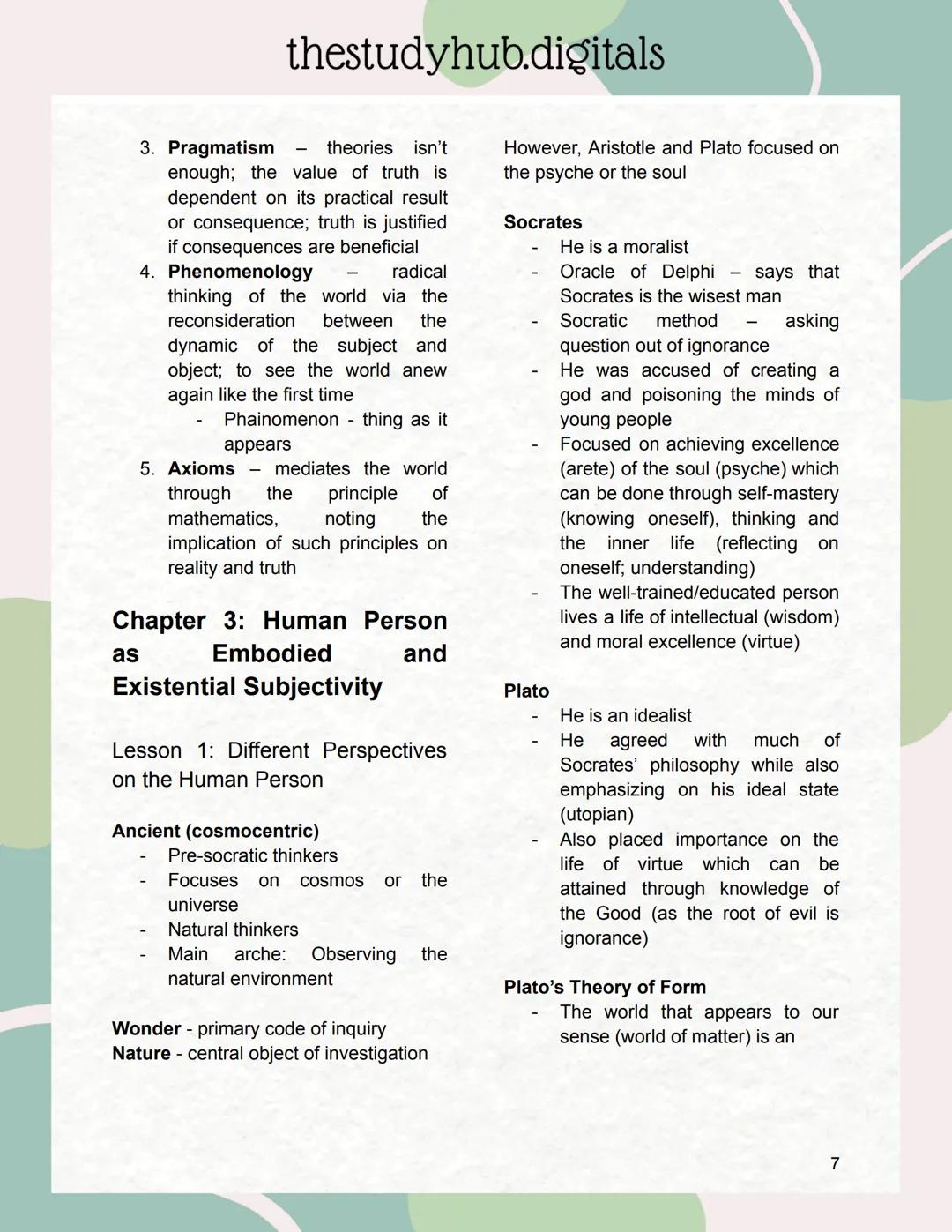
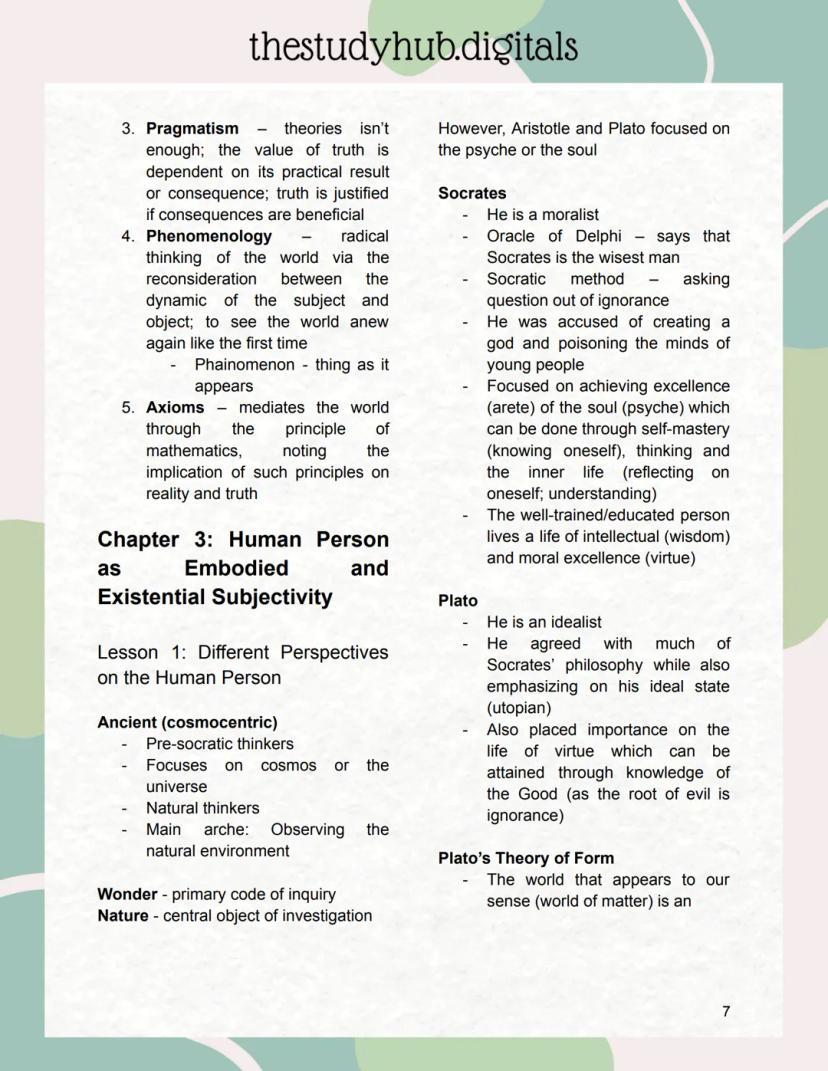
Ancient philosophy started cosmocentric - obsessed with understanding the universe and natural world. The Pre-Socratics wondered about arche (basic elements), but Socrates shifted focus to human excellence and self-knowledge.
Socrates developed the Socratic method - asking questions from a position of ignorance to expose what people really don't know. After being declared the wisest man by the Oracle of Delphi, he realized his wisdom came from recognizing his own ignorance. His goal was arete (excellence of the soul) through self-mastery and reflection.
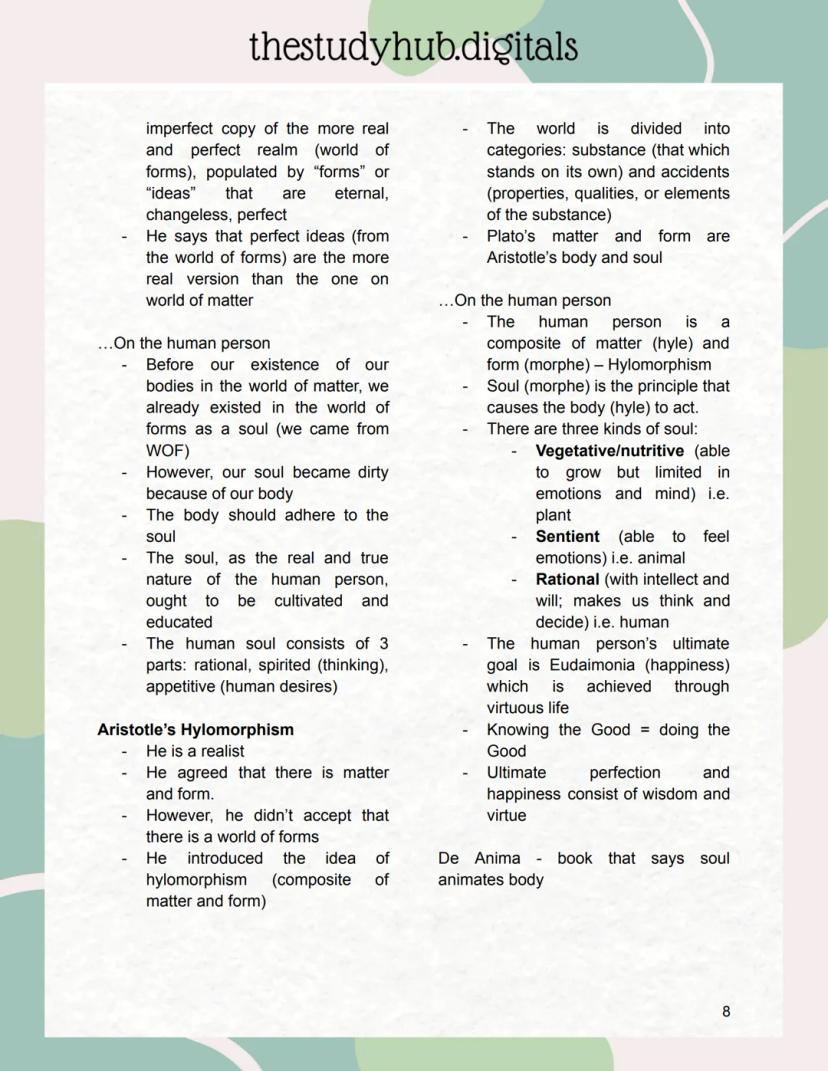
Plato took Socrates' ideas further with his Theory of Forms - arguing that our physical world is just an imperfect copy of a perfect realm of eternal ideas. According to Plato, humans have rational, spirited, and appetitive parts of the soul, with reason needing to control desires.
Ancient Wisdom: The phrase "know thyself" isn't just feel-good advice - it's the foundation for making better decisions and living excellently.
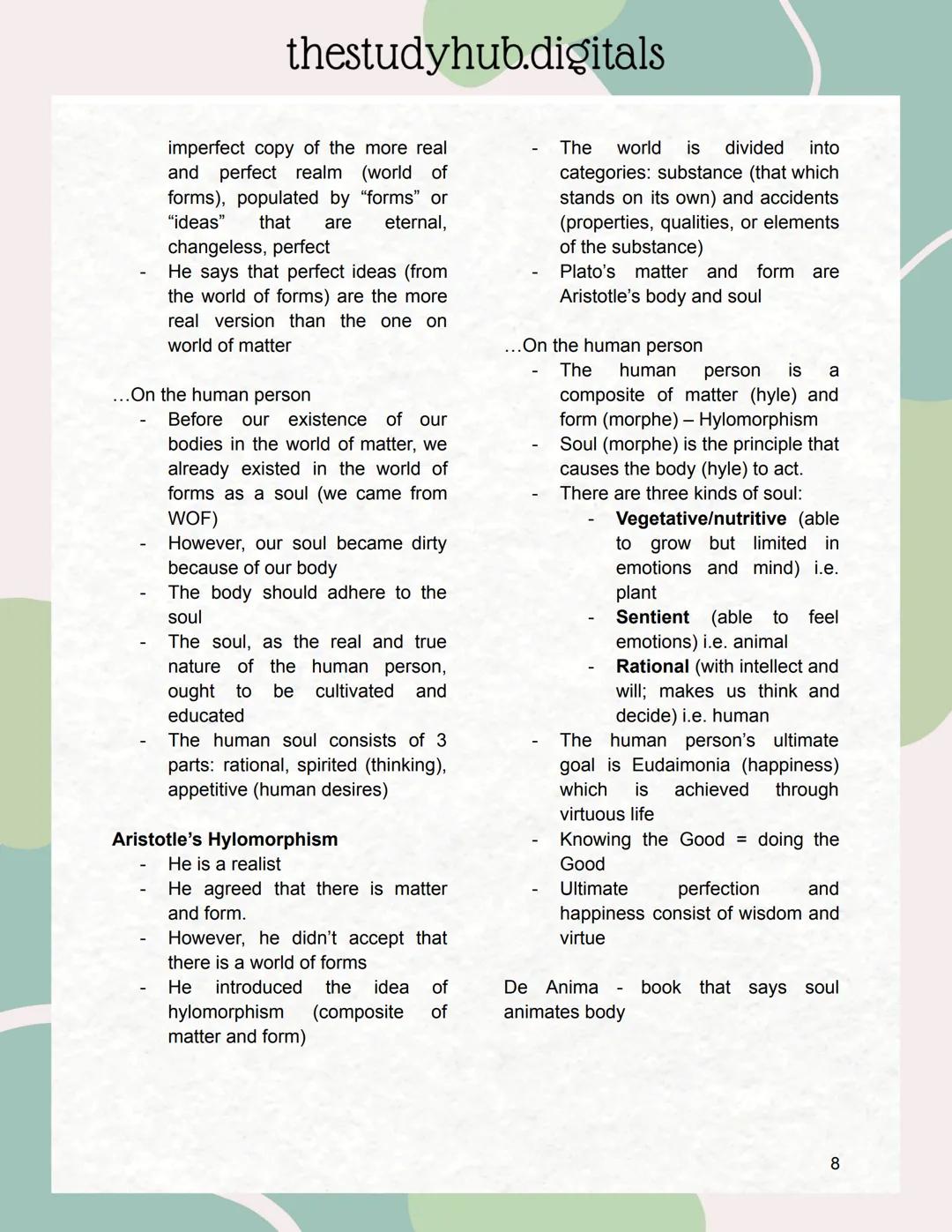
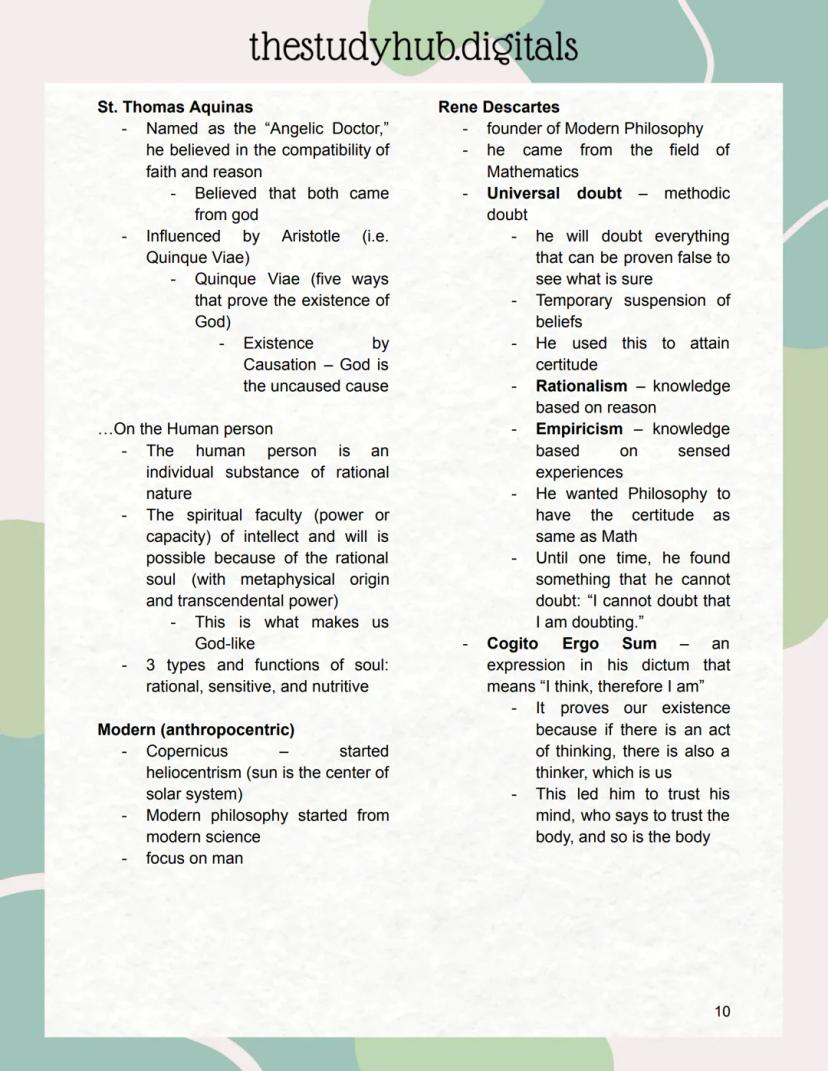
Aristotle brought philosophy down to earth with hylomorphism - the idea that everything is a combination of matter (hyle) and form (morphe). Unlike Plato's separate world of forms, Aristotle saw form and matter as inseparable parts of the same reality.
For Aristotle, humans have three types of souls: vegetative (growth like plants), sentient (feelings like animals), and rational (thinking and deciding like humans). Our ultimate goal is eudaimonia (happiness) achieved through virtuous living and wisdom.
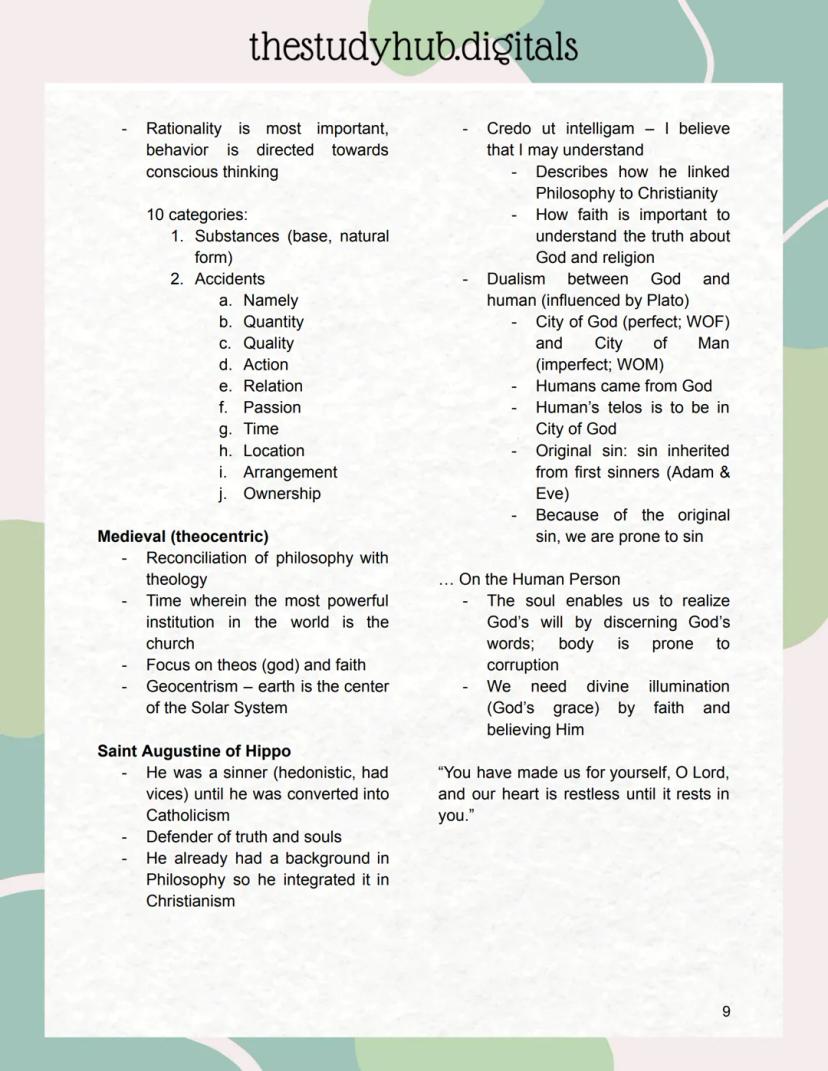
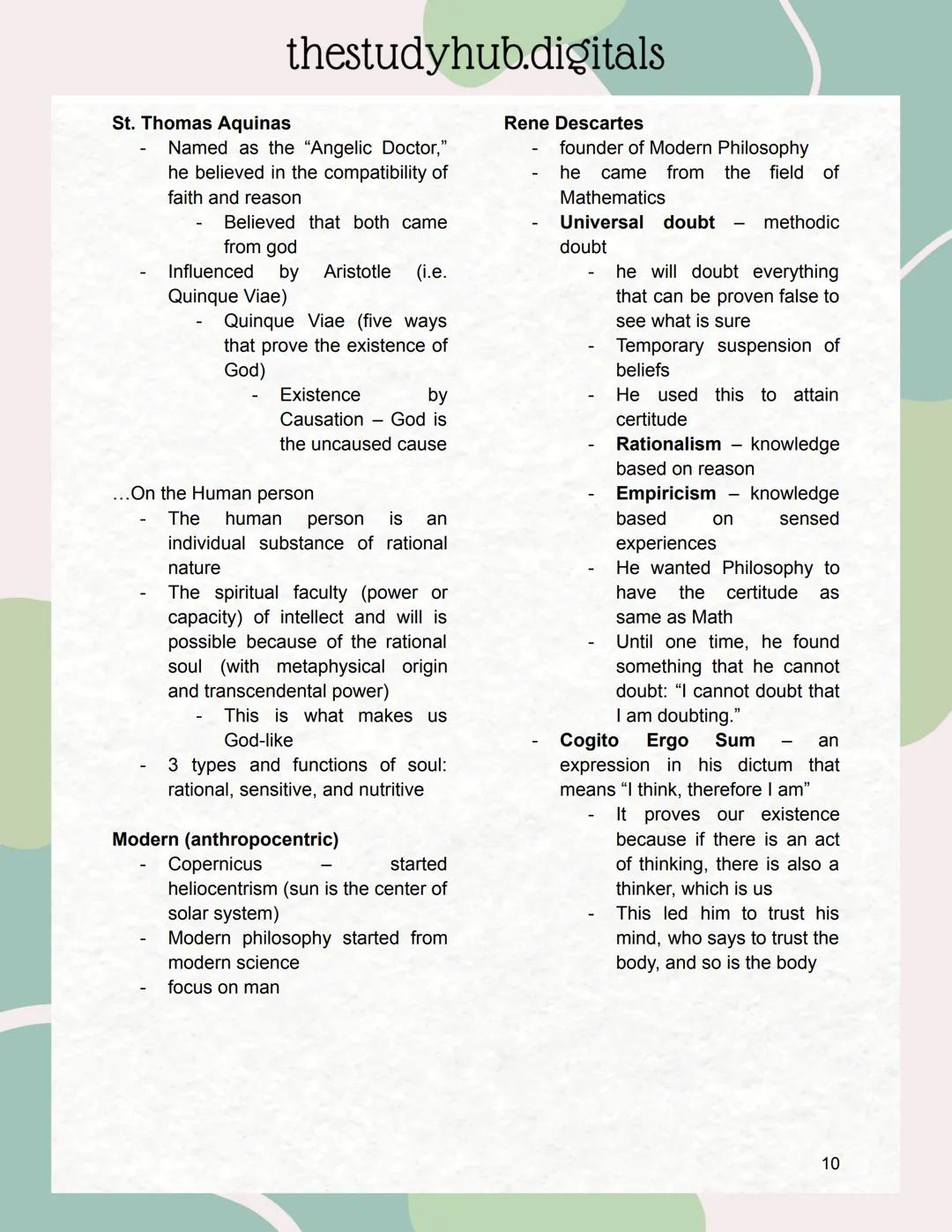
Medieval philosophy became theocentric, focusing on God and reconciling faith with reason. Saint Augustine created the formula "Credo ut intelligam" (I believe so that I may understand), linking faith and philosophy. Thomas Aquinas later argued that both faith and reason come from God, developing his famous "Quinque Viae" (five ways to prove God's existence).
Key Insight: Whether ancient or medieval, philosophers consistently argued that humans achieve their best life through combining knowledge, virtue, and understanding their place in the larger reality.
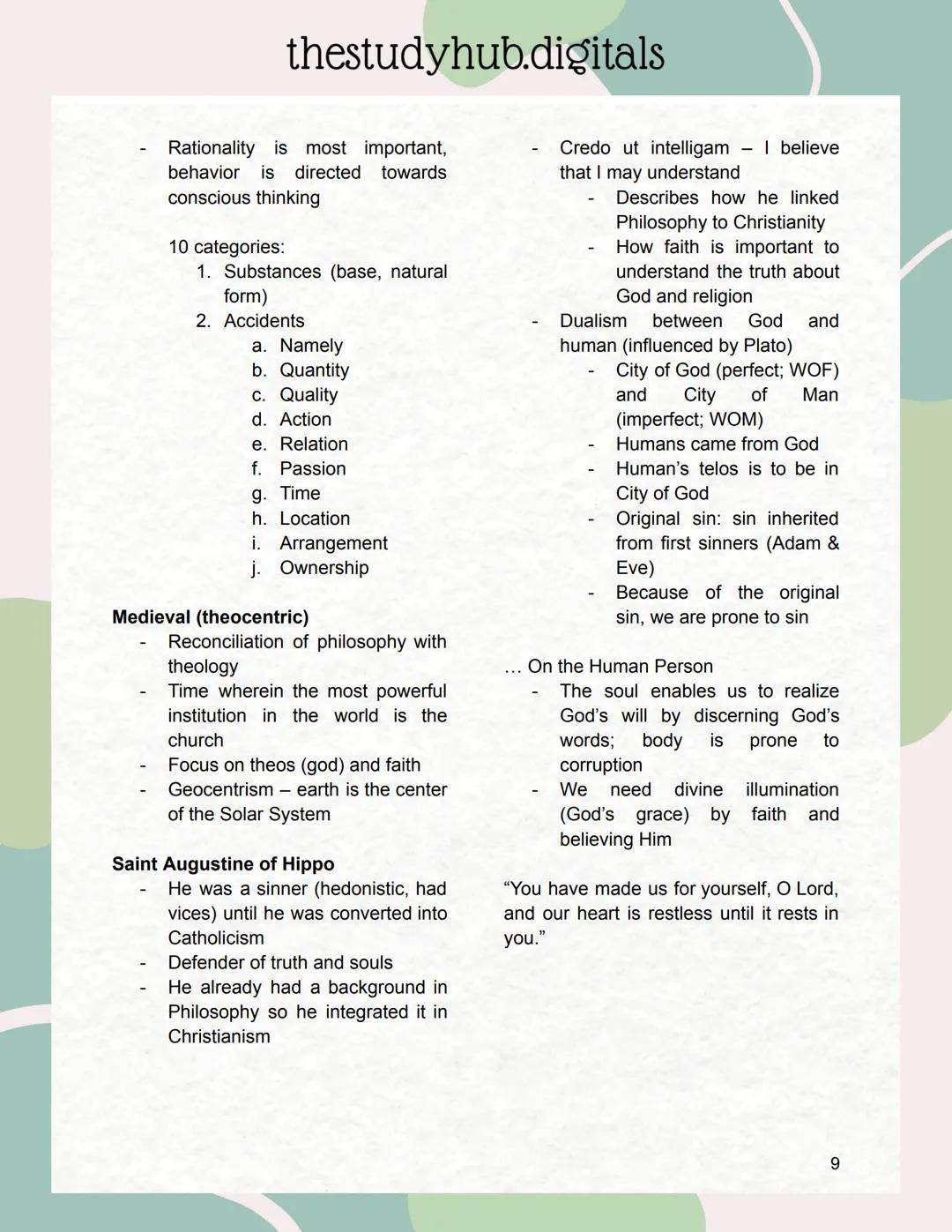
Medieval thinkers faced the challenge of combining Greek philosophy with Christian theology during an era when the Church held massive influence. This theocentric period focused everything on God while trying to make sense of human existence within a religious framework.
Saint Augustine transformed from a hedonistic lifestyle to becoming Christianity's greatest philosophical defender. His dualism separated the perfect "City of God" from the imperfect "City of Man," teaching that humans inherit original sin but can find truth through divine illumination and faith.
Augustine's famous quote captures the medieval spirit: "You have made us for yourself, O Lord, and our heart is restless until it rests in you." This shows how medieval philosophy saw human restlessness and searching as proof that we're meant for something greater than earthly life.
Historical Impact: Medieval philosophers didn't abandon reason - they used it to explore how faith and logic could work together to understand both God and humanity.
Our AI companion is specifically built for the needs of students. Based on the millions of content pieces we have on the platform we can provide truly meaningful and relevant answers to students. But its not only about answers, the companion is even more about guiding students through their daily learning challenges, with personalised study plans, quizzes or content pieces in the chat and 100% personalisation based on the students skills and developments.
You can download the app in the Google Play Store and in the Apple App Store.
That's right! Enjoy free access to study content, connect with fellow students, and get instant help – all at your fingertips.
App Store
Google Play
The app is very easy to use and well designed. I have found everything I was looking for so far and have been able to learn a lot from the presentations! I will definitely use the app for a class assignment! And of course it also helps a lot as an inspiration.
Stefan S
iOS user
This app is really great. There are so many study notes and help [...]. My problem subject is French, for example, and the app has so many options for help. Thanks to this app, I have improved my French. I would recommend it to anyone.
Samantha Klich
Android user
Wow, I am really amazed. I just tried the app because I've seen it advertised many times and was absolutely stunned. This app is THE HELP you want for school and above all, it offers so many things, such as workouts and fact sheets, which have been VERY helpful to me personally.
Anna
iOS user
I think it’s very much worth it and you’ll end up using it a lot once you get the hang of it and even after looking at others notes you can still ask your Artificial intelligence buddy the question and ask to simplify it if you still don’t get it!!! In the end I think it’s worth it 😊👍 ⚠️Also DID I MENTION ITS FREEE YOU DON’T HAVE TO PAY FOR ANYTHING AND STILL GET YOUR GRADES IN PERFECTLY❗️❗️⚠️
Thomas R
iOS user
Knowunity is the BEST app I’ve used in a minute. This is not an ai review or anything this is genuinely coming from a 7th grade student (I know 2011 im young) but dude this app is a 10/10 i have maintained a 3.8 gpa and have plenty of time for gaming. I love it and my mom is just happy I got good grades
Brad T
Android user
Not only did it help me find the answer but it also showed me alternative ways to solve it. I was horrible in math and science but now I have an a in both subjects. Thanks for the help🤍🤍
David K
iOS user
The app's just great! All I have to do is enter the topic in the search bar and I get the response real fast. I don't have to watch 10 YouTube videos to understand something, so I'm saving my time. Highly recommended!
Sudenaz Ocak
Android user
In school I was really bad at maths but thanks to the app, I am doing better now. I am so grateful that you made the app.
Greenlight Bonnie
Android user
I found this app a couple years ago and it has only gotten better since then. I really love it because it can help with written questions and photo questions. Also, it can find study guides that other people have made as well as flashcard sets and practice tests. The free version is also amazing for students who might not be able to afford it. Would 100% recommend
Aubrey
iOS user
Best app if you're in Highschool or Junior high. I have been using this app for 2 school years and it's the best, it's good if you don't have anyone to help you with school work.😋🩷🎀
Marco B
iOS user
THE QUIZES AND FLASHCARDS ARE SO USEFUL AND I LOVE THE SCHOOLGPT. IT ALSO IS LITREALLY LIKE CHATGPT BUT SMARTER!! HELPED ME WITH MY MASCARA PROBLEMS TOO!! AS WELL AS MY REAL SUBJECTS ! DUHHH 😍😁😲🤑💗✨🎀😮
Elisha
iOS user
This app is phenomenal down to the correct info and the various topics you can study! I greatly recommend it for people who struggle with procrastination and those who need homework help. It has been perfectly accurate for world 1 history as far as I’ve seen! Geometry too!
Paul T
iOS user
The app is very easy to use and well designed. I have found everything I was looking for so far and have been able to learn a lot from the presentations! I will definitely use the app for a class assignment! And of course it also helps a lot as an inspiration.
Stefan S
iOS user
This app is really great. There are so many study notes and help [...]. My problem subject is French, for example, and the app has so many options for help. Thanks to this app, I have improved my French. I would recommend it to anyone.
Samantha Klich
Android user
Wow, I am really amazed. I just tried the app because I've seen it advertised many times and was absolutely stunned. This app is THE HELP you want for school and above all, it offers so many things, such as workouts and fact sheets, which have been VERY helpful to me personally.
Anna
iOS user
I think it’s very much worth it and you’ll end up using it a lot once you get the hang of it and even after looking at others notes you can still ask your Artificial intelligence buddy the question and ask to simplify it if you still don’t get it!!! In the end I think it’s worth it 😊👍 ⚠️Also DID I MENTION ITS FREEE YOU DON’T HAVE TO PAY FOR ANYTHING AND STILL GET YOUR GRADES IN PERFECTLY❗️❗️⚠️
Thomas R
iOS user
Knowunity is the BEST app I’ve used in a minute. This is not an ai review or anything this is genuinely coming from a 7th grade student (I know 2011 im young) but dude this app is a 10/10 i have maintained a 3.8 gpa and have plenty of time for gaming. I love it and my mom is just happy I got good grades
Brad T
Android user
Not only did it help me find the answer but it also showed me alternative ways to solve it. I was horrible in math and science but now I have an a in both subjects. Thanks for the help🤍🤍
David K
iOS user
The app's just great! All I have to do is enter the topic in the search bar and I get the response real fast. I don't have to watch 10 YouTube videos to understand something, so I'm saving my time. Highly recommended!
Sudenaz Ocak
Android user
In school I was really bad at maths but thanks to the app, I am doing better now. I am so grateful that you made the app.
Greenlight Bonnie
Android user
I found this app a couple years ago and it has only gotten better since then. I really love it because it can help with written questions and photo questions. Also, it can find study guides that other people have made as well as flashcard sets and practice tests. The free version is also amazing for students who might not be able to afford it. Would 100% recommend
Aubrey
iOS user
Best app if you're in Highschool or Junior high. I have been using this app for 2 school years and it's the best, it's good if you don't have anyone to help you with school work.😋🩷🎀
Marco B
iOS user
THE QUIZES AND FLASHCARDS ARE SO USEFUL AND I LOVE THE SCHOOLGPT. IT ALSO IS LITREALLY LIKE CHATGPT BUT SMARTER!! HELPED ME WITH MY MASCARA PROBLEMS TOO!! AS WELL AS MY REAL SUBJECTS ! DUHHH 😍😁😲🤑💗✨🎀😮
Elisha
iOS user
This app is phenomenal down to the correct info and the various topics you can study! I greatly recommend it for people who struggle with procrastination and those who need homework help. It has been perfectly accurate for world 1 history as far as I’ve seen! Geometry too!
Paul T
iOS user
Isabel Cuevas
@isabelcue_vqe15
Ever wonder how human thinking evolved from ancient myths to logical reasoning? Philosophy began in ancient Greece when people started questioning stories about gods and goddesses, seeking real explanations for how the world works. This journey from "muthos" (stories) to... Show more
Access to all documents
Improve your grades
Join milions of students
By signing up you accept Terms of Service and Privacy Policy
Philosophy kicked off in ancient Greece around the 6th century BCE when people got tired of explaining everything through myths about gods and goddesses. Before this, Greeks relied on epic poems like "Works and Days" that said humans were basically at the mercy of divine beings.
The game-changer happened when thinkers decided that muthos (mythical stories told by poets) wasn't cutting it anymore. They wanted logos - actual reasons and logic to explain how the world worked. Instead of saying "Zeus made it rain," they started asking "What really causes rain?"
Muthos was all about divine inspiration and cosmic relationships - pretty much letting poets and artists create explanations based on what felt right. Logos, on the other hand, demanded evidence and reasoning. Heraclitus called it the "principle of order and knowledge" that could mean speech, word, reason, or logic depending on the situation.
Key Point: This shift from accepting stories to demanding explanations is exactly what you do every time you question something instead of just believing it!
Access to all documents
Improve your grades
Join milions of students
By signing up you accept Terms of Service and Privacy Policy
Picture this: you're in Miletus, a bustling trade city in 587 BCE, and suddenly people start getting stupefied (completely amazed and confused) by everyday things around them. This stupefaction wasn't just being impressed - it was being so puzzled that you absolutely had to find answers.
Thauma or stupefaction pushes you beyond just being confused. A truly stupefied person doesn't stop at "wow, that's cool" but goes straight to "wait, how does that actually work?" Real philosophers doubt what seems obvious and dig deeper for hidden truths.
The Pre-Socratics were the first to ask the ultimate question: what's the basic stuff (arche) that makes up everything? Thales said water, Anaximenes argued for air, Anaximander proposed something indefinite called Apeiron, Heraclitus went with eternal fire, and Democritus theorized about tiny particles (basically atoms).
Remember: The best questions often matter more than having perfect answers - doubt pushes us to discover what's really going on beneath the surface.
Access to all documents
Improve your grades
Join milions of students
By signing up you accept Terms of Service and Privacy Policy
Pythagoras gave us the word "philosophy" - combining "phillein" (love) and "sophia" (wisdom) to mean "love of wisdom." Unlike sophists who charged money to teach, real philosophers shared knowledge freely because they understood that pursuing wisdom never actually ends.
Here's the real definition: Philosophy is the science of all things through their ultimate causes and principles, acquired through natural reason. It's methodical like science, covers everything that can be questioned, seeks the deepest "why" answers, and relies purely on human intellect - no blind faith allowed.
The telos (goal) of philosophy isn't to become a know-it-all, but to keep asking better questions. As Aristotle said, asking the right question solves half the problem. Philosophy challenges you to think about true living and not just go along with whatever society tells you.
Think About It: When you question why something is "just the way it is," you're doing exactly what philosophers have done for over 2,000 years.
Access to all documents
Improve your grades
Join milions of students
By signing up you accept Terms of Service and Privacy Policy
People love criticizing philosophy for being too abstract, impractical, complex, ancient, and uncertain. Bertrand Russell flipped this around, arguing that philosophy's value comes precisely from these "weaknesses." The ambiguity and uncertainty mean we haven't found complete answers yet - and that's exactly the point.
Philosophy's significance isn't in giving you final answers but in developing your capacity to focus on possibilities. It teaches you prudence, critical thinking, tolerance, and intellectual humility. When everything seems certain, philosophy reminds you to keep questioning.
The dialectical method shows how philosophy thrives on criticism through thesis (a claim), antithesis (the opposite claim), and synthesis (combining the best of both). This constant back-and-forth creates stronger ideas and better understanding.
Socrates' Wisdom: "I cannot teach anybody anything. I can only make them think" - and sometimes realizing "I know that I know nothing" is the smartest thing you can do.
Access to all documents
Improve your grades
Join milions of students
By signing up you accept Terms of Service and Privacy Policy
Philosophy splits into five main branches that cover everything humans can think about. Ontology deals with what's real (like whether minds and bodies are separate things). Epistemology asks how we know what we know. Ethics tackles what's right and wrong - whether consequences matter most (utilitarianism) or principles do (deontology).
Aesthetics explores what makes things beautiful, while logic serves as philosophy's toolbox for correct reasoning. These branches work together because life's biggest questions usually involve multiple areas at once.
Critical thinking requires five key elements: independent thinking (forming your own assessments), proactive thinking (anticipating consequences), contextual thinking (understanding the bigger picture), creative thinking (challenging stale ideas), and collaborative thinking (working with others while staying true to your principles).
Daily Application: Every time you analyze a situation before acting instead of just reacting, you're using the logic of everyday philosophy.
Access to all documents
Improve your grades
Join milions of students
By signing up you accept Terms of Service and Privacy Policy
How do we figure out what's actually true? Realism says truth happens when your mind matches up with reality - pretty straightforward. Relativism argues that truth depends on personal perspective and subjective interpretation.
Pragmatism focuses on practical results - if an idea works and produces beneficial consequences, it's true enough. Phenomenology wants you to see the world fresh, like experiencing everything for the first time, focusing on how things appear to consciousness.
Axioms uses mathematical principles to understand reality, looking for universal truths that work like mathematical formulas. Each theory offers different tools for understanding knowledge, and philosophers often combine approaches depending on the situation.
Real Talk: You probably use multiple theories every day - checking facts (realism), considering different viewpoints (relativism), and focusing on what works (pragmatism).
Access to all documents
Improve your grades
Join milions of students
By signing up you accept Terms of Service and Privacy Policy
Ancient philosophy started cosmocentric - obsessed with understanding the universe and natural world. The Pre-Socratics wondered about arche (basic elements), but Socrates shifted focus to human excellence and self-knowledge.
Socrates developed the Socratic method - asking questions from a position of ignorance to expose what people really don't know. After being declared the wisest man by the Oracle of Delphi, he realized his wisdom came from recognizing his own ignorance. His goal was arete (excellence of the soul) through self-mastery and reflection.
Plato took Socrates' ideas further with his Theory of Forms - arguing that our physical world is just an imperfect copy of a perfect realm of eternal ideas. According to Plato, humans have rational, spirited, and appetitive parts of the soul, with reason needing to control desires.
Ancient Wisdom: The phrase "know thyself" isn't just feel-good advice - it's the foundation for making better decisions and living excellently.
Access to all documents
Improve your grades
Join milions of students
By signing up you accept Terms of Service and Privacy Policy
Aristotle brought philosophy down to earth with hylomorphism - the idea that everything is a combination of matter (hyle) and form (morphe). Unlike Plato's separate world of forms, Aristotle saw form and matter as inseparable parts of the same reality.
For Aristotle, humans have three types of souls: vegetative (growth like plants), sentient (feelings like animals), and rational (thinking and deciding like humans). Our ultimate goal is eudaimonia (happiness) achieved through virtuous living and wisdom.
Medieval philosophy became theocentric, focusing on God and reconciling faith with reason. Saint Augustine created the formula "Credo ut intelligam" (I believe so that I may understand), linking faith and philosophy. Thomas Aquinas later argued that both faith and reason come from God, developing his famous "Quinque Viae" (five ways to prove God's existence).
Key Insight: Whether ancient or medieval, philosophers consistently argued that humans achieve their best life through combining knowledge, virtue, and understanding their place in the larger reality.
Access to all documents
Improve your grades
Join milions of students
By signing up you accept Terms of Service and Privacy Policy
Medieval thinkers faced the challenge of combining Greek philosophy with Christian theology during an era when the Church held massive influence. This theocentric period focused everything on God while trying to make sense of human existence within a religious framework.
Saint Augustine transformed from a hedonistic lifestyle to becoming Christianity's greatest philosophical defender. His dualism separated the perfect "City of God" from the imperfect "City of Man," teaching that humans inherit original sin but can find truth through divine illumination and faith.
Augustine's famous quote captures the medieval spirit: "You have made us for yourself, O Lord, and our heart is restless until it rests in you." This shows how medieval philosophy saw human restlessness and searching as proof that we're meant for something greater than earthly life.
Historical Impact: Medieval philosophers didn't abandon reason - they used it to explore how faith and logic could work together to understand both God and humanity.
Access to all documents
Improve your grades
Join milions of students
By signing up you accept Terms of Service and Privacy Policy
Our AI companion is specifically built for the needs of students. Based on the millions of content pieces we have on the platform we can provide truly meaningful and relevant answers to students. But its not only about answers, the companion is even more about guiding students through their daily learning challenges, with personalised study plans, quizzes or content pieces in the chat and 100% personalisation based on the students skills and developments.
You can download the app in the Google Play Store and in the Apple App Store.
That's right! Enjoy free access to study content, connect with fellow students, and get instant help – all at your fingertips.
3
Smart Tools NEW
Transform this note into: ✓ 50+ Practice Questions ✓ Interactive Flashcards ✓ Full Mock Exam ✓ Essay Outlines
App Store
Google Play
The app is very easy to use and well designed. I have found everything I was looking for so far and have been able to learn a lot from the presentations! I will definitely use the app for a class assignment! And of course it also helps a lot as an inspiration.
Stefan S
iOS user
This app is really great. There are so many study notes and help [...]. My problem subject is French, for example, and the app has so many options for help. Thanks to this app, I have improved my French. I would recommend it to anyone.
Samantha Klich
Android user
Wow, I am really amazed. I just tried the app because I've seen it advertised many times and was absolutely stunned. This app is THE HELP you want for school and above all, it offers so many things, such as workouts and fact sheets, which have been VERY helpful to me personally.
Anna
iOS user
I think it’s very much worth it and you’ll end up using it a lot once you get the hang of it and even after looking at others notes you can still ask your Artificial intelligence buddy the question and ask to simplify it if you still don’t get it!!! In the end I think it’s worth it 😊👍 ⚠️Also DID I MENTION ITS FREEE YOU DON’T HAVE TO PAY FOR ANYTHING AND STILL GET YOUR GRADES IN PERFECTLY❗️❗️⚠️
Thomas R
iOS user
Knowunity is the BEST app I’ve used in a minute. This is not an ai review or anything this is genuinely coming from a 7th grade student (I know 2011 im young) but dude this app is a 10/10 i have maintained a 3.8 gpa and have plenty of time for gaming. I love it and my mom is just happy I got good grades
Brad T
Android user
Not only did it help me find the answer but it also showed me alternative ways to solve it. I was horrible in math and science but now I have an a in both subjects. Thanks for the help🤍🤍
David K
iOS user
The app's just great! All I have to do is enter the topic in the search bar and I get the response real fast. I don't have to watch 10 YouTube videos to understand something, so I'm saving my time. Highly recommended!
Sudenaz Ocak
Android user
In school I was really bad at maths but thanks to the app, I am doing better now. I am so grateful that you made the app.
Greenlight Bonnie
Android user
I found this app a couple years ago and it has only gotten better since then. I really love it because it can help with written questions and photo questions. Also, it can find study guides that other people have made as well as flashcard sets and practice tests. The free version is also amazing for students who might not be able to afford it. Would 100% recommend
Aubrey
iOS user
Best app if you're in Highschool or Junior high. I have been using this app for 2 school years and it's the best, it's good if you don't have anyone to help you with school work.😋🩷🎀
Marco B
iOS user
THE QUIZES AND FLASHCARDS ARE SO USEFUL AND I LOVE THE SCHOOLGPT. IT ALSO IS LITREALLY LIKE CHATGPT BUT SMARTER!! HELPED ME WITH MY MASCARA PROBLEMS TOO!! AS WELL AS MY REAL SUBJECTS ! DUHHH 😍😁😲🤑💗✨🎀😮
Elisha
iOS user
This app is phenomenal down to the correct info and the various topics you can study! I greatly recommend it for people who struggle with procrastination and those who need homework help. It has been perfectly accurate for world 1 history as far as I’ve seen! Geometry too!
Paul T
iOS user
The app is very easy to use and well designed. I have found everything I was looking for so far and have been able to learn a lot from the presentations! I will definitely use the app for a class assignment! And of course it also helps a lot as an inspiration.
Stefan S
iOS user
This app is really great. There are so many study notes and help [...]. My problem subject is French, for example, and the app has so many options for help. Thanks to this app, I have improved my French. I would recommend it to anyone.
Samantha Klich
Android user
Wow, I am really amazed. I just tried the app because I've seen it advertised many times and was absolutely stunned. This app is THE HELP you want for school and above all, it offers so many things, such as workouts and fact sheets, which have been VERY helpful to me personally.
Anna
iOS user
I think it’s very much worth it and you’ll end up using it a lot once you get the hang of it and even after looking at others notes you can still ask your Artificial intelligence buddy the question and ask to simplify it if you still don’t get it!!! In the end I think it’s worth it 😊👍 ⚠️Also DID I MENTION ITS FREEE YOU DON’T HAVE TO PAY FOR ANYTHING AND STILL GET YOUR GRADES IN PERFECTLY❗️❗️⚠️
Thomas R
iOS user
Knowunity is the BEST app I’ve used in a minute. This is not an ai review or anything this is genuinely coming from a 7th grade student (I know 2011 im young) but dude this app is a 10/10 i have maintained a 3.8 gpa and have plenty of time for gaming. I love it and my mom is just happy I got good grades
Brad T
Android user
Not only did it help me find the answer but it also showed me alternative ways to solve it. I was horrible in math and science but now I have an a in both subjects. Thanks for the help🤍🤍
David K
iOS user
The app's just great! All I have to do is enter the topic in the search bar and I get the response real fast. I don't have to watch 10 YouTube videos to understand something, so I'm saving my time. Highly recommended!
Sudenaz Ocak
Android user
In school I was really bad at maths but thanks to the app, I am doing better now. I am so grateful that you made the app.
Greenlight Bonnie
Android user
I found this app a couple years ago and it has only gotten better since then. I really love it because it can help with written questions and photo questions. Also, it can find study guides that other people have made as well as flashcard sets and practice tests. The free version is also amazing for students who might not be able to afford it. Would 100% recommend
Aubrey
iOS user
Best app if you're in Highschool or Junior high. I have been using this app for 2 school years and it's the best, it's good if you don't have anyone to help you with school work.😋🩷🎀
Marco B
iOS user
THE QUIZES AND FLASHCARDS ARE SO USEFUL AND I LOVE THE SCHOOLGPT. IT ALSO IS LITREALLY LIKE CHATGPT BUT SMARTER!! HELPED ME WITH MY MASCARA PROBLEMS TOO!! AS WELL AS MY REAL SUBJECTS ! DUHHH 😍😁😲🤑💗✨🎀😮
Elisha
iOS user
This app is phenomenal down to the correct info and the various topics you can study! I greatly recommend it for people who struggle with procrastination and those who need homework help. It has been perfectly accurate for world 1 history as far as I’ve seen! Geometry too!
Paul T
iOS user