
Ever wondered what makes you "you"? Understanding the self is... Show more
 GenBio
 Other
Other Econ
Econ Pre-Cal
 Oral Communication
 Practical Research
 DISS
DISSSign up to see the contentIt's free!
Access to all documents
Improve your grades
Join milions of students
By signing up you accept Terms of Service and Privacy Policy

Biology

Chemistry
AP Chemistry

English
AP English Literature
6,875
•
Dec 19, 2025
•

celestine
@celes_tine_
Ever wondered what makes you "you"? Understanding the self is... Show more
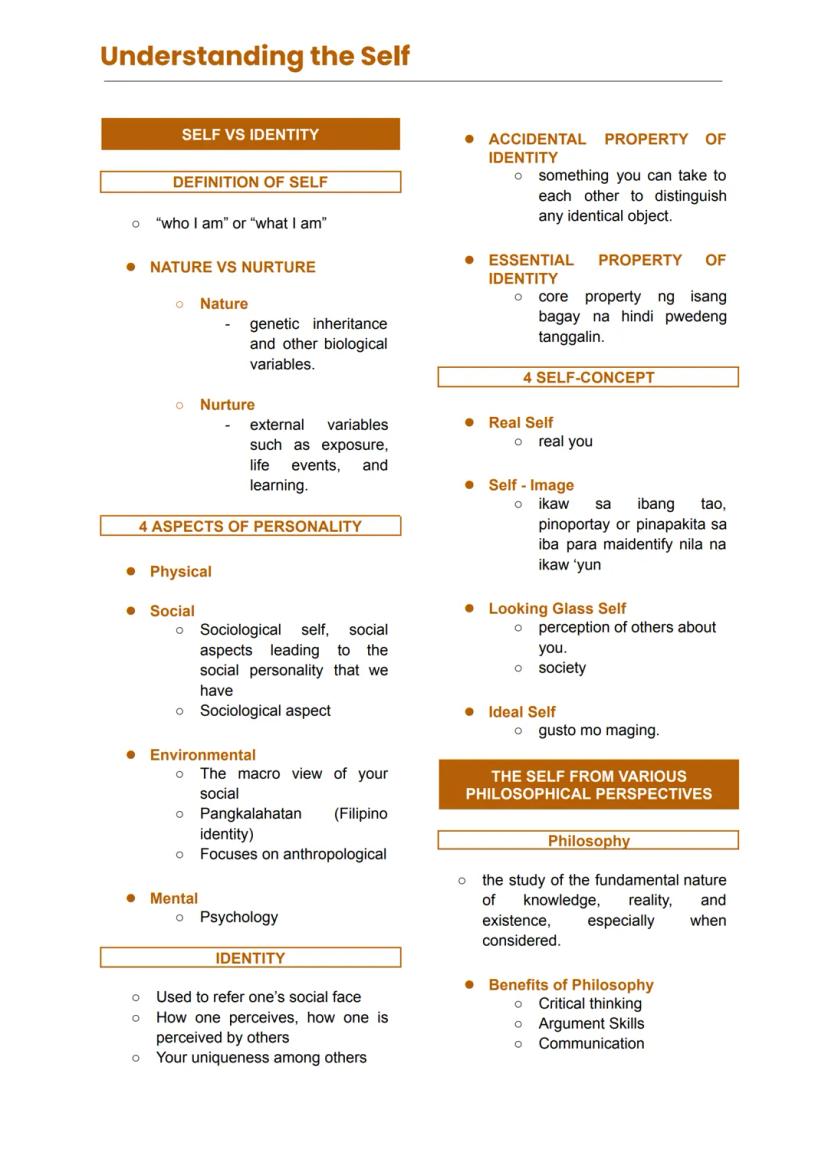
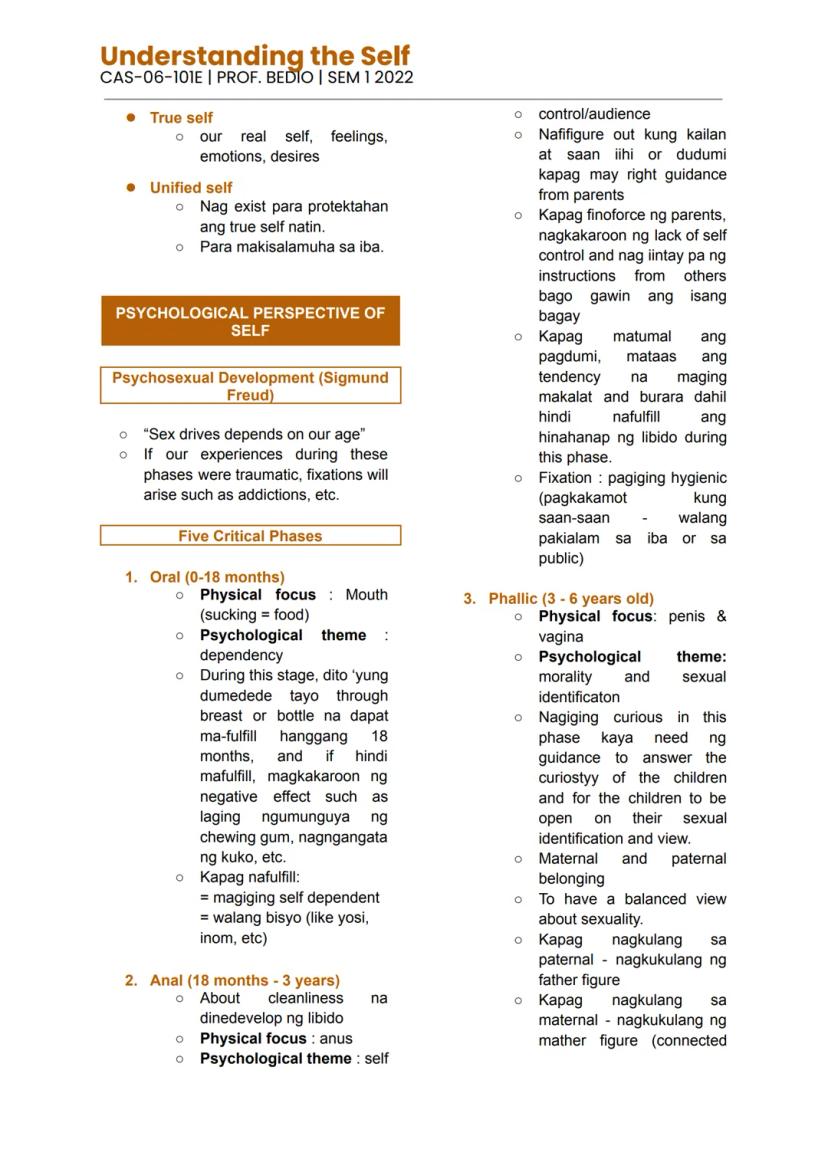
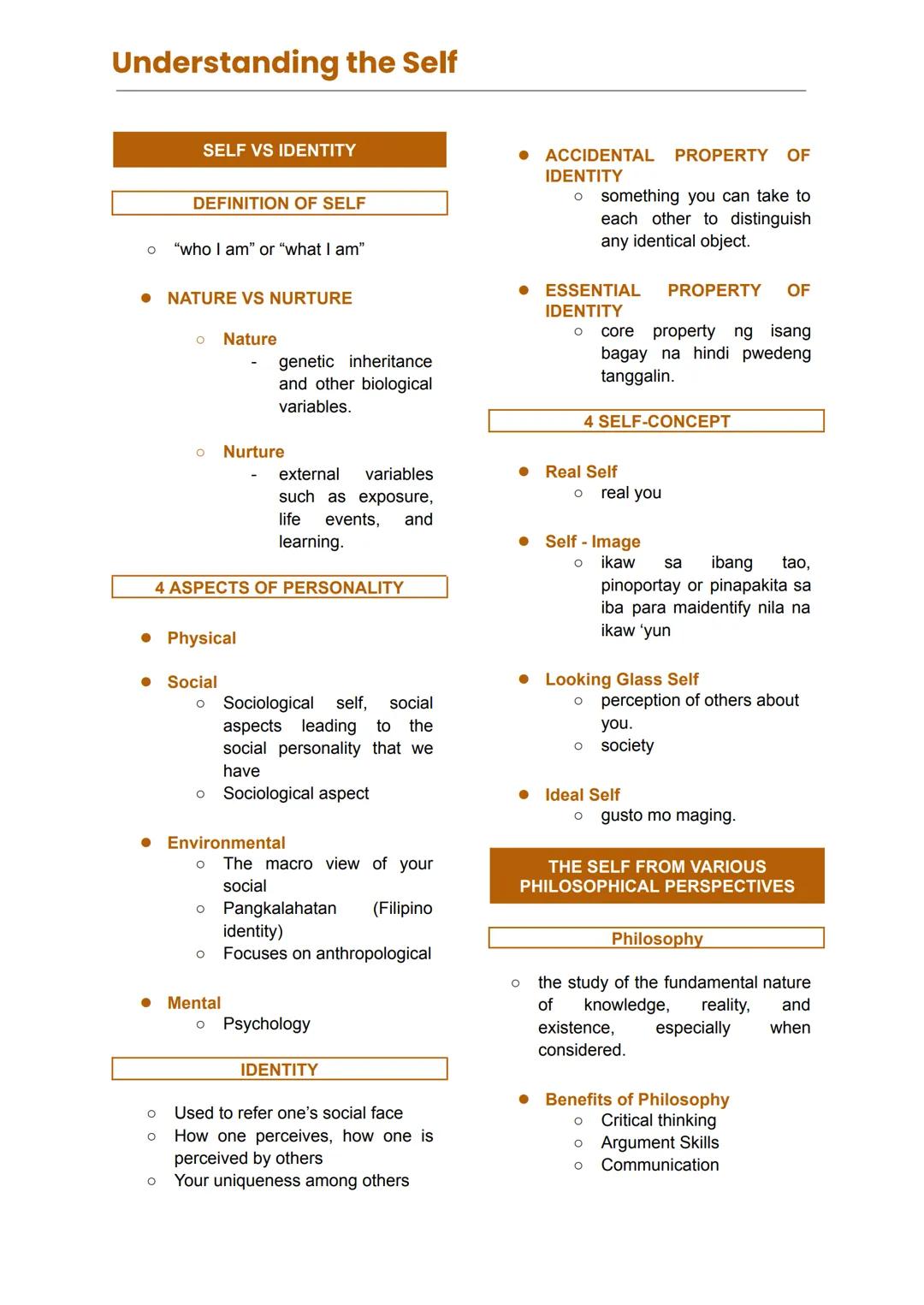
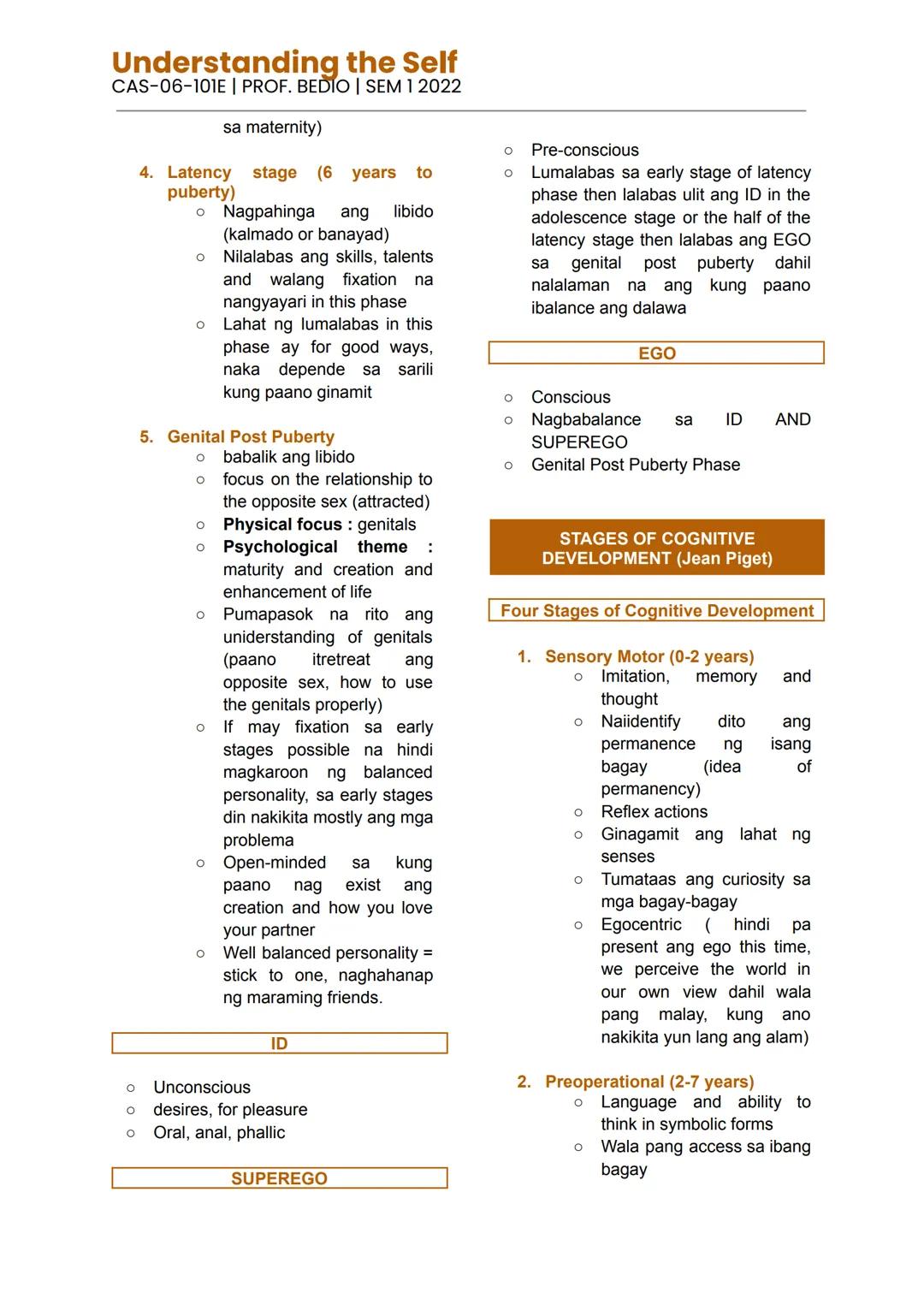
Think of self as your inner "who am I?" - it's shaped by both your genes (nature) and your experiences (nurture). Your personality has four key parts: physical (your body), social (how you interact), sociological (your cultural background, like being Filipino), and mental (your psychology).
Identity is different - it's your "social face" or how others see you. It has accidental properties (things that can change, like your hairstyle) and essential properties (core traits that make you uniquely you).
There are four versions of yourself to understand: your real self (the authentic you), your self-image (how you present yourself), your looking glass self (how society sees you), and your ideal self (who you want to become). These different versions help explain why you might act differently in various situations.
Key Insight: Your self is like a multifaceted diamond - different angles show different aspects, but it's all one precious stone.
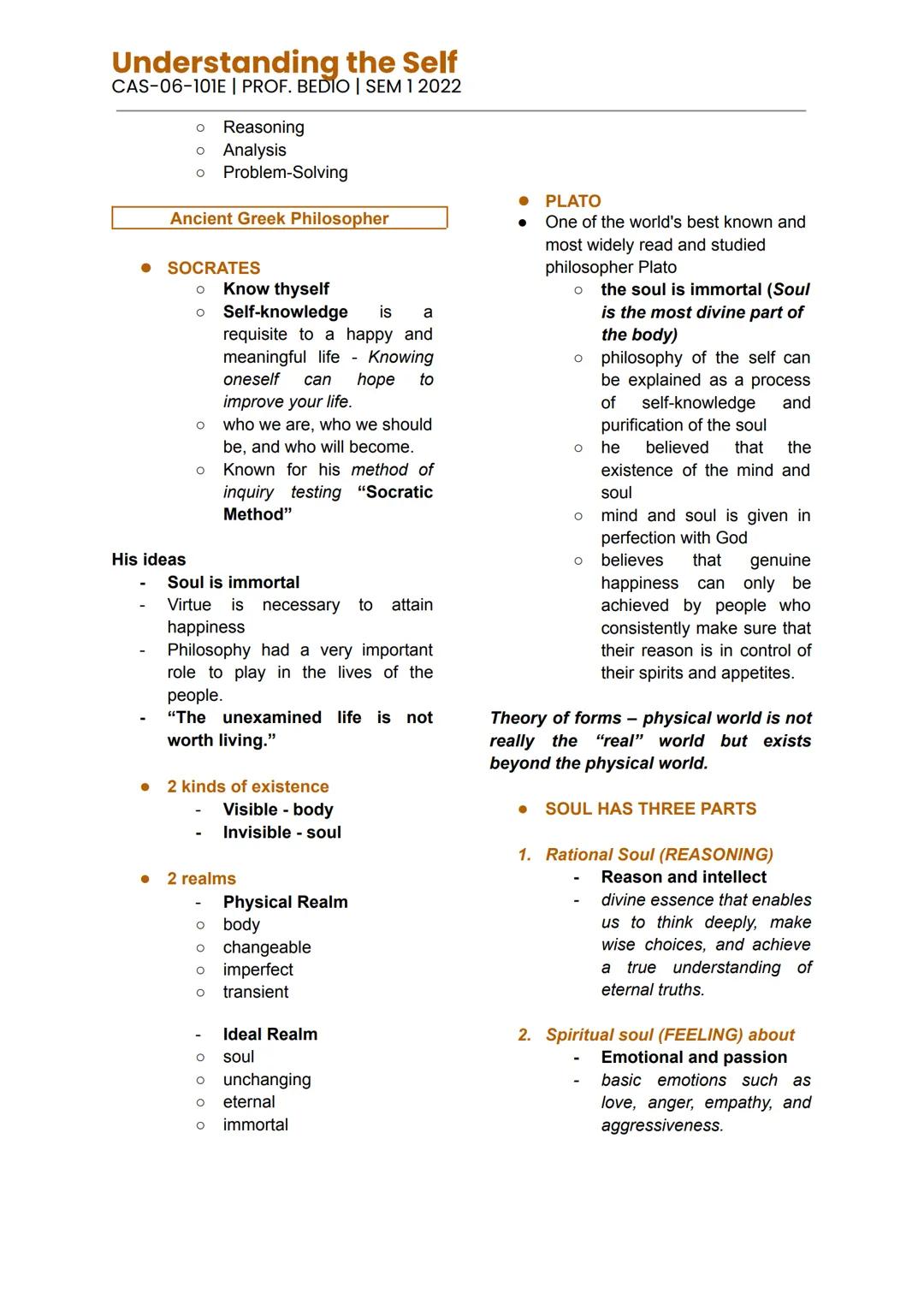
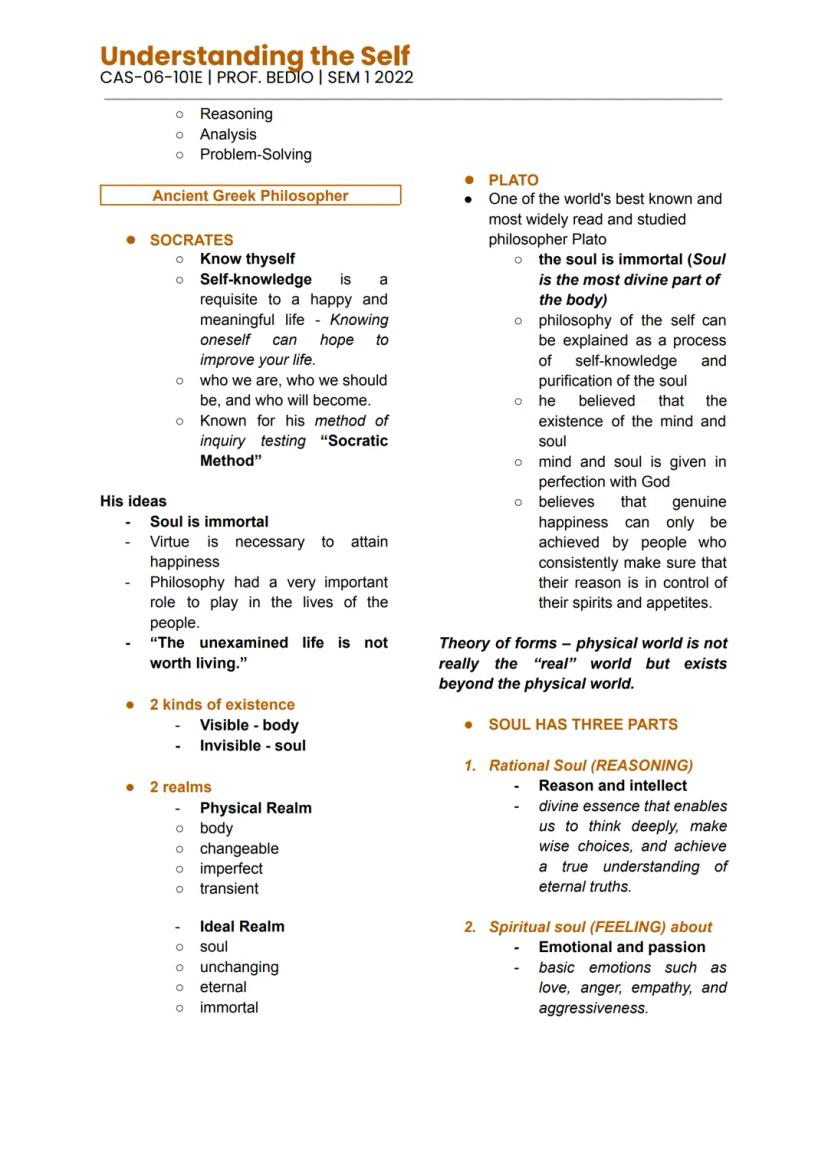
Socrates gave us the famous advice "know thyself" - basically, you can't live a meaningful life without understanding who you are. He believed your soul is immortal and that virtue leads to happiness. His Socratic Method of asking questions to find truth is still used in classrooms today.
Plato took this further, saying your soul has three parts: the rational soul (your thinking mind), spiritual soul (your emotions), and appetitive soul (your basic needs like hunger). He believed genuine happiness comes when your reason controls your emotions and desires.
For Plato, there are two realms - the physical world (your body, which is changeable) and the ideal realm (your soul, which is eternal). This explains why you might feel torn between what your body wants and what your mind knows is right.
Remember: Ancient Greeks saw the soul as the most important part of you - your body is temporary, but your soul defines who you really are.
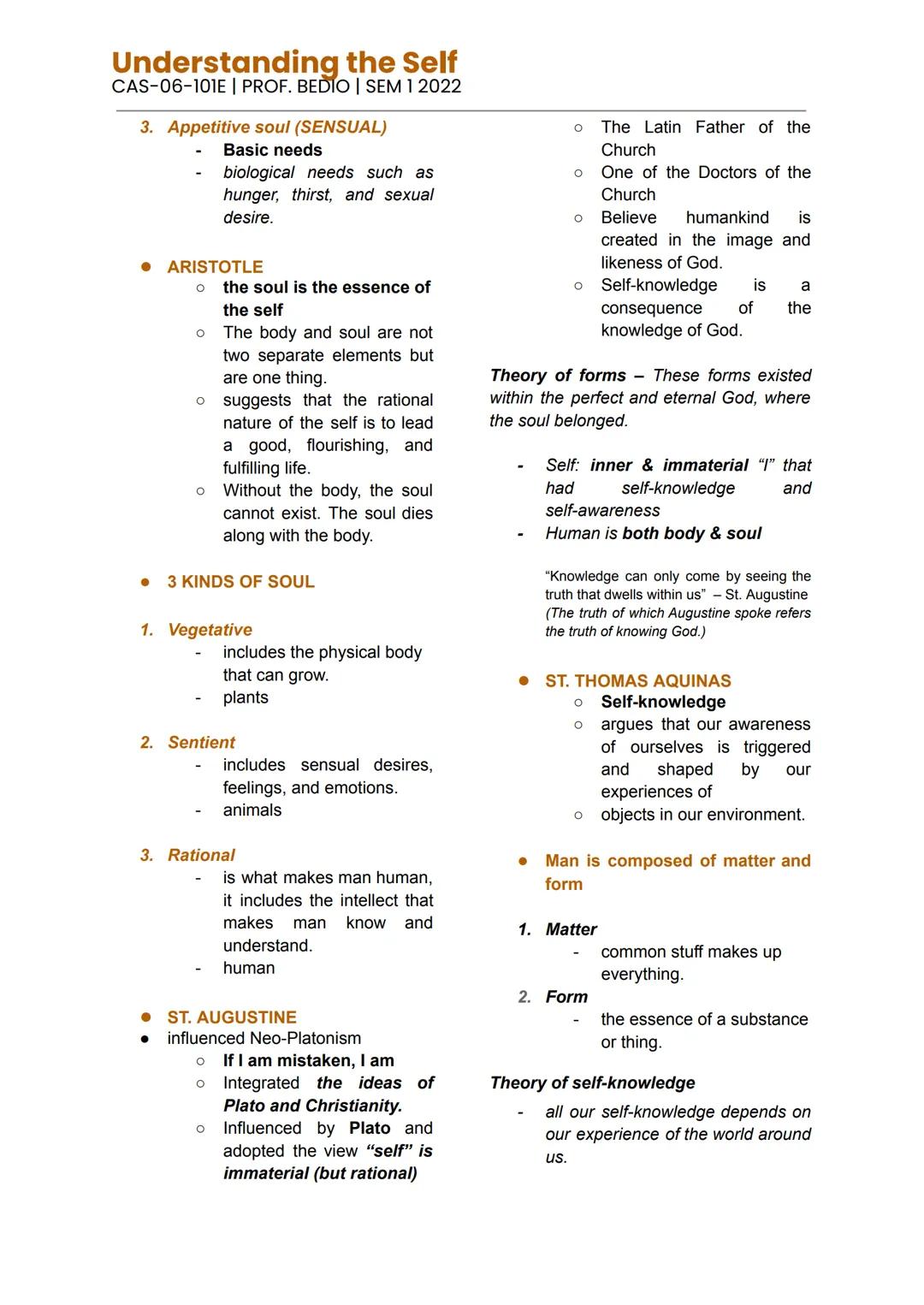
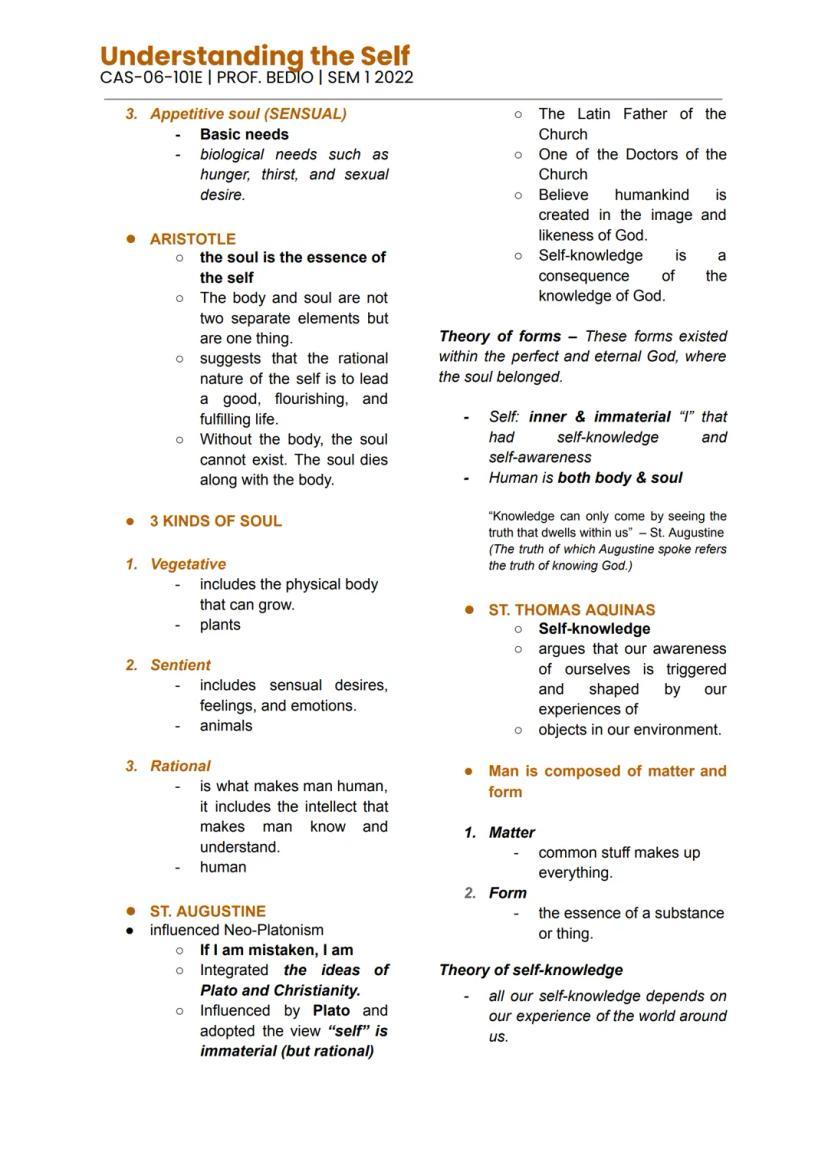
Aristotle disagreed with his teacher Plato - he said body and soul aren't separate but work as one unit. Without your body, your soul can't exist. He identified three types of souls: vegetative (growth, like plants), sentient (feelings, like animals), and rational (thinking, which makes humans unique).
St. Augustine blended Christian beliefs with philosophy, saying we're made in God's image. He believed self-knowledge comes from knowing God - the truth lives within us, and we discover it through spiritual understanding.
St. Thomas Aquinas argued that we learn about ourselves through our experiences with the world around us. Unlike some philosophers who thought the mind was "always on," he believed our self-awareness develops through interacting with our environment.
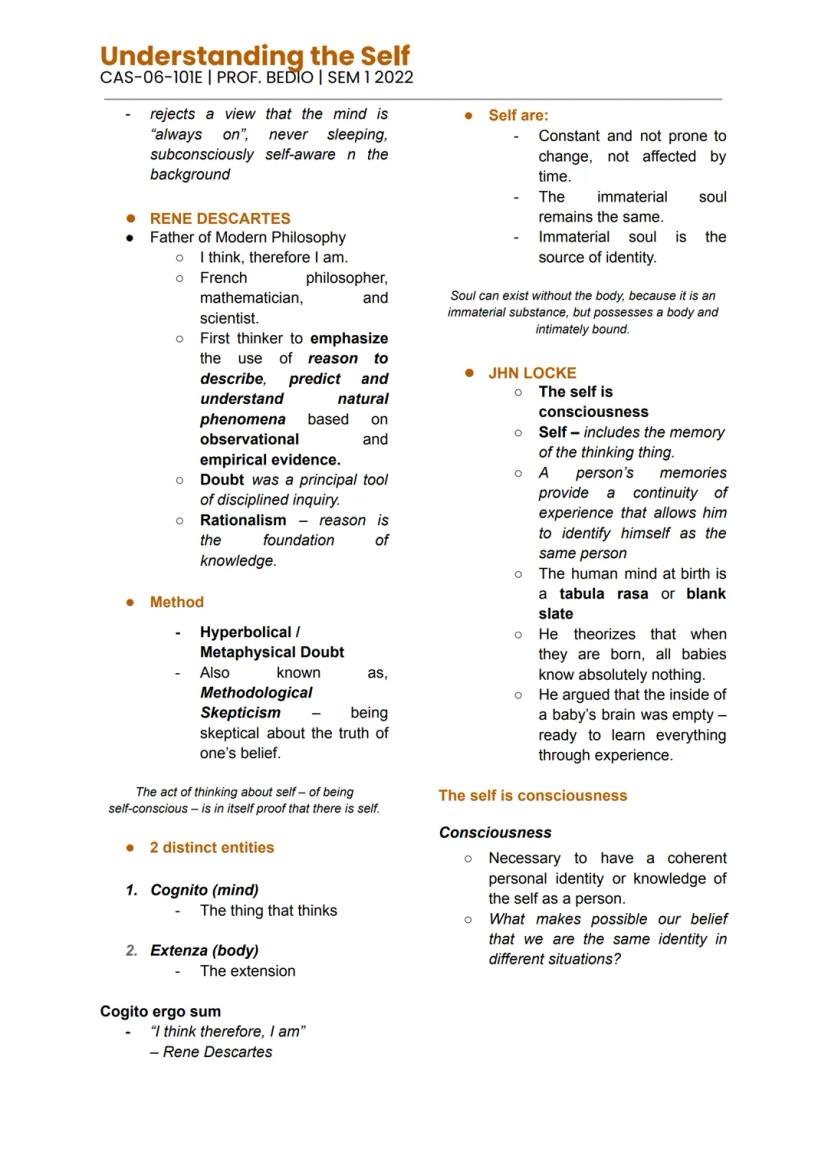
René Descartes, the "Father of Modern Philosophy," gave us "I think, therefore I am." He used doubt as a tool - by questioning everything, he proved that the act of thinking proves you exist. He saw the mind (cogito) and body (extenza) as separate entities.
Fun Fact: Descartes' method of doubting everything to find truth is like being a detective of your own existence!
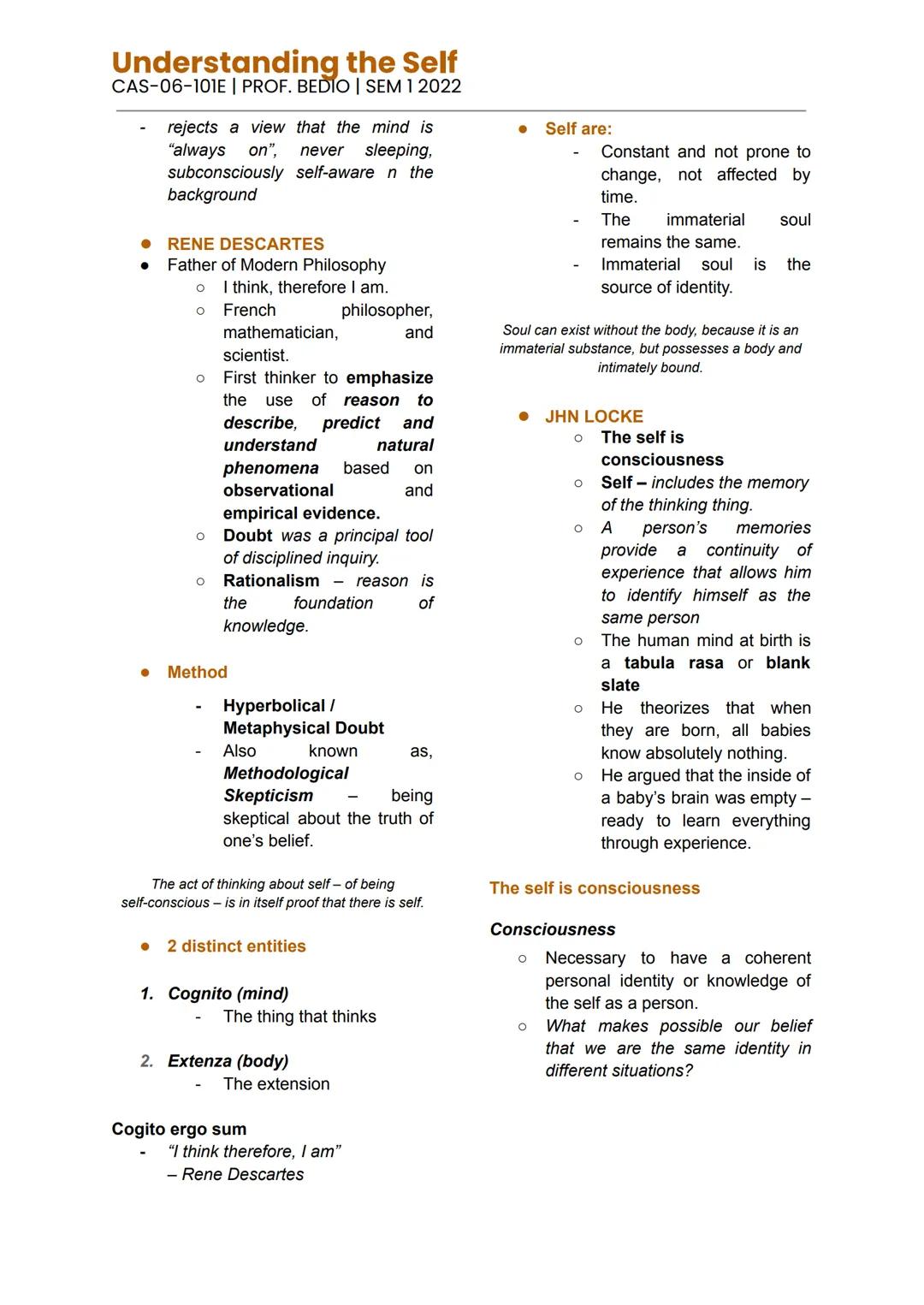
John Locke believed "the self is consciousness" - your memories create continuity and make you the same person over time. He famously said babies are born with minds like blank slates (tabula rasa), learning everything through experience.
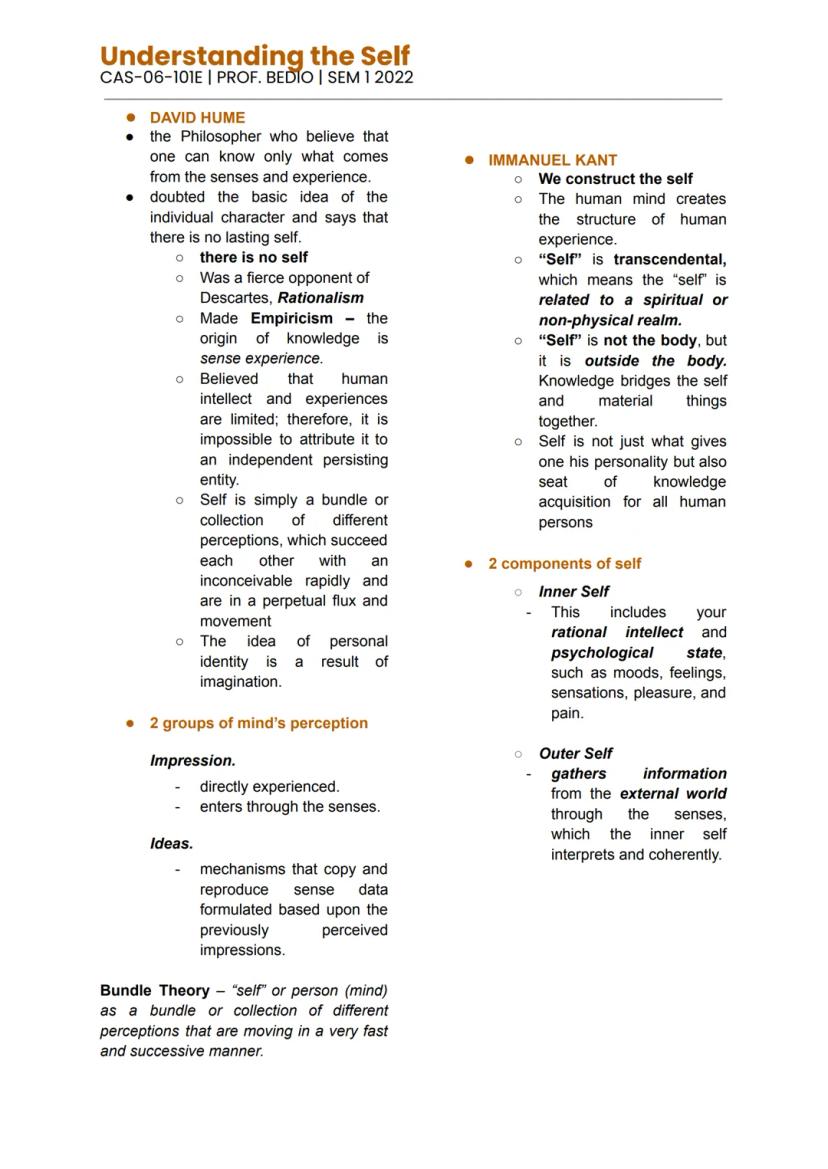
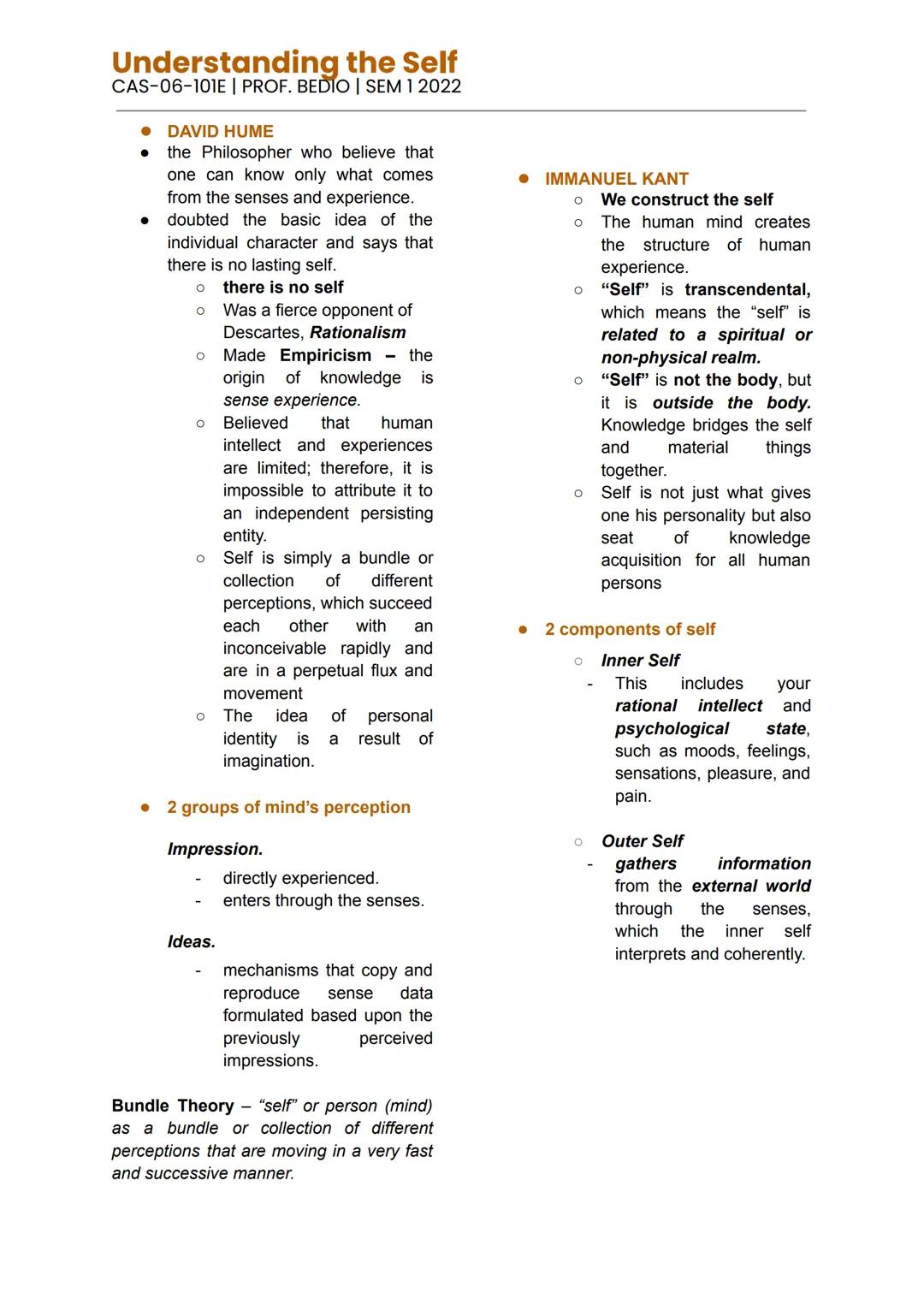
David Hume challenged everyone by saying "there is no lasting self" - you're just a bundle of perceptions flowing rapidly through your mind. What you think is your "self" is actually just your imagination connecting these fleeting experiences.
Immanuel Kant countered that "we construct the self" - your mind actively organizes experiences into a coherent sense of self. He divided this into your inner self (thoughts, feelings, moods) and outer self (gathering information through your senses).
These philosophers show how our understanding of selfhood evolved from ancient soul-based ideas to modern psychological concepts. Each perspective offers valuable insights into the complex question of what makes you "you."
Think About It: If you're just a collection of memories and perceptions, what happens to your sense of self when you forget things or have new experiences?
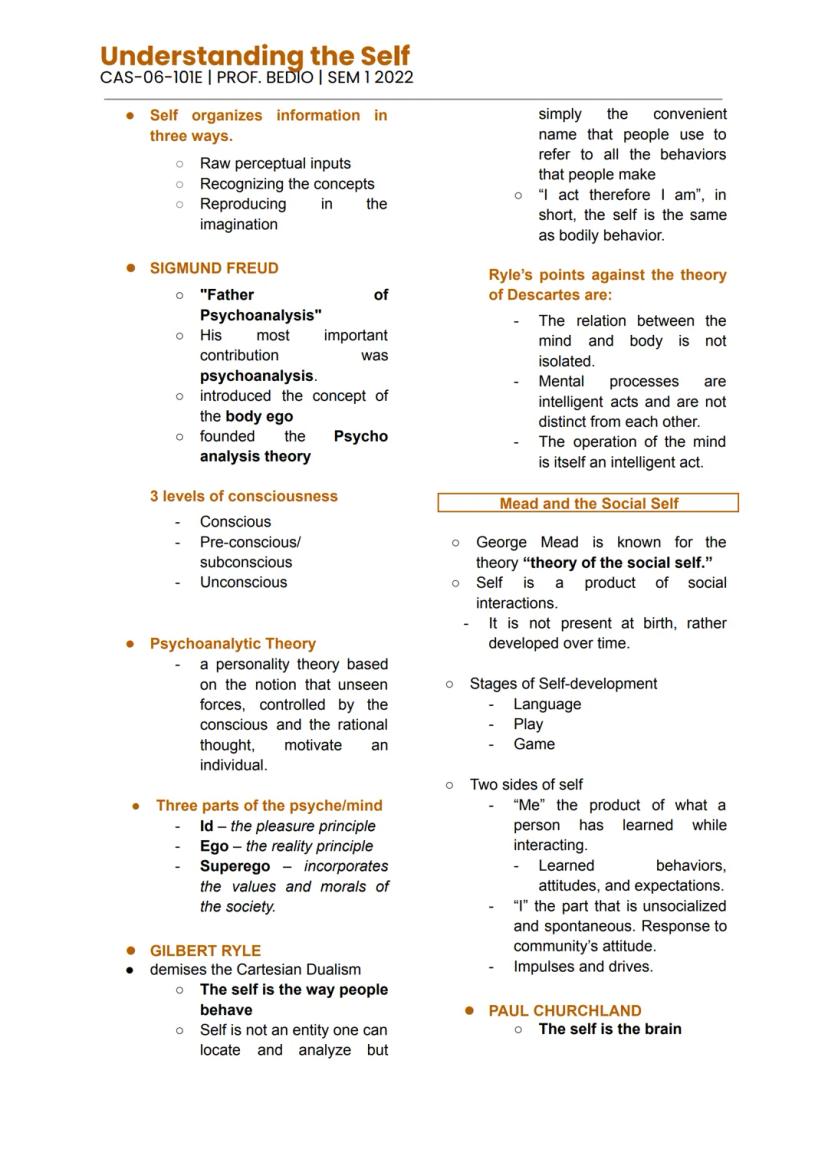
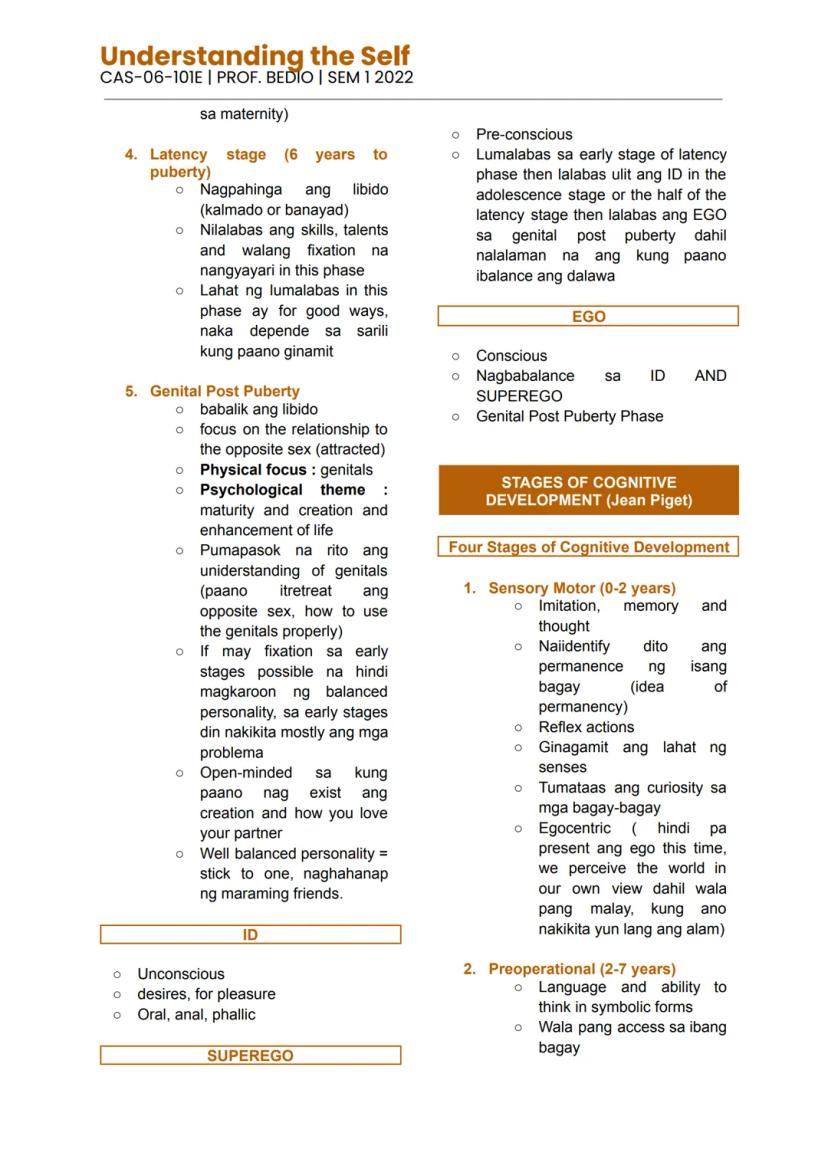
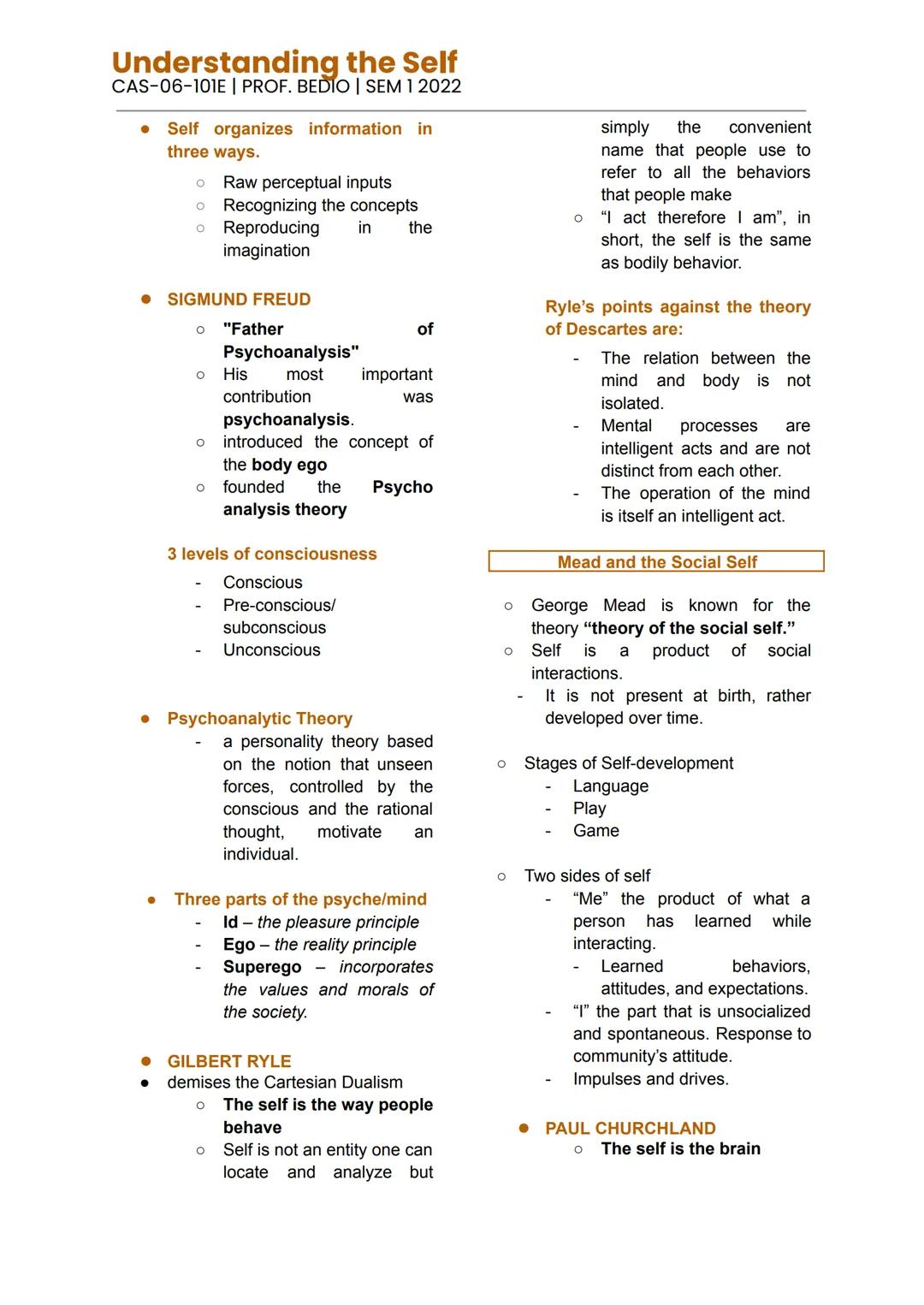
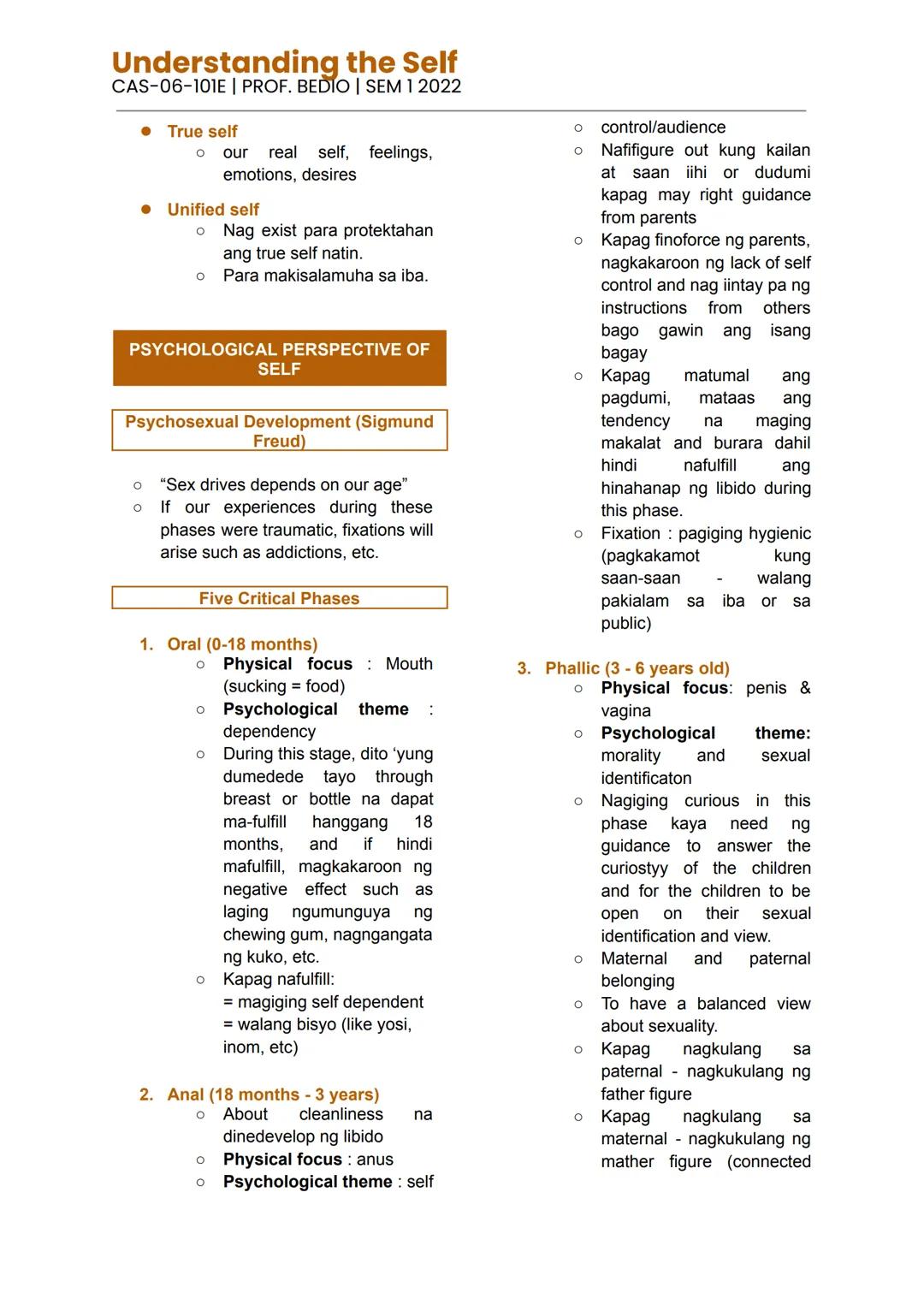
Sigmund Freud, the "Father of Psychoanalysis," revolutionized how we think about the self. He identified three levels of consciousness (conscious, preconscious, unconscious) and three parts of your psyche: Id , Ego , and Superego (moral conscience).
Gilbert Ryle rejected the mind-body separation, arguing "the self is the way people behave." Instead of "I think, therefore I am," he'd say "I act, therefore I am." Your self isn't hidden inside you - it's visible in everything you do.
George Mead developed the social self theory - you're not born with a self, but develop one through social interactions. He identified two sides: the "Me" (learned behaviors from society) and the "I" (your spontaneous, unsocialized responses).
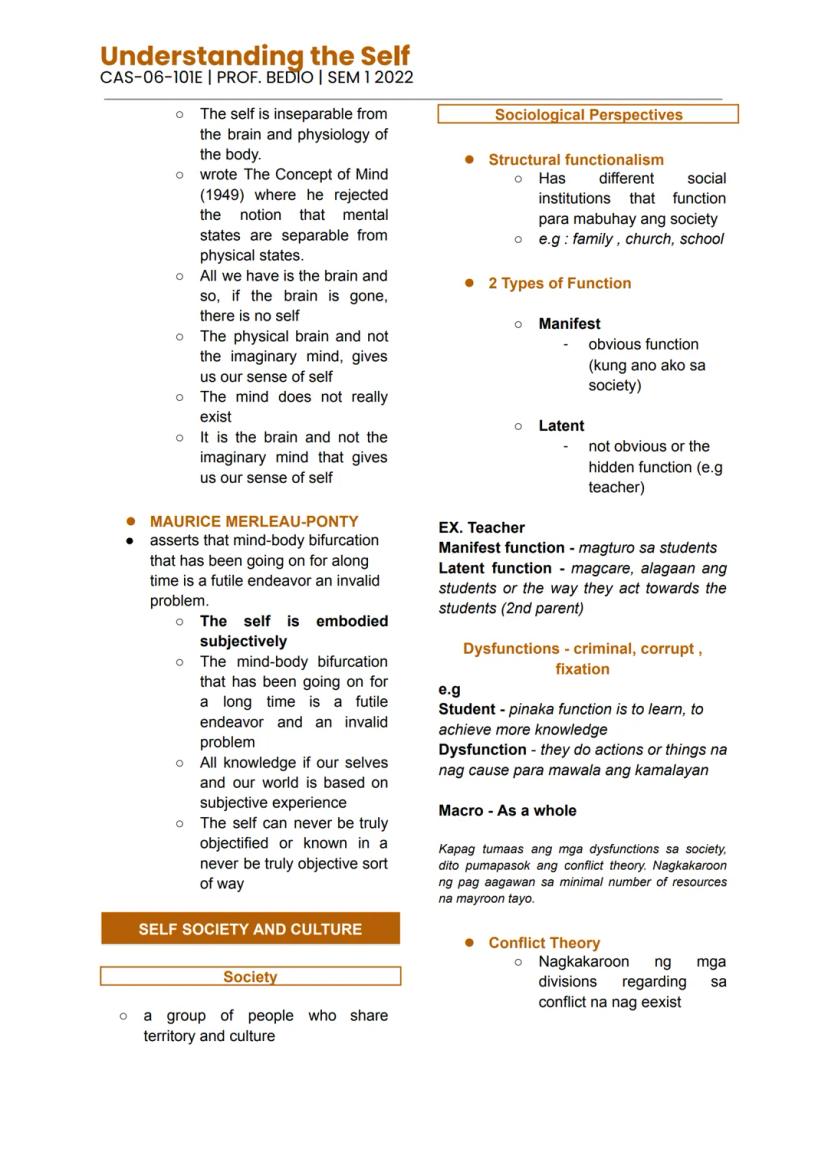
Paul Churchland takes a purely scientific approach: "the self is the brain." No brain, no self. Meanwhile, Maurice Merleau-Ponty argues the self is embodied subjectively - the mind-body split is pointless because they're inseparably connected.
Reality Check: Modern psychology shows that your sense of self comes from complex interactions between biology, psychology, and social experiences.
Society shapes who you are through different sociological perspectives. Structural functionalism shows how institutions like family, school, and church have both obvious functions (manifest) and hidden ones (latent) - like how teachers don't just educate but also care for students.
Conflict theory explains tensions when different groups compete for limited resources, leading to class conflicts and social divisions. Symbolic interactionism focuses on how we communicate through symbols and seek social validation to boost our self-esteem.
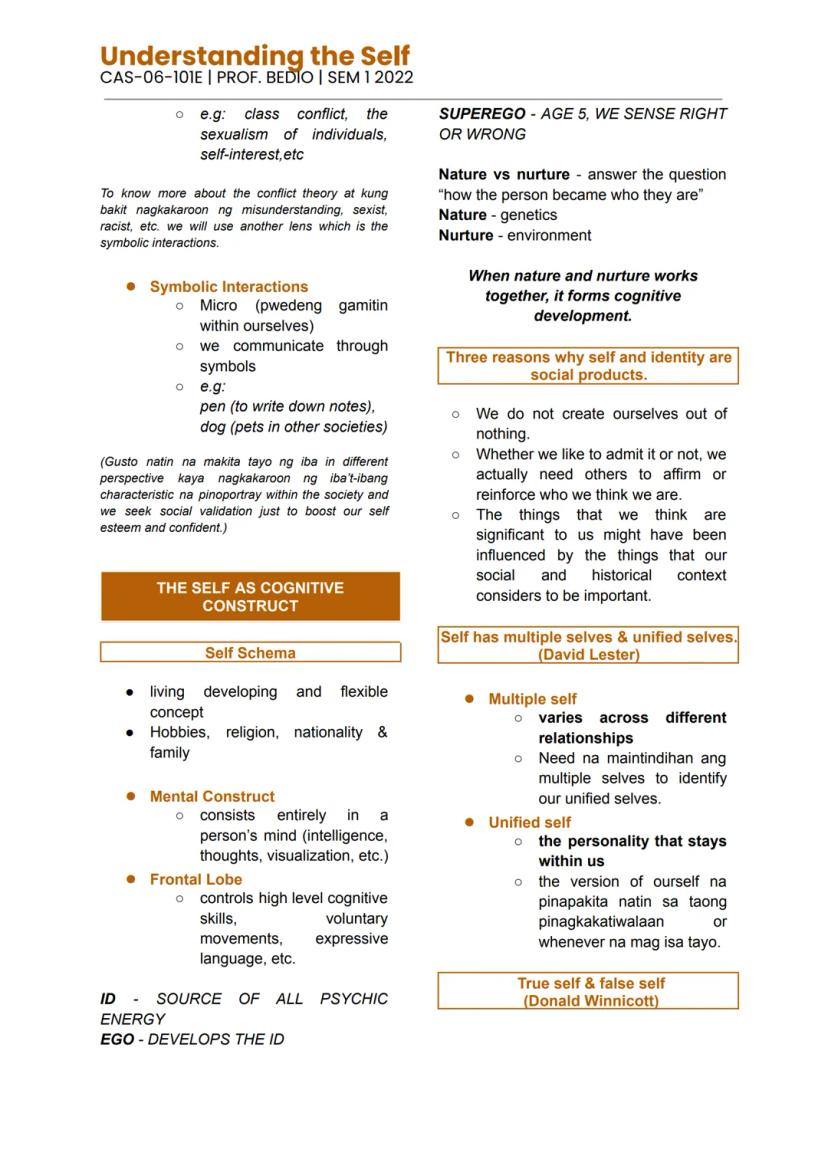
Your self-schema is a flexible mental framework including your hobbies, religion, nationality, and family background. This cognitive construct is controlled by your frontal lobe and constantly develops through experiences.
You actually have multiple selves that vary across different relationships, but also a unified self - your core personality that emerges when you're alone or with people you completely trust. Understanding this helps explain why you might act differently with friends versus family.
Cultural Connection: As a Filipino student, your sociological self includes values like family closeness, respect for elders, and community spirit that shape your identity.
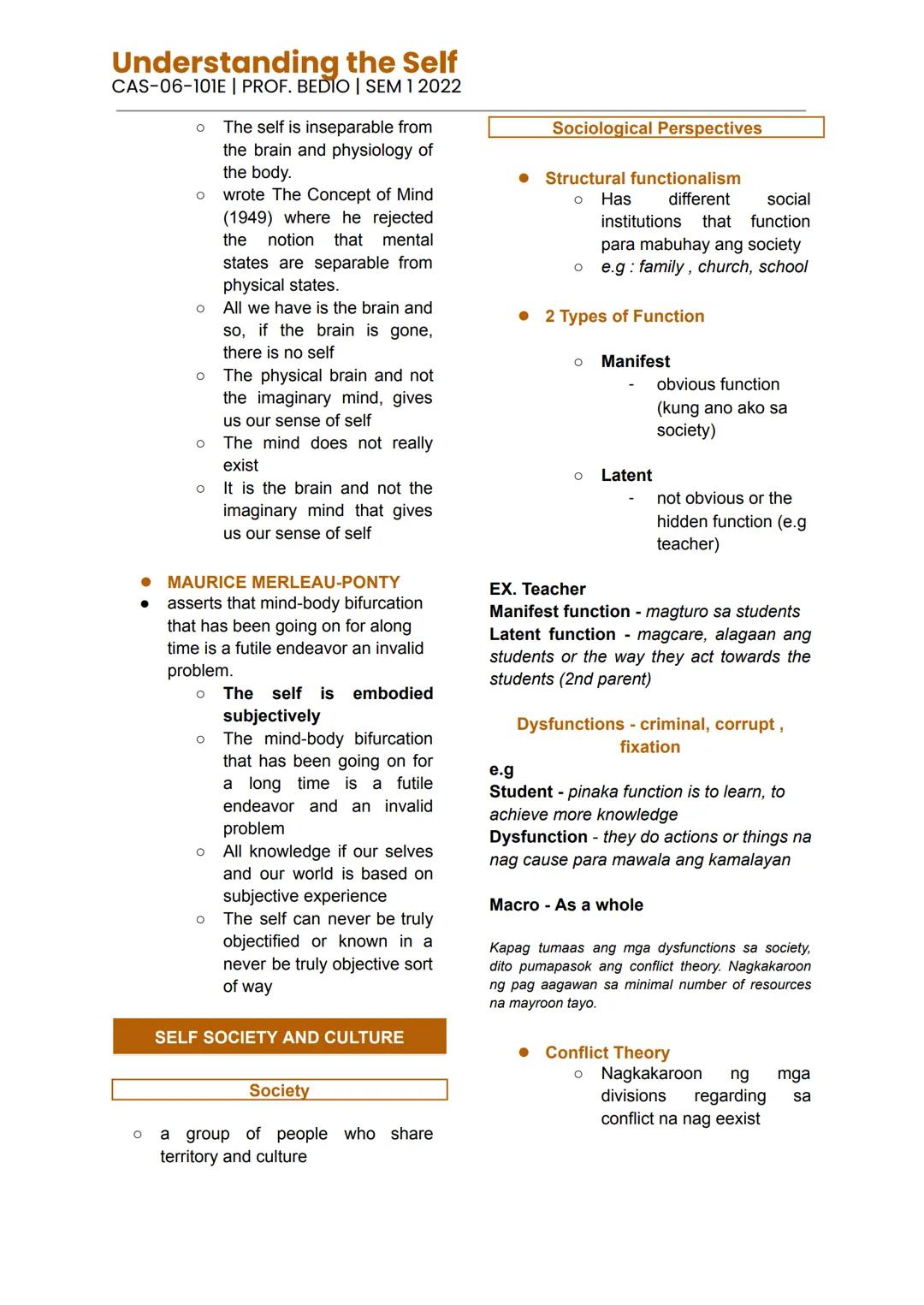
Freud believed your personality develops through five critical phases where sexual energy (libido) focuses on different body parts. Problems during these stages can create lifelong patterns or "fixations."
The oral stage centers on the mouth - if needs aren't met, you might develop habits like nail-biting or smoking. The anal stage focuses on control and cleanliness - overly strict toilet training can make you either obsessively neat or messy.
During the phallic stage , children become curious about sexuality and need proper guidance about gender identity. The latency stage is calm - libido rests while you develop skills and talents.
The genital stage brings back sexual energy, focusing on mature relationships. If earlier stages went well, you'll have a balanced personality and healthy relationships. If not, you might struggle with various fixations or immature behaviors.
Important Note: While Freud's theories are controversial today, they highlight how early childhood experiences significantly impact adult personality development.
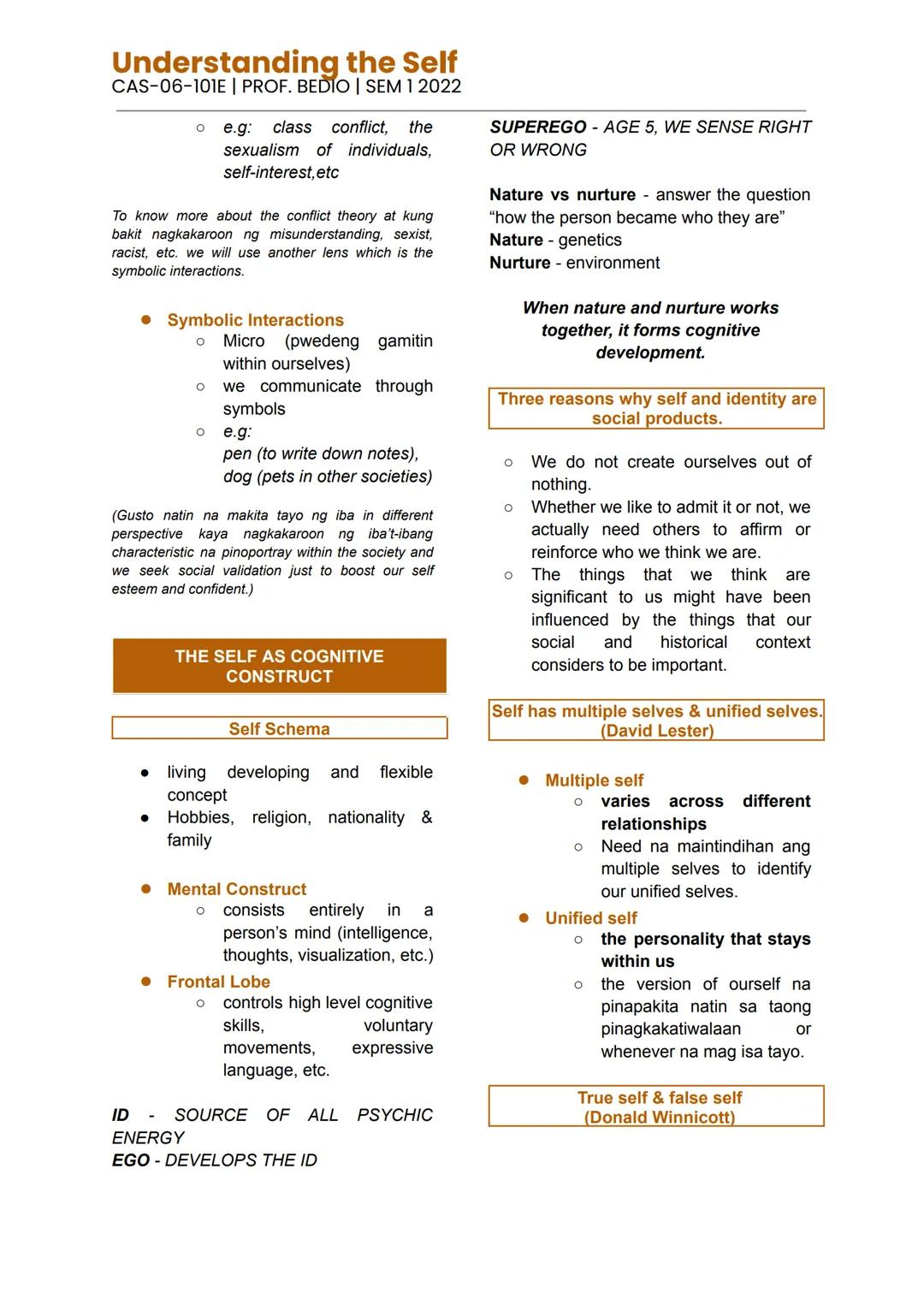
Jean Piaget showed how your thinking abilities develop in four distinct stages. During the sensorimotor stage , you learn through your senses and discover that objects exist even when you can't see them (object permanence).
The preoperational stage brings language and symbolic thinking, but you're still egocentric - seeing the world only from your own perspective. You can't yet understand that others have different viewpoints.
In the concrete operational stage , logical thinking develops but only about concrete, real things. You understand conservation (that amount stays the same even if appearance changes) and can see other perspectives.
Finally, the formal operational stage allows abstract thinking, hypothetical reasoning, and problem-solving. You can now think about thinking itself and consider multiple possibilities for any situation.
Study Tip: Understanding these stages helps explain why younger siblings might seem "selfish" - they're not being mean, their brains just haven't developed the ability to see other viewpoints yet!
Our AI companion is specifically built for the needs of students. Based on the millions of content pieces we have on the platform we can provide truly meaningful and relevant answers to students. But its not only about answers, the companion is even more about guiding students through their daily learning challenges, with personalised study plans, quizzes or content pieces in the chat and 100% personalisation based on the students skills and developments.
You can download the app in the Google Play Store and in the Apple App Store.
That's right! Enjoy free access to study content, connect with fellow students, and get instant help – all at your fingertips.
App Store
Google Play
The app is very easy to use and well designed. I have found everything I was looking for so far and have been able to learn a lot from the presentations! I will definitely use the app for a class assignment! And of course it also helps a lot as an inspiration.
Stefan S
iOS user
This app is really great. There are so many study notes and help [...]. My problem subject is French, for example, and the app has so many options for help. Thanks to this app, I have improved my French. I would recommend it to anyone.
Samantha Klich
Android user
Wow, I am really amazed. I just tried the app because I've seen it advertised many times and was absolutely stunned. This app is THE HELP you want for school and above all, it offers so many things, such as workouts and fact sheets, which have been VERY helpful to me personally.
Anna
iOS user
I think it’s very much worth it and you’ll end up using it a lot once you get the hang of it and even after looking at others notes you can still ask your Artificial intelligence buddy the question and ask to simplify it if you still don’t get it!!! In the end I think it’s worth it 😊👍 ⚠️Also DID I MENTION ITS FREEE YOU DON’T HAVE TO PAY FOR ANYTHING AND STILL GET YOUR GRADES IN PERFECTLY❗️❗️⚠️
Thomas R
iOS user
Knowunity is the BEST app I’ve used in a minute. This is not an ai review or anything this is genuinely coming from a 7th grade student (I know 2011 im young) but dude this app is a 10/10 i have maintained a 3.8 gpa and have plenty of time for gaming. I love it and my mom is just happy I got good grades
Brad T
Android user
Not only did it help me find the answer but it also showed me alternative ways to solve it. I was horrible in math and science but now I have an a in both subjects. Thanks for the help🤍🤍
David K
iOS user
The app's just great! All I have to do is enter the topic in the search bar and I get the response real fast. I don't have to watch 10 YouTube videos to understand something, so I'm saving my time. Highly recommended!
Sudenaz Ocak
Android user
In school I was really bad at maths but thanks to the app, I am doing better now. I am so grateful that you made the app.
Greenlight Bonnie
Android user
I found this app a couple years ago and it has only gotten better since then. I really love it because it can help with written questions and photo questions. Also, it can find study guides that other people have made as well as flashcard sets and practice tests. The free version is also amazing for students who might not be able to afford it. Would 100% recommend
Aubrey
iOS user
Best app if you're in Highschool or Junior high. I have been using this app for 2 school years and it's the best, it's good if you don't have anyone to help you with school work.😋🩷🎀
Marco B
iOS user
THE QUIZES AND FLASHCARDS ARE SO USEFUL AND I LOVE THE SCHOOLGPT. IT ALSO IS LITREALLY LIKE CHATGPT BUT SMARTER!! HELPED ME WITH MY MASCARA PROBLEMS TOO!! AS WELL AS MY REAL SUBJECTS ! DUHHH 😍😁😲🤑💗✨🎀😮
Elisha
iOS user
This app is phenomenal down to the correct info and the various topics you can study! I greatly recommend it for people who struggle with procrastination and those who need homework help. It has been perfectly accurate for world 1 history as far as I’ve seen! Geometry too!
Paul T
iOS user
The app is very easy to use and well designed. I have found everything I was looking for so far and have been able to learn a lot from the presentations! I will definitely use the app for a class assignment! And of course it also helps a lot as an inspiration.
Stefan S
iOS user
This app is really great. There are so many study notes and help [...]. My problem subject is French, for example, and the app has so many options for help. Thanks to this app, I have improved my French. I would recommend it to anyone.
Samantha Klich
Android user
Wow, I am really amazed. I just tried the app because I've seen it advertised many times and was absolutely stunned. This app is THE HELP you want for school and above all, it offers so many things, such as workouts and fact sheets, which have been VERY helpful to me personally.
Anna
iOS user
I think it’s very much worth it and you’ll end up using it a lot once you get the hang of it and even after looking at others notes you can still ask your Artificial intelligence buddy the question and ask to simplify it if you still don’t get it!!! In the end I think it’s worth it 😊👍 ⚠️Also DID I MENTION ITS FREEE YOU DON’T HAVE TO PAY FOR ANYTHING AND STILL GET YOUR GRADES IN PERFECTLY❗️❗️⚠️
Thomas R
iOS user
Knowunity is the BEST app I’ve used in a minute. This is not an ai review or anything this is genuinely coming from a 7th grade student (I know 2011 im young) but dude this app is a 10/10 i have maintained a 3.8 gpa and have plenty of time for gaming. I love it and my mom is just happy I got good grades
Brad T
Android user
Not only did it help me find the answer but it also showed me alternative ways to solve it. I was horrible in math and science but now I have an a in both subjects. Thanks for the help🤍🤍
David K
iOS user
The app's just great! All I have to do is enter the topic in the search bar and I get the response real fast. I don't have to watch 10 YouTube videos to understand something, so I'm saving my time. Highly recommended!
Sudenaz Ocak
Android user
In school I was really bad at maths but thanks to the app, I am doing better now. I am so grateful that you made the app.
Greenlight Bonnie
Android user
I found this app a couple years ago and it has only gotten better since then. I really love it because it can help with written questions and photo questions. Also, it can find study guides that other people have made as well as flashcard sets and practice tests. The free version is also amazing for students who might not be able to afford it. Would 100% recommend
Aubrey
iOS user
Best app if you're in Highschool or Junior high. I have been using this app for 2 school years and it's the best, it's good if you don't have anyone to help you with school work.😋🩷🎀
Marco B
iOS user
THE QUIZES AND FLASHCARDS ARE SO USEFUL AND I LOVE THE SCHOOLGPT. IT ALSO IS LITREALLY LIKE CHATGPT BUT SMARTER!! HELPED ME WITH MY MASCARA PROBLEMS TOO!! AS WELL AS MY REAL SUBJECTS ! DUHHH 😍😁😲🤑💗✨🎀😮
Elisha
iOS user
This app is phenomenal down to the correct info and the various topics you can study! I greatly recommend it for people who struggle with procrastination and those who need homework help. It has been perfectly accurate for world 1 history as far as I’ve seen! Geometry too!
Paul T
iOS user
celestine
@celes_tine_
Ever wondered what makes you "you"? Understanding the self is all about exploring your identity, personality, and how you've developed into the person you are today. This fascinating journey takes us through philosophical ideas, psychological theories, and social influences that... Show more
Access to all documents
Improve your grades
Join milions of students
By signing up you accept Terms of Service and Privacy Policy
Think of self as your inner "who am I?" - it's shaped by both your genes (nature) and your experiences (nurture). Your personality has four key parts: physical (your body), social (how you interact), sociological (your cultural background, like being Filipino), and mental (your psychology).
Identity is different - it's your "social face" or how others see you. It has accidental properties (things that can change, like your hairstyle) and essential properties (core traits that make you uniquely you).
There are four versions of yourself to understand: your real self (the authentic you), your self-image (how you present yourself), your looking glass self (how society sees you), and your ideal self (who you want to become). These different versions help explain why you might act differently in various situations.
Key Insight: Your self is like a multifaceted diamond - different angles show different aspects, but it's all one precious stone.
Access to all documents
Improve your grades
Join milions of students
By signing up you accept Terms of Service and Privacy Policy
Socrates gave us the famous advice "know thyself" - basically, you can't live a meaningful life without understanding who you are. He believed your soul is immortal and that virtue leads to happiness. His Socratic Method of asking questions to find truth is still used in classrooms today.
Plato took this further, saying your soul has three parts: the rational soul (your thinking mind), spiritual soul (your emotions), and appetitive soul (your basic needs like hunger). He believed genuine happiness comes when your reason controls your emotions and desires.
For Plato, there are two realms - the physical world (your body, which is changeable) and the ideal realm (your soul, which is eternal). This explains why you might feel torn between what your body wants and what your mind knows is right.
Remember: Ancient Greeks saw the soul as the most important part of you - your body is temporary, but your soul defines who you really are.
Access to all documents
Improve your grades
Join milions of students
By signing up you accept Terms of Service and Privacy Policy
Aristotle disagreed with his teacher Plato - he said body and soul aren't separate but work as one unit. Without your body, your soul can't exist. He identified three types of souls: vegetative (growth, like plants), sentient (feelings, like animals), and rational (thinking, which makes humans unique).
St. Augustine blended Christian beliefs with philosophy, saying we're made in God's image. He believed self-knowledge comes from knowing God - the truth lives within us, and we discover it through spiritual understanding.
St. Thomas Aquinas argued that we learn about ourselves through our experiences with the world around us. Unlike some philosophers who thought the mind was "always on," he believed our self-awareness develops through interacting with our environment.
René Descartes, the "Father of Modern Philosophy," gave us "I think, therefore I am." He used doubt as a tool - by questioning everything, he proved that the act of thinking proves you exist. He saw the mind (cogito) and body (extenza) as separate entities.
Fun Fact: Descartes' method of doubting everything to find truth is like being a detective of your own existence!
Access to all documents
Improve your grades
Join milions of students
By signing up you accept Terms of Service and Privacy Policy
John Locke believed "the self is consciousness" - your memories create continuity and make you the same person over time. He famously said babies are born with minds like blank slates (tabula rasa), learning everything through experience.
David Hume challenged everyone by saying "there is no lasting self" - you're just a bundle of perceptions flowing rapidly through your mind. What you think is your "self" is actually just your imagination connecting these fleeting experiences.
Immanuel Kant countered that "we construct the self" - your mind actively organizes experiences into a coherent sense of self. He divided this into your inner self (thoughts, feelings, moods) and outer self (gathering information through your senses).
These philosophers show how our understanding of selfhood evolved from ancient soul-based ideas to modern psychological concepts. Each perspective offers valuable insights into the complex question of what makes you "you."
Think About It: If you're just a collection of memories and perceptions, what happens to your sense of self when you forget things or have new experiences?
Access to all documents
Improve your grades
Join milions of students
By signing up you accept Terms of Service and Privacy Policy
Sigmund Freud, the "Father of Psychoanalysis," revolutionized how we think about the self. He identified three levels of consciousness (conscious, preconscious, unconscious) and three parts of your psyche: Id , Ego , and Superego (moral conscience).
Gilbert Ryle rejected the mind-body separation, arguing "the self is the way people behave." Instead of "I think, therefore I am," he'd say "I act, therefore I am." Your self isn't hidden inside you - it's visible in everything you do.
George Mead developed the social self theory - you're not born with a self, but develop one through social interactions. He identified two sides: the "Me" (learned behaviors from society) and the "I" (your spontaneous, unsocialized responses).
Paul Churchland takes a purely scientific approach: "the self is the brain." No brain, no self. Meanwhile, Maurice Merleau-Ponty argues the self is embodied subjectively - the mind-body split is pointless because they're inseparably connected.
Reality Check: Modern psychology shows that your sense of self comes from complex interactions between biology, psychology, and social experiences.
Access to all documents
Improve your grades
Join milions of students
By signing up you accept Terms of Service and Privacy Policy
Society shapes who you are through different sociological perspectives. Structural functionalism shows how institutions like family, school, and church have both obvious functions (manifest) and hidden ones (latent) - like how teachers don't just educate but also care for students.
Conflict theory explains tensions when different groups compete for limited resources, leading to class conflicts and social divisions. Symbolic interactionism focuses on how we communicate through symbols and seek social validation to boost our self-esteem.
Your self-schema is a flexible mental framework including your hobbies, religion, nationality, and family background. This cognitive construct is controlled by your frontal lobe and constantly develops through experiences.
You actually have multiple selves that vary across different relationships, but also a unified self - your core personality that emerges when you're alone or with people you completely trust. Understanding this helps explain why you might act differently with friends versus family.
Cultural Connection: As a Filipino student, your sociological self includes values like family closeness, respect for elders, and community spirit that shape your identity.
Access to all documents
Improve your grades
Join milions of students
By signing up you accept Terms of Service and Privacy Policy
Freud believed your personality develops through five critical phases where sexual energy (libido) focuses on different body parts. Problems during these stages can create lifelong patterns or "fixations."
The oral stage centers on the mouth - if needs aren't met, you might develop habits like nail-biting or smoking. The anal stage focuses on control and cleanliness - overly strict toilet training can make you either obsessively neat or messy.
During the phallic stage , children become curious about sexuality and need proper guidance about gender identity. The latency stage is calm - libido rests while you develop skills and talents.
The genital stage brings back sexual energy, focusing on mature relationships. If earlier stages went well, you'll have a balanced personality and healthy relationships. If not, you might struggle with various fixations or immature behaviors.
Important Note: While Freud's theories are controversial today, they highlight how early childhood experiences significantly impact adult personality development.
Access to all documents
Improve your grades
Join milions of students
By signing up you accept Terms of Service and Privacy Policy
Jean Piaget showed how your thinking abilities develop in four distinct stages. During the sensorimotor stage , you learn through your senses and discover that objects exist even when you can't see them (object permanence).
The preoperational stage brings language and symbolic thinking, but you're still egocentric - seeing the world only from your own perspective. You can't yet understand that others have different viewpoints.
In the concrete operational stage , logical thinking develops but only about concrete, real things. You understand conservation (that amount stays the same even if appearance changes) and can see other perspectives.
Finally, the formal operational stage allows abstract thinking, hypothetical reasoning, and problem-solving. You can now think about thinking itself and consider multiple possibilities for any situation.
Study Tip: Understanding these stages helps explain why younger siblings might seem "selfish" - they're not being mean, their brains just haven't developed the ability to see other viewpoints yet!
Access to all documents
Improve your grades
Join milions of students
By signing up you accept Terms of Service and Privacy Policy
Access to all documents
Improve your grades
Join milions of students
By signing up you accept Terms of Service and Privacy Policy
Our AI companion is specifically built for the needs of students. Based on the millions of content pieces we have on the platform we can provide truly meaningful and relevant answers to students. But its not only about answers, the companion is even more about guiding students through their daily learning challenges, with personalised study plans, quizzes or content pieces in the chat and 100% personalisation based on the students skills and developments.
You can download the app in the Google Play Store and in the Apple App Store.
That's right! Enjoy free access to study content, connect with fellow students, and get instant help – all at your fingertips.
202
Smart Tools NEW
Transform this note into: ✓ 50+ Practice Questions ✓ Interactive Flashcards ✓ Full Mock Exam ✓ Essay Outlines
App Store
Google Play
The app is very easy to use and well designed. I have found everything I was looking for so far and have been able to learn a lot from the presentations! I will definitely use the app for a class assignment! And of course it also helps a lot as an inspiration.
Stefan S
iOS user
This app is really great. There are so many study notes and help [...]. My problem subject is French, for example, and the app has so many options for help. Thanks to this app, I have improved my French. I would recommend it to anyone.
Samantha Klich
Android user
Wow, I am really amazed. I just tried the app because I've seen it advertised many times and was absolutely stunned. This app is THE HELP you want for school and above all, it offers so many things, such as workouts and fact sheets, which have been VERY helpful to me personally.
Anna
iOS user
I think it’s very much worth it and you’ll end up using it a lot once you get the hang of it and even after looking at others notes you can still ask your Artificial intelligence buddy the question and ask to simplify it if you still don’t get it!!! In the end I think it’s worth it 😊👍 ⚠️Also DID I MENTION ITS FREEE YOU DON’T HAVE TO PAY FOR ANYTHING AND STILL GET YOUR GRADES IN PERFECTLY❗️❗️⚠️
Thomas R
iOS user
Knowunity is the BEST app I’ve used in a minute. This is not an ai review or anything this is genuinely coming from a 7th grade student (I know 2011 im young) but dude this app is a 10/10 i have maintained a 3.8 gpa and have plenty of time for gaming. I love it and my mom is just happy I got good grades
Brad T
Android user
Not only did it help me find the answer but it also showed me alternative ways to solve it. I was horrible in math and science but now I have an a in both subjects. Thanks for the help🤍🤍
David K
iOS user
The app's just great! All I have to do is enter the topic in the search bar and I get the response real fast. I don't have to watch 10 YouTube videos to understand something, so I'm saving my time. Highly recommended!
Sudenaz Ocak
Android user
In school I was really bad at maths but thanks to the app, I am doing better now. I am so grateful that you made the app.
Greenlight Bonnie
Android user
I found this app a couple years ago and it has only gotten better since then. I really love it because it can help with written questions and photo questions. Also, it can find study guides that other people have made as well as flashcard sets and practice tests. The free version is also amazing for students who might not be able to afford it. Would 100% recommend
Aubrey
iOS user
Best app if you're in Highschool or Junior high. I have been using this app for 2 school years and it's the best, it's good if you don't have anyone to help you with school work.😋🩷🎀
Marco B
iOS user
THE QUIZES AND FLASHCARDS ARE SO USEFUL AND I LOVE THE SCHOOLGPT. IT ALSO IS LITREALLY LIKE CHATGPT BUT SMARTER!! HELPED ME WITH MY MASCARA PROBLEMS TOO!! AS WELL AS MY REAL SUBJECTS ! DUHHH 😍😁😲🤑💗✨🎀😮
Elisha
iOS user
This app is phenomenal down to the correct info and the various topics you can study! I greatly recommend it for people who struggle with procrastination and those who need homework help. It has been perfectly accurate for world 1 history as far as I’ve seen! Geometry too!
Paul T
iOS user
The app is very easy to use and well designed. I have found everything I was looking for so far and have been able to learn a lot from the presentations! I will definitely use the app for a class assignment! And of course it also helps a lot as an inspiration.
Stefan S
iOS user
This app is really great. There are so many study notes and help [...]. My problem subject is French, for example, and the app has so many options for help. Thanks to this app, I have improved my French. I would recommend it to anyone.
Samantha Klich
Android user
Wow, I am really amazed. I just tried the app because I've seen it advertised many times and was absolutely stunned. This app is THE HELP you want for school and above all, it offers so many things, such as workouts and fact sheets, which have been VERY helpful to me personally.
Anna
iOS user
I think it’s very much worth it and you’ll end up using it a lot once you get the hang of it and even after looking at others notes you can still ask your Artificial intelligence buddy the question and ask to simplify it if you still don’t get it!!! In the end I think it’s worth it 😊👍 ⚠️Also DID I MENTION ITS FREEE YOU DON’T HAVE TO PAY FOR ANYTHING AND STILL GET YOUR GRADES IN PERFECTLY❗️❗️⚠️
Thomas R
iOS user
Knowunity is the BEST app I’ve used in a minute. This is not an ai review or anything this is genuinely coming from a 7th grade student (I know 2011 im young) but dude this app is a 10/10 i have maintained a 3.8 gpa and have plenty of time for gaming. I love it and my mom is just happy I got good grades
Brad T
Android user
Not only did it help me find the answer but it also showed me alternative ways to solve it. I was horrible in math and science but now I have an a in both subjects. Thanks for the help🤍🤍
David K
iOS user
The app's just great! All I have to do is enter the topic in the search bar and I get the response real fast. I don't have to watch 10 YouTube videos to understand something, so I'm saving my time. Highly recommended!
Sudenaz Ocak
Android user
In school I was really bad at maths but thanks to the app, I am doing better now. I am so grateful that you made the app.
Greenlight Bonnie
Android user
I found this app a couple years ago and it has only gotten better since then. I really love it because it can help with written questions and photo questions. Also, it can find study guides that other people have made as well as flashcard sets and practice tests. The free version is also amazing for students who might not be able to afford it. Would 100% recommend
Aubrey
iOS user
Best app if you're in Highschool or Junior high. I have been using this app for 2 school years and it's the best, it's good if you don't have anyone to help you with school work.😋🩷🎀
Marco B
iOS user
THE QUIZES AND FLASHCARDS ARE SO USEFUL AND I LOVE THE SCHOOLGPT. IT ALSO IS LITREALLY LIKE CHATGPT BUT SMARTER!! HELPED ME WITH MY MASCARA PROBLEMS TOO!! AS WELL AS MY REAL SUBJECTS ! DUHHH 😍😁😲🤑💗✨🎀😮
Elisha
iOS user
This app is phenomenal down to the correct info and the various topics you can study! I greatly recommend it for people who struggle with procrastination and those who need homework help. It has been perfectly accurate for world 1 history as far as I’ve seen! Geometry too!
Paul T
iOS user