Open the App

Subjects

PE

Nov 25, 2025

238

9 pages

Understanding the Muscular System for OCR PE Students

K

katie turner @katieturner_eanq

Understanding how your muscles work is absolutely crucial for PE, sports science, and any fitness goals you might... Show more

anterior
deltoid
(antenor)
pectoralis major
rectus
abdominis
abdominal
external oblique
wrist
Hixon
adductor
longus
rectus
fermons
vastus
la

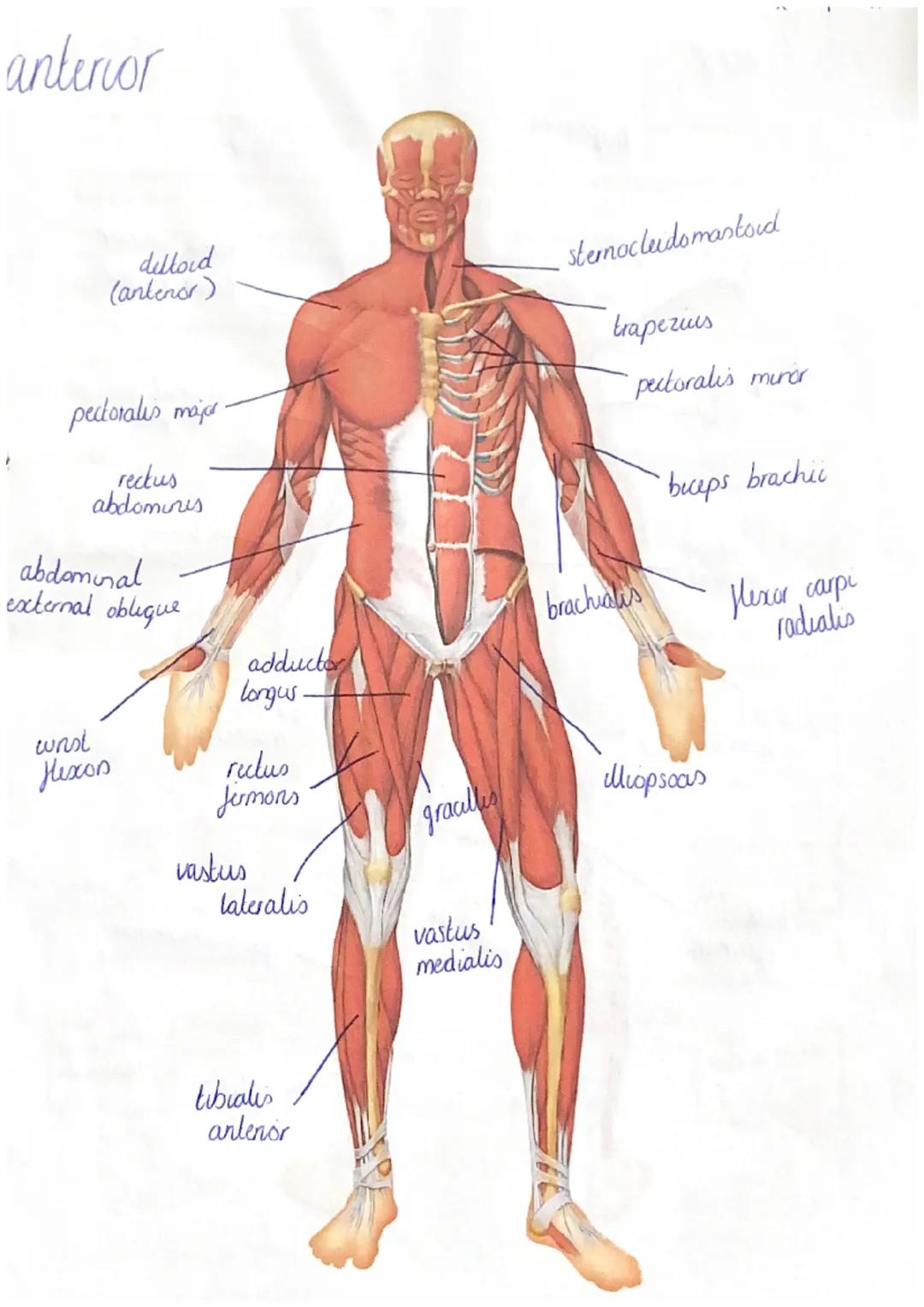
Anterior Muscle Anatomy

Getting familiar with your anterior muscles (the ones you can see when looking in the mirror) is your first step to understanding how your body moves. These muscles are the powerhouses behind most of your daily movements and sports activities.

The major players include your deltoids in your shoulders, pectoralis major in your chest, and the rectus abdominis yoursixpackmusclesyour six-pack muscles. Your arms feature the biceps brachii for flexing and the brachialis underneath for extra power.

Down in your legs, you've got the massive quadriceps group - including rectus femoris, vastus lateralis, and vastus medialis - which straighten your knee and help you jump, run, and squat. The iliopsoas connects your spine to your thigh, making it essential for lifting your legs.

Quick Tip These anterior muscles often work as the "agonists" (prime movers) when you're pushing, lifting, or moving forward - think push-ups, squats, or sprinting.

anterior
deltoid
(antenor)
pectoralis major
rectus
abdominis
abdominal
external oblique
wrist
Hixon
adductor
longus
rectus
fermons
vastus
la

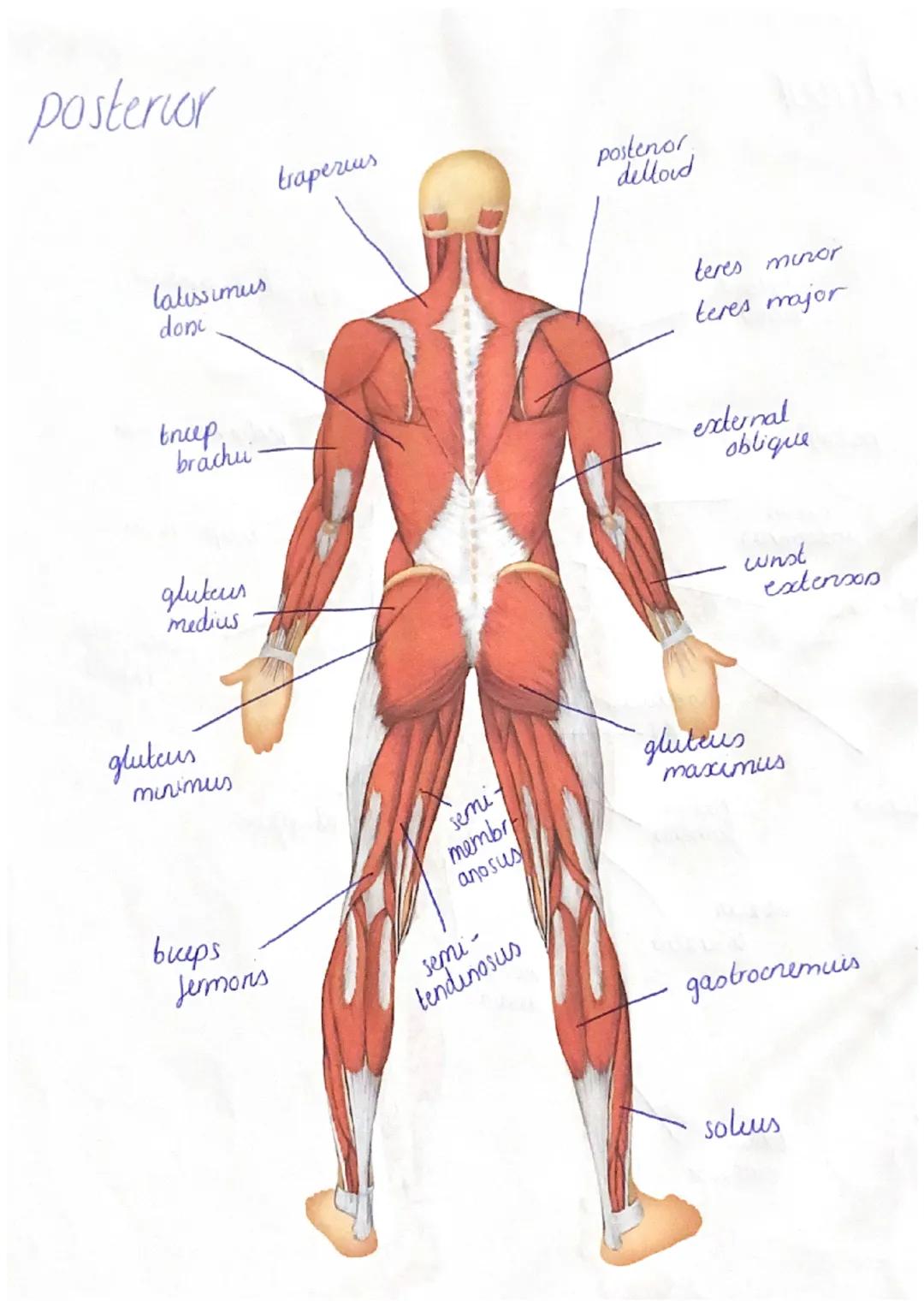
Posterior Muscle Anatomy

Your posterior muscles are the unsung heroes of good posture and athletic performance. These muscles on the back of your body often get overlooked, but they're absolutely essential for balanced movement and preventing injuries.

Key muscles include the trapezius spanning your upper back and neck, latissimus dorsi (your "lats") for pulling movements, and the posterior deltoid at the back of your shoulders. Your teres major and minor help rotate and stabilise your shoulders.

The gluteus maximus is actually your body's largest muscle and provides serious power for running and jumping. Support comes from gluteus medius and minimus for hip stability. Your legs feature the hamstring group (semitendinosus, semimembranosus) and gastrocnemius and soleus in your calves.

Remember Posterior muscles typically act as stabilisers and work opposite to your anterior muscles - they're crucial for balanced training and injury prevention.

anterior
deltoid
(antenor)
pectoralis major
rectus
abdominis
abdominal
external oblique
wrist
Hixon
adductor
longus
rectus
fermons
vastus
la

How Muscles Create Movement

Muscles are basically your body's engines, converting chemical energy into the mechanical force that moves your bones. Understanding how this works will make you a much more effective athlete and help you avoid injuries.

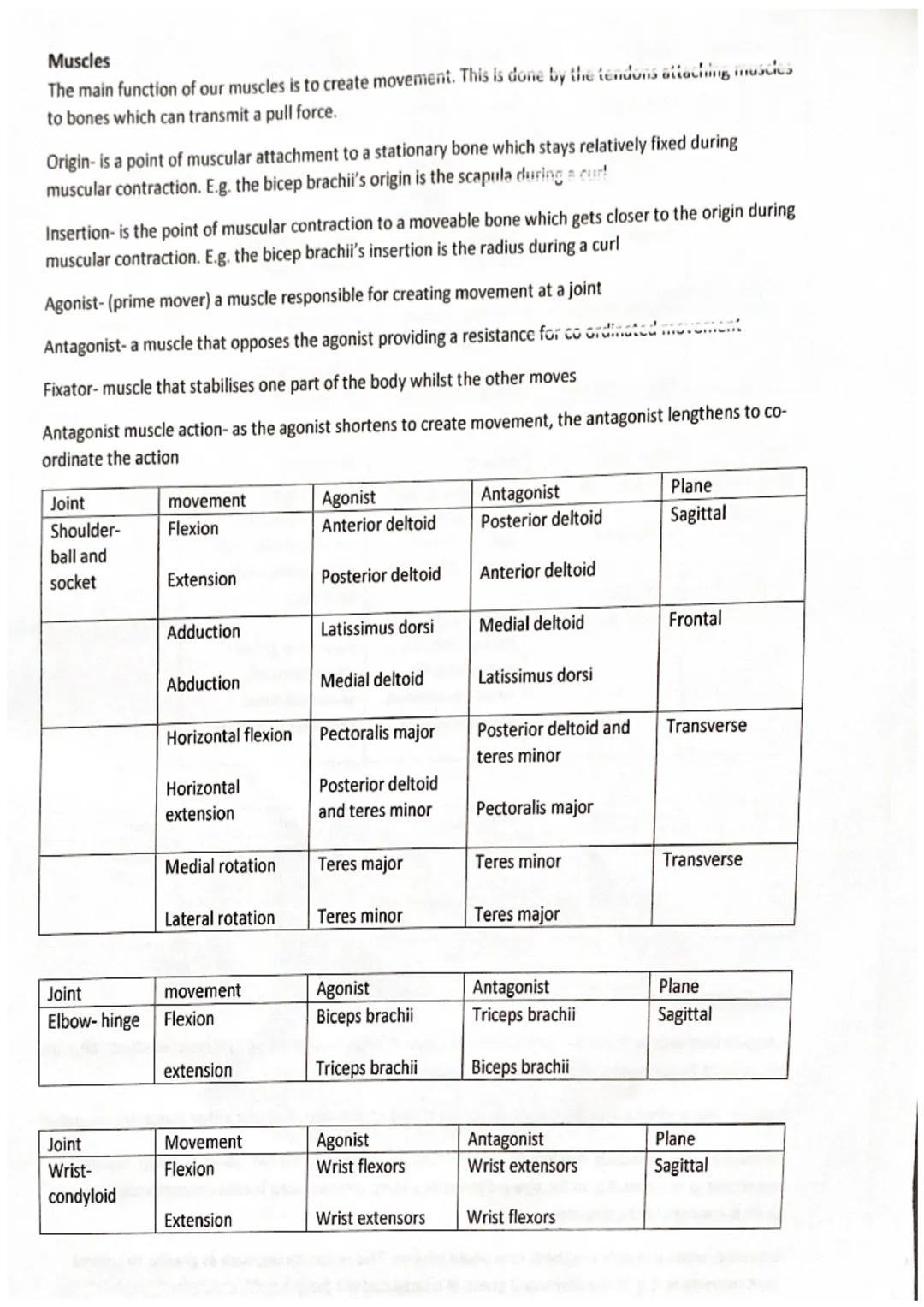
Every muscle has an origin (the fixed attachment point) and an insertion (the moving attachment point). During movement, muscles work in teams the agonist creates the movement, the antagonist provides controlled resistance, and fixator muscles keep everything stable.

Muscle contraction happens in different ways. Concentric contractions shorten the muscle (like lifting a weight up), while eccentric contractions lengthen it under tension (lowering the weight down). Isometric contractions create force without movement - perfect for holding positions.

The tables show exactly which muscles work together for each joint movement. For example, during a bicep curl, your biceps brachii is the agonist whilst your triceps brachii acts as the antagonist, creating smooth, controlled movement in the sagittal plane.

Training Tip Understanding agonist-antagonist pairs helps you create balanced workouts - if you train your chest (agonist), don't forget your back muscles (antagonist)!

anterior
deltoid
(antenor)
pectoralis major
rectus
abdominis
abdominal
external oblique
wrist
Hixon
adductor
longus
rectus
fermons
vastus
la

Major Joint Movements and Muscle Actions

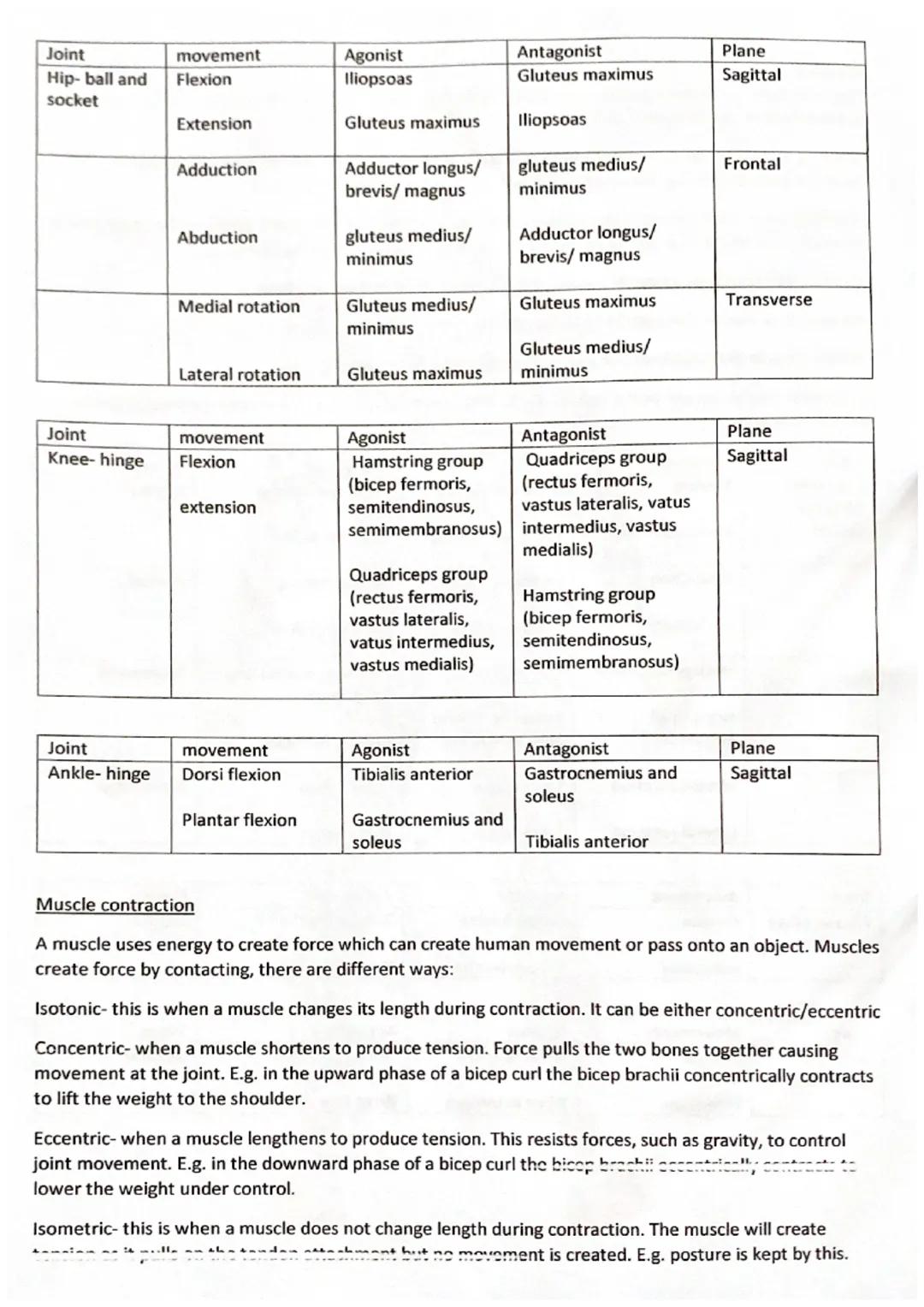
Each joint in your body has specific muscles responsible for different movements, and knowing these partnerships is essential for effective training and injury prevention. This systematic approach helps you understand exactly what's happening during any exercise or sport movement.

Your hip joint (ball and socket) relies on the iliopsoas for flexion and gluteus maximus for powerful extension - think squats and deadlifts. The gluteus medius and minimus handle abduction (moving your leg sideways), whilst the adductor group brings it back.

The knee joint (hinge) features the classic battle between your quadriceps group (rectus femoris, vastus lateralis, vastus medialis, vastus intermedius) for extension and your hamstring group (bicep femoris, semitendinosus, semimembranosus) for flexion.

Your ankle joint uses tibialis anterior for dorsi flexion (pulling your toes up) and the powerful gastrocnemius and soleus for plantar flexion (pointing your toes down). These muscles are absolutely crucial for running, jumping, and maintaining balance.

Key Insight Most injuries happen when there's an imbalance between agonist and antagonist muscles - strong quads but weak hamstrings often lead to knee problems.

anterior
deltoid
(antenor)
pectoralis major
rectus
abdominis
abdominal
external oblique
wrist
Hixon
adductor
longus
rectus
fermons
vastus
la

Muscle Structure and Organisation

Understanding muscle structure is like looking under the bonnet of a high-performance car - it explains why your muscles work the way they do. This knowledge helps you train more effectively and understand concepts like muscle fibre types.

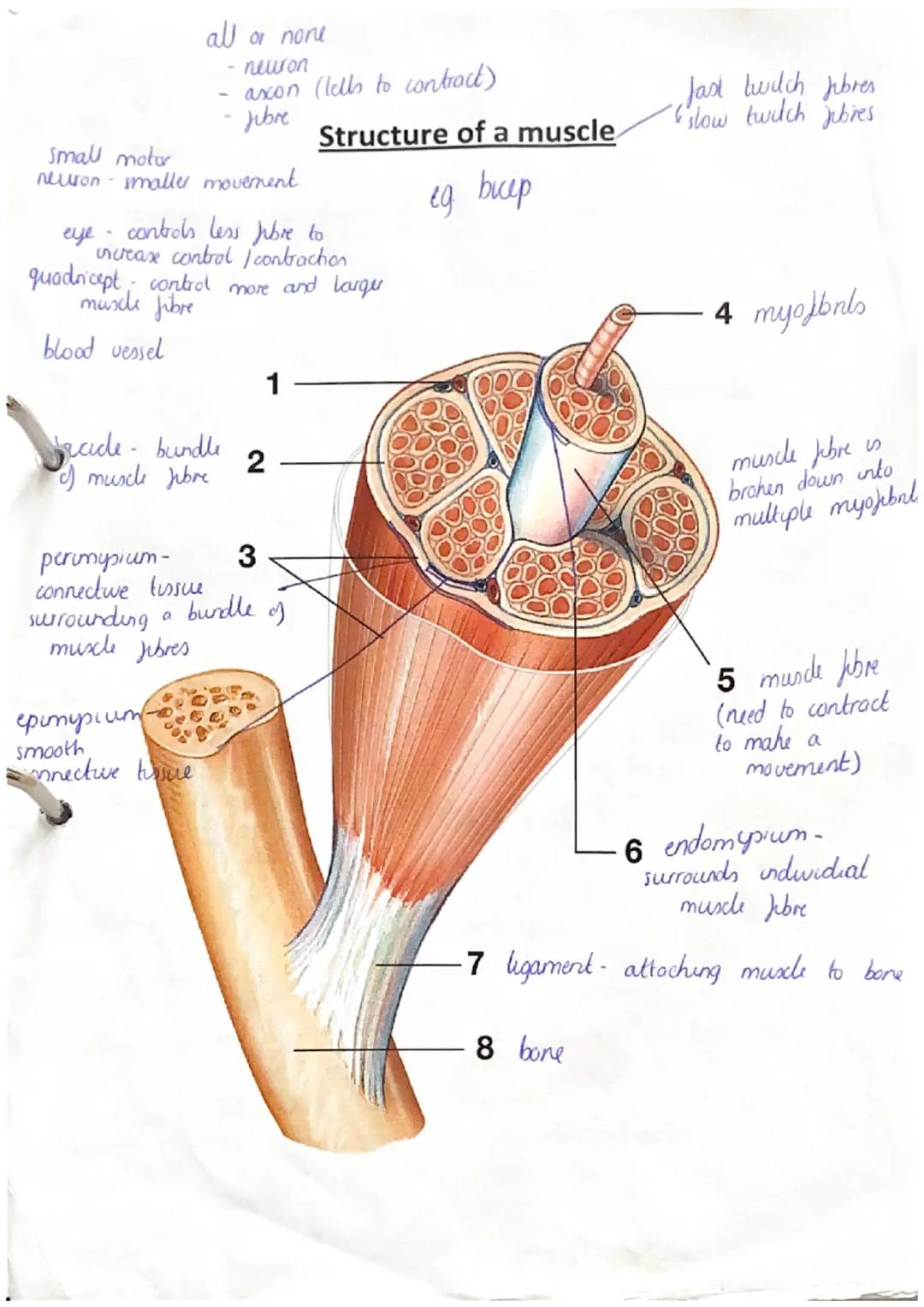
Muscles are organised in a hierarchical system. The entire muscle is wrapped in epimysium, then divided into fascicles (bundles) surrounded by perimysium. Individual muscle fibres are wrapped in endomysium and contain multiple myofibrils - the actual contractile units.

Motor neurons control muscle contraction through their axons, which branch out to connect with multiple muscle fibres. Smaller motor neurons control fewer fibres for precise movements (like eye movements), whilst larger ones control massive muscle groups like your quadriceps for powerful actions.

Your muscles contain two main types of fibres fast twitch for explosive power and slow twitch for endurance. The ratio you're born with largely determines whether you're naturally better at sprinting or marathon running, though training can modify their characteristics.

Fascinating Fact Your eye muscles might have motor units controlling just 10 fibres for precise control, whilst your quadriceps might have units controlling over 1,000 fibres for maximum power!

anterior
deltoid
(antenor)
pectoralis major
rectus
abdominis
abdominal
external oblique
wrist
Hixon
adductor
longus
rectus
fermons
vastus
la

The Motor Unit and Neural Control

Your brain controlling your muscles is like a sophisticated computer network sending signals at lightning speed. Understanding this neuromuscular system explains why some people are naturally more coordinated and how you can improve your own movement skills.

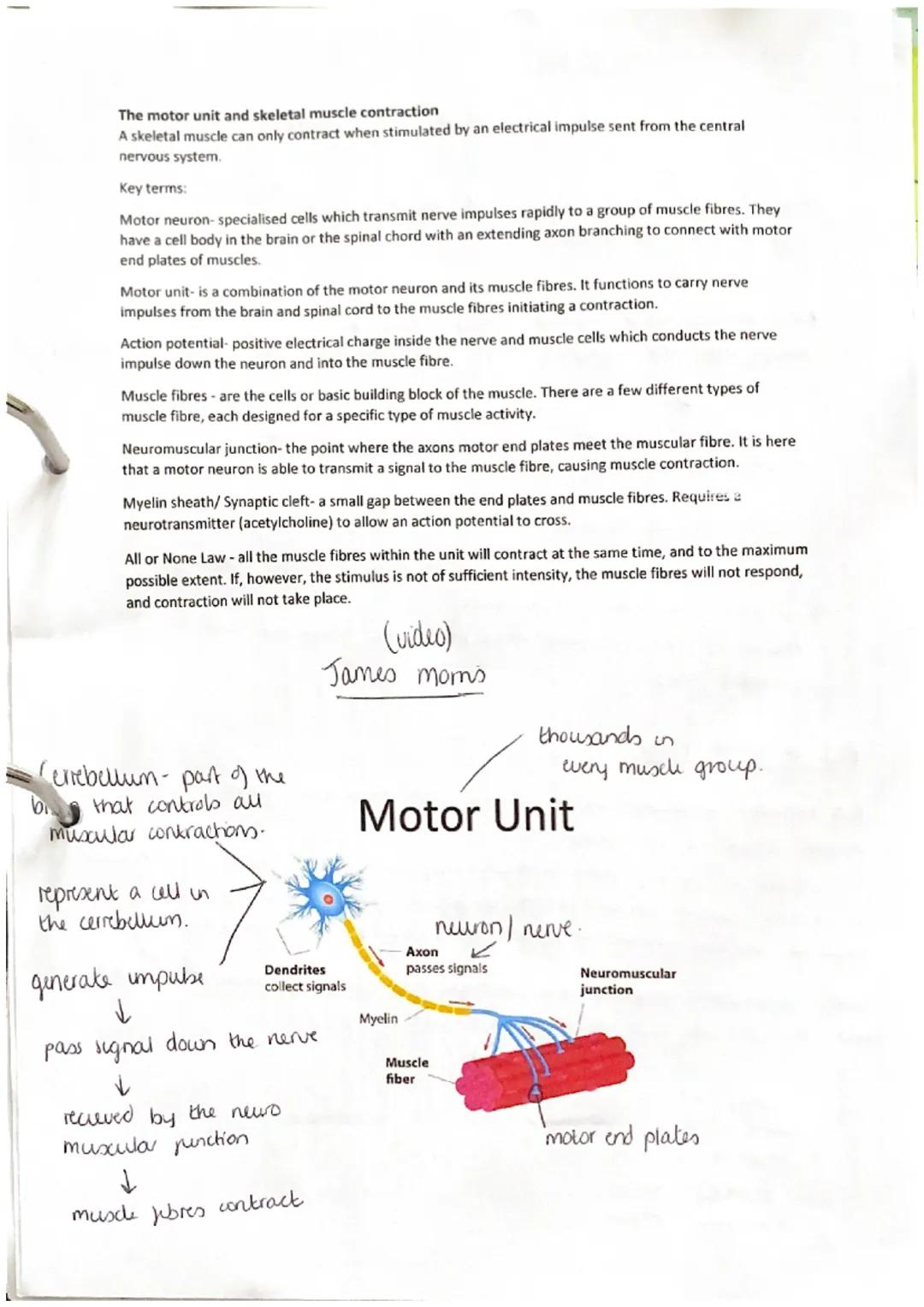
A motor unit consists of one motor neuron and all the muscle fibres it controls. When your brain decides to move, it sends an action potential (electrical impulse) down the neuron's axon to the neuromuscular junction where it meets the muscle.

The signal must cross the synaptic cleft using a neurotransmitter called acetylcholine. If the signal is strong enough, it triggers muscle contraction. This follows the All or None Law - either all fibres in a motor unit contract maximally, or none contract at all.

Your cerebellum orchestrates this entire process, coordinating thousands of motor units to create smooth, controlled movement. The myelin sheath around neurons speeds up signal transmission, which is why well-trained athletes have such quick reflexes and precise control.

Training Application Regular practice literally rewires your brain, creating more efficient neural pathways - this is why skills become "muscle memory" with enough repetition.

anterior
deltoid
(antenor)
pectoralis major
rectus
abdominis
abdominal
external oblique
wrist
Hixon
adductor
longus
rectus
fermons
vastus
la

Creating Muscle Contractions

The process of muscle contraction is absolutely fascinating and explains why some movements feel effortless whilst others require maximum effort. Mastering this concept helps you understand training intensity and muscle recruitment patterns.

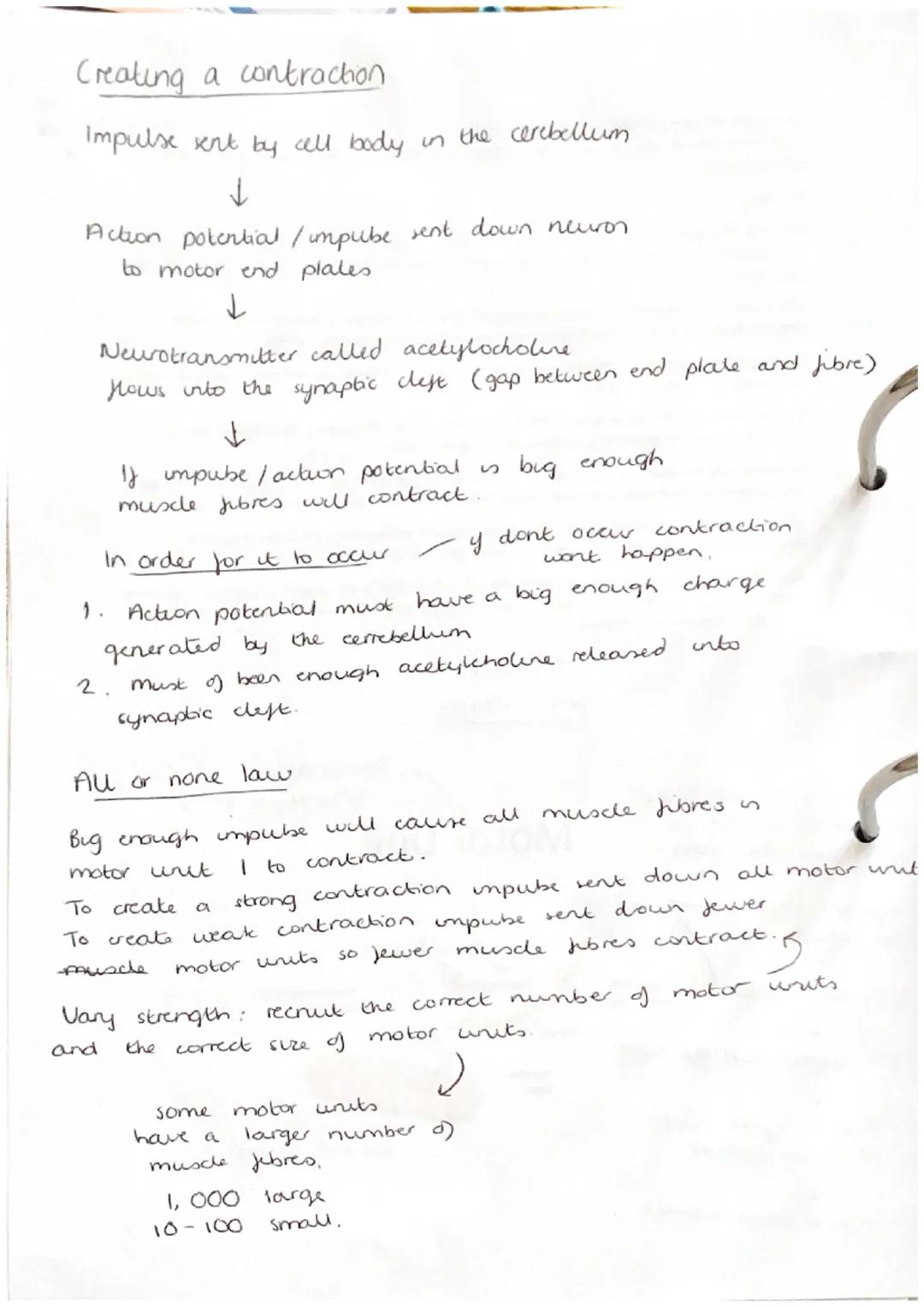
Contraction starts when your cerebellum generates an impulse that travels down the motor neuron as an action potential. At the neuromuscular junction, acetylcholine flows into the synaptic cleft. If there's sufficient neurotransmitter and the signal is strong enough, the muscle fibres contract.

The All or None Law means that when a motor unit fires, every fibre within it contracts maximally. To create stronger contractions, your nervous system recruits more motor units. For weaker movements, it activates fewer units, giving you precise control over force production.

Motor unit size varies dramatically - small units might control 10-100 muscle fibres for delicate tasks, whilst large units can control over 1,000 fibres for maximum power. Your brain cleverly selects the right combination based on the task demands.

Performance Tip This explains why strength training works - you're not just building bigger muscles, but also training your nervous system to recruit more motor units more efficiently.

anterior
deltoid
(antenor)
pectoralis major
rectus
abdominis
abdominal
external oblique
wrist
Hixon
adductor
longus
rectus
fermons
vastus
la

Muscle Fibre Types and Characteristics

Your muscles contain different types of fibres, each designed for specific activities - understanding this explains why some people excel at different sports and how to train most effectively for your goals.

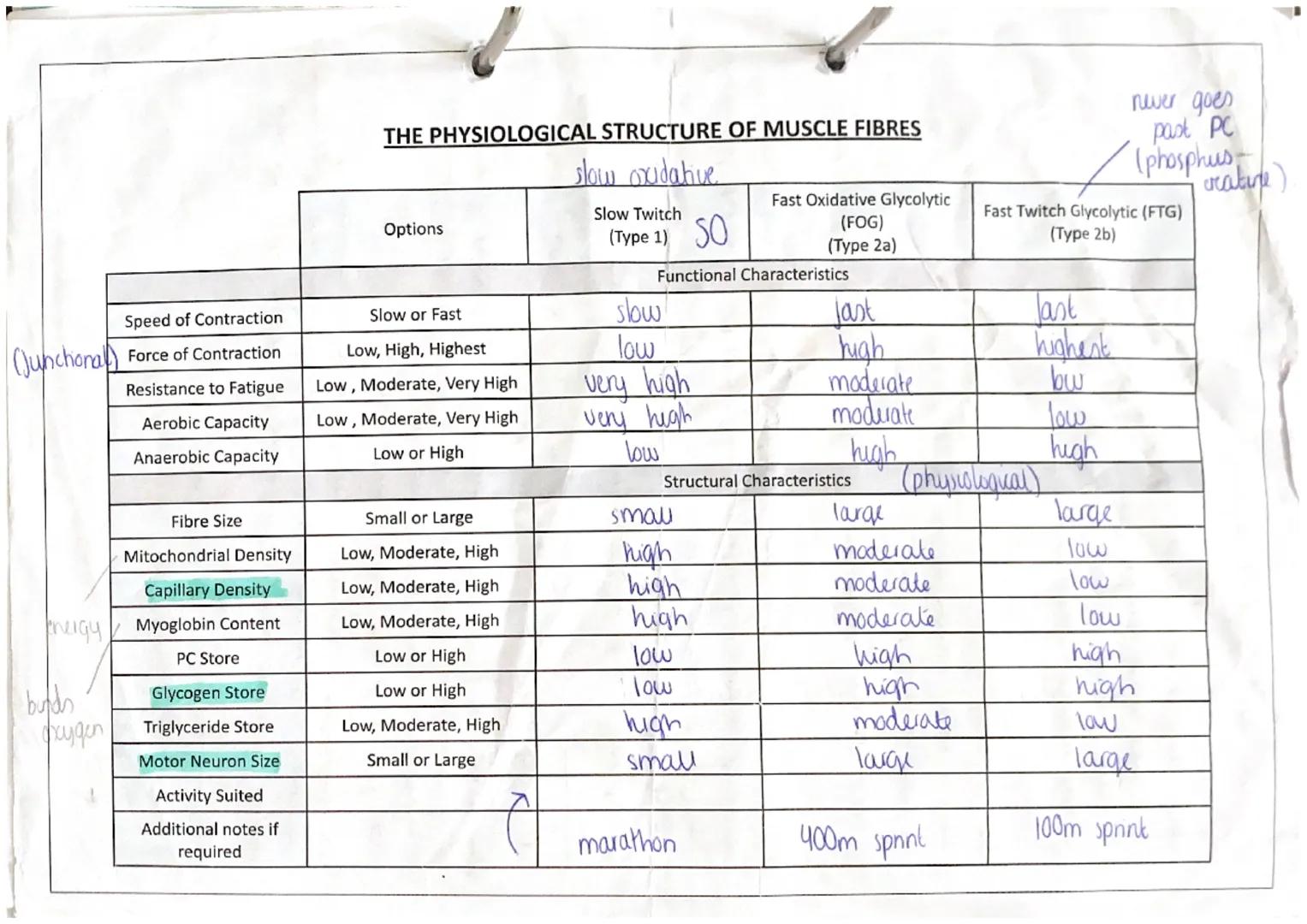
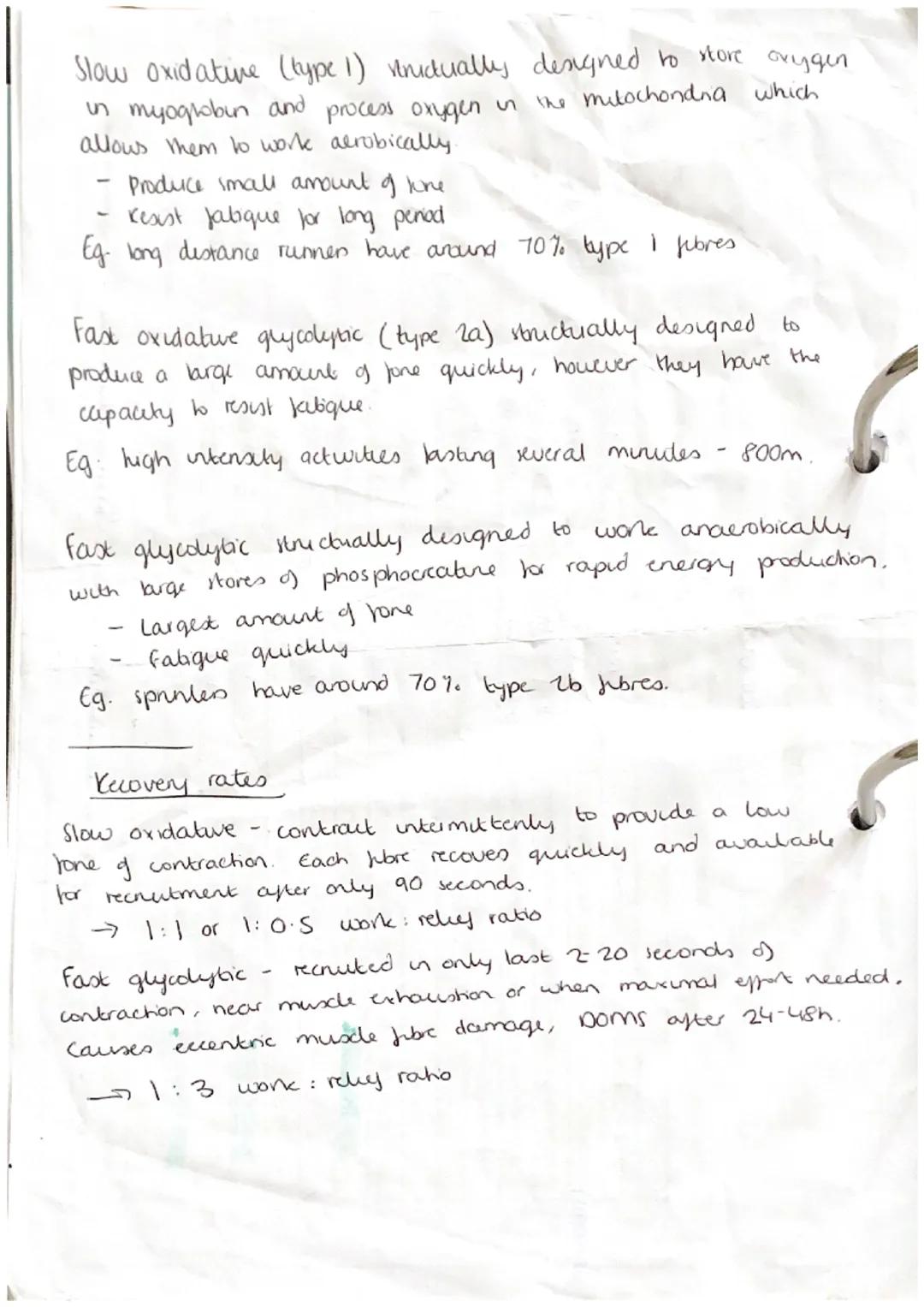
Slow oxidative fibres (Type I) are your endurance specialists. They're packed with mitochondria and myoglobin for oxygen processing, have high capillary density for blood flow, but produce relatively low force. These fibres resist fatigue brilliantly and suit marathon running.

Fast oxidative glycolytic fibres (Type IIa) are the all-rounders. They can work both aerobically and anaerobically, producing moderate to high force whilst maintaining decent fatigue resistance. They're perfect for activities like 400m sprints or football.

Fast glycolytic fibres (Type IIb) are pure power machines. They have large stores of phosphocreatine, big glycogen stores, but low mitochondrial density. They produce the highest force but fatigue quickly - ideal for 100m sprints or powerlifting.

Genetic Reality Elite marathon runners often have 70% Type I fibres, whilst elite sprinters have 70% Type IIb fibres - but training can modify fibre characteristics to some extent.

anterior
deltoid
(antenor)
pectoralis major
rectus
abdominis
abdominal
external oblique
wrist
Hixon
adductor
longus
rectus
fermons
vastus
la

Fibre Types in Training and Recovery

Understanding how different muscle fibres respond to training and recover is crucial for designing effective programmes and avoiding overtraining. Each fibre type has unique characteristics that directly impact your training approach.

Slow oxidative fibres work intermittently and recover incredibly quickly - they're ready for action again after just 90 seconds. This means you can use short rest periods 11or10.5worktorestratios11 or 10.5 work-to-rest ratios for endurance training without compromising performance.

Fast oxidative glycolytic fibres bridge the gap between endurance and power. They can handle several minutes of high-intensity work but need moderate recovery time. They're perfect for interval training and sports requiring repeated high-intensity efforts.

Fast glycolytic fibres are recruited only during maximum efforts lasting 2-20 seconds. They cause significant muscle damage and DOMS (delayed onset muscle soreness) appearing 24-48 hours later. They require much longer recovery 13worktorestratios13 work-to-rest ratios between intense sessions.

Recovery Wisdom This explains why you can do light cardio daily but need 48-72 hours between intense strength sessions - different fibre types have completely different recovery needs.

We thought you’d never ask...

What is the Knowunity AI companion?

Our AI companion is specifically built for the needs of students. Based on the millions of content pieces we have on the platform we can provide truly meaningful and relevant answers to students. But its not only about answers, the companion is even more about guiding students through their daily learning challenges, with personalised study plans, quizzes or content pieces in the chat and 100% personalisation based on the students skills and developments.

Where can I download the Knowunity app?

You can download the app in the Google Play Store and in the Apple App Store.

Is Knowunity really free of charge?

That's right! Enjoy free access to study content, connect with fellow students, and get instant help – all at your fingertips.

7

Smart Tools NEW

Transform this note into: ✓ 50+ Practice Questions ✓ Interactive Flashcards ✓ Full Mock Exam ✓ Essay Outlines

Mock Exam
Quiz
Flashcards
Essay

Similar Content

Muscular System & Lever Mechanics

Explore the key concepts of the muscular system and lever mechanics essential for GCSE Physical Education (OCR). This summary covers the 11 major muscles, their roles in movement, antagonistic pairs, and the three types of lever systems. Ideal for exam preparation and understanding functional anatomy.

Physical EducationPhysical Education
11

Skeletal System Overview

Explore the comprehensive anatomy of the skeletal system, including types of bones, their functions, and the structure of the spine. This presentation covers key concepts such as bone growth, joint types, and the roles of ligaments, making it essential for Level 3 Sports Science students.

Physical EducationPhysical Education
11

Lifestyle Fitness

Physical fitness is to the human body what fine tuning is to an engine. It enables us to perform up to our potential.

HealthHealth

Anatomy and physiology

Anatomy and physiology for grade 11 and 12

Physical EducationPhysical Education
11th

Muscle Fiber Types & Functions

Explore the different types of muscle fibers, including Type I, Type IIa, and Type IIb, and their roles in physical activities. Understand the concept of antagonistic muscle pairs and how they work together to facilitate movement. This summary covers key concepts in muscle physiology, ideal for students studying anatomy and sports science.

PEPE
11

Understanding the Skeletal System

Explore the key components of the skeletal system, including bone types, joint structures, and their functions in movement and protection. This summary covers the roles of bones in blood cell production, mineral storage, and muscle attachment, along with detailed descriptions of various joint types and their movements. Ideal for students studying human anatomy and physiology.

PEPE
11

Can't find what you're looking for? Explore other subjects.

Students love us — and so will you.

4.9/5

App Store

4.8/5

Google Play

The app is very easy to use and well designed. I have found everything I was looking for so far and have been able to learn a lot from the presentations! I will definitely use the app for a class assignment! And of course it also helps a lot as an inspiration.

Stefan S

iOS user

This app is really great. There are so many study notes and help [...]. My problem subject is French, for example, and the app has so many options for help. Thanks to this app, I have improved my French. I would recommend it to anyone.

Samantha Klich

Android user

Wow, I am really amazed. I just tried the app because I've seen it advertised many times and was absolutely stunned. This app is THE HELP you want for school and above all, it offers so many things, such as workouts and fact sheets, which have been VERY helpful to me personally.

Anna

iOS user

I think it’s very much worth it and you’ll end up using it a lot once you get the hang of it and even after looking at others notes you can still ask your Artificial intelligence buddy the question and ask to simplify it if you still don’t get it!!! In the end I think it’s worth it 😊👍 ⚠️Also DID I MENTION ITS FREEE YOU DON’T HAVE TO PAY FOR ANYTHING AND STILL GET YOUR GRADES IN PERFECTLY❗️❗️⚠️

Thomas R

iOS user

Knowunity is the BEST app I’ve used in a minute. This is not an ai review or anything this is genuinely coming from a 7th grade student (I know 2011 im young) but dude this app is a 10/10 i have maintained a 3.8 gpa and have plenty of time for gaming. I love it and my mom is just happy I got good grades

Brad T

Android user

Not only did it help me find the answer but it also showed me alternative ways to solve it. I was horrible in math and science but now I have an a in both subjects. Thanks for the help🤍🤍

David K

iOS user

The app's just great! All I have to do is enter the topic in the search bar and I get the response real fast. I don't have to watch 10 YouTube videos to understand something, so I'm saving my time. Highly recommended!

Sudenaz Ocak

Android user

In school I was really bad at maths but thanks to the app, I am doing better now. I am so grateful that you made the app.

Greenlight Bonnie

Android user

I found this app a couple years ago and it has only gotten better since then. I really love it because it can help with written questions and photo questions. Also, it can find study guides that other people have made as well as flashcard sets and practice tests. The free version is also amazing for students who might not be able to afford it. Would 100% recommend

Aubrey

iOS user

Best app if you're in Highschool or Junior high. I have been using this app for 2 school years and it's the best, it's good if you don't have anyone to help you with school work.😋🩷🎀

Marco B

iOS user

THE QUIZES AND FLASHCARDS ARE SO USEFUL AND I LOVE THE SCHOOLGPT. IT ALSO IS LITREALLY LIKE CHATGPT BUT SMARTER!! HELPED ME WITH MY MASCARA PROBLEMS TOO!! AS WELL AS MY REAL SUBJECTS ! DUHHH 😍😁😲🤑💗✨🎀😮

Elisha

iOS user

This app is phenomenal down to the correct info and the various topics you can study! I greatly recommend it for people who struggle with procrastination and those who need homework help. It has been perfectly accurate for world 1 history as far as I’ve seen! Geometry too!

Paul T

iOS user

The app is very easy to use and well designed. I have found everything I was looking for so far and have been able to learn a lot from the presentations! I will definitely use the app for a class assignment! And of course it also helps a lot as an inspiration.

Stefan S

iOS user

This app is really great. There are so many study notes and help [...]. My problem subject is French, for example, and the app has so many options for help. Thanks to this app, I have improved my French. I would recommend it to anyone.

Samantha Klich

Android user

Wow, I am really amazed. I just tried the app because I've seen it advertised many times and was absolutely stunned. This app is THE HELP you want for school and above all, it offers so many things, such as workouts and fact sheets, which have been VERY helpful to me personally.

Anna

iOS user

I think it’s very much worth it and you’ll end up using it a lot once you get the hang of it and even after looking at others notes you can still ask your Artificial intelligence buddy the question and ask to simplify it if you still don’t get it!!! In the end I think it’s worth it 😊👍 ⚠️Also DID I MENTION ITS FREEE YOU DON’T HAVE TO PAY FOR ANYTHING AND STILL GET YOUR GRADES IN PERFECTLY❗️❗️⚠️

Thomas R

iOS user

Knowunity is the BEST app I’ve used in a minute. This is not an ai review or anything this is genuinely coming from a 7th grade student (I know 2011 im young) but dude this app is a 10/10 i have maintained a 3.8 gpa and have plenty of time for gaming. I love it and my mom is just happy I got good grades

Brad T

Android user

Not only did it help me find the answer but it also showed me alternative ways to solve it. I was horrible in math and science but now I have an a in both subjects. Thanks for the help🤍🤍

David K

iOS user

The app's just great! All I have to do is enter the topic in the search bar and I get the response real fast. I don't have to watch 10 YouTube videos to understand something, so I'm saving my time. Highly recommended!

Sudenaz Ocak

Android user

In school I was really bad at maths but thanks to the app, I am doing better now. I am so grateful that you made the app.

Greenlight Bonnie

Android user

I found this app a couple years ago and it has only gotten better since then. I really love it because it can help with written questions and photo questions. Also, it can find study guides that other people have made as well as flashcard sets and practice tests. The free version is also amazing for students who might not be able to afford it. Would 100% recommend

Aubrey

iOS user

Best app if you're in Highschool or Junior high. I have been using this app for 2 school years and it's the best, it's good if you don't have anyone to help you with school work.😋🩷🎀

Marco B

iOS user

THE QUIZES AND FLASHCARDS ARE SO USEFUL AND I LOVE THE SCHOOLGPT. IT ALSO IS LITREALLY LIKE CHATGPT BUT SMARTER!! HELPED ME WITH MY MASCARA PROBLEMS TOO!! AS WELL AS MY REAL SUBJECTS ! DUHHH 😍😁😲🤑💗✨🎀😮

Elisha

iOS user

This app is phenomenal down to the correct info and the various topics you can study! I greatly recommend it for people who struggle with procrastination and those who need homework help. It has been perfectly accurate for world 1 history as far as I’ve seen! Geometry too!

Paul T

iOS user


PE

238

Nov 25, 2025

9 pages

Understanding the Muscular System for OCR PE Students

K

katie turner

@katieturner_eanq

Understanding how your muscles work is absolutely crucial for PE, sports science, and any fitness goals you might have. This guide breaks down muscle anatomy, how muscles create movement, and the fascinating science behind muscle contractions - knowledge that'll help... Show more

anterior
deltoid
(antenor)
pectoralis major
rectus
abdominis
abdominal
external oblique
wrist
Hixon
adductor
longus
rectus
fermons
vastus
la

Sign up to see the contentIt's free!

Access to all documents

Improve your grades

Join milions of students

By signing up you accept Terms of Service and Privacy Policy

Anterior Muscle Anatomy

Getting familiar with your anterior muscles (the ones you can see when looking in the mirror) is your first step to understanding how your body moves. These muscles are the powerhouses behind most of your daily movements and sports activities.

The major players include your deltoids in your shoulders, pectoralis major in your chest, and the rectus abdominis yoursixpackmusclesyour six-pack muscles. Your arms feature the biceps brachii for flexing and the brachialis underneath for extra power.

Down in your legs, you've got the massive quadriceps group - including rectus femoris, vastus lateralis, and vastus medialis - which straighten your knee and help you jump, run, and squat. The iliopsoas connects your spine to your thigh, making it essential for lifting your legs.

Quick Tip: These anterior muscles often work as the "agonists" (prime movers) when you're pushing, lifting, or moving forward - think push-ups, squats, or sprinting.

anterior
deltoid
(antenor)
pectoralis major
rectus
abdominis
abdominal
external oblique
wrist
Hixon
adductor
longus
rectus
fermons
vastus
la

Sign up to see the contentIt's free!

Access to all documents

Improve your grades

Join milions of students

By signing up you accept Terms of Service and Privacy Policy

Posterior Muscle Anatomy

Your posterior muscles are the unsung heroes of good posture and athletic performance. These muscles on the back of your body often get overlooked, but they're absolutely essential for balanced movement and preventing injuries.

Key muscles include the trapezius spanning your upper back and neck, latissimus dorsi (your "lats") for pulling movements, and the posterior deltoid at the back of your shoulders. Your teres major and minor help rotate and stabilise your shoulders.

The gluteus maximus is actually your body's largest muscle and provides serious power for running and jumping. Support comes from gluteus medius and minimus for hip stability. Your legs feature the hamstring group (semitendinosus, semimembranosus) and gastrocnemius and soleus in your calves.

Remember: Posterior muscles typically act as stabilisers and work opposite to your anterior muscles - they're crucial for balanced training and injury prevention.

anterior
deltoid
(antenor)
pectoralis major
rectus
abdominis
abdominal
external oblique
wrist
Hixon
adductor
longus
rectus
fermons
vastus
la

Sign up to see the contentIt's free!

Access to all documents

Improve your grades

Join milions of students

By signing up you accept Terms of Service and Privacy Policy

How Muscles Create Movement

Muscles are basically your body's engines, converting chemical energy into the mechanical force that moves your bones. Understanding how this works will make you a much more effective athlete and help you avoid injuries.

Every muscle has an origin (the fixed attachment point) and an insertion (the moving attachment point). During movement, muscles work in teams: the agonist creates the movement, the antagonist provides controlled resistance, and fixator muscles keep everything stable.

Muscle contraction happens in different ways. Concentric contractions shorten the muscle (like lifting a weight up), while eccentric contractions lengthen it under tension (lowering the weight down). Isometric contractions create force without movement - perfect for holding positions.

The tables show exactly which muscles work together for each joint movement. For example, during a bicep curl, your biceps brachii is the agonist whilst your triceps brachii acts as the antagonist, creating smooth, controlled movement in the sagittal plane.

Training Tip: Understanding agonist-antagonist pairs helps you create balanced workouts - if you train your chest (agonist), don't forget your back muscles (antagonist)!

anterior
deltoid
(antenor)
pectoralis major
rectus
abdominis
abdominal
external oblique
wrist
Hixon
adductor
longus
rectus
fermons
vastus
la

Sign up to see the contentIt's free!

Access to all documents

Improve your grades

Join milions of students

By signing up you accept Terms of Service and Privacy Policy

Major Joint Movements and Muscle Actions

Each joint in your body has specific muscles responsible for different movements, and knowing these partnerships is essential for effective training and injury prevention. This systematic approach helps you understand exactly what's happening during any exercise or sport movement.

Your hip joint (ball and socket) relies on the iliopsoas for flexion and gluteus maximus for powerful extension - think squats and deadlifts. The gluteus medius and minimus handle abduction (moving your leg sideways), whilst the adductor group brings it back.

The knee joint (hinge) features the classic battle between your quadriceps group (rectus femoris, vastus lateralis, vastus medialis, vastus intermedius) for extension and your hamstring group (bicep femoris, semitendinosus, semimembranosus) for flexion.

Your ankle joint uses tibialis anterior for dorsi flexion (pulling your toes up) and the powerful gastrocnemius and soleus for plantar flexion (pointing your toes down). These muscles are absolutely crucial for running, jumping, and maintaining balance.

Key Insight: Most injuries happen when there's an imbalance between agonist and antagonist muscles - strong quads but weak hamstrings often lead to knee problems.

anterior
deltoid
(antenor)
pectoralis major
rectus
abdominis
abdominal
external oblique
wrist
Hixon
adductor
longus
rectus
fermons
vastus
la

Sign up to see the contentIt's free!

Access to all documents

Improve your grades

Join milions of students

By signing up you accept Terms of Service and Privacy Policy

Muscle Structure and Organisation

Understanding muscle structure is like looking under the bonnet of a high-performance car - it explains why your muscles work the way they do. This knowledge helps you train more effectively and understand concepts like muscle fibre types.

Muscles are organised in a hierarchical system. The entire muscle is wrapped in epimysium, then divided into fascicles (bundles) surrounded by perimysium. Individual muscle fibres are wrapped in endomysium and contain multiple myofibrils - the actual contractile units.

Motor neurons control muscle contraction through their axons, which branch out to connect with multiple muscle fibres. Smaller motor neurons control fewer fibres for precise movements (like eye movements), whilst larger ones control massive muscle groups like your quadriceps for powerful actions.

Your muscles contain two main types of fibres: fast twitch for explosive power and slow twitch for endurance. The ratio you're born with largely determines whether you're naturally better at sprinting or marathon running, though training can modify their characteristics.

Fascinating Fact: Your eye muscles might have motor units controlling just 10 fibres for precise control, whilst your quadriceps might have units controlling over 1,000 fibres for maximum power!

anterior
deltoid
(antenor)
pectoralis major
rectus
abdominis
abdominal
external oblique
wrist
Hixon
adductor
longus
rectus
fermons
vastus
la

Sign up to see the contentIt's free!

Access to all documents

Improve your grades

Join milions of students

By signing up you accept Terms of Service and Privacy Policy

The Motor Unit and Neural Control

Your brain controlling your muscles is like a sophisticated computer network sending signals at lightning speed. Understanding this neuromuscular system explains why some people are naturally more coordinated and how you can improve your own movement skills.

A motor unit consists of one motor neuron and all the muscle fibres it controls. When your brain decides to move, it sends an action potential (electrical impulse) down the neuron's axon to the neuromuscular junction where it meets the muscle.

The signal must cross the synaptic cleft using a neurotransmitter called acetylcholine. If the signal is strong enough, it triggers muscle contraction. This follows the All or None Law - either all fibres in a motor unit contract maximally, or none contract at all.

Your cerebellum orchestrates this entire process, coordinating thousands of motor units to create smooth, controlled movement. The myelin sheath around neurons speeds up signal transmission, which is why well-trained athletes have such quick reflexes and precise control.

Training Application: Regular practice literally rewires your brain, creating more efficient neural pathways - this is why skills become "muscle memory" with enough repetition.

anterior
deltoid
(antenor)
pectoralis major
rectus
abdominis
abdominal
external oblique
wrist
Hixon
adductor
longus
rectus
fermons
vastus
la

Sign up to see the contentIt's free!

Access to all documents

Improve your grades

Join milions of students

By signing up you accept Terms of Service and Privacy Policy

Creating Muscle Contractions

The process of muscle contraction is absolutely fascinating and explains why some movements feel effortless whilst others require maximum effort. Mastering this concept helps you understand training intensity and muscle recruitment patterns.

Contraction starts when your cerebellum generates an impulse that travels down the motor neuron as an action potential. At the neuromuscular junction, acetylcholine flows into the synaptic cleft. If there's sufficient neurotransmitter and the signal is strong enough, the muscle fibres contract.

The All or None Law means that when a motor unit fires, every fibre within it contracts maximally. To create stronger contractions, your nervous system recruits more motor units. For weaker movements, it activates fewer units, giving you precise control over force production.

Motor unit size varies dramatically - small units might control 10-100 muscle fibres for delicate tasks, whilst large units can control over 1,000 fibres for maximum power. Your brain cleverly selects the right combination based on the task demands.

Performance Tip: This explains why strength training works - you're not just building bigger muscles, but also training your nervous system to recruit more motor units more efficiently.

anterior
deltoid
(antenor)
pectoralis major
rectus
abdominis
abdominal
external oblique
wrist
Hixon
adductor
longus
rectus
fermons
vastus
la

Sign up to see the contentIt's free!

Access to all documents

Improve your grades

Join milions of students

By signing up you accept Terms of Service and Privacy Policy

Muscle Fibre Types and Characteristics

Your muscles contain different types of fibres, each designed for specific activities - understanding this explains why some people excel at different sports and how to train most effectively for your goals.

Slow oxidative fibres (Type I) are your endurance specialists. They're packed with mitochondria and myoglobin for oxygen processing, have high capillary density for blood flow, but produce relatively low force. These fibres resist fatigue brilliantly and suit marathon running.

Fast oxidative glycolytic fibres (Type IIa) are the all-rounders. They can work both aerobically and anaerobically, producing moderate to high force whilst maintaining decent fatigue resistance. They're perfect for activities like 400m sprints or football.

Fast glycolytic fibres (Type IIb) are pure power machines. They have large stores of phosphocreatine, big glycogen stores, but low mitochondrial density. They produce the highest force but fatigue quickly - ideal for 100m sprints or powerlifting.

Genetic Reality: Elite marathon runners often have 70% Type I fibres, whilst elite sprinters have 70% Type IIb fibres - but training can modify fibre characteristics to some extent.

anterior
deltoid
(antenor)
pectoralis major
rectus
abdominis
abdominal
external oblique
wrist
Hixon
adductor
longus
rectus
fermons
vastus
la

Sign up to see the contentIt's free!

Access to all documents

Improve your grades

Join milions of students

By signing up you accept Terms of Service and Privacy Policy

Fibre Types in Training and Recovery

Understanding how different muscle fibres respond to training and recover is crucial for designing effective programmes and avoiding overtraining. Each fibre type has unique characteristics that directly impact your training approach.

Slow oxidative fibres work intermittently and recover incredibly quickly - they're ready for action again after just 90 seconds. This means you can use short rest periods 1:1or1:0.5worktorestratios1:1 or 1:0.5 work-to-rest ratios for endurance training without compromising performance.

Fast oxidative glycolytic fibres bridge the gap between endurance and power. They can handle several minutes of high-intensity work but need moderate recovery time. They're perfect for interval training and sports requiring repeated high-intensity efforts.

Fast glycolytic fibres are recruited only during maximum efforts lasting 2-20 seconds. They cause significant muscle damage and DOMS (delayed onset muscle soreness) appearing 24-48 hours later. They require much longer recovery 1:3worktorestratios1:3 work-to-rest ratios between intense sessions.

Recovery Wisdom: This explains why you can do light cardio daily but need 48-72 hours between intense strength sessions - different fibre types have completely different recovery needs.

We thought you’d never ask...

What is the Knowunity AI companion?

Our AI companion is specifically built for the needs of students. Based on the millions of content pieces we have on the platform we can provide truly meaningful and relevant answers to students. But its not only about answers, the companion is even more about guiding students through their daily learning challenges, with personalised study plans, quizzes or content pieces in the chat and 100% personalisation based on the students skills and developments.

Where can I download the Knowunity app?

You can download the app in the Google Play Store and in the Apple App Store.

Is Knowunity really free of charge?

That's right! Enjoy free access to study content, connect with fellow students, and get instant help – all at your fingertips.

7

Smart Tools NEW

Transform this note into: ✓ 50+ Practice Questions ✓ Interactive Flashcards ✓ Full Mock Exam ✓ Essay Outlines

Mock Exam
Quiz
Flashcards
Essay

Similar Content

Muscular System & Lever Mechanics

Explore the key concepts of the muscular system and lever mechanics essential for GCSE Physical Education (OCR). This summary covers the 11 major muscles, their roles in movement, antagonistic pairs, and the three types of lever systems. Ideal for exam preparation and understanding functional anatomy.

Physical EducationPhysical Education
11

Skeletal System Overview

Explore the comprehensive anatomy of the skeletal system, including types of bones, their functions, and the structure of the spine. This presentation covers key concepts such as bone growth, joint types, and the roles of ligaments, making it essential for Level 3 Sports Science students.

Physical EducationPhysical Education
11

Lifestyle Fitness

Physical fitness is to the human body what fine tuning is to an engine. It enables us to perform up to our potential.

HealthHealth

Anatomy and physiology

Anatomy and physiology for grade 11 and 12

Physical EducationPhysical Education
11th

Muscle Fiber Types & Functions

Explore the different types of muscle fibers, including Type I, Type IIa, and Type IIb, and their roles in physical activities. Understand the concept of antagonistic muscle pairs and how they work together to facilitate movement. This summary covers key concepts in muscle physiology, ideal for students studying anatomy and sports science.

PEPE
11

Understanding the Skeletal System

Explore the key components of the skeletal system, including bone types, joint structures, and their functions in movement and protection. This summary covers the roles of bones in blood cell production, mineral storage, and muscle attachment, along with detailed descriptions of various joint types and their movements. Ideal for students studying human anatomy and physiology.

PEPE
11

Can't find what you're looking for? Explore other subjects.

Students love us — and so will you.

4.9/5

App Store

4.8/5

Google Play

The app is very easy to use and well designed. I have found everything I was looking for so far and have been able to learn a lot from the presentations! I will definitely use the app for a class assignment! And of course it also helps a lot as an inspiration.

Stefan S

iOS user

This app is really great. There are so many study notes and help [...]. My problem subject is French, for example, and the app has so many options for help. Thanks to this app, I have improved my French. I would recommend it to anyone.

Samantha Klich

Android user

Wow, I am really amazed. I just tried the app because I've seen it advertised many times and was absolutely stunned. This app is THE HELP you want for school and above all, it offers so many things, such as workouts and fact sheets, which have been VERY helpful to me personally.

Anna

iOS user

I think it’s very much worth it and you’ll end up using it a lot once you get the hang of it and even after looking at others notes you can still ask your Artificial intelligence buddy the question and ask to simplify it if you still don’t get it!!! In the end I think it’s worth it 😊👍 ⚠️Also DID I MENTION ITS FREEE YOU DON’T HAVE TO PAY FOR ANYTHING AND STILL GET YOUR GRADES IN PERFECTLY❗️❗️⚠️

Thomas R

iOS user

Knowunity is the BEST app I’ve used in a minute. This is not an ai review or anything this is genuinely coming from a 7th grade student (I know 2011 im young) but dude this app is a 10/10 i have maintained a 3.8 gpa and have plenty of time for gaming. I love it and my mom is just happy I got good grades

Brad T

Android user

Not only did it help me find the answer but it also showed me alternative ways to solve it. I was horrible in math and science but now I have an a in both subjects. Thanks for the help🤍🤍

David K

iOS user

The app's just great! All I have to do is enter the topic in the search bar and I get the response real fast. I don't have to watch 10 YouTube videos to understand something, so I'm saving my time. Highly recommended!

Sudenaz Ocak

Android user

In school I was really bad at maths but thanks to the app, I am doing better now. I am so grateful that you made the app.

Greenlight Bonnie

Android user

I found this app a couple years ago and it has only gotten better since then. I really love it because it can help with written questions and photo questions. Also, it can find study guides that other people have made as well as flashcard sets and practice tests. The free version is also amazing for students who might not be able to afford it. Would 100% recommend

Aubrey

iOS user

Best app if you're in Highschool or Junior high. I have been using this app for 2 school years and it's the best, it's good if you don't have anyone to help you with school work.😋🩷🎀

Marco B

iOS user

THE QUIZES AND FLASHCARDS ARE SO USEFUL AND I LOVE THE SCHOOLGPT. IT ALSO IS LITREALLY LIKE CHATGPT BUT SMARTER!! HELPED ME WITH MY MASCARA PROBLEMS TOO!! AS WELL AS MY REAL SUBJECTS ! DUHHH 😍😁😲🤑💗✨🎀😮

Elisha

iOS user

This app is phenomenal down to the correct info and the various topics you can study! I greatly recommend it for people who struggle with procrastination and those who need homework help. It has been perfectly accurate for world 1 history as far as I’ve seen! Geometry too!

Paul T

iOS user

The app is very easy to use and well designed. I have found everything I was looking for so far and have been able to learn a lot from the presentations! I will definitely use the app for a class assignment! And of course it also helps a lot as an inspiration.

Stefan S

iOS user

This app is really great. There are so many study notes and help [...]. My problem subject is French, for example, and the app has so many options for help. Thanks to this app, I have improved my French. I would recommend it to anyone.

Samantha Klich

Android user

Wow, I am really amazed. I just tried the app because I've seen it advertised many times and was absolutely stunned. This app is THE HELP you want for school and above all, it offers so many things, such as workouts and fact sheets, which have been VERY helpful to me personally.

Anna

iOS user

I think it’s very much worth it and you’ll end up using it a lot once you get the hang of it and even after looking at others notes you can still ask your Artificial intelligence buddy the question and ask to simplify it if you still don’t get it!!! In the end I think it’s worth it 😊👍 ⚠️Also DID I MENTION ITS FREEE YOU DON’T HAVE TO PAY FOR ANYTHING AND STILL GET YOUR GRADES IN PERFECTLY❗️❗️⚠️

Thomas R

iOS user

Knowunity is the BEST app I’ve used in a minute. This is not an ai review or anything this is genuinely coming from a 7th grade student (I know 2011 im young) but dude this app is a 10/10 i have maintained a 3.8 gpa and have plenty of time for gaming. I love it and my mom is just happy I got good grades

Brad T

Android user

Not only did it help me find the answer but it also showed me alternative ways to solve it. I was horrible in math and science but now I have an a in both subjects. Thanks for the help🤍🤍

David K

iOS user

The app's just great! All I have to do is enter the topic in the search bar and I get the response real fast. I don't have to watch 10 YouTube videos to understand something, so I'm saving my time. Highly recommended!

Sudenaz Ocak

Android user

In school I was really bad at maths but thanks to the app, I am doing better now. I am so grateful that you made the app.

Greenlight Bonnie

Android user

I found this app a couple years ago and it has only gotten better since then. I really love it because it can help with written questions and photo questions. Also, it can find study guides that other people have made as well as flashcard sets and practice tests. The free version is also amazing for students who might not be able to afford it. Would 100% recommend

Aubrey

iOS user

Best app if you're in Highschool or Junior high. I have been using this app for 2 school years and it's the best, it's good if you don't have anyone to help you with school work.😋🩷🎀

Marco B

iOS user

THE QUIZES AND FLASHCARDS ARE SO USEFUL AND I LOVE THE SCHOOLGPT. IT ALSO IS LITREALLY LIKE CHATGPT BUT SMARTER!! HELPED ME WITH MY MASCARA PROBLEMS TOO!! AS WELL AS MY REAL SUBJECTS ! DUHHH 😍😁😲🤑💗✨🎀😮

Elisha

iOS user

This app is phenomenal down to the correct info and the various topics you can study! I greatly recommend it for people who struggle with procrastination and those who need homework help. It has been perfectly accurate for world 1 history as far as I’ve seen! Geometry too!

Paul T

iOS user