
Ready to ace your General Science exam? This reviewer covers... Show more
 Physical Science
 Health
 Earth and Space Science
 Algebra
 Calculus 1
 Algebra 1
 Overige
Sign up to see the contentIt's free!
Access to all documents
Improve your grades
Join milions of students
By signing up you accept Terms of Service and Privacy Policy
Subjects

Biology

Chemistry
AP Chemistry

English
AP English Literature
3
0
Daniel Aguada
11/29/2025
Physical Science
Gen Sci 11
105
•
Nov 29, 2025
•
Daniel Aguada
@danielaguada
Ready to ace your General Science exam? This reviewer covers... Show more
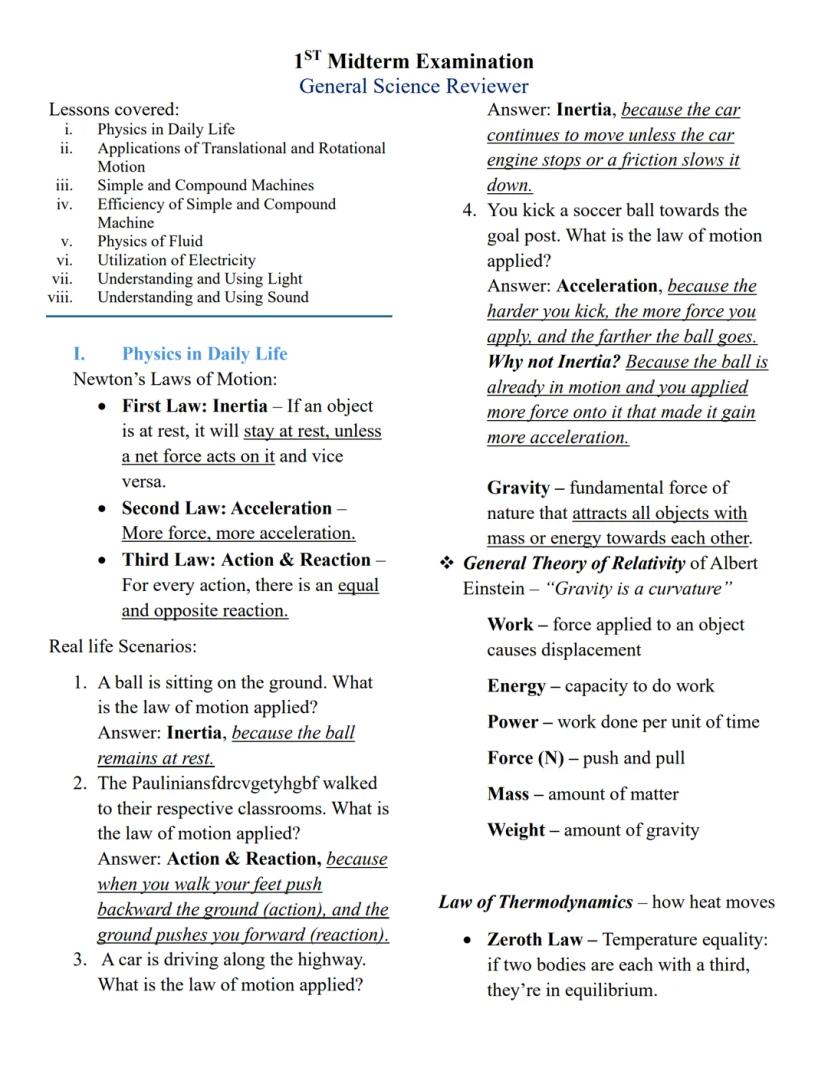
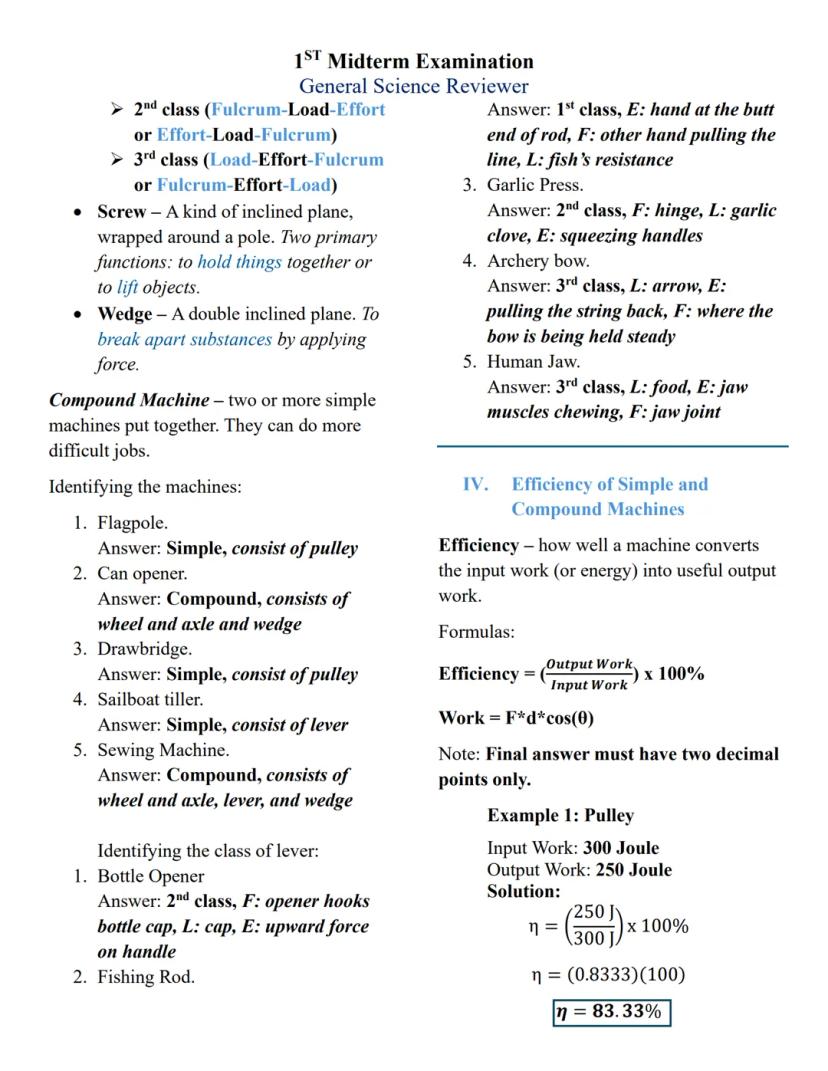
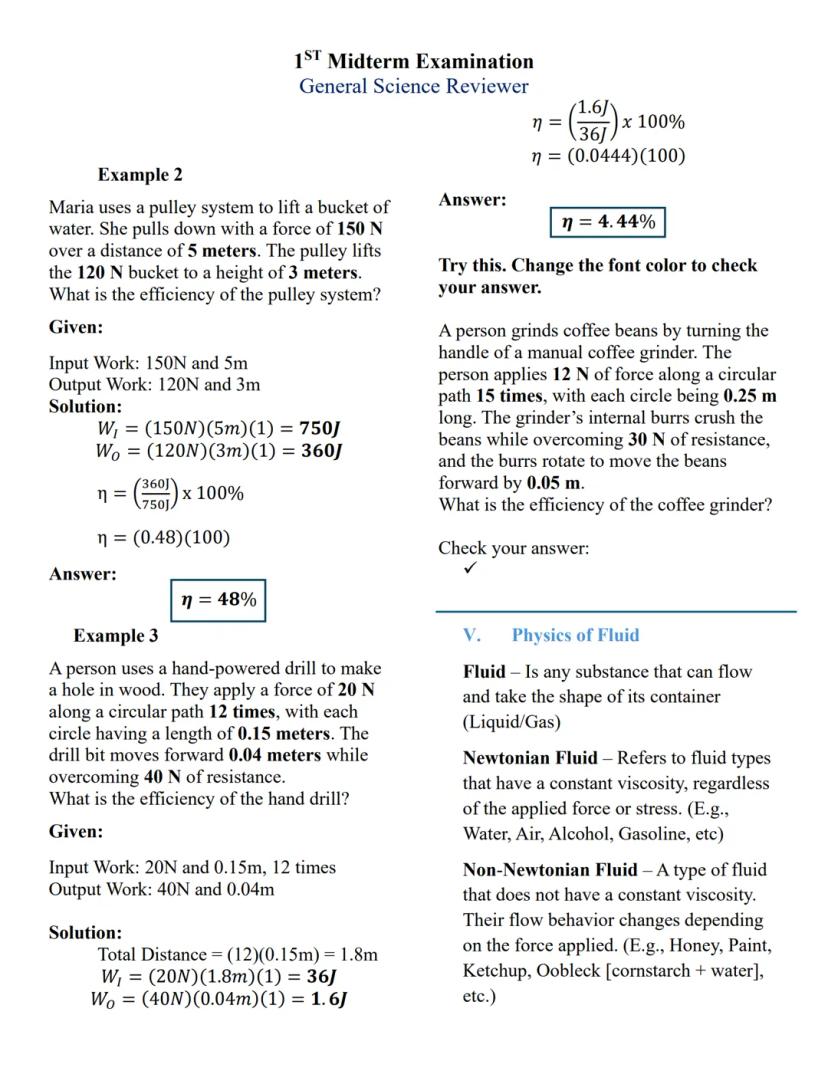
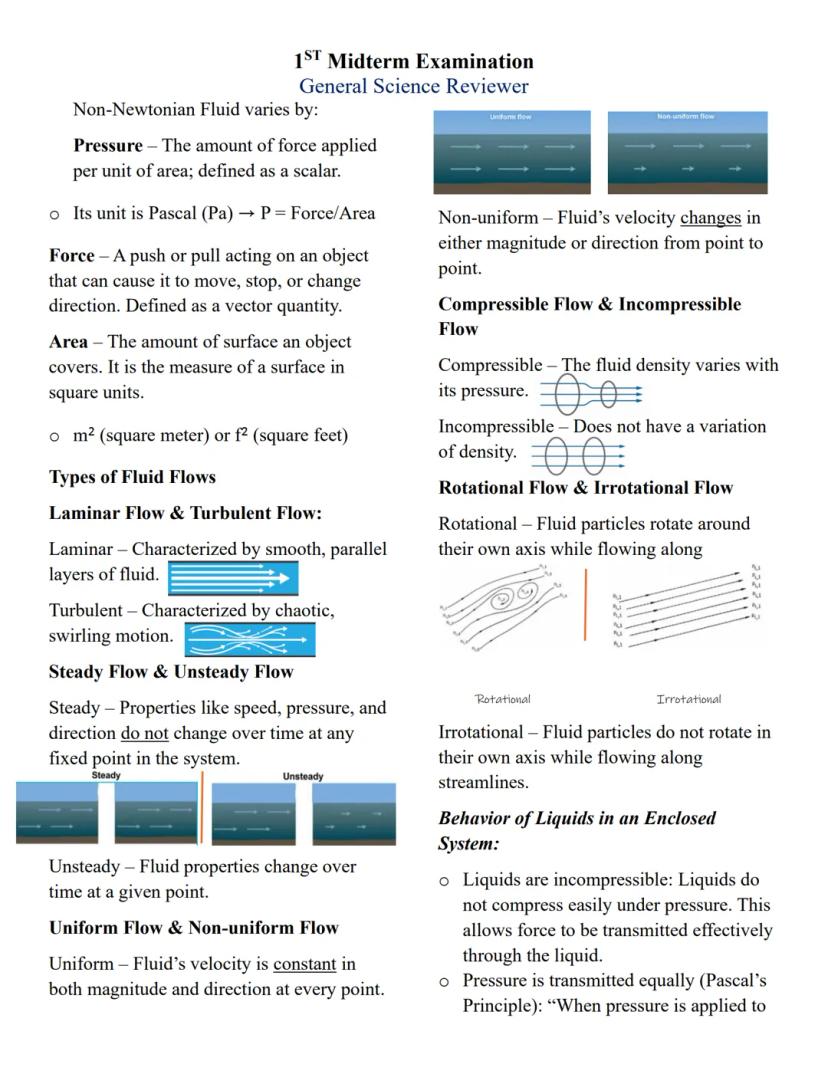
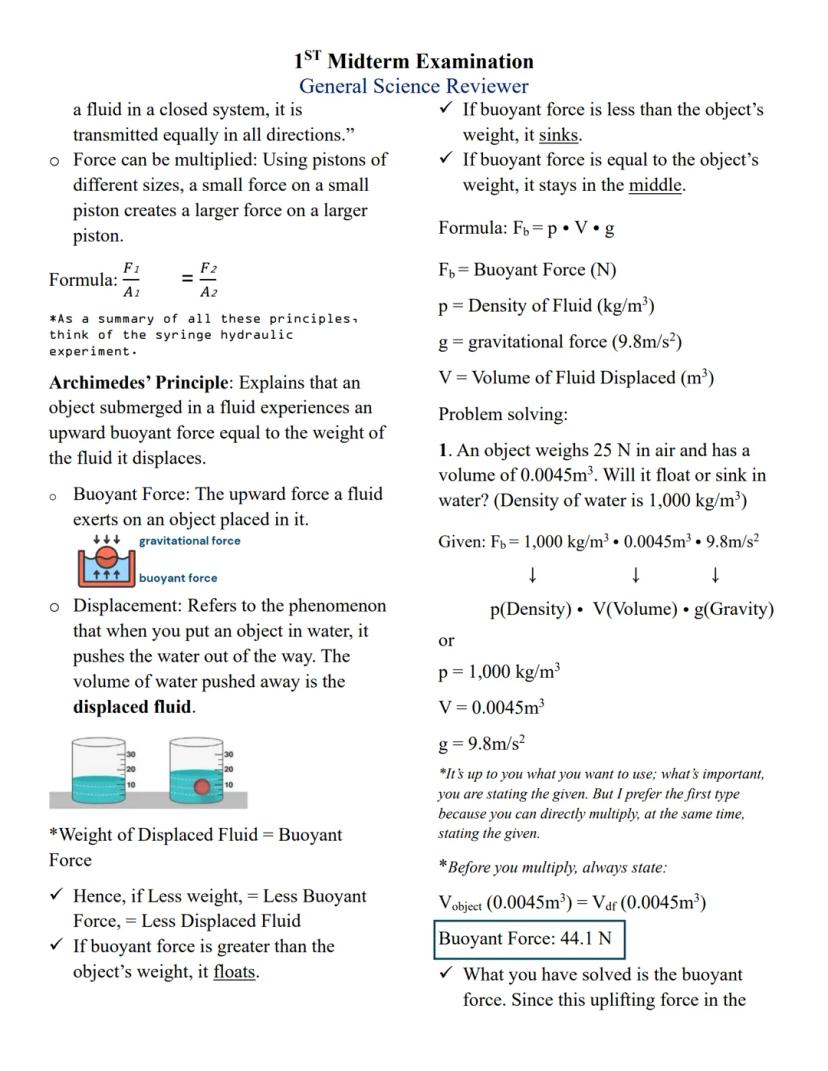
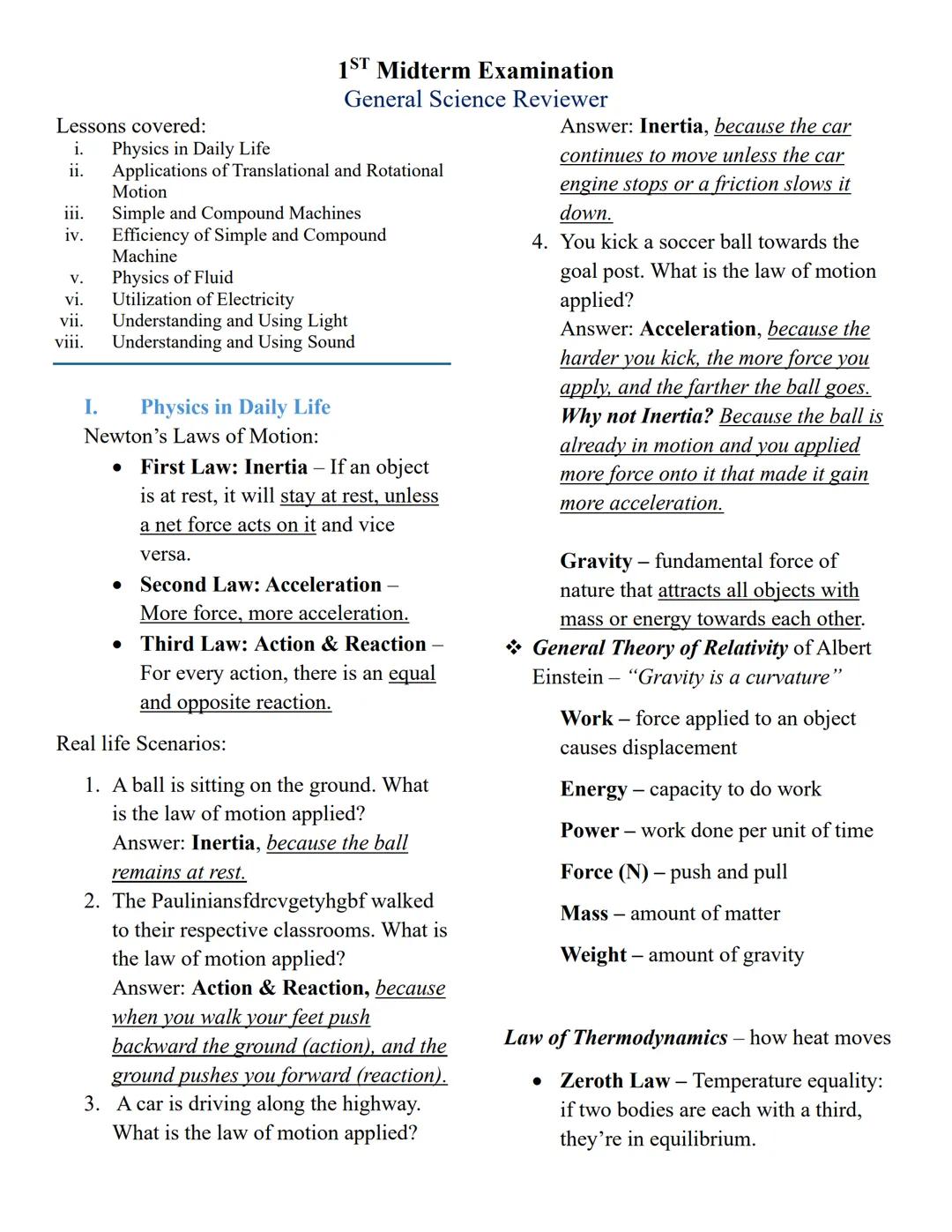
Ever wondered why a soccer ball keeps rolling after you kick it? Physics explains it! Newton's Laws of Motion govern everything that moves. The First Law (Inertia) tells us objects stay at rest or in motion unless acted upon by force—like a ball sitting on the ground. The Second Law (Acceleration) shows that more force creates more acceleration—kick a soccer ball harder and it goes farther. The Third Law (Action & Reaction) explains that for every action there's an equal opposite reaction—when you walk, you push back on the ground, and it pushes you forward.
Physics concepts explain our daily experiences through fundamental principles. Gravity attracts objects with mass toward each other, while work occurs when force causes displacement. The relationship between energy (capacity to do work) and power (work done per unit of time) helps us understand efficiency in physical systems.
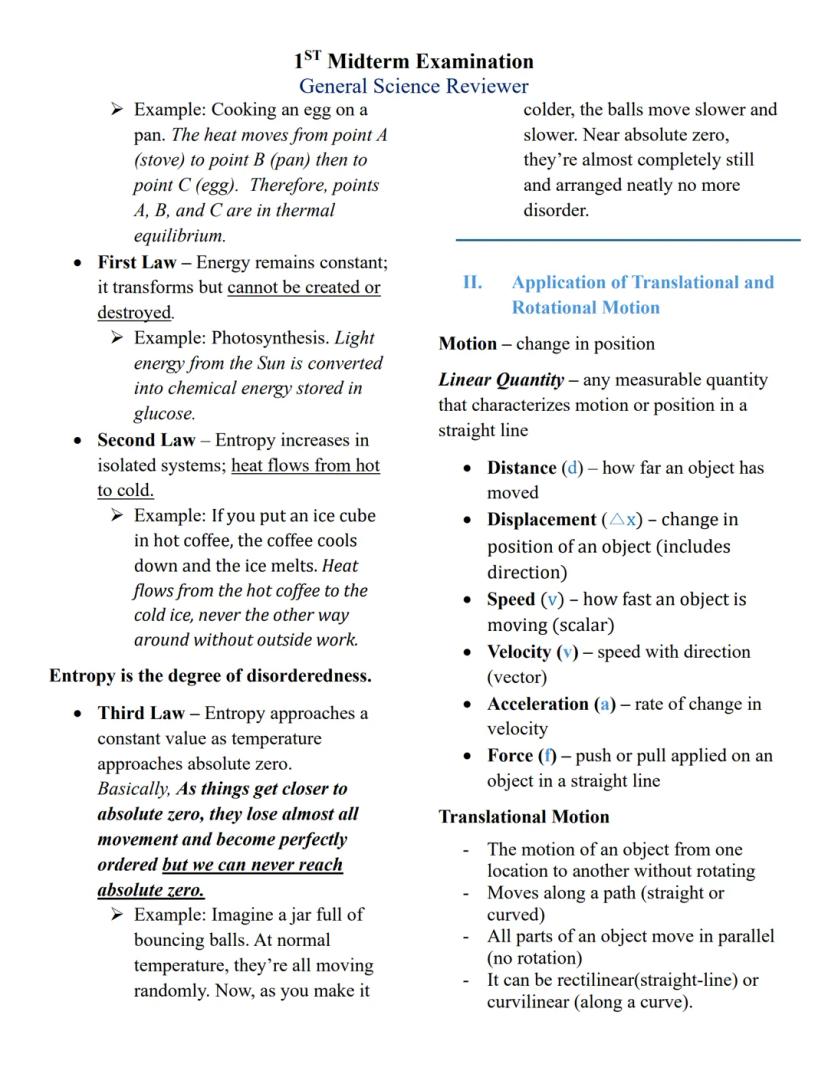
The Laws of Thermodynamics explain how heat moves through our world. The Zeroth Law shows that if two bodies are in equilibrium with a third, they're in equilibrium with each other (like heat traveling from stove → pan → egg during cooking). The First Law tells us energy can't be created or destroyed, only transformed—like sunlight converting to chemical energy in plants.
Science Connection: When you kick a soccer ball toward the goal, you're seeing Newton's Second Law in action! The harder you kick (more force), the greater the acceleration and the farther the ball travels.
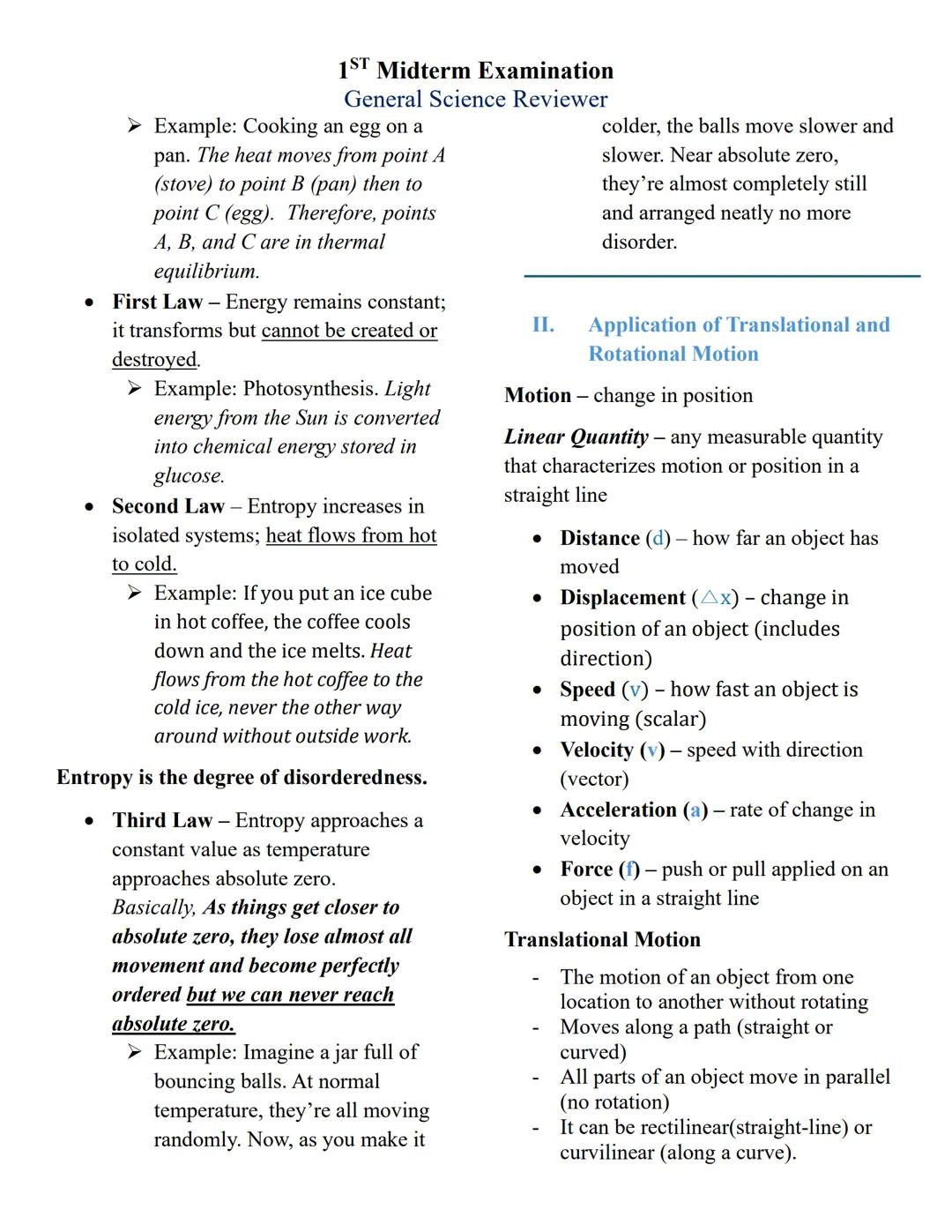
The Second Law of Thermodynamics describes how systems naturally move toward disorder (entropy). When you drop ice in hot coffee, heat always flows from hot to cold—the coffee cools and the ice melts. The Third Law states that as temperature approaches absolute zero, entropy approaches a constant minimum value. Think of bouncing balls slowing down and becoming ordered as they approach absolute zero temperature.
Motion is all about changing position, and physics gives us precise ways to describe it. Linear quantities measure straight-line motion: distance (total path), displacement (position change), speed (how fast), velocity (speed with direction), and acceleration (change in velocity). These help us analyze everything from cars driving to athletes running.
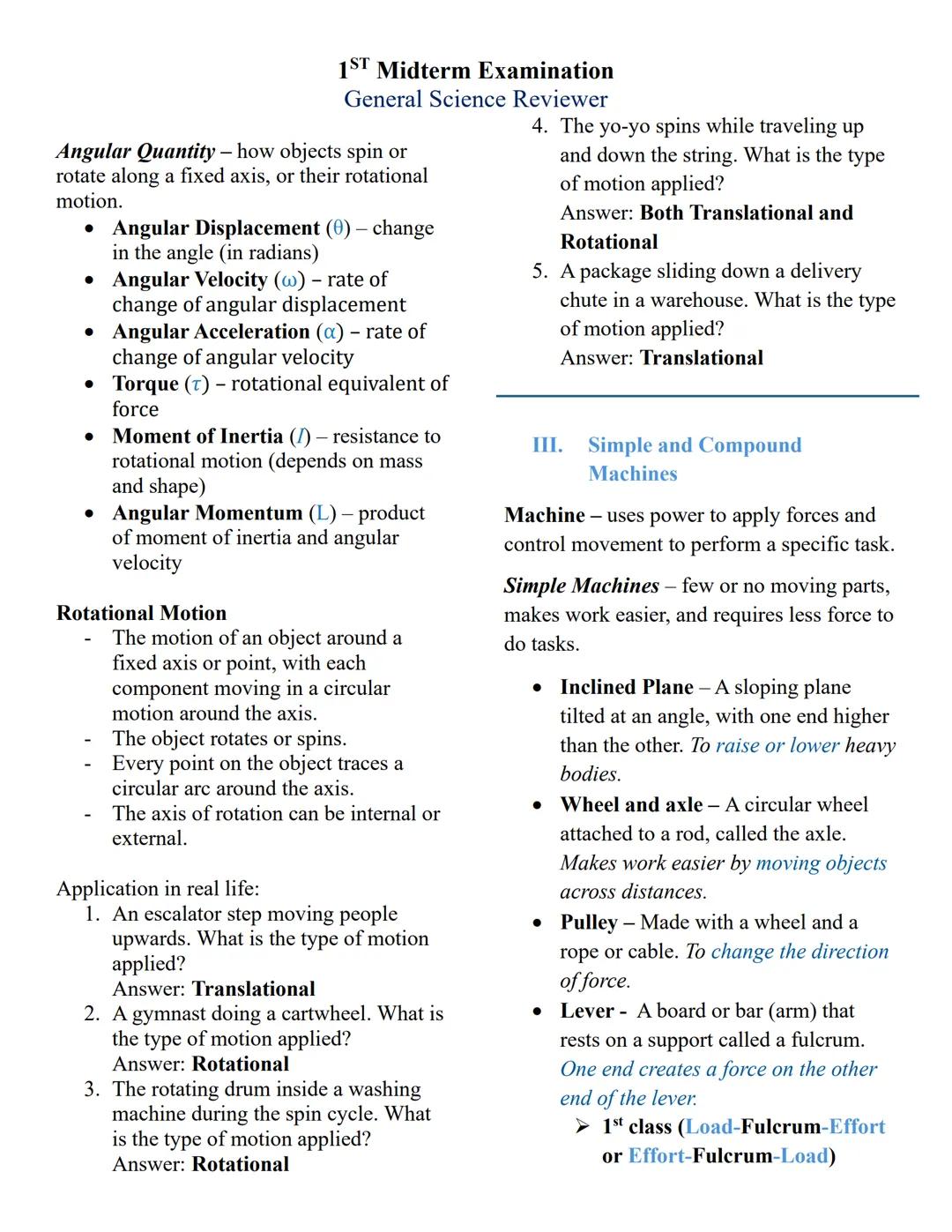
Translational motion occurs when an object moves from one place to another without rotating. All parts of the object move in parallel along the same path—like an escalator step moving upward or a package sliding down a warehouse chute. This motion can follow straight or curved paths.
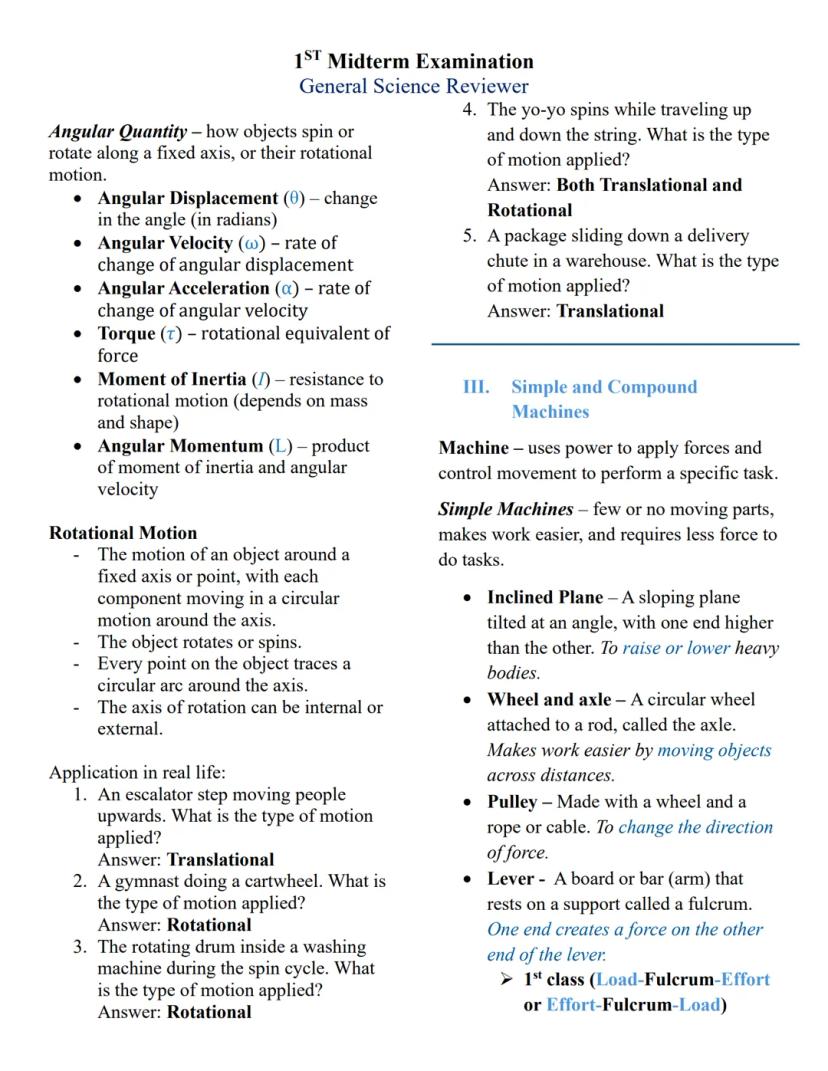
Angular quantities describe rotational motion: angular displacement (angle change), angular velocity (rotation speed), and angular acceleration (change in rotation speed). Torque is the rotational equivalent of force, while moment of inertia represents resistance to rotation. These explain spinning objects like a washing machine drum or a gymnast doing cartwheels.
Think About It: Many real-world movements combine both translational and rotational motion—like a yo-yo that spins while traveling up and down a string. Can you identify other examples in your daily life?
Machines make our lives easier by reducing the force we need to do work. Simple machines have few or no moving parts but can transform force effectively. An inclined plane (like a ramp) helps raise heavy objects with less effort. The wheel and axle (like a doorknob) makes it easier to move objects across distances, while pulleys (found on flagpoles) change the direction of force.
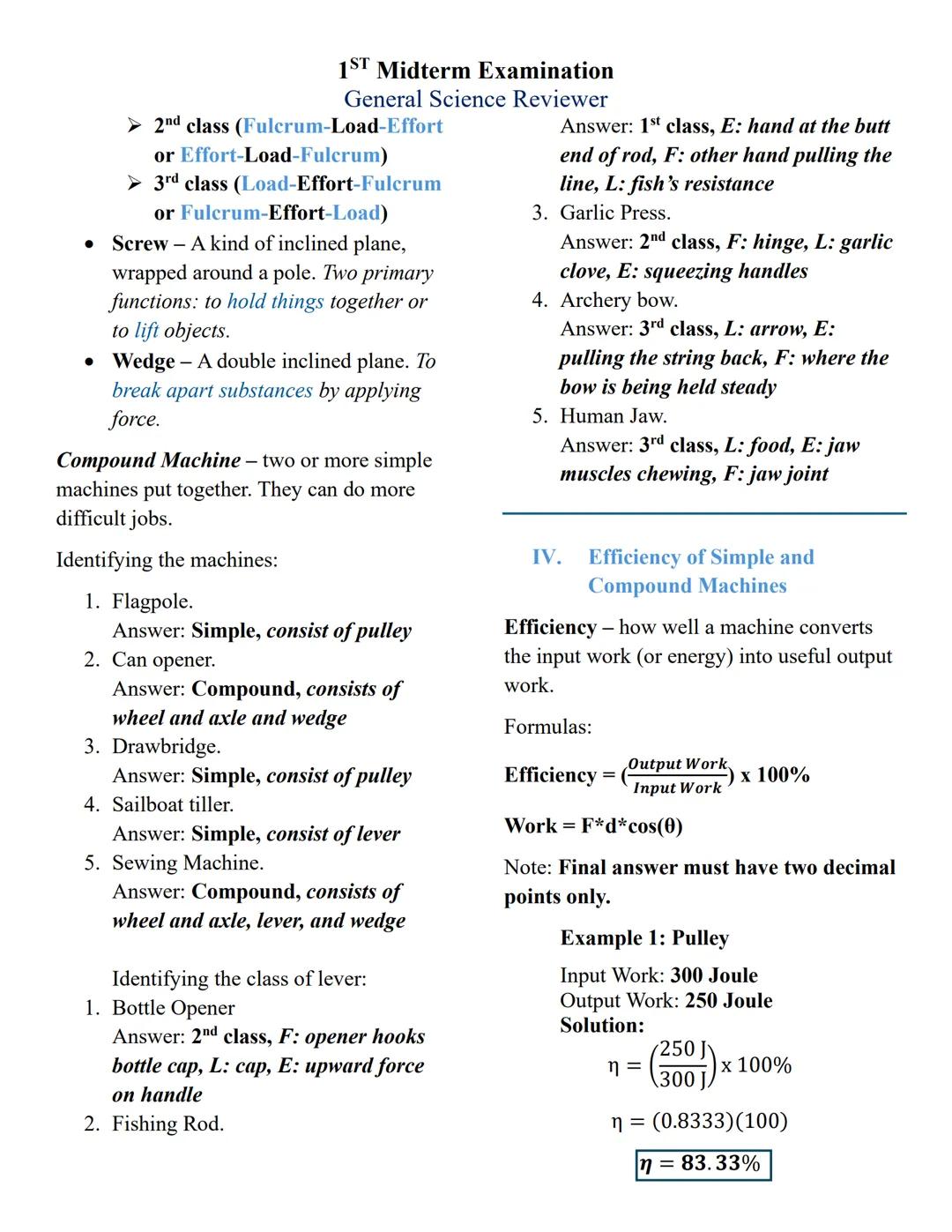
Levers are versatile simple machines with three classes. First-class levers (like seesaws) have the fulcrum between effort and load. Second-class levers (like wheelbarrows) place the load between fulcrum and effort. Third-class levers (like fishing rods) put the effort between fulcrum and load. Other simple machines include screws, which are wrapped inclined planes that hold things together, and wedges that transform force to split objects.
Compound machines combine two or more simple machines to perform more complex tasks. A can opener uses both a wheel and axle and a wedge, while a sewing machine incorporates multiple simple machines. Learning to identify these machines helps you understand the mechanics behind everyday objects.
When identifying levers, look for the three key components: the fulcrum (pivot point), the load (resistance), and the effort (applied force). A bottle opener is a second-class lever because the fulcrum is at one end (hook), the load is in the middle (cap), and the effort is at the other end (handle).
Real-World Application: Next time you use scissors, notice they're actually two first-class levers working together! The fulcrum is the pivot point, you apply effort at the handles, and the resistance (load) is what you're cutting.
No machine is perfect—some energy is always lost to friction and heat. Efficiency measures how effectively a machine converts input work into useful output work. A perfect machine would be 100% efficient, but real-world machines always lose some energy.
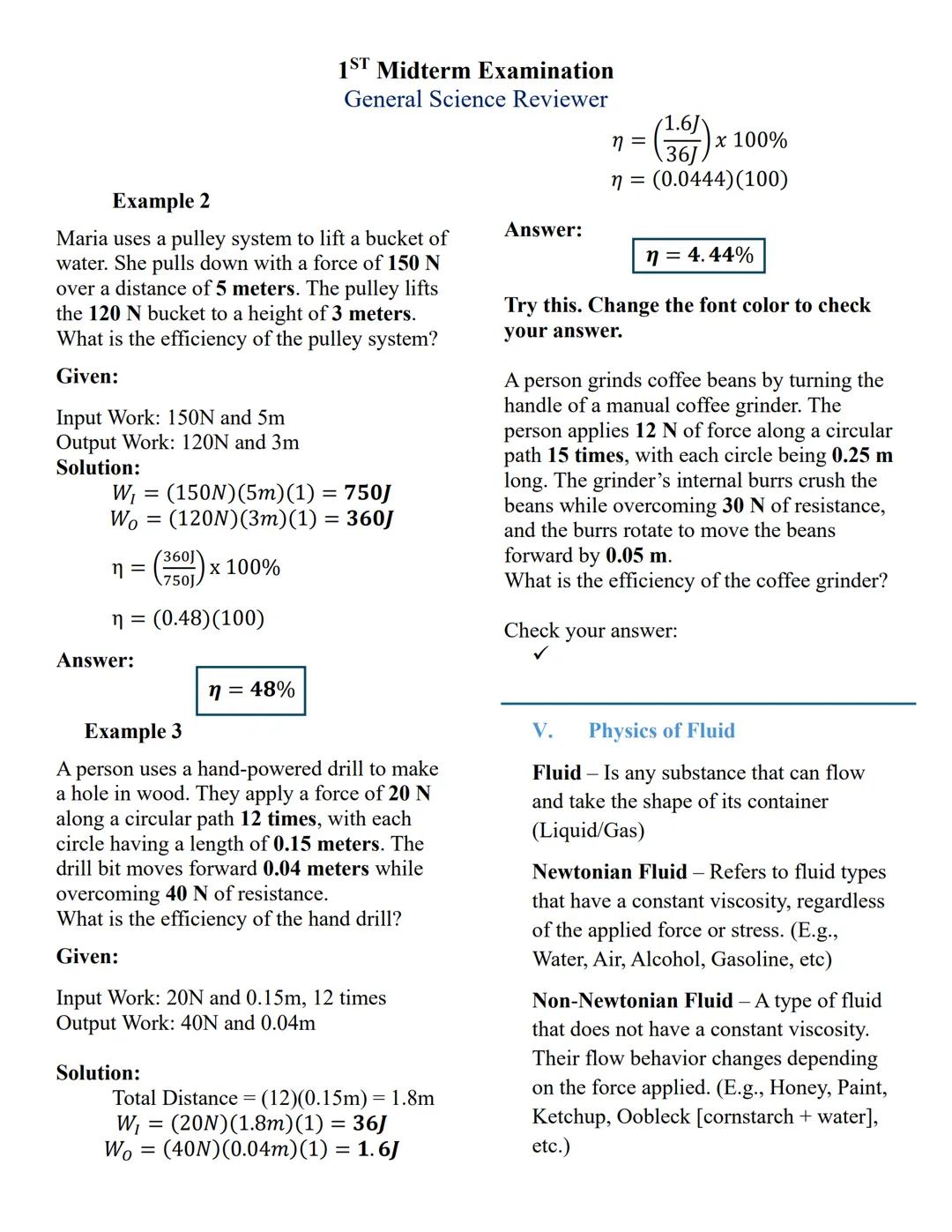
To calculate efficiency, use the formula: Efficiency = (Output Work ÷ Input Work) × 100%. This gives you a percentage that shows how much of your effort actually goes toward the intended task. For instance, if you put in 300 joules of work and get 250 joules of useful output, your machine is 83.33% efficient.
Let's apply this to a real example: Maria uses a pulley system with 150 N of force over 5 meters to lift a 120 N bucket 3 meters high. To find efficiency, first calculate input work (Force × Distance × cosθ). With no angle , input work equals 750 J. The output work is 360 J. Dividing and multiplying by 100% gives us 48% efficiency—less than half of Maria's effort produces useful work!
Efficiency calculations help us understand why some tasks feel harder than they should. A hand-powered drill with only 4.44% efficiency means most of your effort gets lost to friction and other factors rather than actually drilling the hole. This explains why power tools make work so much easier!
Calculation Tip: When solving efficiency problems, always convert your final answer to a percentage with two decimal places. Remember that work equals force times distance times the cosine of the angle between them .
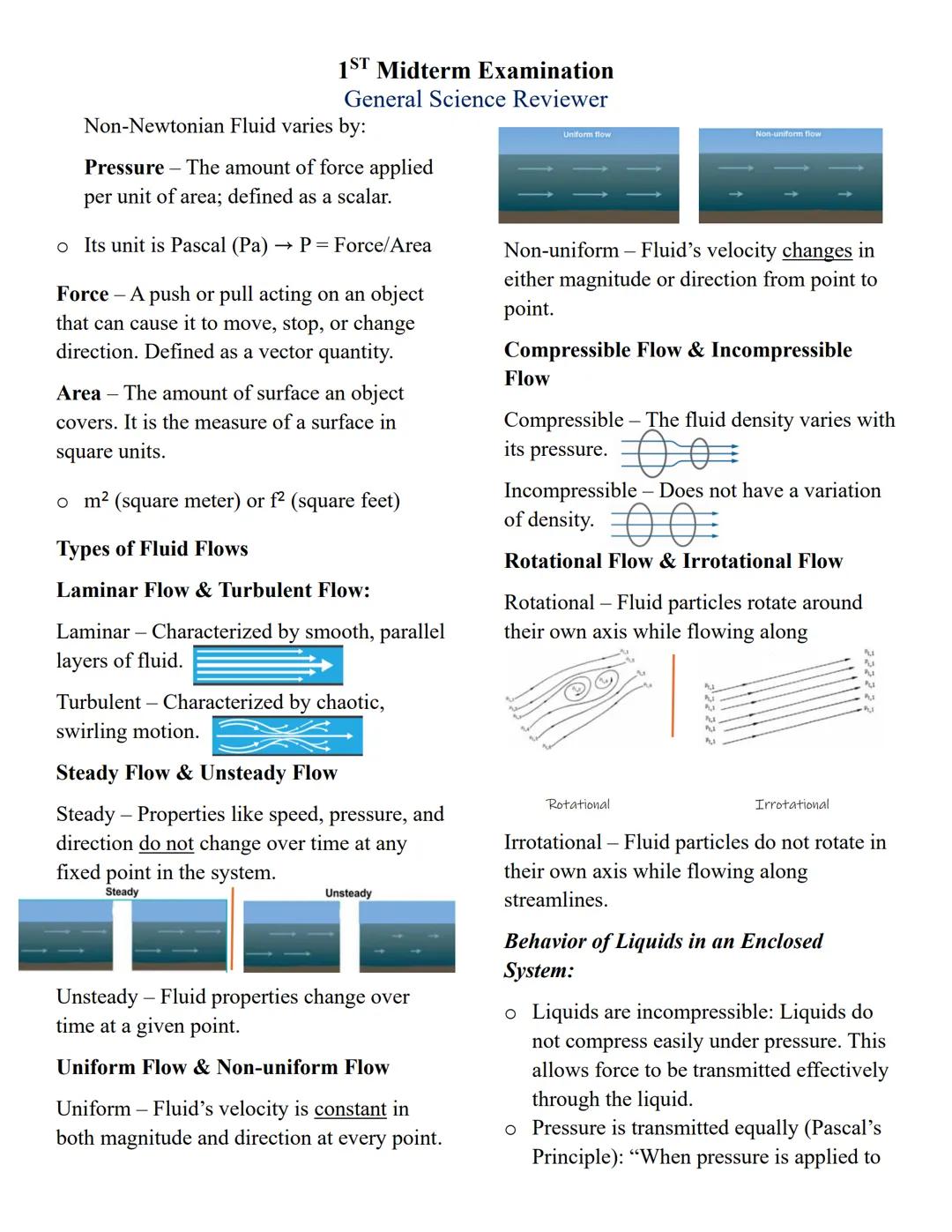
Fluids include both liquids and gases—substances that flow and take the shape of their container. Understanding how fluids behave helps explain everything from blood flow to weather patterns. Newtonian fluids like water and air have consistent viscosity regardless of applied force, while non-Newtonian fluids like ketchup and oobleck change behavior when force is applied.
Fluids can flow in different ways. Laminar flow creates smooth, parallel layers (think honey pouring), while turbulent flow produces chaotic swirls (like rapids in a river). Flows can also be categorized as steady (unchanging at any point over time) or unsteady (changing at fixed points), and uniform (same velocity throughout) or non-uniform (varying velocity).
Another important distinction is between compressible flows (where density varies with pressure, like in gases) and incompressible flows (constant density, like in most liquids). Additionally, rotational flow occurs when fluid particles rotate around their own axis while moving, whereas in irrotational flow, particles move without rotating.
Liquids in enclosed systems follow specific principles that enable hydraulic systems to work. Since liquids are nearly incompressible, Pascal's Principle states that pressure applied to a confined liquid is transmitted equally in all directions. This allows force multiplication in hydraulic systems when pistons of different sizes are used.
Fluid Fact: Next time you squeeze a bottle of shampoo, you're seeing Pascal's Principle in action! The pressure you apply is transmitted equally throughout the fluid, pushing it out of the opening with the same force.
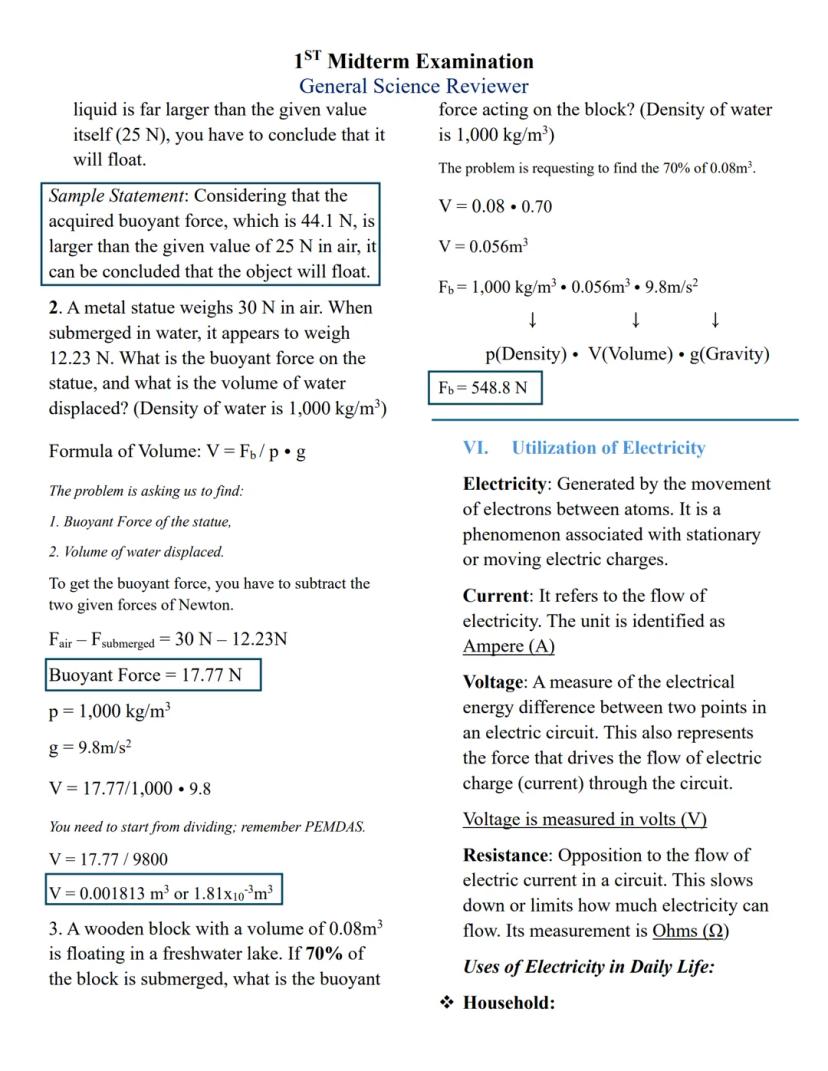
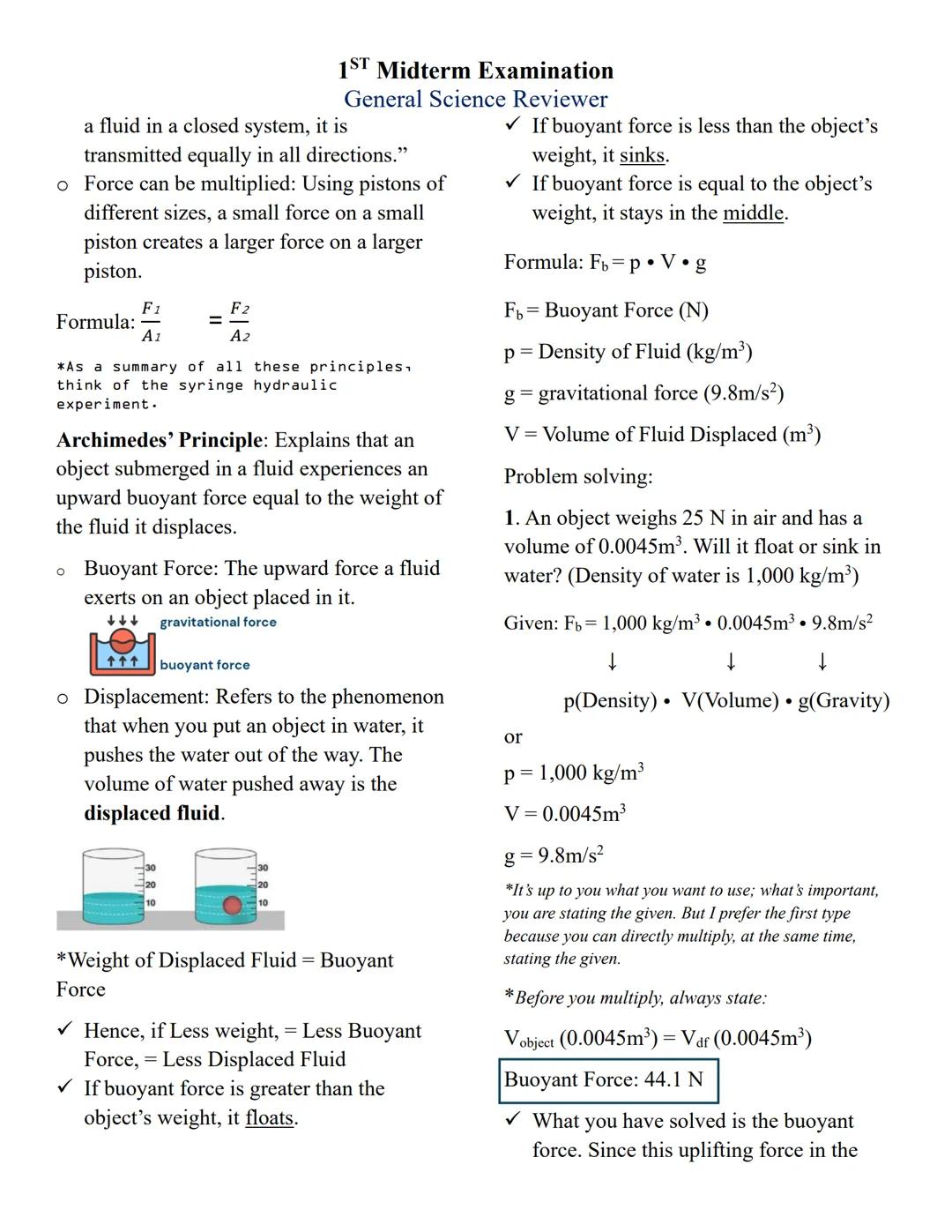
Archimedes' Principle explains why some objects float while others sink. When an object is submerged in fluid, it experiences an upward buoyant force equal to the weight of the fluid it displaces. If this buoyant force exceeds the object's weight, it floats; if less, it sinks; if equal, it remains suspended. The formula Fb = ρVg helps calculate this force using fluid density (ρ), displaced volume (V), and gravitational acceleration (g).
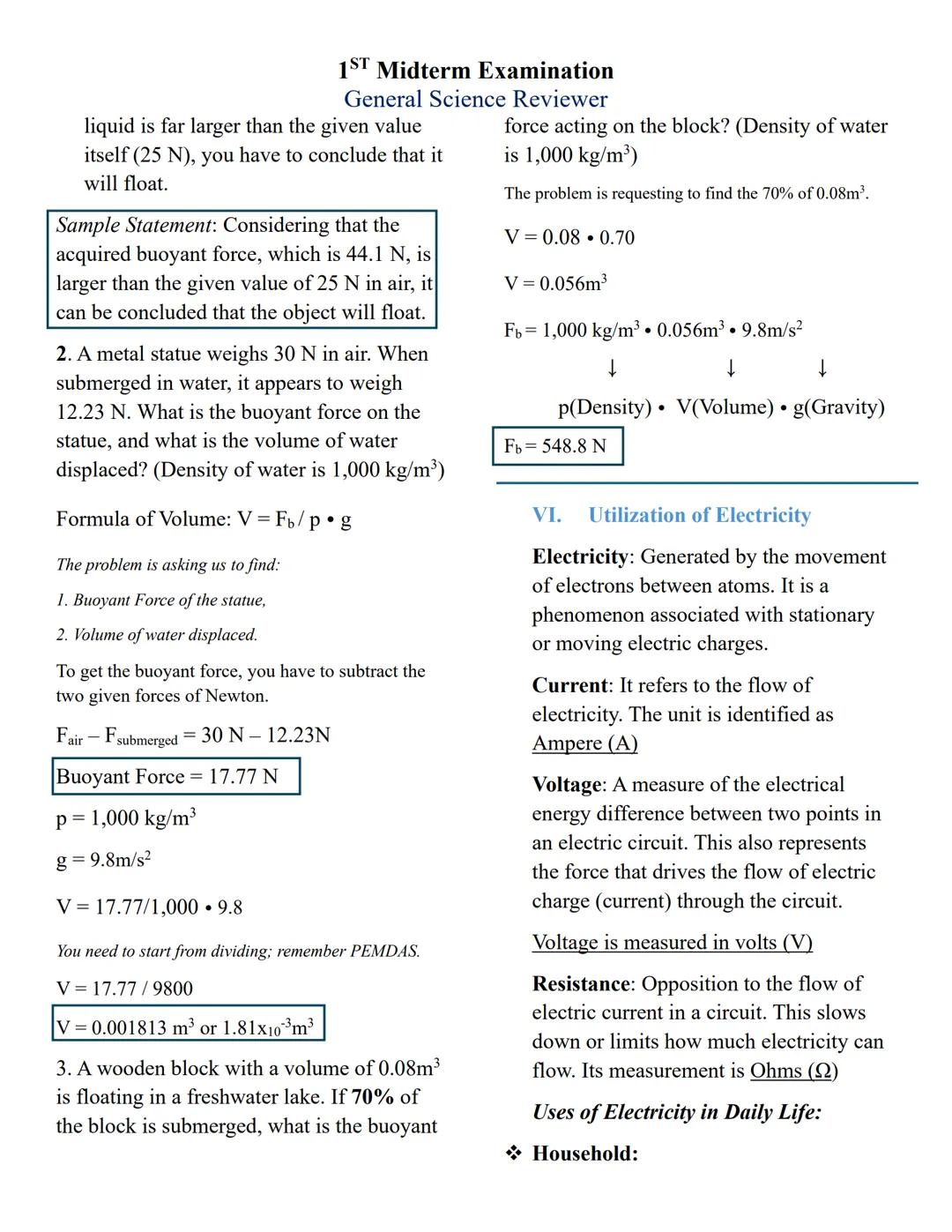
Applying Archimedes' Principle to real problems is straightforward. For an object weighing 25 N with volume 0.0045m³, we can calculate the buoyant force in water as 44.1 N. Since this exceeds the object's weight, it will float. Similarly, when a metal statue weighs less underwater (12.23 N) than in air (30 N), the difference (17.77 N) is the buoyant force.
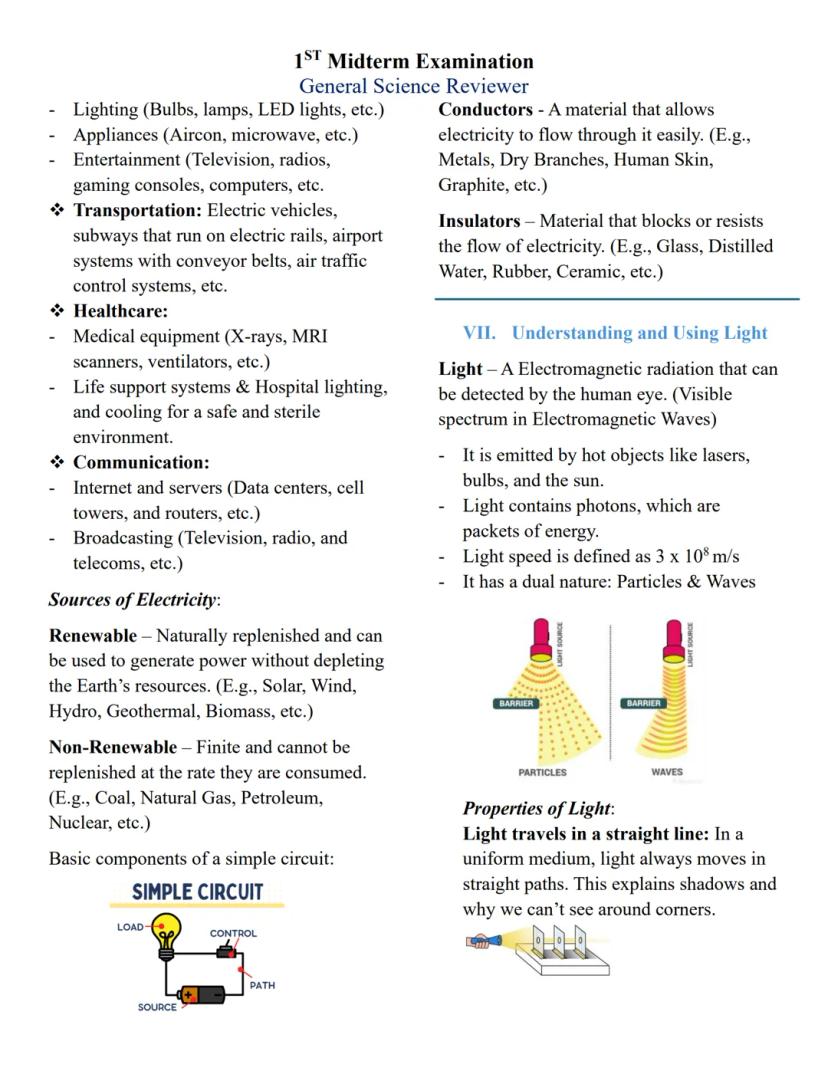
Electricity powers our modern world through the movement of electrons. Understanding basic electrical concepts helps explain how devices work. Current (measured in Amperes) is the flow of electricity, while voltage (measured in Volts) is the electrical energy difference that drives this flow. Resistance (measured in Ohms) opposes current flow, limiting how much electricity can pass through.
We use electricity in countless ways: household applications (lighting, appliances, entertainment), transportation (electric vehicles, subways), healthcare (medical equipment, life support systems), and communication (internet, broadcasting). This versatility makes electricity one of our most valuable resources.
Problem-Solving Tip: When working with Archimedes' Principle problems, remember that the volume of displaced fluid equals the submerged volume of the object. For fully submerged objects, this equals the object's total volume. For floating objects, it's only the portion below the fluid's surface.
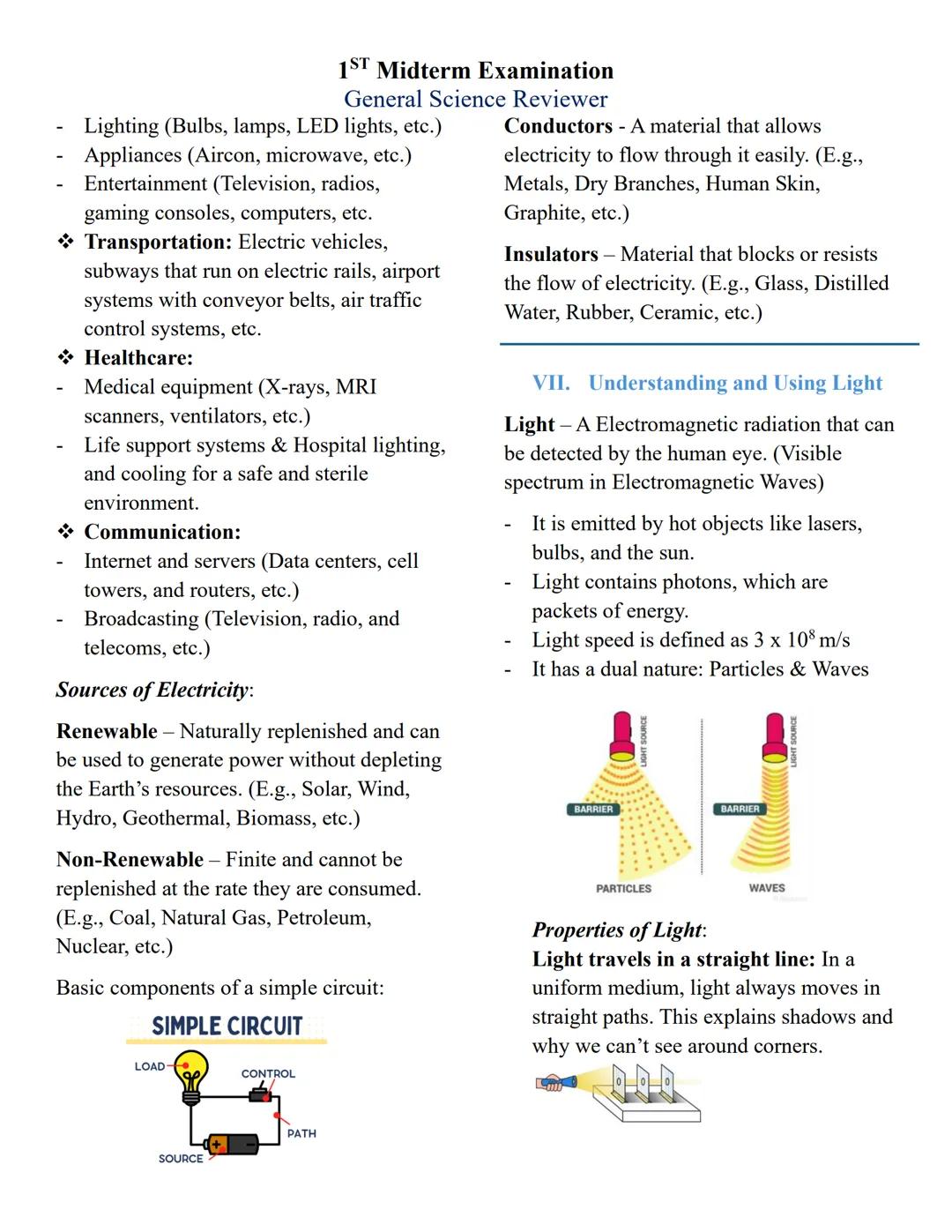
Electricity comes from various sources, categorized as either renewable or non-renewable. Renewable sources like solar, wind, and hydropower naturally replenish and don't deplete Earth's resources. Non-renewable sources like coal, natural gas, and nuclear power exist in finite amounts and cannot be replenished at the rate we consume them.
A simple electrical circuit contains basic components that work together. Conductors like metals allow electricity to flow easily, while insulators like rubber resist this flow. Understanding which materials conduct electricity helps us design safe, effective electrical systems.
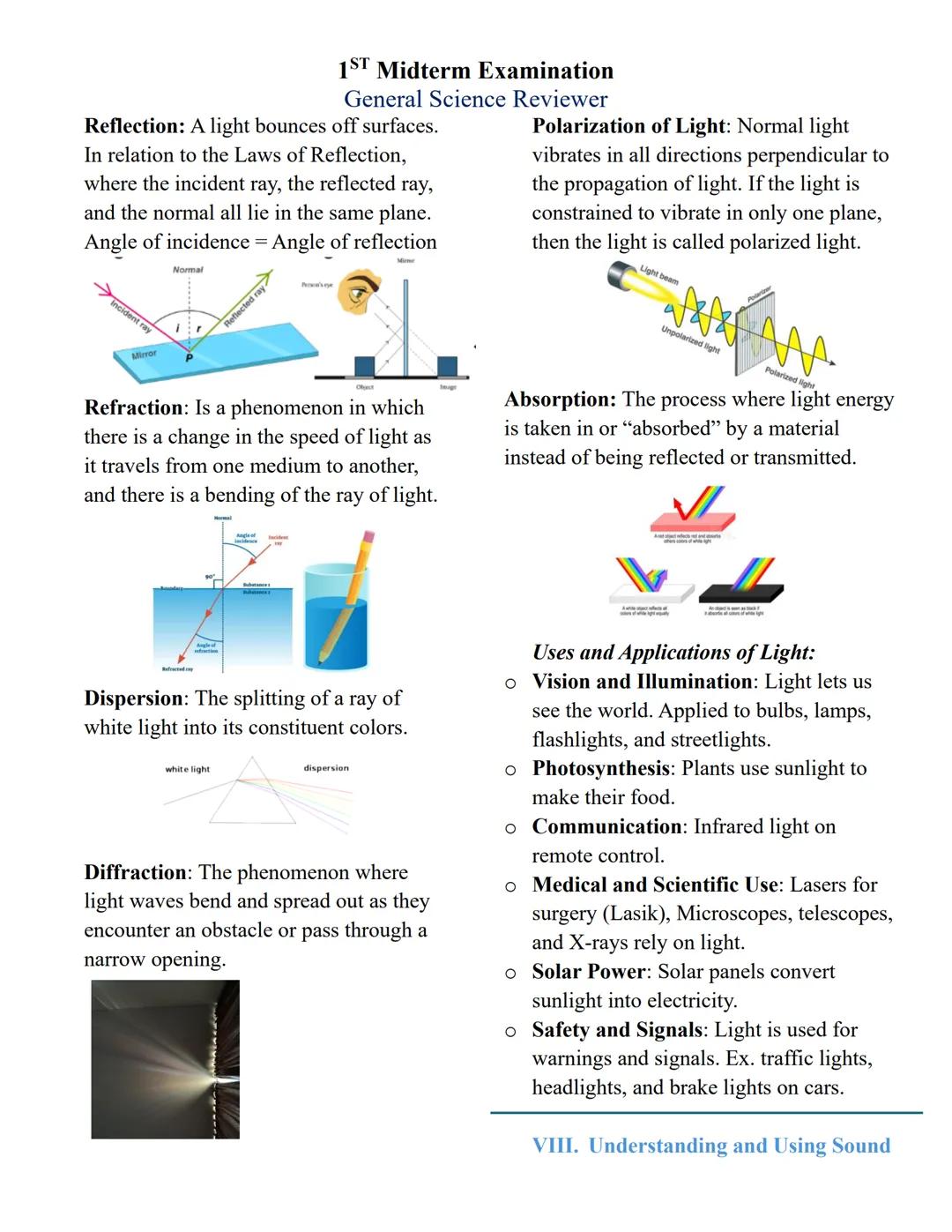
Light is electromagnetic radiation visible to the human eye. It travels at an incredible speed of 3×10^8 m/s and exhibits both particle and wave properties. As particles, light consists of photons (packets of energy). As waves, light can interfere, diffract, and be polarized. This dual nature helps explain various light phenomena.
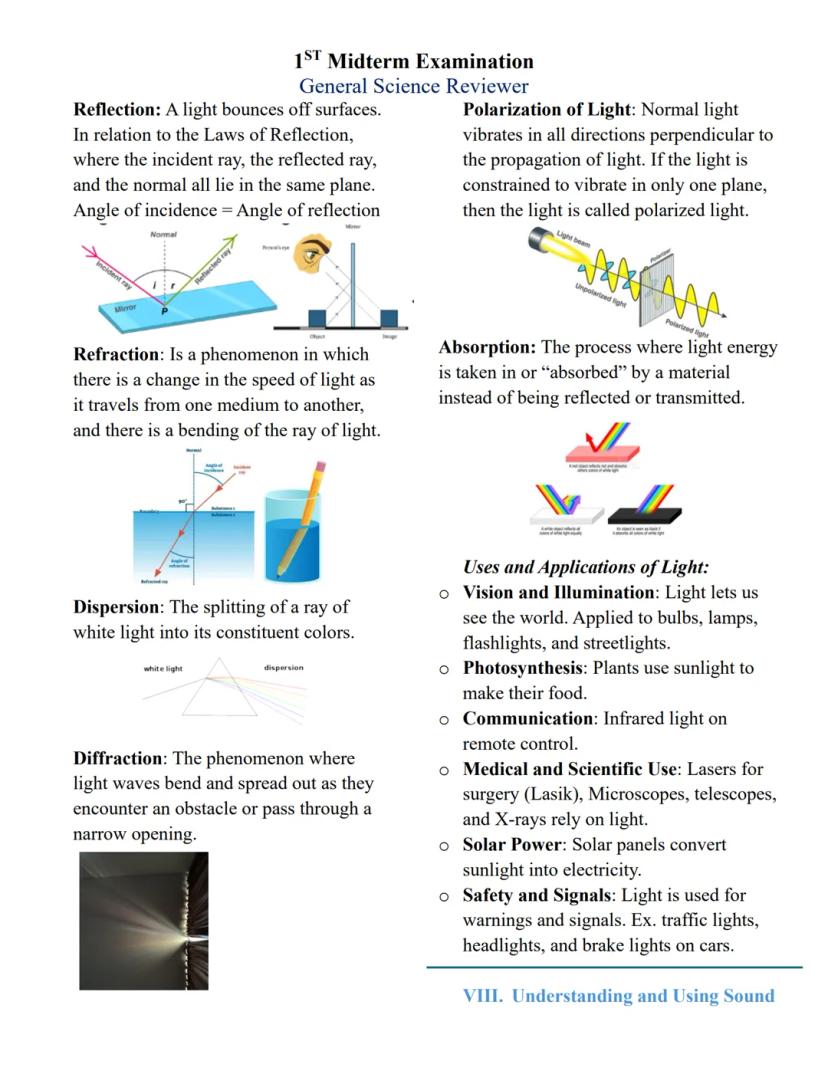
Light follows several fundamental properties. It travels in straight lines within a uniform medium, explaining why shadows form and why we can't see around corners. Reflection occurs when light bounces off surfaces, following the law that the angle of incidence equals the angle of reflection. This principle makes mirrors work and helps us see non-luminous objects.
Refraction happens when light bends as it passes between different mediums (like air to water), while dispersion splits white light into its component colors (as in rainbows). Absorption occurs when materials take in light energy rather than reflecting or transmitting it, and diffraction is the bending of light around obstacles or through openings.
Light Insight: Ever wonder why the sky appears blue? It's because of light scattering! Air molecules scatter blue wavelengths from sunlight more than other colors, spreading blue light across the sky.
Light's diverse properties enable countless applications in our daily lives. We use light for vision and illumination through bulbs, lamps, and flashlights. Plants harness sunlight for photosynthesis to create food. In technology, infrared light powers remote controls, while fiber optic cables transmit data using light pulses. Medical applications include lasers for surgery and light-based imaging techniques. Solar power converts sunlight to electricity, and light signals (like traffic lights) help maintain safety.
Sound is a form of energy created by vibrating objects. Unlike light, sound requires a medium (solid, liquid, or gas) to travel through—it can't move through a vacuum. Sound waves are mechanical disturbances that propagate through compression and rarefaction of the medium's particles.
A sound wave consists of crests (compressions) and troughs (rarefactions). The wavelength is the distance between successive crests, while the frequency (measured in Hertz) indicates how many wave cycles occur per second. These properties determine what we hear.
Two key properties of sound are pitch and amplitude. Pitch determines how high or low a sound seems and depends on the wave's frequency—higher frequencies create higher pitches. Most humans can hear frequencies between 20 Hz and 20,000 Hz. Amplitude relates to loudness—larger amplitude waves sound louder. Together, these properties create the rich variety of sounds we experience.
Experiment Idea: You can see sound vibrations by placing some salt on a drum or stretched plastic wrap, then making a loud noise nearby. Watch how the salt particles jump and form patterns from the sound waves!
Sound exhibits several fascinating properties that explain how we hear in different environments. Reflection occurs when sound waves bounce off surfaces, creating echoes. This explains why your voice sounds different in an empty room versus a furnished one. Absorption happens when materials like curtains or foam soak up sound energy, reducing noise—this is why recording studios use soft materials on walls.
Diffraction allows sound to bend around obstacles and through openings, which is why you can hear someone talking around a corner even when you can't see them. This property gives sound an advantage over light, which travels only in straight lines. Interference occurs when multiple sound waves interact, either reinforcing each other (constructive interference, creating louder sounds) or canceling each other out (destructive interference, creating quieter areas).
Sound technology enhances many aspects of our lives. In communication, we use sound for talking, listening, and phone conversations. Sonar and echolocation help submarines detect underwater objects, while bats navigate using the same principle. Medical imaging like ultrasound uses high-frequency sound waves to visualize internal body structures. Entertainment industries rely on sound for music, movies, and broadcasting. Even industrial applications use sound to detect machine malfunctions.
Modern innovations harness sound properties in clever ways. Noise-canceling headphones use destructive interference to eliminate unwanted background noise. Concert halls are designed with specific shapes to enhance sound reflection. Understanding how sound works helps us create better acoustic environments and technologies.
Cool Connection: Noise-canceling headphones work by detecting incoming sound waves and generating exact opposite waves (180° out of phase). When these opposing waves meet, they cancel each other out through destructive interference, creating a quieter listening experience!
Our AI companion is specifically built for the needs of students. Based on the millions of content pieces we have on the platform we can provide truly meaningful and relevant answers to students. But its not only about answers, the companion is even more about guiding students through their daily learning challenges, with personalised study plans, quizzes or content pieces in the chat and 100% personalisation based on the students skills and developments.
You can download the app in the Google Play Store and in the Apple App Store.
That's right! Enjoy free access to study content, connect with fellow students, and get instant help – all at your fingertips.
App Store
Google Play
The app is very easy to use and well designed. I have found everything I was looking for so far and have been able to learn a lot from the presentations! I will definitely use the app for a class assignment! And of course it also helps a lot as an inspiration.
Stefan S
iOS user
This app is really great. There are so many study notes and help [...]. My problem subject is French, for example, and the app has so many options for help. Thanks to this app, I have improved my French. I would recommend it to anyone.
Samantha Klich
Android user
Wow, I am really amazed. I just tried the app because I've seen it advertised many times and was absolutely stunned. This app is THE HELP you want for school and above all, it offers so many things, such as workouts and fact sheets, which have been VERY helpful to me personally.
Anna
iOS user
I think it’s very much worth it and you’ll end up using it a lot once you get the hang of it and even after looking at others notes you can still ask your Artificial intelligence buddy the question and ask to simplify it if you still don’t get it!!! In the end I think it’s worth it 😊👍 ⚠️Also DID I MENTION ITS FREEE YOU DON’T HAVE TO PAY FOR ANYTHING AND STILL GET YOUR GRADES IN PERFECTLY❗️❗️⚠️
Thomas R
iOS user
Knowunity is the BEST app I’ve used in a minute. This is not an ai review or anything this is genuinely coming from a 7th grade student (I know 2011 im young) but dude this app is a 10/10 i have maintained a 3.8 gpa and have plenty of time for gaming. I love it and my mom is just happy I got good grades
Brad T
Android user
Not only did it help me find the answer but it also showed me alternative ways to solve it. I was horrible in math and science but now I have an a in both subjects. Thanks for the help🤍🤍
David K
iOS user
The app's just great! All I have to do is enter the topic in the search bar and I get the response real fast. I don't have to watch 10 YouTube videos to understand something, so I'm saving my time. Highly recommended!
Sudenaz Ocak
Android user
In school I was really bad at maths but thanks to the app, I am doing better now. I am so grateful that you made the app.
Greenlight Bonnie
Android user
I found this app a couple years ago and it has only gotten better since then. I really love it because it can help with written questions and photo questions. Also, it can find study guides that other people have made as well as flashcard sets and practice tests. The free version is also amazing for students who might not be able to afford it. Would 100% recommend
Aubrey
iOS user
Best app if you're in Highschool or Junior high. I have been using this app for 2 school years and it's the best, it's good if you don't have anyone to help you with school work.😋🩷🎀
Marco B
iOS user
THE QUIZES AND FLASHCARDS ARE SO USEFUL AND I LOVE THE SCHOOLGPT. IT ALSO IS LITREALLY LIKE CHATGPT BUT SMARTER!! HELPED ME WITH MY MASCARA PROBLEMS TOO!! AS WELL AS MY REAL SUBJECTS ! DUHHH 😍😁😲🤑💗✨🎀😮
Elisha
iOS user
This app is phenomenal down to the correct info and the various topics you can study! I greatly recommend it for people who struggle with procrastination and those who need homework help. It has been perfectly accurate for world 1 history as far as I’ve seen! Geometry too!
Paul T
iOS user
The app is very easy to use and well designed. I have found everything I was looking for so far and have been able to learn a lot from the presentations! I will definitely use the app for a class assignment! And of course it also helps a lot as an inspiration.
Stefan S
iOS user
This app is really great. There are so many study notes and help [...]. My problem subject is French, for example, and the app has so many options for help. Thanks to this app, I have improved my French. I would recommend it to anyone.
Samantha Klich
Android user
Wow, I am really amazed. I just tried the app because I've seen it advertised many times and was absolutely stunned. This app is THE HELP you want for school and above all, it offers so many things, such as workouts and fact sheets, which have been VERY helpful to me personally.
Anna
iOS user
I think it’s very much worth it and you’ll end up using it a lot once you get the hang of it and even after looking at others notes you can still ask your Artificial intelligence buddy the question and ask to simplify it if you still don’t get it!!! In the end I think it’s worth it 😊👍 ⚠️Also DID I MENTION ITS FREEE YOU DON’T HAVE TO PAY FOR ANYTHING AND STILL GET YOUR GRADES IN PERFECTLY❗️❗️⚠️
Thomas R
iOS user
Knowunity is the BEST app I’ve used in a minute. This is not an ai review or anything this is genuinely coming from a 7th grade student (I know 2011 im young) but dude this app is a 10/10 i have maintained a 3.8 gpa and have plenty of time for gaming. I love it and my mom is just happy I got good grades
Brad T
Android user
Not only did it help me find the answer but it also showed me alternative ways to solve it. I was horrible in math and science but now I have an a in both subjects. Thanks for the help🤍🤍
David K
iOS user
The app's just great! All I have to do is enter the topic in the search bar and I get the response real fast. I don't have to watch 10 YouTube videos to understand something, so I'm saving my time. Highly recommended!
Sudenaz Ocak
Android user
In school I was really bad at maths but thanks to the app, I am doing better now. I am so grateful that you made the app.
Greenlight Bonnie
Android user
I found this app a couple years ago and it has only gotten better since then. I really love it because it can help with written questions and photo questions. Also, it can find study guides that other people have made as well as flashcard sets and practice tests. The free version is also amazing for students who might not be able to afford it. Would 100% recommend
Aubrey
iOS user
Best app if you're in Highschool or Junior high. I have been using this app for 2 school years and it's the best, it's good if you don't have anyone to help you with school work.😋🩷🎀
Marco B
iOS user
THE QUIZES AND FLASHCARDS ARE SO USEFUL AND I LOVE THE SCHOOLGPT. IT ALSO IS LITREALLY LIKE CHATGPT BUT SMARTER!! HELPED ME WITH MY MASCARA PROBLEMS TOO!! AS WELL AS MY REAL SUBJECTS ! DUHHH 😍😁😲🤑💗✨🎀😮
Elisha
iOS user
This app is phenomenal down to the correct info and the various topics you can study! I greatly recommend it for people who struggle with procrastination and those who need homework help. It has been perfectly accurate for world 1 history as far as I’ve seen! Geometry too!
Paul T
iOS user
Daniel Aguada
@danielaguada
Ready to ace your General Science exam? This reviewer covers key physics concepts from Newton's laws to the physics of sound waves. By understanding these principles, you'll see how physics shapes our everyday experiences and explains the world around us.
Access to all documents
Improve your grades
Join milions of students
By signing up you accept Terms of Service and Privacy Policy
Ever wondered why a soccer ball keeps rolling after you kick it? Physics explains it! Newton's Laws of Motion govern everything that moves. The First Law (Inertia) tells us objects stay at rest or in motion unless acted upon by force—like a ball sitting on the ground. The Second Law (Acceleration) shows that more force creates more acceleration—kick a soccer ball harder and it goes farther. The Third Law (Action & Reaction) explains that for every action there's an equal opposite reaction—when you walk, you push back on the ground, and it pushes you forward.
Physics concepts explain our daily experiences through fundamental principles. Gravity attracts objects with mass toward each other, while work occurs when force causes displacement. The relationship between energy (capacity to do work) and power (work done per unit of time) helps us understand efficiency in physical systems.
The Laws of Thermodynamics explain how heat moves through our world. The Zeroth Law shows that if two bodies are in equilibrium with a third, they're in equilibrium with each other (like heat traveling from stove → pan → egg during cooking). The First Law tells us energy can't be created or destroyed, only transformed—like sunlight converting to chemical energy in plants.
Science Connection: When you kick a soccer ball toward the goal, you're seeing Newton's Second Law in action! The harder you kick (more force), the greater the acceleration and the farther the ball travels.
Access to all documents
Improve your grades
Join milions of students
By signing up you accept Terms of Service and Privacy Policy
The Second Law of Thermodynamics describes how systems naturally move toward disorder (entropy). When you drop ice in hot coffee, heat always flows from hot to cold—the coffee cools and the ice melts. The Third Law states that as temperature approaches absolute zero, entropy approaches a constant minimum value. Think of bouncing balls slowing down and becoming ordered as they approach absolute zero temperature.
Motion is all about changing position, and physics gives us precise ways to describe it. Linear quantities measure straight-line motion: distance (total path), displacement (position change), speed (how fast), velocity (speed with direction), and acceleration (change in velocity). These help us analyze everything from cars driving to athletes running.
Translational motion occurs when an object moves from one place to another without rotating. All parts of the object move in parallel along the same path—like an escalator step moving upward or a package sliding down a warehouse chute. This motion can follow straight or curved paths.
Angular quantities describe rotational motion: angular displacement (angle change), angular velocity (rotation speed), and angular acceleration (change in rotation speed). Torque is the rotational equivalent of force, while moment of inertia represents resistance to rotation. These explain spinning objects like a washing machine drum or a gymnast doing cartwheels.
Think About It: Many real-world movements combine both translational and rotational motion—like a yo-yo that spins while traveling up and down a string. Can you identify other examples in your daily life?
Access to all documents
Improve your grades
Join milions of students
By signing up you accept Terms of Service and Privacy Policy
Machines make our lives easier by reducing the force we need to do work. Simple machines have few or no moving parts but can transform force effectively. An inclined plane (like a ramp) helps raise heavy objects with less effort. The wheel and axle (like a doorknob) makes it easier to move objects across distances, while pulleys (found on flagpoles) change the direction of force.
Levers are versatile simple machines with three classes. First-class levers (like seesaws) have the fulcrum between effort and load. Second-class levers (like wheelbarrows) place the load between fulcrum and effort. Third-class levers (like fishing rods) put the effort between fulcrum and load. Other simple machines include screws, which are wrapped inclined planes that hold things together, and wedges that transform force to split objects.
Compound machines combine two or more simple machines to perform more complex tasks. A can opener uses both a wheel and axle and a wedge, while a sewing machine incorporates multiple simple machines. Learning to identify these machines helps you understand the mechanics behind everyday objects.
When identifying levers, look for the three key components: the fulcrum (pivot point), the load (resistance), and the effort (applied force). A bottle opener is a second-class lever because the fulcrum is at one end (hook), the load is in the middle (cap), and the effort is at the other end (handle).
Real-World Application: Next time you use scissors, notice they're actually two first-class levers working together! The fulcrum is the pivot point, you apply effort at the handles, and the resistance (load) is what you're cutting.
Access to all documents
Improve your grades
Join milions of students
By signing up you accept Terms of Service and Privacy Policy
No machine is perfect—some energy is always lost to friction and heat. Efficiency measures how effectively a machine converts input work into useful output work. A perfect machine would be 100% efficient, but real-world machines always lose some energy.
To calculate efficiency, use the formula: Efficiency = (Output Work ÷ Input Work) × 100%. This gives you a percentage that shows how much of your effort actually goes toward the intended task. For instance, if you put in 300 joules of work and get 250 joules of useful output, your machine is 83.33% efficient.
Let's apply this to a real example: Maria uses a pulley system with 150 N of force over 5 meters to lift a 120 N bucket 3 meters high. To find efficiency, first calculate input work (Force × Distance × cosθ). With no angle , input work equals 750 J. The output work is 360 J. Dividing and multiplying by 100% gives us 48% efficiency—less than half of Maria's effort produces useful work!
Efficiency calculations help us understand why some tasks feel harder than they should. A hand-powered drill with only 4.44% efficiency means most of your effort gets lost to friction and other factors rather than actually drilling the hole. This explains why power tools make work so much easier!
Calculation Tip: When solving efficiency problems, always convert your final answer to a percentage with two decimal places. Remember that work equals force times distance times the cosine of the angle between them .
Access to all documents
Improve your grades
Join milions of students
By signing up you accept Terms of Service and Privacy Policy
Fluids include both liquids and gases—substances that flow and take the shape of their container. Understanding how fluids behave helps explain everything from blood flow to weather patterns. Newtonian fluids like water and air have consistent viscosity regardless of applied force, while non-Newtonian fluids like ketchup and oobleck change behavior when force is applied.
Fluids can flow in different ways. Laminar flow creates smooth, parallel layers (think honey pouring), while turbulent flow produces chaotic swirls (like rapids in a river). Flows can also be categorized as steady (unchanging at any point over time) or unsteady (changing at fixed points), and uniform (same velocity throughout) or non-uniform (varying velocity).
Another important distinction is between compressible flows (where density varies with pressure, like in gases) and incompressible flows (constant density, like in most liquids). Additionally, rotational flow occurs when fluid particles rotate around their own axis while moving, whereas in irrotational flow, particles move without rotating.
Liquids in enclosed systems follow specific principles that enable hydraulic systems to work. Since liquids are nearly incompressible, Pascal's Principle states that pressure applied to a confined liquid is transmitted equally in all directions. This allows force multiplication in hydraulic systems when pistons of different sizes are used.
Fluid Fact: Next time you squeeze a bottle of shampoo, you're seeing Pascal's Principle in action! The pressure you apply is transmitted equally throughout the fluid, pushing it out of the opening with the same force.
Access to all documents
Improve your grades
Join milions of students
By signing up you accept Terms of Service and Privacy Policy
Archimedes' Principle explains why some objects float while others sink. When an object is submerged in fluid, it experiences an upward buoyant force equal to the weight of the fluid it displaces. If this buoyant force exceeds the object's weight, it floats; if less, it sinks; if equal, it remains suspended. The formula Fb = ρVg helps calculate this force using fluid density (ρ), displaced volume (V), and gravitational acceleration (g).
Applying Archimedes' Principle to real problems is straightforward. For an object weighing 25 N with volume 0.0045m³, we can calculate the buoyant force in water as 44.1 N. Since this exceeds the object's weight, it will float. Similarly, when a metal statue weighs less underwater (12.23 N) than in air (30 N), the difference (17.77 N) is the buoyant force.
Electricity powers our modern world through the movement of electrons. Understanding basic electrical concepts helps explain how devices work. Current (measured in Amperes) is the flow of electricity, while voltage (measured in Volts) is the electrical energy difference that drives this flow. Resistance (measured in Ohms) opposes current flow, limiting how much electricity can pass through.
We use electricity in countless ways: household applications (lighting, appliances, entertainment), transportation (electric vehicles, subways), healthcare (medical equipment, life support systems), and communication (internet, broadcasting). This versatility makes electricity one of our most valuable resources.
Problem-Solving Tip: When working with Archimedes' Principle problems, remember that the volume of displaced fluid equals the submerged volume of the object. For fully submerged objects, this equals the object's total volume. For floating objects, it's only the portion below the fluid's surface.
Access to all documents
Improve your grades
Join milions of students
By signing up you accept Terms of Service and Privacy Policy
Electricity comes from various sources, categorized as either renewable or non-renewable. Renewable sources like solar, wind, and hydropower naturally replenish and don't deplete Earth's resources. Non-renewable sources like coal, natural gas, and nuclear power exist in finite amounts and cannot be replenished at the rate we consume them.
A simple electrical circuit contains basic components that work together. Conductors like metals allow electricity to flow easily, while insulators like rubber resist this flow. Understanding which materials conduct electricity helps us design safe, effective electrical systems.
Light is electromagnetic radiation visible to the human eye. It travels at an incredible speed of 3×10^8 m/s and exhibits both particle and wave properties. As particles, light consists of photons (packets of energy). As waves, light can interfere, diffract, and be polarized. This dual nature helps explain various light phenomena.
Light follows several fundamental properties. It travels in straight lines within a uniform medium, explaining why shadows form and why we can't see around corners. Reflection occurs when light bounces off surfaces, following the law that the angle of incidence equals the angle of reflection. This principle makes mirrors work and helps us see non-luminous objects.
Refraction happens when light bends as it passes between different mediums (like air to water), while dispersion splits white light into its component colors (as in rainbows). Absorption occurs when materials take in light energy rather than reflecting or transmitting it, and diffraction is the bending of light around obstacles or through openings.
Light Insight: Ever wonder why the sky appears blue? It's because of light scattering! Air molecules scatter blue wavelengths from sunlight more than other colors, spreading blue light across the sky.
Access to all documents
Improve your grades
Join milions of students
By signing up you accept Terms of Service and Privacy Policy
Light's diverse properties enable countless applications in our daily lives. We use light for vision and illumination through bulbs, lamps, and flashlights. Plants harness sunlight for photosynthesis to create food. In technology, infrared light powers remote controls, while fiber optic cables transmit data using light pulses. Medical applications include lasers for surgery and light-based imaging techniques. Solar power converts sunlight to electricity, and light signals (like traffic lights) help maintain safety.
Sound is a form of energy created by vibrating objects. Unlike light, sound requires a medium (solid, liquid, or gas) to travel through—it can't move through a vacuum. Sound waves are mechanical disturbances that propagate through compression and rarefaction of the medium's particles.
A sound wave consists of crests (compressions) and troughs (rarefactions). The wavelength is the distance between successive crests, while the frequency (measured in Hertz) indicates how many wave cycles occur per second. These properties determine what we hear.
Two key properties of sound are pitch and amplitude. Pitch determines how high or low a sound seems and depends on the wave's frequency—higher frequencies create higher pitches. Most humans can hear frequencies between 20 Hz and 20,000 Hz. Amplitude relates to loudness—larger amplitude waves sound louder. Together, these properties create the rich variety of sounds we experience.
Experiment Idea: You can see sound vibrations by placing some salt on a drum or stretched plastic wrap, then making a loud noise nearby. Watch how the salt particles jump and form patterns from the sound waves!
Access to all documents
Improve your grades
Join milions of students
By signing up you accept Terms of Service and Privacy Policy
Sound exhibits several fascinating properties that explain how we hear in different environments. Reflection occurs when sound waves bounce off surfaces, creating echoes. This explains why your voice sounds different in an empty room versus a furnished one. Absorption happens when materials like curtains or foam soak up sound energy, reducing noise—this is why recording studios use soft materials on walls.
Diffraction allows sound to bend around obstacles and through openings, which is why you can hear someone talking around a corner even when you can't see them. This property gives sound an advantage over light, which travels only in straight lines. Interference occurs when multiple sound waves interact, either reinforcing each other (constructive interference, creating louder sounds) or canceling each other out (destructive interference, creating quieter areas).
Sound technology enhances many aspects of our lives. In communication, we use sound for talking, listening, and phone conversations. Sonar and echolocation help submarines detect underwater objects, while bats navigate using the same principle. Medical imaging like ultrasound uses high-frequency sound waves to visualize internal body structures. Entertainment industries rely on sound for music, movies, and broadcasting. Even industrial applications use sound to detect machine malfunctions.
Modern innovations harness sound properties in clever ways. Noise-canceling headphones use destructive interference to eliminate unwanted background noise. Concert halls are designed with specific shapes to enhance sound reflection. Understanding how sound works helps us create better acoustic environments and technologies.
Cool Connection: Noise-canceling headphones work by detecting incoming sound waves and generating exact opposite waves (180° out of phase). When these opposing waves meet, they cancel each other out through destructive interference, creating a quieter listening experience!
Access to all documents
Improve your grades
Join milions of students
By signing up you accept Terms of Service and Privacy Policy
Our AI companion is specifically built for the needs of students. Based on the millions of content pieces we have on the platform we can provide truly meaningful and relevant answers to students. But its not only about answers, the companion is even more about guiding students through their daily learning challenges, with personalised study plans, quizzes or content pieces in the chat and 100% personalisation based on the students skills and developments.
You can download the app in the Google Play Store and in the Apple App Store.
That's right! Enjoy free access to study content, connect with fellow students, and get instant help – all at your fingertips.
3
Smart Tools NEW
Transform this note into: ✓ 50+ Practice Questions ✓ Interactive Flashcards ✓ Full Mock Exam ✓ Essay Outlines
App Store
Google Play
The app is very easy to use and well designed. I have found everything I was looking for so far and have been able to learn a lot from the presentations! I will definitely use the app for a class assignment! And of course it also helps a lot as an inspiration.
Stefan S
iOS user
This app is really great. There are so many study notes and help [...]. My problem subject is French, for example, and the app has so many options for help. Thanks to this app, I have improved my French. I would recommend it to anyone.
Samantha Klich
Android user
Wow, I am really amazed. I just tried the app because I've seen it advertised many times and was absolutely stunned. This app is THE HELP you want for school and above all, it offers so many things, such as workouts and fact sheets, which have been VERY helpful to me personally.
Anna
iOS user
I think it’s very much worth it and you’ll end up using it a lot once you get the hang of it and even after looking at others notes you can still ask your Artificial intelligence buddy the question and ask to simplify it if you still don’t get it!!! In the end I think it’s worth it 😊👍 ⚠️Also DID I MENTION ITS FREEE YOU DON’T HAVE TO PAY FOR ANYTHING AND STILL GET YOUR GRADES IN PERFECTLY❗️❗️⚠️
Thomas R
iOS user
Knowunity is the BEST app I’ve used in a minute. This is not an ai review or anything this is genuinely coming from a 7th grade student (I know 2011 im young) but dude this app is a 10/10 i have maintained a 3.8 gpa and have plenty of time for gaming. I love it and my mom is just happy I got good grades
Brad T
Android user
Not only did it help me find the answer but it also showed me alternative ways to solve it. I was horrible in math and science but now I have an a in both subjects. Thanks for the help🤍🤍
David K
iOS user
The app's just great! All I have to do is enter the topic in the search bar and I get the response real fast. I don't have to watch 10 YouTube videos to understand something, so I'm saving my time. Highly recommended!
Sudenaz Ocak
Android user
In school I was really bad at maths but thanks to the app, I am doing better now. I am so grateful that you made the app.
Greenlight Bonnie
Android user
I found this app a couple years ago and it has only gotten better since then. I really love it because it can help with written questions and photo questions. Also, it can find study guides that other people have made as well as flashcard sets and practice tests. The free version is also amazing for students who might not be able to afford it. Would 100% recommend
Aubrey
iOS user
Best app if you're in Highschool or Junior high. I have been using this app for 2 school years and it's the best, it's good if you don't have anyone to help you with school work.😋🩷🎀
Marco B
iOS user
THE QUIZES AND FLASHCARDS ARE SO USEFUL AND I LOVE THE SCHOOLGPT. IT ALSO IS LITREALLY LIKE CHATGPT BUT SMARTER!! HELPED ME WITH MY MASCARA PROBLEMS TOO!! AS WELL AS MY REAL SUBJECTS ! DUHHH 😍😁😲🤑💗✨🎀😮
Elisha
iOS user
This app is phenomenal down to the correct info and the various topics you can study! I greatly recommend it for people who struggle with procrastination and those who need homework help. It has been perfectly accurate for world 1 history as far as I’ve seen! Geometry too!
Paul T
iOS user
The app is very easy to use and well designed. I have found everything I was looking for so far and have been able to learn a lot from the presentations! I will definitely use the app for a class assignment! And of course it also helps a lot as an inspiration.
Stefan S
iOS user
This app is really great. There are so many study notes and help [...]. My problem subject is French, for example, and the app has so many options for help. Thanks to this app, I have improved my French. I would recommend it to anyone.
Samantha Klich
Android user
Wow, I am really amazed. I just tried the app because I've seen it advertised many times and was absolutely stunned. This app is THE HELP you want for school and above all, it offers so many things, such as workouts and fact sheets, which have been VERY helpful to me personally.
Anna
iOS user
I think it’s very much worth it and you’ll end up using it a lot once you get the hang of it and even after looking at others notes you can still ask your Artificial intelligence buddy the question and ask to simplify it if you still don’t get it!!! In the end I think it’s worth it 😊👍 ⚠️Also DID I MENTION ITS FREEE YOU DON’T HAVE TO PAY FOR ANYTHING AND STILL GET YOUR GRADES IN PERFECTLY❗️❗️⚠️
Thomas R
iOS user
Knowunity is the BEST app I’ve used in a minute. This is not an ai review or anything this is genuinely coming from a 7th grade student (I know 2011 im young) but dude this app is a 10/10 i have maintained a 3.8 gpa and have plenty of time for gaming. I love it and my mom is just happy I got good grades
Brad T
Android user
Not only did it help me find the answer but it also showed me alternative ways to solve it. I was horrible in math and science but now I have an a in both subjects. Thanks for the help🤍🤍
David K
iOS user
The app's just great! All I have to do is enter the topic in the search bar and I get the response real fast. I don't have to watch 10 YouTube videos to understand something, so I'm saving my time. Highly recommended!
Sudenaz Ocak
Android user
In school I was really bad at maths but thanks to the app, I am doing better now. I am so grateful that you made the app.
Greenlight Bonnie
Android user
I found this app a couple years ago and it has only gotten better since then. I really love it because it can help with written questions and photo questions. Also, it can find study guides that other people have made as well as flashcard sets and practice tests. The free version is also amazing for students who might not be able to afford it. Would 100% recommend
Aubrey
iOS user
Best app if you're in Highschool or Junior high. I have been using this app for 2 school years and it's the best, it's good if you don't have anyone to help you with school work.😋🩷🎀
Marco B
iOS user
THE QUIZES AND FLASHCARDS ARE SO USEFUL AND I LOVE THE SCHOOLGPT. IT ALSO IS LITREALLY LIKE CHATGPT BUT SMARTER!! HELPED ME WITH MY MASCARA PROBLEMS TOO!! AS WELL AS MY REAL SUBJECTS ! DUHHH 😍😁😲🤑💗✨🎀😮
Elisha
iOS user
This app is phenomenal down to the correct info and the various topics you can study! I greatly recommend it for people who struggle with procrastination and those who need homework help. It has been perfectly accurate for world 1 history as far as I’ve seen! Geometry too!
Paul T
iOS user