
Forces are everywhere - when you kick a football, sit... Show more
 Physics42 views·Updated May 20, 2026·7 pages
Understanding Balanced and Unbalanced Forces: Effects on Motion
1 / 7
1
of 7
What Are Forces?
Think of forces as invisible pushes and pulls that are constantly acting on everything around you. You can't see them, but you definitely see what they do - like when you push a door open or gravity pulls your phone to the ground when you drop it.
Forces are measured in Newtons (N), named after Sir Isaac Newton. Every time something starts moving, stops, speeds up, or changes direction, it's because of forces doing their job.
The big idea here is simple: balanced forces keep things as they are, whilst unbalanced forces create change. Master this concept and you'll understand why a book stays on your desk and why a football flies through the air when you kick it.
Key Insight: Forces might be invisible, but their effects are everywhere - from the friction that stops you sliding off your chair to the gravity that keeps your feet on the ground!
2
of 7
Balanced Forces - When Nothing Changes
Balanced forces are like a perfectly even tug-of-war - both sides pull with equal strength, so nobody moves. When forces acting on an object are equal in size but opposite in direction, they cancel each other out completely.
The magic number here is zero. When forces are balanced, the net force (the total of all forces) equals 0 N. This means the object's motion won't change at all.
Here's the tricky bit that catches loads of students: if something is already moving when forces become balanced, it doesn't stop - it keeps moving at the same speed in the same direction! Think of a car on cruise control on a straight motorway.
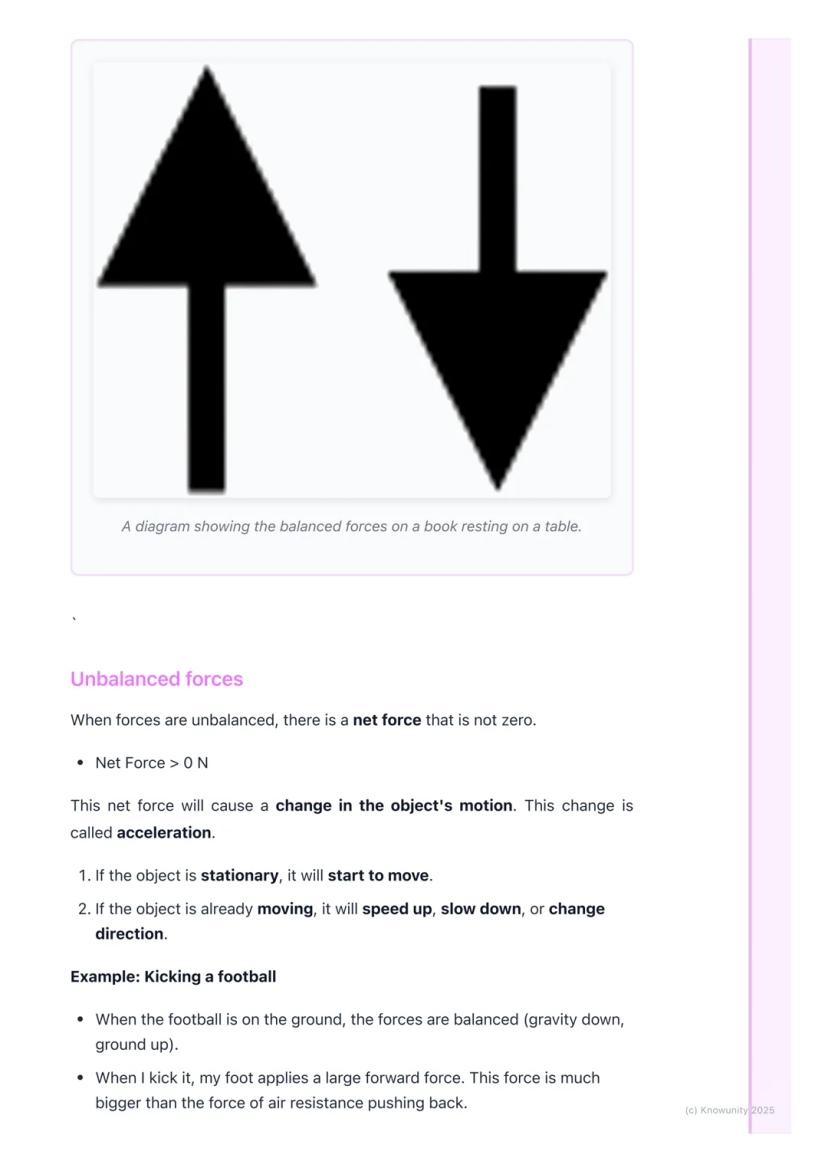
Take a book on your desk. Gravity pulls it down whilst the normal force from the desk pushes up with exactly the same strength. These balanced forces mean your book stays put instead of falling through the desk or floating to the ceiling.
Remember: Balanced forces don't always mean "not moving" - they mean "not changing motion"!
3
of 7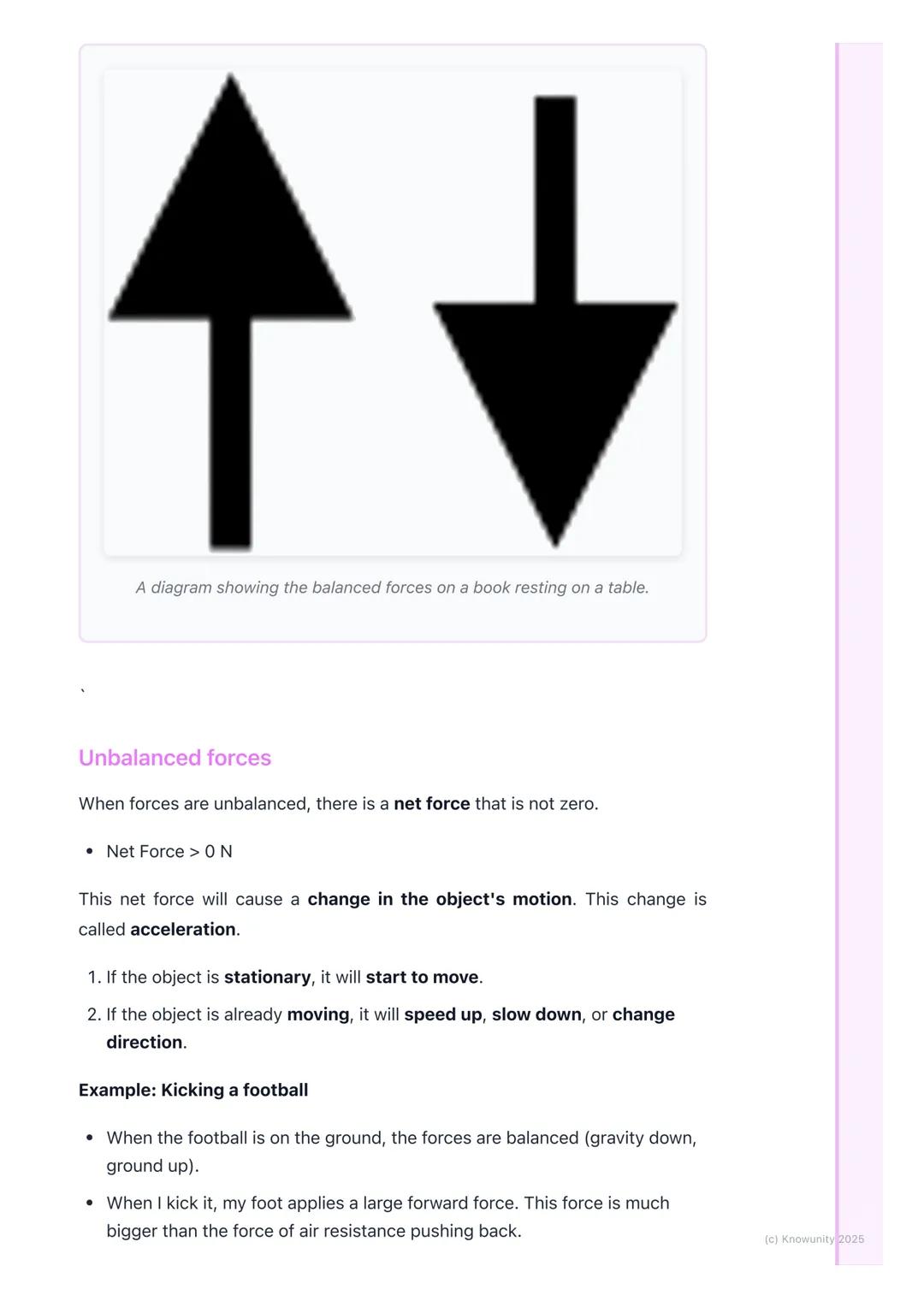
Unbalanced Forces - When Change Happens
This is where things get exciting! Unbalanced forces occur when the forces acting on an object aren't equal - one direction "wins" over the other. The net force is greater than 0 N, and that's when you see acceleration.
Acceleration doesn't just mean speeding up - it's any change in motion. Things can speed up, slow down, or change direction. All of these count as acceleration in physics.
Picture kicking a football. Before you kick it, the ball sits still because gravity downwards equals the ground's upward push. But when your foot applies a massive forward force, suddenly the forces become unbalanced.
Your kick creates a much bigger force than air resistance can provide in the opposite direction. The net force sends the ball flying forward, and that's unbalanced forces in action!
Test Tip: If you see acceleration happening, you know the forces must be unbalanced - no exceptions!
4
of 7
Working Out Net Force
Let's make this practical with some maths - don't worry, it's easier than it looks! You just need to add up all the forces, keeping track of which direction they're pushing or pulling.
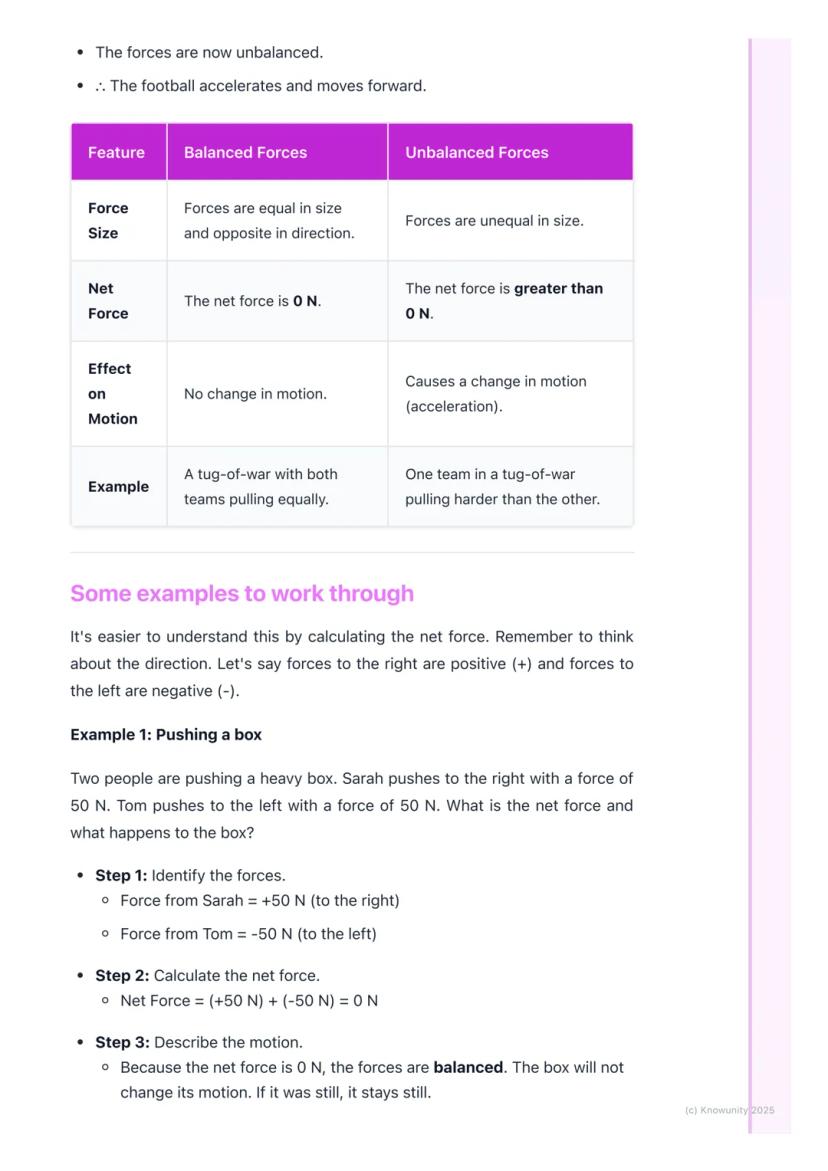
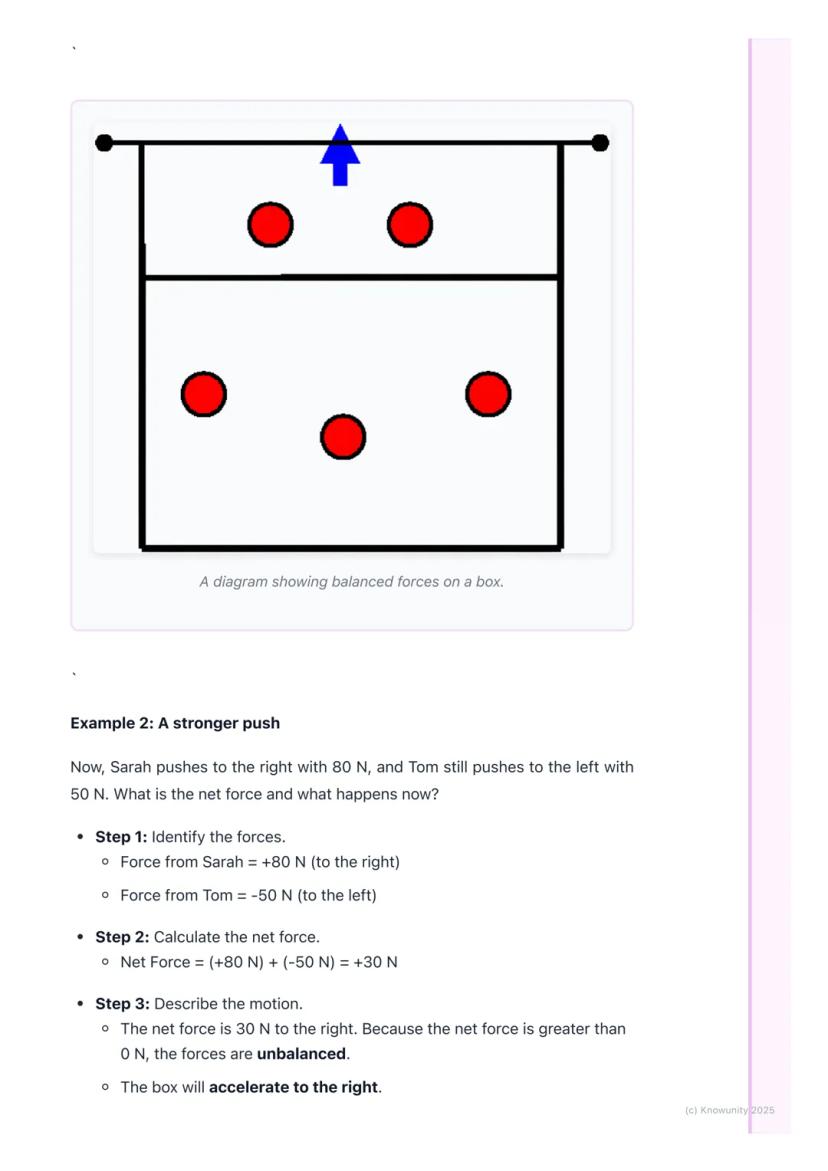
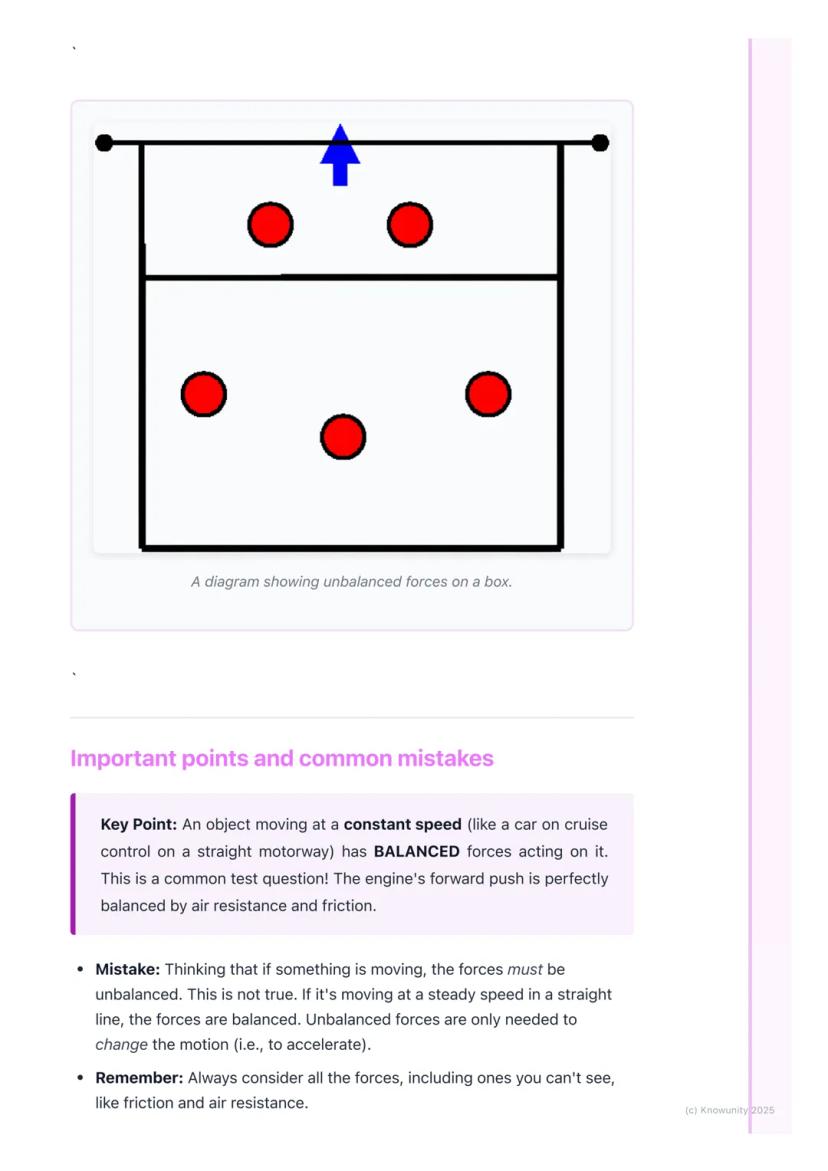
Example 1: Sarah pushes a box right with 50 N, whilst Tom pushes left with 50 N. Net force = 50 N + = 0 N. The forces are balanced, so the box won't change its motion.
Example 2: Now Sarah pushes right with 80 N, and Tom still pushes left with 50 N. Net force = 80 N + = 30 N to the right. These unbalanced forces will accelerate the box rightward.
The trick is picking a direction as positive (usually right or up) and making the opposite direction negative. Then it's just simple addition and subtraction to find your net force.
Study Hack: Always draw arrows showing force direction - it makes the maths much clearer and helps avoid silly mistakes!
5
of 7
Common Mistakes and Key Points
Here's the mistake that trips up nearly everyone: thinking that moving objects always have unbalanced forces acting on them. That's completely wrong! A car travelling at steady speed on a straight road has perfectly balanced forces - the engine's push forward exactly equals friction and air resistance pushing back.
Unbalanced forces are only needed when motion changes. If something moves at constant speed in a straight line, the forces are balanced. It's only when things speed up, slow down, or turn that you need unbalanced forces.
Don't forget about invisible forces like friction and air resistance - they're always there, even if you can't see them. These forces often balance out the more obvious pushes and pulls.
The direction of your net force always matches the direction of acceleration. If the net force points left, the object accelerates left. If it points right, acceleration goes right too.
Exam Success: Remember that constant velocity (steady speed, straight line) always means balanced forces - this question appears on nearly every test!
6
of 7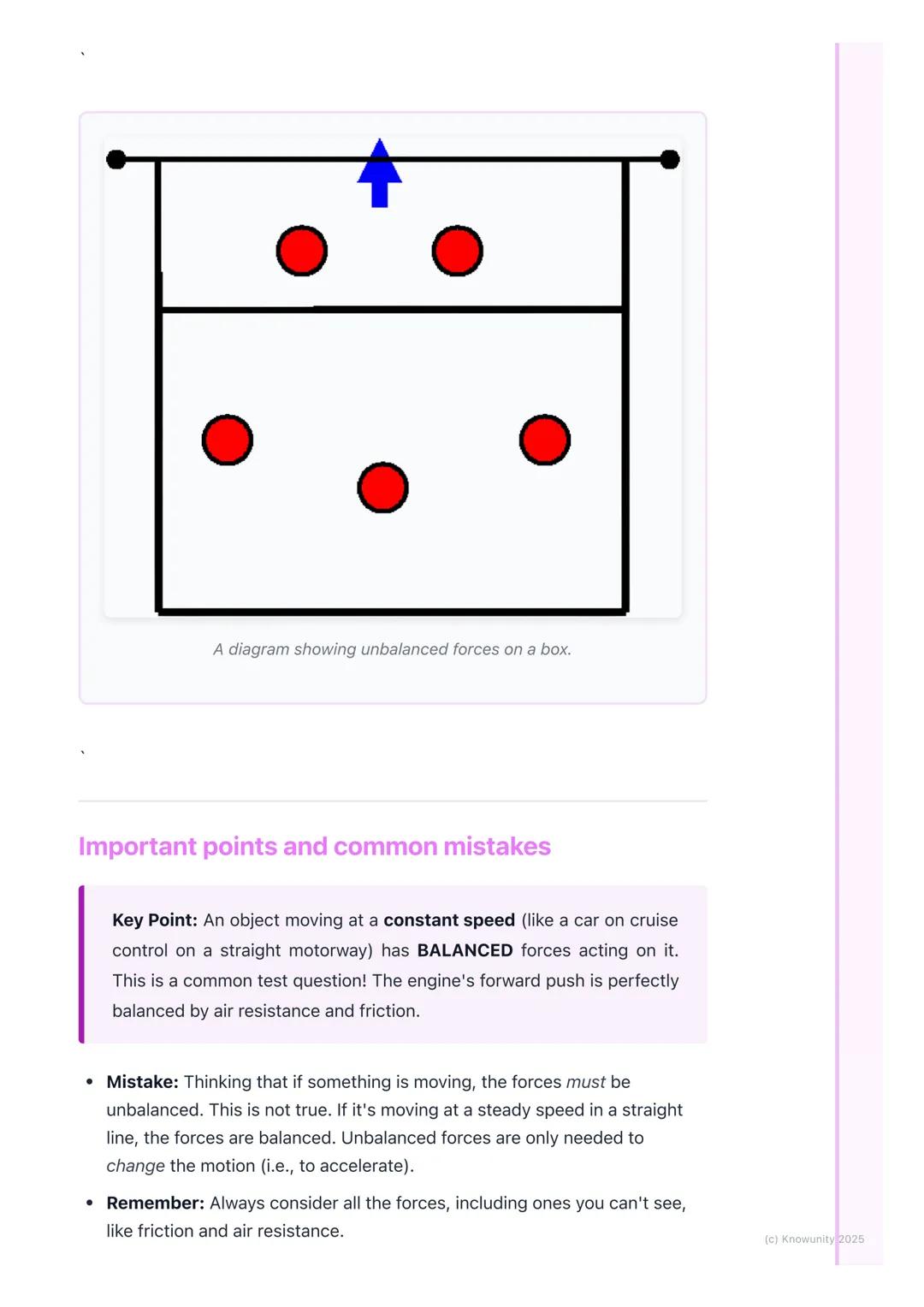
Quick Revision Summary
Forces are pushes or pulls measured in Newtons (N). When they're balanced (equal and opposite), the net force is 0 N and motion doesn't change. When they're unbalanced (not equal), you get a net force greater than 0 N that causes acceleration.
To find net force, add all forces together, remembering that direction matters. Use positive for one direction and negative for the opposite.
Objects at rest have balanced forces. Objects moving at constant speed also have balanced forces. Only accelerating objects have unbalanced forces acting on them.
Final Tip: If you can remember that balanced forces mean "no change" and unbalanced forces mean "change happens", you'll ace this topic!
7
of 7
We thought you’d never ask...
What is the Knowunity AI companion?
Our AI companion is specifically built for the needs of students. Based on the millions of content pieces we have on the platform we can provide truly meaningful and relevant answers to students. But its not only about answers, the companion is even more about guiding students through their daily learning challenges, with personalised study plans, quizzes or content pieces in the chat and 100% personalisation based on the students skills and developments.
Where can I download the Knowunity app?
You can download the app in the Google Play Store and in the Apple App Store.
Is Knowunity really free of charge?
That's right! Enjoy free access to study content, connect with fellow students, and get instant help – all at your fingertips.
Most popular content in Physics
2PhysicsTypes of Forces
Students will identify common forces such as gravity (pulling objects down), friction (opposing motion), and air resistance (slowing objects in the air).
2nd Year460
PhysicsSpeed, Distance, and Time
Students will learn the basic concepts of speed, distance, and time, and how they relate to each other in describing motion.
2nd Year100
Most popular content
9 Irish
IrishIrish oral questions and answers
Questions and answers for the leaving cert oral
5th Year4254
IrishIrish oral questions
Outline of oral questions
5th Year2055
 English
Key Quotes : Sive
Key Quotes and explanations: Sive
6th Year2822
IrishIníon- le hÁine Durkin
Aine Durkin’s poem, Iníon: Themes & summary
5th Year850
IrishIrish poetry 2027
Iníon + Dínit an Bhróin
5th Year1133
IrishLC HL notes- Iníon (poem)
Includes poem in English and Irish, theme, key words & phrases
5th Year2284
IrishGaeilge Grammar Office
All the basics you need to know on Irish grammar.
6th Year1013
EnglishCultural Context : Shawshank Redemption : Sive : Small Things Like These
Comparative Study : Cultural Context : Shawshank Redemption, Sive and Small Things Like These
6th Year1420
IrishAn Gaeilge Aiste
Irish Language essay
6th Year1310
Can't find what you're looking for? Explore other subjects.
Students love us — and so will you.
4.6/5App Store
4.7/5Google Play
The app is very easy to use and well designed. I have found everything I was looking for so far and have been able to learn a lot from the presentations! I will definitely use the app for a class assignment! And of course it also helps a lot as an inspiration.
Stefan SiOS user
This app is really great. There are so many study notes and help [...]. My problem subject is French, for example, and the app has so many options for help. Thanks to this app, I have improved my French. I would recommend it to anyone.
Samantha KlichAndroid user
Wow, I am really amazed. I just tried the app because I've seen it advertised many times and was absolutely stunned. This app is THE HELP you want for school and above all, it offers so many things, such as workouts and fact sheets, which have been VERY helpful to me personally.
AnnaiOS user
Physics42 views·Updated May 20, 2026·7 pagesUnderstanding Balanced and Unbalanced Forces: Effects on Motion
Forces are everywhere - when you kick a football, sit on a chair, or even just stand still, forces are acting on you and everything around you. Understanding whether these forces are balanced or unbalanced helps explain why things move... Show more
1
of 7Sign up to see the content. It's free!
- Access to all documents
- Improve your grades
- Join milions of students
What Are Forces?
Think of forces as invisible pushes and pulls that are constantly acting on everything around you. You can't see them, but you definitely see what they do - like when you push a door open or gravity pulls your phone to the ground when you drop it.
Forces are measured in Newtons (N), named after Sir Isaac Newton. Every time something starts moving, stops, speeds up, or changes direction, it's because of forces doing their job.
The big idea here is simple: balanced forces keep things as they are, whilst unbalanced forces create change. Master this concept and you'll understand why a book stays on your desk and why a football flies through the air when you kick it.
Key Insight: Forces might be invisible, but their effects are everywhere - from the friction that stops you sliding off your chair to the gravity that keeps your feet on the ground!
2
of 7Sign up to see the content. It's free!
- Access to all documents
- Improve your grades
- Join milions of students
Balanced Forces - When Nothing Changes
Balanced forces are like a perfectly even tug-of-war - both sides pull with equal strength, so nobody moves. When forces acting on an object are equal in size but opposite in direction, they cancel each other out completely.
The magic number here is zero. When forces are balanced, the net force (the total of all forces) equals 0 N. This means the object's motion won't change at all.
Here's the tricky bit that catches loads of students: if something is already moving when forces become balanced, it doesn't stop - it keeps moving at the same speed in the same direction! Think of a car on cruise control on a straight motorway.
Take a book on your desk. Gravity pulls it down whilst the normal force from the desk pushes up with exactly the same strength. These balanced forces mean your book stays put instead of falling through the desk or floating to the ceiling.
Remember: Balanced forces don't always mean "not moving" - they mean "not changing motion"!
3
of 7Sign up to see the content. It's free!
- Access to all documents
- Improve your grades
- Join milions of students
Unbalanced Forces - When Change Happens
This is where things get exciting! Unbalanced forces occur when the forces acting on an object aren't equal - one direction "wins" over the other. The net force is greater than 0 N, and that's when you see acceleration.
Acceleration doesn't just mean speeding up - it's any change in motion. Things can speed up, slow down, or change direction. All of these count as acceleration in physics.
Picture kicking a football. Before you kick it, the ball sits still because gravity downwards equals the ground's upward push. But when your foot applies a massive forward force, suddenly the forces become unbalanced.
Your kick creates a much bigger force than air resistance can provide in the opposite direction. The net force sends the ball flying forward, and that's unbalanced forces in action!
Test Tip: If you see acceleration happening, you know the forces must be unbalanced - no exceptions!
4
of 7Sign up to see the content. It's free!
- Access to all documents
- Improve your grades
- Join milions of students
Working Out Net Force
Let's make this practical with some maths - don't worry, it's easier than it looks! You just need to add up all the forces, keeping track of which direction they're pushing or pulling.
Example 1: Sarah pushes a box right with 50 N, whilst Tom pushes left with 50 N. Net force = 50 N + = 0 N. The forces are balanced, so the box won't change its motion.
Example 2: Now Sarah pushes right with 80 N, and Tom still pushes left with 50 N. Net force = 80 N + = 30 N to the right. These unbalanced forces will accelerate the box rightward.
The trick is picking a direction as positive (usually right or up) and making the opposite direction negative. Then it's just simple addition and subtraction to find your net force.
Study Hack: Always draw arrows showing force direction - it makes the maths much clearer and helps avoid silly mistakes!
5
of 7Sign up to see the content. It's free!
- Access to all documents
- Improve your grades
- Join milions of students
Common Mistakes and Key Points
Here's the mistake that trips up nearly everyone: thinking that moving objects always have unbalanced forces acting on them. That's completely wrong! A car travelling at steady speed on a straight road has perfectly balanced forces - the engine's push forward exactly equals friction and air resistance pushing back.
Unbalanced forces are only needed when motion changes. If something moves at constant speed in a straight line, the forces are balanced. It's only when things speed up, slow down, or turn that you need unbalanced forces.
Don't forget about invisible forces like friction and air resistance - they're always there, even if you can't see them. These forces often balance out the more obvious pushes and pulls.
The direction of your net force always matches the direction of acceleration. If the net force points left, the object accelerates left. If it points right, acceleration goes right too.
Exam Success: Remember that constant velocity (steady speed, straight line) always means balanced forces - this question appears on nearly every test!
6
of 7Sign up to see the content. It's free!
- Access to all documents
- Improve your grades
- Join milions of students
Quick Revision Summary
Forces are pushes or pulls measured in Newtons (N). When they're balanced (equal and opposite), the net force is 0 N and motion doesn't change. When they're unbalanced (not equal), you get a net force greater than 0 N that causes acceleration.
To find net force, add all forces together, remembering that direction matters. Use positive for one direction and negative for the opposite.
Objects at rest have balanced forces. Objects moving at constant speed also have balanced forces. Only accelerating objects have unbalanced forces acting on them.
Final Tip: If you can remember that balanced forces mean "no change" and unbalanced forces mean "change happens", you'll ace this topic!
7
of 7Sign up to see the content. It's free!
- Access to all documents
- Improve your grades
- Join milions of students
We thought you’d never ask...
What is the Knowunity AI companion?
Our AI companion is specifically built for the needs of students. Based on the millions of content pieces we have on the platform we can provide truly meaningful and relevant answers to students. But its not only about answers, the companion is even more about guiding students through their daily learning challenges, with personalised study plans, quizzes or content pieces in the chat and 100% personalisation based on the students skills and developments.
Where can I download the Knowunity app?
You can download the app in the Google Play Store and in the Apple App Store.
Is Knowunity really free of charge?
That's right! Enjoy free access to study content, connect with fellow students, and get instant help – all at your fingertips.
Most popular content in Physics
2PhysicsTypes of Forces
Students will identify common forces such as gravity (pulling objects down), friction (opposing motion), and air resistance (slowing objects in the air).
2nd Year460
PhysicsSpeed, Distance, and Time
Students will learn the basic concepts of speed, distance, and time, and how they relate to each other in describing motion.
2nd Year100
Most popular content
9IrishIrish oral questions and answers
Questions and answers for the leaving cert oral
5th Year4254
IrishIrish oral questions
Outline of oral questions
5th Year2055
EnglishKey Quotes : Sive
Key Quotes and explanations: Sive
6th Year2822
IrishIníon- le hÁine Durkin
Aine Durkin’s poem, Iníon: Themes & summary
5th Year850
IrishIrish poetry 2027
Iníon + Dínit an Bhróin
5th Year1133
IrishLC HL notes- Iníon (poem)
Includes poem in English and Irish, theme, key words & phrases
5th Year2284
IrishGaeilge Grammar Office
All the basics you need to know on Irish grammar.
6th Year1013
EnglishCultural Context : Shawshank Redemption : Sive : Small Things Like These
Comparative Study : Cultural Context : Shawshank Redemption, Sive and Small Things Like These
6th Year1420
IrishAn Gaeilge Aiste
Irish Language essay
6th Year1310
Can't find what you're looking for? Explore other subjects.
Students love us — and so will you.
4.6/5App Store
4.7/5Google Play
The app is very easy to use and well designed. I have found everything I was looking for so far and have been able to learn a lot from the presentations! I will definitely use the app for a class assignment! And of course it also helps a lot as an inspiration.
Stefan SiOS user
This app is really great. There are so many study notes and help [...]. My problem subject is French, for example, and the app has so many options for help. Thanks to this app, I have improved my French. I would recommend it to anyone.
Samantha KlichAndroid user
Wow, I am really amazed. I just tried the app because I've seen it advertised many times and was absolutely stunned. This app is THE HELP you want for school and above all, it offers so many things, such as workouts and fact sheets, which have been VERY helpful to me personally.
AnnaiOS user