
Psychology is the scientific study of mind and behavior, using... Show more
 Algebra
Sign up to see the contentIt's free!
Access to all documents
Improve your grades
Join milions of students
Subjects
Triangle Congruence and Similarity Theorems
Triangle Properties and Classification
Linear Equations and Graphs
Geometric Angle Relationships
Trigonometric Functions and Identities
Equation Solving Techniques
Circle Geometry Fundamentals
Division Operations and Methods
Basic Differentiation Rules
Exponent and Logarithm Properties
Show all topics
Human Organ Systems
Reproductive Cell Cycles
Biological Sciences Subdisciplines
Cellular Energy Metabolism
Autotrophic Energy Processes
Inheritance Patterns and Principles
Biomolecular Structure and Organization
Cell Cycle and Division Mechanics
Cellular Organization and Development
Biological Structural Organization
Show all topics
Chemical Sciences and Applications
Atomic Structure and Composition
Molecular Electron Structure Representation
Atomic Electron Behavior
Matter Properties and Water
Mole Concept and Calculations
Gas Laws and Behavior
Periodic Table Organization
Chemical Thermodynamics Fundamentals
Chemical Bond Types and Properties
Show all topics
European Renaissance and Enlightenment
European Cultural Movements 800-1920
American Revolution Era 1763-1797
American Civil War 1861-1865
Global Imperial Systems
Mongol and Chinese Dynasties
U.S. Presidents and World Leaders
Historical Sources and Documentation
World Wars Era and Impact
World Religious Systems
Show all topics
Classic and Contemporary Novels
Literary Character Analysis
Rhetorical Theory and Practice
Classic Literary Narratives
Reading Analysis and Interpretation
Narrative Structure and Techniques
English Language Components
Influential English-Language Authors
Basic Sentence Structure
Narrative Voice and Perspective
Show all topics
303
•
Feb 6, 2026
•
Anna Zheng
@annazheng_rpos
Psychology is the scientific study of mind and behavior, using... Show more
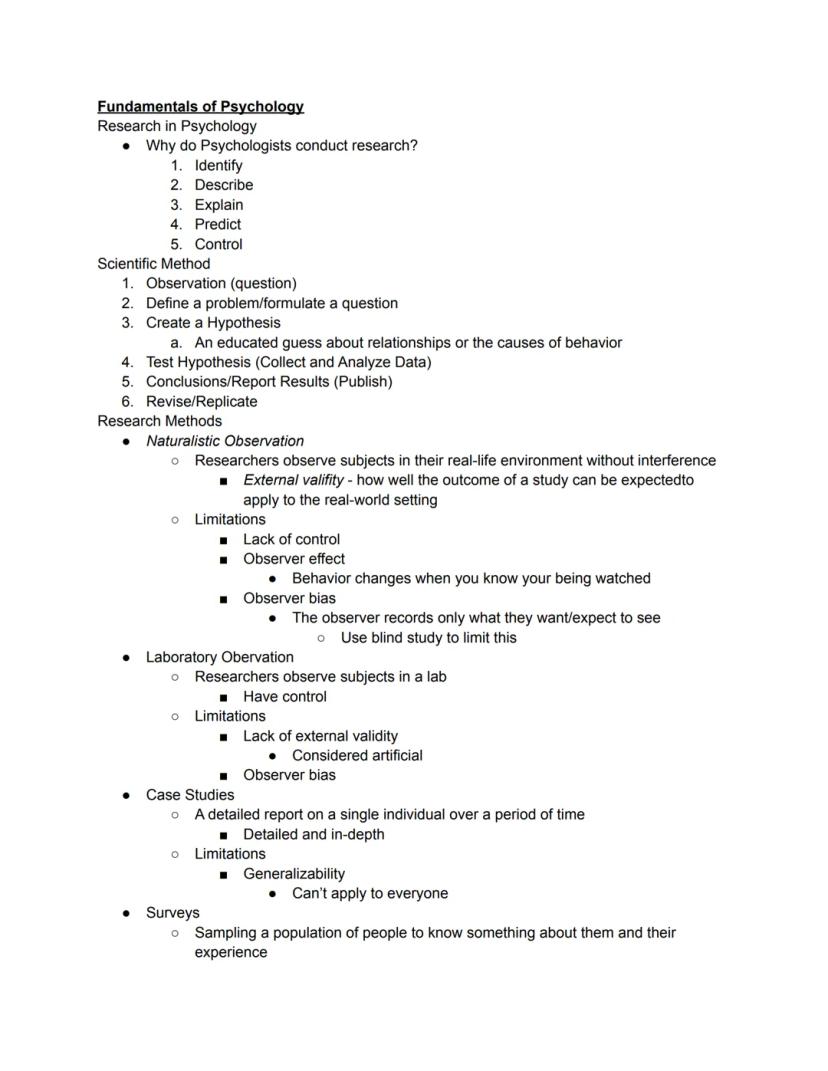
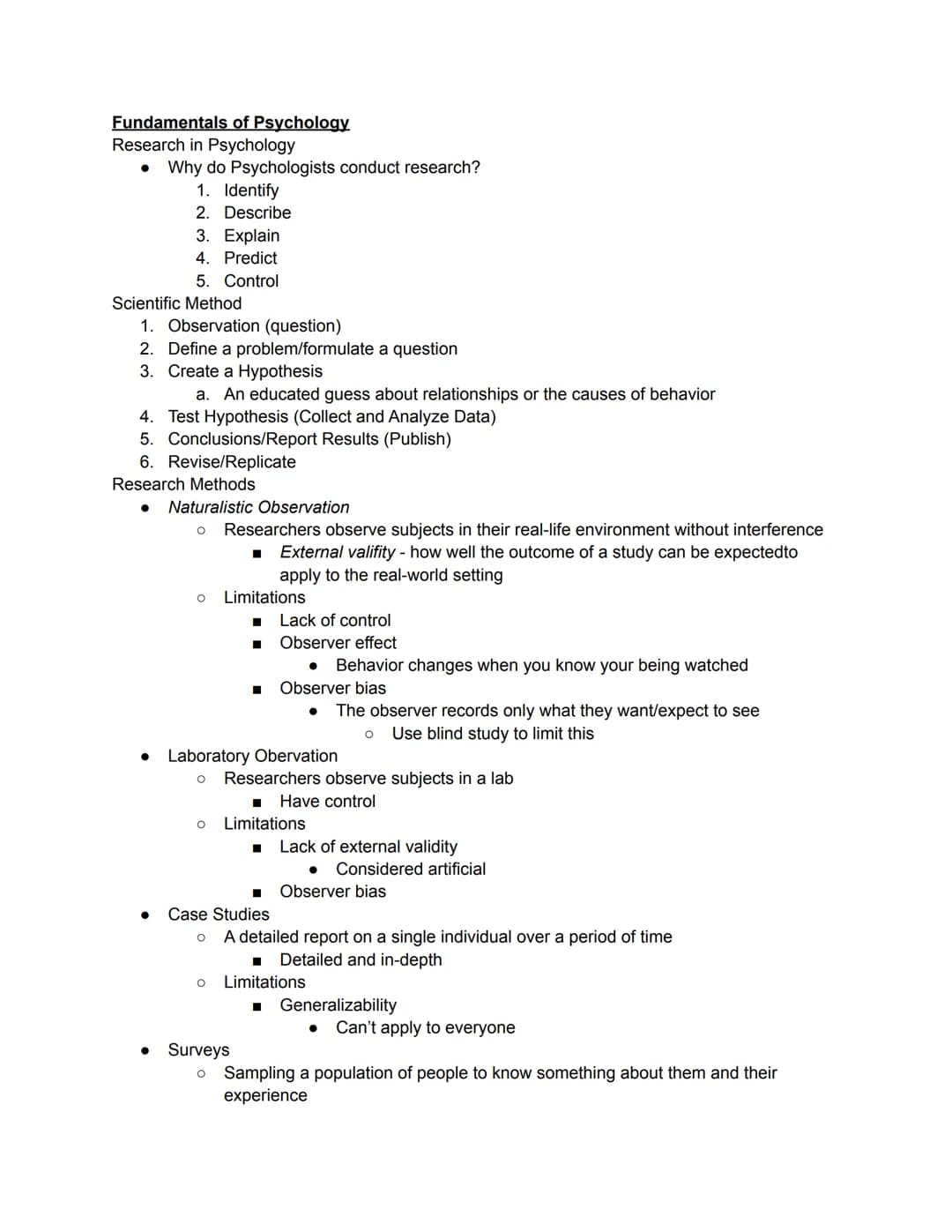
Ever wonder why we study psychology? Psychologists conduct research to identify, describe, explain, predict, and ultimately control various aspects of human behavior. Their work follows the scientific method, which begins with an observation, defines a problem, creates a hypothesis, tests that hypothesis, draws conclusions, and finally revises or replicates the study.
Researchers use several methods to gather data. Naturalistic observation involves watching subjects in their real-life environments without interference, providing strong external validity but suffering from lack of control and potential observer effects. Laboratory observation offers more control but may create artificial situations. Case studies provide detailed reports on single individuals, offering depth but limited generalizability.
Surveys involve sampling a population to learn about their experiences. A good survey requires a representative sample that accurately reflects the larger population. However, surveys can be limited by biased samples (like convenience samples) and social desirability bias, where people report what sounds good rather than the truth.
💡 When you see research in the news or social media, ask yourself: "What method did they use, and what are its limitations?" This critical thinking skill will help you evaluate psychological claims throughout your life.
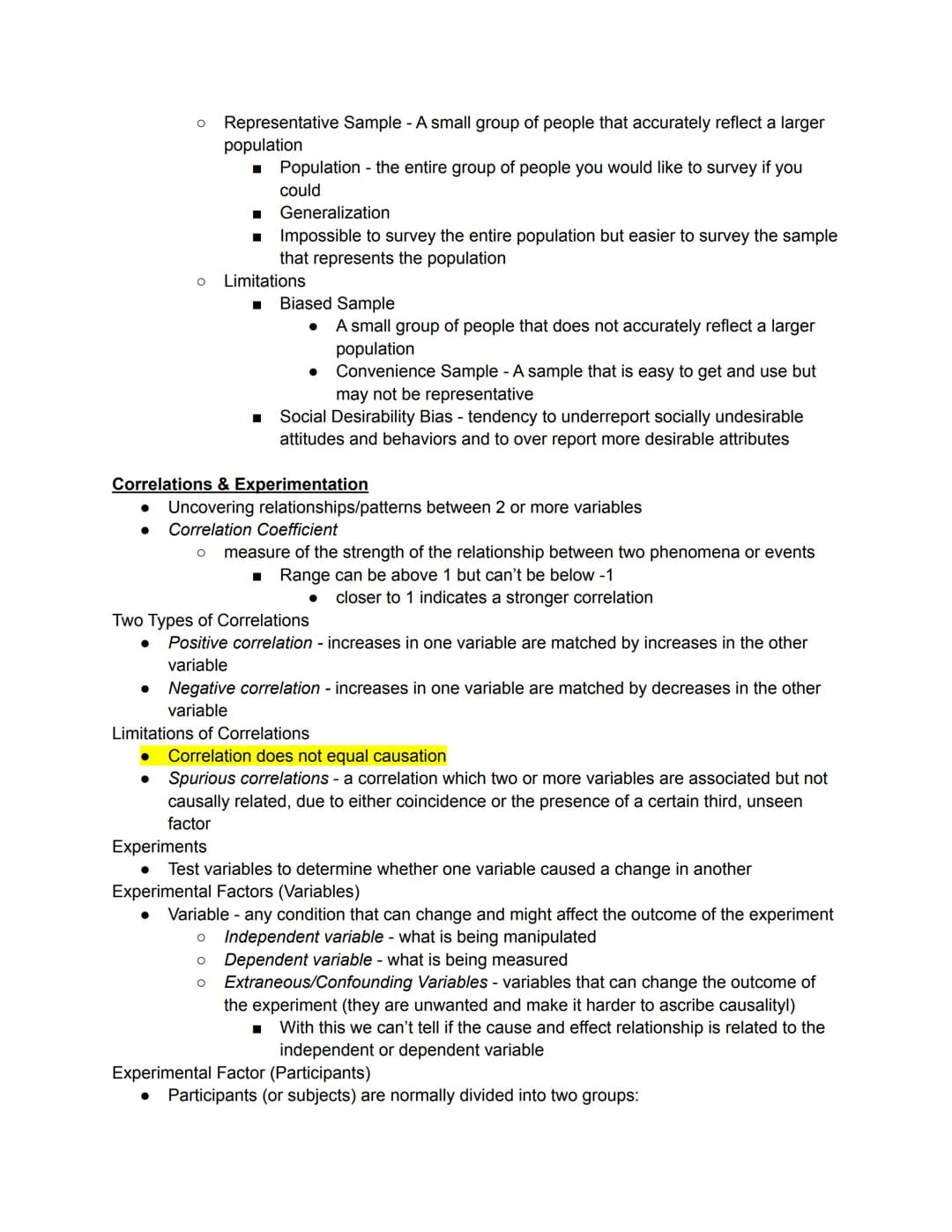
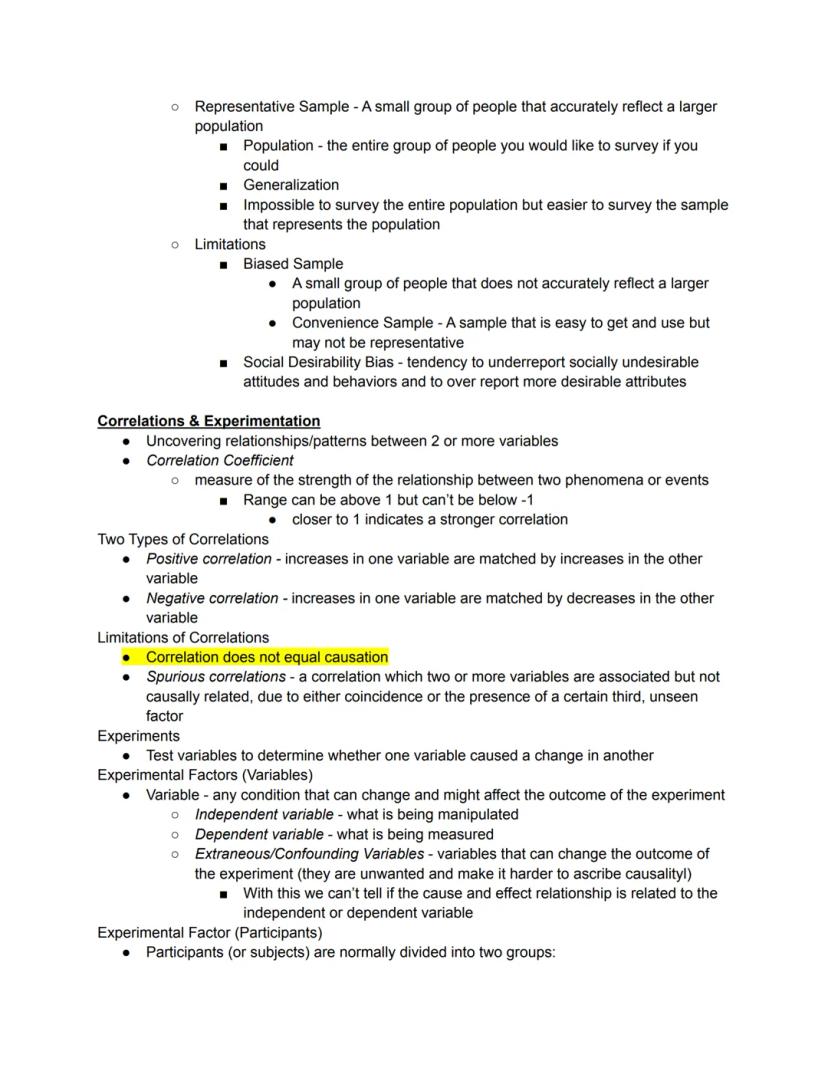
Have you ever noticed two things happening together and wondered if one caused the other? That's what correlational research explores! A correlation coefficient measures the relationship strength between variables, ranging from -1 to +1. The closer to either extreme, the stronger the relationship.
Correlations come in two types: positive correlations (when both variables increase together) and negative correlations (when one increases as the other decreases). However, remember this key limitation: correlation does not equal causation. Sometimes spurious correlations occur when variables appear related but aren't actually causing each other.
To determine cause and effect, psychologists use experiments. In an experiment, researchers manipulate an independent variable to see its effect on a dependent variable while controlling for confounding variables that could affect results. Participants are typically divided into two groups: an experimental group that receives the manipulation and a control group that doesn't.
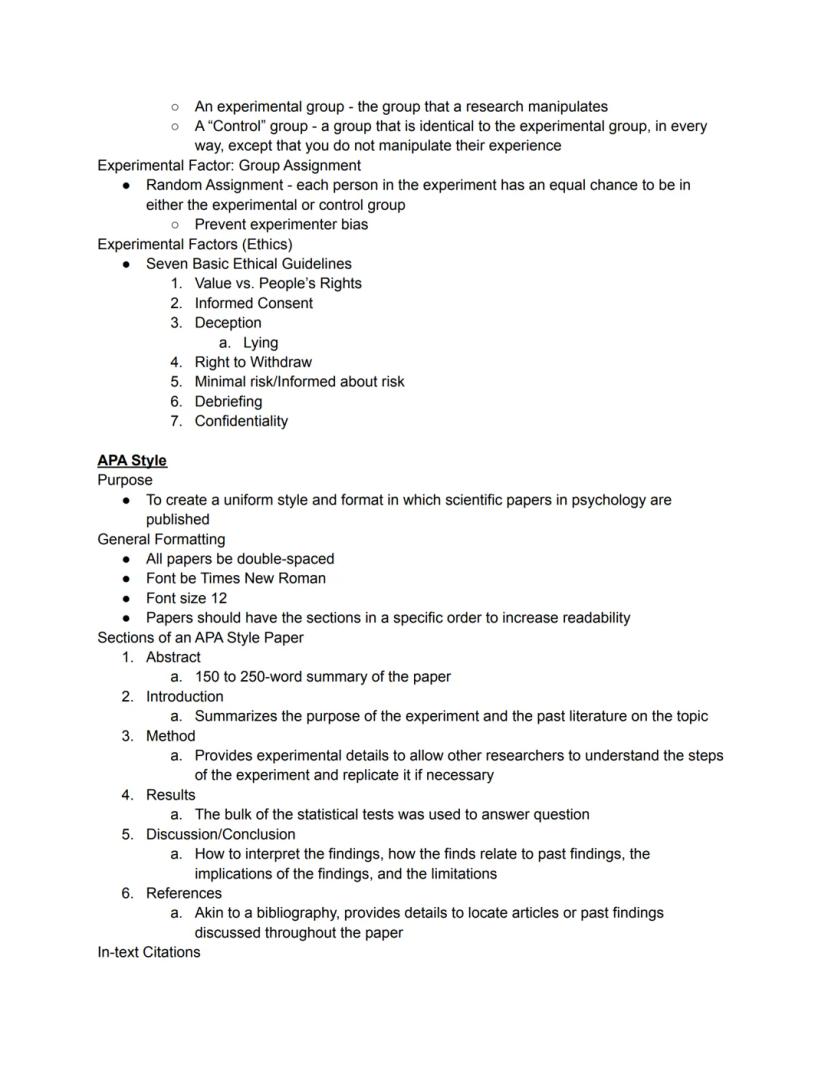
For valid results, researchers use random assignment to place participants in groups, preventing bias. They must also follow ethical guidelines including informed consent, minimal risk, right to withdraw, debriefing participants after the study, and maintaining confidentiality.
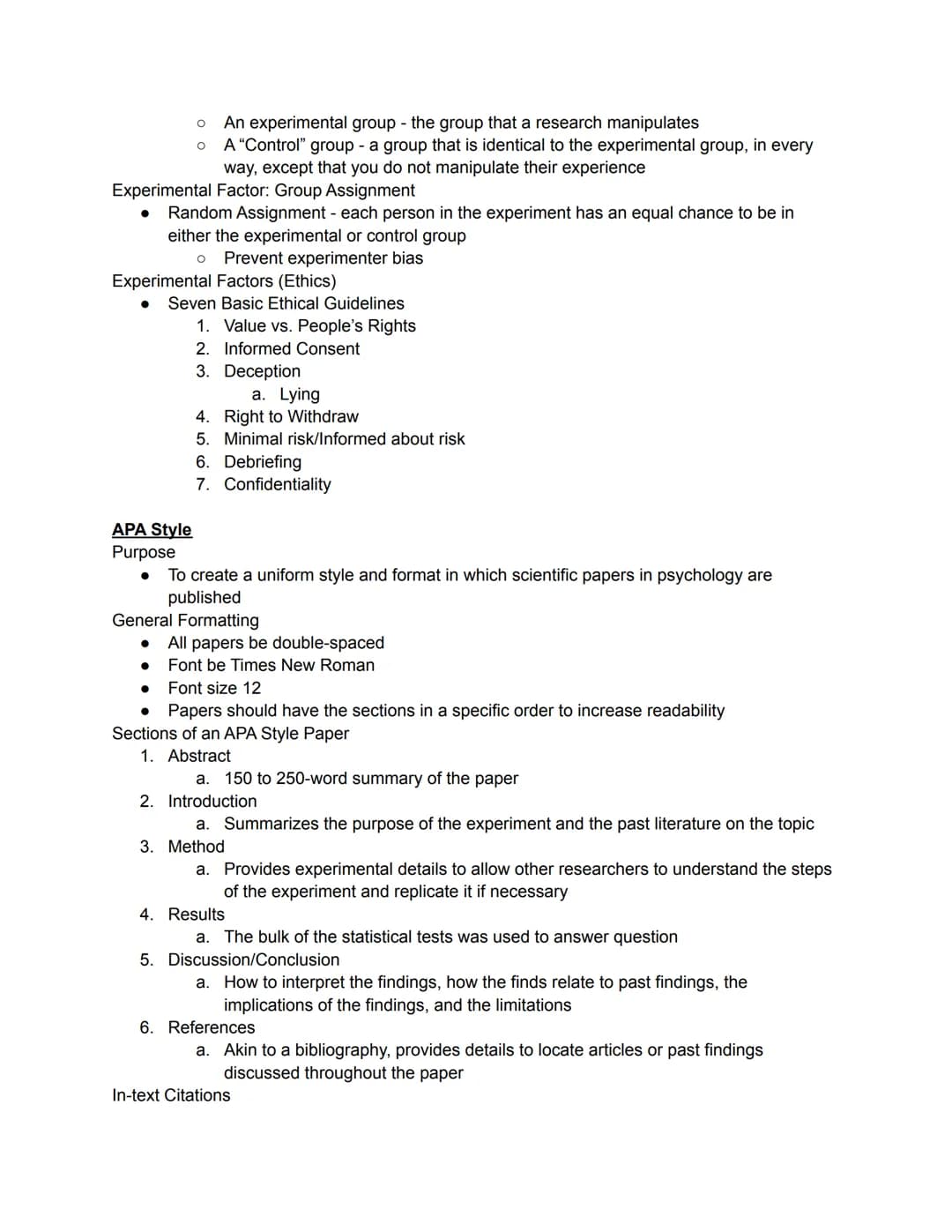
When psychologists conduct research, they have a responsibility to protect their participants. The seven basic ethical guidelines include balancing research value against people's rights, getting informed consent, minimizing deception, allowing participants to withdraw, minimizing risks, debriefing afterwards, and maintaining confidentiality.
The APA style provides a standardized format for psychology papers, making research easier to understand and compare. Papers should be double-spaced in 12-point Times New Roman font with specific sections in a particular order. Each APA paper includes an abstract (a brief summary), introduction, method section, results, discussion/conclusion, and references.
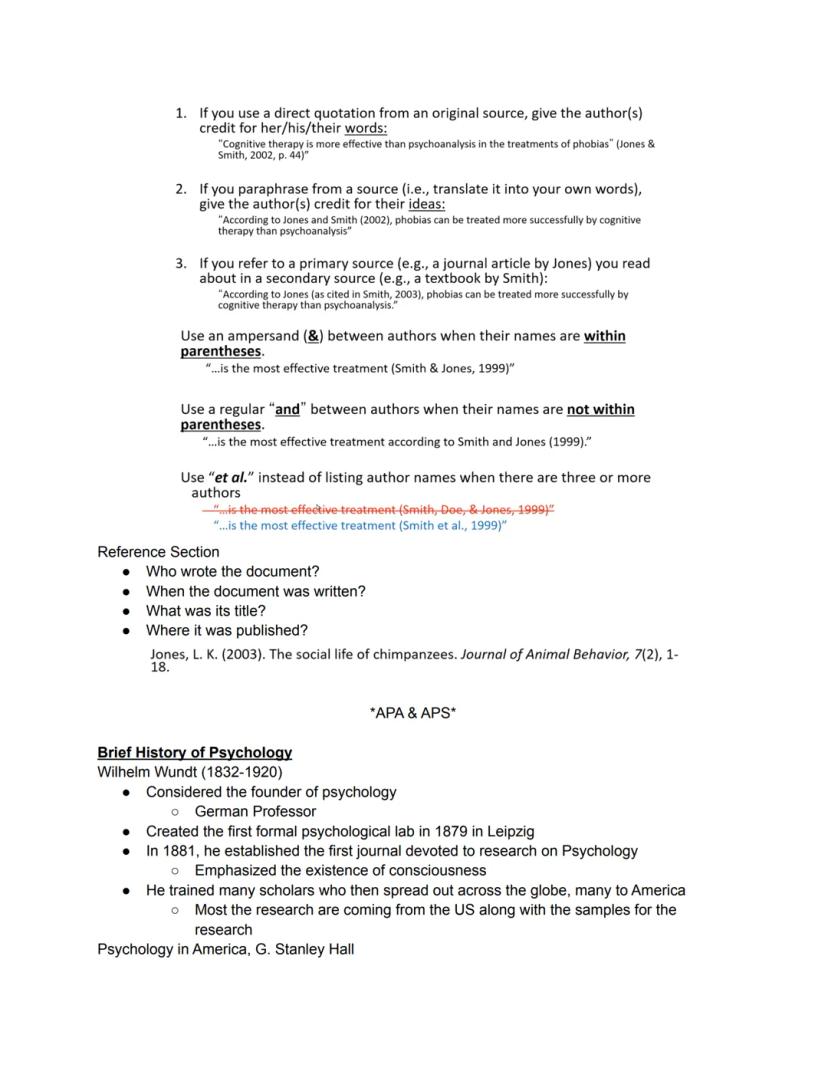
Proper documentation is crucial in psychological writing. When using someone else's work, you must cite it correctly using in-text citations. These citations vary depending on whether you're directly quoting, paraphrasing, or referring to a primary source mentioned in another work. For multiple authors, use "&" within parentheses and "and" in the text.
🔍 Think of APA style as the "language" psychologists use to communicate with each other. Learning it is like learning the rules of a game—once you know them, you can participate fully in the conversation!
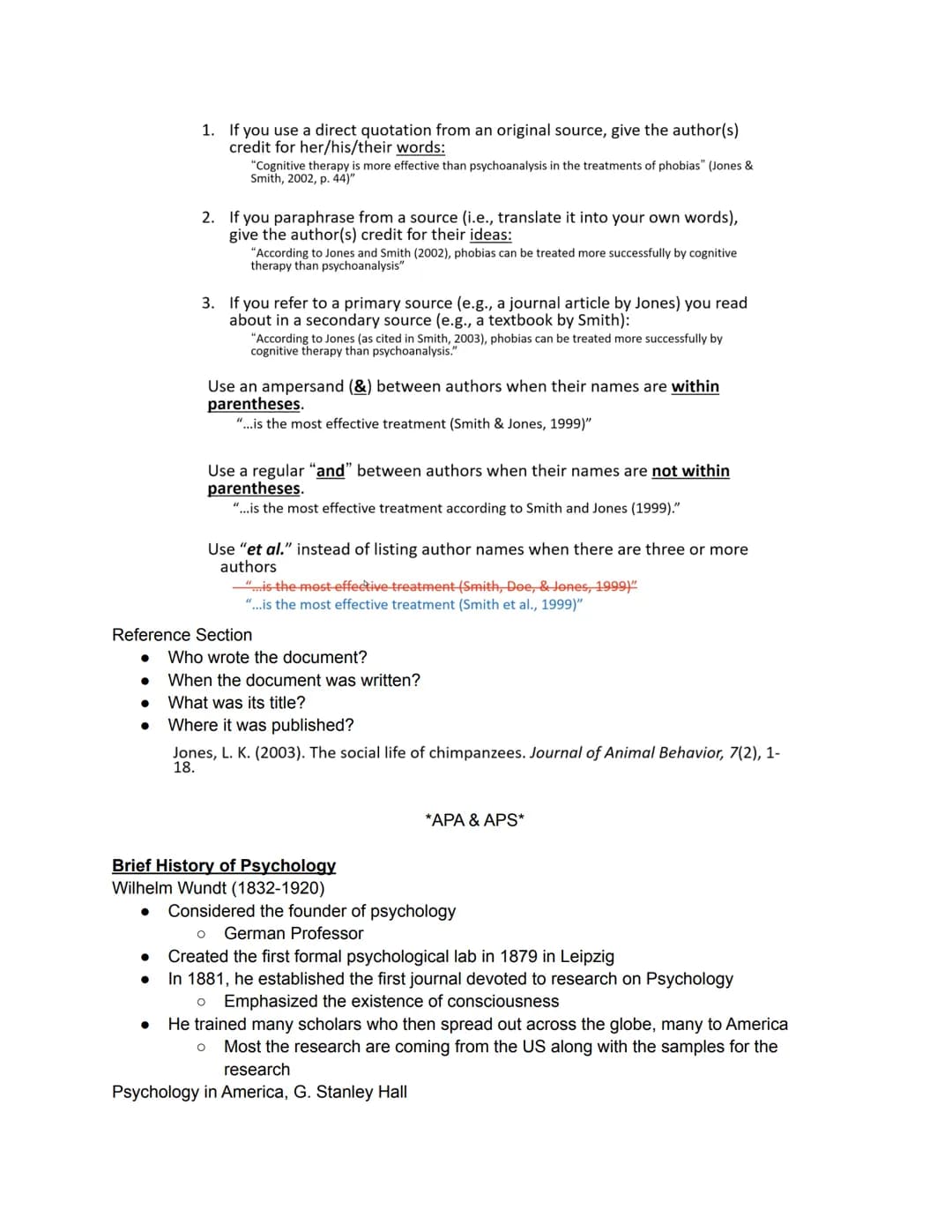
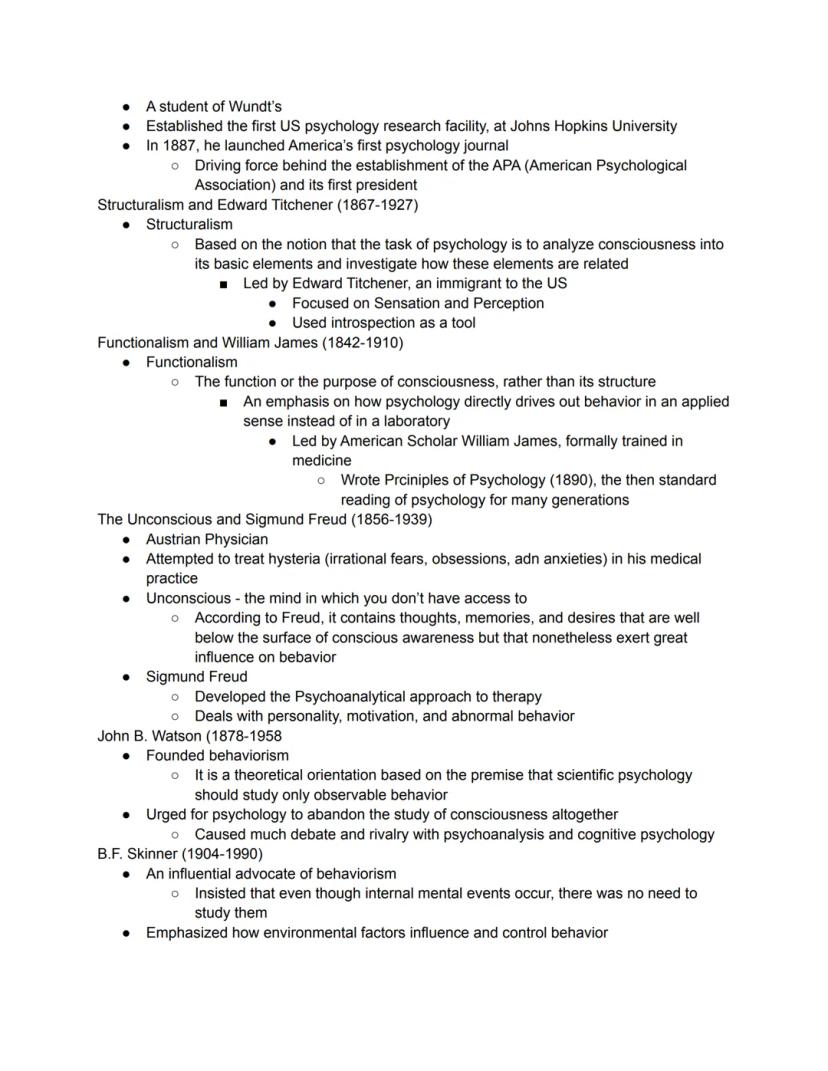
Psychology as a formal science is younger than you might think! Wilhelm Wundt, considered the founder of psychology, established the first psychological laboratory in 1879 in Germany. His work emphasized the existence of consciousness, and his students spread his ideas worldwide.
In America, G. Stanley Hall established the first US psychology research facility and launched America's first psychology journal. He also helped establish the American Psychological Association (APA) and became its first president. Early approaches to psychology included structuralism, led by Edward Titchener, which analyzed consciousness into basic elements using introspection.
William James championed functionalism, focusing on how consciousness serves practical purposes rather than just its structure. His book "Principles of Psychology" became standard reading for generations of psychology students. Meanwhile in Europe, Sigmund Freud developed psychoanalysis, emphasizing the role of the unconscious mind—thoughts and desires below conscious awareness that influence behavior.
When citing research in APA format, you'll often see citations with multiple authors shown as "Smith et al. (1999)" when there are three or more authors. The reference section provides complete information about sources, including author, publication date, title, and where it was published.
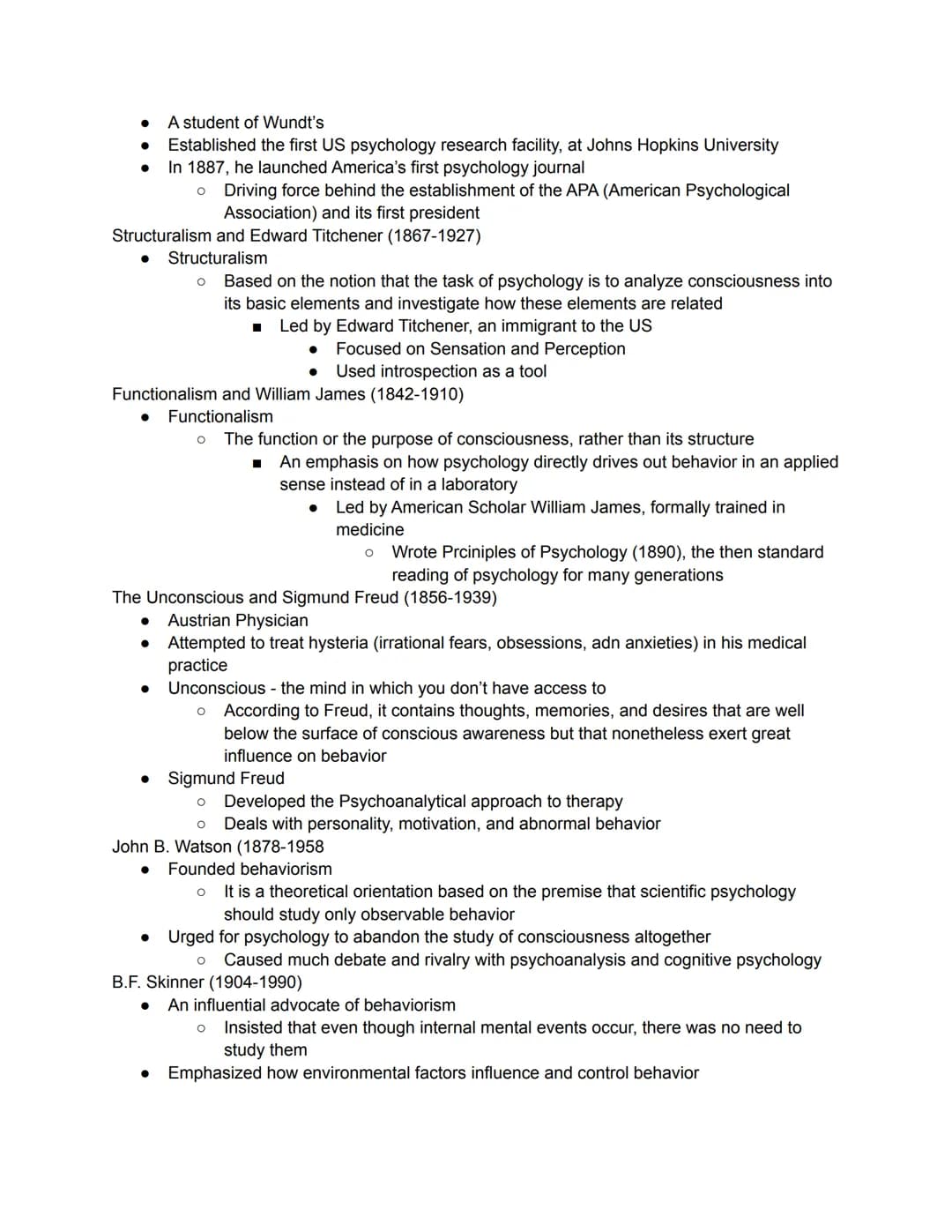
Have you ever thought about how many different ways there are to understand human behavior? Early in the 20th century, John B. Watson founded behaviorism, arguing that psychology should study only observable behavior, not consciousness. B.F. Skinner expanded this view, suggesting that behavior is controlled by environmental factors and that "free will is an illusion."
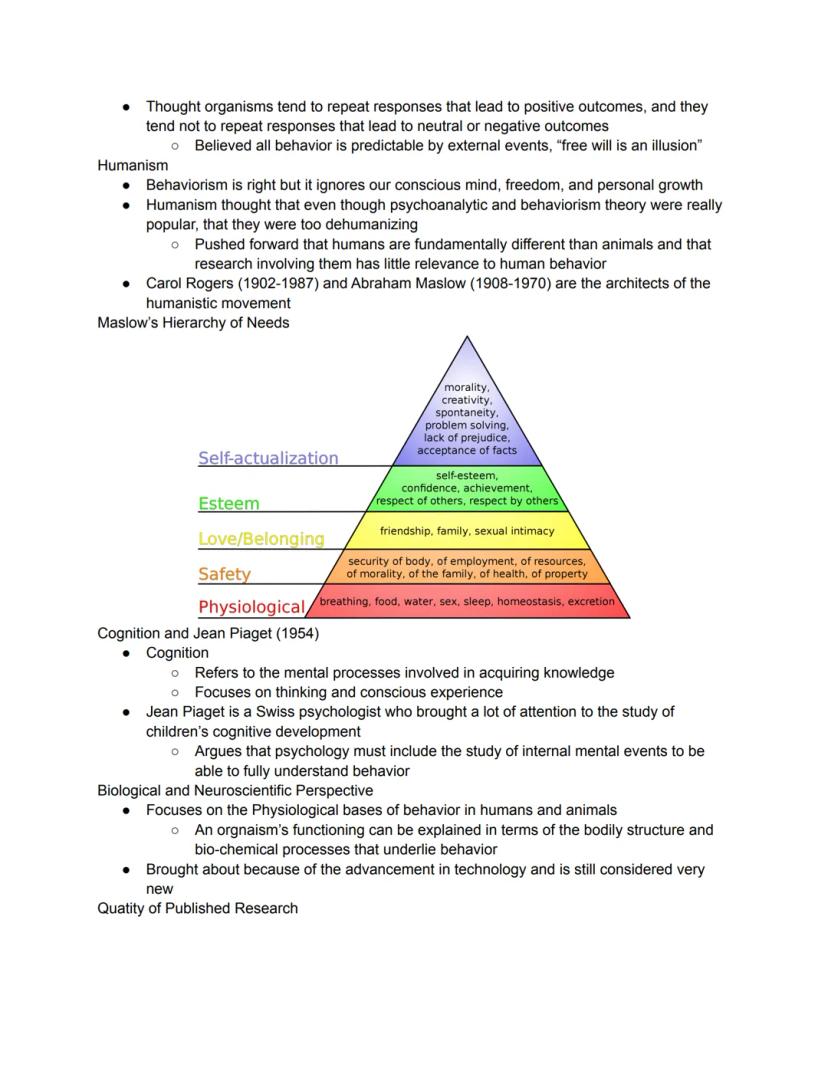
In response to behaviorism and psychoanalysis, humanism emerged as a perspective that emphasized conscious experience, freedom, and personal growth. Led by Carl Rogers and Abraham Maslow, humanists believed humans are fundamentally different from animals and deserve a more positive, growth-oriented approach. Maslow's famous hierarchy of needs suggests that people must satisfy basic needs before achieving self-actualization.
The cognitive perspective, which focuses on thinking and mental processes, gained prominence with Jean Piaget's work on children's cognitive development. Piaget argued that psychology must study internal mental events to fully understand behavior. More recently, the biological perspective has grown due to technological advances, focusing on how physical structure and biochemical processes influence behavior.
🧠 Think of these psychological perspectives as different lenses for viewing human behavior. Just as different camera lenses help photographers capture different aspects of a scene, each perspective helps psychologists understand different aspects of the human experience.
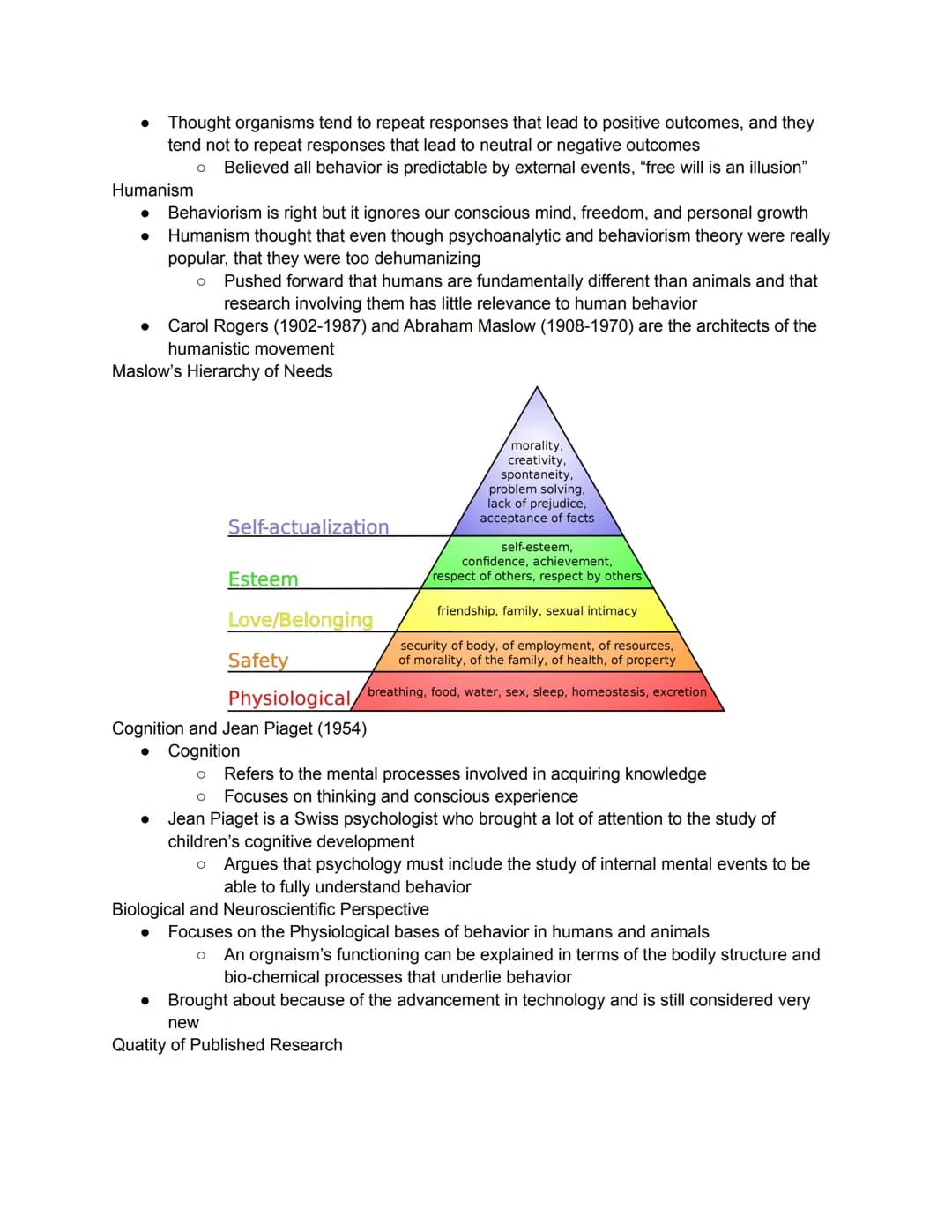
Psychology has changed dramatically over time, with different approaches rising and falling in popularity. The humanistic approach emerged as a response to what its founders saw as the dehumanizing aspects of behaviorism and psychoanalysis. Humanists like Rogers and Maslow emphasized human potential and self-actualization rather than just responding to stimuli or unconscious drives.
Maslow's hierarchy of needs illustrates this humanistic approach perfectly. It shows how humans must satisfy basic physiological needs like food and water before moving up to safety needs, love/belonging, esteem, and finally self-actualization. This model remains influential in understanding human motivation and development.
Meanwhile, the cognitive perspective gained momentum with Jean Piaget's research on children's thinking. Cognition refers to the mental processes involved in acquiring knowledge, and cognitive psychologists study how we perceive, remember, solve problems, and make decisions. This approach argues that we can't fully understand behavior without examining internal mental events.
The newest major approach is the biological perspective, which examines the physiological bases of behavior. With advanced technologies like brain imaging, researchers can now explore connections between brain activity and behavior that were previously impossible to observe. This perspective has grown dramatically in recent decades, as shown by the increasing number of neuroscience articles published in psychology journals.
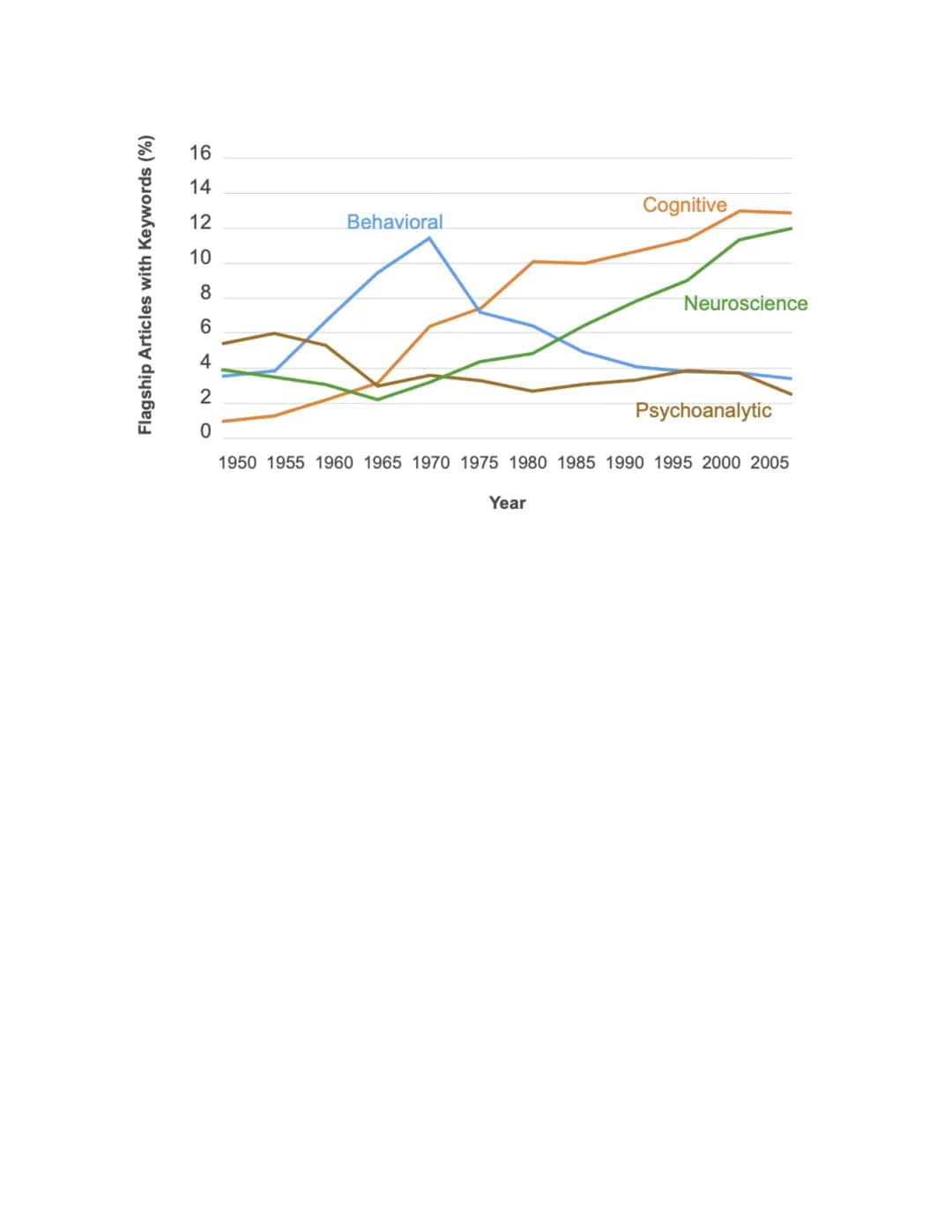
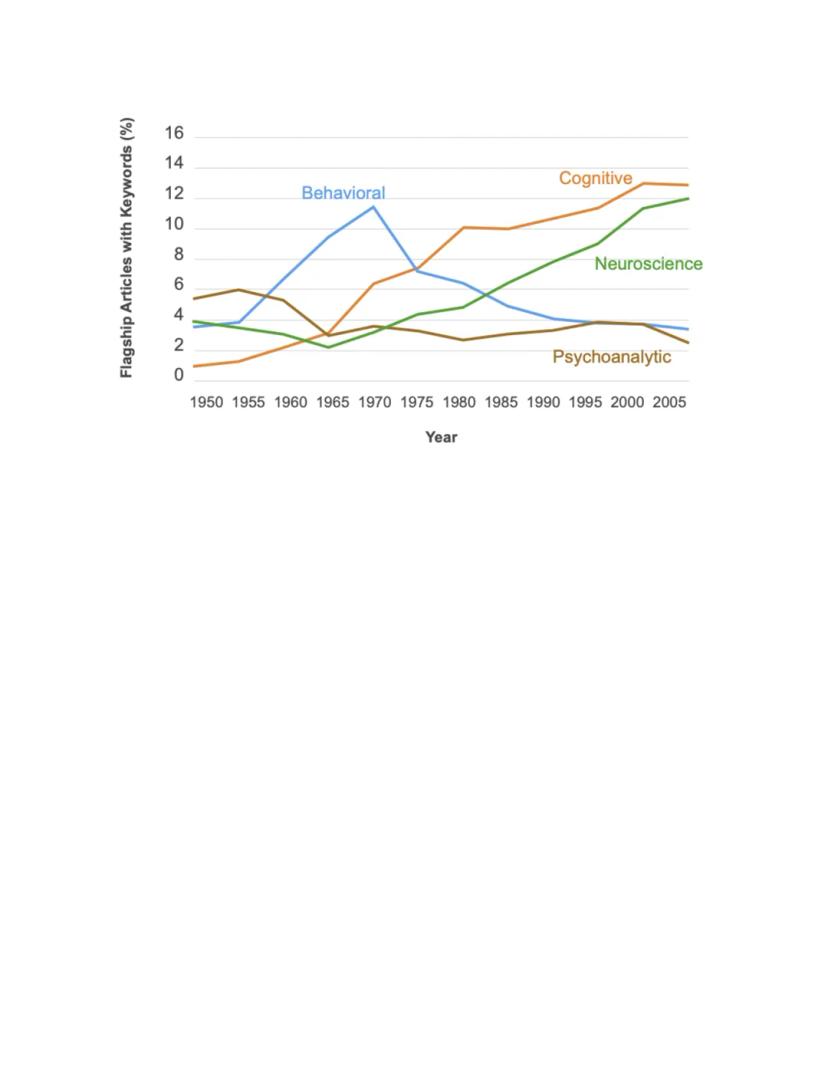
Looking at the published research over time reveals fascinating shifts in psychology's focus. From 1950 to 2005, we can see clear trends in which approaches dominated the field during different periods. The graph of flagship articles shows how psychology has evolved over decades.
The behavioral approach was quite popular in the 1950s and 1960s but declined afterward as new perspectives emerged. Cognitive psychology began growing in the 1960s and saw a significant increase through the 1980s and 1990s, reflecting psychology's "cognitive revolution" that shifted focus toward mental processes.
Perhaps most striking is the dramatic rise of neuroscience research starting in the 1980s and accelerating through the 2000s. This surge reflects technological advances that made studying the brain more accessible and the growing recognition of connections between brain function and behavior. Meanwhile, psychoanalytic approaches have declined steadily since the 1950s.
📊 These trends remind us that psychology is a dynamic, evolving science—not a fixed set of facts. The questions that interest psychologists and the methods they use continue to change as we learn more about the mind and behavior. Today's cutting-edge approach might be tomorrow's historical footnote!
Our AI companion is specifically built for the needs of students. Based on the millions of content pieces we have on the platform we can provide truly meaningful and relevant answers to students. But its not only about answers, the companion is even more about guiding students through their daily learning challenges, with personalised study plans, quizzes or content pieces in the chat and 100% personalisation based on the students skills and developments.
You can download the app in the Google Play Store and in the Apple App Store.
That's right! Enjoy free access to study content, connect with fellow students, and get instant help – all at your fingertips.
App Store
Google Play
The app is very easy to use and well designed. I have found everything I was looking for so far and have been able to learn a lot from the presentations! I will definitely use the app for a class assignment! And of course it also helps a lot as an inspiration.
Stefan S
iOS user
This app is really great. There are so many study notes and help [...]. My problem subject is French, for example, and the app has so many options for help. Thanks to this app, I have improved my French. I would recommend it to anyone.
Samantha Klich
Android user
Wow, I am really amazed. I just tried the app because I've seen it advertised many times and was absolutely stunned. This app is THE HELP you want for school and above all, it offers so many things, such as workouts and fact sheets, which have been VERY helpful to me personally.
Anna
iOS user
I think it’s very much worth it and you’ll end up using it a lot once you get the hang of it and even after looking at others notes you can still ask your Artificial intelligence buddy the question and ask to simplify it if you still don’t get it!!! In the end I think it’s worth it 😊👍 ⚠️Also DID I MENTION ITS FREEE YOU DON’T HAVE TO PAY FOR ANYTHING AND STILL GET YOUR GRADES IN PERFECTLY❗️❗️⚠️
Thomas R
iOS user
Knowunity is the BEST app I’ve used in a minute. This is not an ai review or anything this is genuinely coming from a 7th grade student (I know 2011 im young) but dude this app is a 10/10 i have maintained a 3.8 gpa and have plenty of time for gaming. I love it and my mom is just happy I got good grades
Brad T
Android user
Not only did it help me find the answer but it also showed me alternative ways to solve it. I was horrible in math and science but now I have an a in both subjects. Thanks for the help🤍🤍
David K
iOS user
The app's just great! All I have to do is enter the topic in the search bar and I get the response real fast. I don't have to watch 10 YouTube videos to understand something, so I'm saving my time. Highly recommended!
Sudenaz Ocak
Android user
In school I was really bad at maths but thanks to the app, I am doing better now. I am so grateful that you made the app.
Greenlight Bonnie
Android user
I found this app a couple years ago and it has only gotten better since then. I really love it because it can help with written questions and photo questions. Also, it can find study guides that other people have made as well as flashcard sets and practice tests. The free version is also amazing for students who might not be able to afford it. Would 100% recommend
Aubrey
iOS user
Best app if you're in Highschool or Junior high. I have been using this app for 2 school years and it's the best, it's good if you don't have anyone to help you with school work.😋🩷🎀
Marco B
iOS user
THE QUIZES AND FLASHCARDS ARE SO USEFUL AND I LOVE Knowunity AI. IT ALSO IS LITREALLY LIKE CHATGPT BUT SMARTER!! HELPED ME WITH MY MASCARA PROBLEMS TOO!! AS WELL AS MY REAL SUBJECTS ! DUHHH 😍😁😲🤑💗✨🎀😮
Elisha
iOS user
This app is phenomenal down to the correct info and the various topics you can study! I greatly recommend it for people who struggle with procrastination and those who need homework help. It has been perfectly accurate for world 1 history as far as I’ve seen! Geometry too!
Paul T
iOS user
The app is very easy to use and well designed. I have found everything I was looking for so far and have been able to learn a lot from the presentations! I will definitely use the app for a class assignment! And of course it also helps a lot as an inspiration.
Stefan S
iOS user
This app is really great. There are so many study notes and help [...]. My problem subject is French, for example, and the app has so many options for help. Thanks to this app, I have improved my French. I would recommend it to anyone.
Samantha Klich
Android user
Wow, I am really amazed. I just tried the app because I've seen it advertised many times and was absolutely stunned. This app is THE HELP you want for school and above all, it offers so many things, such as workouts and fact sheets, which have been VERY helpful to me personally.
Anna
iOS user
I think it’s very much worth it and you’ll end up using it a lot once you get the hang of it and even after looking at others notes you can still ask your Artificial intelligence buddy the question and ask to simplify it if you still don’t get it!!! In the end I think it’s worth it 😊👍 ⚠️Also DID I MENTION ITS FREEE YOU DON’T HAVE TO PAY FOR ANYTHING AND STILL GET YOUR GRADES IN PERFECTLY❗️❗️⚠️
Thomas R
iOS user
Knowunity is the BEST app I’ve used in a minute. This is not an ai review or anything this is genuinely coming from a 7th grade student (I know 2011 im young) but dude this app is a 10/10 i have maintained a 3.8 gpa and have plenty of time for gaming. I love it and my mom is just happy I got good grades
Brad T
Android user
Not only did it help me find the answer but it also showed me alternative ways to solve it. I was horrible in math and science but now I have an a in both subjects. Thanks for the help🤍🤍
David K
iOS user
The app's just great! All I have to do is enter the topic in the search bar and I get the response real fast. I don't have to watch 10 YouTube videos to understand something, so I'm saving my time. Highly recommended!
Sudenaz Ocak
Android user
In school I was really bad at maths but thanks to the app, I am doing better now. I am so grateful that you made the app.
Greenlight Bonnie
Android user
I found this app a couple years ago and it has only gotten better since then. I really love it because it can help with written questions and photo questions. Also, it can find study guides that other people have made as well as flashcard sets and practice tests. The free version is also amazing for students who might not be able to afford it. Would 100% recommend
Aubrey
iOS user
Best app if you're in Highschool or Junior high. I have been using this app for 2 school years and it's the best, it's good if you don't have anyone to help you with school work.😋🩷🎀
Marco B
iOS user
THE QUIZES AND FLASHCARDS ARE SO USEFUL AND I LOVE Knowunity AI. IT ALSO IS LITREALLY LIKE CHATGPT BUT SMARTER!! HELPED ME WITH MY MASCARA PROBLEMS TOO!! AS WELL AS MY REAL SUBJECTS ! DUHHH 😍😁😲🤑💗✨🎀😮
Elisha
iOS user
This app is phenomenal down to the correct info and the various topics you can study! I greatly recommend it for people who struggle with procrastination and those who need homework help. It has been perfectly accurate for world 1 history as far as I’ve seen! Geometry too!
Paul T
iOS user
Anna Zheng
@annazheng_rpos
Psychology is the scientific study of mind and behavior, using various research methods to understand why we think and act the way we do. From early pioneers establishing labs to modern neuroscientific approaches, psychology has evolved significantly over time. This... Show more
Access to all documents
Improve your grades
Join milions of students
Ever wonder why we study psychology? Psychologists conduct research to identify, describe, explain, predict, and ultimately control various aspects of human behavior. Their work follows the scientific method, which begins with an observation, defines a problem, creates a hypothesis, tests that hypothesis, draws conclusions, and finally revises or replicates the study.
Researchers use several methods to gather data. Naturalistic observation involves watching subjects in their real-life environments without interference, providing strong external validity but suffering from lack of control and potential observer effects. Laboratory observation offers more control but may create artificial situations. Case studies provide detailed reports on single individuals, offering depth but limited generalizability.
Surveys involve sampling a population to learn about their experiences. A good survey requires a representative sample that accurately reflects the larger population. However, surveys can be limited by biased samples (like convenience samples) and social desirability bias, where people report what sounds good rather than the truth.
💡 When you see research in the news or social media, ask yourself: "What method did they use, and what are its limitations?" This critical thinking skill will help you evaluate psychological claims throughout your life.
Access to all documents
Improve your grades
Join milions of students
Have you ever noticed two things happening together and wondered if one caused the other? That's what correlational research explores! A correlation coefficient measures the relationship strength between variables, ranging from -1 to +1. The closer to either extreme, the stronger the relationship.
Correlations come in two types: positive correlations (when both variables increase together) and negative correlations (when one increases as the other decreases). However, remember this key limitation: correlation does not equal causation. Sometimes spurious correlations occur when variables appear related but aren't actually causing each other.
To determine cause and effect, psychologists use experiments. In an experiment, researchers manipulate an independent variable to see its effect on a dependent variable while controlling for confounding variables that could affect results. Participants are typically divided into two groups: an experimental group that receives the manipulation and a control group that doesn't.
For valid results, researchers use random assignment to place participants in groups, preventing bias. They must also follow ethical guidelines including informed consent, minimal risk, right to withdraw, debriefing participants after the study, and maintaining confidentiality.
Access to all documents
Improve your grades
Join milions of students
When psychologists conduct research, they have a responsibility to protect their participants. The seven basic ethical guidelines include balancing research value against people's rights, getting informed consent, minimizing deception, allowing participants to withdraw, minimizing risks, debriefing afterwards, and maintaining confidentiality.
The APA style provides a standardized format for psychology papers, making research easier to understand and compare. Papers should be double-spaced in 12-point Times New Roman font with specific sections in a particular order. Each APA paper includes an abstract (a brief summary), introduction, method section, results, discussion/conclusion, and references.
Proper documentation is crucial in psychological writing. When using someone else's work, you must cite it correctly using in-text citations. These citations vary depending on whether you're directly quoting, paraphrasing, or referring to a primary source mentioned in another work. For multiple authors, use "&" within parentheses and "and" in the text.
🔍 Think of APA style as the "language" psychologists use to communicate with each other. Learning it is like learning the rules of a game—once you know them, you can participate fully in the conversation!
Access to all documents
Improve your grades
Join milions of students
Psychology as a formal science is younger than you might think! Wilhelm Wundt, considered the founder of psychology, established the first psychological laboratory in 1879 in Germany. His work emphasized the existence of consciousness, and his students spread his ideas worldwide.
In America, G. Stanley Hall established the first US psychology research facility and launched America's first psychology journal. He also helped establish the American Psychological Association (APA) and became its first president. Early approaches to psychology included structuralism, led by Edward Titchener, which analyzed consciousness into basic elements using introspection.
William James championed functionalism, focusing on how consciousness serves practical purposes rather than just its structure. His book "Principles of Psychology" became standard reading for generations of psychology students. Meanwhile in Europe, Sigmund Freud developed psychoanalysis, emphasizing the role of the unconscious mind—thoughts and desires below conscious awareness that influence behavior.
When citing research in APA format, you'll often see citations with multiple authors shown as "Smith et al. (1999)" when there are three or more authors. The reference section provides complete information about sources, including author, publication date, title, and where it was published.
Access to all documents
Improve your grades
Join milions of students
Have you ever thought about how many different ways there are to understand human behavior? Early in the 20th century, John B. Watson founded behaviorism, arguing that psychology should study only observable behavior, not consciousness. B.F. Skinner expanded this view, suggesting that behavior is controlled by environmental factors and that "free will is an illusion."
In response to behaviorism and psychoanalysis, humanism emerged as a perspective that emphasized conscious experience, freedom, and personal growth. Led by Carl Rogers and Abraham Maslow, humanists believed humans are fundamentally different from animals and deserve a more positive, growth-oriented approach. Maslow's famous hierarchy of needs suggests that people must satisfy basic needs before achieving self-actualization.
The cognitive perspective, which focuses on thinking and mental processes, gained prominence with Jean Piaget's work on children's cognitive development. Piaget argued that psychology must study internal mental events to fully understand behavior. More recently, the biological perspective has grown due to technological advances, focusing on how physical structure and biochemical processes influence behavior.
🧠 Think of these psychological perspectives as different lenses for viewing human behavior. Just as different camera lenses help photographers capture different aspects of a scene, each perspective helps psychologists understand different aspects of the human experience.
Access to all documents
Improve your grades
Join milions of students
Psychology has changed dramatically over time, with different approaches rising and falling in popularity. The humanistic approach emerged as a response to what its founders saw as the dehumanizing aspects of behaviorism and psychoanalysis. Humanists like Rogers and Maslow emphasized human potential and self-actualization rather than just responding to stimuli or unconscious drives.
Maslow's hierarchy of needs illustrates this humanistic approach perfectly. It shows how humans must satisfy basic physiological needs like food and water before moving up to safety needs, love/belonging, esteem, and finally self-actualization. This model remains influential in understanding human motivation and development.
Meanwhile, the cognitive perspective gained momentum with Jean Piaget's research on children's thinking. Cognition refers to the mental processes involved in acquiring knowledge, and cognitive psychologists study how we perceive, remember, solve problems, and make decisions. This approach argues that we can't fully understand behavior without examining internal mental events.
The newest major approach is the biological perspective, which examines the physiological bases of behavior. With advanced technologies like brain imaging, researchers can now explore connections between brain activity and behavior that were previously impossible to observe. This perspective has grown dramatically in recent decades, as shown by the increasing number of neuroscience articles published in psychology journals.
Access to all documents
Improve your grades
Join milions of students
Looking at the published research over time reveals fascinating shifts in psychology's focus. From 1950 to 2005, we can see clear trends in which approaches dominated the field during different periods. The graph of flagship articles shows how psychology has evolved over decades.
The behavioral approach was quite popular in the 1950s and 1960s but declined afterward as new perspectives emerged. Cognitive psychology began growing in the 1960s and saw a significant increase through the 1980s and 1990s, reflecting psychology's "cognitive revolution" that shifted focus toward mental processes.
Perhaps most striking is the dramatic rise of neuroscience research starting in the 1980s and accelerating through the 2000s. This surge reflects technological advances that made studying the brain more accessible and the growing recognition of connections between brain function and behavior. Meanwhile, psychoanalytic approaches have declined steadily since the 1950s.
📊 These trends remind us that psychology is a dynamic, evolving science—not a fixed set of facts. The questions that interest psychologists and the methods they use continue to change as we learn more about the mind and behavior. Today's cutting-edge approach might be tomorrow's historical footnote!
Our AI companion is specifically built for the needs of students. Based on the millions of content pieces we have on the platform we can provide truly meaningful and relevant answers to students. But its not only about answers, the companion is even more about guiding students through their daily learning challenges, with personalised study plans, quizzes or content pieces in the chat and 100% personalisation based on the students skills and developments.
You can download the app in the Google Play Store and in the Apple App Store.
That's right! Enjoy free access to study content, connect with fellow students, and get instant help – all at your fingertips.
9
Smart Tools NEW
Transform this note into: ✓ 50+ Practice Questions ✓ Interactive Flashcards ✓ Full Practice Test ✓ Essay Outlines
Explore the origins of psychology, focusing on Wundt's pioneering work in introspection and the development of structuralism. Understand the shift to behaviorism led by Watson, emphasizing observable behavior over introspective methods. This summary covers key concepts such as the birth of psychology, structuralism, and the behavioral approach, providing a comprehensive overview for students studying psychological theories.
 Psychology
In class notes
 Psychology
In class notes
 AP Psychology
PsychologyHistory of psychology, important psychologist, schools of thought
AP PsychologyApp Store
Google Play
The app is very easy to use and well designed. I have found everything I was looking for so far and have been able to learn a lot from the presentations! I will definitely use the app for a class assignment! And of course it also helps a lot as an inspiration.
Stefan S
iOS user
This app is really great. There are so many study notes and help [...]. My problem subject is French, for example, and the app has so many options for help. Thanks to this app, I have improved my French. I would recommend it to anyone.
Samantha Klich
Android user
Wow, I am really amazed. I just tried the app because I've seen it advertised many times and was absolutely stunned. This app is THE HELP you want for school and above all, it offers so many things, such as workouts and fact sheets, which have been VERY helpful to me personally.
Anna
iOS user
I think it’s very much worth it and you’ll end up using it a lot once you get the hang of it and even after looking at others notes you can still ask your Artificial intelligence buddy the question and ask to simplify it if you still don’t get it!!! In the end I think it’s worth it 😊👍 ⚠️Also DID I MENTION ITS FREEE YOU DON’T HAVE TO PAY FOR ANYTHING AND STILL GET YOUR GRADES IN PERFECTLY❗️❗️⚠️
Thomas R
iOS user
Knowunity is the BEST app I’ve used in a minute. This is not an ai review or anything this is genuinely coming from a 7th grade student (I know 2011 im young) but dude this app is a 10/10 i have maintained a 3.8 gpa and have plenty of time for gaming. I love it and my mom is just happy I got good grades
Brad T
Android user
Not only did it help me find the answer but it also showed me alternative ways to solve it. I was horrible in math and science but now I have an a in both subjects. Thanks for the help🤍🤍
David K
iOS user
The app's just great! All I have to do is enter the topic in the search bar and I get the response real fast. I don't have to watch 10 YouTube videos to understand something, so I'm saving my time. Highly recommended!
Sudenaz Ocak
Android user
In school I was really bad at maths but thanks to the app, I am doing better now. I am so grateful that you made the app.
Greenlight Bonnie
Android user
I found this app a couple years ago and it has only gotten better since then. I really love it because it can help with written questions and photo questions. Also, it can find study guides that other people have made as well as flashcard sets and practice tests. The free version is also amazing for students who might not be able to afford it. Would 100% recommend
Aubrey
iOS user
Best app if you're in Highschool or Junior high. I have been using this app for 2 school years and it's the best, it's good if you don't have anyone to help you with school work.😋🩷🎀
Marco B
iOS user
THE QUIZES AND FLASHCARDS ARE SO USEFUL AND I LOVE Knowunity AI. IT ALSO IS LITREALLY LIKE CHATGPT BUT SMARTER!! HELPED ME WITH MY MASCARA PROBLEMS TOO!! AS WELL AS MY REAL SUBJECTS ! DUHHH 😍😁😲🤑💗✨🎀😮
Elisha
iOS user
This app is phenomenal down to the correct info and the various topics you can study! I greatly recommend it for people who struggle with procrastination and those who need homework help. It has been perfectly accurate for world 1 history as far as I’ve seen! Geometry too!
Paul T
iOS user
The app is very easy to use and well designed. I have found everything I was looking for so far and have been able to learn a lot from the presentations! I will definitely use the app for a class assignment! And of course it also helps a lot as an inspiration.
Stefan S
iOS user
This app is really great. There are so many study notes and help [...]. My problem subject is French, for example, and the app has so many options for help. Thanks to this app, I have improved my French. I would recommend it to anyone.
Samantha Klich
Android user
Wow, I am really amazed. I just tried the app because I've seen it advertised many times and was absolutely stunned. This app is THE HELP you want for school and above all, it offers so many things, such as workouts and fact sheets, which have been VERY helpful to me personally.
Anna
iOS user
I think it’s very much worth it and you’ll end up using it a lot once you get the hang of it and even after looking at others notes you can still ask your Artificial intelligence buddy the question and ask to simplify it if you still don’t get it!!! In the end I think it’s worth it 😊👍 ⚠️Also DID I MENTION ITS FREEE YOU DON’T HAVE TO PAY FOR ANYTHING AND STILL GET YOUR GRADES IN PERFECTLY❗️❗️⚠️
Thomas R
iOS user
Knowunity is the BEST app I’ve used in a minute. This is not an ai review or anything this is genuinely coming from a 7th grade student (I know 2011 im young) but dude this app is a 10/10 i have maintained a 3.8 gpa and have plenty of time for gaming. I love it and my mom is just happy I got good grades
Brad T
Android user
Not only did it help me find the answer but it also showed me alternative ways to solve it. I was horrible in math and science but now I have an a in both subjects. Thanks for the help🤍🤍
David K
iOS user
The app's just great! All I have to do is enter the topic in the search bar and I get the response real fast. I don't have to watch 10 YouTube videos to understand something, so I'm saving my time. Highly recommended!
Sudenaz Ocak
Android user
In school I was really bad at maths but thanks to the app, I am doing better now. I am so grateful that you made the app.
Greenlight Bonnie
Android user
I found this app a couple years ago and it has only gotten better since then. I really love it because it can help with written questions and photo questions. Also, it can find study guides that other people have made as well as flashcard sets and practice tests. The free version is also amazing for students who might not be able to afford it. Would 100% recommend
Aubrey
iOS user
Best app if you're in Highschool or Junior high. I have been using this app for 2 school years and it's the best, it's good if you don't have anyone to help you with school work.😋🩷🎀
Marco B
iOS user
THE QUIZES AND FLASHCARDS ARE SO USEFUL AND I LOVE Knowunity AI. IT ALSO IS LITREALLY LIKE CHATGPT BUT SMARTER!! HELPED ME WITH MY MASCARA PROBLEMS TOO!! AS WELL AS MY REAL SUBJECTS ! DUHHH 😍😁😲🤑💗✨🎀😮
Elisha
iOS user
This app is phenomenal down to the correct info and the various topics you can study! I greatly recommend it for people who struggle with procrastination and those who need homework help. It has been perfectly accurate for world 1 history as far as I’ve seen! Geometry too!
Paul T
iOS user