
Psychological disorders are conditions that affect a person's thoughts, feelings,... Show more
 AP Psychology
 Algebra
 Biology
Sign up to see the contentIt's free!
Access to all documents
Improve your grades
Join milions of students
Knowunity AI
Subjects
Triangle Congruence and Similarity Theorems
Triangle Properties and Classification
Linear Equations and Graphs
Geometric Angle Relationships
Trigonometric Functions and Identities
Equation Solving Techniques
Circle Geometry Fundamentals
Division Operations and Methods
Basic Differentiation Rules
Exponent and Logarithm Properties
Show all topics
Human Organ Systems
Reproductive Cell Cycles
Biological Sciences Subdisciplines
Cellular Energy Metabolism
Autotrophic Energy Processes
Inheritance Patterns and Principles
Biomolecular Structure and Organization
Cell Cycle and Division Mechanics
Cellular Organization and Development
Biological Structural Organization
Show all topics
Chemical Sciences and Applications
Atomic Structure and Composition
Molecular Electron Structure Representation
Atomic Electron Behavior
Matter Properties and Water
Mole Concept and Calculations
Gas Laws and Behavior
Periodic Table Organization
Chemical Thermodynamics Fundamentals
Chemical Bond Types and Properties
Show all topics
European Renaissance and Enlightenment
European Cultural Movements 800-1920
American Revolution Era 1763-1797
American Civil War 1861-1865
Global Imperial Systems
Mongol and Chinese Dynasties
U.S. Presidents and World Leaders
Historical Sources and Documentation
World Wars Era and Impact
World Religious Systems
Show all topics
Classic and Contemporary Novels
Literary Character Analysis
Rhetorical Theory and Practice
Classic Literary Narratives
Reading Analysis and Interpretation
Narrative Structure and Techniques
English Language Components
Influential English-Language Authors
Basic Sentence Structure
Narrative Voice and Perspective
Show all topics
232
•
Updated Mar 17, 2026
•

Sarah
@sarah_qkyv
Psychological disorders are conditions that affect a person's thoughts, feelings,... Show more
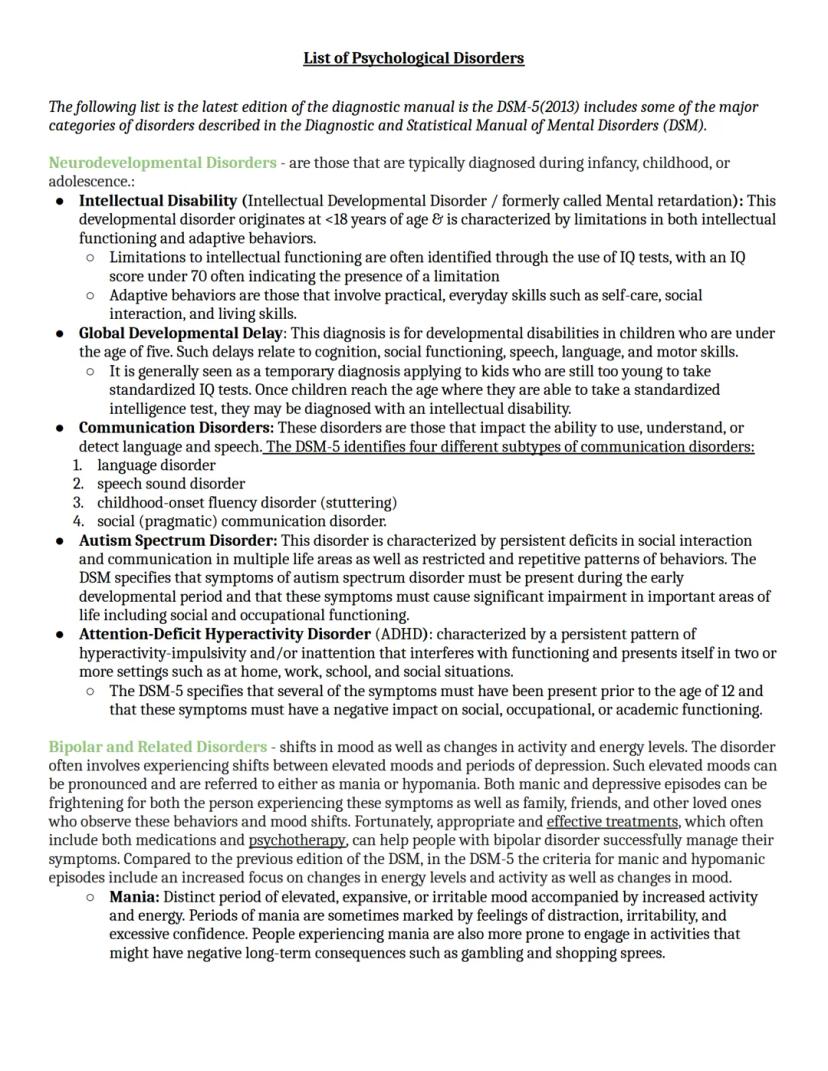
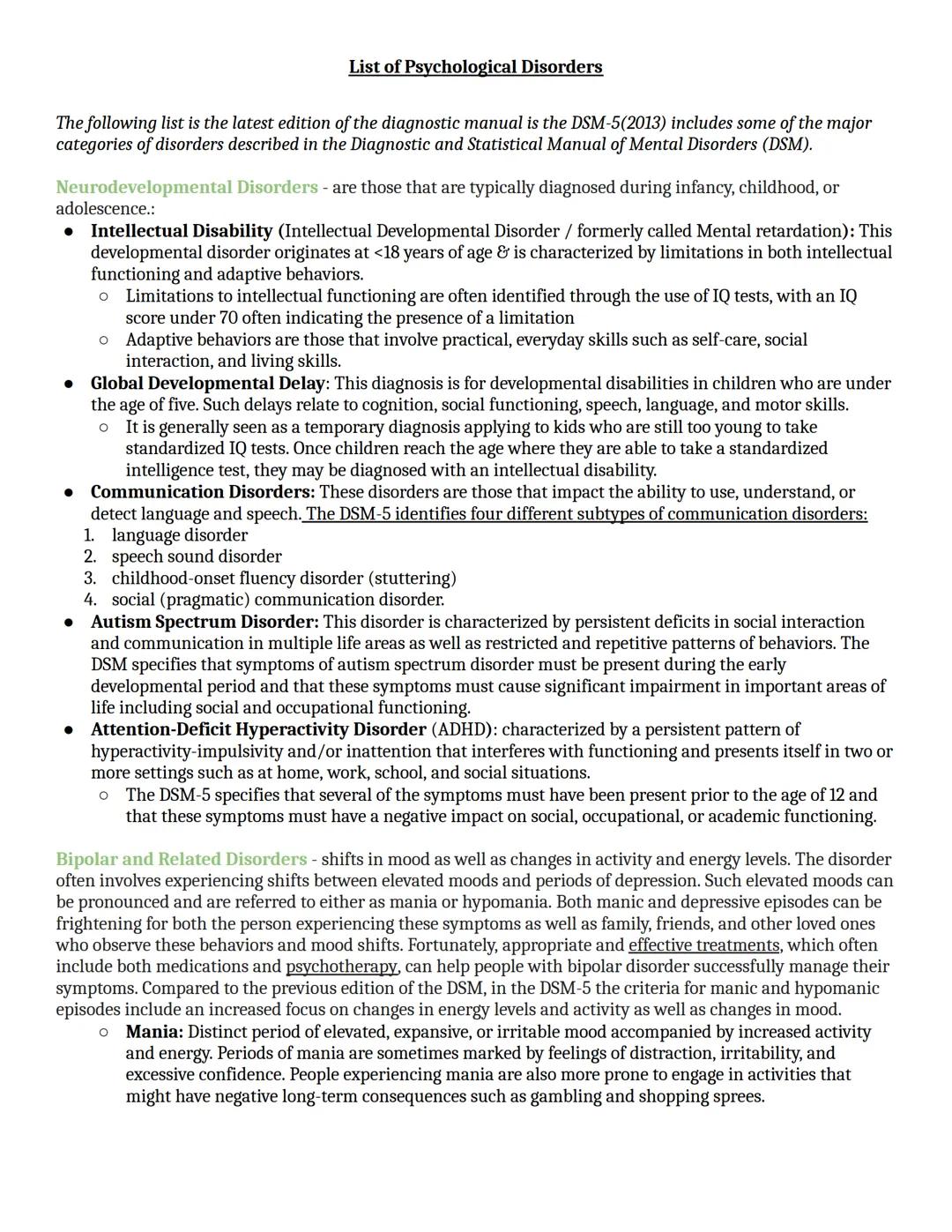
Neurodevelopmental disorders typically appear during childhood or adolescence and affect brain development. Intellectual disability involves limitations in intellectual functioning (IQ below 70) and everyday adaptive behaviors like self-care and social skills.
Children under five might be diagnosed with Global Developmental Delay if they show delays in areas like cognition and motor skills. This is usually a temporary diagnosis until they're old enough for standardized testing.
Communication disorders affect language and speech abilities, including language disorder, speech sound disorder, stuttering, and social communication disorder. Autism Spectrum Disorder involves persistent deficits in social interaction and communication along with restricted, repetitive behaviors.
ADHD features patterns of hyperactivity-impulsivity and/or inattention that interfere with functioning across multiple settings. Symptoms must appear before age 12 and impact social, occupational, or academic functioning.
Did you know? Bipolar disorder involves shifts between elevated moods and depression, along with changes in energy levels and activity. People experiencing mania might engage in risky behaviors like excessive shopping or gambling.
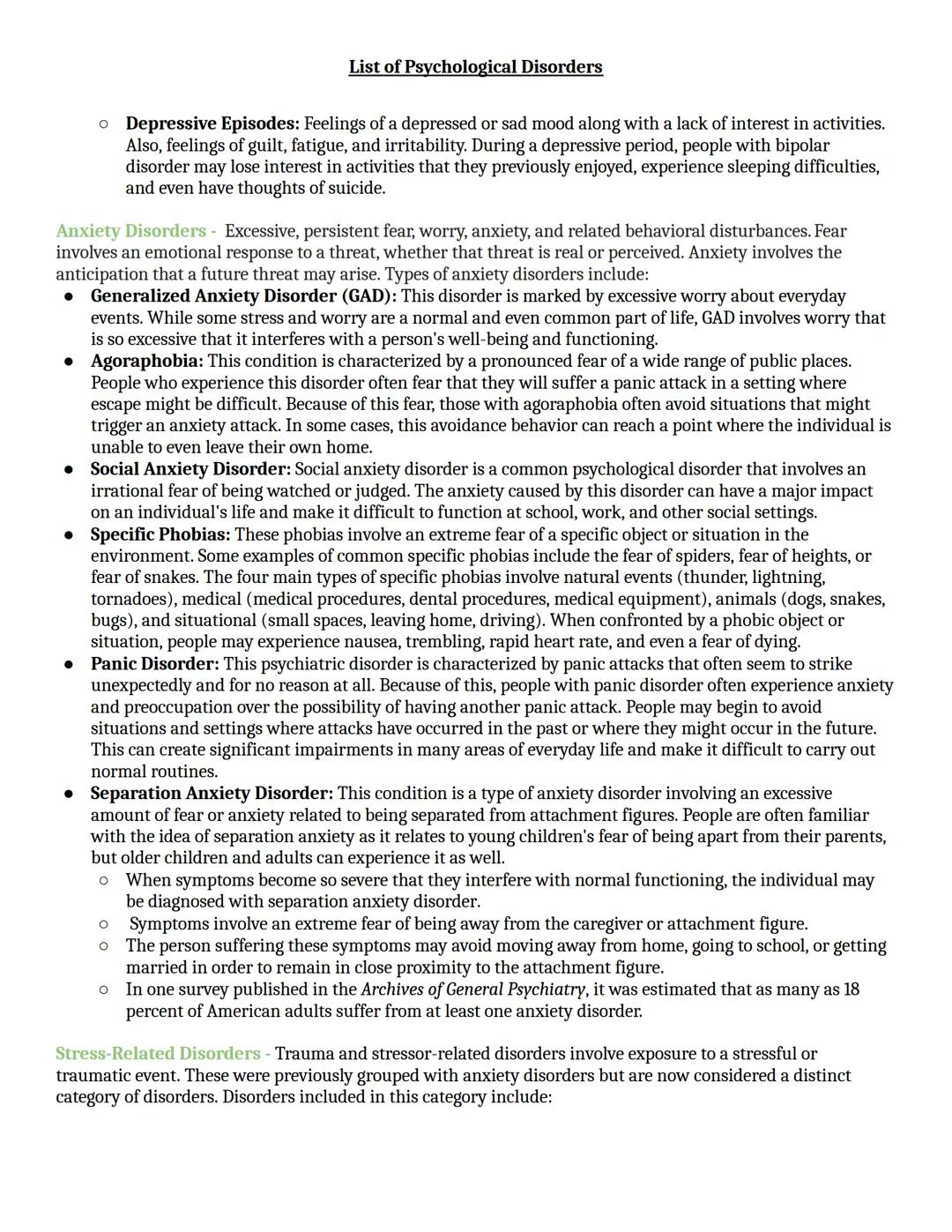
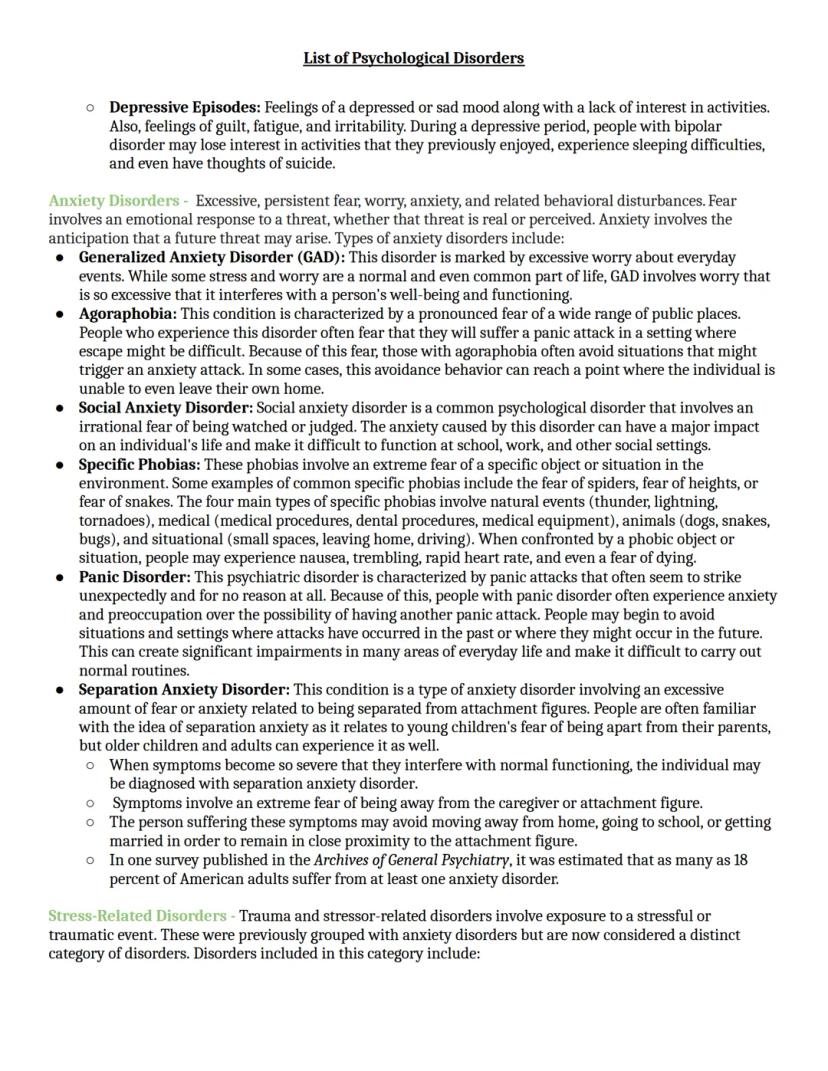
Anxiety disorders involve excessive fear, worry, and related behavioral disturbances. Generalized Anxiety Disorder (GAD) features excessive worry about everyday events that interferes with normal functioning.
People with Social Anxiety Disorder have an irrational fear of being watched or judged, making it difficult to function in social settings. Specific Phobias involve extreme fear of particular objects or situations like spiders, heights, or small spaces.
Panic Disorder involves unexpected panic attacks that can lead people to avoid situations where attacks might occur. Separation Anxiety Disorder involves excessive fear about being separated from attachment figures—not just in children, but adults too.
Trauma and stressor-related disorders develop after exposure to stressful or traumatic events. Acute Stress Disorder involves severe anxiety for up to one month after a traumatic event, with symptoms like dissociation and flashbacks.
Remember this: Around 18% of American adults suffer from at least one anxiety disorder, making them among the most common mental health conditions.
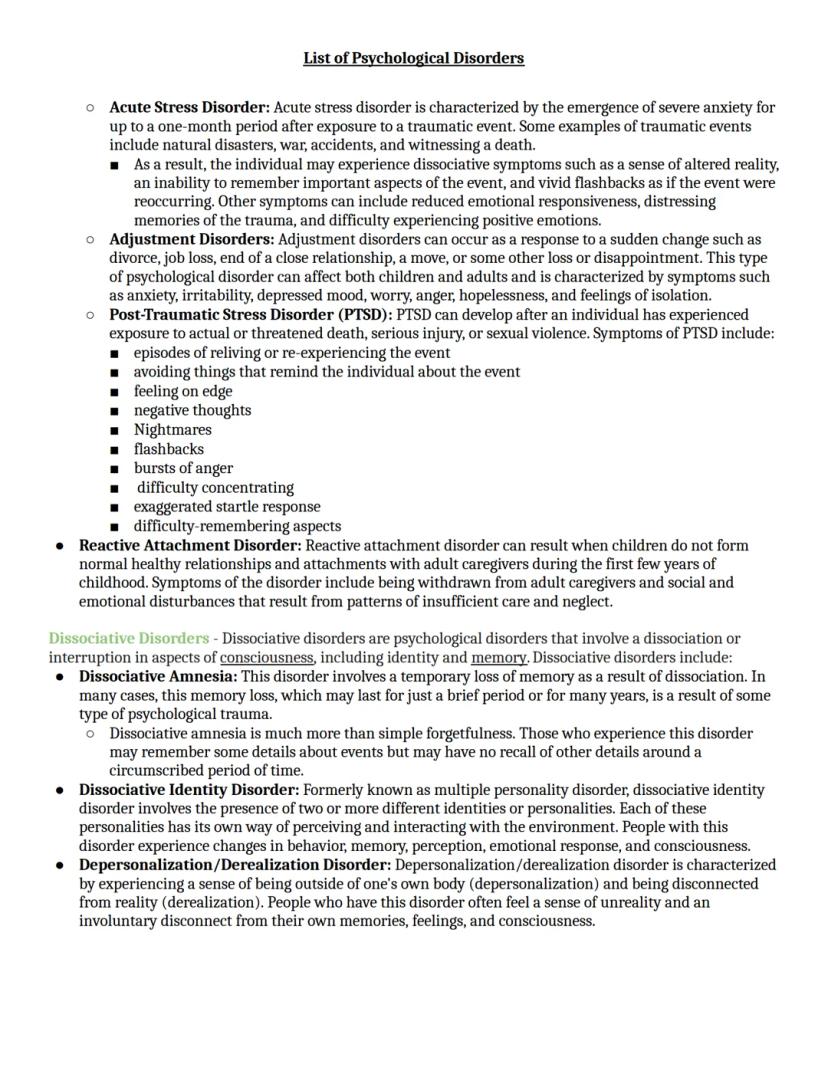
Post-Traumatic Stress Disorder (PTSD) can develop after experiencing or witnessing traumatic events and includes symptoms like flashbacks, nightmares, avoiding reminders of the trauma, and feeling constantly on edge.
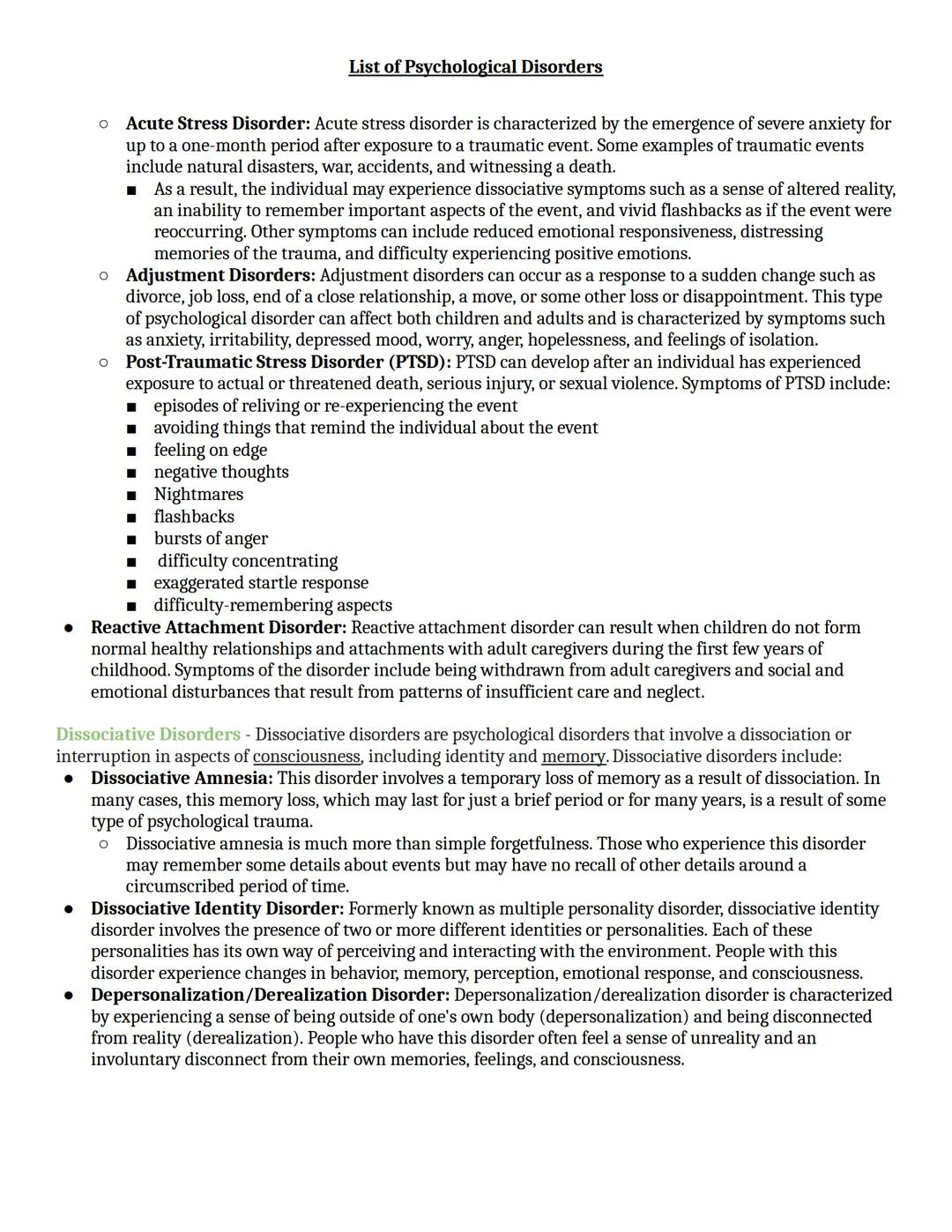
Dissociative disorders involve interruptions in consciousness, identity, or memory. Dissociative Amnesia causes temporary memory loss beyond normal forgetfulness, often following psychological trauma. People may remember some details about events but have no recall of others.
Dissociative Identity Disorder (formerly called multiple personality disorder) involves the presence of two or more distinct identities or personalities. Each personality has its own way of perceiving and interacting with the world, causing changes in behavior, memory, and consciousness.
People with Depersonalization/Derealization Disorder feel disconnected from their body (depersonalization) or from reality (derealization). They experience a sense of unreality and disconnect from their memories, feelings, and consciousness.
Somatic symptom disorders involve physical symptoms that cause significant distress, regardless of whether a medical cause can be found. Somatic Symptom Disorder involves preoccupation with physical symptoms that makes normal functioning difficult.
Important: People with somatic symptom disorders are not faking their symptoms. Their physical pain and fatigue are real—it's their extreme reaction to these symptoms that creates problems in their lives.
Illness Anxiety Disorder involves excessive worry about having an undiagnosed serious illness, even when medical tests are negative. This preoccupation causes significant anxiety and behavioral changes.
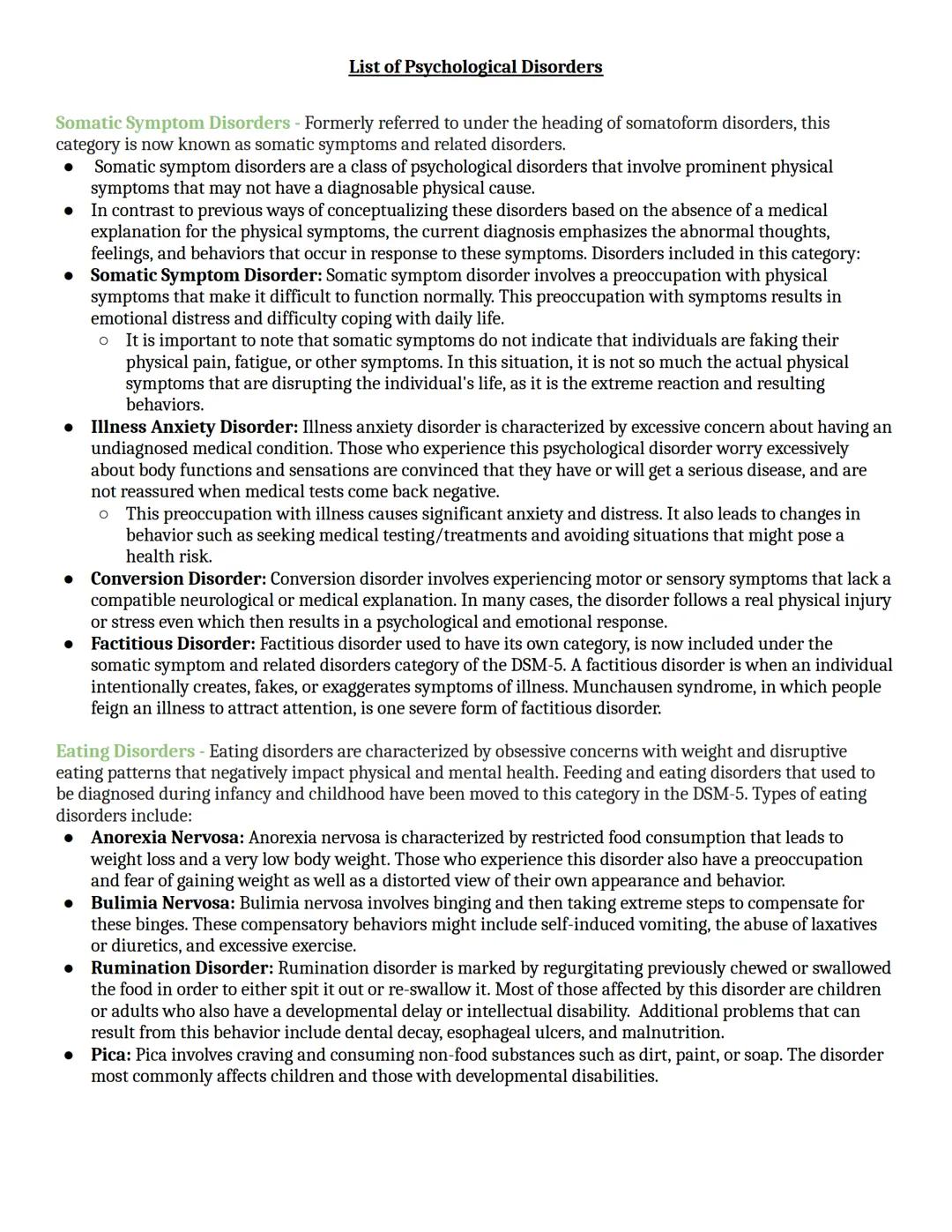
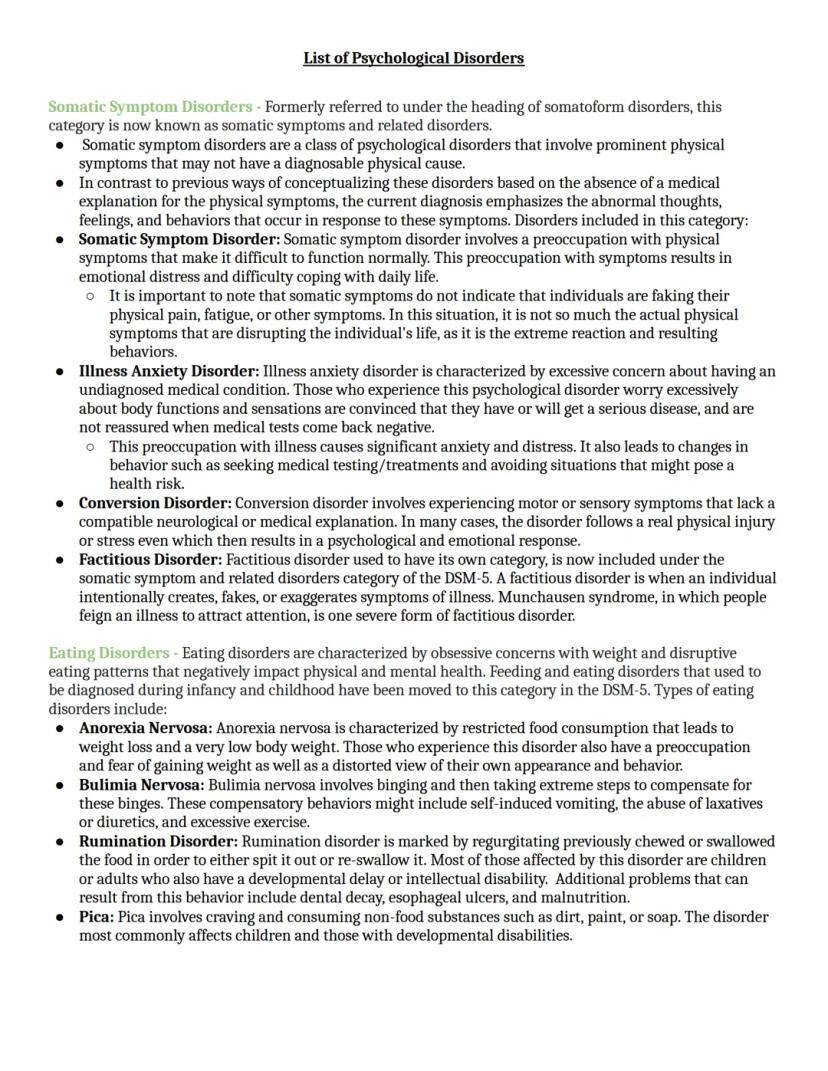
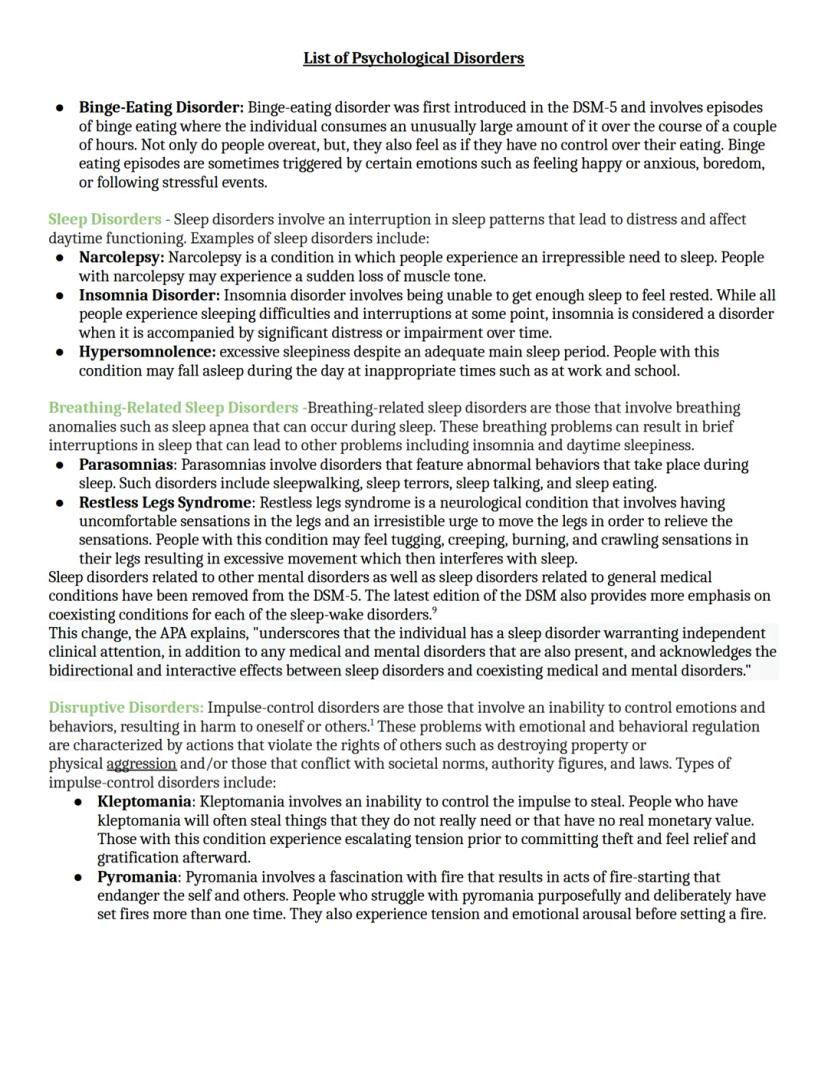
Eating disorders involve obsessive concerns with weight and disruptive eating patterns. Anorexia Nervosa is characterized by restricted food consumption leading to severe weight loss, fear of gaining weight, and a distorted self-image.
Bulimia Nervosa involves cycles of binging followed by extreme compensatory behaviors like self-induced vomiting or excessive exercise. Binge-Eating Disorder features episodes of consuming unusually large amounts of food within a short time, accompanied by feelings of loss of control.
Less common eating disorders include Rumination Disorder and Pica , which often affect children or people with developmental disabilities.
Sleep disorders interrupt normal sleep patterns, causing distress and daytime functioning problems. Insomnia involves difficulty falling or staying asleep, while Hypersomnolence causes excessive daytime sleepiness despite adequate nighttime sleep.
Sleep fact: Breathing-related sleep disorders like sleep apnea can cause brief interruptions in sleep that lead to insomnia and daytime sleepiness. These interruptions might happen hundreds of times a night without you being aware of them!
Parasomnias involve abnormal behaviors during sleep, including sleepwalking, sleep terrors, sleep talking, and sleep eating. Restless Legs Syndrome causes uncomfortable sensations and an irresistible urge to move the legs, interfering with sleep.
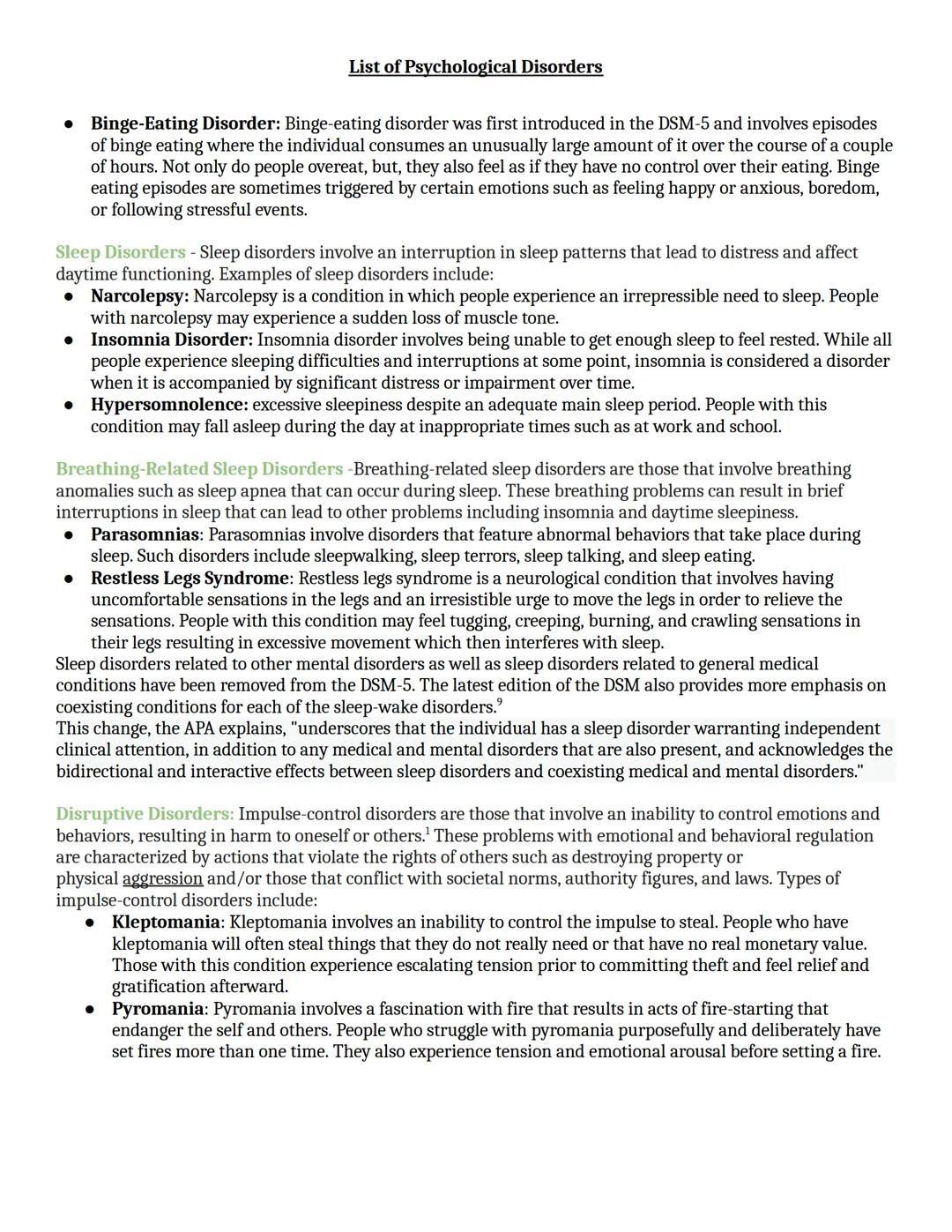
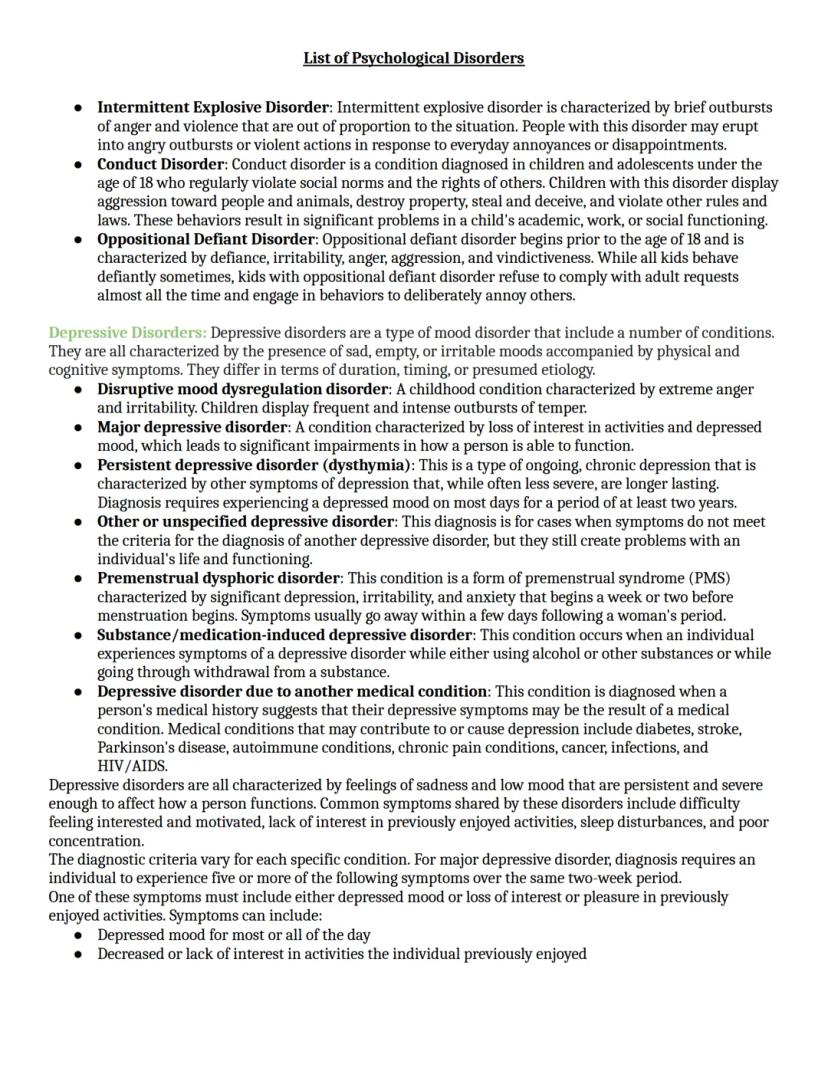
Disruptive disorders involve problems controlling emotions and behaviors. People with Intermittent Explosive Disorder have brief outbursts of anger and violence that are way out of proportion to the situation. They might erupt over everyday annoyances that others would handle calmly.
Children with Conduct Disorder regularly violate social norms and others' rights by showing aggression, destroying property, stealing, and breaking rules. This significantly impacts their academic and social functioning. Oppositional Defiant Disorder involves persistent defiance, irritability, and vindictiveness in children, going far beyond normal childhood rebellion.
Other impulse-control disorders include Kleptomania (inability to resist stealing items, often without real value) and Pyromania .
Depressive disorders all involve persistent sad moods and physical/cognitive symptoms that affect functioning. Major Depressive Disorder causes loss of interest in activities and depressed mood that significantly impairs daily life.
Key difference: While Major Depressive Disorder typically lasts for weeks or months, Persistent Depressive Disorder (dysthymia) involves experiencing depressed mood on most days for at least two years.
Diagnosis of major depression requires experiencing five or more symptoms for at least two weeks, including either depressed mood or loss of interest in previously enjoyed activities, plus symptoms like sleep disturbances, fatigue, concentration problems, or thoughts of suicide.
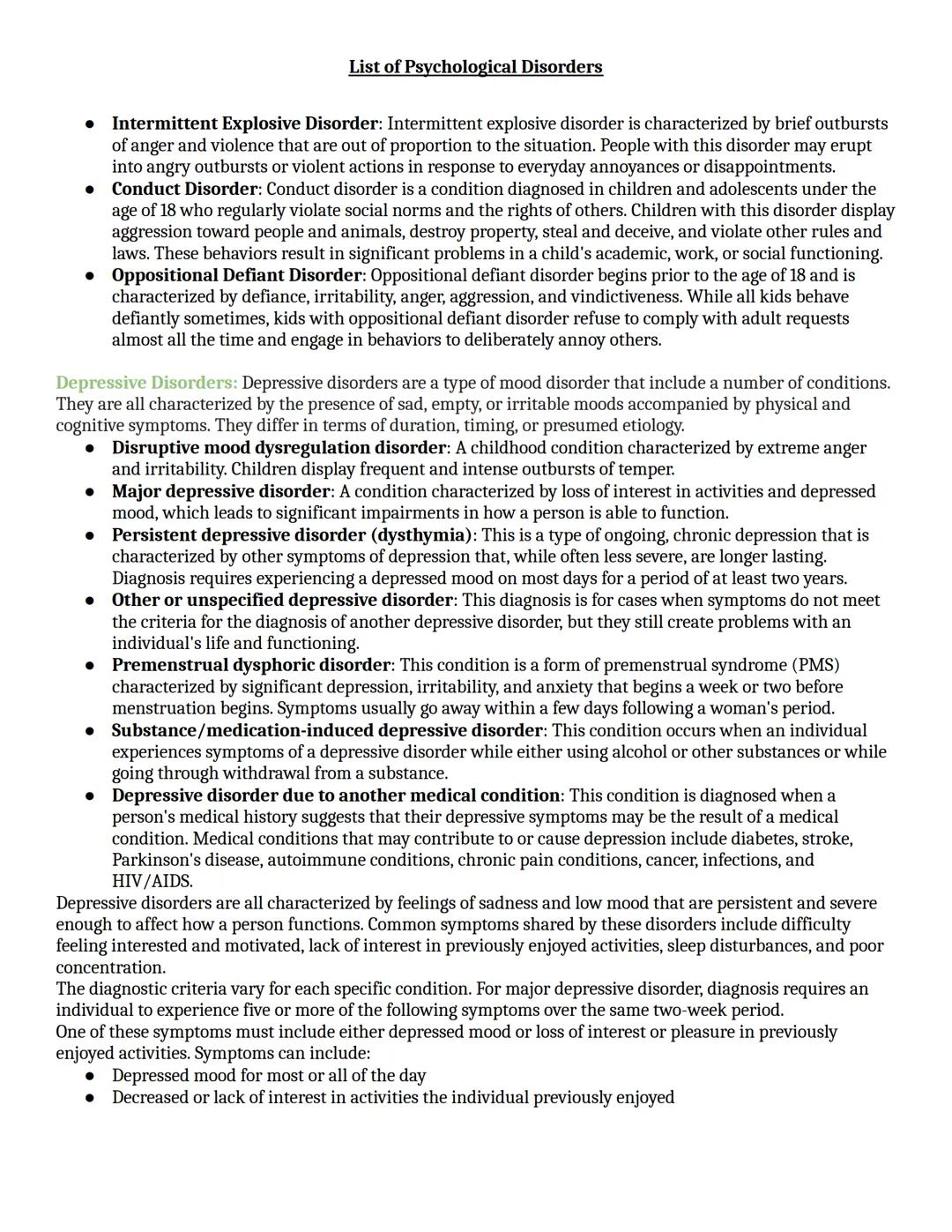
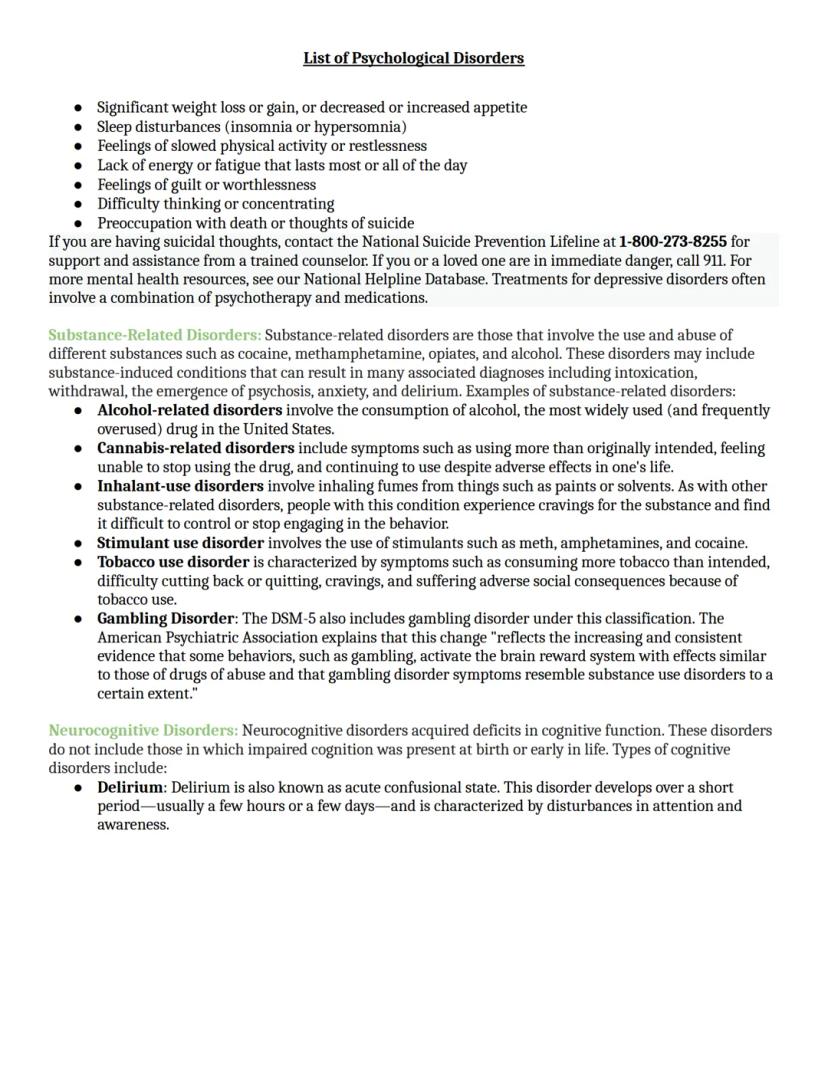
Substance-related disorders involve the use and abuse of substances like alcohol, cannabis, stimulants, or tobacco. These disorders can lead to conditions including intoxication, withdrawal, psychosis, anxiety, and delirium.
People with substance use disorders typically experience cravings, difficulty controlling use, and continued use despite negative consequences in their lives. Alcohol-related disorders are particularly common, as alcohol is the most widely used and frequently overused drug in the United States.
Interestingly, the DSM-5 includes Gambling Disorder in this category because gambling activates the brain's reward system similarly to drugs of abuse, and gambling disorder symptoms resemble substance use disorders.
Neurocognitive disorders involve acquired deficits in cognitive function that weren't present at birth or early in life. Delirium develops over a short period (hours or days) and involves disturbances in attention and awareness.
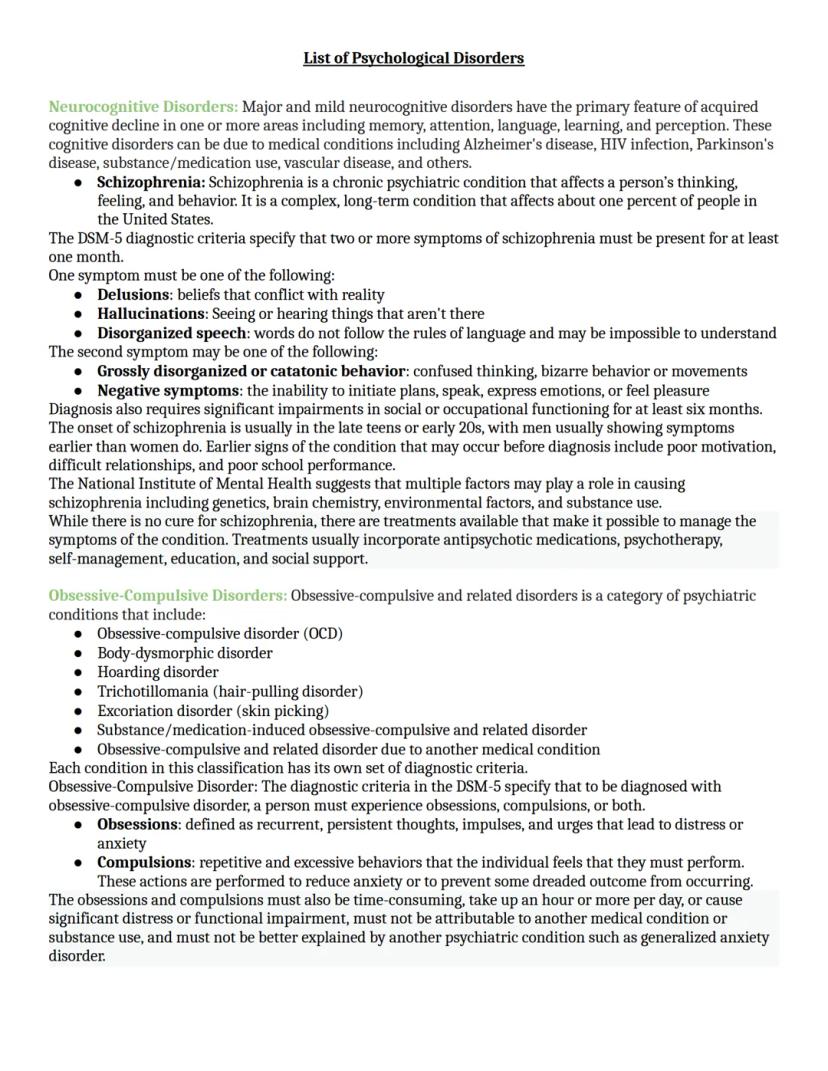
Major and mild neurocognitive disorders feature acquired cognitive decline in areas like memory, attention, language, and learning. These can be caused by conditions like Alzheimer's disease, Parkinson's disease, HIV infection, or vascular disease.
Understanding schizophrenia: Schizophrenia affects about 1% of Americans and typically begins in the late teens or early twenties, with men usually showing symptoms earlier than women. While there's no cure, treatments combining medications, therapy, and support can help manage symptoms.
For a schizophrenia diagnosis, a person must show at least two symptoms for one month, with one being delusions, hallucinations, or disorganized speech.
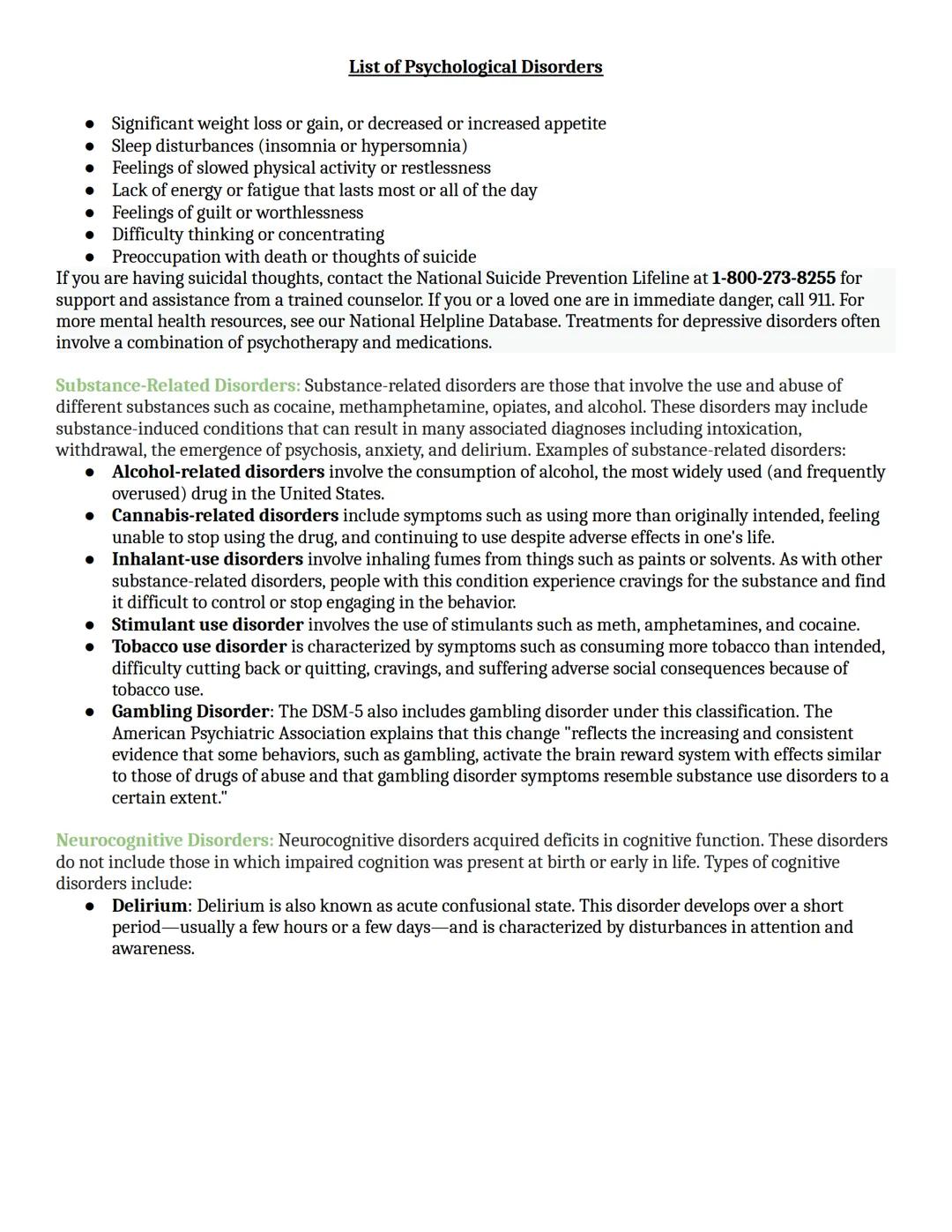
Obsessive-compulsive and related disorders include several conditions characterized by intrusive thoughts and repetitive behaviors. In Obsessive-Compulsive Disorder (OCD), people experience recurrent, unwanted thoughts (obsessions) and feel driven to perform repetitive behaviors (compulsions) to reduce anxiety.
For an OCD diagnosis, these obsessions and compulsions must be time-consuming (taking at least an hour daily), cause significant distress, or impair functioning. Treatment typically combines cognitive-behavioral therapy, particularly exposure and response prevention (ERP), with medications like antidepressants.
Related conditions include Body Dysmorphic Disorder (preoccupation with perceived physical flaws), Hoarding Disorder (difficulty discarding possessions), and Trichotillomania .
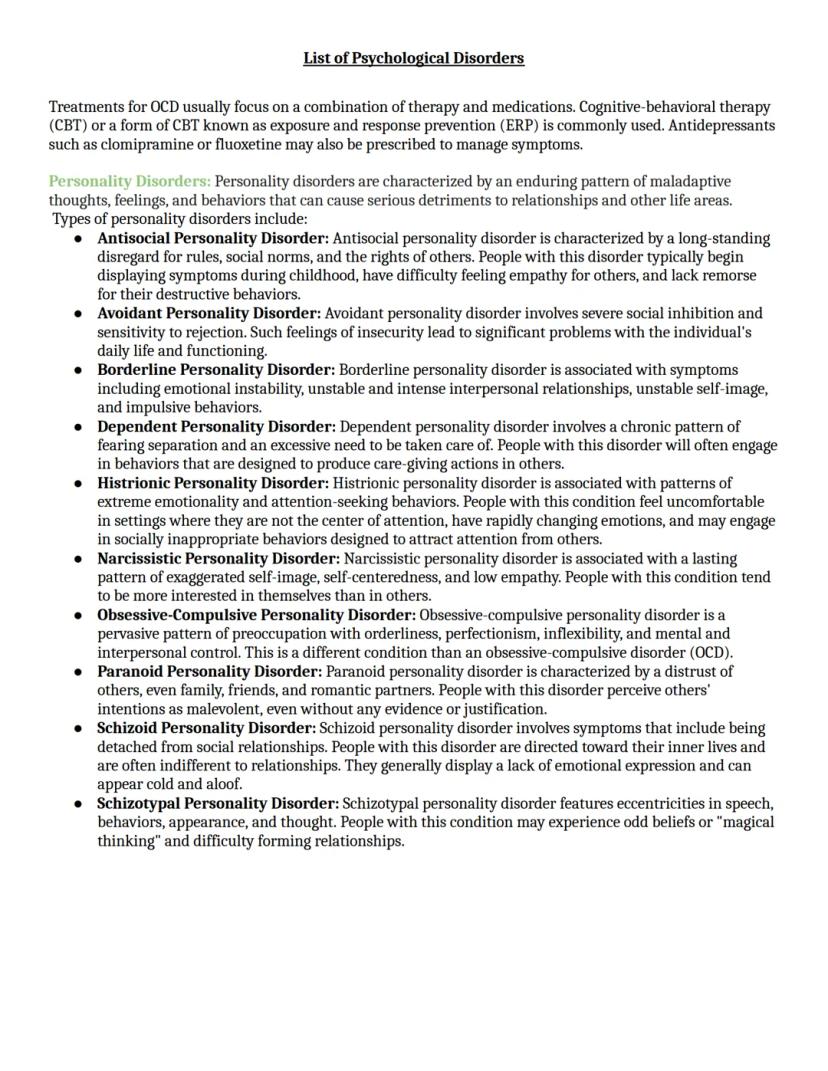
Personality disorders involve enduring patterns of maladaptive thoughts, feelings, and behaviors that significantly impact relationships and daily functioning. Borderline Personality Disorder features emotional instability, unstable relationships, poor self-image, and impulsive behaviors.
Not all perfectionists have a disorder: While many people have perfectionist tendencies, Obsessive-Compulsive Personality Disorder involves an extreme preoccupation with orderliness and control that significantly impairs functioning. This is different from OCD, which centers on specific obsessions and compulsions.
People with Narcissistic Personality Disorder show patterns of exaggerated self-image, self-centeredness, and low empathy. Those with Antisocial Personality Disorder display a long-standing disregard for rules, social norms, and others' rights, typically beginning in childhood.
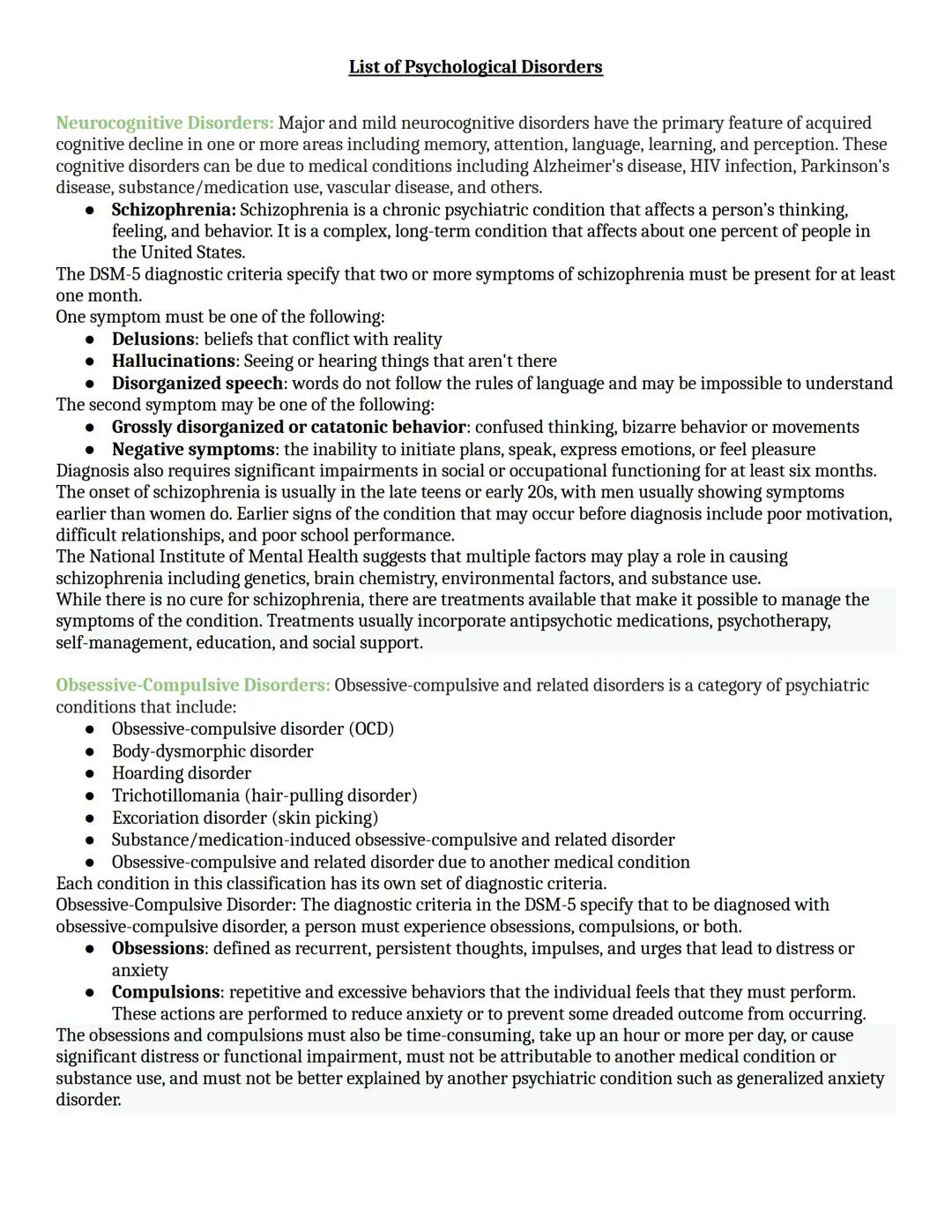
Schizophrenia is a chronic condition affecting thinking, feeling, and behavior that impacts about 1% of Americans. For diagnosis, two or more symptoms must be present for at least a month, with one being delusions, hallucinations, or disorganized speech.
These symptoms cause significant impairment in functioning for at least six months. Early signs before diagnosis might include poor motivation, difficult relationships, and declining school performance. While there's no cure, treatments combining antipsychotic medications, therapy, and support help manage symptoms.
Personality disorders continue to affect millions of Americans. People with Avoidant Personality Disorder experience severe social inhibition and sensitivity to rejection, causing significant life problems. Those with Dependent Personality Disorder have an excessive need to be taken care of and fear of separation.
Histrionic Personality Disorder involves extreme emotionality and attention-seeking behaviors. People with this condition feel uncomfortable when not the center of attention and may behave inappropriately to attract notice.
Complex conditions: Personality disorders develop from a combination of genetic and environmental factors and typically emerge during adolescence or early adulthood. They're among the most challenging conditions to treat because the behaviors are deeply ingrained in the person's identity.
Schizoid Personality Disorder involves detachment from social relationships and limited emotional expression. People with Schizotypal Personality Disorder show eccentricities in speech, behavior, and appearance, sometimes with odd beliefs or "magical thinking."
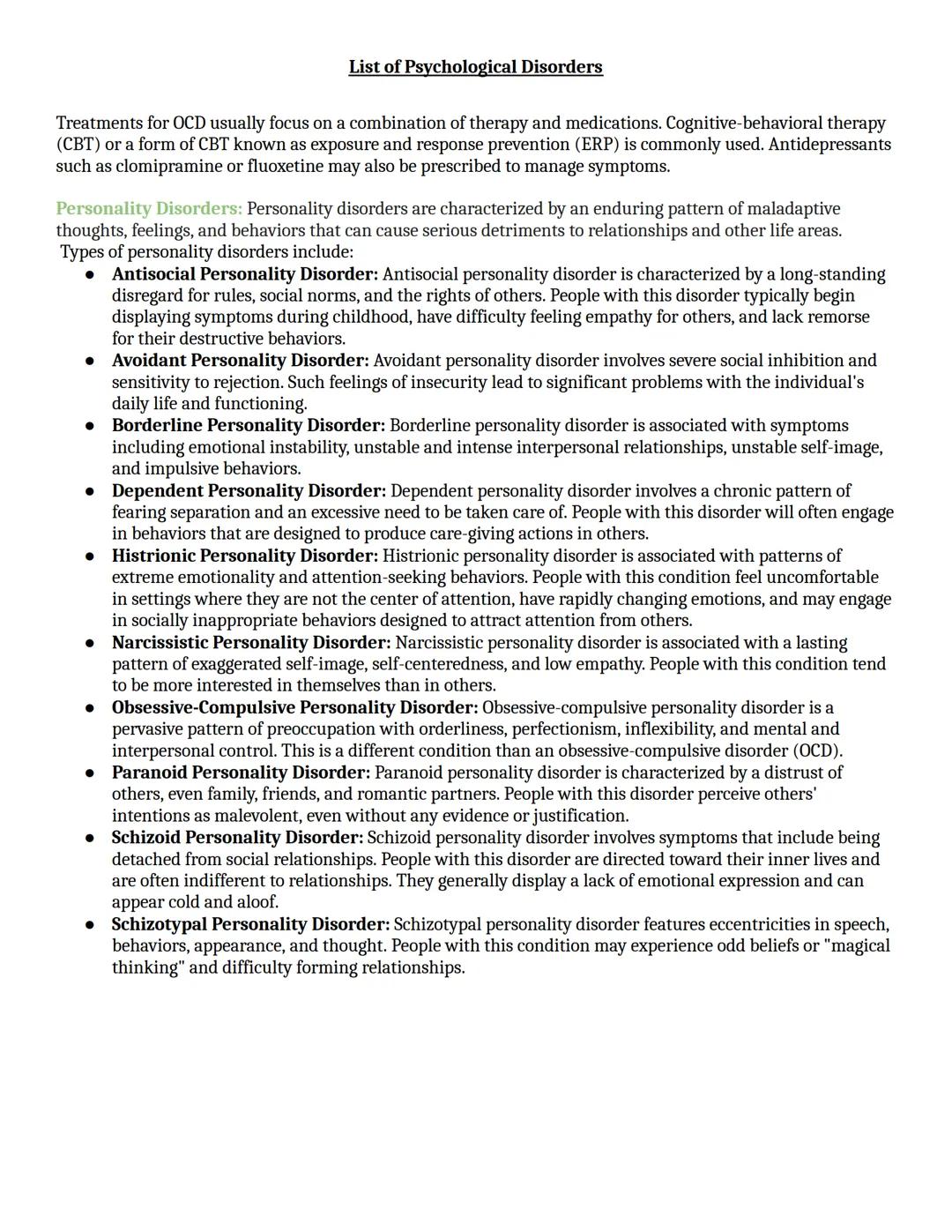
Most psychological disorders respond best to treatment combining therapy and medication when needed. For Obsessive-Compulsive Disorder (OCD), cognitive-behavioral therapy (CBT) or exposure and response prevention (ERP) works well alongside antidepressants like clomipramine or fluoxetine.
Personality disorders are complex conditions affecting thoughts, feelings, and behaviors in ways that damage relationships and disrupt daily life. Paranoid Personality Disorder involves persistent distrust of others, even family and friends, with a belief that others have malicious intentions without evidence.
People with Narcissistic Personality Disorder show an exaggerated sense of self-importance and lack empathy for others. This self-centered focus creates significant problems in relationships, work, and other areas of life.
Antisocial Personality Disorder involves a pattern of disregarding rules, norms, and others' rights. Symptoms typically begin in childhood, with those affected showing difficulty feeling empathy and lack of remorse for harmful behaviors.
Getting help matters: If you recognize symptoms of any psychological disorder in yourself or someone else, professional help can make a tremendous difference. Many conditions that once seemed untreatable now have effective interventions that can significantly improve quality of life.
While personality disorders are challenging to treat, various approaches help people manage symptoms and improve relationships. These include dialectical behavior therapy (DBT), schema therapy, and psychodynamic approaches, depending on the specific disorder and individual needs.
Remember that mental health conditions are medical conditions—not character flaws—and deserve the same compassion and treatment as physical ailments.
Our AI companion is specifically built for the needs of students. Based on the millions of content pieces we have on the platform we can provide truly meaningful and relevant answers to students. But its not only about answers, the companion is even more about guiding students through their daily learning challenges, with personalised study plans, quizzes or content pieces in the chat and 100% personalisation based on the students skills and developments.
You can download the app in the Google Play Store and in the Apple App Store.
That's right! Enjoy free access to study content, connect with fellow students, and get instant help – all at your fingertips.
App Store
Google Play
The app is very easy to use and well designed. I have found everything I was looking for so far and have been able to learn a lot from the presentations! I will definitely use the app for a class assignment! And of course it also helps a lot as an inspiration.
Stefan S
iOS user
This app is really great. There are so many study notes and help [...]. My problem subject is French, for example, and the app has so many options for help. Thanks to this app, I have improved my French. I would recommend it to anyone.
Samantha Klich
Android user
Wow, I am really amazed. I just tried the app because I've seen it advertised many times and was absolutely stunned. This app is THE HELP you want for school and above all, it offers so many things, such as workouts and fact sheets, which have been VERY helpful to me personally.
Anna
iOS user
I think it’s very much worth it and you’ll end up using it a lot once you get the hang of it and even after looking at others notes you can still ask your Artificial intelligence buddy the question and ask to simplify it if you still don’t get it!!! In the end I think it’s worth it 😊👍 ⚠️Also DID I MENTION ITS FREEE YOU DON’T HAVE TO PAY FOR ANYTHING AND STILL GET YOUR GRADES IN PERFECTLY❗️❗️⚠️
Thomas R
iOS user
Knowunity is the BEST app I’ve used in a minute. This is not an ai review or anything this is genuinely coming from a 7th grade student (I know 2011 im young) but dude this app is a 10/10 i have maintained a 3.8 gpa and have plenty of time for gaming. I love it and my mom is just happy I got good grades
Brad T
Android user
Not only did it help me find the answer but it also showed me alternative ways to solve it. I was horrible in math and science but now I have an a in both subjects. Thanks for the help🤍🤍
David K
iOS user
The app's just great! All I have to do is enter the topic in the search bar and I get the response real fast. I don't have to watch 10 YouTube videos to understand something, so I'm saving my time. Highly recommended!
Sudenaz Ocak
Android user
In school I was really bad at maths but thanks to the app, I am doing better now. I am so grateful that you made the app.
Greenlight Bonnie
Android user
I found this app a couple years ago and it has only gotten better since then. I really love it because it can help with written questions and photo questions. Also, it can find study guides that other people have made as well as flashcard sets and practice tests. The free version is also amazing for students who might not be able to afford it. Would 100% recommend
Aubrey
iOS user
Best app if you're in Highschool or Junior high. I have been using this app for 2 school years and it's the best, it's good if you don't have anyone to help you with school work.😋🩷🎀
Marco B
iOS user
THE QUIZES AND FLASHCARDS ARE SO USEFUL AND I LOVE Knowunity AI. IT ALSO IS LITREALLY LIKE CHATGPT BUT SMARTER!! HELPED ME WITH MY MASCARA PROBLEMS TOO!! AS WELL AS MY REAL SUBJECTS ! DUHHH 😍😁😲🤑💗✨🎀😮
Elisha
iOS user
This app is phenomenal down to the correct info and the various topics you can study! I greatly recommend it for people who struggle with procrastination and those who need homework help. It has been perfectly accurate for world 1 history as far as I’ve seen! Geometry too!
Paul T
iOS user
The app is very easy to use and well designed. I have found everything I was looking for so far and have been able to learn a lot from the presentations! I will definitely use the app for a class assignment! And of course it also helps a lot as an inspiration.
Stefan S
iOS user
This app is really great. There are so many study notes and help [...]. My problem subject is French, for example, and the app has so many options for help. Thanks to this app, I have improved my French. I would recommend it to anyone.
Samantha Klich
Android user
Wow, I am really amazed. I just tried the app because I've seen it advertised many times and was absolutely stunned. This app is THE HELP you want for school and above all, it offers so many things, such as workouts and fact sheets, which have been VERY helpful to me personally.
Anna
iOS user
I think it’s very much worth it and you’ll end up using it a lot once you get the hang of it and even after looking at others notes you can still ask your Artificial intelligence buddy the question and ask to simplify it if you still don’t get it!!! In the end I think it’s worth it 😊👍 ⚠️Also DID I MENTION ITS FREEE YOU DON’T HAVE TO PAY FOR ANYTHING AND STILL GET YOUR GRADES IN PERFECTLY❗️❗️⚠️
Thomas R
iOS user
Knowunity is the BEST app I’ve used in a minute. This is not an ai review or anything this is genuinely coming from a 7th grade student (I know 2011 im young) but dude this app is a 10/10 i have maintained a 3.8 gpa and have plenty of time for gaming. I love it and my mom is just happy I got good grades
Brad T
Android user
Not only did it help me find the answer but it also showed me alternative ways to solve it. I was horrible in math and science but now I have an a in both subjects. Thanks for the help🤍🤍
David K
iOS user
The app's just great! All I have to do is enter the topic in the search bar and I get the response real fast. I don't have to watch 10 YouTube videos to understand something, so I'm saving my time. Highly recommended!
Sudenaz Ocak
Android user
In school I was really bad at maths but thanks to the app, I am doing better now. I am so grateful that you made the app.
Greenlight Bonnie
Android user
I found this app a couple years ago and it has only gotten better since then. I really love it because it can help with written questions and photo questions. Also, it can find study guides that other people have made as well as flashcard sets and practice tests. The free version is also amazing for students who might not be able to afford it. Would 100% recommend
Aubrey
iOS user
Best app if you're in Highschool or Junior high. I have been using this app for 2 school years and it's the best, it's good if you don't have anyone to help you with school work.😋🩷🎀
Marco B
iOS user
THE QUIZES AND FLASHCARDS ARE SO USEFUL AND I LOVE Knowunity AI. IT ALSO IS LITREALLY LIKE CHATGPT BUT SMARTER!! HELPED ME WITH MY MASCARA PROBLEMS TOO!! AS WELL AS MY REAL SUBJECTS ! DUHHH 😍😁😲🤑💗✨🎀😮
Elisha
iOS user
This app is phenomenal down to the correct info and the various topics you can study! I greatly recommend it for people who struggle with procrastination and those who need homework help. It has been perfectly accurate for world 1 history as far as I’ve seen! Geometry too!
Paul T
iOS user
Sarah
@sarah_qkyv
Psychological disorders are conditions that affect a person's thoughts, feelings, and behaviors. These disorders can disrupt daily life, relationships, and overall well-being. Understanding these conditions helps us recognize symptoms and know when to seek help.
Access to all documents
Improve your grades
Join milions of students
Neurodevelopmental disorders typically appear during childhood or adolescence and affect brain development. Intellectual disability involves limitations in intellectual functioning (IQ below 70) and everyday adaptive behaviors like self-care and social skills.
Children under five might be diagnosed with Global Developmental Delay if they show delays in areas like cognition and motor skills. This is usually a temporary diagnosis until they're old enough for standardized testing.
Communication disorders affect language and speech abilities, including language disorder, speech sound disorder, stuttering, and social communication disorder. Autism Spectrum Disorder involves persistent deficits in social interaction and communication along with restricted, repetitive behaviors.
ADHD features patterns of hyperactivity-impulsivity and/or inattention that interfere with functioning across multiple settings. Symptoms must appear before age 12 and impact social, occupational, or academic functioning.
Did you know? Bipolar disorder involves shifts between elevated moods and depression, along with changes in energy levels and activity. People experiencing mania might engage in risky behaviors like excessive shopping or gambling.
Access to all documents
Improve your grades
Join milions of students
Anxiety disorders involve excessive fear, worry, and related behavioral disturbances. Generalized Anxiety Disorder (GAD) features excessive worry about everyday events that interferes with normal functioning.
People with Social Anxiety Disorder have an irrational fear of being watched or judged, making it difficult to function in social settings. Specific Phobias involve extreme fear of particular objects or situations like spiders, heights, or small spaces.
Panic Disorder involves unexpected panic attacks that can lead people to avoid situations where attacks might occur. Separation Anxiety Disorder involves excessive fear about being separated from attachment figures—not just in children, but adults too.
Trauma and stressor-related disorders develop after exposure to stressful or traumatic events. Acute Stress Disorder involves severe anxiety for up to one month after a traumatic event, with symptoms like dissociation and flashbacks.
Remember this: Around 18% of American adults suffer from at least one anxiety disorder, making them among the most common mental health conditions.
Post-Traumatic Stress Disorder (PTSD) can develop after experiencing or witnessing traumatic events and includes symptoms like flashbacks, nightmares, avoiding reminders of the trauma, and feeling constantly on edge.
Access to all documents
Improve your grades
Join milions of students
Dissociative disorders involve interruptions in consciousness, identity, or memory. Dissociative Amnesia causes temporary memory loss beyond normal forgetfulness, often following psychological trauma. People may remember some details about events but have no recall of others.
Dissociative Identity Disorder (formerly called multiple personality disorder) involves the presence of two or more distinct identities or personalities. Each personality has its own way of perceiving and interacting with the world, causing changes in behavior, memory, and consciousness.
People with Depersonalization/Derealization Disorder feel disconnected from their body (depersonalization) or from reality (derealization). They experience a sense of unreality and disconnect from their memories, feelings, and consciousness.
Somatic symptom disorders involve physical symptoms that cause significant distress, regardless of whether a medical cause can be found. Somatic Symptom Disorder involves preoccupation with physical symptoms that makes normal functioning difficult.
Important: People with somatic symptom disorders are not faking their symptoms. Their physical pain and fatigue are real—it's their extreme reaction to these symptoms that creates problems in their lives.
Illness Anxiety Disorder involves excessive worry about having an undiagnosed serious illness, even when medical tests are negative. This preoccupation causes significant anxiety and behavioral changes.
Access to all documents
Improve your grades
Join milions of students
Eating disorders involve obsessive concerns with weight and disruptive eating patterns. Anorexia Nervosa is characterized by restricted food consumption leading to severe weight loss, fear of gaining weight, and a distorted self-image.
Bulimia Nervosa involves cycles of binging followed by extreme compensatory behaviors like self-induced vomiting or excessive exercise. Binge-Eating Disorder features episodes of consuming unusually large amounts of food within a short time, accompanied by feelings of loss of control.
Less common eating disorders include Rumination Disorder and Pica , which often affect children or people with developmental disabilities.
Sleep disorders interrupt normal sleep patterns, causing distress and daytime functioning problems. Insomnia involves difficulty falling or staying asleep, while Hypersomnolence causes excessive daytime sleepiness despite adequate nighttime sleep.
Sleep fact: Breathing-related sleep disorders like sleep apnea can cause brief interruptions in sleep that lead to insomnia and daytime sleepiness. These interruptions might happen hundreds of times a night without you being aware of them!
Parasomnias involve abnormal behaviors during sleep, including sleepwalking, sleep terrors, sleep talking, and sleep eating. Restless Legs Syndrome causes uncomfortable sensations and an irresistible urge to move the legs, interfering with sleep.
Access to all documents
Improve your grades
Join milions of students
Disruptive disorders involve problems controlling emotions and behaviors. People with Intermittent Explosive Disorder have brief outbursts of anger and violence that are way out of proportion to the situation. They might erupt over everyday annoyances that others would handle calmly.
Children with Conduct Disorder regularly violate social norms and others' rights by showing aggression, destroying property, stealing, and breaking rules. This significantly impacts their academic and social functioning. Oppositional Defiant Disorder involves persistent defiance, irritability, and vindictiveness in children, going far beyond normal childhood rebellion.
Other impulse-control disorders include Kleptomania (inability to resist stealing items, often without real value) and Pyromania .
Depressive disorders all involve persistent sad moods and physical/cognitive symptoms that affect functioning. Major Depressive Disorder causes loss of interest in activities and depressed mood that significantly impairs daily life.
Key difference: While Major Depressive Disorder typically lasts for weeks or months, Persistent Depressive Disorder (dysthymia) involves experiencing depressed mood on most days for at least two years.
Diagnosis of major depression requires experiencing five or more symptoms for at least two weeks, including either depressed mood or loss of interest in previously enjoyed activities, plus symptoms like sleep disturbances, fatigue, concentration problems, or thoughts of suicide.
Access to all documents
Improve your grades
Join milions of students
Substance-related disorders involve the use and abuse of substances like alcohol, cannabis, stimulants, or tobacco. These disorders can lead to conditions including intoxication, withdrawal, psychosis, anxiety, and delirium.
People with substance use disorders typically experience cravings, difficulty controlling use, and continued use despite negative consequences in their lives. Alcohol-related disorders are particularly common, as alcohol is the most widely used and frequently overused drug in the United States.
Interestingly, the DSM-5 includes Gambling Disorder in this category because gambling activates the brain's reward system similarly to drugs of abuse, and gambling disorder symptoms resemble substance use disorders.
Neurocognitive disorders involve acquired deficits in cognitive function that weren't present at birth or early in life. Delirium develops over a short period (hours or days) and involves disturbances in attention and awareness.
Major and mild neurocognitive disorders feature acquired cognitive decline in areas like memory, attention, language, and learning. These can be caused by conditions like Alzheimer's disease, Parkinson's disease, HIV infection, or vascular disease.
Understanding schizophrenia: Schizophrenia affects about 1% of Americans and typically begins in the late teens or early twenties, with men usually showing symptoms earlier than women. While there's no cure, treatments combining medications, therapy, and support can help manage symptoms.
For a schizophrenia diagnosis, a person must show at least two symptoms for one month, with one being delusions, hallucinations, or disorganized speech.
Access to all documents
Improve your grades
Join milions of students
Obsessive-compulsive and related disorders include several conditions characterized by intrusive thoughts and repetitive behaviors. In Obsessive-Compulsive Disorder (OCD), people experience recurrent, unwanted thoughts (obsessions) and feel driven to perform repetitive behaviors (compulsions) to reduce anxiety.
For an OCD diagnosis, these obsessions and compulsions must be time-consuming (taking at least an hour daily), cause significant distress, or impair functioning. Treatment typically combines cognitive-behavioral therapy, particularly exposure and response prevention (ERP), with medications like antidepressants.
Related conditions include Body Dysmorphic Disorder (preoccupation with perceived physical flaws), Hoarding Disorder (difficulty discarding possessions), and Trichotillomania .
Personality disorders involve enduring patterns of maladaptive thoughts, feelings, and behaviors that significantly impact relationships and daily functioning. Borderline Personality Disorder features emotional instability, unstable relationships, poor self-image, and impulsive behaviors.
Not all perfectionists have a disorder: While many people have perfectionist tendencies, Obsessive-Compulsive Personality Disorder involves an extreme preoccupation with orderliness and control that significantly impairs functioning. This is different from OCD, which centers on specific obsessions and compulsions.
People with Narcissistic Personality Disorder show patterns of exaggerated self-image, self-centeredness, and low empathy. Those with Antisocial Personality Disorder display a long-standing disregard for rules, social norms, and others' rights, typically beginning in childhood.
Access to all documents
Improve your grades
Join milions of students
Schizophrenia is a chronic condition affecting thinking, feeling, and behavior that impacts about 1% of Americans. For diagnosis, two or more symptoms must be present for at least a month, with one being delusions, hallucinations, or disorganized speech.
These symptoms cause significant impairment in functioning for at least six months. Early signs before diagnosis might include poor motivation, difficult relationships, and declining school performance. While there's no cure, treatments combining antipsychotic medications, therapy, and support help manage symptoms.
Personality disorders continue to affect millions of Americans. People with Avoidant Personality Disorder experience severe social inhibition and sensitivity to rejection, causing significant life problems. Those with Dependent Personality Disorder have an excessive need to be taken care of and fear of separation.
Histrionic Personality Disorder involves extreme emotionality and attention-seeking behaviors. People with this condition feel uncomfortable when not the center of attention and may behave inappropriately to attract notice.
Complex conditions: Personality disorders develop from a combination of genetic and environmental factors and typically emerge during adolescence or early adulthood. They're among the most challenging conditions to treat because the behaviors are deeply ingrained in the person's identity.
Schizoid Personality Disorder involves detachment from social relationships and limited emotional expression. People with Schizotypal Personality Disorder show eccentricities in speech, behavior, and appearance, sometimes with odd beliefs or "magical thinking."
Access to all documents
Improve your grades
Join milions of students
Most psychological disorders respond best to treatment combining therapy and medication when needed. For Obsessive-Compulsive Disorder (OCD), cognitive-behavioral therapy (CBT) or exposure and response prevention (ERP) works well alongside antidepressants like clomipramine or fluoxetine.
Personality disorders are complex conditions affecting thoughts, feelings, and behaviors in ways that damage relationships and disrupt daily life. Paranoid Personality Disorder involves persistent distrust of others, even family and friends, with a belief that others have malicious intentions without evidence.
People with Narcissistic Personality Disorder show an exaggerated sense of self-importance and lack empathy for others. This self-centered focus creates significant problems in relationships, work, and other areas of life.
Antisocial Personality Disorder involves a pattern of disregarding rules, norms, and others' rights. Symptoms typically begin in childhood, with those affected showing difficulty feeling empathy and lack of remorse for harmful behaviors.
Getting help matters: If you recognize symptoms of any psychological disorder in yourself or someone else, professional help can make a tremendous difference. Many conditions that once seemed untreatable now have effective interventions that can significantly improve quality of life.
While personality disorders are challenging to treat, various approaches help people manage symptoms and improve relationships. These include dialectical behavior therapy (DBT), schema therapy, and psychodynamic approaches, depending on the specific disorder and individual needs.
Remember that mental health conditions are medical conditions—not character flaws—and deserve the same compassion and treatment as physical ailments.
Our AI companion is specifically built for the needs of students. Based on the millions of content pieces we have on the platform we can provide truly meaningful and relevant answers to students. But its not only about answers, the companion is even more about guiding students through their daily learning challenges, with personalised study plans, quizzes or content pieces in the chat and 100% personalisation based on the students skills and developments.
You can download the app in the Google Play Store and in the Apple App Store.
That's right! Enjoy free access to study content, connect with fellow students, and get instant help – all at your fingertips.
17
Smart Tools NEW
Transform this note into: ✓ 50+ Practice Questions ✓ Interactive Flashcards ✓ Full Practice Test ✓ Essay Outlines
Psychology
 Psychology
App Store
Google Play
The app is very easy to use and well designed. I have found everything I was looking for so far and have been able to learn a lot from the presentations! I will definitely use the app for a class assignment! And of course it also helps a lot as an inspiration.
Stefan S
iOS user
This app is really great. There are so many study notes and help [...]. My problem subject is French, for example, and the app has so many options for help. Thanks to this app, I have improved my French. I would recommend it to anyone.
Samantha Klich
Android user
Wow, I am really amazed. I just tried the app because I've seen it advertised many times and was absolutely stunned. This app is THE HELP you want for school and above all, it offers so many things, such as workouts and fact sheets, which have been VERY helpful to me personally.
Anna
iOS user
I think it’s very much worth it and you’ll end up using it a lot once you get the hang of it and even after looking at others notes you can still ask your Artificial intelligence buddy the question and ask to simplify it if you still don’t get it!!! In the end I think it’s worth it 😊👍 ⚠️Also DID I MENTION ITS FREEE YOU DON’T HAVE TO PAY FOR ANYTHING AND STILL GET YOUR GRADES IN PERFECTLY❗️❗️⚠️
Thomas R
iOS user
Knowunity is the BEST app I’ve used in a minute. This is not an ai review or anything this is genuinely coming from a 7th grade student (I know 2011 im young) but dude this app is a 10/10 i have maintained a 3.8 gpa and have plenty of time for gaming. I love it and my mom is just happy I got good grades
Brad T
Android user
Not only did it help me find the answer but it also showed me alternative ways to solve it. I was horrible in math and science but now I have an a in both subjects. Thanks for the help🤍🤍
David K
iOS user
The app's just great! All I have to do is enter the topic in the search bar and I get the response real fast. I don't have to watch 10 YouTube videos to understand something, so I'm saving my time. Highly recommended!
Sudenaz Ocak
Android user
In school I was really bad at maths but thanks to the app, I am doing better now. I am so grateful that you made the app.
Greenlight Bonnie
Android user
I found this app a couple years ago and it has only gotten better since then. I really love it because it can help with written questions and photo questions. Also, it can find study guides that other people have made as well as flashcard sets and practice tests. The free version is also amazing for students who might not be able to afford it. Would 100% recommend
Aubrey
iOS user
Best app if you're in Highschool or Junior high. I have been using this app for 2 school years and it's the best, it's good if you don't have anyone to help you with school work.😋🩷🎀
Marco B
iOS user
THE QUIZES AND FLASHCARDS ARE SO USEFUL AND I LOVE Knowunity AI. IT ALSO IS LITREALLY LIKE CHATGPT BUT SMARTER!! HELPED ME WITH MY MASCARA PROBLEMS TOO!! AS WELL AS MY REAL SUBJECTS ! DUHHH 😍😁😲🤑💗✨🎀😮
Elisha
iOS user
This app is phenomenal down to the correct info and the various topics you can study! I greatly recommend it for people who struggle with procrastination and those who need homework help. It has been perfectly accurate for world 1 history as far as I’ve seen! Geometry too!
Paul T
iOS user
The app is very easy to use and well designed. I have found everything I was looking for so far and have been able to learn a lot from the presentations! I will definitely use the app for a class assignment! And of course it also helps a lot as an inspiration.
Stefan S
iOS user
This app is really great. There are so many study notes and help [...]. My problem subject is French, for example, and the app has so many options for help. Thanks to this app, I have improved my French. I would recommend it to anyone.
Samantha Klich
Android user
Wow, I am really amazed. I just tried the app because I've seen it advertised many times and was absolutely stunned. This app is THE HELP you want for school and above all, it offers so many things, such as workouts and fact sheets, which have been VERY helpful to me personally.
Anna
iOS user
I think it’s very much worth it and you’ll end up using it a lot once you get the hang of it and even after looking at others notes you can still ask your Artificial intelligence buddy the question and ask to simplify it if you still don’t get it!!! In the end I think it’s worth it 😊👍 ⚠️Also DID I MENTION ITS FREEE YOU DON’T HAVE TO PAY FOR ANYTHING AND STILL GET YOUR GRADES IN PERFECTLY❗️❗️⚠️
Thomas R
iOS user
Knowunity is the BEST app I’ve used in a minute. This is not an ai review or anything this is genuinely coming from a 7th grade student (I know 2011 im young) but dude this app is a 10/10 i have maintained a 3.8 gpa and have plenty of time for gaming. I love it and my mom is just happy I got good grades
Brad T
Android user
Not only did it help me find the answer but it also showed me alternative ways to solve it. I was horrible in math and science but now I have an a in both subjects. Thanks for the help🤍🤍
David K
iOS user
The app's just great! All I have to do is enter the topic in the search bar and I get the response real fast. I don't have to watch 10 YouTube videos to understand something, so I'm saving my time. Highly recommended!
Sudenaz Ocak
Android user
In school I was really bad at maths but thanks to the app, I am doing better now. I am so grateful that you made the app.
Greenlight Bonnie
Android user
I found this app a couple years ago and it has only gotten better since then. I really love it because it can help with written questions and photo questions. Also, it can find study guides that other people have made as well as flashcard sets and practice tests. The free version is also amazing for students who might not be able to afford it. Would 100% recommend
Aubrey
iOS user
Best app if you're in Highschool or Junior high. I have been using this app for 2 school years and it's the best, it's good if you don't have anyone to help you with school work.😋🩷🎀
Marco B
iOS user
THE QUIZES AND FLASHCARDS ARE SO USEFUL AND I LOVE Knowunity AI. IT ALSO IS LITREALLY LIKE CHATGPT BUT SMARTER!! HELPED ME WITH MY MASCARA PROBLEMS TOO!! AS WELL AS MY REAL SUBJECTS ! DUHHH 😍😁😲🤑💗✨🎀😮
Elisha
iOS user
This app is phenomenal down to the correct info and the various topics you can study! I greatly recommend it for people who struggle with procrastination and those who need homework help. It has been perfectly accurate for world 1 history as far as I’ve seen! Geometry too!
Paul T
iOS user