
Welcome to the fascinating world of neuroscience! This chapter explores...
 Psychology42 views·Updated Jun 4, 2026·4 pages
Introduction to Neuroscience: Key Concepts Explained

Vanita Rabsatt@v_maeee
1 / 4
1
of 4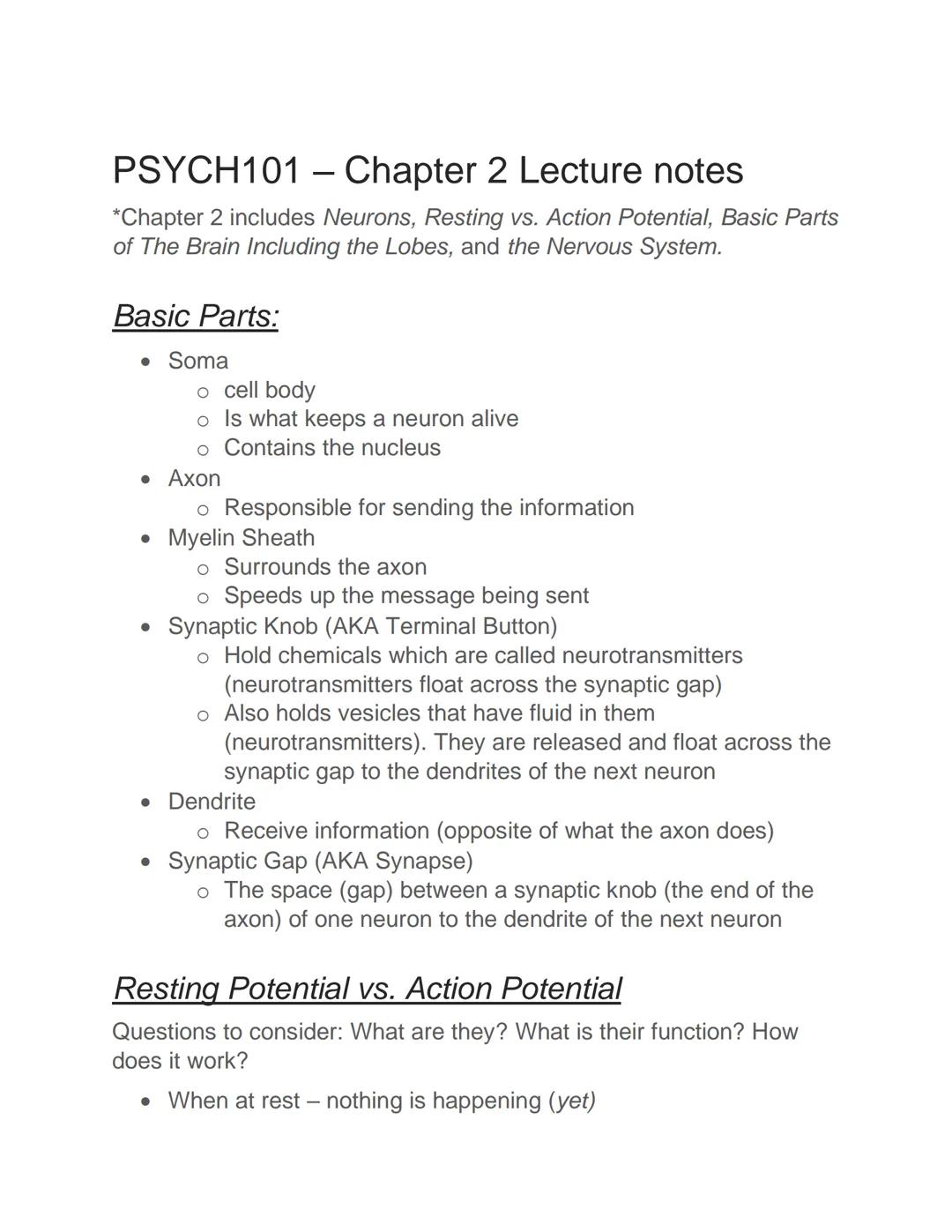
Neurons: The Brain's Building Blocks
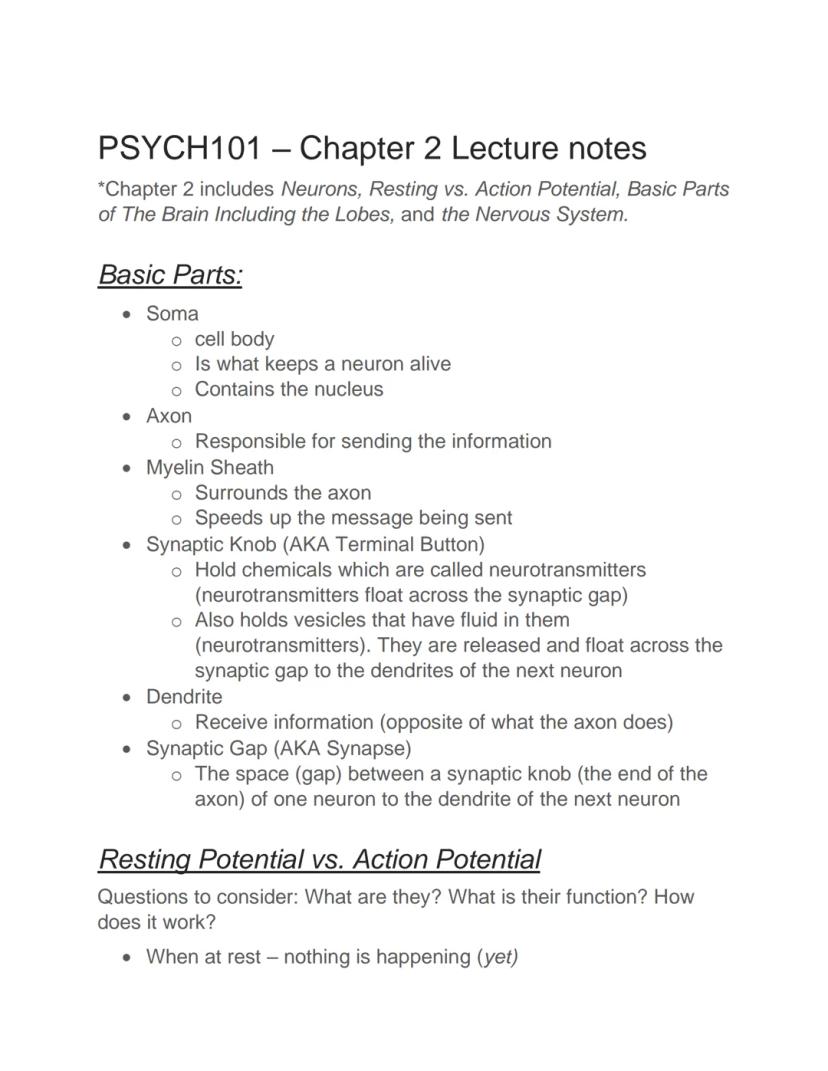
Ever wonder how your brain sends messages throughout your body? It's all thanks to neurons, the specialized cells that form your brain's communication network. Each neuron has several key parts that work together to transmit information.
The soma (cell body) keeps the neuron alive and contains its nucleus. Information travels along the axon, which sends signals to other neurons. Many axons are covered with a myelin sheath that acts like insulation on electrical wires, speeding up message transmission.
At the end of the axon, you'll find the synaptic knob (also called terminal button), which stores chemicals called neurotransmitters. These chemicals are released from tiny sacs called vesicles and travel across the synaptic gap to reach the dendrites of another neuron, which receive the information.
💡 Fun Fact: If all the neurons in your brain were lined up end to end, they would stretch about 600 miles! That's roughly the distance from Boston to Washington, DC.
2
of 4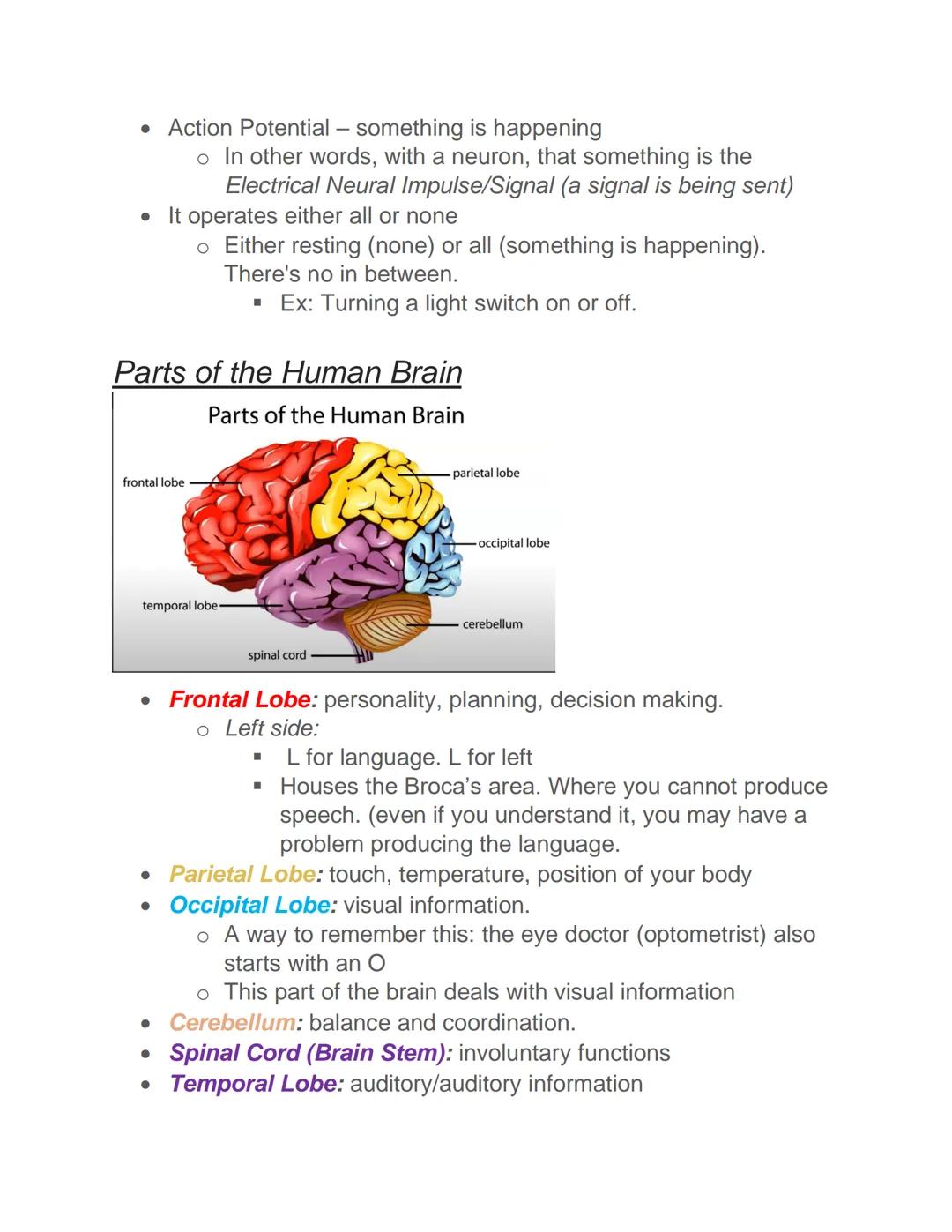
Neural Signals and Brain Structure
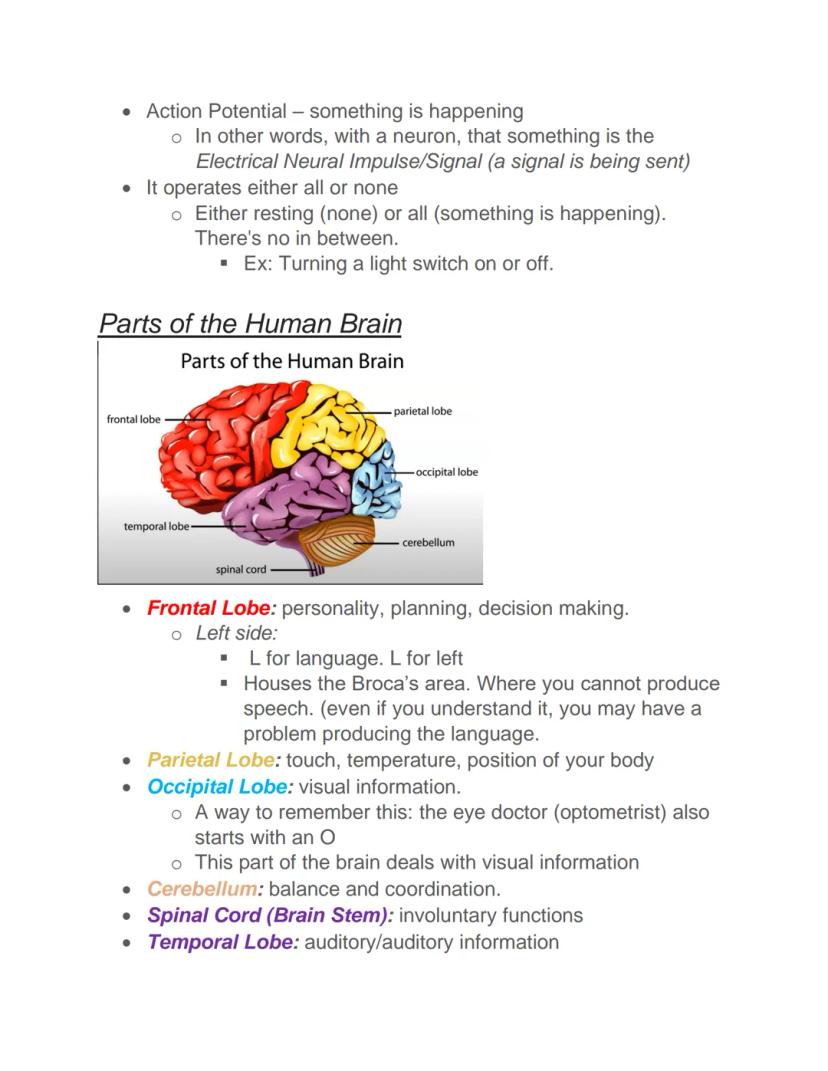
Think of your neurons as having two states: resting and action potential. During resting potential, the neuron is quiet, like a light switch that's turned off. When stimulated, it switches to action potential, sending an electrical signal down the axon. This system works on an "all or none" principle—either the neuron fires completely or not at all.
Your brain has several major regions, each with specific responsibilities. The frontal lobe controls your personality, planning, and decision-making. Within it, the left side contains Broca's area, which helps you produce speech. The parietal lobe processes touch and body position, while the occipital lobe handles visual information.
The temporal lobe processes hearing and contains Wernicke's area on the left side, which helps you understand speech. Meanwhile, the cerebellum coordinates balance and smooth movement, and the spinal cord manages involuntary functions like breathing.
💡 Memory Tip: To remember that the occipital lobe handles vision, note that both "occipital" and "optometrist" (eye doctor) start with "o"!
3
of 4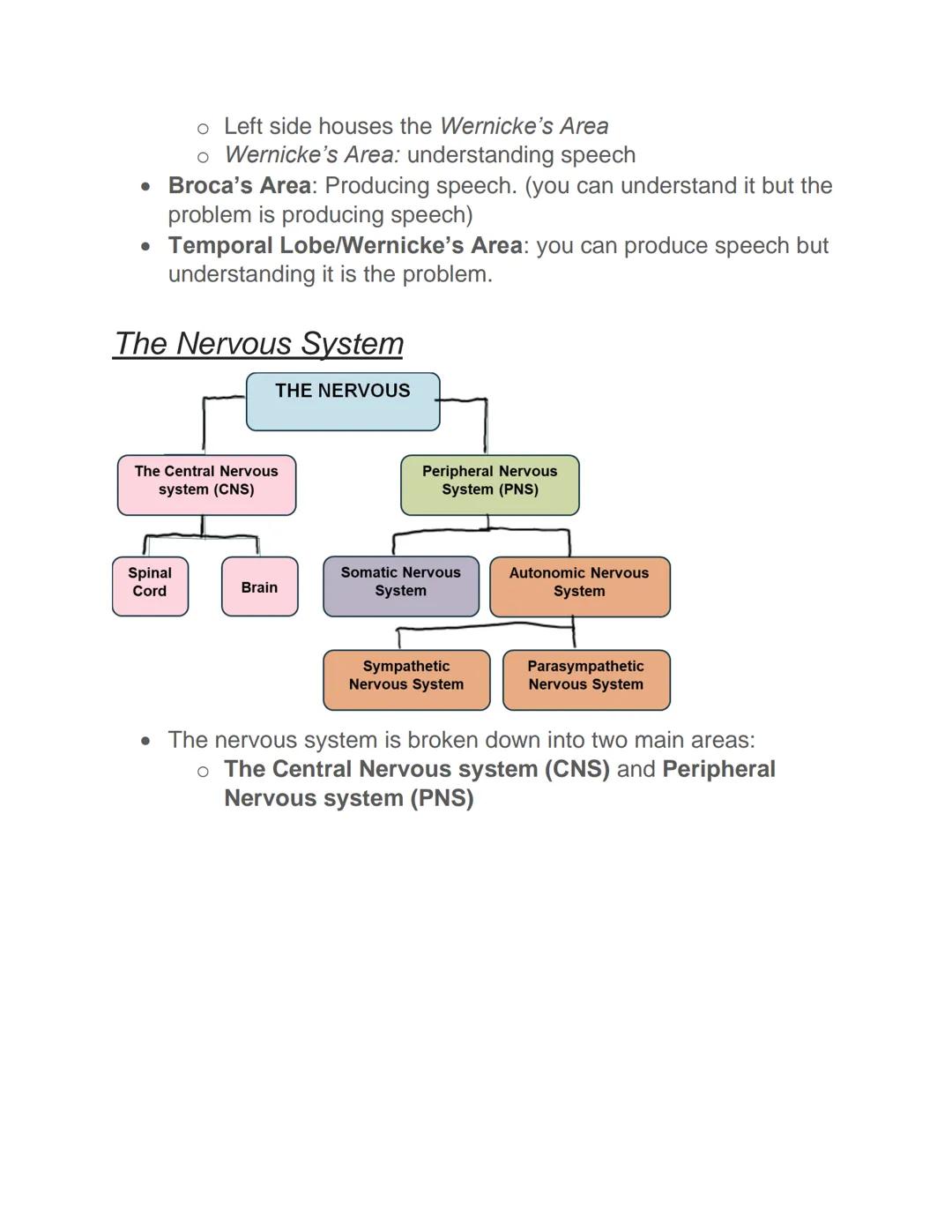
Language Processing and Nervous System Overview
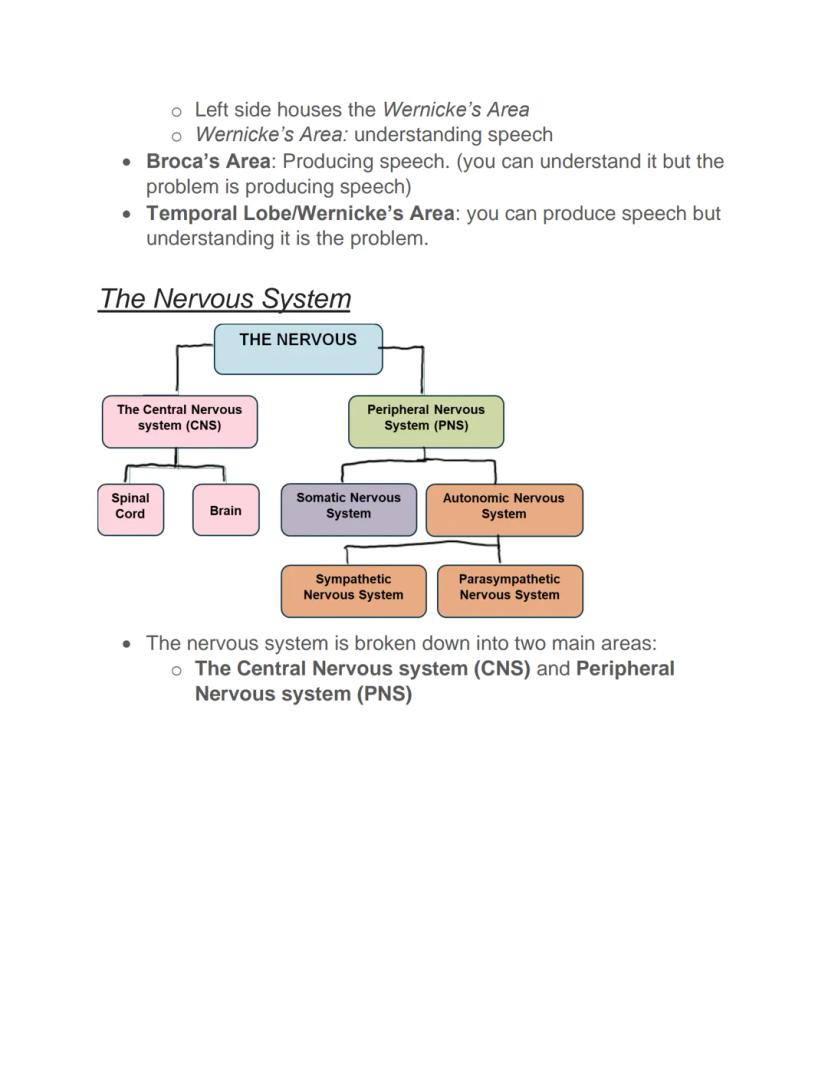
Your ability to communicate depends on two crucial brain areas. Broca's area in the frontal lobe helps you produce speech—damage here means you might understand language but struggle to speak. Wernicke's area in the temporal lobe helps you comprehend speech—damage here means you can speak but might not understand what others are saying.
The nervous system is divided into two main parts. The Central Nervous System (CNS) consists of your brain and spinal cord—think of it as the command center. The Peripheral Nervous System (PNS) includes all the nerves that branch out from your CNS to the rest of your body.
The PNS itself branches into two systems: the Somatic Nervous System, which controls voluntary movements like walking or talking, and the Autonomic Nervous System, which handles automatic functions that you don't consciously control.
💡 Real-World Connection: When you're playing sports, your somatic nervous system controls your deliberate movements, while your autonomic system keeps your heart beating faster to supply oxygen to your muscles!
4
of 4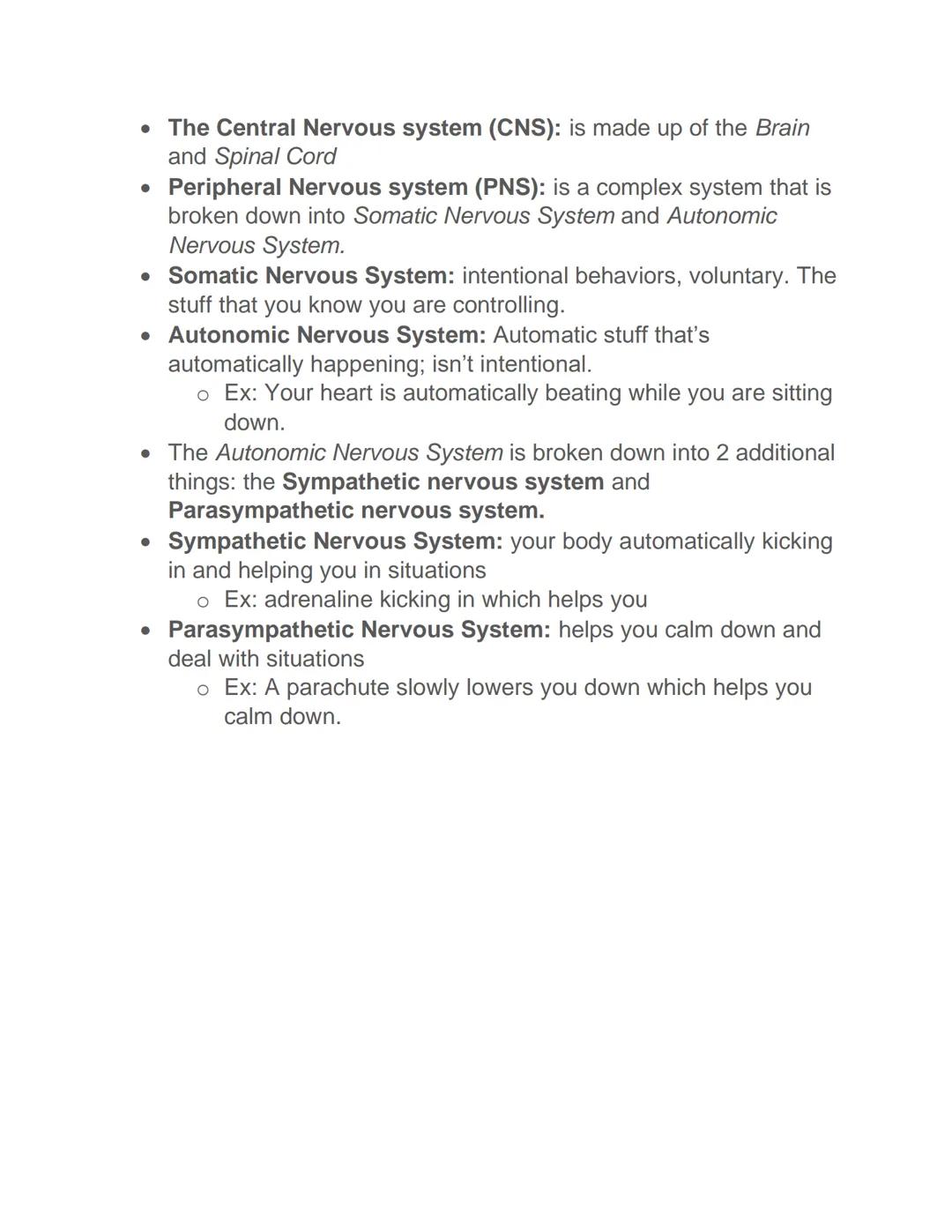
The Autonomic Nervous System
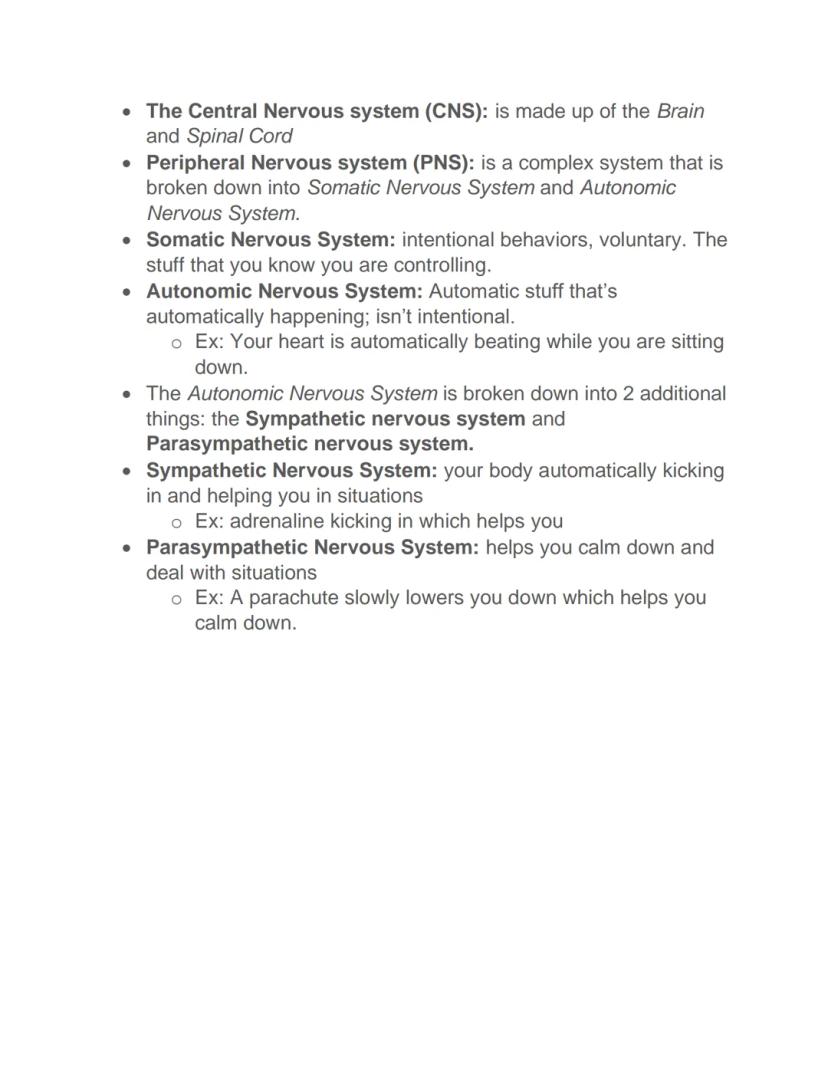
Your body has an amazing ability to respond to different situations automatically, thanks to the Autonomic Nervous System. This system works behind the scenes, controlling functions you don't have to think about, like digestion, breathing, and heart rate.
The Autonomic System has two complementary branches. The Sympathetic Nervous System activates your "fight-or-flight" response when you're stressed or in danger. It's like your body's gas pedal—increasing your heart rate, dilating pupils, and releasing adrenaline to help you respond to threats.
On the flip side, the Parasympathetic Nervous System acts as your body's brake pedal, helping you "rest and digest." It slows your heart rate, increases digestion, and generally calms your body down after the threat has passed. The name can be remembered by thinking of a parachute gently lowering you down to a calm state.
💡 Everyday Example: Have you ever felt your heart racing before a big test (sympathetic) and then felt relief wash over you when it's finished (parasympathetic)? That's your autonomic nervous system in action!
We thought you’d never ask...
What is the Knowunity AI companion?
Our AI companion is specifically built for the needs of students. Based on the millions of content pieces we have on the platform we can provide truly meaningful and relevant answers to students. But its not only about answers, the companion is even more about guiding students through their daily learning challenges, with personalised study plans, quizzes or content pieces in the chat and 100% personalisation based on the students skills and developments.
Where can I download the Knowunity app?
You can download the app in the Google Play Store and in the Apple App Store.
Is Knowunity really free of charge?
That's right! Enjoy free access to study content, connect with fellow students, and get instant help – all at your fingertips.
Similar Content
Most popular content in Psychology
7Most popular content
9Can't find what you're looking for? Explore other subjects.
Students love us — and so will you.
4.6/5App Store
4.7/5Google Play
The app is very easy to use and well designed. I have found everything I was looking for so far and have been able to learn a lot from the presentations! I will definitely use the app for a class assignment! And of course it also helps a lot as an inspiration.
Stefan SiOS user
This app is really great. There are so many study notes and help [...]. My problem subject is French, for example, and the app has so many options for help. Thanks to this app, I have improved my French. I would recommend it to anyone.
Samantha KlichAndroid user
Wow, I am really amazed. I just tried the app because I've seen it advertised many times and was absolutely stunned. This app is THE HELP you want for school and above all, it offers so many things, such as workouts and fact sheets, which have been VERY helpful to me personally.
AnnaiOS user
Psychology42 views·Updated Jun 4, 2026·4 pagesIntroduction to Neuroscience: Key Concepts Explained
Vanita Rabsatt@v_maeee
Welcome to the fascinating world of neuroscience! This chapter explores how your brain and nervous system work together to control everything you do, from conscious decisions to automatic functions like breathing and heartbeat.
1
of 4
Sign up to see the content. It's free!
- Access to all documents
- Improve your grades
- Join milions of students
Neurons: The Brain's Building Blocks
Ever wonder how your brain sends messages throughout your body? It's all thanks to neurons, the specialized cells that form your brain's communication network. Each neuron has several key parts that work together to transmit information.
The soma (cell body) keeps the neuron alive and contains its nucleus. Information travels along the axon, which sends signals to other neurons. Many axons are covered with a myelin sheath that acts like insulation on electrical wires, speeding up message transmission.
At the end of the axon, you'll find the synaptic knob (also called terminal button), which stores chemicals called neurotransmitters. These chemicals are released from tiny sacs called vesicles and travel across the synaptic gap to reach the dendrites of another neuron, which receive the information.
💡 Fun Fact: If all the neurons in your brain were lined up end to end, they would stretch about 600 miles! That's roughly the distance from Boston to Washington, DC.
2
of 4Sign up to see the content. It's free!
- Access to all documents
- Improve your grades
- Join milions of students
Neural Signals and Brain Structure
Think of your neurons as having two states: resting and action potential. During resting potential, the neuron is quiet, like a light switch that's turned off. When stimulated, it switches to action potential, sending an electrical signal down the axon. This system works on an "all or none" principle—either the neuron fires completely or not at all.
Your brain has several major regions, each with specific responsibilities. The frontal lobe controls your personality, planning, and decision-making. Within it, the left side contains Broca's area, which helps you produce speech. The parietal lobe processes touch and body position, while the occipital lobe handles visual information.
The temporal lobe processes hearing and contains Wernicke's area on the left side, which helps you understand speech. Meanwhile, the cerebellum coordinates balance and smooth movement, and the spinal cord manages involuntary functions like breathing.
💡 Memory Tip: To remember that the occipital lobe handles vision, note that both "occipital" and "optometrist" (eye doctor) start with "o"!
3
of 4Sign up to see the content. It's free!
- Access to all documents
- Improve your grades
- Join milions of students
Language Processing and Nervous System Overview
Your ability to communicate depends on two crucial brain areas. Broca's area in the frontal lobe helps you produce speech—damage here means you might understand language but struggle to speak. Wernicke's area in the temporal lobe helps you comprehend speech—damage here means you can speak but might not understand what others are saying.
The nervous system is divided into two main parts. The Central Nervous System (CNS) consists of your brain and spinal cord—think of it as the command center. The Peripheral Nervous System (PNS) includes all the nerves that branch out from your CNS to the rest of your body.
The PNS itself branches into two systems: the Somatic Nervous System, which controls voluntary movements like walking or talking, and the Autonomic Nervous System, which handles automatic functions that you don't consciously control.
💡 Real-World Connection: When you're playing sports, your somatic nervous system controls your deliberate movements, while your autonomic system keeps your heart beating faster to supply oxygen to your muscles!
4
of 4Sign up to see the content. It's free!
- Access to all documents
- Improve your grades
- Join milions of students
The Autonomic Nervous System
Your body has an amazing ability to respond to different situations automatically, thanks to the Autonomic Nervous System. This system works behind the scenes, controlling functions you don't have to think about, like digestion, breathing, and heart rate.
The Autonomic System has two complementary branches. The Sympathetic Nervous System activates your "fight-or-flight" response when you're stressed or in danger. It's like your body's gas pedal—increasing your heart rate, dilating pupils, and releasing adrenaline to help you respond to threats.
On the flip side, the Parasympathetic Nervous System acts as your body's brake pedal, helping you "rest and digest." It slows your heart rate, increases digestion, and generally calms your body down after the threat has passed. The name can be remembered by thinking of a parachute gently lowering you down to a calm state.
💡 Everyday Example: Have you ever felt your heart racing before a big test (sympathetic) and then felt relief wash over you when it's finished (parasympathetic)? That's your autonomic nervous system in action!
We thought you’d never ask...
What is the Knowunity AI companion?
Our AI companion is specifically built for the needs of students. Based on the millions of content pieces we have on the platform we can provide truly meaningful and relevant answers to students. But its not only about answers, the companion is even more about guiding students through their daily learning challenges, with personalised study plans, quizzes or content pieces in the chat and 100% personalisation based on the students skills and developments.
Where can I download the Knowunity app?
You can download the app in the Google Play Store and in the Apple App Store.
Is Knowunity really free of charge?
That's right! Enjoy free access to study content, connect with fellow students, and get instant help – all at your fingertips.
Similar Content
Most popular content in Psychology
7Most popular content
9Can't find what you're looking for? Explore other subjects.
Students love us — and so will you.
4.6/5App Store
4.7/5Google Play
The app is very easy to use and well designed. I have found everything I was looking for so far and have been able to learn a lot from the presentations! I will definitely use the app for a class assignment! And of course it also helps a lot as an inspiration.
Stefan SiOS user
This app is really great. There are so many study notes and help [...]. My problem subject is French, for example, and the app has so many options for help. Thanks to this app, I have improved my French. I would recommend it to anyone.
Samantha KlichAndroid user
Wow, I am really amazed. I just tried the app because I've seen it advertised many times and was absolutely stunned. This app is THE HELP you want for school and above all, it offers so many things, such as workouts and fact sheets, which have been VERY helpful to me personally.
AnnaiOS user