

The nervous system is our body's lightning-fast information network, controlling... Show more
 Algebra
Sign up to see the contentIt's free!
Access to all documents
Improve your grades
Join milions of students
Knowunity AI
Subjects
Triangle Congruence and Similarity Theorems
Triangle Properties and Classification
Linear Equations and Graphs
Geometric Angle Relationships
Trigonometric Functions and Identities
Equation Solving Techniques
Circle Geometry Fundamentals
Division Operations and Methods
Basic Differentiation Rules
Exponent and Logarithm Properties
Show all topics
Human Organ Systems
Reproductive Cell Cycles
Biological Sciences Subdisciplines
Cellular Energy Metabolism
Autotrophic Energy Processes
Inheritance Patterns and Principles
Biomolecular Structure and Organization
Cell Cycle and Division Mechanics
Cellular Organization and Development
Biological Structural Organization
Show all topics
Chemical Sciences and Applications
Atomic Structure and Composition
Molecular Electron Structure Representation
Atomic Electron Behavior
Matter Properties and Water
Mole Concept and Calculations
Gas Laws and Behavior
Periodic Table Organization
Chemical Thermodynamics Fundamentals
Chemical Bond Types and Properties
Show all topics
European Renaissance and Enlightenment
European Cultural Movements 800-1920
American Revolution Era 1763-1797
American Civil War 1861-1865
Global Imperial Systems
Mongol and Chinese Dynasties
U.S. Presidents and World Leaders
Historical Sources and Documentation
World Wars Era and Impact
World Religious Systems
Show all topics
Classic and Contemporary Novels
Literary Character Analysis
Rhetorical Theory and Practice
Classic Literary Narratives
Reading Analysis and Interpretation
Narrative Structure and Techniques
English Language Components
Influential English-Language Authors
Basic Sentence Structure
Narrative Voice and Perspective
Show all topics
50
•
Feb 18, 2026
•
The nervous system is our body's lightning-fast information network, controlling... Show more
Biopsychology explores how your physical brain and nervous system create who you are. This fascinating field connects your biology to your thoughts, feelings, and behaviors.
When you feel nervous before a test or happy when seeing a friend, that's your biology and psychology working together. Biopsychology helps explain why certain medications affect mood and why brain injuries can change personality.
Understanding these biological roots of behavior gives us powerful insights into human nature and helps scientists develop treatments for psychological disorders.
Did you know? The decisions you make, emotions you feel, and even your personality traits all have biological foundations in your brain and nervous system!
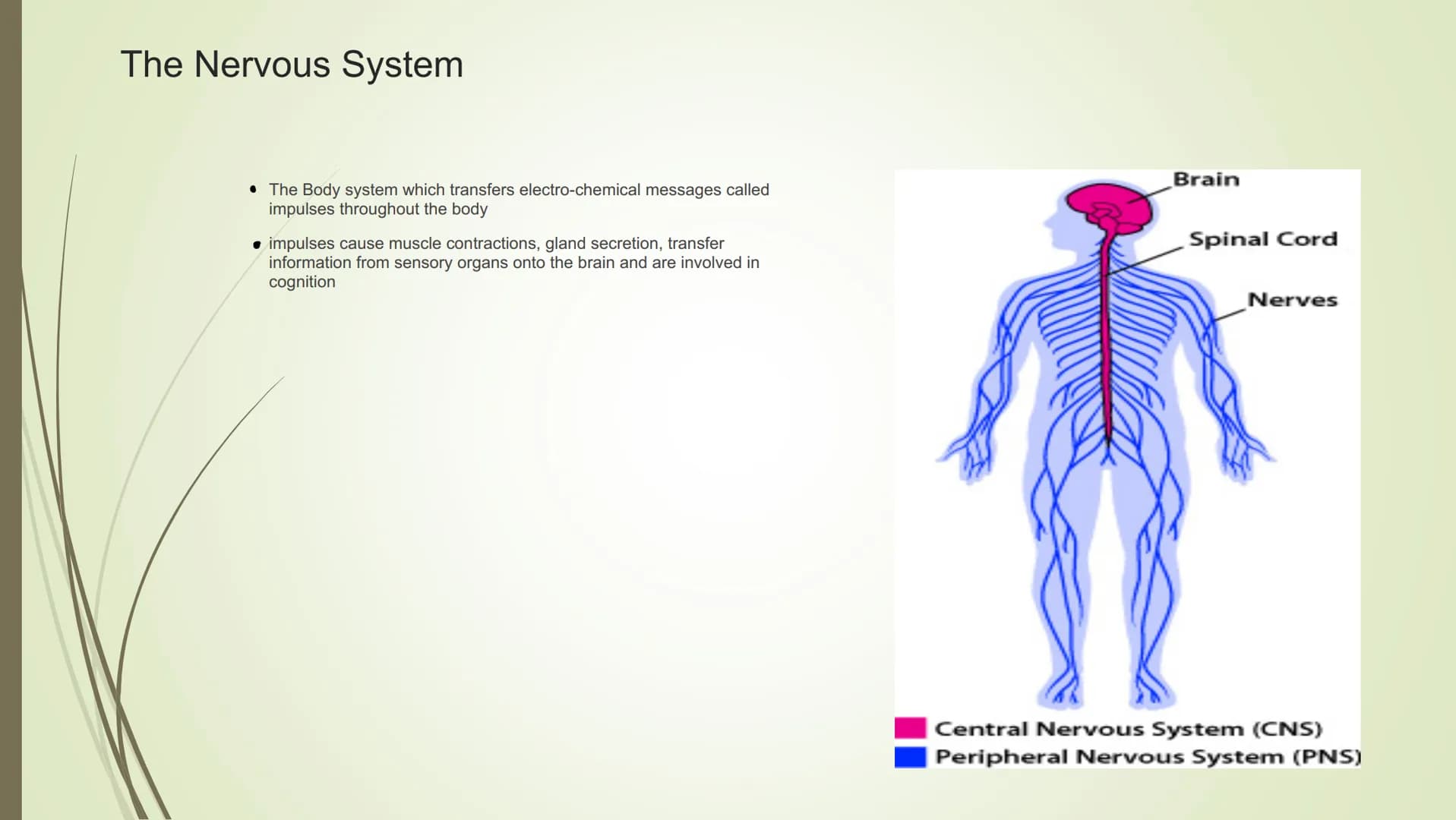
Your nervous system is like your body's electrical wiring, sending lightning-fast messages called impulses throughout your body. These impulses control everything from your movements to your thoughts.
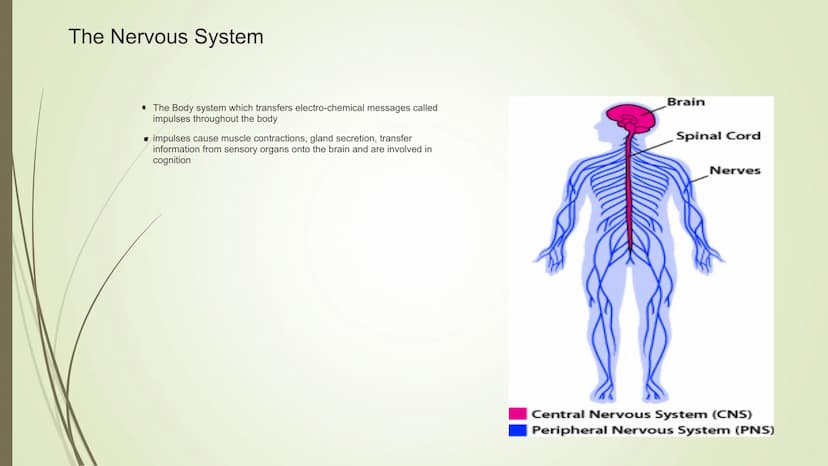
The nervous system is divided into two main parts. The Central Nervous System (CNS) includes your brain and spinal cord—the command center of your body. The Peripheral Nervous System (PNS) consists of all the nerves that branch out to the rest of your body.
Think of your nervous system as a complex network that allows your brain to communicate with every part of your body. When you touch something hot, nerves in your fingers send messages to your brain, which then sends signals to your muscles to pull away—all in a fraction of a second!
Quick Tip: Remember that every action you take, from texting a friend to solving a math problem, involves your nervous system sending electrical signals throughout your body.
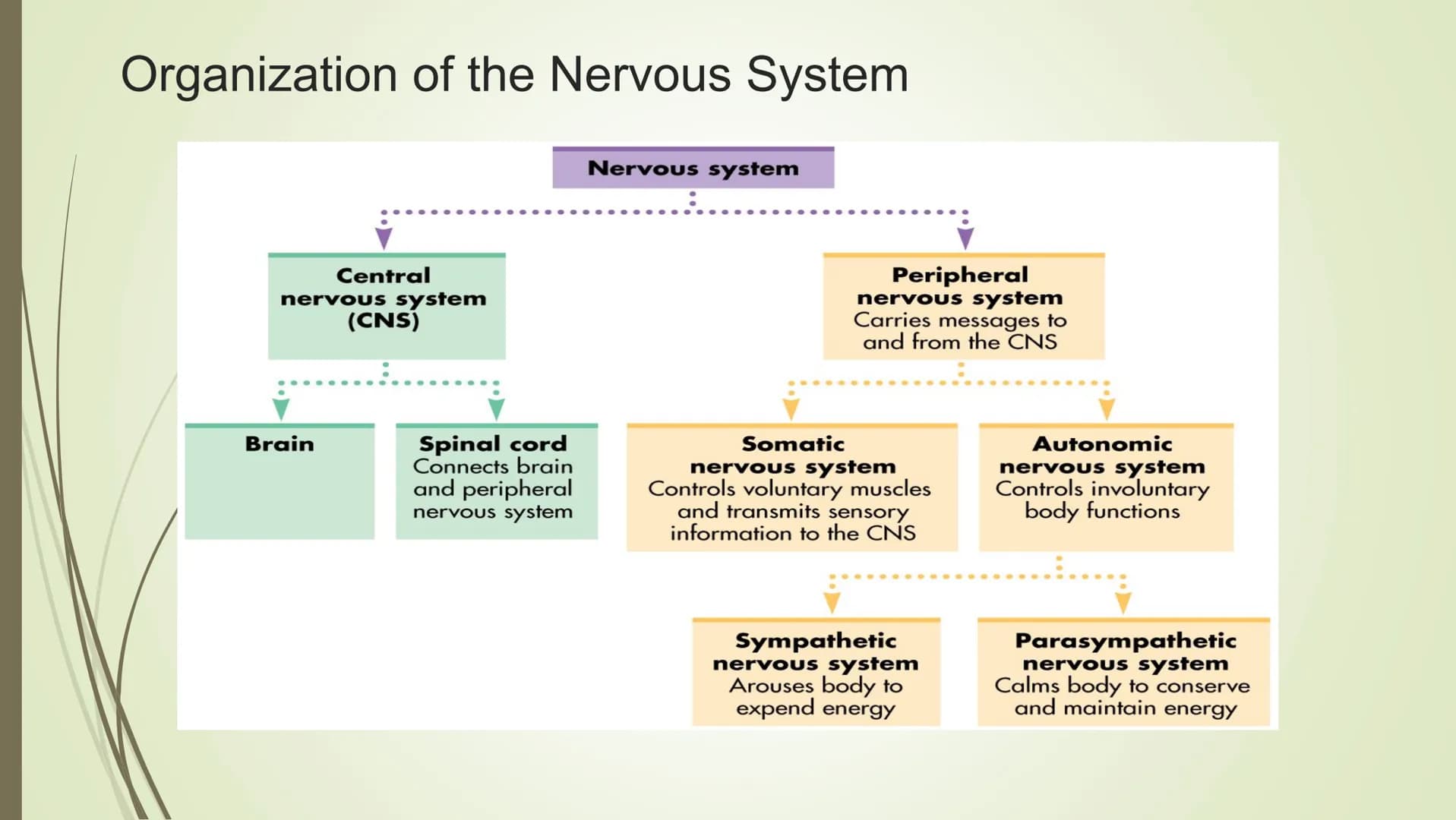
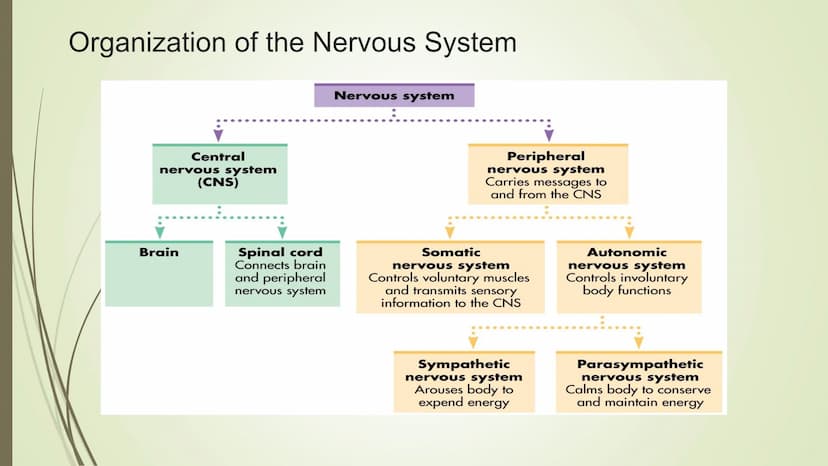
Your nervous system is organized like a company with different departments handling specific jobs. The Central Nervous System (CNS) works as the headquarters, while the Peripheral Nervous System (PNS) acts as the communication network.
Within the PNS, the Somatic Nervous System handles your voluntary movements—like when you decide to raise your hand in class. It also delivers sensory information to your brain. Ever feel a paper cut? That's your somatic system at work!
The Autonomic Nervous System manages all the body functions you don't have to think about. It has two divisions: the Sympathetic Nervous System and the Parasympathetic Nervous System .
Remember: When you're stressed about a test, your sympathetic nervous system activates, increasing your heart rate. After the test, your parasympathetic system helps you relax again.
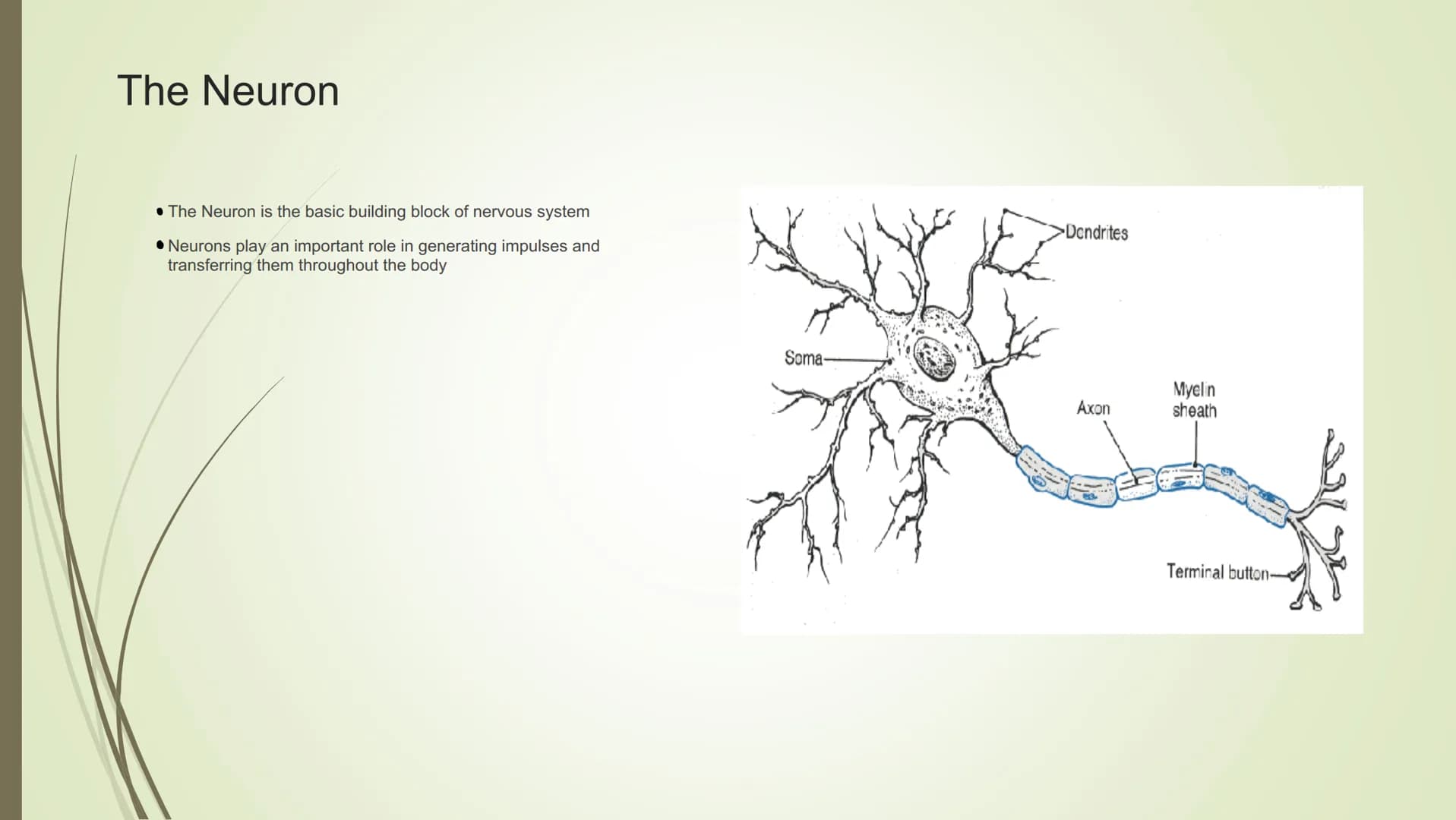
Neurons are the superstar cells of your nervous system—the basic building blocks that make thinking and movement possible. These specialized cells generate and transmit impulses throughout your body.
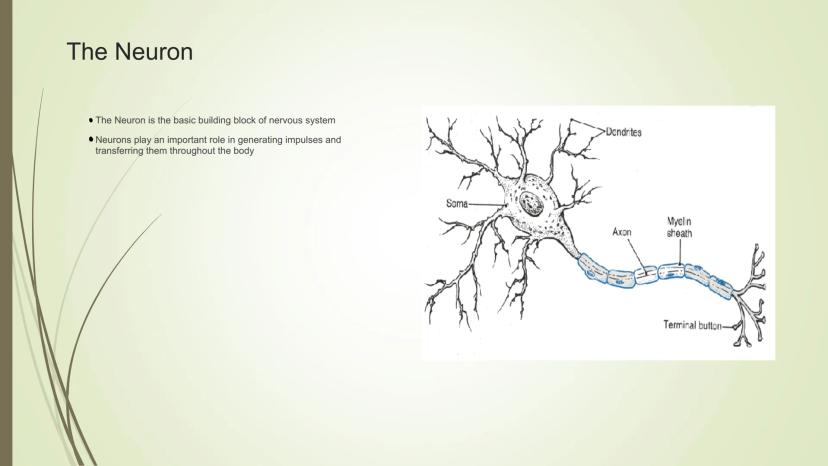
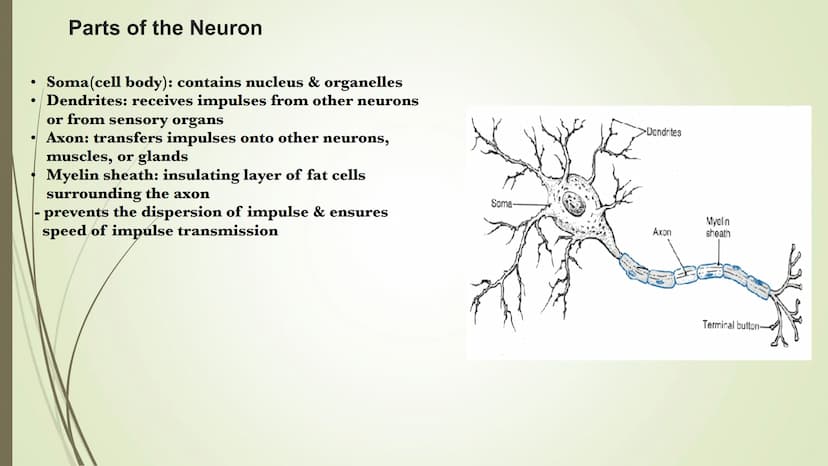
Each neuron has distinct parts with specific jobs. The soma (cell body) contains the nucleus and keeps the cell alive. Dendrites are branch-like extensions that receive messages from other neurons. The axon is a long cable-like structure that carries the electrical signal away from the cell body.
Many axons are covered with a fatty layer called the myelin sheath, which acts like insulation on an electrical wire. This covering helps messages travel much faster—up to 268 miles per hour!
Wow Factor: Your brain contains roughly 86 billion neurons, and each one can connect with thousands of others, creating a network more complex than all the computers on Earth combined!
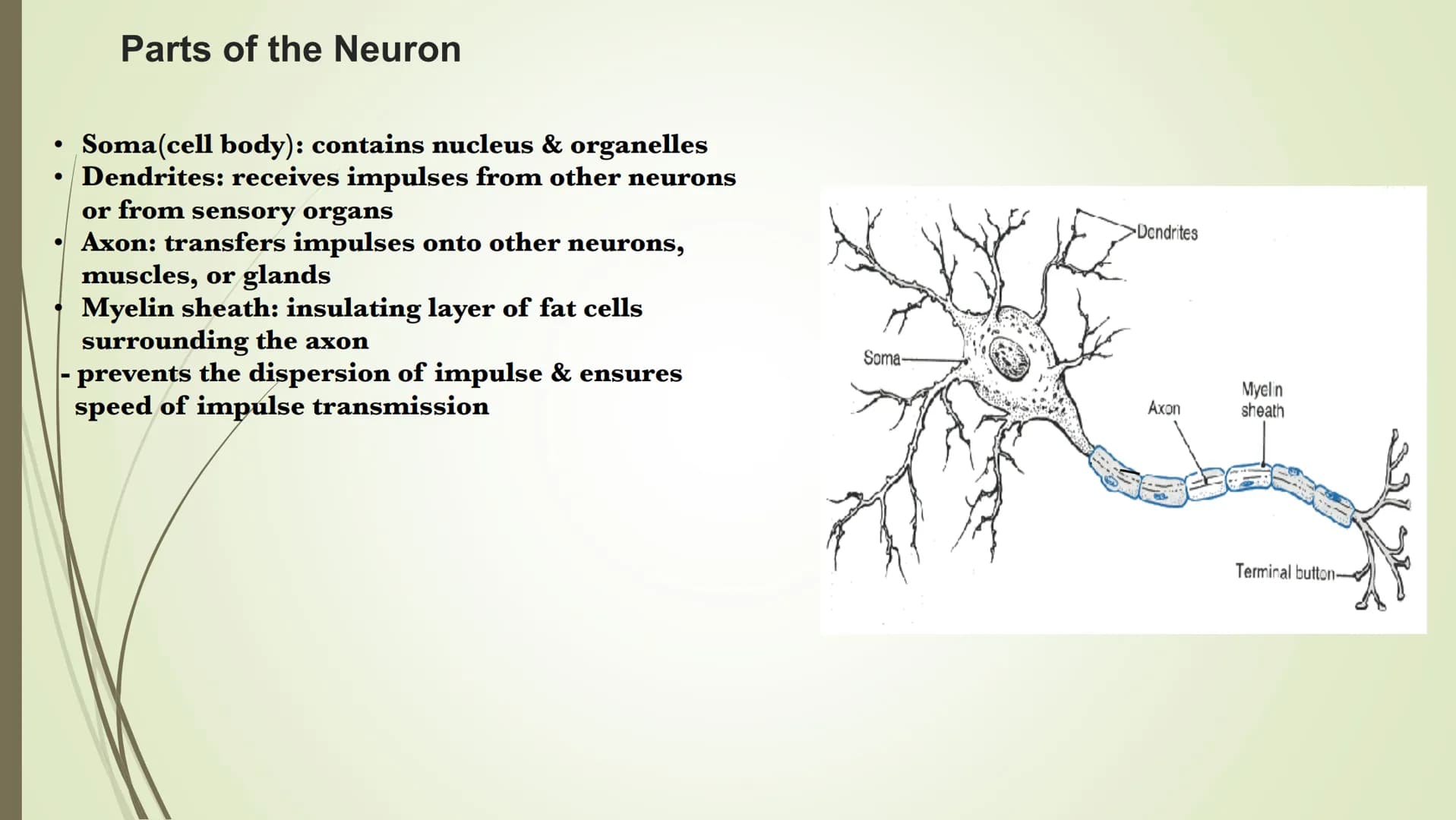
Neurons have specialized parts that work together to receive and transmit information. The soma (cell body) contains the nucleus and is essentially the neuron's control center, keeping the cell alive and functioning.
Branching out from the soma are tree-like structures called dendrites that receive incoming messages from other neurons or sensory organs. Think of dendrites as the neuron's antennae, constantly monitoring for incoming signals.
The axon is like a long cable that carries electrical impulses away from the soma to other neurons, muscles, or glands. Many axons are wrapped in a fatty covering called the myelin sheath. This insulating layer prevents signal leakage and dramatically increases transmission speed—making your reactions and thoughts much faster!
Try this: Why do you react so quickly when you touch something hot? Your myelinated neurons can transmit signals at speeds up to 268 mph, allowing almost instant reactions to danger!
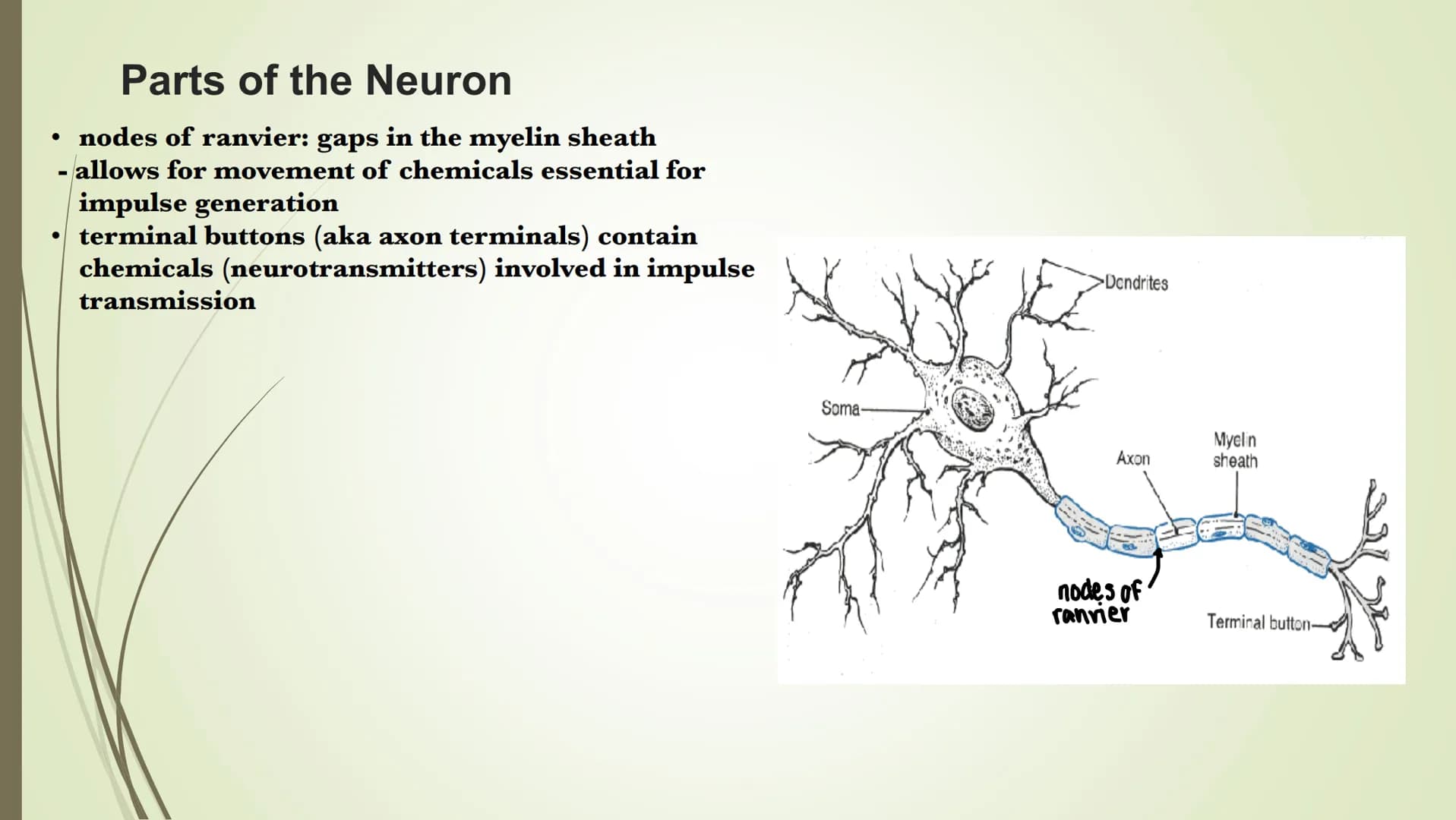
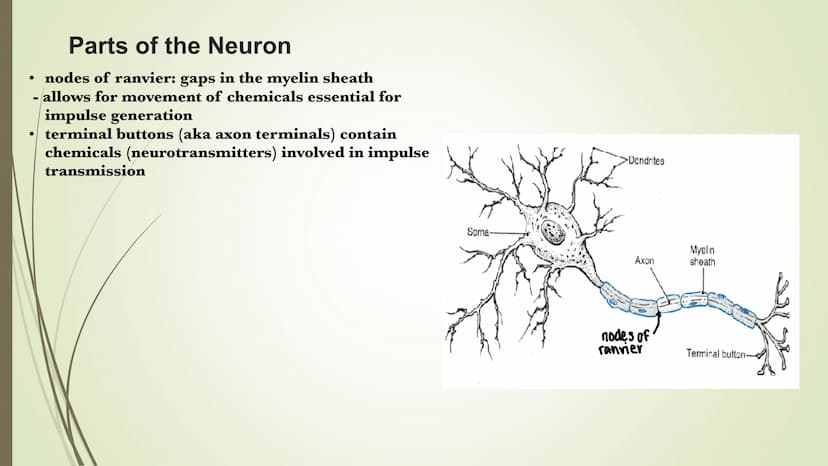
The myelin sheath isn't continuous—it has small gaps called nodes of Ranvier that play a crucial role in neural communication. These gaps allow essential chemicals to move in and out of the axon, helping generate and boost the electrical impulse as it travels.
When the electrical signal reaches the end of the axon, it arrives at structures called terminal buttons (or axon terminals). These button-like endings contain tiny sacs filled with chemicals called neurotransmitters.
The terminal buttons are where the magic happens—they release neurotransmitters that bridge the gap between neurons, allowing information to continue its journey. Without these specialized endings, your neural network would break down completely.
Mind Blower: If all your neurons were laid end to end, they would stretch about 600 miles—roughly the distance from New York City to Cincinnati!
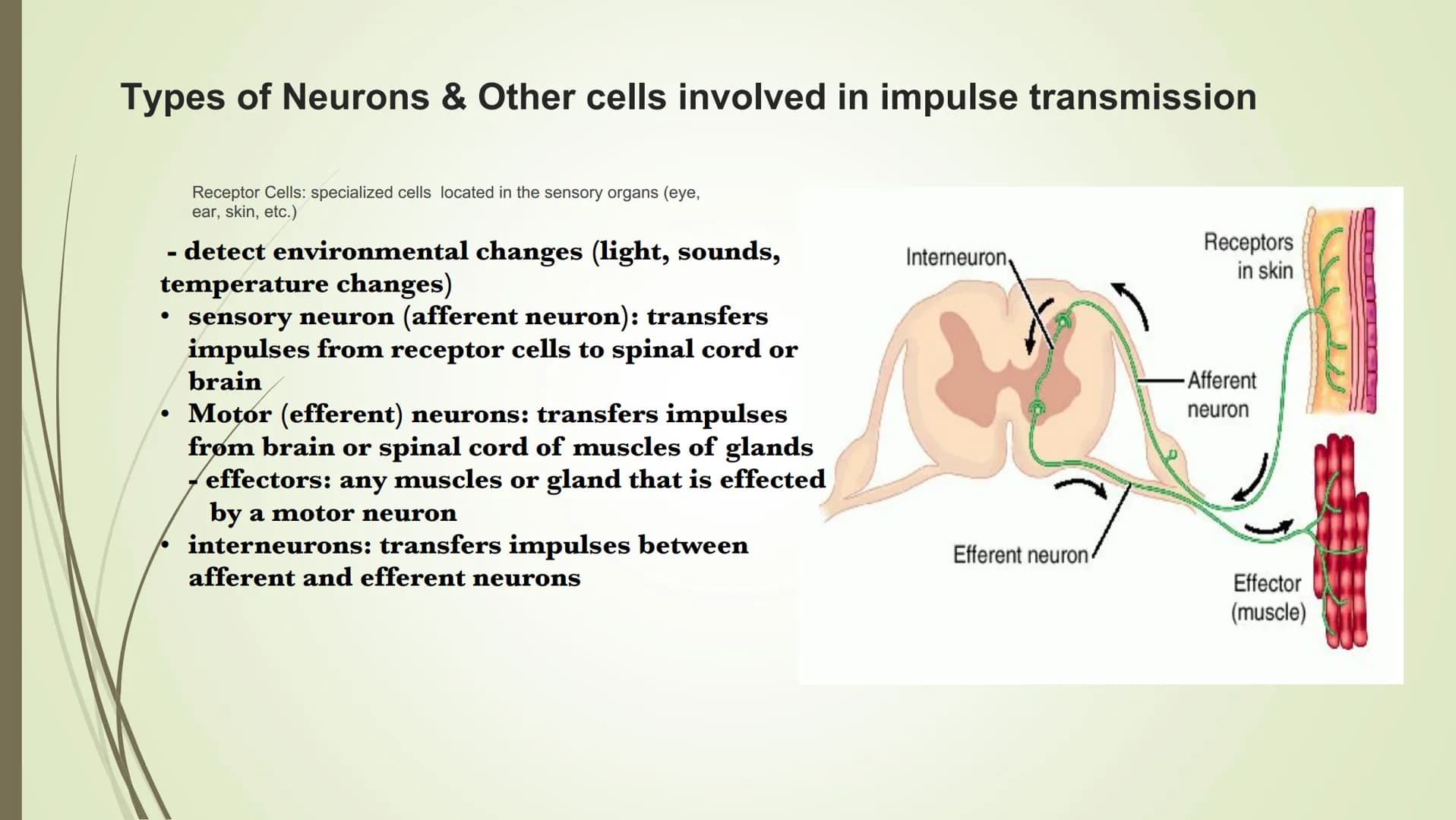
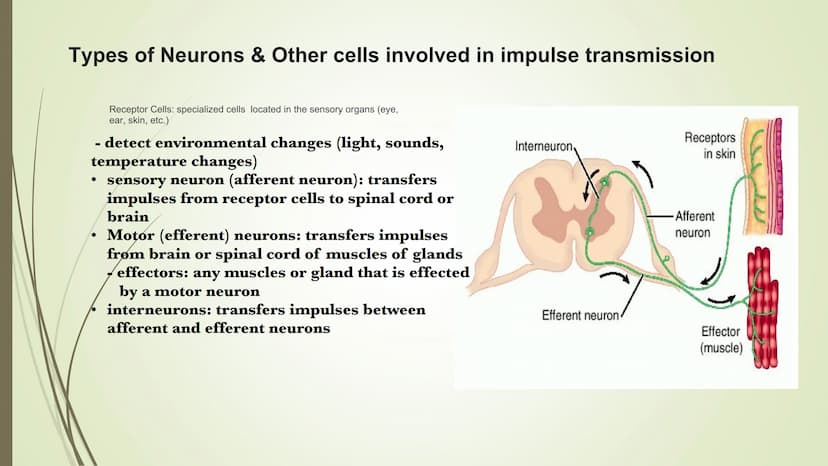
Your nervous system has different specialized cells that work together like a relay team. Receptor cells are the starting line—they sit in your sensory organs and detect environmental changes like light, sound, and temperature.
When receptor cells detect something, they activate sensory neurons (afferent neurons) that carry information from your environment to your spinal cord and brain. Think of them as the messengers bringing news from the outside world.
After your brain processes this information, motor neurons (efferent neurons) carry commands from your brain or spinal cord to effectors—muscles or glands that carry out actions. The muscles that move your hand to answer a question in class are effectors responding to motor neuron signals.
Interneurons are the coordinators that connect sensory and motor neurons, allowing complex processing and integration of information. Most of the neurons in your brain are actually interneurons!
Connection Check: When you smell cookies baking, receptor cells in your nose detect the aroma, sensory neurons carry that information to your brain, and motor neurons might direct your legs to walk toward the kitchen!
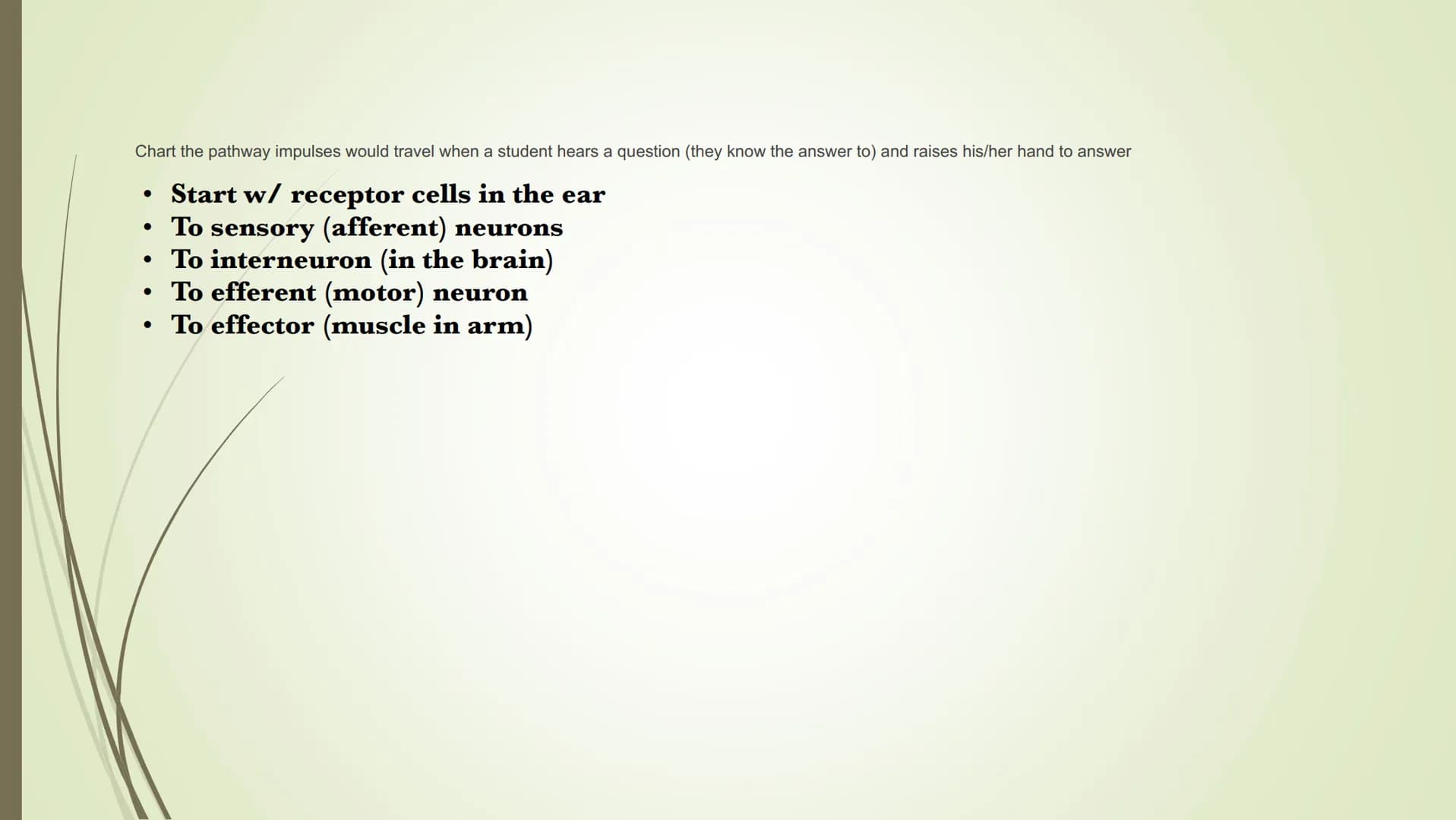
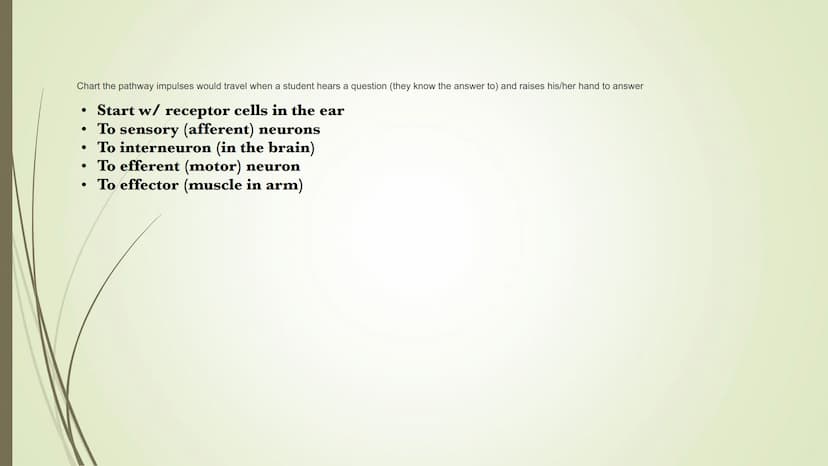
Let's follow the journey of a neural signal when you hear a teacher ask a question and you raise your hand to answer. This everyday action involves a sophisticated relay of information through your nervous system.
First, receptor cells in your ear detect sound waves from the teacher's voice. These cells activate sensory (afferent) neurons that carry this auditory information to your brain. The message travels through your auditory nerve right into your brain.
In your brain, interneurons process the sound, recognize it as a question, and connect to the parts of your brain that know the answer. Your brain then decides to raise your hand, sending signals through motor (efferent) neurons to the effector muscles in your arm and hand.
Awesome Fact: This entire process—from hearing the question to raising your hand—happens in less than a second, showing the incredible speed and efficiency of your nervous system!
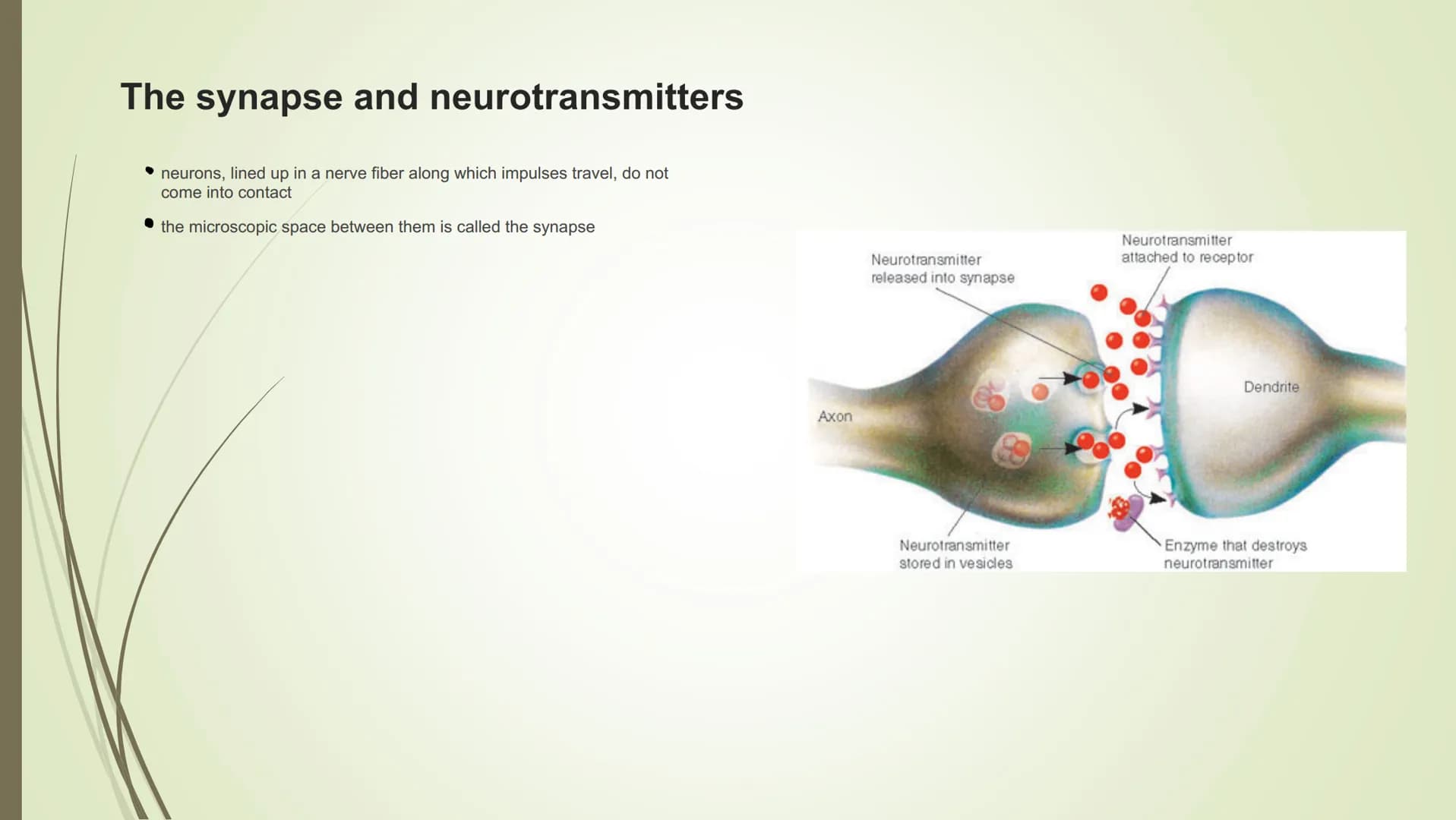
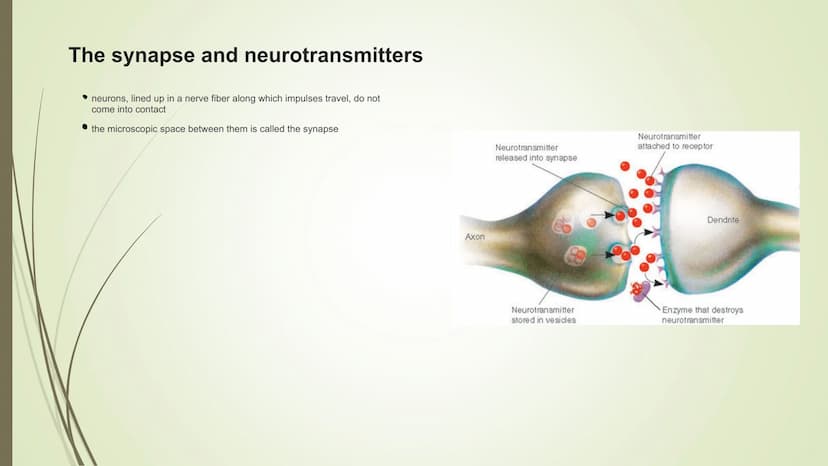
Neurons don't actually touch each other—they're separated by tiny gaps called synapses. These microscopic spaces are where the communication magic happens between neurons in your nervous system.
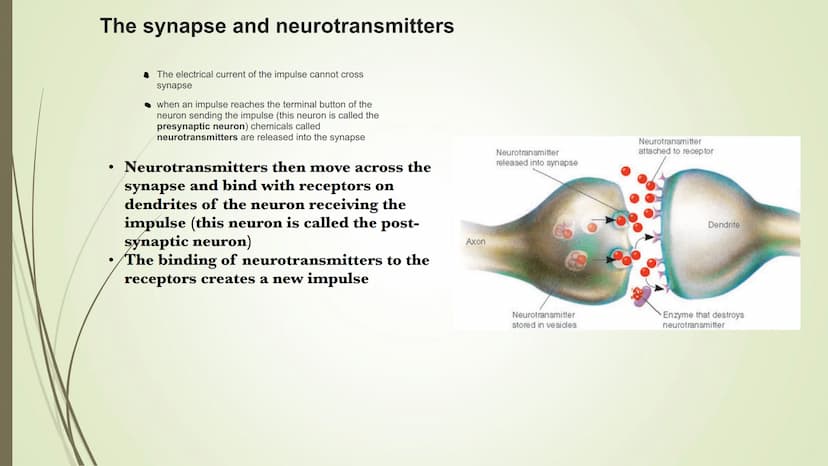
An electrical impulse can't jump across the synapse on its own. Instead, when an impulse reaches the end of a neuron, it triggers the release of chemical messengers called neurotransmitters from small sacs called vesicles in the terminal buttons.
These neurotransmitters float across the synapse and attach to specialized receptors on the receiving neuron's dendrites—like a key fitting into a lock. Once enough neurotransmitters bind to the receptors, they can trigger a new electrical impulse in the receiving neuron, continuing the message.
Think About It: Every thought you have, every emotion you feel, and every movement you make depends on neurotransmitters crossing synapses. Your personality, talents, and memories all exist because of these tiny chemical messengers!
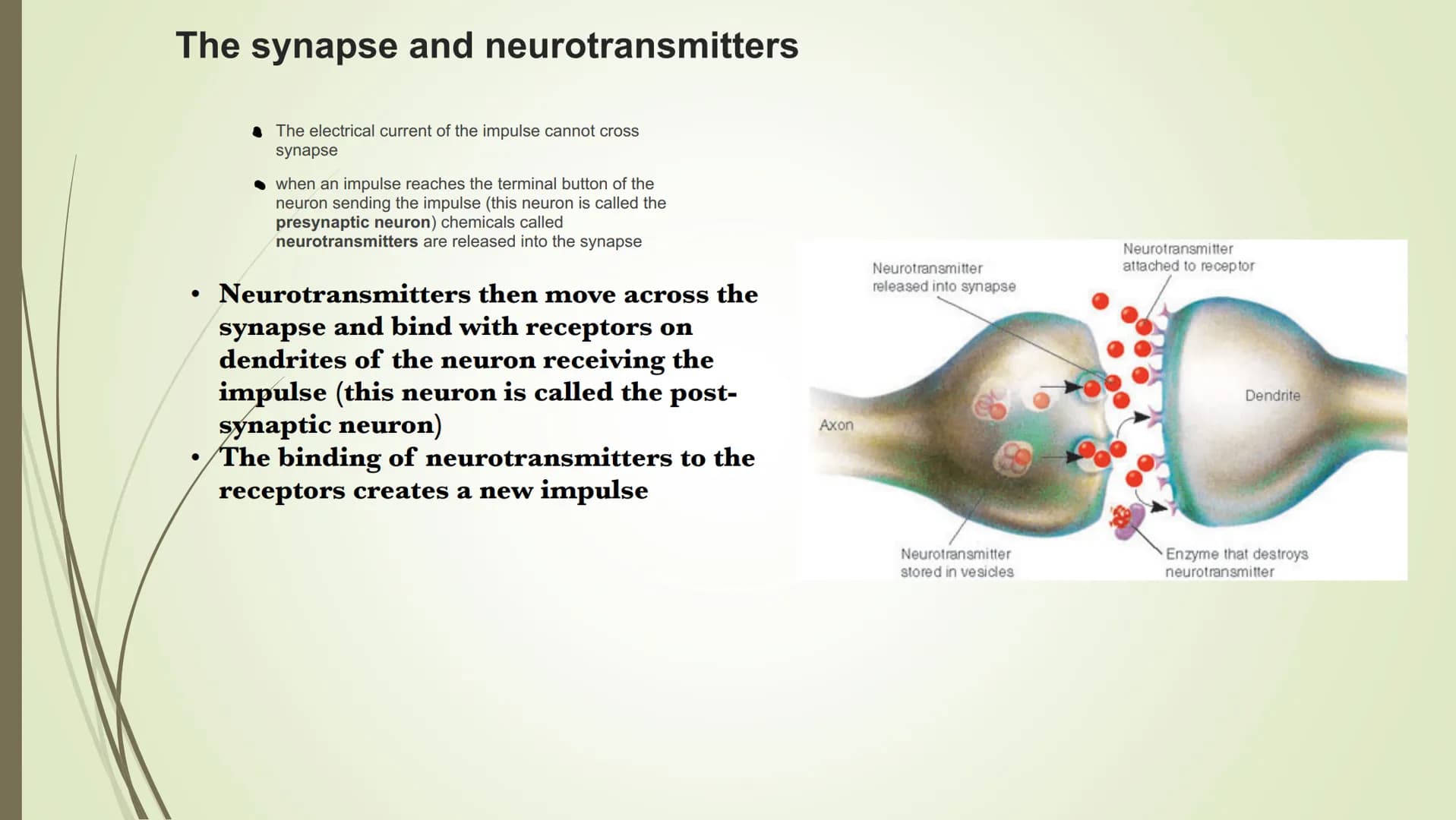
Neurons communicate using a combination of electricity and chemistry. Inside a neuron, the message travels as an electrical impulse, but between neurons, chemical messengers take over.
When an electrical impulse reaches the end of a presynaptic neuron (the sending neuron), it causes tiny sacs to release neurotransmitters into the synapse. These chemical messengers drift across the gap to the postsynaptic neuron (the receiving neuron).
The neurotransmitters bind to specific receptor sites on the receiving neuron's dendrites, like a key in a lock. This binding creates a new electrical impulse in the receiving neuron, continuing the signal's journey. After delivering their message, enzymes quickly break down the neurotransmitters or they're reabsorbed by the sending neuron, clearing the synapse for the next message.
Real-World Connection: Many medications for mental health work by affecting neurotransmitters in the brain. Antidepressants, for example, often increase levels of serotonin by preventing its reabsorption in the synapse.
Our AI companion is specifically built for the needs of students. Based on the millions of content pieces we have on the platform we can provide truly meaningful and relevant answers to students. But its not only about answers, the companion is even more about guiding students through their daily learning challenges, with personalised study plans, quizzes or content pieces in the chat and 100% personalisation based on the students skills and developments.
You can download the app in the Google Play Store and in the Apple App Store.
That's right! Enjoy free access to study content, connect with fellow students, and get instant help – all at your fingertips.
App Store
Google Play
The app is very easy to use and well designed. I have found everything I was looking for so far and have been able to learn a lot from the presentations! I will definitely use the app for a class assignment! And of course it also helps a lot as an inspiration.
Stefan S
iOS user
This app is really great. There are so many study notes and help [...]. My problem subject is French, for example, and the app has so many options for help. Thanks to this app, I have improved my French. I would recommend it to anyone.
Samantha Klich
Android user
Wow, I am really amazed. I just tried the app because I've seen it advertised many times and was absolutely stunned. This app is THE HELP you want for school and above all, it offers so many things, such as workouts and fact sheets, which have been VERY helpful to me personally.
Anna
iOS user
I think it’s very much worth it and you’ll end up using it a lot once you get the hang of it and even after looking at others notes you can still ask your Artificial intelligence buddy the question and ask to simplify it if you still don’t get it!!! In the end I think it’s worth it 😊👍 ⚠️Also DID I MENTION ITS FREEE YOU DON’T HAVE TO PAY FOR ANYTHING AND STILL GET YOUR GRADES IN PERFECTLY❗️❗️⚠️
Thomas R
iOS user
Knowunity is the BEST app I’ve used in a minute. This is not an ai review or anything this is genuinely coming from a 7th grade student (I know 2011 im young) but dude this app is a 10/10 i have maintained a 3.8 gpa and have plenty of time for gaming. I love it and my mom is just happy I got good grades
Brad T
Android user
Not only did it help me find the answer but it also showed me alternative ways to solve it. I was horrible in math and science but now I have an a in both subjects. Thanks for the help🤍🤍
David K
iOS user
The app's just great! All I have to do is enter the topic in the search bar and I get the response real fast. I don't have to watch 10 YouTube videos to understand something, so I'm saving my time. Highly recommended!
Sudenaz Ocak
Android user
In school I was really bad at maths but thanks to the app, I am doing better now. I am so grateful that you made the app.
Greenlight Bonnie
Android user
I found this app a couple years ago and it has only gotten better since then. I really love it because it can help with written questions and photo questions. Also, it can find study guides that other people have made as well as flashcard sets and practice tests. The free version is also amazing for students who might not be able to afford it. Would 100% recommend
Aubrey
iOS user
Best app if you're in Highschool or Junior high. I have been using this app for 2 school years and it's the best, it's good if you don't have anyone to help you with school work.😋🩷🎀
Marco B
iOS user
THE QUIZES AND FLASHCARDS ARE SO USEFUL AND I LOVE Knowunity AI. IT ALSO IS LITREALLY LIKE CHATGPT BUT SMARTER!! HELPED ME WITH MY MASCARA PROBLEMS TOO!! AS WELL AS MY REAL SUBJECTS ! DUHHH 😍😁😲🤑💗✨🎀😮
Elisha
iOS user
This app is phenomenal down to the correct info and the various topics you can study! I greatly recommend it for people who struggle with procrastination and those who need homework help. It has been perfectly accurate for world 1 history as far as I’ve seen! Geometry too!
Paul T
iOS user
The app is very easy to use and well designed. I have found everything I was looking for so far and have been able to learn a lot from the presentations! I will definitely use the app for a class assignment! And of course it also helps a lot as an inspiration.
Stefan S
iOS user
This app is really great. There are so many study notes and help [...]. My problem subject is French, for example, and the app has so many options for help. Thanks to this app, I have improved my French. I would recommend it to anyone.
Samantha Klich
Android user
Wow, I am really amazed. I just tried the app because I've seen it advertised many times and was absolutely stunned. This app is THE HELP you want for school and above all, it offers so many things, such as workouts and fact sheets, which have been VERY helpful to me personally.
Anna
iOS user
I think it’s very much worth it and you’ll end up using it a lot once you get the hang of it and even after looking at others notes you can still ask your Artificial intelligence buddy the question and ask to simplify it if you still don’t get it!!! In the end I think it’s worth it 😊👍 ⚠️Also DID I MENTION ITS FREEE YOU DON’T HAVE TO PAY FOR ANYTHING AND STILL GET YOUR GRADES IN PERFECTLY❗️❗️⚠️
Thomas R
iOS user
Knowunity is the BEST app I’ve used in a minute. This is not an ai review or anything this is genuinely coming from a 7th grade student (I know 2011 im young) but dude this app is a 10/10 i have maintained a 3.8 gpa and have plenty of time for gaming. I love it and my mom is just happy I got good grades
Brad T
Android user
Not only did it help me find the answer but it also showed me alternative ways to solve it. I was horrible in math and science but now I have an a in both subjects. Thanks for the help🤍🤍
David K
iOS user
The app's just great! All I have to do is enter the topic in the search bar and I get the response real fast. I don't have to watch 10 YouTube videos to understand something, so I'm saving my time. Highly recommended!
Sudenaz Ocak
Android user
In school I was really bad at maths but thanks to the app, I am doing better now. I am so grateful that you made the app.
Greenlight Bonnie
Android user
I found this app a couple years ago and it has only gotten better since then. I really love it because it can help with written questions and photo questions. Also, it can find study guides that other people have made as well as flashcard sets and practice tests. The free version is also amazing for students who might not be able to afford it. Would 100% recommend
Aubrey
iOS user
Best app if you're in Highschool or Junior high. I have been using this app for 2 school years and it's the best, it's good if you don't have anyone to help you with school work.😋🩷🎀
Marco B
iOS user
THE QUIZES AND FLASHCARDS ARE SO USEFUL AND I LOVE Knowunity AI. IT ALSO IS LITREALLY LIKE CHATGPT BUT SMARTER!! HELPED ME WITH MY MASCARA PROBLEMS TOO!! AS WELL AS MY REAL SUBJECTS ! DUHHH 😍😁😲🤑💗✨🎀😮
Elisha
iOS user
This app is phenomenal down to the correct info and the various topics you can study! I greatly recommend it for people who struggle with procrastination and those who need homework help. It has been perfectly accurate for world 1 history as far as I’ve seen! Geometry too!
Paul T
iOS user
The nervous system is our body's lightning-fast information network, controlling everything from conscious movements to automatic functions like breathing. It's made of specialized cells that communicate through electrical and chemical signals, working together to help you think, move, and respond... Show more
Access to all documents
Improve your grades
Join milions of students
Biopsychology explores how your physical brain and nervous system create who you are. This fascinating field connects your biology to your thoughts, feelings, and behaviors.
When you feel nervous before a test or happy when seeing a friend, that's your biology and psychology working together. Biopsychology helps explain why certain medications affect mood and why brain injuries can change personality.
Understanding these biological roots of behavior gives us powerful insights into human nature and helps scientists develop treatments for psychological disorders.
Did you know? The decisions you make, emotions you feel, and even your personality traits all have biological foundations in your brain and nervous system!
Access to all documents
Improve your grades
Join milions of students
Your nervous system is like your body's electrical wiring, sending lightning-fast messages called impulses throughout your body. These impulses control everything from your movements to your thoughts.
The nervous system is divided into two main parts. The Central Nervous System (CNS) includes your brain and spinal cord—the command center of your body. The Peripheral Nervous System (PNS) consists of all the nerves that branch out to the rest of your body.
Think of your nervous system as a complex network that allows your brain to communicate with every part of your body. When you touch something hot, nerves in your fingers send messages to your brain, which then sends signals to your muscles to pull away—all in a fraction of a second!
Quick Tip: Remember that every action you take, from texting a friend to solving a math problem, involves your nervous system sending electrical signals throughout your body.
Access to all documents
Improve your grades
Join milions of students
Your nervous system is organized like a company with different departments handling specific jobs. The Central Nervous System (CNS) works as the headquarters, while the Peripheral Nervous System (PNS) acts as the communication network.
Within the PNS, the Somatic Nervous System handles your voluntary movements—like when you decide to raise your hand in class. It also delivers sensory information to your brain. Ever feel a paper cut? That's your somatic system at work!
The Autonomic Nervous System manages all the body functions you don't have to think about. It has two divisions: the Sympathetic Nervous System and the Parasympathetic Nervous System .
Remember: When you're stressed about a test, your sympathetic nervous system activates, increasing your heart rate. After the test, your parasympathetic system helps you relax again.
Access to all documents
Improve your grades
Join milions of students
Neurons are the superstar cells of your nervous system—the basic building blocks that make thinking and movement possible. These specialized cells generate and transmit impulses throughout your body.
Each neuron has distinct parts with specific jobs. The soma (cell body) contains the nucleus and keeps the cell alive. Dendrites are branch-like extensions that receive messages from other neurons. The axon is a long cable-like structure that carries the electrical signal away from the cell body.
Many axons are covered with a fatty layer called the myelin sheath, which acts like insulation on an electrical wire. This covering helps messages travel much faster—up to 268 miles per hour!
Wow Factor: Your brain contains roughly 86 billion neurons, and each one can connect with thousands of others, creating a network more complex than all the computers on Earth combined!
Access to all documents
Improve your grades
Join milions of students
Neurons have specialized parts that work together to receive and transmit information. The soma (cell body) contains the nucleus and is essentially the neuron's control center, keeping the cell alive and functioning.
Branching out from the soma are tree-like structures called dendrites that receive incoming messages from other neurons or sensory organs. Think of dendrites as the neuron's antennae, constantly monitoring for incoming signals.
The axon is like a long cable that carries electrical impulses away from the soma to other neurons, muscles, or glands. Many axons are wrapped in a fatty covering called the myelin sheath. This insulating layer prevents signal leakage and dramatically increases transmission speed—making your reactions and thoughts much faster!
Try this: Why do you react so quickly when you touch something hot? Your myelinated neurons can transmit signals at speeds up to 268 mph, allowing almost instant reactions to danger!
Access to all documents
Improve your grades
Join milions of students
The myelin sheath isn't continuous—it has small gaps called nodes of Ranvier that play a crucial role in neural communication. These gaps allow essential chemicals to move in and out of the axon, helping generate and boost the electrical impulse as it travels.
When the electrical signal reaches the end of the axon, it arrives at structures called terminal buttons (or axon terminals). These button-like endings contain tiny sacs filled with chemicals called neurotransmitters.
The terminal buttons are where the magic happens—they release neurotransmitters that bridge the gap between neurons, allowing information to continue its journey. Without these specialized endings, your neural network would break down completely.
Mind Blower: If all your neurons were laid end to end, they would stretch about 600 miles—roughly the distance from New York City to Cincinnati!
Access to all documents
Improve your grades
Join milions of students
Your nervous system has different specialized cells that work together like a relay team. Receptor cells are the starting line—they sit in your sensory organs and detect environmental changes like light, sound, and temperature.
When receptor cells detect something, they activate sensory neurons (afferent neurons) that carry information from your environment to your spinal cord and brain. Think of them as the messengers bringing news from the outside world.
After your brain processes this information, motor neurons (efferent neurons) carry commands from your brain or spinal cord to effectors—muscles or glands that carry out actions. The muscles that move your hand to answer a question in class are effectors responding to motor neuron signals.
Interneurons are the coordinators that connect sensory and motor neurons, allowing complex processing and integration of information. Most of the neurons in your brain are actually interneurons!
Connection Check: When you smell cookies baking, receptor cells in your nose detect the aroma, sensory neurons carry that information to your brain, and motor neurons might direct your legs to walk toward the kitchen!
Access to all documents
Improve your grades
Join milions of students
Let's follow the journey of a neural signal when you hear a teacher ask a question and you raise your hand to answer. This everyday action involves a sophisticated relay of information through your nervous system.
First, receptor cells in your ear detect sound waves from the teacher's voice. These cells activate sensory (afferent) neurons that carry this auditory information to your brain. The message travels through your auditory nerve right into your brain.
In your brain, interneurons process the sound, recognize it as a question, and connect to the parts of your brain that know the answer. Your brain then decides to raise your hand, sending signals through motor (efferent) neurons to the effector muscles in your arm and hand.
Awesome Fact: This entire process—from hearing the question to raising your hand—happens in less than a second, showing the incredible speed and efficiency of your nervous system!
Access to all documents
Improve your grades
Join milions of students
Neurons don't actually touch each other—they're separated by tiny gaps called synapses. These microscopic spaces are where the communication magic happens between neurons in your nervous system.
An electrical impulse can't jump across the synapse on its own. Instead, when an impulse reaches the end of a neuron, it triggers the release of chemical messengers called neurotransmitters from small sacs called vesicles in the terminal buttons.
These neurotransmitters float across the synapse and attach to specialized receptors on the receiving neuron's dendrites—like a key fitting into a lock. Once enough neurotransmitters bind to the receptors, they can trigger a new electrical impulse in the receiving neuron, continuing the message.
Think About It: Every thought you have, every emotion you feel, and every movement you make depends on neurotransmitters crossing synapses. Your personality, talents, and memories all exist because of these tiny chemical messengers!
Access to all documents
Improve your grades
Join milions of students
Neurons communicate using a combination of electricity and chemistry. Inside a neuron, the message travels as an electrical impulse, but between neurons, chemical messengers take over.
When an electrical impulse reaches the end of a presynaptic neuron (the sending neuron), it causes tiny sacs to release neurotransmitters into the synapse. These chemical messengers drift across the gap to the postsynaptic neuron (the receiving neuron).
The neurotransmitters bind to specific receptor sites on the receiving neuron's dendrites, like a key in a lock. This binding creates a new electrical impulse in the receiving neuron, continuing the signal's journey. After delivering their message, enzymes quickly break down the neurotransmitters or they're reabsorbed by the sending neuron, clearing the synapse for the next message.
Real-World Connection: Many medications for mental health work by affecting neurotransmitters in the brain. Antidepressants, for example, often increase levels of serotonin by preventing its reabsorption in the synapse.
Our AI companion is specifically built for the needs of students. Based on the millions of content pieces we have on the platform we can provide truly meaningful and relevant answers to students. But its not only about answers, the companion is even more about guiding students through their daily learning challenges, with personalised study plans, quizzes or content pieces in the chat and 100% personalisation based on the students skills and developments.
You can download the app in the Google Play Store and in the Apple App Store.
That's right! Enjoy free access to study content, connect with fellow students, and get instant help – all at your fingertips.
0
Smart Tools NEW
Transform this note into: ✓ 50+ Practice Questions ✓ Interactive Flashcards ✓ Full Practice Test ✓ Essay Outlines
In class notes - edited at home
 Psychology
Explore the key concepts of the biological approach in psychology, including the relationship between brain function and criminal behavior, the role of neurotransmitters, and the effectiveness of various biomedical therapies. This summary covers essential topics such as aggression, the lobes of the brain, and the impact of psychoactive drugs. Ideal for students studying the biological basis of behavior and its implications in psychology.
 Psychology
Notes from Psychopharm exam 3
PsychologyAP Psych
 AP Psychology
Explore Lombroso's groundbreaking research on the biological basis of criminal behavior, focusing on the atavistic form and its implications in criminology. This summary examines key concepts such as offender profiling, the influence of genetics, and critiques of Lombroso's theories, including counterarguments and modern perspectives on nature versus nurture in criminality.
PsychologyAP Psychology Unit 2 Biological Bases of Behavior
AP PsychologyApp Store
Google Play
The app is very easy to use and well designed. I have found everything I was looking for so far and have been able to learn a lot from the presentations! I will definitely use the app for a class assignment! And of course it also helps a lot as an inspiration.
Stefan S
iOS user
This app is really great. There are so many study notes and help [...]. My problem subject is French, for example, and the app has so many options for help. Thanks to this app, I have improved my French. I would recommend it to anyone.
Samantha Klich
Android user
Wow, I am really amazed. I just tried the app because I've seen it advertised many times and was absolutely stunned. This app is THE HELP you want for school and above all, it offers so many things, such as workouts and fact sheets, which have been VERY helpful to me personally.
Anna
iOS user
I think it’s very much worth it and you’ll end up using it a lot once you get the hang of it and even after looking at others notes you can still ask your Artificial intelligence buddy the question and ask to simplify it if you still don’t get it!!! In the end I think it’s worth it 😊👍 ⚠️Also DID I MENTION ITS FREEE YOU DON’T HAVE TO PAY FOR ANYTHING AND STILL GET YOUR GRADES IN PERFECTLY❗️❗️⚠️
Thomas R
iOS user
Knowunity is the BEST app I’ve used in a minute. This is not an ai review or anything this is genuinely coming from a 7th grade student (I know 2011 im young) but dude this app is a 10/10 i have maintained a 3.8 gpa and have plenty of time for gaming. I love it and my mom is just happy I got good grades
Brad T
Android user
Not only did it help me find the answer but it also showed me alternative ways to solve it. I was horrible in math and science but now I have an a in both subjects. Thanks for the help🤍🤍
David K
iOS user
The app's just great! All I have to do is enter the topic in the search bar and I get the response real fast. I don't have to watch 10 YouTube videos to understand something, so I'm saving my time. Highly recommended!
Sudenaz Ocak
Android user
In school I was really bad at maths but thanks to the app, I am doing better now. I am so grateful that you made the app.
Greenlight Bonnie
Android user
I found this app a couple years ago and it has only gotten better since then. I really love it because it can help with written questions and photo questions. Also, it can find study guides that other people have made as well as flashcard sets and practice tests. The free version is also amazing for students who might not be able to afford it. Would 100% recommend
Aubrey
iOS user
Best app if you're in Highschool or Junior high. I have been using this app for 2 school years and it's the best, it's good if you don't have anyone to help you with school work.😋🩷🎀
Marco B
iOS user
THE QUIZES AND FLASHCARDS ARE SO USEFUL AND I LOVE Knowunity AI. IT ALSO IS LITREALLY LIKE CHATGPT BUT SMARTER!! HELPED ME WITH MY MASCARA PROBLEMS TOO!! AS WELL AS MY REAL SUBJECTS ! DUHHH 😍😁😲🤑💗✨🎀😮
Elisha
iOS user
This app is phenomenal down to the correct info and the various topics you can study! I greatly recommend it for people who struggle with procrastination and those who need homework help. It has been perfectly accurate for world 1 history as far as I’ve seen! Geometry too!
Paul T
iOS user
The app is very easy to use and well designed. I have found everything I was looking for so far and have been able to learn a lot from the presentations! I will definitely use the app for a class assignment! And of course it also helps a lot as an inspiration.
Stefan S
iOS user
This app is really great. There are so many study notes and help [...]. My problem subject is French, for example, and the app has so many options for help. Thanks to this app, I have improved my French. I would recommend it to anyone.
Samantha Klich
Android user
Wow, I am really amazed. I just tried the app because I've seen it advertised many times and was absolutely stunned. This app is THE HELP you want for school and above all, it offers so many things, such as workouts and fact sheets, which have been VERY helpful to me personally.
Anna
iOS user
I think it’s very much worth it and you’ll end up using it a lot once you get the hang of it and even after looking at others notes you can still ask your Artificial intelligence buddy the question and ask to simplify it if you still don’t get it!!! In the end I think it’s worth it 😊👍 ⚠️Also DID I MENTION ITS FREEE YOU DON’T HAVE TO PAY FOR ANYTHING AND STILL GET YOUR GRADES IN PERFECTLY❗️❗️⚠️
Thomas R
iOS user
Knowunity is the BEST app I’ve used in a minute. This is not an ai review or anything this is genuinely coming from a 7th grade student (I know 2011 im young) but dude this app is a 10/10 i have maintained a 3.8 gpa and have plenty of time for gaming. I love it and my mom is just happy I got good grades
Brad T
Android user
Not only did it help me find the answer but it also showed me alternative ways to solve it. I was horrible in math and science but now I have an a in both subjects. Thanks for the help🤍🤍
David K
iOS user
The app's just great! All I have to do is enter the topic in the search bar and I get the response real fast. I don't have to watch 10 YouTube videos to understand something, so I'm saving my time. Highly recommended!
Sudenaz Ocak
Android user
In school I was really bad at maths but thanks to the app, I am doing better now. I am so grateful that you made the app.
Greenlight Bonnie
Android user
I found this app a couple years ago and it has only gotten better since then. I really love it because it can help with written questions and photo questions. Also, it can find study guides that other people have made as well as flashcard sets and practice tests. The free version is also amazing for students who might not be able to afford it. Would 100% recommend
Aubrey
iOS user
Best app if you're in Highschool or Junior high. I have been using this app for 2 school years and it's the best, it's good if you don't have anyone to help you with school work.😋🩷🎀
Marco B
iOS user
THE QUIZES AND FLASHCARDS ARE SO USEFUL AND I LOVE Knowunity AI. IT ALSO IS LITREALLY LIKE CHATGPT BUT SMARTER!! HELPED ME WITH MY MASCARA PROBLEMS TOO!! AS WELL AS MY REAL SUBJECTS ! DUHHH 😍😁😲🤑💗✨🎀😮
Elisha
iOS user
This app is phenomenal down to the correct info and the various topics you can study! I greatly recommend it for people who struggle with procrastination and those who need homework help. It has been perfectly accurate for world 1 history as far as I’ve seen! Geometry too!
Paul T
iOS user