
Ever wondered what makes up everything around you - from... Show more
 Econ
Econ GenBio
 Other
Other Araling Panlipunan (AP)
 Practical Research
 DISS
DISSSign up to see the contentIt's free!
Access to all documents
Improve your grades
Join milions of students
By signing up you accept Terms of Service and Privacy Policy
Subjects

Biology

Chemistry
AP Chemistry

English
AP English Literature
6
0
Knowunity Philippines
12/15/2025
Science
Atoms, elements, and compounds: Structure of the atom
504
•
Dec 15, 2025
•
Knowunity Philippines
@knowunityphilippines
Ever wondered what makes up everything around you - from... Show more
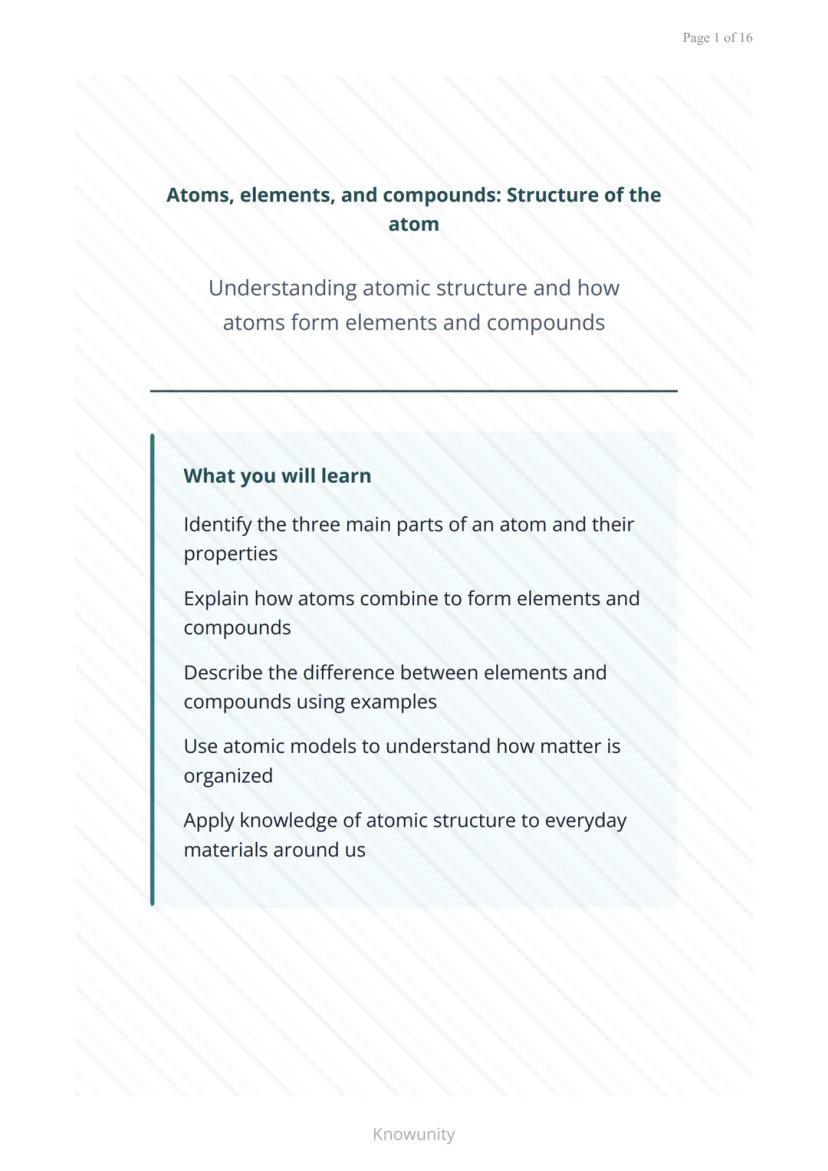
You're about to discover the three main parts of atoms and how they give different materials their unique properties. Think of this as learning the secret recipe behind everything you touch, see, and breathe every day.
By the end of this topic, you'll understand how atoms combine to form the countless substances around you. You'll also learn to tell the difference between elements and compounds using real examples from your daily life.
Quick Confidence Boost: These concepts might seem complex, but you already interact with atoms billions of times every day - you've got this!
Most importantly, you'll be able to look at everyday materials - from your trainers to your breakfast - and understand exactly how they're built from the atomic level up.
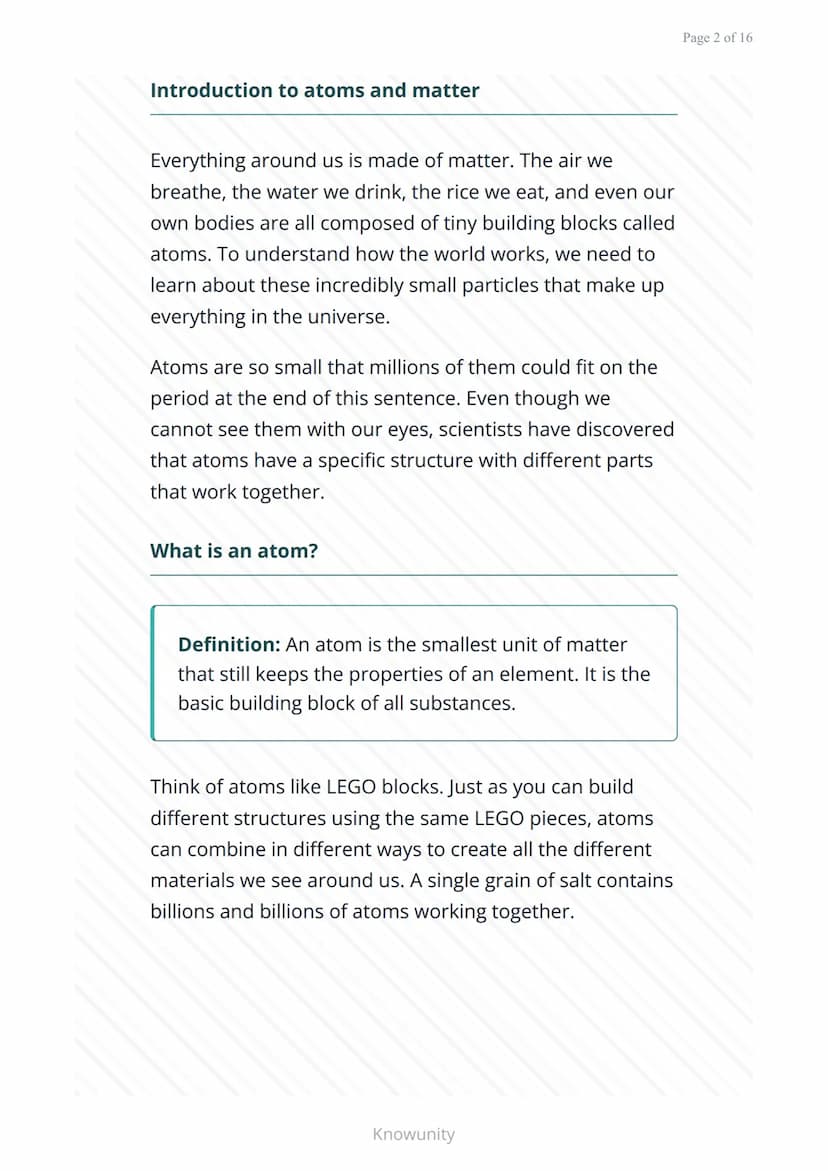
Everything you've ever touched is made of matter, and all matter is built from incredibly small particles called atoms. The air filling your lungs right now? Atoms. The water you drink? More atoms. Even your own body? Yep, billions upon billions of atoms working together.
Here's how small atoms really are: millions of them could fit on the full stop at the end of this sentence. Scientists can't see individual atoms with regular microscopes, but they've figured out that atoms have a specific structure with different parts.
An atom is the smallest unit of matter that still keeps all the properties of an element. Imagine atoms like LEGO blocks - you can build completely different structures using the same basic pieces, just like atoms combine in different ways to create everything from diamonds to chocolate.
Real-World Connection: A single grain of salt contains more atoms than there are people on Earth - that's roughly 1.2 billion billion atoms!
Picture a piece of gold jewellery that someone in your family might own - maybe a ring or necklace. That gold is made entirely of gold atoms, and here's the amazing part: every single gold atom has exactly the same structure and properties.
This is why gold always looks and behaves the same way, whether it's shaped into a ring, a necklace, or even a coin. The atomic structure never changes, which means the gold's properties stay constant no matter what form it takes.
Fun Fact: Gold atoms are so stable that gold found in ancient Egyptian tombs looks exactly the same as gold mined today!
Understanding this concept helps explain why different materials have such consistent properties - it's all down to the specific types of atoms they contain.
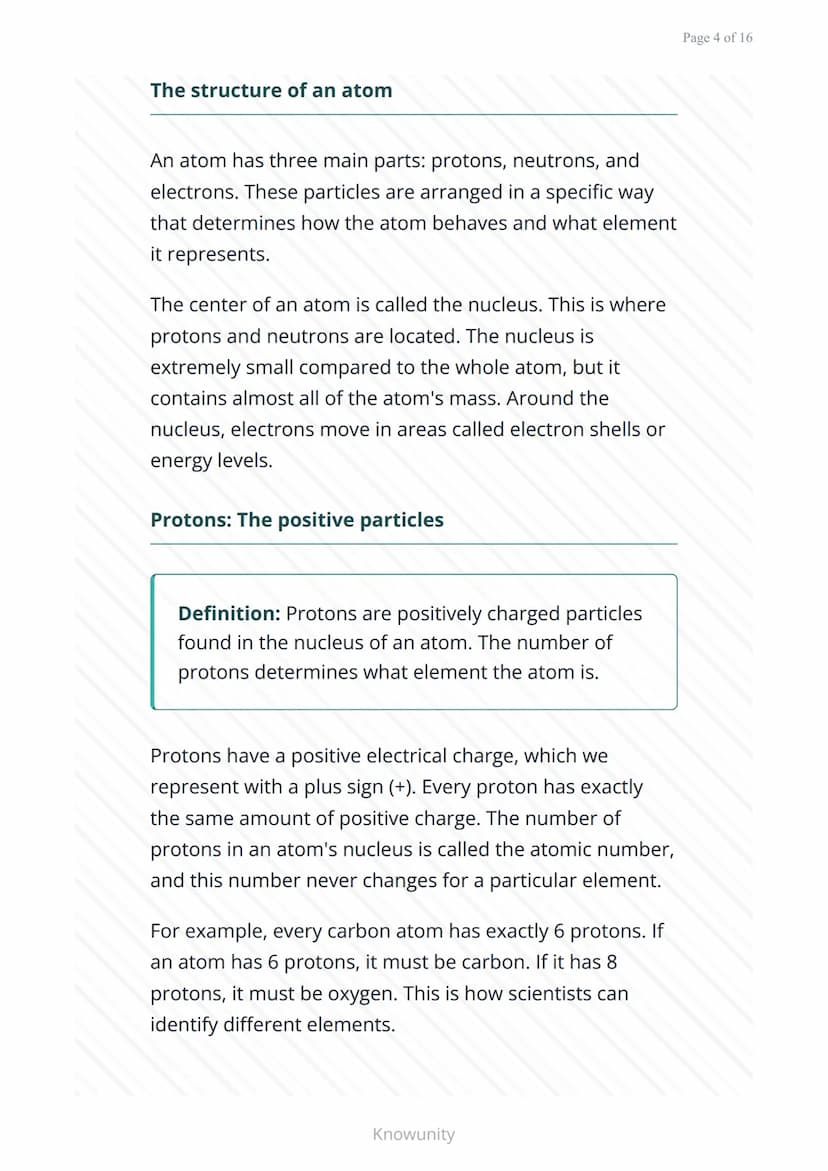
An atom has three main parts: protons, neutrons, and electrons, all arranged in a specific way that determines what element the atom represents. Picture the atom like a tiny solar system with everything revolving around a dense centre.
The centre of an atom is called the nucleus, where protons and neutrons hang out together. Even though the nucleus is incredibly small compared to the whole atom, it contains almost all the atom's mass - imagine all the weight of a football concentrated into a grain of rice.
Protons are positively charged particles that live in the nucleus, and here's the crucial bit: the number of protons determines what element the atom is. Every carbon atom has exactly 6 protons - no more, no less. If you find an atom with 8 protons, it must be oxygen.
Memory Trick: Think "P for Protons = Positive" and remember that protons determine the element's identity, just like your fingerprint determines your identity.
This is how scientists can identify different elements - they simply count the protons in the nucleus, which is called the atomic number.
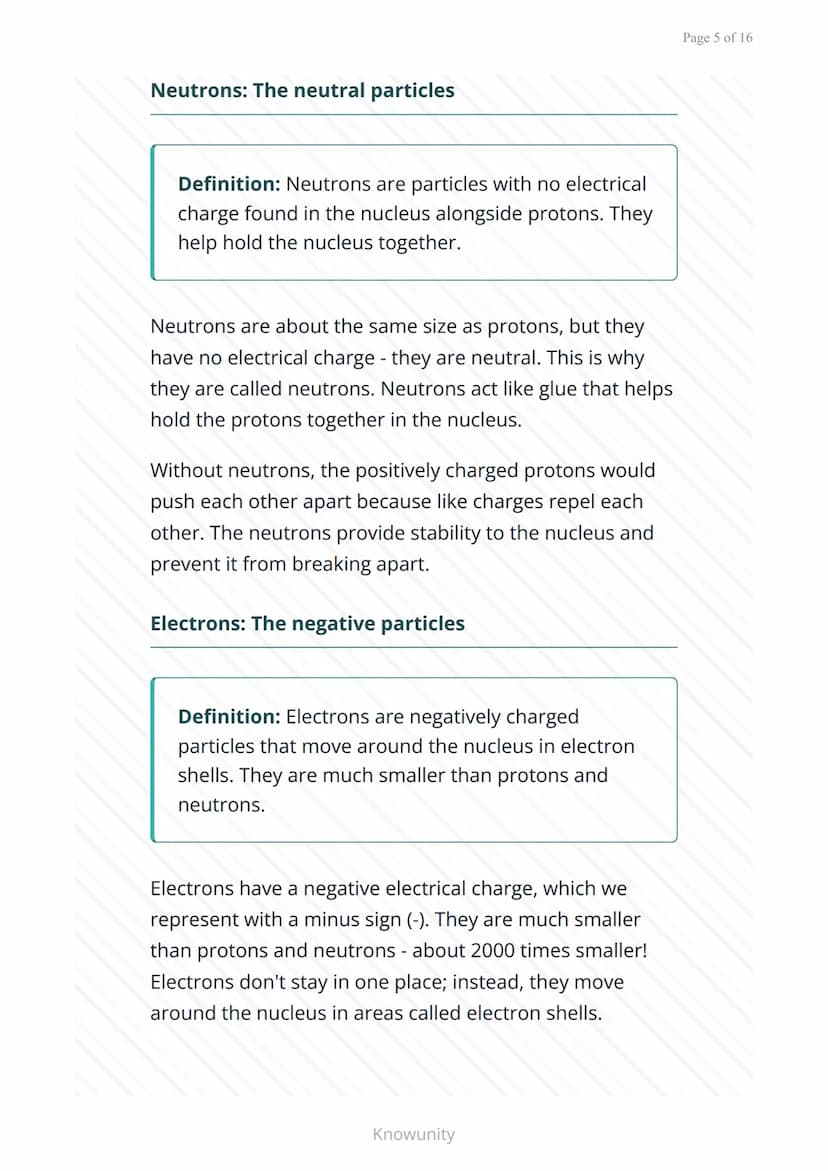
Neutrons are particles with no electrical charge that share the nucleus with protons. They're about the same size as protons but act like nuclear glue, holding everything together in the centre of the atom.
Without neutrons, the positively charged protons would push each other apart (like trying to stick the same ends of magnets together). Neutrons provide the stability that prevents the nucleus from breaking apart - pretty important job!
Electrons are negatively charged particles that move around the nucleus in areas called electron shells. These little particles are absolutely tiny - about 2000 times smaller than protons and neutrons - but they play a huge role in how atoms behave.
The number of electrons in an atom usually equals the number of protons, which means the positive and negative charges balance out perfectly. This is why most atoms have no overall electrical charge - they're electrically neutral.
Think About It: Electrons are like energetic dancers constantly moving around the nucleus, while protons and neutrons are like the solid foundation they dance around.
When an atom has equal numbers of protons and electrons, the positive and negative charges cancel each other out completely. This creates what scientists call a neutral atom - one with no overall electrical charge.
This balance is nature's way of keeping things stable. Think of it like a perfectly balanced see-saw where the positive charges on one side exactly match the negative charges on the other side.
Key Insight: This charge balance is why you don't get electric shocks from touching everyday objects - most atoms in normal materials are electrically neutral.
Understanding this balance helps explain why atoms behave predictably and why the materials around you have consistent properties day after day.
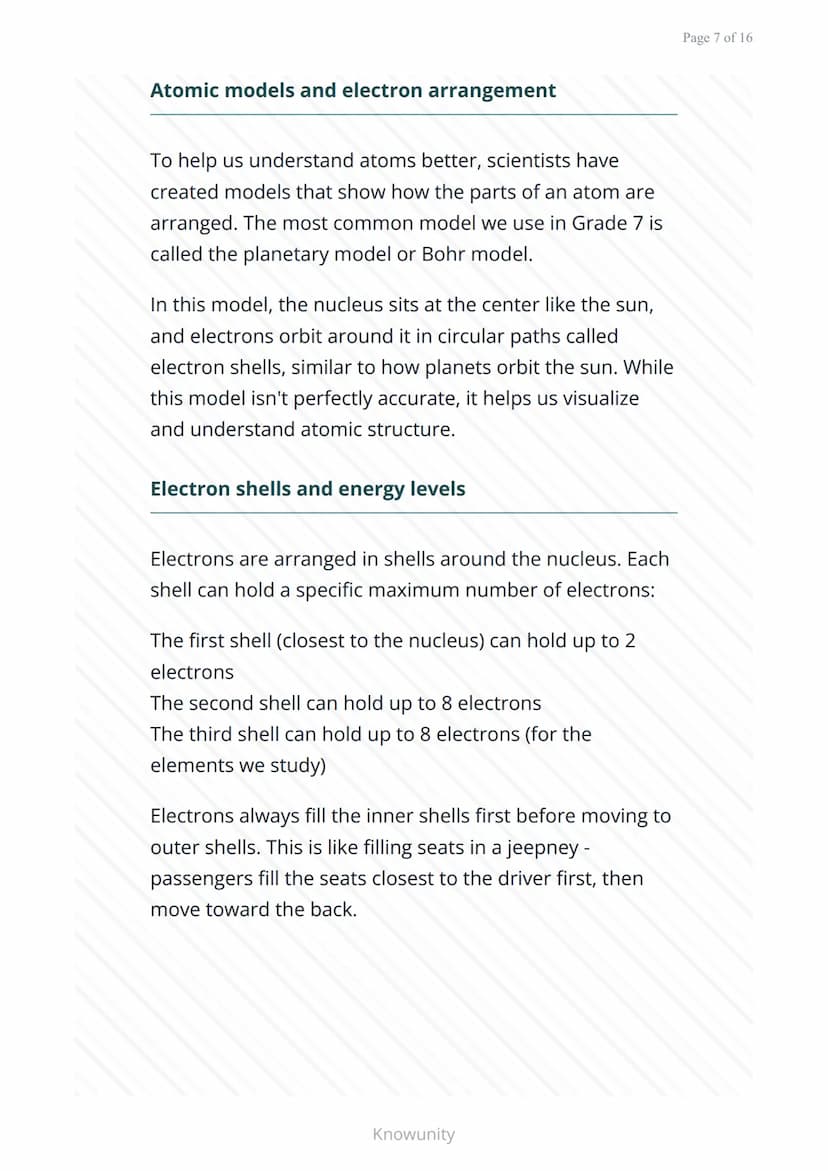
Scientists use atomic models to help us picture how atoms are structured, since we can't actually see them. The most useful model for understanding basic atomic structure is called the planetary model or Bohr model.
In this model, the nucleus sits at the centre like the sun, while electrons orbit around it in circular paths called electron shells. It's similar to how planets orbit the sun in our solar system - though atoms are far more complex than this simple picture suggests.
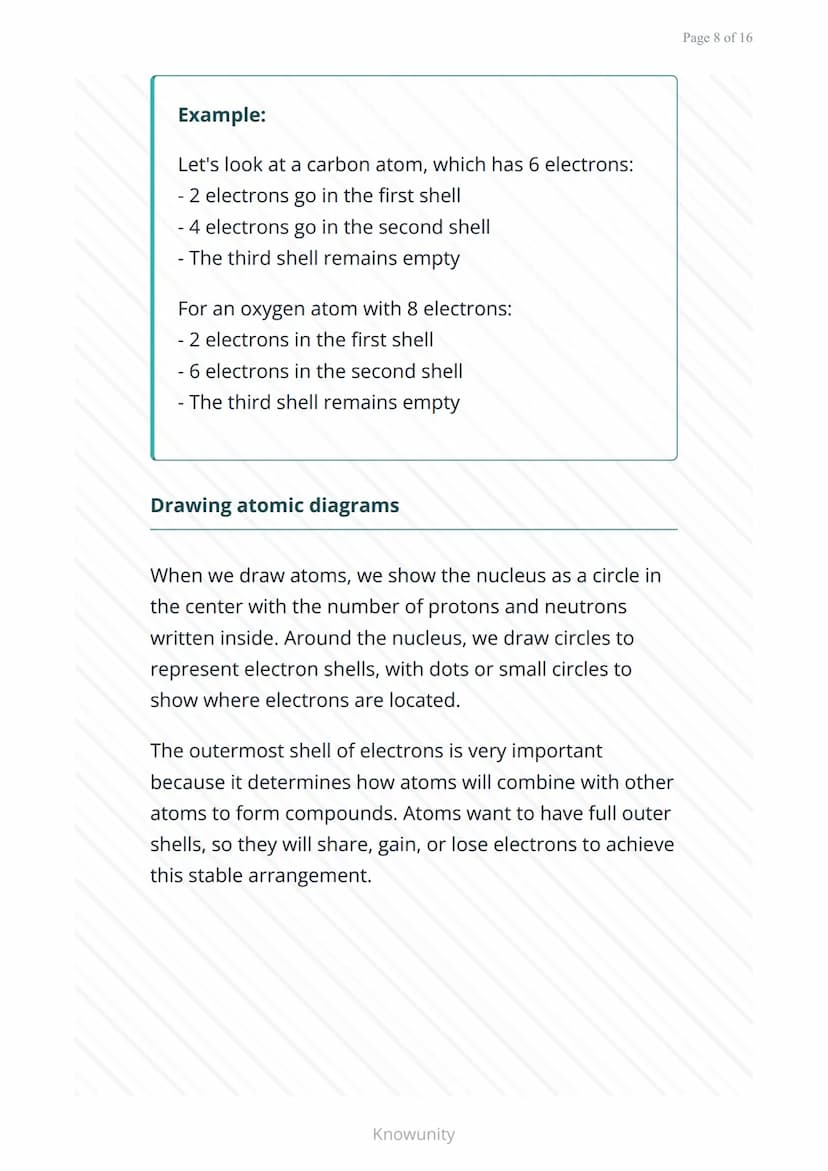
Electrons are arranged in shells around the nucleus, and each shell has a maximum capacity. The first shell (closest to the nucleus) holds up to 2 electrons, while the second and third shells can each hold up to 8 electrons.
Electrons always fill the inner shells first before moving to outer shells. Think of it like filling seats on a bus - passengers naturally fill the front seats first, then move toward the back.
Visual Tip: When drawing atoms, imagine the nucleus as a marble in the centre of a football stadium, with electrons whizzing around the outer edges - that's roughly the scale we're dealing with!
Let's look at some real examples of how electrons arrange themselves in atomic structure. A carbon atom has 6 electrons: 2 fill the first shell completely, then 4 go into the second shell, leaving the third shell empty.
For an oxygen atom with 8 electrons, you get 2 in the first shell and 6 in the second shell, with the third shell remaining empty. Notice how electrons always fill inner shells before moving outward.
When drawing atomic diagrams, scientists show the nucleus as a circle in the centre with the number of protons and neutrons written inside. Around this, they draw circles to represent electron shells, with dots showing where electrons are located.
The outermost shell of electrons is incredibly important because it determines how atoms will combine with other atoms to form compounds. Atoms "want" to have full outer shells, so they'll share, gain, or lose electrons to achieve this stable arrangement.
Pro Tip: The outermost electrons are like the "social" electrons - they're the ones that interact with other atoms to form the millions of different substances around you.
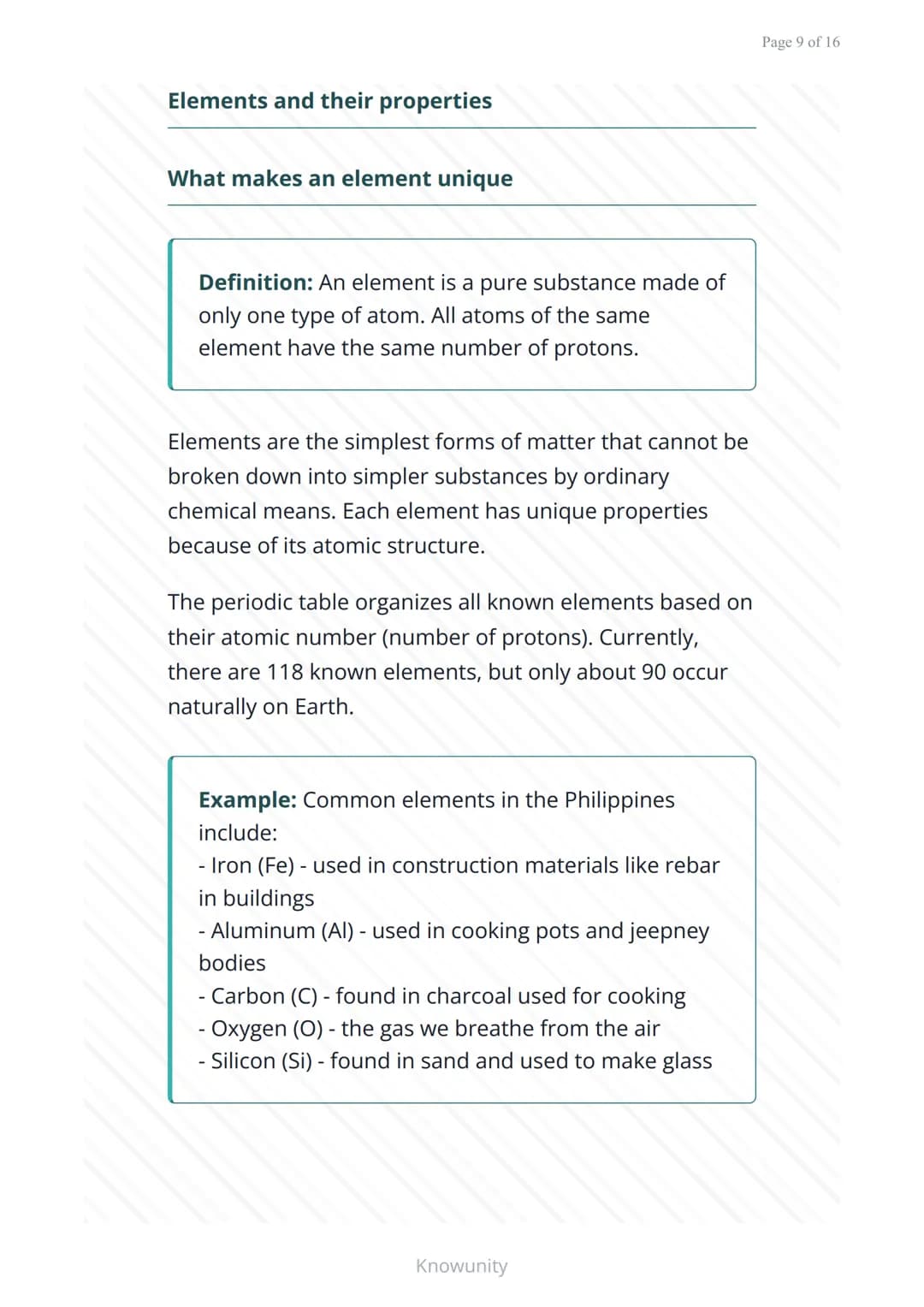
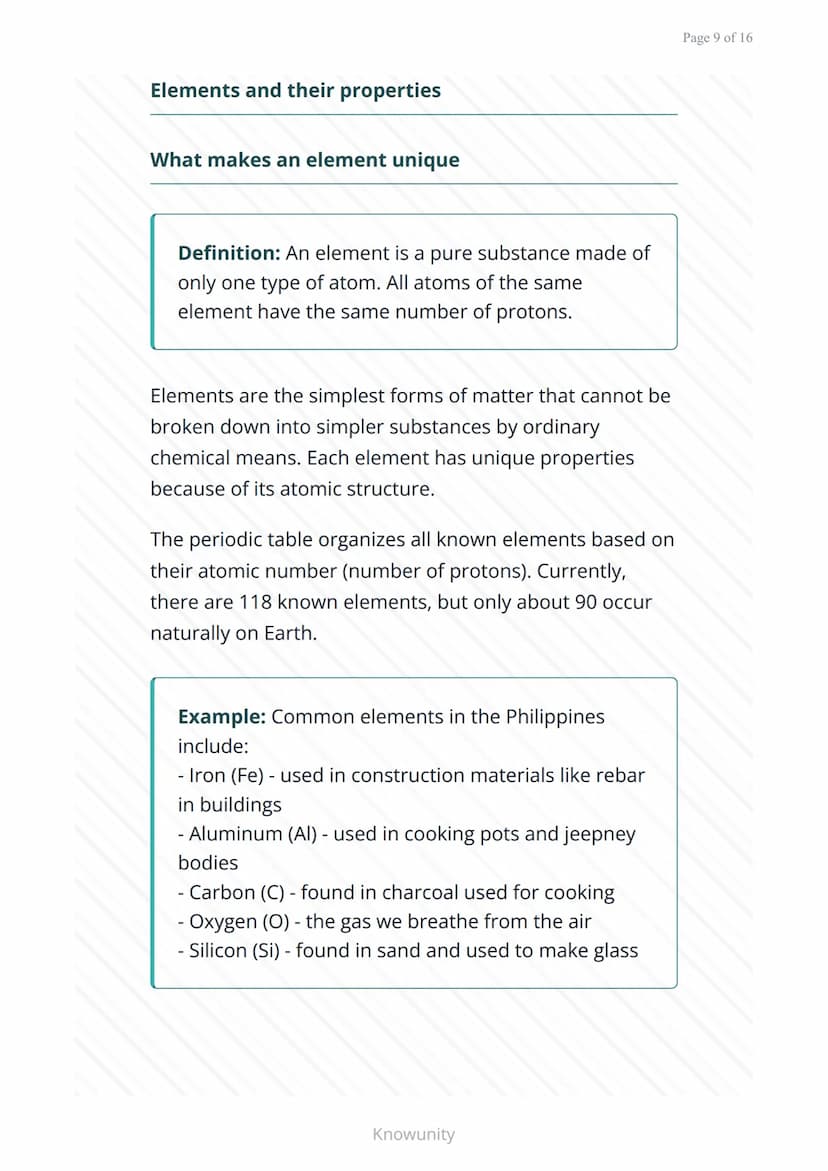
An element is a pure substance made of only one type of atom, and all atoms of the same element have exactly the same number of protons. Elements are like the alphabet of chemistry - just as you combine letters to make words, you combine elements to make compounds.
Elements are the simplest forms of matter that cannot be broken down into simpler substances by ordinary chemical means. Each element has unique properties because of its specific atomic structure - this is why gold behaves so differently from oxygen or iron.
The periodic table organizes all 118 known elements based on their atomic number (number of protons). Only about 90 of these elements occur naturally on Earth - the rest are created artificially in laboratories.
You encounter many elements in daily life: iron in construction materials, aluminium in cooking pots and drink cans, carbon in the charcoal used for barbecues, and oxygen in the air you breathe.
Local Connection: The jeepneys you see on the roads contain iron and steel (made from iron), while the glass in windows contains silicon from sand - elements are literally everywhere!
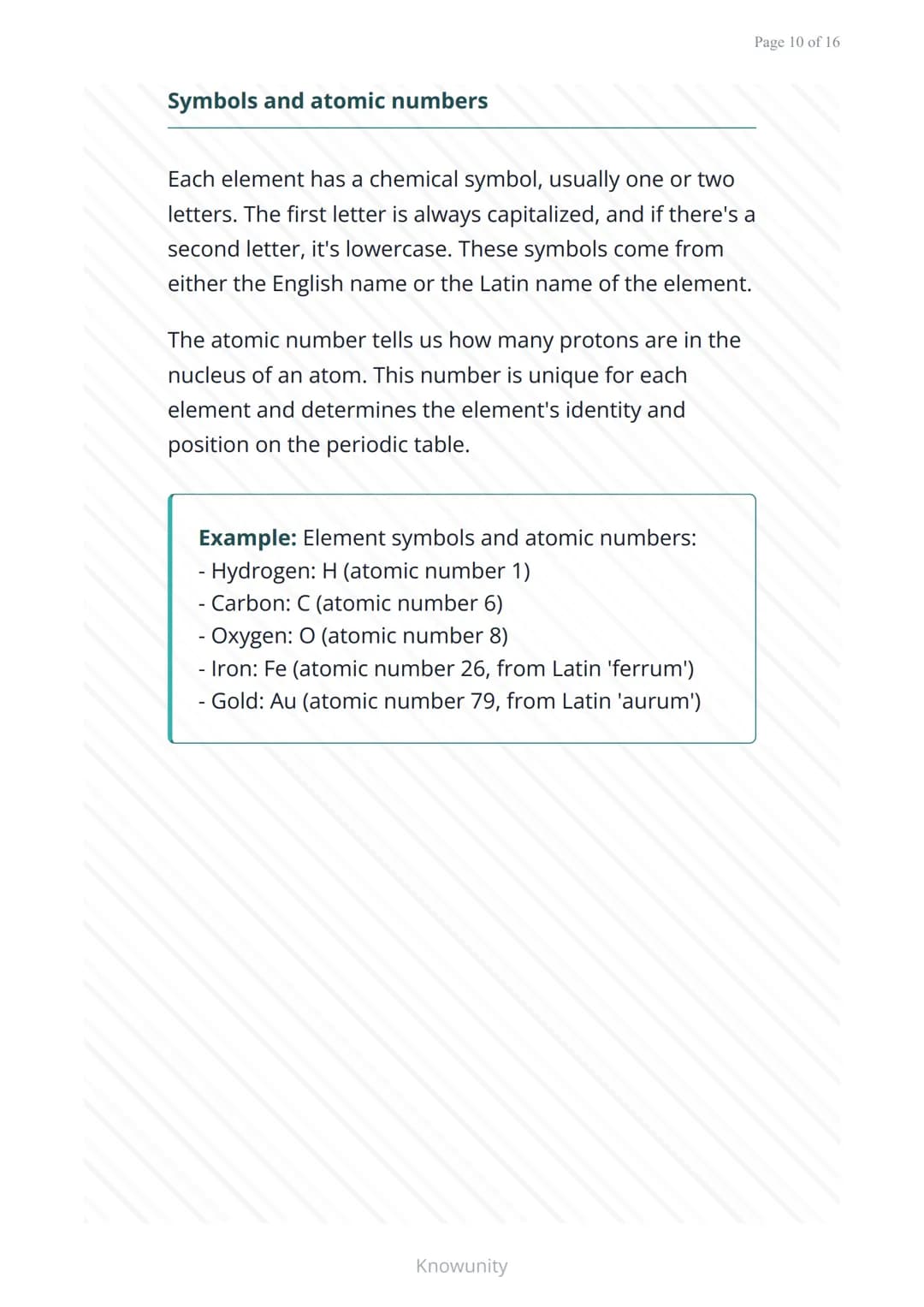
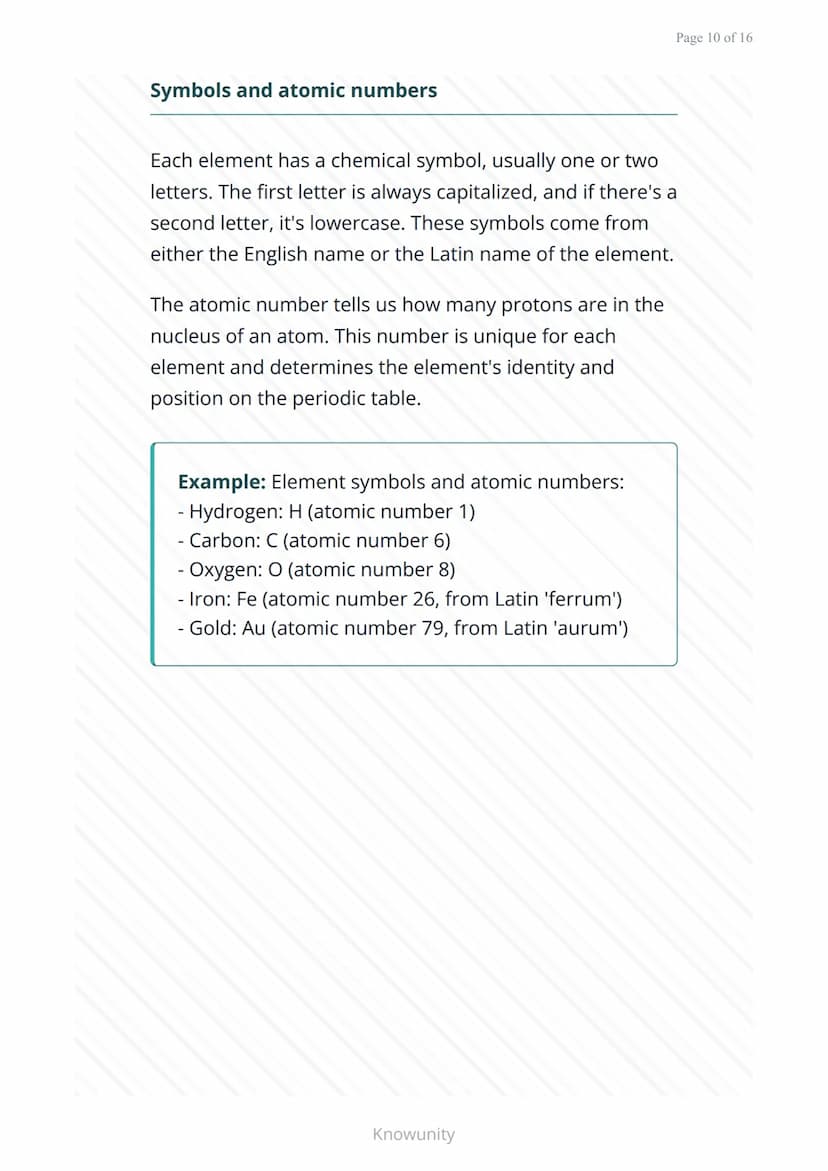
Each element has a unique chemical symbol - usually one or two letters that act like a shorthand code. The first letter is always capitalized, and if there's a second letter, it's lowercase. These symbols come from either the English name or sometimes the Latin name of the element.
The atomic number tells you exactly how many protons are in an atom's nucleus. This number is unique for each element and determines both the element's identity and its position on the periodic table - it's like each element's personal ID number.
Some common examples include: Hydrogen (H) with atomic number 1, Carbon (C) with atomic number 6, and Oxygen (O) with atomic number 8. Some symbols come from Latin names, like Iron (Fe, from 'ferrum') with atomic number 26.
Memory Hack: Learning element symbols is like learning text abbreviations - once you know that "O" means oxygen and "C" means carbon, you can start reading the chemical language around you.
Understanding these symbols and numbers gives you the foundation to explore how elements combine to form the countless compounds that make up your world.
Our AI companion is specifically built for the needs of students. Based on the millions of content pieces we have on the platform we can provide truly meaningful and relevant answers to students. But its not only about answers, the companion is even more about guiding students through their daily learning challenges, with personalised study plans, quizzes or content pieces in the chat and 100% personalisation based on the students skills and developments.
You can download the app in the Google Play Store and in the Apple App Store.
That's right! Enjoy free access to study content, connect with fellow students, and get instant help – all at your fingertips.
App Store
Google Play
The app is very easy to use and well designed. I have found everything I was looking for so far and have been able to learn a lot from the presentations! I will definitely use the app for a class assignment! And of course it also helps a lot as an inspiration.
Stefan S
iOS user
This app is really great. There are so many study notes and help [...]. My problem subject is French, for example, and the app has so many options for help. Thanks to this app, I have improved my French. I would recommend it to anyone.
Samantha Klich
Android user
Wow, I am really amazed. I just tried the app because I've seen it advertised many times and was absolutely stunned. This app is THE HELP you want for school and above all, it offers so many things, such as workouts and fact sheets, which have been VERY helpful to me personally.
Anna
iOS user
I think it’s very much worth it and you’ll end up using it a lot once you get the hang of it and even after looking at others notes you can still ask your Artificial intelligence buddy the question and ask to simplify it if you still don’t get it!!! In the end I think it’s worth it 😊👍 ⚠️Also DID I MENTION ITS FREEE YOU DON’T HAVE TO PAY FOR ANYTHING AND STILL GET YOUR GRADES IN PERFECTLY❗️❗️⚠️
Thomas R
iOS user
Knowunity is the BEST app I’ve used in a minute. This is not an ai review or anything this is genuinely coming from a 7th grade student (I know 2011 im young) but dude this app is a 10/10 i have maintained a 3.8 gpa and have plenty of time for gaming. I love it and my mom is just happy I got good grades
Brad T
Android user
Not only did it help me find the answer but it also showed me alternative ways to solve it. I was horrible in math and science but now I have an a in both subjects. Thanks for the help🤍🤍
David K
iOS user
The app's just great! All I have to do is enter the topic in the search bar and I get the response real fast. I don't have to watch 10 YouTube videos to understand something, so I'm saving my time. Highly recommended!
Sudenaz Ocak
Android user
In school I was really bad at maths but thanks to the app, I am doing better now. I am so grateful that you made the app.
Greenlight Bonnie
Android user
I found this app a couple years ago and it has only gotten better since then. I really love it because it can help with written questions and photo questions. Also, it can find study guides that other people have made as well as flashcard sets and practice tests. The free version is also amazing for students who might not be able to afford it. Would 100% recommend
Aubrey
iOS user
Best app if you're in Highschool or Junior high. I have been using this app for 2 school years and it's the best, it's good if you don't have anyone to help you with school work.😋🩷🎀
Marco B
iOS user
THE QUIZES AND FLASHCARDS ARE SO USEFUL AND I LOVE THE SCHOOLGPT. IT ALSO IS LITREALLY LIKE CHATGPT BUT SMARTER!! HELPED ME WITH MY MASCARA PROBLEMS TOO!! AS WELL AS MY REAL SUBJECTS ! DUHHH 😍😁😲🤑💗✨🎀😮
Elisha
iOS user
This app is phenomenal down to the correct info and the various topics you can study! I greatly recommend it for people who struggle with procrastination and those who need homework help. It has been perfectly accurate for world 1 history as far as I’ve seen! Geometry too!
Paul T
iOS user
The app is very easy to use and well designed. I have found everything I was looking for so far and have been able to learn a lot from the presentations! I will definitely use the app for a class assignment! And of course it also helps a lot as an inspiration.
Stefan S
iOS user
This app is really great. There are so many study notes and help [...]. My problem subject is French, for example, and the app has so many options for help. Thanks to this app, I have improved my French. I would recommend it to anyone.
Samantha Klich
Android user
Wow, I am really amazed. I just tried the app because I've seen it advertised many times and was absolutely stunned. This app is THE HELP you want for school and above all, it offers so many things, such as workouts and fact sheets, which have been VERY helpful to me personally.
Anna
iOS user
I think it’s very much worth it and you’ll end up using it a lot once you get the hang of it and even after looking at others notes you can still ask your Artificial intelligence buddy the question and ask to simplify it if you still don’t get it!!! In the end I think it’s worth it 😊👍 ⚠️Also DID I MENTION ITS FREEE YOU DON’T HAVE TO PAY FOR ANYTHING AND STILL GET YOUR GRADES IN PERFECTLY❗️❗️⚠️
Thomas R
iOS user
Knowunity is the BEST app I’ve used in a minute. This is not an ai review or anything this is genuinely coming from a 7th grade student (I know 2011 im young) but dude this app is a 10/10 i have maintained a 3.8 gpa and have plenty of time for gaming. I love it and my mom is just happy I got good grades
Brad T
Android user
Not only did it help me find the answer but it also showed me alternative ways to solve it. I was horrible in math and science but now I have an a in both subjects. Thanks for the help🤍🤍
David K
iOS user
The app's just great! All I have to do is enter the topic in the search bar and I get the response real fast. I don't have to watch 10 YouTube videos to understand something, so I'm saving my time. Highly recommended!
Sudenaz Ocak
Android user
In school I was really bad at maths but thanks to the app, I am doing better now. I am so grateful that you made the app.
Greenlight Bonnie
Android user
I found this app a couple years ago and it has only gotten better since then. I really love it because it can help with written questions and photo questions. Also, it can find study guides that other people have made as well as flashcard sets and practice tests. The free version is also amazing for students who might not be able to afford it. Would 100% recommend
Aubrey
iOS user
Best app if you're in Highschool or Junior high. I have been using this app for 2 school years and it's the best, it's good if you don't have anyone to help you with school work.😋🩷🎀
Marco B
iOS user
THE QUIZES AND FLASHCARDS ARE SO USEFUL AND I LOVE THE SCHOOLGPT. IT ALSO IS LITREALLY LIKE CHATGPT BUT SMARTER!! HELPED ME WITH MY MASCARA PROBLEMS TOO!! AS WELL AS MY REAL SUBJECTS ! DUHHH 😍😁😲🤑💗✨🎀😮
Elisha
iOS user
This app is phenomenal down to the correct info and the various topics you can study! I greatly recommend it for people who struggle with procrastination and those who need homework help. It has been perfectly accurate for world 1 history as far as I’ve seen! Geometry too!
Paul T
iOS user
Knowunity Philippines
@knowunityphilippines
Ever wondered what makes up everything around you - from your mobile phone to the rice you eat? It all comes down to incredibly tiny building blocks called atoms that are far too small to see but make up absolutely... Show more
Access to all documents
Improve your grades
Join milions of students
By signing up you accept Terms of Service and Privacy Policy
You're about to discover the three main parts of atoms and how they give different materials their unique properties. Think of this as learning the secret recipe behind everything you touch, see, and breathe every day.
By the end of this topic, you'll understand how atoms combine to form the countless substances around you. You'll also learn to tell the difference between elements and compounds using real examples from your daily life.
Quick Confidence Boost: These concepts might seem complex, but you already interact with atoms billions of times every day - you've got this!
Most importantly, you'll be able to look at everyday materials - from your trainers to your breakfast - and understand exactly how they're built from the atomic level up.
Access to all documents
Improve your grades
Join milions of students
By signing up you accept Terms of Service and Privacy Policy
Everything you've ever touched is made of matter, and all matter is built from incredibly small particles called atoms. The air filling your lungs right now? Atoms. The water you drink? More atoms. Even your own body? Yep, billions upon billions of atoms working together.
Here's how small atoms really are: millions of them could fit on the full stop at the end of this sentence. Scientists can't see individual atoms with regular microscopes, but they've figured out that atoms have a specific structure with different parts.
An atom is the smallest unit of matter that still keeps all the properties of an element. Imagine atoms like LEGO blocks - you can build completely different structures using the same basic pieces, just like atoms combine in different ways to create everything from diamonds to chocolate.
Real-World Connection: A single grain of salt contains more atoms than there are people on Earth - that's roughly 1.2 billion billion atoms!
Access to all documents
Improve your grades
Join milions of students
By signing up you accept Terms of Service and Privacy Policy
Picture a piece of gold jewellery that someone in your family might own - maybe a ring or necklace. That gold is made entirely of gold atoms, and here's the amazing part: every single gold atom has exactly the same structure and properties.
This is why gold always looks and behaves the same way, whether it's shaped into a ring, a necklace, or even a coin. The atomic structure never changes, which means the gold's properties stay constant no matter what form it takes.
Fun Fact: Gold atoms are so stable that gold found in ancient Egyptian tombs looks exactly the same as gold mined today!
Understanding this concept helps explain why different materials have such consistent properties - it's all down to the specific types of atoms they contain.
Access to all documents
Improve your grades
Join milions of students
By signing up you accept Terms of Service and Privacy Policy
An atom has three main parts: protons, neutrons, and electrons, all arranged in a specific way that determines what element the atom represents. Picture the atom like a tiny solar system with everything revolving around a dense centre.
The centre of an atom is called the nucleus, where protons and neutrons hang out together. Even though the nucleus is incredibly small compared to the whole atom, it contains almost all the atom's mass - imagine all the weight of a football concentrated into a grain of rice.
Protons are positively charged particles that live in the nucleus, and here's the crucial bit: the number of protons determines what element the atom is. Every carbon atom has exactly 6 protons - no more, no less. If you find an atom with 8 protons, it must be oxygen.
Memory Trick: Think "P for Protons = Positive" and remember that protons determine the element's identity, just like your fingerprint determines your identity.
This is how scientists can identify different elements - they simply count the protons in the nucleus, which is called the atomic number.
Access to all documents
Improve your grades
Join milions of students
By signing up you accept Terms of Service and Privacy Policy
Neutrons are particles with no electrical charge that share the nucleus with protons. They're about the same size as protons but act like nuclear glue, holding everything together in the centre of the atom.
Without neutrons, the positively charged protons would push each other apart (like trying to stick the same ends of magnets together). Neutrons provide the stability that prevents the nucleus from breaking apart - pretty important job!
Electrons are negatively charged particles that move around the nucleus in areas called electron shells. These little particles are absolutely tiny - about 2000 times smaller than protons and neutrons - but they play a huge role in how atoms behave.
The number of electrons in an atom usually equals the number of protons, which means the positive and negative charges balance out perfectly. This is why most atoms have no overall electrical charge - they're electrically neutral.
Think About It: Electrons are like energetic dancers constantly moving around the nucleus, while protons and neutrons are like the solid foundation they dance around.
Access to all documents
Improve your grades
Join milions of students
By signing up you accept Terms of Service and Privacy Policy
When an atom has equal numbers of protons and electrons, the positive and negative charges cancel each other out completely. This creates what scientists call a neutral atom - one with no overall electrical charge.
This balance is nature's way of keeping things stable. Think of it like a perfectly balanced see-saw where the positive charges on one side exactly match the negative charges on the other side.
Key Insight: This charge balance is why you don't get electric shocks from touching everyday objects - most atoms in normal materials are electrically neutral.
Understanding this balance helps explain why atoms behave predictably and why the materials around you have consistent properties day after day.
Access to all documents
Improve your grades
Join milions of students
By signing up you accept Terms of Service and Privacy Policy
Scientists use atomic models to help us picture how atoms are structured, since we can't actually see them. The most useful model for understanding basic atomic structure is called the planetary model or Bohr model.
In this model, the nucleus sits at the centre like the sun, while electrons orbit around it in circular paths called electron shells. It's similar to how planets orbit the sun in our solar system - though atoms are far more complex than this simple picture suggests.
Electrons are arranged in shells around the nucleus, and each shell has a maximum capacity. The first shell (closest to the nucleus) holds up to 2 electrons, while the second and third shells can each hold up to 8 electrons.
Electrons always fill the inner shells first before moving to outer shells. Think of it like filling seats on a bus - passengers naturally fill the front seats first, then move toward the back.
Visual Tip: When drawing atoms, imagine the nucleus as a marble in the centre of a football stadium, with electrons whizzing around the outer edges - that's roughly the scale we're dealing with!
Access to all documents
Improve your grades
Join milions of students
By signing up you accept Terms of Service and Privacy Policy
Let's look at some real examples of how electrons arrange themselves in atomic structure. A carbon atom has 6 electrons: 2 fill the first shell completely, then 4 go into the second shell, leaving the third shell empty.
For an oxygen atom with 8 electrons, you get 2 in the first shell and 6 in the second shell, with the third shell remaining empty. Notice how electrons always fill inner shells before moving outward.
When drawing atomic diagrams, scientists show the nucleus as a circle in the centre with the number of protons and neutrons written inside. Around this, they draw circles to represent electron shells, with dots showing where electrons are located.
The outermost shell of electrons is incredibly important because it determines how atoms will combine with other atoms to form compounds. Atoms "want" to have full outer shells, so they'll share, gain, or lose electrons to achieve this stable arrangement.
Pro Tip: The outermost electrons are like the "social" electrons - they're the ones that interact with other atoms to form the millions of different substances around you.
Access to all documents
Improve your grades
Join milions of students
By signing up you accept Terms of Service and Privacy Policy
An element is a pure substance made of only one type of atom, and all atoms of the same element have exactly the same number of protons. Elements are like the alphabet of chemistry - just as you combine letters to make words, you combine elements to make compounds.
Elements are the simplest forms of matter that cannot be broken down into simpler substances by ordinary chemical means. Each element has unique properties because of its specific atomic structure - this is why gold behaves so differently from oxygen or iron.
The periodic table organizes all 118 known elements based on their atomic number (number of protons). Only about 90 of these elements occur naturally on Earth - the rest are created artificially in laboratories.
You encounter many elements in daily life: iron in construction materials, aluminium in cooking pots and drink cans, carbon in the charcoal used for barbecues, and oxygen in the air you breathe.
Local Connection: The jeepneys you see on the roads contain iron and steel (made from iron), while the glass in windows contains silicon from sand - elements are literally everywhere!
Access to all documents
Improve your grades
Join milions of students
By signing up you accept Terms of Service and Privacy Policy
Each element has a unique chemical symbol - usually one or two letters that act like a shorthand code. The first letter is always capitalized, and if there's a second letter, it's lowercase. These symbols come from either the English name or sometimes the Latin name of the element.
The atomic number tells you exactly how many protons are in an atom's nucleus. This number is unique for each element and determines both the element's identity and its position on the periodic table - it's like each element's personal ID number.
Some common examples include: Hydrogen (H) with atomic number 1, Carbon (C) with atomic number 6, and Oxygen (O) with atomic number 8. Some symbols come from Latin names, like Iron (Fe, from 'ferrum') with atomic number 26.
Memory Hack: Learning element symbols is like learning text abbreviations - once you know that "O" means oxygen and "C" means carbon, you can start reading the chemical language around you.
Understanding these symbols and numbers gives you the foundation to explore how elements combine to form the countless compounds that make up your world.
Our AI companion is specifically built for the needs of students. Based on the millions of content pieces we have on the platform we can provide truly meaningful and relevant answers to students. But its not only about answers, the companion is even more about guiding students through their daily learning challenges, with personalised study plans, quizzes or content pieces in the chat and 100% personalisation based on the students skills and developments.
You can download the app in the Google Play Store and in the Apple App Store.
That's right! Enjoy free access to study content, connect with fellow students, and get instant help – all at your fingertips.
6
Smart Tools NEW
Transform this note into: ✓ 50+ Practice Questions ✓ Interactive Flashcards ✓ Full Mock Exam ✓ Essay Outlines
App Store
Google Play
The app is very easy to use and well designed. I have found everything I was looking for so far and have been able to learn a lot from the presentations! I will definitely use the app for a class assignment! And of course it also helps a lot as an inspiration.
Stefan S
iOS user
This app is really great. There are so many study notes and help [...]. My problem subject is French, for example, and the app has so many options for help. Thanks to this app, I have improved my French. I would recommend it to anyone.
Samantha Klich
Android user
Wow, I am really amazed. I just tried the app because I've seen it advertised many times and was absolutely stunned. This app is THE HELP you want for school and above all, it offers so many things, such as workouts and fact sheets, which have been VERY helpful to me personally.
Anna
iOS user
I think it’s very much worth it and you’ll end up using it a lot once you get the hang of it and even after looking at others notes you can still ask your Artificial intelligence buddy the question and ask to simplify it if you still don’t get it!!! In the end I think it’s worth it 😊👍 ⚠️Also DID I MENTION ITS FREEE YOU DON’T HAVE TO PAY FOR ANYTHING AND STILL GET YOUR GRADES IN PERFECTLY❗️❗️⚠️
Thomas R
iOS user
Knowunity is the BEST app I’ve used in a minute. This is not an ai review or anything this is genuinely coming from a 7th grade student (I know 2011 im young) but dude this app is a 10/10 i have maintained a 3.8 gpa and have plenty of time for gaming. I love it and my mom is just happy I got good grades
Brad T
Android user
Not only did it help me find the answer but it also showed me alternative ways to solve it. I was horrible in math and science but now I have an a in both subjects. Thanks for the help🤍🤍
David K
iOS user
The app's just great! All I have to do is enter the topic in the search bar and I get the response real fast. I don't have to watch 10 YouTube videos to understand something, so I'm saving my time. Highly recommended!
Sudenaz Ocak
Android user
In school I was really bad at maths but thanks to the app, I am doing better now. I am so grateful that you made the app.
Greenlight Bonnie
Android user
I found this app a couple years ago and it has only gotten better since then. I really love it because it can help with written questions and photo questions. Also, it can find study guides that other people have made as well as flashcard sets and practice tests. The free version is also amazing for students who might not be able to afford it. Would 100% recommend
Aubrey
iOS user
Best app if you're in Highschool or Junior high. I have been using this app for 2 school years and it's the best, it's good if you don't have anyone to help you with school work.😋🩷🎀
Marco B
iOS user
THE QUIZES AND FLASHCARDS ARE SO USEFUL AND I LOVE THE SCHOOLGPT. IT ALSO IS LITREALLY LIKE CHATGPT BUT SMARTER!! HELPED ME WITH MY MASCARA PROBLEMS TOO!! AS WELL AS MY REAL SUBJECTS ! DUHHH 😍😁😲🤑💗✨🎀😮
Elisha
iOS user
This app is phenomenal down to the correct info and the various topics you can study! I greatly recommend it for people who struggle with procrastination and those who need homework help. It has been perfectly accurate for world 1 history as far as I’ve seen! Geometry too!
Paul T
iOS user
The app is very easy to use and well designed. I have found everything I was looking for so far and have been able to learn a lot from the presentations! I will definitely use the app for a class assignment! And of course it also helps a lot as an inspiration.
Stefan S
iOS user
This app is really great. There are so many study notes and help [...]. My problem subject is French, for example, and the app has so many options for help. Thanks to this app, I have improved my French. I would recommend it to anyone.
Samantha Klich
Android user
Wow, I am really amazed. I just tried the app because I've seen it advertised many times and was absolutely stunned. This app is THE HELP you want for school and above all, it offers so many things, such as workouts and fact sheets, which have been VERY helpful to me personally.
Anna
iOS user
I think it’s very much worth it and you’ll end up using it a lot once you get the hang of it and even after looking at others notes you can still ask your Artificial intelligence buddy the question and ask to simplify it if you still don’t get it!!! In the end I think it’s worth it 😊👍 ⚠️Also DID I MENTION ITS FREEE YOU DON’T HAVE TO PAY FOR ANYTHING AND STILL GET YOUR GRADES IN PERFECTLY❗️❗️⚠️
Thomas R
iOS user
Knowunity is the BEST app I’ve used in a minute. This is not an ai review or anything this is genuinely coming from a 7th grade student (I know 2011 im young) but dude this app is a 10/10 i have maintained a 3.8 gpa and have plenty of time for gaming. I love it and my mom is just happy I got good grades
Brad T
Android user
Not only did it help me find the answer but it also showed me alternative ways to solve it. I was horrible in math and science but now I have an a in both subjects. Thanks for the help🤍🤍
David K
iOS user
The app's just great! All I have to do is enter the topic in the search bar and I get the response real fast. I don't have to watch 10 YouTube videos to understand something, so I'm saving my time. Highly recommended!
Sudenaz Ocak
Android user
In school I was really bad at maths but thanks to the app, I am doing better now. I am so grateful that you made the app.
Greenlight Bonnie
Android user
I found this app a couple years ago and it has only gotten better since then. I really love it because it can help with written questions and photo questions. Also, it can find study guides that other people have made as well as flashcard sets and practice tests. The free version is also amazing for students who might not be able to afford it. Would 100% recommend
Aubrey
iOS user
Best app if you're in Highschool or Junior high. I have been using this app for 2 school years and it's the best, it's good if you don't have anyone to help you with school work.😋🩷🎀
Marco B
iOS user
THE QUIZES AND FLASHCARDS ARE SO USEFUL AND I LOVE THE SCHOOLGPT. IT ALSO IS LITREALLY LIKE CHATGPT BUT SMARTER!! HELPED ME WITH MY MASCARA PROBLEMS TOO!! AS WELL AS MY REAL SUBJECTS ! DUHHH 😍😁😲🤑💗✨🎀😮
Elisha
iOS user
This app is phenomenal down to the correct info and the various topics you can study! I greatly recommend it for people who struggle with procrastination and those who need homework help. It has been perfectly accurate for world 1 history as far as I’ve seen! Geometry too!
Paul T
iOS user