
Ever wonder why mountains crumble and continents shift over time?... Show more
 GenBio
 Econ
Econ Araling Panlipunan (AP)
 Iba pa
 Practical Research
 DISS
DISSSign up to see the contentIt's free!
Access to all documents
Improve your grades
Join milions of students
By signing up you accept Terms of Service and Privacy Policy

Biology

Chemistry
AP Chemistry

English
AP English Literature
7
0
sam ⋆𐙚₊˚⊹♡
12/12/2025
Science
Earth Science - Quarter 2
403
•
Dec 12, 2025
•
sam ⋆𐙚₊˚⊹♡
@samantha.badiola_
Ever wonder why mountains crumble and continents shift over time?... Show more
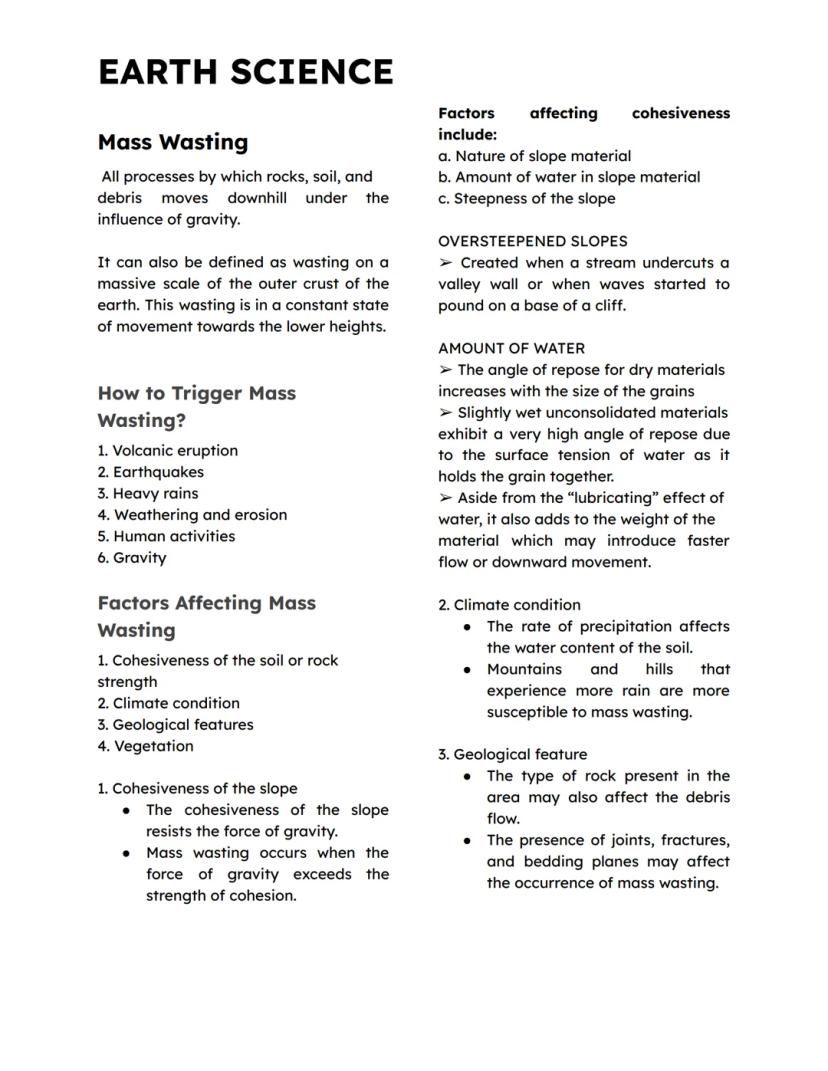

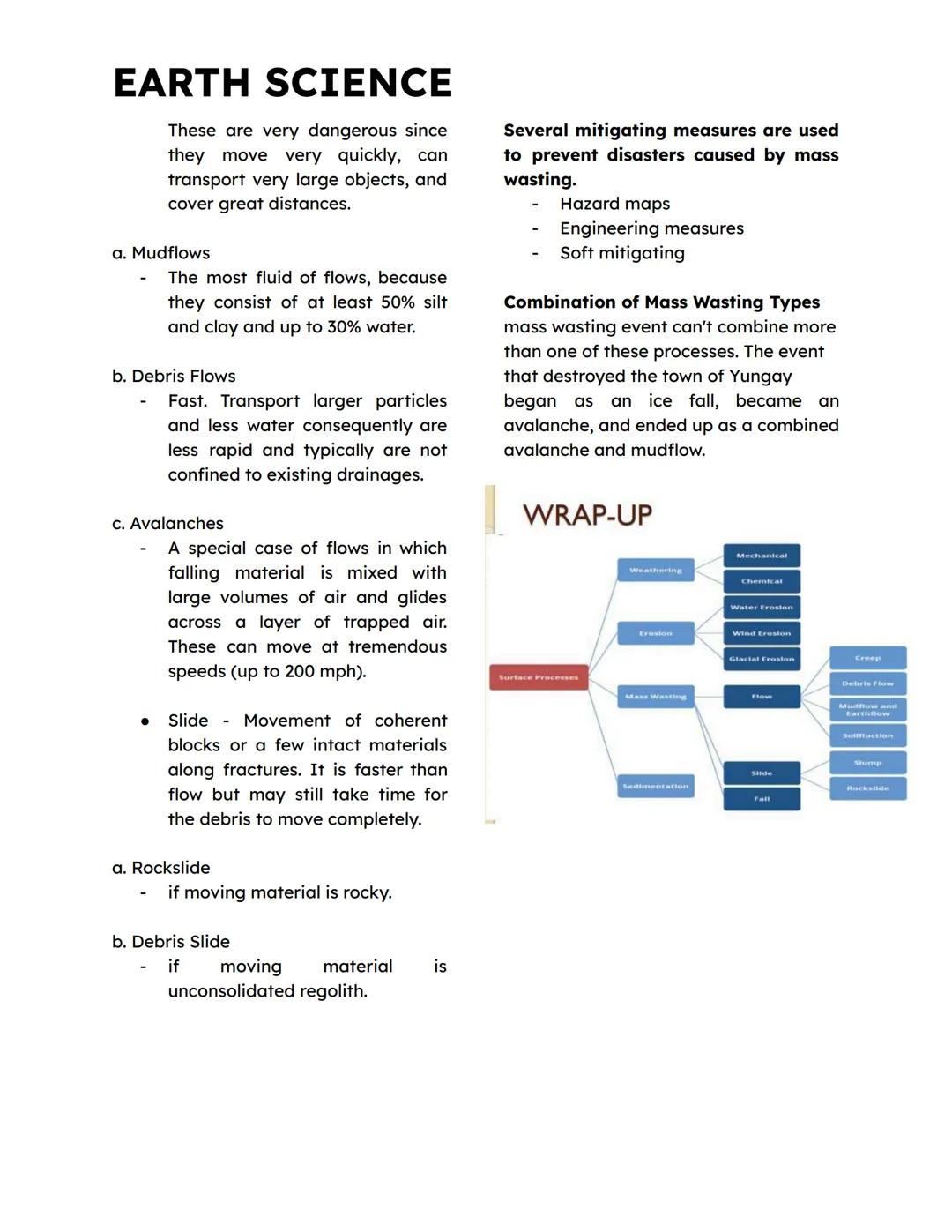
Picture a landslide racing down a mountainside - that's mass wasting in action! It's basically all the ways that rocks, soil, and debris move downhill because gravity never takes a break.
Triggers that can set off mass wasting include volcanic eruptions, earthquakes, heavy rains, weathering, human activities, and of course, gravity itself. Think of it like the final straw that breaks the camel's back.
The main factor is cohesiveness - how well the slope material sticks together versus how hard gravity pulls it down. When gravity wins, stuff starts sliding! Things like water content, steepness of the slope, and the type of material all affect this battle.
Key Point: Mass wasting happens when gravity's pull becomes stronger than the forces holding slope materials together.
Climate, geology, and vegetation also play huge roles. Mountains that get lots of rain are more prone to mass wasting, while plants with deep roots act like nature's glue, holding soil in place through their root systems.
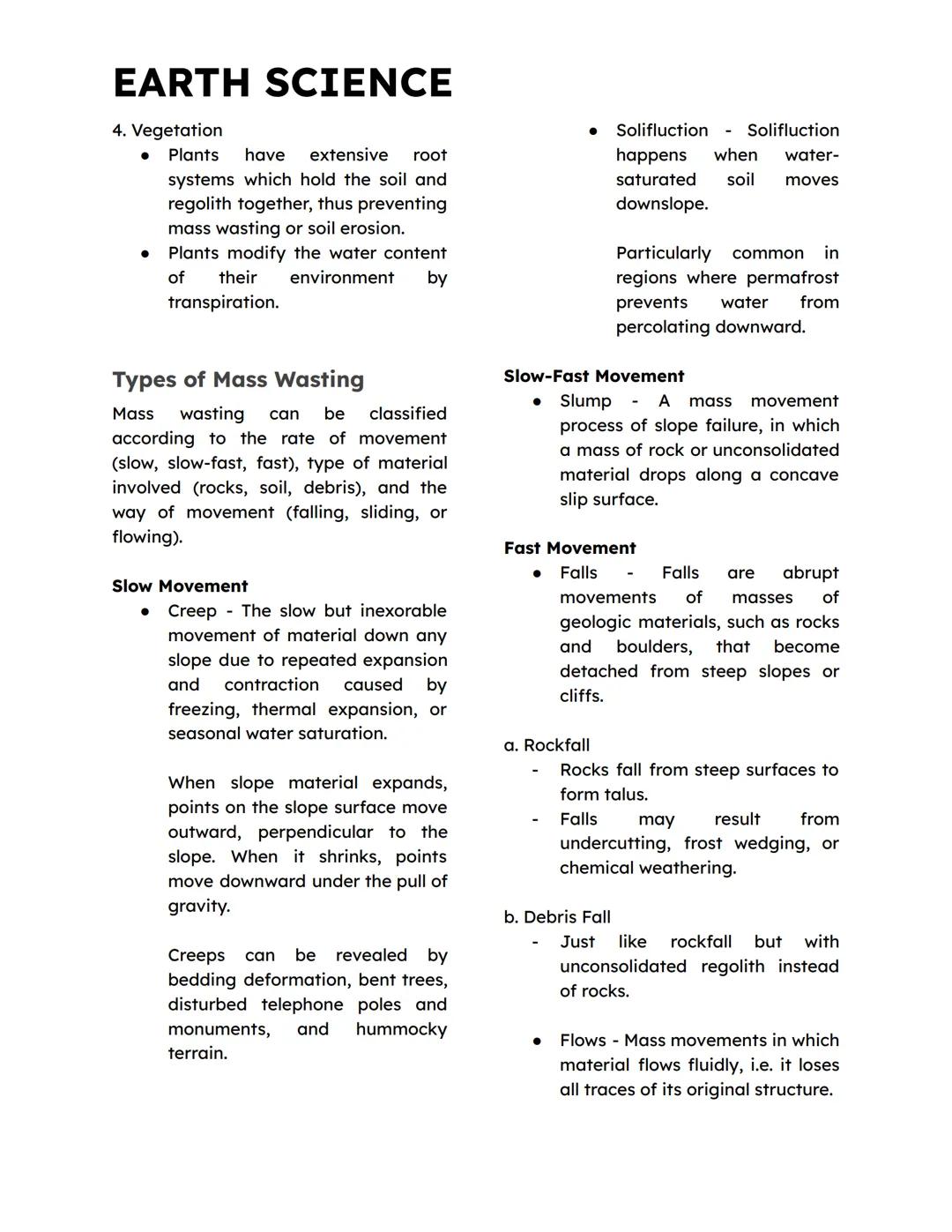
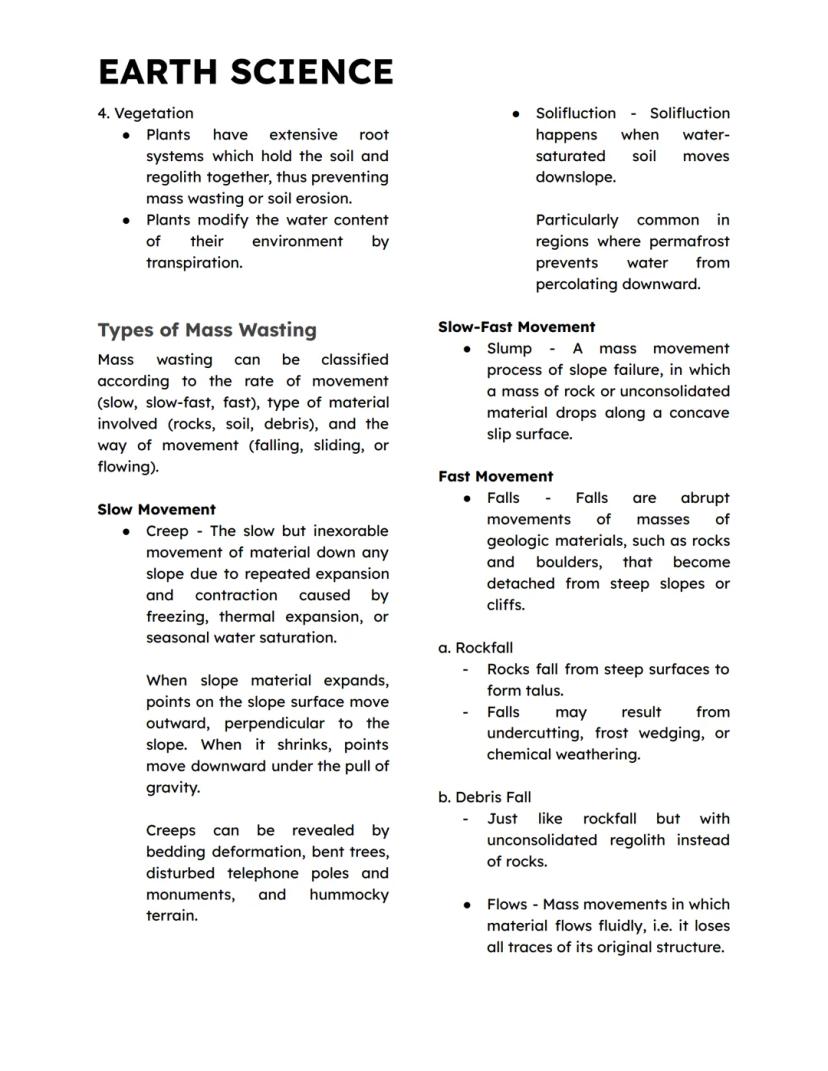
Mass wasting moves at different speeds - some so slow you barely notice, others terrifyingly fast. The speed depends on the material and conditions involved.
Slow movement includes creep and solifluction . You can spot creep by looking for bent trees or tilted fence posts.
Fast movement is where things get dramatic. Falls happen when rocks break away from cliffs and crash down, forming piles of debris called talus. Flows are like nature's cement mixers - mudflows, debris flows, and avalanches that can race along at speeds up to 200 mph!
Remember This: The faster the movement, the more dangerous it becomes. Avalanches and debris flows can destroy entire towns in minutes.
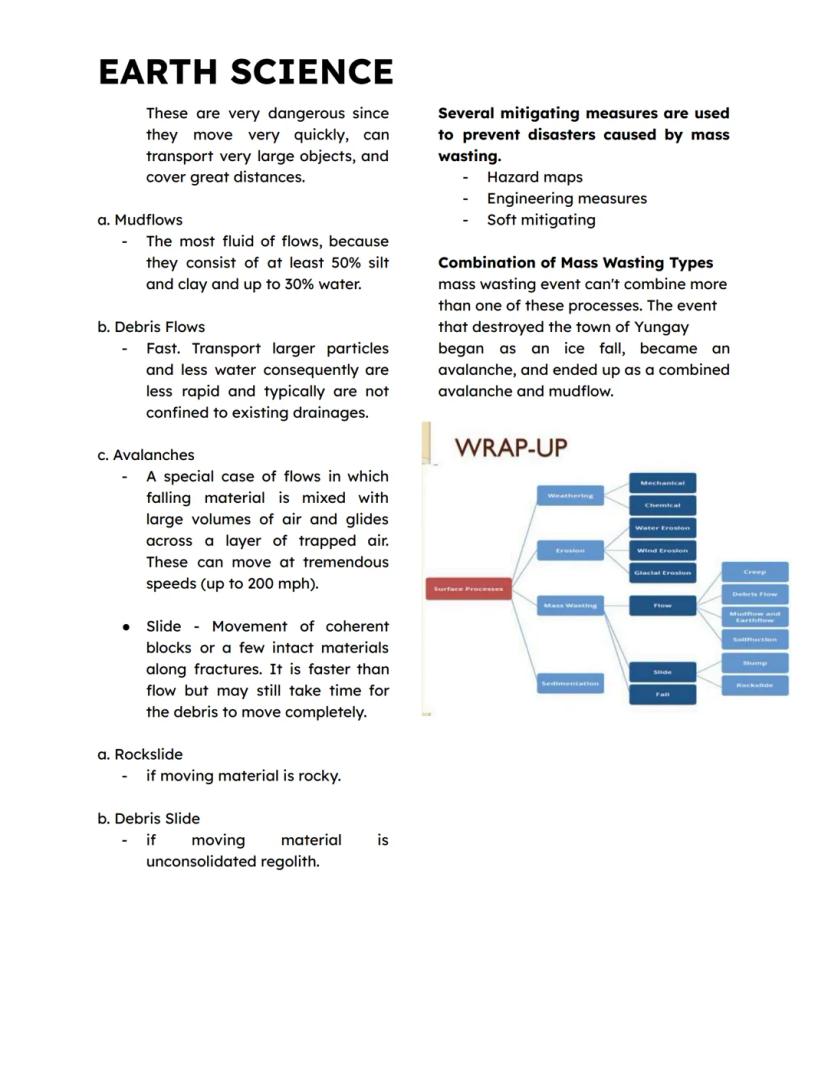
Slides involve chunks of material moving along fractures. Sometimes these processes combine - the disaster that destroyed Yungay started as an ice fall, became an avalanche, then ended as a mudflow.
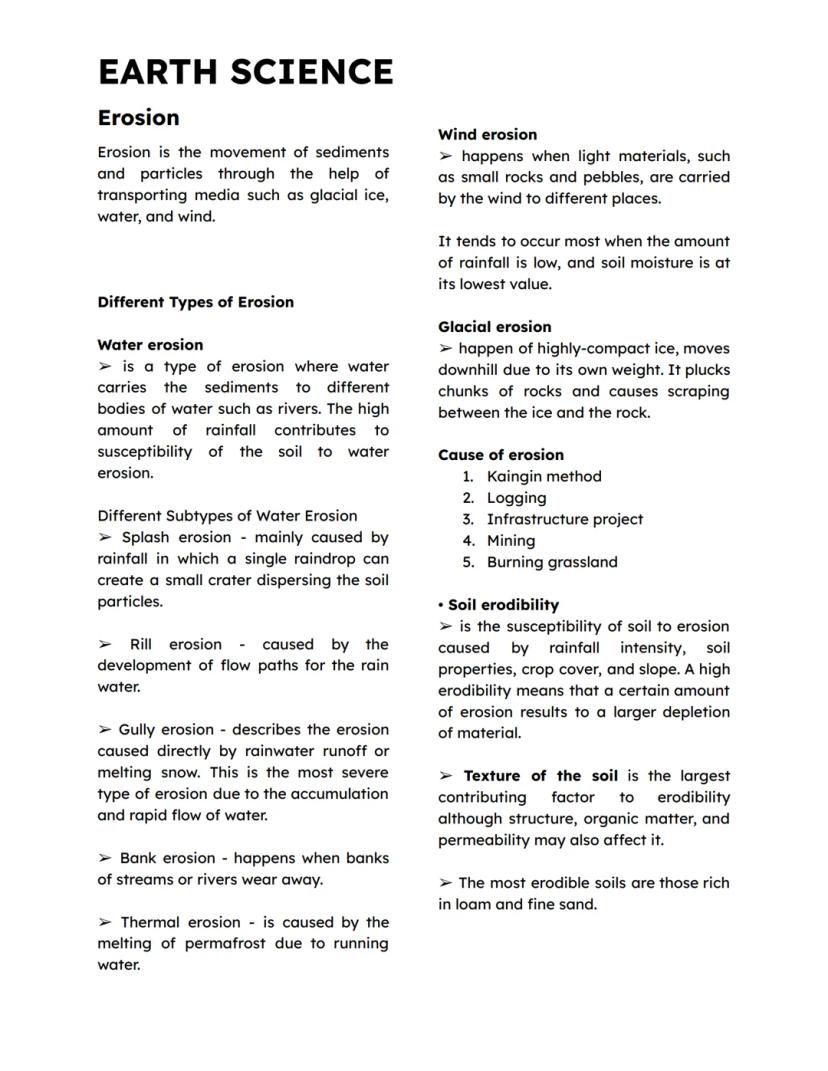
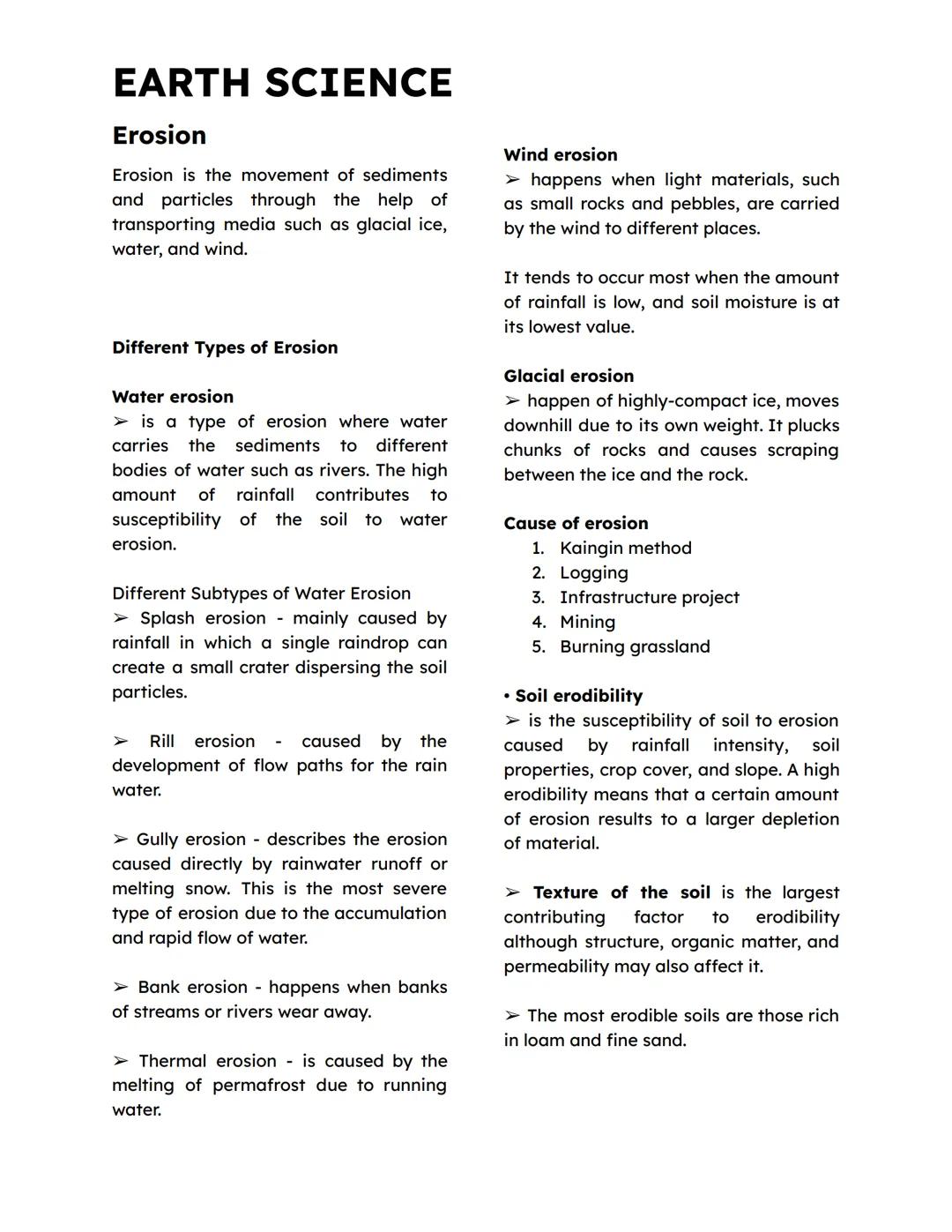
Erosion is like nature's delivery service - it picks up sediments and particles and transports them using water, wind, and ice. Unlike mass wasting, erosion needs a moving agent to carry materials away.
Water erosion is the most common type, especially in our rainy Philippines. It ranges from splash erosion (single raindrops creating tiny craters) to gully erosion (the most severe type where rushing water carves deep channels). Bank erosion wears away riverbanks, while thermal erosion melts permafrost.
Wind erosion carries light materials like sand and small rocks, usually happening in dry areas with low rainfall. Glacial erosion occurs when massive ice chunks scrape and pluck rocks as they move downhill.
Real Talk: Human activities like kaingin farming, logging, and mining are major causes of erosion in the Philippines.
Soil erodibility measures how easily soil gets eroded based on texture, with loam and fine sand being most vulnerable. The effects go beyond just losing topsoil - crops suffer, water gets contaminated, and soil becomes less fertile.
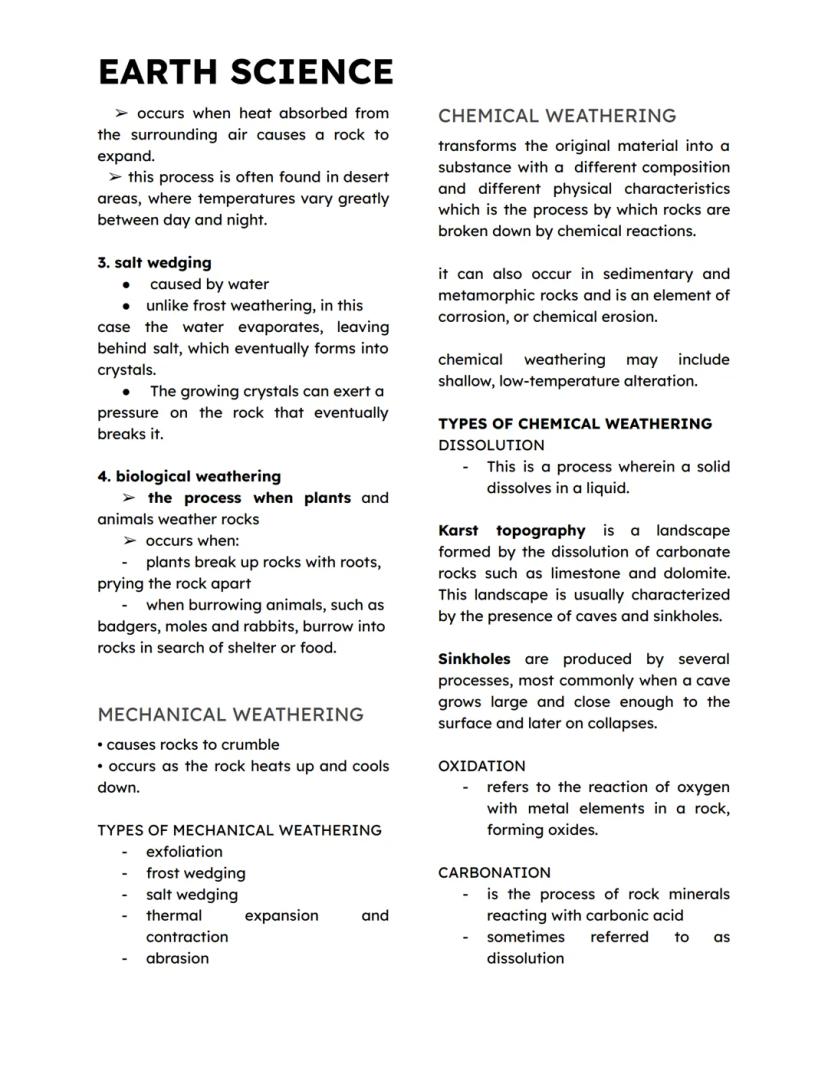
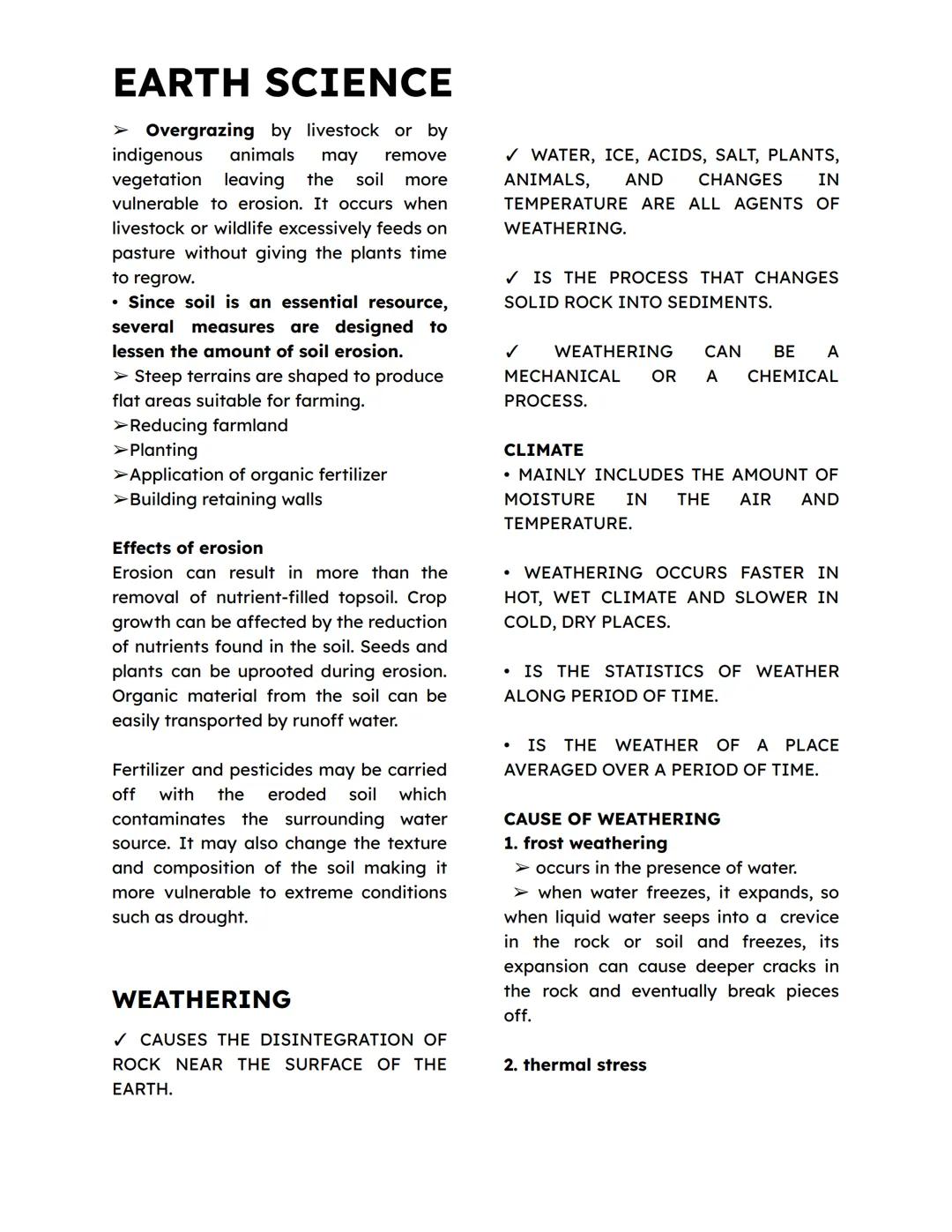
Weathering is nature's way of breaking down solid rock into smaller pieces near Earth's surface. Think of it as the prep work before erosion can do its job of moving materials around.
Climate plays a huge role - hot, wet places like the Philippines experience faster weathering than cold, dry areas. Water, ice, acids, salt, plants, animals, and temperature changes all act as weathering agents.
Mechanical weathering physically breaks rocks apart without changing their composition. Frost weathering happens when water freezes in rock cracks and expands, while thermal stress occurs from heating and cooling cycles. Salt wedging forms crystals that pressure rocks apart, and biological weathering involves plant roots and burrowing animals breaking up rocks.
Cool Fact: Desert areas experience extreme thermal stress because temperatures vary drastically between scorching days and cold nights.
The key causes include frost action, thermal expansion, salt crystal growth, and biological activity. Each process slowly but surely weakens rock structures until they crumble into smaller fragments.
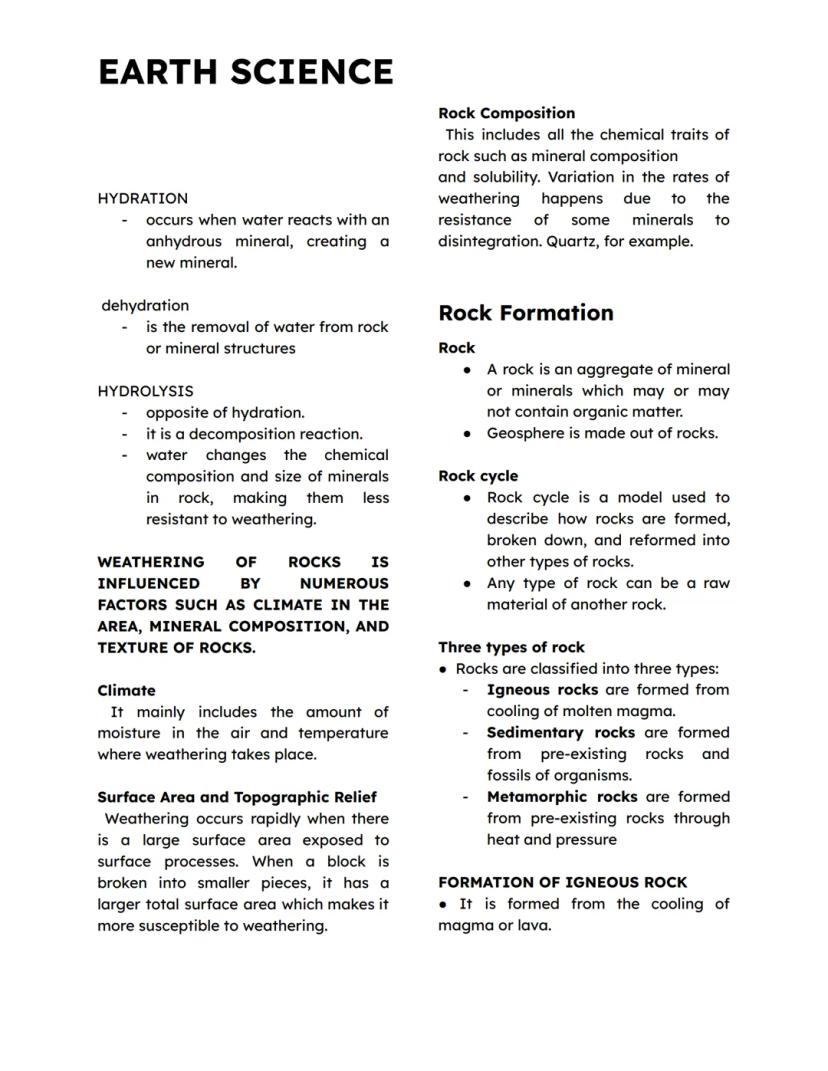
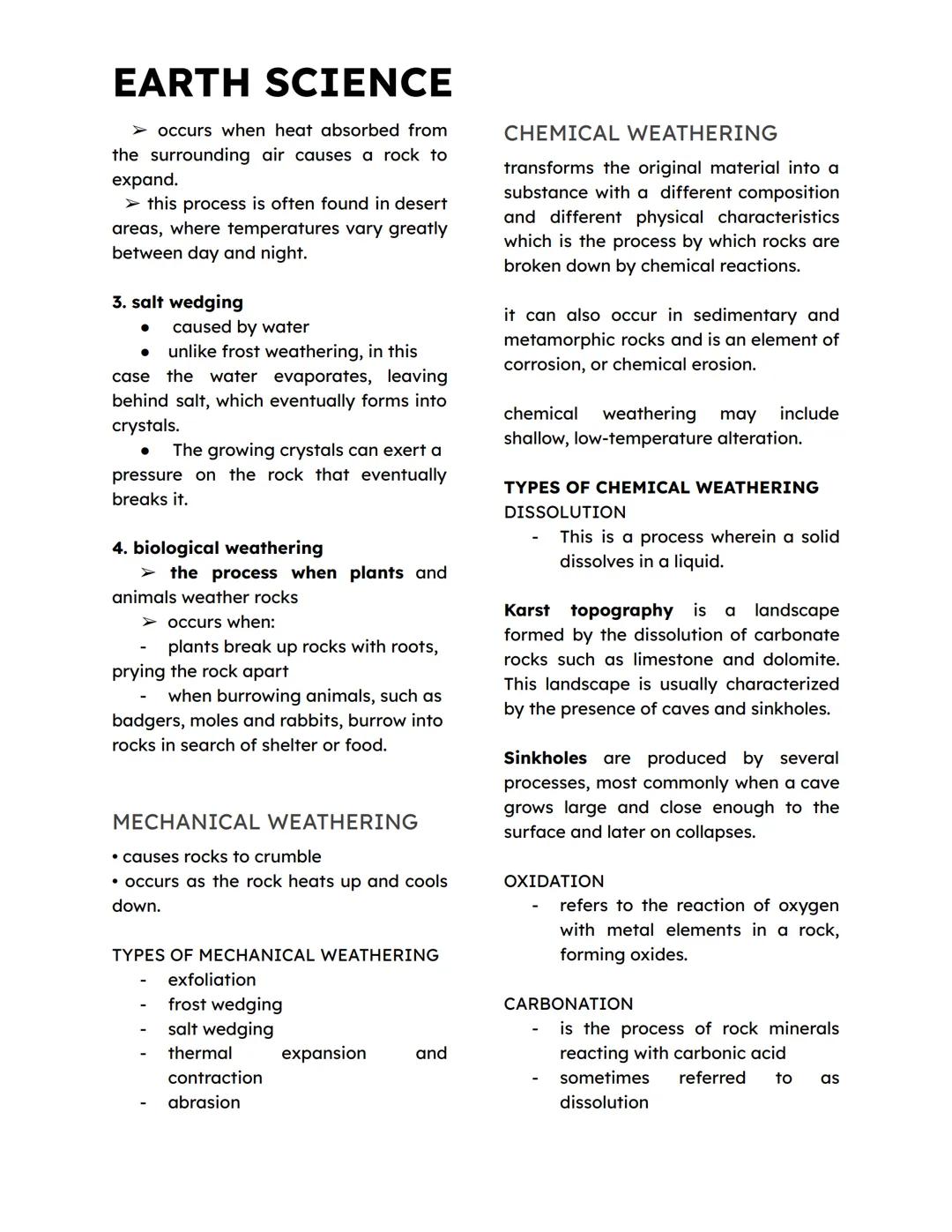
Chemical weathering goes deeper than mechanical weathering - it actually changes the rock's composition and creates entirely new substances. This process transforms original materials through chemical reactions.
Dissolution happens when rocks dissolve in water, creating dramatic karst topography with caves and sinkholes (like those found in Palawan!). Oxidation occurs when oxygen reacts with metal elements, forming rust-like compounds that weaken rocks.
Carbonation involves rock minerals reacting with carbonic acid, while hydration creates new minerals when water combines with existing ones. Hydrolysis is the opposite - it breaks down minerals using water, making them less resistant to further weathering.
Important: Chemical weathering is more intense in tropical climates like ours because heat and moisture speed up chemical reactions.
Factors affecting weathering include climate (temperature and moisture), surface area (smaller pieces weather faster), rock composition (some minerals resist weathering better), and rock formation. Quartz, for example, is super resistant to weathering.
A rock is basically a collection of minerals that might include organic matter. All rocks on Earth go through the rock cycle - a continuous process where rocks form, break down, and transform into other rock types.
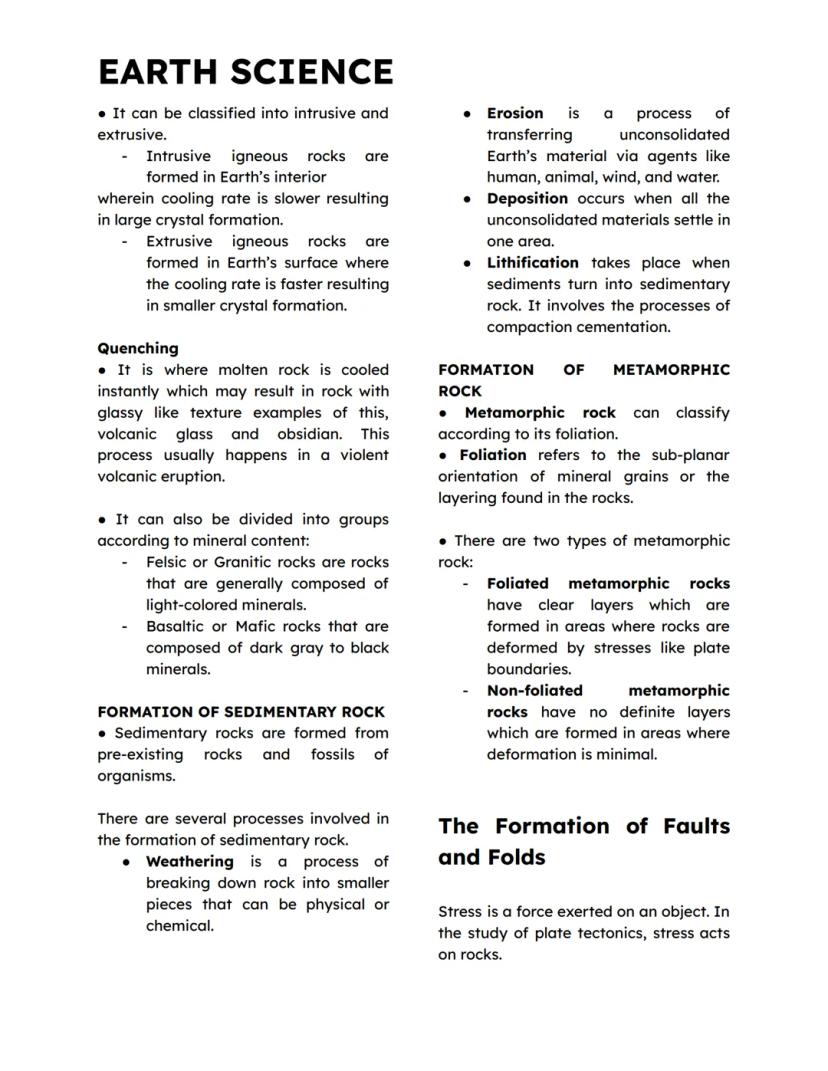
Igneous rocks form when molten magma or lava cools down. Intrusive igneous rocks cool slowly underground, creating large crystals, while extrusive rocks cool quickly on the surface, forming smaller crystals. Quenching happens during explosive eruptions, creating glassy textures like obsidian.
Sedimentary rocks come from pre-existing rocks and organism remains. The process involves weathering (breaking down), erosion (transporting), deposition (settling), and lithification (compacting and cementing sediments together).
Mind-Blowing: Any rock type can become the raw material for any other rock type - it's nature's ultimate recycling program!
Metamorphic rocks form when existing rocks experience heat and pressure. Foliated metamorphic rocks have clear layers (formed under stress), while non-foliated rocks have no definite layers (formed with minimal deformation).
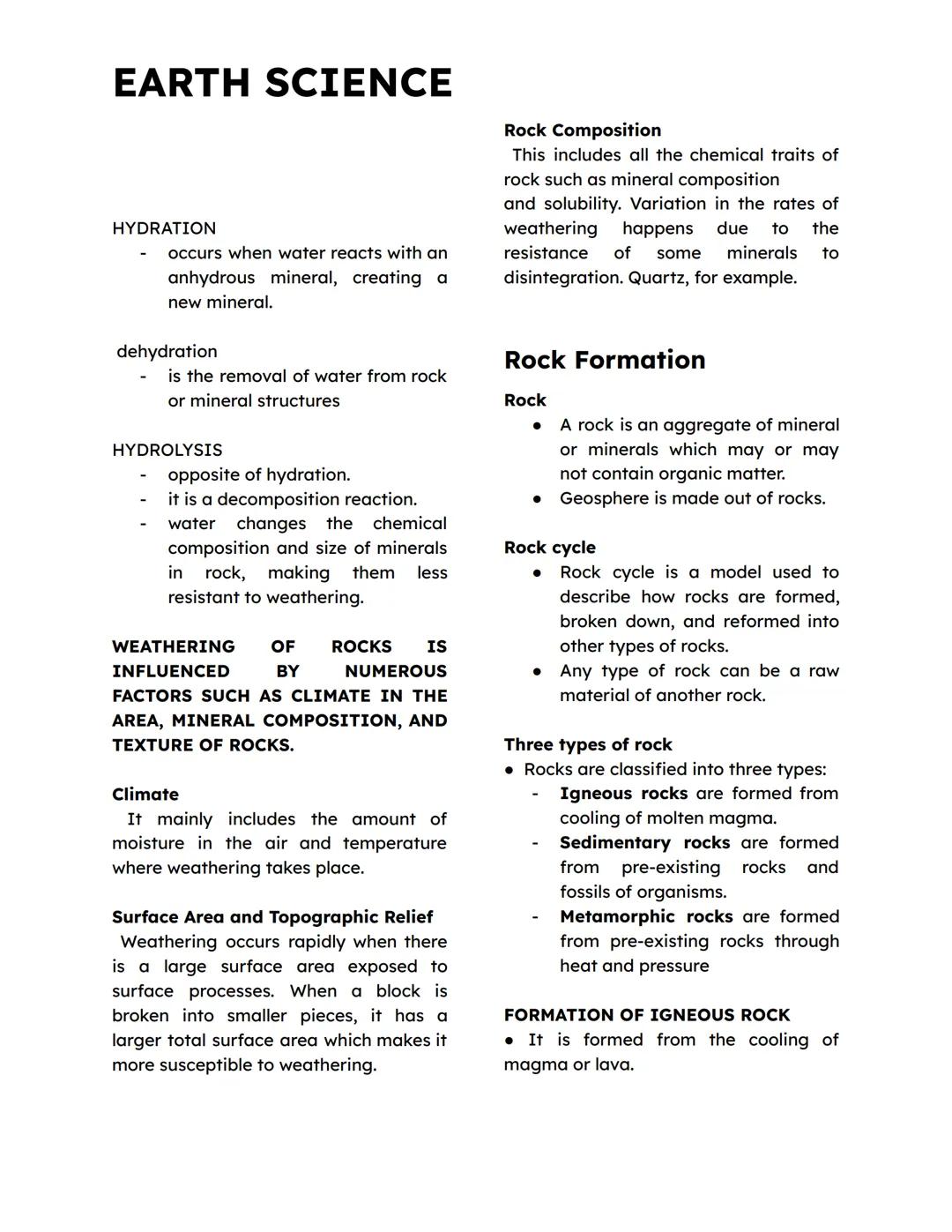
Igneous rocks are classified by cooling location and mineral content. Felsic (granitic) rocks contain light-colored minerals, while mafic (basaltic) rocks are dark-colored. The cooling rate determines crystal size - slow cooling creates big crystals, fast cooling makes tiny ones.
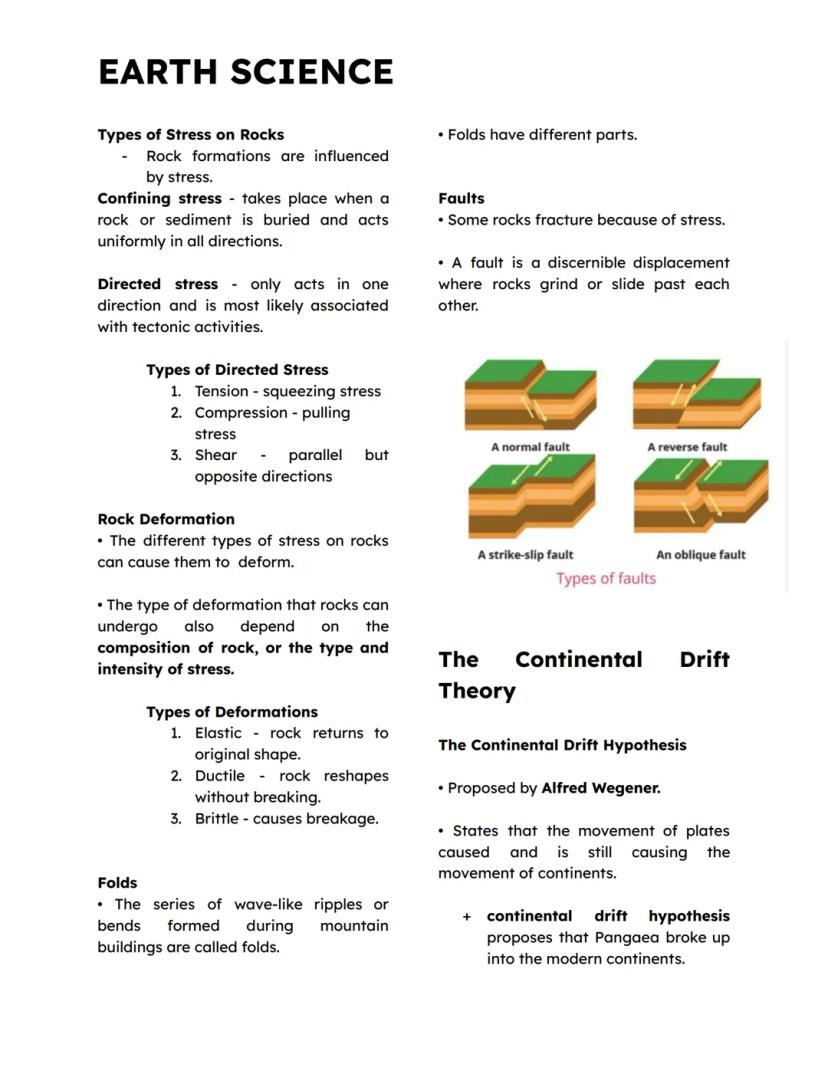
Stress is the force that acts on rocks, especially during tectonic activity. Confining stress acts equally in all directions (like when rocks get buried), while directed stress acts in one direction during tectonic movements.
The three types of directed stress are tension (pulling apart), compression (squeezing together), and shear (sliding past each other). Each creates different geological features and rock deformations.
Key Insight: The type of stress determines whether rocks will fold, fault, or completely break apart.
Rocks respond to stress through elastic deformation (returning to original shape), ductile deformation (reshaping without breaking), or brittle deformation (breaking apart). The response depends on rock composition, temperature, and stress intensity.
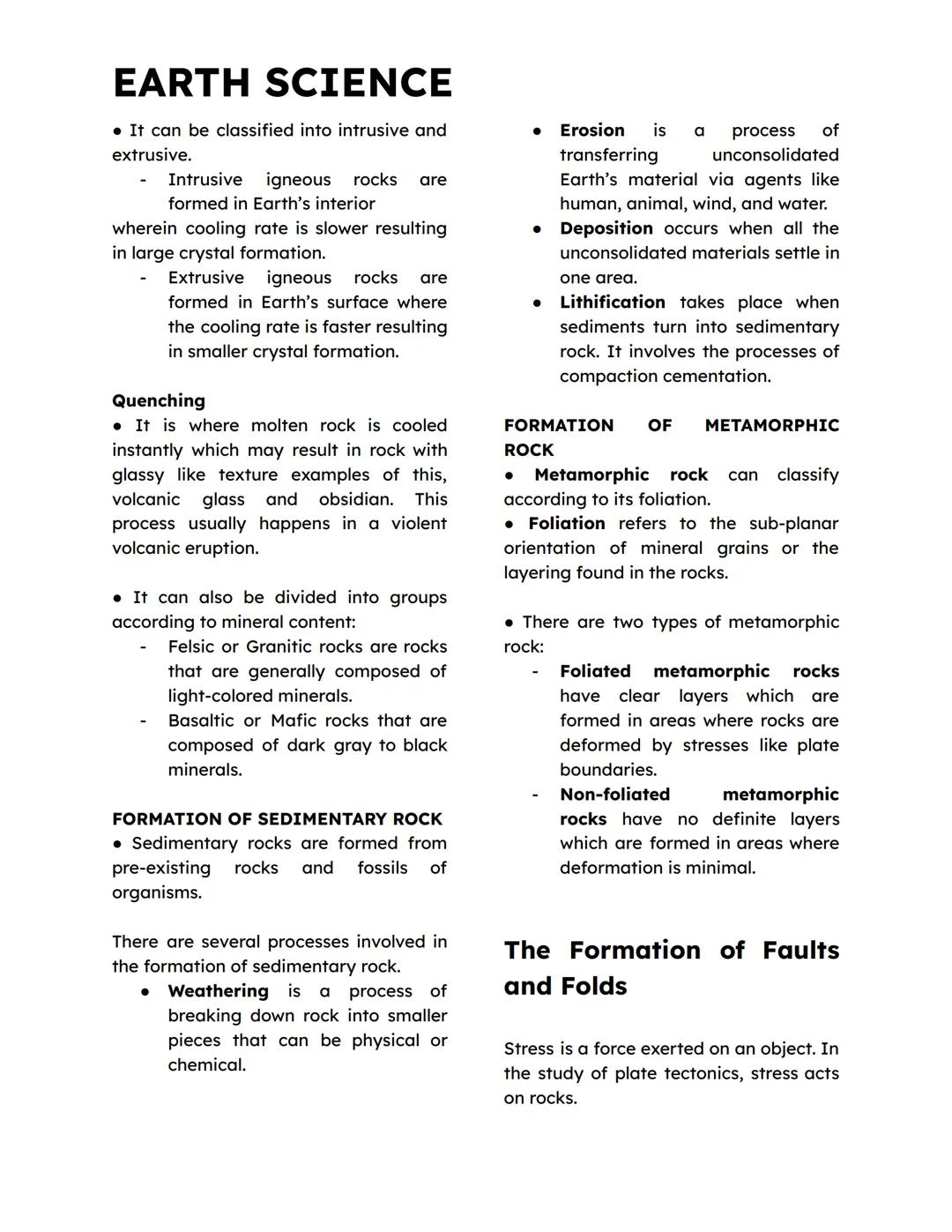
Folds are wave-like bends that form when rocks undergo compression during mountain building. They create those awesome rippled patterns you see in rock layers on mountainsides.
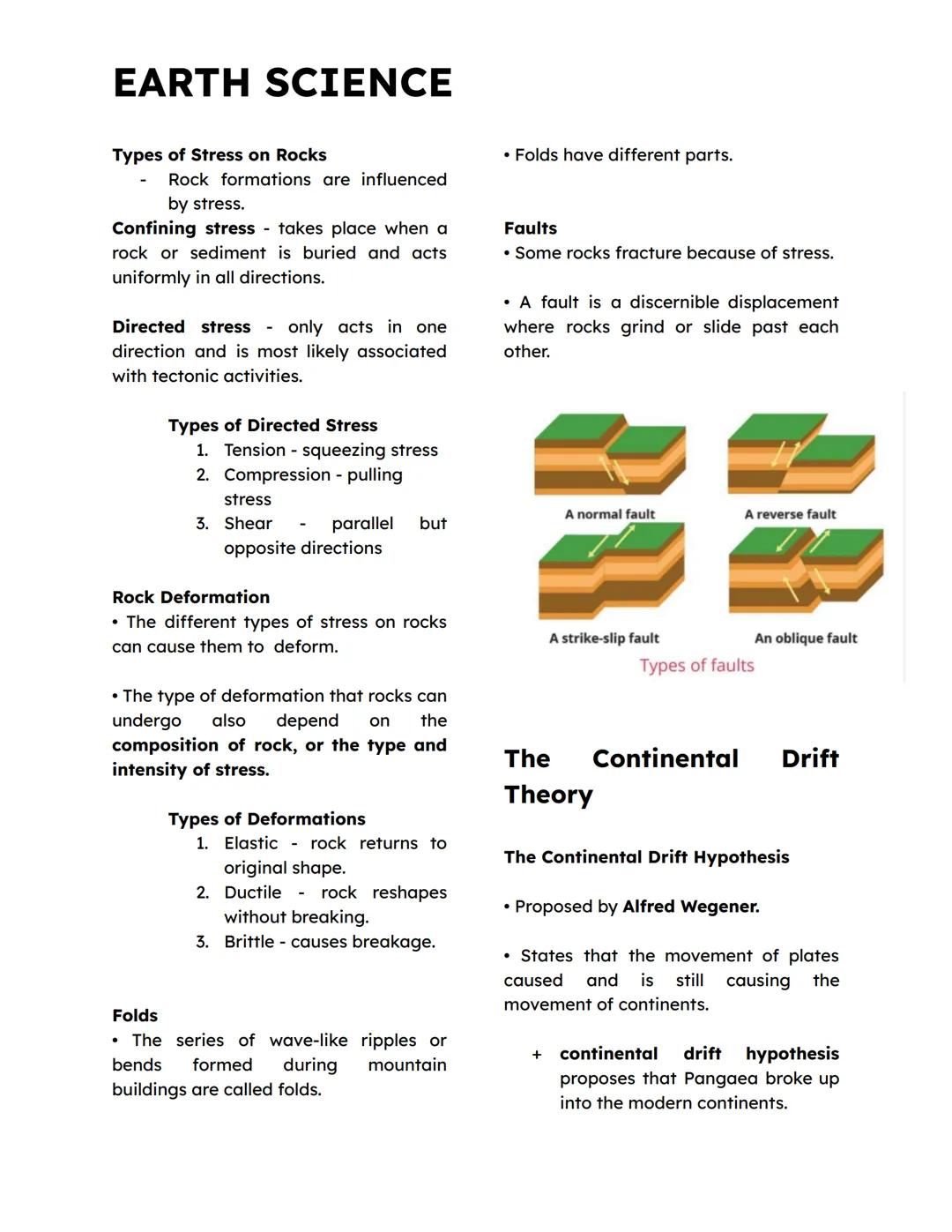
Faults occur when rocks fracture and slide past each other due to stress. There are several types: normal faults (rocks pull apart), reverse faults (rocks push together), strike-slip faults (rocks slide horizontally), and oblique faults (combination movements).
These features are direct evidence of the powerful forces operating inside Earth. They help geologists understand how mountains form and why earthquakes occur in certain areas.
Philippines Connection: Our country sits along the Pacific Ring of Fire, where active faulting creates earthquakes and builds our mountainous landscape.
Understanding folds and faults is crucial for earthquake preparedness and construction planning, especially in tectonically active regions like the Philippines.
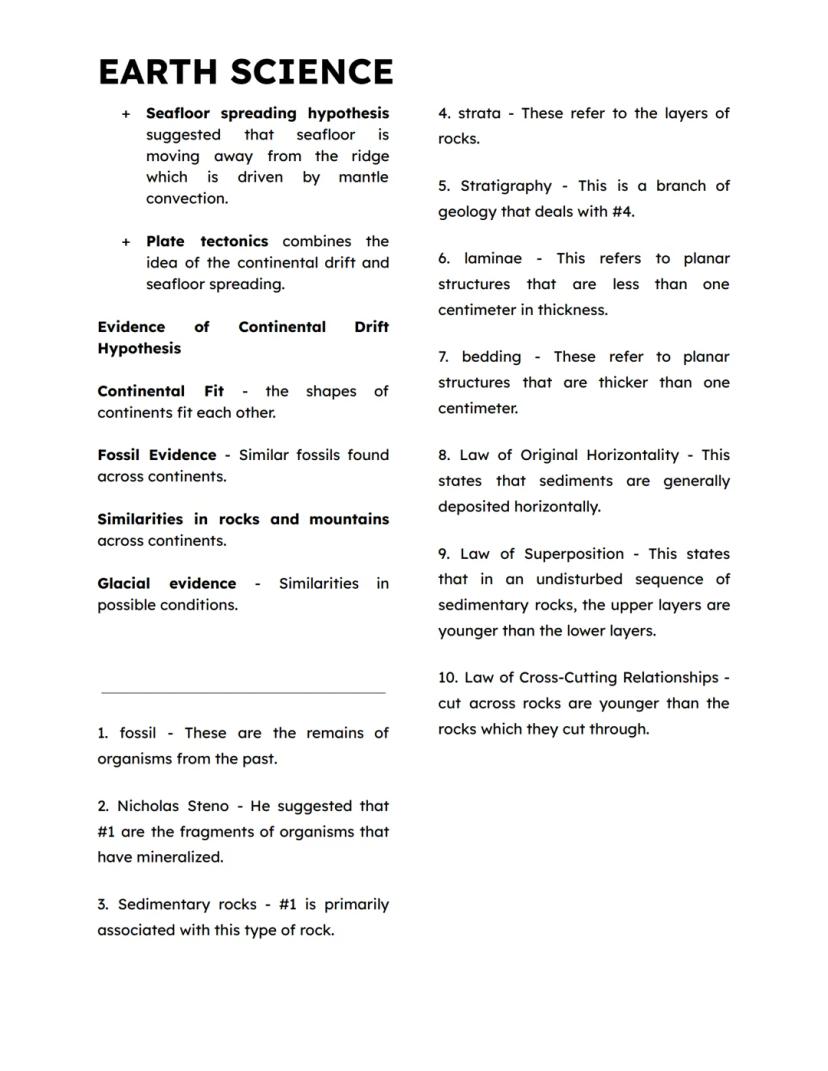
Alfred Wegener proposed the Continental Drift Theory, suggesting that continents have been moving around Earth's surface over millions of years. He believed all continents were once joined in a supercontinent called Pangaea.
The evidence for continental drift is pretty convincing. Continental fit shows how continents' shapes match like puzzle pieces. Fossil evidence reveals identical species found on different continents that are now separated by oceans.
Rock and mountain similarities across continents suggest they were once connected. Glacial evidence shows ice sheet patterns that only make sense if continents were in different positions.
Evolution of Ideas: Wegener's continental drift evolved into seafloor spreading, which eventually became our modern plate tectonics theory.
This theory combines continental drift with seafloor spreading and plate tectonics (explaining how Earth's surface plates move and interact).
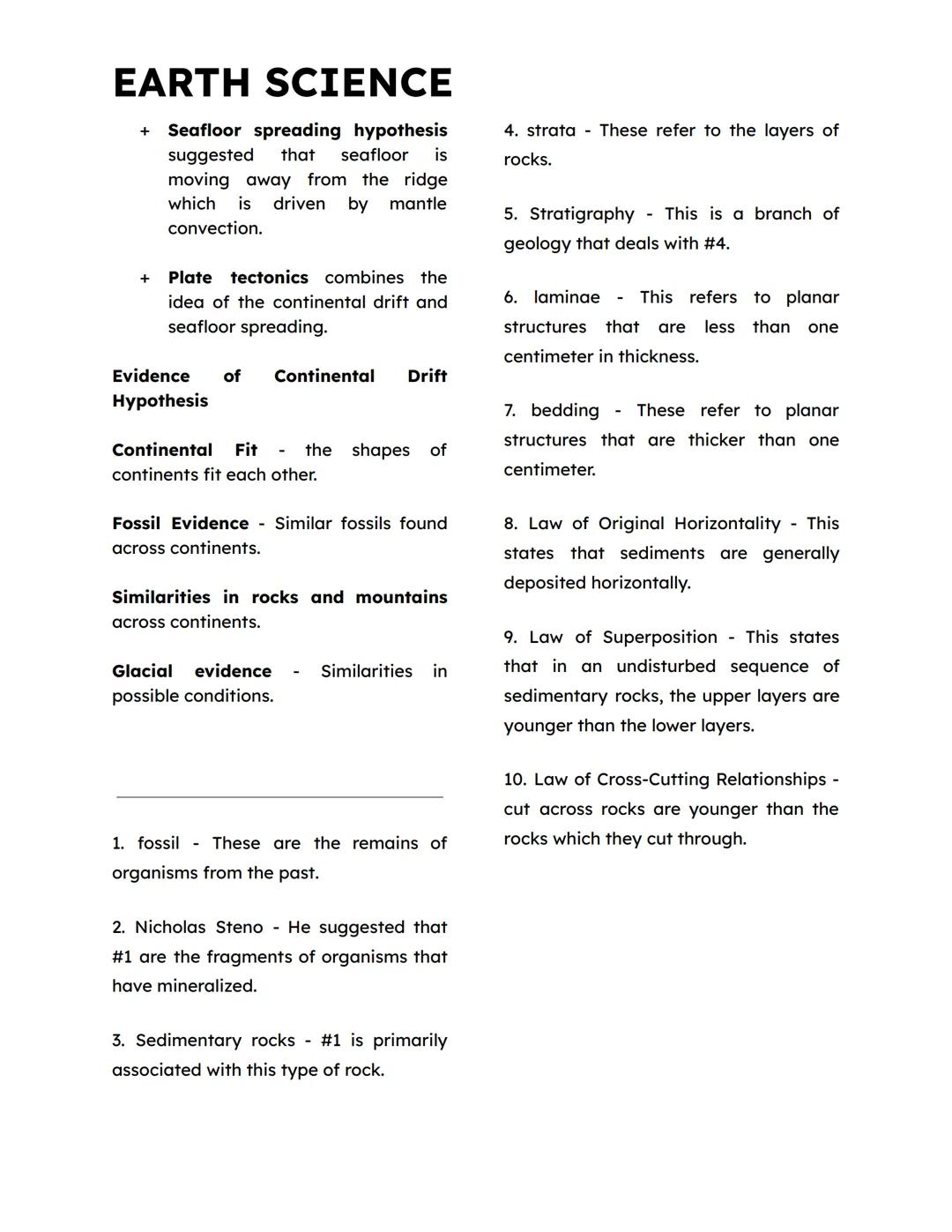
Fossils are remains of ancient organisms preserved in rock, primarily found in sedimentary rocks. Nicholas Steno first suggested that fossils are mineralized fragments of once-living organisms.
Stratigraphy studies rock layers called strata. Laminae are thin layers (less than 1 cm), while bedding refers to thicker layers (more than 1 cm). These layers tell the story of Earth's history.
Three fundamental laws help us interpret rock layers. The Law of Original Horizontality states that sediments deposit in horizontal layers. The Law of Superposition explains that upper layers are younger than lower ones in undisturbed sequences.
Detective Work: Geologists use these laws like detectives, piecing together Earth's history from rock layer clues.
The Law of Cross-Cutting Relationships tells us that any feature cutting through rocks (like a fault or intrusion) is younger than the rocks it cuts through. These principles help determine the relative ages of geological events and create a timeline of Earth's history.
Our AI companion is specifically built for the needs of students. Based on the millions of content pieces we have on the platform we can provide truly meaningful and relevant answers to students. But its not only about answers, the companion is even more about guiding students through their daily learning challenges, with personalised study plans, quizzes or content pieces in the chat and 100% personalisation based on the students skills and developments.
You can download the app in the Google Play Store and in the Apple App Store.
That's right! Enjoy free access to study content, connect with fellow students, and get instant help – all at your fingertips.
App Store
Google Play
The app is very easy to use and well designed. I have found everything I was looking for so far and have been able to learn a lot from the presentations! I will definitely use the app for a class assignment! And of course it also helps a lot as an inspiration.
Stefan S
iOS user
This app is really great. There are so many study notes and help [...]. My problem subject is French, for example, and the app has so many options for help. Thanks to this app, I have improved my French. I would recommend it to anyone.
Samantha Klich
Android user
Wow, I am really amazed. I just tried the app because I've seen it advertised many times and was absolutely stunned. This app is THE HELP you want for school and above all, it offers so many things, such as workouts and fact sheets, which have been VERY helpful to me personally.
Anna
iOS user
I think it’s very much worth it and you’ll end up using it a lot once you get the hang of it and even after looking at others notes you can still ask your Artificial intelligence buddy the question and ask to simplify it if you still don’t get it!!! In the end I think it’s worth it 😊👍 ⚠️Also DID I MENTION ITS FREEE YOU DON’T HAVE TO PAY FOR ANYTHING AND STILL GET YOUR GRADES IN PERFECTLY❗️❗️⚠️
Thomas R
iOS user
Knowunity is the BEST app I’ve used in a minute. This is not an ai review or anything this is genuinely coming from a 7th grade student (I know 2011 im young) but dude this app is a 10/10 i have maintained a 3.8 gpa and have plenty of time for gaming. I love it and my mom is just happy I got good grades
Brad T
Android user
Not only did it help me find the answer but it also showed me alternative ways to solve it. I was horrible in math and science but now I have an a in both subjects. Thanks for the help🤍🤍
David K
iOS user
The app's just great! All I have to do is enter the topic in the search bar and I get the response real fast. I don't have to watch 10 YouTube videos to understand something, so I'm saving my time. Highly recommended!
Sudenaz Ocak
Android user
In school I was really bad at maths but thanks to the app, I am doing better now. I am so grateful that you made the app.
Greenlight Bonnie
Android user
I found this app a couple years ago and it has only gotten better since then. I really love it because it can help with written questions and photo questions. Also, it can find study guides that other people have made as well as flashcard sets and practice tests. The free version is also amazing for students who might not be able to afford it. Would 100% recommend
Aubrey
iOS user
Best app if you're in Highschool or Junior high. I have been using this app for 2 school years and it's the best, it's good if you don't have anyone to help you with school work.😋🩷🎀
Marco B
iOS user
THE QUIZES AND FLASHCARDS ARE SO USEFUL AND I LOVE THE SCHOOLGPT. IT ALSO IS LITREALLY LIKE CHATGPT BUT SMARTER!! HELPED ME WITH MY MASCARA PROBLEMS TOO!! AS WELL AS MY REAL SUBJECTS ! DUHHH 😍😁😲🤑💗✨🎀😮
Elisha
iOS user
This app is phenomenal down to the correct info and the various topics you can study! I greatly recommend it for people who struggle with procrastination and those who need homework help. It has been perfectly accurate for world 1 history as far as I’ve seen! Geometry too!
Paul T
iOS user
The app is very easy to use and well designed. I have found everything I was looking for so far and have been able to learn a lot from the presentations! I will definitely use the app for a class assignment! And of course it also helps a lot as an inspiration.
Stefan S
iOS user
This app is really great. There are so many study notes and help [...]. My problem subject is French, for example, and the app has so many options for help. Thanks to this app, I have improved my French. I would recommend it to anyone.
Samantha Klich
Android user
Wow, I am really amazed. I just tried the app because I've seen it advertised many times and was absolutely stunned. This app is THE HELP you want for school and above all, it offers so many things, such as workouts and fact sheets, which have been VERY helpful to me personally.
Anna
iOS user
I think it’s very much worth it and you’ll end up using it a lot once you get the hang of it and even after looking at others notes you can still ask your Artificial intelligence buddy the question and ask to simplify it if you still don’t get it!!! In the end I think it’s worth it 😊👍 ⚠️Also DID I MENTION ITS FREEE YOU DON’T HAVE TO PAY FOR ANYTHING AND STILL GET YOUR GRADES IN PERFECTLY❗️❗️⚠️
Thomas R
iOS user
Knowunity is the BEST app I’ve used in a minute. This is not an ai review or anything this is genuinely coming from a 7th grade student (I know 2011 im young) but dude this app is a 10/10 i have maintained a 3.8 gpa and have plenty of time for gaming. I love it and my mom is just happy I got good grades
Brad T
Android user
Not only did it help me find the answer but it also showed me alternative ways to solve it. I was horrible in math and science but now I have an a in both subjects. Thanks for the help🤍🤍
David K
iOS user
The app's just great! All I have to do is enter the topic in the search bar and I get the response real fast. I don't have to watch 10 YouTube videos to understand something, so I'm saving my time. Highly recommended!
Sudenaz Ocak
Android user
In school I was really bad at maths but thanks to the app, I am doing better now. I am so grateful that you made the app.
Greenlight Bonnie
Android user
I found this app a couple years ago and it has only gotten better since then. I really love it because it can help with written questions and photo questions. Also, it can find study guides that other people have made as well as flashcard sets and practice tests. The free version is also amazing for students who might not be able to afford it. Would 100% recommend
Aubrey
iOS user
Best app if you're in Highschool or Junior high. I have been using this app for 2 school years and it's the best, it's good if you don't have anyone to help you with school work.😋🩷🎀
Marco B
iOS user
THE QUIZES AND FLASHCARDS ARE SO USEFUL AND I LOVE THE SCHOOLGPT. IT ALSO IS LITREALLY LIKE CHATGPT BUT SMARTER!! HELPED ME WITH MY MASCARA PROBLEMS TOO!! AS WELL AS MY REAL SUBJECTS ! DUHHH 😍😁😲🤑💗✨🎀😮
Elisha
iOS user
This app is phenomenal down to the correct info and the various topics you can study! I greatly recommend it for people who struggle with procrastination and those who need homework help. It has been perfectly accurate for world 1 history as far as I’ve seen! Geometry too!
Paul T
iOS user
sam ⋆𐙚₊˚⊹♡
@samantha.badiola_
Ever wonder why mountains crumble and continents shift over time? This Earth Science guide breaks down the powerful forces that shape our planet - from landslides and erosion to the formation of rocks and movement of continents. You'll discover how... Show more
Access to all documents
Improve your grades
Join milions of students
By signing up you accept Terms of Service and Privacy Policy
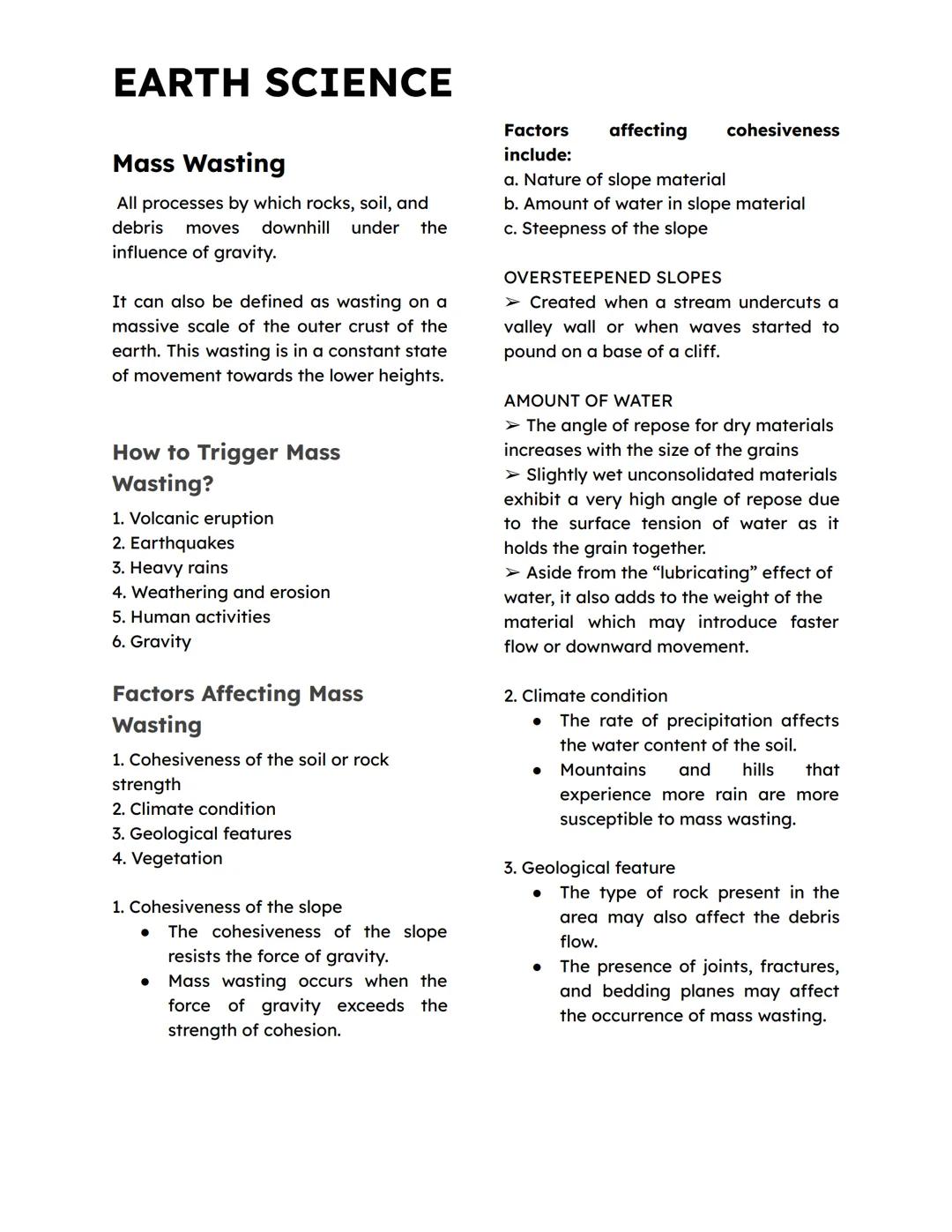
Picture a landslide racing down a mountainside - that's mass wasting in action! It's basically all the ways that rocks, soil, and debris move downhill because gravity never takes a break.
Triggers that can set off mass wasting include volcanic eruptions, earthquakes, heavy rains, weathering, human activities, and of course, gravity itself. Think of it like the final straw that breaks the camel's back.
The main factor is cohesiveness - how well the slope material sticks together versus how hard gravity pulls it down. When gravity wins, stuff starts sliding! Things like water content, steepness of the slope, and the type of material all affect this battle.
Key Point: Mass wasting happens when gravity's pull becomes stronger than the forces holding slope materials together.
Climate, geology, and vegetation also play huge roles. Mountains that get lots of rain are more prone to mass wasting, while plants with deep roots act like nature's glue, holding soil in place through their root systems.
Access to all documents
Improve your grades
Join milions of students
By signing up you accept Terms of Service and Privacy Policy
Mass wasting moves at different speeds - some so slow you barely notice, others terrifyingly fast. The speed depends on the material and conditions involved.
Slow movement includes creep and solifluction . You can spot creep by looking for bent trees or tilted fence posts.
Fast movement is where things get dramatic. Falls happen when rocks break away from cliffs and crash down, forming piles of debris called talus. Flows are like nature's cement mixers - mudflows, debris flows, and avalanches that can race along at speeds up to 200 mph!
Remember This: The faster the movement, the more dangerous it becomes. Avalanches and debris flows can destroy entire towns in minutes.
Slides involve chunks of material moving along fractures. Sometimes these processes combine - the disaster that destroyed Yungay started as an ice fall, became an avalanche, then ended as a mudflow.
Access to all documents
Improve your grades
Join milions of students
By signing up you accept Terms of Service and Privacy Policy
Erosion is like nature's delivery service - it picks up sediments and particles and transports them using water, wind, and ice. Unlike mass wasting, erosion needs a moving agent to carry materials away.
Water erosion is the most common type, especially in our rainy Philippines. It ranges from splash erosion (single raindrops creating tiny craters) to gully erosion (the most severe type where rushing water carves deep channels). Bank erosion wears away riverbanks, while thermal erosion melts permafrost.
Wind erosion carries light materials like sand and small rocks, usually happening in dry areas with low rainfall. Glacial erosion occurs when massive ice chunks scrape and pluck rocks as they move downhill.
Real Talk: Human activities like kaingin farming, logging, and mining are major causes of erosion in the Philippines.
Soil erodibility measures how easily soil gets eroded based on texture, with loam and fine sand being most vulnerable. The effects go beyond just losing topsoil - crops suffer, water gets contaminated, and soil becomes less fertile.
Access to all documents
Improve your grades
Join milions of students
By signing up you accept Terms of Service and Privacy Policy
Weathering is nature's way of breaking down solid rock into smaller pieces near Earth's surface. Think of it as the prep work before erosion can do its job of moving materials around.
Climate plays a huge role - hot, wet places like the Philippines experience faster weathering than cold, dry areas. Water, ice, acids, salt, plants, animals, and temperature changes all act as weathering agents.
Mechanical weathering physically breaks rocks apart without changing their composition. Frost weathering happens when water freezes in rock cracks and expands, while thermal stress occurs from heating and cooling cycles. Salt wedging forms crystals that pressure rocks apart, and biological weathering involves plant roots and burrowing animals breaking up rocks.
Cool Fact: Desert areas experience extreme thermal stress because temperatures vary drastically between scorching days and cold nights.
The key causes include frost action, thermal expansion, salt crystal growth, and biological activity. Each process slowly but surely weakens rock structures until they crumble into smaller fragments.
Access to all documents
Improve your grades
Join milions of students
By signing up you accept Terms of Service and Privacy Policy
Chemical weathering goes deeper than mechanical weathering - it actually changes the rock's composition and creates entirely new substances. This process transforms original materials through chemical reactions.
Dissolution happens when rocks dissolve in water, creating dramatic karst topography with caves and sinkholes (like those found in Palawan!). Oxidation occurs when oxygen reacts with metal elements, forming rust-like compounds that weaken rocks.
Carbonation involves rock minerals reacting with carbonic acid, while hydration creates new minerals when water combines with existing ones. Hydrolysis is the opposite - it breaks down minerals using water, making them less resistant to further weathering.
Important: Chemical weathering is more intense in tropical climates like ours because heat and moisture speed up chemical reactions.
Factors affecting weathering include climate (temperature and moisture), surface area (smaller pieces weather faster), rock composition (some minerals resist weathering better), and rock formation. Quartz, for example, is super resistant to weathering.
Access to all documents
Improve your grades
Join milions of students
By signing up you accept Terms of Service and Privacy Policy
A rock is basically a collection of minerals that might include organic matter. All rocks on Earth go through the rock cycle - a continuous process where rocks form, break down, and transform into other rock types.
Igneous rocks form when molten magma or lava cools down. Intrusive igneous rocks cool slowly underground, creating large crystals, while extrusive rocks cool quickly on the surface, forming smaller crystals. Quenching happens during explosive eruptions, creating glassy textures like obsidian.
Sedimentary rocks come from pre-existing rocks and organism remains. The process involves weathering (breaking down), erosion (transporting), deposition (settling), and lithification (compacting and cementing sediments together).
Mind-Blowing: Any rock type can become the raw material for any other rock type - it's nature's ultimate recycling program!
Metamorphic rocks form when existing rocks experience heat and pressure. Foliated metamorphic rocks have clear layers (formed under stress), while non-foliated rocks have no definite layers (formed with minimal deformation).
Access to all documents
Improve your grades
Join milions of students
By signing up you accept Terms of Service and Privacy Policy
Igneous rocks are classified by cooling location and mineral content. Felsic (granitic) rocks contain light-colored minerals, while mafic (basaltic) rocks are dark-colored. The cooling rate determines crystal size - slow cooling creates big crystals, fast cooling makes tiny ones.
Stress is the force that acts on rocks, especially during tectonic activity. Confining stress acts equally in all directions (like when rocks get buried), while directed stress acts in one direction during tectonic movements.
The three types of directed stress are tension (pulling apart), compression (squeezing together), and shear (sliding past each other). Each creates different geological features and rock deformations.
Key Insight: The type of stress determines whether rocks will fold, fault, or completely break apart.
Rocks respond to stress through elastic deformation (returning to original shape), ductile deformation (reshaping without breaking), or brittle deformation (breaking apart). The response depends on rock composition, temperature, and stress intensity.
Access to all documents
Improve your grades
Join milions of students
By signing up you accept Terms of Service and Privacy Policy
Folds are wave-like bends that form when rocks undergo compression during mountain building. They create those awesome rippled patterns you see in rock layers on mountainsides.
Faults occur when rocks fracture and slide past each other due to stress. There are several types: normal faults (rocks pull apart), reverse faults (rocks push together), strike-slip faults (rocks slide horizontally), and oblique faults (combination movements).
These features are direct evidence of the powerful forces operating inside Earth. They help geologists understand how mountains form and why earthquakes occur in certain areas.
Philippines Connection: Our country sits along the Pacific Ring of Fire, where active faulting creates earthquakes and builds our mountainous landscape.
Understanding folds and faults is crucial for earthquake preparedness and construction planning, especially in tectonically active regions like the Philippines.
Access to all documents
Improve your grades
Join milions of students
By signing up you accept Terms of Service and Privacy Policy
Alfred Wegener proposed the Continental Drift Theory, suggesting that continents have been moving around Earth's surface over millions of years. He believed all continents were once joined in a supercontinent called Pangaea.
The evidence for continental drift is pretty convincing. Continental fit shows how continents' shapes match like puzzle pieces. Fossil evidence reveals identical species found on different continents that are now separated by oceans.
Rock and mountain similarities across continents suggest they were once connected. Glacial evidence shows ice sheet patterns that only make sense if continents were in different positions.
Evolution of Ideas: Wegener's continental drift evolved into seafloor spreading, which eventually became our modern plate tectonics theory.
This theory combines continental drift with seafloor spreading and plate tectonics (explaining how Earth's surface plates move and interact).
Access to all documents
Improve your grades
Join milions of students
By signing up you accept Terms of Service and Privacy Policy
Fossils are remains of ancient organisms preserved in rock, primarily found in sedimentary rocks. Nicholas Steno first suggested that fossils are mineralized fragments of once-living organisms.
Stratigraphy studies rock layers called strata. Laminae are thin layers (less than 1 cm), while bedding refers to thicker layers (more than 1 cm). These layers tell the story of Earth's history.
Three fundamental laws help us interpret rock layers. The Law of Original Horizontality states that sediments deposit in horizontal layers. The Law of Superposition explains that upper layers are younger than lower ones in undisturbed sequences.
Detective Work: Geologists use these laws like detectives, piecing together Earth's history from rock layer clues.
The Law of Cross-Cutting Relationships tells us that any feature cutting through rocks (like a fault or intrusion) is younger than the rocks it cuts through. These principles help determine the relative ages of geological events and create a timeline of Earth's history.
Our AI companion is specifically built for the needs of students. Based on the millions of content pieces we have on the platform we can provide truly meaningful and relevant answers to students. But its not only about answers, the companion is even more about guiding students through their daily learning challenges, with personalised study plans, quizzes or content pieces in the chat and 100% personalisation based on the students skills and developments.
You can download the app in the Google Play Store and in the Apple App Store.
That's right! Enjoy free access to study content, connect with fellow students, and get instant help – all at your fingertips.
7
Smart Tools NEW
Transform this note into: ✓ 50+ Practice Questions ✓ Interactive Flashcards ✓ Full Mock Exam ✓ Essay Outlines
App Store
Google Play
The app is very easy to use and well designed. I have found everything I was looking for so far and have been able to learn a lot from the presentations! I will definitely use the app for a class assignment! And of course it also helps a lot as an inspiration.
Stefan S
iOS user
This app is really great. There are so many study notes and help [...]. My problem subject is French, for example, and the app has so many options for help. Thanks to this app, I have improved my French. I would recommend it to anyone.
Samantha Klich
Android user
Wow, I am really amazed. I just tried the app because I've seen it advertised many times and was absolutely stunned. This app is THE HELP you want for school and above all, it offers so many things, such as workouts and fact sheets, which have been VERY helpful to me personally.
Anna
iOS user
I think it’s very much worth it and you’ll end up using it a lot once you get the hang of it and even after looking at others notes you can still ask your Artificial intelligence buddy the question and ask to simplify it if you still don’t get it!!! In the end I think it’s worth it 😊👍 ⚠️Also DID I MENTION ITS FREEE YOU DON’T HAVE TO PAY FOR ANYTHING AND STILL GET YOUR GRADES IN PERFECTLY❗️❗️⚠️
Thomas R
iOS user
Knowunity is the BEST app I’ve used in a minute. This is not an ai review or anything this is genuinely coming from a 7th grade student (I know 2011 im young) but dude this app is a 10/10 i have maintained a 3.8 gpa and have plenty of time for gaming. I love it and my mom is just happy I got good grades
Brad T
Android user
Not only did it help me find the answer but it also showed me alternative ways to solve it. I was horrible in math and science but now I have an a in both subjects. Thanks for the help🤍🤍
David K
iOS user
The app's just great! All I have to do is enter the topic in the search bar and I get the response real fast. I don't have to watch 10 YouTube videos to understand something, so I'm saving my time. Highly recommended!
Sudenaz Ocak
Android user
In school I was really bad at maths but thanks to the app, I am doing better now. I am so grateful that you made the app.
Greenlight Bonnie
Android user
I found this app a couple years ago and it has only gotten better since then. I really love it because it can help with written questions and photo questions. Also, it can find study guides that other people have made as well as flashcard sets and practice tests. The free version is also amazing for students who might not be able to afford it. Would 100% recommend
Aubrey
iOS user
Best app if you're in Highschool or Junior high. I have been using this app for 2 school years and it's the best, it's good if you don't have anyone to help you with school work.😋🩷🎀
Marco B
iOS user
THE QUIZES AND FLASHCARDS ARE SO USEFUL AND I LOVE THE SCHOOLGPT. IT ALSO IS LITREALLY LIKE CHATGPT BUT SMARTER!! HELPED ME WITH MY MASCARA PROBLEMS TOO!! AS WELL AS MY REAL SUBJECTS ! DUHHH 😍😁😲🤑💗✨🎀😮
Elisha
iOS user
This app is phenomenal down to the correct info and the various topics you can study! I greatly recommend it for people who struggle with procrastination and those who need homework help. It has been perfectly accurate for world 1 history as far as I’ve seen! Geometry too!
Paul T
iOS user
The app is very easy to use and well designed. I have found everything I was looking for so far and have been able to learn a lot from the presentations! I will definitely use the app for a class assignment! And of course it also helps a lot as an inspiration.
Stefan S
iOS user
This app is really great. There are so many study notes and help [...]. My problem subject is French, for example, and the app has so many options for help. Thanks to this app, I have improved my French. I would recommend it to anyone.
Samantha Klich
Android user
Wow, I am really amazed. I just tried the app because I've seen it advertised many times and was absolutely stunned. This app is THE HELP you want for school and above all, it offers so many things, such as workouts and fact sheets, which have been VERY helpful to me personally.
Anna
iOS user
I think it’s very much worth it and you’ll end up using it a lot once you get the hang of it and even after looking at others notes you can still ask your Artificial intelligence buddy the question and ask to simplify it if you still don’t get it!!! In the end I think it’s worth it 😊👍 ⚠️Also DID I MENTION ITS FREEE YOU DON’T HAVE TO PAY FOR ANYTHING AND STILL GET YOUR GRADES IN PERFECTLY❗️❗️⚠️
Thomas R
iOS user
Knowunity is the BEST app I’ve used in a minute. This is not an ai review or anything this is genuinely coming from a 7th grade student (I know 2011 im young) but dude this app is a 10/10 i have maintained a 3.8 gpa and have plenty of time for gaming. I love it and my mom is just happy I got good grades
Brad T
Android user
Not only did it help me find the answer but it also showed me alternative ways to solve it. I was horrible in math and science but now I have an a in both subjects. Thanks for the help🤍🤍
David K
iOS user
The app's just great! All I have to do is enter the topic in the search bar and I get the response real fast. I don't have to watch 10 YouTube videos to understand something, so I'm saving my time. Highly recommended!
Sudenaz Ocak
Android user
In school I was really bad at maths but thanks to the app, I am doing better now. I am so grateful that you made the app.
Greenlight Bonnie
Android user
I found this app a couple years ago and it has only gotten better since then. I really love it because it can help with written questions and photo questions. Also, it can find study guides that other people have made as well as flashcard sets and practice tests. The free version is also amazing for students who might not be able to afford it. Would 100% recommend
Aubrey
iOS user
Best app if you're in Highschool or Junior high. I have been using this app for 2 school years and it's the best, it's good if you don't have anyone to help you with school work.😋🩷🎀
Marco B
iOS user
THE QUIZES AND FLASHCARDS ARE SO USEFUL AND I LOVE THE SCHOOLGPT. IT ALSO IS LITREALLY LIKE CHATGPT BUT SMARTER!! HELPED ME WITH MY MASCARA PROBLEMS TOO!! AS WELL AS MY REAL SUBJECTS ! DUHHH 😍😁😲🤑💗✨🎀😮
Elisha
iOS user
This app is phenomenal down to the correct info and the various topics you can study! I greatly recommend it for people who struggle with procrastination and those who need homework help. It has been perfectly accurate for world 1 history as far as I’ve seen! Geometry too!
Paul T
iOS user