
Your world is full of amazing ecosystems - from coral... Show more

Sign up to see the contentIt's free!
Access to all documents
Improve your grades
Join milions of students
By signing up you accept Terms of Service and Privacy Policy
Subjects

Biology

Chemistry
AP Chemistry

English
AP English Literature
1
0
Knowunity Philippines
11/19/2025
Science
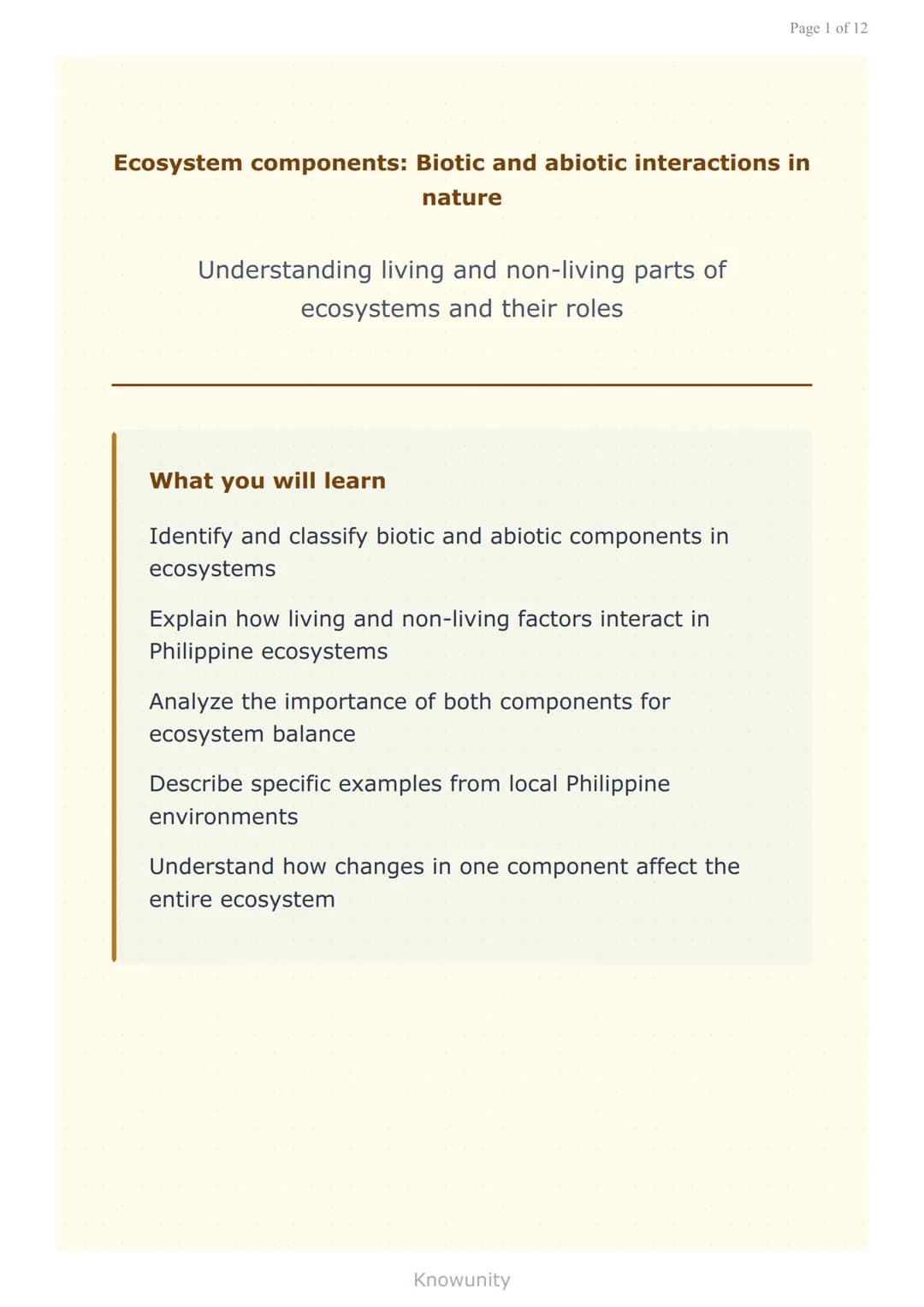
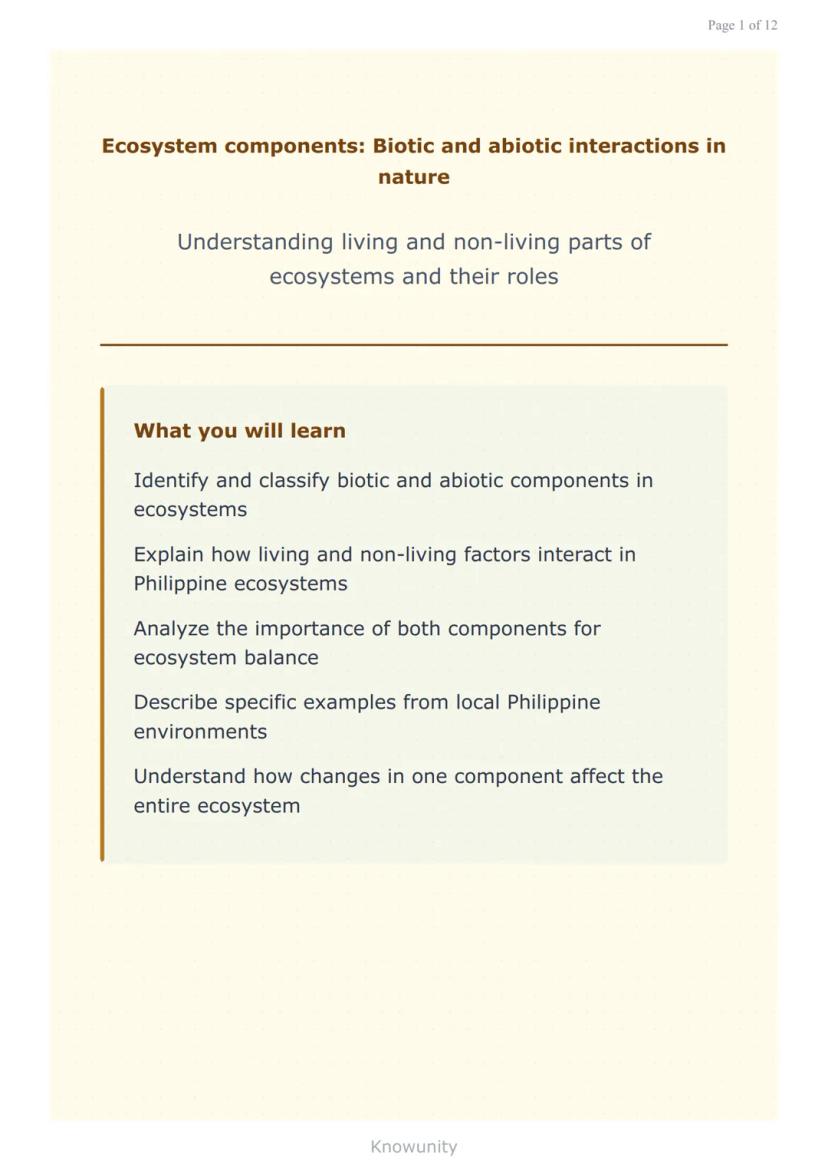
Ecosystem components: Biotic and abiotic interactions in nature
25
•
Nov 19, 2025
•
Knowunity Philippines
@knowunityphilippines
Your world is full of amazing ecosystems - from coral... Show more
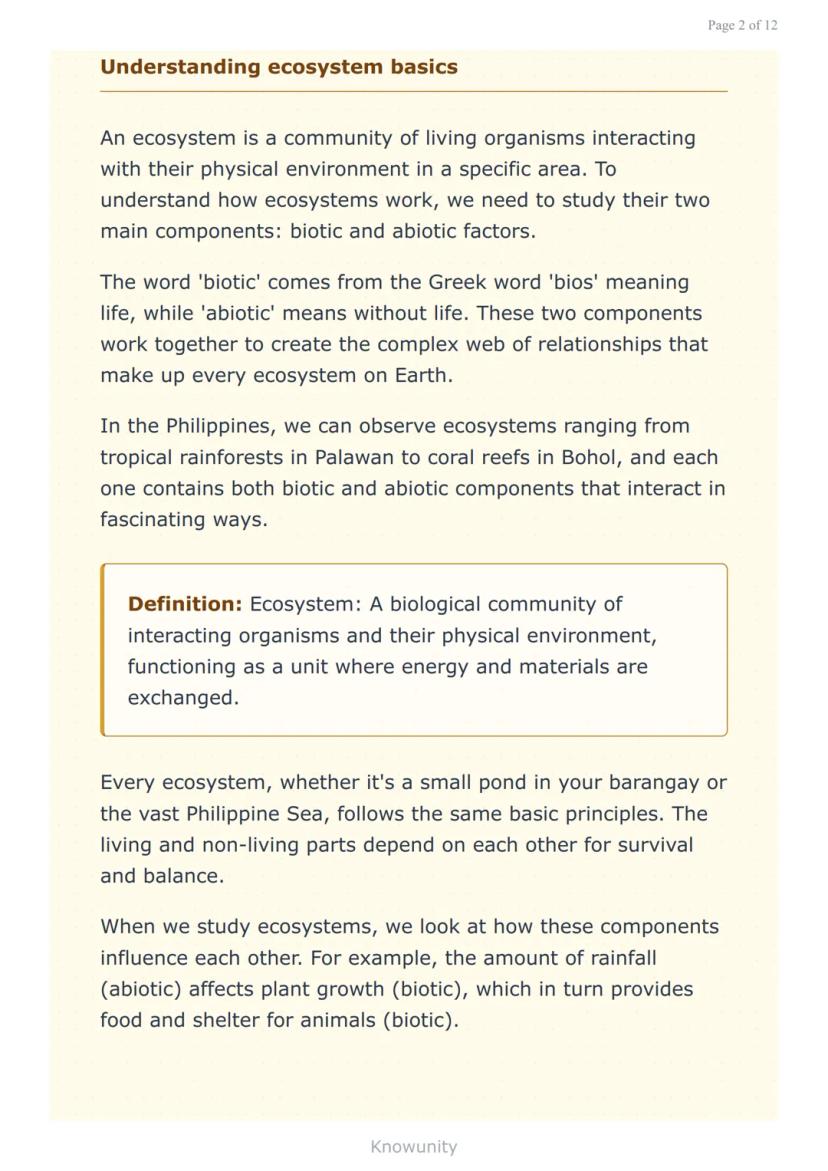
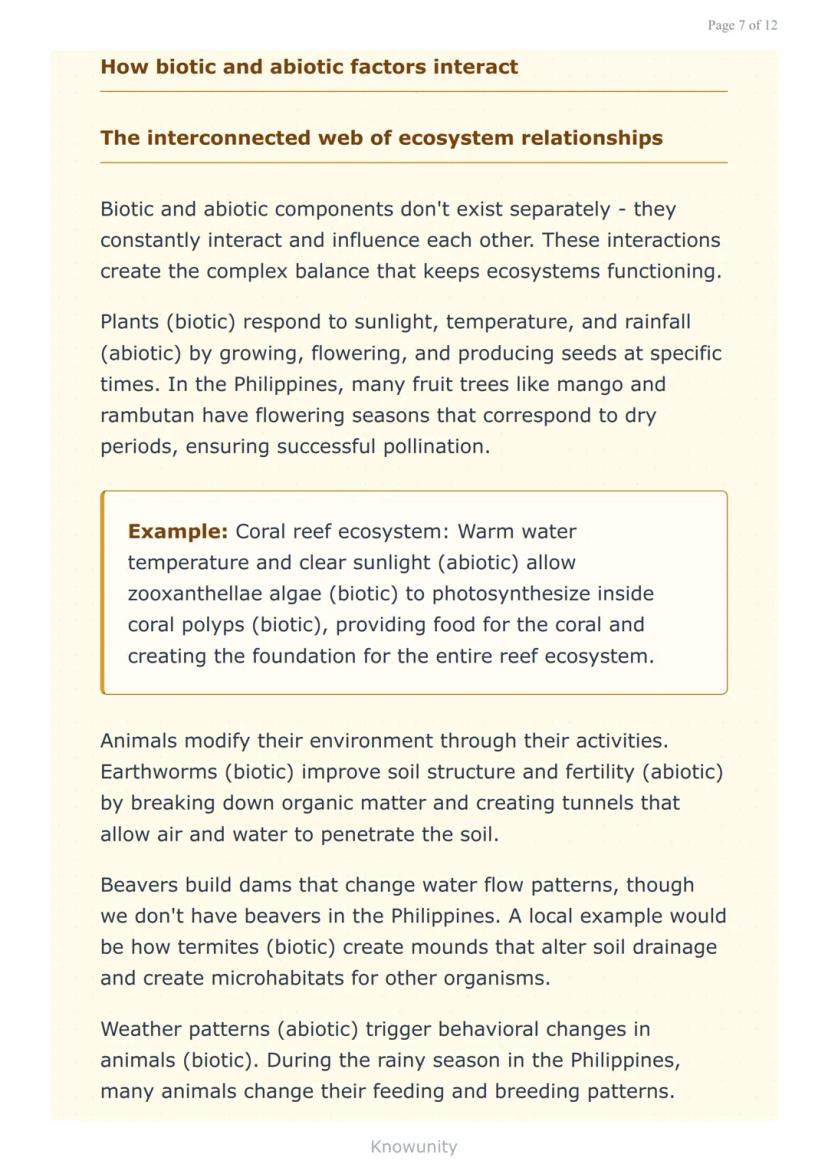
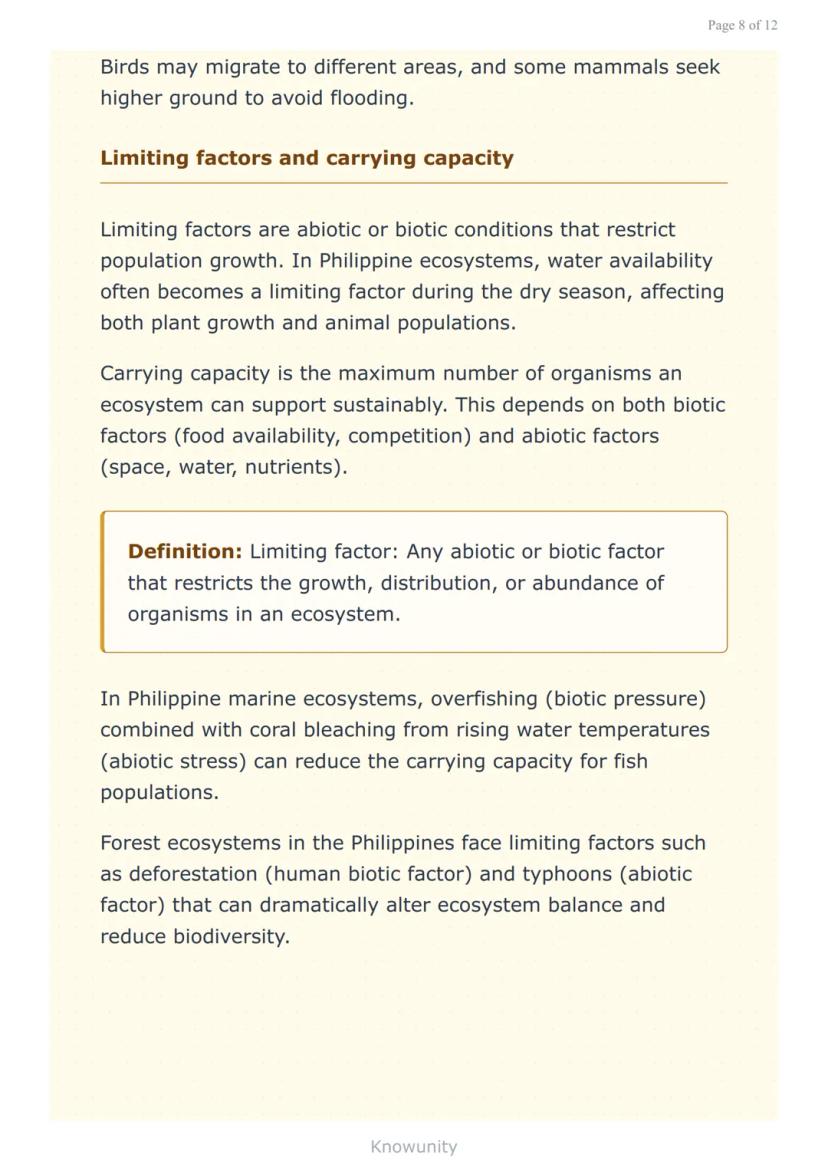
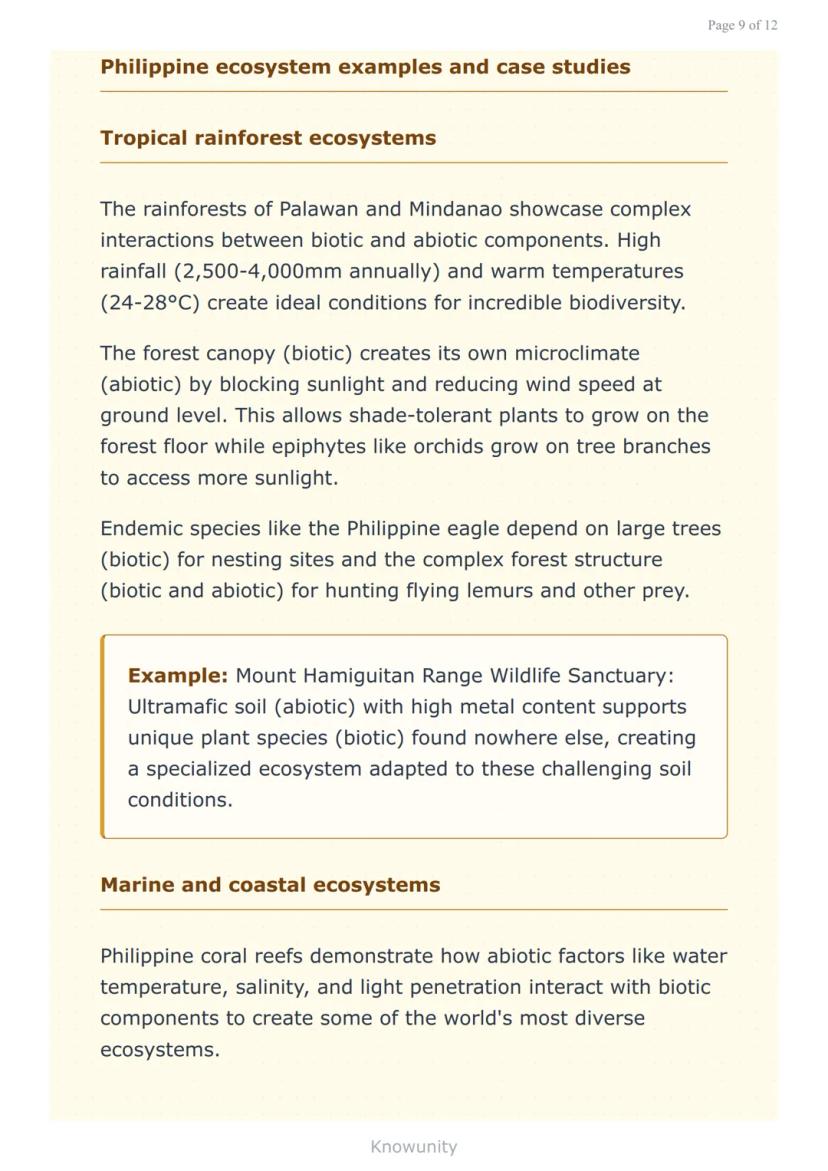
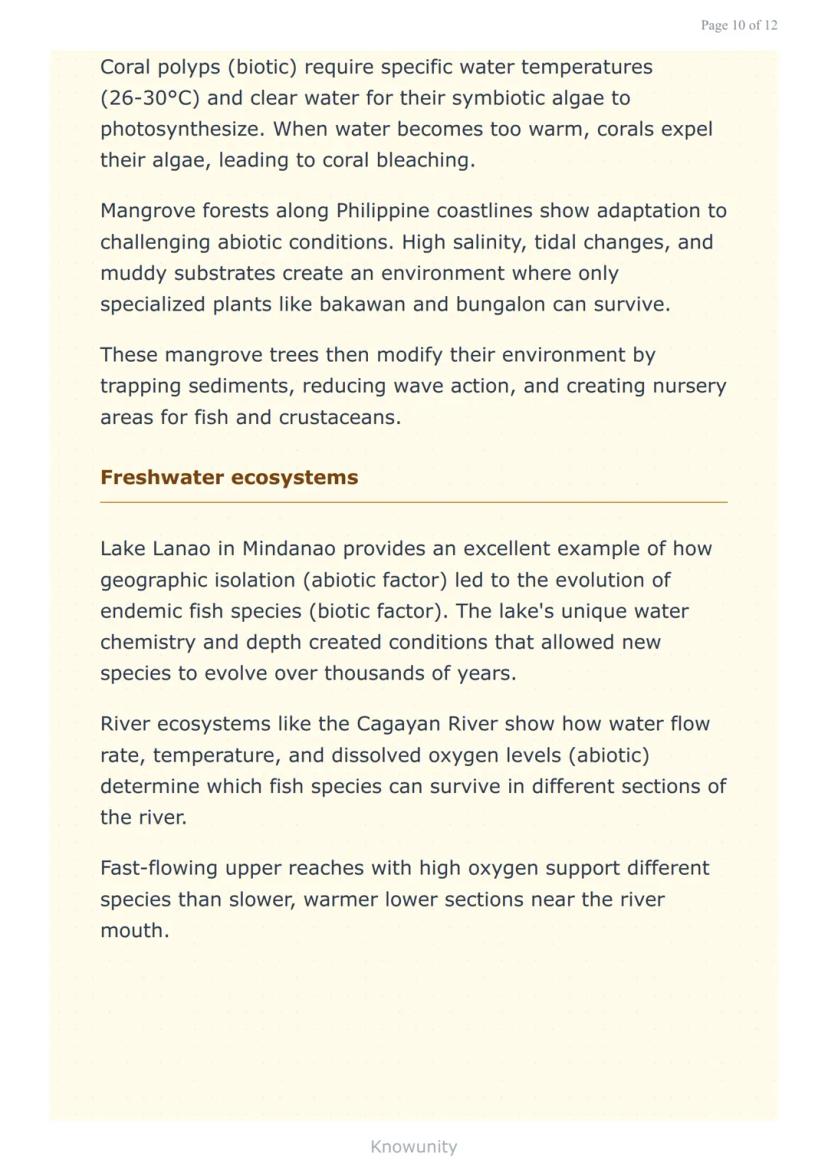
Ever wondered why certain animals only live in specific places, or why some plants thrive while others struggle? The answer lies in understanding ecosystem components - the building blocks that make every natural environment work.
An ecosystem is basically nature's community where living organisms hang out with their physical environment, sharing resources and energy. Think of it like a massive group chat where everyone's constantly interacting and depending on each other.
Every ecosystem has two main types of components working together: biotic factors (all the living stuff) and abiotic factors . From tiny pond ecosystems in your local area to the vast Philippine Sea, these same principles apply everywhere.
Quick Tip: Remember it this way - biotic = biology = life, and abiotic = no life. Simple!
Here's where it gets interesting - ecosystems aren't just random collections of plants and animals thrown together. They're incredibly organised systems where every living and non-living part has a role to play.
Biotic and abiotic factors are constantly influencing each other in fascinating ways. For example, the amount of rainfall (abiotic) directly affects how well plants grow (biotic), which then determines how much food is available for animals (also biotic).
You can see this happening everywhere in Philippine ecosystems. The warm tropical climate and heavy rainfall create perfect conditions for lush rainforests in places like Palawan, whilst drier areas support completely different types of plants and animals.
The brilliant thing is that once you understand these basic interactions, you'll start noticing them everywhere - from your school garden to coral reefs. Every ecosystem follows these same fundamental rules, no matter how big or small it is.
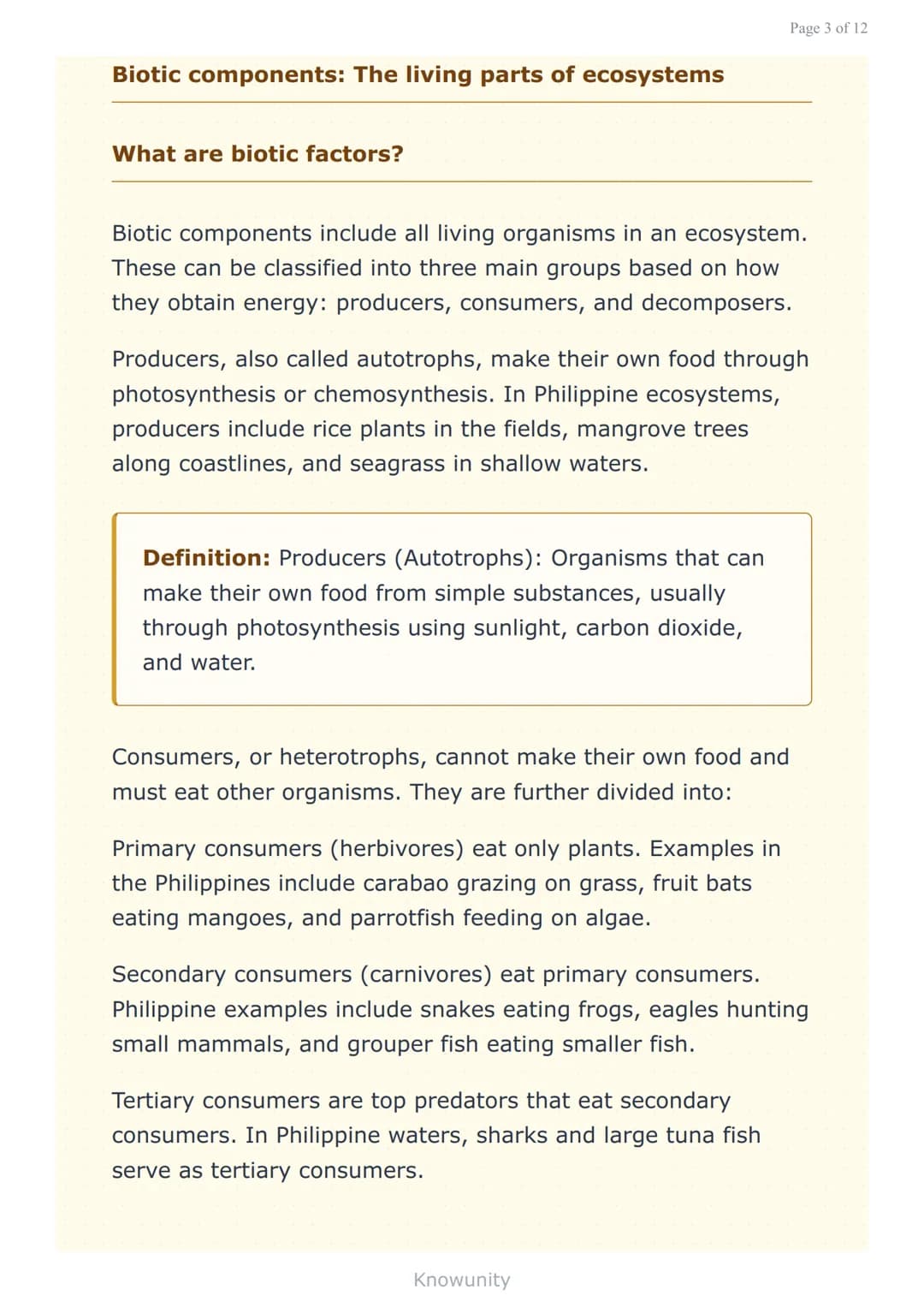
All the living things in an ecosystem fall into three main groups based on how they get their energy, and understanding these groups is your key to mastering ecosystem dynamics.
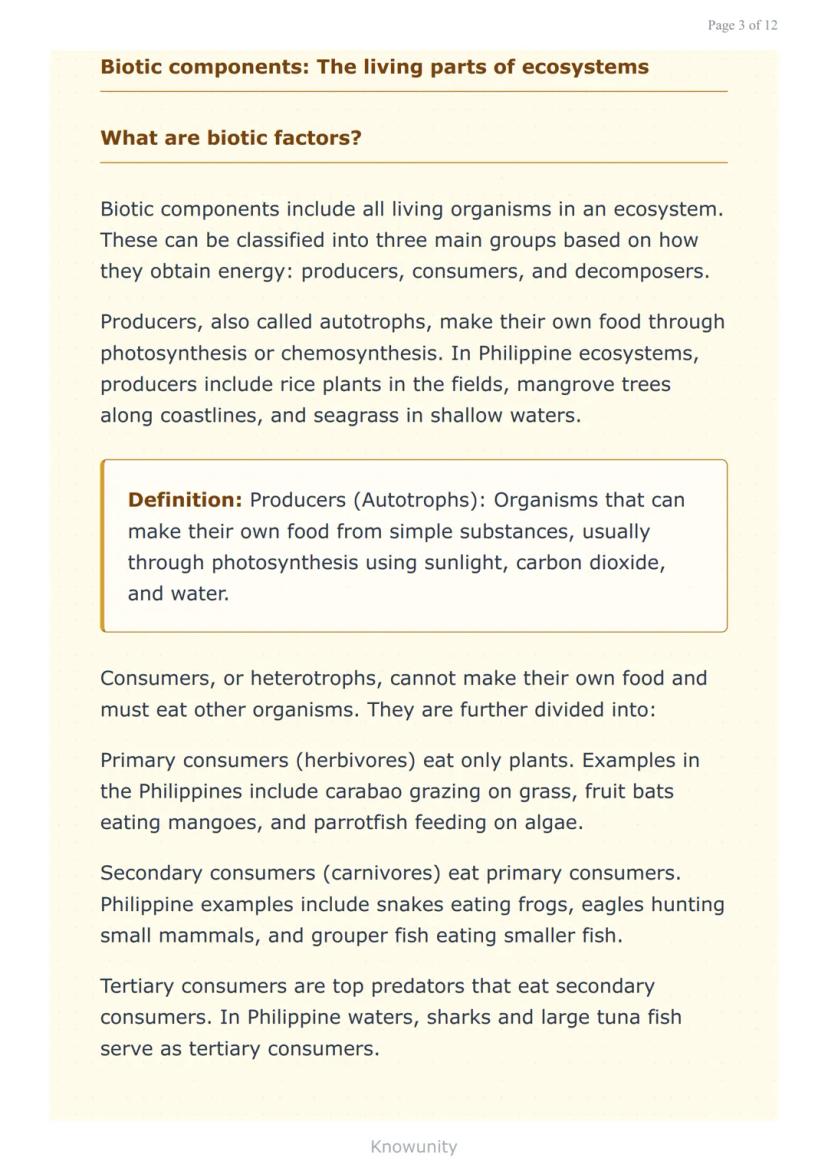
Producers (also called autotrophs) are the superstars that make their own food through photosynthesis. In Philippine ecosystems, these include rice plants, mangrove trees, and seagrass - basically anything green that can turn sunlight into energy.
Consumers can't make their own food, so they have to eat other organisms. Primary consumers (herbivores) like carabao and fruit bats munch on plants, whilst secondary consumers (carnivores) like snakes and eagles hunt the primary consumers. Tertiary consumers are the top predators - think sharks and large tuna fish.
Remember: Energy flows in one direction through ecosystems - from producers to primary consumers to secondary consumers, and so on.
Decomposers like bacteria and fungi are the recyclers of nature, breaking down dead stuff and returning nutrients to the soil. In the Philippines' warm, humid climate, decomposers work incredibly fast, which is why forest floors don't pile up with dead leaves!
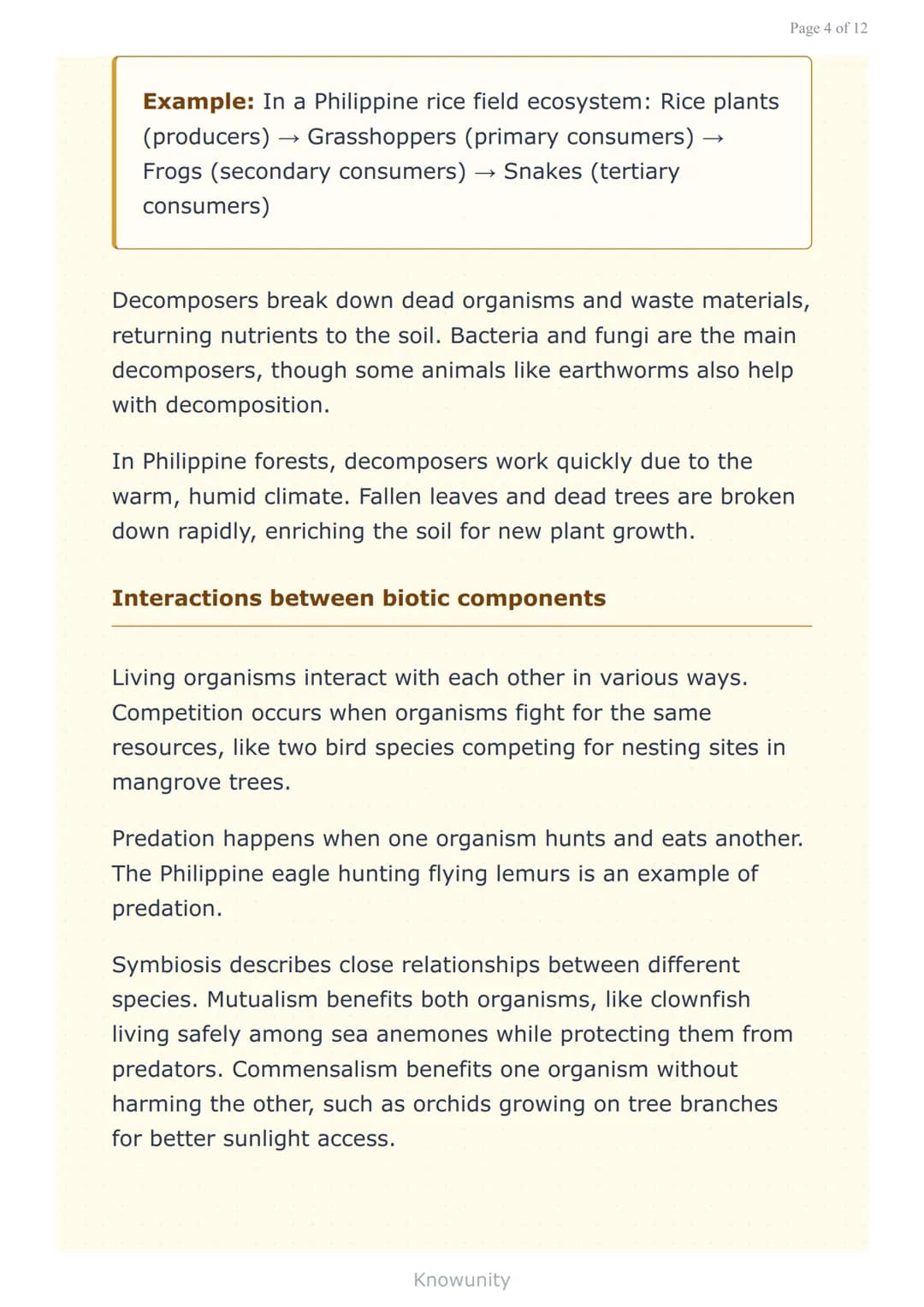
Living organisms don't just coexist - they're constantly interacting in ways that can be helpful, harmful, or neutral, and these interactions shape entire ecosystems.
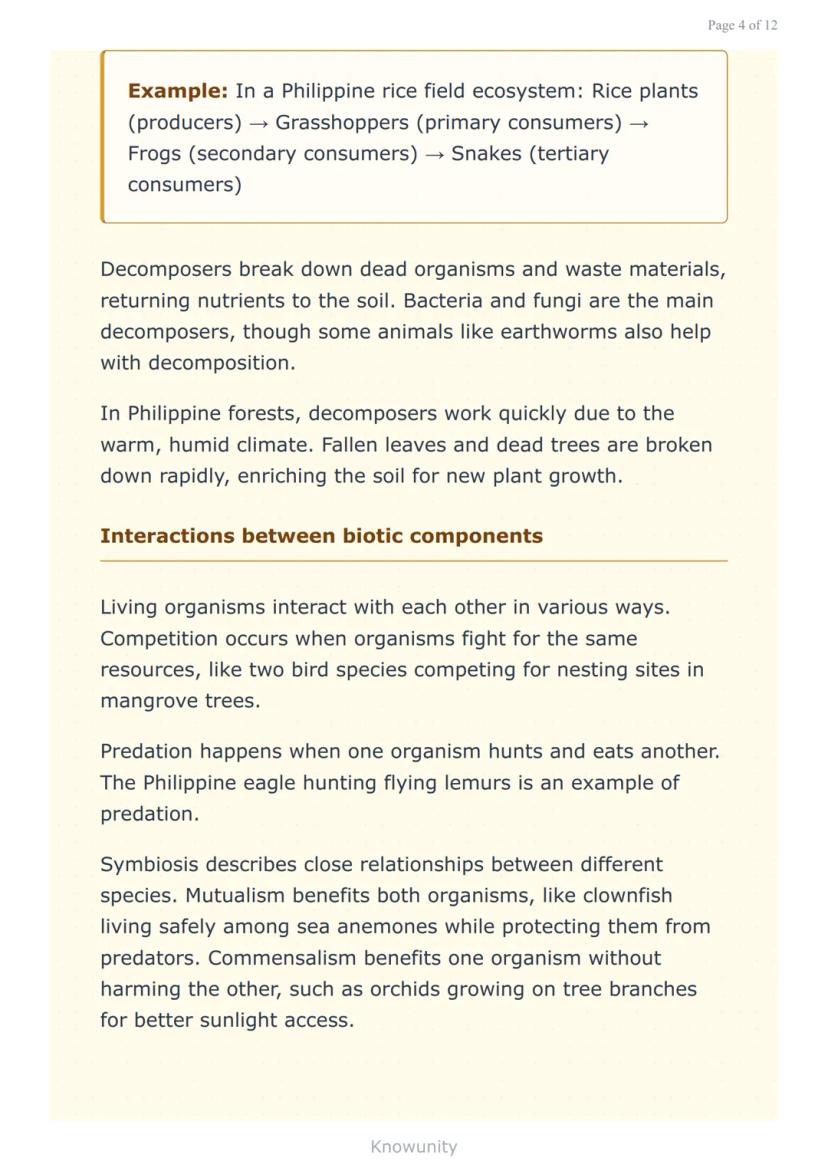
Competition happens when organisms fight for the same resources, like two bird species competing for the best nesting spots in mangrove trees. Predation is straightforward hunting - the Philippine eagle hunting flying lemurs is a perfect example.
Symbiosis describes close relationships between different species. In mutualism, both species benefit - like clownfish living safely among sea anemones whilst protecting them from predators. Commensalism benefits one species without harming the other, such as orchids growing on tree branches for better sunlight access.
A simple food chain example from Philippine rice fields shows these relationships in action: Rice plants (producers) → Grasshoppers (primary consumers) → Frogs (secondary consumers) → Snakes (tertiary consumers). Each level depends on the one below it for survival.
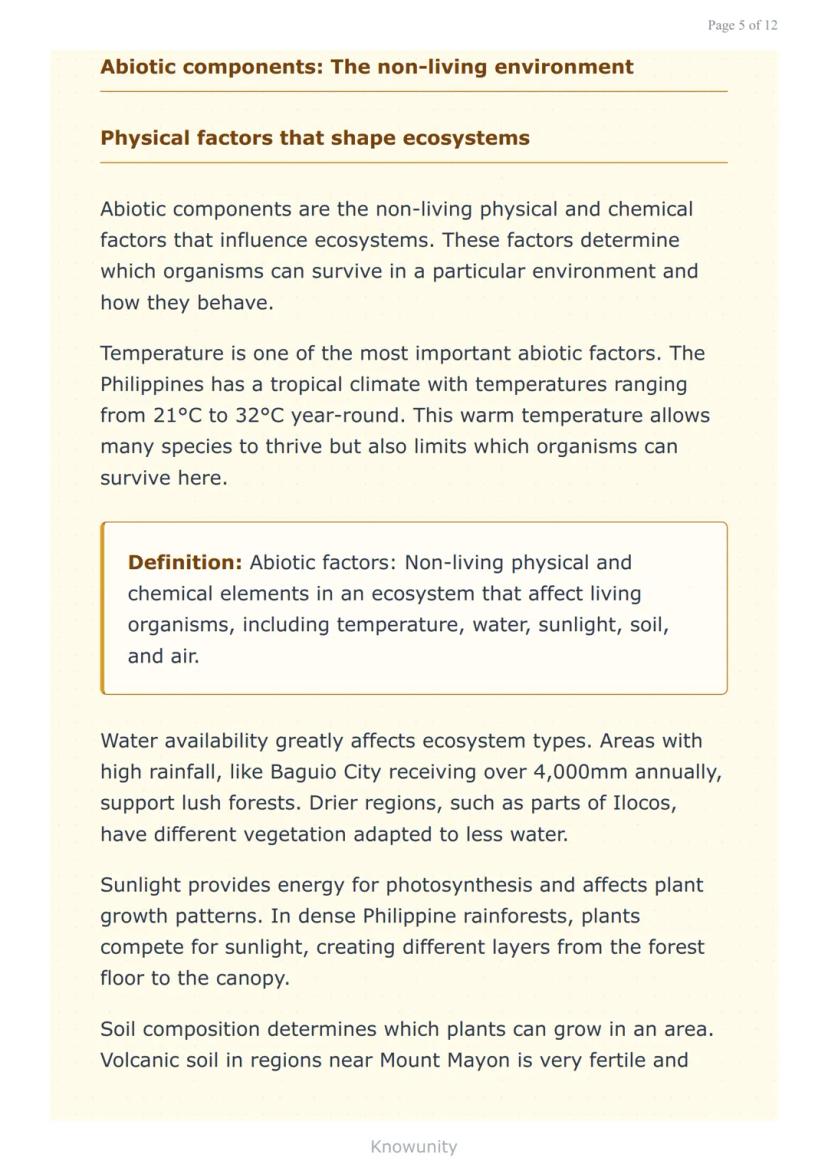
Abiotic factors are the non-living environmental conditions that basically set the rules for which organisms can survive in any given ecosystem, and they're just as important as the living components.
Temperature is massive - the Philippines' tropical climate allows many species to thrive but also limits which organisms can actually survive here. Water availability creates completely different ecosystems depending on rainfall patterns.
Sunlight powers photosynthesis and affects how plants grow and compete. In dense rainforests, plants literally fight for sunlight, creating different layers from the dark forest floor to the bright canopy above.
Think About It: Volcanic soil near Mount Mayon is incredibly fertile and supports diverse plant life, whilst sandy coastal soils require specially adapted plants.
Soil composition determines which plants can grow, whilst chemical factors like pH levels, oxygen concentration, and nutrient availability fine-tune which specific organisms can thrive in different environments.
The invisible chemical environment plays a huge role in determining ecosystem success, and understanding these factors helps explain why certain organisms live where they do.
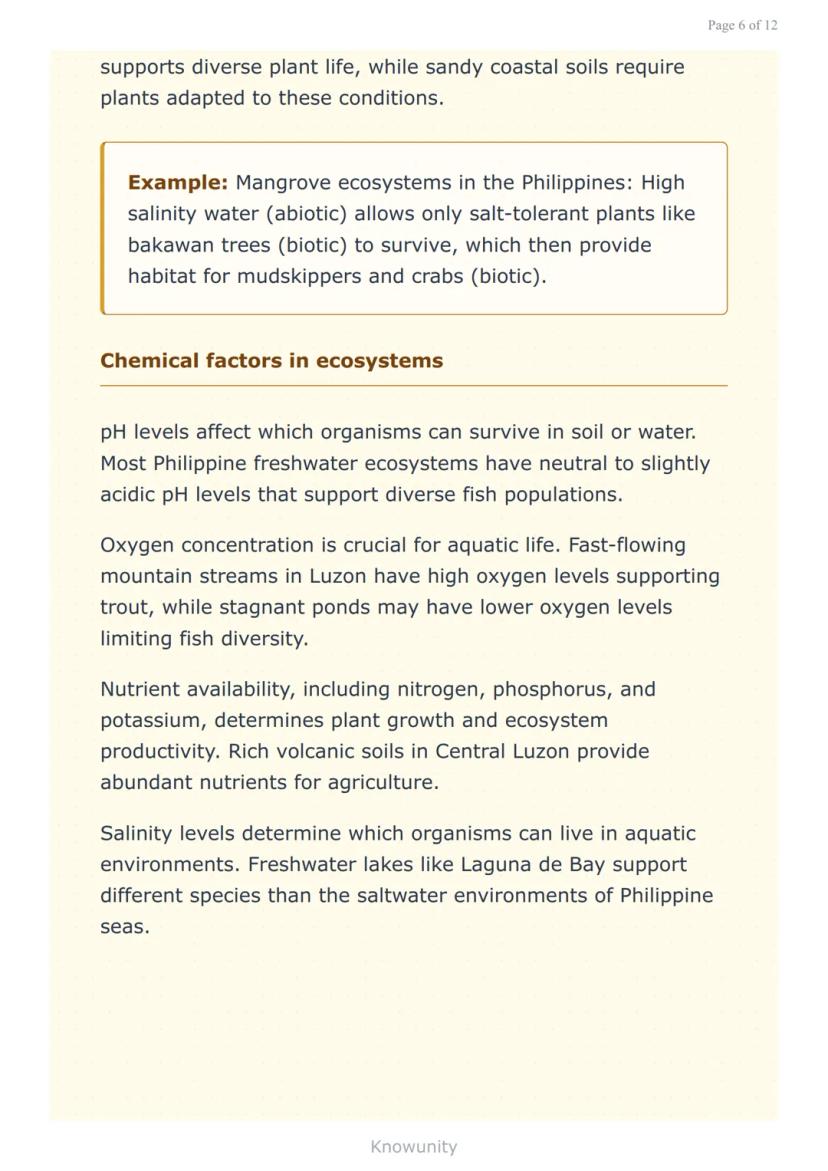
pH levels affect survival in both soil and water - most Philippine freshwater ecosystems have neutral to slightly acidic pH levels that support diverse fish populations. Oxygen concentration is crucial for aquatic life, with fast-flowing mountain streams having high oxygen levels perfect for trout.
Nutrient availability (nitrogen, phosphorus, and potassium) determines how productive an ecosystem can be. The rich volcanic soils in Central Luzon provide abundant nutrients, which is why agriculture thrives there.
Salinity levels create completely different worlds - freshwater lakes like Laguna de Bay support entirely different species than the saltwater environments of Philippine seas. Mangrove ecosystems perfectly demonstrate this, as only salt-tolerant plants like bakawan trees can survive the high salinity conditions.
Real Example: High salinity water allows only salt-tolerant mangrove plants to survive, which then provide habitat for mudskippers and crabs adapted to these conditions.
This is where ecosystems get really exciting - biotic and abiotic components don't exist separately but constantly interact and influence each other in complex ways that create ecosystem balance.
Plants respond to environmental cues by timing their growth and reproduction perfectly. Many Philippine fruit trees like mango and rambutan flower during dry periods to ensure successful pollination - they're literally reading the weather!
Animals actively modify their environment through their activities. Earthworms improve soil structure and fertility by breaking down organic matter and creating tunnels for air and water. Termites create mounds that alter soil drainage and create microhabitats for other organisms.
Amazing Example: In coral reefs, warm water and clear sunlight allow zooxanthellae algae to photosynthesise inside coral polyps, providing food for the coral and creating the foundation for entire reef ecosystems.
Weather patterns trigger major behavioural changes in animals. During the Philippines' rainy season, animals change their feeding and breeding patterns, with many seeking higher ground to avoid flooding.
Every ecosystem has limits, and understanding limiting factors and carrying capacity explains why populations can't just keep growing forever.
Limiting factors are conditions that restrict population growth. In Philippine ecosystems, water availability often becomes the limiting factor during dry season, affecting both plant growth and animal populations.
Carrying capacity is the maximum number of organisms an ecosystem can support sustainably. This depends on both food availability and competition (biotic factors) plus space, water, and nutrients (abiotic factors).
Philippine marine ecosystems face serious challenges when overfishing combines with coral bleaching from rising water temperatures. These pressures dramatically reduce the carrying capacity for fish populations.
Important Concept: A limiting factor is any condition that restricts organism growth, distribution, or abundance in an ecosystem.
Forest ecosystems face limiting factors like deforestation and typhoons that can dramatically alter ecosystem balance and reduce biodiversity. Understanding these limits helps us protect and manage ecosystems more effectively.
Philippine rainforests showcase the most complex biotic and abiotic interactions on Earth, with incredible biodiversity supported by perfect environmental conditions.
The rainforests of Palawan and Mindanao receive massive rainfall and maintain warm temperatures , creating ideal conditions for thousands of species to thrive together.
The forest canopy creates its own microclimate by blocking sunlight and reducing wind speed at ground level. This allows shade-tolerant plants to grow on the forest floor whilst epiphytes like orchids grow on tree branches to access sunlight.
Endemic species like the Philippine eagle depend entirely on large trees for nesting sites and the complex forest structure for hunting. These top predators need huge territories and diverse prey populations to survive.
Unique Example: Mount Hamiguitan's ultramafic soil has high metal content that supports plant species found nowhere else on Earth - a perfect example of how challenging abiotic conditions create specialised ecosystems.
Our AI companion is specifically built for the needs of students. Based on the millions of content pieces we have on the platform we can provide truly meaningful and relevant answers to students. But its not only about answers, the companion is even more about guiding students through their daily learning challenges, with personalised study plans, quizzes or content pieces in the chat and 100% personalisation based on the students skills and developments.
You can download the app in the Google Play Store and in the Apple App Store.
That's right! Enjoy free access to study content, connect with fellow students, and get instant help – all at your fingertips.
App Store
Google Play
The app is very easy to use and well designed. I have found everything I was looking for so far and have been able to learn a lot from the presentations! I will definitely use the app for a class assignment! And of course it also helps a lot as an inspiration.
Stefan S
iOS user
This app is really great. There are so many study notes and help [...]. My problem subject is French, for example, and the app has so many options for help. Thanks to this app, I have improved my French. I would recommend it to anyone.
Samantha Klich
Android user
Wow, I am really amazed. I just tried the app because I've seen it advertised many times and was absolutely stunned. This app is THE HELP you want for school and above all, it offers so many things, such as workouts and fact sheets, which have been VERY helpful to me personally.
Anna
iOS user
I think it’s very much worth it and you’ll end up using it a lot once you get the hang of it and even after looking at others notes you can still ask your Artificial intelligence buddy the question and ask to simplify it if you still don’t get it!!! In the end I think it’s worth it 😊👍 ⚠️Also DID I MENTION ITS FREEE YOU DON’T HAVE TO PAY FOR ANYTHING AND STILL GET YOUR GRADES IN PERFECTLY❗️❗️⚠️
Thomas R
iOS user
Knowunity is the BEST app I’ve used in a minute. This is not an ai review or anything this is genuinely coming from a 7th grade student (I know 2011 im young) but dude this app is a 10/10 i have maintained a 3.8 gpa and have plenty of time for gaming. I love it and my mom is just happy I got good grades
Brad T
Android user
Not only did it help me find the answer but it also showed me alternative ways to solve it. I was horrible in math and science but now I have an a in both subjects. Thanks for the help🤍🤍
David K
iOS user
The app's just great! All I have to do is enter the topic in the search bar and I get the response real fast. I don't have to watch 10 YouTube videos to understand something, so I'm saving my time. Highly recommended!
Sudenaz Ocak
Android user
In school I was really bad at maths but thanks to the app, I am doing better now. I am so grateful that you made the app.
Greenlight Bonnie
Android user
I found this app a couple years ago and it has only gotten better since then. I really love it because it can help with written questions and photo questions. Also, it can find study guides that other people have made as well as flashcard sets and practice tests. The free version is also amazing for students who might not be able to afford it. Would 100% recommend
Aubrey
iOS user
Best app if you're in Highschool or Junior high. I have been using this app for 2 school years and it's the best, it's good if you don't have anyone to help you with school work.😋🩷🎀
Marco B
iOS user
THE QUIZES AND FLASHCARDS ARE SO USEFUL AND I LOVE THE SCHOOLGPT. IT ALSO IS LITREALLY LIKE CHATGPT BUT SMARTER!! HELPED ME WITH MY MASCARA PROBLEMS TOO!! AS WELL AS MY REAL SUBJECTS ! DUHHH 😍😁😲🤑💗✨🎀😮
Elisha
iOS user
This app is phenomenal down to the correct info and the various topics you can study! I greatly recommend it for people who struggle with procrastination and those who need homework help. It has been perfectly accurate for world 1 history as far as I’ve seen! Geometry too!
Paul T
iOS user
The app is very easy to use and well designed. I have found everything I was looking for so far and have been able to learn a lot from the presentations! I will definitely use the app for a class assignment! And of course it also helps a lot as an inspiration.
Stefan S
iOS user
This app is really great. There are so many study notes and help [...]. My problem subject is French, for example, and the app has so many options for help. Thanks to this app, I have improved my French. I would recommend it to anyone.
Samantha Klich
Android user
Wow, I am really amazed. I just tried the app because I've seen it advertised many times and was absolutely stunned. This app is THE HELP you want for school and above all, it offers so many things, such as workouts and fact sheets, which have been VERY helpful to me personally.
Anna
iOS user
I think it’s very much worth it and you’ll end up using it a lot once you get the hang of it and even after looking at others notes you can still ask your Artificial intelligence buddy the question and ask to simplify it if you still don’t get it!!! In the end I think it’s worth it 😊👍 ⚠️Also DID I MENTION ITS FREEE YOU DON’T HAVE TO PAY FOR ANYTHING AND STILL GET YOUR GRADES IN PERFECTLY❗️❗️⚠️
Thomas R
iOS user
Knowunity is the BEST app I’ve used in a minute. This is not an ai review or anything this is genuinely coming from a 7th grade student (I know 2011 im young) but dude this app is a 10/10 i have maintained a 3.8 gpa and have plenty of time for gaming. I love it and my mom is just happy I got good grades
Brad T
Android user
Not only did it help me find the answer but it also showed me alternative ways to solve it. I was horrible in math and science but now I have an a in both subjects. Thanks for the help🤍🤍
David K
iOS user
The app's just great! All I have to do is enter the topic in the search bar and I get the response real fast. I don't have to watch 10 YouTube videos to understand something, so I'm saving my time. Highly recommended!
Sudenaz Ocak
Android user
In school I was really bad at maths but thanks to the app, I am doing better now. I am so grateful that you made the app.
Greenlight Bonnie
Android user
I found this app a couple years ago and it has only gotten better since then. I really love it because it can help with written questions and photo questions. Also, it can find study guides that other people have made as well as flashcard sets and practice tests. The free version is also amazing for students who might not be able to afford it. Would 100% recommend
Aubrey
iOS user
Best app if you're in Highschool or Junior high. I have been using this app for 2 school years and it's the best, it's good if you don't have anyone to help you with school work.😋🩷🎀
Marco B
iOS user
THE QUIZES AND FLASHCARDS ARE SO USEFUL AND I LOVE THE SCHOOLGPT. IT ALSO IS LITREALLY LIKE CHATGPT BUT SMARTER!! HELPED ME WITH MY MASCARA PROBLEMS TOO!! AS WELL AS MY REAL SUBJECTS ! DUHHH 😍😁😲🤑💗✨🎀😮
Elisha
iOS user
This app is phenomenal down to the correct info and the various topics you can study! I greatly recommend it for people who struggle with procrastination and those who need homework help. It has been perfectly accurate for world 1 history as far as I’ve seen! Geometry too!
Paul T
iOS user
Knowunity Philippines
@knowunityphilippines
Your world is full of amazing ecosystems - from coral reefs to rainforests - and they all work because of a brilliant partnership between living and non-living things. Understanding how these biotic (living) and abiotic (non-living) components interact will help... Show more
Access to all documents
Improve your grades
Join milions of students
By signing up you accept Terms of Service and Privacy Policy
Ever wondered why certain animals only live in specific places, or why some plants thrive while others struggle? The answer lies in understanding ecosystem components - the building blocks that make every natural environment work.
An ecosystem is basically nature's community where living organisms hang out with their physical environment, sharing resources and energy. Think of it like a massive group chat where everyone's constantly interacting and depending on each other.
Every ecosystem has two main types of components working together: biotic factors (all the living stuff) and abiotic factors . From tiny pond ecosystems in your local area to the vast Philippine Sea, these same principles apply everywhere.
Quick Tip: Remember it this way - biotic = biology = life, and abiotic = no life. Simple!
Access to all documents
Improve your grades
Join milions of students
By signing up you accept Terms of Service and Privacy Policy
Here's where it gets interesting - ecosystems aren't just random collections of plants and animals thrown together. They're incredibly organised systems where every living and non-living part has a role to play.
Biotic and abiotic factors are constantly influencing each other in fascinating ways. For example, the amount of rainfall (abiotic) directly affects how well plants grow (biotic), which then determines how much food is available for animals (also biotic).
You can see this happening everywhere in Philippine ecosystems. The warm tropical climate and heavy rainfall create perfect conditions for lush rainforests in places like Palawan, whilst drier areas support completely different types of plants and animals.
The brilliant thing is that once you understand these basic interactions, you'll start noticing them everywhere - from your school garden to coral reefs. Every ecosystem follows these same fundamental rules, no matter how big or small it is.
Access to all documents
Improve your grades
Join milions of students
By signing up you accept Terms of Service and Privacy Policy
All the living things in an ecosystem fall into three main groups based on how they get their energy, and understanding these groups is your key to mastering ecosystem dynamics.
Producers (also called autotrophs) are the superstars that make their own food through photosynthesis. In Philippine ecosystems, these include rice plants, mangrove trees, and seagrass - basically anything green that can turn sunlight into energy.
Consumers can't make their own food, so they have to eat other organisms. Primary consumers (herbivores) like carabao and fruit bats munch on plants, whilst secondary consumers (carnivores) like snakes and eagles hunt the primary consumers. Tertiary consumers are the top predators - think sharks and large tuna fish.
Remember: Energy flows in one direction through ecosystems - from producers to primary consumers to secondary consumers, and so on.
Decomposers like bacteria and fungi are the recyclers of nature, breaking down dead stuff and returning nutrients to the soil. In the Philippines' warm, humid climate, decomposers work incredibly fast, which is why forest floors don't pile up with dead leaves!
Access to all documents
Improve your grades
Join milions of students
By signing up you accept Terms of Service and Privacy Policy
Living organisms don't just coexist - they're constantly interacting in ways that can be helpful, harmful, or neutral, and these interactions shape entire ecosystems.
Competition happens when organisms fight for the same resources, like two bird species competing for the best nesting spots in mangrove trees. Predation is straightforward hunting - the Philippine eagle hunting flying lemurs is a perfect example.
Symbiosis describes close relationships between different species. In mutualism, both species benefit - like clownfish living safely among sea anemones whilst protecting them from predators. Commensalism benefits one species without harming the other, such as orchids growing on tree branches for better sunlight access.
A simple food chain example from Philippine rice fields shows these relationships in action: Rice plants (producers) → Grasshoppers (primary consumers) → Frogs (secondary consumers) → Snakes (tertiary consumers). Each level depends on the one below it for survival.
Access to all documents
Improve your grades
Join milions of students
By signing up you accept Terms of Service and Privacy Policy
Abiotic factors are the non-living environmental conditions that basically set the rules for which organisms can survive in any given ecosystem, and they're just as important as the living components.
Temperature is massive - the Philippines' tropical climate allows many species to thrive but also limits which organisms can actually survive here. Water availability creates completely different ecosystems depending on rainfall patterns.
Sunlight powers photosynthesis and affects how plants grow and compete. In dense rainforests, plants literally fight for sunlight, creating different layers from the dark forest floor to the bright canopy above.
Think About It: Volcanic soil near Mount Mayon is incredibly fertile and supports diverse plant life, whilst sandy coastal soils require specially adapted plants.
Soil composition determines which plants can grow, whilst chemical factors like pH levels, oxygen concentration, and nutrient availability fine-tune which specific organisms can thrive in different environments.
Access to all documents
Improve your grades
Join milions of students
By signing up you accept Terms of Service and Privacy Policy
The invisible chemical environment plays a huge role in determining ecosystem success, and understanding these factors helps explain why certain organisms live where they do.
pH levels affect survival in both soil and water - most Philippine freshwater ecosystems have neutral to slightly acidic pH levels that support diverse fish populations. Oxygen concentration is crucial for aquatic life, with fast-flowing mountain streams having high oxygen levels perfect for trout.
Nutrient availability (nitrogen, phosphorus, and potassium) determines how productive an ecosystem can be. The rich volcanic soils in Central Luzon provide abundant nutrients, which is why agriculture thrives there.
Salinity levels create completely different worlds - freshwater lakes like Laguna de Bay support entirely different species than the saltwater environments of Philippine seas. Mangrove ecosystems perfectly demonstrate this, as only salt-tolerant plants like bakawan trees can survive the high salinity conditions.
Real Example: High salinity water allows only salt-tolerant mangrove plants to survive, which then provide habitat for mudskippers and crabs adapted to these conditions.
Access to all documents
Improve your grades
Join milions of students
By signing up you accept Terms of Service and Privacy Policy
This is where ecosystems get really exciting - biotic and abiotic components don't exist separately but constantly interact and influence each other in complex ways that create ecosystem balance.
Plants respond to environmental cues by timing their growth and reproduction perfectly. Many Philippine fruit trees like mango and rambutan flower during dry periods to ensure successful pollination - they're literally reading the weather!
Animals actively modify their environment through their activities. Earthworms improve soil structure and fertility by breaking down organic matter and creating tunnels for air and water. Termites create mounds that alter soil drainage and create microhabitats for other organisms.
Amazing Example: In coral reefs, warm water and clear sunlight allow zooxanthellae algae to photosynthesise inside coral polyps, providing food for the coral and creating the foundation for entire reef ecosystems.
Weather patterns trigger major behavioural changes in animals. During the Philippines' rainy season, animals change their feeding and breeding patterns, with many seeking higher ground to avoid flooding.
Access to all documents
Improve your grades
Join milions of students
By signing up you accept Terms of Service and Privacy Policy
Every ecosystem has limits, and understanding limiting factors and carrying capacity explains why populations can't just keep growing forever.
Limiting factors are conditions that restrict population growth. In Philippine ecosystems, water availability often becomes the limiting factor during dry season, affecting both plant growth and animal populations.
Carrying capacity is the maximum number of organisms an ecosystem can support sustainably. This depends on both food availability and competition (biotic factors) plus space, water, and nutrients (abiotic factors).
Philippine marine ecosystems face serious challenges when overfishing combines with coral bleaching from rising water temperatures. These pressures dramatically reduce the carrying capacity for fish populations.
Important Concept: A limiting factor is any condition that restricts organism growth, distribution, or abundance in an ecosystem.
Forest ecosystems face limiting factors like deforestation and typhoons that can dramatically alter ecosystem balance and reduce biodiversity. Understanding these limits helps us protect and manage ecosystems more effectively.
Access to all documents
Improve your grades
Join milions of students
By signing up you accept Terms of Service and Privacy Policy
Philippine rainforests showcase the most complex biotic and abiotic interactions on Earth, with incredible biodiversity supported by perfect environmental conditions.
The rainforests of Palawan and Mindanao receive massive rainfall and maintain warm temperatures , creating ideal conditions for thousands of species to thrive together.
The forest canopy creates its own microclimate by blocking sunlight and reducing wind speed at ground level. This allows shade-tolerant plants to grow on the forest floor whilst epiphytes like orchids grow on tree branches to access sunlight.
Endemic species like the Philippine eagle depend entirely on large trees for nesting sites and the complex forest structure for hunting. These top predators need huge territories and diverse prey populations to survive.
Unique Example: Mount Hamiguitan's ultramafic soil has high metal content that supports plant species found nowhere else on Earth - a perfect example of how challenging abiotic conditions create specialised ecosystems.
Access to all documents
Improve your grades
Join milions of students
By signing up you accept Terms of Service and Privacy Policy
Our AI companion is specifically built for the needs of students. Based on the millions of content pieces we have on the platform we can provide truly meaningful and relevant answers to students. But its not only about answers, the companion is even more about guiding students through their daily learning challenges, with personalised study plans, quizzes or content pieces in the chat and 100% personalisation based on the students skills and developments.
You can download the app in the Google Play Store and in the Apple App Store.
That's right! Enjoy free access to study content, connect with fellow students, and get instant help – all at your fingertips.
1
Smart Tools NEW
Transform this note into: ✓ 50+ Practice Questions ✓ Interactive Flashcards ✓ Full Mock Exam ✓ Essay Outlines
App Store
Google Play
The app is very easy to use and well designed. I have found everything I was looking for so far and have been able to learn a lot from the presentations! I will definitely use the app for a class assignment! And of course it also helps a lot as an inspiration.
Stefan S
iOS user
This app is really great. There are so many study notes and help [...]. My problem subject is French, for example, and the app has so many options for help. Thanks to this app, I have improved my French. I would recommend it to anyone.
Samantha Klich
Android user
Wow, I am really amazed. I just tried the app because I've seen it advertised many times and was absolutely stunned. This app is THE HELP you want for school and above all, it offers so many things, such as workouts and fact sheets, which have been VERY helpful to me personally.
Anna
iOS user
I think it’s very much worth it and you’ll end up using it a lot once you get the hang of it and even after looking at others notes you can still ask your Artificial intelligence buddy the question and ask to simplify it if you still don’t get it!!! In the end I think it’s worth it 😊👍 ⚠️Also DID I MENTION ITS FREEE YOU DON’T HAVE TO PAY FOR ANYTHING AND STILL GET YOUR GRADES IN PERFECTLY❗️❗️⚠️
Thomas R
iOS user
Knowunity is the BEST app I’ve used in a minute. This is not an ai review or anything this is genuinely coming from a 7th grade student (I know 2011 im young) but dude this app is a 10/10 i have maintained a 3.8 gpa and have plenty of time for gaming. I love it and my mom is just happy I got good grades
Brad T
Android user
Not only did it help me find the answer but it also showed me alternative ways to solve it. I was horrible in math and science but now I have an a in both subjects. Thanks for the help🤍🤍
David K
iOS user
The app's just great! All I have to do is enter the topic in the search bar and I get the response real fast. I don't have to watch 10 YouTube videos to understand something, so I'm saving my time. Highly recommended!
Sudenaz Ocak
Android user
In school I was really bad at maths but thanks to the app, I am doing better now. I am so grateful that you made the app.
Greenlight Bonnie
Android user
I found this app a couple years ago and it has only gotten better since then. I really love it because it can help with written questions and photo questions. Also, it can find study guides that other people have made as well as flashcard sets and practice tests. The free version is also amazing for students who might not be able to afford it. Would 100% recommend
Aubrey
iOS user
Best app if you're in Highschool or Junior high. I have been using this app for 2 school years and it's the best, it's good if you don't have anyone to help you with school work.😋🩷🎀
Marco B
iOS user
THE QUIZES AND FLASHCARDS ARE SO USEFUL AND I LOVE THE SCHOOLGPT. IT ALSO IS LITREALLY LIKE CHATGPT BUT SMARTER!! HELPED ME WITH MY MASCARA PROBLEMS TOO!! AS WELL AS MY REAL SUBJECTS ! DUHHH 😍😁😲🤑💗✨🎀😮
Elisha
iOS user
This app is phenomenal down to the correct info and the various topics you can study! I greatly recommend it for people who struggle with procrastination and those who need homework help. It has been perfectly accurate for world 1 history as far as I’ve seen! Geometry too!
Paul T
iOS user
The app is very easy to use and well designed. I have found everything I was looking for so far and have been able to learn a lot from the presentations! I will definitely use the app for a class assignment! And of course it also helps a lot as an inspiration.
Stefan S
iOS user
This app is really great. There are so many study notes and help [...]. My problem subject is French, for example, and the app has so many options for help. Thanks to this app, I have improved my French. I would recommend it to anyone.
Samantha Klich
Android user
Wow, I am really amazed. I just tried the app because I've seen it advertised many times and was absolutely stunned. This app is THE HELP you want for school and above all, it offers so many things, such as workouts and fact sheets, which have been VERY helpful to me personally.
Anna
iOS user
I think it’s very much worth it and you’ll end up using it a lot once you get the hang of it and even after looking at others notes you can still ask your Artificial intelligence buddy the question and ask to simplify it if you still don’t get it!!! In the end I think it’s worth it 😊👍 ⚠️Also DID I MENTION ITS FREEE YOU DON’T HAVE TO PAY FOR ANYTHING AND STILL GET YOUR GRADES IN PERFECTLY❗️❗️⚠️
Thomas R
iOS user
Knowunity is the BEST app I’ve used in a minute. This is not an ai review or anything this is genuinely coming from a 7th grade student (I know 2011 im young) but dude this app is a 10/10 i have maintained a 3.8 gpa and have plenty of time for gaming. I love it and my mom is just happy I got good grades
Brad T
Android user
Not only did it help me find the answer but it also showed me alternative ways to solve it. I was horrible in math and science but now I have an a in both subjects. Thanks for the help🤍🤍
David K
iOS user
The app's just great! All I have to do is enter the topic in the search bar and I get the response real fast. I don't have to watch 10 YouTube videos to understand something, so I'm saving my time. Highly recommended!
Sudenaz Ocak
Android user
In school I was really bad at maths but thanks to the app, I am doing better now. I am so grateful that you made the app.
Greenlight Bonnie
Android user
I found this app a couple years ago and it has only gotten better since then. I really love it because it can help with written questions and photo questions. Also, it can find study guides that other people have made as well as flashcard sets and practice tests. The free version is also amazing for students who might not be able to afford it. Would 100% recommend
Aubrey
iOS user
Best app if you're in Highschool or Junior high. I have been using this app for 2 school years and it's the best, it's good if you don't have anyone to help you with school work.😋🩷🎀
Marco B
iOS user
THE QUIZES AND FLASHCARDS ARE SO USEFUL AND I LOVE THE SCHOOLGPT. IT ALSO IS LITREALLY LIKE CHATGPT BUT SMARTER!! HELPED ME WITH MY MASCARA PROBLEMS TOO!! AS WELL AS MY REAL SUBJECTS ! DUHHH 😍😁😲🤑💗✨🎀😮
Elisha
iOS user
This app is phenomenal down to the correct info and the various topics you can study! I greatly recommend it for people who struggle with procrastination and those who need homework help. It has been perfectly accurate for world 1 history as far as I’ve seen! Geometry too!
Paul T
iOS user