Earth's Core and Key Geological Terms
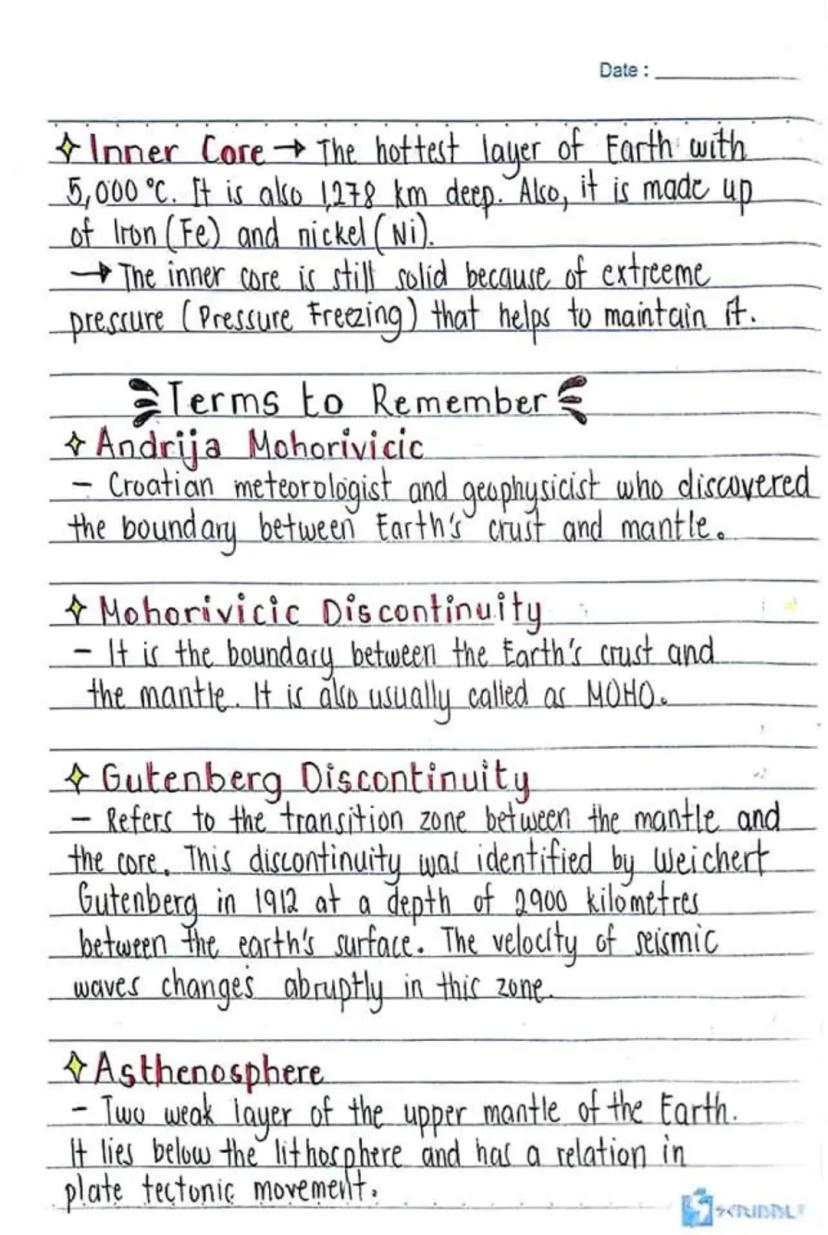
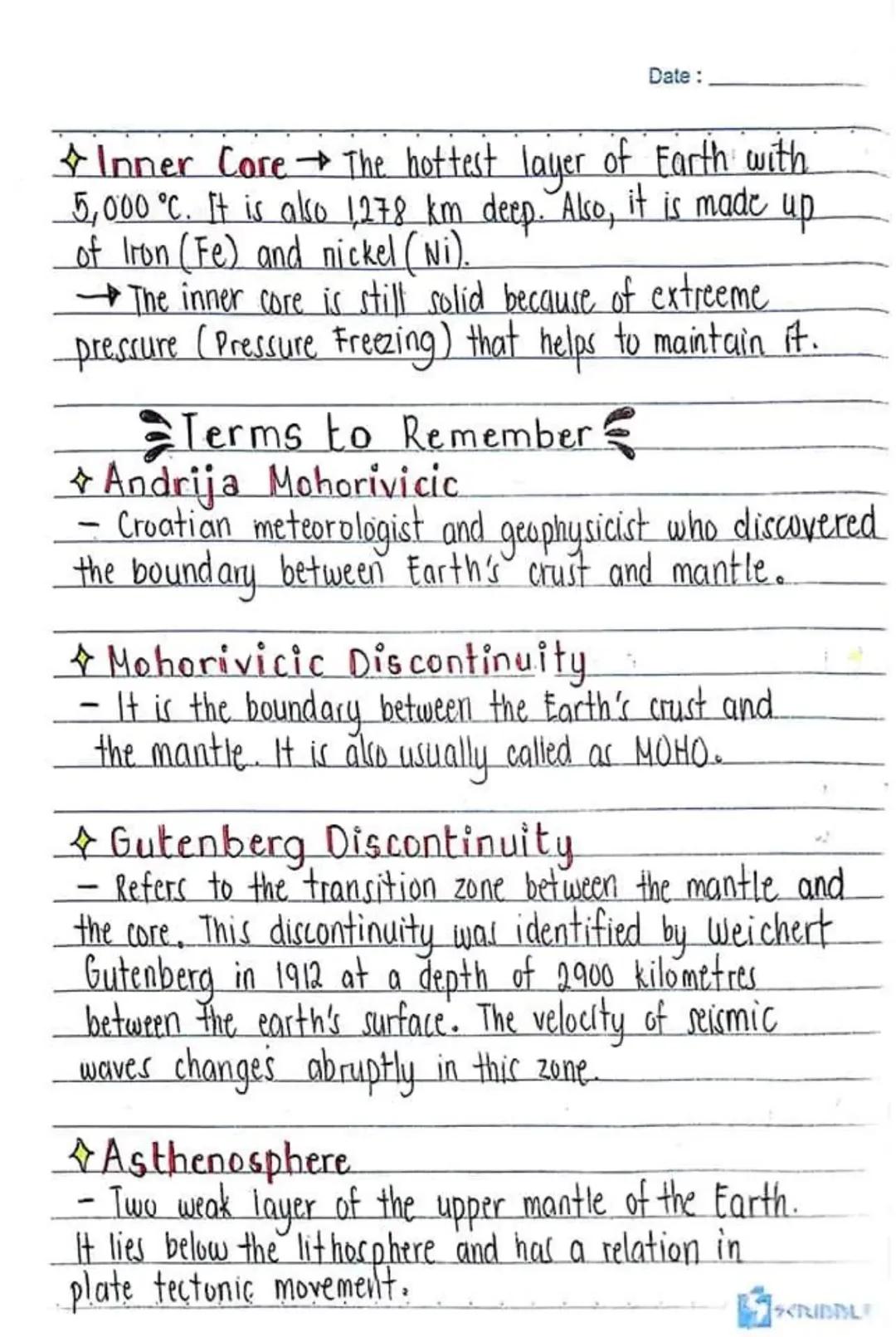
The inner core is Earth's hottest layer at 5,000°C and 1,278 km deep. Despite these extreme temperatures, it remains solid due to the phenomenon of "pressure freezing" - the enormous pressure keeps it from melting. Like the outer core, it's made primarily of iron and nickel.
Some important terms to remember:
Andrija Mohorovičić was a Croatian scientist who discovered the boundary between Earth's crust and mantle, now named after him.
The Mohorovičić Discontinuity (or "Moho") marks the boundary between the crust and mantle.
The Gutenberg Discontinuity, identified in 1912, marks the transition between the mantle and core at about 2,900 km deep.
The asthenosphere is a weak, partially molten layer in the upper mantle that lies below the lithosphere. It plays a key role in plate tectonic movement, allowing plates to "float" and move.
Connect the dots: The asthenosphere is what allows tectonic plates to move! Without this partially molten layer, plate tectonics as we know it wouldn't be possible.