Ever wondered why earthquakes happen or how scientists figure out... Show more
Sign up to see the contentIt's free!
Access to all documents
Improve your grades
Join milions of students
By signing up you accept Terms of Service and Privacy Policy

412
5
kish andres
11/29/2025
Science
Science G10 1ST QUARTER Reviewer
10,374
•
Nov 29, 2025
•
kish andres
@kishandres
Ever wondered why earthquakes happen or how scientists figure out... Show more


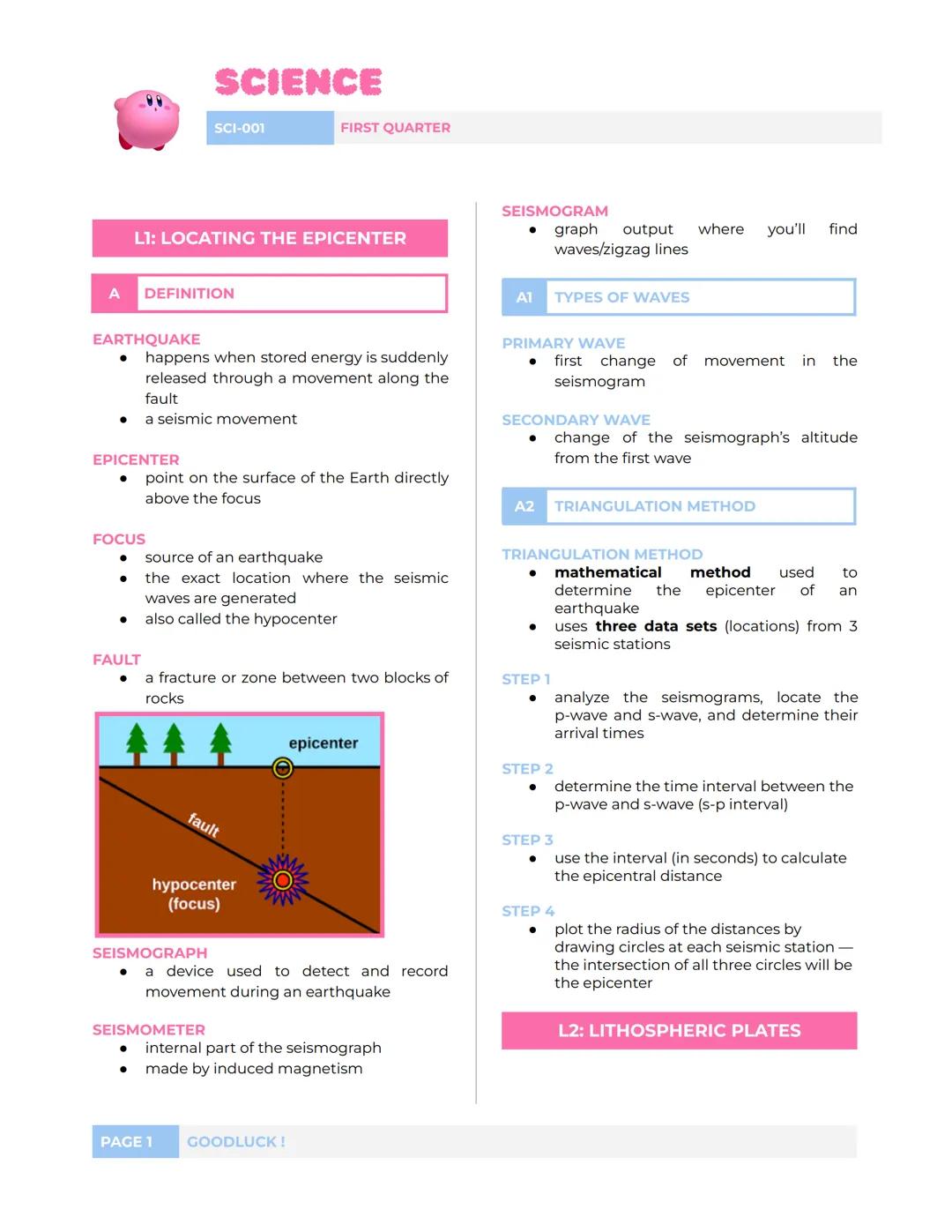
Think of earthquakes as Earth's way of releasing built-up stress, kind of like when you crack your knuckles! An earthquake happens when stored energy suddenly releases through movement along a fault (basically a crack between rock blocks).
Here's what you need to know: the focus (or hypocenter) is where the earthquake actually starts underground, while the epicenter is the point directly above it on Earth's surface. Scientists use a seismograph to detect and record these movements, creating zigzag patterns called seismograms.
Primary waves arrive first, followed by secondary waves . The triangulation method is like detective work - scientists use data from three different seismic stations, measure the time difference between P and S waves, then draw circles to find where they intersect. That intersection point? That's your epicenter!
Quick Tip: Remember that P-waves are "primary" because they're first, and S-waves are "secondary" because they arrive second!

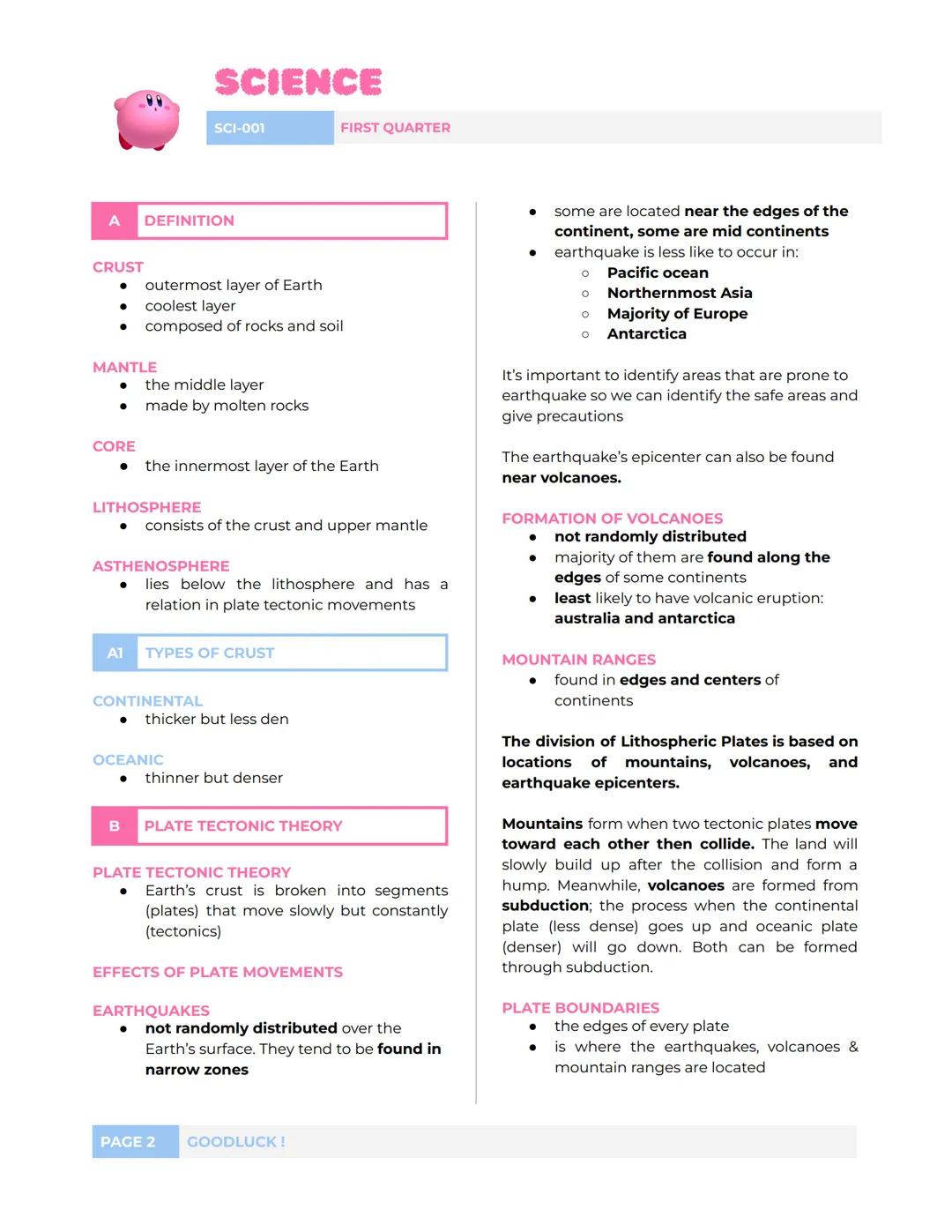
Your planet is basically a layered cake! The crust is the cool, rocky outer layer we live on, the mantle is the hot middle layer made of molten rock, and the core is the super-hot center. The lithosphere combines the crust and upper mantle, while the asthenosphere sits below and helps plates move.
There are two types of crust: continental crust (thicker but lighter, like the land you walk on) and oceanic crust (thinner but denser, under the oceans). The plate tectonic theory explains that Earth's crust is broken into huge moving pieces called plates.
Here's the cool part - earthquakes, volcanoes, and mountains aren't randomly scattered around Earth! They cluster along plate boundaries where these massive pieces meet. Most volcanoes and earthquakes happen around the Pacific Ring of Fire, and here in the Philippines, we need to watch the West Valley Fault where the predicted "Big One" earthquake might hit.
Remember: Mountains form when plates crash into each other, while volcanoes often form through subduction when denser oceanic plates dive under lighter continental plates.

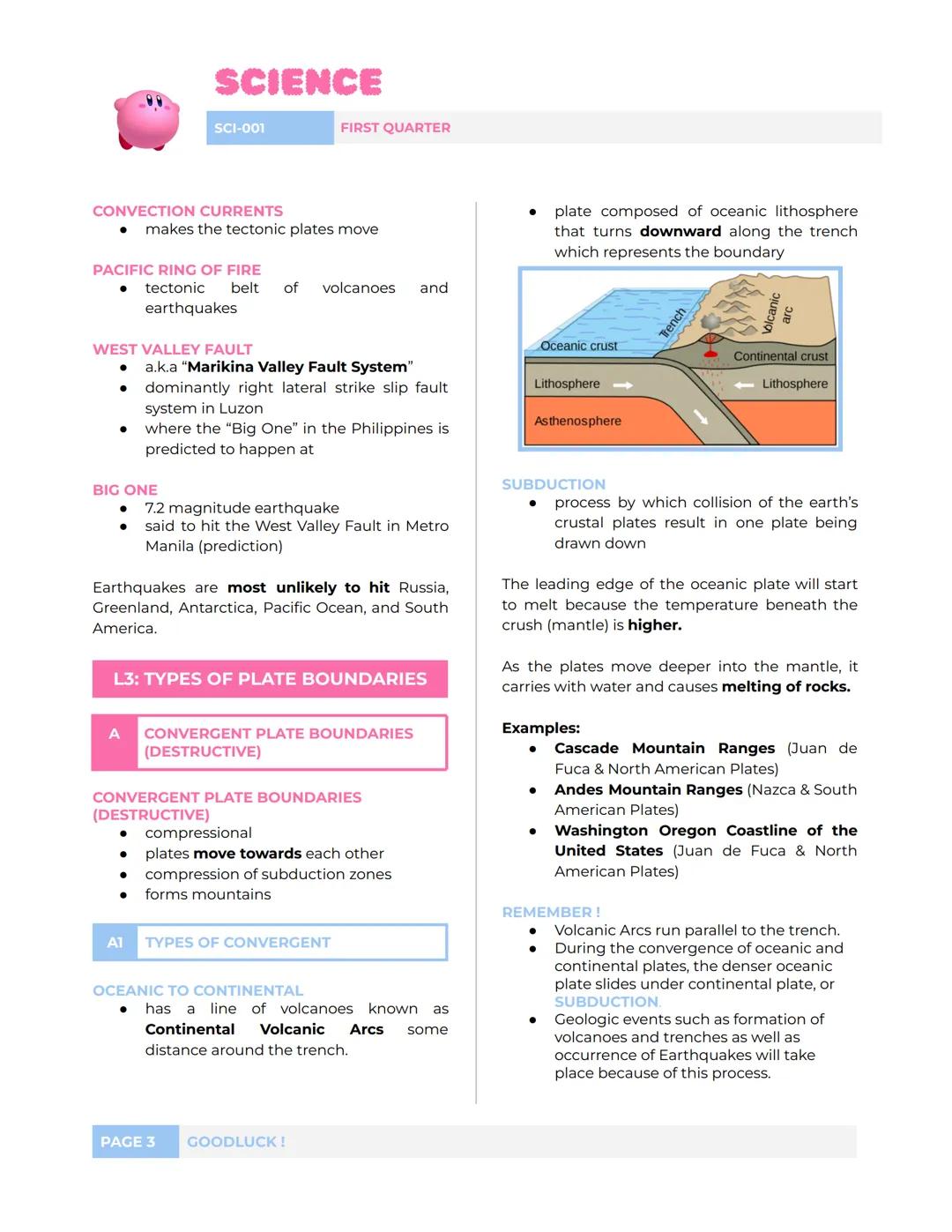
When plates crash into each other, you get convergent boundaries - think of them as Earth's collision zones! These create some of our planet's most dramatic features through compression and subduction (when one plate slides under another).
Oceanic-to-continental convergence happens when a dense oceanic plate dives under a lighter continental plate, creating volcanic arcs and deep trenches. Examples include the Andes Mountains where the Nazca Plate meets the South American Plate. The diving oceanic plate melts as it goes deeper, creating magma that rises to form volcanoes.
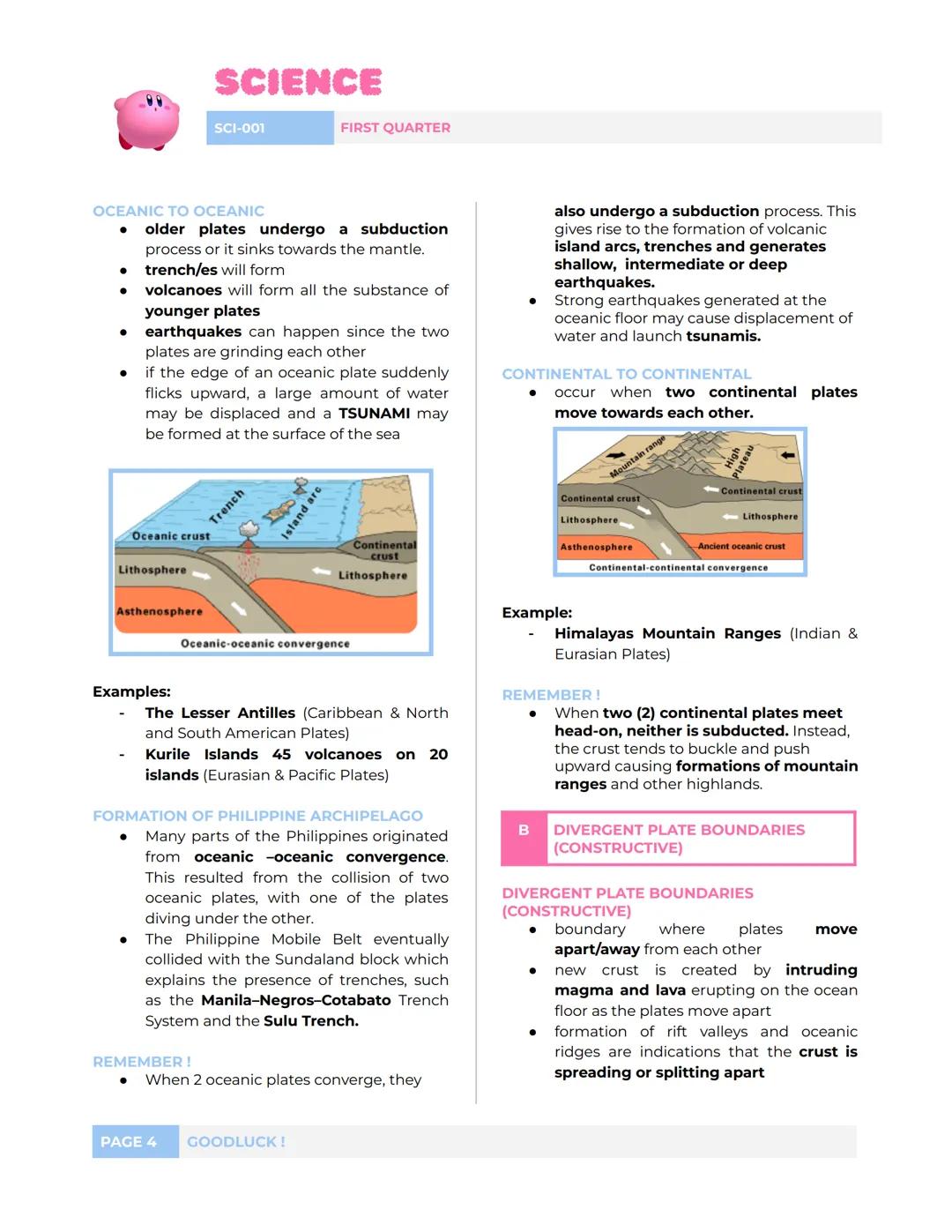
Oceanic-to-oceanic convergence occurs when two oceanic plates meet, and the older, denser one subducts. This creates volcanic island arcs (like many parts of the Philippines!) and can trigger tsunamis if the seafloor suddenly moves upward. Continental-to-continental convergence is like a head-on collision - neither plate subducts, so they buckle upward forming massive mountain ranges like the Himalayas.
Philippine Connection: Many parts of our archipelago formed from oceanic-oceanic convergence, which explains why we have so many volcanoes and experience frequent earthquakes!

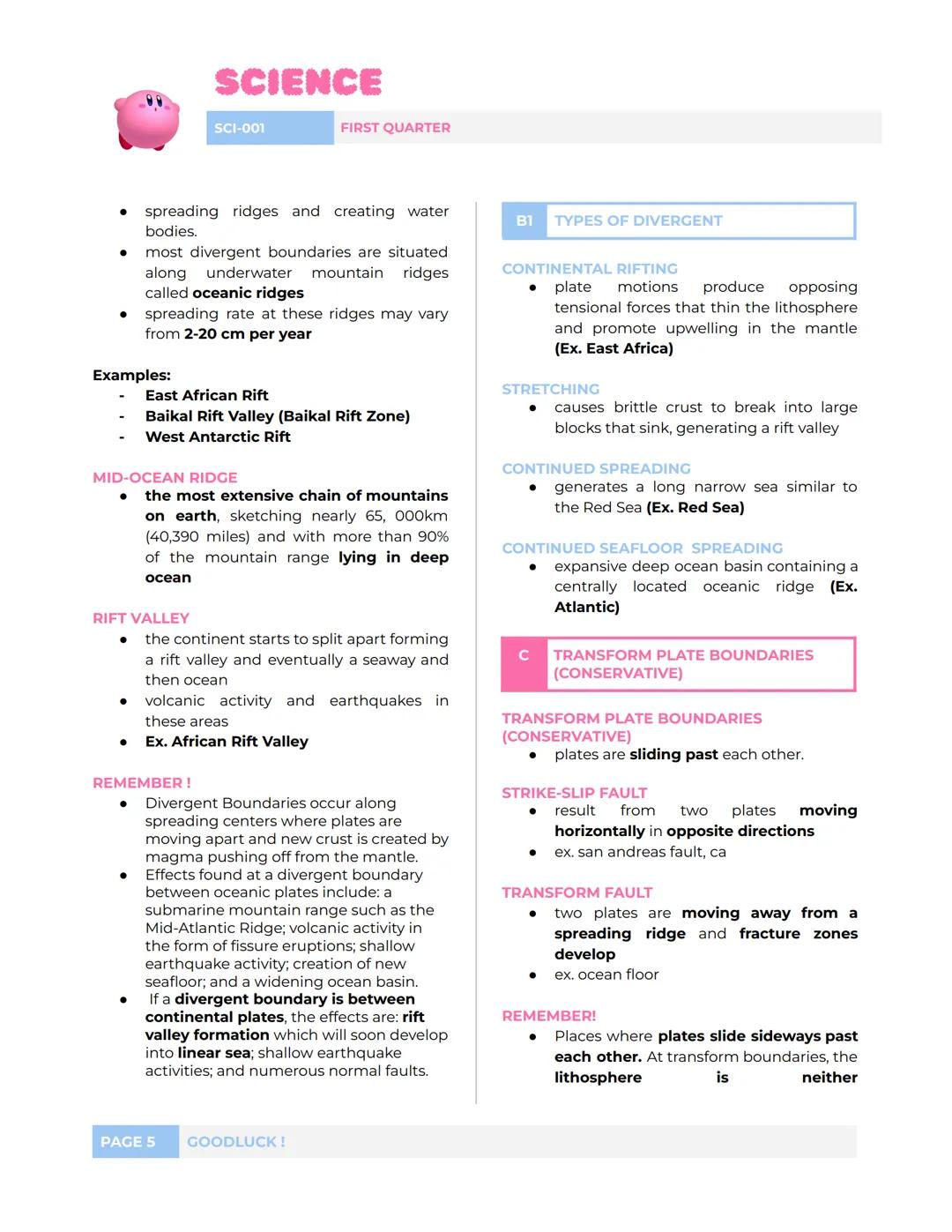
Divergent boundaries are where plates move apart - think of them as Earth's "stretching zones." As plates separate, new crust forms from rising magma, creating features like mid-ocean ridges and rift valleys. It's like Earth is constantly making new seafloor!
Continental rifting happens when continents start splitting apart, forming rift valleys like the East African Rift. Eventually, continued spreading can create new oceans! Mid-ocean ridges are actually Earth's longest mountain chains, stretching about 65,000 km mostly underwater.
Transform boundaries are where plates slide sideways past each other, like cars changing lanes. The famous San Andreas Fault in California is a perfect example of a strike-slip fault. These boundaries don't create or destroy crust - they're "conservative" - but they can generate powerful earthquakes when plates get stuck and then suddenly slip.
Real Talk: At divergent boundaries, new crust is born. At convergent boundaries, old crust gets recycled. At transform boundaries, plates just slide past each other like they're minding their own business!

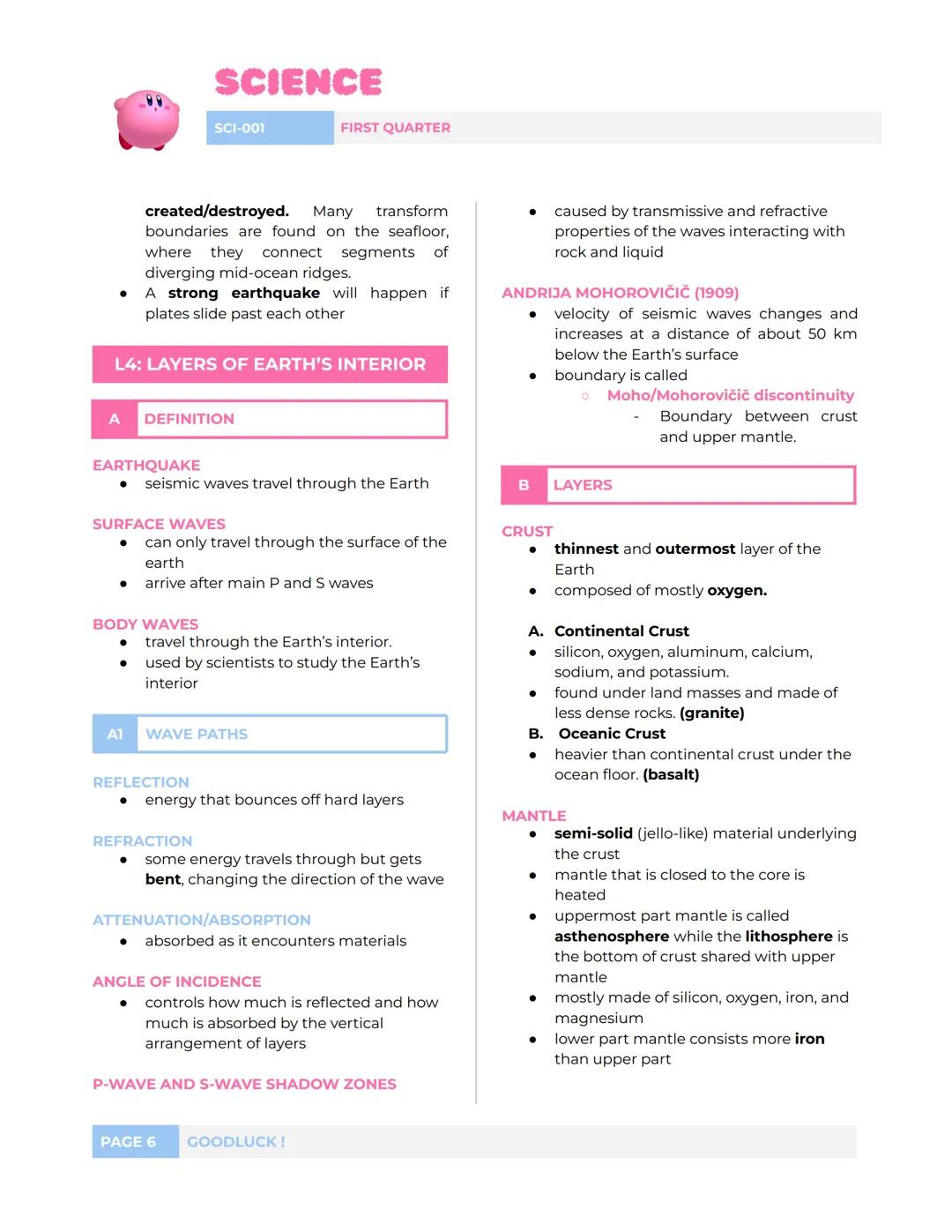
Scientists use seismic waves from earthquakes like X-rays to see inside Earth! Body waves travel through Earth's interior while surface waves only travel on top. When these waves hit different materials, they reflect, refract, or get absorbed - telling us what's inside our planet.
The crust is our thin, rocky outer shell made mostly of oxygen and silicon. Continental crust (like granite) is thicker but less dense than oceanic crust (like basalt). Below that, the mantle is a semi-solid, jello-like layer that's mostly silicon, oxygen, iron, and magnesium.
Earth's core has two parts: the liquid outer core of iron and nickel that creates our magnetic field, and the solid inner core that stays solid despite extreme heat because of crushing pressure. The movement of the outer core around the inner core generates Earth's magnetic field - basically turning our planet into a giant electromagnet!
Cool Fact: The Mohorovičič discontinuity (or "Moho") is the boundary between crust and mantle, discovered when scientists noticed seismic waves suddenly speed up at about 50 km depth!

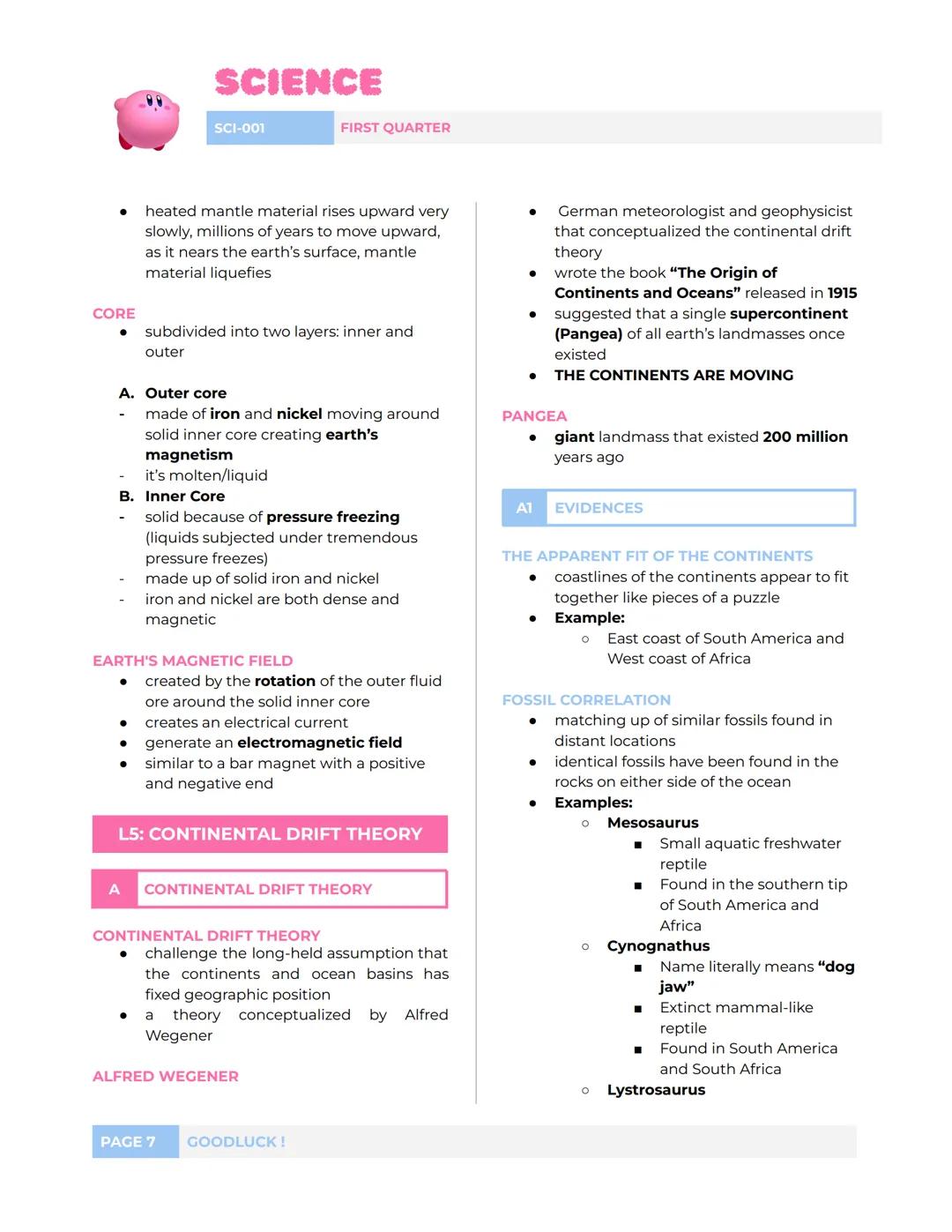
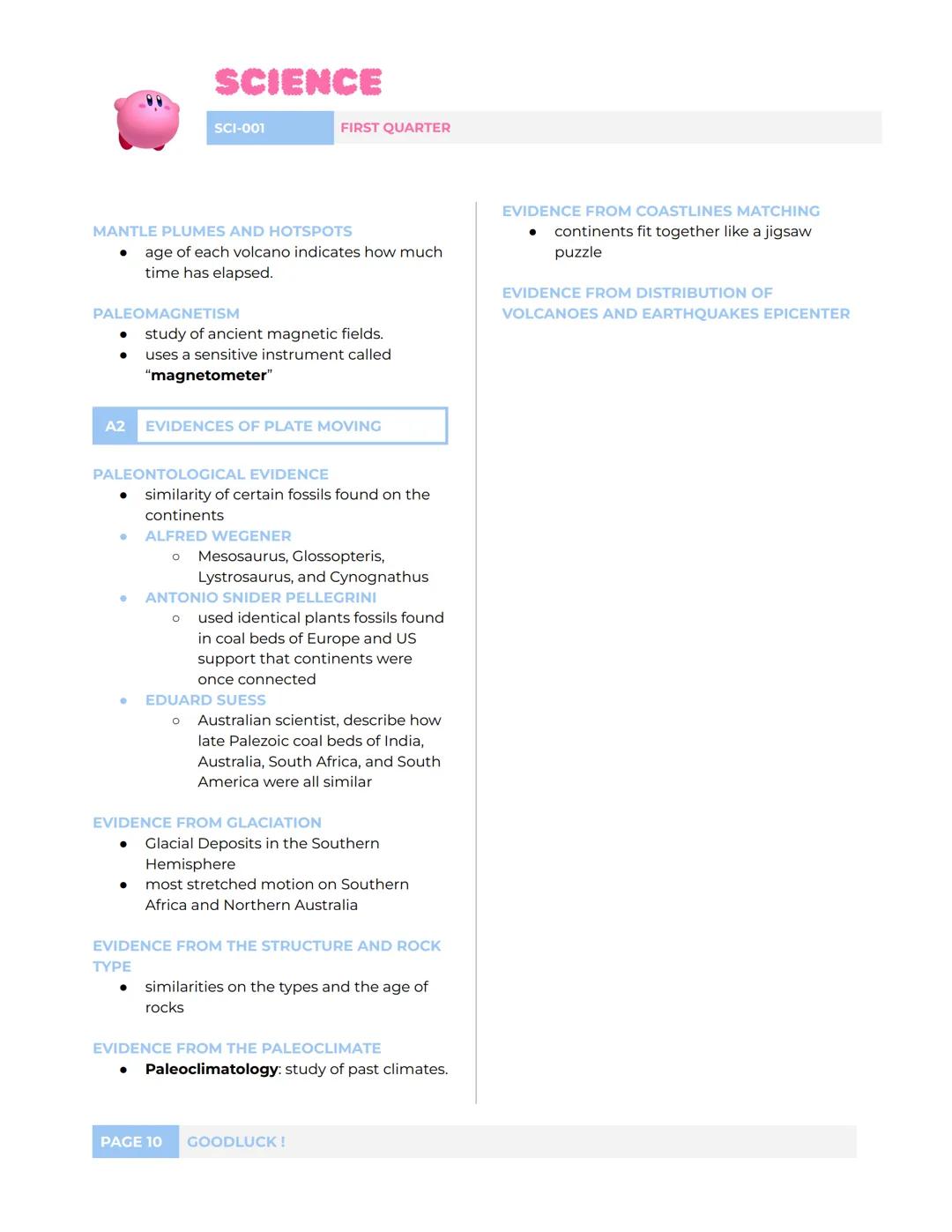
Back in 1915, German scientist Alfred Wegener proposed a wild idea: all continents were once joined together in a supercontinent called Pangea about 200 million years ago. People thought he was crazy, but he had some pretty convincing evidence!
Fossil correlation was Wegener's strongest proof. Identical fossils like Mesosaurus (a small freshwater reptile), Cynognathus , Lystrosaurus (the "shovel lizard"), and Glossopteris were found on continents separated by vast oceans. How could the same species exist on different continents unless they were once connected?
He also showed how continents fit together like puzzle pieces, especially South America and Africa. Rock correlation revealed matching mountain ranges and rock types across oceans, while paleoclimate data showed evidence of ancient ice sheets in now-warm places and tropical plant remains (coal) in now-cold regions.
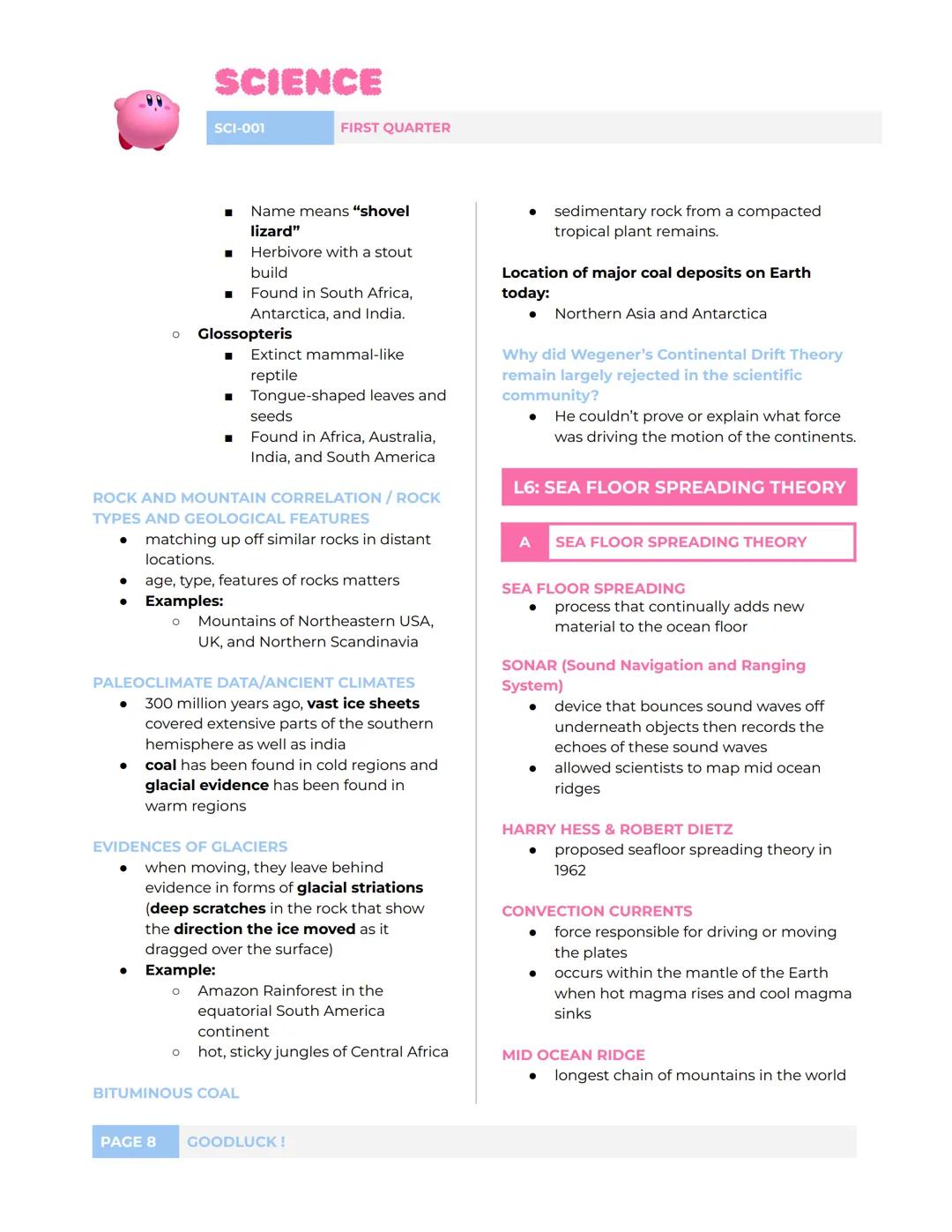
Why was Wegener rejected? His evidence was solid, but he couldn't explain what force was powerful enough to move entire continents. That mystery wasn't solved until the 1960s!

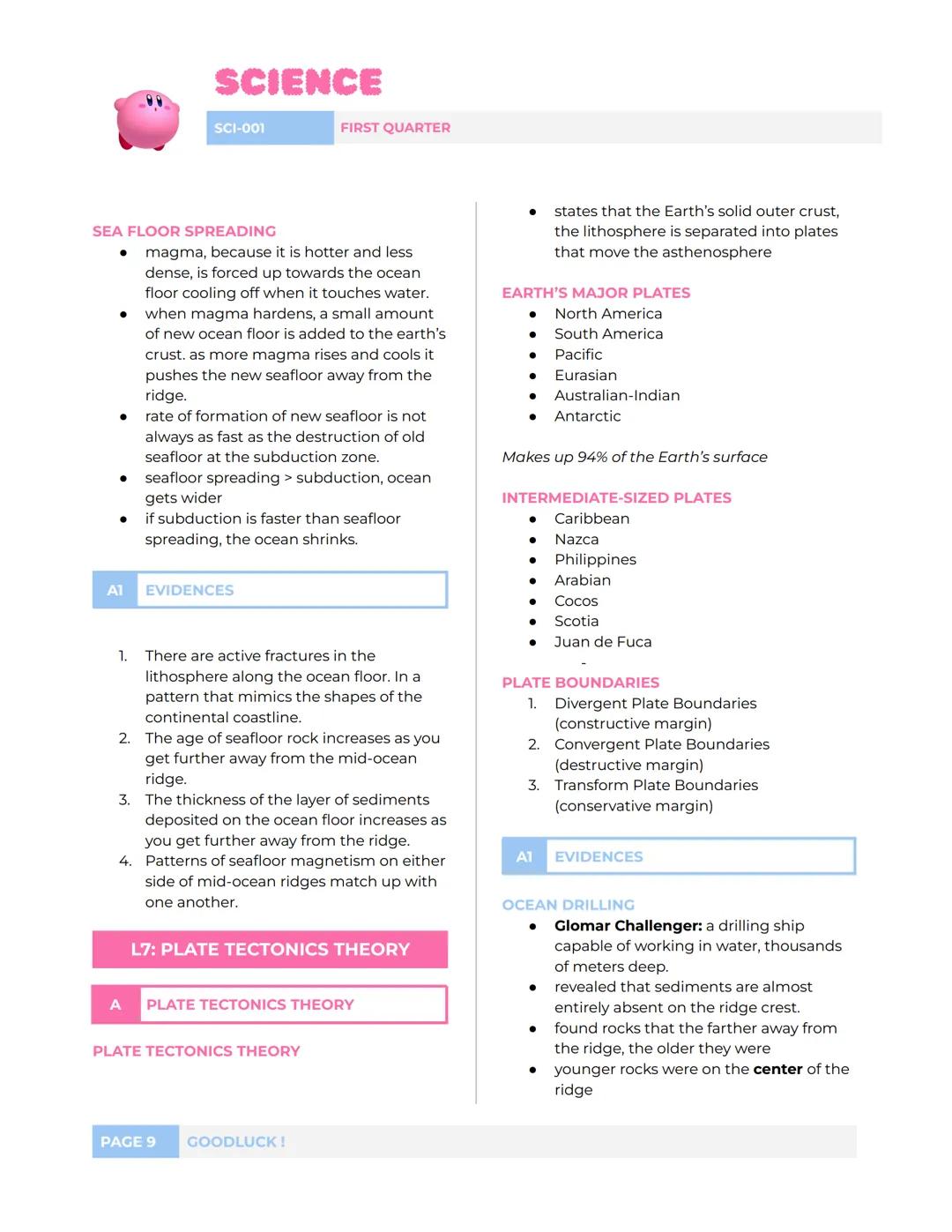
In 1962, Harry Hess and Robert Dietz solved Wegener's puzzle with the seafloor spreading theory. They discovered that new ocean floor constantly forms at mid-ocean ridges - Earth's longest mountain chains hidden underwater.
Here's how it works: convection currents in the mantle act like a giant conveyor belt. Hot magma rises at mid-ocean ridges, cools when it hits seawater, and hardens into new seafloor. As more magma rises, it pushes the older seafloor away from the ridge, spreading the ocean floor outward.
SONAR technology helped map these underwater mountain ranges and revealed amazing evidence: seafloor rocks get older the farther you move from the ridges, sediment layers get thicker away from ridges, and magnetic patterns on both sides of ridges mirror each other perfectly. The rate of spreading varies - sometimes new seafloor forms faster than old seafloor gets destroyed at subduction zones, making oceans wider!
Mind-Blowing Fact: The Atlantic Ocean is still growing wider by about 2-5 centimeters per year - roughly the same rate your fingernails grow!

The plate tectonics theory combines continental drift and seafloor spreading into one unified explanation. Earth's lithosphere is broken into major plates that float on the asthenosphere like puzzle pieces on a slow-moving conveyor belt.
Seven major plates make up 94% of Earth's surface: North American, South American, Pacific, Eurasian, Australian-Indian, Antarctic, and African plates. Several intermediate-sized plates like the Philippine, Caribbean, and Nazca plates fill in the gaps.
Multiple lines of evidence support this theory: ocean drilling by the Glomar Challenger showed that seafloor rocks get progressively older away from ridges, paleomagnetism revealed magnetic stripe patterns, and the distribution of volcanoes and earthquakes perfectly matches plate boundaries. Paleontological evidence from fossils and glaciation evidence from ancient ice sheets all confirm that continents have indeed moved over geological time.
The Big Picture: Plate tectonics explains almost everything - why we have earthquakes, volcanoes, mountains, and even why similar fossils appear on different continents. It's the unifying theory that ties Earth science together!


Our AI companion is specifically built for the needs of students. Based on the millions of content pieces we have on the platform we can provide truly meaningful and relevant answers to students. But its not only about answers, the companion is even more about guiding students through their daily learning challenges, with personalised study plans, quizzes or content pieces in the chat and 100% personalisation based on the students skills and developments.
You can download the app in the Google Play Store and in the Apple App Store.
That's right! Enjoy free access to study content, connect with fellow students, and get instant help – all at your fingertips.
App Store
Google Play
The app is very easy to use and well designed. I have found everything I was looking for so far and have been able to learn a lot from the presentations! I will definitely use the app for a class assignment! And of course it also helps a lot as an inspiration.
Stefan S
iOS user
This app is really great. There are so many study notes and help [...]. My problem subject is French, for example, and the app has so many options for help. Thanks to this app, I have improved my French. I would recommend it to anyone.
Samantha Klich
Android user
Wow, I am really amazed. I just tried the app because I've seen it advertised many times and was absolutely stunned. This app is THE HELP you want for school and above all, it offers so many things, such as workouts and fact sheets, which have been VERY helpful to me personally.
Anna
iOS user
I think it’s very much worth it and you’ll end up using it a lot once you get the hang of it and even after looking at others notes you can still ask your Artificial intelligence buddy the question and ask to simplify it if you still don’t get it!!! In the end I think it’s worth it 😊👍 ⚠️Also DID I MENTION ITS FREEE YOU DON’T HAVE TO PAY FOR ANYTHING AND STILL GET YOUR GRADES IN PERFECTLY❗️❗️⚠️
Thomas R
iOS user
Knowunity is the BEST app I’ve used in a minute. This is not an ai review or anything this is genuinely coming from a 7th grade student (I know 2011 im young) but dude this app is a 10/10 i have maintained a 3.8 gpa and have plenty of time for gaming. I love it and my mom is just happy I got good grades
Brad T
Android user
Not only did it help me find the answer but it also showed me alternative ways to solve it. I was horrible in math and science but now I have an a in both subjects. Thanks for the help🤍🤍
David K
iOS user
The app's just great! All I have to do is enter the topic in the search bar and I get the response real fast. I don't have to watch 10 YouTube videos to understand something, so I'm saving my time. Highly recommended!
Sudenaz Ocak
Android user
In school I was really bad at maths but thanks to the app, I am doing better now. I am so grateful that you made the app.
Greenlight Bonnie
Android user
I found this app a couple years ago and it has only gotten better since then. I really love it because it can help with written questions and photo questions. Also, it can find study guides that other people have made as well as flashcard sets and practice tests. The free version is also amazing for students who might not be able to afford it. Would 100% recommend
Aubrey
iOS user
Best app if you're in Highschool or Junior high. I have been using this app for 2 school years and it's the best, it's good if you don't have anyone to help you with school work.😋🩷🎀
Marco B
iOS user
THE QUIZES AND FLASHCARDS ARE SO USEFUL AND I LOVE THE SCHOOLGPT. IT ALSO IS LITREALLY LIKE CHATGPT BUT SMARTER!! HELPED ME WITH MY MASCARA PROBLEMS TOO!! AS WELL AS MY REAL SUBJECTS ! DUHHH 😍😁😲🤑💗✨🎀😮
Elisha
iOS user
This app is phenomenal down to the correct info and the various topics you can study! I greatly recommend it for people who struggle with procrastination and those who need homework help. It has been perfectly accurate for world 1 history as far as I’ve seen! Geometry too!
Paul T
iOS user
The app is very easy to use and well designed. I have found everything I was looking for so far and have been able to learn a lot from the presentations! I will definitely use the app for a class assignment! And of course it also helps a lot as an inspiration.
Stefan S
iOS user
This app is really great. There are so many study notes and help [...]. My problem subject is French, for example, and the app has so many options for help. Thanks to this app, I have improved my French. I would recommend it to anyone.
Samantha Klich
Android user
Wow, I am really amazed. I just tried the app because I've seen it advertised many times and was absolutely stunned. This app is THE HELP you want for school and above all, it offers so many things, such as workouts and fact sheets, which have been VERY helpful to me personally.
Anna
iOS user
I think it’s very much worth it and you’ll end up using it a lot once you get the hang of it and even after looking at others notes you can still ask your Artificial intelligence buddy the question and ask to simplify it if you still don’t get it!!! In the end I think it’s worth it 😊👍 ⚠️Also DID I MENTION ITS FREEE YOU DON’T HAVE TO PAY FOR ANYTHING AND STILL GET YOUR GRADES IN PERFECTLY❗️❗️⚠️
Thomas R
iOS user
Knowunity is the BEST app I’ve used in a minute. This is not an ai review or anything this is genuinely coming from a 7th grade student (I know 2011 im young) but dude this app is a 10/10 i have maintained a 3.8 gpa and have plenty of time for gaming. I love it and my mom is just happy I got good grades
Brad T
Android user
Not only did it help me find the answer but it also showed me alternative ways to solve it. I was horrible in math and science but now I have an a in both subjects. Thanks for the help🤍🤍
David K
iOS user
The app's just great! All I have to do is enter the topic in the search bar and I get the response real fast. I don't have to watch 10 YouTube videos to understand something, so I'm saving my time. Highly recommended!
Sudenaz Ocak
Android user
In school I was really bad at maths but thanks to the app, I am doing better now. I am so grateful that you made the app.
Greenlight Bonnie
Android user
I found this app a couple years ago and it has only gotten better since then. I really love it because it can help with written questions and photo questions. Also, it can find study guides that other people have made as well as flashcard sets and practice tests. The free version is also amazing for students who might not be able to afford it. Would 100% recommend
Aubrey
iOS user
Best app if you're in Highschool or Junior high. I have been using this app for 2 school years and it's the best, it's good if you don't have anyone to help you with school work.😋🩷🎀
Marco B
iOS user
THE QUIZES AND FLASHCARDS ARE SO USEFUL AND I LOVE THE SCHOOLGPT. IT ALSO IS LITREALLY LIKE CHATGPT BUT SMARTER!! HELPED ME WITH MY MASCARA PROBLEMS TOO!! AS WELL AS MY REAL SUBJECTS ! DUHHH 😍😁😲🤑💗✨🎀😮
Elisha
iOS user
This app is phenomenal down to the correct info and the various topics you can study! I greatly recommend it for people who struggle with procrastination and those who need homework help. It has been perfectly accurate for world 1 history as far as I’ve seen! Geometry too!
Paul T
iOS user
kish andres
@kishandres
Ever wondered why earthquakes happen or how scientists figure out where they start? Earth science is all about understanding our planet's incredible forces - from locating earthquake epicenters to discovering how continents move around like puzzle pieces over millions of... Show more

Access to all documents
Improve your grades
Join milions of students
By signing up you accept Terms of Service and Privacy Policy
Think of earthquakes as Earth's way of releasing built-up stress, kind of like when you crack your knuckles! An earthquake happens when stored energy suddenly releases through movement along a fault (basically a crack between rock blocks).
Here's what you need to know: the focus (or hypocenter) is where the earthquake actually starts underground, while the epicenter is the point directly above it on Earth's surface. Scientists use a seismograph to detect and record these movements, creating zigzag patterns called seismograms.
Primary waves arrive first, followed by secondary waves . The triangulation method is like detective work - scientists use data from three different seismic stations, measure the time difference between P and S waves, then draw circles to find where they intersect. That intersection point? That's your epicenter!
Quick Tip: Remember that P-waves are "primary" because they're first, and S-waves are "secondary" because they arrive second!

Access to all documents
Improve your grades
Join milions of students
By signing up you accept Terms of Service and Privacy Policy
Your planet is basically a layered cake! The crust is the cool, rocky outer layer we live on, the mantle is the hot middle layer made of molten rock, and the core is the super-hot center. The lithosphere combines the crust and upper mantle, while the asthenosphere sits below and helps plates move.
There are two types of crust: continental crust (thicker but lighter, like the land you walk on) and oceanic crust (thinner but denser, under the oceans). The plate tectonic theory explains that Earth's crust is broken into huge moving pieces called plates.
Here's the cool part - earthquakes, volcanoes, and mountains aren't randomly scattered around Earth! They cluster along plate boundaries where these massive pieces meet. Most volcanoes and earthquakes happen around the Pacific Ring of Fire, and here in the Philippines, we need to watch the West Valley Fault where the predicted "Big One" earthquake might hit.
Remember: Mountains form when plates crash into each other, while volcanoes often form through subduction when denser oceanic plates dive under lighter continental plates.

Access to all documents
Improve your grades
Join milions of students
By signing up you accept Terms of Service and Privacy Policy
When plates crash into each other, you get convergent boundaries - think of them as Earth's collision zones! These create some of our planet's most dramatic features through compression and subduction (when one plate slides under another).
Oceanic-to-continental convergence happens when a dense oceanic plate dives under a lighter continental plate, creating volcanic arcs and deep trenches. Examples include the Andes Mountains where the Nazca Plate meets the South American Plate. The diving oceanic plate melts as it goes deeper, creating magma that rises to form volcanoes.
Oceanic-to-oceanic convergence occurs when two oceanic plates meet, and the older, denser one subducts. This creates volcanic island arcs (like many parts of the Philippines!) and can trigger tsunamis if the seafloor suddenly moves upward. Continental-to-continental convergence is like a head-on collision - neither plate subducts, so they buckle upward forming massive mountain ranges like the Himalayas.
Philippine Connection: Many parts of our archipelago formed from oceanic-oceanic convergence, which explains why we have so many volcanoes and experience frequent earthquakes!

Access to all documents
Improve your grades
Join milions of students
By signing up you accept Terms of Service and Privacy Policy
Divergent boundaries are where plates move apart - think of them as Earth's "stretching zones." As plates separate, new crust forms from rising magma, creating features like mid-ocean ridges and rift valleys. It's like Earth is constantly making new seafloor!
Continental rifting happens when continents start splitting apart, forming rift valleys like the East African Rift. Eventually, continued spreading can create new oceans! Mid-ocean ridges are actually Earth's longest mountain chains, stretching about 65,000 km mostly underwater.
Transform boundaries are where plates slide sideways past each other, like cars changing lanes. The famous San Andreas Fault in California is a perfect example of a strike-slip fault. These boundaries don't create or destroy crust - they're "conservative" - but they can generate powerful earthquakes when plates get stuck and then suddenly slip.
Real Talk: At divergent boundaries, new crust is born. At convergent boundaries, old crust gets recycled. At transform boundaries, plates just slide past each other like they're minding their own business!

Access to all documents
Improve your grades
Join milions of students
By signing up you accept Terms of Service and Privacy Policy
Scientists use seismic waves from earthquakes like X-rays to see inside Earth! Body waves travel through Earth's interior while surface waves only travel on top. When these waves hit different materials, they reflect, refract, or get absorbed - telling us what's inside our planet.
The crust is our thin, rocky outer shell made mostly of oxygen and silicon. Continental crust (like granite) is thicker but less dense than oceanic crust (like basalt). Below that, the mantle is a semi-solid, jello-like layer that's mostly silicon, oxygen, iron, and magnesium.
Earth's core has two parts: the liquid outer core of iron and nickel that creates our magnetic field, and the solid inner core that stays solid despite extreme heat because of crushing pressure. The movement of the outer core around the inner core generates Earth's magnetic field - basically turning our planet into a giant electromagnet!
Cool Fact: The Mohorovičič discontinuity (or "Moho") is the boundary between crust and mantle, discovered when scientists noticed seismic waves suddenly speed up at about 50 km depth!

Access to all documents
Improve your grades
Join milions of students
By signing up you accept Terms of Service and Privacy Policy
Back in 1915, German scientist Alfred Wegener proposed a wild idea: all continents were once joined together in a supercontinent called Pangea about 200 million years ago. People thought he was crazy, but he had some pretty convincing evidence!
Fossil correlation was Wegener's strongest proof. Identical fossils like Mesosaurus (a small freshwater reptile), Cynognathus , Lystrosaurus (the "shovel lizard"), and Glossopteris were found on continents separated by vast oceans. How could the same species exist on different continents unless they were once connected?
He also showed how continents fit together like puzzle pieces, especially South America and Africa. Rock correlation revealed matching mountain ranges and rock types across oceans, while paleoclimate data showed evidence of ancient ice sheets in now-warm places and tropical plant remains (coal) in now-cold regions.
Why was Wegener rejected? His evidence was solid, but he couldn't explain what force was powerful enough to move entire continents. That mystery wasn't solved until the 1960s!

Access to all documents
Improve your grades
Join milions of students
By signing up you accept Terms of Service and Privacy Policy
In 1962, Harry Hess and Robert Dietz solved Wegener's puzzle with the seafloor spreading theory. They discovered that new ocean floor constantly forms at mid-ocean ridges - Earth's longest mountain chains hidden underwater.
Here's how it works: convection currents in the mantle act like a giant conveyor belt. Hot magma rises at mid-ocean ridges, cools when it hits seawater, and hardens into new seafloor. As more magma rises, it pushes the older seafloor away from the ridge, spreading the ocean floor outward.
SONAR technology helped map these underwater mountain ranges and revealed amazing evidence: seafloor rocks get older the farther you move from the ridges, sediment layers get thicker away from ridges, and magnetic patterns on both sides of ridges mirror each other perfectly. The rate of spreading varies - sometimes new seafloor forms faster than old seafloor gets destroyed at subduction zones, making oceans wider!
Mind-Blowing Fact: The Atlantic Ocean is still growing wider by about 2-5 centimeters per year - roughly the same rate your fingernails grow!

Access to all documents
Improve your grades
Join milions of students
By signing up you accept Terms of Service and Privacy Policy
The plate tectonics theory combines continental drift and seafloor spreading into one unified explanation. Earth's lithosphere is broken into major plates that float on the asthenosphere like puzzle pieces on a slow-moving conveyor belt.
Seven major plates make up 94% of Earth's surface: North American, South American, Pacific, Eurasian, Australian-Indian, Antarctic, and African plates. Several intermediate-sized plates like the Philippine, Caribbean, and Nazca plates fill in the gaps.
Multiple lines of evidence support this theory: ocean drilling by the Glomar Challenger showed that seafloor rocks get progressively older away from ridges, paleomagnetism revealed magnetic stripe patterns, and the distribution of volcanoes and earthquakes perfectly matches plate boundaries. Paleontological evidence from fossils and glaciation evidence from ancient ice sheets all confirm that continents have indeed moved over geological time.
The Big Picture: Plate tectonics explains almost everything - why we have earthquakes, volcanoes, mountains, and even why similar fossils appear on different continents. It's the unifying theory that ties Earth science together!

Access to all documents
Improve your grades
Join milions of students
By signing up you accept Terms of Service and Privacy Policy

Access to all documents
Improve your grades
Join milions of students
By signing up you accept Terms of Service and Privacy Policy
Our AI companion is specifically built for the needs of students. Based on the millions of content pieces we have on the platform we can provide truly meaningful and relevant answers to students. But its not only about answers, the companion is even more about guiding students through their daily learning challenges, with personalised study plans, quizzes or content pieces in the chat and 100% personalisation based on the students skills and developments.
You can download the app in the Google Play Store and in the Apple App Store.
That's right! Enjoy free access to study content, connect with fellow students, and get instant help – all at your fingertips.
412
Smart Tools NEW
Transform this note into: ✓ 50+ Practice Questions ✓ Interactive Flashcards ✓ Full Mock Exam ✓ Essay Outlines
App Store
Google Play
The app is very easy to use and well designed. I have found everything I was looking for so far and have been able to learn a lot from the presentations! I will definitely use the app for a class assignment! And of course it also helps a lot as an inspiration.
Stefan S
iOS user
This app is really great. There are so many study notes and help [...]. My problem subject is French, for example, and the app has so many options for help. Thanks to this app, I have improved my French. I would recommend it to anyone.
Samantha Klich
Android user
Wow, I am really amazed. I just tried the app because I've seen it advertised many times and was absolutely stunned. This app is THE HELP you want for school and above all, it offers so many things, such as workouts and fact sheets, which have been VERY helpful to me personally.
Anna
iOS user
I think it’s very much worth it and you’ll end up using it a lot once you get the hang of it and even after looking at others notes you can still ask your Artificial intelligence buddy the question and ask to simplify it if you still don’t get it!!! In the end I think it’s worth it 😊👍 ⚠️Also DID I MENTION ITS FREEE YOU DON’T HAVE TO PAY FOR ANYTHING AND STILL GET YOUR GRADES IN PERFECTLY❗️❗️⚠️
Thomas R
iOS user
Knowunity is the BEST app I’ve used in a minute. This is not an ai review or anything this is genuinely coming from a 7th grade student (I know 2011 im young) but dude this app is a 10/10 i have maintained a 3.8 gpa and have plenty of time for gaming. I love it and my mom is just happy I got good grades
Brad T
Android user
Not only did it help me find the answer but it also showed me alternative ways to solve it. I was horrible in math and science but now I have an a in both subjects. Thanks for the help🤍🤍
David K
iOS user
The app's just great! All I have to do is enter the topic in the search bar and I get the response real fast. I don't have to watch 10 YouTube videos to understand something, so I'm saving my time. Highly recommended!
Sudenaz Ocak
Android user
In school I was really bad at maths but thanks to the app, I am doing better now. I am so grateful that you made the app.
Greenlight Bonnie
Android user
I found this app a couple years ago and it has only gotten better since then. I really love it because it can help with written questions and photo questions. Also, it can find study guides that other people have made as well as flashcard sets and practice tests. The free version is also amazing for students who might not be able to afford it. Would 100% recommend
Aubrey
iOS user
Best app if you're in Highschool or Junior high. I have been using this app for 2 school years and it's the best, it's good if you don't have anyone to help you with school work.😋🩷🎀
Marco B
iOS user
THE QUIZES AND FLASHCARDS ARE SO USEFUL AND I LOVE THE SCHOOLGPT. IT ALSO IS LITREALLY LIKE CHATGPT BUT SMARTER!! HELPED ME WITH MY MASCARA PROBLEMS TOO!! AS WELL AS MY REAL SUBJECTS ! DUHHH 😍😁😲🤑💗✨🎀😮
Elisha
iOS user
This app is phenomenal down to the correct info and the various topics you can study! I greatly recommend it for people who struggle with procrastination and those who need homework help. It has been perfectly accurate for world 1 history as far as I’ve seen! Geometry too!
Paul T
iOS user
The app is very easy to use and well designed. I have found everything I was looking for so far and have been able to learn a lot from the presentations! I will definitely use the app for a class assignment! And of course it also helps a lot as an inspiration.
Stefan S
iOS user
This app is really great. There are so many study notes and help [...]. My problem subject is French, for example, and the app has so many options for help. Thanks to this app, I have improved my French. I would recommend it to anyone.
Samantha Klich
Android user
Wow, I am really amazed. I just tried the app because I've seen it advertised many times and was absolutely stunned. This app is THE HELP you want for school and above all, it offers so many things, such as workouts and fact sheets, which have been VERY helpful to me personally.
Anna
iOS user
I think it’s very much worth it and you’ll end up using it a lot once you get the hang of it and even after looking at others notes you can still ask your Artificial intelligence buddy the question and ask to simplify it if you still don’t get it!!! In the end I think it’s worth it 😊👍 ⚠️Also DID I MENTION ITS FREEE YOU DON’T HAVE TO PAY FOR ANYTHING AND STILL GET YOUR GRADES IN PERFECTLY❗️❗️⚠️
Thomas R
iOS user
Knowunity is the BEST app I’ve used in a minute. This is not an ai review or anything this is genuinely coming from a 7th grade student (I know 2011 im young) but dude this app is a 10/10 i have maintained a 3.8 gpa and have plenty of time for gaming. I love it and my mom is just happy I got good grades
Brad T
Android user
Not only did it help me find the answer but it also showed me alternative ways to solve it. I was horrible in math and science but now I have an a in both subjects. Thanks for the help🤍🤍
David K
iOS user
The app's just great! All I have to do is enter the topic in the search bar and I get the response real fast. I don't have to watch 10 YouTube videos to understand something, so I'm saving my time. Highly recommended!
Sudenaz Ocak
Android user
In school I was really bad at maths but thanks to the app, I am doing better now. I am so grateful that you made the app.
Greenlight Bonnie
Android user
I found this app a couple years ago and it has only gotten better since then. I really love it because it can help with written questions and photo questions. Also, it can find study guides that other people have made as well as flashcard sets and practice tests. The free version is also amazing for students who might not be able to afford it. Would 100% recommend
Aubrey
iOS user
Best app if you're in Highschool or Junior high. I have been using this app for 2 school years and it's the best, it's good if you don't have anyone to help you with school work.😋🩷🎀
Marco B
iOS user
THE QUIZES AND FLASHCARDS ARE SO USEFUL AND I LOVE THE SCHOOLGPT. IT ALSO IS LITREALLY LIKE CHATGPT BUT SMARTER!! HELPED ME WITH MY MASCARA PROBLEMS TOO!! AS WELL AS MY REAL SUBJECTS ! DUHHH 😍😁😲🤑💗✨🎀😮
Elisha
iOS user
This app is phenomenal down to the correct info and the various topics you can study! I greatly recommend it for people who struggle with procrastination and those who need homework help. It has been perfectly accurate for world 1 history as far as I’ve seen! Geometry too!
Paul T
iOS user