Open the App

Subjects

Grade 10 Science 2nd Quarter Study Guide

189

0

K

kish andres

11/27/2025

Science

Science G10 2ND QUARTER Reviewer

6,643

Nov 27, 2025

12 pages

Grade 10 Science 2nd Quarter Study Guide

K

kish andres

@kishandres

Ever wondered how magnets work, why your phone connects to... Show more

Page 1
Page 2
Page 3
Page 4
Page 5
Page 6
Page 7
Page 8
Page 9
Page 10
1 / 10
SCIENCE
SCI-002
SECOND QUARTER
L1: MAGNETS
Nickel
When an unmagnetized substance is placed in
a magnetic field, the substance can become
mag

Magnets and Magnetic Properties

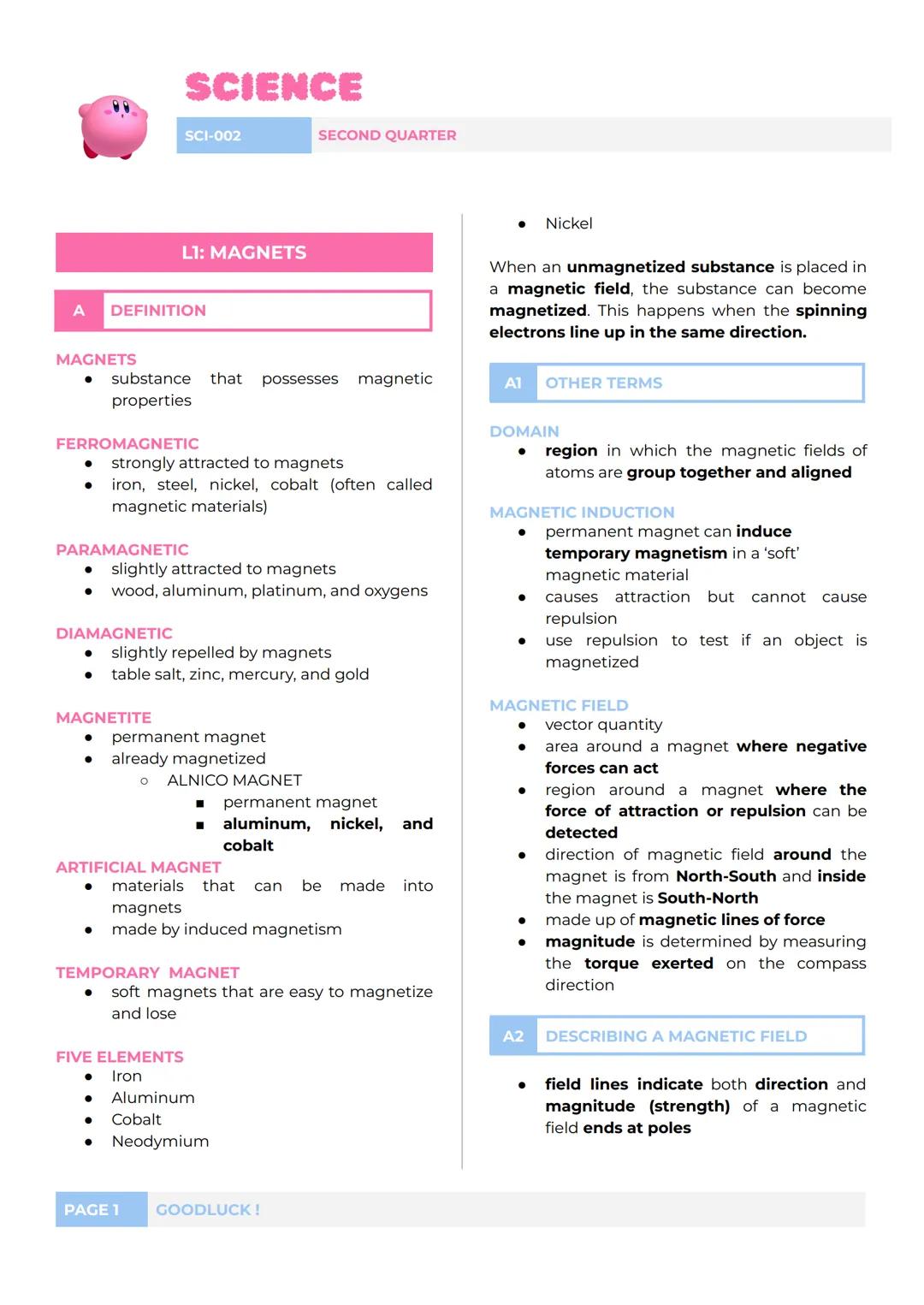
Think about how a magnet sticks to your refrigerator - that's just the beginning of understanding magnetic forces! Magnets are substances that possess magnetic properties, and they work because of tiny spinning electrons that can line up in the same direction.

Materials react differently to magnets. Ferromagnetic materials like iron, steel, nickel, and cobalt are strongly attracted to magnets - these are what we usually call "magnetic materials." Paramagnetic materials like wood and aluminum are only slightly attracted, while diamagnetic materials like gold and zinc are actually slightly repelled.

The space around a magnet where its force can be detected is called a magnetic field. These fields have direction (from North to South pole) and strength, which you can visualize using iron filings that align along invisible magnetic field lines.

Quick Tip: To test if something is actually magnetized (not just magnetic), try using repulsion - only magnetized objects can repel each other!

SCIENCE
SCI-002
SECOND QUARTER
L1: MAGNETS
Nickel
When an unmagnetized substance is placed in
a magnetic field, the substance can become
mag

Magnetic Field Patterns

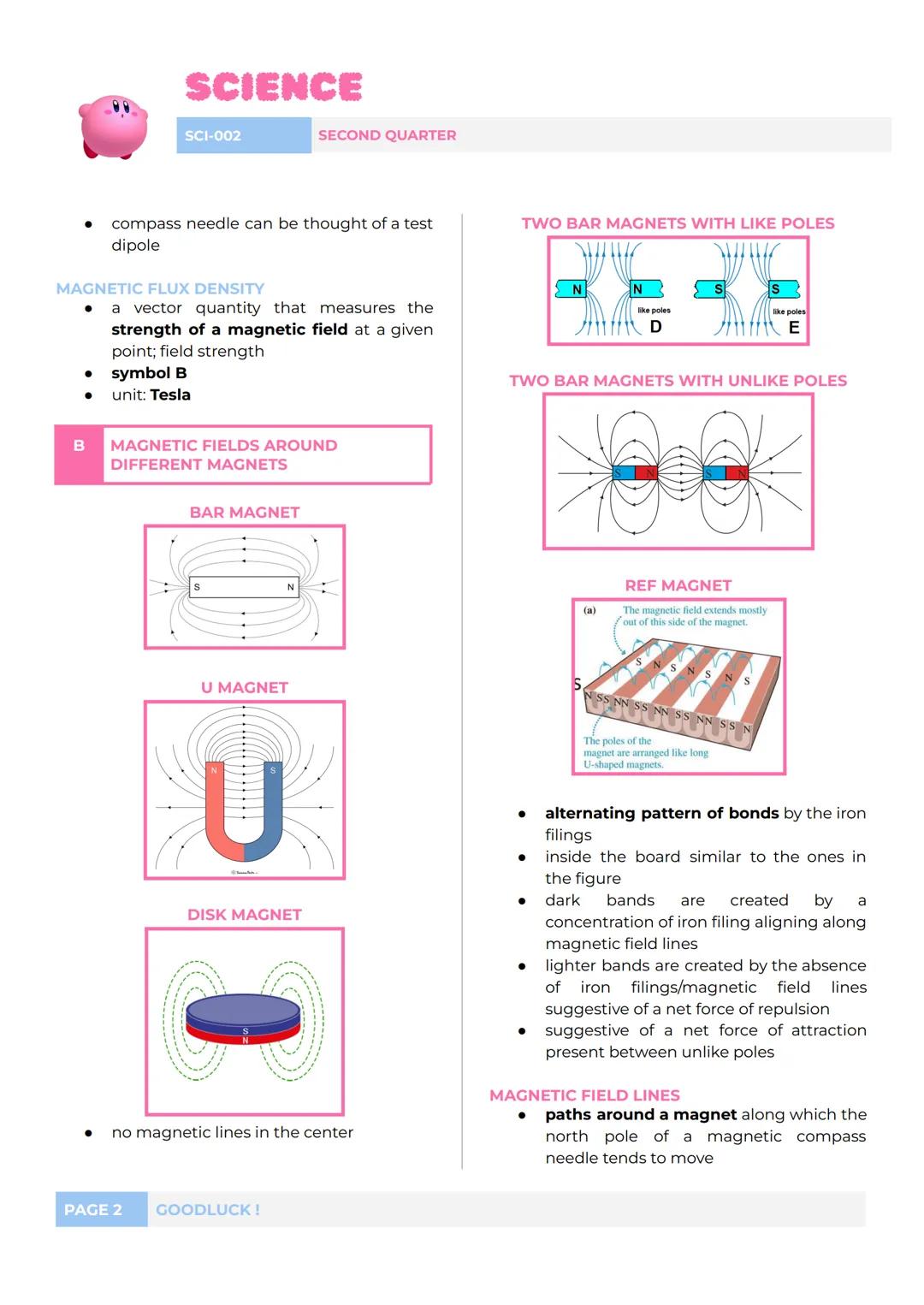
Magnetic fields create fascinating patterns that reveal how magnetic forces work in space. The magnetic flux density (symbol B, measured in Tesla) tells us exactly how strong a magnetic field is at any point - think of it as the "intensity level" of magnetism.

Different magnet shapes create unique field patterns. Bar magnets show classic curved lines flowing from North to South poles, while U-shaped magnets create stronger fields between their poles. Disk magnets have an interesting feature - there are no magnetic lines in their center!

When you bring two magnets together, the magic really happens. Like poles NorthNorthorSouthSouthNorth-North or South-South create field patterns that push away from each other, showing repulsion. Unlike poles NorthSouthNorth-South create field patterns that connect and pull together, demonstrating attraction.

Fun Fact: Iron filings sprinkled around magnets will arrange themselves along field lines, creating visible proof of invisible magnetic forces!

SCIENCE
SCI-002
SECOND QUARTER
L1: MAGNETS
Nickel
When an unmagnetized substance is placed in
a magnetic field, the substance can become
mag

Magnetic Fields from Electric Current

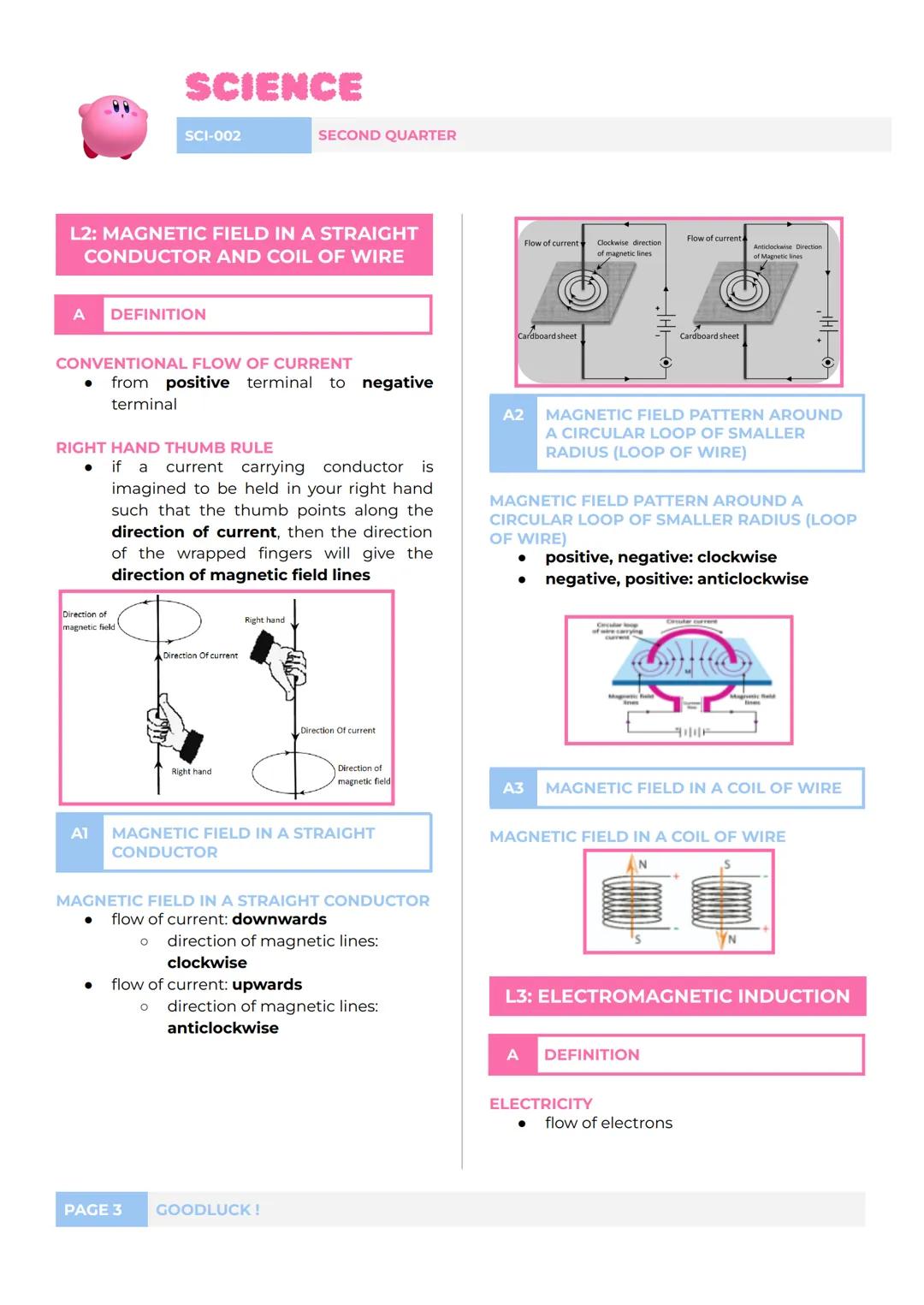
Here's where things get really cool - electricity can create magnetism! When electric current flows through a wire, it generates a magnetic field around that wire. This discovery changed our world forever.

The right-hand thumb rule helps you figure out the direction of these magnetic fields. Point your right thumb in the direction of conventional current flow (positive to negative), and your wrapped fingers show the direction of the magnetic field lines.

Straight conductors create circular magnetic field patterns around the wire. Current flowing downward creates clockwise magnetic fields, while upward current creates counterclockwise fields. When you shape wire into a coil, these circular fields combine to create much stronger magnetic effects.

This principle powers electromagnets - temporary magnets that work only when current flows through them. Unlike permanent magnets, you can turn electromagnets on and off, making them incredibly useful in everything from speakers to MRI machines.

Real World Connection: Every electric motor in your home uses this principle to convert electricity into motion!

SCIENCE
SCI-002
SECOND QUARTER
L1: MAGNETS
Nickel
When an unmagnetized substance is placed in
a magnetic field, the substance can become
mag

Electromagnetic Induction and Key Scientists

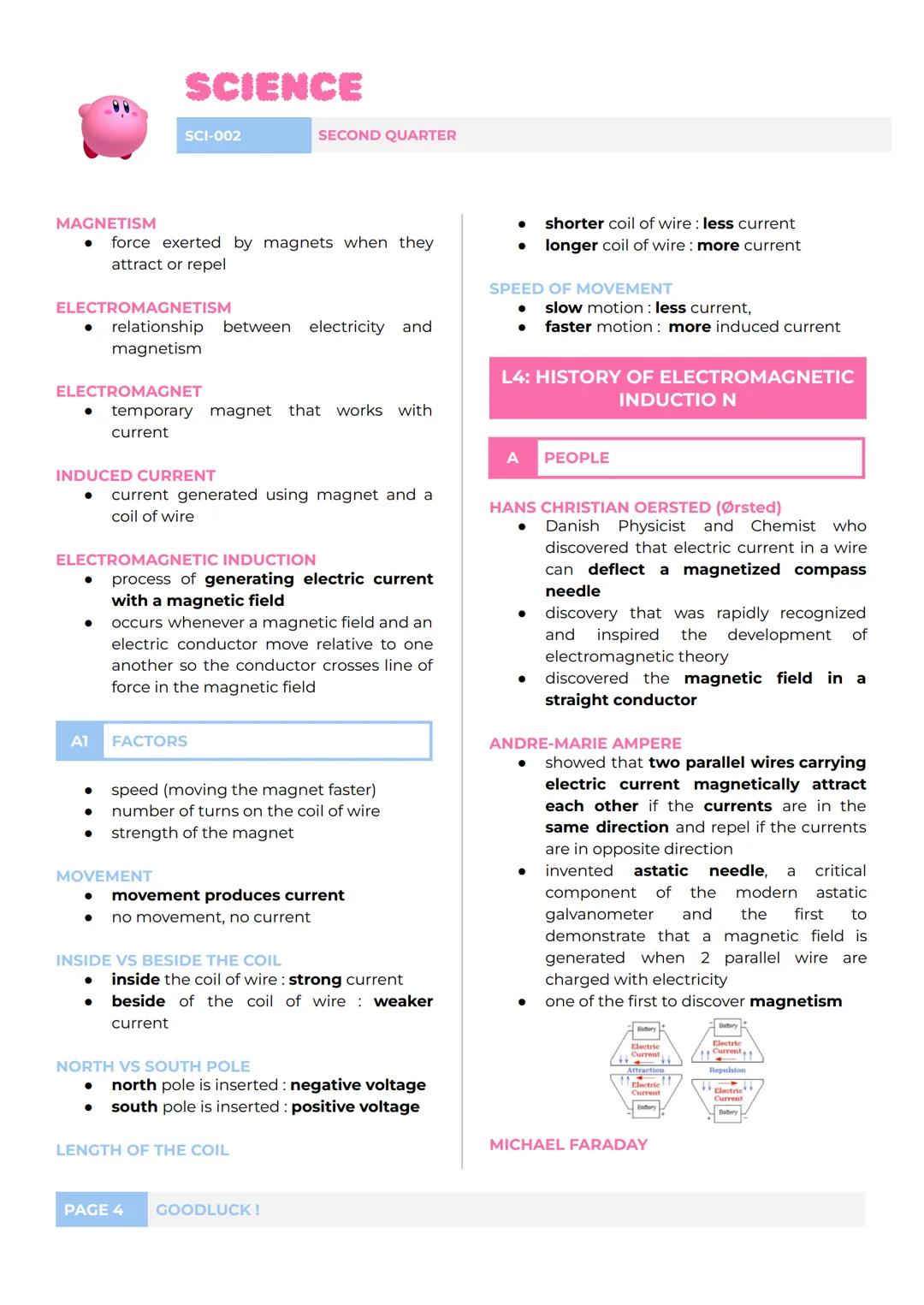
Moving magnets near coils of wire creates electricity - this process is called electromagnetic induction. It's literally how most of the world's electricity is generated! The faster you move the magnet, the more turns in the coil, and the stronger the magnet, the more induced current you'll create.

Several brilliant scientists discovered these principles. Hans Christian Oersted first noticed that electric current could deflect compass needles, proving electricity creates magnetism. Michael Faraday discovered that moving magnets near coils generates electric current, while Andre-Marie Ampere showed how current-carrying wires attract or repel each other.

James Clerk Maxwell put it all together, realizing that changing electric fields create magnetic fields, and changing magnetic fields create electric fields. This creates electromagnetic waves that travel at the speed of light - 3 × 10⁸ m/s!

The key insight: movement produces current, no movement means no current. Whether you move the magnet toward the coil or the coil toward the magnet doesn't matter - only relative motion counts.

Mind Blowing Fact: The electricity powering your phone right now was probably generated using electromagnetic induction at a power plant!

SCIENCE
SCI-002
SECOND QUARTER
L1: MAGNETS
Nickel
When an unmagnetized substance is placed in
a magnetic field, the substance can become
mag

The Electromagnetic Spectrum

Electromagnetic waves are everywhere around you, carrying energy through space at light speed. They don't need any medium to travel through - they can zip through the vacuum of space just fine. The electromagnetic spectrum organizes all these waves by their wavelength, frequency, and energy.

Here's the pattern: shorter wavelengths mean higher frequency and more energy, while longer wavelengths mean lower frequency and less energy. It's like comparing rapid drumbeats (high frequency) to slow, deep bass notes (low frequency).

Radio and TV waves have the longest wavelengths and lowest energy - they're perfect for transmitting information over long distances. Microwaves are shorter and great for heating food and WiFi signals. Infrared waves come from hot objects and are what you feel as heat from a campfire.

Visible light is the tiny portion your eyes can detect, while ultraviolet rays from the sun can cause sunburn but also help your body make vitamin D. X-rays and gamma rays have so much energy they can pass through your body - that's why they're useful in medicine but also potentially dangerous.

Cool Connection: Your smartphone uses multiple parts of the electromagnetic spectrum simultaneously - radio waves for calls, microwaves for WiFi, and visible light for the screen!

SCIENCE
SCI-002
SECOND QUARTER
L1: MAGNETS
Nickel
When an unmagnetized substance is placed in
a magnetic field, the substance can become
mag

Electromagnetic Wave Applications

Each type of electromagnetic radiation has specific applications that affect your daily life. Radio and TV waves carry sound and picture information over vast distances through oscillating electricity in antennas - that's how broadcasting works.

Microwaves range from 1mm to 30cm wavelengths, making them perfect for radar systems and heating food. Your smartphone uses microwaves for WiFi, but transferring voice calls actually uses radio waves. Infrared waves come from molecular motion in hot objects and are readily absorbed by most materials, causing them to warm up.

Visible light is obviously what allows you to see, but ultraviolet radiation has three types with different effects. UV-A reaches your lens and retina, UV-B affects your skin's top layer (causing tans and potential cancer), while UV-C gets absorbed by the atmosphere before reaching you.

X-rays have enough energy to pass through soft tissues but not bones, making them perfect for medical imaging. Gamma rays are the most energetic and penetrating - they're used in cancer treatment and sterilization but can seriously damage living tissue.

Health Note: The sun produces UV radiation that helps your body make vitamin D, but overexposure can cause skin damage - balance is key!

SCIENCE
SCI-002
SECOND QUARTER
L1: MAGNETS
Nickel
When an unmagnetized substance is placed in
a magnetic field, the substance can become
mag

Radio Communication and Mirror Basics

Radio communication systems transmit information over distances using electromagnetic waves. The process involves a transmitter converting information into electrical signals, a channel (like air or cables) carrying the signal, and a receiver converting it back to usable form.

AM radio keeps frequency constant while the sound wave changes the amplitude (strength). FM radio does the opposite - it maintains constant amplitude while varying the frequency based on the signal. Bandwidth measures the frequency range a device uses, like 80 MHz for WiFi.

Now let's switch to optics! Reflection is simply light bouncing back when it strikes a surface. Specular reflection occurs on smooth surfaces like mirrors, creating clear, mirror-like images. Diffuse reflection happens on rough surfaces, scattering light in many directions.

The law of reflection is beautifully simple: the angle of incidence (incoming light ray) equals the angle of reflection (outgoing ray). Both angles are measured from the normal line - an imaginary line perpendicular to the surface.

Tech Fact: Your WiFi router uses a specific bandwidth of microwaves (around 2.4 GHz) to carry data through the air to your devices!

SCIENCE
SCI-002
SECOND QUARTER
L1: MAGNETS
Nickel
When an unmagnetized substance is placed in
a magnetic field, the substance can become
mag

Types of Mirrors and Their Images

Plane mirrors are flat and create images that are the same size as the object, upright, and appear to be the same distance behind the mirror as the object is in front. However, they show left-right reversal - that's why text looks backwards in a mirror.

Spherical mirrors have curved surfaces that create different effects. Concave mirrors (curved inward) are converging mirrors that can create both real and virtual images depending on object placement. When objects are far away, concave mirrors create small, inverted, real images. When objects are close, they create large, upright, virtual images.

Convex mirrors (curved outward) are diverging mirrors that always create small, upright, virtual images regardless of object distance. The image always appears between the focal point and the mirror's surface.

These mirrors have practical applications everywhere. Concave mirrors focus light in car headlights and create magnified images for shaving. Convex mirrors provide wide-angle views in car side mirrors and store security systems, helping you see more area at once.

Memory Tip: Concave caves IN and can create real images; Convex curves OUT and only creates virtual images!

SCIENCE
SCI-002
SECOND QUARTER
L1: MAGNETS
Nickel
When an unmagnetized substance is placed in
a magnetic field, the substance can become
mag

Refraction and Lens Basics

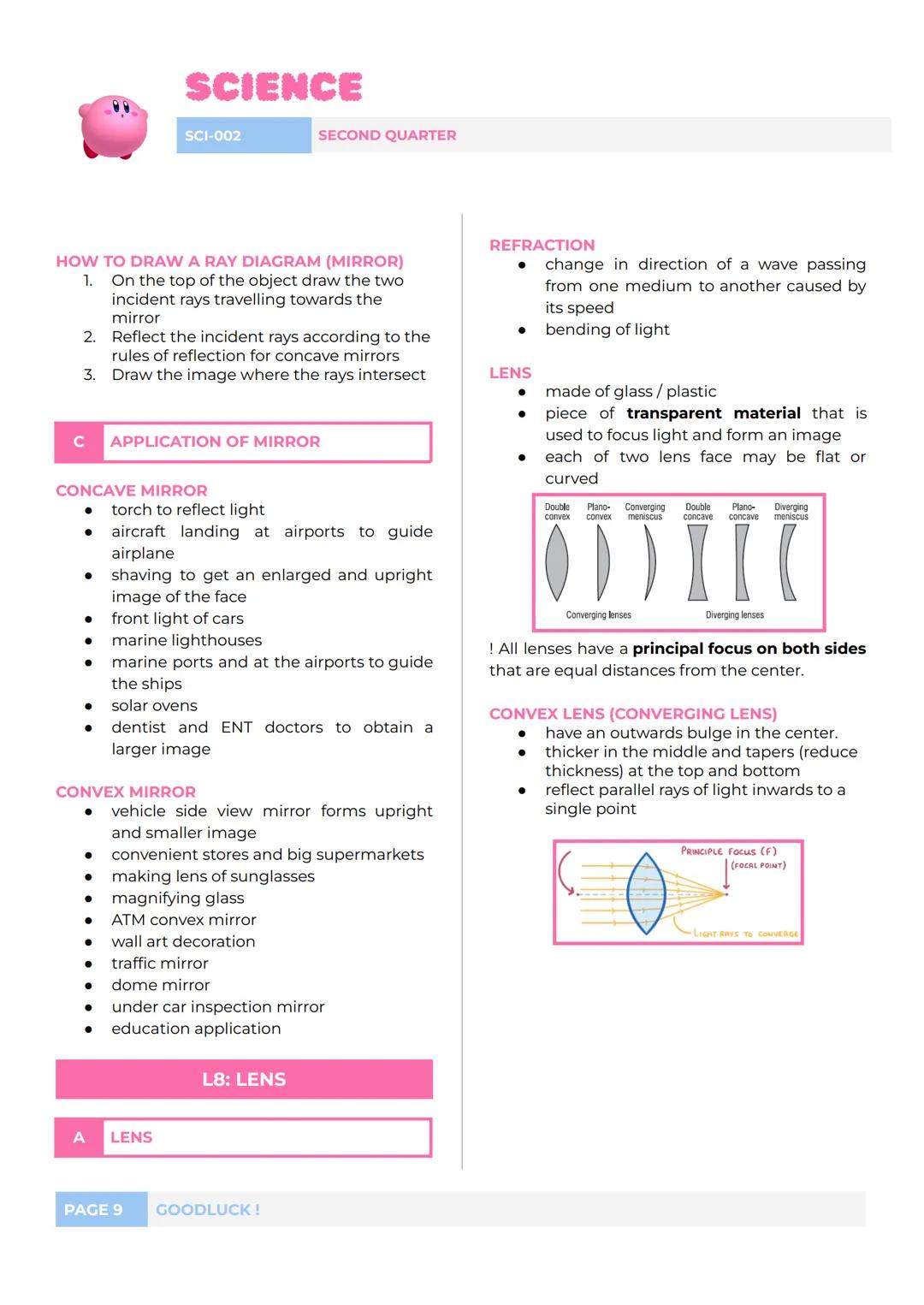
Refraction is the bending of light when it passes from one material to another, like from air to water. This happens because light changes speed in different materials. Lenses use refraction to focus light and form images.

Convex lenses (converging lenses) are thicker in the middle and taper toward the edges. They bend parallel light rays inward to meet at the focal point (F). The distance from the lens center to the focal point is called focal length - shorter focal lengths mean more powerful lenses.

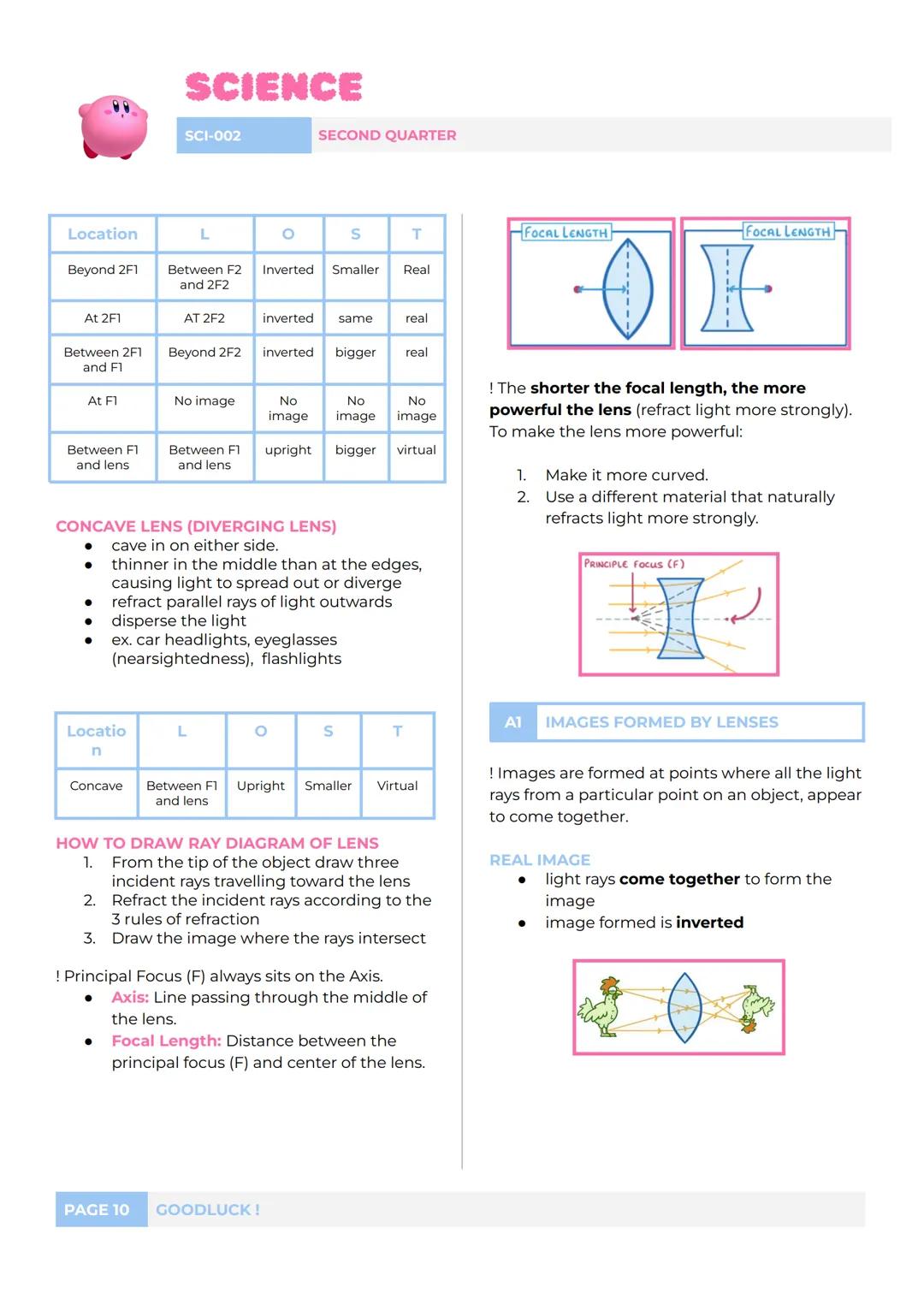
Concave lenses (diverging lenses) are thinner in the middle and thicker at the edges. They spread light rays outward, making them appear to come from a focal point behind the lens. These lenses always create virtual, upright, smaller images.

The position of an object relative to the focal point determines the image characteristics. Objects beyond 2F create small, inverted, real images. Objects between F and the lens create large, upright, virtual images. Objects exactly at F create no image at all!

Eye Connection: If you're nearsighted, you use concave lenses to diverge light before it hits your eye, helping you see distant objects clearly!

SCIENCE
SCI-002
SECOND QUARTER
L1: MAGNETS
Nickel
When an unmagnetized substance is placed in
a magnetic field, the substance can become
mag

Lens Image Formation and Applications

Understanding how lenses create images is crucial for everything from cameras to eyeglasses. Real images form when light rays actually converge at a point - these are always inverted and can be projected on a screen. Virtual images appear to form where light rays seem to come from but don't actually meet - these are always upright.

For convex lenses, object position determines everything. Objects far beyond 2F create small, real, inverted images (like in cameras). Objects between 2F and F create large, real, inverted images (like in projectors). Objects between F and the lens create large, virtual, upright images (like magnifying glasses).

Concave lenses are much simpler - they always create small, virtual, upright images between the focal point and the lens, regardless of object position. This makes them perfect for correcting nearsightedness.

To make lenses more powerful (bend light more strongly), you can either make them more curved or use materials with higher refractive indices. The shorter the focal length, the more powerful the lens becomes.

Photography Tip: Camera zoom lenses change their focal length to make images larger or smaller - it's all about changing the distance between lens elements!


We thought you’d never ask...

What is the Knowunity AI companion?

Our AI companion is specifically built for the needs of students. Based on the millions of content pieces we have on the platform we can provide truly meaningful and relevant answers to students. But its not only about answers, the companion is even more about guiding students through their daily learning challenges, with personalised study plans, quizzes or content pieces in the chat and 100% personalisation based on the students skills and developments.

Where can I download the Knowunity app?

You can download the app in the Google Play Store and in the Apple App Store.

Is Knowunity really free of charge?

That's right! Enjoy free access to study content, connect with fellow students, and get instant help – all at your fingertips.

Can't find what you're looking for? Explore other subjects.

Students love us — and so will you.

4.9/5

App Store

4.8/5

Google Play

The app is very easy to use and well designed. I have found everything I was looking for so far and have been able to learn a lot from the presentations! I will definitely use the app for a class assignment! And of course it also helps a lot as an inspiration.

Stefan S

iOS user

This app is really great. There are so many study notes and help [...]. My problem subject is French, for example, and the app has so many options for help. Thanks to this app, I have improved my French. I would recommend it to anyone.

Samantha Klich

Android user

Wow, I am really amazed. I just tried the app because I've seen it advertised many times and was absolutely stunned. This app is THE HELP you want for school and above all, it offers so many things, such as workouts and fact sheets, which have been VERY helpful to me personally.

Anna

iOS user

I think it’s very much worth it and you’ll end up using it a lot once you get the hang of it and even after looking at others notes you can still ask your Artificial intelligence buddy the question and ask to simplify it if you still don’t get it!!! In the end I think it’s worth it 😊👍 ⚠️Also DID I MENTION ITS FREEE YOU DON’T HAVE TO PAY FOR ANYTHING AND STILL GET YOUR GRADES IN PERFECTLY❗️❗️⚠️

Thomas R

iOS user

Knowunity is the BEST app I’ve used in a minute. This is not an ai review or anything this is genuinely coming from a 7th grade student (I know 2011 im young) but dude this app is a 10/10 i have maintained a 3.8 gpa and have plenty of time for gaming. I love it and my mom is just happy I got good grades

Brad T

Android user

Not only did it help me find the answer but it also showed me alternative ways to solve it. I was horrible in math and science but now I have an a in both subjects. Thanks for the help🤍🤍

David K

iOS user

The app's just great! All I have to do is enter the topic in the search bar and I get the response real fast. I don't have to watch 10 YouTube videos to understand something, so I'm saving my time. Highly recommended!

Sudenaz Ocak

Android user

In school I was really bad at maths but thanks to the app, I am doing better now. I am so grateful that you made the app.

Greenlight Bonnie

Android user

I found this app a couple years ago and it has only gotten better since then. I really love it because it can help with written questions and photo questions. Also, it can find study guides that other people have made as well as flashcard sets and practice tests. The free version is also amazing for students who might not be able to afford it. Would 100% recommend

Aubrey

iOS user

Best app if you're in Highschool or Junior high. I have been using this app for 2 school years and it's the best, it's good if you don't have anyone to help you with school work.😋🩷🎀

Marco B

iOS user

THE QUIZES AND FLASHCARDS ARE SO USEFUL AND I LOVE THE SCHOOLGPT. IT ALSO IS LITREALLY LIKE CHATGPT BUT SMARTER!! HELPED ME WITH MY MASCARA PROBLEMS TOO!! AS WELL AS MY REAL SUBJECTS ! DUHHH 😍😁😲🤑💗✨🎀😮

Elisha

iOS user

This app is phenomenal down to the correct info and the various topics you can study! I greatly recommend it for people who struggle with procrastination and those who need homework help. It has been perfectly accurate for world 1 history as far as I’ve seen! Geometry too!

Paul T

iOS user

The app is very easy to use and well designed. I have found everything I was looking for so far and have been able to learn a lot from the presentations! I will definitely use the app for a class assignment! And of course it also helps a lot as an inspiration.

Stefan S

iOS user

This app is really great. There are so many study notes and help [...]. My problem subject is French, for example, and the app has so many options for help. Thanks to this app, I have improved my French. I would recommend it to anyone.

Samantha Klich

Android user

Wow, I am really amazed. I just tried the app because I've seen it advertised many times and was absolutely stunned. This app is THE HELP you want for school and above all, it offers so many things, such as workouts and fact sheets, which have been VERY helpful to me personally.

Anna

iOS user

I think it’s very much worth it and you’ll end up using it a lot once you get the hang of it and even after looking at others notes you can still ask your Artificial intelligence buddy the question and ask to simplify it if you still don’t get it!!! In the end I think it’s worth it 😊👍 ⚠️Also DID I MENTION ITS FREEE YOU DON’T HAVE TO PAY FOR ANYTHING AND STILL GET YOUR GRADES IN PERFECTLY❗️❗️⚠️

Thomas R

iOS user

Knowunity is the BEST app I’ve used in a minute. This is not an ai review or anything this is genuinely coming from a 7th grade student (I know 2011 im young) but dude this app is a 10/10 i have maintained a 3.8 gpa and have plenty of time for gaming. I love it and my mom is just happy I got good grades

Brad T

Android user

Not only did it help me find the answer but it also showed me alternative ways to solve it. I was horrible in math and science but now I have an a in both subjects. Thanks for the help🤍🤍

David K

iOS user

The app's just great! All I have to do is enter the topic in the search bar and I get the response real fast. I don't have to watch 10 YouTube videos to understand something, so I'm saving my time. Highly recommended!

Sudenaz Ocak

Android user

In school I was really bad at maths but thanks to the app, I am doing better now. I am so grateful that you made the app.

Greenlight Bonnie

Android user

I found this app a couple years ago and it has only gotten better since then. I really love it because it can help with written questions and photo questions. Also, it can find study guides that other people have made as well as flashcard sets and practice tests. The free version is also amazing for students who might not be able to afford it. Would 100% recommend

Aubrey

iOS user

Best app if you're in Highschool or Junior high. I have been using this app for 2 school years and it's the best, it's good if you don't have anyone to help you with school work.😋🩷🎀

Marco B

iOS user

THE QUIZES AND FLASHCARDS ARE SO USEFUL AND I LOVE THE SCHOOLGPT. IT ALSO IS LITREALLY LIKE CHATGPT BUT SMARTER!! HELPED ME WITH MY MASCARA PROBLEMS TOO!! AS WELL AS MY REAL SUBJECTS ! DUHHH 😍😁😲🤑💗✨🎀😮

Elisha

iOS user

This app is phenomenal down to the correct info and the various topics you can study! I greatly recommend it for people who struggle with procrastination and those who need homework help. It has been perfectly accurate for world 1 history as far as I’ve seen! Geometry too!

Paul T

iOS user


Science

6,643

Nov 27, 2025

12 pages

Grade 10 Science 2nd Quarter Study Guide

K

kish andres

@kishandres

Ever wondered how magnets work, why your phone connects to Wi-Fi, or how mirrors and lenses create images? This science module covers the fascinating world of magnetism, electromagnetic waves, and optics - concepts that power everything from your smartphone to... Show more

SCIENCE
SCI-002
SECOND QUARTER
L1: MAGNETS
Nickel
When an unmagnetized substance is placed in
a magnetic field, the substance can become
mag

Sign up to see the contentIt's free!

Access to all documents

Improve your grades

Join milions of students

By signing up you accept Terms of Service and Privacy Policy

Magnets and Magnetic Properties

Think about how a magnet sticks to your refrigerator - that's just the beginning of understanding magnetic forces! Magnets are substances that possess magnetic properties, and they work because of tiny spinning electrons that can line up in the same direction.

Materials react differently to magnets. Ferromagnetic materials like iron, steel, nickel, and cobalt are strongly attracted to magnets - these are what we usually call "magnetic materials." Paramagnetic materials like wood and aluminum are only slightly attracted, while diamagnetic materials like gold and zinc are actually slightly repelled.

The space around a magnet where its force can be detected is called a magnetic field. These fields have direction (from North to South pole) and strength, which you can visualize using iron filings that align along invisible magnetic field lines.

Quick Tip: To test if something is actually magnetized (not just magnetic), try using repulsion - only magnetized objects can repel each other!

SCIENCE
SCI-002
SECOND QUARTER
L1: MAGNETS
Nickel
When an unmagnetized substance is placed in
a magnetic field, the substance can become
mag

Sign up to see the contentIt's free!

Access to all documents

Improve your grades

Join milions of students

By signing up you accept Terms of Service and Privacy Policy

Magnetic Field Patterns

Magnetic fields create fascinating patterns that reveal how magnetic forces work in space. The magnetic flux density (symbol B, measured in Tesla) tells us exactly how strong a magnetic field is at any point - think of it as the "intensity level" of magnetism.

Different magnet shapes create unique field patterns. Bar magnets show classic curved lines flowing from North to South poles, while U-shaped magnets create stronger fields between their poles. Disk magnets have an interesting feature - there are no magnetic lines in their center!

When you bring two magnets together, the magic really happens. Like poles NorthNorthorSouthSouthNorth-North or South-South create field patterns that push away from each other, showing repulsion. Unlike poles NorthSouthNorth-South create field patterns that connect and pull together, demonstrating attraction.

Fun Fact: Iron filings sprinkled around magnets will arrange themselves along field lines, creating visible proof of invisible magnetic forces!

SCIENCE
SCI-002
SECOND QUARTER
L1: MAGNETS
Nickel
When an unmagnetized substance is placed in
a magnetic field, the substance can become
mag

Sign up to see the contentIt's free!

Access to all documents

Improve your grades

Join milions of students

By signing up you accept Terms of Service and Privacy Policy

Magnetic Fields from Electric Current

Here's where things get really cool - electricity can create magnetism! When electric current flows through a wire, it generates a magnetic field around that wire. This discovery changed our world forever.

The right-hand thumb rule helps you figure out the direction of these magnetic fields. Point your right thumb in the direction of conventional current flow (positive to negative), and your wrapped fingers show the direction of the magnetic field lines.

Straight conductors create circular magnetic field patterns around the wire. Current flowing downward creates clockwise magnetic fields, while upward current creates counterclockwise fields. When you shape wire into a coil, these circular fields combine to create much stronger magnetic effects.

This principle powers electromagnets - temporary magnets that work only when current flows through them. Unlike permanent magnets, you can turn electromagnets on and off, making them incredibly useful in everything from speakers to MRI machines.

Real World Connection: Every electric motor in your home uses this principle to convert electricity into motion!

SCIENCE
SCI-002
SECOND QUARTER
L1: MAGNETS
Nickel
When an unmagnetized substance is placed in
a magnetic field, the substance can become
mag

Sign up to see the contentIt's free!

Access to all documents

Improve your grades

Join milions of students

By signing up you accept Terms of Service and Privacy Policy

Electromagnetic Induction and Key Scientists

Moving magnets near coils of wire creates electricity - this process is called electromagnetic induction. It's literally how most of the world's electricity is generated! The faster you move the magnet, the more turns in the coil, and the stronger the magnet, the more induced current you'll create.

Several brilliant scientists discovered these principles. Hans Christian Oersted first noticed that electric current could deflect compass needles, proving electricity creates magnetism. Michael Faraday discovered that moving magnets near coils generates electric current, while Andre-Marie Ampere showed how current-carrying wires attract or repel each other.

James Clerk Maxwell put it all together, realizing that changing electric fields create magnetic fields, and changing magnetic fields create electric fields. This creates electromagnetic waves that travel at the speed of light - 3 × 10⁸ m/s!

The key insight: movement produces current, no movement means no current. Whether you move the magnet toward the coil or the coil toward the magnet doesn't matter - only relative motion counts.

Mind Blowing Fact: The electricity powering your phone right now was probably generated using electromagnetic induction at a power plant!

SCIENCE
SCI-002
SECOND QUARTER
L1: MAGNETS
Nickel
When an unmagnetized substance is placed in
a magnetic field, the substance can become
mag

Sign up to see the contentIt's free!

Access to all documents

Improve your grades

Join milions of students

By signing up you accept Terms of Service and Privacy Policy

The Electromagnetic Spectrum

Electromagnetic waves are everywhere around you, carrying energy through space at light speed. They don't need any medium to travel through - they can zip through the vacuum of space just fine. The electromagnetic spectrum organizes all these waves by their wavelength, frequency, and energy.

Here's the pattern: shorter wavelengths mean higher frequency and more energy, while longer wavelengths mean lower frequency and less energy. It's like comparing rapid drumbeats (high frequency) to slow, deep bass notes (low frequency).

Radio and TV waves have the longest wavelengths and lowest energy - they're perfect for transmitting information over long distances. Microwaves are shorter and great for heating food and WiFi signals. Infrared waves come from hot objects and are what you feel as heat from a campfire.

Visible light is the tiny portion your eyes can detect, while ultraviolet rays from the sun can cause sunburn but also help your body make vitamin D. X-rays and gamma rays have so much energy they can pass through your body - that's why they're useful in medicine but also potentially dangerous.

Cool Connection: Your smartphone uses multiple parts of the electromagnetic spectrum simultaneously - radio waves for calls, microwaves for WiFi, and visible light for the screen!

SCIENCE
SCI-002
SECOND QUARTER
L1: MAGNETS
Nickel
When an unmagnetized substance is placed in
a magnetic field, the substance can become
mag

Sign up to see the contentIt's free!

Access to all documents

Improve your grades

Join milions of students

By signing up you accept Terms of Service and Privacy Policy

Electromagnetic Wave Applications

Each type of electromagnetic radiation has specific applications that affect your daily life. Radio and TV waves carry sound and picture information over vast distances through oscillating electricity in antennas - that's how broadcasting works.

Microwaves range from 1mm to 30cm wavelengths, making them perfect for radar systems and heating food. Your smartphone uses microwaves for WiFi, but transferring voice calls actually uses radio waves. Infrared waves come from molecular motion in hot objects and are readily absorbed by most materials, causing them to warm up.

Visible light is obviously what allows you to see, but ultraviolet radiation has three types with different effects. UV-A reaches your lens and retina, UV-B affects your skin's top layer (causing tans and potential cancer), while UV-C gets absorbed by the atmosphere before reaching you.

X-rays have enough energy to pass through soft tissues but not bones, making them perfect for medical imaging. Gamma rays are the most energetic and penetrating - they're used in cancer treatment and sterilization but can seriously damage living tissue.

Health Note: The sun produces UV radiation that helps your body make vitamin D, but overexposure can cause skin damage - balance is key!

SCIENCE
SCI-002
SECOND QUARTER
L1: MAGNETS
Nickel
When an unmagnetized substance is placed in
a magnetic field, the substance can become
mag

Sign up to see the contentIt's free!

Access to all documents

Improve your grades

Join milions of students

By signing up you accept Terms of Service and Privacy Policy

Radio Communication and Mirror Basics

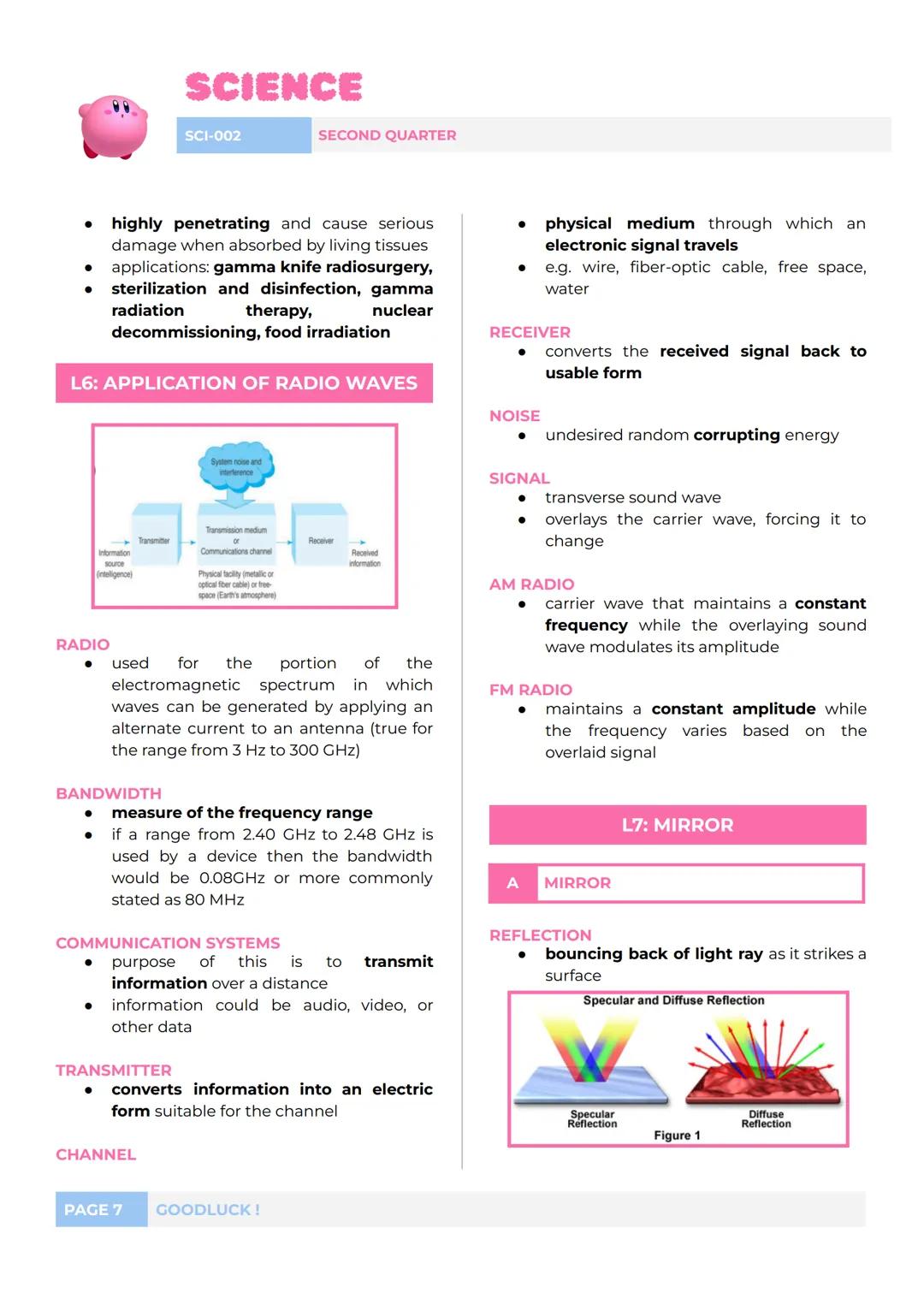
Radio communication systems transmit information over distances using electromagnetic waves. The process involves a transmitter converting information into electrical signals, a channel (like air or cables) carrying the signal, and a receiver converting it back to usable form.

AM radio keeps frequency constant while the sound wave changes the amplitude (strength). FM radio does the opposite - it maintains constant amplitude while varying the frequency based on the signal. Bandwidth measures the frequency range a device uses, like 80 MHz for WiFi.

Now let's switch to optics! Reflection is simply light bouncing back when it strikes a surface. Specular reflection occurs on smooth surfaces like mirrors, creating clear, mirror-like images. Diffuse reflection happens on rough surfaces, scattering light in many directions.

The law of reflection is beautifully simple: the angle of incidence (incoming light ray) equals the angle of reflection (outgoing ray). Both angles are measured from the normal line - an imaginary line perpendicular to the surface.

Tech Fact: Your WiFi router uses a specific bandwidth of microwaves (around 2.4 GHz) to carry data through the air to your devices!

SCIENCE
SCI-002
SECOND QUARTER
L1: MAGNETS
Nickel
When an unmagnetized substance is placed in
a magnetic field, the substance can become
mag

Sign up to see the contentIt's free!

Access to all documents

Improve your grades

Join milions of students

By signing up you accept Terms of Service and Privacy Policy

Types of Mirrors and Their Images

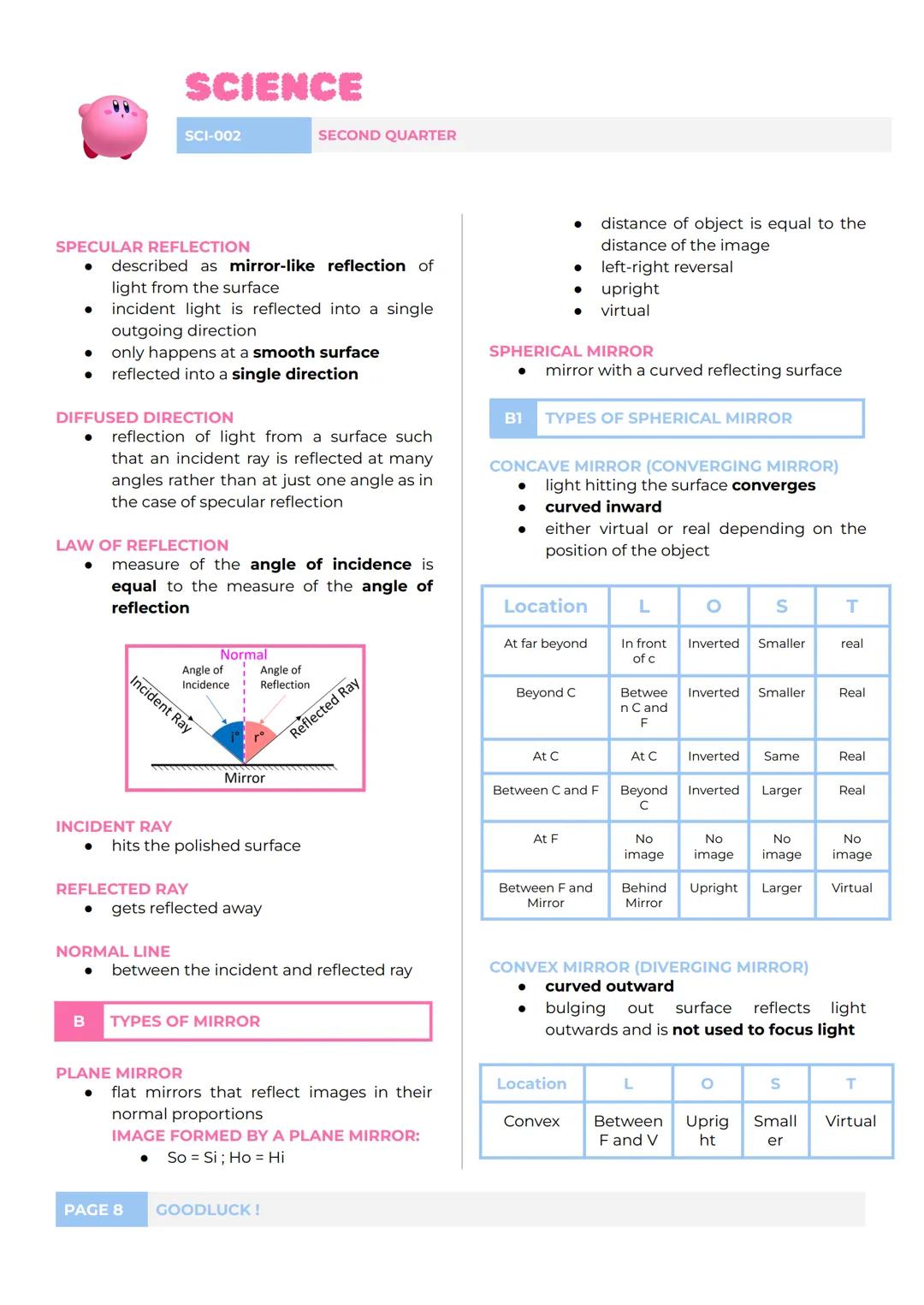
Plane mirrors are flat and create images that are the same size as the object, upright, and appear to be the same distance behind the mirror as the object is in front. However, they show left-right reversal - that's why text looks backwards in a mirror.

Spherical mirrors have curved surfaces that create different effects. Concave mirrors (curved inward) are converging mirrors that can create both real and virtual images depending on object placement. When objects are far away, concave mirrors create small, inverted, real images. When objects are close, they create large, upright, virtual images.

Convex mirrors (curved outward) are diverging mirrors that always create small, upright, virtual images regardless of object distance. The image always appears between the focal point and the mirror's surface.

These mirrors have practical applications everywhere. Concave mirrors focus light in car headlights and create magnified images for shaving. Convex mirrors provide wide-angle views in car side mirrors and store security systems, helping you see more area at once.

Memory Tip: Concave caves IN and can create real images; Convex curves OUT and only creates virtual images!

SCIENCE
SCI-002
SECOND QUARTER
L1: MAGNETS
Nickel
When an unmagnetized substance is placed in
a magnetic field, the substance can become
mag

Sign up to see the contentIt's free!

Access to all documents

Improve your grades

Join milions of students

By signing up you accept Terms of Service and Privacy Policy

Refraction and Lens Basics

Refraction is the bending of light when it passes from one material to another, like from air to water. This happens because light changes speed in different materials. Lenses use refraction to focus light and form images.

Convex lenses (converging lenses) are thicker in the middle and taper toward the edges. They bend parallel light rays inward to meet at the focal point (F). The distance from the lens center to the focal point is called focal length - shorter focal lengths mean more powerful lenses.

Concave lenses (diverging lenses) are thinner in the middle and thicker at the edges. They spread light rays outward, making them appear to come from a focal point behind the lens. These lenses always create virtual, upright, smaller images.

The position of an object relative to the focal point determines the image characteristics. Objects beyond 2F create small, inverted, real images. Objects between F and the lens create large, upright, virtual images. Objects exactly at F create no image at all!

Eye Connection: If you're nearsighted, you use concave lenses to diverge light before it hits your eye, helping you see distant objects clearly!

SCIENCE
SCI-002
SECOND QUARTER
L1: MAGNETS
Nickel
When an unmagnetized substance is placed in
a magnetic field, the substance can become
mag

Sign up to see the contentIt's free!

Access to all documents

Improve your grades

Join milions of students

By signing up you accept Terms of Service and Privacy Policy

Lens Image Formation and Applications

Understanding how lenses create images is crucial for everything from cameras to eyeglasses. Real images form when light rays actually converge at a point - these are always inverted and can be projected on a screen. Virtual images appear to form where light rays seem to come from but don't actually meet - these are always upright.

For convex lenses, object position determines everything. Objects far beyond 2F create small, real, inverted images (like in cameras). Objects between 2F and F create large, real, inverted images (like in projectors). Objects between F and the lens create large, virtual, upright images (like magnifying glasses).

Concave lenses are much simpler - they always create small, virtual, upright images between the focal point and the lens, regardless of object position. This makes them perfect for correcting nearsightedness.

To make lenses more powerful (bend light more strongly), you can either make them more curved or use materials with higher refractive indices. The shorter the focal length, the more powerful the lens becomes.

Photography Tip: Camera zoom lenses change their focal length to make images larger or smaller - it's all about changing the distance between lens elements!

We thought you’d never ask...

What is the Knowunity AI companion?

Our AI companion is specifically built for the needs of students. Based on the millions of content pieces we have on the platform we can provide truly meaningful and relevant answers to students. But its not only about answers, the companion is even more about guiding students through their daily learning challenges, with personalised study plans, quizzes or content pieces in the chat and 100% personalisation based on the students skills and developments.

Where can I download the Knowunity app?

You can download the app in the Google Play Store and in the Apple App Store.

Is Knowunity really free of charge?

That's right! Enjoy free access to study content, connect with fellow students, and get instant help – all at your fingertips.

189

Smart Tools NEW

Transform this note into: ✓ 50+ Practice Questions ✓ Interactive Flashcards ✓ Full Mock Exam ✓ Essay Outlines

Mock Exam
Quiz
Flashcards
Essay

Can't find what you're looking for? Explore other subjects.

Students love us — and so will you.

4.9/5

App Store

4.8/5

Google Play

The app is very easy to use and well designed. I have found everything I was looking for so far and have been able to learn a lot from the presentations! I will definitely use the app for a class assignment! And of course it also helps a lot as an inspiration.

Stefan S

iOS user

This app is really great. There are so many study notes and help [...]. My problem subject is French, for example, and the app has so many options for help. Thanks to this app, I have improved my French. I would recommend it to anyone.

Samantha Klich

Android user

Wow, I am really amazed. I just tried the app because I've seen it advertised many times and was absolutely stunned. This app is THE HELP you want for school and above all, it offers so many things, such as workouts and fact sheets, which have been VERY helpful to me personally.

Anna

iOS user

I think it’s very much worth it and you’ll end up using it a lot once you get the hang of it and even after looking at others notes you can still ask your Artificial intelligence buddy the question and ask to simplify it if you still don’t get it!!! In the end I think it’s worth it 😊👍 ⚠️Also DID I MENTION ITS FREEE YOU DON’T HAVE TO PAY FOR ANYTHING AND STILL GET YOUR GRADES IN PERFECTLY❗️❗️⚠️

Thomas R

iOS user

Knowunity is the BEST app I’ve used in a minute. This is not an ai review or anything this is genuinely coming from a 7th grade student (I know 2011 im young) but dude this app is a 10/10 i have maintained a 3.8 gpa and have plenty of time for gaming. I love it and my mom is just happy I got good grades

Brad T

Android user

Not only did it help me find the answer but it also showed me alternative ways to solve it. I was horrible in math and science but now I have an a in both subjects. Thanks for the help🤍🤍

David K

iOS user

The app's just great! All I have to do is enter the topic in the search bar and I get the response real fast. I don't have to watch 10 YouTube videos to understand something, so I'm saving my time. Highly recommended!

Sudenaz Ocak

Android user

In school I was really bad at maths but thanks to the app, I am doing better now. I am so grateful that you made the app.

Greenlight Bonnie

Android user

I found this app a couple years ago and it has only gotten better since then. I really love it because it can help with written questions and photo questions. Also, it can find study guides that other people have made as well as flashcard sets and practice tests. The free version is also amazing for students who might not be able to afford it. Would 100% recommend

Aubrey

iOS user

Best app if you're in Highschool or Junior high. I have been using this app for 2 school years and it's the best, it's good if you don't have anyone to help you with school work.😋🩷🎀

Marco B

iOS user

THE QUIZES AND FLASHCARDS ARE SO USEFUL AND I LOVE THE SCHOOLGPT. IT ALSO IS LITREALLY LIKE CHATGPT BUT SMARTER!! HELPED ME WITH MY MASCARA PROBLEMS TOO!! AS WELL AS MY REAL SUBJECTS ! DUHHH 😍😁😲🤑💗✨🎀😮

Elisha

iOS user

This app is phenomenal down to the correct info and the various topics you can study! I greatly recommend it for people who struggle with procrastination and those who need homework help. It has been perfectly accurate for world 1 history as far as I’ve seen! Geometry too!

Paul T

iOS user

The app is very easy to use and well designed. I have found everything I was looking for so far and have been able to learn a lot from the presentations! I will definitely use the app for a class assignment! And of course it also helps a lot as an inspiration.

Stefan S

iOS user

This app is really great. There are so many study notes and help [...]. My problem subject is French, for example, and the app has so many options for help. Thanks to this app, I have improved my French. I would recommend it to anyone.

Samantha Klich

Android user

Wow, I am really amazed. I just tried the app because I've seen it advertised many times and was absolutely stunned. This app is THE HELP you want for school and above all, it offers so many things, such as workouts and fact sheets, which have been VERY helpful to me personally.

Anna

iOS user

I think it’s very much worth it and you’ll end up using it a lot once you get the hang of it and even after looking at others notes you can still ask your Artificial intelligence buddy the question and ask to simplify it if you still don’t get it!!! In the end I think it’s worth it 😊👍 ⚠️Also DID I MENTION ITS FREEE YOU DON’T HAVE TO PAY FOR ANYTHING AND STILL GET YOUR GRADES IN PERFECTLY❗️❗️⚠️

Thomas R

iOS user

Knowunity is the BEST app I’ve used in a minute. This is not an ai review or anything this is genuinely coming from a 7th grade student (I know 2011 im young) but dude this app is a 10/10 i have maintained a 3.8 gpa and have plenty of time for gaming. I love it and my mom is just happy I got good grades

Brad T

Android user

Not only did it help me find the answer but it also showed me alternative ways to solve it. I was horrible in math and science but now I have an a in both subjects. Thanks for the help🤍🤍

David K

iOS user

The app's just great! All I have to do is enter the topic in the search bar and I get the response real fast. I don't have to watch 10 YouTube videos to understand something, so I'm saving my time. Highly recommended!

Sudenaz Ocak

Android user

In school I was really bad at maths but thanks to the app, I am doing better now. I am so grateful that you made the app.

Greenlight Bonnie

Android user

I found this app a couple years ago and it has only gotten better since then. I really love it because it can help with written questions and photo questions. Also, it can find study guides that other people have made as well as flashcard sets and practice tests. The free version is also amazing for students who might not be able to afford it. Would 100% recommend

Aubrey

iOS user

Best app if you're in Highschool or Junior high. I have been using this app for 2 school years and it's the best, it's good if you don't have anyone to help you with school work.😋🩷🎀

Marco B

iOS user

THE QUIZES AND FLASHCARDS ARE SO USEFUL AND I LOVE THE SCHOOLGPT. IT ALSO IS LITREALLY LIKE CHATGPT BUT SMARTER!! HELPED ME WITH MY MASCARA PROBLEMS TOO!! AS WELL AS MY REAL SUBJECTS ! DUHHH 😍😁😲🤑💗✨🎀😮

Elisha

iOS user

This app is phenomenal down to the correct info and the various topics you can study! I greatly recommend it for people who struggle with procrastination and those who need homework help. It has been perfectly accurate for world 1 history as far as I’ve seen! Geometry too!

Paul T

iOS user