
Quadratic functions and equations are fundamental concepts in algebra, covering... Show more
 Math (SAT®)
 Algebra 1
 Biology
Sign up to see the contentIt's free!
Access to all documents
Improve your grades
Join milions of students
Knowunity AI
Subjects
Triangle Congruence and Similarity Theorems
Triangle Properties and Classification
Linear Equations and Graphs
Geometric Angle Relationships
Trigonometric Functions and Identities
Equation Solving Techniques
Circle Geometry Fundamentals
Division Operations and Methods
Basic Differentiation Rules
Exponent and Logarithm Properties
Show all topics
Human Organ Systems
Reproductive Cell Cycles
Biological Sciences Subdisciplines
Cellular Energy Metabolism
Autotrophic Energy Processes
Inheritance Patterns and Principles
Biomolecular Structure and Organization
Cell Cycle and Division Mechanics
Cellular Organization and Development
Biological Structural Organization
Show all topics
Chemical Sciences and Applications
Atomic Structure and Composition
Molecular Electron Structure Representation
Atomic Electron Behavior
Matter Properties and Water
Mole Concept and Calculations
Gas Laws and Behavior
Periodic Table Organization
Chemical Thermodynamics Fundamentals
Chemical Bond Types and Properties
Show all topics
European Renaissance and Enlightenment
European Cultural Movements 800-1920
American Revolution Era 1763-1797
American Civil War 1861-1865
Global Imperial Systems
Mongol and Chinese Dynasties
U.S. Presidents and World Leaders
Historical Sources and Documentation
World Wars Era and Impact
World Religious Systems
Show all topics
Classic and Contemporary Novels
Literary Character Analysis
Rhetorical Theory and Practice
Classic Literary Narratives
Reading Analysis and Interpretation
Narrative Structure and Techniques
English Language Components
Influential English-Language Authors
Basic Sentence Structure
Narrative Voice and Perspective
Show all topics
43
•
Updated Mar 18, 2026
•

Miranda M.
@scarmira1
Quadratic functions and equations are fundamental concepts in algebra, covering... Show more
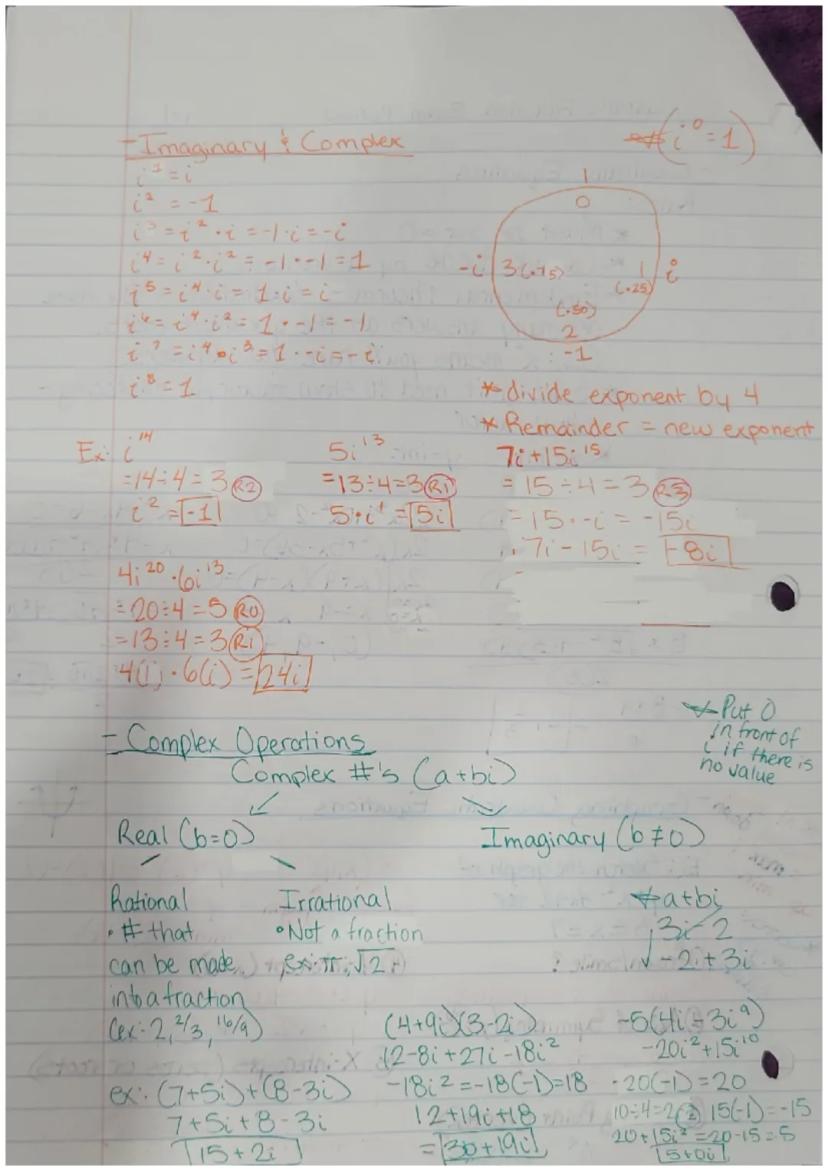
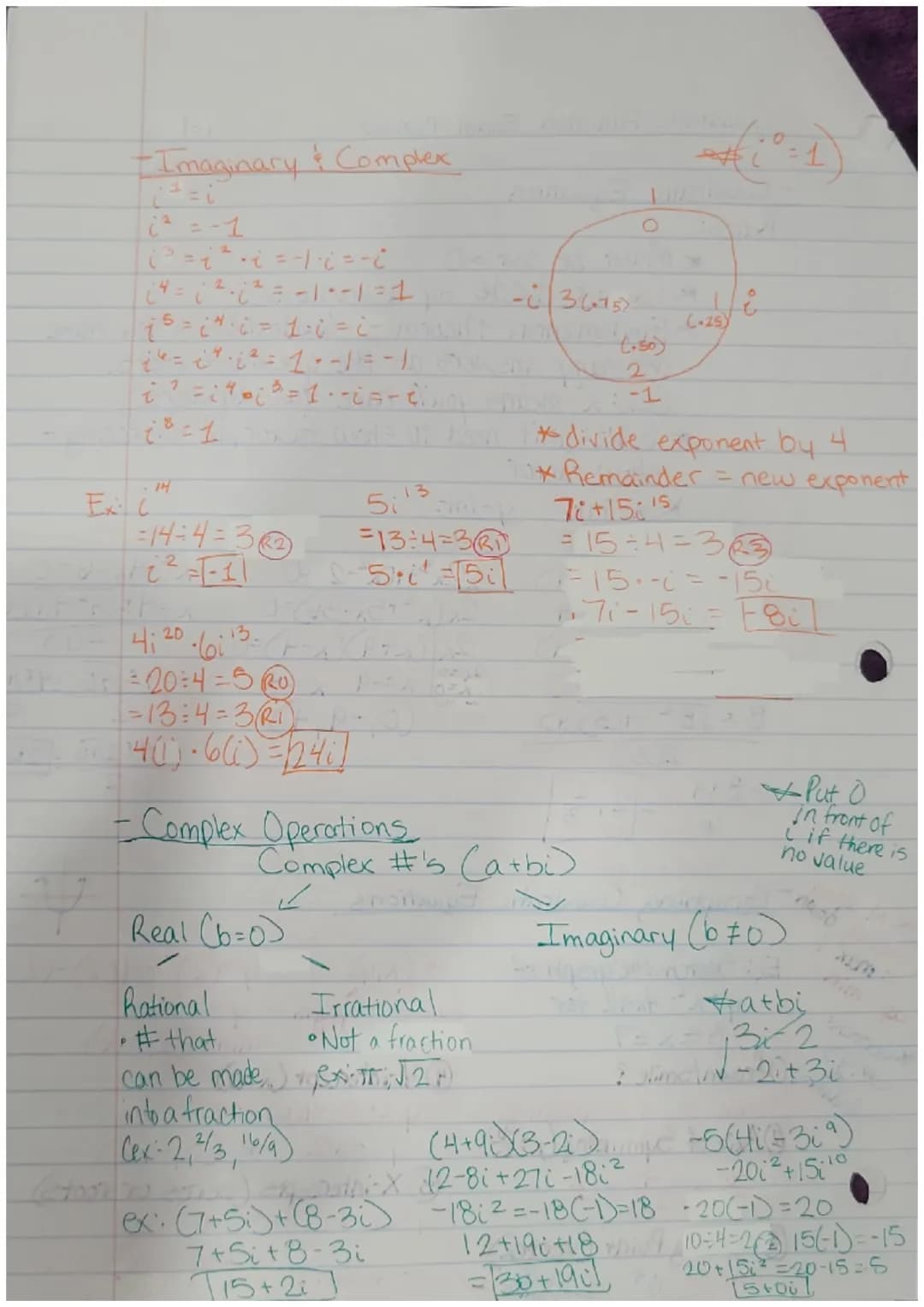
This page delves into imaginary and complex numbers, providing definitions and examples of operations involving these numbers. It covers the fundamental concept that i² = -1 and how this applies to various calculations.
Vocabulary: Complex numbers are numbers in the form a + bi, where a is the real part and b is the imaginary part.
The page includes examples of simplifying expressions with imaginary numbers and performing operations with complex numbers. It also introduces the concepts of rational and irrational numbers.
Example: The page demonstrates how to simplify expressions like (5i)⁴, breaking it down step-by-step to arrive at the solution 625.
Highlight: When working with powers of i, remember that the pattern repeats every four powers: i¹ = i, i² = -1, i³ = -i, i⁴ = 1.
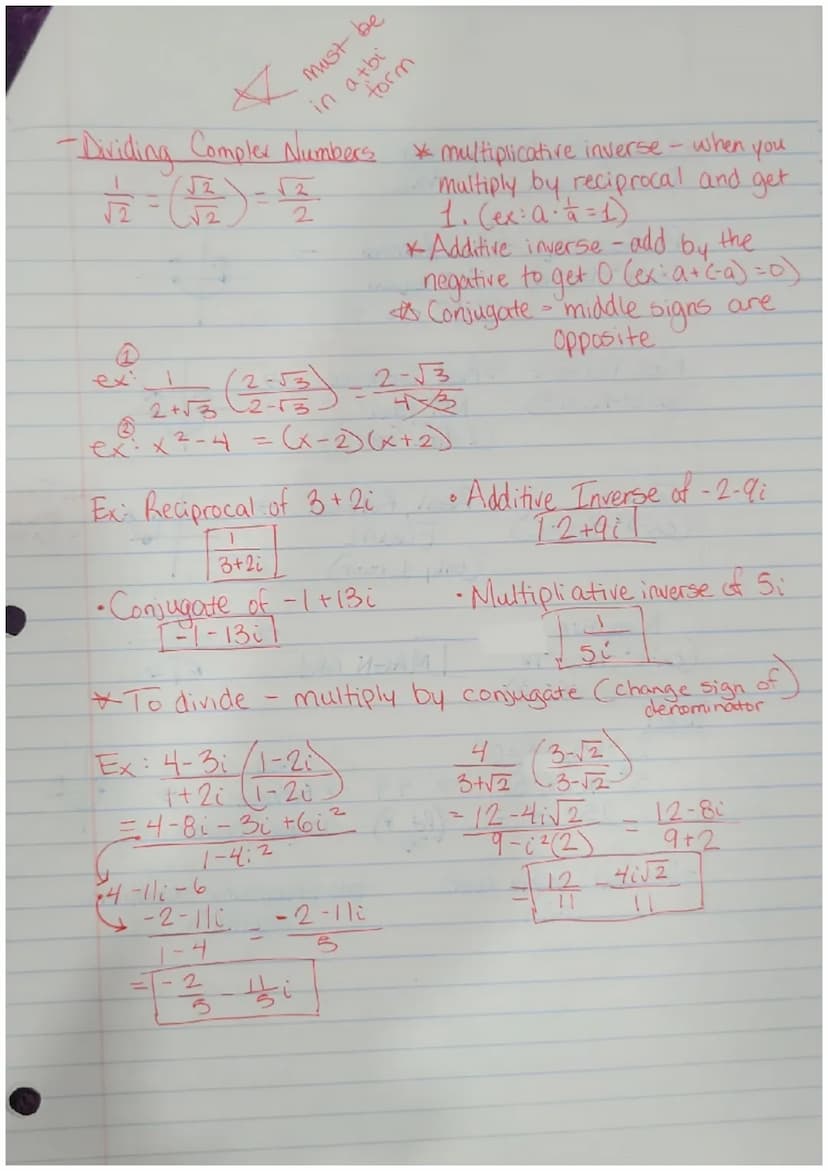
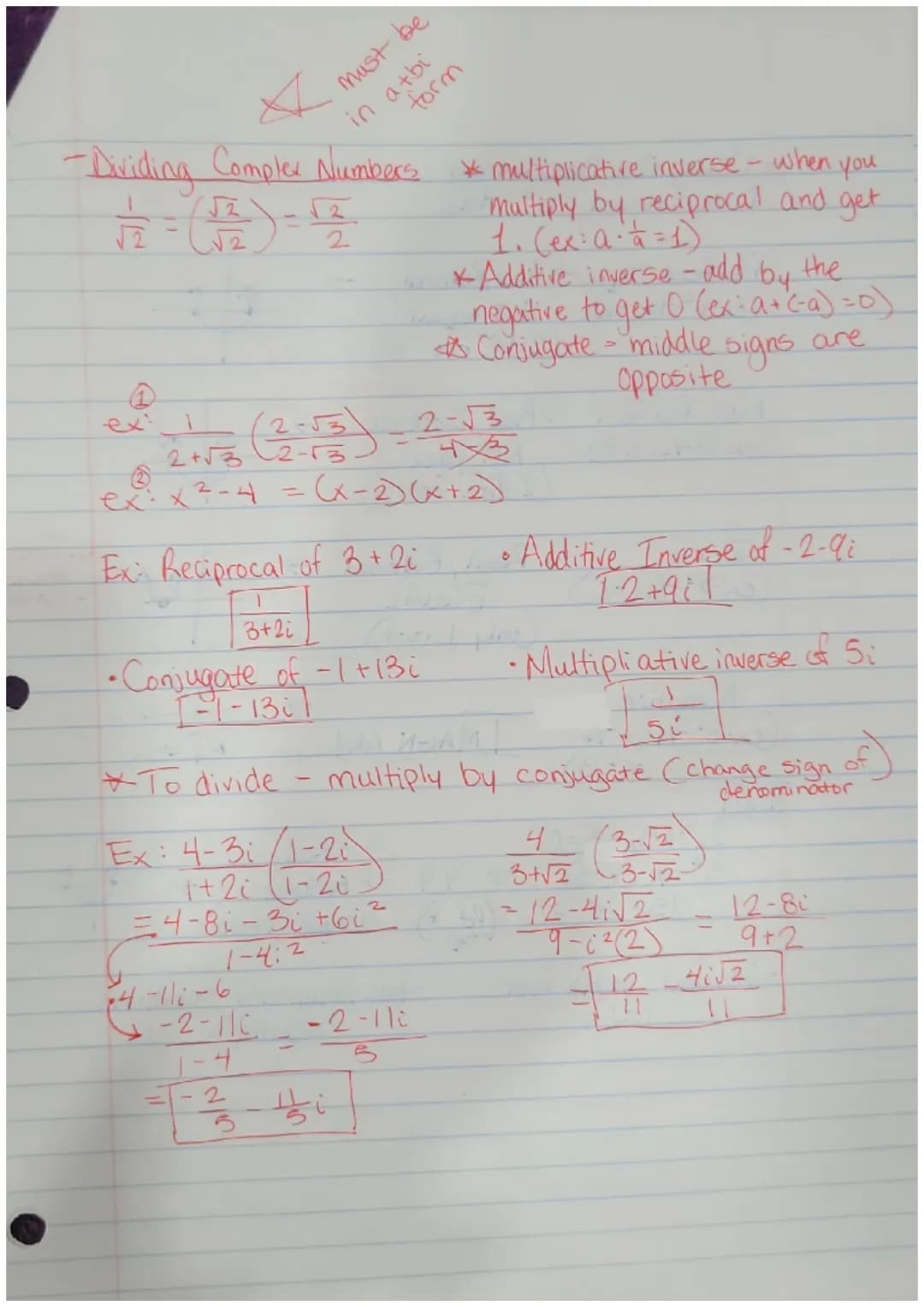
This page focuses on the process of dividing complex numbers, which is a crucial skill in understanding the discriminant in quadratic functions. It explains the use of conjugates and provides step-by-step examples.
Definition: The conjugate of a complex number a + bi is a - bi. Multiplying a complex number by its conjugate eliminates the imaginary part in the denominator.
The page covers important concepts such as multiplicative inverse, additive inverse, and conjugates. It provides detailed examples of how to divide complex numbers and simplify the results.
Example: To divide 4 - 3i by 1 - 2i, multiply both numerator and denominator by the conjugate of the denominator: / .
Highlight: When dividing complex numbers, always multiply both the numerator and denominator by the conjugate of the denominator to rationalize the denominator.
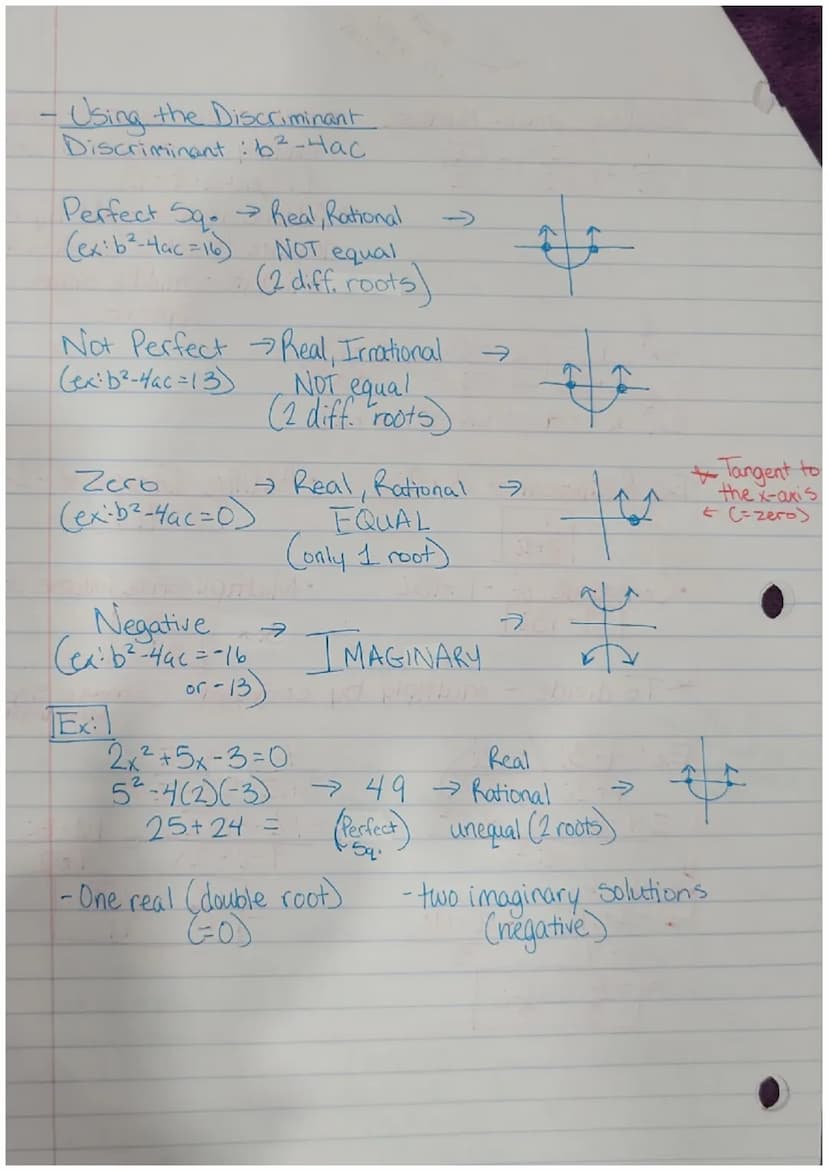
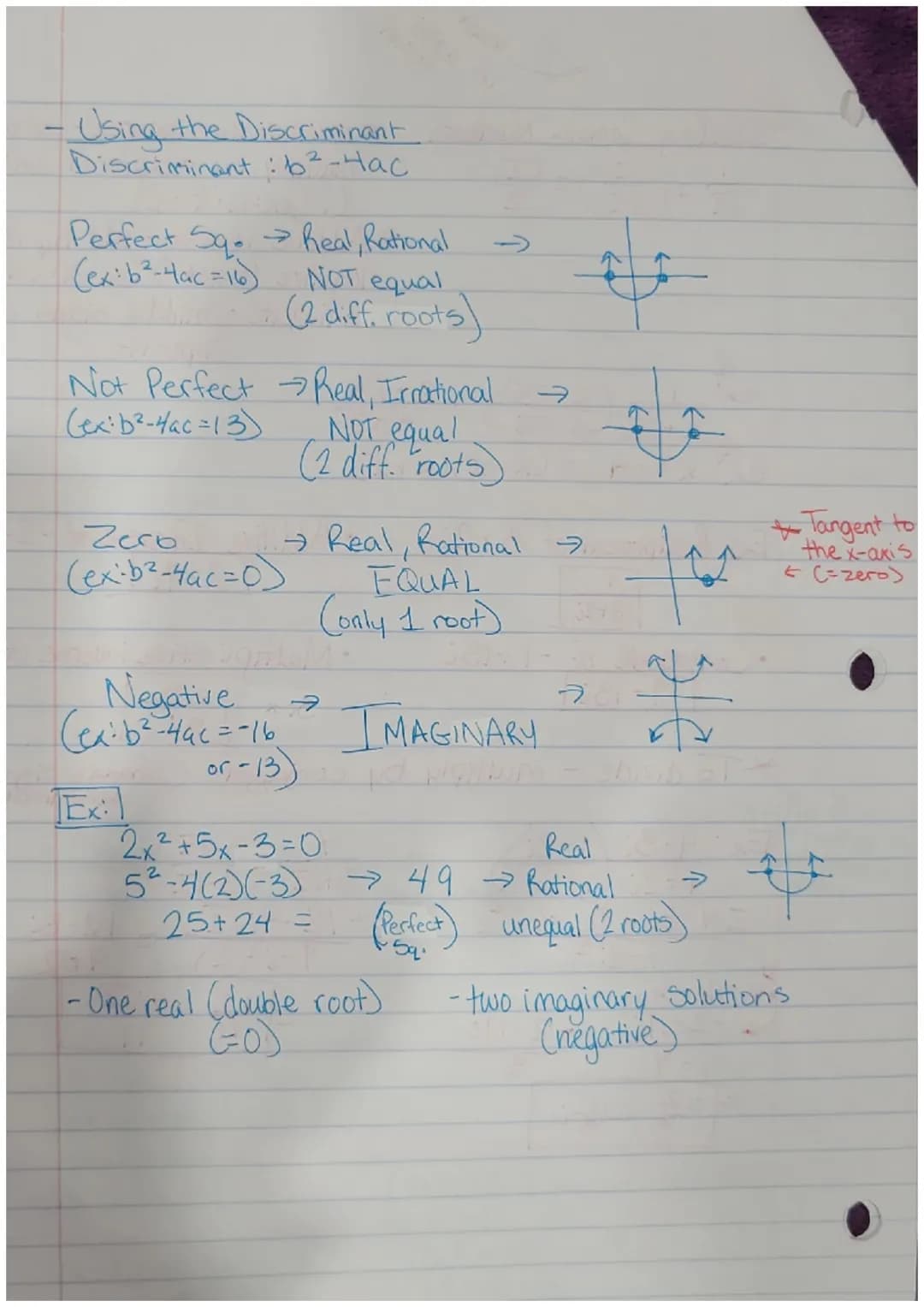
This page explains the concept of the discriminant in quadratic equations and how it can be used to determine the nature of the roots. The discriminant is given by the formula b² - 4ac for a quadratic equation in the form ax² + bx + c = 0.
Definition: The discriminant is a value that helps determine the nature of the roots of a quadratic equation without actually solving the equation.
The page provides a breakdown of what different discriminant values mean:
Example: For the equation 2x² + 5x - 3 = 0, the discriminant is calculated as 5² - 4(2)(-3) = 49, indicating two real, rational roots.
Highlight: The discriminant is a powerful tool for quickly determining the nature of a quadratic equation's solutions without solving the equation completely.
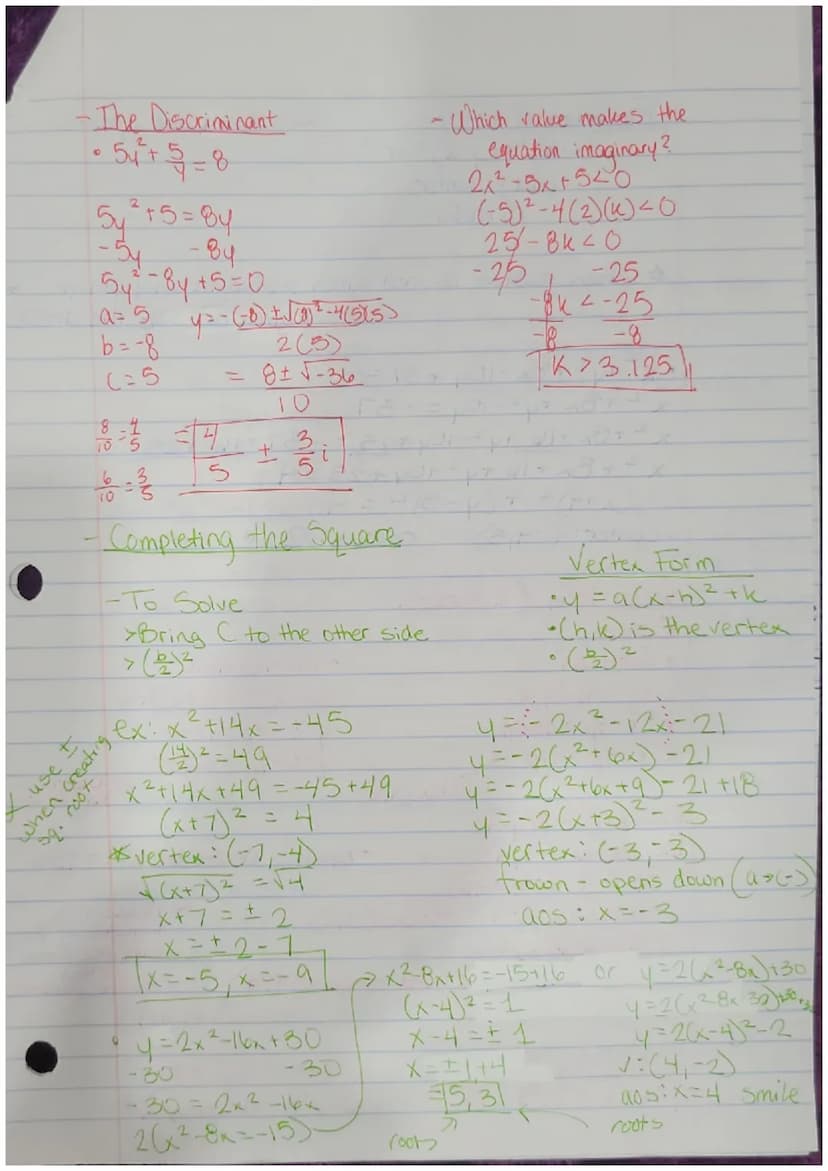
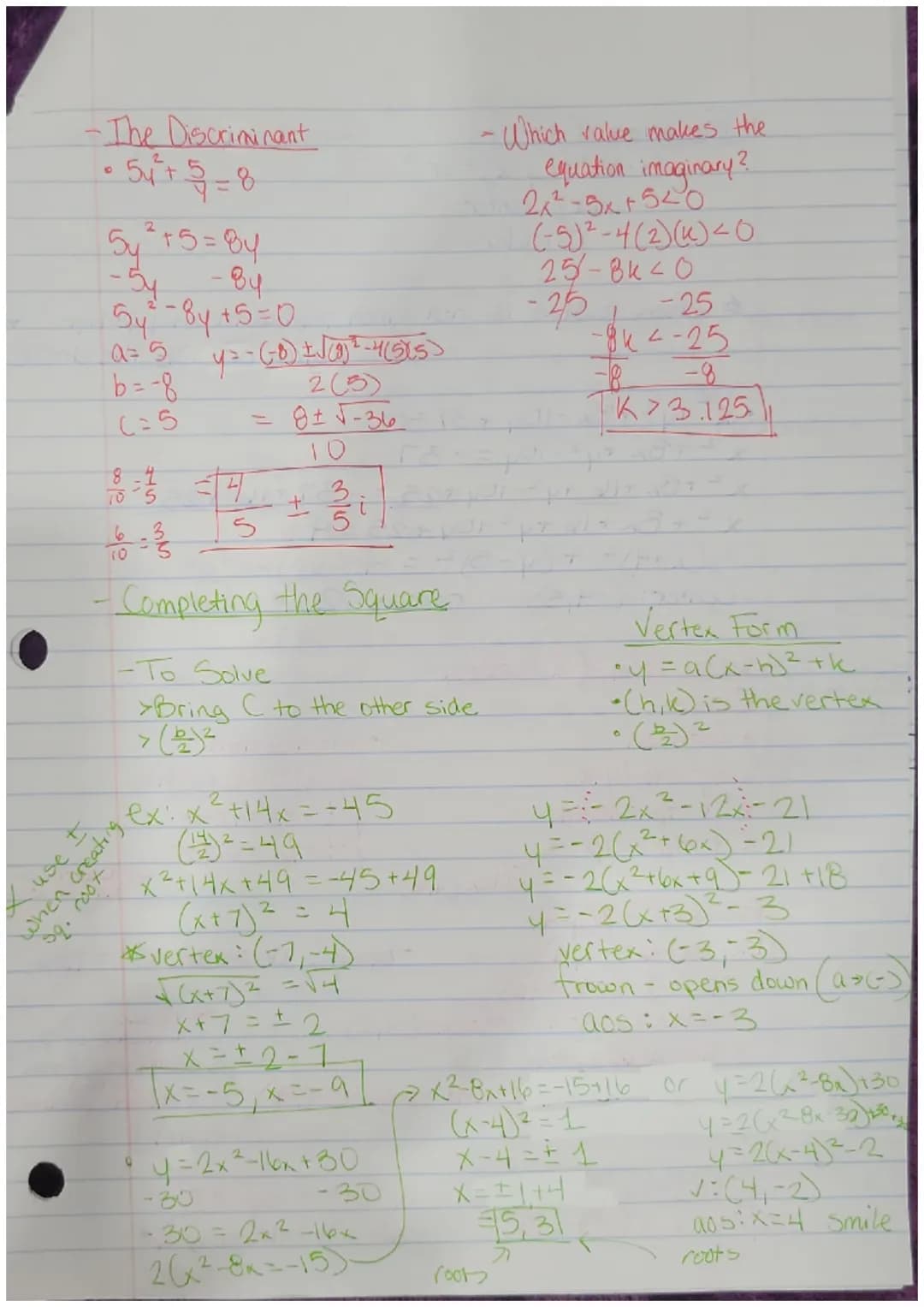
This page continues the discussion on the discriminant and introduces the method of completing the square. It provides examples of using the discriminant to analyze quadratic equations and demonstrates how to complete the square to solve equations and find the vertex of parabolas.
Example: The page shows how to complete the square for the equation x² + 14x = 45, resulting in ² = 94, which can then be solved to find the roots.
The page also covers how to use the discriminant to determine when an equation will have imaginary roots. It includes an example of finding the range of values that make a quadratic equation have imaginary roots.
Highlight: Completing the square is not only useful for solving quadratic equations but also for converting quadratic functions into vertex form, which makes it easier to identify the vertex and axis of symmetry.
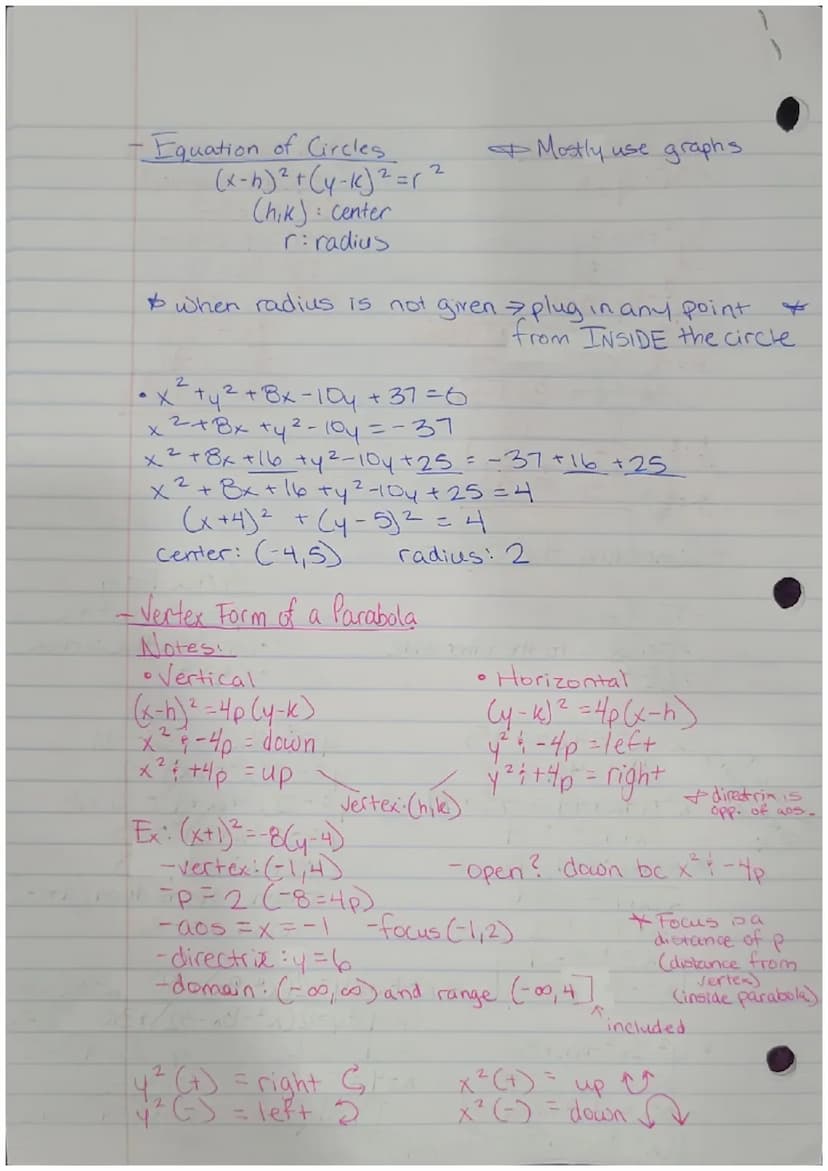
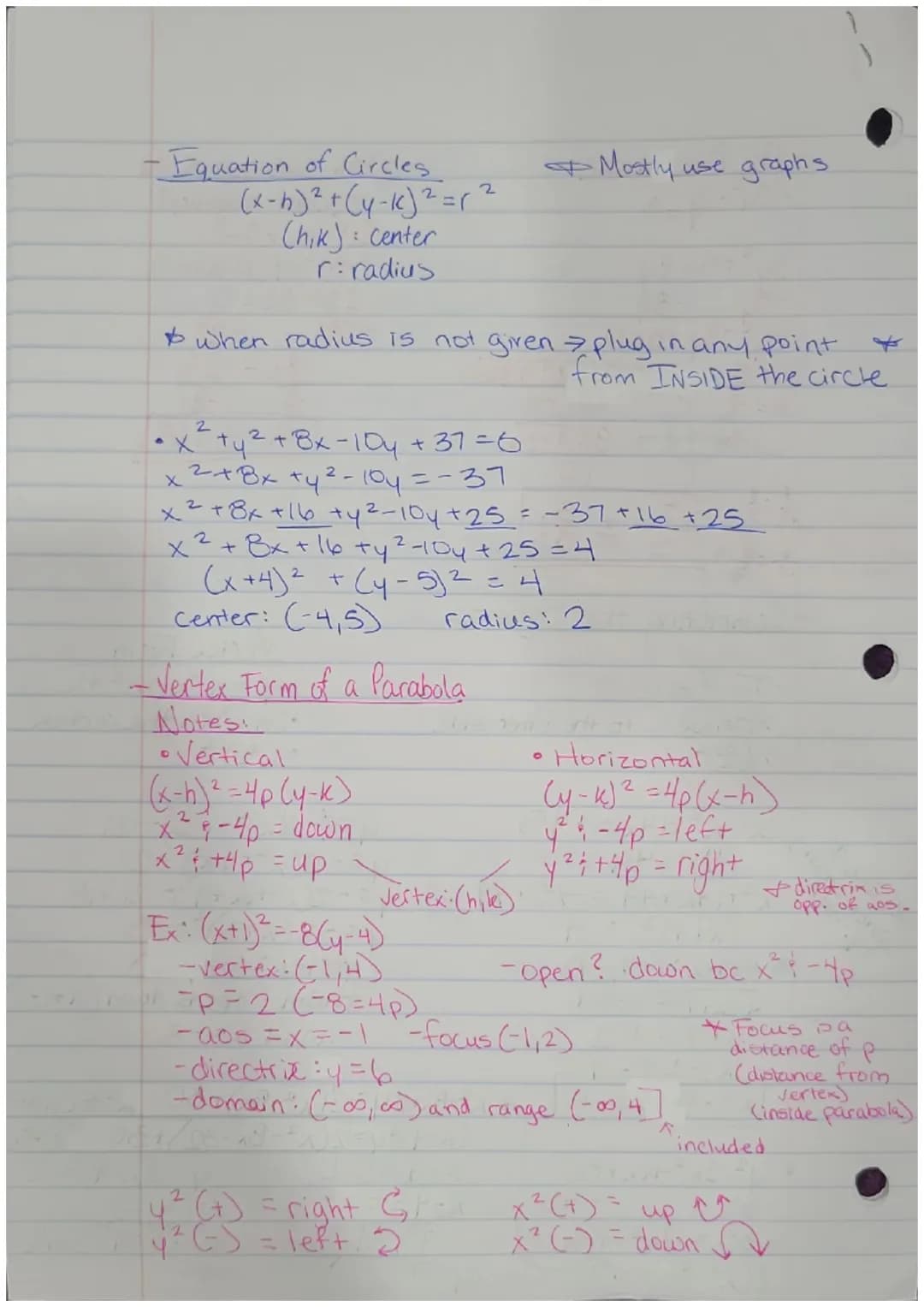
This final page covers two important topics: the equation of circles and the vertex form of parabolas. It provides the general form of a circle equation and explains how to identify the center and radius from the equation.
Definition: The general form of a circle equation is ² + ² = r², where (h, k) is the center and r is the radius.
The page also discusses the vertex form of parabolas for both vertical and horizontal orientations. It explains how to interpret the coefficients in these forms to determine the direction of opening and the location of the vertex.
Example: For the parabola equation ² = -8, the page demonstrates how to identify the vertex, axis of symmetry, directrix, and focus.
Highlight: Understanding the vertex form of parabolas is crucial for quickly identifying key features of the graph, such as the vertex, direction of opening, and axis of symmetry.
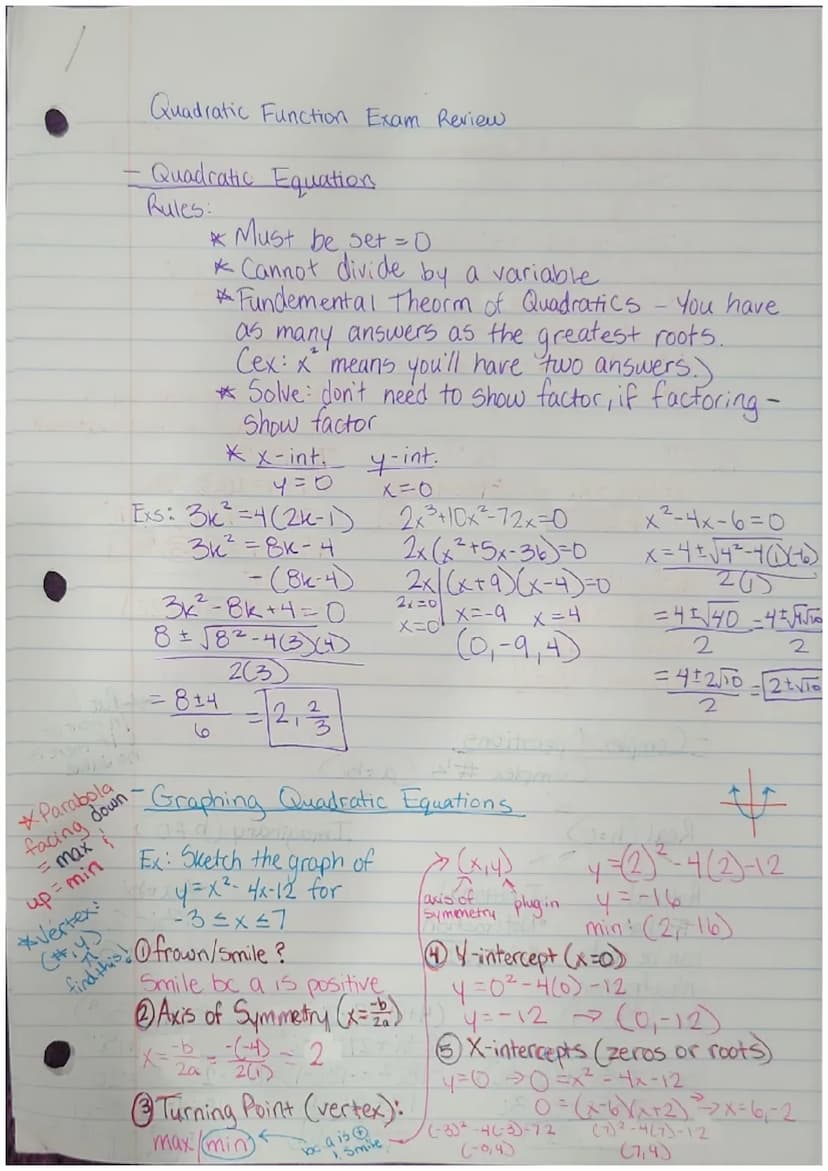
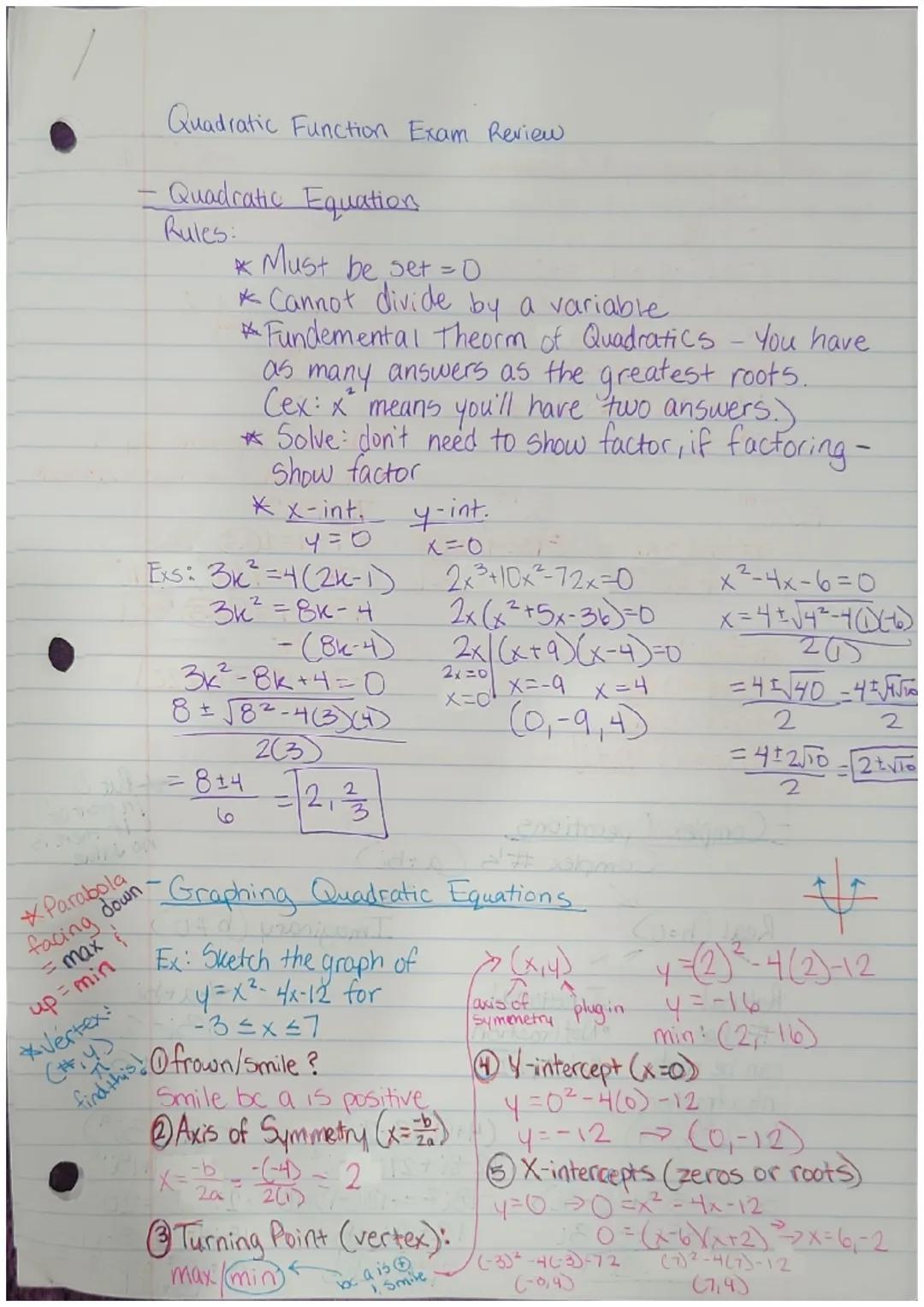
This page introduces key concepts for solving quadratic equations and graphing quadratic functions. It covers the fundamental theorem of quadratics, rules for solving equations, and methods for graphing.
Definition: The fundamental theorem of quadratics states that you have as many answers as the greatest roots.
Example: For solving quadratic equations, the page provides examples such as 3k² = 8k - 4, demonstrating the step-by-step process to find solutions.
The page also explains how to graph quadratic equations, including finding the axis of symmetry, vertex, y-intercept, and x-intercepts. It emphasizes the importance of understanding whether the parabola opens upward or downward based on the sign of the leading coefficient.
Highlight: When graphing quadratic equations, pay attention to the sign of the leading coefficient to determine if the parabola opens upward (positive) or downward (negative).
Our AI companion is specifically built for the needs of students. Based on the millions of content pieces we have on the platform we can provide truly meaningful and relevant answers to students. But its not only about answers, the companion is even more about guiding students through their daily learning challenges, with personalised study plans, quizzes or content pieces in the chat and 100% personalisation based on the students skills and developments.
You can download the app in the Google Play Store and in the Apple App Store.
That's right! Enjoy free access to study content, connect with fellow students, and get instant help – all at your fingertips.
App Store
Google Play
The app is very easy to use and well designed. I have found everything I was looking for so far and have been able to learn a lot from the presentations! I will definitely use the app for a class assignment! And of course it also helps a lot as an inspiration.
Stefan S
iOS user
This app is really great. There are so many study notes and help [...]. My problem subject is French, for example, and the app has so many options for help. Thanks to this app, I have improved my French. I would recommend it to anyone.
Samantha Klich
Android user
Wow, I am really amazed. I just tried the app because I've seen it advertised many times and was absolutely stunned. This app is THE HELP you want for school and above all, it offers so many things, such as workouts and fact sheets, which have been VERY helpful to me personally.
Anna
iOS user
I think it’s very much worth it and you’ll end up using it a lot once you get the hang of it and even after looking at others notes you can still ask your Artificial intelligence buddy the question and ask to simplify it if you still don’t get it!!! In the end I think it’s worth it 😊👍 ⚠️Also DID I MENTION ITS FREEE YOU DON’T HAVE TO PAY FOR ANYTHING AND STILL GET YOUR GRADES IN PERFECTLY❗️❗️⚠️
Thomas R
iOS user
Knowunity is the BEST app I’ve used in a minute. This is not an ai review or anything this is genuinely coming from a 7th grade student (I know 2011 im young) but dude this app is a 10/10 i have maintained a 3.8 gpa and have plenty of time for gaming. I love it and my mom is just happy I got good grades
Brad T
Android user
Not only did it help me find the answer but it also showed me alternative ways to solve it. I was horrible in math and science but now I have an a in both subjects. Thanks for the help🤍🤍
David K
iOS user
The app's just great! All I have to do is enter the topic in the search bar and I get the response real fast. I don't have to watch 10 YouTube videos to understand something, so I'm saving my time. Highly recommended!
Sudenaz Ocak
Android user
In school I was really bad at maths but thanks to the app, I am doing better now. I am so grateful that you made the app.
Greenlight Bonnie
Android user
I found this app a couple years ago and it has only gotten better since then. I really love it because it can help with written questions and photo questions. Also, it can find study guides that other people have made as well as flashcard sets and practice tests. The free version is also amazing for students who might not be able to afford it. Would 100% recommend
Aubrey
iOS user
Best app if you're in Highschool or Junior high. I have been using this app for 2 school years and it's the best, it's good if you don't have anyone to help you with school work.😋🩷🎀
Marco B
iOS user
THE QUIZES AND FLASHCARDS ARE SO USEFUL AND I LOVE Knowunity AI. IT ALSO IS LITREALLY LIKE CHATGPT BUT SMARTER!! HELPED ME WITH MY MASCARA PROBLEMS TOO!! AS WELL AS MY REAL SUBJECTS ! DUHHH 😍😁😲🤑💗✨🎀😮
Elisha
iOS user
This app is phenomenal down to the correct info and the various topics you can study! I greatly recommend it for people who struggle with procrastination and those who need homework help. It has been perfectly accurate for world 1 history as far as I’ve seen! Geometry too!
Paul T
iOS user
The app is very easy to use and well designed. I have found everything I was looking for so far and have been able to learn a lot from the presentations! I will definitely use the app for a class assignment! And of course it also helps a lot as an inspiration.
Stefan S
iOS user
This app is really great. There are so many study notes and help [...]. My problem subject is French, for example, and the app has so many options for help. Thanks to this app, I have improved my French. I would recommend it to anyone.
Samantha Klich
Android user
Wow, I am really amazed. I just tried the app because I've seen it advertised many times and was absolutely stunned. This app is THE HELP you want for school and above all, it offers so many things, such as workouts and fact sheets, which have been VERY helpful to me personally.
Anna
iOS user
I think it’s very much worth it and you’ll end up using it a lot once you get the hang of it and even after looking at others notes you can still ask your Artificial intelligence buddy the question and ask to simplify it if you still don’t get it!!! In the end I think it’s worth it 😊👍 ⚠️Also DID I MENTION ITS FREEE YOU DON’T HAVE TO PAY FOR ANYTHING AND STILL GET YOUR GRADES IN PERFECTLY❗️❗️⚠️
Thomas R
iOS user
Knowunity is the BEST app I’ve used in a minute. This is not an ai review or anything this is genuinely coming from a 7th grade student (I know 2011 im young) but dude this app is a 10/10 i have maintained a 3.8 gpa and have plenty of time for gaming. I love it and my mom is just happy I got good grades
Brad T
Android user
Not only did it help me find the answer but it also showed me alternative ways to solve it. I was horrible in math and science but now I have an a in both subjects. Thanks for the help🤍🤍
David K
iOS user
The app's just great! All I have to do is enter the topic in the search bar and I get the response real fast. I don't have to watch 10 YouTube videos to understand something, so I'm saving my time. Highly recommended!
Sudenaz Ocak
Android user
In school I was really bad at maths but thanks to the app, I am doing better now. I am so grateful that you made the app.
Greenlight Bonnie
Android user
I found this app a couple years ago and it has only gotten better since then. I really love it because it can help with written questions and photo questions. Also, it can find study guides that other people have made as well as flashcard sets and practice tests. The free version is also amazing for students who might not be able to afford it. Would 100% recommend
Aubrey
iOS user
Best app if you're in Highschool or Junior high. I have been using this app for 2 school years and it's the best, it's good if you don't have anyone to help you with school work.😋🩷🎀
Marco B
iOS user
THE QUIZES AND FLASHCARDS ARE SO USEFUL AND I LOVE Knowunity AI. IT ALSO IS LITREALLY LIKE CHATGPT BUT SMARTER!! HELPED ME WITH MY MASCARA PROBLEMS TOO!! AS WELL AS MY REAL SUBJECTS ! DUHHH 😍😁😲🤑💗✨🎀😮
Elisha
iOS user
This app is phenomenal down to the correct info and the various topics you can study! I greatly recommend it for people who struggle with procrastination and those who need homework help. It has been perfectly accurate for world 1 history as far as I’ve seen! Geometry too!
Paul T
iOS user
Miranda M.
@scarmira1
Quadratic functions and equations are fundamental concepts in algebra, covering topics from solving equations to graphing parabolas. This comprehensive guide explores various aspects of quadratic functions, including how to solve quadratic equations with examples, understanding the discriminant in quadratic... Show more
Access to all documents
Improve your grades
Join milions of students
This page delves into imaginary and complex numbers, providing definitions and examples of operations involving these numbers. It covers the fundamental concept that i² = -1 and how this applies to various calculations.
Vocabulary: Complex numbers are numbers in the form a + bi, where a is the real part and b is the imaginary part.
The page includes examples of simplifying expressions with imaginary numbers and performing operations with complex numbers. It also introduces the concepts of rational and irrational numbers.
Example: The page demonstrates how to simplify expressions like (5i)⁴, breaking it down step-by-step to arrive at the solution 625.
Highlight: When working with powers of i, remember that the pattern repeats every four powers: i¹ = i, i² = -1, i³ = -i, i⁴ = 1.
Access to all documents
Improve your grades
Join milions of students
This page focuses on the process of dividing complex numbers, which is a crucial skill in understanding the discriminant in quadratic functions. It explains the use of conjugates and provides step-by-step examples.
Definition: The conjugate of a complex number a + bi is a - bi. Multiplying a complex number by its conjugate eliminates the imaginary part in the denominator.
The page covers important concepts such as multiplicative inverse, additive inverse, and conjugates. It provides detailed examples of how to divide complex numbers and simplify the results.
Example: To divide 4 - 3i by 1 - 2i, multiply both numerator and denominator by the conjugate of the denominator: / .
Highlight: When dividing complex numbers, always multiply both the numerator and denominator by the conjugate of the denominator to rationalize the denominator.
Access to all documents
Improve your grades
Join milions of students
This page explains the concept of the discriminant in quadratic equations and how it can be used to determine the nature of the roots. The discriminant is given by the formula b² - 4ac for a quadratic equation in the form ax² + bx + c = 0.
Definition: The discriminant is a value that helps determine the nature of the roots of a quadratic equation without actually solving the equation.
The page provides a breakdown of what different discriminant values mean:
Example: For the equation 2x² + 5x - 3 = 0, the discriminant is calculated as 5² - 4(2)(-3) = 49, indicating two real, rational roots.
Highlight: The discriminant is a powerful tool for quickly determining the nature of a quadratic equation's solutions without solving the equation completely.
Access to all documents
Improve your grades
Join milions of students
This page continues the discussion on the discriminant and introduces the method of completing the square. It provides examples of using the discriminant to analyze quadratic equations and demonstrates how to complete the square to solve equations and find the vertex of parabolas.
Example: The page shows how to complete the square for the equation x² + 14x = 45, resulting in ² = 94, which can then be solved to find the roots.
The page also covers how to use the discriminant to determine when an equation will have imaginary roots. It includes an example of finding the range of values that make a quadratic equation have imaginary roots.
Highlight: Completing the square is not only useful for solving quadratic equations but also for converting quadratic functions into vertex form, which makes it easier to identify the vertex and axis of symmetry.
Access to all documents
Improve your grades
Join milions of students
This final page covers two important topics: the equation of circles and the vertex form of parabolas. It provides the general form of a circle equation and explains how to identify the center and radius from the equation.
Definition: The general form of a circle equation is ² + ² = r², where (h, k) is the center and r is the radius.
The page also discusses the vertex form of parabolas for both vertical and horizontal orientations. It explains how to interpret the coefficients in these forms to determine the direction of opening and the location of the vertex.
Example: For the parabola equation ² = -8, the page demonstrates how to identify the vertex, axis of symmetry, directrix, and focus.
Highlight: Understanding the vertex form of parabolas is crucial for quickly identifying key features of the graph, such as the vertex, direction of opening, and axis of symmetry.
Access to all documents
Improve your grades
Join milions of students
This page introduces key concepts for solving quadratic equations and graphing quadratic functions. It covers the fundamental theorem of quadratics, rules for solving equations, and methods for graphing.
Definition: The fundamental theorem of quadratics states that you have as many answers as the greatest roots.
Example: For solving quadratic equations, the page provides examples such as 3k² = 8k - 4, demonstrating the step-by-step process to find solutions.
The page also explains how to graph quadratic equations, including finding the axis of symmetry, vertex, y-intercept, and x-intercepts. It emphasizes the importance of understanding whether the parabola opens upward or downward based on the sign of the leading coefficient.
Highlight: When graphing quadratic equations, pay attention to the sign of the leading coefficient to determine if the parabola opens upward (positive) or downward (negative).
Our AI companion is specifically built for the needs of students. Based on the millions of content pieces we have on the platform we can provide truly meaningful and relevant answers to students. But its not only about answers, the companion is even more about guiding students through their daily learning challenges, with personalised study plans, quizzes or content pieces in the chat and 100% personalisation based on the students skills and developments.
You can download the app in the Google Play Store and in the Apple App Store.
That's right! Enjoy free access to study content, connect with fellow students, and get instant help – all at your fingertips.
1
Smart Tools NEW
Transform this note into: ✓ 50+ Practice Questions ✓ Interactive Flashcards ✓ Full Practice Test ✓ Essay Outlines
Definition and how to solve equations/expressions with imaginary numbers.
 Algebra 2
Sets, subsets, set builder notation
Algebra 2Learn about the concept of mutually exclusive events and how to calculate their probabilities through various examples and formulas.
Algebra 2Explanation of function domain and range, with examples and evaluations of specific functions, and analysis of relationships between variables.
Algebra 2Notes about the topic
Algebra 2Learn how to complete a table, graph solution sets, and state domain and range using interval notation in inequality notation.
Algebra 2App Store
Google Play
The app is very easy to use and well designed. I have found everything I was looking for so far and have been able to learn a lot from the presentations! I will definitely use the app for a class assignment! And of course it also helps a lot as an inspiration.
Stefan S
iOS user
This app is really great. There are so many study notes and help [...]. My problem subject is French, for example, and the app has so many options for help. Thanks to this app, I have improved my French. I would recommend it to anyone.
Samantha Klich
Android user
Wow, I am really amazed. I just tried the app because I've seen it advertised many times and was absolutely stunned. This app is THE HELP you want for school and above all, it offers so many things, such as workouts and fact sheets, which have been VERY helpful to me personally.
Anna
iOS user
I think it’s very much worth it and you’ll end up using it a lot once you get the hang of it and even after looking at others notes you can still ask your Artificial intelligence buddy the question and ask to simplify it if you still don’t get it!!! In the end I think it’s worth it 😊👍 ⚠️Also DID I MENTION ITS FREEE YOU DON’T HAVE TO PAY FOR ANYTHING AND STILL GET YOUR GRADES IN PERFECTLY❗️❗️⚠️
Thomas R
iOS user
Knowunity is the BEST app I’ve used in a minute. This is not an ai review or anything this is genuinely coming from a 7th grade student (I know 2011 im young) but dude this app is a 10/10 i have maintained a 3.8 gpa and have plenty of time for gaming. I love it and my mom is just happy I got good grades
Brad T
Android user
Not only did it help me find the answer but it also showed me alternative ways to solve it. I was horrible in math and science but now I have an a in both subjects. Thanks for the help🤍🤍
David K
iOS user
The app's just great! All I have to do is enter the topic in the search bar and I get the response real fast. I don't have to watch 10 YouTube videos to understand something, so I'm saving my time. Highly recommended!
Sudenaz Ocak
Android user
In school I was really bad at maths but thanks to the app, I am doing better now. I am so grateful that you made the app.
Greenlight Bonnie
Android user
I found this app a couple years ago and it has only gotten better since then. I really love it because it can help with written questions and photo questions. Also, it can find study guides that other people have made as well as flashcard sets and practice tests. The free version is also amazing for students who might not be able to afford it. Would 100% recommend
Aubrey
iOS user
Best app if you're in Highschool or Junior high. I have been using this app for 2 school years and it's the best, it's good if you don't have anyone to help you with school work.😋🩷🎀
Marco B
iOS user
THE QUIZES AND FLASHCARDS ARE SO USEFUL AND I LOVE Knowunity AI. IT ALSO IS LITREALLY LIKE CHATGPT BUT SMARTER!! HELPED ME WITH MY MASCARA PROBLEMS TOO!! AS WELL AS MY REAL SUBJECTS ! DUHHH 😍😁😲🤑💗✨🎀😮
Elisha
iOS user
This app is phenomenal down to the correct info and the various topics you can study! I greatly recommend it for people who struggle with procrastination and those who need homework help. It has been perfectly accurate for world 1 history as far as I’ve seen! Geometry too!
Paul T
iOS user
The app is very easy to use and well designed. I have found everything I was looking for so far and have been able to learn a lot from the presentations! I will definitely use the app for a class assignment! And of course it also helps a lot as an inspiration.
Stefan S
iOS user
This app is really great. There are so many study notes and help [...]. My problem subject is French, for example, and the app has so many options for help. Thanks to this app, I have improved my French. I would recommend it to anyone.
Samantha Klich
Android user
Wow, I am really amazed. I just tried the app because I've seen it advertised many times and was absolutely stunned. This app is THE HELP you want for school and above all, it offers so many things, such as workouts and fact sheets, which have been VERY helpful to me personally.
Anna
iOS user
I think it’s very much worth it and you’ll end up using it a lot once you get the hang of it and even after looking at others notes you can still ask your Artificial intelligence buddy the question and ask to simplify it if you still don’t get it!!! In the end I think it’s worth it 😊👍 ⚠️Also DID I MENTION ITS FREEE YOU DON’T HAVE TO PAY FOR ANYTHING AND STILL GET YOUR GRADES IN PERFECTLY❗️❗️⚠️
Thomas R
iOS user
Knowunity is the BEST app I’ve used in a minute. This is not an ai review or anything this is genuinely coming from a 7th grade student (I know 2011 im young) but dude this app is a 10/10 i have maintained a 3.8 gpa and have plenty of time for gaming. I love it and my mom is just happy I got good grades
Brad T
Android user
Not only did it help me find the answer but it also showed me alternative ways to solve it. I was horrible in math and science but now I have an a in both subjects. Thanks for the help🤍🤍
David K
iOS user
The app's just great! All I have to do is enter the topic in the search bar and I get the response real fast. I don't have to watch 10 YouTube videos to understand something, so I'm saving my time. Highly recommended!
Sudenaz Ocak
Android user
In school I was really bad at maths but thanks to the app, I am doing better now. I am so grateful that you made the app.
Greenlight Bonnie
Android user
I found this app a couple years ago and it has only gotten better since then. I really love it because it can help with written questions and photo questions. Also, it can find study guides that other people have made as well as flashcard sets and practice tests. The free version is also amazing for students who might not be able to afford it. Would 100% recommend
Aubrey
iOS user
Best app if you're in Highschool or Junior high. I have been using this app for 2 school years and it's the best, it's good if you don't have anyone to help you with school work.😋🩷🎀
Marco B
iOS user
THE QUIZES AND FLASHCARDS ARE SO USEFUL AND I LOVE Knowunity AI. IT ALSO IS LITREALLY LIKE CHATGPT BUT SMARTER!! HELPED ME WITH MY MASCARA PROBLEMS TOO!! AS WELL AS MY REAL SUBJECTS ! DUHHH 😍😁😲🤑💗✨🎀😮
Elisha
iOS user
This app is phenomenal down to the correct info and the various topics you can study! I greatly recommend it for people who struggle with procrastination and those who need homework help. It has been perfectly accurate for world 1 history as far as I’ve seen! Geometry too!
Paul T
iOS user